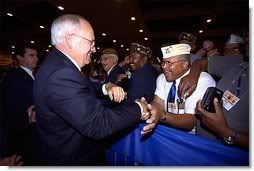
Remarks by the Vice President to the Veterans of Foreign Wars 103rd National Convention:
THE VICE PRESIDENT: Thank you very much. Thank you, Jim, and I appreciate your introduction, and your strong leadership for the VFW. And I especially appreciate your warm welcome.
I've been looking forward to this opportunity to visit the historic city of Nashville, and to being with the members of the VFW and Ladies Auxiliary. I see many good friends here in the audience this morning. I know I have attended your convention in the past. It's a special privilege to stand before you today, for the first time, as Vice President of the United States. (Applause.) And it is my great honor to serve with a commander in chief every soldier and every veteran can be proud of - President George W. Bush. (Applause.)
I'm grateful to Jim Goldsmith and Diana Stout for their hard work on behalf of the nation's veterans and military personnel. I also want to thank Bob Wallace, your fine executive director who runs the Washington office. And permit me to be among the first to wish great success to Ray Sisk of California, who will exceed Jim -- succeed Jim this Friday as the VFW Commander-in-Chief, and Betty Morris of Maryland, the incoming national president of the Ladies Auxiliary. I know Ray and Betty will both do a superb job. (Applause.)
As members of the VFW, you are united by common experiences and shared commitments. In the military, you devoted yourselves to a cause above self-interest, served with a firm sense of duty and developed personal standards that make you an example for your families and your fellow citizens. The daughter of an Army Air Corpsman described growing up with her father, and the values she learned from him without even knowing it. As she recalls, "Honesty, integrity, hard work, personal responsibility, and perseverance were all around me and I absorbed them almost imperceptibly." Our veterans have had a similar effect on the entire nation.
Those values are embodied in this organization. In the VFW our nation sees a continuing ethic of service, shown in the time, talent, and money you have given to citizens in need. Last year alone, VFW members gave more than 16 million hours to worthy causes. Your Operation Uplink has allowed service members and hospitalized veterans to make free calls home. I know they and their families are deeply grateful to all of you.
The VFW also serves the nation by leading on a range of important issues, such as health care and education, employment opportunities and homeland security, military readiness and the quality of life for our service families. The VFW stands firm for protecting our country's flag and for defending the right of every American to pledge allegiance to one nation under God. (Applause.)
Our administration is proud to have strong ties with the leadership and the membership of the VFW. We believe that in dealing with the federal government, every veteran deserves a response that is fair, respectful and prompt.
We are working every day to improve the level of service to our veterans. On taking office we found a large claims backlog, numbering in the hundreds of thousands. The backlog is falling steadily, as is the average time for processing each claim. But there's a lot more work to be done and America's veterans can now be certain that someone is doing it. The President has put a solid, results-oriented veteran in charge of the Department, Secretary Tony Principi. Under our administration you won't receive excuses, you will receive action.
To further improve health care services to veterans, President Bush has established a veterans health task force, of which Bob Wallace is an influential member. And although we are holding most discretionary spending to 2 percent increases, the President has asked Congress for an 8 percent increase for veterans' health care, and a seven percent increase for veterans' programs overall. (Applause.) The money is necessary to meet pressing needs, some of which have gone neglected in recent years.
We will continue working with VFW leaders and members on homeland security, drawing upon your experiences in military and civilian life. And we share common cause on the matter of servicemen whose fate is still undetermined. For all the uncertainties that remain, the basic issue is clear: thousands of brave Americans, last seen doing their duty, remain unaccounted for. The nation remembers these men, and this government will persist in the effort to account for every last one of them. (Applause.)
As we meet all of these commitments, our administration is moving forward on an agenda to build a safe and prosperous future for the American people. We have laid the foundation for greater prosperity and opportunity with the most significant education reforms in 35 years, with free trade legislation to open up markets to American producers, with tough new laws to ensure corporate integrity and honest accounting, with spending discipline in Washington and with the largest federal tax reduction in twenty years.
There is a full agenda for the fall, and beyond. Yet the President and I never for a moment forget our number one responsibility: to protect the American people against further attack, and to win the war that began last September 11th.
The danger to America requires action on many fronts all at once. We are reorganizing the federal government to protect the nation against further attack. The new Department of Homeland Security will gather under one roof the capability to identify threats, to check them against our vulnerabilities, and to move swiftly to protect the nation.
At the same time, we realize that wars are never won on the defensive. We must take the battle to the enemy. We will take every step necessary to make sure our country is secure, and we will prevail.
Much has happened since the attacks of 9/11. But as Secretary Rumsfeld has put it, we are still closer to the beginning of this war than we are to its end. The United States has entered a struggle of years -- a new kind of war against a new kind of enemy. The terrorists who struck America are ruthless, they are resourceful, and they hide in many countries. They came into our country to murder thousands of innocent men, women, and children. There is no doubt they wish to strike again, and that they are working to acquire the deadliest of all weapons.
Against such enemies, America and the civilized world have only one option: wherever terrorists operate, we must find them where they dwell, stop them in their planning, and one by one bring them to justice.
In Afghanistan, the Taliban regime and al Qaeda terrorists have met the fate they chose for themselves. And they saw, up-close and personal, the new methods and capabilities of America's armed services. (Applause.) May I say, as a former Secretary of Defense, that I have never been more proud of the America's military. (Applause.)
The combination of advantages already seen in this conflict -- precision power from the air, real-time intelligence, special forces, the long reach of Naval task forces, and close coordination with local forces represents a dramatic advance in our ability to engage and defeat the enemy. These advantages will only become more vital in future campaigns. President Bush has often spoken of how America can keep the peace by redefining war on our terms. That means that our armed services must have every tool to answer any threat that forms against us. It means that any enemy conspiring to harm America or our friends must face a swift, a certain and a devastating response. (Applause.)
As always in America's armed forces, the single most important asset we have is the man or woman who steps forward and puts on the uniform of this great nation. Much has been asked of our military this past year, and more will be asked in the months and the years ahead. Those who serve are entitled to expect many things from us in return. They deserve the very best weapons, the best equipment, the best support, and the best training we can possibly provide them. And under President Bush they will have them all. (Applause.)
The President has asked Congress for a one-year increase of more than $48 billion for national defense, the largest since Ronald Reagan lived in the White House. And for the good of the nation's military families, he has also asked Congress to provide every person in uniform a raise in pay. We think they've earned it. (Applause.)
In this war we've assembled a broad coalition of civilized nations that recognize the danger and are working with us on all fronts. The President has made very clear that there is no neutral ground in the fight against terror. Those who harbor terrorists share guilt for the acts they commit. Under the Bush Doctrine, a regime that harbors or supports terrorists will be regarded as hostile to the United States.
The Taliban has already learned that lesson, but Afghanistan was only the beginning of a lengthy campaign. Were we to stop now, any sense of security we might have would be false and temporary. There is a terrorist underworld out there, spread among more than 60 countries. The job we have will require every tool at our means of diplomacy, of finance, of intelligence, of law enforcement, and of military power. But we will, over time, find and defeat the enemies of the United States. In the case of Osama bin Laden -- as President Bush said recently -- "If he's alive, we'll get him. If he's not alive -- we already got him." (Applause.)
But the challenges to our country involve more than just tracking down a single person or one small group. Nine-eleven and its aftermath awakened this nation to danger, to the true ambitions of the global terror network, and to the reality that weapons of mass destruction are being sought by determined enemies who would not hesitate to use them against us.
It is a certainty that the al Qaeda network is pursuing such weapons, and has succeeded in acquiring at least a crude capability to use them. We found evidence of their efforts in the ruins of al Qaeda hideouts in Afghanistan. And we've seen in recent days additional confirmation in videos recently shown on CNN -- pictures of al Qaeda members training to commit acts of terror, and testing chemical weapons on dogs. Those terrorists who remain at large are determined to use these capabilities against the United States and our friends and allies around the world.
As we face this prospect, old doctrines of security do not apply. In the days of the Cold War, we were able to manage the threat with strategies of deterrence and containment. But it's a lot tougher to deter enemies who have no country to defend. And containment is not possible when dictators obtain weapons of mass destruction, and are prepared to share them with terrorists who intend to inflict catastrophic casualties on the United States.
The case of Saddam Hussein, a sworn enemy of our country, requires a candid appraisal of the facts. After his defeat in the Gulf War in 1991, Saddam agreed under to U.N. Security Council Resolution 687 to cease all development of weapons of mass destruction. He agreed to end his nuclear weapons program. He agreed to destroy his chemical and his biological weapons. He further agreed to admit U.N. inspection teams into his country to ensure that he was in fact complying with these terms.
In the past decade, Saddam has systematically broken each of these agreements. The Iraqi regime has in fact been very busy enhancing its capabilities in the field of chemical and biological agents. And they continue to pursue the nuclear program they began so many years ago. These are not weapons for the purpose of defending Iraq; these are offensive weapons for the purpose of inflicting death on a massive scale, developed so that Saddam can hold the threat over the head of anyone he chooses, in his own region or beyond.
On the nuclear question, many of you will recall that Saddam's nuclear ambitions suffered a severe setback in 1981 when the Israelis bombed the Osirak reactor. They suffered another major blow in Desert Storm and its aftermath.
But we now know that Saddam has resumed his efforts to acquire nuclear weapons. Among other sources, we've gotten this from the firsthand testimony of defectors -- including Saddam's own son-in-law, who was subsequently murdered at Saddam's direction. Many of us are convinced that Saddam will acquire nuclear weapons fairly soon.
Just how soon, we cannot really gauge. Intelligence is an uncertain business, even in the best of circumstances. This is especially the case when you are dealing with a totalitarian regime that has made a science out of deceiving the international community. Let me give you just one example of what I mean. Prior to the Gulf War, America's top intelligence analysts would come to my office in the Defense Department and tell me that Saddam Hussein was at least five or perhaps even 10 years away from having a nuclear weapon. After the war we learned that he had been much closer than that, perhaps within a year of acquiring such a weapon.
Saddam also devised an elaborate program to conceal his active efforts to build chemical and biological weapons. And one must keep in mind the history of U.N. inspection teams in Iraq. Even as they were conducting the most intrusive system of arms control in history, the inspectors missed a great deal. Before being barred from the country, the inspectors found and destroyed thousands of chemical weapons, and hundreds of tons of mustard gas and other nerve agents.
Yet Saddam Hussein had sought to frustrate and deceive them at every turn, and was often successful in doing so. I'll cite one instance. During the spring of 1995, the inspectors were actually on the verge of declaring that Saddam's programs to develop chemical weapons and longer-range ballistic missiles had been fully accounted for and shut down. Then Saddam's son-in-law suddenly defected and began sharing information. Within days the inspectors were led to an Iraqi chicken farm. Hidden there were boxes of documents and lots of evidence regarding Iraq's most secret weapons programs. That should serve as a reminder to all that we often learned more as the result of defections than we learned from the inspection regime itself.
To the dismay of the inspectors, they in time discovered that Saddam had kept them largely in the dark about the extent of his program to mass produce VX, one of the deadliest chemicals known to man. And far from having shut down Iraq's prohibited missile programs, the inspectors found that Saddam had continued to test such missiles, almost literally under the noses of the U.N. inspectors.
Against that background, a person would be right to question any suggestion that we should just get inspectors back into Iraq, and then our worries will be over. Saddam has perfected the game of cheat and retreat, and is very skilled in the art of denial and deception. A return of inspectors would provide no assurance whatsoever of his compliance with U.N. resolutions. On the contrary, there is a great danger that it would provide false comfort that Saddam was somehow "back in his box."
Meanwhile, he would continue to plot. Nothing in the last dozen years has stopped him -- not his agreements; not the discoveries of the inspectors; not the revelations by defectors; not criticism or ostracism by the international community; and not four days of bombings by the U.S. in 1998. What he wants is time and more time to husband his resources, to invest in his ongoing chemical and biological weapons programs, and to gain possession of nuclear arms.
Should all his ambitions be realized, the implications would be enormous for the Middle East, for the United States, and for the peace of the world. The whole range of weapons of mass destruction then would rest in the hands of a dictator who has already shown his willingness to use such weapons, and has done so, both in his war with Iran and against his own people. Armed with an arsenal of these weapons of terror, and seated atop ten percent of the world's oil reserves, Saddam Hussein could then be expected to seek domination of the entire Middle East, take control of a great portion of the world's energy supplies, directly threaten America's friends throughout the region, and subject the United States or any other nation to nuclear blackmail.
Simply stated, there is no doubt that Saddam Hussein now has weapons of mass destruction. There is no doubt he is amassing them to use against our friends, against our allies, and against us. And there is no doubt that his aggressive regional ambitions will lead him into future confrontations with his neighbors -- confrontations that will involve both the weapons he has today, and the ones he will continue to develop with his oil wealth.
Ladies and gentlemen, there is no basis in Saddam Hussein's conduct or history to discount any of the concerns that I am raising this morning. We are, after all, dealing with the same dictator who shoots at American and British pilots in the no-fly zone, on a regular basis, the same dictator who dispatched a team of assassins to murder former President Bush as he traveled abroad, the same dictator who invaded Iran and Kuwait, and has fired ballistic missiles at Iran, Saudi Arabia, and Israel, the same dictator who has been on the State Department's list of state sponsors of terrorism for the better part of two decades.
In the face of such a threat, we must proceed with care, deliberation, and consultation with our allies. I know our president very well. I've worked beside him as he directed our response to the events of 9/11. I know that he will proceed cautiously and deliberately to consider all possible options to deal with the threat that an Iraq ruled by Saddam Hussein represents. And I am confident that he will, as he has said he would, consult widely with the Congress and with our friends and allies before deciding upon a course of action. He welcomes the debate that has now been joined here at home, and he has made it clear to his national security team that he wants us to participate fully in the hearings that will be held in Congress next month on this vitally important issue.
We will profit as well from a review of our own history. There are a lot of World War II veterans in the hall today. For the United States, that war began on December 7, 1941, with the attack on Pearl Harbor and the near-total destruction of our Pacific Fleet. Only then did we recognize the magnitude of the danger to our country. Only then did the Axis powers fully declare their intentions against us. By that point, many countries had fallen. Many millions had died. And our nation was plunged into a two-front war resulting in more than a million American casualties. To this day, historians continue to analyze that war, speculating on how we might have prevented Pearl Harbor, and asking what actions might have averted the tragedies that rate among the worst in human history.
America in the year 2002 must ask careful questions, not merely about our past, but also about our future. The elected leaders of this country have a responsibility to consider all of the available options. And we are doing so. What we must not do in the face of a mortal threat is give in to wishful thinking or willful blindness. We will not simply look away, hope for the best, and leave the matter for some future administration to resolve. As President Bush has said, time is not on our side. Deliverable weapons of mass destruction in the hands of a terror network, or a murderous dictator, or the two working together, constitutes as grave a threat as can be imagined. The risks of inaction are far greater than the risk of action.
Now and in the future, the United States will work closely with the global coalition to deny terrorists and their state sponsors the materials, technology, and expertise to make and deliver weapons of mass destruction. We will develop and deploy effective missile defenses to protect America and our allies from sudden attack. And the entire world must know that we will take whatever action is necessary to defend our freedom and our security.
As former Secretary of State Kissinger recently stated: "The imminence of proliferation of weapons of mass destruction, the huge dangers it involves, the rejection of a viable inspection system, and the demonstrated hostility of Saddam Hussein combine to produce an imperative for preemptive action." If the United States could have preempted 9/11, we would have, no question. Should we be able to prevent another, much more devastating attack, we will, no question. This nation will not live at the mercy of terrorists or terror regimes. (Applause.)
I am familiar with the arguments against taking action in the case of Saddam Hussein. Some concede that Saddam is evil, power-hungry, and a menace -- but that, until he crosses the threshold of actually possessing nuclear weapons, we should rule out any preemptive action. That logic seems to me to be deeply flawed. The argument comes down to this: yes, Saddam is as dangerous as we say he is, we just need to let him get stronger before we do anything about it.
Yet if we did wait until that moment, Saddam would simply be emboldened, and it would become even harder for us to gather friends and allies to oppose him. As one of those who worked to assemble the Gulf War coalition, I can tell you that our job then would have been infinitely more difficult in the face of a nuclear-armed Saddam Hussein. And many of those who now argue that we should act only if he gets a nuclear weapon, would then turn around and say that we cannot act because he has a nuclear weapon. At bottom, that argument counsels a course of inaction that itself could have devastating consequences for many countries, including our own.
Another argument holds that opposing Saddam Hussein would cause even greater troubles in that part of the world, and interfere with the larger war against terror. I believe the opposite is true. Regime change in Iraq would bring about a number of benefits to the region. When the gravest of threats are eliminated, the freedom-loving peoples of the region will have a chance to promote the values that can bring lasting peace. As for the reaction of the Arab "street," the Middle East expert Professor Fouad Ajami predicts that after liberation, the streets in Basra and Baghdad are "sure to erupt in joy in the same way the throngs in Kabul greeted the Americans." Extremists in the region would have to rethink their strategy of Jihad. Moderates throughout the region would take heart. And our ability to advance the Israeli-Palestinian peace process would be enhanced, just as it was following the liberation of Kuwait in 1991.
The reality is that these times bring not only dangers but also opportunities. In the Middle East, where so many have known only poverty and oppression, terror and tyranny, we look to the day when people can live in freedom and dignity and the young can grow up free of the conditions that breed despair, hatred, and violence.
In other times the world saw how the United States defeated fierce enemies, then helped rebuild their countries, forming strong bonds between our peoples and our governments. Today in Afghanistan, the world is seeing that America acts not to conquer but to liberate, and remains in friendship to help the people build a future of stability, self-determination, and peace.
We would act in that same spirit after a regime change in Iraq. With our help, a liberated Iraq can be a great nation once again. Iraq is rich in natural resources and human talent, and has unlimited potential for a peaceful, prosperous future. Our goal would be an Iraq that has territorial integrity, a government that is democratic and pluralistic, a nation where the human rights of every ethnic and religious group are recognized and protected. In that troubled land all who seek justice, and dignity, and the chance to live their own lives, can know they have a friend and ally in the United States of America.
Great decisions and challenges lie ahead of us. Yet we can and we will build a safer and better world beyond the war on terror. Over the past year, millions here and abroad have been inspired once again by the bravery and the selflessness of the American armed forces. For my part, I have been reminded on a daily basis, as I was during my years at the Pentagon, of what a privilege it is to work with the people of our military. In whatever branch, at whatever rank, these are men and women who live by a code, who give America the best years of their lives, and who show the world the finest qualities of our country.
As veterans, each of you has a place in the long, unbroken line of Americans who came to the defense of freedom. Having served in foreign wars, you bore that duty in some of our nation's most difficult hours. And I know that when you come together, your thoughts inevitably turn to those who never lived to be called veterans. In a book about his Army years, Andy Rooney tells the story of his childhood friend Obie Slingerland -- a decent, good-hearted, promising boy who was captain of the high school football team. Obie later went on to be the quarterback at Amherst before entering the Navy and becoming a pilot. Still a young man in his early 20s, he was killed while flying a combat mission off the carrier Saratoga. Andy Rooney writes: "I have awakened in the middle of the night a thousand times and thought about the life I had that Obie never got to have."
Many of you have known that experience. The entire nation joins you in honoring the memory of your friends, and all who have died for our freedom. And the American people will always respect each one of you for your standing ready to make that same sacrifice. On the nation's behalf, and for myself and President Bush, I thank you for the service you gave to your fellow citizens, for the loyalty you have shown to each other and for the great honor you have brought to your uniform, to our flag, and to our country.
Monday, August 26, 2002
| [+/-] |
Vice President Cheney Speaks at VFW 103rd National Convention |
Thursday, August 15, 2002
| [+/-] |
"Don't Attack Saddam . . . . |
. . . . It would undermine our antiterror efforts," says Brent Scowcroft, national security adviser under President Gerald Ford and George H.W. Bush, and is founder and president of the Forum for International Policy
From the WSJ opinion page:
Our nation is presently engaged in a debate about whether to launch a war against Iraq. Leaks of various strategies for an attack on Iraq appear with regularity. The Bush administration vows regime change, but states that no decision has been made whether, much less when, to launch an invasion.
It is beyond dispute that Saddam Hussein is a menace. He terrorizes and brutalizes his own people. He has launched war on two of his neighbors. He devotes enormous effort to rebuilding his military forces and equipping them with weapons of mass destruction. We will all be better off when he is gone.
That said, we need to think through this issue very carefully. We need to analyze the relationship between Iraq and our other pressing priorities--notably the war on terrorism--as well as the best strategy and tactics available were we to move to change the regime in Baghdad.
Saddam's strategic objective appears to be to dominate the Persian Gulf, to control oil from the region, or both.
That clearly poses a real threat to key U.S. interests. But there is scant evidence to tie Saddam to terrorist organizations, and even less to the Sept. 11 attacks. Indeed Saddam's goals have little in common with the terrorists who threaten us, and there is little incentive for him to make common cause with them.
He is unlikely to risk his investment in weapons of mass destruction, much less his country, by handing such weapons to terrorists who would use them for their own purposes and leave Baghdad as the return address. Threatening to use these weapons for blackmail--much less their actual use--would open him and his entire regime to a devastating response by the U.S. While Saddam is thoroughly evil, he is above all a power-hungry survivor.
Saddam is a familiar dictatorial aggressor, with traditional goals for his aggression. There is little evidence to indicate that the United States itself is an object of his aggression. Rather, Saddam's problem with the U.S. appears to be that we stand in the way of his ambitions. He seeks weapons of mass destruction not to arm terrorists, but to deter us from intervening to block his aggressive designs.
Given Saddam's aggressive regional ambitions, as well as his ruthlessness and unpredictability, it may at some point be wise to remove him from power. Whether and when that point should come ought to depend on overall U.S. national security priorities. Our pre-eminent security priority--underscored repeatedly by the president--is the war on terrorism. An attack on Iraq at this time would seriously jeopardize, if not destroy, the global counterterrorist campaign we have undertaken.
The United States could certainly defeat the Iraqi military and destroy Saddam's regime. But it would not be a cakewalk. On the contrary, it undoubtedly would be very expensive--with serious consequences for the U.S. and global economy--and could as well be bloody. In fact, Saddam would be likely to conclude he had nothing left to lose, leading him to unleash whatever weapons of mass destruction he possesses.
Israel would have to expect to be the first casualty, as in 1991 when Saddam sought to bring Israel into the Gulf conflict. This time, using weapons of mass destruction, he might succeed, provoking Israel to respond, perhaps with nuclear weapons, unleashing an Armageddon in the Middle East. Finally, if we are to achieve our strategic objectives in Iraq, a military campaign very likely would have to be followed by a large-scale, long-term military occupation.
But the central point is that any campaign against Iraq, whatever the strategy, cost and risks, is certain to divert us for some indefinite period from our war on terrorism. Worse, there is a virtual consensus in the world against an attack on Iraq at this time. So long as that sentiment persists, it would require the U.S. to pursue a virtual go-it-alone strategy against Iraq, making any military operations correspondingly more difficult and expensive. The most serious cost, however, would be to the war on terrorism. Ignoring that clear sentiment would result in a serious degradation in international cooperation with us against terrorism. And make no mistake, we simply cannot win that war without enthusiastic international cooperation, especially on intelligence.
Possibly the most dire consequences would be the effect in the region. The shared view in the region is that Iraq is principally an obsession of the U.S. The obsession of the region, however, is the Israeli-Palestinian conflict. If we were seen to be turning our backs on that bitter conflict--which the region, rightly or wrongly, perceives to be clearly within our power to resolve--in order to go after Iraq, there would be an explosion of outrage against us. We would be seen as ignoring a key interest of the Muslim world in order to satisfy what is seen to be a narrow American interest.
Even without Israeli involvement, the results could well destabilize Arab regimes in the region, ironically facilitating one of Saddam's strategic objectives. At a minimum, it would stifle any cooperation on terrorism, and could even swell the ranks of the terrorists. Conversely, the more progress we make in the war on terrorism, and the more we are seen to be committed to resolving the Israel-Palestinian issue, the greater will be the international support for going after Saddam.
If we are truly serious about the war on terrorism, it must remain our top priority. However, should Saddam Hussein be found to be clearly implicated in the events of Sept. 11, that could make him a key counterterrorist target, rather than a competing priority, and significantly shift world opinion toward support for regime change.
In any event, we should be pressing the United Nations Security Council to insist on an effective no-notice inspection regime for Iraq--any time, anywhere, no permission required. On this point, senior administration officials have opined that Saddam Hussein would never agree to such an inspection regime. But if he did, inspections would serve to keep him off balance and under close observation, even if all his weapons of mass destruction capabilities were not uncovered. And if he refused, his rejection could provide the persuasive casus belli which many claim we do not now have. Compelling evidence that Saddam had acquired nuclear-weapons capability could have a similar effect.
In sum, if we will act in full awareness of the intimate interrelationship of the key issues in the region, keeping counterterrorism as our foremost priority, there is much potential for success across the entire range of our security interests--including Iraq. If we reject a comprehensive perspective, however, we put at risk our campaign against terrorism as well as stability and security in a vital region of the world.
Mr. Scowcroft, national security adviser under President Gerald Ford and George H.W. Bush, is founder and president of the Forum for International Policy.
Sunday, July 21, 2002
| [+/-] |
Cheney's Halliburton Won $3.8 Billion In Contracts From Government |
The Guardian reports:
The oil services company once headed by United States Vice-President Dick Cheney reaped massive rewards in government contracts and bank loans after he took its helm, including one deal with a Russian firm under investigation for mafia connections.
This was disclosed as President George Bush renewed his efforts to stabilise stock markets and distance himself from the wave of accounting scandals afflicting corporate America. Yesterday, Bush urged Congress to punish corporate abuses.
From 1995 to 2000 Cheney was chief executive and chairman of Halliburton, the Dallas-based company that provides products and services to the oil and energy industries, employing 100,000 people worldwide.
Its share value has fallen by two-thirds because of lawsuits over asbestos poisoning and an investigation of accounting changes introduced under Cheney.
Most of Halliburton's government contracts were won by its construction subsidiary, Kellogg, Brown and Root - a company with British origins that was sold to the US parent in the 1970s.
Documents uncovered by a Washington researcher, Knut Royce - formerly with the Centre for Public Integrity - and by The Observer show that government banks loaned or insured loans worth $1.5 billion during the five years that Cheney was chief executive, compared with only $100 million during the previous five years.
The company under Cheney benefited from $3.8bn in government contracts or insured loans. Although Bill Clinton was in the White House, Capitol Hill - where the Appropriations Committee handles government contracts - was controlled by Cheney's Republican Party, to which Halliburton doubled its contributions to $1,212,000 after his arrival.
The most eye-catching contract was for the refurbishment of a Siberian oilfield, Samotlor, for the Tyumen oil company of Russia. The company was loaned $489m in credits by the US Export-Import Bank after lobbying by Halliburton; it was in return to receive $292m for the refurbishments.
The White House and State Department tried to veto the Russian deal. But after intense lobbying by Halliburton the objections were overruled on Capitol Hill. One of Halliburton's top lobbyists was David Gribben, who had been Cheney's chief of staff at the Pentagon.
The State Department's concerns were based on the fact that Tyumen was controlled by a holding conglomerate, the Alfa Group, that had been investigated in Russia for mafia connections.
Alfa strongly denies that it has ever had any criminal connection, describing the allegations as 'nonsense'.
Cheney was highly valued by Halliburton because of connections made in the Arab oil-producing states while Defence Secretary during the war against Iraq under George Bush Snr.
Halliburton denies that Cheney used his position or contacts to win government business. A spokeswoman said: 'Any innuendo that Halliburton or Dick Cheney has acted improperly is false.'
The company's fortunes have flourished during the 'war on terrorism'. It has landed contracts to build the cells for al-Qaeda detainees at Guantanamo Bay.
A Securities and Exchange Commission investigation is under way into accounting changes introduced by Halliburton in 1998, when it inflated its revenue figures by including uncollected debts.
Sunday, June 30, 2002
| [+/-] |
The Flow Of Illegal Immigrants To The U.S. |
Rich Land, Poor People: Exports vs. Food Security in Mexico
The real reason for the stream of flight northward across the border,
is that post-NAFTA the Mexican Government has leased or sold out all
the ejidos - communally owned farmlands - to American Agribusiness.
NAFTA broke the people's ability to farm. Don't blame them for trying
to survive. Global fascism has stolen their farmlands. They can't
feed themselves anymore. If you don't like Mexican immigrants then
stop buying fruits and vegetables out of season and start buying
locally. Support your local farm markets.
As Oakley Biesanz, Octavio Madigan Ruiz, Amy Sanders, and Meredith Sommers write:
Global trade is bringing U.S. and Canadian consumers a year-round supply of fresh flowers; fresh and processed fruits such as tomatoes, melons, pineapples, strawberries, and mangos; and fresh vegetables such
as artichokes, cucumbers, cabbage, cauliflower, green beans, peppers, broccoli, snow peas, and asparagus. All these are flown in daily from Mexico. In addition, there are the traditional exports that feed Mexico's northern neighbors, such as sugar, coffee, bananas and cattle. During winter and spring, more than half the fresh vegetables consumed in the United States come from Mexico.
The growth of these exports has bittersweet outcomes, depending on one's perspective. These products have proven very profitable for foreign investors, transnational food corporations, and many large-scale Mexican farmers. These exports both satisfy the appetites of North American consumers and create jobs in Mexico. On the other hand, these exports have serious economic, personal, and environmental effects, and cause grave problems for small-scale farmers, or campesinos.
Mexico's Dual Agricultural Structure
Mexico has two agricultural systems, operating parallel to each other. Producing foods as cash crops for export is the primary goal of large-scale farmers. Although only about 15% of Mexico's land is arable, or suitable for cultivation, 88% of the arable land is used for cultivation of export crops and for grazing cattle. What large-scale farmers produce is determined by what brings the highest prices in international markets. Since the 1970s, most large-scale farmers have been producing the non-traditional crops listed above. They sell to transnational corporations that process or directly transport the products to warehouses and eventually to grocers.
Among those who benefit from the large-scale agricultural system are transnational corporations such as Del Monte, Green Giant, Heinz, United Brands, Castle and Cooke, PepsiCo, Ralston Purina, Campbell's, General Foods, Beatrice Foods, Gerber, Kellogg, Kraft and Nestle.
Rarely do these corporations own land. Instead, they contract with large-scale farmers. The corporations have capital to invest in technology, seeds, fertilizers and pesticides, transport systems, and marketing.
The other agriculture system involves about 60% of Mexico's farmers who have access to the remaining 12% of arable land. This includes individual small-scale farms that produce for local markets, and farms known as ejidos. Ejidos are a system of community-owned lands which, in some cases, have been owned "in trust" by communities for centuries.
Ejido lands were protected from sale as a result of the 1910 Mexican Revolution. However, a significant amount of ejido land passed into private hands during the 1980s and 1990s due to extreme credit pressures and changes to the Mexican Constitution. These constitutional changes allow, for the first time since the Revolution, the sale of ejido land to private owners. The changes were a crucial concession by Mexico to ensure the passage of the North American Free Trade Agreement in 1993.
Ejido lands rarely have been more than subsistence farms, where corn and beans are grown for the consumption of campesinos and their families. They have, however, provided a way for poor families to at least provide basic grains for themselves. With the ongoing loss of ejidos to private producers and the general inability of campesinos to gain access to other arable land, there is a growing problem of malnutrition in Mexico. The World Bank estimates that half of all rural Mexican children are malnourished.
Furthermore, small-scale farmers have considerable difficulties competing with large-scale farms because they lack access to money for seeds, water, transportation and information required for success in agribusiness. They tend to be unfamiliar with non-traditional crops and production technology. Gaining entry into the export market is very difficult for small farmers, if that is what they choose to do.
Tuesday, June 18, 2002
| [+/-] |
Profile: Robert Mueller |
Too Much A Company Man?
Salon.com reports:
As FBI director Robert Mueller takes on the daunting task of reforming his agency, some of the criticisms he's faced from FBI whistleblower Coleen Rowley and congressional inquisitors echo charges that arose more than 10 years ago during Mueller's handling of the investigation into the Bank of Credit and Commerce International.
At the time, the criticism of Mueller focused on his willingness to defend the Justice Department and its employees, and his refusal to admit error in an investigation that, critics alleged, went awry.
As assistant attorney general in charge of the Justice Department's criminal division in the early 1990s, Mueller oversaw the department's investigation into BCCI, which was eventually found to be involved in a host of criminal activities, including international money laundering, the support of global terrorism, and the selling of nuclear technology, according to a 1992 congressional report on the bank.
Mueller came to the Justice Department after U.S. attorneys in Tampa, Fla., had brought an indictment against BCCI in 1988 for laundering drug money. Congressional critics, including Sen. John Kerry, D-Mass., argued Tampa investigators "failed to recognize the importance of information they received concerning BCCI's other crimes, including its apparent secret ownership of First American," then the largest bank in the Washington area. Kerry and his investigators said the Justice Department failed to connect the dots and allowed BCCI to continue its illegal operations in the United States and abroad.
A 1992 report by a Senate Foreign Relations subcommittee, chaired by Kerry and Sen. Hank Brown, R-Colo., stated that "the decision to stop investigating BCCI appears to be an example of poor communication, overwork, under-staffing, inadequate understanding of the meaning of information in the possession of Justice, and a flawed prosecutorial and investigative strategy" -- a summary that sounds as though it could come from a congressional report about the FBI and Sept. 11.
"Mueller back then was faced with a very similar situation," says Jim Winer, a Washington lawyer who served as a congressional investigator into the BCCI probe. "The prosecutors in Tampa had made a very narrow case against BCCI, when BCCI was a much more substantial, international problem. They indicted local money-laundering accounts without looking at the fact that the bank actually had $4 billion missing and was engaged in massive fraud all over the world, including its secret and illegal ownership of what was then the largest bank in Washington, D.C., First American Bank.
"There was a failure of coordination between FBI and CIA that was very substantial, and allowed a criminal enterprise to take over the largest bank in the Washington metro area," he says. "And what Bob Mueller perceived his job to be was to defend the department for institutional reasons."
Kerry, who has known Mueller since their New Hampshire prep school days, now downplays his confrontation with him over the BCCI probe 10 years ago, noting that he supported Mueller's nomination last summer to be FBI director. "I don't think you would call it a dust-up, and I don't think anyone characterized it as such at the time," Kerry says. "It was a difference of opinion over prosecutorial judgment about a particular case. It's just one of those things that happen around here."
But Kerry was severely critical of the department's handling of the BCCI investigation, and a report by his committee castigated the Justice Department for "failing to provide adequate support and assistance to investigators and prosecutors working on the case against BCCI in 1988 and 1989," a year before Mueller took his position at the department.
Back then, testifying before the Senate about charges that his new subordinates had botched the job, Mueller staunchly defended his people.
"The allegation that prosecutors have deliberately failed to do their duty is absolutely and categorically false," said Mueller, under questioning by Kerry at a contentious hearing in November 1991. "The department has been criticized for reported delays in bringing indictments against BCCI and its officers. And I must say that the claim is simply untrue."
Defending the institution was also Mueller's first instinct when the FBI came under criticism last month. After a pair of memos -- one from before Sept. 11 from Arizona FBI agent Kenneth Williams, and another written last month by Minnesota agent Coleen Rowley -- raised doubts about the FBI's performance both before and after Sept. 11, Mueller went on the defensive.
"The agent in Minneapolis did a terrific job in pushing as hard as he could to do everything we possibly could with Moussaoui," Mueller said at a May 8 hearing of the Judiciary Committee. "But did we discern from that that there was a plot that would have led us to Sept. 11? No. Could we have? I rather doubt it."
That led Rowley to charge "that a delicate and subtle shading/skewing of the facts by [Mueller] and others at the highest levels of FBI management has occurred." She also claimed that certain facts "have, up to now, been omitted, downplayed, glossed over and/or mischaracterized in an effort to avoid or minimize personal and/or institutional embarrassment on the part of the FBI and/or perhaps even for improper political reasons."
Mueller initially marked Rowley's letter confidential, but copies were sent to senators, and an edited version was obtained by Time magazine. Only after the memo was made public did Mueller concede, "I cannot say for sure that there wasn't a possibility we could have come across some lead that would have led us to the hijackers."
He made a similarly steadfast defense when Sen. John Edwards, D-N.C., a member of the Senate Judiciary committee, complained that his staff was not told of Williams' memo -- which urged the counterterrorism unit to probe flight schools for possible al-Qaida terrorists -- or concerns from the Minnesota office about the FBI's handling of the Zacarias Moussaoui case when the staff was briefed in January by FBI counterterrorism chief David Frasca and Spike Bowman, the FBI's associate general counsel for national security affairs.
Winer says it is not surprising that Mueller, a former Marine who earned a bronze star in Vietnam, offered a steadfast defense of Bowman and Frasca. "The first thing, he was going to defend his people against what he perceived to be political attacks," Winer says. "It so happened that the political attacks were utterly accurate and fair, but he was still going to defend his people as an institutional matter, because Marines defend their people."
Mueller has repeatedly assured members of Congress that the FBI is conducting a thorough review of its shortcomings leading up to the Sept. 11 attacks. Of course, the overhaul of the FBI is a much larger task than the one Mueller faced as assistant attorney general a decade ago. But as he was in the BCCI case of more than 10 years ago, Mueller is being called on by Congress to clean up a mess made on somebody else's watch, and so far, as it was then, Mueller's instinct seems to be to defend his institution before all else.
Tuesday, April 30, 2002
| [+/-] |
Modern Meat |
Have the dramatic changes in the U.S. meat industry compromised the safety of America's beef? ...[Cows] can take this grass which we can't digest, very few creatures can digest, and turn it into [fuel]. What is so amazing about that? Pollan, a former editor at Harper's Magazine, is the author of The Botany of Desire and several other books that examine the intersections between science and culture. Here, he talks about his experience as a small-scale rancher and his decision to buy a cow and track its journey through the cattle system for The New York Times Magazine. He also discusses the widespread use of antibiotics in the meat industry, and why he thinks the system is fragile and susceptible to microbes and pathogens. What do you mean? You could not crowd animals into these feedlots or feed them this highly concentrated ration without giving them antibiotics. But the antibiotics, in turn, lead to resistance; resistant microbes that then come and infect us. So most people think of a cow as something that's out grazing, and then is taken to the slaughterhouse.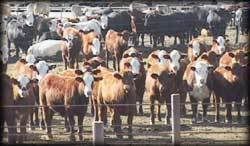
Frontline interviews Michael Pollan:
Well, a cow out on grass is just an incredible thing to behold. ... Cows and other ruminants can do things we just can't do. They have the most highly evolved digestive organ on the planet, called the rumen. And the rumen can digest grass. It takes grass, cellulose in grass, and turns it into protein, very nutritious protein.
We can't do that. We can't digest grass. So to take land that is not good enough for agriculture -- that's growing grass and nothing else, that's been doing that for 10,000 years since the buffalo -- and put a cow on it ... there's something beautiful about that, and it's just the way it was meant to be.
And I went into this story [for the New York Times] thinking, "Well, that's how we get meat." But alas, it's not true.
By the time a modern American beef cow is six months old, it has seen its last blade of grass for the rest of its life. As soon as they wean, they spend the first six months out on the pasture with their moms, nursing, nibbling grass. The mom is converting the grass's protein that's turning into milk for the animal, doing the way they've done it for millions of years. We take them off grass. We put them in pens, called backgrounding pens, and we teach them how to eat something that they are not evolved to eat, which is grain, and mostly corn.
Why do we do this? Well, it's a very good question, because it makes absolutely no sense from an ecological standpoint. From a financial standpoint, it does. It makes them grow much more quickly. It makes them get fat, and we like our meat really fat and marbled. And it allows us to speed up the lifespan. In capitalism, time is money.
We're taking cows that we used to let grow to be four or five years old before we eat them [and] we've got it down to 14 months, and we're heading toward 11 months. What allows us to do this is getting them [on] corn, getting them off this whole evolutionary relationship they've had with grass....
...No, not true. Cows see very little grass nowadays in their lives. They get them on corn as fast as they can, which speeds up their lifespan, gets them really fat, and allows you to slaughter them within 14 months.
The problem with this system, or one of the problems with this system, is that cows are not evolved to digest corn. It creates all sorts of problems for them. The rumen is designed for grass. And corn is just too rich, too starchy. So as soon as you introduce corn, the animal is liable to get sick.
It creates a whole [host] of changes to the animal. So you have to essentially teach them how to eat corn. You teach their bodies to adjust. And this is done in something called the backgrounding pen at the ranch, which is kind of the prep school for the feedlot. Here's where you teach them how to eat corn.
You start giving them antibiotics, because as soon as you give them corn, you've disturbed their digestion, and they're apt to get sick, so you then have to give them drugs. That's how you get in this whole cycle of drugs and meat. By feeding them what they're not equipped to eat well, we then go down this path of technological fixes, and the first is the antibiotics. Once they start eating the [corn], they're more vulnerable. They're stressed, so they're more vulnerable to all the different diseases cows get. But specifically they get bloat, which is just a horrible thing to happen. They stop ruminating.
You have the image of a cow on grass of the cow ruminating, which is chewing its cud and burping a lot. In fact, a lot of greenhouse gases come out of the stock as methane emerges from their mouth as they eructate -- it's a technical term. And they bring down saliva in this process, and it keeps their stomach very base rather than acid.
So you put in the corn, and this layer of slime forms over the rumen. You've got to picture the rumen. It's a 45-gallon fermentation tank. It's essentially fermenting the grass. Suddenly your slime forms and the gas can't escape, and the rumen just expands like a balloon. It's pressing against the lungs and the heart, and if nothing is done, the animal suffocates.
So what is done is, if you catch it in time, you stick a hose down the esophagus and you release the gas and maybe give the animal some hay or grass, and it's a lot healthier. But it's one of the things that happens to cows on corn. ...
Not all cows get bloat. They're prone to bloat. It's a serious problem on feedlots. They also get acidosis, which is an acidifying of the rumen. ... And when the animals get acid stomach, it's a really bad case of heartburn, and they go off their feed. Eventually, if you give them too much corn too quickly, it ulcerates the rumen; bacteria escape from the rumen into the blood stream, and end up in the liver, creating liver abscesses.
What do we do about that? Another antibiotic. ... Most cows on feedlots eating this rich diet of corn are prone to having their livers damaged. So to prevent that, or limit the incidence of liver disease, we have to give them another antibiotic.
We spoke with a guy, Bill Haw, who runs a lot of these big feedlots. I asked him about the livers. And he said, "We've learned that the livers are not very economically viable, and there's a willingness to sacrifice the liver for the overall growth, which far transcends the value of the liver that may be damaged in the process." What's he saying?
He's saying that the economic calculus justifies ruining their liver. ... The fact is, we don't eat a lot of beef liver any more. So the fact that you have to throw out a significant percentage of the liver -- I've heard between 15 percent to 30 percent of the livers are too abscessed for people to eat -- it's worth it. ...
But that's a symptom. ... It means you have a sick cow. When your liver fails, other things fail. It's simply a symptom of a sick animal. So we try to treat [it] as best we can, but we tolerate it.
I've talked to many people who've said that if you kept animals on this diet indefinitely, they couldn't survive. They're eating a diet on feedlots at 80 percent to 90 percent corn that would sooner or later, as one vet told me, blow out their liver. They could not continue that. And in fact, dairy cows, which we want to live up to 8-10 years, we don't feed them like this, because we know that it hurts their health. So yes, economically, we tolerate sick cows. ...
But the issue is, you have an economic logic, and you have an evolutionary and natural logic. And when you get to the cow, you see them come into conflict. It may well make sense economically to feed cows what we feed them, but ecologically, it's a disaster. It's a disaster for them because they're getting sick. If you look at a cow on a feedlot, it is not a happy camper. ...
Instead, we take the Midwest and we pave it essentially [with] corn and soybeans, and the environmental consequences of growing all that corn -- and most of the corn grown in this country goes to feed livestock -- is environmental degradation of the Midwest and the Gulf. There's a dead zone in the Gulf of Mexico a thousand miles wide that is the result of nitrogen runoff coming down the Mississippi and killing all the life in this zone in the Gulf. And that's coming directly from corn.
So you see the cow is connected to that dead zone in the Gulf, and the cow is connected to our health, too. All these things are connected. There is an ecological logic that is very different than the economic logic. And in that ecological logic, you can't separate the health of the cow, the health of the environment, and the health of the eater.
[Why] do we feed them corn in the first place? When did that start happening, and what was the reason for it?
We feed them corn because it's the cheapest, most convenient thing we can give them. Corn is incredibly cheap; it costs about $2.25 for a bushel of corn, which is like 50 pounds. It actually costs less to buy than it costs to grow, because of subsidy. We pay the farmer to grow the corn -- see, this is a hidden cost to this supposedly cheap feed. I think it costs about $3 to grow a bushel of corn, and the feedlots only have to pay $2.25.
It's also very compact, so corn allows you to urbanize your livestock population in America. Since the corn takes up so little space relative to its food value, you can bring all the animals into a small space, and have 50,000 or 100,000. You could never bring in that much hay -- the sheer volume of the hay would just overwhelm the shipping cost and everything. So it's very compact.
How long have we been doing it? To some extent, for a long time. In the 19th century, we would grow animals on grass up to a few months before slaughter, and then we'd give them some corn mixed in. We like meat to get fatter, and corn definitely does make the meat fatter, and it makes it more tender and tasty, in a lot of people's judgment. I'm not so sure it's true, but we've learned to think that that's how beef should taste.
But it's only post-World War II that we began putting them on feedlots in this concentrated way and giving them a diet that's quite as hot, as ranchers call it, a hot ration. And the reason for that is that's when you had the explosion of corn surpluses. That's when you've got corn that people are giving away.
The yield of an acre of American farmland went from 20 bushels ... of corn in 1900 to 138 in the 1990s. So because of the improvements in technology in American agriculture -- but specifically because of chemical agriculture, because of chemical fertilizer -- we were able to get so much corn off the land that they didn't know how to get rid of it. So the USDA made it its policy to encourage people to feed corn, not just to cows, but to chicken and even fish and now in pigs. We had to get rid of corn.
Sounds like a good idea. We had this surplus.
Yes, and economically, it is a good idea. But economics is not the measure of all things. And so we're passing half of the corn crop in America through the guts of animals, some of which are well adapted to using it. I don't know that much about chickens and pigs, but they don't seem to have the same digestive problems that cows do. Cows are ruminants; they're designed for another kind of food.
Nevertheless, [corn] has so much food energy that it does put fat on them quickly. And so it makes sense to do.
...Explain to somebody in New York City what the abbreviated life of a cow is these days.
A cow is born in the late winter on a ranch; could be the product of artificial insemination or traditional sexual reproduction. It spends the first six months of its life with its mother on pasture and grass. The American food chain, when it comes to beef, starts out like the wide end of the funnel. It's as big as the Great Plains. There are hundreds of thousands of ranchers with millions of acres. And so it starts right out in the open, grazing, ruminating, doing what cows and ruminants have always done.
At weaning, which is normally in the fall of the first year after about six months, seven months, eight months, cows are taken off the grass, moved into the backgrounding pen. They're sorted and separated from their mother. Actually [it's one of] the more traumatic [events] in a cow's life, because the mothers just bellow and look around for their calves for several days.
You separate them. You get the cows as far away as you can, so they can't hear one another. And you start them on this ration of corn. You start out, though, pretty modest, with some silage, which is whole cornstalks and everything, and some corn or other grain, and still some hay. And you start with the drugs because to get them to tolerate that diet, they must have a drug called [Rumensin], which is a kind of antibiotic, a very powerful drug. It's toxic, and therefore it's not used in human medicine. In fact, you can't even give it to dairy cows -- it's very toxic.
They spend a few months in the backgrounding pen and then they are up to, say, 600-700 pounds. I should say they start at about 80 pounds; they grow very quickly. And once they go to the backgrounding pen, they grow even more quickly. You can actually say how fast you want your animal to grow. You can say, "I want to put two pounds a day on them." You feed that into a computer. You feed in the weather, the humidity, and it will tell you exactly what to feed it to put on two pounds a day.
They're getting up to 600-700 pounds, and then the cow gets on a truck and goes to the feedlots. When it gets to the feedlot, its life changes in a substantial way. It will never see any grass ever again. ... A feedlot is a city of cows. I saw several of them in western Kansas, and it was a stunning experience. You're driving down these ramrod straight roads through Kansas, and it's just empty, empty prairie. And suddenly there was this giant subdivision, only it's a city for animals. It's cattle pens, black earth, as far as you can see. Of course it's not really earth, you learn as you get a little closer; it's manure, reaching to the horizon.
[There are] 35,000, 50,000, 100,000 animals in the space of a couple of hundred acres. And in the middle of the city is rising the single landmark, which is the feedmill. It's several stories high. It's silvery. It's sort of this cathedral in the midst of this, and everything rotates around it. ...
But they really are medieval cities in many respects, I realized, because they are cities in the days before modern sanitation. They're from the time when cities really were stinky. When they were teeming and filthy and pestilential and liable to be ridden with plague, because you had people coming from many, many different places, bringing many, many different microbes into a concentrated area where they could spread them around.
The only reason this doesn't happen in the city of animals, the modern city of animals, is of course the modern antibiotics. That is the only thing that keeps the modern feedlots from being different than the 14th-century city where everybody was dying of plague. We can, to some extent, control the disease with drugs. Absent the drugs, these places would be as plague-ridden and pestilential as a 14th-century city....
Every hour I was on this feedlot, another tanker truck came in filled with liquefied fat. Another one with liquefied protein. Every hour there was another truck with 50,000 pounds of corn. You see all the feedstuff coming into the city, and you see the waste going out. The wastes, by and large, are manure, trucks coming in from farms carrying it away. But a lot of this was pooled in these lagoons, which were just full of this.
I haven't even mentioned the smell. I mean, it is overwhelming, the smell of these places. ... You get used to it, after a couple of hours, but initially, it is [overwhelming]. And it's not the smell of a cow on a farm. This is the smell of the bus station men's room. It's fierce. And you wear it in your clothing for days afterward.
It sounds rather disgusting the way you describe it. What's the purpose, what's the advantage of the system?
It's a wonderfully efficient system; it's a factory for producing protein. What it does is, it takes in corn and fat and vitamins and drugs, passes through that mill, which in a way is the hub of this factory, and then passes it through the bovine digestive system. And these animals put on three-and-a-half to four pounds a day, half of which is edible meat.
So it is an excellent factory for producing meat. And the factory farm metaphor makes perfect sense. You've got cheap inputs, more expensive outputs, although, the margins are very tight. It costs about $1.60 a day right now to keep an animal on a feedlot, which seems pretty cheap for 32 pounds of food, all you can eat. But nevertheless, the price of meat isn't very high, either. So they operate on very tight margins.
We spoke with Bill Haw, and he said that if you could interview a cow, a cow would probably choose to be in the feedlot, because it gets all the food it wants, and it's treated if it has medical conditions.
It's treated if it has medical conditions it would not have anywhere else, that's true. You know, that's an interesting thought experiment. I would love to see one of these guys open the gate and have some green grass out beyond the feed yard, and see how many cows stick around.
My guess is, I don't know. I don't know cow psychology very well. I asked the ranchers the same question about the backgrounding pen, and their sense was that they would leave. There's a reason that you lock the gate. And they might come back to eat some food, because they're lazy. But if you compare an image of a cow on grass, and a cow on a feedlot, you don't have to be the Freud of the bovine world to say, "Well, this one is happier than that one." I think we can say that.
It's very hard to speculate about what animal happiness is. But one definition is, an animal doing what it's evolved to do. And what cows have evolved to do is be out on grass, eating grass. And they sure look happy when they're doing it.
Tell me from a personal experience the difference between what a cow looks like that you've seen grazing and a cow in a feedlot....
...The cows I saw on the feedlot looked sullen. I'm very concerned not to anthropomorphize them, but that was how they appeared to me. They're standing around in their manure all day long. Animals have evolved basically to avoid their feces. Natural selection discourages this, because there are parasites in diseases. So in general, animals will stay away from that.
They're forced to exist with their feces all the time. When they go to sleep, that's what they lie down in. The beds in these feedlots, you look and you say, "Oh, there's dirt. They're in dirt." And of course no grass could grow there. But you look a little closer and it is manure, as far as you can see. They only scrape them out between classes, which is every six months.
So I can't say that that bothers a cow. I'm speculating. My guess is that, at some level, it does. But cows are very forgetful. Cows live in the present. So whether they're nostalgic for their days on grass, I would doubt that, too. ... But they love grass. When they're sick, as soon as they get on the feedlot, they give them nice long-stem hay. And they love it. And I saw them go to that.
I was on another ranch where the rancher was giving a little bit of corn to his animals in the hopper. Then we came onto the field and we had hay in the back of the truck, and we wanted to give them some hay. And he put that down in another hopper. They all left the grain and came over to the hay. They like not just the taste of hay but what it does to their stomachs. It stimulates the rumen, allows them to ruminate, to regurgitate. They love to chew their cud, and they can't chew their cud when they're on corn.
Speculating about animal happiness is dangerous turf. But common sense tells you that animals doing what they evolved to do are the happier animals.
...First of all, why did you buy a cow?
...I decided to become a small-scale rancher basically to learn about the business. I wanted to see it from the inside. So I purchased a steer, a calf, from these ranchers in South Dakota ... and followed it through the whole process. It's now on a feedlot in southwestern Kansas. And I'm using this animal, No. 534, as the hero of my story.
I'm chronicling everything he eats, and the drugs that he gets, and how much money he brings at the end. One of the things I wanted to understand -- better than I could from outside the calculation a rancher makes when he's deciding, for instance, whether to give a hormone implant to his animal, which strikes me as a bad idea -- [is] just in a general way, [if we should] be eating meat that has residues of hormones, even though no one has proved that it's bad for you. ... Why do it?
Well, if you own a cow, you understand why. It costs $1.50, and it puts 40-50 pounds on the final weight of your animal, which is worth $25-$35. So the economic calculus is just irresistible, and it's legal. That's why you do it. And if I don't do it, I will surely lose money on this animal.
So I wanted to understand things from the cow's perspective to some extent, and from the rancher's perspective. And I figured the best way to do that was to buy a cow. And at the end of the process, I'll see whether I want to eat my cow. But that's an option.
So when will your cow meet its end?
My cow has a date with the knocker, or the stunner, in June. One day in June, he will be judged sufficiently fat, because they really do get obese. And they move around at the end with that kind of the lugubrious awkwardness of the truly obese. And the owner of the feedlot, the manager, will say, "This pen is ready."
Then they will get on another truck and travel 100 miles to Liberal, Kansas, to a National Beef plant there. They will be put in a pen in a parking lot and wait their turn, and go up the ramp, and through a blue door. I was not allowed to go through the blue door. The kill floor is not something that journalists are allowed to see, even if you own the animal, I learned.
But I have reconstructed what happens on the other side of the blue door. What happens is that the animals go in single file. At a certain point, they pass over a bar, their legs on both sides, and the floor slowly drops away, and at that point they're being carried along sort of on that bar, which is a conveyor belt, and they then pass through a station where there's a man on the catwalk above. He's holding an object that looks like a power nailing gun or something. It's a pneumatic device called a stunner.
This essentially injects a metal bolt. It's about the size and length of a thick pencil into its brain, right between the eyes, and that should render the animal brain dead.
At that point, chains will be attached to his rear legs. He will be lifted up by the chains. The chains are attached to an overhead trolley, and then he will be bled. Another person in another station will stick a long knife in and cut his aorta and bleed the animal. And then he will be completely dead.
And from there he goes through a series of stations to clean him and to remove his hide. One of the real problems is that the animals have spent their [lives] lying in their manure, are smeared and caked with the stuff, and they're entering the food plant. And so many steps are taken to make sure that the manure doesn't infect the meat, which can happen very easily.
And this is really just the source of food-safety problems in the industry, in the beef industry, is microbes in the manure getting into the meat. So how do you stop that?
...Be explicit about what it means that they have manure caked on them, and why that becomes a problem.
Well, when the animals arrive at the meatpacking plant from their homes on the feedlot, they're carrying quite a bit of manure. They've been sleeping in it and resting in it, so their bodies are caked with it. They are then, of course, passing through that door on their way to becoming food. So you need to make sure that you remove their hides in such a way that you get all of the manure, and none of it ends up on the meat. And a great deal of the effort, which is now 99.9 percent of the time successful, is essentially keeping the manure out of the meat. But it doesn't; it's not a perfect system. And it's bound to happen, and does happen.
The problem is that that manure is particularly lethal, because it contains now certain microbes like E. coli O157, is a strain of a common intestinal bacteria which is now very common in the manure of feedlot animals. It's principally a feedlot microbe. And if we ingest only 10 of those bacteria, they can kill us, because they release this lethal toxin. The great problems that you've read about, of contaminated hamburgers and the Jack in the Box episode from several years ago, are a result of this particular pathogen.
The story of this pathogen really illustrates the ecological links between the health of these animals and the health of us. I was surprised to learn that E. coli O157 is relatively new -- it wasn't isolated until the early 1980s -- and that it essentially doesn't exist in the gut of animals that eat grass. It is a problem associated with feeding animals corn.
And here's how it works. The rumen, which is not an acidic environment normally, becomes acidic when it's fed corn. These [E. coli] bacteria evolved to be able to withstand the acid of the rumen. So they are acid-tolerant bacteria. Therefore, when they get into our guts -- through the manure, onto the carcass of the animal, into the hamburger -- they can survive our digestive processes; whereas in the past, if you had an equally lethal microbe resident in the gut of a cow, it probably was not acid-tolerant, since it didn't live in such an environment, so our stomachs gave it a gastric shock.... All the acids in our stomach would just kill it off. This is one of the protections built into the food chain that we've messed with by acidifying the guts of these animals....
The industry's response -- and the industry is working very hard to keep the meat clean, there's no question about it -- is a series of high-tech solutions, such as sprays. There's a spray based on milk, made from milk, that seems to kill it. They have these steam cabinets that they pass the meat through -- bags of hot water. This kills a lot of the bacteria, or most of the bacteria.
And now irradiating it. This is why we want to irradiate meat. Make no mistake, the need to irradiate meat is because there is a certain amount of manure in the meat. So the idea is to kill the microbes in the manure rather than keep the manure out, which they're trying to do also. But better to kill it after; it's easier and cheaper.
There is, it turns out, a much simpler solution. There is research that's been done that shows simply by putting cows on grass or hay for the last several days of their life, the E. coli population in their gut plummets by as much as 80 percent because, again, they can't tolerate the change in the pH in the stomach. A scientist, a very well-respected researcher at Cornell named James Russell, has proposed this in a series of articles.
But as far as I can tell, the industry doesn't want to hear about it. It would just be too cumbersome to bring all that hay into a feedlot. They would lose gain; they would lose pounds at the end, switching them to hay, because they don't grow as fast. ... It's King Corn. King Corn runs the American cattle business. And this is considered an anti-corn message. So this research, as far as I can see, has fallen largely on deaf ears.
And it's classic, in a way. Rather than going back and fixing the system, you figure out a way to make more money solving the problem with a new technology.
What's wrong with that? If we have a system that, because of the technology, results in cheap meat and this enormous efficiency, and if we can keep that system going by introducing more technology, why not?
Well, cheap meat is a bit of a myth. Cheap feed in general is a bit of a myth. The real costs of cheap food, when you look at it, are just being borne by someone other than the consumer. There is no free lunch in nature. And what happens is our cheap meat is a product of these drugs, for instance, antibiotics. We are using so many antibiotics in livestock -- over half of the antibiotics in this country go to livestock -- that these drugs no longer work for us. The reason I have trouble finding a good antibiotic when my son has an ear infection is directly related to the cost of that cheap hamburger. There is an expense, a public health cost.
Food poisoning too.... There's another public health cost. There's the environmental cost of all of this corn, which is polluting the Gulf of Mexico. That's a cost not reflected in that cheap hamburger. And then finally there's the cost to the animals, too, and their own health. I mean, nobody counts that. So when I hear the expression, "cheap food," "cheap meat," yes, it's true in a very narrow sense. But it depends on the way you do your math. And the way we do the math, it is cheap food.
Specifically in terms of food safety, irradiating the meat is better than not doing anything. And I'm not saying we shouldn't do these technologies. But isn't it interesting that we don't go back and just look at the whole system? It's like feedlots. If you talk to environmentalists, they're very concerned about feedlots. They become a serious environmental issue, and they treat them as this point-source pollution ... because of all of the water that comes out of them. The water and the waste is also full of pharmaceuticals. There are hormones in the water. They are finding fish with strange sexual characteristics downstream from feedlots. The antibiotics get into the environment also.
But they've kind of accepted it as, "Well, this is the cost of food. We'll just deal with the effluents." Rather than [saying], "Let's step back a little further and look at the whole system and see if we can't change the system. Maybe there's a more sustainable way to do this."
...There is another cost, too, that never gets counted. When you eat meat, you're eating oil .... This goes back to the cost of corn. The reason we can grow corn so cheaply is because we give the corn chemical fertilizer that is a fossil fuel product.... So you've taken the rumen, which is this sustainable solar organ, and we've turned it into just another fossil fuel burner. Which is the last thing we need.
And working with an economist at Cornell ... I wanted to figure out how much oil it took to grow my cow to slaughter with. It turns out it's about 100 gallons of oil to grow a single animal. So there's a cost that you're not seeing. It's the cost of the oil; it's the cost of having a military to defend the Gulf. It's all there.
The great lesson of ecology is that everything is connected. And it's true. So next time you're reaching for that cheap food, you might ask, is it really so cheap?
So cheapness is one of the arguments. But also we don't have the kind of population where everyone has a few cows and can slaughter their own.... You can do this on less space. That's another argument....
There's no question that the beef industry has done something quite incredible, which is, they've taken a feed that once belonged to the upper classes -- it was a very special occasion to eat meat; not everybody got to eat beef, and those who did, just on Sundays -- ... and made it a staple for everybody.
Is that a good thing? Well, yes and no. Beef is not very good for us. Maybe we shouldn't be eating so much beef. ... Animals raised on corn produce fattier meat, but it's not just that it's fattier, it's the kinds of fats. Corn-fed beef produces lots of saturated fats. So that the heart disease we associate with eating meat is really a problem with corn-fed meat. If you eat grass-fed beef, it has much more of the nutritional profile of the wild meat. Hunter-gatherers subsisted on lots of meat, and they never had heart disease.
So the so-called diseases of civilization that we're prone to such as heart disease are really the result of what we're feeding the animals. We always say, "You are what you eat." But that's only half the story. We're also what what we eat eats, too. And cows that eat corn are different meat. So when we're eating that corn-fed, oil-fed meat, we're incurring another kind of cost as well.
But yes, we've made the meat cheaper. We've democratized meat. But in the process, we've made it a less healthy product with much more serious consequences for the environment....
So is there a clear link between the system of agriculture and beef production and the problems we have with E. coli O157 and other virulent pathogens?
Yes and no. I would say that, yes, this system of industrial meat production, there's always been food-safety problems. There has always been sloppy slaughter practices. Probably slaughterhouses are cleaner now than they've been ever. OK? Major improvements have happened as a result of these problems like the Jack in the Box incident and others.
However, the animals are coming into the slaughterhouses with these new microbes that they're picking up in the feedlots, or they're developing because of what we feed them. So there are some novel threats as a result of this.
The fact is, the incidence of food poisoning generally has gone up. Most people don't realize this, but it's a much more serious problem than it was 100 years ago. Does that have to do with industrial agriculture? In part, it does. It has to do with a lot of things. It has to do with the fact that we take food from all over the world, and we can't really inspect it very well.
But a lot of it has to do with the way we grow our food, and the fact that we mix 100 different cows in a single burger. We never used to do that. The butcher used to take the scraps from that one animal and make his hamburger right in front of your eyes. ... Now, you get one infected carcass, and that meat can spread all around the country, because we have this centralized national system.
So there is a sense in which you rationalize things when you make them bigger and more centralized. But that's an environment in which microbes can thrive and spread. The best thing that ever happened to microbes is this centralization of agriculture. ... There were very few diseases until we had cities. When people were hunter-gatherers, they didn't spend enough time close together to communicate diseases. But when you bring everything together and you make it really build and you mix up microbes from all these different places in the feedlot and then in the hamburger, then it spans out to millions of people. Yes, that's a petri dish for food poisoning.
So the efficient system is also efficient for the microbes?
Yes, the efficient system is very efficient for the microbes. It is a fragile system. The bigger any system is, the more centralized it is. You know we've learned this about all monocultures. Take a system, centralize it to that extent, and a small problem can destroy it. It's like a computer virus can take out everybody's mail system, because we all have the same program in our computers. We have Microsoft, so it's a very vulnerable system....
Let's switch over to antibiotics.... Why are we using so much antibiotics? ... And are we using a lot of them?
Well, nobody knows exactly how many antibiotics we're using in agriculture, because the industry is very tight-lipped about it. But the Union of Concerned Scientists did a study last year, and they found it was well over half the antibiotics used do go to animals, for many reasons. Some of them are to treat animals, which no one really has a problem with. Some of them, though, are for what's called growth promotion. In many animals -- and this is particularly true in chickens and pigs for reasons we don't even understand -- if you give low levels of antibiotics to an animal, it will grow more quickly. It may be that it kills off low-level disease that was harming its productivity or something like that. No one really understands why.
But in many cases -- and this is definitely true in beef -- we give them antibiotics to keep them from getting sick from other things we're doing to them. ... So a lot of it is prophylactic, is being used to prevent them from getting sick. Then you also have the antibiotics used to keep them from having liver disease because they can't digest the corn.
And so there were many, many reasons that we were using them. Very few of them have to do with treating sick animals, although the beef case kind of confounds the usual argument. If you talk to public health advocates, they say, "It's fine to use antibiotics on sick animals; we just don't want them used for growth promotion." But exactly how do you categorize an antibiotic you've giving an animal because you've made it sick? And that's what we're doing. So that kind of falls in the middle.
Why is this a problem? We exist in the same microbial environment as these animals. So whatever you do to that ecosystem of germs, to them, is going to redound to us. ... Evolution is going on, and microbes are evolving to withstand those antibiotics. This is how evolution works. When there is a threat to the survival of any population, whatever members of that population ... are not susceptible, they then grow. Their population explodes. You select for resistance.
And that's what's happening. We're selecting for resistance in the guts of these animals, in the manure on the ground, in the water downstream of these places. And microbes are evolving that can withstand Cipro, that can withstand Tetracycline, that can withstand [other antibiotics].
This is helping in hospitals, too. I mean, this is not the only cause of antibiotic resistance. But given that most of the antibiotics are used in agriculture, the belief is that a lot of these superbugs that are showing up in hospitals that are not susceptible to any antibiotics are being created by their process. ... And so you have this phenomenon [that] we simply can't treat. We're getting antibiotic-resistant gonorrhea. We're getting antibiotic-resistant tuberculosis.
Public health advocates think perhaps this is the most serious threat to our public health over the next several years, because new antibiotics are not coming along as fast as we thought they would. ...
One of the things we hear is that the industry is reducing its amounts of antibiotics.... Is it?
That's what they say. The chicken industry claims that they have reduced their use of antibiotics, which is great, if true. It's on their own say-so.... So there is an effort to do it....
For many, many years, agribusiness claimed that there was no public health problem with their use of antibiotics. But the proof had not been found; the link between human health and using antibiotics in agriculture had not been established. Nobody makes that argument any more, except some real die-hard spokesmen for the industry. The FDA, the CDC, every public health expert in the country will tell you that there is a link between human health and the use of antibiotics in agriculture.
As a result, the industry, I think in an effort to forestall regulations which are on their way, has taken voluntary steps. The chicken industry, they say, has reduced their use substantially, several companies. If true, it's terrific. And it needs to be done. Whether they can do it without changing their practices is an interesting question. Have they changed anything else? And if they can reduce antibiotic use without having epidemics of disease on their chicken farms or such loss of productivity, then why would they do it in the first place?
So there are still a lot of questions about it. But we're definitely moving in the right direction on that issue....
[How does the current system make antibiotic resistance] a bigger problem? ...
You have the system that could not survive without antibiotics. You could not crowd animals into these feedlots or feed them this highly concentrated ration without giving them antibiotics. But the antibiotics, in turn, lead to resistance; resistant microbes that then come and infect us. So they're hidden costs.
If you follow the lines, ecology teaches you to see how things are connected. And there was a direct result between feeding the animals corn, and then antibiotics, and then us developing infections that we can't treat. ... Everything is connected. ...
So with these new threats, with the globalization of the microbial threat, with these superbugs that we're creating, what are we to do?
I think it's possible to build a more sustainable food system. I think if we really tried to calculate the costs in a saner way, and realized that this was the actual cost, that there's a cost in oil, there's a cost in public health, we would redesign the food system.
Antibiotics is a great example. Let's say we banned the non-clinical use, the non-therapeutic use of antibiotics in livestock. A lot of other things would change too. You couldn't go on with the level of crowding.... So the whole system would slow down a little bit, be a little less concentrated. And it can be done. The Europeans have done it. They're not using these drugs on animals, and they're still producing food at reasonable prices. Yes, the price would go up. The price would go up 5 percent to 10 percent for beef. It seems to me that is not just a fair price, but a more accurate price of what's really involved. So the system can be made more sustainable.
Ideally, I'd like to see us go back to a system where we relied more on grass. Imagine if [some of] the Midwestern farm belt, all those millions of acres of corn and soybean ... were turned back to pasture on which animals grazed. That system worked pretty well. It makes very healthy, very healthy meat, and does a lot less environmental damage....
We've heard a lot about overgrazing on the Western range, and it certainly is an environmental problem. But in recent years, the environmentalists will tell you, that's not the big environmental impact of the cattle business. It's all on the feedlot. The reason is that the ranchers have gotten a lot better at rotational grazing. They're basically having the animals imitate the buffalo's grazing patterns, which the grasses can handle, which the waterways can handle.
This is a sustainable system if you don't overdo it. So I would like to see us take a few steps back. I think the way we were growing beef 50 years ago was much better for the environment; much better for our health; and actually, I think, tastes great. I like the taste of grass-fed meat. It is chewier, I'll own that.... The Argentines make excellent beef that's grass-fed. They've learned how to age it, and they've gotten good at it. We've forgotten how to do it. We don't age our meat any more.
You phrased it interestingly there. You'd like to take a few steps back. What do you mean?
Well, I think the whole food system in the last, say, 50 years, as it has industrialized, it has made some incredible strides in terms of productivity, efficiency, cheapness. But it has also given a system that is incredibly fragile, that is making us sick. We're not very healthy. Our diets are killing us. If the food system were to step back a few paces to the point before it was quite as industrialized, before it became as dependent on drugs, as dependent on technology, as dependent on oil.... It's a very complicated issue.
Globally, we are dependent on this efficient system.... The definition of sustainability is that it can last. This is an unsustainable system. When I say that, I mean it's going to break down. And it is already breaking down in various ways. We have symptoms of the breakdown. The breakdown is the food-safety problem, the fact that more of us are getting sick. Add Mad Cow Disease, [it's] a sign of the breakdown of the system.... So the system is showing great signs of stress. And the idea that we have a choice between going on with the current system that we have and slowing things down a bit, we may not have that choice. The industrial system may collapse of its own weight.
You make a very persuasive case for one approach, and that's stepping back just a little bit to something that's a little more tenable, a little more sustainable. There seem to be two other basic approaches out there, and I want to talk to you about them. One of them is sort of the regulatory approach, where we're trying to control the food safety issue by regulating changes that will minimize the effects of this other system.
These are Band-Aids.
What do you mean?
You have a food-safety problem that, in some part, is the product of the system. Rather than reexamining the system, it's much more appealing to put a Band-Aid on it. Now, Band-Aids are often necessary. You want to stop bleeding. If people are getting sick, you apply whatever tourniquet you can find. But Band-Aids don't solve problems, really. You need to look at the system, I think, and not just the symptoms....
Would you call the enormous effort that's going into changing the regulatory system to look for microbes, to clean carcasses, to prevent the spread of E. coli, would you call that a Band-Aid?
Yes. Yes, it is. All the regulatory efforts are Band-Aids to solve a problem that could be solved in other ways. Band-Aids aren't bad.... [But] they don't get at the underlying unsustainability of the system....
But the argument would be that even if we've done everything we can, ... given that we have this industrial system, given that people depend on this kind of fast food in their lives, that they've made those choices.
And we may have, as a society. We may have made those choices as a society by insisting on cheap food. I think it's an enormous choice with great consequences that we have made, and it's a bad choice. But some regulation I think is fundamental, and not a Band-Aid.
For instance, were we to decide that antibiotics cannot be used in livestock except when they're specifically sick, that is a systemic change. I think it would be a very healthy change, because I think it would force changes all the way back through the system. You couldn't keep so many animals so close together, because you couldn't feed the cattle quite that hard. So I think that that would be a really salutary change. ...
Industry is also making some very positive changes. McDonald's has become a force for change in the cattle business in terms of humane slaughter. ... A single company like McDonald's can get the entire industry to change its practices overnight. When they said, "We're unhappy with the way you're stunning these animals, because it's not working all the time and occasionally the animals are getting past the stun process and being skinned alive." They said, "Let's audit this process. We're going to do something about it." And the change was night and day.
So they can make changes. McDonald's is in a unique position. They can decide they don't want meat with hormones in it, and that will be the end of hormones in meat. I actually think exerting pressure on McDonald's is probably just as important as on the Department of Agriculture.
The other approach -- a smaller-scale approach, the regulatory approach -- is sort of a technological approach. The industry certainly seems to be advocating that. Isn't that where the solutions are? Dave Theno, who is the guy who changed the whole Jack in the Box food-safety system and is one of the sort of respected people in food safety, basically says, "I believe in technology. It is going to make our food safer. It is going to make our food better."
Yes and no. I don't think you can make any blanket statements about technology. There are good technologies and bad technologies. I tend not to look at technologies so much as at systems. Genetic engineering is a technology that may or may not be a good technology, depending on how it gets used in the system. So I'm not prepared to make any kind of blanket condemnation or praise of technology.
I just think it's very interesting that we have a broken system, and rather than look at the system, it's much more appealing to sort of figure out a new business: food irradiation. There's more money to be made now solving this problem for a whole set of other companies than actually [saying], "Well, let's go back and see how did we get here, and maybe we can get off that road and get on a slightly different road."
You know, that may be very utopian. But I don't have any problems with using these technologies to keep people healthy. I'd hate to say, "No, don't irradiate," because it probably will save some lives. But you must look at a situation that's gotten to the point where irradiating our food is the only way to keep us healthy. We just never should have gotten there....
[Is irradiation safe?]
It's probably fine. I don't know. It's basically bombarding food with gamma rays.... Is there a health problem with that? I don't know. Probably not. But will that system do the work? ... The agent that appears to cause Mad Cow Disease, what distinguishes it is it doesn't have any nucleic acid, so therefore it would not be helped; radiation would not kill it. Something will get through that system, too. Every technology will need another technology. Nature will outwit any technology. This is what evolution has been doing for billions of years -- figuring out ways to outwit threats to a given population.
So yes, irradiation, maybe it'll work for a few years. And then we'll need something else.
