Wednesday, February 5, 2003
| [+/-] |
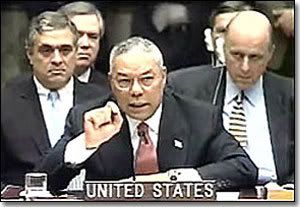
Colin Powell Addresses The UN On Iraq |
Following is a transcript of U.S. Secretary of State Colin Powell's presentation to the U.N. Security Council on the U.S. case against Iraq.
Transcript:
Part 1: Introduction
Thank you, Mr. President.
Mr. President, Mr. Secretary General, distinguished colleagues, I would like to begin by expressing my thanks for the special effort that each of you made to be here today.
This is important day for us all as we review the situation with respect to Iraq and its disarmament obligations under U.N. Security Council Resolution 1441.
Last November 8, this council passed Resolution 1441 by a unanimous vote. The purpose of that resolution was to disarm Iraq of its weapons of mass destruction. Iraq had already been found guilty of material breach of its obligations, stretching back over 16 previous resolutions and 12 years.
Resolution 1441 was not dealing with an innocent party, but a regime this council has repeatedly convicted over the years. Resolution 1441 gave Iraq one last chance, one last chance to come into compliance or to face serious consequences. No council member present in voting on that day had any illusions about the nature and intent of the resolution or what serious consequences meant if Iraq did not comply.
And to assist in its disarmament, we called on Iraq to cooperate with returning inspectors from UNMOVIC and IAEA.
We laid down tough standards for Iraq to meet to allow the inspectors to do their job.
This council placed the burden on Iraq to comply and disarm and not on the inspectors to find that which Iraq has gone out of its way to conceal for so long. Inspectors are inspectors; they are not detectives.
I asked for this session today for two purposes: First, to support the core assessments made by Dr. Blix and Dr. ElBaradei. As Dr. Blix reported to this council on January 27th, "Iraq appears not to have come to a genuine acceptance, not even today, of the disarmament which was demanded of it."
And as Dr. ElBaradei reported, Iraq's declaration of December 7, "did not provide any new information relevant to certain questions that have been outstanding since 1998."
My second purpose today is to provide you with additional information, to share with you what the United States knows about Iraq's weapons of mass destruction as well as Iraq's involvement in terrorism, which is also the subject of Resolution 1441 and other earlier resolutions.
I might add at this point that we are providing all relevant information we can to the inspection teams for them to do their work.
The material I will present to you comes from a variety of sources. Some are U.S. sources. And some are those of other countries. Some of the sources are technical, such as intercepted telephone conversations and photos taken by satellites. Other sources are people who have risked their lives to let the world know what Saddam Hussein is really up to.
I cannot tell you everything that we know. But what I can share with you, when combined with what all of us have learned over the years, is deeply troubling.
What you will see is an accumulation of facts and disturbing patterns of behavior. The facts on Iraq's behavior demonstrate that Saddam Hussein and his regime have made no effort -- no effort -- to disarm as required by the international community.
Indeed, the facts and Iraq's behavior show that Saddam Hussein and his regime are concealing their efforts to produce more weapons of mass destruction.
Part 2: Hiding prohibited equipment
Let me begin by playing a tape for you. What you're about to hear is a conversation that my government monitored. It takes place on November 26 of last year, on the day before United Nations teams resumed inspections in Iraq.
The conversation involves two senior officers, a colonel and a brigadier general, from Iraq's elite military unit, the Republican Guard.
[Following is a U.S. translation of that taped conversation.]
GEN: Yeah.
COL: About this committee that is coming...
GEN: Yeah, yeah.
COL: ...with Mohamed ElBaradei [Director, International Atomic Energy Agency]
GEN: Yeah, yeah.
COL: Yeah.
GEN: Yeah?
COL: We have this modified vehicle.
GEN: Yeah.
COL: What do we say if one of them sees it?
GEN: You didn't get a modified... You don't have a modified...
COL: By God, I have one.
GEN: Which? From the workshop...?
COL: From the al-Kindi Company
GEN: What?
COL: From al-Kindi.
GEN: Yeah, yeah. I'll come to you in the morning. I have some comments. I'm worried you all have something left.
COL: We evacuated everything. We don't have anything left.
GEN: I will come to you tomorrow.
COL: Okay.
GEN: I have a conference at Headquarters, before I attend the conference I will come to you.
Let me pause and review some of the key elements of this conversation that you just heard between these two officers.
First, they acknowledge that our colleague, Mohamed ElBaradei, is coming, and they know what he's coming for, and they know he's coming the next day. He's coming to look for things that are prohibited. He is expecting these gentlemen to cooperate with him and not hide things.
But they're worried. "We have this modified vehicle. What do we say if one of them sees it?"
What is their concern? Their concern is that it's something they should not have, something that should not be seen.
The general is incredulous: "You didn't get a modified. You don't have one of those, do you?"
"I have one."
"Which, from where?"
"From the workshop, from the al-Kindi Company?"
"What?"
"From al-Kindi."
"I'll come to see you in the morning. I'm worried. You all have something left."
"We evacuated everything. We don't have anything left."
Note what he says: "We evacuated everything."
We didn't destroy it. We didn't line it up for inspection. We didn't turn it into the inspectors. We evacuated it to make sure it was not around when the inspectors showed up.
"I will come to you tomorrow."
The al-Kindi Company: This is a company that is well known to have been involved in prohibited weapons systems activity.
Let me play another tape for you. As you will recall, the inspectors found 12 empty chemical warheads on January 16. On January 20, four days later, Iraq promised the inspectors it would search for more. You will now hear an officer from Republican Guard headquarters issuing an instruction to an officer in the field. Their conversation took place just last week on January 30.
Let me pause again and review the elements of this message.
"They're inspecting the ammunition you have, yes."
"Yes."
"For the possibility there are forbidden ammo."
"For the possibility there is by chance forbidden ammo?"
"Yes."
"And we sent you a message yesterday to clean out all of the areas, the scrap areas, the abandoned areas. Make sure there is nothing there."
Remember the first message, evacuated.
This is all part of a system of hiding things and moving things out of the way and making sure they have left nothing behind.
If you go a little further into this message, and you see the specific instructions from headquarters: "After you have carried out what is contained in this message, destroy the message because I don't want anyone to see this message."
"OK, OK."
Why? Why?
This message would have verified to the inspectors that they have been trying to turn over things. They were looking for things. But they don't want that message seen, because they were trying to clean up the area to leave no evidence behind of the presence of weapons of mass destruction. And they can claim that nothing was there. And the inspectors can look all they want, and they will find nothing.
This effort to hide things from the inspectors is not one or two isolated events, quite the contrary. This is part and parcel of a policy of evasion and deception that goes back 12 years, a policy set at the highest levels of the Iraqi regime.
Part 3: Attempt to thwart inspection
We know that Saddam Hussein has what is called "a higher committee for monitoring the inspections teams." Think about that. Iraq has a high-level committee to monitor the inspectors who were sent in to monitor Iraq's disarmament.
Not to cooperate with them, not to assist them, but to spy on them and keep them from doing their jobs.
The committee reports directly to Saddam Hussein. It is headed by Iraq's vice president, Taha Yassin Ramadan. Its members include Saddam Hussein's son Qusay.
This committee also includes Lt. Gen. Amir al-Saadi, an adviser to Saddam. In case that name isn't immediately familiar to you, Gen. Saadi has been the Iraqi regime's primary point of contact for Dr. Blix and Dr. ElBaradei. It was Gen. Saadi who last fall publicly pledged that Iraq was prepared to cooperate unconditionally with inspectors. Quite the contrary, Saadi's job is not to cooperate, it is to deceive; not to disarm, but to undermine the inspectors; not to support them, but to frustrate them and to make sure they learn nothing.
We have learned a lot about the work of this special committee. We learned that just prior to the return of inspectors last November the regime had decided to resume what we heard called, "the old game of cat and mouse."
For example, let me focus on the now famous declaration that Iraq submitted to this council on December 7. Iraq never had any intention of complying with this council's mandate.
Instead, Iraq planned to use the declaration, overwhelm us and to overwhelm the inspectors with useless information about Iraq's permitted weapons so that we would not have time to pursue Iraq's prohibited weapons. Iraq's goal was to give us, in this room, to give those of us on this council the false impression that the inspection process was working.
You saw the result. Dr. Blix pronounced the 12,200-page declaration, rich in volume, but poor in information and practically devoid of new evidence.
Could any member of this council honestly rise in defense of this false declaration?
Everything we have seen and heard indicates that, instead of cooperating actively with the inspectors to ensure the success of their mission, Saddam Hussein and his regime are busy doing all they possibly can to ensure that inspectors succeed in finding absolutely nothing.
My colleagues, every statement I make today is backed up by sources, solid sources. These are not assertions. What we're giving you are facts and conclusions based on solid intelligence. I will cite some examples, and these are from human sources.
Orders were issued to Iraq's security organizations, as well as to Saddam Hussein's own office, to hide all correspondence with the Organization of Military Industrialization.
This is the organization that oversees Iraq's weapons of mass destruction activities. Make sure there are no documents left which could connect you to the OMI.
We know that Saddam's son, Qusay, ordered the removal of all prohibited weapons from Saddam's numerous palace complexes. We know that Iraqi government officials, members of the ruling Baath Party and scientists have hidden prohibited items in their homes. Other key files from military and scientific establishments have been placed in cars that are being driven around the countryside by Iraqi intelligence agents to avoid detection.
Thanks to intelligence they were provided, the inspectors recently found dramatic confirmation of these reports. When they searched the home of an Iraqi nuclear scientist, they uncovered roughly 2,000 pages of documents. You see them here being brought out of the home and placed in U.N. hands. Some of the material is
classified and related to Iraq's nuclear program.
Tell me, answer me, are the inspectors to search the house of every government official, every Baath Party member and every scientist in the country to find the truth, to get the information they need, to satisfy the demands of our council?
Our sources tell us that, in some cases, the hard drives of computers at Iraqi weapons facilities were replaced. Who took the hard drives. Where did they go? What's being hidden? Why? There's only one answer to the why: to deceive, to hide, to keep from the inspectors.
Numerous human sources tell us that the Iraqis are moving, not just documents and hard drives, but weapons of mass destruction to keep them from being found by inspectors.
While we were here in this council chamber debating Resolution 1441 last fall, we know, we know from sources that a missile brigade outside Baghdad was disbursing rocket launchers and warheads containing biological warfare agents to various locations, distributing them to various locations in western Iraq. Most of the launchers and warheads have been hidden in large groves of palm trees and were to be moved every one to four weeks to escape detection.
We also have satellite photos that indicate that banned materials have recently been moved from a number of Iraqi weapons of mass destruction facilities.
Let me say a word about satellite images before I show a couple. The photos that I am about to show you are sometimes hard for the average person to interpret, hard for me. The painstaking work of photo analysis takes experts with years and years of experience, pouring for hours and hours over light tables. But as I show you these images, I will try to capture and explain what they mean, what they indicate to our imagery specialists.
Let's look at one. This one is about a weapons munition facility, a facility that holds ammunition at a place called Taji (ph). This is one of about 65 such facilities in Iraq. We know that this one has housed chemical munitions. In fact, this is where the Iraqis recently came up with the additional four chemical weapon shells.
Here, you see 15 munitions bunkers in yellow and red outlines. The four that are in red squares represent active chemical munitions bunkers.
How do I know that? How can I say that? Let me give you a closer look. Look at the image on the left. On the left is a close-up of one of the four chemical bunkers. The two arrows indicate the presence of sure signs that the bunkers are storing chemical munitions. The arrow at the top that says security points to a facility that is the signature item for this kind of bunker. Inside that facility are special guards and special equipment to monitor any leakage that might come out of the bunker.
The truck you also see is a signature item. It's a decontamination vehicle in case something goes wrong.
This is characteristic of those four bunkers. The special security facility and the decontamination vehicle will be in the area, if not at any one of them or one of the other, it is moving around those four, and it moves as it needed to move, as people are working in the different bunkers.
Now look at the picture on the right. You are now looking at two of those sanitized bunkers. The signature vehicles are gone, the tents are gone, it's been cleaned up, and it was done on the 22nd of December, as the U.N. inspection team is arriving, and you can see the inspection vehicles arriving in the lower portion of the picture on the right.
The bunkers are clean when the inspectors get there. They found nothing.
This sequence of events raises the worrisome suspicion that Iraq had been tipped off to the forthcoming inspections at Taji (ph). As it did throughout the 1990s, we know that Iraq today is actively using its considerable intelligence capabilities to hide its illicit activities. From our sources, we know that inspectors are under constant surveillance by an army of Iraqi intelligence operatives.
Iraq is relentlessly attempting to tap all of their communications, both voice and electronics.
I would call my colleagues attention to the fine paper that United Kingdom distributed yesterday, which describes in exquisite detail Iraqi deception activities.
In this next example, you will see the type of concealment activity Iraq has undertaken in response to the resumption of inspections. Indeed, in November 2002, just when the inspections were about to resume this type of activity spiked. Here are three examples.
At this ballistic missile site, on November 10, we saw a cargo truck preparing to move ballistic missile components. At this biological weapons related facility, on November 25, just two days before inspections resumed, this truck caravan appeared, something we almost never see at this facility, and we monitor it carefully and regularly.
At this ballistic missile facility, again, two days before inspections began, five large cargo trucks appeared along with the truck-mounted crane to move missiles. We saw this kind of house cleaning at close to 30 sites.
Days after this activity, the vehicles and the equipment that I've just highlighted disappear and the site returns to patterns of normalcy. We don't know precisely what Iraq was moving, but the inspectors already knew about these sites, so Iraq knew that they would be coming.
We must ask ourselves: Why would Iraq suddenly move equipment of this nature before inspections if they were anxious to demonstrate what they had or did not have?
Remember the first intercept in which two Iraqis talked about the need to hide a modified vehicle from the inspectors. Where did Iraq take all of this equipment? Why wasn't it presented to the inspectors?
Iraq also has refused to permit any U-2 reconnaissance flights that would give the inspectors a better sense of what's being moved before, during and after inspectors.
This refusal to allow this kind of reconnaissance is in direct, specific violation of operative paragraph seven of our Resolution 1441.
Saddam Hussein and his regime are not just trying to conceal weapons, they're also trying to hide people. You know the basic facts. Iraq has not complied with its obligation to allow immediate, unimpeded, unrestricted and private access to all officials and other persons as required by Resolution 1441.
Part 4: Access to scientists
The regime only allows interviews with inspectors in the presence of an Iraqi official, a minder. The official Iraqi organization charged with facilitating inspections announced, announced publicly and announced ominously that, quote, "Nobody is ready to leave Iraq to be interviewed."
Iraqi Vice President Ramadan accused the inspectors of conducting espionage, a veiled threat that anyone cooperating with U.N. inspectors was committing treason.
Iraq did not meet its obligations under 1441 to provide a comprehensive list of scientists associated with its weapons of mass destruction programs. Iraq's list was out of date and contained only about 500 names, despite the fact that UNSCOM had earlier put together a list of about 3,500 names.
Let me just tell you what a number of human sources have told us.
Saddam Hussein has directly participated in the effort to prevent interviews. In early December, Saddam Hussein had all Iraqi scientists warned of the serious consequences that they and their families would face if they revealed any sensitive information to the inspectors. They were forced to sign documents acknowledging that divulging information is punishable by death.
Saddam Hussein also said that scientists should be told not to agree to leave Iraq; anyone who agreed to be interviewed outside Iraq would be treated as a spy. This violates 1441.
In mid-November, just before the inspectors returned, Iraqi experts were ordered to report to the headquarters of the special security organization to receive counterintelligence training. The training focused on evasion methods, interrogation resistance techniques, and how to mislead inspectors.
Ladies and gentlemen, these are not assertions. These are facts, corroborated by many sources, some of them sources of the intelligence services of other countries.
For example, in mid-December weapons experts at one facility were replaced by Iraqi intelligence agents who were to deceive inspectors about the work that was being done there.
On orders from Saddam Hussein, Iraqi officials issued a false death certificate for one scientist, and he was sent into hiding.
In the middle of January, experts at one facility that was related to weapons of mass destruction, those experts had been ordered to stay home from work to avoid the inspectors. Workers from other Iraqi military facilities not engaged in illicit weapons projects were to replace the workers who'd been sent home. A dozen experts have been placed under house arrest, not in their own houses, but as a group at one of Saddam Hussein's guest houses. It goes on and on and on.
As the examples I have just presented show, the information and intelligence we have gathered point to an active and systematic effort on the part of the Iraqi regime to keep key materials and people from the inspectors in direct violation of Resolution 1441. The pattern is not just one of reluctant cooperation, nor is it merely a lack of cooperation. What we see is a deliberate campaign to prevent any meaningful inspection work.
My colleagues, operative paragraph four of U.N. Resolution 1441, which we lingered over so long last fall, clearly states that false statements and omissions in the declaration and a failure by Iraq at any time to comply with and cooperate fully in the implementation of this resolution shall constitute -- the facts speak for themselves --shall constitute a further material breach of its obligation.
We wrote it this way to give Iraq an early test -- to give Iraq an early test. Would they give an honest declaration and would they early on indicate a willingness to cooperate with the inspectors? It was designed to be an early test.
They failed that test. By this standard, the standard of this operative paragraph, I believe that Iraq is now in further material breach of its obligations. I believe this conclusion is irrefutable and undeniable.
Iraq has now placed itself in danger of the serious consequences called for in U.N. Resolution 1441. And this body places itself in danger of irrelevance if it allows Iraq to continue to defy its will without responding effectively and immediately.
The issue before us is not how much time we are willing to give the inspectors to be frustrated by Iraqi obstruction. But how much longer are we willing to put up with Iraq's noncompliance before we, as a council, we, as the United Nations, say: "Enough. Enough."
The gravity of this moment is matched by the gravity of the threat that Iraq's weapons of mass destruction pose to the world. Let me now turn to those deadly weapons programs and describe why they are real and present dangers to the region and to the world.
Part 5: Biological weapons program
First, biological weapons. We have talked frequently here about biological weapons. By way of introduction and history, I think there are just three quick points I need to make.
First, you will recall that it took UNSCOM four long and frustrating years to pry -- to pry -- an admission out of Iraq that it had biological weapons.
Second, when Iraq finally admitted having these weapons in 1995, the quantities were vast. Less than a teaspoon of dry anthrax, a little bit about this amount -- this is just about the amount of a teaspoon -- less than a teaspoon full of dry anthrax in an envelope shutdown the United States Senate in the fall of 2001. This forced several hundred people to undergo emergency medical treatment and killed two postal workers just from an amount just about this quantity that was inside of an envelope.
Iraq declared 8,500 liters of anthrax, but UNSCOM estimates that Saddam Hussein could have produced 25,000 liters. If concentrated into this dry form, this amount would be enough to fill tens upon tens upon tens of thousands of teaspoons. And Saddam Hussein has not verifiably accounted for even one teaspoon-full of this deadly material.
And that is my third point. And it is key. The Iraqis have never accounted for all of the biological weapons they admitted they had and we know they had. They have never accounted for all the organic material used to make them. And they have not accounted for many of the weapons filled with these agents such as there are 400 bombs. This is evidence, not conjecture. This is true. This is all well-documented.
Dr. Blix told this council that Iraq has provided little evidence to verify anthrax production and no convincing evidence of its destruction. It should come as no shock then, that since Saddam Hussein forced out the last inspectors in 1998, we have amassed much intelligence indicating that Iraq is continuing to make these weapons.
One of the most worrisome things that emerges from the thick intelligence file we have on Iraq's biological weapons is the existence of mobile production facilities used to make biological agents.
Let me take you inside that intelligence file and share with you what we know from eye witness accounts. We have firsthand descriptions of biological weapons factories on wheels and on rails.
The trucks and train cars are easily moved and are designed to evade detection by inspectors. In a matter of months, they can produce a quantity of biological poison equal to the entire amount that Iraq claimed to have produced in the years prior to the Gulf War.
Although Iraq's mobile production program began in the mid-1990s, U.N. inspectors at the time only had vague hints of such programs. Confirmation came later, in the year 2000.
The source was an eye witness, an Iraqi chemical engineer who supervised one of these facilities. He actually was present during biological agent production runs. He was also at the site when an accident occurred in 1998. Twelve technicians died from exposure to biological agents.
He reported that when UNSCOM was in country and inspecting, the biological weapons agent production always began on Thursdays at midnight because Iraq thought UNSCOM would not inspect on the Muslim Holy Day, Thursday night through Friday. He added that this was important because the units could not be broken down in the middle of a production run, which had to be completed by Friday evening before the inspectors might arrive again.
This defector is currently hiding in another country with the certain knowledge that Saddam Hussein will kill him if he finds him. His eye-witness account of these mobile production facilities has been corroborated by other sources.
A second source, an Iraqi civil engineer in a position to know the details of the program, confirmed the existence of transportable facilities moving on trailers.
A third source, also in a position to know, reported in summer 2002 that Iraq had manufactured mobile production systems mounted on road trailer units and on rail cars.
Finally, a fourth source, an Iraqi major, who defected, confirmed that Iraq has mobile biological research laboratories, in addition to the production facilities I mentioned earlier.
We have diagrammed what our sources reported about these mobile facilities. Here you see both truck and rail car-mounted mobile factories. The description our sources gave us of the technical features required by such facilities are highly detailed and extremely accurate. As these drawings based on their description show, we know what the fermenters look like, we know what the tanks, pumps, compressors and other parts look like. We know how they fit together. We know how they work. And we know a great deal about the platforms on which they are mounted.
As shown in this diagram, these factories can be concealed easily, either by moving ordinary-looking trucks and rail cars along Iraq's thousands of miles of highway or track, or by parking them in a garage or warehouse or somewhere in Iraq's extensive system of underground tunnels and bunkers.
We know that Iraq has at lest seven of these mobile biological agent factories. The truck-mounted ones have at least two or three trucks each. That means that the mobile production facilities are very few, perhaps 18 trucks that we know of -- there may be more -- but perhaps 18 that we know of. Just imagine trying to find 18 trucks among the thousands and thousands of trucks that travel the roads of Iraq every single day.
It took the inspectors four years to find out that Iraq was making biological agents. How long do you think it will take the inspectors to find even one of these 18 trucks without Iraq coming forward, as they are supposed to, with the information about these kinds of capabilities?
Ladies and gentlemen, these are sophisticated facilities. For example, they can produce anthrax and botulism toxin. In fact, they can produce enough dry biological agent in a single month to kill thousands upon thousands of people. And dry agent of this type is the most lethal form for human beings.
By 1998, U.N. experts agreed that the Iraqis had perfected drying techniques for their biological weapons programs. Now, Iraq has incorporated this drying expertise into these mobile production facilities.
We know from Iraq's past admissions that it has successfully weaponized not only anthrax, but also other biological agents, including botulism toxin, aflatoxin and ricin.
But Iraq's research efforts did not stop there. Saddam Hussein has investigated dozens of biological agents causing diseases such as gas gangrene, plague, typhus, tetanus, cholera, camelpox and hemorrhagic fever, and he also has the wherewithal to develop smallpox.
The Iraqi regime has also developed ways to disburse lethal biological agents, widely and discriminately into the water supply, into the air. For example, Iraq had a program to modify aerial fuel tanks for Mirage jets. This video of an Iraqi test flight obtained by UNSCOM some years ago shows an Iraqi F-1 Mirage jet aircraft. Note the spray coming from beneath the Mirage; that is 2,000 liters of simulated anthrax that a jet is spraying.
In 1995, an Iraqi military officer, Mujahid Sali Abdul Latif (ph), told inspectors that Iraq intended the spray tanks to be mounted onto a MiG-21 that had been converted into an unmanned aerial vehicle, or a UAV. UAVs outfitted with spray tanks constitute an ideal method for launching a terrorist attack using biological weapons.
Iraq admitted to producing four spray tanks. But to this day, it has provided no credible evidence that they were destroyed, evidence that was required by the international community.
There can be no doubt that Saddam Hussein has biological weapons and the capability to rapidly produce more, many more. And he has the ability to dispense these lethal poisons and diseases in ways that can cause massive death and destruction. If biological weapons seem too terrible to contemplate, chemical weapons are equally chilling.
UNMOVIC already laid out much of this, and it is documented for all of us to read in UNSCOM's 1999 report on the subject.
Let me set the stage with three key points that all of us need to keep in mind: First, Saddam Hussein has used these horrific weapons on another country and on his own people. In fact, in the history of chemical warfare, no country has had more battlefield experience with chemical weapons since World War I than Saddam Hussein's Iraq.
Part 6: Chemical weapons
Second, as with biological weapons, Saddam Hussein has never accounted for vast amounts of chemical weaponry: 550 artillery shells with mustard, 30,000 empty munitions and enough precursors to increase his stockpile to as much as 500 tons of chemical agents. If we consider just one category of missing weaponry -- 6,500 bombs from the Iran-Iraq war -- UNMOVIC says the amount of chemical agent in them would be in the order of 1,000 tons. These quantities of chemical weapons are now unaccounted for.
Dr. Blix has quipped that, quote, "Mustard gas is not (inaudible) You are supposed to know what you did with it."
We believe Saddam Hussein knows what he did with it, and he has not come clean with the international community. We have evidence these weapons existed. What we don't have is evidence from Iraq that they have been destroyed or where they are. That is what we are still waiting for.
Third point, Iraq's record on chemical weapons is replete with lies. It took years for Iraq to finally admit that it had produced four tons of the deadly nerve agent, VX. A single drop of VX on the skin will kill in minutes. Four tons.
The admission only came out after inspectors collected documentation as a result of the defection of Hussein Kamal, Saddam Hussein's late son-in-law. UNSCOM also gained forensic evidence that Iraq had produced VX and put it into weapons for delivery. Yet, to this day, Iraq denies it had ever weaponized VX.
And on January 27, UNMOVIC told this council that it has information that conflicts with the Iraqi account of its VX program.
We know that Iraq has embedded key portions of its illicit chemical weapons infrastructure within its legitimate civilian industry. To all outward appearances, even to experts, the infrastructure looks like an ordinary civilian operation. Illicit and legitimate production can go on simultaneously; or, on a dime, this dual-use infrastructure can turn from clandestine to commercial and then back again.
These inspections would be unlikely, any inspections of such facilities would be unlikely to turn up anything prohibited, especially if there is any warning that the inspections are coming. Call it ingenuous or evil genius, but the Iraqis deliberately designed their chemical weapons programs to be inspected. It is infrastructure with a built-in ally.
Under the guise of dual-use infrastructure, Iraq has undertaken an effort to reconstitute facilities that were closely associated with its past program to develop and produce chemical weapons.
For example, Iraq has rebuilt key portions of the Tariq state establishment. Tariq includes facilities designed specifically for Iraq's chemical weapons program and employs key figures from past programs.
That's the production end of Saddam's chemical weapons business.
What about the delivery end?
I'm going to show you a small part of a chemical complex called al-Moussaid (ph), a site that Iraq has used for at least three years to transship chemical weapons from production facilities out to the field.
In May 2002, our satellites photographed the unusual activity in this picture. Here we see cargo vehicles are again at this transshipment point, and we can see that they are accompanied by a decontamination vehicle associated with biological or chemical weapons activity.
What makes this picture significant is that we have a human source who has corroborated that movement of chemical weapons occurred at this site at that time. So it's not just the photo, and it's not an individual seeing the photo. It's the photo and then the knowledge of an individual being brought together to make the case.
This photograph of the site taken two months later in July shows not only the previous site, which is the figure in the middle at the top with the bulldozer sign near it, it shows that this previous site, as well as all of the other sites around the site, have been fully bulldozed and graded. The topsoil has been removed. The Iraqis literally removed the crust of the earth from large portions of this site in order to conceal chemical weapons evidence that would be there from years of chemical weapons activity.
To support its deadly biological and chemical weapons programs, Iraq procures needed items from around the world using an extensive clandestine network. What we know comes largely from intercepted communications and human sources who are in a position to know the facts.
Iraq's procurement efforts include equipment that can filter and separate micro-organisms and toxins involved in biological weapons, equipment that can be used to concentrate the agent, growth media that can be used to continue producing anthrax and botulism toxin, sterilization equipment for laboratories, glass-lined reactors and specialty pumps that can handle corrosive chemical weapons agents and recursors, large amounts of vinyl chloride, a precursor for nerve and blister agents, and other chemicals such as sodium sulfide, an important mustard agent precursor.
Now, of course, Iraq will argue that these items can also be used for legitimate purposes. But if that is true, why do we have to learn about them by intercepting communications and risking the lives of human agents? With Iraq's well documented history on biological and chemical weapons, why should any of us give Iraq the benefit of the doubt? I don't, and I don't think you will either after you hear this next intercept.
Just a few weeks ago, we intercepted communications between two commanders in Iraq's Second Republican Guard Corps. One commander is going to be giving an instruction to the other. You will hear as this unfolds that what he wants to communicate to the other guy, he wants to make sure the other guy hears clearly, to the point of repeating it so that it gets written down and completely understood. Listen.
(BEGIN AUDIO TAPE)
(Speaking in Foreign Language.)
(END AUDIO TAPE)
Let's review a few selected items of this conversation.
Two officers talking to each other on the radio want to make sure that nothing is misunderstood:
"Remove. Remove."
The expression, the expression, "I got it."
"Nerve agents. Nerve agents. Wherever it comes up."
"Got it."
"Wherever it comes up."
"In the wireless instructions, in the instructions."
"Correction. No. In the wireless instructions."
"Wireless. I got it."
Why does he repeat it that way? Why is he so forceful in making sure this is understood? And why did he focus on wireless instructions? Because the senior officer is concerned that somebody might be listening.
Well, somebody was.
"Nerve agents. Stop talking about it. They are listening to us. Don't give any evidence that we have these horrible agents."
Well, we know that they do. And this kind of conversation confirms it.
Our conservative estimate is that Iraq today has a stockpile of between 100 and 500 tons of chemical weapons agent. That is enough agent to fill 16,000 battlefield rockets.
Even the low end of 100 tons of agent would enable Saddam Hussein to cause mass casualties across more than 100 square miles of territory, an area nearly five times the size of Manhattan.
Let me remind you that, of the 122 millimeter chemical warheads, that the U.N. inspectors found recently, this discovery could very well be, as has been noted, the tip of the submerged iceberg. The question before us, all my friends, is when will we see the rest of the submerged iceberg?
Saddam Hussein has chemical weapons. Saddam Hussein has used such weapons. And Saddam Hussein has no compunction about using them again, against his neighbors and against his own people.
And we have sources who tell us that he recently has authorized his field commanders to use them. He wouldn't be passing out the orders if he didn't have the weapons or the intent to use them.
We also have sources who tell us that, since the 1980s, Saddam's regime has been experimenting on human beings to perfect its biological or chemical weapons.
A source said that 1,600 death row prisoners were transferred in 1995 to a special unit for such experiments. An eye witness saw prisoners tied down to beds, experiments conducted on them, blood oozing around the victim's mouths and autopsies performed to confirm the effects on the prisoners. Saddam Hussein's humanity -- inhumanity has no limits.
Part 7: Nuclear weapons
Let me turn now to nuclear weapons. We have no indication that Saddam Hussein has ever abandoned his nuclear weapons program.
On the contrary, we have more than a decade of proof that he remains determined to acquire nuclear weapons.
To fully appreciate the challenge that we face today, remember that, in 1991, the inspectors searched Iraq's primary nuclear weapons facilities for the first time. And they found nothing to conclude that Iraq had a nuclear weapons program.
But based on defector information in May of 1991, Saddam Hussein's lie was exposed. In truth, Saddam Hussein had a massive clandestine nuclear weapons program that covered several different techniques to enrich uranium, including electromagnetic isotope separation, gas centrifuge, and gas diffusion. We estimate that this illicit program cost the Iraqis several billion dollars.
Nonetheless, Iraq continued to tell the IAEA that it had no nuclear weapons program. If Saddam had not been stopped, Iraq could have produced a nuclear bomb by 1993, years earlier than most worse-case assessments that had been made before the war.
In 1995, as a result of another defector, we find out that, after his invasion of Kuwait, Saddam Hussein had initiated a crash program to build a crude nuclear weapon in violation of Iraq's U.N. obligations.
Saddam Hussein already possesses two out of the three key components needed to build a nuclear bomb. He has a cadre of nuclear scientists with the expertise, and he has a bomb design.
Since 1998, his efforts to reconstitute his nuclear program have been focused on acquiring the third and last component, sufficient fissile material to produce a nuclear explosion. To make the fissile material, he needs to develop an ability to enrich uranium.
Saddam Hussein is determined to get his hands on a nuclear bomb.
He is so determined that he has made repeated covert attempts to acquire high-specification aluminum tubes from 11 different countries, even after inspections resumed.
These tubes are controlled by the Nuclear Suppliers Group precisely because they can be used as centrifuges for enriching uranium. By now, just about everyone has heard of these tubes, and we all know that there are differences of opinion. There is controversy about what these tubes are for.
Most U.S. experts think they are intended to serve as rotors in centrifuges used to enrich uranium. Other experts, and the Iraqis themselves, argue that they are really to produce the rocket bodies for a conventional weapon, a multiple rocket launcher.
Let me tell you what is not controversial about these tubes.
First, all the experts who have analyzed the tubes in our possession agree that they can be adapted for centrifuge use. Second, Iraq had no business buying them for any purpose. They are banned for Iraq.
I am no expert on centrifuge tubes, but just as an old Army trooper, I can tell you a couple of things: First, it strikes me as quite odd that these tubes are manufactured to a tolerance that far exceeds U.S. requirements for comparable rockets.
Maybe Iraqis just manufacture their conventional weapons to a higher standard than we do, but I don't think so.
Second, we actually have examined tubes from several different batches that were seized clandestinely before they reached Baghdad. What we notice in these different batches is a progression to higher and higher levels of specification, including, in the latest batch, an anodized coating on extremely smooth inner and outer surfaces. Why would they continue refining the specifications, go to all that trouble for something that, if it was a rocket, would soon be blown into shrapnel when it went off?
The high tolerance aluminum tubes are only part of the story. We also have intelligence from multiple sources that Iraq is attempting to acquire magnets and high-speed balancing machines; both items can be used in a gas centrifuge program to enrich uranium.
In 1999 and 2000, Iraqi officials negotiated with firms in Romania, India, Russia and Slovenia for the purchase of a magnet production plant. Iraq wanted the plant to produce magnets weighing 20 to 30 grams. That's the same weight as the magnets used in Iraq's gas centrifuge program before the Gulf War. This incident linked with the tubes is another indicator of Iraq's attempt to reconstitute its nuclear weapons program.
Intercepted communications from mid-2000 through last summer show that Iraq front companies sought to buy machines that can be used to balance gas centrifuge rotors. One of these companies also had been involved in a failed effort in 2001 to smuggle aluminum tubes into Iraq.
People will continue to debate this issue, but there is no doubt in my mind, these illicit procurement efforts show that Saddam Hussein is very much focused on putting in place the key missing piece from his nuclear weapons program, the ability to produce fissile material.
He also has been busy trying to maintain the other key parts of his nuclear program, particularly his cadre of key nuclear scientists.
It is noteworthy that, over the last 18 months, Saddam Hussein has paid increasing personal attention to Iraqi's top nuclear scientists, a group that the governmental-controlled press calls openly, his nuclear mujahedeen. He regularly exhorts them and praises their progress. Progress toward what end?
Long ago, the Security Council, this council, required Iraq to halt all nuclear activities of any kind.
Part 8: Prohibited arms systems
Let me talk now about the systems Iraq is developing to deliver weapons of mass destruction, in particular Iraq's ballistic missiles and unmanned aerial vehicles, UAVs.
First, missiles. We all remember that before the Gulf War Saddam Hussein's goal was missiles that flew not just hundreds, but thousands of kilometers. He wanted to strike not only his neighbors, but also nations far beyond his borders.
While inspectors destroyed most of the prohibited ballistic missiles, numerous intelligence reports over the past decade, from sources inside Iraq, indicate that Saddam Hussein retains a covert force of up to a few dozen Scud variant ballistic missiles. These are missiles with a range of 650 to 900 kilometers.
We know from intelligence and Iraq's own admissions that Iraq's alleged permitted ballistic missiles, the al-Samud II and the al-Fatah , violate the 150-kilometer limit established by this council in Resolution 687. These are prohibited systems.
UNMOVIC has also reported that Iraq has illegally important 380 SA-2 rocket engines. These are likely for use in the al-Samud II. Their import was illegal on three counts. Resolution 687 prohibited all military shipments into Iraq. UNSCOM specifically prohibited use of these engines in surface-to-surface missiles. And finally, as we have just noted, they are for a system that exceeds the150-kilometer range limit.
Worst of all, some of these engines were acquired as late as December -- after this council passed Resolution 1441.
What I want you to know today is that Iraq has programs that are intended to produce ballistic missiles that fly over 1,000 kilometers.
One program is pursuing a liquid fuel missile that would be able to fly more than 1,200 kilometers. And you can see from this map, as well as I can, who will be in danger of these missiles.
As part of this effort, another little piece of evidence, Iraq has built an engine test stand that is larger than anything it has ever had. Notice the dramatic difference in size between the test stand on the left, the old one, and the new one on the right. Note the large exhaust vent. This is where the flame from the engine comes out. The exhaust on the right test stand is five times longer than the one on the left. The one on the left was used for short-range missile. The one on the right is clearly intended for long-range missiles that can fly 1,200 kilometers.
This photograph was taken in April of 2002. Since then, the test stand has been finished and a roof has been put over it so it will be harder for satellites to see what's going on underneath the test stand.
Saddam Hussein's intentions have never changed. He is not developing the missiles for self-defense. These are missiles that Iraq wants in order to project power, to threaten, and to deliver chemical, biological and, if we let him, nuclear warheads.
Now, unmanned aerial vehicles, UAVs.
Iraq has been working on a variety of UAVs for more than a decade. This is just illustrative of what a UAV would look like.
This effort has included attempts to modify for unmanned flight the MiG-21 and with greater success an aircraft called the L-29.
However, Iraq is now concentrating not on these airplanes, but on developing and testing smaller UAVs, such as this.
UAVs are well suited for dispensing chemical and biological weapons.
There is ample evidence that Iraq has dedicated much effort to developing and testing spray devices that could be adapted for UAVs. And of the little that Saddam Hussein told us about UAVs, he has not told the truth. One of these lies is graphically and indisputably demonstrated by intelligence we collected on June 27, last year.
According to Iraq's December 7 declaration, its UAVs have a range of only 80 kilometers. But we detected one of Iraq's newest UAVs in a test flight that went 500 kilometers nonstop on autopilot in the race track pattern depicted here.
Not only is this test well in excess of the 150 kilometers that the United Nations permits, the test was left out of Iraq's December 7th declaration. The UAV was flown around and around and around in a circle. And so, that its 80 kilometer limit really was 500 kilometers unrefueled and on autopilot, violative of all of its obligations under 1441.
The linkages over the past 10 years between Iraq's UAV program and biological and chemical warfare agents are of deep concern to us.
Iraq could use these small UAVs which have a wingspan of only a few meters to deliver biological agents to its neighbors or if transported, to other countries, including the United States.
My friends, the information I have presented to you about these terrible weapons and about Iraq's continued flaunting of its obligations under Security Council Resolution 1441 links to a subject I now want to spend a little bit of time on. And that has to do with terrorism.
Part 9: Ties to al Qaeda
Our concern is not just about these illicit weapons. It's the way that these illicit weapons can be connected to terrorists and terrorist organizations that have no compunction about using such devices against innocent people around the world.
Iraq and terrorism go back decades. Baghdad trains Palestine Liberation Front members in small arms and explosives. Saddam uses the Arab Liberation Front to funnel money to the families of Palestinian suicide bombers in order to prolong the intifada. And it's no secret that Saddam's own intelligence service was involved in dozens of attacks or attempted assassinations in the 1990s.
But what I want to bring to your attention today is the potentially much more sinister nexus between Iraq and the al Qaeda terrorist network, a nexus that combines classic terrorist organizations and modern methods of murder. Iraq today harbors a deadly terrorist network headed by Abu Musab Zarqawi, an associate and collaborator of Osama bin Laden and his al Qaeda lieutenants.
Zarqawi, a Palestinian born in Jordan, fought in the Afghan war more than a decade ago. Returning to Afghanistan in 2000, he oversaw a terrorist training camp. One of his specialities and one of the specialties of this camp is poisons. When our coalition ousted the Taliban, the Zarqawi network helped establish another poison and explosive training center camp. And this camp is located in northeastern Iraq.
You see a picture of this camp.
The network is teaching its operatives how to produce ricin and other poisons. Let me remind you how ricin works. Less than a pinch -- image a pinch of salt -- less than a pinch of ricin, eating just this amount in your food, would cause shock followed by circulatory failure. Death comes within 72 hours and there is no antidote, there is no cure. It is fatal.
Those helping to run this camp are Zarqawi lieutenants operating in northern Kurdish areas outside Saddam Hussein's controlled Iraq.
But Baghdad has an agent in the most senior levels of the radical organization, Ansar al-Islam, that controls this corner of Iraq. In 2000 this agent offered al Qaeda safe haven in the region. After we swept al Qaeda from Afghanistan, some of its members accepted this safe haven. They remain their today.
Zarqawi's activities are not confined to this small corner of northeast Iraq. He traveled to Baghdad in May 2002 for medical treatment, staying in the capital of Iraq for two months while he recuperated to fight another day.
During this stay, nearly two dozen extremists converged on Baghdad and established a base of operations there. These al Qaeda affiliates, based in Baghdad, now coordinate the movement of people, money and supplies into and throughout Iraq for his network, and they've now been operating freely in the capital for more than eight months.
Iraqi officials deny accusations of ties with al Qaeda. These denials are simply not credible. Last year an al Qaeda associate bragged that the situation in Iraq was, quote, "good," that Baghdad could be transited quickly.
We know these affiliates are connected to Zarqawi because they remain even today in regular contact with his direct subordinates, including the poison cell plotters, and they are involved in moving more than money and materiel.
Last year, two suspected al Qaeda operatives were arrested crossing from Iraq into Saudi Arabia. They were linked to associates of the Baghdad cell, and one of them received training in Afghanistan on how to use cyanide. From his terrorist network in Iraq, Zarqawi can direct his network in the Middle East and beyond.
We, in the United States, all of us at the State Department, and the Agency for International Development -- we all lost a dear friend with the cold-blooded murder of Mr. Lawrence Foley in Amman, Jordan, last October -- a despicable act was committed that day. The assassination of an individual whose sole mission was to assist the people of Jordan. The captured assassin says his cell received money and weapons from Zarqawi for that murder.
After the attack, an associate of the assassin left Jordan to go to Iraq to obtain weapons and explosives for further operations. Iraqi officials protest that they are not aware of the whereabouts of Zarqawi or of any of his associates. Again, these protests are not credible. We know of Zarqawi's activities in Baghdad. I described them earlier.
And now let me add one other fact. We asked a friendly security service to approach Baghdad about extraditing Zarqawi and providing information about him and his close associates. This service contacted Iraqi officials twice, and we passed details that should have made it easy to find Zarqawi. The network remains in Baghdad. Zarqawi still remains at large to come and go.
As my colleagues around this table and as the citizens they represent in Europe know, Zarqawi's terrorism is not confined to the Middle East. Zarqawi and his network have plotted terrorist actions against countries, including France, Britain, Spain, Italy, Germany and Russia.
According to detainees, Abu Atia, who graduated from Zakawi's terrorist camp in Afghanistan, tasked at least nine North African extremists in 2001 to travel to Europe to conduct poison and explosive attacks.
Since last year, members of this network have been apprehended in France, Britain, Spain and Italy. By our last count, 116 operatives connected to this global web have been arrested.
The chart you are seeing shows the network in Europe. We know about this European network, and we know about its links to Zarqawi, because the detainee who provided the information about the targets also provided the names of members of the network.
Three of those he identified by name were arrested in France last December. In the apartments of the terrorists, authorities found circuits for explosive devices and a list of ingredients to make toxins.
The detainee who helped piece this together says the plot also targeted Britain. Later evidence, again, proved him right. When the British unearthed a cell there just last month, one British police officer was murdered during the disruption of the cell.
We also know that Zarqawi's colleagues have been active in the Pankisi Gorge, Georgia and in Chechnya, Russia. The plotting to which they are linked is not mere chatter. Members of Zarqawi's network say their goal was to kill Russians with toxins.
We are not surprised that Iraq is harboring Zarqawi and his subordinates. This understanding builds on decades long experience with respect to ties between Iraq and al Qaeda.
Going back to the early and mid-1990s, when bin Laden was based in Sudan, an al Qaeda source tells us that Saddam and bin Laden reached an understanding that al Qaeda would no longer support activities against Baghdad. Early al Qaeda ties were forged by secret, high-level intelligence service contacts with al Qaeda, secret Iraqi intelligence high-level contacts with al Qaeda.
We know members of both organizations met repeatedly and have met at least eight times at very senior levels since the early 1990s. In1996, a foreign security service tells us, that bin Laden met with a senior Iraqi intelligence official in Khartoum, and later met the director of the Iraqi intelligence service.
Saddam became more interested as he saw al Qaeda's appalling attacks. A detained al Qaeda member tells us that Saddam was more willing to assist al Qaeda after the 1998 bombings of our embassies in Kenya and Tanzania. Saddam was also impressed by al Qaeda's attacks on the USS Cole in Yemen in October 2000.
Iraqis continued to visit bin Laden in his new home in Afghanistan. A senior defector, one of Saddam's former intelligence chiefs in Europe, says Saddam sent his agents to Afghanistan sometime in the mid-1990s to provide training to al Qaeda members on document forgery.
From the late 1990s until 2001, the Iraqi embassy in Pakistan played the role of liaison to the al Qaeda organization.
Some believe, some claim these contacts do not amount to much.
They say Saddam Hussein's secular tyranny and al Qaeda's religious tyranny do not mix. I am not comforted by this thought. Ambition and hatred are enough to bring Iraq and al Qaeda together, enough so al Qaeda could learn how to build more sophisticated bombs and learn how to forge documents, and enough so that al Qaeda could turn to Iraq for help in acquiring expertise on weapons of mass destruction.
And the record of Saddam Hussein's cooperation with other Islamist terrorist organizations is clear. Hamas, for example, opened an office in Baghdad in 1999, and Iraq has hosted conferences attended by Palestine Islamic Jihad. These groups are at the forefront of sponsoring suicide attacks against Israel.
Al Qaeda continues to have a deep interest in acquiring weapons of mass destruction. As with the story of Zarqawi and his network, I can trace the story of a senior terrorist operative telling how Iraq provided training in these weapons to al Qaeda.
Fortunately, this operative is now detained, and he has told his story. I will relate it to you now as he, himself, described it.
This senior al Qaeda terrorist was responsible for one of al Qaeda's training camps in Afghanistan.
His information comes firsthand from his personal involvement at senior levels of al Qaeda. He says bin Laden and his top deputy in Afghanistan, deceased al Qaeda leader Mohammed Atef, did not believe that al Qaeda labs in Afghanistan were capable enough to manufacture these chemical or biological agents. They needed to go somewhere else. They had to look outside of Afghanistan for help. Where did they go? Where did they look? They went to Iraq.
The support that (inaudible) describes included Iraq offering chemical or biological weapons training for two al Qaeda associates beginning in December 2000. He says that a militant known as Abu Abdula Al-Iraqi (ph) had been sent to Iraq several times between 1997and 2000 for help in acquiring poisons and gases. Abdula Al-Iraqi (ph) characterized the relationship he forged with Iraqi officials as successful.
Part 10: Conclusion
As I said at the outset, none of this should come as a surprise to any of us. Terrorism has been a tool used by Saddam for decades. Saddam was a supporter of terrorism long before these terrorist networks had a name. And this support continues. The nexus of poisons and terror is new. The nexus of Iraq and terror is old. The combination is lethal.
With this track record, Iraqi denials of supporting terrorism take the place alongside the other Iraqi denials of weapons of mass destruction. It is all a web of lies.
When we confront a regime that harbors ambitions for regional domination, hides weapons of mass destruction and provides haven and active support for terrorists, we are not confronting the past, we are confronting the present. And unless we act, we are confronting an even more frightening future.
My friends, this has been a long and a detailed presentation.
And I thank you for your patience. But there is one more subject that I would like to touch on briefly. And it should be a subject of deep and continuing concern to this council, Saddam Hussein's violations of human rights.
Underlying all that I have said, underlying all the facts and the patterns of behavior that I have identified as Saddam Hussein's contempt for the will of this council, his contempt for the truth and most damning of all, his utter contempt for human life. Saddam Hussein's use of mustard and nerve gas against the Kurds in 1988 was one of the 20th century's most horrible atrocities; 5,000 men, women and children died.
His campaign against the Kurds from 1987 to '89 included mass summary executions, disappearances, arbitrary jailing, ethnic cleansing and the destruction of some 2,000 villages. He has also conducted ethnic cleansing against the Shiite Iraqis and the Marsh Arabs whose culture has flourished for more than a millennium. Saddam Hussein's police state ruthlessly eliminates anyone who dares to dissent. Iraq has more forced disappearance cases than any other country, tens of thousands of people reported missing in the past decade.
Nothing points more clearly to Saddam Hussein's dangerous intentions and the threat he poses to all of us than his calculated cruelty to his own citizens and to his neighbors. Clearly, Saddam Hussein and his regime will stop at nothing until something stops him.
For more than 20 years, by word and by deed Saddam Hussein has pursued his ambition to dominate Iraq and the broader Middle East using the only means he knows, intimidation, coercion and annihilation of all those who might stand in his way. For Saddam Hussein, possession of the world's most deadly weapons is the ultimate trump card, the one he most hold to fulfill his ambition.
We know that Saddam Hussein is determined to keep his weapons of mass destruction; he's determined to make more. Given Saddam Hussein's history of aggression, given what we know of his grandiose plans, given what we know of his terrorist associations and given his determination to exact revenge on those who oppose him, should we take the risk that he will not some day use these weapons at a time and the place and in the manner of his choosing at a time when the world is in a much weaker position to respond?
The United States will not and cannot run that risk to the American people. Leaving Saddam Hussein in possession of weapons of mass destruction for a few more months or years is not an option, not in a post-September 11th world.
My colleagues, over three months ago this council recognized that Iraq continued to pose a threat to international peace and security, and that Iraq had been and remained in material breach of its disarmament obligations. Today Iraq still poses a threat and Iraq still remains in material breach.
Indeed, by its failure to seize on its one last opportunity to come clean and disarm, Iraq has put itself in deeper material breach and closer to the day when it will face serious consequences for its continued defiance of this council.
My colleagues, we have an obligation to our citizens, we have an obligation to this body to see that our resolutions are complied with. We wrote 1441 not in order to go to war, we wrote 1441 to try to preserve the peace. We wrote 1441 to give Iraq one last chance. Iraq is not so far taking that one last chance.
We must not shrink from whatever is ahead of us. We must not fail in our duty and our responsibility to the citizens of the countries that are represented by this body.
Thank you, Mr. President.
| [+/-] |
The Case for War Has Not Been Made |
Colin Powell showed that Saddam Hussein is resisting disarming. But he didn't prove that he's an immediate threat.
At Salon.com, Joe Conason reports:
Show and tell As Colin Powell outlined his case against Iraq before the U.N. Security Council, with CIA director George Tenet sitting behind him, two questions kept occurring to me: Does this information prove that war is the best and only means to implement Resolution 1441? And if this information is accurate, was it provided to the UNMOVIC inspectors in full compliance with the responsibilities placed on all member states by that resolution? (Full text of Powell's remarks is here.)There are legitimate questions about the interpretation of what the tapes and satellite pictures mean, as we know from reported disputes within and between U.S. agencies over interpretation of intelligence about Iraq. Lacking the technical ability to evaluate this information, we will have to wait for other interpretations to emerge, if they do.
So let's assume that all of the evidence presented by Powell can be taken at face value, as described by him. A Gallup poll today showed that on this issue, he is far more trusted than the president by most Americans, for good reason. Meanwhile, the intercepted conversations played by the secretary of state do seem to reveal panic among members of the Iraqi officer corps over the arrival of inspectors. The tapes suggest that the Republican Guard and other units have tried to conceal evidence of forbidden weapons. Those conversations also indicate more broadly that Iraq is not handing over all its weapons and information to UNMOVIC forthrightly, as required by 1441.
To an untrained eye, the satellite photographs are more difficult to judge, as Powell acknowledged. Pictures of buildings don't tell us what's inside them. If decontamination vehicles have been detected outside certain facilities, that too suggests concealment.
Information obtained from human informants is subject to all the traditional doubts about testimony from defectors, and is therefore less convincing. And even based on defector and prisoner testimony, the information regarding Baghdad's alleged links with Osama bin Laden is still thin. (An essay in today's Wall Street Journal by former Secretary of Defense Bill Cohen advises the administration to drop this line of argument, but it's only available online to subscribers.) Powell didn't even try to suggest that Iraq was involved in any specific terrorist attacks on the United States, let alone the Sept. 11 atrocity.
There was quite a lot of other pertinent information missing from Powell's address. It is hard to listen to him talk about Saddam's violations of human rights and his gassing of the Kurds, without wondering why those events didn't bother the Reagan and Bush administrations when they were actually occurring. (It's easier to understand why he omitted any reference to the American role in arming Iraq and the subsequent coverup under his old boss, the president's father.)
What was most noticeably absent from Powell's presentation, however, was any evidence that Iraq is a present threat to its neighbors or any other nation -- and thus must be invaded and subdued immediately. He showed that Saddam has sought an arsenal of mass destruction, and that his regime is still resisting disarmament. But he inadvertently made some arguments for continued inspections backed by force, rather than war.
"This effort to hide things from the inspectors is not one or two isolated events, quite the contrary," he said. "This is part and parcel of a policy of evasion and deception that goes back 12 years, a policy set at the highest levels of the Iraqi regime." No doubt true -- and yet the U.N. inspection team between 1991 and 1998 destroyed tens of thousands of tons of chemical and biological weapons, prohibited missiles and the Iraqi nuclear program in its entirety, despite Saddam's duplicity. What the inspectors are now trying to find is a small fraction of what their predecessors found and neutralized.
Powell also pointed to the documents found by inspectors in the home of an Iraqi nuclear scientist, an achievement he attributed to "intelligence they were provided." If sharing U.S. intelligence with the inspectors can locate documents in a private home, why not continue with that process?
"Tell me, answer me, are the inspectors to search the house of every government official, every Baath Party member and every scientist in the country to find the truth, to get the information they need, to satisfy the demands of our council?" the secretary demanded. They don't need to do that. Finding every scrap of paper is not the mandate of the inspectors. Locating weapons and laboratories is their job, and Powell only offered glancing indications that the U.S. has made that easier.
There was also a clue that American confidence in the data presented by Powell is not absolute. His presentation about links between Iraq and al-Qaida included a satellite photograph described as a "terrorist camp" in northern Iraq where operatives are trained in the use of poisons. "You see a picture of this camp," he said. "The network is teaching its operatives how to produce ricin and other poisons ... Those helping to run this camp are Zarqawi lieutenants operating in northern Kurdish areas outside Saddam Hussein's controlled Iraq. But Baghdad has an agent in the most senior levels of the radical organization, Ansar al-Islam, that controls this corner of Iraq."
If the United States firmly believes that its satellites have located an al-Qaida training camp in northern Iraq, why haven't our bombers, jets and missiles destroyed it already? On the ground, northern Iraq is friendly Kurdish territory, and the U.S. and its allies control the airspace.
Nothing Powell said proved that war is necessary now. He didn't justify the potential deaths of thousands of people and the unforeseeable dangers of an invasion by the U.S. and its coalition. He didn't convince the Security Council to change course in support of immediate war. What he did prove is that inspections ought to continue and intensify -- and if Iraq tries to frustrate them as the regime did in 1998, there will still be plenty of time for military action.
French kiss-off France is no longer an ally of the United States, according to neocon eminence Richard Perle, who told a conference in New York yesterday that other friends in Europe "must develop a strategy to contain our erstwhile ally or we will not be talking about a NATO alliance." Insofar as Perle sometimes plays "bad cop" for the Bush White House as chairman of the Pentagon's Defense Policy Board, his remarks suggest a bullying approach that is growing worse as they move closer to war. (Several days ago on Fox News, Perle accused the French government of pursuing an Iraq policy controlled solely by oil interests.)
At the New York event Perle also suggested that the United States should never again consult the U.N. Security Council on a matter of important policy. Such is Bush-Cheney-Rumsfeld policy at its worst: provoke America's oldest friends, bluster about dumping the U.N. when we don't get our way immediately, and dismantle the most important military alliance in the world in a fit of pique. It sounds eerily like the John Birch Society, circa 1962.
Perle's hostility to France is nothing new, but it made me recall today that he owns a very nice little house in the south of France. It's near the town of Gordes in the Luberon. I know because I went to a New Year's Day party at that house two years ago (he wasn't there). Maybe he's sold his share of it.
Monday, January 13, 2003
| [+/-] |
Senator Wants FBI To Explain Bonus For Official in 9/11 Case |
The Washington Times reports:
FBI Director Robert S. Mueller III has been asked by a senior member of the Senate Judiciary Committee to justify an award he gave to an FBI official who refused requests by Minneapolis agents for a warrant to search the computer of terror suspect Zacarias Moussaoui.
Sen. Charles E. Grassley, Iowa Republican, described as "shocking" Mr. Mueller's decision to give the Presidential Rank of Meritorious Service award to Marion "Spike" Bowman, head of the FBI's national security law unit.
"By granting this award and a monetary bonus, you are sending the wrong signal to those agents who fought sometimes against senior FBI bureaucrats at headquarters to prevent the [September 11] attacks," Mr. Grassley said in a letter Thursday to Mr. Mueller.
FBI agents in Minneapolis, advised that Moussaoui, 33, a French Moroccan, was seeking flight lessons, had sought a secret Foreign Intelligence Surveillance Act (FISA) warrant to search his computer, but FBI officials in Washington refused, saying there was insufficient probable cause.
The agents had gathered information, including intelligence from officials overseas, that Moussaoui was tied to terrorism suspects. He was detained a month before the September 11 attacks after officials at a Minneapolis flight school called authorities when he offered to pay cash to learn how to fly a Boeing jetliner.
A senior FBI agent in Minneapolis later complained in a letter to Mr. Mueller that bureau executives in Washington had blocked the Moussaoui investigation because they did not understand the significance of his arrest.
Agent Coleen Rowley, chief principal legal assistant, said the agents faced a "roadblock" when they sought the Moussaoui search warrant, and they became so frustrated at the lack of response that they sought to bypass the chain of command and notify the CIA directly but were reprimanded.
Mr. Mueller has told reporters that lawyers at FBI headquarters found insufficient probable cause and denied the request. He has since referred the matter to the Justice Department's Office of Inspector General for review.
Moussaoui was indicted in December by a federal grand jury in Alexandria on six counts of conspiracy. Four of the counts could result in the death penalty.
The award was given to Mr. Bowman during a ceremony on Dec. 4 in Des Moines, Iowa, which recognized "exceptional performance" by nine senior managers. In a statement, Mr. Mueller said those honored "are strongly linked to our counterterrorism efforts," citing investigations into the bombings of two U.S. embassies in Africa and the USS Cole, as well as the September 11 attacks.
The awards included cash bonuses of between 20 percent or 35 percent of each recipient's base salary.
The Judiciary Committee has been investigating FISA problems at the FBI, including holding closed hearings where Mr. Bowman and others were questioned about the Moussaoui case.
Mr. Grassley said a 26-page electronic communication from the Minneapolis agents contained information that "a reasonable person would have concluded" was sufficient to obtain a FISA warrant.
He said the application should have gone forward to the Justice Department and the FISA court.
Instead, he said, FBI Supervisory Special Agent Michael Maltbie concluded there was not enough information and that Mr. Bowman agreed, although he was aware Mr. Maltbie had "removed certain information before making a presentation of questionable accuracy and length to the national security law unit."
Mr. Grassley said if the application had gone forward and a warrant issued, the agents would have found information in Moussaoui's belongings linking him both to a major financier of the hijacking plot and to an al Qaeda boss who met with at least two other hijackers while under surveillance by intelligence officials.
"You have given an award and extra money to a bureaucrat at headquarters who is seen by many as having stymied the work of field agents," he said.
In the letter, Mr. Grassley asked for information on how and why Mr. Bowman was selected for the award and how much money he received because of it. Mr. Grassley gave the director until Jan. 27 to respond.
Tuesday, December 31, 2002
| [+/-] |
Oil in Iraq: The Heart of the Crisis |
Oil is at the heart of the crisis that leads towards a US war against Iraq. For more than a hundred years, major powers have battled to control this enormous source of wealth and strategic power. The major international oil companies, headquartered in the United States and the United Kingdom, are keen to regain control over Iraq’s oil, lost with the nationalization in 1972. Few outside the industry understand just how high the stakes in Iraq really are and how much the history of the world oil industry is a history of power, national rivalry and military force.
For the Global Policy Forum, James A. Paul writes:
Why Iraq’s Oil is so coveted by the big companies
Oil in Iraq is especially attractive to the big international oil companies because of three factors:
(1)high quality/high value product
Iraq’s oil is generally of high quality because it has attractive chemical properties, notably high carbon content, lightness and low sulfur content, that make it especially suitable for refining into the high-value products. For these reasons, Iraqi oil commands a premium on the world market.
(2)huge supplies
Iraq’s oil is very plentiful. The country’s proven reserves in 2002 were listed at 112.5 billion barrels, about 11% of the world total. With little exploration since the nationalization of the industry in 1972, many promising areas remain unexplored. Experts believe that Iraq has potential reserves substantially above 200 billion barrels. The Energy Information Administration of the US Department of Energy has estimated that Iraqi reserves could possibly total over 400 billion barrels. If new exploration fulfills such high-end predictions, Iraq’s reserves could prove close to those of Saudi Arabia, now listed at 260 billion barrels but likely also to go considerably higher as well. The Department of Energy assessment says that:
“Iraq contains 112 billion barrels of proven oil reserves, the second largest in the world (behind Saudi Arabia) along with roughly 220 billion barrels of probable and possible resources. Iraq’s true potential may be far greater than this, however, as the country is relatively unexplored due to years of war and sanctions. Deep oil-bearing formations located mainly in the vast Western Desert region, for instance, could yield large additional oil resources (possibly another 100 billion barrels), but have not been explored.” (http://www.eia.doe.gov/emeu/cabs/iraq.html)
On May 22, 2002, Iraqi Senior Deputy Oil Minister gave an interview to Platts, a leading industry information source. Discussing Iraq’s estimates of its potential reserves, he told Platts that "The figure we reached and which is widely known, is that we could discover 214 billion barrels of oil in addition to the present proven reserve [of 112 billion]. We are sure of this figure as all available indications and scientific standards say. This means that we will exceed the 300 billion barrels when all Iraq's regions are explored."
Hamud indicated that more reserves were probably to be found. "We have also said on many occasions that we have indications of oil structures--these are only primary indications--estimated to be more than 560 reservoirs that could be oil fields that need digging, appraisal and which we believe have a high potential oil presence. We believe that when we prove all this, Iraq will be the number one holder of oil reserves in the world. We are highly confident of this."
According to Iraq oil expert Mohammad Al-Gallani at British-based GeoDesign Ltd, Iraq has 526 prospective drilling sites, of which only 125 have been drilled. Of those, 90 have proven potential as oil fields, but only 30 have been partially developed and just 12 are on stream. “You can imagine the huge potential that lies there for the future,” Al-Gallani told Canadian Press in a story datelined December 14, 2002.
As world demand for oil increases and as oil reserves in other areas decline at a fast rate, oil in Iraq will represent a steadily-larger proportion of the world’s total. If Iraq’s fields meet high-end estimates in the 3-400 billon barrel range, Iraq’s reserves could reach over 30% of total global reserves by mid-century or even before.
(3)exceptionally low production costs, yielding a high per barrel profit
The US Department of Energy states that “Iraq’s oil production costs are amongst the lowest in the world, making it a highly attractive oil prospect.” This is because Iraq’s oil comes in enormous fields that can be tapped by relatively shallow wells, producing a high “flow rate.” Iraq’s oil rises rapidly to the surface, because of high pressure on the oil reservoir from water and from associated natural gas deposits.
More than a third of Iraq’s current reserves lie just 600 meters (1800 feet) below the earth’s surface and some of Iraq’s fields are among the world’s largest. The fabulous Majnoun Field, not yet in production, is said to hold at least 25 billion barrels. According to Oil and Gas Journal, Western oil companies estimate that they can produce a barrel of Iraqi oil for less than $1.50 and possibly as little as $1, including all exploration, oilfield development and production costs and including a 15% return. This is similar to production costs in Saudi Arabia and lower than virtually any other country.
By way of comparison, a barrel of oil costs $5 to produce in other relatively low-cost areas like Malaysia and Oman. Production costs in Mexico and Russia might potentially be as low as $6-8 per barrel (higher under current production arrangements by local companies).
Offshore production areas like the North Sea, with expensive platforms, can run to $12-16 a barrel. In Texas and other US and Canadian fields, where deep wells and small reservoirs make production especially expensive, costs can run above $20 a barrel. When world market prices dip below $20 a barrel, the North American fields yield no profit at all, and many are capped, while production in an area like Iraq proves extremely profitable in all market conditions.
Oil companies' future profits (and share prices) depend on their control of reserves. In recent years, as older fields have begun to run out, the companies have faced rising “replacement” costs. According to a 2002 report by energy consultants John S. Herold, finding costs for new reserves rose 60% in 2001, pushing replacement costs to $5.31 a barrel. ExxonMobil, BP and Shell are facing this difficulty. Imagine the lure of the vast Iraqi fields, with little prospecting required, offering nearly free acquisition. As Fadel Gheit of Fahnstock & Co. in New York commented in an article in Dawn, Iraq “would be a logical place in the future for oil companies to replace their reserves.” http://www.dawn.com/2002/12/15/ebr12.htm Another expert called Iraq an “El Dorado” for the oil industry.
Estimating Profits in Iraq
Oil prices fluctuate widely, so any discussion of financial yield must be based on a long term average price estimate. For this discussion, we will use an average prices of $25 a barrel in real (inflation-adjusted) terms. This average is higher than the average price in recent years, but as oil becomes scarcer, the price should rise steadily and might well reach a far high level than $25. (During 2002, by way of reference, the price of oil has fluctuated between $20 and $30).
We will assume the level of Iraqi reserves at 250 billion barrels (a very conservative estimate) and recovery rates at 50% (also a very conservative estimate). Under those conditions, recoverable Iraqi oil would be worth altogether about $3.125 trillion. Assuming production costs of $1.50 a barrel (a high-end figure), total costs would be $188 billion, leaving a balance of $2.937 trillion as the difference between costs and sales revenues. Assuming a 50/50 split with the government and further assuming a production period of 50 years, the company profits per year would run to $29 billion. That huge sum is two-thirds of the $44 billion total profits earned by the world’s five major oil companies combined in 2001. If higher assumptions are used, annual profits might soar to as much as $50 billion per year.
Though such numbers are highly speculative, the oil companies themselves engage in similar exercises, as they develop their global strategies and plan for a flow of profits many years into the future. For instance, two Russian companies, Zarubeshneft and Rosneft, told journalists in 2002 that that they were preparing to develop Iraq’s Nahr Umr field that they estimated was worth about $570 billion. This estimate appears too high, based on our assumptions, but they suggest the order of magnitude. Reliable estimates for the value of the fabulous Majnoun field go up to $400 billion and beyond.
If diminishing supplies drive future prices steadily higher or if Iraq’s oil reserves prove to be much larger than 250 billion barrels, the profit yield might be considerably greater. On the other hand, a nationalist government in Baghdad that would demand a higher percentage split would reduce the profit potential, as would the development of major alternative energy sources and taxes on carbon-based fuels in response to global warming. Whatever the exact results, and assuming a U.S.-friendly government, it is clear that Iraq is a goldmine that is literally “worth fighting for” in the view of the big companies.
Iraqi Gas Reserves and Pipeline Routes
The same multinational companies that rule the oil industry are also in the natural gas business. Gas is increasingly popular because it burns with less particulate and has a lower carbon content per unit of energy output. Large gas reserves have been discovered in fields in northern Iraq and other gas fields may be found elsewhere in the country. Though Iraq’s gas may not prove to be as lucrative as its oil, this resource is also coveted by the companies and could be a source of additional multi-billion dollar profits. In December, 1996, Gaz de France and ENI of Italy formed a consortium to build a pipeline from the Iraqi fields to Turkey, a project that could eventually link up with the European gas grid. But because of the UN sanctions against Iraq, this project could not proceed. In post-war Iraq, the big US-UK companies will seek gas production and transport deals along with oil deals, in hopes of snatching these lucrative prospects away from continental European competitors. Other pipeline projects, to bring gas from Qatar and other Gulf states through Iraq to the European market, are also under study and offer huge profits to whichever companies get permission to build them.
New Oil Company Strategy Aims to Regain Dominance in Production
After the nationalizations that swept the oil producing countries, beginning with Iraq’s nationalization in 1972, the oil multinationals lost much of their role in production, known in the oil business as “upstream.” Forced to abandon the cornucopia of profits in the Middle East (and to buy Middle East oil on the world market), they developed alternative production in such areas as the North Sea and the West Coast of Africa where production costs were higher and profits lower. They had to shift much of their profit-making to “downstream” activities such as transportation (tankers and pipelines), refining, petrochemicals and retailing. Major national oil companies (such as Kuwait and Venezuela) pursued downstream strategies as well, however, leading to overcapacity and falling rates of return.
By the mid-1990s, the companies began to revise their strategy towards a return to upstream, crude-oil production, pressing oil producing governments to offer production-related arrangements that could give the multinationals a direct share in crude reserves. Such ideas proved controversial and contrary to nationalist public sentiment in the producing countries.
By the end of the 1990s, however, oil-producing governments were mired in political crises, due to corruption, wars, and civil unrest. In Venezuela, Iraq, Algeria, Iran, and other producer countries, the US government appeared to be involved in destabilization measures, deepening existing social instability and what some scholars call “the crisis of the rentier state." Facing domestic unrest and oil production problems, the nationalized companies confront the need for large new investments to preserve production in older fields and to prospect for new reserves. But corrupt and instable governments want to take all the oil revenue stream, leaving little left over for investments. The multinationals argue that their enormous finances, greater technical competence and lower production costs could benefit producer governments, but behind these technocratic arguments lies the threat of further foreign destabilization and even direct military intervention. Clearly, the companies hope to roll the clock back to the “good old days” when they ruled the oil business and gave producer governments only a very small share.
Effects of US-Dominated Iraq on Other Oil Producer Governments
A U.S. client government in Baghdad – or a U.S. military occupation government – would doubtless hand out upstream production concessions to US-UK companies that would set an important precedent in the world oil industry, tipping the balance of power in favor of the companies and away from the producer states. In this way, the war against Iraq would have an effect on the oil industry that would go far beyond the borders of Iraq.
Oil analysts believe that a US-controlled Iraqi government would quickly make deals with the companies for privatized production. Such deals, though possibly agreed-to in advance of the war, would be justified by the new government on the basis that only the companies would be able to quickly resume post-war production, in order to resume exports and buy critical food, medicines, and other humanitarian goods. Further, Iraq’s huge needs to rebuild its post-war infrastructure would lead towards high production.
Even before Iraq had reached its full production potential of 8 million barrels or more per day, the companies would gain huge leverage over the international oil system. OPEC would be weakened by the withdrawal of one of its key producers from the OPEC quota system. Indeed, OPEC might face the paradox that a US military government of occupation in Iraq would be an OPEC member! Alternatively, such a government might pull out of the producers’ cartel.
This would put pressure on all major oil producers like Kuwait, Iran, Saudi Arabia and Venezuela to de-nationalize their oil companies and offer US-UK companies new concessions or production-sharing agreements that could lead to far higher company profits in these areas. Iran has already made some deals based on a 50/50 split and Saudi Arabia has returned to production sharing in its emerging gas business. US military presence in the Gulf and US clandestine operations to overthrow nationalist governments such as Chavez in Venzuela would increase the pressure. Privatization, even if incomplete, could yield additional tens of billions of profits to the oil companies and would weaken and even destabilize the major oil-producing states. Oil prices might be lowered temporarily to achieve this purpose, then raised later on when a new company-friendly order had been established.
Competition among the Multinational Oil Companies
Five companies dominate the international oil industry, four of them based in the US and the UK. The largest, US-based Exxon Mobil, was the world’s most profitable company in 2001 ($15 billion in profits) and the largest industrial company in terms of revenue. The three other companies in order of size are: BP Amoco (UK), Royal Dutch Shell (UK), and Chevron Texaco (US). France’s TotalElfFina ranks in fifth place. Predecessors of these firms controlled nearly all of the Iraq Petroleum Company from the discovery of oil in the late 1920s until nationalization in 1972. The British firms held half of the company, reflecting the dominant colonial position of the UK at that time in the region.
After nationalization, the Iraqis sought to gain greater control of their oil resources. They shunned the UK and US companies, while developing working relationships with French companies and the (Soviet) Russian government.. Just before the Gulf War (1990-91), Japanese companies negotiated for production-sharing contracts in Iraq and were said to have concluded a deal for the Majnoun field, but that deal collapsed due to the US-led war and the subsequent sanctions. During the 1990s, various firms negotiated with the Iraqis in hopes of gaining access to Iraqi oil once the sanctions were lifted. Shell, and possibly other US-UK companies held secret talks that did not succeed. In 1997 TotalFinaElf, China National Oil Company, and Lukoil of Russia signed agreements with the Iraqis for deals worth hundreds of billions of dollars. Lukoil’s deal concerned development of the West Qurna field, while TotalFinaElf obtained rights to Majnoun and China Nations to North Rumailah (the latter is the huge field that lies astride the border with Kuwait). A number of smaller companies, mostly Russian but also from Malaysia and other countries, got contracts at about this time.
The US-UK companies, keen to regain their former dominance in Iraq, fear that they would lose their leading role in the world oil industry if these contracts with their competitors come to fruition. France and Russia pose the biggest threat, but serious competitors from China, Germany, Italy and Japan also are players in this sweepstakes. China is especially keen to gain a stake in the region’s oil reserves because its rapid economic growth is pushing up its oil consumption. Chinese economists estimate that China may have to import as much as 5.5 million barrels a day from the Gulf by 2020.
The US-UK companies strongly favored the sanctions, as a means to hold their competitors at bay (and hold down excess production on the world market), but weakening sanctions in the late 1990s threatened their future prosperity. The companies are nervous but enthusiastic about Washington’s war option, for it seems to be the only means left to oust their rivals and establish a dominant presence in the fabulously profitable future of Iraq oil production.
It appears that the Washington has used its post-war control over Iraqi oil to win over opposition in the UN Security Council. Discussions over access to future oil production in Iraq have apparently been going on between Washington, London, Moscow, Paris and Beijing and also between the companies directly. Many news stories have suggested that these parleys have taken place and statements by government leaders have underscored the importance of the oil issue.
"We will review all these agreements, definitely," said Faisal Qaragholi to a Washington Post reporter in September. Quaragholi is a petroleum engineer who directs the London office of the Iraqi National Congress (INC), an umbrella organization of opposition groups that is backed by the United States. "Our oil policies should be decided by a government in Iraq elected by the people."
Ahmed Chalabi, the INC leader, went even further, saying he favored the creation of a U.S.-led consortium to develop Iraq's oil fields, which have deteriorated under more than a decade of sanctions. "American companies will have a big shot at Iraqi oil," Chalabi said. Such statements have deepened the fears of the non-US-UK companies and pressured them to go along with the US war plans in order to get a share of the post-war concessions.
Business news agency Reuters, in a story datelined December 15, 2002, put the matter bluntly when it wrote “Iraq's crude reserves, the world's second largest after Saudi Arabia, are at the center of a tug-of-war between countries hoping to grab a share of Baghdad's oil wealth once United Nations sanctions are lifted.”
Free Market Forces vs. Government Intervention and Military Might
The specially high rate of profit (or “rent” as it is sometimes called by economists who study the oil sector) results from the unusual monopolistic structure of the oil industry and its unusual pricing system. From the earliest days in the 1870s, when John D. Rockeller built the Standard Oil Trust, a relatively small number of major companies have controlled world production and prices. These companies have tried to keep prices and production at a controlled level – to maximize their profits. The industry has always relied on close ties to governments. Governments have helped to maintain favorable market conditions, to promote managed pricing and to help the companies gain new sources of supply in foreign lands.
In the early decades, the Standard Oil Trust completely dominated the international oil markets, and US production represented a very large share of the world’s total. During World War I, US oil supplied an estimated 80% of the Allies’ needs. But by the end of the war, the British had built alternative companies – the Anglo-Persian Oil Company (later BP) and Royal Dutch Shell, which together controlled more than half of the world’s oil reserves. US companies feared that the British, through exclusionary policies in their empire, were going to dominate the world’s oil industry. British government purchase of the Anglo-Persian Oil Company (now BP) in 1914 confirmed these fears. And British firms’ leading role in Venezuela brought the competition right into the backyard of the American companies.
Throughout the inter-war period and up to the present the US and the UK have dominated the international oil industry, always in rivalry but also in collusion. The companies in these two countries have towered above those of all other nations. Bids by Japan, Germany, Italy, Russia and France to gain a major stake in the industry have largely failed, though a single large French company remains the sole challenger today to Anglo-American domination.
The Anglo-American companies have always sought to manage global oil output, though collusive agreements. In 1928, they reached the famous “Red Line Agreement” on joint action in the Middle East and the “Achanarry Agreement” to divide up (and avoid competition in) international markets. These agreements have maintained the extraordinary “rent” of Middle East producers, while supporting continued high-cost production in the United States and Canada. If oil markets functioned “normally,” production would increase in the low-cost areas like Saudi Arabia, Kuwait, Iran and Iraq, driving out of business the low-cost producers in North America, but this has not been the case.
Because of the enormous value of oil concessions and the high “rent” that results from low-cost fields, oil concessions are rarely allocated on a purely “market” basis. The companies typically win the most lucrative concessions through their host governments’ political and military power.
Imperial Control and Local Opposition: Will the US Iraq Plan Succeed?
The long, bitter experience of oil producing countries with the US-UK companies has left behind an anger and militancy in local politics that hinders the companies’ efforts to re-organize the “upstream” system. Such feelings run deep in Iraqi politics, going back to British seizure of Iraq after World War I and the bloody repression (including the use of poison gas) that crushed the nationalist revolt of 1920. British leaders fulminated against "Turkish misrule" in Iraq, but their own rule proved equally odious to Iraqis seeking independence and democracy.
Iraqis also remember the way the companies treated the country after it gained its independence and how the companies held Iraqi production down, to manage international supply and price levels. Iraqi’s also remember the fierce company resistance to Iraqi proposals for new exploration contracts in the 1960s. Such sentiments would doubtless not change after the ouster of Saddam Hussein.
These feelings are magnified by US support for Israel and by the long, punishing US-UK-UN sanctions. The US-UK would thus find it very politically difficult to create an indigenous post-Saddam government that would agree to a sweetheart deal for the US-UK companies. For this reason, the US-UK have announced that they are planning a military government that will “purge” Iraqi politics of its Baathist and nationalist elements and remain in power more than a year or as long as necessary. Though the US-UK official announcements speak about “human rights” and “democracy,” it would appear that the main goal of the war and “regime change” is to carry out the oil deals and re-fashion Iraqi politics on a new and more conciliatory and pro-US basis. Scenarios circulating in Washington talk about rapid military seizure of the oil fields, rebuilding oil infrastructure and protecting the oil production system from the negative effects of local politics.
| [+/-] |
Not Just Salsa and Cigars |
In the Psychiatric Bulletin, "Mental Health Care in Cuba" (S.R. Collinson, Lecturer, Bartholomew's and the London Medical School, West Smithfield, EC1A 7BE, T. H. Turner, Consultant Psychiatrist and Honorary Senior Lecturer, Homerton Hospital):
Given the marginal nature of psychiatry in terms of Western health priorities, it is always worth reviewing how countries with clearly different political systems treat their mentally ill. The 40-year economic embargo imposed by the USA on Cuba, the effects of which have been compounded by the hardships suffered during the ‘Special Period’ from 1989 onwards when the collapse of the Soviet Union left the island's economy in ruins (Pilling, 2001), is one of the most stringent of its kind. It prohibits the sale of food, and sharply restricts the sale of medicines and medical equipment, which, given the USA's pre-eminence in the pharmaceutical industry, effectively bars Cuba from purchasing nearly half of the new world class drugs on the market (Rojas Ochoa, 1997). Between 1989 and 1993, Cuba's gross domestic product fell by 35% and exports declined by 75% (Pan American Health Organisation, 1999). This has reduced the availability of resources and has adversely affected some health determinants and certain aspects of the population's health status. Despite this, however, Cuba has developed a system prioritised to primary and preventive care, with an infant mortality rate half that of the city of Washington, DC (World Health Organization & Pan American Health Organization, 1997; Casas et al, 2001). Furthermore, biotechnology and family medicine are being developed by Cuba as a human resource for other developing countries. Cuban medical schools also train physicians specifically for many developing countries around the world (Waitzkin et al, 1997).
The Cuban constitution makes health care a right of every citizen and the responsibility of the government. The national health system is based on universal coverage and comprehensive care, with free preventive, curative and rehabilitation services. Drugs and medical aids are charged for, but prices are low and subsidised by the state. Despite the imposition of the US embargo in 1961, Castro's Government has consistently invested both human and financial resources in the health care system. Thus, the doctor per population ratio has risen steadily during the past 25 years, with 60 000 now in practice: one doctor for every 214 Cubans, the world's best doctor—patient ratio (Garfield & Santana 1997). Family medicine specialists practising in the local community serve more than 90% of the population. There are currently 272 hospitals and 442 poly-clinics. New health projects for 2001 include the development of four mental health centres and a psychiatric occupational health therapy complex. In general, and in keeping with the tenets of ‘revolutionary medicine’ (Guevara, 1987), mental health services are oriented not only toward the biomedical aspects of mental health, but also toward promotion of health, prevention of mental illness and, importantly, social rehabilitation. It was against this context that in January 2001 we accepted an invitation to visit the Hospital Psiquiátrico de la Habana (HPH), known locally as Mazorra, located in a western suburb of the capital, Havana.
Historical background
The original hospital was founded in 1853 and, as with European asylums, was designed to be outside the city. On our arrival, we approached the hospital along a wide avenue that led to the main building, which was dated 1930, and displayed the legend Casa de Dementes above the entrance door. The hospital itself covers some 7 hectares and consists in the main of single storey buildings surrounded by spacious lawns and flowerbeds. A band was playing underneath a pergola, and apparently practises there regularly, although its members are not part of the patient population. The layout of the hospital is reminiscent of the ‘pavilion’ system of, for example, the Bethlem Royal Hospital in England, and of colonial asylums around the world.
Until 1959, HPH was the only public psychiatric hospital in Cuba. Prior to that time the only other psychiatric facilities were private clinics. The doctors we met were reluctant to talk about the pre-1959 era, as this was considered a dark time, when the hospital was compared to a lunatic house, or even a concentration camp. We were, however, shown around an extensive archive of the hospital's history, and photographs and artefacts from this time certainly bore out these statements. The photographs of the hospital from 1859 onwards formed an anthology that moved from images of colonial paternalism, through the neglect and despair of the Batista years, to the humanitarian transformation that took place under Castro's régime. The photographs from 1959 onwards show clean, white-clothed patients helping to build their own new hospital.
The transformation of the hospital was deemed a priority by the new Castro Government, and the current Director, Dr Eduardo B. Ordaz Ducungè (now aged 78), was chosen for this task because of his ‘very humane behaviour’. Originally an anaesthetist, he had been fighting with Che Guevara in the jungles of the Sierra Maestra, and the day after arriving in Havana with the victorious guerrillas, after the collapse of the Batista régime, Fidel Castro put him in charge of the hospital. When the Director and his team arrived at the hospital on 9 January 1959, they found 6000 ‘unclassified’ patients, that is to say, none of them had a clear diagnosis. Furthermore, these 6000 patients were incarcerated in a 2000-bed hospital, with the result that many of them were living on the floors of the wards and corridors. As was evident from the photographs in the archive, conditions were clearly atrocious. Patients were tied to beds with ropes and manacles, and most of the beds were iron-framed and without mattresses. Many patients were locked away behind iron bars. Few had adequate clothing; some had none. A range of physical disorders, including leprosy, were endemic, and there was, of course, a wide mix of psychiatric presentations (learning disability, neurological conditions, psychosis, etc). There was also a special ward for the children of patients (who were actively procreating).
Under the leadership of Dr Ducungè, a team of psychiatrists and psychologists set about trying to classify the patients and reform the hospital, and in the 1960s a group went to Europe, to acquire expertise in new treatment approaches. A particular innovation they picked up on was the rehabilitation model, principally because of their experiences in France and Spain. It is clear that these are the two European countries that have developed the closest professional contacts with psychiatrists in Cuba. There is in fact a Cuban—French Psychology and Psychiatry Association, which holds regular meetings to promote exchanges between specialists in the two countries, and to encourage scientific cooperation.
The current situation
We were told that today HPH has some 2000 in-patients, and about another 2000 attending on a day or community basis. It is one of the three major psychiatric hospitals in Cuba, the others (in Camaguey and Santiago de Cuba) both having about 500-600 beds each. Each of Cuba's 14 regions also have a psychiatric unit, attached to the general hospital, and usually with about 20-30 beds. Most of the patients in HPH had long-term schizophrenic illnesses, requiring rehabilitation, and that was very much the kind of patient we saw.
Altogether, there are about 1000 psychiatrists in Cuba, about 200 of whom are child psychiatrists. The training programme involves 6 years as a medical student, 3 years of general medicine (internships), followed by 3 years of specialist psychiatric training. There are also a number of grades among the psychiatrists themselves, and presently there are eight professors of psychiatry in Cuba, with two senior ‘titular’ professors based in Havana. There are 150 doctors working in HPH, 50 of whom are non-psychiatrists. It was noteworthy that the hospital had its own ‘somatic’ clinic. Facilities included X-ray, electrocardiogram, electroencephalogram and other physical assessments, but patients needing an operation required transfer to a general hospital. The psychiatric hospital itself covers all specialities, including acute and emergency, as well as forensic and rehabilitation. It does not take older patients (over 65), but does quite clearly receive a significant forensic load. Our senior guide was actually a forensic psychiatrist.
In terms of the general treatment approach, it seems that most patients in the hospital were there on a non-voluntary basis (brought in under the Cuban version of the Mental Health Act), although there were some voluntary patients. The reverse is true for the psychiatric units attached to the general hospitals, in which most of the patients are voluntary. The process of bringing someone into hospital is very similar to that in the UK. It requires the signatures of two psychiatrists, one of whom must be the psychiatrist in the receiving hospital, and a family member. Initially an order is for 72 hours. A commission reviews those patients detained for a longer period every third month. The last Cuban Mental Health Act was passed in 1983, with an enhancement in 1984. Our guides mentioned that their process was modelled on the Canadian system. They also talked about the ethical background to their legislation, and referred to a list of patients' rights and the principle of consent.
Therapeutic approaches
Treatment was generally eclectic, combining rehabilitation, social therapies, occupational therapy and medication (Pan American Health Organization & World Health Organization, 1998). Our guides talked of ‘social therapy linked to the pharmacotherapies’, as well as socialist transformation and other Marxist accounts that informed their understanding of mental illness. They felt that their occupational therapy, for example, went beyond mere ‘ergotherapy’, and was aimed at generating both emotional and social benefits, a major improvement, in their view, over the more limited approaches used in North America or Europe. They also use electroconvulsive therapy (ECT), considering it to be a very effective therapy, although they agreed that the profession in Cuba was quite divided about ECT (‘50/50’), not unlike the profession elsewhere.
The drugs available to them seem to be general (e.g. standard antipsychotics and antidepressants), but they have only a very limited number of atypicals. They mentioned olanzapine, but seem to have to rely on help from certain hospitals and institutions in France and Spain, who channel medications to them. They do seem to have fluoxetine regularly available as an antidepressant, as well as the usual tricyclics. It should also be noted that the hospital has a high staff—patient ratio with, in total, about 2000 members of staff. These seemed to be well-trained and interacting enthusiastically with the patients. We saw occupational therapists and nurses engaged in a range of activities, including sports, music therapy (psycho-ballet), hair-dressing, language and numeracy classes, foot massage and handicrafts. We also attended a musical show put on by the patients.
In relation to other diagnoses apart from the psychoses, they see little anorexia or bulimia nervosa. The hospital has a drug dependency unit (DDU), but this is largely for foreigners. Most of the patients in the DDU are Spanish speakers, from countries such as Venezuela and Colombia. This seems to be a way of bringing in an additional income. There is apparently not much drug misuse in Cuba (antidrug laws are very severe), but recently the doctors have begun to see cocaine-dependent patients. Inevitably, their biggest problem is alcohol, as rum is widely available and quite cheap. The regimen in the DDU is based on intensive group therapy, a model used elsewhere in the world.
Social impact
In terms of community outreach, a number of patients go home at the weekends, and many others come in as day patients, for occupational therapy and other activities. There was also a ‘night ward’, where patients who went off site during the day — often because they had jobs — would return to sleep. It seems that there are community-based teams throughout the Havana region (consisting of some 3 million people) who do most of the community care. Each patient does have an assigned social worker, but it was difficult to clarify the actual training of these. It is also of note that medical students come and live on site for 2 months, in one of the pavilions, when they do their psychiatry firm. Typically, however, psychiatry is not a high status specialism within the medical profession.
When asked about ‘untoward incidents’ in the community, the doctors said that these were not really a problem for psychiatrists. They said at first that this was because ‘we don't have lawyers to attack the psychiatrists’. They conceded that there might be a problem if a forensic patient was let out without full consultation with the whole team, and in defiance of the legal ruling. They mentioned the notion of a patient not being evaluated correctly, and of the importance of ethical practices. They felt there was a difference between their approach and that of psychiatrists in a capitalist society, in so far as in the latter any decision about discharge implied some sort of ‘responsibility’.
They discharge patients into the community, and the community organises follow-up and tries to prevent relapse in the usual way. They mentioned a recent famous case that had involved a well-known actress killing her daughter and then killing herself while actually being ‘evaluated’ (presumably while in hospital). She was, it emerged, suffering from a psychotic illness. However, these tragic events did not provoke a huge outbreak in the press. They gave as reasons for this: first the fact that their press ‘does not want that, and it's not a big scandal’; but also that there was a sense that they did not let ‘the media take power’ in terms of what happens. Thus, it simply was not ‘a matter of news’.
Health tourism
While at HPH, we walked past a half-built building, originally planned as a new forensic unit. The money for this had, however, run out, and the building was going to be completed, at a reduced cost, as a theatre for the patients' use. There is a visible lack of resources throughout Cuba, but the Cuban government has begun to address this with great resourcefulness. It has realised the marketable value of a highly trained medical workforce situated in a beautiful location. Cubanacan, the state tourism company, has openly developed a thriving health tourism service, which has turned into a tourist sub-system in itself. It provides primary care in the form of physicians at hotels and international clinics; secondary care in clinics and hospitals offering specialised medical care in a wide range of disciplines, including surgery and dentistry; and a large number of goods in the field of medical products, pharmacology and optics.
Among the clinics and centres promoted by Cubanacan are several that specialise in the treatment of drug and alcohol misuse; and of degenerative and neurological conditions. The health tourism industry also offers ‘centres to improve the quality of life’. These include `thermal centres, aesthetic centres and thalassotherapy centres, where tourists can receive ‘executive checkups, stress control, general biological restoration, and sleeping disorders control’. Although a majority of the health tourists are from Spanish speaking countries, an increasing number are arriving from North America.
Summary
Our general impression from the visit to HPH was of a positive attitude towards mental health, with much work being done in order to destigmatise those with mental illness. However, it was agreed by the doctors that some families did still cover up mental illness, and that others would resort to traditional remedies if they felt that conventional medicine was not working. The doctors themselves were enthusiastic about their work, although biologically orientated. The sceptical Westerner might consider whether we were being presented with a ‘show piece’, but the overall feel of the hospital was of a caring and well-organised institution. Fidel Castro's 42-year régime has been notable for its drive to eradicate poverty, hunger and disease through a comprehensive social welfare programme. For this psychiatric hospital, having one of Castro's oldest comrades as Director may well have further ensured that vital resources were forthcoming. A lesson perhaps in realpolitik for mental health workers of the world?
References
CASAS, J. A., DACHS, J. N. W. & BAMBAS, A. (2001). Health disparities in Latin America and the Caribbean: the role of social and economic determinants. In Equity and Health: Views from the Pan American Sanitary Bureau. Occasional Publication No. 8. Washington, DC: PAHO.
GARFIELD, R. & SANTANA, S. (1997) The impact of the economic crisis and the US embargo on health in Cuba. American Journal of Public Health, 87(1), 15-20.[Abstract]
GUEVARA, E. C. (1987) Speech on ‘Revolutionary Medicine’ given in Havana, August 19, 1960. In Che Guevara and the Cuban Revolution: Writings and Speeches of Ernesto Che Guevara. New York: Pathfinder/Pacific & Asian Press.
PAN AMERICAN HEALTH ORGANIZATION (1999) Improving the health of the peoples of the Americas. Epidemiological Bulletin, 21(4), 206-219.
PAN AMERICAN HEALTH ORGANIZATION & WORLD HEALTH ORGANIZATION (1998) Health in the Americas: Improving the Health of the Peoples of the Americas. Technical Report. Washington, DC: PAHO & WHO.
PILLING, D. (2001) Cuba's medical revolution. Financial Times Weekend, January 13-14, p. 10.
ROJAS OCHOA, F. (1997) Economy, politics and health status in Cuba. International Journal of Health Services, 27(4), 791-807.[Medline]
WAITZKIN, H., WALD, K., KEE, R., et al (1997) Primary care in Cuba: low- and high-technology developments pertinent to family medicine. Journal of Family Practice, 45(3), 250-258.[Medline]
WORLD HEALTH ORGANIZATION & PAN AMERICAL HEALTH ORGANIZATION (1997) American Association for World Health Report Executive summary. Denial of food and medicine: the impact of the US embargo on the health and nutrition in Cuba. American Association for World Health Quarterly, 1-11.
Thursday, October 31, 2002
| [+/-] |
When Corn Is King |
The ubiquitous vegetable is wreaking havoc on everything from public health to foreign policy, argues writer Michael Pollan
The Christian Science Monitor reports:
Food may well be one of the biggest stories of the new century.
Witness the extensive news coverage of mad cow disease and E.coli contamination, and the controversies over growth hormones and genetic engineering. Modern-day Upton Sinclairs like Eric Schlossinger have given us exposés on the beef and fast-food industries. And the organic revolution has reached adulthood, with its coming out party on the cover of Newsweek last month.
So important has the food story become that the Graduate School of Journalism at the University of California, Berkeley, recently invited scientists, farmers, and government officials to talk to journalists about industrial food production, food-borne pathogens, and other issues in food writing.
Among those panelists was Michael Pollan – well-known for his groundbreaking books that explore the relationship between humans and nature. In "The Botany of Desire," Mr. Pollan looks at his garden in Connecticut and sees scheming arugula and plotting asparagus. We humans might think we control our agriculture and engineer our environment, but Pollan argues that plants use us as much as we use them. He follows the trail of the apple and the tulip to show how they cleverly manipulated American frontiersmen and Dutch merchants to extend their domain.
One plant has gone too far, however, according to the author. Pollan accuses corn of wreaking havoc on everything from public health to foreign policy.
Corn's place in the US economy is secure, judging by Congress's approval this spring of an unprecedented $190 billion farm-subsidy package. One of its largest beneficiaries was corn growers.
In an interview, Pollan talked about why he says that this brazen vegetable is calling the shots.
What exactly led you to corn?
When you see that a plant has taken over – like grasses and lawns, and like corn – it has somehow manipulated us. We're doing its evolutionary job, spreading it around, because it's made itself attractive to us. Corn is like this second great American lawn – I mean miles and miles of it, all through the Midwest, and even where I live in Connecticut. This plant is so successful. And the productivity of corn is astonishing. The reason is that it responds very well to fertilizer. We've gotten the yield per acre from 20 bushels a hundred years ago to 160 now.
Why is the productivity of corn a problem?
We're producing way too much corn. So, we make corn sweeteners. High-fructose corn sweeteners are everywhere. They've completely replaced sugar in sodas and soft drinks. They make sweet things cheaper. We also give it to animals. Corn explains everything about the cattle industry. It explains why we have to give [cattle] antibiotics, because corn doesn't agree with their digestive system. It explains why we have this E.coli 0157 problem, because the corn acidifies their digestive system in such a way that these bacteria can survive.
And we subsidize this overproduction. We structure the subsidies to make corn very, very cheap, which encourages farmers to plant more and more to make the same amount of money. The argument is that it helps us compete internationally. The great beneficiaries are the processors that are using corn domestically. We're subsidizing obesity. We're subsidizing the food-safety problems associated with feedlot beef. It's an absolutely irrational system. The people who worry about public health don't have any control over agricultural subsidies. The USDA is not thinking about public health. The USDA is thinking about getting rid of corn. And, helping [businesses] to be able to make their products more cheaply – whether it's beef or high-fructose corn syrup. Agribusiness gives an immense amount of funding to Congress.
What about corn growers?
To pull out of that system for them is very hard. It depends on where they live. They should be diversifying and growing other things, niche crops, and getting away from commodities. It's very hard to compete with agricultural commodities. Somebody [at the Berkeley conference] said that 40 percent of farm income is represented by subsidies. Say the farmer could make more money doing strawberries. There's no subsidy for that. So he's taking an enormous risk, and he's giving up for all time his corn subsidy.
What about economies of scale? We've been able to feed more people, democratize meat.
I don't know if democratizing beef is a good thing. The industry can always make the popular arguments, because they certainly make things cheaper. But is it really cheap? Think of the taxpayer, who's actually subsidizing every one of those burgers. All that corn requires an immense amount of fossil fuel. Corn requires more fertilizers and pesticides than other crops. It takes the equivalent of half a gallon of gasoline to grow every bushel of corn. [Almost] everything we do to protect our oil supply ... is a cost of that burger.
And then there are the health costs. It's not really good for us. Corn-fed beef has much more saturated fat. So, yeah, it's cheap, if you only look at the price tag.
You talked about how you were encouraged by the idea of engineering corn so it could be a perennial.
I have no problem with interfering with nature. We live in places where we can only live by changing the environment. This is the human condition, and I don't think that's bad. It's working with nature. It's taking the prairie and figuring out a way to get food out of [it] without having to plow, without having to break the sod. If you could make corn and wheat and rice perennials rather than annuals, you would just come and mow it, and get your food that way, instead of having to tear it up every year. That could help end world hunger.
Many people read your book and think of ... Thoreau.
Like him, I'm interested in looking at my relationship with the natural world, and doing it in my backyard rather than wandering around in Yosemite or the Amazon. And he used his everyday experiences to explore his connections to the much larger world. However, I see us as having much more participation in the natural world. I don't have as much of a sense of opposition between nature and culture. At this point, I think we have more to learn by looking at the working landscape: farms and gardens. I think we have said all we can say about the 8 percent of this country that's untouched. It's still very important. However, there is this other 92 percent. We need models of how to take care of that.
You talk about ending our love affair with the lawn.
I call it in my first book a totalitarian landscape. You have wilderness on one side and the lawn on the other end. I don't think you choose between them. You work on that middle answer. Even though we think we are subjugating those lawns, we're probably doing exactly what they want us to do. Because, if you're a lawn, what do you want? You want some creature to come along every week and mow you so the trees won't come back. So, in fact we're dupes of our lawns.
Do you have any corn in your garden?
Not this year. I have a big raccoon problem. As soon as the corn gets ripe, they come in and steal it. So I guess corn isn't winning in every way. But it may be in the corn's interest to have a raccoon eat it, because they're so wasteful. They leave more seed around.
There's corn in that?
• Of 10,000 items in a typical grocery store, at least 2,500 use corn in some form during production or processing.
• Your bacon and egg breakfast, glass of milk at lunch, or hamburger for supper were all produced with US corn.
• Besides food for human and livestock consumption, corn is used in paint, paper products, cosmetics, tires, fuel, plastics, textiles, explosives, and wallboard – among other things.
• In the US, corn leads all other crops in value and volume of production – more than double that of any other crop.
• Corn is America's chief crop export, with total bushels exported exceeding total bushels used domestically for food, seed, and industrial purposes.
Sources: www.campsilos.org; www.public.iastate.edu; www.ontariocorn.org
Thursday, October 10, 2002
| [+/-] |
Hillary Clinton's Comments on Floor of Senate About Authorizing Bush To War In Iraq |
Transcript of Hillary Clinton's comments before voting yes to authorize Bush to use military force against Iraq:
Mrs. CLINTON. Mr. President, I thank the Senator from West Virginia for his courtesy. By far beyond that, I thank him for his leadership and his eloquence and his passion and commitment to this body and to our Constitution. I join with the remarks by both the Senators from Michigan and Maryland, expressing our appreciation for the way in which he has waged this battle on behalf of his convictions. It is a lesson to us all.
Today, Mr. President, we are asked whether to give the President of the United States authority to use force in Iraq should diplomatic efforts fail to dismantle Saddam Hussein's chemical and biological weapons and his nuclear program.
I am honored to represent nearly 19 million New Yorkers, a thoughtful democracy of voices and opinions who make themselves heard on the great issues of our day, especially this one. Many have contacted my office about this resolution, both in support of and in opposition to it. I am grateful to all who have expressed an opinion.
I also greatly respect the differing opinions within this body. The debate they engender will aid our search for a wise, effective policy. Therefore, on no account should dissent be discouraged or disparaged. It is central to our freedom and to our progress, for on more than one occasion history has proven our great dissenters to be right.
I believe the facts that have brought us to this fateful vote are not in doubt. Saddam Hussein is a tyrant who has tortured and killed his own people, even his own family members, to maintain his iron grip on power. He used chemical weapons on Iraqi Kurds and on Iranians, killing over 20,000 people.
Unfortunately, during the 1980s, while he engaged in such horrific activity, he enjoyed the support of the American Government because he had oil and was seen as a counterweight to the Ayatollah Khomeini in Iran.
In 1991, Saddam Hussein invaded and occupied Kuwait, losing the support of the United States. The first President Bush assembled a global coalition, including many Arab States, and threw Saddam out after 43 days of bombing and hundreds of hours of ground operations. The United States led the coalition, then withdrew, leaving the Kurds and the Shiites, who had risen against Saddam Hussein at our urging, to Saddam's revenge.
As a condition for ending the conflict, the United Nations imposed a number of requirements on Iraq , among them disarmament of all weapons of mass destruction, stocks used to make such weapons, and laboratories necessary to do the work. Saddam Hussein agreed and an inspection system was set up to ensure compliance. Though he repeatedly lied, delayed, and obstructed the inspectors' work, the inspectors found and destroyed far more weapons of mass destruction capability than were destroyed in the gulf war, including thousands of chemical weapons, large volumes of chemical and biological stocks, a number of missiles and warheads, a major lab equipped to produce anthrax and other bioweapons, as well as substantial nuclear facilities.
In 1998, Saddam Hussein pressured the United Nations to lift the sanctions by threatening to stop all cooperation with the inspectors. In an attempt to resolve the situation, the U.N., unwisely in my view, agreed to put limits on inspections of designated sovereign sites, including the so-called Presidential palaces--which in reality were huge compounds, well suited to hold weapons labs, stocks, and records which Saddam Hussein was required by U.N. resolution to turn over.
When Saddam blocked the inspection process, the inspectors
left. As a result, President Clinton, with the British and others, ordered an intensive 4-day air assault, Operation Desert Fox, on known and suspected weapons of mass destruction sites and other military targets.
In 1998, the United States also changed its underlying policy toward Iraq from containment to regime change and began to examine options to effect such a change, including support for Iraqi opposition leaders within the country and abroad. In the 4 years since the inspectors, intelligence reports show that Saddam Hussein has worked to rebuild his chemical and biological weapons stock, his missile delivery capability, and his nuclear program. He has also given aid, comfort, and sanctuary to terrorists, including al-Qaida members, though there is apparently no evidence of his involvement in the terrible events of September 11, 2001.
It is clear, however, that if left unchecked, Saddam Hussein will continue to increase his capability to wage biological and chemical warfare and will keep trying to develop nuclear weapons. Should he succeed in that endeavor, he could alter the political and security landscape of the Middle East which, as we know all too well, affects American security.
This much is undisputed. The open questions are: What should we do about it? How, when, and with whom?
Some people favor attacking Saddam Hussein now, with any allies we can muster, in the belief that one more round of weapons inspections would not produce the required disarmament and that deposing Saddam would be a positive good for the Iraqi people and would create the possibility of a secular, democratic state in the Middle East, one which could, perhaps, move the entire region toward democratic reform.
This view has appeal to some because it would assure disarmament; because it would right old wrongs after our abandonment of the Shiites and Kurds in 1991 and our support for Saddam Hussein in the 1980s when he was using chemical weapons and terrorizing his people; and because it could give the Iraqi people a chance to build a future in freedom.
However, this course is fraught with danger.
We and our NATO allies did not depose Mr. Milosevic, who was responsible for more than a quarter of million people being killed in the 1990s. Instead, by stopping his aggression in Bosnia and Kosovo, and keeping the tough sanctions, we created the conditions in which his own people threw him out and led to his being in the dock and being tried for war crimes as we speak.
If we were to attack Iraq now, alone or with few allies, it would set a precedent that could come back to haunt us. In recent days, Russia has talked of an invasion of Georgia to attack Chechen rebels. India has mentioned the possibility of a preemptive strike on Pakistan. What if China should perceive a threat from Taiwan?
So, for all its appeal, a unilateral attack, while it cannot be ruled out, is not a good option.
Others argue that we should work through the United Nations and should only resort to force if and when the United Nations Security Council approves it. This too has great appeal for different reasons. The United Nations deserves our support. Whenever possible we should work through it and strengthen it, for it enables the world to share the risks and burdens of global security and when it acts, it confers a legitimacy that increases the likelihood of long-term success. The United Nations can lead the world into a new era of global cooperation. And the United States should support that goal.
But there are problems with this approach as well. The United Nations is an organization that is still growing and maturing. It often lacks the cohesion to enforce its own mandates. And when Security Council members use the veto on occasion for reasons of narrow national interest, it cannot act. In Kosovo, the Russians did not approve the NATO military action because of political, ethnic, and religious ties to the Serbs.
The United States, therefore, could not obtain a Security Council resolution in favor of the action necessary to stop the dislocation and ethnic cleansing of more than a million Kosovar Albanians. However, most of the world was with us because there was a genuine emergency with thousands dead and a million more driven from their homes. As soon as the American-led conflict was over, Russia joined the peacekeeping effort that is still underway.
In the case of Iraq , recent comments indicate that one or two Security Council members might never approve forces against Saddam Hussein until he has actually used chemical, biological, or God forbid, nuclear weapons.
So, the question is how do we do our best to both diffuse the threat Saddam Hussein poses to his people, the region, including Israel, and the United States, and at the same time, work to maximize our international support and strengthen the United Nations.
While there is no perfect approach to this thorny dilemma, and while people of good faith and high intelligence can reach diametrically opposing conclusions, I believe the best course is to go to the United Nations for a strong resolution that scraps the 1998 restrictions on inspections and calls for complete, unlimited inspections, with cooperation expected and demanded from Iraq .
I know the administration wants more, including an explicit authorization to use force, but we may not be able to secure that now, perhaps even later. If we get a clear requirement for unfettered inspections, I believe the authority to use force to enforce that mandate is inherent in the original 1991 United Nations resolutions, as President Clinton recognized when he launched Operation Desert Fox in 1998.
If we get the resolution the President seeks, and Saddam complies, disarmament can proceed and the threat can be eliminated. Regime change will, of course, take longer but we must still work for it, nurturing all reasonable forces of opposition.
If we get the resolution and Saddam does not comply, we can attack him with far more support and legitimacy than we would have otherwise.
If we try and fail to get a resolution that simply calls for Saddam's compliance with unlimited inspections, those who oppose even that will be in an indefensible position. And, we will still have more support and legitimacy than if we insist now on a resolution that includes authorizing military action and other requirements giving other nations superficially legitimate reasons to oppose Security Council action. They will say, we never wanted a resolution at all and that we only support the U.N. when it does exactly want we want.
I believe international support and legitimacy are crucial. After shots are fired and bombs are dropped, not all consequences are predictable. While the military outcome is not in doubt, should we put troops on the ground, there is still the matter of Saddam Hussein's biological and chemical weapons. Today he has maximum incentive not to use them or give them away. If he did either, the world would demand his immediate removal. Once the battle is joined, with the outcome certain, he will have maximum incentive to use weapons of mass destruction and give what he can't use to terrorists who can torment us with them long after he is gone. We cannot be paralyzed by this possibility, but we would be foolish to ignore it. According to recent reports, the CIA agrees with this analysis. A world united in sharing the risk at least would make this occurrence less likely and more bearable and would be far more likely to share the considerable burden of rebuilding a secure and peaceful post-Saddam Iraq .
President Bush's speech in Cincinnati and the changes in policy that have come forth from the administration since they first began broaching this issue some weeks ago have made my vote easier.
Even though the resolution before the Senate is not as strong as I would like in requiring the diplomatic route first and placing highest priority on a simple, clear requirement for unlimited inspections, I take the President at his word that he will try hard to pass a United Nations resolution and seek to avoid war, if possible.
Because bipartisan support for this resolution makes success in the United Nations more likely and war less likely, and because a good faith effort by the United States, even if it fails, will bring more allies and legitimacy to our cause, I have concluded, after careful and serious consideration, that a vote for the resolution best serves the security of our Nation. If we were to defeat this resolution or pass it with only a few Democrats, I am concerned that those who want to pretend this problem will go way with delay will oppose any United Nations resolution calling for unrestricted inspections.
This is a difficult vote. This is probably the hardest decision I have ever had to make. Any vote that may lead to war should be hard, but I cast it with conviction. Perhaps my decision is influenced by my 8 years of experience on the other end of Pennsylvania Avenue in the White House watching my husband deal with serious challenges to our Nation. I want this President, or any future President, to be in the strongest possible position to lead our country in the United Nations or in war. Secondly, I want to ensure that Saddam Hussein makes no mistake about our national unity and support for the President's efforts to wage America's war against terrorists and weapons of mass destruction. Thirdly, I want the men and women in our Armed Forces to know that if they should be called upon to act against Iraq our country will stand resolutely behind them.
My vote is not, however, a vote for any new doctrine of preemption or for unilateralism or for the arrogance of American power or purpose, all of which carry grave dangers for our Nation, the rule of international law, and the peace and security of people throughout the world.
Over 11 years have passed since the UN called on Saddam Hussein to rid himself of weapons of mass destruction as a condition of returning to the world community.
Time and time again, he has frustrated and denied these conditions. This matter cannot be left hanging forever with consequences we would all live to regret. War can yet be avoided, but our responsibility to global security and the integrity of United Nations resolutions protecting it cannot.
I urge the President to spare no effort to secure a clear, unambiguous demand by the United Nations for unlimited inspections.
Finally, on another personal note, I come to this decision from the perspective of a Senator from New York who has seen all too closely the consequences of last year's terrible attacks on our Nation. In balancing the risks of action versus inaction, I think New Yorkers, who have gone through the fires of hell, may be more attuned to the risk of not acting. I know I am.
So it is with conviction that I support this resolution as being in the best interests of our Nation. A vote for it is not a vote to rush to war; it is a vote that puts awesome responsibility in the hands of our President. And we say to him: Use these powers wisely and as a last resort. And it is a vote that says clearly to Saddam Hussein: This is your last chance; disarm or be disarmed.
