The Baltimore Sun reports:
At least two U.S. senators received letters and other contacts nearly a year ago from relatives of four Army reservists who were accused of abusing detainees at the Camp Bucca prison in southern Iraq, detailing dangerous conditions and low morale.
The troubles at Camp Bucca, which surfaced as early as a year ago, in some ways foreshadowed what happened last fall at Abu Ghraib prison near Baghdad, where allegations of abuse and humiliation of Iraqi prisoners have triggered investigations by the military and by Congress.
The man who commanded Camp Bucca when four soldiers were accused of assaulting prisoners there, Lt. Col. Jerry L. Phillabaum, was promoted to run Abu Ghraib, where photos and videos of sexual humiliation and brutal treatment of Iraqi detainees shocked the world and led to criminal charges against seven soldiers from the Western Maryland-based 372nd Military Police Company.
The two senators, Rick Santorum and Arlen Specter, both Pennsylvania Republicans, said yesterday that in response, they had contacted the Pentagon and made an attempt to meet with at least one of the soldiers to investigate the charges.
A June 2003 letter to Specter from David J. Girman recounts a "horrifying" incident at Camp Bucca referred to as the "PALM SUNDAY RIOTS, a revolt in which thousands of Iraqi prisoners attempted to overthrow the [military police guards] and create a hostage situation, and from several accounts were within minutes and feet of doing so."
Higher-ranking soldiers "failed to quell the uprising," said Girman, whose sister, Master Sgt. Lisa Girman, was one of four reservists who were accused of abuse at Camp Bucca. She and Staff Sgt. Scott McKenzie, Sgt. Shawna Edmondson and Spc. Timothy Canjar received administrative punishments early this year on charges that included dereliction of duty and maltreatment of prisoners, according to an Army letter sent to Specter.
Girman also asserted that his sister and the other accused soldiers were acting in self-defense and had been accused of abuse by other soldiers as retaliation for complaints she made about higher-ranking officers.
"The morale of the entire camp," he wrote, "is pitiful."
An Army report that details the abuse at Abu Ghraib, written by Maj. Gen. Antonio M. Taguba, also refers back to the case of the four Pennsylvania reservists, who were accused of punching and kicking detainees while transporting them to the prison from an air base.
It describes Camp Bucca as overcrowded and undermanned. The report lists "inexperienced guards, lapses in accountability, complacency, lack of leadership presence, poor visibility, and lack of clear and concise communication between the guards and the leadership."
Many of these problems, Taguba makes clear, were replicated at Abu Ghraib.
In interviews aired Wednesday on CBS' 60 Minutes II, Lisa Girman and Canjar corroborated that account. They described a prison riot by detainees armed with shanks and rocks, and they called their commanders neglectful and often absent.
Edmondson's mother, Linda Edmondson, said her daughter had been "repeatedly stoned" by prisoners at Camp Bucca. "All I can say is that she was following orders," she added.
Her daughter had basic military police training, but no training about how to guard a prison, and was in charge of 500 to 700 people by herself, Edmondson said. She asserted that her daughter's "other-than-honorable-conditions discharge" from the military was far too harsh.
"She was told what to do," Edmondson said of her daughter. "It all stemmed from one incident, not repeated" abuse.
Girman and Canjar told CBS that they had tried to draw attention to the troubles at the prison by writing to the Defense Department and to several senators, including Joseph I. Lieberman, a Connecticut Democrat, and Carl Levin, a Michigan Democrat, as well as Santorum and Specter.
Spokesmen for Levin and Lieberman said they had no record of communication with the families of any of the four soldiers accused of abuse at Camp Bucca.
Santorum and Specter said they heard from the soldiers' families only after the soldiers had been accused of abusing prisoners at Camp Bucca.
Santorum set up a meeting with Girman in February, but a ricin scare on Capitol Hill forced him to cancel the meeting, and an offer to reschedule it was never answered, Santorum said yesterday.
Specter wrote to the Defense Department in July 2003 seeking information about the four reservists' legal status. He said he waited more than six months for a response. In February, the Defense Department wrote to Specter to tell him that the four had received administrative punishments from the Army, including "other than honorable" discharges for Lisa Girman and Edmondson and demotions for Canjar and McKenzie.
Taguba's report faulted the officer who oversaw the military prison system in Iraq - Brig. Gen. Janis Karpinski, whose 800th Military Police Brigade also managed Camp Bucca - for failing to ensure after the incidents at Camp Bucca that all her soldiers were familiar with military rules and international standards guaranteeing humane treatment for detainees.
"Following the abuse of several detainees at Camp Bucca in May 2003," Taguba wrote, "I could find no evidence that [General] Karpinski ever directed corrective training for her soldiers or ensured that [military police] soldiers throughout Iraq clearly understood the requirements of the Geneva Conventions relating to the treatment of detainees."
The Taguba report also severely criticizes Phillabaum, whom it calls an "extremely ineffective commander and leader."
The colonel and his wife, Pamela Phillabaum, sent e-mails to Specter's office several times in March, pleading for the senator's help in bringing him home from Iraq.
"I feel that I am being made a scapegoat by the Army," Phillabaum wrote in an e-mail forwarded to Specter's office by Pamela Phillabaum. "I have suffered pain and humiliation for doing the best job that anyone could have done given the resources I had to work with."
Phillabaum complained to Specter that he was being forced to remain in Iraq while waiting to hear whether he would receive an administrative reprimand for the troubles at Abu Ghraib, while others implicated in the case - including Karpinski - were allowed to return home.
In his official response to the Army's allegations against him, obtained by The Sun, Phillabaum wrote that he lacked enough resources to control individual soldiers, at Camp Bucca or Abu Ghraib, who were bent on abusing prisoners.
He accuses Lisa Girman of having assaulted a prisoner who she believed had raped Pfc. Jessica Lynch, likening Girman's case to that of Cpl. Charles A. Graner Jr., one of the seven members of the 372nd who have been criminally charged in the mistreatment at Abu Ghraib.
"Training alone would not have prevented these acts of abuse," Phillabaum wrote in his rebuttal. "As battalion commander, I could not be everywhere at all times and therefore delegated authority.
"If I were omnipotent, I would have removed MSG Girman and CPL Grainer [sic] from their duties and avoided the abuse of prisoners and the disgrace to the nation."
Friday, May 14, 2004
| [+/-] |
Abuse Incident Foreshadowed Abu Ghraib |
| [+/-] |
Torture At Abu Ghraib Followed CIA's Manual |
The Boston Globe reports:
The photos from Iraq's Abu Ghraib prison are snapshots not of simple brutality or a breakdown in discipline but of CIA torture techniques that have metastasized over the past 50 years like an undetected cancer inside the US intelligence community. From 1950 to 1962, the CIA led secret research into coercion and consciousness that reached a billion dollars at peak. After experiments with hallucinogenic drugs, electric shocks, and sensory deprivation, this CIA research produced a new method of torture that was psychological, not physical -- best described as "no touch" torture.
The CIA's discovery of psychological torture was a counterintuitive breakthrough -- indeed, the first real revolution in this cruel science since the 17th century. The old physical approach required interrogators to inflict pain, usually by crude beatings that often produced heightened resistance or unreliable information. Under the CIA's new psychological paradigm, however, interrogators used two essential methods to achieve their goals.
In the first stage, interrogators employ the simple, nonviolent techniques of hooding or sleep deprivation to disorient the subject; sometimes sexual humiliation is used as well.
Once the subject is disoriented, interrogators move on to a second stage with simple, self-inflicted discomfort such as standing for hours with arms extended. In this phase, the idea is to make victims feel responsible for their own pain and thus induce them to alleviate it by capitulating to the interrogator's power. In his statement on reforms at Abu Ghraib last week, General Geoffrey Miller, former chief of the Guantanamo detention center and now prison commander in Iraq, offered an unwitting summary of this two-phase torture. "We will no longer, in any circumstances, hood any of the detainees," the general said. "We will no longer use stress positions in any of our interrogations. And we will no longer use sleep deprivation in any of our interrogations."
Although seemingly less brutal, no-touch torture leaves deep psychological scars. The victims often need long treatment to recover from trauma far more crippling than physical pain. The perpetrators can suffer a dangerous expansion of ego, leading to cruelty and lasting emotional problems.
After codification in the CIA's "Kubark Counterintelligence Interrogation" manual in 1963, the new method was disseminated globally to police in Asia and Latin America through USAID's Office of Public Safety. Following allegations of torture by USAID's police trainees in Brazil, the US Senate closed down the office in 1975.
After it was abolished, the agency continued to disseminate its torture methods through the US Army's Mobile Training Teams, which were active in Central America during the 1980s. In 1997, the Baltimore Sun published chilling extracts of the "Human Resource Exploitation Training Manual" that had been distributed to allied militaries for 20 years. In the 10 years between the last known use of these manuals in the early 1990s and the arrest of Al Qaeda suspects since September 2001, torture was maintained as a US intelligence practice by delivering suspects to foreign agencies, including the Philippine National Police, who broke a bomb plot in 1995.
Once the war on terror started, however, the US use of no-touch torture resumed, first surfacing at Bagram Air Base near Kabul in early 2002, where Pentagon investigators found two Afghans had died during interrogation. In reports from Iraq, the methods are strikingly similar to those detailed in the Kubark manual.
Following the CIA's two-part technique, last September General Miller instructed US military police at Abu Ghraib to soften up high-priority detainees in the initial disorientation phase for later "successful interrogation and exploitation" by CIA and military intelligence. As often happens in no-touch torture sessions, this process soon moved beyond sleep and sensory deprivation to sexual humiliation. The question, in the second, still unexamined phase, is whether US Army intelligence and CIA operatives administered the prescribed mix of interrogation and self-inflicted pain -- but outside the frame of these photographs. If so, the soldiers now facing courts-martial would have been following standard interrogation procedure.
For more than 50 years, the CIA's no-touch methods have become so widely accepted that US interrogators seem unaware that they are, in fact, engaged in systematic torture. But now, through these photographs from Abu Ghraib, we can see the reality of these techniques. We have a chance to join fully with the international community in repudiating a practice that, more than any other, represents a denial of democracy.
Sunday, May 9, 2004
| [+/-] |
Abu Ghraib & Gitmo Abuse: U.S. Policy or Anomaly? |
Major General Miller's team stated that the function of Detention Operations is to provide a safe, secure, and humane environment that supports the expeditious collection of intelligence
~Taguba report
The BBC reports:
A key question which remains unresolved after the furore over the photos of alleged Iraqi prisoner abuse is to what extent the breaking of prisoner morale is still part of American policy.
The man brought in to run the Abu Ghraib prison is Maj Gen Geoffrey Miller, the man who ran the US detention facility at Guantanamo Bay, Cuba.
He told reporters who were shown the prison near Baghdad that sensory deprivation methods would now be used only after a general had "signed off" on them.
"We will examine very closely the more aggressive techniques," he said. But he did not say they would be stopped.
Yet he also said on Saturday that the Geneva Conventions would be applied in Iraq - they are not in Guantanamo though the Pentagon says their "spirit" is respected.
The Geneva Conventions are designed to protect prisoners of war from inhumane treatment.
Protections
On Saturday Gen Miller referred to the Fourth Geneva Convention, which applies to the protection of civilians in wartime.
Both it and the Third Geneva Convention, also drawn up in 1949, but this time to cover prisoners of war, lay down a series of measures to ensure that protection.
Importantly, both state that prisoners must "be treated humanely at all times".
Gen Miller is not new to Abu Ghraib. Last summer he was brought in to review the handling of prisoners there. His findings are revealed in the report this year by Maj Gen Antonio Taguba into abuses at Abu Ghraib.
The report uses euphemisms as it describes Gen Miller's conclusions. But the meaning is clear enough - prisoners have to be prepared for questioning.
"MG Miller's team focused on three areas: Intelligence integration, synchronisation, and fusion; interrogation operations; and detention operations.
"The principal focus of MG Miller's team was on the strategic interrogation of detainees/internees in Iraq. Among its conclusions in its Executive Summary were that CJTF-7 [the US army in Iraq] did not have authorities and procedures in place to affect a unified strategy to detain, interrogate, and report information from detainees/internees in Iraq. The Executive Summary also stated that detention operations must act as an enabler for interrogation."
Interrogation conditions
The words "integration", "synchronisation", "fusion" and the phrase "enabler for interrogation" must mean the process by which the detention officers prepare the prisoners for questioning by subjecting them to demoralising techniques.
There is more.
"MG Miller's team stated that the function of Detention Operations is to provide a safe, secure, and humane environment that supports the expeditious collection of intelligence. However, it also stated "it is essential that the guard force be actively engaged in setting the conditions for successful exploitation of the internees".
Did the guard force at Abu Ghraib who liked to take pictures of themselves at work simply overstep the mark while following a general instruction to set the "conditions for successful exploitation of the internees"?
Claims of accused
Evidence that it is all part of policy has come from one of the soldiers seen in the photos. Specialist Sabrina Harman of the Military Police was pictured smiling behind a pyramid of naked prisoners.
She is quoted in the Washington Post as saying in an e-mail that the aim was to break down the prisoners for interrogation.
"If the prisoner was co-operating, then the prisoner was able to keep his jumpsuit, mattress, and was allowed cigarettes on request or even hot food. But if the prisoner didn't give what they wanted, it was all taken away until [military intelligence] decided," she wrote.
"The job of the MP [military police] was to keep them awake, make it hell so they would talk."
Gen Miller insists the Geneva Conventions are being fully adhered to now
The whole issue of interrogation is now under examination by yet another investigation, this time led by Maj Gen George Fay.
And as US Defence Secretary Donald Rumsfeld himself said during Friday's Congressional hearings into the alleged abuse, there is more to come.
During the hearings Republican Senator Lindsey Graham warned that the further revelations might concern "rape and murder".
It was striking that only one senator, the senior Democrat Carl Levin, asked Mr Rumsfeld about this. Many others chose to use most of their time making speeches, as often happens in Senate hearings.
Mr Levin identified the problem. The photos, he suggested, did not show a few "bad apples" infecting the rest of the barrel, but the application of a policy.
PR disaster
One is reminded of the calamitous effect of the British treatment of IRA suspects during internment without trial in the early 1970s.
The British army put into practice so-called "sensory deprivation" techniques designed to break down a prisoner's resistance before and during interrogation.
Those techniques involved isolation, subjection to white noise, hooding, sleep deprivation and physical hardship, such as being kept standing or keeping arms spread out.
When news of these methods came out, as they did quite quickly, there was an uproar and the IRA was handed a new recruiting sergeant.
The CIA and the US military developed similar coercive techniques. An American manual describing some of them and called "Human Resource Exploitation Training Manual - 1983" was released under the US Freedom of Information Act in 1997.
The methods included the threat of force on relatives, blindfolding and the stripping of prisoners naked.
The methods used in Abu Ghraib have added in sexual humiliation, presumably regarded by the guards as particularly effective in the Arab world.
US and British soldiers are regularly subjected to the techniques themselves to help enable them to resist interrogation. It is known in the trade as R2I - resistance to interrogation.
Tuesday, May 4, 2004
| [+/-] |
New Abu Ghraib Commander Explains Detention and Interrogation Procedures |
The Coalition Provisional Authority reports:
Physical contact, hooding, stress positioning, and questioning unclothed detainees are not authorized U.S. interrogation techniques in Iraq, the deputy commanding general of detention operations told reporters in Baghdad May 4.
Major General Geoffrey Miller, previously head of the military detention center at Guantanamo Bay Naval Base in Cuba, was recently brought into the Iraq operations. He reports directly to Lieutenant General Ricardo Sanchez, the commanding general in Iraq.
Miller said that although hooding had been used in the past as a tactical measure when transporting captured persons to a detention facility within a division environment, that is no longer the case. "They either put a pressure bandage around the detainee's eyes or they use ... dust goggles and they put a rag on the inside," he explained. "Because we have transitioned into an occupation role and as we're transitioning to [working with a sovereign] government, we've chosen to use a less intrusive method that will accomplish the same mission."
Miller said the military was aggressively addressing the problem of any interrogators who used unauthorized techniques. "I got here about 30 days ago and have done this assessment. I've seen an enormous [amount of] positive work and positive change," he said. "There's a commitment by thousands [in the U.S. forces in Iraq] to do the right thing. As you know, unfortunately, a very small number did not do the right thing, and that's being addressed."
He said, "We were all chagrined by the occurrences" and noted that he told the interrogators in Iraq that "at the end of the day, you've got to make sure that what we've done will make America proud."
Miller also said that civilian contract interrogators are held to the same standards as the military. "If they do not follow our standards, then we discharge them," he said. "If there are acts that are beyond the level of discharge, then we will take the appropriate action to hold them accountable."
Miller had visited the Abu Ghraib prison in Iraq during August and September of 2003 to assess detention and interrogation procedures. He said neither he nor his team saw any evidence of abuse during their two-week stay. His recommendation at that time was to streamline the chain of command by integrating the interrogation and detention functions, he said.
Following that recommendation, Abu Ghraib has been reorganized, Miller said, with a military and police brigade commander in charge of the detention mission and a military intelligence brigade commander in charge of interrogation, both reporting to his office.
Interrogations are handled by groups known as "Tiger Teams," Miller explained, and each team has one or two interrogators, an analyst, and a linguist. Every interrogation, he added, "must have an interrogation plan that lays out the techniques that will be used to garner information" and that plan is submitted to a supervisor for authorization. Teams may not use any techniques not authorized in the plan, he said.
According to Miller, the analyst watches the interrogation from a viewing area and team chiefs drop in to make assessments. "There will be times in interrogation where they'll stop -- the analysts will stop the interrogation and bring the interrogators out and say, 'This is not working; we've got five techniques authorized, let's try this one.' Or, 'Let's take a pause.' ... So it is a system of assessments that go on. And then they'll do an after-action review after every interrogation," he said.
"We lay out the standards for what we do on interrogation, and -- I can only speak with great certainty about the last 30 days -- we're following those standards. Interrogation teams are good people. We've laid out the edges of the roads, what the authorities are, and they are moving rapidly toward that," Miller said. "Remember, I'm biased. I'm proud of these people, for they have taken the responsibility for winning. And we're doing this correctly."
Operations at Abu Ghraib will continue, Miller said, although the number of detainees there will be reduced to no more than 2,000.
(Distributed by the Bureau of International Information Programs, U.S. Department of State. Web site: http://usinfo.state.gov)
Thursday, April 29, 2004
| [+/-] |
"Mutiny in Iraq" |
Naomi Klein reports in The Nation:
Can we please stop calling it a quagmire? The United States isn't mired in a bog or a marsh in Iraq (quagmire's literal meaning); it is free-falling off a cliff. The only question now is: Who will follow the Bush clan off this precipice, and who will refuse to jump?
More and more are, thankfully, choosing the second option. The last month of inflammatory US aggression in Iraq has inspired what can only be described as a mutiny: Waves of soldiers, workers and politicians under the command of the US occupation authority are suddenly refusing to follow orders and abandoning their posts. First Spain announced it would withdraw its troops, then Honduras, Dominican Republic, Nicaragua and Kazakhstan. South Korean and Bulgarian troops were pulled back to their bases, while New Zealand is withdrawing its engineers. El Salvador, Norway, the Netherlands and Thailand will likely be next.
And then there are the mutinous members of the US-controlled Iraqi army. Since the latest wave of fighting began, they've been donating their weapons to resistance fighters in the South and refusing to fight in Falluja, saying that they didn't join the army to kill other Iraqis. By late April, Maj. Gen. Martin Dempsey, commander of the 1st Armored Division, was reporting that "about 40 percent [of Iraqi security officers] walked off the job because of intimidation. And about 10 percent actually worked against us."
And it's not just Iraq's soldiers who have been deserting the occupation. Four ministers of the Iraqi Governing Council have resigned their posts in protest. Half the Iraqis with jobs in the secured "green zone"--as translators, drivers, cleaners--are not showing up for work. And that's better than a couple of weeks ago, when 75 percent of Iraqis employed by the US occupation authority stayed home (that staggering figure comes from Adm. David Nash, who oversees the awarding of reconstruction contracts).
Minor mutinous signs are emerging even within the ranks of the US military: Privates Jeremy Hinzman and Brandon Hughey have applied for refugee status in Canada as conscientious objectors and Staff Sgt. Camilo Mejia is facing court martial after he refused to return to Iraq on the grounds that he no longer knew what the war was about [see Christian Parenti, "A Deserter Speaks," at www.thenation.com].
Rebelling against the US authority in Iraq is not treachery, nor is it giving "false comfort to terrorists," as George W. Bush recently cautioned Spain's new prime minister. It is an entirely rational and principled response to policies that have put everyone living and working under US command in grave and unacceptable danger. This is a view shared by fifty-two former British diplomats, who recently sent a letter to Prime Minister Tony Blair stating that although they endorsed his attempts to influence US Middle East policy, "there is no case for supporting policies which are doomed to failure."
And one year in, the US occupation of Iraq does appear doomed on all fronts: political, economic and military. On the political front, the idea that the United States could bring genuine democracy to Iraq is now irredeemably discredited: Too many relatives of Iraqi Governing Council members have landed plum jobs and rigged contracts, too many groups demanding direct elections have been suppressed, too many newspapers have been closed down and too many Arab journalists have been murdered while trying to do their job. The most recent casualties were two employees of Al Iraqiya television, shot dead by US soldiers while filming a checkpoint in Samarra. Ironically, Al Iraqiya is the US-controlled propaganda network that was supposed to weaken the power of Al Jazeera and Al Arabiya, both of which have also lost reporters to US guns and rockets over the past year.
White House plans to turn Iraq into a model free-market economy are in equally rough shape, plagued by corruption scandals and the rage of Iraqis who have seen few benefits--either in services or jobs--from the reconstruction. Corporate trade shows have been canceled across Iraq, investors are relocating to Amman and Iraq's housing minister estimates that more than 1,500 foreign contractors have fled the country. Bechtel, meanwhile, admits that it can no longer operate "in the hot spots" (there are precious few cold ones), truck drivers are afraid to travel the roads with valuable goods and General Electric has suspended work on key power stations. The timing couldn't be worse: Summer heat is coming and demand for electricity is about to soar.
As this predictable (and predicted) disaster unfolds, many are turning to the United Nations for help: Grand Ayatollah Ali al-Sistani called on the UN to support his demand for direct elections back in January. More recently, he has called on the UN to refuse to ratify the despised interim constitution, which most Iraqis see as a US attempt to continue to control Iraq's future long after the June 30 "handover" by, among other measures, giving sweeping veto powers to the Kurds--the only remaining US ally. Spanish Prime Minister José Luis Rodríguez Zapatero, before pulling out his troops, asked the UN to take over the mission from the United States. Even Muqtada al-Sadr, the "outlaw" Shiite cleric, is calling on the UN to prevent a bloodbath in Najaf. On April 18, Sadr's spokesman, Qais al-Khazaali, told Bulgarian television it is "in the interest of the whole world to send peacekeeping forces under the UN flag."
And what has been the UN's response? Worse than silence, it has sided with Washington on all of these critical questions, dashing hopes that it could provide a genuine alternative to the lawlessness and brutality of the US occupation. First it refused to back the call for direct elections, citing security concerns. In retrospect, supporting the call back then might have avoided much of the violence now engulfing the country. After all, the UN's response weakened the more moderate Sistani and strengthened Muqtada al-Sadr, whose supporters continued demanding direct elections and launched a vocal campaign against the US transition plan and the interim constitution. This is what prompted US chief envoy Paul Bremer to decide to take Sadr out, the provocation that sparked the Shiite uprising.
The UN has proved equally deaf to calls to replace the US military occupation with a peacekeeping operation. On the contrary, it has made it clear that it will only re-enter Iraq if it is the United States that guarantees the safety of its staff--seemingly oblivious to the fact that being surrounded by American bodyguards is the best way to make sure that the UN will be targeted. "We have an obligation since [the attack on UN headquarters] last summer to insist on clarity and on what is being asked of us," Edward Mortimer, a senior aide to Secretary General Kofi Annan, told the New York Times. "What are the risks? What kind of guarantees can you give us that we are not going to be blown up? And is the job important enough to justify the risk?"
Even in light of that horrific bombing, this is a stunning series of questions coming from a UN official. Do Iraqis have guarantees that they won't be blown up when they go to the market in Sadr City, when their children get on the school bus in Basra, when they send their injured to a hospital in Falluja? Is there a more important job for the future of global security than peacemaking in Iraq?
The UN's greatest betrayal of all comes in the way it is re-entering Iraq: not as an independent broker but as a glorified US subcontractor, the political arm of the continued US occupation. The post-June 30 caretaker government being set up by UN envoy Lakhdar Brahimi will be subject to all the restraints on Iraqi sovereignty that sparked the current uprising in the first place. The United States will maintain full control over "security" in Iraq, including over Iraq's army. It will keep control over the reconstruction funds. And, worst of all, the caretaker government will be subject to the laws laid out in the interim constitution, including the clause that states that it must enforce the orders written by the US occupiers. The UN should be defending Iraq against this illegal attempt to undermine its independence. Instead it is disgracefully helping Washington to convince the world that a country under continued military occupation by a foreign power is actually sovereign.
Iraq badly needs the UN as a clear, independent voice in the region. The people are calling out for it, begging the international body to live up to its mandate as peacemaker and truth teller. And yet just when it is needed most, the UN is at its most compromised and cowardly.
Friday, April 23, 2004
| [+/-] |
A Controversial Choice for the Position of Archivist of the United States |
Part of the Bush Administration's Secrecy Strategy?
John Dean writes:
On April 8, the U. S. Senate received the President's nomination for a new Archivist of the United States -- historian Allen Weinstein. For most Americans, this is an obscure post. But the Weinstein nomination has rightly been gathering increasing attention.
Indeed, within the archival and historical communities, the nomination has sent sirens screaming and bells clanging. No fewer than nine professional organizations that deal with government records have expressed concern -- faulting Weinstein for his excessive secrecy.
As I have argued in my latest book, President Bush has had a problem with excessive secrecy for quite awhile. As Governor of Texas, he made sure to block any later access to his gubernatorial records. As President, he has tried to seal off the government from scrutiny in numerous ways.
Such secrecy is not a partisan matter. Rather, it is an issue of good government versus bad government -- and secrecy smells of bad government.
Why is President Bush so eager to switch archivists? Bruce Craig of the National Coalition for History explains that the Administration is likely motivated both by "the sensitive nature of certain presidential and executive department records expected to be opened in the near future," and also by "genuine concern in the White House that the president may not be re-elected."
Craig also notes that "in January 2005, the first batch of records (the mandatory 12 years of closure having passed) relating to the president's father's administration will be subject to the Presidential Records Act (PRA) and could be opened."
Finally, Craig (like many others) also reports that there is White House concern about the release of the 9/11 Commission records.
Bush's Earlier Texas Trick To Hide His Gubernatorial Records
Texas has one of the nation's strongest public information laws. But Governor Bush wanted to keep his papers secret anyway. Accordingly, in 1997, he sought and obtained a change in Texas law to help him do so.
Column continues below ↓ The new law allows the governor to select a site for his papers other than the Texas State Library -- as long as it is in Texas. But the governor must first consult with the state's library and archives commission to make certain any alternative arrangement satisfied the state's open access law.
When Bush became president-elect, however, he simply sent his papers and records with no consultation whatsoever to his father's presidential library at Texas A&M University -- known as the most secretive of all the existing presidential libraries.
The result was, in effect, to federalize the papers and records, placing them in a legal limbo where no one could have access. Bush Senior's presidential library is run by the Federal Government -- specifically, the National Archives And Records Administration (NARA).
But Peggy Rudd, Director and Librarian of the Texas State Library and Archives Commission, refused to accept Bush's designation of his father's library as the repository for his papers. Eventually, she procured a ruling by the Texas attorney general, making Bush's gubernatorial papers subject to the Texas Public Information Act -- whereupon they were sent to Austin for processing.
Soon, however, Texas Governor Perry -- Bush's friend and hand-picked successor -- and the new attorney general found new exceptions in the state's information law that they claim give them the keys to the relevant filing cabinets. Good luck to those seeking access.
Now it appears Bush is doing what he did in Texas, on a national level.
Gutting the 1978 Presidential Records Act
This effort began on November 1, 2001, when Bush issued Executive Order 13233. The Executive Order drew loud objections from not only historians and archivists, but also members of Congress -- who were highly critical of the Order in hearings. In the end, however, the Republican leaders quelled the grumbling, and Congress took no action.
The Executive Order gutted prior law -- specifically, the 1978 Presidential Records Act. The Order granted all former presidents, as well as any persons selected by them, an unprecedented authority to invoke executive privilege to block release of their records. In addition, it granted the power to invoke executive privilege to present and former vice-presidents as well.
Moreover, it shifts the burden to the requester to establish why he or she seeks the presidential records. (In contrast, the 1978 law properly put the burden on the former president who seeks to withhold them.) And Bush's Order empowers a current president to block release of a former president's records even when the former president wishes to release them. Finally, it makes the Department of Justice available to represent, in litigation, any incumbent or former president seeking to withhold information.
The public interest group Public Citizen filed a complaint in the U.S. District Court for the District of Columbia. Both sides have filed for summary judgment. So far, the court has not ruled.
Bush should lose the suit. A President should not be able to overturn a statute with an Executive Order -- especially when he is doing so in a self-interested bid to protect the secrecy of his own records.
Bush's Move To Appoint A New Archivist Again Ignores The Law
Bush's earlier moves to ensure records secrecy bring us to the most recent such bid: The President's nomination for Archivist of the United States. The Archivist will head NARA, which administers the 1978 Presidential Records Act -- so even if Bush loses in his attempt to protect his Executive Order in court, he may still preserve his records' secrecy if he manages to appoint a sympathetic enough Archivist.
The Archivist is appointed by the President with the advice and consent of the Senate. A 1985 law makes NARA an independent agency within the executive branch.
That law says that an "Archivist may be removed from office by the President" when he "communicate[s] the reasons for any such removal to each House of the Congress." But President Bush seems to have effectively removed the incumbent Archivist, John Carlin, without following this procedure.
Carlin was appointed by President Clinton. Carlin had long given the impression that he planned to remain in his post for at least ten years -- that is, until at least 2005. Yet in December 2003, Carlin resigned -- apparently due to Bush Administration pressure. However, he has said he will stay until his successor is confirmed, so there is no vacancy.
The law also says that the President must appoint the Archivist "without regard to political affiliations and solely on the basis of the professional qualifications required to perform the duties and responsibilities of the office of Archivist."
Clinton didn't follow this provision: Carlin was a former Democratic governor of Kansas with no archival experience. Neither has Bush. Allen Weinstein is hardly a political neutral. Although he is a registered Democrat, he has close ties with conservative Republicans, and has become something of a champion of their Cold War views.
Both Presidents ought to be faulted for politicizing our nation's archival records and our history. And Clinton's wrong does not create a precedent for Bush to follow.
The U.S. Senate Should Withhold Its Consent
Just as no president could fill a Supreme Court vacancy this close to an election, similarly, President Bush should not be able to now fill the Archivist post -- particularly given Bush's record as the most secretive president this nation has ever had.
Under the rules of the U.S. Senate, any Senator can place a hold on a nomination. Hopefully, one (or more) will do just that -- insisting that this post be filled only after the election, and then demanding that the president comply with the law in filling it.
If Bush should lose, a lame duck president's appointments, obviously, are easily rejected. But should Bush win reelection, the Senate still must require the president comply with the law -- and make a non-political selection of a qualified future Archivist. Not only does our past require it, so does our future.
Monday, April 19, 2004
| [+/-] |
Jennifer Fitzgerald, Described As George H.W. Bush's 'Other Wife' |
President George Bush Sr seemed to be under his wife's thumb, but his lover was really calling the shots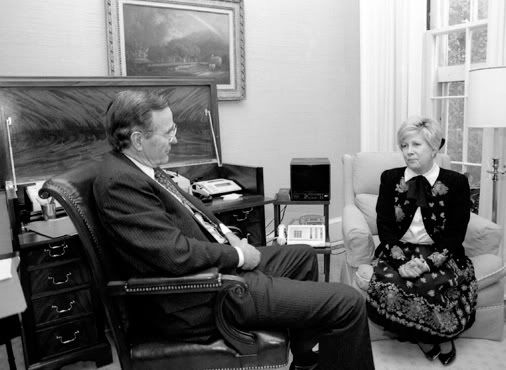
For TimesOnline,
Kitty Kelley writes:
Jennifer Fitzgerald toyed with the long string of pearls around her neck as she waited outside the Oval Office to have her farewell photo taken with President Gerald Ford. Just as the door opened, she broke the strand — but not her stride. She smiled and let the broken pearls dangle as she posed with the president.
It was November 30, 1974. Fitzgerald, personal assistant to one of Ford’s aides, was leaving for the People’s Republic of China to become secretary to the new chief of the American mission there, George Bush.
Bush could hardly wait. His first entry in the new diary he started in Beijing said how much he was looking forward to her arrival.
He had never been a compulsive womaniser. Rather, he maintained a few flirtatious relationships which his wife Barbara had tolerated because he never humiliated her. He chose his involvements very carefully (usually out of town) so as not to threaten his marriage.
Then along came Fitzgerald, who started out as his secretary and became so much more. Short, blonde and pretty, Jennifer Ann Isobel Patteson-Knight Fitzgerald was 42 years old and divorced when Bush first met her in Washington during the tumultuous months of the Watergate scandal. He was chairman of the Republican National Committee; she worked for one of the committee’s officials.
Professionally, Bush’s move from Washington to Beijing would enhance his credentials as he clawed his way to the presidency; but personally it would discombobulate his 30-year-old marriage, prompt his wife to burn her love letters and eventually lead to her severe depression.
“It wasn’t just another woman,” said someone close to the situation, discussing the wedge that came between Bush and Barbara. “It was a woman who came to exert enormous influence over George for many, many years . . . She became in essence his other wife . . . his office wife.”
In those days Beijing was a remote outpost for the staff of the small US mission. Bush told friends when he picked Fitzgerald to join him there that she would be his loyal “buffer” with Henry Kissinger’s State Department.
“I don’t know what particular skills she brought to the job,” recalled one former member of the mission. “She certainly couldn’t type.”
Before her arrival, Barbara Bush suddenly decided to leave Beijing, saying she wanted to spend Thanksgiving and Christmas with her children in America. She did not return for three months.
Fitzgerald landed in Beijing on December 5, 1974, and the next day she and Bush left for a 12-day diplomatic conference in Honolulu.
In his diary, he wrote: “Spent the last two days out of that Sheraton Waikiki madhouse and in the 4999 Kahala apartment — just lovely . . . Checked out the bathhouse again . . . Totally relaxing. Someday I will write a book on massages I have had . . .
“I must confess the Tokyo treatment is the best. Walking the back . . . combination of knees and oil . . . does wonders for the sacroiliac, and a little something for the morale too . . . Flew back to Peking on Iran Airlines. Jennifer and I alone in first class.”
They were not alone for long. Bush’s 73-year-old mother Dorothy had become concerned enough about Barbara’s departure to visit her son over the Christmas holidays.
Bush’s mother was the most important woman in his life. The day before her arrival he wrote: “Mother arrives tomorrow. I have that kind of high school excitement — first vacation feeling.”
“Dotty” Bush understood her son’s driving ambition, and she wanted Barbara to look the part of an important man’s wife. She had urged her white-haired daughter-in-law to try to improve her matronly appearance. Barbara might feel better, she suggested, with a little more exercise.
Long ago, Barbara had athletic skills that impressed the young Bush. They first met in 1941 at a country club Christmas dance in Greenwich, Connecticut. She was 16; he was 17. Neither had dated anyone else before nor even been romantically kissed.
Barbara played soccer and tennis and said she could hold her breath for two laps underwater, all of which validated her with the rampagingly athletic Bush family.
“They were two tomboys, locking each other in closets,” said Bush’s aunt, Mary Carter Walker.
Barbara’s elegant mother, however, would have preferred a more feminine daughter than this big-boned, overweight youngster. Feeling rejected, Barbara ate constantly and developed a caustic tongue.
With Bush she felt pretty for the first time, and he felt adored in turn. As his brother Jonathan said: “She was wild about him. And for George, if anyone wants to be wild about him, it’s fine with him.”
They married in 1944. Over the ensuing decades, as he first made a fortune in Texan oil and then used this to launch his political career, Barbara reinvented herself in the image of his mother.
“George recognised the type of person Barbara was when they first met,” said his friend Fitzhugh Green. “He had seen the same characteristics in his mother: a woman of strong character and personality, direct and honest; one who cares about the outdoors and people, especially children, and is oriented to home life . . . Anyone who has met both mother and wife can see they belong in the same category.”
Marian Javits, the widow of the late Senator Jacob Javits, agreed. “We visited them in China, and while I do not understand Barbara, I do know she adored George,” she said. “I think she saw that her biggest strength was to imitate his mother, almost become his mother . . . Barbara let herself look the way she did on purpose.”
Nadine Eckhardt, who saw a lot of Bush when her husband served in Congress with him, noted his “feminine” side. “George was very ‘femme’. Slim and silly and a hopeless flirt . . . he was cute and we were attracted to each other. It was sort of like when you’re attracted to a gay guy and you know nothing’s going to happen so you just forget about it and be friends.”
Bush and his wife understood and respected each other’s boundaries. Hers was home, where she reigned as the mother of his children; his was work, where he did what he did without threatening his wife’s security or social standing. While his attentions strayed over the years, his family commitment remained solid. He was a mommy’s man, constitutionally incapable of doing anything that would dishonour his mother, and to Dorothy Bush the one abomination that even God could not forgive was divorce.
Bush’s sojourn in Beijing did not last long. Always restless for the next appointment that might put him closer to becoming president, he rarely lasted more than a year in any of his jobs. He wrote to a friend: “I’m sitting out here trying to figure out what to do with my life.”
The answer came in a wire from Henry Kissinger marked “Secret sensitive exclusively eyes only”. It said Ford wanted to nominate him as the new director of the CIA.
“Oh, no, George,” said Barbara. But he said yes. And as a precondition, Bush insisted on bringing Jennifer Fitzgerald with him to the CIA as his confidential assistant. A memo in the Ford Presidential Library, dated November 23, 1975, states: “Please advise me as soon as you have completed office space arrangements for George Bush and Miss Fitzgerald.”
“It’s the most exciting job I’ve had to date,” Bush told friends. He signed personal letters “Head Spook”. Like a little boy, he tested agency disguises by wearing a red wig, false nose, and thick glasses to conduct an official meeting. “He got a big kick out of that,” said Osborne Day, who had been at Yale with him.
Bush was appointed to restore the CIA’s morale and public image after congressional hearings that had exposed its misdeeds — secretly testing drugs on human guinea pigs, spying on American citizens and plotting the assassination of foreign leaders.
Frank Sinatra saw him on television and decided to offer his services to the agency. As the singer was known to be connected to organised crime, the director of the CIA might have thought twice before meeting him; but Bush could hardly wait to meet the mafia’s favourite movie star. He brought Fitzgerald with him. They flew together from Washington to New York on a government plane.
“It was a great evening,” recalled Jonathan Bush, who hosted the meeting. “Sinatra made a very sincere and generous offer to help the CIA in any way possible. He said he was always flying around the world and meeting with people like the Shah of Iran and eating dinner with Prince Philip and socialising with the royal family of Great Britain.”
At the time, Barbara was dealing with a serious depression that more than once led her to the brink of suicide. “George was the only one in the family who knew about it,” Barbara told an interviewer many years later. “He was working such incredible long hours at his job, and I swore to myself I would not burden him.”
She admitted: “I was wallowing in self-pity. I almost wondered why he didn’t leave me. Sometimes the pain was so great, I felt the urge to drive into a tree or into an oncoming car. Then I would pull over to the side of the road until I felt okay.”
Barbara said she did not like his job at the CIA because he could not tell her the agency’s secrets, but in truth she had never played a significant role in his work, except for his political campaigns. Fitzgerald was privy to all that Barbara was not.
Like Beijing, the CIA job did not last. Jimmy Carter, who beat Ford for the presidency in 1976, wanted someone else to head the agency. Bush decided to return to Texas, join the boards of companies controlled by some of his rich friends and lay the foundation for his own presidential campaign. He told Barbara to head for Houston and buy a new house.
Then he looked after his “office wife”. He wrote to Kingman Brewster, the former president of Yale, who was about to become American ambassador to Britain, and obtained a job for Fitzgerald as his special assistant. Conveniently, one of the boards Bush was on had business that took him to London frequently.
“Jennifer only lasted for about a year,” said Brewster’s biographer, Geoffrey Kabaservice. “Kingman was irritated at her frequent absences going to the States to see George . . . Their relationship was no secret to the embassy staff. Everyone knew that she was George’s mistress.”
As his campaign for the presidency picked up speed, Bush set aside several intervals in which he told aides he would not be reachable. He claimed that he was flying to Washington for a secret meeting of former CIA directors. But according to former CIA directors, there were no meetings — secret or otherwise — during that period, and Bush had no assignments of any kind from the CIA.
Although Fitzgerald was a major involvement, she certainly was not the only “other woman” in Bush’s life. During his days at the Republican National Committee, there had been a woman in North Dakota who had divorced her husband and moved to Washington to be closer to Bush. Now, during the 1980 presidential campaign, he had an intense relationship with an attractive young blonde photographer. (After the election, he would offer her a job as his chief photographer, which she would decline because of their romance.)
Fitzgerald was kept out of the campaign at the insistence of James Baker, his old friend and campaign manager, who threatened to resign if he had to deal with “that impossible woman”, as he called her.
“Jennifer was his closest confidante, much to the consternation of many of his closest friends,” recalled the political consultant Ed Rollins. “The only guy able to stare Bush down about Jennifer was Jim Baker.”
Bush’s bid for the Republican presidential nomination failed, but he became Ronald Reagan’s running mate. After their election victory he insisted that Fitzgerald come back as part of his vice-presidential staff.
“I remember when Bush brought his secretaries over to see their new offices,” said Kathleen Lay Ambrose, a vice-presidential aide with the outgoing administration. “We were agog because each one of them was wearing a mink coat. That was such an eye-opener in 1981. Secretaries in mink coats!
“Jennifer Fitzgerald had the best of the minks, and we figured that was because she was . . . well . . . you know . . . Bush’s mistress.” Fitzgerald returned more powerful than ever and soon tangled with Bush’s top political aide, Rich Bond, who became so frustrated that he told the vice-president he would have to leave unless she was reined in.
“Jim Baker made me make that choice once before,” Bush said, “and I made the wrong choice.” Bond had no option but to resign.
Within weeks the new vice-president’s extramarital dalliances flashed up on Nancy Reagan’s radar screen, and she gleefully related every salacious morsel.
When Bush heard the president’s wife was “rumour-mongering”, he wrote in his diary: “I always knew Nancy didn’t like me very much, but there is nothing we can do about all of that. I feel sorry for her, but the main thing is, I feel sorry for President Reagan.”
Nancy lapped up an incident witnessed by some of the Reagans’ closest friends who were having dinner at Le Lion d’Or in Washington on the evening of March 18, 1981.
“Suddenly there was a great commotion as the security men accompanying the secretary of state (Alexander Haig) and the attorney-general (William French Smith) converged on our table,” recalled one of the five dinner guests. “They started jabbering into their walkie-talkies, and then whispered to Haig and Smith, who both jumped up and left the restaurant.
“The two men returned about 45 minutes later, laughing their heads off. They said they had had to bail out George Bush, who’d been in a traffic accident with his girlfriend. Bush had not wanted the incident to appear on the (Washington) DC police blotter, so he had his security men contact Haig and Smith. They took care of things for him, then came back to dinner.”
Michael Kernan, a former editor at The Washington Post, recalls another incident: “Bush was visiting a woman late at night over by the Chinese embassy on Connecticut Avenue and a fire broke out. The DC fire department came, but Bush’s secret service would not let the firemen into the building until they got the vice-president out the back door. We all knew about it at the paper,but nobody wrote about it in those days.”
For most of the Reagan presidency, Fitzgerald had the title of the vice-president’s “executive assistant”. In the spring of 1984 she accompanied him to nuclear disarmament talks in Geneva, where they registered in separate hotel rooms. One night a lawyer from the Arms Control and Disarmament Agency had to deliver some papers to Fitzgerald. The lawyer knocked on Fitzgerald’s door after midnight and was startled when Bush opened it in his pyjamas. After the talks, the vice-president and Fitzgerald shared a cottage, Chateau de Bellerive, on Lake Geneva.
Some aides wondered what Bush saw in Fitzgerald, who was now in her fifties and no longer the pretty divorcée he had first met.
“We all were aware of their relationship — whatever it was,” said an assistant to Craig Fuller, Bush’s chief of staff. “The younger women on staff just couldn’t fathom someone who looked as weirdly out of style as Jennifer sleeping with the vice-president. The men couldn’t figure it either, but there is no denying the connection between them.
“I can’t explain it, other than to say that Jennifer was a doter. She made George feel that he was God’s gift to mankind. She’d bat her eyes and gush all over him. She’d poof her hair, put on lipstick and spray perfume every time she walked into his office in her high stiletto heels.
“Still, she was probably a treat from Bar, who is no gusher. Bar would just as soon say ‘George, cut the crap’ as ‘open the door’. Jennifer was an ego trip for him. She made him feel good about himself.
“She catered to the vain and petty side of George Bush in ways that the rest of us would not have done. For example, he wanted his office on the Hill to be redecorated, and so Jennifer brought him decorator boards with colour schemes and styles and swatches. I remember he wanted blue draperies and threw a tantrum when the draperies weren’t the right shade of blue.
“I was stunned that the vice-president of the United States was focusing on something so small and incidental, but I guess that’s all he really had to do . . . By then he had become so intellectually lazy that he would not spend any time reading the briefs prepared for him. I think he had been a bureaucrat for so long that he simply relied on people to tell him what he needed to know. He did not think for himself. He was verbally inarticulate and could not enunciate a clear concept or formulate ideas.”
Another former member of the vice-president’s staff said: “She was a powerful woman in that she could influence the vice-president more than anyone else, but she was miserable for morale. She was insecure as far as her intellectual capacity because she did not have a college education.”
This source said everyone on his staff sighed with relief when Fitzgerald left the West Wing of the White House for Capitol Hill to become Bush’s chief lobbyist with Congress as he prepared his successful bid for the presidency in 1988.
“One of the reasons she wanted to transfer was to assert she had substantive knowledge and was not just a secretary/scheduler. In effect that’s really all the Veep’s congressional office did, but everyone wanted her out of the office, so they conspired to flatter her into thinking she’d be taken much more seriously if she transferred to the Hill. We all encouraged her in that fantasy and it worked . . . But it did not diminish her influence over the vice-president. It only got her out of our hair.”
“You cannot overestimate her influence on Bush,” said the former assistant to his chief of staff. “He went whenever she called. If she wanted him to meet with a senator or a congressman, we had to change his schedule to do it. Those were his orders.” This source added: “After he became president, Jennifer was shipped off to the State Department so there wouldn’t be any questions regarding their relationship. I also think Barbara did not want her in the White House.
“Whatever, there was a definite decision made that Jennifer would be a target so she had to be moved away from Bush. Jim Baker (the new secretary of state) was the only one who could counterbalance her. So they put her under him.”
Rumours about Fitzgerald started to surface at last in the media. Susan King, a television correspondent, did a story on the campaign whispers about Bush and other women. “He was furious with me,” King said. “I didn’t say in the piece that he and Jennifer were having an affair, and it’s not a story I’d submit for a prize, but it was legitimate to raise the issue because everyone was talking about it at the time. Barbara did not like Jennifer and did not want her around. That was clear to all of us on the campaign.”
In January 1989, after Bush’s presidential election victory, The Washington Post felt bold enough to report slyly: “Jennifer Fitzgerald, who has served president-elect George Bush in a variety of positions . . . is expected to be named deputy chief of protocol in the new administration.”
A year later the Post broke the story that she was fined $648 by the US Customs Service for “misdescribing” the value of a furlined raincoat ($1,100) and failing to declare a silver-fox cape ($1,300) after an official trip to Argentina for the inauguration of President Carlos Menem. Fitzgerald was suspended for two weeks without pay, but she did not lose her presidential appointment.
Barbara, meanwhile, came into her own at last as an extremely popular first lady who made the most of her grandmotherly image.
“I was working at CBS-TV when I first met the Bushes,” recalled Carol Ross Joynt. “He came into the green room with a grey-haired woman who I thought was his mother. Someone told me she was his wife, and I became fascinated by their dynamic because they were not a matched pair . . . He engaged women immediately. He’s not a lecher, but he makes eye contact with sexual energy. He’s polite and does not behave improperly — he’s no Bill Clinton — but the sexual message is there.
“She (Barbara) is oblivious to it all. She’s supremely confident and in charge of him like a mother overseeing her child. It’s clear that she’s the one in the relationship who totally wears the pants . . . it’s also clear that he relies on her.”
Roberta Hornig Draper, whose husband was the US consul-general in Jerusalem, met the Bushes when they visited Israel. “Barbara seemed to wet-nurse George like a little boy. She brushed the dandruff off his shoulders, she straightened his tie, and she was always pushing him along the way. She didn’t tie his shoes or wipe his runny nose, but you get the idea.”
Bush’s relationship with Fitzgerald finally became public during his re-election campaign in 1992, after the sexual peccadillos of the rival candidate, Bill Clinton, had already been well aired.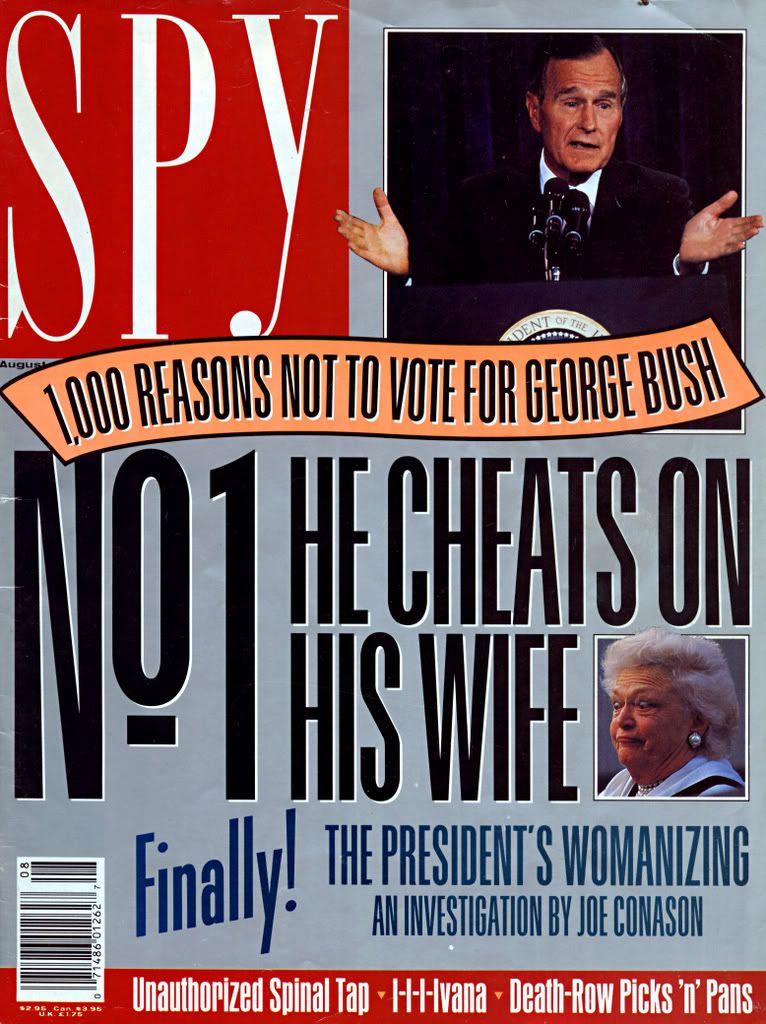
On August 11, the New York Post published a front page story headlined “The Bush affair”, complete with photos of Bush and Fitzgerald, who some people thought bore an eerie resemblance to Barbara.
Usually, the president of the United States does not have his entire family present at a press conference, but the White House made sure that his 91-year-old mother, his wife, his children, their spouses, their pets and all of the grandchildren buttressed Bush when he faced the media that morning.
Thin-lipped with anger, he branded the report a lie. Sensing his fury, one of his granddaughters burst into tears.
Barbara branded it “an outrage”. And Fitzgerald’s 86-year-old mother, Frances Patteson-Knight, whose home in Virginia was adorned with a wide selection of silver-framed photos of Jennifer and George Bush, dismissed it as “ridiculous”.
“Jennifer is completely tortured by this whole business,” she said. She doesn’t know what to do. She thinks it is all just horrible, horrible.”
She added, however, that her daughter — who by then was 60 — had not heard from the president. “She is very disappointed by Bush’s reaction . . . She respects him because he’s president, but doesn’t think he’s acted like a man here. She is very hurt by his lack of support. I don’t think he called her. If he did, she would be less desperate.”
The denials meant nothing to all those who had observed Bush and Fitzgerald together for two decades.
Years later, Carol Taylor Gray, the former wife of the White House counsel C Boyden Gray, said: “Jennifer was a fact of life in George’s life. Period. End of discussion. It was what it was. No one knew that better than my husband, who worked for George Bush for 12 years. We talked about it constantly . . . No one held it against George.
“Actually, I liked Jennifer — she was petite and attractive, and she made him happy, so I’m glad he had her in his life to give him a little joy . . . I know this is heresy to say because Barbara Bush is adored by the country and looks like such a sweet old grandmother, but the country doesn’t know her like I do . . . I don’t think she has a good heart . . . she’s not a nice woman.”
