Naomi Klein reports in Harper's:
It was only after I had been in Baghdad for a month that I found what I was looking for. I had traveled to Iraq a year after the war began, at the height of what should have been a construction boom, but after weeks of searching I had not seen a single piece of heavy machinery apart from tanks and humvees. Then I saw it: a construction crane. It was big and yellow and impressive, and when I caught a glimpse of it around a corner in a busy shopping district I thought that I was finally about to witness some of the reconstruction I had heard so much about. But as I got closer I noticed that the crane was not actually rebuilding anything—not one of the bombed-out government buildings that still lay in rubble all over the city, nor one of the many power lines that remained in twisted heaps even as the heat of summer was starting to bear down. No, the crane was hoisting a giant billboard to the top of a three-story building. SUNBULAH: HONEY 100% NATURAL, made in Saudi Arabia.
Seeing the sign, I couldn't help but think about something Senator John McCain had said back in October. Iraq, he said, is “a huge pot of honey that's attracting a lot of flies.” The flies McCain was referring to were the Halliburtons and Bechtels, as well as the venture capitalists who flocked to Iraq in the path cleared by Bradley Fighting Vehicles and laser-guided bombs. The honey that drew them was not just no-bid contracts and Iraq's famed oil wealth but the myriad investment opportunities offered by a country that had just been cracked wide open after decades of being sealed off, first by the nationalist economic policies of Saddam Hussein, then by asphyxiating United Nations sanctions.
Looking at the honey billboard, I was also reminded of the most common explanation for what has gone wrong in Iraq, a complaint echoed by everyone from John Kerry to Pat Buchanan: Iraq is mired in blood and deprivation because George W. Bush didn't have “a postwar plan.” The only problem with this theory is that it isn't true. The Bush Administration did have a plan for what it would do after the war; put simply, it was to lay out as much honey as possible, then sit back and wait for the flies.
The honey theory of Iraqi reconstruction stems from the most cherished belief of the war's ideological architects: that greed is good. Not good just for them and their friends but good for humanity, and certainly good for Iraqis. Greed creates profit, which creates growth, which creates jobs and products and services and everything else anyone could possibly need or want. The role of good government, then, is to create the optimal conditions for corporations to pursue their bottomless greed, so that they in turn can meet the needs of the society. The problem is that governments, even neoconservative governments, rarely get the chance to prove their sacred theory right: despite their enormous ideological advances, even George Bush's Republicans are, in their own minds, perennially sabotaged by meddling Democrats, intractable unions, and alarmist environmentalists.
Iraq was going to change all that. In one place on Earth, the theory would finally be put into practice in its most perfect and uncompromised form. A country of 25 million would not be rebuilt as it was before the war; it would be erased, disappeared. In its place would spring forth a gleaming showroom for laissez-faire economics, a utopia such as the world had never seen. Every policy that liberates multinational corporations to pursue their quest for profit would be put into place: a shrunken state, a flexible workforce, open borders, minimal taxes, no tariffs, no ownership restrictions. The people of Iraq would, of course, have to endure some short-term pain: assets, previously owned by the state, would have to be given up to create new opportunities for growth and investment. Jobs would have to be lost and, as foreign products flooded across the border, local businesses and family farms would, unfortunately, be unable to compete. But to the authors of this plan, these would be small prices to pay for the economic boom that would surely explode once the proper conditions were in place, a boom so powerful the country would practically rebuild itself.
The fact that the boom never came and Iraq continues to tremble under explosions of a very different sort should never be blamed on the absence of a plan. Rather, the blame rests with the plan itself, and the extraordinarily violent ideology upon which it is based.
Torturers believe that when electrical shocks are applied to various parts of the body simultaneously subjects are rendered so confused about where the pain is coming from that they become incapable of resistance. A declassified CIA “Counterintelligence Interrogation” manual from 1963 describes how a trauma inflicted on prisoners opens up “an interval—which may be extremely brief—of suspended animation, a kind of psychological shock or paralysis. . . . [A]t this moment the source is far more open to suggestion, far likelier to comply.” A similar theory applies to economic shock therapy, or “shock treatment,” the ugly term used to describe the rapid implementation of free-market reforms imposed on Chile in the wake of General Augusto Pinochet's coup. The theory is that if painful economic “adjustments” are brought in rapidly and in the aftermath of a seismic social disruption like a war, a coup, or a government collapse, the population will be so stunned, and so preoccupied with the daily pressures of survival, that it too will go into suspended animation, unable to resist. As Pinochet's finance minister, Admiral Lorenzo Gotuzzo, declared, “The dog's tail must be cut off in one chop.”
That, in essence, was the working thesis in Iraq, and in keeping with the belief that private companies are more suited than governments for virtually every task, the White House decided to privatize the task of privatizing Iraq's state-dominated economy. Two months before the war began, USAID began drafting a work order, to be handed out to a private company, to oversee Iraq's “transition to a sustainable market-driven economic system.” The document states that the winning company (which turned out to be the KPMG offshoot Bearing Point) will take “appropriate advantage of the unique opportunity for rapid progress in this area presented by the current configuration of political circumstances.” Which is precisely what happened.
L. Paul Bremer, who led the U.S. occupation of Iraq from May 2, 2003, until he caught an early flight out of Baghdad on June 28, admits that when he arrived, “Baghdad was on fire, literally, as I drove in from the airport.” But before the fires from the “shock and awe” military onslaught were even extinguished, Bremer unleashed his shock therapy, pushing through more wrenching changes in one sweltering summer than the International Monetary Fund has managed to enact over three decades in Latin America. Joseph Stiglitz, Nobel laureate and former chief economist at the World Bank, describes Bremer's reforms as “an even more radical form of shock therapy than pursued in the former Soviet world.”
The tone of Bremer's tenure was set with his first major act on the job: he fired 500,000 state workers, most of them soldiers, but also doctors, nurses, teachers, publishers, and printers. Next, he flung open the country's borders to absolutely unrestricted imports: no tariffs, no duties, no inspections, no taxes. Iraq, Bremer declared two weeks after he arrived, was “open for business.”
One month later, Bremer unveiled the centerpiece of his reforms. Before the invasion, Iraq's non-oil-related economy had been dominated by 200 state-owned companies, which produced everything from cement to paper to washing machines. In June, Bremer flew to an economic summit in Jordan and announced that these firms would be privatized immediately. “Getting inefficient state enterprises into private hands,” he said, “is essential for Iraq's economic recovery.” It would be the largest state liquidation sale since the collapse of the Soviet Union.
But Bremer's economic engineering had only just begun. In September, to entice foreign investors to come to Iraq, he enacted a radical set of laws unprecedented in their generosity to multinational corporations. There was Order 37, which lowered Iraq's corporate tax rate from roughly 40 percent to a flat 15 percent. There was Order 39, which allowed foreign companies to own 100 percent of Iraqi assets outside of the natural-resource sector. Even better, investors could take 100 percent of the profits they made in Iraq out of the country; they would not be required to reinvest and they would not be taxed. Under Order 39, they could sign leases and contracts that would last for forty years. Order 40 welcomed foreign banks to Iraq under the same favorable terms. All that remained of Saddam Hussein's economic policies was a law restricting trade unions and collective bargaining.
If these policies sound familiar, it's because they are the same ones multinationals around the world lobby for from national governments and in international trade agreements. But while these reforms are only ever enacted in part, or in fits and starts, Bremer delivered them all, all at once. Overnight, Iraq went from being the most isolated country in the world to being, on paper, its widest-open market.
At first, the shock-therapy theory seemed to hold: Iraqis, reeling from violence both military and economic, were far too busy staying alive to mount a political response to Bremer's campaign. Worrying about the privatization of the sewage system was an unimaginable luxury with half the population lacking access to clean drinking water; the debate over the flat tax would have to wait until the lights were back on. Even in the international press, Bremer's new laws, though radical, were easily upstaged by more dramatic news of political chaos and rising crime.
Some people were paying attention, of course. That autumn was awash in “rebuilding Iraq” trade shows, in Washington, London, Madrid, and Amman. The Economist described Iraq under Bremer as “a capitalist dream,” and a flurry of new consulting firms were launched promising to help companies get access to the Iraqi market, their boards of directors stacked with well-connected Republicans. The most prominent was New Bridge Strategies, started by Joe Allbaugh, former Bush-Cheney campaign manager. “Getting the rights to distribute Procter & Gamble products can be a gold mine,” one of the company's partners enthused. “One well-stocked 7-Eleven could knock out thirty Iraqi stores; a Wal-Mart could take over the country.”
Soon there were rumors that a McDonald's would be opening up in downtown Baghdad, funding was almost in place for a Starwood luxury hotel, and General Motors was planning to build an auto plant. On the financial side, HSBC would have branches all over the country, Citigroup was preparing to offer substantial loans guaranteed against future sales of Iraqi oil, and the bell was going to ring on a New York‒style stock exchange in Baghdad any day.
In only a few months, the postwar plan to turn Iraq into a laboratory for the neocons had been realized. Leo Strauss may have provided the intellectual framework for invading Iraq preemptively, but it was that other University of Chicago professor, Milton Friedman, author of the anti-government manifesto Capitalism and Freedom, who supplied the manual for what to do once the country was safely in America's hands. This represented an enormous victory for the most ideological wing of the Bush Administration. But it was also something more: the culmination of two interlinked power struggles, one among Iraqi exiles advising the White House on its postwar strategy, the other within the White House itself.
As the British historian Dilip Hiro has shown, in Secrets and Lies: Operation ‘Iraqi Freedom’ and After, the Iraqi exiles pushing for the invasion were divided, broadly, into two camps. On one side were “the pragmatists,” who favored getting rid of Saddam and his immediate entourage, securing access to oil, and slowly introducing free-market reforms. Many of these exiles were part of the State Department's Future of Iraq Project, which generated a thirteen-volume report on how to restore basic services and transition to democracy after the war. On the other side was the “Year Zero” camp, those who believed that Iraq was so contaminated that it needed to be rubbed out and remade from scratch. The prime advocate of the pragmatic approach was Iyad Allawi, a former high-level Baathist who fell out with Saddam and started working for the CIA. The prime advocate of the Year Zero approach was Ahmad Chalabi, whose hatred of the Iraqi state for expropriating his family's assets during the 1958 revolution ran so deep he longed to see the entire country burned to the ground—everything, that is, but the Oil Ministry, which would be the nucleus of the new Iraq, the cluster of cells from which an entire nation would grow. He called this process “de-Baathification.”
A parallel battle between pragmatists and true believers was being waged within the Bush Administration. The pragmatists were men like Secretary of State Colin Powell and General Jay Garner, the first U.S. envoy to postwar Iraq. General Garner's plan was straightforward enough: fix the infrastructure, hold quick and dirty elections, leave the shock therapy to the International Monetary Fund, and concentrate on securing U.S. military bases on the model of the Philippines. “I think we should look right now at Iraq as our coaling station in the Middle East,” he told the BBC. He also paraphrased T. E. Lawrence, saying, “It's better for them to do it imperfectly than for us to do it for them perfectly.” On the other side was the usual cast of neoconservatives: Vice President Dick Cheney, Secretary of Defense Donald Rumsfeld (who lauded Bremer's “sweeping reforms” as “some of the most enlightened and inviting tax and investment laws in the free world”), Deputy Secretary of Defense Paul Wolfowitz, and, perhaps most centrally, Undersecretary of Defense Douglas Feith. Whereas the State Department had its Future of Iraq report, the neocons had USAID's contract with Bearing Point to remake Iraq's economy: in 108 pages, “privatization” was mentioned no fewer than fifty-one times. To the true believers in the White House, General Garner's plans for postwar Iraq seemed hopelessly unambitious. Why settle for a mere coaling station when you can have a model free market? Why settle for the Philippines when you can have a beacon unto the world?
The Iraqi Year Zeroists made natural allies for the White House neoconservatives: Chalabi's seething hatred of the Baathist state fit nicely with the neocons' hatred of the state in general, and the two agendas effortlessly merged. Together, they came to imagine the invasion of Iraq as a kind of Rapture: where the rest of the world saw death, they saw birth—a country redeemed through violence, cleansed by fire. Iraq wasn't being destroyed by cruise missiles, cluster bombs, chaos, and looting; it was being born again. April 9, 2003, the day Baghdad fell, was Day One of Year Zero.
While the war was being waged, it still wasn't clear whether the pragmatists or the Year Zeroists would be handed control over occupied Iraq. But the speed with which the nation was conquered dramatically increased the neocons' political capital, since they had been predicting a “cakewalk” all along. Eight days after George Bush landed on that aircraft carrier under a banner that said MISSION ACCOMPLISHED, the President publicly signed on to the neocons' vision for Iraq to become a model corporate state that would open up the entire region. On May 9, Bush proposed the “establishment of a U.S.-Middle East free trade area within a decade”; three days later, Bush sent Paul Bremer to Baghdad to replace Jay Garner, who had been on the job for only three weeks. The message was unequivocal: the pragmatists had lost; Iraq would belong to the believers.
A Reagan-era diplomat turned entrepreneur, Bremer had recently proven his ability to transform rubble into gold by waiting exactly one month after the September 11 attacks to launch Crisis Consulting Practice, a security company selling “terrorism risk insurance” to multinationals. Bremer had two lieutenants on the economic front: Thomas Foley and Michael Fleischer, the heads of “private sector development” for the Coalition Provisional Authority (CPA). Foley is a Greenwich, Connecticut, multimillionaire, a longtime friend of the Bush family and a Bush-Cheney campaign “pioneer” who has described Iraq as a modern California “gold rush.” Fleischer, a venture capitalist, is the brother of former White House spokesman Ari Fleischer. Neither man had any high-level diplomatic experience and both use the term corporate “turnaround” specialist to describe what they do. According to Foley, this uniquely qualified them to manage Iraq's economy because it was “the mother of all turnarounds.”
Many of the other CPA postings were equally ideological. The Green Zone, the city within a city that houses the occupation headquarters in Saddam's former palace, was filled with Young Republicans straight out of the Heritage Foundation, all of them given responsibility they could never have dreamed of receiving at home. Jay Hallen, a twenty-four-year-old who had applied for a job at the White House, was put in charge of launching Baghdad's new stock exchange. Scott Erwin, a twenty-one-year-old former intern to Dick Cheney, reported in an email home that “I am assisting Iraqis in the management of finances and budgeting for the domestic security forces.” The college senior's favorite job before this one? “My time as an ice-cream truck driver.” In those early days, the Green Zone felt a bit like the Peace Corps, for people who think the Peace Corps is a communist plot. It was a chance to sleep on cots, wear army boots, and cry “incoming”—all while being guarded around the clock by real soldiers.
The teams of KPMG accountants, investment bankers, think-tank lifers, and Young Republicans that populate the Green Zone have much in common with the IMF missions that rearrange the economies of developing countries from the presidential suites of Sheraton hotels the world over. Except for one rather significant difference: in Iraq they were not negotiating with the government to accept their “structural adjustments” in exchange for a loan; they were the government.
Some small steps were taken, however, to bring Iraq's U.S.-appointed politicians inside. Yegor Gaidar, the mastermind of Russia's mid-nineties privatization auction that gave away the country's assets to the reigning oligarchs, was invited to share his wisdom at a conference in Baghdad. Marek Belka, who as finance minister oversaw the same process in Poland, was brought in as well. The Iraqis who proved most gifted at mouthing the neocon lines were selected to act as what USAID calls local “policy champions”—men like Ahmad al Mukhtar, who told me of his countrymen, “They are lazy. The Iraqis by nature, they are very dependent. . . . They will have to depend on themselves, it is the only way to survive in the world today.” Although he has no economics background and his last job was reading the English-language news on television, al Mukhtar was appointed director of foreign relations in the Ministry of Trade and is leading the charge for Iraq to join the World Trade Organization.
I had been following the economic front of the war for almost a year before I decided to go to Iraq. I attended the “Rebuilding Iraq” trade shows, studied Bremer's tax and investment laws, met with contractors at their home offices in the United States, interviewed the government officials in Washington who are making the policies. But as I prepared to travel to Iraq in March to see this experiment in free-market utopianism up close, it was becoming increasingly clear that all was not going according to plan. Bremer had been working on the theory that if you build a corporate utopia the corporations will come—but where were they? American multinationals were happy to accept U.S. taxpayer dollars to reconstruct the phone or electricity systems, but they weren't sinking their own money into Iraq. There was, as yet, no McDonald's or Wal-Mart in Baghdad, and even the sales of state factories, announced so confidently nine months earlier, had not materialized.
Some of the holdup had to do with the physical risks of doing business in Iraq. But there were other more significant risks as well. When Paul Bremer shredded Iraq's Baathist constitution and replaced it with what The Economist greeted approvingly as “the wish list of foreign investors,” there was one small detail he failed to mention: It was all completely illegal. The CPA derived its legal authority from United Nations Security Council Resolution 1483, passed in May 2003, which recognized the United States and Britain as Iraq's legitimate occupiers. It was this resolution that empowered Bremer to unilaterally make laws in Iraq. But the resolution also stated that the U.S. and Britain must “comply fully with their obligations under international law including in particular the Geneva Conventions of 1949 and the Hague Regulations of 1907.” Both conventions were born as an attempt to curtail the unfortunate historical tendency among occupying powers to rewrite the rules so that they can economically strip the nations they control. With this in mind, the conventions stipulate that an occupier must abide by a country's existing laws unless “absolutely prevented” from doing so. They also state that an occupier does not own the “public buildings, real estate, forests and agricultural assets” of the country it is occupying but is rather their “administrator” and custodian, keeping them secure until sovereignty is reestablished. This was the true threat to the Year Zero plan: since America didn't own Iraq's assets, it could not legally sell them, which meant that after the occupation ended, an Iraqi government could come to power and decide that it wanted to keep the state companies in public hands, or, as is the norm in the Gulf region, to bar foreign firms from owning 100 percent of national assets. If that happened, investments made under Bremer's rules could be expropriated, leaving firms with no recourse because their investments had violated international law from the outset.
By November, trade lawyers started to advise their corporate clients not to go into Iraq just yet, that it would be better to wait until after the transition. Insurance companies were so spooked that not a single one of the big firms would insure investors for “political risk,” that high-stakes area of insurance law that protects companies against foreign governments turning nationalist or socialist and expropriating their investments.
Even the U.S.-appointed Iraqi politicians, up to now so obedient, were getting nervous about their own political futures if they went along with the privatization plans. Communications Minister Haider al-Abadi told me about his first meeting with Bremer. “I said, ‘Look, we don't have the mandate to sell any of this. Privatization is a big thing. We have to wait until there is an Iraqi government.’” Minister of Industry Mohamad Tofiq was even more direct: “I am not going to do something that is not legal, so that's it.”
Both al-Abadi and Tofiq told me about a meeting—never reported in the press—that took place in late October 2003. At that gathering the twenty-five members of Iraq's Governing Council as well as the twenty-five interim ministers decided unanimously that they would not participate in the privatization of Iraq's state-owned companies or of its publicly owned infrastructure.
But Bremer didn't give up. International law prohibits occupiers from selling state assets themselves, but it doesn't say anything about the puppet governments they appoint. Originally, Bremer had pledged to hand over power to a directly elected Iraqi government, but in early November he went to Washington for a private meeting with President Bush and came back with a Plan B. On June 30 the occupation would officially end—but not really. It would be replaced by an appointed government, chosen by Washington. This government would not be bound by the international laws preventing occupiers from selling off state assets, but it would be bound by an “interim constitution,” a document that would protect Bremer's investment and privatization laws.
The plan was risky. Bremer's June 30 deadline was awfully close, and it was chosen for a less than ideal reason: so that President Bush could trumpet the end of Iraq's occupation on the campaign trail. If everything went according to plan, Bremer would succeed in forcing a “sovereign” Iraqi government to carry out his illegal reforms. But if something went wrong, he would have to go ahead with the June 30 handover anyway because by then Karl Rove, and not Dick Cheney or Donald Rumsfeld, would be calling the shots. And if it came down to a choice between ideology in Iraq and the electability of George W. Bush, everyone knew which would win.
At first, Plan B seemed to be right on track. Bremer persuaded the Iraqi Governing Council to agree to everything: the new timetable, the interim government, and the interim constitution. He even managed to slip into the constitution a completely overlooked clause, Article 26. It stated that for the duration of the interim government, “The laws, regulations, orders and directives issued by the Coalition Provisional Authority . . . shall remain in force” and could only be changed after general elections are held.
Bremer had found his legal loophole: There would be a window—seven months—when the occupation was officially over but before general elections were scheduled to take place. Within this window, the Hague and Geneva Conventions' bans on privatization would no longer apply, but Bremer's own laws, thanks to Article 26, would stand. During these seven months, foreign investors could come to Iraq and sign forty-year contracts to buy up Iraqi assets. If a future elected Iraqi government decided to change the rules, investors could sue for compensation.
But Bremer had a formidable opponent: Grand Ayatollah Ali al Sistani, the most senior Shia cleric in Iraq. al Sistani tried to block Bremer's plan at every turn, calling for immediate direct elections and for the constitution to be written after those elections, not before. Both demands, if met, would have closed Bremer's privatization window. Then, on March 2, with the Shia members of the Governing Council refusing to sign the interim constitution, five bombs exploded in front of mosques in Karbala and Baghdad, killing close to 200 worshipers. General John Abizaid, the top U.S. commander in Iraq, warned that the country was on the verge of civil war. Frightened by this prospect, al Sistani backed down and the Shia politicians signed the interim constitution. It was a familiar story: the shock of a violent attack paved the way for more shock therapy.
When I arrived in Iraq a week later, the economic project seemed to be back on track. All that remained for Bremer was to get his interim constitution ratified by a Security Council resolution, then the nervous lawyers and insurance brokers could relax and the sell-off of Iraq could finally begin. The CPA, meanwhile, had launched a major new P.R. offensive designed to reassure investors that Iraq was still a safe and exciting place to do business. The centerpiece of the campaign was Destination Baghdad Exposition, a massive trade show for potential investors to be held in early April at the Baghdad International Fairgrounds. It was the first such event inside Iraq, and the organizers had branded the trade fair “DBX,” as if it were some sort of Mountain Dew‒sponsored dirt-bike race. In keeping with the extreme-sports theme, Thomas Foley traveled to Washington to tell a gathering of executives that the risks in Iraq are akin “to skydiving or riding a motorcycle, which are, to many, very acceptable risks.”
But three hours after my arrival in Baghdad, I was finding these reassurances extremely hard to believe. I had not yet unpacked when my hotel room was filled with debris and the windows in the lobby were shattered. Down the street, the Mount Lebanon Hotel had just been bombed, at that point the largest attack of its kind since the official end of the war. The next day, another hotel was bombed in Basra, then two Finnish businessmen were murdered on their way to a meeting in Baghdad. Brigadier General Mark Kimmitt finally admitted that there was a pattern at work: “the extremists have started shifting away from the hard targets . . . [and] are now going out of their way to specifically target softer targets.” The next day, the State Department updated its travel advisory: U.S. citizens were “strongly warned against travel to Iraq.”
The physical risks of doing business in Iraq seemed to be spiraling out of control. This, once again, was not part of the original plan. When Bremer first arrived in Baghdad, the armed resistance was so low that he was able to walk the streets with a minimal security entourage. During his first four months on the job, 109 U.S. soldiers were killed and 570 were wounded. In the following four months, when Bremer's shock therapy had taken effect, the number of U.S. casualties almost doubled, with 195 soldiers killed and 1,633 wounded. There are many in Iraq who argue that these events are connected—that Bremer's reforms were the single largest factor leading to the rise of armed resistance.
Take, for instance, Bremer's first casualties. The soldiers and workers he laid off without pensions or severance pay didn't all disappear quietly. Many of them went straight into the mujahedeen, forming the backbone of the armed resistance. “Half a million people are now worse off, and there you have the water tap that keeps the insurgency going. It's alternative employment,” says Hussain Kubba, head of the prominent Iraqi business group Kubba Consulting. Some of Bremer's other economic casualties also have failed to go quietly. It turns out that many of the businessmen whose companies are threatened by Bremer's investment laws have decided to make investments of their own—in the resistance. It is partly their money that keeps fighters in Kalashnikovs and RPGs.
These developments present a challenge to the basic logic of shock therapy: the neocons were convinced that if they brought in their reforms quickly and ruthlessly, Iraqis would be too stunned to resist. But the shock appears to have had the opposite effect; rather than the predicted paralysis, it jolted many Iraqis into action, much of it extreme. Haider al-Abadi, Iraq's minister of communication, puts it this way: “We know that there are terrorists in the country, but previously they were not successful, they were isolated. Now because the whole country is unhappy, and a lot of people don't have jobs . . . these terrorists are finding listening ears.”
Bremer was now at odds not only with the Iraqis who opposed his plans but with U.S military commanders charged with putting down the insurgency his policies were feeding. Heretical questions began to be raised: instead of laying people off, what if the CPA actually created jobs for Iraqis? And instead of rushing to sell off Iraq's 200 state-owned firms, how about putting them back to work?
From the start, the neocons running Iraq had shown nothing but disdain for Iraq's state-owned companies. In keeping with their Year Zero‒apocalyptic glee, when looters descended on the factories during the war, U.S. forces did nothing. Sabah Asaad, managing director of a refrigerator factory outside Baghdad, told me that while the looting was going on, he went to a nearby U.S. Army base and begged for help. “I asked one of the officers to send two soldiers and a vehicle to help me kick out the looters. I was crying. The officer said, ‘Sorry, we can't do anything, we need an order from President Bush.’” Back in Washington, Donald Rumsfeld shrugged. “Free people are free to make mistakes and commit crimes and do bad things.”
To see the remains of Asaad's football-field-size warehouse is to understand why Frank Gehry had an artistic crisis after September 11 and was briefly unable to design structures resembling the rubble of modern buildings. Asaad's looted and burned factory looks remarkably like a heavy-metal version of Gehry's Guggenheim in Bilbao, Spain, with waves of steel, buckled by fire, lying in terrifyingly beautiful golden heaps. Yet all was not lost. “The looters were good-hearted,” one of Asaad's painters told me, explaining that they left the tools and machines behind, “so we could work again.” Because the machines are still there, many factory managers in Iraq say that it would take little for them to return to full production. They need emergency generators to cope with daily blackouts, and they need capital for parts and raw materials. If that happened, it would have tremendous implications for Iraq's stalled reconstruction, because it would mean that many of the key materials needed to rebuild—cement and steel, bricks and furniture—could be produced inside the country.
But it hasn't happened. Immediately after the nominal end of the war, Congress appropriated $2.5 billion for the reconstruction of Iraq, followed by an additional $18.4 billion in October. Yet as of July 2004, Iraq's state-owned factories had been pointedly excluded from the reconstruction contracts. Instead, the billions have all gone to Western companies, with most of the materials for the reconstruction imported at great expense from abroad.
With unemployment as high as 67 percent, the imported products and foreign workers flooding across the borders have become a source of tremendous resentment in Iraq and yet another open tap fueling the insurgency. And Iraqis don't have to look far for reminders of this injustice; it's on display in the most ubiquitous symbol of the occupation: the blast wall. The ten-foot-high slabs of reinforced concrete are everywhere in Iraq, separating the protected—the people in upscale hotels, luxury homes, military bases, and, of course, the Green Zone—from the unprotected and exposed. If that wasn't injury enough, all the blast walls are imported, from Kurdistan, Turkey, or even farther afield, this despite the fact that Iraq was once a major manufacturer of cement, and could easily be again. There are seventeen state-owned cement factories across the country, but most are idle or working at only half capacity. According to the Ministry of Industry, not one of these factories has received a single contract to help with the reconstruction, even though they could produce the walls and meet other needs for cement at a greatly reduced cost. The CPA pays up to $1,000 per imported blast wall; local manufacturers say they could make them for $100. Minister Tofiq says there is a simple reason why the Americans refuse to help get Iraq's cement factories running again: among those making the decisions, “no one believes in the public sector.”Tofiq did say that several U.S. companies had expressed strong interest in buying the state-owned cement factories. This supports a widely held belief in Iraq that there is a deliberate strategy to neglect the state firms so that they can be sold more cheaply--a practice known as "starve then sell."
This kind of ideological blindness has turned Iraq's occupiers into prisoners of their own policies, hiding behind walls that, by their very existence, fuel the rage at the U.S. presence, thereby feeding the need for more walls. In Baghdad the concrete barriers have been given a popular nickname: Bremer Walls.
As the insurgency grew, it soon became clear that if Bremer went ahead with his plans to sell off the state companies, it could worsen the violence. There was no question that privatization would require layoffs: the Ministry of Industry estimates that roughly 145,000 workers would have to be fired to make the firms desirable to investors, with each of those workers supporting, on average, five family members. For Iraq's besieged occupiers the question was: Would these shock-therapy casualties accept their fate or would they rebel?
The answer arrived, in rather dramatic fashion, at one of the largest state-owned companies, the General Company for Vegetable Oils. The complex of six factories in a Baghdad industrial zone produces cooking oil, hand soap, laundry detergent, shaving cream, and shampoo. At least that is what I was told by a receptionist who gave me glossy brochures and calendars boasting of “modern instruments” and “the latest and most up to date developments in the field of industry.” But when I approached the soap factory, I discovered a group of workers sleeping outside a darkened building. Our guide rushed ahead, shouting something to a woman in a white lab coat, and suddenly the factory scrambled into activity: lights switched on, motors revved up, and workers—still blinking off sleep—began filling two-liter plastic bottles with pale blue Zahi brand dishwashing liquid.
I asked Nada Ahmed, the woman in the white coat, why the factory wasn't working a few minutes before. She explained that they have only enough electricity and materials to run the machines for a couple of hours a day, but when guests arrive—would-be investors, ministry officials, journalists—they get them going. “For show,” she explained. Behind us, a dozen bulky machines sat idle, covered in sheets of dusty plastic and secured with duct tape.
In one dark corner of the plant, we came across an old man hunched over a sack filled with white plastic caps. With a thin metal blade lodged in a wedge of wax, he carefully whittled down the edges of each cap, leaving a pile of shavings at his feet. “We don't have the spare part for the proper mold, so we have to cut them by hand,” his supervisor explained apologetically. “We haven't received any parts from Germany since the sanctions began.” I noticed that even on the assembly lines that were nominally working there was almost no mechanization: bottles were held under spouts by hand because conveyor belts don't convey, lids once snapped on by machines were being hammered in place with wooden mallets. Even the water for the factory was drawn from an outdoor well, hoisted by hand, and carried inside.
The solution proposed by the U.S. occupiers was not to fix the plant but to sell it, and so when Bremer announced the privatization auction back in June 2003 this was among the first companies mentioned. Yet when I visited the factory in March, nobody wanted to talk about the privatization plan; the mere mention of the word inside the plant inspired awkward silences and meaningful glances. This seemed an unnatural amount of subtext for a soap factory, and I tried to get to the bottom of it when I interviewed the assistant manager. But the interview itself was equally odd: I had spent half a week setting it up, submitting written questions for approval, getting a signed letter of permission from the minister of industry, being questioned and searched several times. But when I finally began the interview, the assistant manager refused to tell me his name or let me record the conversation. “Any manager mentioned in the press is attacked afterwards,” he said. And when I asked whether the company was being sold, he gave this oblique response: “If the decision was up to the workers, they are against privatization; but if it's up to the high-ranking officials and government, then privatization is an order and orders must be followed.”
I left the plant feeling that I knew less than when I'd arrived. But on the way out of the gates, a young security guard handed my translator a note. He wanted us to meet him after work at a nearby restaurant, “to find out what is really going on with privatization.” His name was Mahmud, and he was a twenty-five-year-old with a neat beard and big black eyes. (For his safety, I have omitted his last name.) His story began in July, a few weeks after Bremer's privatization announcement. The company's manager, on his way to work, was shot to death. Press reports speculated that the manager was murdered because he was in favor of privatizing the plant, but Mahmud was convinced that he was killed because he opposed the plan. “He would never have sold the factories like the Americans want. That's why they killed him.”
The dead man was replaced by a new manager, Mudhfar Ja'far. Shortly after taking over, Ja'far called a meeting with ministry officials to discuss selling off the soap factory, which would involve laying off two thirds of its employees. Guarding that meeting were several security officers from the plant. They listened closely to Ja'far's plans and promptly reported the alarming news to their coworkers. “We were shocked,” Mahmud recalled. “If the private sector buys our company, the first thing they would do is reduce the staff to make more money. And we will be forced into a very hard destiny, because the factory is our only way of living.”
Frightened by this prospect, a group of seventeen workers, including Mahmud, marched into Ja'far's office to confront him on what they had heard. “Unfortunately, he wasn't there, only the assistant manager, the one you met,” Mahmud told me. A fight broke out: one worker struck the assistant manager, and a bodyguard fired three shots at the workers. The crowd then attacked the bodyguard, took his gun, and, Mahmud said, “stabbed him with a knife in the back three times. He spent a month in the hospital.” In January there was even more violence. On their way to work, Ja'far, the manager, and his son were shot and badly injured. Mahmud told me he had no idea who was behind the attack, but I was starting to understand why factory managers in Iraq try to keep a low profile.
At the end of our meeting, I asked Mahmud what would happen if the plant was sold despite the workers' objections. “There are two choices,” he said, looking me in the eye and smiling kindly. “Either we will set the factory on fire and let the flames devour it to the ground, or we will blow ourselves up inside of it. But it will not be privatized.”
If there ever was a moment when Iraqis were too disoriented to resist shock therapy, that moment has definitely passed. Labor relations, like everything else in Iraq, has become a blood sport. The violence on the streets howls at the gates of the factories, threatening to engulf them. Workers fear job loss as a death sentence, and managers, in turn, fear their workers, a fact that makes privatization distinctly more complicated than the neocons foresaw.It is in Basra where the connections between economic reforms and the rise of the resistance was put in starkest terms. In December the union representing oil workers was negotiating with the Oil Ministry for a salary increase. Getting nowhere, the workers offered the ministry a simple choice: increase their paltry salaries or they would all join the armed resistance. They received a substantial raise.
As I left the meeting with Mahmud, I got word that there was a major demonstration outside the CPA headquarters. Supporters of the radical young cleric Moqtada al Sadr were protesting the closing of their newspaper, al Hawza, by military police. The CPA accused al Hawza of publishing “false articles” that could “pose the real threat of violence.” As an example, it cited an article that claimed Bremer “is pursuing a policy of starving the Iraqi people to make them preoccupied with procuring their daily bread so they do not have the chance to demand their political and individual freedoms.” To me it sounded less like hate literature than a concise summary of Milton Friedman's recipe for shock therapy.
A few days before the newspaper was shut down, I had gone to Kufa during Friday prayers to listen to al Sadr at his mosque. He had launched into a tirade against Bremer's newly signed interim constitution, calling it “an unjust, terrorist document.” The message of the sermon was clear: Grand Ayatollah Ali al Sistani may have backed down on the constitution, but al Sadr and his supporters were still determined to fight it—and if they succeeded they would sabotage the neocons' careful plan to saddle Iraq's next government with their “wish list” of laws. With the closing of the newspaper, Bremer was giving al Sadr his response: he wasn't negotiating with this young upstart; he'd rather take him out with force.
When I arrived at the demonstration, the streets were filled with men dressed in black, the soon-to-be legendary Mahdi Army. It struck me that if Mahmud lost his security guard job at the soap factory, he could be one of them. That's who al Sadr's foot soldiers are: the young men who have been shut out of the neocons' grand plans for Iraq, who see no possibilities for work, and whose neighborhoods have seen none of the promised reconstruction. Bremer has failed these young men, and everywhere that he has failed, Moqtada al Sadr has cannily set out to succeed. In Shia slums from Baghdad to Basra, a network of Sadr Centers coordinate a kind of shadow reconstruction. Funded through donations, the centers dispatch electricians to fix power and phone lines, organize local garbage collection, set up emergency generators, run blood drives, direct traffic where the streetlights don't work. And yes, they organize militias too. Al Sadr took Bremer's economic casualties, dressed them in black, and gave them rusty Kalashnikovs. His militiamen protected the mosques and the state factories when the occupation authorities did not, but in some areas they also went further, zealously enforcing Islamic law by torching liquor stores and terrorizing women without the veil. Indeed, the astronomical rise of the brand of religious fundamentalism that al Sadr represents is another kind of blowback from Bremer's shock therapy: if the reconstruction had provided jobs, security, and services to Iraqis, al Sadr would have been deprived of both his mission and many of his newfound followers.
At the same time as al Sadr's followers were shouting “Down with America” outside the Green Zone, something was happening in another part of the country that would change everything. Four American mercenary soldiers were killed in Fallujah, their charred and dismembered bodies hung like trophies over the Euphrates. The attacks would prove a devastating blow for the neocons, one from which they would never recover. With these images, investing in Iraq suddenly didn't look anything like a capitalist dream; it looked like a macabre nightmare made real.
The day I left Baghdad was the worst yet. Fallujah was under siege and Brig. Gen. Kimmitt was threatening to “destroy the al-Mahdi Army.” By the end, roughly 2,000 Iraqis were killed in these twin campaigns. I was dropped off at a security checkpoint several miles from the airport, then loaded onto a bus jammed with contractors lugging hastily packed bags. Although no one was calling it one, this was an evacuation: over the next week 1,500 contractors left Iraq, and some governments began airlifting their citizens out of the country. On the bus no one spoke; we all just listened to the mortar fire, craning our necks to see the red glow. A guy carrying a KPMG briefcase decided to lighten things up. “So is there business class on this flight?” he asked the silent bus. From the back, somebody called out, “Not yet.”
Indeed, it may be quite a while before business class truly arrives in Iraq. When we landed in Amman, we learned that we had gotten out just in time. That morning three Japanese civilians were kidnapped and their captors were threatening to burn them alive. Two days later Nicholas Berg went missing and was not seen again until the snuff film surfaced of his beheading, an even more terrifying message for U.S. contractors than the charred bodies in Fallujah. These were the start of a wave of kidnappings and killings of foreigners, most of them businesspeople, from a rainbow of nations: South Korea, Italy, China, Nepal, Pakistan, the Philippines, Turkey. By the end of June more than ninety contractors were reported dead in Iraq. When seven Turkish contractors were kidnapped in June, their captors asked the “company to cancel all contracts and pull out employees from Iraq.” Many insurance companies stopped selling life insurance to contractors, and others began to charge premiums as high as $10,000 a week for a single Western executive—the same price some insurgents reportedly pay for a dead American.
For their part, the organizers of DBX, the historic Baghdad trade fair, decided to relocate to the lovely tourist city of Diyarbakir in Turkey, “just 250 km from the Iraqi border.” An Iraqi landscape, only without those frightening Iraqis. Three weeks later just fifteen people showed up for a Commerce Department conference in Lansing, Michigan, on investing in Iraq. Its host, Republican Congressman Mike Rogers, tried to reassure his skeptical audience by saying that Iraq is “like a rough neighborhood anywhere in America.” The foreign investors, the ones who were offered every imaginable free-market enticement, are clearly not convinced; there is still no sign of them. Keith Crane, a senior economist at the Rand Corporation who has worked for the CPA, put it bluntly: “I don't believe the board of a multinational company could approve a major investment in this environment. If people are shooting at each other, it's just difficult to do business.” Hamid Jassim Khamis, the manager of the largest soft-drink bottling plant in the region, told me he can't find any investors, even though he landed the exclusive rights to produce Pepsi in central Iraq. “A lot of people have approached us to invest in the factory, but people are really hesitating now.” Khamis said he couldn't blame them; in five months he has survived an attempted assassination, a carjacking, two bombs planted at the entrance of his factory, and the kidnapping of his son.
Despite having been granted the first license for a foreign bank to operate in Iraq in forty years, HSBC still hasn't opened any branches, a decision that may mean losing the coveted license altogether. Procter & Gamble has put its joint venture on hold, and so has General Motors. The U.S. financial backers of the Starwood luxury hotel and multiplex have gotten cold feet, and Siemens AG has pulled most staff from Iraq. The bell hasn't rung yet at the Baghdad Stock Exchange—in fact you can't even use credit cards in Iraq's cash-only economy. New Bridge Strategies, the company that had gushed back in October about how “a Wal-Mart could take over the country,” is sounding distinctly humbled. “McDonald's is not opening anytime soon,” company partner Ed Rogers told the Washington Post. Neither is Wal-Mart. The Financial Times has declared Iraq “the most dangerous place in the world in which to do business.” It's quite an accomplishment: in trying to design the best place in the world to do business, the neocons have managed to create the worst, the most eloquent indictment yet of the guiding logic behind deregulated free markets.
The violence has not just kept investors out; it also forced Bremer, before he left, to abandon many of his central economic policies. Privatization of the state companies is off the table; instead, several of the state companies have been offered up for lease, but only if the investor agrees not to lay off a single employee. Thousands of the state workers that Bremer fired have been rehired, and significant raises have been handed out in the public sector as a whole. Plans to do away with the food-ration program have also been scrapped—it just doesn't seem like a good time to deny millions of Iraqis the only nutrition on which they can depend.
The final blow to the neocon dream came in the weeks before the handover. The White House and the CPA were rushing to get the U.N. Security Council to pass a resolution endorsing their handover plan. They had twisted arms to give the top job to former CIA agent Iyad Allawi, a move that will ensure that Iraq becomes, at the very least, the coaling station for U.S. troops that Jay Garner originally envisioned. But if major corporate investors were going to come to Iraq in the future, they would need a stronger guarantee that Bremer's economic laws would stick. There was only one way of doing that: the Security Council resolution had to ratify the interim constitution, which locked in Bremer's laws for the duration of the interim government. But al Sistani once again objected, this time unequivocally, saying that the constitution has been “rejected by the majority of the Iraqi people.” On June 8 the Security Council unanimously passed a resolution that endorsed the handover plan but made absolutely no reference to the constitution. In the face of this far-reaching defeat, George W. Bush celebrated the resolution as a historic victory, one that came just in time for an election trail photo op at the G-8 Summit in Georgia.
With Bremer's laws in limbo, Iraqi ministers are already talking openly about breaking contracts signed by the CPA. Citigroup's loan scheme has been rejected as a misuse of Iraq's oil revenues. Iraq's communication minister is threatening to renegotiate contracts with the three communications firms providing the country with its disastrously poor cell phone service. And the Lebanese and U.S. companies hired to run the state television network have been informed that they could lose their licenses because they are not Iraqi. “We will see if we can change the contract,” Hamid al-Kifaey, spokesperson for the Governing Council, said in May. “They have no idea about Iraq.” For most investors, this complete lack of legal certainty simply makes Iraq too great a risk.
But while the Iraqi resistance has managed to scare off the first wave of corporate raiders, there's little doubt that they will return. Whatever form the next Iraqi government takes—nationalist, Islamist, or free market—it will inherit a shattered nation with a crushing $120 billion debt. Then, as in all poor countries around the world, men in dark blue suits from the IMF will appear at the door, bearing loans and promises of economic boom, provided that certain structural adjustments are made, which will, of course, be rather painful at first but well worth the sacrifice in the end. In fact, the process has already begun: the IMF is poised to approve loans worth $2.5‒ $4.25 billion, pending agreement on the conditions. After an endless succession of courageous last stands and far too many lost lives, Iraq will become a poor nation like any other, with politicians determined to introduce policies rejected by the vast majority of the population, and all the imperfect compromises that will entail. The free market will no doubt come to Iraq, but the neoconservative dream of transforming the country into a free-market utopia has already died, a casualty of a greater dream—a second term for George W. Bush.
The great historical irony of the catastrophe unfolding in Iraq is that the shock-therapy reforms that were supposed to create an economic boom that would rebuild the country have instead fueled a resistance that ultimately made reconstruction impossible. Bremer's reforms unleashed forces that the neocons neither predicted nor could hope to control, from armed insurrections inside factories to tens of thousands of unemployed young men arming themselves. These forces have transformed Year Zero in Iraq into the mirror opposite of what the neocons envisioned: not a corporate utopia but a ghoulish dystopia, where going to a simple business meeting can get you lynched, burned alive, or beheaded. These dangers are so great that in Iraq global capitalism has retreated, at least for now. For the neocons, this must be a shocking development: their ideological belief in greed turns out to be stronger than greed itself.
Iraq was to the neocons what Afghanistan was to the Taliban: the one place on Earth where they could force everyone to live by the most literal, unyielding interpretation of their sacred texts. One would think that the bloody results of this experiment would inspire a crisis of faith: in the country where they had absolute free reign, where there was no local government to blame, where economic reforms were introduced at their most shocking and most perfect, they created, instead of a model free market, a failed state no right-thinking investor would touch. And yet the Green Zone neocons and their masters in Washington are no more likely to reexamine their core beliefs than the Taliban mullahs were inclined to search their souls when their Islamic state slid into a debauched Hades of opium and sex slavery. When facts threaten true believers, they simply close their eyes and pray harder.
Which is precisely what Thomas Foley has been doing. The former head of “private sector development” has left Iraq, a country he had described as “the mother of all turnarounds,” and has accepted another turnaround job, as co-chair of George Bush's reelection committee in Connecticut. On April 30 in Washington he addressed a crowd of entrepreneurs about business prospects in Baghdad. It was a tough day to be giving an upbeat speech: that morning the first photographs had appeared out of Abu Ghraib, including one of a hooded prisoner with electrical wires attached to his hands. This was another kind of shock therapy, far more literal than the one Foley had helped to administer, but not entirely unconnected. “Whatever you're seeing, it's not as bad as it appears,” Foley told the crowd. “You just need to accept that on faith.”
Thursday, September 30, 2004
| [+/-] |
"Baghdad Year Zero" |
Tuesday, September 7, 2004
| [+/-] |
State's Security Bureau Takes on Expanded Role |
Protective Force Grows in Terror Era
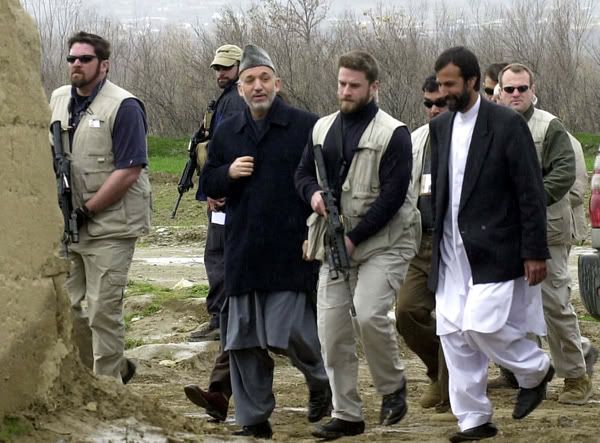 State Department security personnel shield Afghan President Hamid Karzai, arriving for a groundbreaking ceremony in the Bayan district. The department's security unit provides protection for some foreign leaders.
The Washington Post reports:
The State Department likes to call it the harbinger of both the CIA and the Department of Homeland Security.
One of the department's least-known operations emerged in the heated early days of World War I, when Secretary of State Robert Lansing was determined to hire someone to help him with security, espionage and intelligence threats, including the sensitive issue of tracking, expelling or interning diplomats from countries that were suddenly enemies. There was no CIA.
But wartime resources were tight in 1916, so the first "special agent" was paid out of Lansing's own pocket, according to State Department lore.
One agent soon grew to eight in the new Bureau of Secret Intelligence. But the quiet operation remained largely unknown even within government circles.
Nine decades later, with almost 1,400 special agents and a staff of 32,000, the renamed Bureau of Diplomatic Security has more agents deployed around the world than any other U.S. law enforcement agency. Its diverse and often dangerous missions are now on the frontline of the war on terrorism. Yet it remains little known -- deliberately.
At the recent Olympics, Diplomatic Security had about 100 agents embedded with the U.S. men's swimming team, women's gymnastics and several other teams, again more than any of the half-dozen or so U.S. agencies deployed in Athens.
During the 1995 raid in Islamabad, Pakistan, that captured World Trade Center bomber Ramzi Yousef, two agents were in the raid with Pakistani forces who seized him -- while the FBI waited outside. One agent had been the first to speak with the walk-in informant who identified Yousef's hideout. He then coordinated plans for the raid with Pakistani security forces.
Since the end of the U.S.-led occupation in Iraq on June 28, Diplomatic Security has taken over protection of the new U.S. Embassy in Baghdad, the largest diplomatic operation by any nation in the world.
It is also in charge of shielding about 7,000 American staff and many more relatives at the 265 U.S. embassies and consulates in 180 countries, an increasingly challenging mission since the 1998 bombings of the embassies in Kenya and Tanzania by al Qaeda. More than 200 were killed and more than 1,000 were injured in those al Qaeda attacks.
"The long tradition of diplomacy also has been marked by more sacrifice than most Americans will ever know. There are few professions more dangerous than the practice of foreign affairs, and there are few professionals who put more on the line for this nation than the agents of the Diplomatic Security service," Deputy Secretary of State Richard L. Armitage said last year.
In a role symbolic of its mission, one of the last people in the final helicopter to evacuate the U.S. Embassy during the fall of Saigon in 1975 was Leo Crampsey, Diplomatic Security's regional security officer, according to the State Department.
But its mission is far more than protection, U.S. officials say. Diplomatic Security is also in charge of investigations, from threats against the United States' diplomatic facilities overseas to visa and passport fraud, a central component in the war on terrorism.
Diplomatic Security's mission has expanded again recently to include the same service for foreign leaders. In Afghanistan, the bureau that normally protects Secretary of State Colin L. Powell and other high-profile U.S. diplomats is also now providing protection for President Hamid Karzai.
In Haiti, Diplomatic Security is protecting the interim president and prime minister while its agents train a new unit to replace them.
"We are a global force. The men and women who do this are not faint-hearted. Wherever the United States is threatened, you will find a Diplomatic Security person at work," said Ambassador Francis X. Taylor, assistant secretary of state for diplomatic security and director of the Office of Foreign Missions.
The bureau, which has doubled its number of special agents over the past dozen years as its duties have grown, also has a domestic mandate to protect visiting dignitaries. Those notables have included the Dalai Lama; Palestinian leader Yasser Arafat, when he visited the United Nations in the days when he was considered the leader of a terrorist group; and the Chinese table tennis team during its diplomatic icebreaking tour in the early 1970s, bureau officials said.
Although the Secret Service protects visiting heads of state, Diplomatic Security protects all other officials, including envoys from countries that do not have diplomatic relations with Washington, such as the Iranian foreign minister when he visits the United Nations.
"We analyze the threat and develop a security package and then work with his [security] people," a Diplomatic Security agent said.
Hundreds of agents will again be deployed in New York this month when foreign ministers and top officials of dozens of countries visit for the opening of the U.N. General Assembly, bureau officials said.
As a pivotal player in the war on terrorism since the bombing of two U.S. embassies in Beirut in 1983 and 1984, Diplomatic Security now runs the Anti-Terrorism Training Assistance program, which has trained more than 36,000 officials in 130 countries, according to the bureau. Its annual budget has grown from $5 million to $200 million.
It also administers the Rewards for Justice program -- which has paid out more than $57 million to about three dozen people since 1984 -- for information to "prevent, frustrate or resolve acts of terrorism against U.S. interests," according to State Department documents. That has included rewards for al Qaeda operatives as well as for the capture of Saddam Hussein's sons.
Diplomatic Security has an eclectic staff: Many have no background in the military, intelligence or law enforcement. The staff includes a genetic engineer, an astrophysicist, lawyers, a photojournalist and even a former herpetologist with the Philadelphia Zoo. All go through specialized courses that cover such things as intelligence, counterterrorism, languages and "sensitivity training" about foreign cultures.
"We are part of the foreign service and represent the U.S. across the board, so we try to recruit people with diverse backgrounds," said a senior Diplomatic Security official who spoke on the condition of anonymity because many do not want to be identified publicly. "We have one of the most highly educated forces in government."
Saturday, August 28, 2004
| [+/-] |
Club of the Most Powerful Gathers in Strictest Privacy |
The New York Times reports:
Three times a year for 23 years, a little-known club of a few hundred of the most powerful conservatives in the country have met behind closed doors at undisclosed locations for a confidential conference, the Council for National Policy, to strategize about how to turn the country to the right.
Details are closely guarded.
''The media should not know when or where we meet or who takes part in our programs, before of after a meeting,'' a list of rules obtained by The New York Times advises the attendees.
The membership list is ''strictly confidential.'' Guests may attend ''only with the unanimous approval of the executive committee.'' In e-mail messages to one another, members are instructed not to refer to the organization by name, to protect against leaks.
This week, before the Republican convention, the members quietly convened in New York, holding their latest meeting almost in plain sight, at the Plaza Hotel, for what a participant called ''a pep rally'' to re-elect President Bush.
Mr. Bush addressed the group in fall 1999 to solicit support for his campaign, stirring a dispute when news of his speech leaked and Democrats demanded he release a tape recording. He did not.
Not long after the Iraq invasion, Vice President Dick Cheney and Defense Secretary Donald H. Rumsfeld attended a council meeting.
This week, as the Bush campaign seeks to rally Christian conservative leaders to send Republican voters to the polls, several Bush administration and campaign officials were on hand, according to an agenda obtained by The New York Times.
''The destiny of our nation is on the shoulders of the conservative movement,'' the Senate majority leader, Bill Frist, Republican of Tennessee, told the gathering as he accepted its Thomas Jefferson award on Thursday, according to an attendee's notes.
The secrecy that surrounds the meeting and attendees like the Rev. Jerry Falwell, Phyllis Schlafly and the head of the National Rifle Association, among others, makes it a subject of suspicion, at least in the minds of the few liberals aware of it.
''The real crux of this is that these are the genuine leaders of the Republican Party, but they certainly aren't going to be visible on television next week,'' Barry W. Lynn, executive director of Americans United for Separation of Church and State, said.
Mr. Lynn was referring to the list of moderate speakers like Gov. Arnold Schwarzenegger of California and former Mayor Rudolph W. Giuliani of New York who are scheduled to speak at the convention.
''The C.N.P. members are not going to be visible next week,'' he said. ''But they are very much on the minds of George W. Bush and Karl Rove every week of the year, because these are the real powers in the party.''
A spokesman for the White House, Trent Duffy, said: ''The American people are quite clear and know what the president's agenda is. He talks about it every day in public forums, not to any secret group of conservatives or liberals. And he will be talking about his agenda on national television in less than a week.''
The administration and re-election effort were major focuses of the group's meeting on Thursday and yesterday. Under Secretary of State John Bolton spoke about plans for Iran, a spokesman for the State Department said.
Likewise, a spokesman for Assistant Attorney General R. Alexander Acosta confirmed that Mr. Acosta had addressed efforts to stop ''human trafficking,'' a major issue among Christian conservatives.
Dr. Frist spoke about supporting Mr. Bush and limiting embryonic stem cell research, two attendees said. Dan Senor, who recently returned from Iraq after working as a spokesman for L. Paul Bremer III, the top American civilian administrator, was scheduled to provide an update on the situation there.
Among presentations on the elections, an adviser to Mr. Bush's campaign, Ralph Reed, spoke on ''The 2004 Elections: Who Will Win in November?,'' attendees said.
The council was founded in 1981, just as the modern conservative movement began its ascendance. The Rev. Tim LaHaye, an early Christian conservative organizer and the best-selling author of the ''Left Behind'' novels about an apocalyptic Second Coming, was a founder. His partners included Paul Weyrich, another Christian conservative political organizer who also helped found the Heritage Foundation.
They said at the time that they were seeking to create a Christian conservative alternative to what they believed was the liberalism of the Council on Foreign Relations.
A statement of its mission distributed this week said the council's purposes included ''to acquaint our membership with those in positions of leadership in our nation in order that mutual respect be fostered'' and ''to encourage the exchange of information concerning the methodology of working within the system to promote the values and ends sought by individual members.''
Membership costs several thousand dollars a year, a participant said. Its executive director, Steve Baldwin, did not return a phone call.
Over the years, the council has become a staging ground for conservative efforts to make the Republican Party more socially conservative. Ms. Schlafly, who helped build a grass-roots network to fight for socially conservative positions in the party, is a longstanding member.
At times, the council has also seen the party as part of the problem. In 1998, Dr. James Dobson of Focus on the Family spoke at the council to argue that Republicans were taking conservatives for granted. He said he voted for a third-party candidate in 1996.
Opposition to same-sex marriage was a major conference theme. Although conservatives and Bush campaign officials have denied seeking to use state ballot initiatives that oppose same-sex marriage as a tool to bring out conservative voters, the agenda includes a speech on ''Using Conservative Issues in Swing States,'' said Phil Burress, leader of an initiative drive in Ohio, a battleground state.
The membership list this year was a who's who of evangelical Protestant conservatives and their allies, including Dr. Dobson, Mr. Weyrich, Holland H. Coors of the beer dynasty; Wayne LaPierre of the National Riffle Association, Richard A. Viguerie of American Target Advertising, Mark Mix of the National Right to Work Committee and Grover Norquist of Americans for Tax Reform.
Not everyone present was a Bush supporter, however. This year, the council included speeches by Michael Badnarik of the Libertarian Party and Michael A. Peroutka of the ultraconservative Constitution Party. About a quarter of the members attended their speeches, an attendee said.
Nor was the gathering all business. On Wednesday, members had a dinner in the Rainbow Room, where William F. Buckley Jr. of the National Review was a special guest. At 10 p.m. on Thursday and Friday, members had ''prayer sessions'' in the Rose Room at the hotel.
Friday, August 6, 2004
| [+/-] |
McCain Criticizes Ad Attacking Kerry on Vietnam War Record |
The Washington Post reports:
Sen. John McCain (R-Ariz.) rushed to John F. Kerry's defense Thursday, condemning a new ad claiming the Democratic presidential nominee lied about his military record and betrayed his Vietnam comrades by protesting the war.
McCain, who was a prisoner of war in Vietnam, called on President Bush to condemn the ad, which was financed in part by a major Republican Party donor in Texas.
As McCain defended the Democratic nominee, Kerry for the first time criticized Bush for indecisiveness in the moments after the Sept. 11, 2001, terrorist attacks, underscoring how personal issues of war, terrorism and military service have become.
At a morning appearance before minority journalists in Washington, Kerry faulted Bush for spending seven minutes reading to Florida schoolchildren after learning the World Trade Center had been attacked. "Had I been reading to children and had my top aide whispered in my ear that America is under attack, I would have told those kids very nicely and politely that the president of the United States has something that he needs to attend to," Kerry said.
Rudolph W. Giuliani, the Republican mayor of New York on Sept. 11, was tapped by the Bush campaign to fire back. "John Kerry must be frustrated in his campaign if he is armchair-quarterbacking based on cues from Michael Moore," he said. Moore's film "Fahrenheit 9/11" ridicules Bush for continuing to read to youngsters once he learned of the attacks. Giuliani said Kerry is the "indecisive" candidate because he has "demonstrated an inconsistent position on the war on terror."
Still, it was McCain who again came to Kerry's defense at an opportune time for Democrats. McCain, who challenged Bush for the GOP nomination in 2000, has become a central, if sometimes reluctant, figure in the campaign -- for both sides. Kerry courted him as a potential running mate after McCain defended Kerry's war record on national television. At rallies, Kerry frequently cites his relationship with McCain as evidence of bipartisanship.
Bush has turned to McCain for political cover, too. The day Kerry announced Sen. John Edwards (N.C.) as his running mate, Bush released a TV ad in which McCain praised the president's wartime leadership. McCain, who is to deliver a keynote speech at the Republican National Convention this month, has made it clear he is backing Bush and plans to campaign for the Republican ticket with one big condition: He will not criticize Kerry.
On Thursday, McCain addressed the tussle over a new 60-second ad produced by a group calling itself Swift Boat Veterans for Truth. The group includes dozens of Vietnam veterans and claims Kerry exaggerated his wounds to win war medals and betrayed soldiers with his antiwar protesting after he returned from Vietnam. The group is organized as a Section 527 organization, which allows it to raise and spend unlimited "soft" money that federal candidates are prohibited from using.
A GOP firm based in Alexandria -- Stevens Reed Curcio & Potholm -- produced the spot, which began airing Thursday in Ohio, West Virginia and Wisconsin. The ad is part of a broader effort to discredit Kerry's war service that includes a new book, "Unfit for Command: Swift Boat Veterans Speak Out Against John Kerry." While the book will not be released until later this month, it was ranked first in sales Thursday on Amazon.com.
The general counsel for the Kerry campaign and the Democratic National Committee sent television stations a letter asking them not to run the ad because it is "an inflammatory, outrageous lie" by people purporting to have served with Kerry.
In an interview with the Associated Press, McCain called the ad "dishonest and dishonorable." Asked if the White House was behind it, McCain said: "I hope not, but I don't know. But I think the Bush campaign should specifically condemn the ad."
Soon after, White House spokesman Scott McClellan declined to do so and instead criticized the financing of the ad, saying the president "deplores all the unregulated soft-money activity." McClellan said the Bush campaign had nothing to do with the ad or the group behind it. "We have not and we will not question Kerry's service in Vietnam," he said. McClellan used the opportunity to call on Kerry to join Bush in demanding that all soft-money groups quit running ads. The overwhelming majority of such ads have targeted Bush, often harshly. Kerry campaign spokeswoman Stephanie Cutter said Kerry will not ask the groups to stop their advertising.
The back-and-forth over war and service came as Kerry reunited with Edwards to begin a campaign by train, as Missourian Harry S. Truman did six decades ago. Aboard the train pulling the same car, No. 403, used by Truman, Lyndon B. Johnson, Jimmy Carter and Bill Clinton, the Democratic ticket will weave through Missouri, Colorado and New Mexico en route to Arizona. The candidates will stop in several Republican strongholds as part of what they are calling the "believe in America tour."
In Kansas City, Mo., on Friday, Kerry is to propose new energy policies, including a $20 billion trust fund to develop new fuels and technologies. With oil and gasoline prices rising, Kerry will also call for new incentives and mandates to make automobiles more efficient and engineer them to run on alternative fuels such as ethanol and biodiesel.
At St. Louis's Union Station, Edwards played the optimist, leading the crowd in repeated chants of "Hope is on the way," while Kerry played a more muscular role, leading repeated chants of "Help is on the way." A policy book put out by the campaign captures the new dynamic: Edwards is shown with a sunny smile, and Kerry with his arm bent as if he is flexing his bicep.
"I can fight a more effective, smarter and better war on terror that actually makes America safer in the future," Kerry said to thousands of people gathered for the early-afternoon rally.
Kerry ignored the biggest political issue of the week here: the fight to outlaw same-sex marriage. Around 1.5 million Missourians turned out Tuesday to vote heavily in favor of a state ban on same-sex unions, a rousing endorsement that some contend could affect voting in this battleground state on Nov. 2.
At the St Louis rally, however, many voters were skeptical about claims that the issue may influence the presidential race. Instead, people talked of the economy and how the loss of manufacturing jobs has left the state scarred and struggling, with its economic recovery lagging far behind some states.
"I don't think gay marriage is going to be a big issue in Missouri -- people realize there are far more important issues at stake that affect everybody's lives, not just a few," said Joan McCarthy, 45, a database administrator here.
Rochelle Webber-Williams, 45, a Gulf War veteran, recited the mantra that jobs and the economy matter in Missouri above all else. "Personally I really don't care what people do behind closed doors. What I do care about is the economy and the war," she said. "People want a change from Bush more than anything else -- that's why I'm voting for Kerry."
Tuesday, July 20, 2004
| [+/-] |
The Handover That Wasn't |
Before his departure, CPA chief Paul Bremer issued 100 Orders to dramatically restructure Iraq's economy to fit free-market ideals. And no Iraqi, including future elected officials, can undo them
In Foreign Policy in Focus, Antonia Juhasz writes:
The U.S. occupation of Iraq officially ended on June 28, 2004 , in a secret ceremony in Baghdad. Officially, "full sovereignty" was handed from the Americans to the Iraqi Interim Government. But it was clear from the start that this was sovereignty in name, not in deed. First, there is the continued military occupation: 138,000 U.S. soldiers and Marines, plus 20,000 troops from other countries and an estimated 20,000 contractors, all fully under U.S. control and immune to Iraqi laws. Equally debilitating, however significantly less well reported upon, is the continued political and economic occupation by the Bush administration and its corporate allies.
The most important tools being used by the Bush administration to maintain varying degrees of economic and political control in Iraq are the 100 Orders enacted by L. Paul Bremer, III, head of the now defunct Coalition Provisional Authority (CPA) before his departure. It was thought that the "end" of the occupation would also mean the end of the Orders. Instead, in his final Order enacted on his last day in the country, Bremer simply transferred authority for the Orders over to the new Prime Minister, Iyad Allawi. For his part, Allawi – a thirty-year exile of Iraq with close ties to both the CIA and British Intelligence Services – is considered America 's new man in charge of Iraq .
Bremer also ensured the implementation of the Orders by stacking every Ministry with U.S.-appointed authorities with five-year terms – well into the period of the new, elected government, which is to take office by the end of this year.
The Orders are exercised pursuant to the Iraqi interim constitution, the Transitional Administration Law (TAL). The Annex to the TAL states that the Orders can only be overturned with the approval of the president, the two vice presidents and a majority of the ministers.
But the Annex also denies the interim government from taking "any actions affecting Iraq 's destiny" beyond the election of an Iraqi government. The identical sentence appears in UN Security Council Resolution 1546, which outlines Iraq's transition to "sovereignty." Thus, while Allawi may succeed in overturning a few less far-reaching Orders if for no other reason than to demonstrate his independence from the Americans, it is beyond his authority to change any fundamental laws.
And, as Bremer said about the Orders, "You set up these things and they begin to develop a certain life and momentum on their own – and it's harder to reverse course."
It is difficult to over-state how far-reaching the Orders are. As described in Order #39 on Foreign Investment, the Orders are intended to do no less than "transition [ Iraq ] from a ... centrally planned economy to a market economy." This goal is explained in greater detail by BearingPoint, Inc., the Virginia based corporation that received the $250 million contract to facilitate this transition. The contract states:
"It should be clearly understood that the efforts undertaken will be designed to establish the basic legal framework for a functioning market economy; taking appropriate advantage of the unique opportunity for rapid progress in this area presented by the current configuration of political circumstances... Reforms are envisioned in the areas of fiscal reform, financial sector reform, trade, legal and regulatory, and privatization."
The (New and Improved) Bremer Orders
A sampling of the most important Orders demonstrates the economic imprint left behind by Bremer:
Order #39 allows for the following: (1) privatization of Iraq's 200 state-owned enterprises; (2) 100 percent foreign ownership of Iraqi businesses; (3) "national treatment" of foreign firms; (4) unrestricted, tax-free remittance of all profits and other funds; and (5) 40-year ownership licenses. Thus, it allows the U.S. corporations operating in Iraq to own every business, do all of the work, and send all of their money home. Nothing needs to be reinvested locally to service the Iraqi economy, no Iraqi need be hired, no public services need be guaranteed, and workers' rights can easily be ignored. And corporations can take out their investments at any time.
Order #40 turns the banking sector from a state-run to a market-driven system overnight by allowing foreign banks to enter the Iraqi market and to purchase up to 50 percent of Iraqi banks.
Order #49 drops the tax rate on corporations from a high of 40 percent to a flat rate of 15 percent. The income tax rate is also capped at 15 percent.
Order #12 enacted on June 7, 2003 and renewed on February 24, 2004, suspends "all tariffs, customs duties, import taxes, licensing fees and similar surcharges for goods entering or leaving Iraq, and all other trade restrictions that may apply to such goods." This led to an immediate and dramatic inflow of cheap consumer products, which has essentially wiped out all local providers of the same products. This could have significant long-term implications for domestic production as well.
Order #17 grants foreign contractors, including private security firms, full immunity from Iraq 's laws. Even if they do injure a third party by killing someone or causing environmental damage such as dumping toxic chemicals or poisoning drinking water, the injured third party can not turn to the Iraqi legal system, rather, the charges must be brought to U.S. courts under U.S. laws.
Order #77 established the Board of Supreme Audit and named its president and his two deputies. The Board oversees inspectors in every Ministry with wide-ranging authority to review government contracts, audit classified programs, and prescribe regulations and procedures.
Order #57 created and appointed an inspector within every Iraqi Ministry with five-year terms who can perform audits, write policies, and have full access to all offices, materials, and employees of the Ministries.
Then there are the approximately 200 mostly U.S. and other international advisers who will remain embedded as consultants in every Iraqi Ministry well after the official occupation has ended.
Clearly, the Bremer Orders fundamentally altered Iraq's existing laws. For this reason, the Bremer Orders are also illegal. Transformation of an occupied country's laws violates the Hague regulations of 1907 (the companion to the 1949 Geneva conventions, both ratified by the United States), and the U.S. Army's Law of Land Warfare. Indeed, in a leaked memo, British attorney general, Lord Goldsmith, warned Tony Blair that "the imposition of major structural economic reforms would not be authorized by international law."
Following the Money
The U.S. will also exert significant control over Iraq by holding the strings to the largest purse in the country for the foreseeable future.
In June 2004, the U.S. General Accounting Office reported that the CPA had spent virtually all of Iraq's money but relatively little of its own since the end of "active engagement."
There are two primary pots of money earmarked for Iraq's reconstruction. The largest is the approximately $24 billion of U.S. taxpayer money appropriated by Congress last year. The second is known as the Development Fund for Iraq (DFI) worth about $18 billion. This is primarily money from Iraq's oil revenues and was controlled by the CPA until authority for the fund was handed over to the new Interim Government on June 28.
While the CPA controlled the DFI, it spent approximately $13 billion from the fund. On the other hand, it only spent about $8.2 billion of the U.S. appropriation. Thus, the DFI is almost out of money, while the U.S. appropriation has hardly been touched. Control of this money now shifts to John Negroponte, the new U.S. Ambassador to Iraq . In addition to the largest pot of money in Iraq , Negroponte will exercise control over one of the largest embassies in the entire world with some 1,500 employees with offices throughout Iraq .
Pay for the Reconstruction
Reconstruction is the one thing that the U.S. is obligated under international law to do in Iraq . U.S. taxpayers have pledged billions of dollars toward this effort. However, the New York Times reported on June 30, 2004 , that fewer than 140 of 2,300 promised construction projects are even under way in Iraq and there have been widespread reports about waste, fraud, and abuse in the projects that have started.
Supplies of electricity and water are no better for most Iraqis, and in some cases are far worse than they were before the invasion. In fact, UN special envoy Brahimi said upon leaving Iraq that after security, the lack of reliable electricity is the number one problem facing Iraq today. Drinking water throughout the country is in a crisis state, with some villages having no access to water while larger cities receive water approximately 50 percent of the time – leading to vast outbreaks of cholera, diarrhea, nausea, kidney stones, and death. Destroyed bridges continue to create monstrous bottlenecks in many parts of the country. Iraq 's horribly overburdened hospitals need electricity, water, and sewage to function. Hospitals also need the medicines and medical supplies that are in woefully inadequate supply.
With few reconstruction projects underway, and with Bremer's rules favoring U.S. corporations, there has been little opportunity for Iraqis to go back to work, leaving nearly two million unemployed one and a half years after the invasion. Attempts by the Bush administration to reverse this have been minimal, at best. Only three months after Bremer pledged that 50,000 Iraqis would find jobs at construction sites before the formal transfer of sovereignty, fewer than 20,000 local workers are employed.
Compounding these problems is the ongoing security situation, which has slowed reconstruction and vastly increased the costs. Even Iraqis who may have initially welcomed the ouster of Hussein have become enemies of an occupation that increasingly reveals its true objectives: U.S. political and economic exploitation and dominance. This is one reason why U.S. contractors report that as much as one out of every three reconstruction dollars is going toward security costs rather than rebuilding.
End the Occupation
The Bremer Orders are both immoral and illegal and must be repealed to allow Iraqis to govern their own economic and political future. Given the Bush administration's failure to quickly, fairly, or transparently allocate U.S. reconstruction funds, and the complete lack of oversight of the CPA's depletion of nearly all of the DFI, the remainder of U.S. reconstruction funds should be turned over to full UN authority until free and democratic elections are held in Iraq, at which time the money should be turned over to the Iraqis themselves.
Reconstruction of Iraq should be based on rebuilding the economy to maximize fulfilling the long-term needs of Iraqis. All contract processes should be completely transparent and accessible to Iraqis. The awarding of contracts should be done with preference given first to Iraqi companies, experts, and workers. If no Iraqi company is capable of performing necessary work, preference should be given to international humanitarian organizations. If non-Iraqi companies are necessary, contracts must be open to global competition and profit margins held as low as possible by using fixed fees. Oversight must be immediate, independent, transparent, and thorough.
The U.S. needs to extricate itself from Iraq in every way other than the provision of money to pay for the reconstruction – done by and for Iraqis – and to pay for a truly multinational (non-U.S.) peacekeeping force to bring the stability required both for reconstruction and for truly free and democratic elections. The occupation must end.
Tuesday, July 13, 2004
| [+/-] |
The CIA & Iraq: An Intelligence Debaucle . . . . |
. . . . And worse
In Counterpunch, former CIA analyst and co-founder of Veteran Intelligence Professionals for Sanity Ray McGovern writes:
In our various oral and written presentations on Iraq my veteran intelligence officer colleagues and I took no delight in sharply criticizing what we perceived to be the corruption of intelligence analysis at CIA. Nothing would have pleased us more than to have been proven wrong. It turns out we did not know the half of it.
Several of us have just spent a painful weekend digesting the report of the Senate Intelligence Committee on prewar intelligence assessments on Iraq. The corruption is far deeper than we suspected. The only silver lining is that the corrupter-in-chief, George Tenet, is now gone.
When the former CIA Director departed Sunday, he left behind an agency on life support-an institution staffed by sycophant managers and thoroughly demoralized analysts. The analysts are embarrassed at their own naiveté in believing that the passage carved into the marble at the entrance to CIA Headquarters-"You will know the truth, and the truth will set you free"-held real meaning for their work.
The Senate Committee report is meticulous. Its findings are a sharp blow to those of us who took pride in working in an agency where we could speak truth to power-with career protection from retribution from the powerful, and with leaders who would face down those policymakers who tried to exert undue influence over our analysis.
Enter "Joe Centrifuge"
Although it was clear to us that much of the intelligence on Iraq had been cooked to the recipe of policy, not until the Senate report did we know that the skewing included outright lies. We had heard of "Joe," the nuclear weapons analyst in CIA's Center for Weapons Intelligence and Arms Control, and it was abundantly clear that his agenda was to "prove" that the infamous aluminum tubes sought by Iraq were to be used for developing a nuclear weapon. We did not know that he and his CIA associates falsified the data-including rotor testing ironically called "spin tests."
The Senate committee determined that "Joe" deliberately skewed data to fit preconceptions regarding an Iraqi nuclear threat. "Who could have believed that about our intelligence community, that the system could be so dishonest?" wondered the normally soft-spoken David Albright, a widely respected veteran expert on Iraq's work toward developing a nuclear weapon.
I share his wonderment. I too am appalled-and angry. You give 27 years of your professional life to an institution whose main mission-to get at the truth-is essential for orderly policy making, and then you find it has been prostituted. You realize that your former colleagues have lacked the moral courage needed to stave off the effort to enlist them as accomplices in deceiving our elected representatives into giving their blessing to an ill-conceived, unnecessary war. Even Republican stalwart Sen. Pat Roberts, chairman of the Senate Intelligence Committee, has conceded that, had Congress known before the vote for war what his committee has now discovered, "I doubt if the votes would have been there."
Pandering to the "Powers That Be"
It turns out that only one US analyst had met with the now-infamous Iraqi defector appropriately codenamed "Curveball," the source of the scarytale about mobile biological weapons factories. This analyst, in an e-mail to the deputy director of CIA's task force on weapons of mass destruction, raised strong doubt regarding Curveball's reliability before Colin Powell highlighted his claims at the UN on Feb. 5, 2003. I almost became physically ill reading the cynical response from the deputy director of the task force:
"As I said last night, let's keep in mind the fact that this war's going to happen regardless of what Curveball said or didn't say, and the powers that be probably aren't terribly interested in whether Curveball knows what he's talking about."
(Reading this brought to consciousness a painful flashback to early August 1964. We CIA analysts knew that reports of a second attack on US destroyers in the Tonkin Gulf were spurious but were prevented from reporting that to policymakers and to Congress. The then-Director of Current Intelligence explained to us condescendingly that President Johnson had decided to use the non-incident as a pretext to escalate the war and that "we do not want to wear out our welcome at the White House." So this kind of politicization, though rare in the past, is not without precedent-and not without similarly woeful consequences.)
With respect to Iraq, George Tenet's rhetoric about "truth" and "honesty" in his valedictory last week has a distinctly Orwellian ring. Worse still, apparently "Joe Centrifuge," the abovementioned deputy director, and other co-conspirators will get off scot-free. Sen. Roberts says he thinks "It is very important that we quit looking in the rearview mirror and affixing blame and, you know, pointing fingers." And Acting Director John McLaughlin has told the press that he sees no need to dismiss anyone as a result of what he portrayed as honest, limited mistakes.
Tell It To The Families
I would like to hear Roberts and McLaughlin explain all this to the families of the almost 900 US servicemen and women already killed and the many thousand seriously wounded in Iraq.
Roberts seemed at pains to lay the blame on a "flawed system," but a close reading of the committee report yields the unavoidable conclusion that CIA analysis can no longer be assumed to be honest-to be aimed at getting as close to the truth as one can humanly get. For those of you cynics about to smirk, I can only tell you-believe it or not-that truth was in fact the currency of analysis in the CIA in which I was proud to serve.
Aberrations like the Tonkin Gulf cave-in by CIA management notwithstanding, the analysis directorate was widely known as the unique place in Washington where one could normally go and expect a straight answer unencumbered by any political agenda. And we were hard into some very controversial-often critical-national security issues. It boggles my mind how any president, and particularly one whose father headed the CIA, could expect to be able, without that capability, to make intelligent judgments based on unbiased fact.
It is said that truth is the first casualty of war. Sadly, in the case of Iraq, even before the war truth took a back seat to a felt need to snuggle up to power-to stay in good odor with a president and his advisers, all well known to be hell-bent on war on Iraq.
Caution: Don't Be Fooled
The Washington Times lead story on July 10 began: "Flawed intelligence that led the United States to invade Iraq was the fault of the US intelligence communitya report by the Senate Select Committee on Intelligence concluded yesterday." From the other end of the political spectrum, David Corn of The Nation led his own report with, "The United States went to war on the basis of false claims."
Not so. This is precisely the spin that the Bush administration wants to give to the Senate report; i. e., that the president was misled; that his decision for war was based on spurious intelligence about non-existent weapons of mass destruction.
But the president's decision for war had little to do with intelligence on Iraqi weapons of mass destruction. It had everything to do with the administration's determination to gain control of strategic, oil-rich Iraq, implant an enduring military presence there, and-not incidentally--eliminate any possible threat from Iraq to Israel's security.
These, of course, were not the reasons given to justify placing US troops in harms way, but even the most circumspect senior officials have had unguarded moments of candor. For example, when asked in May 2003 why North Korea was being treated differently from Iraq, Deputy Defense Secretary Paul Wolfowitz responded, "Let's look at it simplyThe country (Iraq) swims on a sea of oil."
And basking in the glory of "Mission Accomplished" shortly after Baghdad had fallen, Wolfowitz admitted that the focus on weapons of mass destruction to justify the attack on Iraq was "for bureaucratic reasons." It was, he added, "the one reason everyone could agree on"-meaning, of course, the one that could successfully sell the war to Congress and the American people.
The Israel factor? In another moment of unusual candor-this one before the war-Philip Zelikow, a member of the President's Foreign Intelligence Advisory Board from 2001 to 2003 (and now executive director of the 9/11 commission), pointed to the danger that Iraq posed to Israel as "the unstated threat-a threat that dare not speak its namebecause it is not a popular sell."
Last, but hardly least. It was not until several months after the Bush White House decided to make war on Iraq that the weapons-of-mass-destruction-laden National Intelligence Estimate was commissioned, and then only because Congress needed to be persuaded that the threat was so immediate that war was necessary. Vice President Dick Cheney set the main parameters in a major speech on August 26, 2002, in which he declared, "We know that Saddam has resumed his efforts to acquire nuclear weapons." The estimate Tenet signed dutifully endorsed that spurious judgment-with "high confidence," no less.
Is There Hope?
If hope is what is found at the bottom of Pandora's box, it can be found here too. That there are still honest, perceptive analysts at CIA is clear from the analysis that Anonymous sets forth in his excellent book, Imperial Hubris: Why the West is Losing the War on Terror. (Note to Condoleezza Rice: Anonymous' name is Michael Scheuer; he is an overt employee; you can get his extension from the CIA operator-just call 703 482 1100.)
As long as analysts of Scheuer's caliber hang in there, there can be hope that, once the CIA is given the adult supervision it has lacked for the last two dozen years, it can get back on track in performing its critical job for our country.
Wednesday, July 7, 2004
| [+/-] |
Senate Intelligence Committee Report On Pre-Iraq War Intelligence |
Report on the U.S. intelligence community's pre-war intelligence assessments on Iraq here.
