Antonia Juhasz, author of 'The Bush Agenda,' explains what Bush really means when he says he wants to spread freedom around the world.
Joshua Holland at Alternet interviews Antonia Juhasz:
When George W. Bush says that he wants to spread freedom to every corner of the earth, he means it.
But of course the president that turned Soviet-era gulags into secret CIA prisons in order to do God-knows-what to God-knows-whom isn't talking about individual freedom. He means corporate freedom -- freedom for the great multinationals to extract everything they can from the world's resources and labor without the hindrance of public interest laws, environmental regulations or worker protections.
Bush's vision of a free world actually looks just like the corporate globalization agenda pushed by a succession of American presidents in institutions like the World Trade Organization.
But this administration yearns for freedom too much to leave it up to trade negotiators. Unlike his predecessors, Bush isn't content to use carrots and sticks and a liberal dose of arm twisting to advance that agenda. His administration has made the neoliberal policies euphemistically referred to as "free-trade" a centerpiece of its national security policy.
Bush is willing to use the awesome force of the United States military to guarantee the freedom of the world's largest multinationals.
In her new book, The Bush Agenda, Antonia Juhasz peels the veils away from Bush's agenda -- imperialism, militarism and corporate globalization -- and exposes who drives it: a group of hawkish ideologues with an unprecedented relationship to major defense and energy companies.
Juhasz shows that the invasion of Iraq -- an invasion that was as much economic as military -- was the centerpiece of a larger project: the creation a New American Century in which the end-goal of American foreign policy is to enrich the corporate elites, and dissent at home will not be tolerated. Juhasz is a wonk -- she got her start as a staffer for Rep. John Conyers -- but the book is as readable as it is deeply researched.
I caught up with Juhasz last week at Washington's Union Station, just blocks away from the White House, to chat about The Bush Agenda.
Joshua Holland: [19th century Prussian military philosopher Carl von] Clausewitz said that war is an extension of politics by other means. You suggest that for the Bush administration, war is an extension of corporate globalization by other means. Run down your basic premise.
Antonia Juhasz: The Bush administration has implemented a particularly radical model of corporate globalization by which it has teamed overt military might -- full-scale invasion -- with the advancement of its corporate globalization agenda. And this model is particularly imperial -- that's one of the things that makes it different from, for example, the Reagan or Bush Sr. regimes. As opposed to simply replacing the head of a regime that is no longer serving the interests of the administration, the Bush team has gone further -- using a military invasion to fundamentally transform a country's political and economic structure.
It is also using an occupation to maintain that altered structure, which is the definition of imperialism in my mind: spreading the empire by changing the very laws of foreign nations to service the empire's needs. And, as Bush is repeatedly saying, "Iraq is only the beginning." I detail the rest of the empire's pursuits across the Middle East in the chapter on the U.S.-Middle East Free Trade Area.
The fundamental purpose of the book was to determine how this model came to be, where its advocates hope it will go and who its advocates are so that we can better dismantle it.
JH: But Bush isn't the first to use a full-scale invasion -- unilaterally -- in furtherance of those goals. I think of Reagan's invasion of Grenada to knock off Maurice Bishop, a moderate socialist.
AJ: There was no occupation, and it wasn't done the same way that the Bush administration -- using its own tools, its own people, its own policies -- to explicitly restructure the entire functioning of the country's economy to serve its own ends. Reagan wanted a different leader, a leader that would meet his needs and that was enough. Bush has locked in an entirely new economic and political structure. I'm certainly not justifying the invasion of Grenada, but for me that was quantitatively different.
JH: What is Pax Americana -- the "American Peace" -- and what is it about the original Roman version, Pax Romana, that makes it a poor model to emulate?
AJ: I talk about Pax Americana because that's what members of the administration talk about -- Cheney, Rumsfeld, Wolfowitz, Libby, Khalilzad, Perle, Zoellick, Bolton. … In fact, there are 16 members of the Bush administration that were also participants in the Project for the New American Century, which was very clear that the U.S. not only has a Pax Americana but should seek to maintain it.
This is problematic because it seeks to achieve the Roman model, with an all-powerful emperor who ran his kingdom on 50 percent slave labor, who eliminated all guarantees of civil liberties and eliminated all civic participation, but maintained the fallacy of public institutions and participatory government to keep the elites at bay -- to make elites feel like they had the presence and prestige of serving in government.
So there were senators and there were "representatives of the people," but of course the emperor appointed those he wanted to sit in the senate, and he chose those who would serve his interests. And then he appointed regional overlords to oversee the rest of the empire. In addition, the idea that Rome generated peace -- that it really was in fact a Pax Romana that guaranteed peace for the rest of the world -- is false. To create the empire, there was an enormous amount of war and bloodshed, and also to maintain the empire there was continued fighting as nations and peoples were forced to acquiesce.
However, there was a period of about 200 years where there was relatively less struggle within Rome over who would rule. But one key reason Rome was able to maintain that internal peace was all the money that the empire poured into public services -- building aqueducts, providing services, supporting intellectual thought and -- as I say in the book -- creating the Western Canon.
The Bush administration has chosen all the worst elements of the Roman Empire: the lack of civil liberties and the movement towards a nonrepresentative government run by a dictator. Even the most conservative Republican columnist will admit that Bush has consolidated more and more power in the executive branch than any president in modern history. And he's increased the proportion of people in the United States in the lower income sphere, people who have to work day in and day out in order to meet basic needs like health care, and who often aren't able to meet those needs. I argue that that is a modern form of slavery.
And while the administration is explicitly imperial -- it is trying to annex other nations through its military and its economic policy -- its not putting any of that attention to public education, public resources and public services. So we are getting the worst of the worst. And just as it was a myth that the Pax Romana created world peace, the Pax Americana clearly generates more global insecurity. Acts of deadly terror have increased every year of the Bush administration; they increased more than three-fold between 2003 and 2004.
JH: So he's not just the worst president ever, he's also the worst …
AJ: … Yes, he's also the worst emperor ever.
JH: You're blunt about calling Iraq an economic invasion. Most analyses are geopolitical, but you put it together with the long-standing wish list of the corporate globalists. Can you tell me about Bremer's100 rules and what Bearing Point is?
AJ: If you look at the corporations that have profited most from the invasion -- Bechtel, Halliburton, Lockheed Martin and Chevron -- these are all corporations that have decades of operations and activities trying to increase their economic engagement in Iraq -- lobbying the U.S. government to increase their access to Iraq. And they've done so successfully -- first with Saddam Hussein and later with the coalition authorities and now with the new government of Iraq. They have participated with or guided -- you can choose the word you want -- the Bush administration in its invasion. Through their executives, they played key roles in advocating for war. George Shultz is the perfect example and one I focus on in the book.
I emphasize that it's an absolute fallacy that there was no post-war plan. The plan was written two months before the invasion of Iraq by a company, Bearing Point Inc., which is based in Virginia -- it was KPMG Consulting until it changed its name in the wake of the Arthur Anderson-Enron corruption scandals. The company is not well-known. It works behind the scenes for every branch of government, and it provides all kinds of consulting services.
Bearing point received a $250 million contract from USAID to write a remodeled structure for the Iraqi economy. It was to transition Iraq from a state-controlled economy to a market economy, but I argue that the new model was more a state-controlled economy that is controlled on behalf of multinational corporations, and heavily regulated in fact on behalf of multinational corporations. It just no longer serves the public interest.
Bearing point's plan was implemented to a T by L. Paul Bremer, the administrator of Iraq's coalition government. The U.N.'s special envoy to Iraq, Lakhdar Brahimi, called him the "Dictator of Iraq," and he was. He ruled Iraq for 14 months, and he implemented Bearing Point's plan; he rewrote Iraq's entire economic and political structure by implementing his 100 orders. The orders had the force of law, and any Iraqi laws that contradicted the orders were overridden.
The 100 orders put into place a standard set of corporate globalization policies. Instead of having to wait for Iraq to become a member of the World Trade Organization, for example, or to fulfill requirements of the International Monetary Fund or World Bank, or worrying about whether the policies they most wanted would be accepted, the administration was able to simply invade, occupy and impose those provisions itself. And many of those provisions have been long opposed at institutions like the WTO -- for example the investments provisions -- but they were implemented overnight in Iraq with a stroke of the pen by Paul Bremer.
Probably the most important order in terms of what happened with the occupation was the very first order. Bremer fired 120,000 key bureaucrats in every government ministry in Iraq. That meant that ministries that had been functioning very well for decades lost their bureaucracies almost overnight. The excuse that was given was that they were Ba'ath Party members, but nobody could hold those positions unless they belonged to the Ba'ath Party, so it wasn't an indication that they were a party to Saddam Hussein's crimes. They were fired because they could have stood in the way of the economic transformation.
Then there was the firing of the entire Iraqi military, and I think that problem is well-known. Less well-known is how that played out in relation to the rest of the orders. Order number 39 was the foreign investment order. There were several provisions which I detail in the book, but the most important may be national treatment, which meant that Iraqis could not preference Iraqi companies and Iraqi workers in the reconstruction.
So 150 United States corporations have received $50 billion for work in Iraq, $33 billion of which was exclusively for standard reconstruction -- building bridges, repairing electricity and repairing water. But originally the plan was to use the soldiers -- the Iraqi military -- for the reconstruction. Instead of taking a half a million men and canceling their salaries and sending them home with guns, they were going to go to work and get money, and provide for their families and be part of the reconstruction.
Even worse is that those American companies failed. Miserably. And it's not just because of the insurgency -- the insurgency didn't begin immediately. They failed because they went in to maximize their profit, to build the most expensive state-of-the-art systems they could and to get their feet firmly in Iraq so they would be able to profit long term. But what Iraq needed was just to get the systems up and running. It was summer in the desert.
JH: How long did it take for Iraq to get those systems up after the first invasion?
AJ: Three months. The Iraqi workers and companies rebuilt their systems in three months.
JH: OK, so Bremer imposed these rules under the Coalition Provisional Authority. Explain how rules set up by a provisional government ended up codified in Iraq's new constitution?
AJ: Bremer appointed an interim government for Iraq when the occupation formally ended. The interim government, together with Bremer, threw out the existing Iraqi Constitution. And I think at the time there was this idea that it was a nation being molded out of the dirt -- that it didn't have a government, didn't have a structure -- and here was the United States helping them form a constitutional convention. But they had a government, they had a constitution -- they've had a constitution since 1922. We didn't have to create a constitutional government for them.
The first constitution that was written had all of Bremer's orders, and it could only be changed by a very complicated process -- it essentially locked the orders in. Then the new constitution for Iraq was supposed to be "of the people." It was drafted by the interim government and put to a popular vote. But it was crafted so that it locked into place the occupation, the economic transformation, the constitutionality of the new oil law -- which the United States had drafted -- and all of the Bremer orders.
The only public discussion of the constitution was the few things people were gleaning from the press and what their religious leaders -- who were themselves gleaning it from the press -- told them. Five days before the constitution was to be voted on, the paper copies were released. They made 5 million copies for 15 million voters. And on that same day, the U.S. ambassador to Iraq, Zalmay Khalilzad, was meeting with influential Iraqi leaders to rewrite fundamental aspects of that very constitution. There was absolutely no way that the vast majority of the Iraqi people had any idea what was in the constitution. They were voting for hope, and they risked their lives to do so. But there's no way they knew that they were voting to maintain the Bremer orders.
JH: What's the Hague Convention of 1907?
AJ: Under international law an occupying government has one set of responsibilities, and they're very clear. An occupying government must provide security and basic services. An occupying government explicitly cannot fundamentally rewrite the laws of the country they're occupying. The United States did exactly the opposite; we rewrote the laws, and we didn't provide basic services or security for the people.
JH: Did we ratify the Hague Conventions?
AJ: We certainly did.
JH: You focus on four firms that pushed the policy and have profited handsomely from the invasion: Bechtel, Chevron, Lockheed Martin and Halliburton. But there are many other multinational corporations that have both made a killing in Iraq and have close ties to both the administration and to the conservative movement more generally. Why those four and, playing devil's advocate, is there a danger focusing on a small number of firms when the issues are militarism and corporate globalization more broadly?
AJ: These four companies have the longest relationship to Iraq. Through their executives, they lobbied on behalf of an invasion of Iraq, and they have profited more than almost all other companies from that invasion. And they have intimate interlocking relationships with this administration. They demonstrate very clearly how, in the Bush administration, there essentially is no distinction between corporate characters and government characters. They also are companies that because of their corporate behavior around the world have preexisting and longstanding movements -- social movements -- that are organized against their harmful actions, which readers of the book support and become a part of.
JH: That's a great segue. In your final chapter, you discuss ways that people can oppose the Bush agenda, and you suggest that another agenda is possible. I think that's very important because so many books bash Bush and then leave readers feeling dispirited. Name just one thing that needs to be done to reverse this agenda?
AJ: There are so many alternatives, and I give concrete examples of solutions -- for how to end the economic invasion of Iraq. What I hoped to do in the last chapter was to present the movements and many of the ideas generating fundamental change already. I wanted to empower people -- to show that the information in the book can be used as a tool for these movements and a tool for change.
So I give examples of not only different policies, but I also give examples of organizations and communities that have been successfully mobilizing against the full Bush agenda -- that means corporate globalization, war and imperialism. To me that's more important than any one of the alternatives that I present. The whole point of the chapter is that there are, thankfully, millions of alternatives to choose from. And we're already seeing successful transformation -- there are real movements that we can join and in which we can have an impact.
Saturday, May 6, 2006
| [+/-] |
Bush Clears the Way for Corporate Domination |
Tuesday, April 11, 2006
| [+/-] |
Michael Pollan's "The Omnivore's Dilemma" |
UC Berkeley News reports on journalism professor Michael Pollan's new book on the U.S. food chain, "The Omnivore's Dilemma|A Natural History of Four Meals": Thanks to recent investigative works such as "Fast Food Nation" and "Supersize Me," a growing number of Americans are scrutinizing ingredient labels and asking, What is this stuff? Michael Pollan, Knight Professor of Journalism at UC Berkeley, can tell you. In a just-released new book, he takes readers to the feedlot, to the farm, and into the woods in search of the origins of our dinner. Will we have the nerve to follow? 'You hear plenty of explanations for humanity's expanding waistline, all of them plausible. … But it pays to go a little further, to search for the cause behind the causes. Which, very simply, is this: When food is abundant and cheap, people will eat more of it and get fat.' "I'm not an ayatollah about this stuff, I'm really not. I don't hector people," insists Pollan, who doesn't seem like a food fascist either in the book or in person. Tall and lanky, with a bald promontory of a forehead and a meter-wide grin, he manages to seem simultaneously bookish and outdoorsy. In a sense, he's the journalistic heir to English agronomist and organic agriculture pioneer Sir Albert Howard, who died in 1947: Howard, quotes Pollan, believes we should treat the "whole problem of health in soil, plant, animal, and man as one great subject." What a dollar buys in the average U.S. supermarket: To simplify Pollan's intricate, mesmerizing history drastically, the boom in synthetic fertilizer enabled farmers to grow vast quantities of corn without bankrupting their soil. Corn pushed out pasture-raised cattle and pigs and chickens, as it became more economical to warehouse them together in "Confined Animal Feeding Operations," or CAFOs, and stuff them full of corn. One hitch: the stomachs of cows, one of the few mammals evolutionarily designed to be able to eat grass, can't digest corn. It turns their stomachs acidic and makes them sick. No problem, says the machine: Just pump the cows full of antibiotics, which has the added benefit of making them grow bigger and fatter faster, so they can be slaughtered younger. At least most cattle still live outdoors, Pollan writes, albeit standing ankle-deep in their own excrement. Pigs and chickens, which can digest corn, suffer even more squalid existences, as he describes in the lone section of the book in which outrage can be detected beneath his even-handed tone. Amount of corn-derived carbon present in Pollan's McDonald's family meal, as measured by a mass spectrometer: "Corn is in the coffee whitener and Cheez Whiz, the frozen yogurt and TV dinner, the canned fruit and ketchup and candies, the soups and snacks and cake mixes…everything from the toothpaste and cosmetics to the disposable diapers, trash bags, cleansers, charcoal briquettes, matches, and batteries, right down to the shine of the magazine that catches your eye by the checkout: corn," he writes. "Indeed, even the supermarket itself — the wallboard and joint compound, the petroleum and fiberglass and adhesives out of which the building itself has been built — is in no small measure a manifestation of corn. And us?" Fossil-fuel consumption by agriculture: 20% You see, the American corn diet is really an oil diet. Corn, as Pollan puts it, "is the SUV of plants. Growing it the way we do requires it to guzzle fuel in the form of fertilizer, about a quarter to a third of a gallon of petroleum for each bushel." Processing the corn requires even more energy, as does moving those corn-derived products around the country. A diet based on cheap fossil fuel is rather vulnerable right now, Pollan points out: "If oil gets dramatically more expensive, that will change our food system as much as food policy or consumer choice." Food energy in a 1-pound box of prewashed organic lettuce: 80 calories Long before it became a USDA label — and a permission slip to charge more at the cash register — "organic" was a philosophy. The word "organic," Pollan writes, was chosen in 1942 by J.I. Rodale, the founding editor of "Organic Gardening and Farming" magazine, to emphasize that nature, not a machine, is the proper model for agriculture. Machine vs. Organism: Two ways of looking at the food chain In the second half of "The Omnivore's Dilemma," Pollan leaves the supermarket behind and goes back to the land: to a small farm in Virginia, and to the California hills to hunt wild pigs and mushrooms. On Joel Salatin's Polyface Farm, he learns how intensively grazing cattle on grass — moving them daily and following them with chickens, then pigs — can actually end up producing more topsoil and more fertility than was there before. In effect, "there can be a free lunch in nature," Pollan marvels, one powered by free solar energy captured by grass. Further reading:
"Imagine for a moment if we once again knew, strictly as a matter of course, these few unremarkable things: What it is we're eating. Where it came from. How it found its way to our table. And what, in a true accounting, it really cost," writes Pollan in "The Omnivore's Dilemma: A Natural History of Four Meals."
By the time readers reach this passage, which comes at the very end of the book, they will be able to answer at length. They will have tagged along as Pollan traces the path from earth to plate taken by four meals — from McDonald's, Whole Foods, a small Virginia farm, and a "first person" dinner that he killed, foraged, and grew himself. Pollan is a genial tour guide through a variety of disciplines. Along the way to his main destinations — the feedlot where "his" steer is being fattened, the vast facility where organic baby lettuces are being washed and bagged, the pasture in which chickens joyfully root through cow manure, or the forest where he is helping to disembowel a wild boar he has just shot — he delivers fascinating mini-lectures on agricultural history, plant biology, food chemistry, nutrition, and the animal-rights debate.
Readers of "The Omnivore's Dilemma" will learn that the bulk of the American diet comes from one plant: corn. Grown on massive farms, oceans' worth of the golden kernels and green stalks are then processed, deconstructed, and reassembled in factories into everything from a Chicken McNugget to salad dressing. We eat so much corn that, biologically speaking, most Americans are corn on two legs.
Berkeley residents and other health-conscious readers who are right now comforting themselves with the thought, "But I don't eat that stuff; I shop at Whole Foods," will learn some things about the label "organic" that will forever affect, for example, how they look at Rosie the Organic Chicken. And no reader, meanwhile, will be able to ignore any longer the fact that America's seemingly endless supply of cheap food, whether grown industrially or organically, "is floating on a sinking sea of petroleum."
Do Americans really want to know what we're eating? That's the central gamble of Pollan's book. Are we disturbed enough by mad-cow disease, E. coli outbreaks, mercury levels, and reports like last week's New York Times story on arsenic levels in chicken to look, as the old saying goes, at how the sausage is made?
Or do we just desperately want someone trustworthy to answer the question that kicks off "The Omnivore's Dilemma": "What should we have for dinner?" To tell us, once and for all, fats or carbs, McDonald's or Whole Foods, steak or tofu, sugar or high fructose corn syrup or aspartame? Such are the decisions underpinning the "omnivore's dilemma" of Pollan's title.
If you're hoping that Pollan will put an end to our food anxiety by just telling us what to eat, forget it. "I don't think it's a journalist's job to issue shopping lists or policy descriptions," Pollan explains over lunch. "We're supposed to show people how the world is, to give them the tools they need to make good decisions as citizens or consumers. Depending on what your values are — the environment, your health, animal welfare — the answers are going to be different for every person."
Defying the bread fatwa
Here's yet another tough question: Where should one take Michael Pollan for lunch? He agrees to meet at Phoenix Next Door, a few blocks from his office at the Graduate School of Journalism, which he had not yet tried since moving to Berkeley from Connecticut in 2003. For the curious, we both had the spaghetti, housemade with organic, local ingredients and topped with a spicy ragú of "naturally raised" beef, lamb, and pork. However, when ordering, neither of us asked what "naturally raised" entailed, although we both admitted later that we usually would have.
-Michael Pollan, writing in "The Omnivore's Dilemma"
"The Omnivore's Dilemma" grew out of the final section of Pollan's best-selling last book, "The Botany of Desire," which looked at apples, tulips, cannabis, and genetically modified potatoes from the evolutionary point of view of the plants. The potato chapter "was the first time I really learned how we grow food in this country," he explains. "I'd been to little hobby farms, but I hadn't seen a 10,000-acre, monoculture potato field, where the soil has been absolutely sterilized, so doused with pesticides that people can't even go into it for four days."
The other catalyst was the moment in the fall of 2002 when Americans en masse foreswore bread for bacon and embraced the Atkins diet. "All of a sudden we completely flopped the identity of good and evil in the diet we'd been eating since 1977. Carbohydrates, not fat, became the enemy," marvels Pollan. "That said to me that this is a nation with an eating disorder."
Children of the corn
The four meals in "Omnivore" — call them Industrial, Big Organic, Pastoral, and Hunter-Gatherer — seem very different, but they can be plotted on a continuum between two ways of looking at the food chain: as a machine, or as a living organism.
In Industrial, the most mechanical of the four, inputs of patented seeds and fossil energy are converted into outputs of carbohydrates and protein. This machine became truly turbocharged in 1947, Pollan writes, when the U.S. government had a huge postwar surplus of ammonium nitrate (the main ingredient in making explosives). Ammonium, it had been known for some time, is an excellent source of nitrogen for plants, which helps them convert sunlight into carbohydrates. So the government instructed an Alabama munitions plant to make chemical fertilizer from its bomb material, and modern-day fertilizer was born. (Similarly, modern pesticides were derived from poison gases first developed for wartime use.)
1,200 calories of potato chips and cookies, vs. 250 calories of carrots; 875 calories of soda, vs. 170 calories of fruit juice from concentrate.
The Industrial machine has been fine-tuned to produce vast quantities of processed cheap food. But its cheapness is deceptive. Corn, a farmer tells Pollan disdainfully, is the "welfare queen of crops." Every bushel of corn currently enjoys a 50-cent subsidy from the U.S. government, the result of a spike in food prices in the early 1970s that caused the Nixon administration to switch free-market tactics. "We've been supporting agriculture since the Depression, but we've changed the way you do it — from essentially supporting the farmers to supporting the crop," says Pollan.
Supporting the crop means supporting agribusiness, which leverages cheap ingredients into high profits. Corn is cheaper than sugar, so high fructose corn syrup replaced it as sweetener in sodas in the 1980s, and in just about everything else ever since. Corn stripped to its building blocks and reassembled is now the source for most food additives, from sweeteners to stabilizers to artificial colors and preservatives. In one of the book's most jaw-dropping statistics, Pollan writes that more than a quarter of the 45,000 items in an average American supermarket contain corn.
Soda, 100%; milk shake, 78%; salad dressing, 65%; chicken nuggets, 56%; cheeseburger, 52%; and French fries, 23%.
Yup — we're corn chips in clothes. Pollan confirmed this using a mass spectrometer operated by UC Berkeley colleague Todd Dawson. (Carbon derived from corn has a special marker that can be tracked and measured.) The McDonald's meal that the Pollan family consumed in the car for Omnivore Meal No. 1 might have looked like a hamburger, chicken nuggets, and a salad, but it was engineered overwhelmingly from corn…representing enough bushels to overflow the trunk, he calculates.
Getting out of the maize
OK. Americans are as corny as they come. So what?
"To start, it's a problem from a health point of view," says Pollan, explaining cheerfully that as omnivores, humans need about 50 different molecules and atoms — amino acids, minerals, phytochemicals, fat, sugar, etc. "A lot of people eating a fast-food diet — not just the drive-through kind, but also microwaveable and other prepackaged meals – are malnourished." Another UC Berkeley colleague, biochemistry professor Bruce Ames, is studying obese California children who have rickets, a deficiency traditionally associated with starvation. "By eating from one very narrow cut of nature's bounty, you're not going to get all the nutrients you need. We need to eat at least 10 plants to get those 50 nutrients."
Other, bigger hidden costs are also associated with corn-based cheap food. "We pay with our taxes, because it takes heavy, heavy government subsidies to produce food that cheaply," he says. "We pay with the public health system, with failing antibiotics [whose overuse in cattle has given rise to new antibiotic-resistant strains of 'super-bugs']. We pay with the miles-wide dead zone in the Gulf of Mexico [caused by nitrate-dense agricultural runoff carried out by the Mississippi River]. We pay by having to defend our high-energy food system by fighting wars in the Middle East."
Distance average item of food travels to your plate: 1,500 miles
"Once upon a time there was a happy cow…"
If industrial agriculture has turned nature into an oil-slurping machine, then surely organic agriculture, which treats the food chain more like a living organism, is better, right?
Well…as with many things in "The Omnivore's Dilemma," the answer is a little more complicated than those cartoon labels of "happy cows" frolicking on pesticide-free grass, or stories about "free-range vegetarian" chickens on egg cartons, would have us believe. Pollan calls these labels and similar conscience-appeal marketing "Supermarket Pastoral." He might as well call them fairy tales. Under his scrutiny, they hold up "about as well as you would expect anything genuinely pastoral to hold up in the belly of an $11 billion industry, which is to say not very well at all."
Fossil-fuel energy spent growing, chilling, washing, packaging, and transporting box of lettuce from California to East Coast:
More than 4,600 calories
Several decades and several food scares after "Silent Spring" and "Diet for a Small Planet" gave birth to the '60s organic movement, "organic" is now a very big tent. Under this tent are some very strange beasts, such as organic feedlots and organic high fructose corn syrup. Big Organic, represented by the companies able to supply Whole Foods and Fresh Fields outlets all around the country, has more in common with Industrial than with the quaint red barns pictured on their labels, says Pollan. (Those barns can only be honestly claimed by Pastoral, the small local farms that may or may not be organically certified, but do a much better job of mimicking nature's way of producing food.)
Grimmway and Cal-Organic, two of California's biggest organic vegetable suppliers, were started by conventional growers looking for a more profitable niche and concerned that their preferred pesticides were about to be banned by California. Horizon, the top supplier of organic milk, is owned by Dean Foods, the largest conventional milk bottler in the country; Horizon's "happy cows" rarely encounter a blade of grass, writes Pollan. Instead of gamboling in the pastures, most of them stand around in a dry lot "tethered to milking machines three times a day."
And Rosie the Organic Chicken? She lives in one of several low, football-field-sized sheds in Petaluma, Cal., with 20,000 other chickens, sipping water from tubes and eating organic corn and other feed from elevated trays. Pollan made two separate visits, wearing a special HazMat-type suit to prevent spreading infection in the crowded quarters (the birds cannot be treated with antibiotics then sold as organic). Not a single chicken ventured out one of the shed's two doors to the outside while he was there. "I think the 'free range' conecept is for our benefit," he concludes.
Right about now, many readers are probably despairing. (I was.) Pollan sympathizes: "People say, 'Now you're telling me organic is not what I thought?' There is this feeling that's it's too complicated, it's too hard. But ethical choices are hard. We like it when Whole Foods comes along and says, 'It's OK. Just shop here; we've checked everything out for you.' But have they really? You can buy farmed Atlantic salmon at the Whole Foods right here in Berkeley — one of the least sustainable foods out there."
Out to pasture
• Industrial vs. pastoral
• Annual species vs. perennial species
• Monoculture vs. polyculture
• Fossil energy vs. solar energy
• Global market vs. local market
• Specialized vs. diversified
• Mechanical vs. biological
• Imported fertility vs. local fertility
• Myriad inputs vs. chicken feed
—"The Omnivore's Dilemma"
Compared to Industrial and Big Organic, this poster child for Pastoral food is extremely labor intensive. Intentionally, it would never scale to an industrial level. Which means farms like it are few and far between; Pollan knows of no California counterpart. Since Salatin is not willing to ship his food out of state, as that would violate the principles of sustainability, most readers will never taste a meal raised quite as sustainably and ethically. Nor is the average reader likely to be able to enjoy a meal like Pollan's fourth, which he hunted (wild boar), foraged (wild mushrooms, Bing cherries, and yeast for the bread), or grew (lettuce, herbs) almost entirely himself.
So in the end, we've come full circle. What should we have for dinner, darn it? Knowing what we know, how do we navigate the sea of choices, all of which seem to be ethically compromised in some way?
"I hope the answer is not 'Ugh, this is just too complicated, I give up,'" says Pollan mock-wearily. "The answer is to figure out what your values are. You care about the environment? There's a certain way to eat. If you care about our dependence on oil, there's a certain way to eat. If you care about pesticides and your health, then going to Whole Foods will pretty much take care of you. If you care about the animals, there's another set of labels to look for."
Pollan's section on animal rights and vegetarianism, by the way, makes for very thought-provoking reading. He concludes that it's not the principle of eating animals that's wrong, but the practice: the manner in which most cows, pigs, and chickens are raised for food in this country is truly abhorrent. Healthier and more humane options do exist that are better for the animal, for our health, and for the planet. (Pollan is pretty persuasive on the ecological havoc that would be wreaked if we all became vegetarian.) "You can buy grass-fed beef right here at Berkeley Bowl. And I still buy Rosie's. I saw it, and I still eat it," offers Pollan. "Rosie chickens are not leading idyllic chicken lives, but I don’t think they're suffering" — they're not debeaked or as overcrowded as conventional birds, nor are they eating rendered chicken parts or reconstituted manure.
Ultimately, it's about incremental improvements. "I'm a half-a-loaf guy. You take it as far as you can, and inevitably you make compromises," he says. "We get three votes a day, actually more, when we eat. If we cast some of those votes with full consciousness of what's involved, and try to make better choices — which might entail spending more money or going out of our way — then that will help create the food chain we want."
He shrugs: "I'm sorry it's not easier, but it's also not that hard." And with that, Michael Pollan picks up a piece of bread and polishes off the last tasty bits of sauce from his lunch. "Mmm. This was really good."
Introduction and first chapter of "The Omnivore's Dilemma" (PDF)
Other excerpts from the book published in the New York Times Magazine
"New organic dining option a first for U.S. campuses," UC Berkeley press release, April 3, 2006
"A beacon for other businesses: Berkeley alum Daryl Ross takes budget organic mainstream," UC Berkeley NewsCenter, August 23, 2005
"Q&A: A conversation with Michael Pollan," California Monthly, December 2004
"Journalism School's Michael Pollan has a beef with McDonald's antibiotics announcement," NewsCenter, July 1, 2003
"Factory food and its consequences: These food writers don’t hype restaurants or counsel recipe-clippers — they’re too busy challenging the underpinnings of our industrial diet," The Berkeleyan, October 2, 2002
Saturday, March 18, 2006
| [+/-] |
Landmark Towers Implosion |
Landmark Towers, Fort Worth, Texas
Wednesday, March 15, 2006
| [+/-] |
U.S. Raid On Home Kills 11 Family Members |
Reuters reports:
Eleven members of an Iraqi family were killed in a U.S. raid on Wednesday, police and witnesses said. The U.S. military said two women and a child died during the bid to seize an al Qaeda militant from a house.
A senior Iraqi police officer said autopsies on the bodies, which included five children, showed each had been shot in the head. Community leaders said they were outraged at the killings and demanded an explanation from the U.S. military.
Television footage showed the bodies in the Tikrit morgue -- five children, two men and four women. Their wounds were not clear though one infant had a gaping head wound.
A freelance photographer later saw them being buried by weeping men in Ishaqi, the town 100 km (60 miles) north of Baghdad where the raid took place.
The U.S. military said in a statement its troops had attacked a house in Ishaqi early on Wednesday to capture a "foreign fighter facilitator for the al Qaeda in Iraq network".
"Troops were engaged by enemy fire as they approached the building," spokesman Major Tim Keefe said. "Coalition Forces returned fire utilising both air and ground assets.
"There was one enemy killed. Two women and one child were also killed in the firefight. The building ... (was) destroyed."
Keefe said the al Qaeda suspect had been captured and was being questioned.
RUBBLE
Major Ali Ahmed of the Ishaqi police said U.S. forces had landed on the roof of the house in the early hours and shot the 11 occupants, including the five children.
"After they left the house they blew it up," he said.
Another policeman, Colonel Farouq Hussein, said autopsies had been carried out at Tikrit hospital and found "all the victims had gunshot wounds to the head".
The bodies, their hands bound, had been dumped in one room before the house was destroyed, Hussein said. Police had found spent American-issue cartridges in the rubble.
"It's a clear and perfect crime without any doubt," he said.
Police in Salahaddin province, a heartland of the Sunni Arab insurgency and the home region of Saddam Hussein, have frequently criticised U.S. military tactics in the area.
Police officers said the U.S. military had asked for a meeting with local tribal leaders. The Joint Co-ordination Centre in Tikrit which coordinates between U.S. and Iraqi security forces said later the meeting would happen on Friday.
Ishaqi's town administrator, Rasheed Shather, said the town was shocked: "Everyone went to the funeral. We want the Americans to give us an explanation for this horrible crime."
Photographs of the funeral showed men crying as five children, who all looked under the age of five, were wrapped in blankets and then lined up in a row. One man who described himself as a relative said one was just seven months old.
"They killed these innocent children. Are these considered terrorists? Is a seven-month-old child a terrorist?" he said angrily, speaking close to the remains of the house.
Local teacher Faeq Nsaef was also outraged: ""An entire family was killed. It's a barbarian act."
In January a U.S. air strike on a house in Baiji, further north, killed several members of a family. In December U.S. fighter jets dropped two 500-pound bombs on a village, also in the region, killing 10 people. The U.S. military said the people targeted had been suspected of planting roadside bombs. (Additional reporting by Ghazwan al-Jibouri in Tikrit and Aseel Kami in Baghdad)
| [+/-] |
U.S.-Led Raid Kills Civilians North Of Balad |
 A rural area north of Balad, Iraq, where U.S.-led forces conducted a raid Wednesday against suspected insurgents. Eleven people were killed, including five children, four women and two men, Iraqi police said. But the U.S. military provided a lower casualty count, saying an insurgent, two women and a child were killed.
 CNN reports:
A U.S.-led raid on a suspected site of terror network al Qaeda in Iraq killed 11 civilians -- including five children -- according to Iraqi police, but the U.S. military said the death toll from the strike north of Balad was four.
In addition to the children, the youngest of whom was 6 months old, the dead included four women and two men, police said.
A U.S. military spokesman said a suspected insurgent, two women and a child were killed in the raid on a building about 10 miles (16 kilometers) north of Balad.
U.S.-led forces came under fire as they raided the building, said Maj. Tim O'Keefe. Air support fired on the site, and the targeted building and a vehicle were destroyed, O'Keefe said.
A man suspected of being a "foreign fighter facilitator" was taken into coalition custody and is being questioned.
Police Capt. Laith Mohammed told The Associated Press that U.S. warplanes and armor were involved in the strike, which flattened a house and killed the 11 people inside. (Gallery -- Viewer discretion advised)
An AP reporter at the scene said the roof of the house collapsed, three cars were destroyed and two cows killed.
AP photographs showed the bodies of two men, five children and four other covered bodies arriving at a hospital in Tikrit accompanied by grieving relatives.
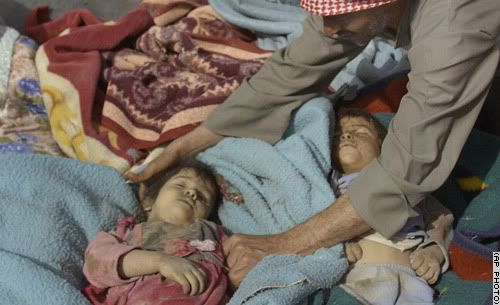 Blankets swaddle the bodies of young children reportedly killed in the U.S.-led raid. The children were taken to a hospital in Tikrit, about 90 miles (150 kilometers) north of Baghdad. Police said five children were among the 11 killed in the raid. American-led forces came under fire as they approached the building north of Balad, according to U.S. Maj. Tim O'Keefe.
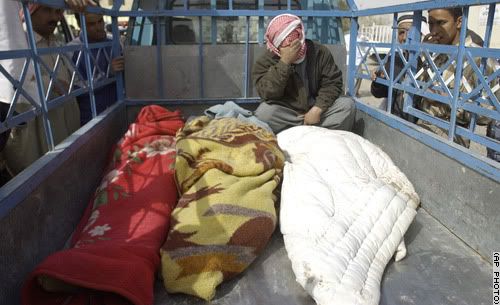 An unidentified man mourns over the bodies of family members killed in the U.S.-led raid as they arrive at a hospital in Tikrit. The raid, targeted at suspected members of terrorist network al Qaeda in Iraq, netted one "foreign fighter facilitator," who was taken into custody for questioning, the U.S. military said.
Tuesday, March 14, 2006
| [+/-] |
200,000 People in U.S. Terror Database |
The Associated Press reports:
Police and other government workers in the U.S. have come in contact with terrorists or people suspected of foreign terror ties more than 6,000 times in the past 28 months, the director of the federal Terrorist Screening Center said Tuesday.
The encounters in traffic stops, applications for permits and other situations have resulted in fewer than 60 arrests, said Donna Bucella, whose agency maintains a list of 200,000 people known or suspected to be terrorists. The list contains an additional 150,000 records that have only partial names, Bucella said.
The vast majority of people on the list are not in this country, and many have only tenuous or inconclusive ties to terrorism, Bucella said at a briefing for reporters at FBI headquarters.
As an example, she cited a truck driver whose work requires him to regularly cross the U.S.-Canada border. He may be under suspicion, but is still allowed to enter the country because there is insufficient evidence linking him to terrorism, she said.
The TSC list, conceived after the intelligence failures before the Sept. 11, 2001, attacks, combines about a dozen databases from nine agencies that any government official — from a Customs agent to a state trooper — can use to check the name of someone who has been screened or stopped.
When there is a possible match, the screening center verifies the information is accurate and advises what steps to take. In most of the more than 6,000 incidents Bucella described, officials collected additional information and let the person go.
There have been about 28,000 matches worldwide, many of those from U.S. diplomatic outposts that screen applicants for visas to enter the United States, Bucella said.
Her agency acts as a sort of guide for law enforcement, facilitating the sharing of information and alerting investigators to suspects' movements, she said. "Those calls happen every single day," she said.
Bucella spoke only in general terms, saying the database last year identified a number of people on the watch list who were flying into the same metropolitan area at the same time. She said their purpose was not innocent, but declined to say whether they were arrested or what they intended to do.
National Intelligence Director John D. Negroponte last year said New York City police were led to a possible al-Qaida associate after they consulted the watch list during a routine search on a parking violation.
Friday, March 10, 2006
| [+/-] |
Forbes Reports Billionaire Boom |
A worldwide economic boom has yielded a record number of dollar billionaires in the past year, according to Forbes.
TOP SIX BRITISH BILLIONAIRES
Philip & Christina Green (retail) - $7bn
Duke of Westminster (real estate) - $6bn
Reuben Brothers (real estate) - $3.6bn
Bernie Ecclestone (Formula One) - $3.4bn
Barclay Brothers (media/retail) - $2.8bn
Richard Branson (Virgin) - $2.8bn
The BBC reports:
Their number rose by 15% to 793 with India taking the lead in Asia and new Russians lining up to fill the gap left by jailed Mikhail Khodorkovsky.
Microsoft's Bill Gates tops the list for the 12th year running, with a net worth of $50bn (£29bn).
The combined net worth of the 793 is $2.6 trillion and US billionaires account for just under half the amount.
TOP FIVE BILLIONAIRES
Bill Gates (US, Microsoft) - $50bn
Warren Buffett (US, investor) - $42bn
Carlos Slim (Mexico, industrialist) - $30bn
Ingvar Kamprad (Sweden, Ikea) - $28bn
Lakshmi Mittal (India, steel) $23.5bn
"A billion just isn't what it used to be," said Luisa Kroll, Forbes magazine's associate editor, revealing the 20th annual list in New York.
But she noted the figures were conservative estimates for different reasons.
A very positive spreadsheet could indicate a desire to sell a business, she told reporters, while somebody about to divorce might seek to downplay their worth.
According to the 2006 list:
the youngest billionaire is a Lebanese woman, 22-year-old Hind Hariri, who inherited $1.4bn from her assassinated father, former Prime Minister Rafik Hariri
India's 23 billionaires have a combined net worth of $99bn, surpassing former Asian leader Japan's 27 billionaires with their total worth of $67bn
Russia's 33 billionaires now have a combined wealth of $172bn, based largely on oil and gas prices, compared to a total of $68bn for oil-rich Saudi Arabia's 11 billionaires.
'Whiff of inflation'
"Russia continues to astound us," said Ms Kroll, as seven new billionaires were recorded from that country.
Khodorkovsky, the former Yukos chief executive convicted of fraud and tax evasion last year, is now in a Siberian prison which allows its inmates to earn less than a dollar a day.
However, Forbes estimates he "still has somewhere below $500m", said Ms Kroll.
While New York has the highest number of resident billionaires with 40, Moscow is second with 25, and London comes third with 23.
Steve Forbes, Forbes' chief executive and editor-in-chief, attributed the global rise in the number of billionaires to an economic boom.
"The global economy has been growing the last two years at rates not seen since World War II, fuelled by a commodities boom with a whiff of inflation," he said.
