Atlanta, Georgia
Saturday, September 30, 2006
Thursday, September 28, 2006
| [+/-] |
The Rich Are Different |
A secret sexual relationship with his daughter was not enough for Fisher Island multi-millionaire Bruce McMahan. He loved her so much, he married her.
[Photo by Colby Katz]
Broward-Palm Beach News reports:
There had to be a wedding.
And it had to be a grand celebration befitting a Fisher Island multimillionaire who controls billions from Wall Street to Bermuda, from London to Dubai.
So on a sunny June day two years ago, father and daughter exchanged rings at Westminster Abbey.
They couldn't follow convention by inviting friends or family, and they couldn't make an announcement that they'd eloped.
There was no white dress and no officiant.
D. Bruce McMahan, then 65, and his daughter Linda Marie Hodge McMahan Schutt, then 35, pronounced themselves husband and wife on June 23, 2004.
It was their secret.
Except for a few traditional photographs, it was a wholly unconventional and unholy union.
Several shots show off their new Cartier Trinity rings — hers diamond, his three shades of gold. In other frames, they look the happy couple — cheek to cheek, faces glowing, and the Abbey's Little Cloister garden a royal backdrop.
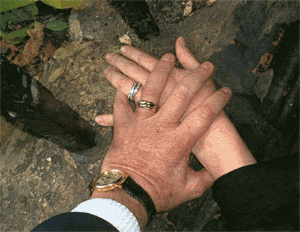 The photo of Bruce's hand on Linda's, with their wedding rings, that they titled "Says it ALL"
Afterward, she flew home to her legal spouse in Mississippi and he went home to his compound on Fisher Island, a ferry ride from Miami.
From different states, they traded their wedding photos back and forth over e-mail.
He talked about touching up her redeye. She declared her favorite the photo of their hands wearing their new rings, his hand on hers, which they had titled: "Says it ALL." Using codes, they addressed each other in the e-mails as husband and wife.
"They are great pictures," McMahan wrote in one of their daily exchanges. "But they tell a story, so pay attention to what happens to them."
With their secret still safe, McMahan filed to divorce his fifth wife, and Linda moved out of the home she shared with her husband.
McMahan began spending more time at the plush Fisher Island retreat he'd built for his hedge-fund clients. Linda moved into a nearby condo, leaving behind her career as a psychologist.
Linda enjoyed the trappings of life with one of America's richest money managers, racking up a $74,000 bill at Barney's New York.
He enjoyed lavishing her with jewels, a Bentley Continental GT, and a Versace Club membership.
He put her on his corporate payroll. They celebrated regularly with bottles of expensive Opus One wine.
But when Christmas 2004 came along, they resumed roles as father and daughter. They needed to keep up appearances, for the sake of their families and to protect their secret.
Family snapshots show their return to normal. She put her legal husband's rings back on her left hand and moved the Trinity ring to her right hand.
They didn't know it then, but their secret was safe for only a few more days. McMahan was right: The photos do tell quite a story.
What followed was a breakup on an even grander scale than their wedding and a legal battle every bit as obsessive as each has been about the other.
For more than a year, attorneys have been kept busy in Miami, New York, Mississippi, and San Diego with the fallout over the breakup of McMahan and Linda in five lawsuits involving not only father and daughter but also their legal spouses, as well as Linda's current boyfriend and soon-to-be father of her child. Details of McMahan and Linda's extraordinary wedding at Westminster Abbey and their years as lovers come from court documents as well as Linda's videotaped deposition, which New Times has made available on its website, browardpalmbeach.com.
In court papers, McMahan denies that he ever had a sexual affair with his daughter. But he doesn't explain how his and Linda's DNA turned up on a vibrator that Linda's husband uncovered in her luggage. McMahan also hints that Linda may not be his biological daughter, despite a DNA test he paid for showing with 99.7 percent probability that he is her father.
When New Times began gathering court records and calling individuals involved in the lawsuits several weeks ago, McMahan declined to comment for this article. He hired a Los Angeles public relations firm to field New Times queries. He also made three requests to seal court documents in Miami and San Diego that three judges denied.
Then, on September 13, as this article was being prepared for print, all five lawsuits were settled on undisclosed terms. As part of the settlement, a federal judge in San Diego sealed the files of the California lawsuit and took the rare step of wiping out any record that the lawsuit had ever existed.
Through McMahan's L.A. public relations firm, the parties sent a statement to New Times, describing the matter as a mere "family dispute," and alluded to taking legal action if this newspaper published this article, which is drawn from the information in the court cases that McMahan has gone to such lengths to hide from public view.
Bruce McMahan began the seduction of his daughter one evening in the spring of 1998 by having her look over his business writings in the library of his lavish Pelham, New York, estate.
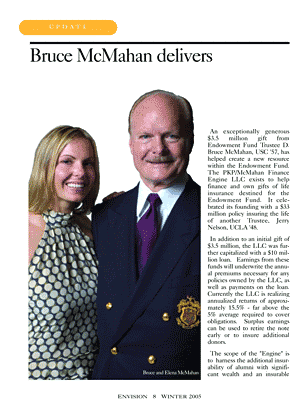 Bruce McMahan with Linda, who is misidentified as his fifth wife, Elena, in a fraternity newsletter
Linda Schutt described the events of that evening earlier this year in a deposition that was taken in Jackson, Mississippi, on April 6. McMahan declined to comment when New Times reached him on the telephone, and he never testified in any of the litigation. But according to Linda's testimony, that night in 1998, McMahan's fourth wife, Cynthia, was at a spa, and a housekeeper was somewhere on the premises.
"He opened a bottle of wine. He poured me a glass of wine, and we drank together."
While they leafed over his writings, he began to tell her of his sexual relationships with past women. He preferred them slender with wide cheekbones. "He told me he liked to buy furs for women and have sex with women on mink coats."
McMahan, who was then around his 59th birthday, asked his daughter, 29, to move to his bedroom and watch the first 30 minutes of the movie Braveheart. He wanted her to see the love story and clandestine wedding that unfolds in the opening act of Mel Gibson's film because, Linda testified, it reminded him of his relationship with her.
Then McMahan really started to lay it on thick. Linda testified he told her he believed they'd been married in a previous life. Earlier in the evening, she remembered, he had pointed out that her legs were a "very sexy version" of his own.
"He asked me what it would be like to kiss me."
Later that night, he found out.
On his bed, he kissed her and ran his hand over her body, on top of and inside her clothes, she testified. The petting session lasted two hours, she recalled. When Linda said she was tired, McMahan suggested they sleep in separate bedrooms. After Linda returned to California, her father asked if she was OK. She said she felt confused.
Their first episode of actual sexual intercourse wouldn't take place for several months. For that encounter, McMahan arranged a fairly dramatic setting — a hotel suite in London after a transatlantic flight.
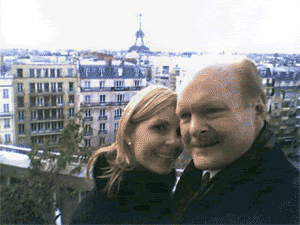 Father and daughter in Paris in an undated photo
But then, McMahan had the cash for that kind of extravagance. Born into a family of entrepreneurs, he set about building his own wealth early on. His father ran McMahan's Furniture, a well-known California retail chain, but Bruce's own ideas were less conventional. Six years after graduating from the University of Southern California in 1960, the young magnate set out with some friends to create their own country.
According to newspaper articles published at the time, the plan involved sinking a mothballed World War II ship 220 miles off the California shore, then piling on concrete, clay, and garbage. The resulting island would be in international waters and outside the jurisdiction of American law. McMahan's group planned to corner the market on abalone fishing.
The plan failed, and his business biographies today don't mention it.
McMahan then moved into the financial services market. After his first wife, Jill Harvick, died of cancer, he married Melinda Headley Ewell in 1969 and moved to Spain. After six years abroad, he moved his family to New York and created the Institutional Options Department at PaineWebber Inc. He moved to Bear Stearns & Co. in 1977 and branched out on his own in 1980.
But McMahan has always been quiet about his money. Until their divorce, which ended in 1984 after three years of legal wrangling, Ewell tells New Times, "I didn't realize how much money he had... We were young, raising children. Bruce was building his business."
Today, McMahan has the reins on more money than some heads of state. On Wall Street, he heads McMahan Securities, a convertible securities firm with a trading volume third only to UBS and Thomas Weisel Partners. Through other corporations, he also owns hedge funds that he invites people to invest in. He sits on the board of the National Committee on United States-China Relations, a private nonprofit with 750 members funded by government grants and corporate gifts.
His London-based Argent Financial Group Ltd. controls billions of investment dollars in the Middle East. According to Dr. Omar Bin Sulaiman, director general of the Dubai International Financial Centre, Argent Financial is the first group in the region licensed to manage wealth-building funds, estimated at a whopping $1.9 trillion.
McMahan spends part of the year at his estate on Fisher Island, an exclusive enclave reached from Miami only by helicopter, boat, or a private ferry. The man-made island, once owned in part by Richard M. Nixon, has a population of about 500 and is in a ZIP code that the 2000 census found had the highest per capita income in the country.
While his finances ballooned, McMahan's family also grew large. He'd had six children by three women and was married to his fourth wife when, in 1990, he learned for the first time that he was the father of a grown child he didn't know existed.
Linda Marie Hodge, by all accounts, had a normal, Southern California upbringing with her adoptive parents, Laird and Mary Hodge. When she was 5, the Hodges told her she was adopted. At 18, Linda employed a service to help her find her birth parents.
Three years later and only about 30 miles away, she found her biological mother in Escondido, California.
She wrote to Myra Westphall, telling her that she was healthy and wanted to find out about her heritage. Westphall eventually answered the letter with a phone call. "It was an emotional conversation that led to our meeting," Linda testified in her deposition.
Westphall told Linda that in 1968, she'd had a fling with McMahan while both were living in Southern California. When McMahan married second wife Melinda Ewell on January 3, 1969, Westphall was already pregnant. She gave birth to Linda five months later, on May 29, 1969.
Westphall, who tells New Times she's now in the publishing business, did not want to discuss her relationship with McMahan or her daughter. "I'm just the biological mother," she says. "She has a mother. I gave her up for adoption at birth."
In 1990, though, Westphall did help Linda locate her father. At the time, Linda was a 21-year-old sophomore psychology major at San Diego State University. One day, McMahan telephoned her. She assumed Westphall had given him the number.
In her deposition, Linda described this telephone call as another emotional one. McMahan told his daughter what he did for a living and said he wanted to meet her. When they met, he also asked her to take a paternity test, saying his lawyers were insisting on it. He got the confirmation — with 99.7 percent certainty — that he was seeking.
It was then that McMahan took Linda into the family fold. He helped pay her tuition, set up a trust fund for her, and began including her in family holiday celebrations. He added her name to his list of children in his professional biographies.
Eight years into their relationship, Linda was about to earn her PhD in psychology from the California School of Professional Psychology in San Diego.
That's when McMahan had Linda over to his New York home and asked her to watch the first half hour of Braveheart.
That same spring, in 1998, Linda began dating a man named Sargent Schutt whom she met at a party in San Diego. In only a few months, the relationship had become serious. But that summer, she accepted her father's invitation to fly to London on a business trip.
They stayed in the Sheraton Belgravia for a week. In her April deposition, she described the trip. After their arrival, she testified, a discussion about how Linda could help him with business turned personal as the two sipped wine. He told her he was disappointed in her career choice in psychology.
"He offered me an opportunity for business that would incorporate my interest in brain studies with his interest in psychic phenomena," she testified.
They were still jet-lagged from their trip, so McMahan suggested they take a nap. When she woke up, "he was touching my leg and becoming physical with me." Later in the week, the two had sexual intercourse for the first time, she testified.
After the trip, according to e-mails submitted in court documents, they mailed each other vibrators. Referring to one he sent his daughter, McMahan e-mailed her on September 10, 1998: "I unpacked the toys and checked them out. The thing excites me just looking at it. I promise you have never seen anything like it. Interestingly 'it' is actually smaller than I am! But what moves! I should have been so lucky. They are now packed into their own bag and I am going to make sure we have enough AA batteries to last for the duration."
At the same time that Linda and her father swapped sex toys, her relationship with Schutt continued to deepen.
McMahan wasn't thrilled: "I know you like him. Even though I am truly jealous, I am hardly in position to interfere or even really want to interfere with that part of your life. Don't lock him out if he is important to you. Kisses everywhere," he wrote in an e-mail dated August 15, 1998.
That winter, Linda and Schutt became engaged. But the sexual relationship with her father didn't stop. She continued to sleep with her father through the end of summer 1999 and "up until" her October wedding to Schutt, she testified. Then, with the ceremony approaching, Linda ended the sex with her dad.
"I was in love with my fiancé... I was deeply disturbed with the relationship with my father."
McMahan, she said, reacted with "anger, withdrawal, paranoia."
He asked her what she wanted, what her "perfect life" would be.
"I told him that I would like to live in Sausalito, California. I would like to have a Saab convertible. I would like to have a dog named Pooh, and a sailboat."
She testified that her father answered that he could give her all of those things and financial security for life. But Schutt, he told her, probably couldn't provide that kind of life.
The argument didn't persuade her. Linda and Schutt married on October 2, 1999, in Sonoma. During the event, McMahan gave the couple a toast.
"He made an attempt to quote Winston Churchill... He told all the guests during his toast at my wedding that, 'This is the beginning of the end. '"
McMahan was no doubt cribbing from Churchill's line from a speech he gave in 1942 at a turning point in WWII: "This is not the end. It is not even the beginning of the end. But it is, perhaps, the end of the beginning."
Linda said that McMahan never explained what he meant by it.
McMahan moved on, starting a new romance with a Ukrainian woman who eventually became his fifth wife. And he did provide his daughter employment. He named Linda president and CEO of McMahan Center for Human Abilities, a nonprofit foundation McMahan had created to extend the efforts of his primary charity, the National Cristina Foundation, which provides computers to disabled children and is named after another of his daughters, who has cerebral palsy. Linda was being paid $10,000 a month to run the foundation in the spring of 2002 when family members gathered to have dinner in a Sonoma restaurant.
Linda testified that she was asked in front of the others when she and Schutt planned to have children. "Soon," she replied.
The next day, McMahan asked to meet her in the lobby of a hotel. When she arrived, carrying paperwork for the McMahan Center, she began to speak with him about ideas for the foundation. But he became enraged.
"His face became red. He clenched his fists, and he raised his voice... He told me that having children was not part of the plan."
McMahan told her he was ending the foundation and no longer planned to pay her. (He did cut her off, but the foundation still exists.)
"He told me that I was not able to have children and be committed to the project," she testified.
She returned to her career in psychology and accepted a post-doctoral fellowship at the University of Mississippi. She and Schutt moved to suburban Jackson. She and McMahan didn't speak for months. Then, on May 25, 2003, Linda's adoptive father, Laird Hodge, a retired government contractor, died in San Diego. Linda and Schutt traveled to the funeral in La Mesa, California. McMahan sent flowers and e-mailed Linda his condolences, but they still didn't speak.
The stress of losing both fathers — Hodge to death, McMahan to indifference — weighed on Linda, she testified. It also wrecked her health. From McMahan, she'd inherited a genetic condition called Reiter's syndrome, an autoimmune disorder that causes inflammation of the soft tissues and can affect the eyes and, more seriously, the heart. Linda had a bad flare-up and developed cataracts in both eyes.
"I became very ill. I was experiencing heart problems and the doctors at the University [of Mississippi] Medical Center indicated to me that I would need surgery on my heart," she testified.
McMahan sent one of his two private planes to ferry her from her home in Mississippi to the Mayo Clinic in Rochester, Minnesota. The treatments she received there helped, and she began to recover. Her father insisted that she come to Fisher Island to recuperate so she would have access to a spa and to the Argent Center, a posh retreat McMahan had built to entertain his family and his billionaire clients. McMahan, she testified, didn't want her to go back to Mississippi or her marriage. He wanted her to leave behind the fellowship in clinical and rehabilitative neuropsychology, and he persuaded her to come back to work for him.
"I told him that I had given up opportunities based on his promises to me in the past," she testified. "And I told him that he wasn't to abandon his promise to me and that it was to be a strictly normal father and daughter relationship."
She accepted a position as executive vice president of marketing for two of her father's financial firms, Argent Funds Group LLC and McMahan Securities. But things didn't stay normal for long.
"It changed from a loving, supportive father caring for an ill, vulnerable daughter to a manipulative, contingency-based rewards/punishment relationship that created my dependence on him and gave him control and dominance over me," Linda testified. According to Linda's court complaint, McMahan again initiated an incestuous sexual relationship in April 2004 that lasted for more than a year.
In June, the couple flew to London with a twisted plan: to get married where the kings and queens of England are crowned.
We traveled to London for some business, and during that trip Bruce took me to the Westminster Abbey and we exchanged vows," Linda testified in her deposition.
Besides her testimony, there are the cheek-to-cheek photographs documenting this unusual ceremony.
There is little description in court records of how the couple made their ceremony happen in the very public church on June 23, 2004. Photographs inside the sanctuary are prohibited, so only the two of them would know if there was anything more to it than two well-dressed tourists walking up and performing a little ritual during visiting hours.
They took their photos with the garden of the Little Cloister as a backdrop. In one, they share a chaste kiss.
According to several people close to the litigation, a ceremony at Westminster Abbey made sense because McMahan, they say, is an Anglophile who counts among his heroes Adm. Lord Nelson, the British naval hero who died in the Battle of Trafalgar. Also, McMahan is said to believe that his genes are exemplary and saw in Linda the best match for his own superiority.
Four days after the ceremony, Linda wrote in an e-mail: "You asked me afterwards if I felt different. Near, I don't but at a distance, I do. I am glad about this and feel the insecurities slipping away."
In other e-mails, they began to sign off as "H" and "W," references to husband and wife. In one e-mail, dated June 29, 2004, McMahan wrote: "Miss you W. Think nasty things about you all the time." Linda answered a couple of hours later: "Mmm yeah, nasty is so good. You must have read my mind. What else can we say, we're H & W — that's the beauty."
"It is an attraction that's like no other," says Joe Soll, a New York psychologist and the only expert in the field he pioneered — genetic attraction.
Soll, who has no attachment to the McMahan litigation, has treated a half-dozen patients who had sexual intercourse with a close blood relative who had been separated early in life. An adoptee himself, Soll mediates group therapy sessions where hundreds of participants have talked openly about their physical desires for relatives they've recently reunited with.
"The dad is supposed to be the adult," Soll said. "He should have been responsible enough to say, well, wait. She got taken by something she had no awareness of."
McMahan seemed to be aware of the severity of their transgression.
"Such passions lead men straight to hell," he wrote in an e-mail to Linda titled "Midnight Musings" that was sent just after midnight on August 15, 1998.
Despite its dramatic location, however, McMahan and Linda's "wedding" in London wasn't legal. Each was married to another person at the time.
Linda's court filings claim that after the ceremony, McMahan wanted Sargent Schutt to play a diminished role in her life. He told Linda he'd start paying her "the big bucks" only if she could convince Schutt to sign a postnuptial agreement, which he did reluctantly.
 Linda Marie Hodge McMahan Schutt prepares to tell the whole, sordid truth.
"May you have all the money in the entire world to yourself," Schutt penned in a handwritten note he attached to the document. "Too bad love is earned not bought."
McMahan was thrilled.
"Good girl!" he wrote to Linda in an e-mail dated June 29, 2004, that was read into the record at Linda's deposition. "This will change how your life can be lived; thank God. Someday you will understand how truly important that document is to you.
"Lots of Opus needed," he added.
By her own admission in one of several sworn statements she filed during the litigation, Linda's job as vice president of marketing entailed little more than being a companion to her father.
"My fancy title with Argent is not an accurate representation of my employment," she testified. "My salary was only $12,000 per year, whereas most of my resources were in the form of personal gifts from my father."
The chief accounting officer for McMahan Securities and Argent Funds Group, Joseph C. Dwyer, sent Linda tax statements detailing her father's largess. From 2004 to 2005, McMahan spent $649,290.55 on gifts for Linda, including $228,727.23 on cars, $25,209.31 in cash wire transfers, and $37,000 in legal bills.
When she and McMahan went out in public, how they acted depended upon who was around. To some, they were father and daughter; to others, they were a married couple.
One friend, Palm Beach interior designer Hilda Flack, knew them in both capacities, according to court filings. Flack designed the interior at McMahan's Argent Center and was planning a business with Linda — the McMahan-Flack Design Center. But Flack, reached at her Palm Beach Gardens design center, denies that she knew of an illicit relationship between McMahan and Linda.
"She was there when we were decorating with her father," Flack says. "She was his daughter, obviously. Mr. McMahan was a gentleman and treated everyone accordingly."
In an affidavit, Linda said Flack was in the room at the Argent Center when McMahan smashed several computer hard drives containing evidence of their incestuous relationship and their Westminster Abbey wedding.
Flack dismisses Linda's claims.
"I never heard of such a preposterous thing," Flack says of the wedding.
Before he flew to London in 2004 to marry his daughter, McMahan had separated from his fifth wife, Elena. Later that year, he filed for divorce.
In January 2005, Elena filed an affidavit in the divorce case reportedly accusing McMahan of having an incestuous relationship with Linda (the affidavit is under seal but referred to in other court papers). Linda alleged in court records that Elena learned of the affair when she hacked into Linda's Yahoo e-mail account and retrieved the Westminster Abbey photos.
In court papers, Linda says that McMahan showed her Elena's affidavit and asked her to make a sworn statement of her own, denying their incestuous relationship. When she refused, their relationship began to deteriorate.
"This was a difficult if not unbearable time of my life as I continued to be abused and subservient to McMahan's sexual demands while at the same time knowing that I had lost any semblance of my marriage with Sargent," Linda said in a sworn statement this past August.
In July 2005, Linda refused to continue sleeping with McMahan. In her August sworn statement, Linda says McMahan responded to the breakup by saying on the telephone: "I am going to preemptively destroy you. If you want to know how I am going to do it, meet me for lunch."
Two months later, a legal conflagration was sparked that spread like wildfire: McMahan sued Linda through one of his firms, claiming that she'd stolen company computers and trade secrets. Linda then sued her father for the income she would have made as his employee. Her estranged husband, Schutt, sued McMahan in Mississippi, where it's still legal for one man to sue another for ruining his marriage. McMahan then filed another suit against the two of them, as well as Schutt's father, accusing them all of conspiring to extort $10 million from him.
McMahan has a long history of litigating his breakups, both personal and financial. In his divorce from Melinda Ewell, for example, he took the case to New York's appellate court, challenging an order compelling him to turn over tapes and files investigators had made while he had her under surveillance.
Ewell describes him as an egomaniac who lives his life in a series of ongoing sagas. The drama he creates feeds his ego and shapes the story of his life, she says.
"When you live with someone like that, it's not fun when you challenge them," she said.
When Ewell made allegations in her divorce that McMahan had treated her cruelly, McMahan countersued and accused Ewell of engaging in affairs and "attempting to seduce mutual friends and associates," according to an appellate opinion in the case. Ewell tells New Times that one of those men was billionaire Jeffrey Epstein, who has been much in the news lately for allegedly hiring underaged women to strip topless and massage him at his Palm Beach mansion. At the time, in the early 1980s, McMahan and Epstein worked together at Bear Stearns in New York. Epstein didn't return a request for comment.
"Jeffrey Epstein worked with [McMahan]. He was, let's just say, in the divorce proceedings," she says. "I was asked to stop by Jeffrey's apartment to pick up some papers for Bruce. It didn't feel right, so I didn't even go in. I stood outside the door. And then, later, Jeff said I propositioned him. There were always allegations I was having to fight."
McMahan's business relationships have also ended in grinding court battles, some making it to federal appeals courts, creating case law.
Miami lawyer and British barrister Henk Milne represented William Toto, whom McMahan sued in 1996 after the Ohio engineer had lost money in an investment with McMahan.
"He served Bill in Florida at his vacation home," Milne said. "He made something like 49 attempts to serve him because, Bill always believed, he wanted to get him on vacation."
Three and a half years later, a judge dismissed the lawsuit and ordered McMahan to pay Toto $265,000 that he had spent in legal fees fighting the case. Toto died of cancer shortly after the case ended.
"He's basically a very wealthy stalker," Shani Robins tells New Times. Robins had been McMahan's latest target in court and is Linda's new boyfriend. He says McMahan is a bruiser in court "because he has the resources to do it."
In May, McMahan sued Robins in Superior Court in Connecticut, alleging wrongdoing when Robins accepted some donations Linda made from McMahan's National Cristina Foundation. (That lawsuit was also dropped as part of the September 13 settlement.)
Consistent with his litigious past, McMahan fought his daughter and son-in-law's lawsuits aggressively. But they fought back with what appeared to be solid evidence.
Court records show, for example, that in Sargent Schutt's lawsuit against McMahan, his attorney had a "rabbit" vibrator Schutt found in Linda's luggage tested for DNA. According to the test results, skin cells from Linda and sperm cells from her father were found on the device and its black cover. Five other vibrators were also sent to labs for testing.
Through a spokesman, McMahan responded that he believed the evidence was "fabricated" but didn't elaborate. He also made allegations in court that his e-mail had been altered.
Also, after spending more than a decade integrating her into the family, McMahan has now questioned in court records whether he is Linda's father.
Ex-wife Melinda Ewell tells New Times that McMahan never had any doubt Linda is his daughter. "There was never a question," she said. "She looks like some of the other kids. He had no qualms."
Some of McMahan's extended family did have their doubts. His eldest daughter, Alison McMahan, says she never trusted Linda.
"All I can tell you is that nothing Linda will tell you can be believed," she tells New Times in an e-mail. "She is an unreal person who does not even know herself."
Ewell, no fan of McMahan after their nasty divorce in 1984, can't quite believe the man slept with his own daughter.
"How much of this is reality, I don't know," Ewell said. "There is a far greater chance that this is in her head. Way, way back when, I noticed she was very possessive of him. At my son's wedding eight to ten years ago, she really hung around him, and if anyone else was trying to talk to Bruce, she would try and get his attention. She would move in. From what I have observed, money appears to be the motivator."
McMahan makes that allegation in his lawsuit against Linda and Schutt, claiming that he was the victim of an extortion scheme. But he apparently never made a formal complaint to law enforcement about the conspiracy against him. One of his attorneys, Angela Agrusa, says that a San Diego prosecutor considered the extortion allegations while investigating charges that Schutt had hit Linda during a July 2005 argument over who owned the computers containing the e-mails and photos detailing Linda and McMahan's love affair.
But the case was dropped, Agrusa says, because Linda decided not to testify against Schutt.
Sargent Schutt filed to divorce Linda in July 2005, and the proceedings are pending. She is now dating Shani Robins, also a psychology PhD, and the couple is expecting its first child, a son, in January.
McMahan has made up with his fifth wife, Elena.
Three days after New Times called McMahan for comment on August 28, he hired Sitrick & Co., a Los Angeles public relations firm specializing in crisis management and whose logo is: "If you don't tell your story, someone else will tell it for you." In another public response, McMahan launched www.wspdfm.com, a now-defunct website asserting that Schutt and Linda had invented their allegations in an effort to extort money from him.
On September 13, after the five court cases were settled, Sitrick & Co. e-mailed New Times this statement:
"The parties to this litigation, Dr. Bruce McMahan, Linda Marie Schutt, Sargent Schutt, Major Schutt and Shani Robins, have resolved the differences among them and agreed to dismiss all pending legal actions. This was a family dispute and, as is the case with many family disputes, charges were made in the heat of the moment with little thought given to the pain they might unfairly or unjustly inflict. All of the parties involved and their counsel sincerely hope that there will be no further media coverage of this family matter and have agreed to make no additional comment about the resolution of their differences."
In other words, Bruce and Linda want their trips to London to be their secret again.
Monday, September 25, 2006
| [+/-] |
GOP Aide Busted For Fake Blog Posts On Liberal Sites |
Liberal bloggers have uncovered a staff member to Rep. Charles Bass (R-NH) using government computers to make fake posts on liberal blogs in New Hampshire, today's ROLL CALL reports.
Heard on The Hill columnist Mary Ann Akers has authorized RAW STORY to reprint the full registration-restricted item below:
Liberal bloggers in New Hampshire busted an aide to Rep. Charles Bass (R-N.H.) who was posing as a liberal blogger on such blogs as Blue Granite, NH-02 Progressive and others. Bass’ office admitted culpability to HOH and said the staffer would be “appropriately disciplined.”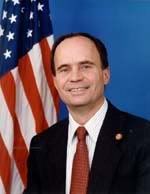 Rep. Charles Bass (R-N.H.)
The unnamed aide to Bass — who, like many others in his party, faces a tough re-election fight — was routinely trolling liberal New Hampshire political blogs calling himself “IndyNH” and more commonly IndieNH, pretending to be a progressive.
Finally, after noticing that lots of things he said just didn’t add up, a couple of the bloggers traced IndieNH’s IP address to the House of Representatives.
And they thought, “How many offices in the U.S. House would be interested in one race in New Hampshire?” The answer: Very few. Probably only one.
Laura Clawson, who runs the Blue Granite blog and writes as “Miss Laura,” told HOH that she and another blogger easily traced IndieNH’s IP address to the House server. They could even see the searches Mr. or Ms. IndieNH was doing to gather opposition research on Bass’ challenger, Paul Hodes (D), such as “Hodes and gay marriage” and “Hodes and taxes.”
The poseur had raised suspicions among liberal bloggers after he pooh-poohed a recent poll showing Bass tied with Hodes and suggested that Democrats should not waste any more time or money on the Hodes race and instead should invest their resources in other races.
“I am going to look at the competitive race list to figure out where to send another mydd.com/netroots donation and maybe help out in other ways,” IndieNH posted. “Maybe CT or NY for me — they are at least close by. Anyone interested in pooling NH efforts for some of those races? Maybe we could even go help out for a few days in buses or something in November?”
After Clawson posted a notice on her site informing IndieNH that he (or she — Clawson wasn’t sure) had been rooted out as a GOP aide in Bass’ office, the postings ceased.
The aide’s job could cease, too. John Billings, a spokesman for Bass, acknowledged that “we have questioned the staff and found that a staffer in this office did indeed post to some blogs under the pseudonym ‘IndieNH.’ There was no good reason for this, just a serious lapse of judgment, and the staffer will be appropriately disciplined.”
Billings, who would not identify the offending staffer, said the office issued a memo “clarifying that posting messages to blogs or other web sites from government computers is a violation of office policy. Congressman Bass will not tolerate this sort of activity in his office.”
The incident follows a string of cases in which Capitol Hill aides have been caught modifying entries on Members in Wikipedia, the online encyclopedia.
Billings added that while the action was certainly a violation of office policy, “whether or not it was a violation of House rules and what disciplinary action is necessary or appropriate is under review.”
No one was more disappointed to hear of the transgression than the folks on the Hodes campaign. (Yeah, right.)
“It’s a safe bet that Bass staffers are the only people on the House network who spend their days reading blogs on the district and running Internet searches on Paul Hodes,” said Hodes spokesman Reid Cherlin. “I guess when you roll over on the big issues you end up with a lot of time on your hands — but I’m pretty sure the taxpayers meant those computers to be used for legislating, not campaigning.”
Friday, September 22, 2006
| [+/-] |
Billionaires Rule U.S. Richest List |
THE TOP FIVE
Bill Gates - $53bn
Warren Buffett - $46bn
Sheldon Adelson - $20.5bn
Larry Ellison - $19.6bn
Paul Allen - $16bn
Source: Forbes
 Bill Gates and Warren Buffett take the top places... again
The BBC reports:
For the first time, the richest 400 tycoons in the US all have a personal wealth of at least $1bn (£526m), Forbes magazine has reported.
Microsoft boss Bill Gates kept top spot for a 13th consecutive year with investment guru-turned-philanthropist Warren Buffett in second place.
Casino and hotel owner Sheldon Adelson has leapt from 15th to third ranking.
The rich list as a whole is worth $1.25 trillion, compared with $1.13 trillion a year ago, Forbes said.
Four of the top 10 came from the Wal-Mart owning Walton family.
'$1m an hour'
Mr Adelson's surge in fortune comes largely from a decision to open a casino in Macau, a pennisula off south-eastern China renowned for its gambling.
Forbes estimates that Mr Adelson has been earning about $1m an hour for the past two years.
Two of the other biggest earners were the founders of search engine Google.
Apple Computers chief executive Steve Jobs was 49th on the list, with $4.9bn.
California is home to 90 of the 400 on the list, while another 44 live in New York.
Thursday, September 21, 2006
| [+/-] |
The Bushes & the Truth About Iran |
Robert Parry broke many of the Iran-Contra stories in the 1980s for the Associated Press and Newsweek. His latest book, Secrecy & Privilege: Rise of the Bush Dynasty from Watergate to Iraq, can be ordered at secrecyandprivilege.com. It's also available at Amazon.com, as is his 1999 book, Lost History: Contras, Cocaine, the Press & 'Project Truth.'
At ConsortiumNews.com, Robert Parry writes:
Having gone through the diplomatic motions with Iran, George W. Bush is shifting toward a military option that carries severe risks for American soldiers in Iraq as well as for long-term U.S. interests around the world. Yet, despite this looming crisis, the Bush Family continues to withhold key historical facts about U.S.-Iranian relations.
Those historical facts – relating to Republican contacts with Iran’s Islamic regime more than a quarter century ago – are relevant today because an underlying theme in Bush’s rationale for war is that direct negotiations with Iran are pointless. But Bush’s own father may know otherwise.
The evidence is now persuasive that George H.W. Bush participated in negotiations with Iran’s radical regime in 1980, behind President Jimmy Carter’s back, with the goal of arranging for 52 American hostages to be released after Bush and Ronald Reagan were sworn in as Vice President and President, respectively.
In exchange, the Republicans agreed to let Iran obtain U.S.-manufactured military supplies through Israel. The Iranians kept their word, releasing the hostages immediately upon Reagan’s swearing-in on Jan. 20, 1981.
Over the next few years, the Republican-Israel-Iran weapons pipeline operated mostly in secret, only exploding into public view with the Iran-Contra scandal in late 1986. Even then, the Reagan-Bush team was able to limit congressional and other investigations, keeping the full history – and the 1980 chapter – hidden from the American people.
Upon taking office on Jan. 20, 2001, George W. Bush walled up the history even more by issuing an executive order blocking the scheduled declassification of records from the Reagan-Bush years. After 9/11, the younger George Bush added more bricks to the wall by giving Presidents, Vice Presidents and their heirs power over releasing documents.
Impending War
But that history is vital today.
First, the American people should know the real history of U.S.-Iran relations before the Bush administration launches another preemptive war in the Middle East. Second, the degree to which Iranian officials are willing to negotiate with their U.S. counterparts – and fulfill their side of the bargain – bears on the feasibility of talks now.
Indeed, the only rationale for hiding the historical record is that it would embarrass the Bush Family and possibly complicate George W. Bush’s decision to attack Iran regardless of what the American people might want.
The Time magazine cover story, released on Sept. 17, and a new report by retired Air Force Col. Sam Gardiner – entitled “The End of the ‘Summer Diplomacy’” – make clear that the military option against Iran is moving rapidly toward implementation.
Gardiner, who taught at the National War College and has war-gamed U.S. attacks on Iran for American policymakers over the past five years, noted that one of the “seven key truths” guiding Bush to war is that “you cannot negotiate with these people.”
That “truth,” combined with suspicions about Iran’s nuclear ambitions and Tehran’s relationship with Hezbelloh and other militant Islamic groups, has led the Bush administration into the box-canyon logic that war is the only answer, despite the fact that Gardiner’s war games have found that war would have disastrous consequences.
In his report, Gardiner also noted that Bush’s personality and his sense of his presidential destiny are adding to the pressures for war.
“The President is said to see himself as being like Winston Churchill, and to believe that the world will only appreciate him after he leaves office; he talks about the Middle East in messianic terms; he is said to have told those close to him that he has got to attack Iran because even if a Republican succeeds him in the White House, he will not have the same freedom of action that Bush enjoys.
“Most recently, someone high in the administration told a reporter that the President believes that he is the only one who can ‘do the right thing’ with respect to Iran. One thing is clear: a major source of the pressure for a military strike emanates from the very man who will ultimately make the decision over whether to authorize such a strike – the President.”
A Made-up Mind
Washington Post columnist Charles Krauthammer, who reflects the thinking of influential neoconservatives, reached a similar conclusion – that Bush had essentially made up his mind about attacking Iran.
Krauthammer noted that on the day after the fifth anniversary of 9/11, Bush responded to a question about Iran by saying: “It’s very important for the American people to see the President try to solve problems diplomatically before resorting to military force.”
“‘Before’ implies that one follows the other,” Krauthammer wrote. “The signal is unmistakable. An aerial attack on Iran’s nuclear facilities lies just beyond the horizon of diplomacy. With the crisis advancing and the moment of truth approaching, it is important to begin looking now with unflinching honesty at the military option.” [Washington Post, Sept. 15, 2006]
Yet, before making such a fateful decision, shouldn’t Bush at least ask his father to finally level with him and with the American people about what happened in 1980 when the country was transfixed by Iranian militants holding 52 American hostages for 444 days?
At Consortiumnews.com, we have a special interest in that history because it was my discovery of a trove of classified documents pointing to the secret Republican negotiations with Iran that led to the founding of this Web site in 1995 and the publication of our first investigative series.
In the mid-1990s, the U.S. news media was obsessed with issues such as the O.J. Simpson trial and the so-called “Clinton scandals,” so there was little interest in reexamining some historical mystery about Republicans going behind Jimmy Carter’s back to strike a deal with Iran’s mullahs.
[The fullest account of this history can be found in Robert Parry’s Secrecy & Privilege, which was published in 2004.]
But that history now could be a matter of life or death for thousands of people in the Middle East, including Iranians, Israelis and American soldiers in Iraq.
False History
The false history surrounding the Iranian hostage crisis also has led to the mistaken conclusion that it was only the specter of Ronald Reagan’s tough-guy image that made Iran buckle in January 1981 and that, therefore, the Iranians respect only force.
The hostage release on Reagan’s Inauguration Day bathed the new President in an aura of heroism as a leader so feared by America’s enemies that they scrambled to avoid angering him. It was viewed as a case study of how U.S. toughness could restore the proper international order.
That night, as fireworks lit the skies of Washington, the celebration was not only for a new President and for the freed hostages, but for a new era in which American power would no longer be mocked. That momentum continues to this day in George W. Bush’s “preemptive” wars and the imperial boasts about a “New American Century.”
However, the reality of that day 25 years ago now appears to have been quite different than was understood at the time. What’s now known about the Iranian hostage crisis suggests that the “coincidence” of the Reagan Inauguration and the Hostage Release was not a case of frightened Iranians cowering before a U.S. President who might just nuke Tehran.
The evidence indicates that it was a prearranged deal between the Republicans and the Iranians. The Republicans got the hostages and the political bounce; Iran’s Islamic fundamentalists got a secret supply of weapons and various other payoffs.
State Secret
Though the full history remains a state secret, it now appears Republicans did contact Iran’s mullahs during the 1980 campaign; a hostage agreement was reached; and a clandestine flow of U.S. weapons soon followed.
In effect, while Americans thought they were witnessing one reality – the cinematic heroism of Ronald Reagan backing down Iran’s Ayatollah Ruhollah Khomeini – another truth existed beneath the surface, one so troubling that the Reagan-Bush political apparatus has made keeping the secret a top priority for a quarter century.
The American people must never be allowed to think that the Reagan-Bush era began with collusion between Republican operatives and Islamic terrorists, an act that many might view as treason.
A part of those secret dealings between Iran and the Republicans surfaced in the Iran-Contra Affair in 1986, when the public learned that the Reagan-Bush administration had sold arms to Iran for its help in freeing U.S. hostages then held in Lebanon.
After first denying these facts, the White House acknowledged the existence of the arms deals in 1985 and 1986 but managed to block investigators from looking back before 1984, when the official histories assert that the Iran initiative began.
During the 1987 congressional hearings on Iran-Contra, Republicans – behind the hardnosed leadership of Rep. Dick Cheney – fought to protect the White House, while Democrats, led by the accommodating Rep. Lee Hamilton, had no stomach for a constitutional crisis.
The result was a truncated investigation that laid much of the blame on supposedly rogue operatives, such as Marine Lt. Col. Oliver North.
Many American editors quickly grew bored with the complex Iran-Contra tale, but a few reporters kept searching for its origins. The trail kept receding in time, back to the Republican-Iranian relationship forged in the heat of the 1980 presidential campaign.
‘Germs’ of Scandal
Besides the few journalists, some U.S. government officials reached the same conclusion. For instance, Nicholas Veliotes, Reagan’s assistant secretary of state for the Middle East, traced the “germs” of the Iran-Contra scandal to the 1980 campaign.
In a PBS interview, Veliotes said he first discovered the secret arms pipeline to Iran when an Israeli weapons flight was shot down over the Soviet Union on July 18, 1981, after straying off course on its third mission to deliver U.S. military supplies from Israel to Iran via Larnaca, Cyprus.
“We received a press report from Tass [the official Soviet news agency] that an Argentinian plane had crashed,” Veliotes said. “According to the documents … this was chartered by Israel and it was carrying American military equipment to Iran. …And it was clear to me after my conversations with people on high that indeed we had agreed that the Israelis could transship to Iran some American-origin military equipment.
“Now this was not a covert operation in the classic sense, for which probably you could get a legal justification for it. As it stood, I believe it was the initiative of a few people [who] gave the Israelis the go-ahead. The net result was a violation of American law.”
The reason that the Israeli flights violated U.S. law was that no formal notification had been given to Congress about the transshipment of U.S. military equipment as required by the Arms Export Control Act – a foreshadowing of George W. Bush’s decision two decades later to bypass the Foreign Intelligence Surveillance Act.
In checking out the Israeli flight, Veliotes came to believe that the Reagan-Bush camp’s dealings with Iran dated back to before the 1980 election.
“It seems to have started in earnest in the period probably prior to the election of 1980, as the Israelis had identified who would become the new players in the national security area in the Reagan administration,” Veliotes said. “And I understand some contacts were made at that time.”
Q: “Between?”
Veliotes: “Between Israelis and these new players.”
Israeli Interests
In my work on the Iran-Contra scandal, I had obtained a classified summary of testimony by a mid-level State Department official, David Satterfield, who saw the early arms shipments as a continuation of Israeli policy toward Iran.
“Satterfield believed that Israel maintained a persistent military relationship with Iran, based on the Israeli assumption that Iran was a non-Arab state which always constituted a potential ally in the Middle East,” the summary read. “There was evidence that Israel resumed providing arms to Iran in 1980.”
Over the years, senior Israeli officials claimed that those early shipments had the discreet blessing of top Reagan-Bush officials.
In May 1982, Israeli Defense Minister Ariel Sharon told the Washington Post that U.S. officials had approved the Iranian arms transfers. “We said that notwithstanding the tyranny of Khomeini, which we all hate, we have to leave a small window open to this country, a tiny small bridge to this country,” Sharon said.
A decade later, in 1993, I took part in an interview with former Israeli Prime Minister Yitzhak Shamir in Tel Aviv during which he said he had read Gary Sick’s 1991 book, October Surprise, which made the case for believing that the Republicans had intervened in the 1980 hostage negotiations to disrupt Jimmy Carter’s reelection.
With the topic raised, one interviewer asked, “What do you think? Was there an October Surprise?”
“Of course, it was,” Shamir responded without hesitation. “It was.” Later in the interview when pressed for details, Shamir seemed to regret his candor and tried to backpedal somewhat on his answer.
Lie Detector
Iran-Contra special prosecutor Lawrence Walsh also came to suspect that the arms-for-hostage trail led back to 1980, since it was the only way to make sense of why the Reagan-Bush team continued selling arms to Iran in 1985-86 when there was so little progress in reducing the number of American hostages in Lebanon.
When Walsh’s investigators conducted a polygraph of George H.W. Bush’s national security adviser Donald Gregg, they added a question about Gregg’s possible participation in the secret 1980 negotiations.
“Were you ever involved in a plan to delay the release of the hostages in Iran until after the 1980 Presidential election?” the examiner asked. Gregg’s denial was judged to be deceptive. [See Final Report of the Independent Counsel for Iran/Contra Matters, Vol. I, p. 501]
While investigating the so-called “October Surprise” issue for PBS “Frontline” in 1991-92, I also discovered a former State Department official who claimed contemporaneous knowledge of an October 1980 trip by then vice presidential candidate George H.W. Bush to Paris to meet with Iranians about the hostages.
David Henderson, who was then a State Department Foreign Service officer, recalled the date as October 18, 1980. He said he heard about the Paris trip when Chicago Tribune correspondent John Maclean met him for an interview on another topic.
Maclean, son of author Norman Maclean who wrote A River Runs Through It, had just been told by a well-placed Republican source that Bush was flying to Paris for a clandestine meeting with a delegation of Iranians about the American hostages.
Henderson wasn’t sure whether Maclean was looking for some confirmation or whether he was simply sharing an interesting tidbit of news. For his part, Maclean never wrote about the leak because, he told me later, a GOP campaign spokesman had denied it.
Faded Memory
As the years passed, the memory of that Bush-to-Paris leak faded for both Henderson and Maclean, until October Surprise allegations bubbled to the surface in the early 1990s.
Several intelligence operatives were claiming that Bush had undertaken a secret mission to Paris in mid-October 1980 to give the Iranian government an assurance from one of the two Republicans on the presidential ticket that the GOP promises of future military and other assistance would be kept.
Henderson mentioned his recollection of the Bush-to-Paris leak in a 1991 letter to a U.S. senator, which someone sent to me. Though Henderson didn’t remember the name of the Chicago Tribune reporter, we were able to track it back to Maclean through a story that he had written about Henderson.
Though not eager to become part of the October Surprise story in 1991, Maclean confirmed that he had received the Republican leak. He also agreed with Henderson’s recollection that their conversation occurred on or about Oct.18, 1980. But Maclean still declined to identify his source.
The significance of the Maclean-Henderson conversation was that it was a piece of information locked in a kind of historical amber, untainted by subsequent claims from intelligence operatives whose credibility had been challenged.
One couldn’t accuse Maclean of concocting the Bush-to-Paris allegation for some ulterior motive, since he hadn’t used it in 1980, nor had he volunteered it a decade later. He only confirmed it when asked and even then wasn’t eager to talk about it.
Bush Meeting
The Maclean-Henderson conversation provided important corroboration for the claims by the intelligence operatives, including Israeli intelligence officer Ari Ben-Menashe who said he saw Bush attend a final round of meetings with Iranians in Paris.
Ben-Menashe said he was in Paris as part of a six-member Israeli delegation that was coordinating the arms deliveries to Iran. He said the key meeting had occurred at the Ritz Hotel in Paris.
In his memoirs, Profits of War, Ben-Menashe said he recognized several Americans, including Republican congressional aide Robert McFarlane and CIA officers Robert Gates, Donald Gregg and George Cave. Then, Ben-Menashe said, Iranian cleric Mehdi Karrubi arrived and walked into a conference room.
“A few minutes later George Bush, with the wispy-haired William Casey in front of him, stepped out of the elevator. He smiled, said hello to everyone, and, like Karrubi, hurried into the conference room,” Ben-Menashe wrote.
Ben-Menashe said the Paris meetings served to finalize a previously outlined agreement calling for release of the 52 hostages in exchange for $52 million, guarantees of arms sales for Iran, and unfreezing of Iranian monies in U.S. banks. The timing, however, was changed, he said, to coincide with Reagan’s expected Inauguration on Jan. 20, 1981.
Ben-Menashe, who repeated his allegations under oath in a congressional deposition, received support from several sources, including pilot Heinrich Rupp, who said he flew Casey – then Reagan’s campaign director – from Washington’s National Airport to Paris on a flight that left very late on a rainy night in mid-October.
Rupp said that after arriving at LeBourget airport outside Paris, he saw a man resembling Bush on the tarmac. The night of Oct. 18 indeed was rainy in the Washington area. Also, sign-in sheets at the Reagan-Bush headquarters in Arlington, Virginia, placed Casey within a five-minute drive of National Airport late that evening.
Other Witnesses
There were other bits and pieces of corroboration about the Paris meetings. As early as 1987, Iran’s ex-President Bani-Sadr had made similar claims about a Paris meeting between Republicans and Iranians. A French arms dealer, Nicholas Ignatiew, told me in 1990 that he had checked with his government contacts and was told that Republicans did meet with Iranians in Paris in mid-October 1980.
A well-connected French investigative reporter Claude Angeli said his sources inside the French secret service confirmed that the service provided “cover” for a meeting between Republicans and Iranians in France on the weekend of Oct. 18-19, 1980. German journalist Martin Kilian had received a similar account from a top aide to the fiercely anti-communist chief of French intelligence, Alexandre deMarenches.
Later, deMarenches’s biographer, David Andelman, told congressional investigators under oath that deMarenches admitted that he had helped the Reagan-Bush campaign arrange meetings with Iranians about the hostage issue in the summer and fall of 1980, with one meeting held in Paris in October.
Andelman said deMarenches ordered that the secret meetings be kept out of his biography because the story could otherwise damage the reputation of his friends, Casey and Bush. “I don’t want to hurt my friend, George Bush,” Andelman recalled deMarenches saying as Bush was seeking re-election in 1992.
Gates, McFarlane, Gregg and Cave all denied participating in the meeting, though some alibis proved shaky and others were never examined at all.
Lashing Out
For his part, George H.W. Bush lashed out at the October Surprise allegations. At a news conference on June 4, 1992, Bush was asked if he thought an independent counsel was needed to investigate allegations of secret arms shipments to Iraq during the 1980s.
“I wonder whether they’re going to use the same prosecutors that are trying out there to see whether I was in Paris in 1980,” Bush snapped.
As a surprised hush fell over the press corps, Bush continued, “I mean, where are we going with the taxpayers’ money in this political year?” Bush then asserted, “I was not in Paris, and we did nothing illegal or wrong here” on Iraq.
Though Bush was a former CIA director and had been caught lying about Iran-Contra with his claims of being “out of the loop,” he was still given the benefit of the doubt in 1992. Plus, he had what appeared to be a solid alibi for Oct. 18-19, 1980, Secret Service records which placed him at his home in Washington on that weekend.
However, the Bush administration released the records only in redacted form, making it difficult for congressional investigators to verify exactly what Bush had done that day and whom he had met.
The records for the key day of Sunday, Oct. 19, purported to show Bush going to the Chevy Chase Country Club in the morning and to someone’s private residence in the afternoon. If Bush indeed had been on those side trips, it would close the window on any possible flight to Paris and back.
Investigators of the October Surprise mystery – including those of us at “Frontline” – put great weight on the Secret Service records. But little is really known about the Secret Service’s standards for recording the movements of protectees.
Since the cooperation of the protectees is essential to the Secret Service staying in position to thwart any attacker, the agents presumably must show flexibility in what details they report.
Few politicians are going to want bodyguards around if they write down the details of sensitive meetings or assignations with illicit lovers. Reasonably, the agents might have to fudge or leave out some of the facts.
Bush’s Alibi
As it turned out, only one Secret Service agent on the Bush detail – supervisor Leonard Tanis – claimed a clear recollection of the trip to the Chevy Chase Country Club that Sunday. Tanis told congressional investigators that Mr. and Mrs. Bush went to the Chevy Chase club for brunch with Justice and Mrs. Potter Stewart.
But at “Frontline,” we had already gone down that path and found it to be a dead end. We had obtained Mrs. Bush’s protective records and they showed her going to the C&O Canal jogging path in Washington, not to the Chevy Chase club.
We also had reached Justice Stewart’s widow, who had no recollection of any Chevy Chase brunch. So it appeared that Tanis was wrong – and he later backed off his claims.
The inaccurate Tanis account raised the suspicions of House International Affairs Committee counsel Spencer Oliver. In a six-page memo urging a closer look at the Bush question, Oliver argued that the Secret Service had withheld the uncensored daily report for no justifiable reason from Congress.
“Why did the Secret Service refuse to cooperate on a matter which could have conclusively cleared George Bush of these serious allegations?” Oliver asked. “Was the White House involved in this refusal? Did they order it?”
Oliver also noted Bush’s strange behavior in raising the October Surprise issue on his own at two news conferences.
“It can be fairly said that President Bush's recent outbursts about the October Surprise inquiries and [about] his whereabouts in mid-October of 1980 are disingenuous at best,” wrote Oliver, “since the administration has refused to make available the documents and the witnesses that could finally and conclusively clear Mr. Bush.”
Secret Flight
Unintentionally, Bush’s eldest son poked another hole in the assumption that the government would never doctor official records to help cover up international travel by a protected public figure.
For Thanksgiving 2003, George W. Bush wanted to make a surprise flight to Iraq. To give Bush’s flight additional security – and extra drama – phony flight plans were filed, a false call sign was employed, and Air Force One was identified as a “Gulfstream 5” in response to a question from a British Airways pilot.
“A senior administration official told reporters that even some members of Bush’s Secret Service detail believed he was still in Crawford, Texas, getting ready to have his parents over for Thanksgiving,” Washington Post reporter Mike Allen wrote. [Washington Post, Nov. 28, 2003]
Besides falsely telling reporters that George W. Bush planned to spend Thanksgiving at his Texas ranch, Bush’s handlers spirited Bush to Air Force One in an unmarked vehicle, with only a tiny Secret Service contingent, the Post reported.
Bush later relished describing the scene to reporters. “They pulled up in a plain-looking vehicle with tinted windows. I slipped on a baseball cap, pulled ‘er down -- as did Condi. We looked like a normal couple,” he said, referring to national security adviser Condoleezza Rice.
Though the melodramatic deception surrounding Bush’s flight to Baghdad soon became public – since it was in essence a publicity stunt – it did prove the ability of high-ranking officials to conduct their movements in secrecy and the readiness of security personnel to file false reports as part of these operations.
Collapsing Alibis
By the late 1990s, other elements of the Republicans’ October Surprise alibis were collapsing, including pro-Reagan-Bush claims cited prominently by some news organizations, such as the New Republic and Newsweek. [For more details, see Parry’s Secrecy & Privilege or Consortiumnews.com’s “The Bushes & the Death of Reason.”]
With the Republican defenses falling apart and with many documents from the Reagan-Bush years scheduled for release in 2001, the opportunity to finally learn the truth about the pivotal election of 1980 loomed.
But George W. Bush got into the White House via a ruling by five Republicans on the U.S. Supreme Court to stop the counting of votes in Florida. Then, on his first day in office, his counsel Alberto Gonzales drafted an executive order for Bush that postponed release of the Reagan-Bush records.
After the Sept. 11, 2001, terror attacks, Bush approved another secrecy order that put the records beyond the public’s reach indefinitely, passing down control of many documents to a President’s or a Vice President’s descendants.
Thus, the truth about how the Reagan-Bush era began in the 1980s – and what was done to contain the Iran-Contra investigations in the late 1980s and early 1990s – might eventually become the property of the noted scholars, the Bush twins, Jenna and Barbara.
The American people will be kept in the dark about their own history, like the subjects of some hereditary dynasty. Without the facts, they also face the possibility of being more easily manipulated by emotional appeals devoid of informed debate
That moment has come sooner than many expected. The United States appears to be on the brink of a war with Iran, while many government officials and the citizenry are operating on historical assumptions derived more from fiction than fact.
| [+/-] |
You Have No Right To Vote |
In Salon.com, Garrett Epps writes:
Last week, a Missouri judge reminded the state Legislature that citizens of the state have a right to vote. And because it is a right, not a privilege granted by the powerful, Missourians can cast their ballots this November without having to meet identification requirements that seemed designed to make it harder for certain people -- the poor, the elderly, minorities and women -- to exercise that right.
That's the good news. The bad news is that this right comes from the Missouri state Constitution. The U.S. Constitution does not explicitly guarantee a right to vote, and our federal courts currently read the document not to include it.
The Missouri case should spark some national discussion about why it is that our country, almost alone among advanced democratic nations, does not find this right worth including in its Constitution. It should also inspire closer scrutiny of a kind of a electoral gamesmanship that is going on around the country, as Republicans seek to exploit this gap in our democratic guarantees.
The Republican majority of the Missouri Legislature has been haunted by a fear that is widespread in red America: a fear that the wrong kinds of people are voting. As a result, they passed a "Voter Protection Act," which required a state-issued photo ID for any voter who shows up at the polls. A state driver's license would do. But those who didn't already have a license -- even if they had been voting at the same address for the past half-century -- would be required to get a state-issued ID. To get one of those IDs, they would need to produce proof of citizenship, like a birth certificate or a passport, as well as documents showing that they were lawfully present at their current addresses. If they had ever changed their names -- if, for example, they were women voting under their married names -- they would be required to produce documents legitimizing the name change as well.
At first glance, this might seem like a minor thing. The bill's sponsor, Republican state Sen. Delbert Scott, noted that "you have to use [photo ID] to get on an airplane, to buy cigarettes." And, after all, the requirement would impact a small group of citizens -- a mere 170,000. That's only about 4 percent of the electorate, hardly a significant number. It is only, for example, eight times the margin of victory by which Sen. Jim Talent (coincidentally running for re-election this fall) defeated Democratic incumbent Jean Carnahan in 2002.
Most people don't really have to show ID to buy cigarettes. Beyond that, to state the obvious, neither air travel nor cigarette smoking is a fundamental component of democratic self-government. Voting is. A law that increases the cost and difficulty of voting will predictably reduce the number of people who vote, and a democracy that excludes large numbers of its citizens from the franchise isn't worthy of the name.
Many middle-class whites don't realize that for the poor and minorities, voting can be a difficult and even scary proposition. I first learned this as a poll-watcher in 1976, when I saw a white registrar in Virginia solicitously asking a black voter whether he was sure his registration form had been properly filled out. "You know fraudulent voting is a federal crime, don't you?" she purred, smiling sweetly. Southern Republicans often blanket poor black neighborhoods warning would-be voters that they might be arrested at the polls if they have unpaid traffic tickets.
Intriguingly, the Republican sponsors of the Missouri bill weren't really able to argue that it was needed to prevent fraud as such. Despite their best efforts, they couldn't find much evidence of fraudulent voting. So they argued instead that the law was needed because without it, solid Missouri citizens -- the kind of people who vote Republican, for example -- might be tempted to think there was fraud at the polls. Gov. Matt Blunt explained that the bill would "restore Missourians' confidence in state elections." (Blunt's margin of victory in 2004 -- certified by himself as secretary of state -- was 3 percent of the vote.) The Springfield News Leader, which supported the bill, said it would provide "peace of mind for voters who want to know that cheaters aren't improperly influencing an election."
But on Sept. 14, Cole County Circuit Judge Richard Callahan blocked the law from taking effect. Callahan pointed out that Article VII of Missouri's Constitution says that "All citizens of the United States ... who are residents of this state ... are entitled to vote at all elections by the people." The ID rule, he reasoned, would allow the Legislature to add an onerous qualification to those spelled out in the Constitution.
The judge's decision squares with common sense, as well as with the text. And it highlights the lack of a similar provision in the U.S. Constitution. As a result of this lack, other states -- mostly those in which Republicans currently run the legislature -- are adding such requirements. Former Bush campaign officials last year launched a new conservative advocacy group, the oxymoronically titled American Center for Voting Rights, designed to push such legislation at both the state and federal levels. So far, Arizona, Georgia, Indiana, Florida and Ohio have passed or tightened photo ID laws. Democratic governors in Wisconsin and Pennsylvania vetoed such laws earlier this year, and state and federal courts have both blocked the Georgia law.
Throughout our history, Americans have been profoundly ambivalent about the vote. The Constitution of 1787 left the issue of federal voting rights entirely to the states, which could disenfranchise their voters more or less as they chose. Today, even though "the right to vote" is by now mentioned five times in the amended Constitution, the federal courts continue to insist that voting is mostly a state matter. The Supreme Court restated the point in 2000, in Bush v. Gore. "The individual citizen has no federal constitutional right to vote for electors for the President of the United States," said the Court, rather breezily, "unless and until the state legislature chooses a statewide election as the means to implement its power to appoint members of the Electoral College."
Meanwhile, virtually every other advanced democracy already has an explicit guarantee of the right to vote. Ironically, whenever the United States imposes a constitution on another (conquered) nation, we tend to insist that they include in those documents a right we do not ourselves possess. Afghans have "the right to elect and be elected," Iraqis have "the right ... to vote, to elect, and to nominate," and the Japanese enjoy "universal adult suffrage."
Since the fiasco in Florida, a number of scholars and activists have been working to generate a constitutional fix for this problem. American University law professor Jamie Raskin (who was elected last week to the Maryland state Senate) in 2001 proposed an amendment that would say, in part, "Citizens of the United States have the right to vote in primary and general elections ... and such right shall not be denied or abridged by the United States or any State." At the time, Raskin noted that "only Azerbaijan, Chechnya, Indonesia, Iran, Iraq, Jordan, Libya, Pakistan, Singapore, and, of course, the United Kingdom ... still leave voting rights out of their constitutions." Raskin's call has been echoed by other scholars. Rep. Jesse Jackson Jr., D-Ill., has championed such an amendment, and FairVote.org, an advocacy group, is fighting for national and local reforms that would make clear that it is the government's responsibility to ensure that all eligible voters have a chance to cast a ballot.
But with Republicans in charge in many state capitals and Washington, the momentum in practical terms is moving the other way. On Sept. 14, the U.S. House Administration Committee approved by a straight party vote a proposed bill that would require all voters nationwide to obtain IDs by producing a birth certificate or passport.
This argument is too crucial to democracy, and too easy to win, for progressives to let it slide. Voting is not a privilege for which citizens must qualify by showing their ability to dodge bureaucratic hurdles. If fraud really is a concern, state elections officials could be authorized to update voter lists and follow up on changes of address. That's what happens in most other democratic countries.
Real democratic values in this country are currently under assault. Day after day, we must justify concepts that were once accepted as givens. We are forced to discuss whether a free country really needs the rule of law, or freedom of speech, or an executive subject to legislative oversight. It would be nice to begin campaigning for measures that would do more than just get democracy out of its defensive crouch -- that would actually make democracy stronger. A right to vote might be one of them. When the argument is truly joined, who can be against it?
Monday, September 18, 2006
| [+/-] |
Gore's 2008 Plans May Become Clearer After Release of Book |
Former vice president Al Gore is set to have a new book out in May. It will focus on how "the public arena has grown more hostile to reason," Gore's editor says.
The Washington Post reports:
Although saying he has no plans to run for president in 2008, former vice president Al Gore has nonetheless left the door ever so slightly ajar. It's a good bet that door will swing open a good bit wider come next May.
That is when Gore is scheduled to publish his next book. With no fanfare, he signed a few weeks ago with Penguin Press to write "The Assault on Reason."
As described by editor Scott Moyers, the book is a meditation on how "the public arena has grown more hostile to reason," and how solving problems such as global warming is impeded by a political culture with a pervasive "unwillingness to let facts drive decisions."
While that may sound abstract, both the subject matter and the timing of the release have an unmistakable subtext. In 2004, Gore cheered liberals when he lashed at President Bush for allegedly falling captive to right-wing special interests and taking flight from "fact-based analysis." If the book strikes a chord, it will produce new momentum for Gore to make another bid for the White House, presumably fueled in large part by anti-Iraq-war Democrats.
As it happens, speculation about presidential ambitions and book tours have long enjoyed symbiotic relationships. In 1995, Colin L. Powell released his memoirs, "My American Story," in the midst of fevered expectations about his own presidential intentions. He ended up not running, but he did produce a runaway best-seller.
Gore is currently on the paperback best-seller lists with the companion book to his documentary on global warming, "An Inconvenient Truth."
"The Assault on Reason" is not the only book due next year that will be deconstructed for political implications. Pollster Mark Penn, a longtime strategist for both President Bill Clinton and Sen. Hillary Rodham Clinton (D-N.Y.), not long ago signed his own book deal with editor Jon Karp of Warner Twelve. "Micro Trends," which analyzes American politics and business, will come out next Labor Day -- when Hillary Clinton's widely anticipated 2008 campaign would presumably be nearing a boil.
Subscribe to:
Posts (Atom)
