World leaders may be condemning the junta's crackdown, but foreign businesses don't want to lose their pieces of Burma's energy pie. Why the latest sanctions are unlikely to work.
At Newsweek, Melinda Liu writes:
Analysts describe it as the Burmese paradox: How can the rulers of a country so rich in energy, teak, minerals and gems be in such financial trouble? Even as it sits on top of 19 trillion cubic feet of natural gas and billions of barrels of crude oil reserves, the junta had to abruptly hike fuel prices so high in August that it triggered the popular uprising led by Buddhist monks.
Part of the explanation is simply bad governance. The Burmese regime is so arrogant—and inept—that it doesn’t expect citizens to rebel even when they watch their hard-won savings disappear overnight. That’s what happened in the summer of 1988, when the regime's surprise demonetization of the local currency, the kyat, meant a lot of money was suddenly not worth the paper it was printed on. (The kyat has a story all its own: on an astrologer’s advice, former Burmese strongman U Ne Win decided the currency should be denominated in multiples of nine, because 9 was a much more auspicious number than 10. As a result 45- and 90-kyat notes still circulate in Burma alongside multiples of 5 and 10. One gauge of the dire economic situation in Burma is the fact that the official exchange rate is 6 kyat to the U.S. greenback, while the unofficial rate is more like 1,350)
But there’s a more important reason for Burma’s predicament. Before the 1962 coup that installed a military regime in power, Burma had one of Southeast Asia’s highest standards of living. It boasted a well-educated intellectual class. It was one of the world biggest exporters of rice. But today, the country’s infrastructure is so decrepit that the regime cannot adequately exploit its own resources without outside help. Despite the country's lucrative oil and gas sectors, the domestic refining industry is a mess due to half a century of mismanagement, lack of investment and neglect. Local refineries aren’t suited to processing the high sulfur content in Burmese oil. As a result, the government has to import nearly all of its diesel, to the tune of nearly 20,000 barrels daily by 2004.
Combine that hunger with today’s high prices, and you can easily see how the need to import diesel could help prompt a price rise. This wasn’t the first time the regime imposed such a hike, either; two years ago fuel prices shot up ninefold. You don’t have to be a rocket scientist—actually Burma’s junta supremo Than Shwe is a former postal clerk—to know people might be mad about the abrupt Aug. 15 doubling of diesel prices and fivefold increase in the cost of compressed natural gas, a hike passed on to passengers using public transport. Or, indeed, that it’s bad PR to throw a lavish wedding ceremony for your daughter—as Than Shwe did—showing how the gem-encrusted elite parties on (while one in three Burmese children is malnourished, according to the World Food Program).
But the excesses don’t stop there. Paranoia has something to do with why the junta is cash-strapped. The nonsensical transfer in November 2005 of government offices to the new administrative capital of remote Naypyidaw, in a jungly wasteland 300 kilometers (about 190 miles) from Rangoon (apparently to boost government secrecy), is believed to have cost hundreds of millions of dollars. Then, to help compel disgruntled civil servants to go along with the move, the government raised their pay 500 percent. For its part, Burma’s 375,000-man Army—key to the junta’s survival—got a tenfold pay raise. And then there's the construction of another big-ticket item called “the Yadanabon Silicon Valley cyber-city.” This from a regime that’s trying to pull the plug on the Internet in a bid to prevent images of its repression from reaching the outside world.
Burma’s economic picture would be depressing enough without the involvement of Big Oil. One of the key reasons why sanctions against the regime are unlikely to work is because the junta's foreign partners hope to maintain business as usual. Foreign firms have been scrambling for a piece of Burma's oil and gas industry since the regime liberalized investment rules in 1988.
These are not obscure players or small-time plays. Burmese natural gas, worth $2.8 billion, generates one fifth of Thailand’s electricity. China wants to build pipelines and roads through Burma that would allow its oil imports to bypass vulnerable chokepoints in the Malacca Straits, which could be blocked by the U.S. Navy in the event of Sino-U.S. tensions.
State-run Chinese firms are also bidding for contracts in Burmese gas fields, as are South Korean and Indian competitors. India’s oil minister, Murli Deora, was present in Rangoon for energy cooperation talks with junta leaders when antigovernment protests broke out last month. Burma’s partners aren’t all Asian either. When earlier European Union and U.S. economic sanctions were levied against Burma, Total of France and Chevron remained involved in the Yadana gasfield. (At the time, existing investments were exempt; Chevron has a 28 percent stake because of its takeover of Unocal, Total’s original partner.)
Now we hear that the EU has just toughened its sanctions against Burma, expanding the visa bans for junta leaders and suspension of some imports such as timber and gems. But such measures—similar to those announced last week by the United States—will be toothless unless key oil and gas firms climb onboard. Today French Foreign Minister Bernard Kouchner hinted that Total—which extracts more than 17 million cubic meters of natural gas daily from its Burmese fields, according to its corporate Web site—“will not be exonerated” from post-crackdown sanctions. Total officials have argued that the firm has made no new capital expenditures in Burma since 1998 and that any “forced withdrawal” by Total would simply pave the way for rivals to take its place. Which is why China, Thailand, India and Russia have been muted in their condemnation of Burma’s recent bloodletting. They may hate the junta’s repression, but they love the thought of biting off a bigger piece of Burma’s energy pie.
Wednesday, October 3, 2007
| [+/-] |
It's the Oil and Gas, Stupid |
| [+/-] |
From the State Department, All the News for Inquiring Minds |
From the Washington Post, Al Kamen writes:
Fox News, launched with such high hopes 11 years ago as the "fair and balanced" network, apparently hasn't lived up to its billing. CNN never had a chance. The other networks? Please. No citizen could dare trust the agenda-driven print media -- The Washington Post, the Wall Street Journal, the New York Times -- to figure out, let alone accurately tell, the "real" story.
But now the State Department is in the blogosphere, and says it "offers the public an alternative source to mainstream media for U.S. foreign policy information." The blog, launched last week and called "Dipnote," is "taking you behind the scenes."
This is what we've all been waiting for! No more media filters and distortions. Unbiased news directly from the federal government, a news source long noted for truthful, unbiased reporting. The Clinton administration and most all its predecessors vowed to end-run the media, and they finally have the new electronic media to help them to do it.
One of the first diplo-bloggers last week was the assistant secretary for international organizations, Kristen Silverberg, who blogged from the United Nations.
"Another busy day in New York!" she gushed Tuesday. ("I'm exhausted!" she wrote in a later dispatch that day.) "First thing this morning, President Bush met with President Karzai" to discuss progress in Afghanistan.
"We have a lot of hope," she wrote, "for the future of Afghanistan," where child mortality has declined 20 percent in the past five years and 80 percent of the public has access to basic health care and "primary school enrollment for both boys and girls has increased by five hundred percent over the past five years."
But that's not all! "Later in the morning," Silverberg reported, "Secretary Rice attended a meeting" and "issued a joint statement calling on the government of Burma to end violence against the peaceful demonstrators."
"The Security Council this afternoon issued a statement of concern about the events in Burma, which were also discussed at today's G8 Foreign Ministers lunch," Silverberg reported, and Rice "raised the issue of Burma when she met this afternoon" with India's foreign minister. She also met with the Korean foreign minister about North Korea's nukes.
"While Secretary Rice will be back in Washington, D.C., for part of the day tomorrow to open the President's meeting of major economies on energy security and climate, I'll still be in New York and will keep you updated!" Thank goodness.
Public diplomacy czarina Karen Hughes's blog from the United Nations yesterday gave us a real insider's view of diplomacy in action.
"This morning I spoke live with hundreds of thousands of people in the Arab world by appearing on Al Arabiya," she wrote, "one of the leading television networks in the Middle East. Whenever I visit a country, and I've been to about 40 during the last two years, I usually do television and radio interviews (I've even appeared on what was described as the Indonesian version of 'Oprah')."
Would the conservative or liberal media give you that insight? Hardly.
Meanwhile, the blog appears to be getting a tremendous response worldwide and -- with the exception of people complaining that the type is too small and that the white print on a black background makes it hard to read -- readers have been overwhelmingly positive.
The first comment to one of Silverberg's blogs was refreshing. "Wong in China writes: 'Hello, I come from China. I hate such countries: North Korea, Iran, Burma, Cuba and Iraq (before liberated by US army).' " Well, thank you, Wong, for your informed perspective. Please report immediately to the embassy in Beijing for your free visa and green card.
State Department folks may be feeling good about their official blog, but the Pentagon, as is usually the case, has been working that venue for a while. In fact it has, within the New Media Directorate, an office that's being called "Blogosphere Initiatives," and one of the truly unsung heroes of the Bush Florida recount machine has been tapped to help out.
He's Michael Allan Leach, who, "it could be argued, played a more direct role" than most anyone else in George W. Bush's victory in Florida in 2000, the St. Petersburg Times reported at the time. Leach, an Air Force veteran, then-recent Florida State graduate and state GOP field worker, "used a laptop computer to salvage hundreds of Republican absentee votes which were in danger of not being counted because they didn't have voter identification numbers."
The Times reported that Leach blamed President Clinton and media liberals for a decline in morals, and wrote in a 1998 Internet posting: "I can no longer sit idly by while liberals in Washington with seven brain cells drag this country into the muck and mire of stupidity."
So, after the election, Leach spent six years as a political appointee as special assistant to the administrator of the Agriculture Department's rural development office, minus time out to handle press duties for the CPA in Iraq. He also picked up a master's degree in international affairs from Georgetown and worked most recently in public affairs at the Department of Homeland Security.
Tuesday, October 2, 2007
| [+/-] |
Arlen Specter Cleared for Air Force One Takeoff |
PennLive.com reports:
The last time U.S. Sen. Arlen Specter, R-Pa., caught a ride about Air Force One, Pennsyltucky's senior senator violated two of the cardinal rules of traveling aboard the president's airplane.
He wandered back to talk with the press and criticized then Attorney General Alberto Gonzales during a July presidential visit to Philadelphia, thereby flouting the unwritten rules against hobnobbing with the press and criticizing the president or his team.
Despite his rule violations, Specter will once again be traveling in style Wednesday when he joins President Bush aboard Air Force One for Wednesday's quick flight from Washington, D.C. to Lancaster.
U.S. Sen. Bob Casey Jr., D-Pa., will not be making the flight.
Bush will be addressing about 400 members of the Lancaster Chamber of Business and Industry in a town hall-style meeting about spending disagreements with Congress during an hour-long forum at the new Hempfield Twp. headquarters of the Jay Group Inc.
Though Specter disagrees with the president on many of the spending fights, it's protocol to invite the local lawmakers and senators for the trip. And with his approval rating hovering around 30 percent, the president can use all the friends he can get.
Besides, it's a short trip.
Monday, October 1, 2007
| [+/-] |
Germans Relying on Pakistani Interrogation Methods |
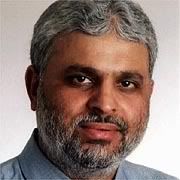 Aleem Nasir was interrogated in Pakistan and then picked up by the German police when he landed in Frankfurt.
Der Spiegel reports:
German prosecutors attempting to prove a salesman guilty of al-Qaida membership have been relying on the results of his interrogation in Pakistan. He says his testimony was extracted by means of torture.
When Aleem Nasir returned from Pakistan on Aug. 25, an unusual VIP service was waiting for him at Frankfurt Airport: A police car took the dealer in semi-precious stones directly to a clinic in Mainz, where he was given a blood test and his hand and arm were photographed. The 45-year-old, who lives in Germersheim in the German state of Rhineland-Palatinate, was far from overjoyed about this unexpected medical examination. After all, the investigators were hoping for a diagnosis that would hardly be favorable to him: They were hoping to prove him a terrorist.
The enforced medical examination had been requested by the Office of the Federal Prosecutor, which had been given carte blanche by Ulrich Hebenstreit, an investigative judge at Germany's Federal Court, in early August. According to a court order written with apparent haste, the examination was intended to prove that Nasir had spent time in an al-Qaida training camp in northern Pakistan. It was alleged that he had attempted to mix "250 grams (8.8 ounces) of potassium nitrate with red phosphorus" and "injured his right hand and arm" when the dangerous concoction exploded.
But so far, the attempt to secure evidence from Nasir's body has not yielded the unambiguous results that had been hoped for. And now the investigators face another problem: The tip-off about Nasir's alleged handling of explosives came from the notorious Pakistani intelligence agency Inter-Services Intelligence (ISI) who interrogated him in Islamabad in June. Nasir says the ISI men, some of them masked, beat him "until I could no longer stand it." The interrogations would routinely begin with between three and five punches and slaps. He was held in an ice-cold cell in a special prison with just five cells run by Americans, Nasir says. In the end, he says, he gave a false testimony just to get out of there.
The allegations are explosive -- particularly in Germany. It is the first time since the Sept. 11, 2001 attacks that German authorities have based the core part of an ongoing terrorism case on the results of questionable interrogation methods. The evidence comes from a country that Amnesty International accuses of carrying out "arbitrary arrests" and of not paying much heed to suspects' basic human rights, particularly terror suspects. Former inmates report having been tortured, says Amnesty. And the German Foreign Ministry also calls the human rights situation in Pakistan "as problematic as ever."
'Forbidden Fruits Marked with Blood'
The case is adding fire to a debate in Berlin about where exactly the line should be drawn in the fight against terrorism, and about whether German authorities "profited from forbidden fruits still marked with dried blood," as Wolfgang Wieland, a member of the opposition Green Party, puts it. A parliamentary commission is currently exploring this question in the Bundestag. In 2006 the chancellery already prohibited Germany's foreign intelligence agency, the Federal Intelligence Service (BND), from carrying out interrogations in countries such as Syria and Pakistan.
 Has Germany's Chief Federal Prosecutor Monika Harms tolerated her staff making use of testimonies extracted by torture?
Since then investigators have continued to evaluate information coming from dubious sources. But using such information in preliminary proceedings was considered taboo -- even for officials working for Germany's Chief Federal Prosecutor Monika Harms. This led the prosecutors to shred US files containing interrogation statements by Ramzi Binalshibh -- the alleged chief logistician behind the Sept. 11, 2001 terror attacks -- when it transpired the CIA sometimes uses interrogation techniques such as "waterboarding," which involves submerging the prisoner in water. The transcripts of a visit German investigators paid the Syrian-born German citizen Mohammed Haydar Zammar in Damascus were also not used in German proceedings -- because Zammar, another al-Qaida member, had been interrogated in Syrian prisons.
The federal prosecutors have strayed from this clear principle in the case of Nasir, even if Justice Minister Brigitte Zypries from the Social Democrat Party (SPD) presents sophisticated arguments to show it is all just a matter of following an "investigative lead." Zypries does not believe a precedent has been set.
The behavior of the investigators also reveals how much they suspect Nasir -- and how difficult it would be to prove him guilty. The father of four was born in Pakistan, is married to a German and has been a German citizen since 1992. The German authorities have considered him a "danger" for some time. Indeed, federal prosecutors had already investigated Nasir once before when he allegedly remarked, after the Sept. 11, 2001 terrorist attacks, that such attacks would now occur "everywhere, including Germany." The investigation didn't lead to a conviction.
So the Germans were of course excited when they heard about Nasir's arrest in Pakistan on June 18, 2007. He simply corresponds too well to the image German Interior Minister Wolfgang Schäuble of the Christian Democrat Party (CDU) has been conjuring up for months: that of German Islamists' Pakistan connection.
While Nasir himself admits to having been in Wana, a city in the lawless region of Pakistan widely held to be an al-Qaida stronghold, he also says all he did there was purchase lapis lazuli. And in fact he was carrying 25 kilograms (55 lbs) of the semi-precious stones when he was arrested.
The ISI reports, on the other hand, state that Nasir admitted to having been invited to a training camp by an al-Qaida functionary, Abdul Rehman, and that while there he mixed the explosives correctly the first time around, and injured himself during his second attempt. According to the ISI, Nasir also provided al-Qaida with binoculars and night vision devices in addition to transporting money for the group.
Another statement by Nasir illustrates just how closely Germany and Pakistan have cooperated on this case -- if the statement is true. Nasir says that his Pakistani interrogators repeatedly showed him photographs of Fritz Gelowicz. The German convert to Islam was part of the Islamist cell recently discovered (more...) in Germany's Sauerland region, which is accused of planning terror attacks in the country. The images of Gelowicz -- mostly photos taken while he was under observation -- come from the German prosecutors' files. Nasir says he did not encounter German investigators in the prison where he was held. "But," he adds, "my interrogators had been fully briefed by the German authorities."
| [+/-] |
Abu Ghraib Abuse Figure Paroled |
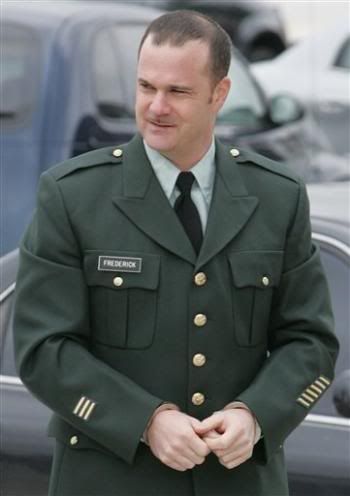 Pvt. Ivan L. Frederick, II is escorted into the courthouse in this May 12, 2005 file photo in Fort Hood, Texas. Former Army Reserve Staff Sgt. Ivan L. "Chip" Frederick Jr., who was paroled Monday, Oct. 1, 2007, from military prison in Fort Leavenworth, Kan., served about three years of an eight-year sentence for abusing detainees at Abu Ghraib prison. (AP Photo/David J. Phillip, file)
The AP reports:
The highest-ranking U.S. soldier convicted of abusing detainees at Abu Ghraib prison in Iraq was paroled Monday from military prison in Fort Leavenworth, Kan., the Army said.
Former Army Reserve Staff Sgt. Ivan L. "Chip" Frederick Jr. served about three years of an eight-year sentence for actions that included placing wires in a detainee's hands and telling him he would be electrocuted if he fell off a box.
Frederick is among 12 U.S. soldiers convicted in the scandal that erupted in April 2004 with the release of pictures of grinning U.S. soldiers posing with detainees, some naked, being held on leashes or in painful and sexually humiliating positions.
Frederick, 40, of Buckingham, Va., declined interview requests made through his attorney, Gary Myers, and family members.
"We're just elated that he's coming home," sister Miriam Frederick said in a telephone interview.
Myers said Frederick's cooperation with prosecutors, including his testimony at the trial in August of final Abu Ghraib defendant Lt. Col. Steven L. Jordan, aided in his early release.
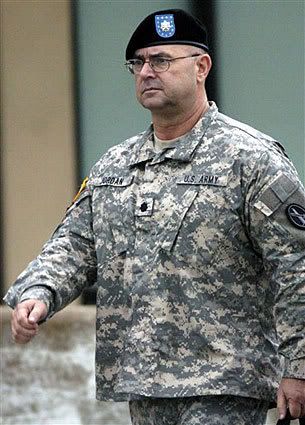 Lt. Col. Steven L. Jordan, the former head of the interrogation center at Abu Ghraib prison in Iraq, leaves a military court at Fort Meade Tuesday after day two of his Article 32 hearing, the military equivalent of a grand jury investigation. (AP photo / October 17, 2006)
"Chip Frederick was never a "bad apple" as the Army tried to portray him," Myers said in an e-mailed statement to The Associated Press. "Frederick recognized that he had done wrong and, like the decent man that he is, pleaded guilty to some of the charges against him."
Myers said Frederick's prosecution was a blatant political attempt to shift blame from former Defense Secretary Donald Rumsfeld and other high-ranking government officials, whom Myers said had created an environment in which the Geneva Conventions were disregarded and misconduct was allowed in the name of national security.
The Pentagon has said that the Abu Ghraib abuses were thoroughly investigated, and that the appropriate people have been held accountable.
Frederick, of the 372nd Military Police Company of Cresaptown, Md., supervised the night shift in the prison's "hard site," where detainees deemed to be of high intelligence value were held.
At his court-martial in Baghdad in October 2004, Frederick admitted placing the wires in the hooded detainee's hands; forcing another, naked detainee to masturbate while soldiers photographed him; jumping and stomping on a pile of seven detainees accused of rioting; and punching a detainee in the chest so hard he needed medical attention.
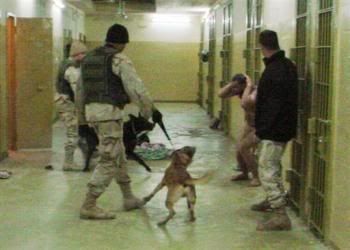 This is an image obtained by The Associated Press which shows Sgt. Michael Smith, left, with his black dog Marco, Sgt. Santos Cardona, second right, with his tan Belgian shepherd Duco, detainee Mohammed Bollendia and Pvt. Ivan L. Frederick II, right, at the Abu Ghraib prison in Baghdad, Iraq in this Dec. 12, 2003 file photo. Former Army Reserve Staff Sgt. Ivan L. "Chip" Frederick Jr., who was paroled Monday, Oct. 1, 2007, from military prison in Fort Leavenworth, Kan., served about three years of an eight-year sentence for abusing detainees at Abu Ghraib prison. (AP Photo, file)
"I knew it was wrong at the time because I knew it was a form of abuse," Frederick, a former Virginia state correctional officer, said at his court-martial. He testified then, and again at Jordan's trial in August, that at least some of the abuse, such as threatening the man with electrocution, stripping male prisoners and covering their heads with women's underwear, was directed by military and civilian interrogators.
Frederick pleaded guilty to conspiracy, dereliction of duty, maltreatment of detainees, assault and committing an indecent act. Prosecutors dropped several other charges in a plea deal.
Frederick is among 11 enlisted soldiers convicted in the scandal. Jordan, the only officer charged, was acquitted of abuse charges but convicted of disobeying a general's order not to communicate with others about a subsequent investigation of the abuse.
Jumana Mousa, advocacy director for Amnesty International USA, said Frederick's early release was "part and parcel of what we've seen of accountability from this administration: mostly lower-level military folks held to account and nobody held to full account."
The only defendant still imprisoned is the alleged ringleader, former Cpl. Charles A. Graner Jr., of Uniontown, Pa., who is serving a 10-year term at Fort Leavenworth. Janet Wray, an installation spokeswoman, said Army policy prohibits her from revealing prisoner release dates until after they have been freed.
| [+/-] |
Senate to Approve More War Funding |
The Associated Press reports:
Powerless in their effort to bring troops home from Iraq, Senate Democrats were on track Monday to help pass a defense policy bill that would authorize another $150 billion for the wars in Iraq and Afghanistan.
The vote comes as the House planned to approve on Tuesday separate legislation requiring that President Bush give Congress a plan for eventual troop withdrawals.
The developments underscored the difficulty facing Democrats in the Iraq debate: They lack the votes to pass legislation ordering troops home and are divided on whether to cut money for combat, despite a mandate by supporters to end the war.
Hoping the political landscape changes in coming months, Democratic leaders say they will renew their fight when Congress considers the money Bush wants in war funding.
While the policy bill the Senate was set to approve Monday authorizes the money to be spent, it does not guarantee it; Bush will have to wait until Congress passes a separate appropriations bill before war funds are transferred to military coffers.
"I think that's where you're going to see the next dogfight," said Senate Majority Leader Harry Reid, D-Nev., of the upcoming war spending bill.
Democrats say their options include directing that the money be spent on bringing troops home instead of combat; setting a date when money for the war is cut off, and identifying a goal to end the war to try to pressure Bush to bring troops home.
Similar attempts have been made but fallen short of the 60 votes needed to overcome procedural hurdles in the Senate.
"Many of us have reached a breaking point on this," said Senate Majority Whip Dick Durbin, D-Ill. "I've done this for too many years. I've waited for the president to start bringing this war to an end. I'm not going to sign up for this any longer."
In the House, Democrats are pushing for a bill that would require the administration to report to Congress in 60 days and every 90 days thereafter on the status of its redeployment plans in Iraq.
The bill, sponsored by Democrats John Tanner of Tennessee and Neil Abercrombie of Hawaii, was initially cast aside as too mild by Democratic leaders focused on tougher proposals ordering troops home this fall.
But after Democrats were unable to peel off Republican support, the Iraq debate stalled and some four dozen rank-and-file Democrats demanded a vote on the Abercrombie-Tanner bill.
"This will be the first time since the war in Iraq began that we are working together as a Congress instead of one party or another to be a constructive voice in the civilian management of operations in Iraq," Tanner said in a statement e-mailed to the Associated Press.
In February, Bush requested more than $140 billion for the war, and is expected to ask for another $42 billion to cover costs in the 2008 budget year, which began Monday. The Senate's defense policy bill authorizes Bush's initial request, plus an additional $23 billion for the purchase of bomb-resistent vehicles.
In addition to war money, the Senate's defense policy bill authorizes more than a half trillion dollars in annual military programs, including such big-ticket items as $10.1 billion for missile defense.
Republicans predict the bill is on track to be vetoed by President Bush because it includes hate-crimes legislation by Sen. Edward Kennedy, D-Mass. The White House said it sees Kennedy's proposal, which would let federal law enforcement help states prosecute attacks on gays, as unnecessary.
The House passed its version of the defense authorization bill in May by a 397-27 vote. That $646 billion measure would trim hundreds of millions of dollars from some weapons modernization programs and use the money instead to aid troops in combat.
The House bill has drawn a veto threat from the White House because of provisions insisting the military rely heavily on American-made products and proposed changes to the Pentagon's personnel policies.
| [+/-] |
Court Rules Delay in Release of Presidential Papers is Illegal |
Fails to Address Authority of Former Vice Presidents to Hold Up Disclosure of Papers
A District Court in the District of Columbia has ruled that an Executive Order issued by President George W. Bush in 2001, which severely slowed or prevented the release of historic presidential papers is, in part, invalid. In a carefully constructed decision, the court held that the Archivist of the United States acts arbitrarily, capriciously, and contrary to law by relying on the Executive Order to delay release of the records of former presidents. The court did not reach the issue of whether it was permissible for President Bush to extend the authority over disclosure of presidential papers to a former president’s heirs or to former vice presidents.
The underlying lawsuit, which was filed in November 2001 by the National Security Archive and other plaintiffs, challenges President Bush's Executive Order 13,233 that gave former Presidents and their heirs (as well as former Vice-Presidents for the first time) indefinite authority to hold up release of White House records. In finding that the plaintiffs have standing to pursue the claim, the court specifically referenced the delays experienced by the National Security Archive for requests pending at the Ronald Reagan Presidential Library. As the Archive’s Director Thomas Blanton testified in Congress this past March, those delays have grown from 18 months in 2001 to “an estimate of 78 months (six and a half years!) [in 2007].”
Archive General Counsel Meredith Fuchs commented, “The court is enforcing procedural standards, but has avoided the hard questions about the role former presidents, former vice presidents, and their heirs can play when it comes to disclosure of presidential records.” She noted, “Unless the Executive Order is reversed or withdrawn, decisions about the release of records from this administration may ultimately be made by the Bush daughters.”
The decision comes at a time when a bill that would overturn Executive Order 13,233 is stalled in the U.S. Senate, reportedly due to a hold placed on the measure by Senator Jim Bunning (R-KY). The bill, H.R. 1255, was approved in the U.S. House of Representatives on March 14, 2007 by a vote of 333-93. The White House has threatened to veto the bill if it is passed in the Senate.
BACKGROUND
The Presidential Records Act of 1978 (PRA) emerged from the scandals of the Nixon presidency to require former presidents to release their records no later than 12 years after they leave office. Under the PRA, as amended, the U.S. government asserts complete "ownership, possession, and control" of all Presidential and Vice-Presidential records. Upon conclusion of the President's term in office, the National Archivist is required to assume custody of the records, and to make them available to the public when permissible under the PRA. Access to the records can be denied after the end of the 12-year embargo only if a former or incumbent president claims an exemption based on a "constitutionally based" executive privilege or continuing national security concern.
On February 8, 2001, shortly after President Bush came into office, he was notified of a scheduled release of Reagan presidential records (68,000 pages of records). His legal counsel requested two successive 90-day extensions of time to review the records prior to their release followed by a third request for an indefinite extension of time so that the White House could evaluate the legal framework and process that would govern release of the records. This was followed on November 1, 2001 with the issuance of Executive Order (E.O. 13,233) that gives the White House and former presidents uncontrolled discretion in deciding whether to deny the release of documents requested by journalists and scholars.
