Couple's slaying is still unsolved; Brazilian suspect freed; children live in Spanish Fork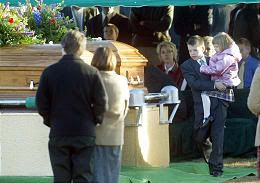 Family members gather at graveside service for Todd and Michelle Staheli in Spanish Fork last year.[Stuart Johnson, Deseret Morning News]
DeseretNews.com reports:
A year has passed since a Utah couple was brutally bludgeoned to death in their posh Rio de Janeiro condominium, and the prime suspect in the case remains free.
Todd Staheli, 39, and his wife, Michelle, 36, of Spanish Fork, were killed on Nov. 30 of last year as they slept in their high-security home, according to Brazilian police authorities.
In April, a 20-year-old handyman confessed to using a crowbar to commit the grisly murders, but the next day he recanted the confession, saying two other Brazilians committed the crime after he let them in.
The handyman, Jociel Conceicao dos Santos, lived with the Stahelis' neighbor. He was arrested in April after allegedly trying to break into another condominium in the complex where the Stahelis lived.
Dos Santos said he killed the couple because Staheli, an executive with Shell Oil, had called him a racial slur. But after relatives said Todd Staheli didn't even speak Portuguese, Dos Santos recanted his confession. He was placed in Brazil's witness protection program.
A few weeks later, police again identified Dos Santos as the prime suspect, saying DNA from blood found on his shorts and backpack matched that of the Stahelis. Dos Santos said the DNA evidence had been planted and that he had confessed because police had pressured him to.
A judge refused a prosecutor's request to keep Dos Santos behind bars and instead ordered psychological tests.
The Staheli family in Utah has been skeptical that Dos Santos had anything to do with the murder.
"It would be nice if they found out who did it," said Todd Staheli's uncle, Elias Staheli. "But I don't think they ever will."
The murder has generated intense media attention and speculation in Brazil. Some still wonder if Staheli was killed because of his position as an oil executive with Shell. There were rumors the Stahelis had received threatening phone calls related to an international oil pipeline.
But Shell officials say they were never alerted of any threats. Before moving to Brazil, Staheli had worked for Shell in London, Switzerland, Ukraine and Saudi Arabia.
Initially, investigators thought the couple was murdered during a botched robbery attempt, but little was taken from the house. Even a $15,000 gold Rolex was left sitting on the nightstand near the couple's bed.
Elias Staheli said the family is trying to move on. He said his brother, Todd's father, was relieved to leave Brazil with the couple's four children, ages 3 to 13. The grandparents have custody of the children and live with them in Spanish Fork.
"I don't think my brother dwells on it too much. He doesn't want to go on with resentment in his life," he said.
Wednesday, December 1, 2004
| [+/-] |
|
Wednesday, November 3, 2004
| [+/-] |
Budget Conscious Maverick On The Move |
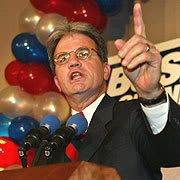
USA Today reports:
Around his hometown of Muskogee, Oklahoma's new senator is best known for delivering more than 3,000 little Okies as a family doctor.
But in Washington, Tom Coburn's former colleagues in the House of Representatives remember a maverick conservative who in 1999 almost single-handedly forced Congress to cut nearly $1 billion in spending. The Republican vows to be just as tight with taxpayers' money when he returns to Capitol Hill as a senator in January.
Coburn, 56, earned a bachelor's degree in accounting from Oklahoma State University and worked in his family's optical business for almost a decade. When the business was sold, he enrolled at the University of Oklahoma Medical School and, at age 35, became a doctor.
It's not clear whether Coburn will continue to practice one day a week, as he did while in the House, after he replaces retiring 24-year Republican Sen. Don Nickles.
Coburn initially wasn't interested in running for the Senate seat. He had just survived colon cancer and had left Washington in 2001 after a self-imposed limit of three terms in the House. Brad Carson, the Democrat he defeated Tuesday, replaced him in Oklahoma's 2nd Congressional District.
But then conservatives, including the anti-tax Club for Growth, urged him to oppose former Oklahoma City mayor Kirk Humphreys in the GOP primary. Humphreys was the choice of party leaders. Coburn couldn't resist sticking it to the establishment and ran. To the dismay of many Republicans, he won.
Coburn then bested Carson, 37, by painting the moderate Democrat as a liberal who would align himself in the Senate with Edward Kennedy and Hillary Rodham Clinton. Conservative Oklahomans opted for Coburn, a budget hawk who still talks about the need for a balanced budget, even if many of his fellow Republicans don't. He also appealed to religious conservatives with his stands against abortion and gay marriage.
But Coburn's candidacy was almost sunk by controversies of his own making.
He caused a stir when he said he favored the death penalty for "abortionists and other people who take life." He called the race with Carson a choice between "good and evil." Most damaging, he was forced to respond when reports surfaced about an old lawsuit against him by a woman who said he sterilized her without written permission.
Coburn and his wife, Carolyn, have three children.
Sunday, October 31, 2004
| [+/-] |
Behind Closed Doors |
Who is The Council For National Policy and What Are They Up To? And Why Don't They Want You To Know?
At Americans United, Jeremy Leaming and Rob Boston write:
When a top U.S. senator receives a major award from a national advocacy organization, it’s standard procedure for both the politician and the group to eagerly tell as many people about it as possible.
Press releases spew from fax machines and e-mails clog reporters’ in-boxes. The news media are summoned in the hope that favorable stories will appear in the newspapers, on radio and on television.
It was odd, therefore, that when U.S. Senate Majority Leader Bill Frist (R-Tenn.) accepted a “Thomas Jefferson Award” from a national group at the Plaza Hotel in New York City in August, the media weren’t notified. In fact, they weren’t welcome to attend.
“The media should not know when or where we meet or who takes part in our programs, before or after a meeting,” reads one of the cardinal rules of the organization that honored Frist.
The membership list of this group is “strictly confidential.” Guests can attend only with the unanimous approval of the organization’s executive committee. The group’s leadership is so secretive that members are told not to refer to it by name in e-mail messages. Anyone who breaks the rules can be tossed out.
What is this group, and why is it so determined to avoid the public spotlight?
That answer is the Council for National Policy (CNP). And if the name isn’t familiar to you, don’t be surprised. That’s just what the Council wants.
The CNP was founded in 1981 as an umbrella organization of right-wing leaders who would gather regularly to plot strategy, share ideas and fund causes and candidates to advance the far-right agenda. Twenty-three years later, it is still secretly pursuing those goals with amazing success.
Since its founding, the tax-exempt organization has been meeting three times a year. Members have come and gone, but all share something in common: They are powerful figures, drawn from both the Religious Right and the anti-government, anti-tax wing of the ultra-conservative movement.
It may sound like a far-left conspiracy theory, but the CNP is all too real and, its critics would argue, all too influential.
What amazes most CNP opponents is the group’s ability to avoid widespread public scrutiny. Despite nearly a quarter century of existence and involvement by wealthy and influential political figures, the CNP remains unknown to most Americans. Operating out of a non-descript office building in the Washing ton, D.C., suburb of Fairfax, Va., the organization has managed to keep an extremely low profile an amazing feat when one considers the people the CNP courts.
New York Times reporter David Kirkpatrick was finally able to pierce the CNP veil in August when he attended a gathering of the group in New York City just before the Republican convention, where the organization presented Frist with the “Jefferson Award.”
The Times described the CNP as consisting of “a few hundred of the most powerful conservatives in the country” who meet “behind closed doors at undisclosed locations…to strategize about how to turn the country to the right.”
Accepting the award, Frist acknowledged the group’s power, telling attendees, “The destiny of the nation is on the shoulders of the conservative movement.”
The CNP meeting was perhaps more important than what took place on the carefully choreographed GOP convention stage a few days later, said Barry W. Lynn, executive director of Americans United for Separation of Church and State.
“The real crux of this is that these are the genuine leaders of the Republican Party, but they certainly aren’t going to be visible on television next week,” Lynn told The Times days before the start of the GOP convention. “The CNP members are not going to be visible next week, but they are very much on the minds of George W. Bush and Karl Rove every week of the year, because these are the real powers in the party.”
The Times’ Kirkpatrick was able to obtain the CNP’s current membership list and reported that its roster includes Focus on the Family founder James C. Dobson, Paul Weyrich of the Free Congress Foundation, Wayne LaPierre of the National Rifle Association and Grover Norquist, head of Americans for Tax Reform. A CNP financial disclosure form for 2002 lists Norquist and Howard Phillips, founder of the ultra-conservative Constitution Party, as directors. The current president of the group is Donald P. Hodel, former executive director of the Christian Coalition.
Other CNP directors include names that would not mean a lot to most people, but they are key players in the right-wing universe. Becky Norton Dunlop is vice president for external relations at the Heritage Foundation. James C. Miller III is former director of Citizens for a Sound Economy. Stuart W. Epperson owns a chain of Christian radio stations. E. Peb Jackson is former president of Young Life. T. Kenneth Cribb Jr., vice president of the CNP, was a domestic policy advisor to President Ronald W. Reagan and runs the Intercollegiate Studies Institute, a group that funds right-wing newspapers on college campuses. Ken Raasch is a businessman who works in partnership with popular artist Thomas Kinkade.
Others who have been affiliated with the CNP include TV preachers Jerry Falwell and Pat Robertson, longtime anti-feminist crusader Phyllis Schlafly, Iran-Contra figure turned right-wing talk radio host Oliver North, former U.S. Sen. Jesse Helms (R-N.C.), wealthy Cali fornia savings and loan heir Howard Ahmanson, former House Majority Leader Dick Army (R-Texas), Attorney General John Ashcroft and Tommy Thompson, secretary of the U.S. Depart ment of Health and Human Services.
Republican Party glitterati and top government officials frequently appear at CNP meetings. During the gathering before this year’s GOP convention, The New York Times reported that several Bush administration representatives were scheduled for speeches. Under secretary of State John Bolton spoke about plans for Iran, Assistant Attorney General Alexander Acosta talked about human trafficking and Dan Senor, who worked for Paul Bremer in Iraq, was scheduled to talk about the war there.
The Times said the CNP meeting was focused on the Bush-Cheney re-election efforts and quoted an anonymous participant who called the gathering a “pep rally” for the president’s campaign. Passing a federal marriage amendment and using that subject as a wedge issue was also a top priority.
The newspaper noted that another CNP meeting that took place shortly after the American invasion of Iraq included visits from Vice President Dick Cheney and Defense Secretary Donald Rumsfeld. A Canadian newspaper reported that Rumsfeld provided the gathering’s keynote address and that Cheney was scheduled to speak. (See “People & Events,” June 2003 Church & State.)
In April of 2002, according to an ABC News story that ran online, Supreme Court Justice Clarence Thomas was the keynote speaker at a CNP meeting in a northern Virginia suburb of Washington, D.C., where White House counsel Alberto Gonzales and Timothy Goeglein, a White House liaison to religious communities, also spoke.
Heavy-hitters such as these show that the CNP is a force to be reckoned with, and Republican politicians ignore the group at their peril. In 1999, GOP presidential candidate George W. Bush appeared before a CNP gathering in San Antonio, and, in a closed-door meeting, assured the members of his right-wing bona fides. Bush critics demanded that the president release the text of his remarks, but he refused. Nonetheless, rumors soon surfaced that Bush promised the CNP to implement its agenda and vowed to appoint only anti-abortion judges to the federal courts.
How did this influential organization get its start? To find the answer, it’s necessary to go all the way back to 1981 and the early years of the Reagan presidency.
Excited by Reagan’s election, Tim LaHaye, Richard Viguerie, Weyrich and a number of far-right conservatives began meeting to discuss ways to maximize the power of the ultra-conservative movement and create an alternative to the more centrist Council on Foreign Relations. In mid May, about 50 of them met at the McLean, Va., home of Viguerie, owner of a conservative fund-raising company.
Viguerie had a knack for networking. Shortly before helping launch the CNP, Viguerie and Weyrich initiated the Moral Majority and tapped Falwell to run it, making the obscure Lynchburg pastor a major political figure overnight. Viguerie’s goal was to lead rural White voters in the South out of the Democratic Party and into the Republican Party by emphasizing divisive social issues such as abortion, gay rights and school prayer.
Back when the CNP was founded, it was a little less media shy. In the summer of 1981, Woody Jenkins, a former Louisiana state lawmaker who served as the group’s first executive director, told Newsweek bluntly, “One day before the end of this century, the Council will be so influential that no president, regardless of party or philosophy, will be able to ignore us or our concerns or shut us out of the highest levels of government.”
From the beginning, the CNP sought to merge two strains of far-right thought: the theocratic Religious Right with the low-tax, anti-government wing of the GOP. The theory was that the Religious Right would provide the grassroots activism and the muscle. The other faction would put up the money.
The CNP has always reflected this two-barreled approach. The group’s first president was LaHaye, then president of Family Life Seminars in El Cajon Calif. LaHaye, a fundamentalist Baptist preacher who went on in the 1990s to launch the popular “Left Behind” series of apocalyptic potboilers, was an early anti-gay crusader and frequent basher of public education and he still is today.
Alongside figures like LaHaye and leaders of the anti-abortion movement, the nascent CNP also included Joseph Coors, the wealthy beer magnate; Herbert and Nelson Bunker Hunt, two billionaire investors and energy company executives known for their advocacy of right-wing causes, and William Cies, another wealthy businessman.
Interestingly, the Hunts, Cies and LaHaye all were affiliated with the John Birch Society, the conspiracy-obsessed anti-communist group founded in 1959. LaHaye had lectured and conducted training seminars frequently for the Society during the 1960s and ’70s a time when the group was known for its campaign against the civil rights movement.
Bringing together the two strains of the far right gave the CNP enormous leverage. The group, for example, could pick a candidate for public office and ply him or her with individual donations and PAC money from its well-endowed, business wing.
The goals of the CNP, then, are similarly two-pronged. Activists like Nor quist, who once said he wanted to shrink the federal government to a size where it could be drowned in a bathtub, are drawn to the group for its exaltation of unfettered capitalism, hostility toward social-service spending and low (or no) tax ideology.
Dramatically scaling back the size of the federal government and abolishing the last remnants of the New Deal may be one goal of the CNP, but many of the foot soldiers of the Religious Right sign on for a different crusade: a desire to remake America in a Christian fundamentalist image.
Since 1981, CNP members have worked assiduously to pack government bodies with ultra-conservative lawmakers who agree that the nation needs a major shift to the right economically and socially. They rail against popular culture and progressive lawmakers, calling them the culprits of the nation’s moral decay. Laws must be passed and enforced, the group argues, that will bring organized prayer back to the public schools, outlaw abortion, prevent gays from achieving full civil rights and fund private religious schools with tax funds.
The CNP does not directly fund these activities itself. In fact, a glance at the group’s publicly available financial statements reveals a modest budget. In 2002, the CNP operated with income of just over $1.2 million. The national office has just a handful of staff members.
(In no way a grassroots organization, the CNP gets much of its money from far-right foundations. The Coors family and Richard DeVos, founder of Amway, have been among the CNP’s largest financial backers. The group received $125,000 from a Coors family philanthropic arm, the Castle Rock Foun dation, and the Richard and Helen DeVos Foundation. Richard DeVos was also one of the CNP’s early presidents and Jeffrey and Holly Coors have been members for many years.)
The CNP’s budgetary figures don’t tell the whole story, however. Financial data shows that the bulk of its money $815,227 in 2002 is spent on “educational conferences and seminars for national leaders in the fields of business, government, religion and academia to explore national policy alternatives.” An additional $69,108 was spent on “weekly newsletters…distributed to all members to keep them apprised of member activities and public policy issues.”
In other words, the CNP is merely a facilitator. While the group has an affiliated arm CNP Action that does some lobbying, in the main it does not work directly to implement the schemes its members devise during the three yearly meetings. The well-heeled leaders and their affiliated organizations are expected to come up with their own funds to pay for the plots hatched during the meetings.
Despite the group’s obsessive desire for secrecy, some information has leaked out over the years, mainly due to the persistent efforts of a few writers and researchers.
In 1988, writer Russ Bellant noted in his book The Coors Connection, which details the beer dynasty’s funding of right-wing causes and groups, that many CNP members have been associated with the outer reaches of the conservative movement. Bellant found that among the far right, there is a certain cachet to being a CNP member. Members pay thousands of dollars yearly to keep their CNP membership. Bellant noted that at the time, individuals paid $2,000 per year for membership and those seeking a spot on the CNP’s board of directors shelled out $5,000 each.
Research undertaken by a now-defunct watchdog group, the Institute for First Amend ment Studies (IFAS), shed some more light on the group’s activities. For many years running, IFAS founder Skip Porteous was able to obtain CNP membership lists, which he posted online.
Bellant noted that Tom Ellis, a top political operative of the ultra-conservative Jesse Helms, followed LaHaye as the CNP president in 1982. Ellis had a checkered past, having served as a director of a foundation called the Pioneer Fund, which has a long history of subsidizing efforts to prove blacks are genetically inferior to whites.
Bellant’s book, as well as work by the IFAS, reveals other CNP members who have flirted with extremist and hateful propaganda.
In addition to obsessing over communist threats and buttressing white supremacist ideology, the CNP has included many members bent on replacing American democracy with theocracy.
LaHaye, like the whole of the nation’s Religious Right leaders, nurtures a strong contempt for the First Amendment principle of church-state separation, because it seriously complicates their goal of installing fundamentalist Christianity as the nation’s officially recognized religion. LaHaye has worked within the CNP and other groups to replace American law with “biblical law.” (See “Left Behind,” February 2002 Church & State.)
Former Christian Coalition head Ralph Reed has also been involved with the CNP and addressed the group during the August GOP meeting in New York. Asked about his relationship with the CNP by CNN’s Wolf Blitzer Aug. 29, Reed fell back on the common ploy of asserting that the group is just a ramped-up social club.
“I think it’s like-minded individuals who believe in conservative public policy views. And they get together a few times a year,” said Reed (whose CNP topic was “The 2004 Elections: Who Will Win in November?”).
Reed, now a top official of the Bush-Cheney campaign, said he is no longer a CNP member, asserting that he quit because “I was just busy doing other things.”
The CNP goes way beyond LaHaye and Reed in its effort to embrace the Religious Right. For many years, the late leader of the Christian Recon struc tionist movement, Rousas J. Rushdoony, was a member. Reconstructionists espouse a radical theology that calls for trashing the U.S. Constitution and replacing it with the harsh legal code of the Old Testament. They advocate the death penalty for adulterers, blasphemers, incorrigible teen agers, gay people, “witches” and those who worship “false gods.”
Another CNP-Reconstruc tionist tie comes through Howard Phillips, the Con stitution Party leader. Phillips, a longtime CNP member, is a disciple of Rushdoony and uses rhetoric that strikes a distinctly Reconstructionist tone. In a 2003 Constitution Party gathering in Clackamas, Oregon, Phillips told party members and guests, “We’ve got to be ready when God chooses to let us restore our once-great Republic.” A report by the Southern Poverty Law Center said that Phillips proclaimed that his party was “raising up an army” to “take back this nation!”
The CNP has provided more prominent Religious Right figures, such as Dob son, with a forum to promote church-state merger and shove the Republican Party toward the right. In 1998, Dobson ap peared before a CNP gathering where he admitted he voted for Constitution Party nominee Phillips in the 1996 presidential election instead of Republican candidate Bob Dole. Dobson threatened to bolt the Republican Party and take “as many people with me as possible” if the GOP did not stop taking Christian conservatives for granted. (Dobson’s speech, like all addresses before CNP functions, was not intended for media coverage. A transcript was published by the IFAS, which was able to gain access to the meeting. The transcript remains avail able on the Internet at www.buildingequality.us/ifas /cnp/dobson.html.)
Dobson railed against the Repub lican-controlled Congress for apparently giving short shrift to the “pro-moral community” and easily acquiescing to a “post-modern notion, that there is no moral law to the universe.” That notion, Dobson said, has spread throughout the nation like a cancer.
For Dobson, the moral law of the universe is clear and should be evident to all lawmakers. The universe “has a boss,” he said. “And He has very clear ideas of what is right and wrong.”
Dobson blasted the Republican-led Congress for increasing funding to Planned Parenthood and the National Endowment of the Arts and for espousing a “safe sex ideology” that he said includes advocacy of the use of condoms to help prevent sexually transmitted diseases.
All of this, Dobson said, directly contravenes God’s law.
“It’s a lack of conviction that there is a boss to the universe and that there are moral standards that we are held to and we need officials that will stand up and respect them,” Dobson said.
Dobson concluded his lecture by begging CNP members “shamelessly, to use your influence on the party at this critical stage of our history. You have a lot of influence on the party. A lot of you are politicians. I beg you to talk to them about what’s at stake here because they’ve laid the foundation for a revolt and I don’t think they even know it because they’re so out of touch with the people that I’m talking about.”
Dobson seemed fully aware that he was speaking to an ultra-partisan group. Indeed, the ABCNews.com report noted that some CNP members have bragged about helping “Christian conservatives” take over Republican state party operations in several Southern and Mid western states.
The CNP’s current executive director, a former California lawmaker named Steve Baldwin, has tried to downplay the organization’s influence on powerful state and national lawmakers. He has remained cagey about the CNP’s goals, insisting it is merely a group that counters liberal policy arguments.
In many ways, Baldwin himself exemplifies the CNP’s operate-in-secret strategy. As a political strategist in Cali fornia in the early 1990s, Baldwin was one of the key architects of the “stealth strategy” that led to Religious Right activists being elected to school boards and other local offices.
“Stealth candidates” were trained to emphasize pocketbook issues such as taxes and spending. But once elected, they would pursue a Religious Right agenda, such as demanding creationism in public schools. A spate of the candidates won election in Southern Cali fornia in the early 1990s, but most were later removed by the voters when the true agenda became apparent.
Baldwin tried to use the stealth strategy during his own campaign for the California Assembly in 1992. He lost that race but fared better in 1994, winning election to a seat in the 77th Assembly District. While in office, he helped lead efforts by Religious Right conservatives to take over the state GOP and, briefly, the entire Assembly.
Baldwin had to leave the Assembly in 2000 after serving six years due to California’s term-limits law. According to one California media outlet, his hard-right views had by then alienated most other members of the Assembly.
But Baldwin refused to let up. In the spring of 2002, while working at the CNP, he penned a controversial article for the law review at TV preacher Pat Robertson’s Regent University. The piece, “Child Molestation and the Homosexual Movement,” linked pedo philia to homosexuality.
The article went on to become a staple in the Religious Right’s anti-gay canon, despite the fact that its claims were challenged by legitimate researchers.
“It is difficult to convey the dark side of the homosexual culture without appearing harsh,” wrote Baldwin. “However, it is time to acknowledge that homosexual behavior threatens the foundation of Western civilization the nuclear family.”
What might the future hold for Baldwin and the CNP? Already Jenkins’ vision of a day when powerful politicians would pay heed to the group has come to pass. With social issues such as same-sex marriage increasingly dominating the Religious Right’s agenda, the organization is not likely to want for things to do.
Americans United, which has monitored the activities of the CNP for years, says the groups holds radical views and is especially dangerous because of its success in connecting Religious Right activism with the secular right’s deep financial pockets.
AU’s Lynn said he hopes the media begins to pay more attention to the CNP and expose its goals.
“If the CNP gets its way,” Lynn said, “the First Amendment, along with the rest of the U.S. Constitution, will be replaced with fundamentalist dogma. In order to ensure religious liberty for future generations of Americans, the CNP’s agenda must be derailed.”
Friday, October 29, 2004
| [+/-] |
GOP Challenging Voter Registrations |
The Washington Post reports:
Republicans yesterday continued to challenge the validity of tens of thousands of voter registrations in Ohio and other key states in the presidential election while a coalition of civil rights and labor groups sued the GOP, contending the Republican efforts were aimed at removing eligible minority voters from the rolls.After initially saying he would not contest a Wednesday ruling halting the challenges, Secretary of State J. Kenneth Blackwell (R) worked with other election officials who asked the U.S. Court of Appeals for the 6th Circuit in Cincinnati to allow GOP challenges to 35,000 voters from mostly urban and minority areas to proceed before the election. As of late last night, the court had not ruled.
Also yesterday, Republicans in Wisconsin attempted to challenge the registrations of 5,600 voters in Milwaukee but were turned down in a unanimous decision by the city's bipartisan election board.
The Republican challenges in Ohio, Wisconsin and other battleground states prompted civil rights and labor unions to sue in U.S. District Court in Newark, saying the GOP is violating a consent decree, issued in the 1980s by Judge Dickinson R. Debevoise and still in effect, that prevents the Republicans from starting "ballot security" programs to prevent voter fraud that target minorities.
Judith A. Browne, acting co-director of the Advancement Project, which filed the lawsuit along with the Leadership Conference on Civil Rights, said the Republican "challenges were, and currently are, used to disenfranchise minority voters."
But Republicans denied that they were targeting black voters. Bobby Burchfield, an attorney for the Republican National Committee, told Debevoise that "troubling reports" of fictitious names such as Mary Poppins appearing on Ohio's rolls prompted the challenges.
Debevoise, who scheduled a hearing for Monday, expressed concern that widespread challenges on the fear of fraud could unnecessarily disrupt polling places.
The legal maneuvering is a testament to the legalization of presidential politics that resulted from the bitterly disputed presidential contest in 2000 between George W. Bush and Al Gore, which deadlocked in Florida. Both parties have embarked on litigation over voting rules in many states and have thousands of lawyers poised for Election Day.
The move in Milwaukee, a heavily minority and Democratic stronghold, is part of a national effort by Republicans in many battleground states to challenge voter registrations.
A similar effort by a former Nevada GOP operative to question 17,000 Democratic voters in Las Vegas was rejected earlier this month by election officials there. Republicans have also filed plans in Florida and Colorado to place watchers who can challenge voters in those key states on Election Day.
Challenge rules vary by state. In general, challengers must supply evidence that the voter may not be eligible. Grounds can include that a voter is not a U.S. citizen, is not a resident of the state or county where he or she is registered, or is younger than 18. The complaints are settled by election board members or precinct judges.
Republicans argue that their program -- the most robust in recent history -- is necessary because unprecedented voter registration drives by Democratic-leaning interest groups have produced thousands of phony registrations. But Democrats say that the GOP's Milwaukee challenges are a perfect example of the party trying to imply fraud where none exists. Lawyers for John F. Kerry's campaign successfully argued before the election board there that the analysis the GOP used to challenge voters was riddled with mistakes.
Courts in the past found that Republicans used tactics that were aimed at intimidating minority voters and suppressing their votes. The consent decrees in New Jersey stemmed from several incidents in the 1980s.
In 1981, the Republican National Committee sent letters to predominantly black neighborhoods in New Jersey, and when 45,000 letters were returned as undeliverable, the committee compiled a challenge list to remove those voters from the rolls. The RNC sent off-duty law enforcement officials to the polls and hung posters in heavily black neighborhoods warning that violating election laws is a crime.
In 1986, the RNC tried to have 31,000 voters, most of them black, removed from the rolls in Louisiana when a party mailer was returned. The consent decrees that resulted prohibited the party from engaging in anti-fraud initiatives that target minorities or conduct mail campaigns to "compile voter challenge lists."
Undeliverable mail is the basis for this year's challenges in Ohio. Republicans also sent mail to about 130,000 voters in Philadelphia, another heavily black and Democratic stronghold.
The civil rights groups and labor unions, which are backed by the Democratic Party, also charged that GOP plans to put challengers in thousands of precincts nationwide on Election Day are race-based. In several Florida counties, for instance, GOP challengers will disproportionately be based in black precincts.
Republicans said their plans involve putting challengers in precincts won handily by either Bush or Gore and has nothing to do with race.
| [+/-] |
The House of Vitter in New Orleans |
Salon.com reports:
A family-values far-right conservative named David Vitter appears headed for victory on Tuesday in the U.S. Senate race in Louisiana. Sharp-edged and uncompromising, but enormously talented at self-promotion, the three-term Republican representative from suburban New Orleans has rocketed to prominence over the last decade despite opposition from the state's Republican power brokers.
Privately aghast at his rise, the state's GOP leaders have all but fallen in line now, afraid to cross the man who may be their next senator. In interviews with Salon over several days, many Louisiana Republicans expressed anguish that a Vitter victory next week could mark the end of the state's unique tradition of moderate, bipartisan politics. This, of course, is exactly what Vitter's breed of brash, Newt Gingrich-style Republicans believe a deeply polarized country needs -- conservatives who disdain common-sense compromise in pursuit of ideological purity. And so Louisiana Republicans are deeply unhappy that the 43-year-old lawyer, known for running slashing negative campaigns with under-the-radar help from white supremacist David Duke, is on track to become the first GOP U.S. senator from Louisiana in more than 100 years.
If Vitter wins more than 50 percent of the vote in Louisiana's unique multiparty open election on Tuesday, he will avoid a runoff and head directly to Washington. In a state where the other U.S. senator (Mary Landrieu) and the governor (Kathleen Blanco) are moderate, consensus-building Democratic women, the polarizing Vitter will become Louisiana's GOP standard-bearer.
While many Republican politicians and operatives see Vitter as duplicitous, and many African-American leaders call him racist, Louisiana's white conservative voters appear mostly beguiled. Based in the New Orleans suburb of Metairie, Vitter has won his last two congressional elections with more than 80 percent of the vote. He presents himself as a morally righteous, clean-cut family man, and his wife and three young children have become virtual campaign props. The Harvard-educated Rhodes scholar is also extremely intelligent, observers say, and runs perhaps the most effective political ads in the state. But there are hints of a dark side: allegations of an affair with a prostitute and a lawsuit claiming he lost his temper and physically charged at a woman at a town hall meeting.
Yet Vitter's increasing popularity and power have caused his once-vocal critics to retreat. The situation today is in stark contrast to five years ago, when virtually the entire state Republican establishment lined up against the young state representative in his successful bid for the congressional seat being vacated by Rep. Bob Livingston, a Republican who was forced to retire after revelations about his extramarital affairs.
In 1999, none of Vitter's future House colleagues showed up at his victory party, and few of his fellow state legislators did. "Vitter has such problems with people -- not just fringe politicians, but legitimate, honest politicians in the legislature who just can't stand him," Republican lawyer Rob Couhig, one of the candidates Vitter defeated for Livingston's congressional seat, told the Capitol Hill newspaper Roll Call at the time. But today Couhig wouldn't dare repeat his earlier assertion. Like most other Louisiana Republicans, he now supports David Vitter.
There is one Republican who refuses to go quietly. He is a 78-year-old retired homebuilder from suburban New Orleans named John Treen, the brother of former Louisiana Gov. David Treen, a Republican whom Vitter defeated in the bitter 1999 congressional race. Saying he doesn't "give a damn" what Vitter thinks of him, Treen said his motivation for speaking up is simple: "I don't like liars."
David Treen was a pioneer in the state GOP who represented Louisiana in the U.S. House in the 1970s. He declined to comment on Vitter, as did other Louisiana Republicans contacted for this article. "Everyone is scared," John Treen told me. "You won't find anyone willing at this point to stick their neck out. No one wants to cross Vitter, because he has grown too powerful."
Vitter's spokesman, Mac Abrams, did not return phone calls seeking comment. Undoubtedly, though, his boss would argue that his critics are merely angry that changing political preferences have swept them aside. Or he would say the clubby, often corrupt, political establishment in Louisiana resents his outsider status and reformer's bent. "So many forces were against us. So many powers that be," Vitter said in his 1999 victory speech. "They had the politicians. We had the people. They've had the past, but we are the future."
Vitter grew up in a well-to-do family in New Orleans. After graduating from Harvard University, he attended Oxford University on a Rhodes scholarship and earned a law degree from Tulane University in New Orleans. He served in the Louisiana House from 1991 to 1999. A Catholic, he lives in Metairie with his wife, Wendy, and three small children.
In the state House, Vitter earned a reputation as a grandstander. He was known for sneakily calling solo press conferences -- sometimes just hours before his fellow Republicans had planned to make a joint announcement -- in order to take credit for group initiatives that he would pass off as his own. "We'd be on the floor debating controversial bills and he'd be on the radio criticizing us," one state Republican legislator, who declined to allow his name to be published, told me.
But Vitter also took on the state's notorious corruption, earning him extensive coverage from the news media. In 1993, he helped expose officials who were awarding lucrative Tulane scholarships to members of their own families. Taking advantage of a perk that dated to the 1880s, the officials -- including Livingston and Sen. J. Bennett Johnston, a Democrat -- had bestowed on their families tens of thousands of dollars in tuition savings.
Also, in 1993, Vitter filed an ethics complaint against Democratic Gov. Edwin Edwards, which accused him of allowing his children to profit illegally from business with the state-regulated riverboat gambling industry. Edwards was later convicted in an extortion case involving riverboat gambling.
At the same time as he was racking up laudatory press coverage, though, Vitter was also getting a reputation in some quarters for a hot temper. At a Sept. 21, 1993, town hall meeting in Metairie, he got into a confrontation with a questioner that led to a lawsuit against him.
Mercedes Hernandez, who was involved in Republican politics, testified that she frequently attended local meetings to engage officials on the issues, usually tape-recording the events. At a town hall meeting, Hernandez asked the state representative about a rumor she'd heard that he was supporting a gay-rights bill in the Legislature. Vitter became "enraged by her question, left the podium where he was standing, advanced toward her in a rapid, threatening manner, pushing aside chairs ... and grabbed a portable tape recorder" that Hernandez was holding, according to her legal complaint.
In his legal filings, Vitter denied that he had assaulted Hernandez and instead accused her of trying to set him up by planting the false idea with other attendees that he supported gay rights, a position that is anathema in his religious conservative district. He further accused Hernandez of working with John Treen and his other political enemies by trying to shop a story about the incident to the media.
After a trial, a judge awarded Hernandez $50. "The court finds that Mr. Vitter's demeanor changed when he saw the tape recorder. He became angry, agitated and excited," the judge wrote. "He thought Ms. Hernandez was using her question [about gay rights] as a ruse to 'set him up' and embarrass him." But the judge also admonished Hernandez. "It appears that Ms. Hernandez was rather enjoying the political advantage she seemed to have perceived herself to have gained." Hernandez, who is still active in Republican politics, did not return phone calls from Salon seeking comment.
By 1999, Vitter was ready to move to the national stage. His chance came when House Republicans lost seats in the 1998 midterm elections amid public anger over the impeachment of President Clinton. The election debacle caused angry House Republicans to reject Newt Gingrich, who resigned. His replacement as speaker was to be Livingston, then chairman of the House Appropriations Committee. But as the Louisiana Republican decried Clinton's sexual transgressions, it emerged that he himself had engaged in extramarital affairs. Livingston too was forced to resign, paving the way for the 1999 special congressional election.
Livingston, Gov. Mike Foster, Rep. Billy Tauzin and other prominent Louisiana Republicans lined up to back David Treen, who even had the support of such Democrats as Sen. John Breaux. Then 70, Treen had served four terms in the U.S. House in the 1970s and became governor in 1979. His reputation was as a consensus builder who reached out to African-Americans. He was not an ally of the religious right. John Treen said, "My brother Dave has a reputation for absolute honesty and integrity. That was one of his trademarks."
In the crowded open primary -- a field that included David Duke -- Treen and Vitter garnered the most votes and proceeded to a head-to-head runoff. In a meeting, they pledged to pull no dirty tricks, John Treen said.
To be sure, their campaign rhetoric was tough. Vitter attacked David Treen as an old-school politician. Treen replied that he was experienced. Treen supported restrictions on the sale of automatic and semiautomatic assault weapons; Vitter was against any form of gun control. Treen opposed racial quotas but supported allowing state colleges and universities to decide their own policies for boosting minority enrollment; Vitter was against any form of affirmative action. For most of the race, the better-known Treen led in the polls -- until the last week, when Vitter violated his pledge not to play dirty, John Treen said.
The Vitter campaign sent fliers to black voters stating that the racist David Duke was supporting his opponent. In fact, Treen had been an enemy of Duke and had tried to stop his rise in Louisiana GOP politics. "Dave Treen and I have absolutely no use for David Duke whatsoever," John Treen said. "He [Duke] tried to shake my hand once, and I said, 'I'm not going to shake your hand, you son of a bitch.' It's hypocritical to shake someone's hand if you consider them an enemy." But in what John Treen believes was a secret pact between Duke and Vitter, the former Ku Klux Klansman came out publicly for his nemesis, Treen.
The effect was to suppress the black vote. Amid low turnout, Vitter eked out a victory with 51 percent. Curiously, though, the New Orleans area precincts that had supported Duke in the earlier phase of the race went not for Treen -- whom the white supremacist had claimed to be supporting -- but for Vitter. That was evidence, John Treen claims, that Duke's supporters had secretly been rounding up votes for Vitter.
On election night, no members of Louisiana's congressional delegation showed up to celebrate with their new colleague. Few members of the state House were there, either. Only one Republican of any consequence -- U.S. Rep. Jim McCrery -- called to congratulate Vitter.
In Congress, Vitter became a reliable vote for the extreme right, earning a 100 percent rating from the American Conservative Union in 2002. He vowed to outlaw abortion in almost all cases, even when pregnancy results from rape or incest; his only exception was to save the life of the mother. And -- with an eye on the governor's office -- he continued the crusade against gambling that he'd started in 1993 with the ethics complaint against Gov. Edwin Edwards.
In 2002, Vitter criticized his fellow Republican, Gov. Mike Foster, for supporting the expansion of a casino operated near the Texas border by the Jena Band of Choctaws. Coming to Vitter's aid was an advocacy group called the Committee Against Gambling Expansion, which mailed out campaign fliers on Vitter's behalf and allowed Vitter to use its name in phone calls to supporters.
It turned out that the advocacy group was not run by "Louisiana folks with the Christian community," as Vitter told the Times-Picayune he had initially thought. Rather, it was a sophisticated front group set up by a Washington lobbyist, who is now under federal investigation for his activities, on behalf of a rival tribe that was trying to block competition. Vitter has said he had no idea the Committee Against Gambling Expansion was actually representing casino interests.
As Vitter geared up in 2002 to run for governor, his bitter race against Treen came back to haunt him. A Treen supporter, local Republican Party official Vincent Bruno, blurted out on a radio show that he believed Vitter had once had an extramarital affair.
The Louisiana Weekly newspaper followed up. Bruno told the paper that the young woman had contacted the Treen campaign in 1999 because she was upset that Vitter was portraying himself as a family-values conservative and trotting out his wife and children for campaign photo ops. Bruno, who declined to comment for this story, and John Treen interviewed the woman, who said she had worked under the name "Leah."
But after nearly a year of regular paid assignations with Vitter, the lawmaker asked her to divulge her real name, according to Treen, citing the account he said she gave him. Her name was Wendy Cortez, Treen said. She said Vitter's response was electric. "He said, 'Oh, my God! I can't see you anymore," John Treen told me, citing the woman's account to him and noting that Vitter's wife is also named Wendy. And Wendy Vitter does not appear to be the indulgent type.
Asked by an interviewer in 2000 whether she could forgive her husband if she learned he'd had an extramarital affair, as Hillary Clinton and Bob Livingston's wife had done, Wendy Vitter told the Times-Picayune: "I'm a lot more like Lorena Bobbitt than Hillary. If he does something like that, I'm walking away with one thing, and it's not alimony, trust me."
Vitter, Bruno and others interviewed the alleged prostitute several times in 1999. She also met with a respected local television reporter, Richard Angelico, the Louisiana Weekly said. But Angelico declined to run with the story after she would not agree to go on camera, the paper said. Vitter denied the allegations. But shortly before the Louisiana Weekly was set to publish its story, he dropped out of the governor's race, saying he needed to deal with marital problems. "Our [marriage] counseling sessions have ... led us to the rather obvious conclusion that it's not time to run for governor," Vitter said at the time.
Chris Tidmore, the author of the Louisiana Weekly story, said he interviewed the alleged prostitute by telephone and reviewed the notes of her sessions with Treen and Bruno before publishing his story. He said she had moved away from New Orleans and is now living under an assumed name. Salon could not locate her.
Amid Vitter's denials and the reluctance of his accuser to go public, no newspapers in Louisiana reported on the allegations. And, when Sen. Breaux announced his retirement last December, Vitter jumped into the race to succeed the conservative Democrat. The far-right and confrontational Vitter was the opposite of Breaux, who had been a consensus-builder in Washington with close relationships with Republicans.
Vitter was also deeply unpopular in the black community. In February a group of black clergy went so far as to accuse Vitter of orchestrating a federal corruption probe into people associated with New Orleans' black former mayor, Marc Morial. Vitter had helped secure federal funding for the task force that was investigating the Morial circle.
After the task force raided the home of the former mayor's brother Jacques, Morial's attorney said sarcastically that he was surprised Vitter hadn't been riding along with the agents. "Congressman Vitter is running for the Senate," Pat Fanning told the Times-Picayune. "You've got a Republican conservative white base, and you went and got money to go and investigate black people in New Orleans."
Vitter denied that he had targeted the Morial family and asked the Greater New Orleans Coalition of Ministers, a group of black clergy that had complained about his motives, to meet with him. Instead, the ministers denounced Vitter's "political ploys," saying they would not participate in a "media event designed to deceive our congregations." Although more than 30 percent of the population in Louisiana is African-American, Vitter appears to have written them off. And if the polls are correct, he doesn't need black voters; he can win on the strength of conservative whites alone in a state that gave its nine electoral votes to George W. Bush in 2000.
Indeed, Vitter has a strong lead in the open-party race. He is the only Republican, and he's running against three Democrats -- state treasurer John Kennedy, U.S. Rep. Chris John, and state Rep. Arthur Morrell. With Democratic votes divided, Vitter may win outright. A Verne Kennedy poll, conducted Oct. 22 and 23, found Vitter pulling 51 percent, enough to avoid a runoff. The poll showed Vitter with only 6 percent of the black vote.
This week, the Lafayette Daily Advertiser declined to endorse any of the Senate candidates, saying they "have shown no indication that they will continue the bipartisan approach that has been so important to Louisiana and the nation." Newt Gingrich would be proud.
Thursday, October 28, 2004
| [+/-] |
Bush To His Biographer In Run-Up To 2000 Campaign: "If I Have A Chance To Invade Iraq, I'm Not Going To Waste It" |
Two Years Before 9/11, Candidate Bush was Already Talking Privately About Attacking Iraq, According to His Former Ghost Writer
For GNN-TV and The Nation, Russ Baker reports:
Two years before the September 11 attacks, presidential candidate George W. Bush was already talking privately about the political benefits of attacking Iraq, according to his former ghost writer, who held many conversations with then-Texas Governor Bush in preparation for a planned autobiography.
"He was thinking about invading Iraq in 1999," said author and journalist Mickey Herskowitz. "It was on his mind. He said to me: 'One of the keys to being seen as a great leader is to be seen as a commander-in-chief.' And he said, 'My father had all this political capital built up when he drove the Iraqis out of Kuwait and he wasted it.' He said, 'If I have a chance to invade·.if I had that much capital, I'm not going to waste it. I'm going to get everything passed that I want to get passed and I'm going to have a successful presidency." Herskowitz said that Bush expressed frustration at a lifetime as an underachiever in the shadow of an accomplished father. In aggressive military action, he saw the opportunity to emerge from his father's shadow. The moment, Herskowitz said, came in the wake of the September 11 attacks. "Suddenly, he's at 91 percent in the polls, and he'd barely crawled out of the bunker."
That President Bush and his advisers had Iraq on their minds long before weapons inspectors had finished their work - and long before alleged Iraqi ties with terrorists became a central rationale for war - has been raised elsewhere, including in a book based on recollections of former Treasury Secretary Paul O'Neill. However, Herskowitz was in a unique position to hear Bush's unguarded and unfiltered views on Iraq, war and other matters - well before he became president.
In 1999, Herskowitz struck a deal with the campaign of George W. Bush about a ghost-written autobiography, which was ultimately titled A Charge to Keep : My Journey to the White House, and he and Bush signed a contract in which the two would split the proceeds. The publisher was William Morrow. Herskowitz was given unimpeded access to Bush, and the two met approximately 20 times so Bush could share his thoughts. Herskowitz began working on the book in May, 1999, and says that within two months he had completed and submitted some 10 chapters, with a remaining 4-6 chapters still on his computer. Herskowitz was replaced as Bush's ghostwriter after Bush's handlers concluded that the candidate's views and life experiences were not being cast in a sufficiently positive light.
According to Herskowitz, who has authored more than 30 books, many of them jointly written autobiographies of famous Americans in politics, sports and media (including that of Reagan adviser Michael Deaver), Bush and his advisers were sold on the idea that it was difficult for a president to accomplish an electoral agenda without the record-high approval numbers that accompany successful if modest wars.
The revelations on Bush's attitude toward Iraq emerged recently during two taped interviews of Herskowitz, which included a discussion of a variety of matters, including his continued closeness with the Bush family, indicated by his subsequent selection to pen an authorized biography of Bush's grandfather, written and published last year with the assistance and blessing of the Bush family.
Herskowitz also revealed the following:
In 2003, Bush's father indicated to him that he disagreed with his son's invasion of Iraq.
Bush admitted that he failed to fulfill his Vietnam-era domestic National Guard service obligation, but claimed that he had been "excused."
Bush revealed that after he left his Texas National Guard unit in 1972 under murky circumstances, he never piloted a plane again. That casts doubt on the carefully-choreographed moment of Bush emerging in pilot's garb from a jet on the aircraft carrier USS Abraham Lincoln in 2003 to celebrate "Mission Accomplished" in Iraq. The image, instantly telegraphed around the globe, and subsequent hazy White House statements about his capacity in the cockpit, created the impression that a heroic Bush had played a role in landing the craft.
Bush described his own business ventures as "floundering" before campaign officials insisted on recasting them in a positive light.
Throughout the interviews for this article and in subsequent conversations, Herskowitz indicated he was conflicted over revealing information provided by a family with which he has longtime connections, and by how his candor could comport with the undefined operating principles of the as-told-to genre. Well after the interviews-in which he expressed consternation that Bush's true views, experience and basic essence had eluded the American people -Herskowitz communicated growing concern about the consequences for himself of the publication of his remarks, and said that he had been under the impression he would not be quoted by name. However, when conversations began, it was made clear to him that the material was intended for publication and attribution. A tape recorder was present and visible at all times.
Several people who know Herskowitz well addressed his character and the veracity of his recollections. "I don't know anybody that's ever said a bad word about Mickey," said Barry Silverman, a well-known Houston executive and civic figure who worked with him on another book project. An informal survey of Texas journalists turned up uniform confidence that Herskowitz's account as contained in this article could be considered accurate.
One noted Texas journalist who spoke with Herskowitz about the book in 1999 recalls how the author mentioned to him at the time that Bush had revealed things the campaign found embarrassing and did not want in print. He requested anonymity because of the political climate in the state. "I can't go near this," he said.
According to Herskowitz, George W. Bush's beliefs on Iraq were based in part on a notion dating back to the Reagan White House - ascribed in part to now-vice president Dick Cheney, Chairman of the House Republican Policy Committee under Reagan. "Start a small war. Pick a country where there is justification you can jump on, go ahead and invade."
Bush's circle of pre-election advisers had a fixation on the political capital that British Prime Minister Margaret Thatcher collected from the Falklands War. Said Herskowitz: "They were just absolutely blown away, just enthralled by the scenes of the troops coming back, of the boats, people throwing flowers at [Thatcher] and her getting these standing ovations in Parliament and making these magnificent speeches."
Republicans, Herskowitz said, felt that Jimmy Carter's political downfall could be attributed largely to his failure to wage a war. He noted that President Reagan and President Bush's father himself had (besides the narrowly-focused Gulf War I) successfully waged limited wars against tiny opponents - Grenada and Panama - and gained politically. But there were successful small wars, and then there were quagmires, and apparently George H.W. Bush and his son did not see eye to eye.
"I know [Bush senior] would not admit this now, but he was opposed to it. I asked him if he had talked to W about invading Iraq. "He said, 'No I haven't, and I won't, but Brent [Scowcroft] has.' Brent would not have talked to him without the old man's okaying it." Scowcroft, national security adviser in the elder Bush's administration, penned a highly publicized warning to George W. Bush about the perils of an invasion.
Herskowitz's revelations are not the sole indicator of Bush's pre-election thinking on Iraq. In December 1999, some six months after his talks with Herskowitz, Bush surprised veteran political chroniclers, including the Boston Globe 's David Nyhan, with his blunt pronouncements about Saddam at a six-way New Hampshire primary event that got little notice: "It was a gaffe-free evening for the rookie front-runner, till he was asked about Saddam's weapons stash," wrote Nyhan. 'I'd take 'em out,' [Bush] grinned cavalierly, 'take out the weapons of mass destruction·I'm surprised he's still there," said Bush of the despot who remains in power after losing the Gulf War to Bush Jr.'s father·It remains to be seen if that offhand declaration of war was just Texas talk, a sort of locker room braggadocio, or whether it was Bush's first big clinker. "
The notion that President Bush held unrealistic or naïve views about the consequences of war was further advanced recently by a Bush supporter, the evangelist Pat Robertson, who revealed that Bush had told him the Iraq invasion would yield no casualties. In addition, in recent days, high-ranking US military officials have complained that the White House did not provide them with adequate resources for the task at hand.
Herskowitz considers himself a friend of the Bush family, and has been a guest at the family vacation home in Kennebunkport. In the late 1960s, Herskowitz, a longtime Houston Chronicle sports columnist designated President Bush's father, then-Congressman George HW Bush, to replace him as a guest columnist, and the two have remained close since then. (Herskowitz was suspended briefly in April without pay for reusing material from one of his own columns, about legendary UCLA basketball coach John Wooden.)
In 1999, when Herskowitz turned in his chapters for Charge to Keep, Bush's staff expressed displeasure -often over Herskowitz's use of language provided by Bush himself. In a chapter on the oil business, Herskowitz included Bush's own words to describe the Texan's unprofitable business ventures, writing: "the companies were floundering". "I got a call from one of the campaign lawyers, he was kind of angry, and he said, 'You've got some wrong information.' I didn't bother to say, 'Well you know where it came from.' [The lawyer] said, 'We do not consider that the governor struggled or floundered in the oil business. We consider him a successful oilman who started up at least two new businesses.' "
In the end, campaign officials decided not to go with Herskowitz's account, and, moreover, demanded everything back. "The lawyer called me and said, 'Delete it. Shred it. Just do it.' "
"They took it and [communications director] Karen [Hughes] rewrote it," he said. A campaign official arrived at his home at seven a.m. on a Monday morning and took his notes and computer files. However, Herskowitz, who is known for his memory of anecdotes from his long history in journalism and book publishing, says he is confident about his recollections.
According to Herskowitz, Bush was reluctant to discuss his time in the Texas Air National Guard - and inconsistent when he did so. Bush, he said, provided conflicting explanations of how he came to bypass a waiting list and obtain a coveted Guard slot as a domestic alternative to being sent to Vietnam. Herskowitz also said that Bush told him that after transferring from his Texas Guard unit two-thirds through his six-year military obligation to work on an Alabama political campaign, he did not attend any Alabama National Guard drills at all, because he was "excused." This directly contradicts his public statements that he participated in obligatory training with the Alabama National Guard. Bush's claim to have fulfilled his military duty has been subject to intense scrutiny; he has insisted in the past that he did show up for monthly drills in Alabama - though commanding officers say they never saw him, and no Guardsmen have come forward to accept substantial "rewards" for anyone who can claim to have seen Bush on base.
Herskowitz said he asked Bush if he ever flew a plane again after leaving the Texas Air National Guard in 1972 - which was two years prior to his contractual obligation to fly jets was due to expire. He said Bush told him he never flew any plane - military or civilian - again. That would contradict published accounts in which Bush talks about his days in 1973 working with inner-city children, when he claimed to have taken some of the children up in a plane.
In 2002, three years after he had been pulled off the George W. Bush biography, Herskowitz was asked by Bush's father to write a book about the current president's grandfather, Prescott Bush, after getting a message that the senior Bush wanted to see him. "Former President Bush just handed it to me. We were sitting there one day, and I was visiting him there in his office·He said, 'I wish somebody would do a book about my dad.' "
"He said to me, 'I know this has been a disappointing time for you, but it's amazing how many times something good will come out of it.' I passed it on to my agent, he jumped all over it. I asked [Bush senior], 'Would you support it and would you give me access to the rest of family?' He said yes."
That book, Duty, Honor, Country: The Life and Legacy of Prescott Bush , was published in 2003 by Routledge. If anything, the book has been criticized for its over-reliance on the Bush family's perspective and rosy interpretation of events. Herskowitz himself is considered the ultimate "as-told-to" author, lending credibility to his account of what George W. Bush told him. Herskowitz's other books run the gamut of public figures, and include the memoirs of Reagan aide Deaver, former Texas Governor and Nixon Treasury Secretary John Connally, newsman Dan Rather, astronaut Walter Cunningham, and baseball greats Mickey Mantle and Nolan Ryan.
After Herskowitz was pulled from the Bush book project, the biographer learned that a scenario was being prepared to explain his departure. "I got a phone call from someone in the Bush campaign, confidentially, saying 'Watch your back.' "
Reporters covering Bush say that when they inquired as to why Herskowitz was no longer on the project, Hughes intimated that Herskowitz had personal habits that interfered with his writing - a claim Herskowitz said is unfounded. Later, the campaign put out the word that Herskowitz had been removed for missing a deadline. Hughes subsequently finished the book herself - it received largely critical reviews for its self-serving qualities and lack of spontaneity or introspection.
So, said Herskowitz, the best material was left on the cutting room floor, including Bush's true feelings.
"He told me that as a leader, you can never admit to a mistake," Herskowitz said. "That was one of the keys to being a leader."
Saturday, October 16, 2004
| [+/-] |
Why is War-Torn Iraq Giving $190,000 to Toys R Us? |
For the Guardian, Naomi Klein reports:
Next week, something will happen that will unmask the upside-down morality of the invasion and occupation of Iraq. On October 21, Iraq will pay $200m in war reparations to some of the richest countries and corporations in the world.
If that seems backwards, it's because it is. Iraqis have never been awarded reparations for any of the crimes they suffered under Saddam, or the brutal sanctions regime that claimed the lives of at least half a million people, or the US-led invasion, which the UN secretary general, Kofi Annan, recently called "illegal". Instead, Iraqis are still being forced to pay reparations for crimes committed by their former dictator.
Quite apart from its crushing $125bn sovereign debt, Iraq has paid $18.8bn in reparations stemming from Saddam Hussein's 1990 invasion and occupation of Kuwait. This is not in itself surprising: as a condition of the ceasefire that ended the 1991 Gulf war, Saddam agreed to pay damages stemming from the invasion. More than 50 countries have made claims, with most of the money awarded to Kuwait. What is surprising is that even after Saddam was overthrown, the payments from Iraq have continued.
Since Saddam was toppled in April, Iraq has paid out $1.8bn in reparations to the United Nations Compensation Commission (UNCC), the Geneva-based quasi tribunal that assesses claims and disburses awards. Of those payments, $37m have gone to Britain and $32.8m have gone to the United States. That's right: in the past 18 months, Iraq's occupiers have collected $69.8m in reparation payments from the desperate people they have been occupying. But it gets worse: the vast majority of those payments, 78%, have gone to multinational corporations, according to statistics on the UNCC website.
Away from media scrutiny, this has been going on for years. Of course there are many legitimate claims for losses that have come before the UNCC: payments have gone to Kuwaitis who have lost loved ones, limbs, and property to Saddam's forces. But much larger awards have gone to corporations: of the total amount the UNCC has awarded in Gulf war reparations, $21.5bn has gone to the oil industry alone. Jean-Claude Aimé, the UN diplomat who headed the UNCC until December 2000, publicly questioned the practice. "This is the first time as far as I know that the UN is engaged in retrieving lost corporate assets and profits," he told the Wall Street Journal in 1997, and then mused: "I often wonder at the correctness of that."
But the UNCC's corporate handouts only accelerated. Here is a small sample of who has been getting "reparation" awards from Iraq: Halliburton ($18m), Bechtel ($7m), Mobil ($2.3m), Shell ($1.6m), Nestlé ($2.6m), Pepsi ($3.8m), Philip Morris ($1.3m), Sheraton ($11m), Kentucky Fried Chicken ($321,000) and Toys R Us ($189,449). In the vast majority of cases, these corporations did not claim that Saddam's forces damaged their property in Kuwait - only that they "lost profits" or, in the case of American Express, experienced a "decline in business" because of the invasion and occupation of Kuwait. One of the biggest winners has been Texaco, which was awarded $505m in 1999. According to a UNCC spokesperson, only 12% of that reparation award has been paid, which means hundreds of millions more will have to come out of the coffers of post-Saddam Iraq.
The fact that Iraqis have been paying reparations to their occupiers is all the more shocking in the context of how little these countries have actually spent on aid in Iraq. Despite the $18.4bn of US tax dollars allocated for Iraq's reconstruction, the Washington Post estimates that only $29m has been spent on water, sanitation, health, roads, bridges, and public safety combined. And in July (the latest figure available), the Department of Defence estimated that only $4m had been spent compensating Iraqis who had been injured, or who lost family members or property as a direct result of the occupation - a fraction of what the US has collected from Iraq in reparations since its occupation began.
For years there have been complaints about the UNCC being used as a slush fund for multinationals and rich oil emirates - a backdoor way for corporations to collect the money they were prevented from making as a result of the sanctions against Iraq. During the Saddam years, these concerns received little attention, for obvious reasons.
But now Saddam is gone and the slush fund survives. And every dollar sent to Geneva is a dollar not spent on humanitarian aid and reconstruction Iraq. Furthermore, if post-Saddam Iraq had not been forced to pay these reparations, it could have avoided the $437m emergency loan that the International Monetary Fund approved on September 29.
With all the talk of forgiving Iraq's debts, the country is actually being pushed deeper into the hole, forced to borrow money from the IMF, and to accept all of the conditions and restrictions that come along with those loans. The UNCC, meanwhile, continues to assess claims and make new awards: $377m worth of new claims were awarded last month alone.
Fortunately, there is a simple way to put an end to these grotesque corporate subsidies. According to United Nations security council resolution 687, which created the reparations programme, payments from Iraq must take into account "the requirements of the people of Iraq, Iraq's payment capacity, and the needs of the Iraqi economy". If a single one of these three issues were genuinely taken into account, the security council would vote to put an end to these payouts tomorrow.
That is the demand of Jubilee Iraq, a debt relief organisation based in London. Reparations are owed to the victims of Saddam Hussein, the group argues - both in Iraq and in Kuwait. But the people of Iraq, who were themselves Saddam's primary victims, should not be paying them. Instead, reparations should be the responsibility of the governments that loaned billions to Saddam, knowing the money was being spent on weapons so he could wage war on his neighbours and his own people. "If justice, and not power, prevailed in international affairs, then Saddam's creditors would be paying reparations to Kuwait as well as far greater reparations to the Iraqi people," says Justin Alexander, coordinator of Jubilee Iraq.
Right now precisely the opposite is happening: instead of flowing into Iraq, reparations are flowing out. It's time for the tide to turn.
