Transcript:
MR. TIM RUSSERT: And we are Greentop in the shadows of the presidential retreat at Camp David. Mr. Vice President, good morning and welcome.
VICE PRES. DICK CHENEY: Good morning, Tim.
MR. RUSSERT: This is the first television program to originate from here, which underscores the seriousness of our discussion this morning. The president, the vice president, the national security team have been meeting for the last 36 hours. What can you share with the American people this morning?
VICE PRES. CHENEY: Well, Tim, this is the first chance we've had really since the events this week to sit down and really focus on various plans and propositions, things we ought to be doing going forward. Up till now it's been focused very much on trying to manage the crisis and to deal with the problems of the immediate situation. But yesterday we've been able to come up and get everybody together, a lot of work done, staff work done in preparation for it and sit down and really spend some time looking at what our strategy ought to be and how we ought to proceed.
MR. RUSSERT: When the president went to the World Trade Center on Friday he said, "The people who did this will hear from all of us soon." There's an expectation in the country that we're about to pay back big time, quickly. What should the American people think or feel about that?
VICE PRES. CHENEY: I think the important thing here, Tim, is for people to understand that, you know, things have changed since last Tuesday. The world shifted in some respects. Clearly, what we're faced with here is a situation where terrorism is struck home in the United States. We've been subject to targets of terrorist attacks before, especially overseas with our forces and American personnel overseas, but this time because of what happened in New York and what happened in Washington, it's a qualitatively different set of circumstances.
It's also important for people to understand that this is a long-term proposition. It's not like, well, even Desert Storm where we had a buildup for a few months, four days of combat, and it was over with. This is going to be the kind of work that will probably take years because the focus has to be not just on any one individual, the problem here is terrorism. And even in this particular instance, it looks as though the responsible organization was a group called al-Qaida. It's Arabic for "The Base."
MR. RUSSERT: That's Osama bin Laden.
VICE PRES. CHENEY: He headed it up and organized it, but it's a very broad, kind of loose coalition of groupings that includes not only his forces but it also includes, for example, Islamic Jihad from Egypt. It includes a movement from is Uzbekistan. The groups that are terrorist organizations, people that oftentimes move around them, sometimes share common ideologies that operate on a worldwide basis. And what we have to do is take down those networks of terrorist organizations, and as say I think this is going to be a struggle that the United States is going to be involved in for the foreseeable future. There's not going to be an end date that we say, "There, it's all over with." It's going to require constant vigilance on our part to avoid problems in the future, but it's also going to require a major effort and, obviously, quite possibly use of military force.
MR. RUSSERT: Do you believe that anyone who participated in the events on Tuesday or, in fact, even in a support role, or on a plane that wasn't successfully hijacked, are they still at large in the United States?
VICE PRES. CHENEY: We don't know. The possibility clearly exists that there could be additional terrorists out there that were part of this operation that maybe got cold feet and didn't get on the airplane, or for one reason or another were thwarted in their efforts. We have to assume that possibility exists. We had these 19 individuals in the United States, some of them for several years, training, preparing, getting ready for this operation and we can by no means assume now that that's all there is. There may well be other operations that have been planned and are, in fact, in the works.
MR. RUSSERT: When the president said, "Everyone in uniform get ready," did that--does that suggest a massive call-up of reserves?
VICE PRES. CHENEY: We've had some reserve call-up. We called up, of course, 35,000 reservists. We felt that was important to do here. I think the way to think about it, Tim, is to think about the target and what our objectives are here. Obviously, we're interested in individuals who were directly involved in planning, coordinating, ordering the attack. And--but those tend to be individuals or small groupings of individuals, cells, perhaps, various places around the world. We need to go find them and root them out. And--but we also--what's different here, what's changed in terms of U.S. policy, is the president's determination to also go after those nations and organizations and people that lend support to these terrorist operators.
If you've got a nation out there now that has provided a base, training facilities, a sanctuary, as has been true, for example, in this case, probably with Afghanistan, then they have to understand, and others like them around the world have to understand, that if you provide sanctuary to terrorists, you face the full wrath of the United States of America. And that we will, in fact, aggressively go after these nations to make certain that they cease and desist from providing support for these kinds of organizations.
MR. RUSSERT: Full wrath. That's a very strong statement to the Afghans this morning.
VICE PRES. CHENEY: It is, indeed. It is, indeed.
MR. RUSSERT: The president said that Osama bin Laden was the prime suspect. Why?
VICE PRES. CHENEY: There is just a lot of evidence to link his organization, the al-Qaida organization, and he is the head of al-Qaida, to this operation. There are some ties, for example, to some of the people involved here back to the U.S.S. Cole bombing in Yemen. We're able to tell--going back now looking at relationships and the way they've operated in the past, we're quite confident that, in fact, as the president said, he is the prime suspect. That doesn't mean we know all there is to know yet. That doesn't mean there weren't others involved. As I mentioned, the Egyptian Islamic Jihad has a very close working relationship with this organization. So there may well be others. We want to continue to investigate aggressively to make sure we've wrapped up and understand fully all who were involved. But clearly, the evidence at this point takes us very much in that direction.
MR. RUSSERT: You have no doubt that Osama bin Laden played some role in this.
VICE PRES. CHENEY: I have no doubt that he and his organization played a significant role in this.
MR. RUSSERT: Were you surprised by the precision and sophistication of the operation?
VICE PRES. CHENEY: Well, certainly, we were surprised in the sense that, you know, there had been information coming in that a big operation was planned, but that's sort of a trend that you see all the time in these kinds of reports. But we didn't...
MR. RUSSERT: No specific threat?
VICE PRES. CHENEY: No specific threat involving really a domestic operation or involving what happened, obviously, the cities, airliner and so forth. We did go on alert with our overseas forces a number of times during the course of the summer when we thought the threat level had risen significantly. So clearly, we were surprised by what happened here. On the other hand, in terms of the sophistication of it, it's interesting to look at, because clearly what happened is you got some people committed to die in the course of the operation, you got them visas, you got them entered into the United States. They came here. Some of them enrolled in our commercial aviation schools and learned to fly, courtesy of our own capabilities here in the United States. Then what they needed in order to execute was some degree of coordination, obviously, in terms of timing. But they needed knives, cardboard cutters, razor blades, whatever it was, and an airline ticket. And that's it. They then were able to take over the aircraft and use our own, you know, heavily loaded with fuel large aircraft to take over and use it.
MR. RUSSERT: Intentionally choosing planes that had lots of fuel and a few passengers?
VICE PRES. CHENEY: It certainly looks that way. And the--so the sophisticated--on the one hand it's very simple. It doesn't involve a lot of hardware or complex devices that they have to bring into the United States. They, in effect, turned some of our own system against us, but its simplicity does, in fact, also speak volumes in terms of planning, creativity, ingenuity in terms of how they go about these kinds of operations.
MR. RUSSERT: We clearly will have to revisit our visa procedures.
VICE PRES. CHENEY: We ought to look at all aspects of the operation here in terms of what happened. Clearly there are going to be a lot of lessons to be learned from it. But it's important for us, too, not to get trapped into thinking if we just guard against another situation where terrorists can hijack airplanes and use them to hit vital targets in the U.S. that we've dealt with the problem. I'm sure they're out there right now thinking about new, creative ways to come after us that don't involve any of those techniques at all, but something totally new.
MR. RUSSERT: Osama bin Laden released a training video, 100 minutes long, which was obtained by the Western media this summer, and I want to show a portion of that to you and give you a chance to respond to it, and we'll play it right now. These are followers of his chanting, "We have to fight every day, even to the shedding of blood in God's righteous path." There he is himself with his own rifle. They go on to say, "We thank God for granting us victory the day we destroyed the Cole in the sea." That's the U.S.S. destroyer that was hit last year. Those are his supporters marching. There you are as secretary of Defense visiting Saudi Arabia, used in this video to rally support for Osama bin Laden. And bin Laden himself, "We have to practice the way of the suicidal commandos of faith and the heroism of the resistance fighter and we refuse their culture and we will take advantage of their misfortunes and the blood of their wounded." He goes on to say, Mr. Secretary, that, "With small capabilities we can defeat the U.S. America is much weaker than it appears." What's your message this morning to Osama bin Laden?
VICE PRES. CHENEY: Well, I think he seriously misreads the American people. I think the--I mean, you have to ask yourself, why somebody would do what he does. Why is someone so motivated? Obviously he's filled with hate for the United States and for everything we stand for...
MR. RUSSERT: Why?
VICE PRES. CHENEY: ...freedom and democracy.
MR. RUSSERT: Why does he hate us so much?
VICE PRES. CHENEY: It must have something to do with his background, his own upbringing. He's the son of a prominent Saudi family, successful business group with significant wealth. He went and served in Afghanistan with the mujahedeen during the war against the Russians, and he has, for whatever reason, developed this intense hatred of everything that relates to the United States. And his objective, obviously, is to try to influence our behavior to force us to withdraw from that part of the world, and clearly he's not going to be successful. And...
MR. RUSSERT: He has stated unequivocally that he wants the United States out of the Middle East. He no longer wants the United States to be the ally of Israel. Will our relationship with Israel change in any way, shape or form because of this event?
VICE PRES. CHENEY: No. The fact of the matter is that the--we'll not allow him to achieve his aims. We're not about to change our policies or change our basic fundamental beliefs. What we are going to do is aggressively go after Mr. bin Laden, obviously, and all of his associates, and even if it takes a long time, I'm convinced eventually we'll prevail.
MR. RUSSERT: There is an FBI wanted poster, and there he is himself, wanted for the murder of US nationals outside the United States. He's under indictment for his involvement in blowing up embassies in Tanzania and Kenya. Could we say to the Afghanistan government, "You are harboring a fugitive from justice. Give him over in 48 hours or we're coming in and taking him"?
VICE PRES. CHENEY: We could say such a thing.
MR. RUSSERT: Legally?
VICE PRES. CHENEY: Well, legally certainly. I'll simply restate again, Tim, I don't want to get into the business of predicting what specific steps we will take. But without question, the president has been very, very clear that to harbor terrorists is to, in effect, accept a certain degree of guilt for the acts that they commit. And the government of Afghanistan has to understand that we believe they have, indeed, been harboring a man who committed, and whose organization committed, this most recent egregious act.
MR. RUSSERT: You're convinced he's still in Afghanistan?
VICE PRES. CHENEY: We don't know.
MR. RUSSERT: Is there any international law or United States law which would prohibit us from killing him if we found him?
VICE PRES. CHENEY: Not in my estimation, Tim. But I'd have to check with the lawyers on that, obviously. Lawyers always have a role to play, but one of the intriguing things here is the way in which people have rallied around, other governments have rallied around this notion that, in fact, this is a war. We've seen our NATO allies for the first time in history invoke Article 5, an attack against one is an attack against all. It's never before been done. They unanimously agreed to that proposition earlier this week in Brussels.
I think the world increasingly will understand what we have here are a group of barbarians, that they threaten all of us, that the U.S. is the target at the moment, but one of the things to remember is if you look at the roster of countries who lost people in the bombing in New York, over 40 countries have had someone killed or have significant numbers missing. The British, for example, have an estimated 100 dead and 500 to 700 still missing. So it's an attack not just upon the United States but upon, you know, civilized society.
MR. RUSSERT: A very important country in all this is Pakistan, on the border of Afghanistan. Pakistan--there are reports on the wires today--has sent a delegation to the Taliban government in Afghanistan saying it's time to turn Osama bin Laden over. The Pakistan government is also saying to its people this morning, "We will get more aid from the United States. The United States will lift economic sanctions against us. And we've been given assurances that the Indian government and the Israeli government will not be part of any military operation based in Pakistan." Can you confirm that?
VICE PRES. CHENEY: I've seen some communication back and forth at this point. Let me simply say we have had discussions with the Paks. President Bush called President Musharraf just yesterday afternoon from Camp David. They've had a good conversation. We have made certain requests of the Pakistanis. They have agreed to work with us in this endeavor, and some of that's covered in the statement they've made there.
MR. RUSSERT: They will get more assistance from us.
VICE PRES. CHENEY: Well, we'd like to be able to work with them. You've got to remember, Pakistan's been a close friend and ally of the United States in the past. The relationship's been somewhat strained in recent years primarily because congressionally imposed sanctions have had an adverse effect, clearly, on the relationship, and the sanctions were imposed as the Pakistanis developed nuclear weapons. But we're clearly in a situation here where that relationship is important. It's important to us. It's important to Pakistan. Pakistan borders Afghanistan; they one of only three countries that have diplomatic relations with the Taliban in Afghanistan. They can be very helpful in this case, and we expect they will be.
MR. RUSSERT: And there's nothing wrong with providing economic rewards for helpful behavior.
VICE PRES. CHENEY: No. I think you're going to want both the carrot and the stick approach.
MR. RUSSERT: Pakistan also has a nuclear capability. How dangerous is it for that government to come out against Osama bin Laden or be helpful to the United States? Are we concerned about destabilizing Pakistan with nuclear capability, a capability that could fall in the hands of the Taliban or Osama bin Laden?
VICE PRES. CHENEY: Well, we're clearly very sensitive to those kinds of problems. Any time you're dealing in that part of the world in the Middle East, the potential for instability always exists. You could have a change in government in relatively short notice, and we're well aware of all that. But it also--it's one of the reasons, frankly, you'll see the al-Qaida organization, Osama bin Laden, choosing to locate in that part of the world because it is an area of instability, because there are places that nobody really controls. And those are the areas we're going to have to operate in if we're going to be successful.
And again, the key here to keep in mind is that what we're asking nations to do, and which the Paks have clearly made a decision to do, is we're asking nations to step up and be counted. They're going to have to decide. Are they going to stand with the United States and believe in freedom and democracy and civilization, or are they going to stand with the terrorists and the barbarians, if you will? And it's a fairly clear-cut choice. And I'm delighted to see that Pakistan has, in fact, stepped up to the task.
MR. RUSSERT: Egypt, Saudi Arabia, Jordan--three critical countries in the Middle East, who have been somewhat supportive of the United States. They also have segments of their population that look at Osama bin Laden as a hero. If we demand that they support us, do we risk destabilizing those governments?
VICE PRES. CHENEY: No, I think you've got to recognize from the standpoint of the Saudis, for example, they're a prime target for this organization of terrorists, Osama bin Laden. He adamantly opposes the Saudi royal family. Probably second only to the United States would be his hatred for the current government in Saudi Arabia. With respect to Egypt, for example, the Egyptian Islamic Jihad, these are groups and organizations that have threatened the government of Egypt in the past. President Mubarak's been the target of several assassination attempts during the course of his career; some of them promulgated by these kinds of groups and organizations. So I think governments, friends of the United States, the governments you mentioned, Jordan, Egypt, Saudi Arabia, etc., they understand very clearly that it's as much in their interest as it is in ours that we end these kinds of activities and that we put a stop to this kind of international terrorism. And I think they'll be prepared to help us.
MR. RUSSERT: Mr. Vice President, how difficult and delicate is it to send this message that we're going to uproot terrorism and Osama bin Laden and some other cells, but that this is not a war against Islam and not a war against all Arab people?
VICE PRES. CHENEY: We have to continually remind folks of that. The president has been very clear, and it would be a huge mistake for we as Americans to assume that this represents some kind of--or should lead us to some kind of condemnation of Islam. It's clearly not the case. This is a perversion, if you will, of some of these religious beliefs by an extremist group. We have extremists associated with, you know, every imaginable religion in the world. But this is by no means a war against Islam. We've got a great many Arab Americans, for example, who are first class, loyal American citizens. We need to make certain that we don't make the mistake of assuming that everybody who comes from a certain ethnic group or certain religious background is somehow to be blamed for this. Clearly, that's not the case. They are as appalled by it as we are.
MR. RUSSERT: When Osama bin Laden took responsibility for blowing up the embassies in Kenya and Tanzania, U.S. embassies, several hundred died, the United States launched 60 tomahawk missiles into his training sites in Afghanistan. It only emboldened him. It only inspired him and seemed even to increase his recruitment. Is it safe to say that that kind of response is not something we're considering, in that kind of minute magnitude?
VICE PRES. CHENEY: I'm going to be careful here, Tim, because I--clearly it would be inappropriate for me to talk about operational matters, specific options or the kinds of activities we might undertake going forward. We do, indeed, though, have, obviously, the world's finest military. They've got a broad range of capabilities. And they may well be given missions in connection with this overall task and strategy.
We also have to work, though, sort of the dark side, if you will. We've got to spend time in the shadows in the intelligence world. A lot of what needs to be done here will have to be done quietly, without any discussion, using sources and methods that are available to our intelligence agencies, if we're going to be successful. That's the world these folks operate in, and so it's going to be vital for us to use any means at our disposal, basically, to achieve our objective.
MR. RUSSERT: There have been restrictions placed on the United States intelligence gathering, reluctance to use unsavory characters, those who violated human rights, to assist in intelligence gathering. Will we lift some of those restrictions?
VICE PRES. CHENEY: Oh, I think so. I think the--one of the by-products, if you will, of this tragic set of circumstances is that we'll see a very thorough sort of reassessment of how we operate and the kinds of people we deal with. There's--if you're going to deal only with sort of officially approved, certified good guys, you're not going to find out what the bad guys are doing. You need to be able to penetrate these organizations. You need to have on the payroll some very unsavory characters if, in fact, you're going to be able to learn all that needs to be learned in order to forestall these kinds of activities. It is a mean, nasty, dangerous dirty business out there, and we have to operate in that arena. I'm convinced we can do it; we can do it successfully. But we need to make certain that we have not tied the hands, if you will, of our intelligence communities in terms of accomplishing their mission.
MR. RUSSERT: These terrorists play by a whole set of different rules. It's going to force us, in your words, to get mean, dirty and nasty in order to take them on, right? And they should realize there will be more than simply a pinprick bombing.
VICE PRES. CHENEY: Yeah, the--I think it's--the thing that I sense--and, of course, that's only been a few days, but I have never seen such determination on the part of--well, my colleagues in government, on the part of the American people, on the part of our friends and allies overseas, and even on the part of some who are not ordinarily deemed friends of the United States, determined in this particular instance to shift and not be tolerant any longer of these kinds of actions or activities.
MR. RUSSERT: Even if we take out Osama bin Laden, that will not stop terrorism.
VICE PRES. CHENEY: No. No. He's the target at the moment. But I don't want to convey the impression that somehow, you know, if we had his head on a platter today, that that would solve the problem. It won't. You've got this organization, as I say, called al-Qaida. It's--somebody described it the other day as--it's like an Internet chat room, that people who come and participate in it, for one reason or another, engage in terrorism, have sometimes different motives and ideologies, but the tactics they use, the way they operate, their targets, that will continue until we go out, basically, and make the world unsafe for terrorists. And that's a key part of the strategy, in terms of working aggressively with those nations that have previously provided support and sustenance and sanctuary, to see to it that they no longer do that.
MR. RUSSERT: You wouldn't mind having his head on a platter.
VICE PRES. CHENEY: I would take it today.
MR. RUSSERT: Saddam Hussein, your old friend, his government had this to say: "The American cowboy is rearing the fruits of crime against humanity." If we determine that Saddam Hussein is also harboring terrorists, and there's a track record there, would we have any reluctance of going after Saddam Hussein?
VICE PRES. CHENEY: No.
MR. RUSSERT: Do we have evidence that he's harboring terrorists?
VICE PRES. CHENEY: There is--in the past, there have been some activities related to terrorism by Saddam Hussein. But at this stage, you know, the focus is over here on al-Qaida and the most recent events in New York. Saddam Hussein's bottled up, at this point, but clearly, we continue to have a fairly tough policy where the Iraqis are concerned.
MR. RUSSERT: Do we have any evidence linking Saddam Hussein or Iraqis to this operation?
VICE PRES. CHENEY: No.
MR. RUSSERT: Let me turn to the events of Tuesday. Where were you when you first learned a plane had struck the World Trade Center?
VICE PRES. CHENEY: Well, I was in my office Tuesday morning. Monday, I had been in Kentucky, and the president had been in the White House. Tuesday, our roles were sort of reversed. He was in Florida, and I was in the White House Tuesday morning. And a little before 9, my speechwriter came in. We were going to go over some speeches coming up. And my secretary called in just as we were starting to meet just before 9:00 and said an airplane had hit the World Trade Center, and that was the first one that went in. So we turned on the television and watched for a few minutes, and then actually saw the second plane hit the World Trade Center. And the--as soon as that second plane showed up, that's what triggered the thought: terrorism, that this was an attack...
MR. RUSSERT: You sensed it immediately, "This is deliberate"?
VICE PRES. CHENEY: Yeah. Then I convened in my office. Condi Rice came down. Her office is right near mine there in the West Wing.
MR. RUSSERT: The national security adviser.
VICE PRES. CHENEY: National security adviser, my chief of staff, Scooter Libby, Mary Matalin, who works for me, convened in my office, and we started talking about getting the Counterterrorism Task Force up and operating. I talked with the president. I'd given word to Andy Card's staff, who is right next door, to get hold of Andy and/or the president and that I wanted to talk to him as soon as they could hook it up. This call came in, and the president knew at this point about that. We discussed a statement that he might make, and the first statement he made describing this as an act of apparent terrorism flowed out of those conversations. While I was there, over the next several minutes, watching developments on the television and as we started to get organized to figure out what to do, my Secret Service agents came in and, under these circumstances, they just move. They don't say "sir" or ask politely. They came in and said, "Sir, we have to leave immediately," and grabbed me and...
MR. RUSSERT: Literally grabbed you and moved you?
VICE PRES. CHENEY: Yeah. And, you know, your feet touch the floor periodically. But they're bigger than I am, and they hoisted me up and moved me very rapidly down the hallway, down some stairs, through some doors and down some more stairs into an underground facility under the White House, and, as a matter of fact, it's a corridor, locked at both ends, and they did that because they had received a report that an airplane was headed for the White House.
MR. RUSSERT: This is Flight 77, which had left Dulles.
VICE PRES. CHENEY: Which turned out to be Flight 77. It left Dulles, flown west towards Ohio, been captured by the terrorists. They turned off the transponder, which led to a later report that a plane had gone down in Ohio, but it really hadn't. Of course, then they turned back and headed back towards Washington. As best we can tell, they came initially at the White House and...
MR. RUSSERT: The plane actually circled the White House?
VICE PRES. CHENEY: Didn't circle it, but was headed on a track into it. The Secret Service has an arrangement with the F.A.A. They had open lines after the World Trade Center was...
MR. RUSSERT: Tracking it by radar.
VICE PRES. CHENEY: And when it entered the danger zone and looked like it was headed for the White House was when they grabbed me and evacuated me to the basement. The plane obviously didn't hit the White House. It turned away and, we think, flew a circle and came back in and then hit the Pentagon. And that's what the radar track looks like. The result of that--once I got down into the shelter, the first thing I did--there's a secure phone there. First thing I did was pick up the telephone and call the president again, who was still down in Florida, at that point, and strongly urged him to delay his return.
MR. RUSSERT: You told him to stay away from Washington.
VICE PRES. CHENEY: I said, `Delay your return. We don't know what's going on here, but it looks like, you know, we've been targeted.'
MR. RUSSERT: Why did you make that judgment?
VICE PRES. CHENEY: Well, it goes to--you know, sort of my basic role as vice president is to worry about presidential succession. And my job, above all other things, is to be prepared to take over if something happens to the president. But over the years from my time with President Ford, as secretary of Defense, on the Intel Committee and so forth, I've been involved in a number of programs that were aimed at ensuring presidential succession. We did a lot of planning during the Cold War, Tim, with respect to the possibility of a nuclear incident. And one of the key requirements always is to protect the presidency. It's not about George Bush or Dick Cheney. It's about the occupant in the office.
And one of the things that we did later on that day were tied directly to guaranteeing presidential succession, and that our enemies, whoever they might be, could not decapitate the federal government and leave us leaderless in a moment of crisis. That's why, for example, when we have a State of the Union speech and we've got the entire government assembled--the president, vice president, congressional leaders, Cabinet and so forth--we always leave a Cabinet member out. He's always taken to a secure location and set up there in case something should happen in the House chambers so we still have a president.
MR. RUSSERT: Did you have any role in Speaker Hastert...
VICE PRES. CHENEY: Yes.
MR. RUSSERT: ...speaker of the House being taken away?
VICE PRES. CHENEY: We evacuated Speaker Hastert to a secure facility, and later, the rest of the congressional leadership. I also ordered the evacuation of Cabinet members. And so we sent Tommy Thompson, Ann Veneman, Gale Norton also up to a secure facility. And in the days since, we've always maintained to say--I've spent a good deal of my time up at Camp David since the president returned to the White House just so we weren't both together in the same place so we could ensure the survival of the government.
The president was on Air Force One. We received a threat to Air Force One--came through the Secret Service...
MR. RUSSERT: A credible threat to Air Force One. You're convinced of that.
VICE PRES. CHENEY: I'm convinced of that. Now, you know, it may have been phoned in by a crank, but in the midst of what was going on, there was no way to know that. I think it was a credible threat, enough for the Secret Service to bring it to me. Once I left that immediate shelter, after I talked to the president, urged him to stay away for now, well, I went down into what's call a PEOC, the Presidential Emergency Operations Center, and there, I had Norm Mineta...
MR. RUSSERT: Secretary of Transportation.
VICE PRES. CHENEY: ...secretary of Transportation, access to the FAA. I had Condi Rice with me and several of my key staff people. We had access, secured communications with Air Force One, with the secretary of Defense over in the Pentagon. We had also the secure videoconference that ties together the White House, CIA, State, Justice, Defense--a very useful and valuable facility. We have the counterterrorism task force up on that net. And so I was in a position to be able to see all the stuff coming in, receive reports and then make decisions in terms of acting with it.
But when I arrived there within a short order, we had word the Pentagon's been hit. We had word the State Department had been bombed, that a car bomb had gone off at the State Department. Turned out not to be true, but we didn't know that at the time. We had a report that Norm had provided that there were six airplanes that might have been hijacked, and that's what we started working off of, was that list of six.
Now we could account for two of them in New York. The third one we didn't know what had happened to it. It turned out it had hit the Pentagon. But the first reports on the Pentagon attack suggested a helicopter, and then later, a private jet, and it was only after we got ahold of some eyewitnesses that we knew it was an American Airlines flight. So then we had three planes accounted for, but we still have had three outstanding.
We had reports of planes down in Ohio, turned out not to be true; down in Pennsylvania; turned out that was true. And all of that--excuse me--added with the report of a perspective attack on Air Force One itself, we'd have been absolute fools not to go into button down mode, make sure we had successors evacuated, make sure the president was safe and secure. Offutt was a good location for that purpose, and also the president...
MR. RUSSERT: In Nebraska.
VICE PRES. CHENEY: In Nebraska.
MR. RUSSERT: Are you convinced there were only four hijackings, that there were not other hijacks attempted that we don't know about?
VICE PRES. CHENEY: I don't know. We know there were four, of course. I don't think until we've completed our investigation, looked at all the ties and relationships, we'll be able to say that there were no other plans for additional planes.
MR. RUSSERT: When you made the recommendation to the president, "Stay where you are, go to a secure facility in Nebraska," were you ever concerned, did it ever enter your thought process that there would be criticism of the president for not coming back to Washington during a crisis?
VICE PRES. CHENEY: I didn't really think about it. I mean, it was such a clear-cut case, in my estimation, that the most important thing here is to preserve the presidency. We don't know what's happening. We know Washington's under attack. We don't know by who, we don't know how many additional planes are coming. We don't know what all is planned for us, at this point. Within about 35 or 40 minutes, we'd seen this unfolding of this monstrous terrorist attack, and it was absolutely the right decision. I have no qualms about it at all. The president wanted to come back. We talked repeatedly during the course of the day. He made it clear he wanted him back as soon as we thought it made sense. The Secret Service did not want him back. They even talked to me to try to get me to evacuate a couple of times, but I didn't want to leave the node that we'd established there, in terms of having all of this capability tied together by communications where we could, in fact, make decisions and act. And if I'd have left, gotten on a helicopter and launched out of the White House, all of that would have been broken down. And we had the presidential succession pretty well guaranteed, so I thought it was appropriate for me to stay in the White House.
MR. RUSSERT: Symbolisms are so important to terrorists. The fact that George Bush stayed at the White House, you came to Camp David. Are you concerned that that sends a mixed message to the terrorists that they can disrupt our government, or do you err on the side of caution and safety and keep the two key leaders separated?
VICE PRES. CHENEY: Well, we erred on the side of, I'd say, responsibility. The--when something like this happens, we've got certain obligations and responsibilities you've got to carry out. And those took priority. They did for the president. They did for me. Also with modern communications--I mean, the president was in touch with me throughout the day. We talked repeatedly. He made some key decisions that were very important to the operation. Once he got to Offutt, he convened a meeting of the National Security Council again using the secure video conference hookup and...
MR. RUSSERT: What's the most important decision you think he made during the course of the day?
VICE PRES. CHENEY: Well, the--I suppose the toughest decision was this question of whether or not we would intercept incoming commercial aircraft.
MR. RUSSERT: And you decided?
VICE PRES. CHENEY: We decided to do it. We'd, in effect, put a flying combat air patrol up over the city; F-16s with an AWACS, which is an airborne radar system, and tanker support so they could stay up a long time. It doesn't do any good to put up a combat air patrol if you don't give them instructions to act, if, in fact, they feel it's appropriate.
MR. RUSSERT: So if the United States government became aware that a hijacked commercial airline was destined for the White House or the Capitol, we would take the plane down?
VICE PRES. CHENEY: Yes. The president made the decision, on my recommendation as well, wholeheartedly conquered in the decision he made, that if the plane would not divert, if they wouldn't pay any attention to instructions to move away from the city, as a last resort, our pilots were authorized to take them out. Now, people say, you know, that's a horrendous decision to make. Well, it is. You've got an airplane full of American citizens, civilians, captured by hostages, captured by terrorists, headed and are you going to, in fact, shoot it down, obviously, and kill all those Americans on board? And you have to ask yourself, "If we had had combat air patrol up over New York and we'd had the opportunity to take out the two aircraft that hit the World Trade Center, would we have been justified in doing that?" I think absolutely we would have. Now, it turned out we did not have to execute on that authorization. But there were some--a few moments when we thought we might, when planes were incoming and we didn't know whether or not they were a problem aircraft until they'd diverted and gone elsewhere and been able to resolve it.
MR. RUSSERT: And that will be the policy of the United States in the future?
VICE PRES. CHENEY: Well, the president will, I'm sure, make a decision, if those circumstances arise again. It's a presidential-level decision, and the president made, I think, exactly the right call in this case, to say, "I wished we'd had combat air patrol up over New York."
MR. RUSSERT: More and more, Mr. Vice President, we're finding out, it appears, that the fourth plane that crashed in Pennsylvania crashed because of some real heroism by Americans. Jeremy Glick had received a--called his wife to say he'd been hijacked. She informed him that two planes had struck the World Trade Center. And he said, "I think we have to do something."
VICE PRES. CHENEY: It's true. I think the Washington part of the attack was significantly interfered with. I'm speculating. Some of this is informed speculation; some of it's based on some evidence. But clearly, we know the plane that crashed outside Pittsburgh was headed for Washington. We know it was part of the scheme. Mr. Glick and others--Mr. Burnett--were very courageous when they made that decision, knowing that they were doomed.
MR. RUSSERT: And you've told his wife that, haven't you?
VICE PRES. CHENEY: I called Mrs. Glick yesterday, as a matter of fact. Haven't been able to reach Mrs. Burnett yet, but I'm going to call her, too. And I'm sure there were probably others on the aircraft who helped, but what they did was to foil, I think, the attack on Washington. My guess is, speculation, that target probably would have been the Capitol building. It's big; it's easy to hit. I think one of the reasons that the White House did not get hit, I think it turned out to be tougher to see than they had anticipated. When you come in from the west, as American 77 did, unless you get up altitude a ways, you can't see the White House because the Executive Office Building is there.
MR. RUSSERT: And Treasury on the other side.
VICE PRES. CHENEY: Treasury on the other side. And I'm speculating that the lack of ability to be able to acquire it visually may, in fact, have led them to go back.
MR. RUSSERT: Gave it up as a target...
VICE PRES. CHENEY: Yeah.
MR. RUSSERT: ...and went to the Pentagon, which is clearly visible?
VICE PRES. CHENEY: And went to the Pentagon instead. And speculation on my part. We'll never know for sure. But without question, the attack would have been much worse if it hadn't been for the courageous acts of those individuals on United 93.
MR. RUSSERT: Two important symbols. Should the World Trade Center be rebuilt?
VICE PRES. CHENEY: I think we clearly want to redevelop that area. Exactly what it ought to--what it ought to look like and what will go in there, those are decisions that are going to have to be made by New York officials. But the president's very interested in supporting those efforts, and I'm absolutely convinced that that's the right thing to do. We don't let terrorists prevail in this day and age.
MR. RUSSERT: Should Ronald Reagan National Airport be re-opened?
VICE PRES. CHENEY: We've got to find ways to deal with that problem. It's been controversial from time to time over the years. But, of course, we've always kept Ronald Reagan open because of its location. It's very convenient for people living in Washington. The problem we have is, of course, that on the approach or takeoff from Reagan, you fly right up the Potomac and you're within seconds or a minute or two of being able to hit the White House, the Congress, important facilities in Washington. And finding the way to deal with those circumstances is going to have to precede, I think, a re-opening of the airport.
MR. RUSSERT: So it may be closed for some time.
VICE PRES. CHENEY: We don't know yet. I mean, Norm Mineta is working aggressively on this and--but we did--especially this week, we wanted to be supercautious. As long as there was the possibility there might be other teams out there that, in fact, planned the same kind of operation that the terrorists undertook on Tuesday. We thought it was prudent to keep it closed for now.
MR. RUSSERT: Mr. Vice President, we have to take a quick break. We'll be right back with more of our discussion with Vice President Dick Cheney. We're at Greentop in the shadows of Camp David. Be right back.
(Announcements)
MR. RUSSERT: A lot more questions for the vice president of the United States, Dick Cheney, right after this.
(Announcements)
MR. RUSSERT: And we are back talking to Vice President Dick Cheney. He's been here at Camp David speaking with the president and the national security team for the last 36 hours at least.
Mr. Vice President, a lot of discussion as to our preparedness. The first hijacking was confirmed at 8:20, the Pentagon was struck at 9:40, and yet, it seems we were not able to scramble fighter jets in time to protect the Pentagon and perhaps even more than that. There have been at least five serious reports on domestic terrorism, how to cope with it, one given to you in May, Cheney to Lead Anti-Terrorism Plan. Were we ready for this?
VICE PRES. CHENEY: Were we ready for it? I think the agencies responded very well once it happened. I think the courage and the bravery of the men and women of New York, for example, the first responders, if you will, fire and rescue teams, many of whom gave their lives when the towers collapsed, was superb. I don't think you can take anything away from them. But the problem you have here--I mean, if you think about it from the standpoint of aircraft--do we train our pilots to shoot down commercial airliners filled with American civilians? No. That's not a mission they've ever been given before. Now we've got to think about that.
With respect to the intelligence area, there'll be, I'm sure, a lot of sort of Monday morning quarterbacking, second-guessing, if you will, about whether or not there was an intelligence failure. Clearly, we did not learn of this operation or we would have stopped it if we had. But I think it's important to remember that our men and women in the intelligence business out there all over the world 365 days a year, defending and protecting us, oftentimes very successful, oftentimes in ways we can never talk about, but we clearly need to do everything we can to forestall those kinds of activities by improving our intelligence capabilities, and this offers a lot of lessons learned.
At the same time, the key, though, is to go eliminate the terrorists. We may never have 100 percent perfection in terms of our intelligence capabilities to be able to penetrate and know about all these kinds of operations--Timothy McVeigh, for example, in Oklahoma City. But if we go after the terrorists, if we deny them sanctuary, if we take out their bases and their locations where they operate, that's probably the most effective way to deal with this threat. But we have to recognize, no matter how good we are, no matter how aggressively we pursue this, we're likely to be subject to that partly by the very nature of our society. We're an open society, we love it that way, that's very important to preserve that, and not to let the terrorists win by turning ourselves into some kind of police state.
MR. RUSSERT: The chairman of the Senate Intelligence Committee said this is a failure of great dimension in terms of intelligence. Will George Tenet remain as director of the CIA?
VICE PRES. CHENEY: I think George clearly should remain as director of the CIA. I think--I've had great confidence in him. I've watched him operate now and worked closely with him for the last seven or eight months. I think he and his people do superb work for us. And I think it would be a tragedy if somehow we were to go back now in the search for scapegoats and say that George Tenet or any other official ought to be eliminated at this point. I don't think you can say that.
MR. RUSSERT: When Air Force One returned to Washington, we saw it accompanied by fighter jets.
VICE PRES. CHENEY: Right.
MR. RUSSERT: General Norman Schwarzkopf, a man you know well, has suggested that perhaps in the short term, at least, Air Force One should be accompanied by fighter jets while flying over the United States just as a precaution.
VICE PRES. CHENEY: Perhaps. I don't know that we've made that judgment yet, that decision yet. You know, what happened on Tuesday--of course, once we got all the aircraft grounded, that gave us a fairly high degree of confidence that we were in control. The problem was, there were some 2,000 aircraft up when this operation started, and it took several hours to get them all down. And as long as there were aircraft up and there was a report of a threat against Air Force One, and there were aircraft we couldn't account for, that might, in fact, have been taken by the terrorists, flying cover for Air Force One was very important.
MR. RUSSERT: Would we consider using fighter jets to protect Air Force One for the short...
VICE PRES. CHENEY: I think if we believe it's necessary, we absolutely will.
MR. RUSSERT: In Europe, the government provides security at the airports, highly trained, well-paid specialists. Here in the United States, it's a low-paying job hired by the airlines. Would we consider having the government take over airline security, airport security?
VICE PRES. CHENEY: We're clearly going to have to look at this whole question and find ways to improve and enhance our security, without a doubt. And it's going to be a prime focus for Norm Mineta and the folks over at the F.A.A. Exactly what the answer ought to be, Tim, I don't have enough information now to be able to judge that. But without question, this was a significant failure there in the sense that they were able to take four aircraft. But again, they didn't do it with guns or explosives; they did it with knives.
MR. RUSSERT: The airline industry is losing $300 million a day, several teetering on bankruptcy or at least Chapter 11. Would you support a federal bailout of both loans and grants and assistance to the airline industry?
VICE PRES. CHENEY: The president hasn't really taken a position on any particular piece of legislation. And I think we're very interested in finding ways to make certain that in this particular instance, there is no sort of permanent damage, if you will, to our civil aviation capacity. It's very important. We've got people--Norm Mineta's working on it. Larry Lindsey, who heads the economic council, is heavily engaged in it. We're working with the airlines, and I'm sure we'll come up with some...
MR. RUSSERT: So you're open to the concept?
VICE PRES. CHENEY: Absolutely.
MR. RUSSERT: About a week ago, we were all discussing the so-called Social Security trust fund and who...
VICE PRES. CHENEY: And the lockbox.
MR. RUSSERT: ...and the lockbox...
VICE PRES. CHENEY: Right.
MR. RUSSERT: ...and who spent the surplus. Is that debate now moot?
VICE PRES. CHENEY: I think so. I certainly hope so. I think, you know, we've all been concerned to make certain we protect Social Security. But we clearly have a situation here--and that debate was a little bit fallacious anyway, because, in fact, there was never any question but what the United States government was going to pay its obligations to our seniors. We've never defaulted on a debt since Alexander Hamilton was Treasury secretary, so that's never really been an issue.
But clearly, at this stage, we do have a surplus that's generated primarily by the payroll tax, and as has been true oftentimes in the past, that comes in, we were using it to retire debt. Clearly, some of it now is going to be used to meet this emergency, the urgent supplemental that the Congress passed this weekend of some $40 billion; take those steps we need to take, both to recover from this attack, as well as to do everything we can to prevent future ones.
MR. RUSSERT: The president said he would use the Social Security surplus in case of war and/or recession.
VICE PRES. CHENEY: Right.
MR. RUSSERT: Do we now have both war and recession?
VICE PRES. CHENEY: Quite possibly. We clearly have a war against terrorism and we don't know yet what the third quarter is going to be like. But if the economists come in and revise the second quarter down into negative territory in terms of Gross Domestic Product growth and the third quarter, fourth quarter--third quarter of the calendar year, fourth quarter of the fiscal year...
MR. RUSSERT: And the economic shock from this.
VICE PRES. CHENEY: Yeah. If that comes in negative, then we'll have the definition of two negative quarters. That would qualify as a recession.
MR. RUSSERT: What about the debate over missile defense? Many Democrats are saying this now proves that our focus should be on terrorism and counterterrorism and preparedness, and that the primary threat is not something the missile defense could take care of.
VICE PRES. CHENEY: Well, I just fundamentally disagree. I mean, there's no question but what there's a threat on the terrorist front, and we've got to deal with that. We've been work it. We'll continue to work it. But there are also--this does not, in any way, diminish the threat with respect to ballistic missiles down the road. A ballistic missile equipped with a weapon of mass destruction, a nuke, for example, a nuclear weapon would be far more devastating than what we just went through. If one of those was to hit one of our cities or to hit a major base overseas where US forces are deployed, the casualty list would be higher. The consequences would be even greater than the terrible tragedy we've just been through.
MR. RUSSERT: So we can afford this war on terrorism and a missile defense system?
VICE PRES. CHENEY: I don't see, Tim, how anybody can argue that we cannot afford to defend America, and we're going to have to defend it against conventional threats. We're going to have to defend it against ballistic missile threats. We're going to have to defend it against the threat of terrorism. And I think for public officials to argue because we got hit with a terrorist assault, we should ignore the ballistic missile threat out there strikes me as irresponsible.
MR. RUSSERT: The stock market has been closed since Tuesday. It reopens tomorrow. Are you concerned?
VICE PRES. CHENEY: I think that our economy is strong. I do believe the market's going to open tomorrow. That's clearly the current plan and expectation. I would hope--I'm not an investor anymore, because I had to get out of the market since I'm now a public official. But I would hope the American people would, in effect, stick their thumb in the eye of the terrorists and say that they've got great confidence in the country, great confidence in our economy, and not let what's happened here in any way throw off their normal level of economic activity. We look forward to recovery later this year from the slowdown period that we've been through, and I have every confidence that that will, in fact, happen.
MR. RUSSERT: Would you ever consider undoing or holding off or triggering part of the tax cut in the future if the resources were necessary?
VICE PRES. CHENEY: No, I think the tax cut's crucial. And that's exactly what we needed in terms of the slowdown. Having the tax cut out there now means we're going to have a more robust year than would have been the case without the tax cut. It's a key piece of stimulus. And I think the president did exactly the right thing.
MR. RUSSERT: There is such fervor, such emotion, such anger in the country right now. And as we conduct this war against terrorism, as you said, it's going to take, days, months, years. What do we ask of the American people? Will they have to sacrifice in order to help win this war?
VICE PRES. CHENEY: I guess I would ask vigilance. Be aware of what's going on around you. Don't operate on the assumption that somehow because we live behind two oceans we're immune to attack. We now know we're not. I would ask, obviously, that they be understanding, if you will, of the importance of the effort that we're going to have to undertake here. We may end up, you know, with more stringent security measures at airports and things like that. But I think there's a unity and a spirit out there that I've not seen for a long time in this country. And I see it on Capitol Hill between Republicans and Democrats. I see it--the workers who were cleaning up the mess in New York where the president visited yesterday. I see it in the people I've talked with. And I think we have to recognize we are the strongest, most powerful nation on Earth. We've got a tremendous set of accomplishments and an enormously bright future ahead of us. There are those in the world who hate us and that will do everything they can to impose pain, and we can't let them win.
MR. RUSSERT: And we'll find them.
VICE PRES. CHENEY: We'll find them.
MR. RUSSERT: Mr. Vice President, we thank you for inviting us up to the mountains here with you, and we'll be watching you very carefully.
VICE PRES. CHENEY: Thanks, Tim.
MR. RUSSERT: Like all of you, I have spent this week wiping my eyes and grinding my teeth and wondering why. I've drawn strength from a story about a man I knew, Father Michael Judge. The chaplain of the New York City Fire Department, a Franciscan, he raced to the World Trade Center after the explosion to comfort the injured. While administering the last rites to a dying rescue worker, he, himself, was killed by flying debris.
New York's bravest physically carried Father Mike away. They brought his body first to the altar of St. Peter's Church, where it would be safe, then to their firehouse on 31st Street, Hook and Ladder Company Number 24, directly across from the friary where he lived. They wrapped him in sheets and placed him in one of their own bunks. They asked his fellow Franciscans to cross the street and join them. Together--firemen, priests, and brothers--wept and sang the prayer of St. Francis, "May the Lord bless and keep you and show his face to you and have mercy on you." That is the way of New York. That is the spirit of America. From February 1945 at Iwo Jima to September 2001 at the World Trade Center.
Sunday, September 16, 2001
| [+/-] |
Transcript of 'Meet the Press', September 16, 2001 |
Friday, September 14, 2001
| [+/-] |
WTO Group Agrees on Chinese Membership |
Reuters reports:
World Trade Organization (WTO) officials said on Friday they had agreed terms for China's entry to the body -- clearing the way for Beijing to come in by the end of the year.
Agreement was sealed at a meeting of the WTO's special working party, which has been negotiating with China for the last 15 years.
"It has been done. The big breakthrough has been achieved," said spokesman Keith Rockwell.
The accord will be rubber-stamped by a formal meeting of the working party on Monday. It will then go through the formality of confirmation by the WTO's ruling General Council, essentially the same negotiators who form the working party, or by ministers of all 142 member countries set to meet in Qatar in November.
China's entry will bring the world's fifth largest trading power -- after the United States, the European Union, Japan and Canada -- into the WTO, and, analysts say, change the balance of forces in the body forever.
"It is only the end of the beginning. It is a long process for China to implement and enforce the agreement and to a good WTO member," chief Chinese negotiator Long Yongtu told reporters after the meeting.
MAJOR PLAYER
As a developing country, Beijing would be expected to add huge weight to the position of the poorer nations -- who already make up well over two thirds of the membership but complain that the current big four dictate the agenda to their own advantage.
"It was long and painful but in the end we have an agreement that will ensure the integration of China into the world trading system," said the European Union's chief negotiator, Karl Falkenberg.
For the big four, known in trade parlance as "The Quad," the lure of a market of one billion people -- one sixth of the world's population -- for goods and services outweighed concerns over the stance China might take in the trade body.
Western leaders also argue that bringing China into the WTO and opening up its economy to the outside world will also bring domestic political liberalization and make the long feared "Communist Dragon" a more predictable partner.
"All countries -- China and its partners -- would benefit. This should become a win-win game," said Falkenberg.
But many developing economies fear that Chinese goods will capture markets for items like clothing, textiles and footwear as well as for agricultural produce that they had hoped to win themselves in the richer countries of the North.
On Thursday, Mexico completed a side agreement with China allowing it to maintain restrictions on many Chinese consumer goods for six years in order to give its industries time to adjust.
INSURANCE AN ISSUE
Right up to the last, however, the deal had also been threatened by a dispute between the EU and the United States over terms for foreign insurance companies opening new offices in China once it has come under the umbrella of WTO rules.
The two powers, with China in the middle, had been at odds over insistence by the United States that the huge American International Group Inc (AIG) conglomerate would be able to hold 100 per cent ownership of any new Chinese operations.
The EU argued that this would mean the AIG getting better terms than insurers from its 15 member states -- which would be bound by Chinese rules giving newcomers onto its market the right to only 50 percent ownership.
Such an outcome, Brussels said, would violate the WTO's basic principle of most-favored-nation, or no discrimination between trading partners who are members of the trade body.
There were no immediate details on how the differences had been resolved.
"The last page in this process reflected close cooperation between the United States and the European Union," said Washington's top negotiator Jeffrey Bader.
Thursday, September 13, 2001
| [+/-] |
Newsweek Magazine: September 13, 2001 |
A list of articles in the September 13, 2001 edition of Newsweek, a special edition that hit the newsstands on September 13, 2001, removing the previous special edition excerpting the book, The 'Accidental President,' that revisited the controversial election of 2000:
'I Saw Things No One Should Ever See': These are dispatches from the front. Schoolteachers and firefighters, parents and police, trauma surgeons and tourists--they all struggled to explain the inexplicable. Here are their voices., September 13, 2001
'We've Hit the Targets': That message, allegedly sent by Osama bin Laden's men, makes him suspect No. 1. Can he be stopped at last?, September 13, 2001
A New Date of Infamy: In the skies and across the nation, the worst terrorist strike in U.S. history is a story of horror, heroes and the resolve not to give in to killers.(United Airlines Flight 93 passengers fight back, Sept 11, 2001 terrorism), September 13, 2001
A President Faces the Test Of a Lifetime: When the news broke, the Secret Service moved Bush deep into the interior, but by nightfall he'd returned to his besieged capital. The journey ahead of him--to reassure the nation and respond to an act of war--will be long and difficult, too., September 13, 2001
America, Unchanged: It's hard to imagine ever caring again about trivial or pedestrian concerns. But here's why we should try., September 13, 2001
Our Worst Nightmare.(September 11, 2001 attacks)(Brief Article), September 13, 2001
The Attack: How It Happened.(Sept 11, 2001)(Brief Article)(Illustration), September 13, 2001
The Toll On Our Psyche: By striking at the icons of America's military might and economic strength, the terrorists aimed to deeply shake the way the nation thinks of itself.(Sept. 11, 2001), September 13, 2001
The War On Terror Goes Global: America alone cannot triumph in the fight against terrorism. It needs the help of freedom-loving nations everywhere. This is their struggle, too., September 13, 2001
Tuesday, July 31, 2001
| [+/-] |
Life in Cuba |
For Online Newshour,
Alexia Elejalde-Ruiz reports:
The Cuban government, controlled exclusively by President Fidel Castro's Cuban Communist Party (PCC), has allowed some market-style reforms in an attempt to control an economic crisis that has plagued the country since the Soviet Union's collapse in 1989.
The USSR's fall eliminated the sizable subsidies that Cuba had received from its communist benefactor. Between 1989 and 1993, the country's gross domestic product declined by 35 percent. The health care system, long praised for providing universal coverage, has suffered as medicines and basic supplies became scarce.
Since 1993, the economy has expanded 26.2 percent, but living conditions remain well below 1989 levels. The unemployment rate was down to 5.8 percent in 2000, the lowest in ten years, and the average monthly wage climbed by six percent. Seventy percent of employees on the budgeted payroll received wage hikes of between 15 and 50 percent, and labor productivity rose six percent.
Among Cuba's recent economic reforms was official dollarization in August 1993, legalizing the possession and use of American currency. But the move widened the economic gap between those with access to dollars and those without. When the government set up state-run dollar stores to sell food, clothing and household items, the amount and variety of goods available at state-run peso stores declined.
The new reliance on dollars has caused people to covet jobs that earn dollar salaries or tips. It is not uncommon for doctors, engineers and other professionals to work for restaurants or as taxi drivers, because such occupations can be more lucrative than their peso-based professions. Dollarization has also reportedly caused growth of the informal dollar-based economy -- a flourishing black market and an increase in workplace theft and prostitution.
Investing in Cuba
The opening of the Cuban economy has prompted a significant investment, particularly in the tourism industry. In 370 joint ventures, businesses from countries such as Spain, Canada and Italy have invested over $4 billion in international tourism, nickel and oil production and telecommunications. The U.S. maintains its 40-year-old embargo on trade and financial transactions.
In 2000 there was an 11 percent increase in exports of goods and services, mostly due to larger sales of traditional sugar and nickel products and to the growing popularity of tourism. There were 1.6 million visitors to Cuba in 2000, up 10 percent from the year before.
But investors are constrained by the 1996 U.S. Cuban Liberty and Solidarity Act, more commonly known as the Helms-Burton Act. One of the act's components provides sanctions against those businessmen who traffic in property once owned by American citizens, but federalized when Castro took power. Over a dozen companies have pulled investments out of Cuba due to threatened action under the Helms-Burton Act.
Yet still investment grows, and so does the number of legally registered self-employed individuals. Artists, real estate lessors, small-scale sugar producers and tobacco farmers are among the 150 occupations that the government has allowed people to pursue privately. For example, 90 percent of Cuba's tobacco is now grown by 30,000 private farmers.
Despite the legality of private enterprise, the government maintains certain controls. Castro's government sets monthly fees that must be paid regardless of income and conducts frequent inspections. Critics of the government say they use these efforts to squeeze people out of private business and back to the public sector.
Three quarters of the labor force is still employed by the state, and social expenditure continues to be a large share of total spending. Twenty-three percent of the GDP goes to funding welfare programs, education, housing, community services, defense, and public order.
Despite the government's dedication to social services, little new housing has been built in Cuba since the 1960s, when Castro solidified his control over the island. Often, three generations live in one apartment, and multi-family occupation of unsafe housing is common. It is believed that these housing shortages may contribute to the remarkably high divorce rate among Cubans.
Transportation has reportedly suffered similar neglect. Few new vehicles have been brought into Cuba since the 1960s, so most people who have cars drive pre-Castro American relics or build cars from old parts. Old buses, called guaguas, and new buses, called camellos, navigate the island crammed with passengers. Bicycles and taxi-bikes are common, and in the cities some people still use horse-drawn carriages. The 30 percent of the population that lives in rural areas usually ride oxen, donkeys or mules. And 100-year-old steam trains carry sugar cane between towns.
Ideology and education
Success in Cuba often depends on an individual's devotion to the Castro government. High-level official positions are typically reserved for those who demonstrate a loyalty to the Communist Party, the sole legal party.
The Cuban constitution states all legally recognized civil liberties can be denied to anyone who opposes "the decision of the Cuban people to build socialism," while the Ley de la Peligrosidad, or Endangerment Law, says anyone who poses a threat to the system can be arrested and incarcerated without due process. There are reportedly between 300 and 500 "prisoners of conscience" currently being held in Cuban jails.
The government routinely monitors people's level of "ideological and political integration." Groups organized by city block, known as Committees for the Defense of the Revolution, supervise such socialized tasks as recycling, health campaigns and street night patrol.
Men are required to perform two years of military service between the ages of 16 and 30, although he government has recently added the option of doing agricultural work instead. Throughout their lives, Cuban citizens are encouraged to join government organizations that require them to perform voluntary work in the fields.
The educational system, long hailed as a great advancement of the socialist society, provides universal education and boasts a 95 percent literacy rate, the highest among the Latin American countries.
In addition to evaluating students according to traditional academic standards, teachers assess students and their parents according to their level of political and ideological integration. Any blot on the Cumulative Academic Record means they can be refused access to higher education or the right to freely choose a career.
The government also monitors the population through a Labor Record, which documents ideological conduct, and through mandatory identification cards. Citizens must obtain government permission in order to change homes or jobs.
Exiting the island
Many people who are unhappy with the government's tight control over their daily lives have tried to flee the island. Since Castro overthrew dictator Fulgencio Batista in 1959, over one million Cubans have gone into exile legally.
Many have tried to make the journey to the U.S., just 90 miles across the Florida Straits, in makeshift boats or rafts. Thousands have died in the shark-infested waters, been recaptured by the Cuban government, or turned back by the United States. Between 25 - 33 percent of people who have tried to escape have succeeded.
In August 1994, Castro gave his consent to allow anyone to leave the island. Thirty-five thousand people attempted the trip. In the summer of 1999, the de facto U.S. embassy in Havana held a lottery to provide 15,000 people with immigration visas for the United States. Over 540,000 people, out of a population of 11 million, applied.
Wednesday, July 18, 2001
| [+/-] |
Blaming The Blockade |
Online NewsHour reports:
PAUL SOLMAN: Dr. Erminia Valenzuela is a cardiac surgeon with a message.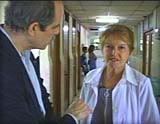 DR. ERMINIA VALENZUELA: I don't want to end this interview without asking the people of the United States to help us to end with the block.
PAUL SOLMAN: The blockade.
DR. ERMINIA VALENZUELA: The blockade.
PAUL SOLMAN: The embargo.
DR. ERMINIA VALENZUELA: The blockade, the embargo. So I'm asking the people of the United States to help us to end the blockade.
PAUL SOLMAN: She runs this ward at Havana's top pediatric hospital, where children with serious heart defects come for surgery they can't get in the provinces. The care tops anything in the third world, she says, but could be much broader.
DR. ERMINIA VALENZUELA: If we are able to operate on 500 patients in a year, it would be enough in order not to have a waiting list.
Cuban health care
PAUL SOLMAN: They used to do 500 operations a year back when the Soviet Union subsidized the Cuban economy, including its medical care. They don't, however, blame the Russian pullout for the waiting list, but the U.S. blockade, or "block."
DR. ERMINIA VALENZUELA: With all these difficulties of the block, we had less money, and we had to decrease the number of operations to 50 percent or 60 percent.
PAUL SOLMAN: "Stop the blockade." It's a refrain we heard at almost every stop in Cuba, including Lenin High School.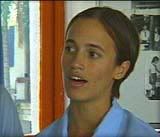
STUDENT: Cuba is open to the world, and the world is almost open to Cuba, but we have, how can I say, a door closed for us.
PAUL SOLMAN: But isn't it socialism that prevents Cuba from becoming richer, we asked.
STUDENT: We got education, hospitals, medicines, all free, and if we want to be richer, we don't have to stop to get all of that. We only have to... You only have to stop this blockade.
The U.S. position
PAUL SOLMAN: We could go on, but you get the point: Even though Cuba now gets goods from all over the world, the U.S. embargo is still the number one excuse for Cuba's economic failings. Now, Cuba has actually lived with the embargo about as long as it's lived with socialism. In fact, the two are inseparable. When Fidel Castro first descended from the hills and toppled the Batista dictatorship in 1959, the Republican Eisenhower administration never imagined Cuba would soon be sleeping with the ideological enemy.
But within a year, Castro began nationalizing U.S. businesses. President Eisenhower-- a longtime friend of Batista-- retaliated by severing diplomatic relations, while the CIA initiated plans to assassinate Castro and invade Cuba. Eisenhower also set in motion an embargo on trade, made law by President Kennedy and Congress in 1962.
There have been opponents, like Jimmy Carter and the UN, which condemned it just last year by a vote of 163 to 3. But Miami's Cuban exile community and its allies in Congress have always prevailed. In 1996, Congress passed, and President Clinton reluctantly signed, the Helms-Burton Act, which among other provisions extended the penalties on trade with Cuba to companies and nations outside the U.S.
SEN. PHIL GRAMM: Our position has always been a commitment to isolation, the isolation of Cuba, and a commitment to overthrowing Fidel Castro. Today, with this bill, we go back to that policy and we hit Fidel Castro where it hurts the most. We hit him in the pocketbook.
PAUL SOLMAN: It's been a 40-year campaign, then, of U.S. economic pressure to topple Castro and install democratic capitalism, a campaign Castro has used for dramatic effect.
FIDEL CASTRO (Translated): What the imperialists want for us is nothing but capitalism, and worse still, the capitalism of the third world, of Guatemala and Honduras. But we'll defend our socialism at any cost.
PAUL SOLMAN: And defend it he has. But if Castro isn't quitting, neither is his opposition. (Crowd chanting) The key, according to anti- Castro forces outside Cuba, is to support anti-Castro forces inside the country-- build an anti-socialist opposition, like solidarity in Poland.
REP. LINCOLN DIAZ-BALART: There is a growing internal opposition movement that is being oppressed and repressed, thrown in dungeons on a day-in and day-out basis, and yet it has demonstrated extreme courage and is growing. That has to be the focus of our policy.
PAUL SOLMAN: To find out what the internal opposition itself makes of this approach, we went to see Cuba's best-known dissident. Elizardo Sanchez spent eight years in prison for crimes against the state. And yet, this is what he said:
ELIZARDO SANCHEZ (Translated): For 15 years, I have been in a group that has opposed these sanctions. They're unilateral actions of Washington against Cuba. For a long time, I was alone among dissidents in this view, but now nearly all of us oppose the U.S. policy.
PAUL SOLMAN: Arrested at gunpoint in the middle of the night for opposing Castro, Sanchez also opposes the policy on which his U.S. supporters pin their hopes.
ELIZARDO SANCHEZ (Translated): I believe the embargo is the best ally this totalitarian government has, because it justifies its failures. When there's no medicine or transport, or food, everyone says, "it's Washington's fault."
Blaming the embargo
PAUL SOLMAN: Indeed, the embargo is widely blamed for many, if not all of the country's economic woes. We heard that argument, among other places, at Cuba's version of the Federal Reserve, its Central Bank, where revolutionary hero Che Guevara once presided as the country's first Alan Greenspan. Francisco Soberon is now in charge, and maintains the embargo has cost Cuba decades of development.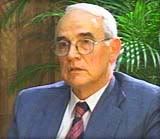
FRANCISCO SOBERON: It's a terrible cost, you see. It has to be measured in hundreds of billions, already.
PAUL SOLMAN: Hundreds of billions, you mean cumulatively?
FRANCISCO SOBERON: Accumulated during these 40 years.
PAUL SOLMAN: Soberon reorganized the bank to help implement market reforms after the Soviet Union-- and its huge subsides-- vanished in the early '90s. But he's still a devout socialist who blames the embargo for crippling Cuba's economy.
FRANCISCO SOBERON: We cannot go to an American bank to ask for a loan. But not only that, foreign banks, a lot of them have very close links with the American markets, and a lot of them feel that if they do business with Cuba, it could hamper their relations with the United States, and then they don't want to do business with us.
PAUL SOLMAN: Finance from abroad is key, says Soberon, because Cuba's own major investments have been in health care and in education; investments, that is, in "human capital," in Cuba's people, an asset of professional talent just waiting for the financial capital to make it world-class productive.
FRANCISCO SOBERON: 700,000 professionals, we have.
PAUL SOLMAN: 700,000 professionals.
FRANCISCO SOBERON: 700,000. And when I say "professionals," I mean people who have a university degree, you see?
PAUL SOLMAN: At a baseball game one night in Havana, we got yet another example of the embargo's cost.
MAN (Translated): You know, we've got this fight with the U.S. to buy oil, we have to get it all the way from Russia. Imagine if we could just get it from you, 90 miles away, how much easier and cheaper it would be.
PAUL SOLMAN: So then, the embargo would seem to be working, just as its supporters claim. But when we trekked to a far-off Havana neighborhood to interview another dissident, we again heard the message that the embargo is letting socialism off the hook and that trade with the U.S., according to Marta Beatriz Roque, would actually speed economic and political reform.
MARTA BEATRIZ ROQUE: I'm against the embargo. I would like that the embargo will be lifted.
PAUL SOLMAN: Because?
MARTA BEATRIZ ROQUE (Translated): Because I believe Cuban society needs contact with North American society. We need to be in touch with capitalism.
Supporting the economy
PAUL SOLMAN: To the extent that Cuba is changing, many think, it's because of contact with the capitalist U.S., for better, or sometimes worse. And certainly, says Roque, economic contact with U.S. capitalism keeps the dissident community alive.
MARTA BEATRIZ ROQUE (Translated): I have family outside. I have support. Many friends in the U.S., especially in Miami, help us.
PAUL SOLMAN: As it happens, it's not just dissidents who get help from friends and family in the U.S. In Miami's Little Havana neighborhood, business at Western Union is brisker than ever these days.
MAN (Translated): With Western Union, you can send up to $100 a month to any one person.
PAUL SOLMAN: This Cuban exile, who preferred not to give his name, came to the states 12 years ago and has been sending dollars back home ever since.
MAN (Translated): I sent money to my parents so they could come and visit, and they did. Now I have to wait three more months before I can send any more.
PAUL SOLMAN: Again, back in Havana, dissident Elizardo Sanchez:
ELIZARDO SANCHEZ (Translated): I would say that 20 percent to 30 percent of what Cubans manage to get to survive comes from remittances -- my family included.
PAUL SOLMAN: What percent of your income-- family income-- comes from remittances?
MAN (Translated): Eighty percent. It's been that way for 20 years.
PAUL SOLMAN: Remittances-- what the Cubans call ramesas-- may actually be the single biggest source of dollars in what's becoming a dollarized country. You can use them to buy your own car, or to take a taxi instead of waiting for the so-called "camels," the trucks modified to haul people that most Cubans are forced to rely on.
If you pay in dollars at Coppelia's ice cream parlor, you can skip the long peso line and sit in comfort with the tourists. The burgeoning well-stocked supermarkets are dollars-only, which relegates those without dollars to the state's own meager food stores, where the pickings are generally slim and where they wouldn't let us take pictures. What's more, the dissidents say, the government itself relies indirectly on remittances, via heavy taxes on the dollar economy, to help finance, among other things, the costly Cuban safety net in health care and education.
PAUL SOLMAN: Do you think remittances are keeping the government in business?
ELIZARDO SANCHEZ (Translated): Definitely. Remittances coming from the U.S. have substituted in part for the huge subsidy we got from the Soviet Union. Today the remittances represent more than sugar exports and tourism. They're the principle source of income for the government. The total now comes to between $800 million and a billion dollars a year.
PAUL SOLMAN: Moreover, exile economic support doesn't stop with wiring dollars from the U.S. While some who fled have vowed never to return, many do come back, as tourists, and tourism now makes up fully 5 percent of the Cuban economy. And furthermore, when the exiles return, they bring not just first world cash, but bundles of first world stuff for their families-- TV's, toasters, VCR's.
When you add it all up-- the purchases, the care packages, the tourism, the remittances-- it seems the exile community is tossing a lot of money over the wall they themselves helped build-- between 5 percent and 10 percent, by some estimates, of the entire Cuban economy. So Castro's foes outside Cuba support the embargo politically while perhaps undermining it economically. And Castro's supporters inside Cuba condemn the embargo, though it arguably serves as their best excuse.
ELIZARDO SANCHEZ (Translated): For decades, the government has liked to present an image of itself as a little David against a giant Goliath. The day they lift the embargo and normalize relations as you've done with Hanoi, for example, or China, that will be the beginning of the end for this government.
PAUL SOLMAN: Now, it's possible that dissidents like Sanchez may be wrong about the embargo's effects, that the government's efforts to end the blockade are genuine. At the same time, the message we kept hearing-- from street level to the highest ranks of government-- was that the policy intended to bring Cuba to its knees may in fact have done quite the opposite.
FRANCISCO SOBERON: The blockade, or the economic war of the United States, has been terrible for us, no? But the good part of it is that it has made us stronger, because we have... When you have to fight, when you have to face more big challenges, then you become stronger.
PAUL SOLMAN: A sobering thought on a U.S. policy that Cuba, after four decades, appears not only to have survived, but to have turned to at least rhetorical advantage.
JIM LEHRER: On Tuesday, President Bush announced he would not enforce a section of the 1996 Helms-Burton Act. It allows Americans to sue foreigners who invest in properties confiscated by the Cuban government.
Tuesday, July 17, 2001
| [+/-] |
Capitalism in Cuba |
Paul Solman reports from Cuba on the growing role of capitalism in the country's socialist system: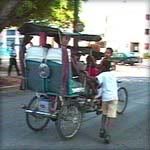
PAUL SOLMAN: For the newcomer, Cuba, and especially Havana, is a surprise. Yes, there are plenty of the expected third-world vignettes: The make-work jobs, the makeshift travel arrangements, a public transportation system bursting at the seams, the occasional beggar in the street-- this one was deaf. Reminders that as recently as a decade ago when the Soviet Union collapsed and its subsidies vanished, people were nearly starving here. But today a major makeover is in progress. Opening doors to tourism
Cuba has decided to sell its culture, its climate, its beaches to foreigners, and so tourists are pouring in all over the country, from all over the world. Hotels abound, especially in Havana, and new ones are going up, built by everyone from the Spanish to the Chinese. Joint ventures with the Japanese and Koreans have brought in household gear you might see at Electronic Eddie's or Home Depot, and supermarkets offer an almost all-Cuban clientele everything from Brazilian diet Jell-O to Jack Daniels and Johnnie Walker Red. This year's sales at the Super Mercado...
ALBERTO LOTTI, Supermarket Manager (Translated ): Up to this moment, they are $6,324,000. The average bill per customer is $17.36.
PAUL SOLMAN: That's right. Here you pay not in Cuban pesos but in U.S. dollars, officially allowed after the Russians pulled out. Tourism and foreign investment contribute to dollars now reaching, it's estimated, more than half the Cuban population. In short, it seems like capitalism is taking root. (Pig snorting) on the other hand, many Cubans still think capitalists are pigs, business is dirty, and that all production should be sold to and through the state as these real pigs will be as soon as they fatten up.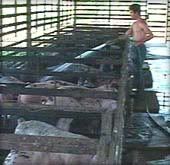
PIG FARMER (Translated ): The state gives me everything I need-- the grain, the breeding stock-- so my commitment is to them. Sometimes the private guys show up, but I don't trust their scale. With the state, I always have confidence.
PAUL SOLMAN: The state, meanwhile, still tries to command the economy. Every family gets subsidized food with a national ration book. Fidel Castro has banned billboard advertising, making Havana look like some sort of Soviet throwback featuring Che Guevara, and slogans like "This is the socialist revolution right under the nose of the U.S." And when we tried to interview a would-be emigrant, the police stopped us, took our documents, and wanted to take us downtown. We sneaked these shots from our van. True, the government itself didn't object to our interviewing prominent dissidents like Elizardo Sanchez, but the dissidents themselves insisted Cuba's less free than ever.
ELIZARDO SANCHEZ, Dissident (Translated ): What we have here is closer to the Soviet totalitarian system, an absolute state monopoly that controls virtually everything down to the barbershops.
PAUL SOLMAN: In Cuba, then, an economics correspondent can feel whipsawed. At some moments you think Castro has saved Socialism, and right under Uncle Sam's nose. At other times it seems clear the free market is burrowing irresistibly from within. This elite Lenin High School, we figured, might be one place to sort things out. Only one in 100 is admitted here in a country with a whopping 99 percent literacy rate. At Cuba's training ground for the next generation, a group of English speakers awaited them.
STUDENT: Schoolmates, I tell you, you're welcome, and I hope you get satisfied with our school, with out students, with us. Thank you.
PAUL SOLMAN: Well, thank you.
PAUL SOLMAN: We got the red carpet treatment and it kept getting redder.
STUDENT: We don't want capitalism. We have... We want socialism, because we want equality to all the people.
STUDENT: We don't want to be like the United States because right now we have fewer children in streets... I mean, I would say, almost anywhere, almost no kids in street asking for money.
STUDENT: We are the same people. We have the same clothes, the same things. It's not that the other countries that you're better than me because you have a new Adidas and I don't.
PAUL SOLMAN: The kids at Lenin High seem determined to sustain socialist equality at almost any cost. As for the market changes Cuba has made?
STUDENT: We don't want those changes. We have to put them there... They're there because we need them. When we don't... If we don't need them anymore, we will fade it.
PAUL SOLMAN: Fade it.
PAUL SOLMAN: They will fade it-- that is, phase out the market reforms of the post-Soviet special period. Now maybe the reforms are temporary, and schools like this will restore Cuba's purist past, or maybe instead Cuba's many private markets are already beyond a point where anyone can fade them. Food production has exploded, for instance, because of free market incentives that let farmers sell privately some of what they produce. So incentives work.
MAN (Translated): Clearly, yes. It's obvious. That's the way it works everywhere.
Stark contrast in ideologies
PAUL SOLMAN: Incentives not only mean more food more available without waiting on line, they also mean better food at the private markets.
SALESMAN (Translated): It's better quality. This is what people are looking for. There's less fat. There's less bone. Do you understand?
PAUL SOLMAN: The more we saw of Cuba, the starker the contrast between capitalist experiment and socialist ideology. Alberto Lotti, for instance, who runs this state-owned dollar store, plays by market rules like pursuing profits in competition with similar stores.
ALBERTO LOTTI (Translated): Competition exists, and it's good for the consumer. Competition is about who offers the best product, the best quality, at the best price in the battle to lower costs. That's what satisfies consumers' needs.
PAUL SOLMAN: But of course, needs are always being redefined more broadly in an economy where there's more to buy. Do you worry that you'll become too much of a consumer society if you have more and more of these things?
ALBERTO LOTTI (Translated): I think this is not a consumer society. Economic development itself requires monetary mercantile exchange.
PAUL SOLMAN: Muchas gracias.
PAUL SOLMAN: So not capitalist, but not really socialist either; in fact, a distinctly Cuban straddle concluded with a distinctly Cuban sendoff. Meanwhile, in Lotti's parking lot, there was more evidence that Cuba may become a consumer society as soon as it can afford to. In Cuba's famous health care system, we heard a similar mixed message. On the one hand, the head of the country's national cancer hospital says he devoutly believes in socialized medicine.
DR. ROLANDO CAMACHO, Cancer Specialist: Health is something that is the right of a human being. If you put it in the hands of the one depending of your pocket, that's terrible.
PAUL SOLMAN: Free health care and free education were recently hailed by the World Bank-- no friend of Castro's-- as model investments, yet this doctor thinks the forced move to the free market was good economic medicine.
DR. ROLANDO CAMACHO: In that sense, I believe it's a good thing. It starts to make people to face the reality and not to... Because we were so accustomed that the government provided everything. You just have to ask, 'I need this, I need this.' And we don't know from where it comes, how it costs, nothing like that.
PAUL SOLMAN: You even see socialism versus capitalism down at the old ballpark. Omar Linares is a slugging superstar who's had million dollar offers from U.S. teams, but turned them all down. Why?
OMAR LINARES, Baseball Player (Translated ): I prefer to stay in Cuba because this is my country. Everything I've accomplished I owe to the revolution.
PAUL SOLMAN: On the field, the socialist party line; in the stands, however, entrepreneurship run rampant. Get a load of this transaction.
PAUL SOLMAN: Donde?
SALESMAN: Cuanto? Five dollars.
PAUL SOLMAN: Five dollars.
SALESMAN: Omar Linares?
PAUL SOLMAN: No, it doesn't say Linares. There's a different name.
SALESMAN: ( Speaking Spanish ) ( translated ): It's the way he signs. He does it real fast.
PAUL SOLMAN: He signs with another name?
SALESMAN: ( Translated ): I don't know. Maybe he was in a hurry.
Encouraging and resisting capitalism
PAUL SOLMAN: In fact, capitalists were budding everywhere we looked. Bottle collectors moonlighting from state jobs who wouldn't talk on camera, stilt walkers who wouldn't tell us what they earned. It's about art, they sniffed, not commerce; then complained when we made a donation that we'd underpaid them. And then there was this paledar, one of the small private dollar-only restaurants that dot Havana. When it comes to moving the merchandise here, Cuba's favorite cocktail, say, the mojito, owner Juan Carlos uses very clear market incentives.
JUAN CARLOS (Translated ): If my waiters sell more mojitos, they get paid more money. But if they bring the mojito to the table and it's not properly prepared, I fine them.
PAUL SOLMAN: You could call this capitalism with a vengeance. The government tolerates it, but puts legal hurdles in the paledar's path to protect the many state-owned restaurants.
JUAN CARLOS (Translated ): A private restaurant can only sell certain things. You can't sell beef or lobster. You can only have 12 seats.
PAUL SOLMAN: Some paledars like this one, whose identity we promised not to reveal, have responded with hidden rooms. Others have simply given up. And that makes Elizardo Sanchez believe the capitalist experiment in Cuba is about to end.
ELIZARDO SANCHEZ: Ahora. (Translated ) Today there's less free enterprise than there was three years. Paledars are closing down. They can't survive. Their workers are unemployed or working for the state.
PAUL SOLMAN: Sanchez spent eight years in prison for his politics. He's sure Cuba won't let capitalism do its thing.
ELIZARDO SANCHEZ (Translated ): The situation has changed in Cuba, but sadly it has changed for the worse rather than the better-- especially with regard to human rights.
PAUL SOLMAN: But you're now not in prison...
ELIZARDO SANCHEZ (Translated ): True. There have been some small steps, but nobody can be sure that tomorrow things won't change back.
PAUL SOLMAN: And yet capitalism continues to make inroads, it seems, almost everywhere; even in Cuba's creaky sugar industry, with nearly half a million workers, the country's largest. Having arrived in 1511, the Spanish decided to satisfy Europe's sweet tooth by transplanting sugar cane from the East Indies and slaves from Africa.
At this factory they lived in these very barracks. Sugar has been the backbone of the Cuban economy ever since. At this mill outside Havana, the propaganda was as abundant as the cane, but here, too, they've changed to market practices like incentive pay. They just insist the changes won't change them.
JOSE ANTONIO SANCHEZ, Sugar Mill Foreman (Translated}): The more we produce, the more we can offer salary and other benefits to our workers.
PAUL SOLMAN: This sounds like capitalism.
JOSE ANTONIO SANCHEZ (Translated ): Hey, we're surrounded by capitalism. We don't have much choice but to apply some of the formulas of capitalism to resolve our problems.
PAUL SOLMAN: Do you worry that the more capitalist techniques you use, the less socialism you'll have?
JOSE ANTONIO SANCHEZ (Translated): No. These are just methods of organizing production. We still have our benefits: Social equality, health care and education for all. We are not making any concessions to capitalism; all we're doing is applying certain techniques.
PAUL SOLMAN: But can social equality hold out as the market marches in? Our search for an answer brings us back to the émigré we were trying to interview when the police stopped us. Medical Dr. Giselle Castro-- no relation-- lost her job when she applied to leave for the U.S. Lord knows she's no fan of Socialism. But what did she complain to us about? Growing market inequality in Cuba.
DR. GISELLE CASTRO, Physician (Translated ): What's happening here is that those who have now have more, and those that don't continue to slide. Right here on this block you can see the inequality. Look at the differences between that house across the street and the one down the block-- that house and that house, they're different classes.
PAUL SOLMAN: You can see the inequalities, says Giselle Castro, and we could and did. In the end, this new fact of Cuban life-- the growing gulf between those with access to dollars and those without-- may well prove to be the core of the country's dilemma. It's a dilemma now so widespread it provides the punch line to what may be Cuba's hottest joke, about a girl who dumps her boyfriend. "He swore he'd struck it rich at the Hotel Nacional," she gripes, "claimed he'd actually landed the job of doorman." But she dropped him when she learned the bitter truth, that he was just another Cuban neurosurgeon -- a state job, that is, with no ties to the dollar economy.
So, in the end we were left with one big question: can Cuba, or any planned economy for that matter, encourage the free market and resist it at the same time? The only sure bet is that Cuba will grapple with that question for some time to come.
Monday, July 16, 2001
| [+/-] |
The Helms-Burton Act |
Today, President Bush enacted a six-month waiver of provisions of the 1996 Helms-Burton Act that would allow lawsuits against foreign companies who deal with Cuban businesses once claimed by U.S. nationals.
The Online NewsHours reports:
The act, sponsored by U.S. Sen. Jesse Helms (R-N.C.) and Rep. Dan Burton (R-Ind.), also formalized the U.S. trade embargo of the island nation, in effect by presidential order since the Kennedy administration.
Helms-Burton's lawsuit provision has been one of the act's most controversial components. It was meant to keep foreign investors away from nearly 6,000 formerly American-owned companies in Cuba brought under government control following the 1959 Cuban revolution. Those companies are now valued at over $6 billion.
President Clinton signed the legislation less than a month after Cuban air force jets shot down two American planes over international waters - dealing yet another blow to U.S. relations with Cuba. Four Cuban exile activists died in the incident.
Despite the broad powers in Helms-Burton, no one has ever filed suit under the law because former President Clinton suspended that portion of the legislation before it took effect in Aug. 1996. He renewed his suspension every six months, as the law allows, until the end of his term.
Opposition
Clinton's decision to hold off on the lawsuit proposals came after the European Union and Canada announced their opposition to the act. They argued the provisions violate international trade treaties by punishing foreign companies for business conducted outside U.S. borders. The E.U. brought its case to the World Trade Organization, but dropped its legal challenge in 1998. The U.S. and E.U. are still working toward an agreement on the issue.
Among the companies that could be affected are some Mexican and Italian firms with a stake in Cuba's telephone network -- originally built by an American company in the 1950s. Some executives from Canada's Sherritt International Corp., that invested in a nickel mine once operated by an American mining company, have already been prohibited from traveling to the U.S. in accordance with the act.
Large-scale foreign investment in Cuba is a relatively recent development. Canadian, Mexican and European firms moved in after Cuban President Fidel Castro opened the island nation to foreign investment in 1991. Foreign companies have invested billions of dollars in Cuba, much of it going into hotels, utilities, and other businesses formerly once controlled by Americans or Cubans now living in the U.S.
Provisions of the 1996 Helms-Burton Act
Title I: Formalizes the U.S. embargo on trade and financial transactions.
Title II: Outlines American policy and economic assistance towards a future transition or democratic Cuban government.
Title III: Allows lawsuits in American courts against foreign companies who invest in businesses once owned by Americans or by Cubans now living in the U.S. The president can suspend the lawsuit provision for 6-month periods.
Title IV: Authorizes the banning of executives of the foreign companies targeted in Title III from entering the U.S. Also allows denial of entry to the executives' families and the companies' shareholders.
