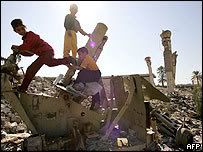
 More and more children in Iraq do not have enough food to eat
The BBC reports:
Increasing numbers of children in Iraq do not have enough food to eat and more than a quarter are chronically undernourished, a UN report says.
Malnutrition rates in children under five have almost doubled since the US-led invasion - to nearly 8% by the end of last year, it says.
The report was prepared for the annual meeting of the UN Human Rights Commission in Geneva.
It also expressed concern over North Korea and Sudan's Darfur province.
Jean Ziegler, a UN specialist on hunger who prepared the report, blamed the worsening situation in Iraq on the war led by coalition forces.
The silent daily massacre by hunger is a form of murder - it must be battled and eliminated
Jean Ziegler
He was addressing a meeting of the 53-nation commission, the top UN rights watchdog, which is halfway through its annual six-week session.
When Saddam Hussein was overthrown, about 4% of Iraqi children under five were going hungry; now that figure has almost doubled to 8%, his report says.
Governments must recognise their extra-territorial obligations towards the right to food and should not do anything that might undermine access to it of people living outside their borders, it says.
That point is aimed clearly at the US, but Washington, which has sent a large delegation to the Human Rights Commission, declined to respond to the charges, says the BBC's Imogen Foulkes in Geneva.
Increasing hunger
Mr Ziegler also said he was very concerned about the lack of food in North Korea, where there are reports that UN food aid is not being distributed fairly.
In Darfur, the continuing conflict has prevented people from planting vital crops, he said.
Overall, Mr Ziegler said he was shocked by the fact that hunger is actually increasing worldwide.
Some 17,000 children die every day from hunger-related diseases, the report claims, calling the situation a scandal in a world that is richer than ever before.
"The silent daily massacre by hunger is a form of murder," Mr Ziegler said. "It must be battled and eliminated."
Wednesday, March 30, 2005
| [+/-] |
Children 'Starving' in New Iraq |
| [+/-] |
Malnutrition Rate of Iraqi Children Doubled After U.S. Invasion |
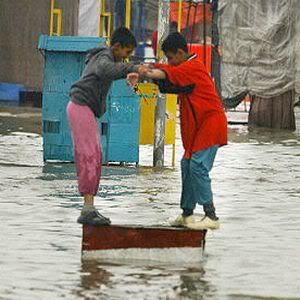 Iraqi children try to balance on a box in a flooded street on the outskirts of Sadr City, Baghdad.
The UN's Human Rights Commission's special expert on the right to food said that by last fall 7.7 per cent of children under the age of 5 in Iraq suffered from acute malnutrition.
Malnutrition, a disease which is exacerbated by the lack of clean water and adequate sanitation, is a major killer of children in poor countries. Children who survive are usually physically and mentally impaired for life, and are more vulnerable to disease.
The situation facing Iraqi youngsters is "a result of the war led by coalition forces," said Ziegler, an outspoken Swiss sociology professor and former lawmaker whose previous targets have included Swiss banks, China, Brazil and Israels treatment of Palestinians.
Overall, more than a quarter of Iraqi children don't get enough to eat, Ziegler told the 53-nation commission, which is halfway through its annual six-week session.
The U.S. delegation and other coalition countries declined to respond to his presentation, which compiled the findings of studies conducted by other specialists.
In reporting the 7.7 percent malnutrition rate for Iraqi youngsters, the Norwegian-based Fafo Institute for Applied Social Science said last November that the figure was similar to the levels witnessed in some African countries.
During the 1970s and 1980s Iraq was generally regarded as having good nutrition, but health problems only emerged when the Security Council imposed sanctions after Iraq's invasion of Kuwait in 1990.
Ziegler did not mention the role violence is playing in the nutrition problem, something often cited by aid groups.
Last year, Carol Bellamy, head of UNICEF, said the violence hampers the delivery of adequate supplies of food.
Ziegler also cited an October 2004 U.S. study that estimated as many as 100,000 more Iraqis, most of whom are women and children, have died since the start of the U.S.-led invasion of Iraq. The number is higher than those who would have normally have died, based on the death rate before the war.
"Most died as a result of the violence, but many others died as a result of the increasingly difficult living conditions, reflected in increasing child mortality levels," he said.
The authors of the U.S. study in the British-based medical journal The Lancet, who the researchers for hailed from Johns Hopkins University, Columbia University and the Al-Mustansiriya University in Baghdad, conceded their data were of "limited precision."
Ziegler also told the commission he was concerned about hunger in North Korea, Palestinian areas, Sudan's conflict-ravaged Darfur region, Zimbabwe, India, Myanmar, the Philippines and Romania.
Worldwide, he said, more than 17,000 children under 5 die daily from hunger-related diseases.
"The silent daily massacre by hunger is a form of murder," Ziegler said. "It must be battled and eliminated."
| [+/-] |
U.S. Scatters Bases To Control Eurasia |
Asia Times Online reports:
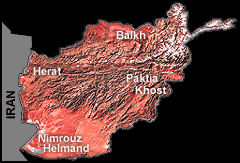
The United States is beefing up its military presence in Afghanistan, at the same time encircling Iran. Washington will set up nine new bases in Afghanistan in the provinces of Helmand, Herat, Nimrouz, Balkh, Khost and Paktia.
Reports also make it clear that the decision to set up new US military bases was made during Secretary of Defense Donald Rumsfeld's visit to Kabul last December. Subsequently, Afghan President Hamid Karzai accepted the Pentagon diktat. Not that Karzai had a choice: US intelligence is of the view that he will not be able to hold on to his throne beyond June unless the US Army can speed up training of a large number of Afghan army recruits and protect Kabul. Even today, the inner core of Karzai's security is run by the US State Department with personnel provided by private US contractors.
Admittedly, Afghanistan is far from stable, even after four years of US presence. Still, the establishment of a rash of bases would seem to be overkill. Indeed, according to observers, the base expansion could be part of a US global military plan calling for small but flexible bases that make it easy to ferry supplies and can be used in due time as a springboard to assert a presence far beyond Afghanistan.
Afghanistan under control?
On February 23, according to the official Bakhter News Agency, 196 American military instructors arrived in Kabul. These instructors are scheduled to be in Afghanistan until the end of 2006. According to General H Head, commander of the US Phoenix Joint Working Force, the objective of the team is to expedite the educational and training programs of Afghan army personnel. The plan to protect Karzai and the new-found "democracy" in Afghanistan rests on the creation of a well-trained 70,000-man Afghan National Army (ANA) by the end of 2006. As of now, 20,000 ANA personnel help out 17,000-plus US troops and some 5,000-plus North Atlantic Treaty Organization (NATO) troops currently based in Afghanistan.
In addition, on February 28, in a move to bring a large number of militiamen into the ANA quickly, Karzai appointed General Abdur Rashid Dostum, a regional Uzbek-Afghan warlord of disrepute, as his personal military chief of staff. The list of what is wrong with Dostum is too long for this article, but he is important to Karzai and the Pentagon.
Dostum has at least 30,000 militiamen, members of his Jumbush-e-Milli, under him. A quick change of their uniforms would increase the ANA by 30,000 at a minimal cost. Moreover, Dostum's men do not need military training (what they do need is some understanding of and respect for law and order). Another important factor that comes into play with this union is the Pentagon-Karzai plan to counter the other major north Afghan ethnic grouping, the Tajik-Afghans.
Since the presidential election took place in Afghanistan last October, Washington has conveyed repeatedly that the poison fangs of al-Qaeda have been uprooted and the Taliban is split. There was also reliable news suggesting that a section of Taliban leaders have accepted the leadership of two fellow Pashtuns, Karzai and US Ambassador Zalmay Khalilzad, and are making their way into the Kabul government.
With al-Qaeda defanged and the Taliban split, one would tend to believe that the Afghan situation is well under control. But then, how does one explain that a bomb went off in the southern city of Kandahar, killing five people on March 17, the very day US Secretary of State Condoleezza Rice landed in Kabul on her first visit to Afghanistan? And why has Karzai pushed back the dates for Afghanistan's historical parliamentary elections, originally planned for 2004, and then to May 2005, now to September 2005?
One thing that is certainly not under control, and is surely the source of many threats to the region, is opium production. During the US occupation, opium production grew at a much faster rate than Washington's, and Karzai's, enemies weakened. In 2003, US-occupied Afghanistan produced 4,200 tons of opium. In 2004, US-occupied and semi-democratic Afghanistan produced a record 4,950 tons, breaking the all-time high of 4,600 tons produced under the Taliban in the year 2000.
Though the problem is known to the world, the Pentagon refuses to deal with it. It is not the military's job to eradicate poppy fields, says the Pentagon. Indeed, it would antagonize the warlords who remain the mainstays of the Pentagon in Afghanistan, say observers.
Back on the base
When all is said and done, one cannot but wonder why the new military bases are being set up. Given that al-Qaeda is only a shadow of the past, the Taliban leaders are queuing up to join the Kabul government, and the US military is not interested in tackling the opium explosion, why are the bases needed?
A ray of light was shed on this question during the recent trip to Afghanistan by five US senators, led by John McCain. On February 22, McCain, accompanied by Senators Hillary Clinton, Susan Collins, Lindsey Graham and Russ Feingold, held talks with Karzai.
After the talks, McCain, the No 2 Republican on the Senate Armed Services Committee, said he was committed to a "strategic partnership that we believe must endure for many, many years". McCain told reporters in Kabul that America's strategic partnership with Afghanistan should include "permanent bases" for US military forces. A spokesman for the Afghan president told news reporters that establishing permanent US bases required approval from the yet-to-be-created Afghan parliament.
Later, perhaps realizing that the image that Washington would like to project of Afghanistan is that of a sovereign nation, McCain's office amended his comments with a clarification: "The US will need to remain in Afghanistan to help the country rid itself of the last vestiges of Taliban and al-Qaeda." His office also indicated that what McCain meant was that the US needs to make a long-term commitment, not necessarily "permanent" bases.
On March 16, General Richard Myers, chairman of the US Joint Chiefs of Staff, said no decision had been reached on whether to seek permanent bases on Afghan soil. "But clearly we've developed good relationships and good partnerships in this part of the world, not only in Afghanistan," he added, also mentioning existing US bases in Uzbekistan and Kyrgyzstan.
A military pattern
But this is mere word play. Media reports coming out of the South Asian subcontinent point to a US intent that goes beyond bringing Afghanistan under control, to playing a determining role in the vast Eurasian region. In fact, one can argue that the landing of US troops in Afghanistan in the winter of 2001 was a deliberate policy to set up forward bases at the crossroads of three major areas: the Middle East, Central Asia and South Asia. Not only is the area energy-rich, but it is also the meeting point of three growing powers - China, India and Russia.
On February 23, the day after McCain called for "permanent bases" in Afghanistan, a senior political analyst and chief editor of the Kabul Journal, Mohammad Hassan Wulasmal, said, "The US wants to dominate Iran, Uzbekistan and China by using Afghanistan as a military base."
Other recent developments cohere with a US Air Force strategy to expand its operational scope across Afghanistan and the Caspian Sea region - with its vital oil reserves and natural resources: Central Asia, all of Iran, the Persian Gulf, the Strait of Hormuz and the northern Arabian Sea up to Yemen's Socotra Islands. This may also provide the US a commanding position in relation to Pakistan, India and the western fringes of China.
The base set up at Manas outside Bishkek, the capital of Kyrgyzstan - where, according to Central Asian reports, about 3,000 US troops are based - looks to be part of the same military pattern. It embodies a major commitment to maintain not just air operations over Afghanistan for the foreseeable future, but also a robust military presence in the region well after the war.
Prior to setting up the Manas Air Base, the US paid off the Uzbek government handsomely to set up an air base in Qarshi Hanabad. Qarshi Hanabad holds about 1,500 US soldiers, and agreements have been made for the use of Tajik and Kazakh airfields for military operations. Even neutral Turkmenistan has granted permission for military overflights. Ostensibly, the leaders of these Central Asian nations are providing military facilities to the US to help them eradicate the Islamic and other sorts of terrorists that threaten their nations.
These developments, particularly setting up bases in Manas and Qarshi Hanabad, are not an attempt by the US to find an exit strategy for Afghanistan, but the opposite: establishing a military presence.
Encircling Iran
On February 28, Asia Times Online pointed out that construction work had begun on a new NATO base in Herat, western Afghanistan (US digs in deeper in Afghanistan ). Another Asia Times Online article said US officials had confirmed that they would like more military bases in the country, in addition to the use of bases in Pakistan (see The remaking of al-Qaeda , February 25).
Last December, US Army spokesman Major Mark McCann said the United States was building four military bases in Afghanistan that would only be used by the Afghan National Army. On that occasion, McCann stated, "We are building a base in Herat. It is true." McCann added that Herat was one of four bases being built; the others were in the southern province of Kandahar, the southeastern city of Gardez in Paktia province, and Mazar-i-Sharif, the northern city controlling the main route to central Afghanistan.
The US already has three operational bases inside Afghanistan; the main logistical center for the US-led coalition in Afghanistan is Bagram Air Field north of Kabul - known by US military forces as "BAF". Observers point out that Bagram is not a full-fledged air base.
Other key US-run logistical centers in Afghanistan include Kandahar Air Field, or "KAF", in southern Afghanistan and Shindand Air Field in the western province of Herat. Shindand is about 100 kilometers from the border with Iran, a location that makes it controversial. Moreover, according to the US-based think-tank Global Security, Shindand is the largest air base in Afghanistan.
The US is spending US$83 million to upgrade its bases at Bagram and Kandahar. Both are being equipped with new runways. US Brigadier General Jim Hunt, the commander of US air operations in Afghanistan, said at a news conference in Kabul Monday, "We are continuously improving runways, taxiways, navigation aids, airfield lighting, billeting and other facilities to support our demanding mission."
The proximity of Shindand to Iran could give Tehran cause for concern, says Paul Beaver, an independent defense analyst based in London. Beaver points out that with US ships in the Persian Gulf and Shindand sitting next to Iran, Tehran has a reason to claim that Washington is in the process of encircling Iran. But the US plays down the potential of Shindand, saying it will not remain with the US for long. Still, it has not been lost on Iranian strategists that the base in the province of Herat is a link in a formidable chain of new facilities the US is in the process of drawing around their country.
Shindand is not Tehran's only worry. In Pakistan, the Pervez Musharraf government has allowed the commercial airport at Jacobabad, about 420km north of Karachi and 420km southeast of Kandahar, as one of three Pakistani bases used by US and allied forces to support their campaign in Afghanistan. The other bases are at Dalbandin and Pasni. Under the terms of an agreement with Pakistan, the allied forces can use these bases for search and rescue missions, but are not permitted to use them to stage attacks on Taliban targets. Both Jacobabad and Pasni bases have been sealed off and a five-kilometer cordon set up around the bases by Pakistani security forces.
Reports of increased US operations in Pakistan go back to March 2004, when two air bases - Dalbandin and Shahbaz - in Pakistan were the focus for extensive movements to provide logistical support for Special Forces and intelligence operations. Shahbaz Air Base near Jacobabad appeared to be the key to the United States' 2004 spring offensive. At Jacobabad, C-17 transports were reportedly involved in the daily deliveries of supplies. A report in the Pakistani newspaper the Daily Times on March 10, 2004, claimed that the air base was under US control, with an inner ring of facilities off limits to Pakistan's military.
Tuesday, March 15, 2005
| [+/-] |
Anthrax Detected At 2 Mailrooms |
Another postal facility was closed Tuesday as concern spread over the detection of anthrax in two pieces of mail at military mailrooms. Hundreds of workers were offered antibiotics as a precaution, though no unusual health problems were reported.
The AP reports:
Officials said the mail in question had been irradiated, so any anthrax in them was inert when they triggered alarms at the Pentagon mail facility and another nearby facility that handles military mail.
Environmental testing was being conducted on the two military mail facilities and on a third postal facility in the District of Columbia, which was closed Tuesday because it may have handled the mail that went to the two military mailrooms.
Antibiotics were offered to some 200 workers at the D.C. facility and to workers at the military mailrooms. Hospitals were told to be on the lookout for symptoms like respiratory problems, rashes or flu-like symptoms that could signal exposure to anthrax, which can be used as a biological weapon.
"This is a prudent course of action. I don't think there's cause for alarm or panic or undue worry," said Dr. Gregg Pane, director of the city's Department of Health. "We've also mobilized our strategic national stockpile so we have enough antibiotics available should the need arise."
Also on Tuesday, a hazardous materials team was called to a building occupied by the Internal Revenue Service after a report of a powdery substance found in a letter. IRS officials said in a statement later that "initial tests were negative for chemical or biological substances."
At the Pentagon, officials on Tuesday corrected inaccurate information about when mailroom sensors were triggered over the possible presence of anthrax.
Spokesman Glenn Flood said the mail that tested positive for anthrax passed through the Pentagon's mail handling facility on Thursday, not Monday, as he previously said. The test results on the mail did not come back until Monday.
Anthrax was confirmed in two items of mail at the two military mail facilities. The Pentagon's mail delivery site, which is separate from the main Pentagon building, was evacuated and shut down Monday remained closed, along with a nearby satellite facility in Fairfax County, Virginia.
Officials disclosed no information about the origins of the two pieces of mail.
About 175 people work at the Pentagon's mail facility, and an additional 100 may have been in contact with deliveries for the Pentagon, officials said.
Follow-up tests were being conducted at the U.S. Army Research Institute for Infectious Diseases at Fort Detrick, Md., officials said. They would take two to three days to complete.
Anthrax can be spread through the air or by skin contact. Officials noted that sometimes anthrax sensors can give false-positive results.
In October 2001, someone sent anthrax in letters through the mail to media and government offices in Washington, Florida and elsewhere, raising fears of bioterrorism. Five people were killed and 17 more sickened. Those cases have never been solved.
Saturday, March 5, 2005
| [+/-] |
Oil Companies Eye Iraq Reserves |
The world's major oil companies are dusting off their Baghdad Rolodexes as Iraq's political factions move closer to forming a new government.
The AP reports:
Through 15 years of conflict and sanctions, major oil companies never lost sight of Iraq's massive reserves -- the world's second-largest after Saudi Arabia. Efforts to form the nation's first elected government in more than half a century are making the prospect of major contracts more tantalizingly real, even if that government could still be more than a year away.
The Shi'ite alliance that won a slim majority in January's Iraqi election held talks yesterday with Kurdish parties, with both sides saying a deal was close. The new parliament is set to convene for the first time tomorrow.
The world's three biggest integrated oil companies -- BP PLC, Exxon Mobil Corp. and the Royal Dutch/Shell Group of Cos. -- recently struck cooperation or training deals with Iraq. France's Total SA regularly invites Iraqi engineers to Paris for training.
"It's a way to maintain contact and get the oil officials to know about them," said former Iraqi Oil Minister Issam Chalabi, who fled Saddam Hussein's regime in 1991.
Speaking from Jordan, where he works as a consultant, Mr. Chalabi said some 20 companies have offered Iraq's interim government training for oil personnel, free geological studies or other technical assistance.
The oil powerhouses stayed on the sidelines as oil-services companies such as Halliburton Co. were awarded billions of dollars in contracts to renovate Iraqi pipelines and other infrastructure. The U.S.-led postwar administration and the provisional government that followed lacked the democratic or legal legitimacy to approve full-blown production deals, which typically guarantee companies a share of oil extracted from fields they invest in.
Such long-term contracts may still have to wait until after the framing of a new constitution and a second round of elections slated for the end of this year, and perhaps even until the adoption of a new energy law.
Iraq's crude is badly needed to fund the country's reconstruction and to feed surging global demand. Iraq is exempt from OPEC's quota system to aid its reconstruction.
With proven reserves of 112 billion barrels, but current production of just 2 million per day, "Iraq has more oil fields that have been discovered, but not developed, than any other country in the world," Mr. Chalabi said.
If rapid improvements are made to Iraq's damaged oil infrastructure, Mr. Chalabi sees the potential to triple output to 6 million barrels per day within about five years.
Yesterday, Saudi Arabia's support of a 2 percent increase to OPEC's output target failed to calm oil markets, though it appeared to reflect growing concern within the cartel about the effect high prices could have on the global economy.
Even if the Organization of Petroleum Exporting Countries raised its daily production ceiling by 500,000 barrels, the impact on actual supplies would be muted because member nations -- eager to maximize profits with crude futures trading near $55 a barrel -- are already overshooting the existing quota by about 700,000 barrels.
The price for light, sweet crude for April delivery fell early yesterday, but then reversed course, rising 52 cents to $54.95 per barrel on the New York Mercantile Exchange. Brent crude rose 56 cents to settle at $53.66 per barrel on London's International Petroleum Exchange.
The high cost of oil has led to surging prices for heating oil, diesel, jet fuel and unleaded gasoline, which in the United States averages $2 a gallon, or 26 cents higher than a year ago.
While they wait for Iraq's new government to form, the world's oil leaders are lining up contracts.
Britain's BP agreed last month to analyze Iraqi oil ministry data on the Rumailah oil field near the southern city of Basra, in the zone patrolled by British forces. Such studies are vital when preparing to start new drilling operations.
Exxon Mobil Corp. has an agreement covering technical assistance, training and potential studies, while Royal Dutch/Shell won a contract in January to carry out study work on Kirkuk, a major oil field in the north.
Total SA, which negotiated production contracts for two Iraqi oil fields in the early 1990s but never signed them, argues that its 80 years of experience in Iraq could be crucial. Total was founded by a group of investors who took over the French government's 24 percent stake in Iraq Petroleum.
Former oil company geologist Ibrahim Mohammed, who works as a London consultant in contact with Iraqi officials, says Baghdad oil ministry staff expects the major U.S. companies to win the lion's share of contracts.
"Among people who are high up in the ministry of oil and the national Iraqi oil company," the feeling is that "the new government is going to be influenced by the United States," he said.
That perspective may have been a factor in OAO Lukoil's decision in September to team up with ConocoPhillips Co. as it evaluates the 68.5 percent stake in the large West Qurna oil field that Lukoil negotiated with Saddam's Iraq.
Lukoil is based in Russia, which also opposed the war. The company is granting ConocoPhillips, based in Houston, a 17.5 percent stake in the southern oil field -- giving the project a solid U.S. connection. ConocoPhillips, which holds a 10 percent stake in Lukoil, declined to further discuss the deal or comment on reports that post-Saddam administrators have canceled Lukoil's production rights.
Thursday, February 10, 2005
| [+/-] |
The Iraq Elections |
'Getting the Purple Finger', reports Naomi Klein for The Nation:
"The Iraqi people gave America the biggest 'thank you' in the best way we could have hoped for." Reading this election analysis from Betsy Hart, a columnist for the Scripps Howard News Service, I found myself thinking about my late grandmother. Half blind and a menace behind the wheel of her Chevrolet, she adamantly refused to surrender her car keys. She was convinced that everywhere she drove (flattening the house pets of Philadelphia along the way) people were waving and smiling at her. "They are so friendly!" We had to break the bad news. "They aren't waving with their whole hand, Grandma--just with their middle finger."
So it is with Betsy Hart and the other near-sighted election observers: They think the Iraqi people have finally sent America those long-awaited flowers and candies, when Iraq's voters just gave them the (purple) finger.
The election results are in: Iraqis voted overwhelmingly to throw out the US-installed government of Iyad Allawi, who refused to ask the United States to leave. A decisive majority voted for the United Iraqi Alliance; the second plank in the UIA platform calls for "a timetable for the withdrawal of the multinational forces from Iraq."
There are more single-digit messages embedded in the winning coalition's platform. Some highlights: "Adopting a social security system under which the state guarantees a job for every fit Iraqi...and offers facilities to citizens to build homes." The UIA also pledges "to write off Iraq's debts, cancel reparations and use the oil wealth for economic development projects." In short, Iraqis voted to repudiate the radical free-market policies imposed by former chief US envoy Paul Bremer and locked in by a recent agreement with the International Monetary Fund.
So will the people who got all choked up watching Iraqis flock to the polls support these democratically chosen demands? Please. "You don't set timetables," George W. Bush said four days after Iraqis voted for exactly that. Likewise, British Prime Minister Tony Blair called the elections "magnificent" but dismissed a firm timetable out of hand. The UIA's pledges to expand the public sector, keep the oil and drop the debt will likely suffer similar fates. At least if Adel Abd al-Mahdi gets his way--he's Iraq's finance minister and the man suddenly being touted as leader of Iraq's next government.
Al-Mahdi is the Bush Administration's Trojan horse in the UIA. (You didn't think they were going to put all their money on Allawi, did you?) In October he told a gathering of the American Enterprise Institute that he planned to "restructure and privatize [Iraq's] state-owned enterprises," and in December he made another trip to Washington to unveil plans for a new oil law "very promising to the American investors." It was al-Mahdi himself who oversaw the signing of a flurry of deals with Shell, BP and ChevronTexaco in the weeks before the elections, and it is he who negotiated the recent austerity deal with the IMF. On troop withdrawal, al-Mahdi sounds nothing like his party's platform and instead appears to be channeling Dick Cheney on Fox News: "When the Americans go will depend on when our own forces are ready and on how the resistance responds after the elections." But on Sharia law, we are told, he is very close to the clerics.
Iraq's elections were delayed time and time again, while the occupation and resistance grew ever more deadly. Now it seems that two years of bloodshed, bribery and backroom arm-twisting were leading up to this: a deal in which the ayatollahs get control over the family, Texaco gets the oil, and Washington gets its enduring military bases (call it the "oil for women program"). Everyone wins except the voters, who risked their lives to cast their ballots for a very different set of policies.
But never mind that. January 30, we are told, was not about what Iraqis were voting for--it was about the fact of their voting and, more important, how their plucky courage made Americans feel about their war. Apparently, the elections' true purpose was to prove to Americans that, as George Bush put it, "the Iraqi people value their own liberty." Stunningly, this appears to come as news. Chicago Sun-Times columnist Mark Brown said the vote was "the first clear sign that freedom really may mean something to the Iraqi people." On The Daily Show, CNN's Anderson Cooper described it as "the first time we've sort of had a gauge of whether or not they're willing to sort of step forward and do stuff."
This is some tough crowd. The Shiite uprising against Saddam in 1991 was clearly not enough to convince them that Iraqis were willing to "do stuff" to be free. Nor was the demonstration of 100,000 people held one year ago demanding immediate elections, or the spontaneous local elections organized by Iraqis in the early months of the occupation--both summarily shot down by Bremer. It turns out that on American TV, the entire occupation has been one long episode of Fear Factor, in which Iraqis overcome ever-more-challenging obstacles to demonstrate the depths of their desire to win their country back. Having their cities leveled, being tortured in Abu Ghraib, getting shot at checkpoints, having their journalists censored and their water and electricity cut off--all of it was just a prelude to the ultimate endurance test: dodging bombs and bullets to get to the polling station. At last, Americans were persuaded that Iraqis really, really want to be free.
So what's the prize? An end to occupation, as the voters demanded? Don't be silly--the US government won't submit to any "artificial timetable." Jobs for everyone, as the UIA promised? You can't vote for socialist nonsense like that. No, they get Geraldo Rivera's tears ("I felt like such a sap"), Laura Bush's motherly pride ("It was so moving for the President and me to watch people come out with purple fingers") and Betsy Hart's sincere apology for ever doubting them ("Wow--do I stand corrected").
And that should be enough. Because if it weren't for the invasion, Iraqis would not even have the freedom to vote for their liberation, and then to have that vote completely ignored. And that's the real prize: the freedom to be occupied. Wow--do I stand corrected.
Friday, February 4, 2005
| [+/-] |
Lost Count |
Researchers rushed a rigorous study of Iraqi civilian casualties into print. Is that why it was dismissed as pure politics?
Lila Guterman at the Chronicle of Higher Education writes:
When more than 200,000 people died in a tsunami caused by an Asian earthquake in December, the immediate reaction in the United States was an outpouring of grief and philanthropy, prompted by extensive coverage in the news media.
Two months earlier the reaction in the United States to news of another large-scale human tragedy was much quieter. In late October, a study was published in The Lancet, a prestigious British medical journal, concluding that about 100,000 civilians had been killed in Iraq since it was invaded by a United States-led coalition in March 2003. On the eve of a contentious presidential election -- fought in part over U.S. policy on Iraq -- many American newspapers and television news programs ignored the study or buried reports about it far from the top headlines.
The paper, written by researchers at the Johns Hopkins University, Columbia University, and Baghdad's Al-Mustansiriya University, was based on a door-to-door survey in September of nearly 8,000 people in 33 randomly selected locations in Iraq. It was dangerous work, and the team of researchers was lucky to emerge from the survey unharmed.
The paper that they published carried some caveats. For instance, the researchers admitted that many of the dead might have been combatants. They also acknowledged that the true number of deaths could fall anywhere within a range of 8,000 to 194,000, a function of the researchers' having extrapolated their survey to a country of 25 million.
But the statistics do point to a number in the middle of that wide range. And the raw numbers upon which the researchers' extrapolation was based are undeniable: Since the invasion, the No. 1 cause of death among households surveyed was violence. The risk of death due to violence had increased 58-fold since before the war. And more than half of the people who had died from violence and its aftermath since the invasion began were women and children.
Neither the Defense Department nor the State Department responded to the paper, nor would they comment when contacted by The Chronicle. American news-media outlets largely published only short articles, noting how much higher the Lancet estimate was than previous estimates. Some pundits called the results politicized and worthless.
Les F. Roberts, a research associate at Hopkins and the lead author of the paper, was shocked by the muted or dismissive reception. He had expected the public response to his paper to be "moral outrage."
On its merits, the study should have received more prominent play. Public-health professionals have uniformly praised the paper for its correct methods and notable results.
"Les has used, and consistently uses, the best possible methodology," says Bradley A. Woodruff, a medical epidemiologist at the U.S. Centers for Disease Control and Prevention.
Indeed, the United Nations and the U.S. State Department have cited mortality numbers compiled by Mr. Roberts on previous conflicts as fact -- and have acted on those results.
What went wrong this time? Perhaps the rush by researchers and The Lancet to put the study in front of American voters before the election accomplished precisely the opposite result, drowning out a valuable study in the clamor of the presidential campaign.
A Risky Proposition
Mr. Roberts has studied mortality caused by war since 1992, having done surveys in locations including Bosnia, Congo, and Rwanda. His three surveys in Congo for the International Rescue Committee, a nongovernmental humanitarian organization, in which he used methods akin to those of his Iraq study, received a great deal of attention. "Tony Blair and Colin Powell have quoted those results time and time again without any question as to the precision or validity," he says.
Mr. Roberts's first survey in Congo, in 2000, estimated that 1.7 million people had died over 22 months of armed conflict. The response was dramatic. Within a month, the U.N. Security Council passed a resolution that all foreign armies must leave Congo, and later that year, the United Nations called for $140-million in aid to that country, more than doubling its previous annual request. Later, citing the study, the State Department announced a pledge of an additional $10-million for Congo.
About a year ago, Mr. Roberts decided to study mortality in Iraq. He connected with a colleague at Columbia, Richard Garfield, a professor of nursing who had done research in Iraq since the mid-1990s. Mr. Garfield knew Riyadh Lafta, a mortality researcher at Al-Mustansiriya University, who recruited interviewers to do the door-to-door survey.
"He had to ask many people before he could find five interviewers willing to work in a study that involved an American," Mr. Roberts says.
Mr. Roberts planned to travel to Iraq last spring. After an American hostage was beheaded on video, however, Dr. Lafta told him that the danger was too great. "I was going to go in June, but in June it was even worse," says Mr. Roberts. Finally, in August, with a fall teaching commitment looming, he decided to go.
On September 1, Mr. Roberts sneaked into Iraq from Jordan lying on the back seat of an SUV. He trained the interviewers, who tried out their questions in a relatively safe neighborhood of Baghdad before embarking on the study.
The researchers visited 30 homes in each of 33 neighborhoods in Iraq. They selected the communities to be surveyed using a random process adjusted so that more populous areas were more likely to be picked, giving each person in Iraq an equal chance of being interviewed. Within each community, a spot was chosen at random, and the interviewers visited the 30 households nearest to that point.
At each house, the interviewers asked for the age and sex of everyone living there currently and on January 1, 2002. The interviewers asked about deaths since the first day of 2002 and recorded the day, cause, and circumstances, so that they could compare the time just before the 2003 invasion with the period since then.
In each neighborhood, in at least the first two households where an adult's death had occurred, the interviewers ended by asking for death certificates. They received confirmation of deaths in 63 of the 78 houses where they asked.
Mr. Garfield says the high proportion of death certificates assuaged his concern that lying might be widespread. In unstable countries, where records of deaths aren't always thorough, ascertaining lies or simply faulty memories becomes difficult.
At first Mr. Roberts accompanied the Iraqi researchers. To mask his identity, he dyed his graying brown hair black, wore Iraqi clothing, and never spoke in public. But he was acutely aware of the danger his presence created for his colleagues; one interviewer refused to ride in a car with him.
On the eighth day, the interviewers ended up in Balad, a town north of Baghdad, whose main street was dominated by a huge portrait of the radical Shiite Muslim cleric Moktada al-Sadr. "As fate would have it," says Mr. Roberts, "one of the first doors we knocked on was the governor's. There I am, I'm sitting in the car, and a police car rolls up and my two interviewers get hauled away."
Mr. Roberts and his driver decided to wait. "I laid on my side and pretended to be asleep so no one would see my blue eyes," Mr. Roberts says. After the interviewers had been gone for about 40 minutes, he says, "Two little kids walked up to the car and in English said, 'Hello, Mister!' It's just impossible for a Westerner to stay invisible in Iraq."
After more than an hour, the two interviewers, who were physicians for the Iraqi Ministry of Health, managed to talk their way out of the situation. Mr. Roberts retreated to a hotel in Baghdad for the duration of his stay, getting daily reports from Dr. Lafta.
Canvassing Fallujah
The researchers saved the most dangerous location for last: On September 20, Dr. Lafta went to violence-wracked Fallujah with the only interviewer willing to travel there. The researchers had done a haunting bit of calculus before the journey: given that the chance was high of an interviewer's or researcher's getting killed there, the study would be better served by getting the other data first.
The Fallujah data were chilling: 53 deaths had taken place in the study's 30 households there since the invasion commenced on March 19, 2003. In the other 32 neighborhoods combined, the researchers had counted 89 deaths. While 21 of the deaths elsewhere were attributable to violence, in Fallujah 52 of the 53 deaths were due to violence.
The number of deaths in Fallujah was so much higher than in other locations that the researchers excluded the data from their overall estimate as a statistical outlier. Because of that, Mr. Roberts says, chances are good that the actual number of deaths caused by the invasion and occupation is higher than 100,000.
Speed Kills?
Mr. Roberts took a few days in Baghdad in late September to compile and analyze the data. He discovered that the risk of death was 2.5 times as high in the 18 months after the invasion as it had been in the 15 months before it; the risk was still 1.5 times as high if he ignored the Fallujah data. Because he had found in many other wars that malnutrition and disease were the most frequent causes of civilian deaths, he was "shocked," he says, that violence had been the primary cause of death since the invasion.
"On the 25th of September, my focus was about how to get out of the country," he recalls. "My second focus was to get this information out before the U.S. election." In little more than 30 days, the paper was published in The Lancet.
Mr. Roberts and his colleagues now believe that the speedy publication of that data created much of the public skepticism toward his study. He sent the manuscript to the medical journal on October 1, requesting that it be published that month. Mr. Roberts says the editors agreed to do so without asking him why.
Despite the sprint to publication, the paper did go through editing and peer review. In an accompanying editorial, Richard Horton, editor of The Lancet, wrote that the paper "has been extensively peer-reviewed, revised, edited, and fast-tracked to publication because of its importance to the evolving security situation in Iraq."
Dr. Horton declined repeated requests for comment on the study and the decision to publish it before the U.S. presidential election. But three other major medical journals told The Chronicle that they, too, occasionally fast-track papers of immediate importance, and that the time from receipt to publication can be days or a few weeks.
Mr. Roberts calls the peer-review process that his paper underwent "rigorous." One of the peer reviewers told The Chronicle that he had had about a week to comment on the paper.
A Question of Timing
The timing of the paper's publication opened the study to charges of political propaganda. So did Mr. Roberts's admission to an Associated Press reporter on the day that the paper came out that he opposed the war. "That was the wrong answer," Mr. Roberts says now, "because some of the other study members hated Saddam and were in favor of the initial invasion."
Mr. Garfield, one of the co-authors, says he did not feel the same urgency about publishing before the U.S. election. "I was afraid that the importance of the topic would get lost among many other electoral issues," he says.
Mr. Garfield appears to have been correct.
The Lancet released the paper on October 29, the Friday before the election, when many reporters were busy with political stories. That day the Los Angeles Times and the Chicago Tribune each dedicated only about 400 words to the study and placed the stories inside their front section, on pages A4 and A11, respectively. (The news media in Europe gave the study much more play; many newspapers put articles about it on their front pages.)
In a short article about the study on page A8, The New York Times noted that the Iraq Body Count, a project to tally civilian deaths reported in the news media, had put the maximum death count at around 17,000. The new study, the article said, "is certain to generate intense controversy." But the Times has not published any further news articles about the paper.
The Washington Post, perhaps most damagingly to the study's reputation, quoted Marc E. Garlasco, a senior military analyst at Human Rights Watch, as saying, "These numbers seem to be inflated."
Mr. Garlasco says now that he hadn't read the paper at the time and calls his quote in the Post "really unfortunate." He says he told the reporter, "I haven't read it. I haven't seen it. I don't know anything about it, so I shouldn't comment on it." But, Mr. Garlasco continues, "Like any good journalist, he got me to."
Mr. Garlasco says he misunderstood the reporter's description of the paper's results. He didn't understand that the paper's estimate includes deaths caused not only directly by violence but also by its offshoots: chaos leading to lack of sanitation and medical care.
Online, the words flew. Some bloggers denounced the study. The online magazine Slate published an essay by its military columnist, Fred Kaplan, saying that the wide range of possible deaths, 8,000 to 194,000, "isn't an estimate. It's a dartboard."
The U.S. government had no comment at the time and remains silent about Iraqi civilian deaths. "The only thing we keep track of is casualties for U.S. troops and civilians," a Defense Department spokesman told The Chronicle.
Mr. Garfield now regrets the timing of the paper's release because he believes that it allowed people to dismiss the research. "The argument is an idiotic one of, 'You're playing politics, so then the data's not true,'" he says.
Such logic angers him. "Hey," he says, "this is valuable information. The fact that somebody wants to convince you of it -- how is that suddenly illegitimate? Why is that a reason to ignore it? If it's wrong, then ignore it! If it's dealing with deaths of people that don't count in the world, then ignore it! I don't think it's wrong, and I don't think Iraqi deaths don't count."
Mr. Roberts insists that his primary motivation for rushing the paper to press was not political. He says he is glad the paper appeared before the election because he was concerned for his Iraqi colleagues' safety. Had the paper come out after the election, he argues, it would have looked like a cover-up. Dr. Lafta, he says, "would have been killed. There is just no doubt."
Dr. Lafta, in an e-mail message to The Chronicle, disagrees: "My personal opinion is that this was an unjustified fear."
Mr. Roberts acknowledges that he also hoped to ignite a policy change or public response. "This was going to do more good in terms of changing policy if it came out in October than if it came out in November," he says. "But we never had any delusions that this might affect the U.S. election."
Reassessing the Evidence
The reception of the Iraqi mortality study by scientists has been far friendlier than by the news media.
Scientists say the size of the survey was adequate for extrapolation to the entire country. "That's a classical sample size," says Michael J. Toole, head of the Center for International Health at the Burnet Institute, an Australian research organization. Researchers typically conduct surveys in 30 neighborhoods, so the Iraq study's total of 33 strengthens its conclusions. "I just don't see any evidence of significant exaggeration," he says.
David R. Meddings, a medical officer with the Department of Injuries and Violence Prevention at the World Health Organization, says any such survey will have uncertainty because of extrapolation based on small numbers, and because of the possibility that people gave incorrect information about deaths in their households.
"I don't think the authors ignored that or understated" those factors, he says. "Those cautions I don't believe should be applied any more or any less stringently to a study that looks at a politically sensitive conflict than to a study that looks at a pill for heart disease."
The uncertainty leads to the breadth of the so-called 95-percent confidence interval -- in other words, the 95-percent chance that the number of deaths in Iraq resulting from military activities is between 8,000 and 194,000. Critics like the Slate writer seized on that range, says Dr. Woodruff, the government epidemiologist.
"They thought, 'Well, it's just as likely to be 18,000 as 100,000.' That's not true at all," he says. "The further you get away from 100,000, the probability that the number is true gets much smaller."
The gap between the Lancet estimate and that of Iraq Body Count does not trouble scientists contacted by The Chronicle. John Sloboda, a professor of psychology at the University of Keele, in England, and co-founder of the body count, says his team's efforts will lead to a count smaller than the true number because not every death is reported in the media.
Dr. Woodruff says, "Les [Roberts] has the most valid estimate."
Dr. Toole agrees: "If anything, the deaths may have been higher [than the study's estimate] because what they are unable to do is survey families where everyone has died."
Robin M. Coupland, a medical adviser on weapons and armed violence in the legal division of the International Committee of the Red Cross, has only one concern: Mr. Roberts's team did not document how many people were wounded.
"In every recorded context where conventional explosive weapons have been used in armed contact," Dr. Coupland says, "there's usually two or more people wounded per person killed. The question that glares out from that article is, Where are all the 200,000 wounded?"
Mr. Roberts says they didn't ask about injuries because of the difficulty of defining both what constitutes an injury and whether the injury stemmed from violence. "If someone is running from fighting and they cut their foot, is that a war wound?" he asks.
Burden of Proof
Despite the muted public response, public-health professionals are glad that the study brought to light the human toll of the Iraq war and continuing occupation. Both the study and the Iraq Body Count, says Mr. Sloboda, are "shoestring attempts by private citizens" to do work he says the government ought to be doing.
Mr. Garlasco, of Human Rights Watch, is mystified that the Defense Department has not expressed interest in such studies. "Civilian casualties can be a bellwether for the actual conduct of the war," says Mr. Garlasco, who was an intelligence officer at the Pentagon until 2003. "They're using all these precision weapons, so one would expect that if you're striving to minimize casualties, you'd have very low casualties. In Iraq we've seen the exact opposite, so one has to wonder why."
Besides, he says, counting civilian deaths could actually be useful for the Pentagon's public image. "I truly believe when the U.S. military says we're not there to kill civilians, it's absolutely true," he says. "The problem is, though, there are many people who don't accept their reasoning. The only way they'll change their minds is if the U.S. military shows they take civilian casualties seriously enough that they quantify them and attempt to minimize casualties in the future."
In the Lancet article, Mr. Roberts and his colleagues write, "It seems difficult to understand how a military force could monitor the extent to which civilians are protected without systematically doing body counts or at least looking at the kinds of casualties they induce."
That's why surveys like the Lancet one are important, says the WHO's Dr. Meddings, even if the immediate response is hesitant: "If you can put accurate information out, it shifts the burden of proof onto militaries to substantiate why what they're doing is worth this humanitarian cost."
At the end of the day, Mr. Roberts worries that his study may play little part in that crucial debate. Although he blames the American news media for being embedded not only with the military but also with the military point of view, he also partially blames himself for the lack of public response.
"Maybe we the scientists have mismanaged this information," he says. "We had a message that was of interest to most Americans. We had a message that was extremely robust scientifically. And we failed to get it out into society where they could use it."
