In the New Yorker, Jane Mayer reports:
On December 18th, Colin Powell, the former Secretary of State, joined other prominent Washington figures at FedEx Field, the Redskins' stadium, in a skybox belonging to the team's owner. During the game, between the Redskins and the Dallas Cowboys, Powell spoke of a recent report in the Times which revealed that President Bush, in his pursuit of terrorists, had secretly authorized the National Security Agency to eavesdrop on American citizens without first obtaining a warrant from the Foreign Intelligence Surveillance Court, as required by federal law. This requirement, which was instituted by Congress in 1978, after the Watergate scandal, was designed to protect civil liberties and curb abuses of executive power, such as Nixon's secret monitoring of political opponents and the F.B.I.'s eavesdropping on Martin Luther King, Jr. Nixon had claimed that as President he had the "inherent authority" to spy on people his Administration deemed enemies, such as the anti-Vietnam War activist Daniel Ellsberg. Both Nixon and the institution of the Presidency had paid a high price for this assumption. But, according to the Times, since 2002 the legal checks that Congress constructed to insure that no President would repeat Nixon's actions had been secretly ignored.
According to someone who knows Powell, his comment about the article was terse. "It's Addington," he said. "He doesn't care about the Constitution." Powell was referring to David S. Addington, Vice-President Cheney's chief of staff and his longtime principal legal adviser. Powell's office says that he does not recall making the statement. But his former top aide, Lawrence Wilkerson, confirms that he and Powell shared this opinion of Addington.
Most Americans, even those who follow politics closely, have probably never heard of Addington. But current and former Administration officials say that he has played a central role in shaping the Administration's legal strategy for the war on terror. Known as the New Paradigm, this strategy rests on a reading of the Constitution that few legal scholars share - namely, that the President, as Commander-in-Chief, has the authority to disregard virtually all previously known legal boundaries, if national security demands it. Under this framework, statutes prohibiting torture, secret detention, and warrantless surveillance have been set aside. A former high-ranking Administration lawyer who worked extensively on national-security issues said that the Administration's legal positions were, to a remarkable degree, "all Addington." Another lawyer, Richard L. Shiffrin, who until 2003 was the Pentagon's deputy general counsel for intelligence, said that Addington was "an unopposable force."
The overarching intent of the New Paradigm, which was put in place after the attacks of September 11th, was to allow the Pentagon to bring terrorists to justice as swiftly as possible. Criminal courts and military courts, with their exacting standards of evidence and emphasis on protecting defendants' rights, were deemed too cumbersome. Instead, the President authorized a system of detention and interrogation that operated outside the international standards for the treatment of prisoners of war established by the 1949 Geneva Conventions. Terror suspects would be tried in a system of military commissions, in Guantánamo Bay, Cuba, devised by the executive branch. The Administration designated these suspects not as criminals or as prisoners of war but as "illegal enemy combatants," whose treatment would be ultimately decided by the President. By emphasizing interrogation over due process, the government intended to preëmpt future attacks before they materialized. In November, 2001, Cheney said of the military commissions, "We think it guarantees that we'll have the kind of treatment of these individuals that we believe they deserve."
Yet, almost five years later, this improvised military model, which Addington was instrumental in creating, has achieved very limited results. Not a single terror suspect has been tried before a military commission. Only ten of the more than seven hundred men who have been imprisoned at Guantánamo have been formally charged with any wrongdoing. Earlier this month, three detainees committed suicide in the camp. Germany and Denmark, along with the European Union and the United Nations Commission on Human Rights, have called for the prison to be closed, accusing the United States of violating internationally accepted standards for humane treatment and due process. The New Paradigm has also come under serious challenge from the judicial branch. Two years ago, in Rasul v. Bush, the Supreme Court ruled against the Administration's contention that the Guantánamo prisoners were beyond the reach of the U.S. court system and could not challenge their detention. And this week the Court is expected to deliver a decision in Hamdan v. Rumsfeld, a case that questions the legality of the military commissions.
For years, Addington has carried a copy of the U.S. Constitution in his pocket; taped onto the back are photocopies of extra statutes that detail the legal procedures for Presidential succession in times of national emergency. Many constitutional experts, however, question his interpretation of the document, especially his views on Presidential power. Scott Horton, a professor at Columbia Law School, and the head of the New York Bar Association's International Law committee, said that Addington and a small group of Administration lawyers who share his views had attempted to "overturn two centuries of jurisprudence defining the limits of the executive branch. They've made war a matter of dictatorial power." The historian Arthur Schlesinger, Jr., who defined Nixon as the extreme example of Presidential overreaching in his book "The Imperial Presidency" (1973), said he believes that Bush "is more grandiose than Nixon." As for the Administration's legal defense of torture, which Addington played a central role in formulating, Schlesinger said, "No position taken has done more damage to the American reputation in the world - ever."
Bruce Fein, a Republican legal activist, who voted for Bush in both Presidential elections, and who served as associate deputy attorney general in the Reagan Justice Department, said that Addington and other Presidential legal advisers had "staked out powers that are a universe beyond any other Administration. This President has made claims that are really quite alarming. He's said that there are no restraints on his ability, as he sees it, to collect intelligence, to open mail, to commit torture, and to use electronic surveillance. If you used the President's reasoning, you could shut down Congress for leaking too much. His war powers allow him to declare anyone an illegal combatant. All the world's a battlefield - according to this view, he could kill someone in Lafayette Park if he wants! It's got the sense of Louis XIV: 'I am the State.' " Richard A. Epstein, a prominent libertarian law professor at the University of Chicago, said, "The President doesn't have the power of a king, or even that of state governors. He's subject to the laws of Congress! The Administration's lawyers are nuts on this issue." He warned of an impending "constitutional crisis," because "their talk of the inherent power of the Presidency seems to be saying that the courts can't stop them, and neither can Congress."
The former high-ranking lawyer for the Administration, who worked closely with Addington, and who shares his political conservatism, said that, in the aftermath of September 11th, "Addington was more like Cheney's agent than like a lawyer. A lawyer sometimes says no." He noted, "Addington never said, 'There is a line you can't cross.' " Although the lawyer supported the President, he felt that his Administration had been led astray. "George W. Bush has been damaged by incredibly bad legal advice," he said.
David Addington is a tall, bespectacled man of forty-nine, who has a thickening middle, a thatch of gray hair, and a trim gray beard, which gives him the look of a sea captain. He is extremely private; he keeps the door of his office locked at all times, colleagues say, because of the national-security documents in his files. He has left almost no public paper trail, and he does not speak to the press or allow photographs to be taken for news stories. (He declined repeated requests to be interviewed for this article.)
In many ways, his influence in Washington defies conventional patterns. Addington doesn't serve the President directly. He has never run for elected office. Although he has been a government lawyer for his entire career, he has never worked in the Justice Department. He is a hawk on defense issues, but he has never served in the military.
There are various plausible explanations for Addington's power, including the force of his intellect and his personality, and his closeness to Cheney, whose political views he clearly shares. Addington has been an ally of Cheney's since the nineteen-eighties, and has been referred to as "Cheney's Cheney," or, less charitably, as "Cheney's hit man." Addington's talent for bureaucratic infighting is such that some of his supporters tend to invoke, with admiration, metaphors involving knives. Juleanna Glover Weiss, Cheney's former press secretary, said, "David is efficient, discreet, loyal, sublimely brilliant, and, as anyone who works with him knows, someone who, in a knife fight, you want covering your back." Bradford Berenson, a former White House lawyer, said, "He's powerful because people know he speaks for the Vice-President, and because he's an extremely smart, creative, and aggressive public official. Some engage in bureaucratic infighting using slaps. Some use knives. David falls into the latter category. You could make the argument that there are some costs. It introduces a little fear into the policymaking process. Views might be more candidly expressed without that fear. But David is like the Marines. No better friend - no worse enemy." People who have sparred with him agree. "He's utterly ruthless," Lawrence Wilkerson said. A former top national-security lawyer said, "He takes a political litmus test of everyone. If you're not sufficiently ideological, he would cut the ground out from under you."
Another reason for Addington's singular role after September 11th is that he offered legal certitude at a moment of great political and legal confusion, in an Administration in which neither the President, the Vice-President, the Secretary of Defense, the Secretary of State, nor the national-security adviser was a lawyer. (In the Clinton Administration, all these posts, except for the Vice-Presidency, were held by lawyers at some point.) Neither the Attorney General, John Ashcroft, nor the White House counsel, Alberto Gonzales, had anything like Addington's familiarity with national-security law. Moreover, Ashcroft's relations with the White House were strained, and he was left out of the inner circle that decided the most radical legal strategies in the war on terror. Gonzales had more influence, because of his longtime ties to the President, but, as an Administration lawyer put it, "he was an empty suit. He was weak. And he doesn't know shit about the Geneva Conventions." Participants in meetings in the White House counsel's office, in the days immediately after September 11th, have described Gonzales sitting in a wingback chair, asking questions, while Addington sat directly across from him and held forth. "Gonzales would call the meetings," the former high-ranking lawyer recalled. "But Addington was always the force in the room." Bruce Fein said that the Bush legal team was strikingly unsophisticated. "There is no one of legal stature, certainly no one like Bork, or Scalia, or Elliot Richardson, or Archibald Cox," he said. "It's frightening. No one knows the Constitution - certainly not Cheney."
Conventional wisdom holds that September 11th changed everything, including the thinking of Cheney and Addington. Brent Scowcroft, the former national-security adviser, has said of Cheney that he barely recognizes the reasonable politician he knew in the past. But a close look at the twenty-year collaboration between Cheney and Addington suggests that in fact their ideology has not changed much. It seems clear that Addington was able to promote vast executive powers after September 11th in part because he and Cheney had been laying the political groundwork for years. "This preceded 9/11," Fein, who has known both men professionally for decades, said. "I'm not saying that warrantless surveillance did. But the idea of reducing Congress to a cipher was already in play. It was Cheney and Addington's political agenda."
Addington's admirers see him as a selfless patriot, a workaholic defender of a purist interpretation of Presidential power - the necessary answer to threatening times. In 1983, Steve Berry, a Republican lawyer and lobbyist in Washington, hired Addington to work with him as the legislative counsel to the House Intelligence Committee; he has been a career patron and close friend ever since. He said, "I know him well, and I know that if there's a threat he will do everything in his power, within the law, to protect the United States." Berry added that Addington is acutely aware of the legal tensions between liberty and security. "We fought ourselves every day about it," he recalled. But, he said, they concluded that a "strong national security and defense" was the first priority, and that "without a strong defense, there's not much expectation or hope of having other freedoms." He said that there is no better defender of the country than Addington: "I've got a lot of respect for the guy. He's probably the foremost expert on intelligence and national-security law in the nation right now." Berry has a daughter who works in New York City, and he said that when he thinks of her safety he appreciates the efforts that Addington has made to strengthen the country's security. He said, "For Dave, protecting America isn't just a virtue. It's a personal mission. I feel safer just knowing he's where he is."
Berry said of his friend, "He's methodical, conscientious, analytical, and logical. And he's as straight an arrow as they come." He noted that Addington refuses to let Berry treat him to a hamburger because it might raise issues of influence-buying - instead, they split the check. Addington, he went on, has a dazzling ability to recall the past twenty-five years' worth of intelligence and national-security legislation. For many years, he kept a vast collection of legal documents in a library in his modest brick-and-clapboard home, in Alexandria, Virginia. One evening several years ago, lightning struck a nearby power line and the house caught fire; much of the archive burned. The fire started at around nine in the evening, and Addington, typically, was still in his office. His wife, Cynthia, and their three daughters were fine, but the loss of his extraordinary collection of papers and political memorabilia, Berry said, "was very hard for him to accept. All you get in this work is memorabilia. There is no cash. But he's the type of guy who gets psychic benefit from going to work every day, making a difference."
Though few people doubt Addington's knowledge of national-security law, even his admirers question his political instincts. "The only time I've seen him wrong is on his political judgment," a former colleague said. "He has a tin ear for political issues. Sometimes the law says one thing, but you have to at least listen to the other side. He will cite case history, case after case. David doesn't see why you have to compromise." Even Berry offered a gentle criticism: "His political skills can be overshadowed by his pursuit of what he feels is legally correct."
Addington has been a hawk on national defense since he was a teen-ager. Leonard Napolitano, an engineer who was one of Addington's close childhood friends, and whose political leanings are more like those of his sister, Janet Napolitano, the Democratic governor of Arizona, joked, "I don't think that in high school David was a believer in the divine right of kings." But, he said, Addington was "always conservative."
The Addingtons were a traditional Catholic military family. They moved frequently; David's father, Jerry, an electrical engineer in the Army, was assigned to a variety of posts, including Saudi Arabia and Washington, D.C., where he worked with the Joint Chiefs of Staff. As a teen-ager, Addington told a friend that he hoped to live in Washington himself when he grew up. Jerry Addington, a 1940 graduate of West Point who won a Bronze Star during the Second World War, also served in Korea and at the North American Air Defense Command, in Colorado; he reached the rank of brigadier general before he retired, in 1970, when David was thirteen. David attended public high school in Albuquerque, New Mexico, and his father began a second career, teaching middle-school math. His mother, Eleanore, was a housewife; the family lived in a ranch house in a middle-class subdivision. She still lives there; Jerry died in 1994. "We are an extremely close family," one of Addington's three older sisters, Linda, recalled recently. "Discipline was very important for us, and faith was very important. It was about being ethical - the right thing to do whether anyone else does it or not. I see that in Dave." She was reluctant to say more. "Dave is most deliberate about his privacy," she added.
Socially, Napolitano recalled, he and Addington were "the brains, or nerds." Addington stood out for wearing black socks with shorts. He and his friends were not particularly athletic, and they liked to play poker all night on weekends, stopping early in the morning for breakfast. Their circle included some girls, until the boys found them "too distracting to our interest in cards," Napolitano recalled.
When he and Addington were in high school, Napolitano said, the Vietnam War was in its final stages, and "there was a certain amount of 'Challenge authority' and alcohol and drugs, but they weren't issues in our group." Addington's high-school history teacher, Irwin Hoffman, whom Napolitano recalled as wonderful, exacting, and "a flaming liberal," said that Addington felt strongly that America "should have stayed and won the Vietnam War, despite the fact that we were losing." Hoffman, who is retired, added, "The boy seemed terribly, terribly bright. He wrote well, and he was very verbal, not at all reluctant to express his opinions. He was pleasant and quite handsome. He also had a very strong sarcastic streak. He was scornful of anyone who said anything that was naïve, or less than bright. His sneers were almost palpable."
Addington graduated in 1974, the year that Nixon resigned. In the aftermath of Watergate, liberal Democratic reformers imposed tighter restraints on the President and reined in the C.I.A., whose excesses were critiqued in congressional hearings, led by Senator Frank Church and Representative Otis Pike, that exposed details of assassination plots, coup attempts, mind-control experiments, and domestic spying. Congress passed a series of measures aimed at reinvigorating the system of checks and balances, including an expanded Freedom of Information Act and the Foreign Intelligence Surveillance Act, the law requiring judicial review before foreign suspects inside the country could be wiretapped. It also created the House and Senate Intelligence Committees, which oversee all covert C.I.A. activities.
After high school, Addington pursued an ambition that he had had for years: to join the military. Rather than attending West Point, as his father had, he enrolled in the U.S. Naval Academy, in Annapolis. But he dropped out before the end of his freshman year. He went home and, according to Napolitano, worked in a Long John Silver's restaurant. "The academy wasn't academically challenging enough for him," Napolitano said.
Addington went to Georgetown University, graduating summa cum laude, in 1978, from the school of foreign service; he went on to earn honors at Duke Law School. After graduating, in 1981, he married Linda Werling, a graduate student in pharmacology. The marriage ended in divorce. His current wife, Cynthia, takes care of their three girls full-time.
Soon after leaving Duke, Addington started his first job, in the general counsel's office at the C.I.A. A former top agency lawyer who later worked with Addington said that Addington strongly opposed the reform movements that followed Vietnam and Watergate. "Addington was too young to be fully affected by the Vietnam War," the lawyer said. "He was shaped by the postwar, post-Watergate years instead. He thought the Presidency was too weakened. He's a believer that in foreign policy the executive is meant to be quite powerful."
These views were shared by Dick Cheney, who served as chief of staff in the Ford Administration. "On a range of executive-power issues, Cheney thought that Presidents from Nixon onward yielded too quickly," Michael J. Malbin, a political scientist who has advised Cheney on the issue of executive power, said. Kenneth Adelman, who was a high-ranking Pentagon official under Ford, said that the fall of Saigon, in 1975, was "very painful for Dick. He believed that Vietnam could have been saved - maybe - if Congress hadn't cut off funding. He was against that kind of interference."
Jane Harman, the ranking Democrat on the House Intelligence Committee, who has spent considerable time working with Cheney and Addington in recent years, believes that they are still fighting Watergate. "They're focussed on restoring the Nixon Presidency," she said. "They've persuaded themselves that, following Nixon, things went all wrong." She said that in meetings Addington is always courtly and pleasant. But when it comes to accommodating Congress "his answer is always no."
In a revealing interview that Cheney gave last December to reporters travelling with him to Oman, he explained, "I do have the view that over the years there had been an erosion of Presidential power and authority. . . . A lot of the things around Watergate and Vietnam both, in the seventies, served to erode the authority I think the President needs." Further, Cheney explained, it was his express aim to restore the balance of power. The President needed to be able to act as Alexander Hamilton had described it in the Federalist Papers, with "secrecy" and "despatch" - especially, Cheney said, "in the day and age we live in ... with the threats we face." He added, "I believe in a strong, robust executive authority, and I think the world we live in demands it."
At the C.I.A., where Addington spent two years, he focussed on curtailing the ability of Congress to interfere in intelligence gathering. "He was a rookie, plenty bright," Frederick Hitz, another C.I.A. lawyer, who later became Inspector General, recalled. After the Church and Pike hearings, legislators came up with hundreds of pages of oversight recommendations, he said. "Addington was very pro-agency. He was trying to figure out how to comply with government oversight without getting hog-tied." Addington viewed the public airings of the C.I.A.'s covert activities as "an absolute disaster," Berry recalled. "We both felt that Congress did great harm by flinging open the doors to operational secrets."
When Addington joined the C.I.A., it was directed by William J. Casey, who also regarded congressional constraints on the agency as impediments to be circumvented. His sentiment about congressional overseers was best captured during a hearing about covert actions in Central America, when he responded to tough questioning by muttering the word "assholes." After Reagan's election in 1980, the executive branch was dominated by conservative Republicans, while the House was governed by liberal Democrats. The two parties fought intensely over Central America; the Reagan Administration was determined to overthrow the leftist Sandinista government in Nicaragua. Using their constitutional authority over appropriations, the Democrats in Congress forbade the C.I.A. to spend federal funds to support the Contras, a rightist rebel group. But Casey's attitude, as Berry recalled it, was "We're gonna fund these freedom fighters whether Congress wants us to or not." Berry, then the staff director for the Republicans on the House Intelligence Committee, asked Casey for help in fighting the Democrats. Soon afterward, Addington joined Berry on Capitol Hill.
When the Iran-Contra scandal broke, in 1986, it exposed White House arms deals and foreign fund-raising designed to help the anti-Sandinista forces in Nicaragua. Members of Congress were furious. Summoned to Capitol Hill, Casey lied, denying that funds for the Contras had been solicited from any foreign governments, although he knew that the Saudis, among others, had agreed to give millions of dollars to the Contras, at the request of the White House. Even within the Reagan Administration, the foreign funding was controversial. Secretary of State George Shultz had warned Reagan that he might be committing an impeachable offense. But, under Casey's guidance, the White House went ahead with the plan; Shultz, having expressed misgivings, was not told. It was a bureaucratic tactic that Addington reprised after September 11th, when Powell was left out of key deliberations about the treatment of detainees. Lawrence Wilkerson, Powell's aide, said that he was aware of Addington's general strategy: "We had heard that, behind our backs, he was saying that Powell was 'soft, but easy to get around.' "
The Iran-Contra scandal substantially weakened Reagan's popularity and, eventually, seven people were convicted of seventeen felonies. Cheney, who was then a Republican congressman from Wyoming, worried that the scandal would further undercut Presidential authority. In late 1986, he became the ranking Republican on a House select committee that was investigating the scandal, and he commissioned a report on Reagan's support of the Contras. Addington, who had become an expert in intelligence law, contributed legal research. The scholarly-sounding but politically outlandish Minority Report, released in 1987, argued that Congress - not the President - had overstepped its authority, by encroaching on the President's foreign-policy powers. The President, the report said, had been driven by "a legitimate frustration with abuses of power and irresolution by the legislative branch." The Minority Report sanctioned the President's actions to a surprising degree, considering the number of criminal charges that resulted from the scandal. The report also defended the legality of ignoring congressional intelligence oversight, arguing that "the President has the Constitutional and statutory authority to withhold notifying Congress of covert actions under rare conditions." And it condemned "legislative hostage taking," noting that "Congress must realize ... that the power of the purse does not make it supreme" in matters of war. In his December interview with reporters, Cheney proudly cited this document. "If you want reference to an obscure text, go look at the minority views that were filed in the Iran-Contra committee, the Iran-Contra report, in about 1987," he said. "Part of the argument was whether the President had the authority to do what was done in the Reagan years."
Addington and Cheney became a formidable team, but it was soon clear that Addington would not join Cheney as a politician. Adelman recalled Addington's personality as "dour," adding that, "unlike with Dick, I never saw much of a sense of humor. Cheney can be witty and funny. David is sober. I didn't see him at social events much." But, he added, "Dick wasn't looking for friends at work. He was looking for performance. And David delivers. He's efficient and dedicated. He's a doer." He went on, "Cheney's not a lawyer, so he would defer to David on the law."
In 1989, President George H. W. Bush appointed Cheney Secretary of Defense. Cheney hired Addington first as his special assistant and, later, as the Pentagon's general counsel. At the Pentagon, Addington became widely known as Cheney's gatekeeper - a stickler for process who controlled the flow of documents to his boss. Using a red felt-tipped pen, he covered his colleagues' memos with comments before returning them for rewrites. His editing invariably made arguments sharper, smarter, and more firm in their defense of Cheney's executive powers, a former military official who worked with him said.
At the Pentagon, Addington took a particular interest in the covert actions of the Special Forces. A former colleague recalled that, after attending a demonstration by Special Forces officers, he mocked the C.I.A., which was constrained by oversight laws. "This is how real covert operations are done," he said. (After September 11th, the Pentagon greatly expanded its covert intelligence operations; these programs have less congressional oversight than those of the C.I.A.) Cheney, throughout his tenure as Defense Secretary, shared with Addington a pessimistic view of the Soviet Union. Both remained skeptical of Gorbachev long after the State Department, the national-security adviser, and the C.I.A. had concluded that he was a reformer. "They were always, like, 'Whoa - beware the Bear!' " Wilkerson recalled. They immersed themselves in "continuity of government exercises" - studying with unusual intensity how the government might survive a nuclear attack. According to "Rise of the Vulcans," a history of the period by James Mann, Cheney, more than once, spent the night in an underground bunker.
A decade later, when hijacked planes slammed into the Twin Towers and the Pentagon, Addington, perhaps more than anyone else in the U.S. government, was ready to act. During the Clinton Presidency, he had worked as a lawyer for various business interests, such as the American Trucking Associations, and in 1994 he had led an exploratory Presidential campaign for Cheney, who decided against running. Once Cheney became Vice-President, Addington helped oversee the transition, setting up the most powerful Vice-Presidency in America's history. Addington's high-school friend Leonard Napolitano said Addington told him that he and Cheney were merging the Vice-President's office with the President's into a single "Executive Office," instead of having "two different camps." Napolitano added, "David said that Cheney saw the Vice-President as the executive and implementer of the President." Addington created a system to insure that virtually all important documents relating to national-security matters were seen by the Vice-President's office. The former high-ranking Administration lawyer said that Addington regularly attended White House legal meetings with the C.I.A. and the National Security Agency. He received copies of all National Security Council documents, including internal memos from the staff. And, as a former top official in the Defense Department, he exerted influence over the legal office at the Pentagon, helping his protégé William J. Haynes secure the position of general counsel. A former national-security lawyer, speaking of the Pentagon's legal office, said, "It's obvious that Addington runs the whole operation."
In the days after September 11th, a half-dozen White House lawyers had heated discussions about how to frame the Administration's legal response to the attacks. Bradford Berenson, one of the participants, recalled how "raw" feelings were at the time: "There were thousands of bereaved American families. Everyone was expecting additional attacks. The only planes in the air were military. At a moment like that, there's an intense focus on responsibility and accountability. Preventing another attack should always be within the law. But if you have to err on the side of being too aggressive or not aggressive enough, you'd err by being too aggressive."
Berry said that Addington felt this keenly. "I've talked to David about this a little. Psychologically, it's really taxing to read every day not about one or two but about a dozen, or two dozen, legitimate reports about efforts to take out U.S. citizens.... There's a little bit of a bunker mentality that set in among some of the national-security-policy officials after 9/11."
Almost immediately, other Administration lawyers noticed that Addington dominated the internal debates. His assumption, shared by other hard-line lawyers in the White House counsel's office and in the Justice Department's Office of Legal Counsel, was that the criminal-justice system was insufficient to handle the threat from terrorism. The matter was settled without debate, Berenson recalled: "There was a consensus that we had to move from retribution and punishment to preëmption and prevention. Only a warfare model allows that approach."
Richard Shiffrin, the former Pentagon lawyer, said that during a tense White House meeting held in the Situation Room just a few days after September 11th "all of us felt under a great deal of pressure to be willing to consider even the most extraordinary proposals. The C.I.A., the N.S.C., the State Department, the Pentagon, and the Justice Department all had people there. Addington was particularly strident. He'd sit, listen, and then say, 'No, that's not right.' He was particularly doctrinaire and ideological. He didn't recognize the wisdom of the other lawyers. He was always right. He didn't listen. He knew the answers." The details of the discussion are classified, Shiffrin said, but he left with the impression that Addington "doesn't believe there should be co-equal branches." Another participant recalled, "If you favored international law, you were in danger of being called 'soft on terrorism' by Addington." He added that Addington's manner in meetings was "very insistent and very loud." Yet another participant said that, whenever he cautioned against executive-branch overreaching, Addington would respond brusquely, "There you go again, giving away the President's power."
Some of the protests from Democrats about the Administration's legal arguments and some of the declarations of high principle from Republicans are mere partisan gestures. Both sides have changed their views about the need for a strong President, depending on whether they were in power. "It's a matter of degree," the liberal Princeton historian Sean Wilentz said. "War always expands the powers of the Presidency. And Presidents always overreach." Lincoln infamously suspended habeas-corpus rights during the Civil War, locking up thousands of Confederate sympathizers without due process, and Franklin D. Roosevelt interned more than a hundred thousand innocent Japanese-Americans. "Someone said that this Administration is monarchical," Wilentz added. "That's just rhetoric. We're not a dictatorship. At the same time, this White House has assumed powers for itself that no previous Administration has done." Bush's defenders frequently cite the example of Lincoln as a justification for placing national security above the rule of law. But Schlesinger, in his book "War and the American Presidency" (2004), points out that Lincoln never "claimed an inherent and routine right to do what [he] did." The Bush White House, he told me, has seized on these historical aberrations and turned them into a doctrine of Presidential prerogative.
On September 25th, the Office of Legal Counsel issued a memo declaring that the President had inherent constitutional authority to take whatever military action he deemed necessary, not just in response to the September 11th attacks but also in the prevention of any future attacks from terrorist groups, whether they were linked to Al Qaeda or not. The memo's broad definition of the enemy went beyond that of Congress, which, on September 14th, had passed legislation authorizing the President to use military force against "nations, organizations, or persons" directly linked to the attacks. The memo was written by John Yoo, a lawyer in the Office of Legal Counsel who worked closely with Addington, and said, in part, "The power of the President is at its zenith under the Constitution when the President is directing military operations of the armed forces, because the power of the Commander-in-Chief is assigned solely to the President." The memo acknowledged that Article I of the Constitution gives Congress the power to declare war, but argued that it was a misreading to assume that the article gives Congress the lead role in making war. Instead, the memo said, "it is beyond question that the President has the plenary Constitutional power to take such military actions as he deems necessary and appropriate to respond to the terrorist attacks upon the United States on September 11, 2001." It concluded, "These decisions, under our Constitution, are for the President alone to make."
Another memo sanctioned torture when the President deems it necessary; yet another claimed that there were virtually no valid legal prohibitions against the inhumane treatment of foreign prisoners held by the C.I.A. outside the U.S. Most of these decisions, according to many Administration officials who were involved in the process, were made in secrecy, and the customary interagency debate and vetting procedures were sidestepped. Addington either drafted the memos himself or advised those who were drafting them. "Addington's fingerprints were all over these policies," said Wilkerson, who, as Powell's top aide, later assembled for the Secretary a dossier of internal memos detailing the decision-making process.
On November 13, 2001, an executive order setting up the military commissions was issued under Bush's signature. The decision stunned Powell; the national-security adviser, Condoleezza Rice; the highest-ranking lawyer at the C.I.A.; and many judge advocate generals, or JAGs, the top lawyers in the military services. None of them had been consulted. Michael Chertoff, the head of the Justice Department's criminal division, who had argued for trying terror suspects in the U.S. courts, was also bypassed. And the order surprised John Bellinger III, the National Security Council legal adviser and deputy White House counsel, who had been formally asked to help create a legal method for trying foreign terror suspects. According to multiple sources, Addington secretly usurped the process. He and a few hand-picked associates, including Bradford Berenson and Timothy Flanigan, a lawyer in the White House counsel's office, wrote the executive order creating the commissions. Moreover, Addington did not show drafts of the order to Powell or Rice, who, the senior Administration lawyer said, was incensed when she learned about her exclusion.
The order proclaimed a state of "extraordinary emergency," and announced that the rules for the military commissions would be dictated by the Secretary of Defense, without review by Congress or the courts. The commissions could try any foreign person the President or his representatives deemed to have "engaged in" or "abetted" or "conspired to commit" terrorism, without offering the right to seek an appeal from anyone but the President or the Secretary of Defense. Detainees would be treated "humanely," and would be given "full and fair trials," the order said. Yet the order continued that "it is not practicable" to apply "the principles of law and the rules of evidence generally recognized in the trial of criminal cases in the United States district courts." The death penalty, for example, could be imposed even if there was a split verdict. Moreover, in December, 2001, the Department of Defense circulated internal memos suggesting that, in the commission system, defendants would have only limited rights to confront their accusers, see all the evidence against them, or be present during their trials. There would be no right to remain silent, and hearsay evidence would be admissible, as would evidence obtained through physical coercion. Guilt did not need to be proved beyond a reasonable doubt. The order firmly established that terrorism would henceforth be approached on a war footing, endowing the President with enhanced powers.
The precedent for the order was an arcane 1942 case, ex parte Quirin, in which Franklin Roosevelt created a military commission to try eight Nazi saboteurs who had infiltrated the United States via submarines. The Supreme Court upheld the case, 8-0, but even the conservative Justice Antonin Scalia has called it "not this Court's finest hour." Roosevelt was later criticized for creating a sham process. Moreover, while he used military commissions to try a handful of suspects who had already admitted their guilt, the Bush White House was proposing expanding the process to cover thousands of "enemy combatants." It was also ignoring the Uniform Code of Military Justice, which, having codified procedures for courts-martial in 1951, had rendered Quirin out of date.
Berenson said, "The legal foundation was very strong. F.D.R.'s order establishing military commissions had been upheld by the Supreme Court. This was almost identical. What we underestimated was the extent to which the culture had shifted beneath us since World War Two." Concerns about civil liberties and human rights, and anger over Vietnam and Watergate, he said, had turned public opinion against a strong executive branch: "But Addington thought military commissions had to be a tool at the President's disposal."
Rear Admiral Donald Guter, who was the Navy's chief JAG until June, 2002, said that he and the other JAGs, who were experts in the laws of war, tried unsuccessfully to amend parts of the military-commission plan when they learned of it, days before the order was formally signed by the President. "But we were marginalized," he said. "We were warning them that we had this long tradition of military justice, and we didn't want to tarnish it. The treatment of detainees was a huge issue. They didn't want to hear it." In a 2004 report in the Times, Guter said that when he and the other JAGs told Haynes that they needed more information, Haynes replied, "No, you don't." (Haynes's office offered no comment.)
At the Defense Department, Shiffrin, the deputy general counsel for intelligence, and a career lawyer rather than a political appointee, was taken aback when Haynes showed him the order. Earlier in Shiffrin's career, at the Justice Department, his office had been in the same room where the Nazi defendants were tried, and he had become interested in the case, which he said he regarded as "one of the worst Supreme Court cases ever." He recalled informing Haynes that he was skeptical of the Administration's invocation of Quirin. "Gee, this is problematic," Shiffrin told him.
Marine Major Dan Mori, the uniformed lawyer who has been assigned to defend David Hicks, one of the ten terror suspects in Guantánamo who have been charged, said of the commissions, "It was a political stunt. The Administration clearly didn't know anything about military law or the laws of war. I think they were clueless that there even was a U.C.M.J. and a Manual for Courts-Martial! The fundamental problem is that the rules were constructed by people with a vested interest in conviction."
Mori said that the charges against the detainees reflected a profound legal confusion. "A military commission can try only violations of the laws of war," he said. "But the Administration's lawyers didn't understand this." Under federal criminal statutes, for example, conspiring to commit terrorist acts is a crime. But, as the Nuremburg trials that followed the Second World War established, under the laws of war it is not, since all soldiers could be charged with conspiring to fight for their side. Yet, Mori said, a charge of conspiracy "is the only thing there is in many cases at Guantánamo - guilt by association. So you've got this big problem." He added, "I hope that nobody confuses military justice with these 'military commissions.' This is a political process, set up by the civilian leadership. It's inept, incompetent, and improper."
Under attack from defense lawyers like Mori, the military commissions have been tied up in the courts almost since the order was issued. Bellinger and others fought to make the commissions fairer, so that they could withstand court challenges, and the Pentagon gradually softened its rules. But Administration lawyers involved in the process said that Addington resisted at every turn. He insisted, for instance, on maintaining the admissibility of statements obtained through coercion, or even torture. In meetings, he argued that officials in charge of the military commissions should be given maximum flexibility to decide whether to include such evidence. "Torture isn't important to Addington as a scientific matter, good or bad, or whether it works or not," the Administration lawyer, who is familiar with these debates, said. "It's more about his philosophy of Presidential power. He thinks that if the President wants torture he should get torture. He always argued for 'maximum flexibility.' "
Last month, Addington lost this internal battle. The Administration rescinded the provision allowing coerced testimony, after even the military officials overseeing the commissions supported the reform. According to a senior Administration legal adviser who participated in discussions about the commissions, Addington remained opposed to the change. "He wanted no changes," the lawyer said. "He said the rules were good, right from the start." Addington accused officials who were trying to reform the rules of "giving away the President's prerogatives."
President Bush has blamed the legal challenges for the delays in prosecuting Guantánamo detainees. But many lawyers, even some inside the Administration, believe that the challenges were inevitable, considering the dubious constitutionality of the commissions. The Supreme Court's ruling in the Hamdan case is expected to establish whether the commissions meet basic standards of due process. The Administration lawyer isn't sanguine about the outcome. "It shows again that Addington overreached," he said.
Meanwhile, Addington has fought tirelessly to stem reform of other controversial aspects of the New Paradigm, such as the detention and interrogation of terror suspects. Last year, he and Cheney led an unsuccessful campaign to defeat an amendment, proposed by Senator John McCain, to ban the abusive treatment of detainees held by the military or the C.I.A. Government officials who have worked closely with Addington say he insists that legal flexibility is necessary, because of the iniquity of the enemy; moreover, he does not believe that the legal positions taken by the Bush Administration in the war on terror have damaged the country's international reputation. "He's a very smart guy, but he gives no credibility to those who say these policies are hurting us around the world," the senior Administration legal adviser said. "His feeling is that there are no costs. He'll say people are just whining. He thinks most of them would be against us no matter what." In Addington's view, critics of the Administration's aggressive legal policies are just political enemies of the President.
Yet, from the start, some of the sharpest critics of detainee-treatment policies have been military and law-enforcement officials inside the Bush Administration; people close to it, like McCain; and our foreign allies. Just a few months after the Guantánamo detention centers were established, members of the Administration began receiving reports that questioned whether all the prisoners there were really, as Secretary of Defense Donald Rumsfeld had labelled them, "the worst of the worst." Guter said that the Pentagon had originally planned to screen the suspects individually on the battlefields in Afghanistan; such "Article 5 hearings" are a provision of the Geneva Conventions. But the White House cancelled the hearings, which had been standard protocol during the previous fifty years, including in the first Gulf War. In a January 25, 2002, legal memorandum, Administration lawyers dismissed the Geneva Conventions as "obsolete," "quaint," and irrelevant to the war on terror. The memo was signed by Gonzales, but the Administration lawyer said he believed that "Addington and Flanigan were behind it." The memo argued that all Taliban and Al Qaeda detainees were illegal enemy combatants, which eliminated "any argument regarding the need for case-by-case determination of P.O.W. status." Critics claim that the lack of a careful screening process led some innocent detainees to be imprisoned. "Article 5 hearings would have cost them nothing," the Administration lawyer, who was involved in the process, said. "They just wanted to make a point on executive power - that the President can designate them all enemy combatants if he wants to."
Guter, the Navy JAG, said that, before long, he and other military experts began to wonder whether the reason they weren't getting much useful intelligence from Guantánamo was that, as he puts it, "it wasn't there." Guter, who was in the Pentagon on September 11th, said, "I don't have a sympathetic bone in my body for the terrorists. But I just wanted to make sure we were getting the right people - the real terrorists. And I wanted to make sure we were doing it in a way consistent with our values."
While the JAGs' questions about the treatment of detainees went largely unheeded, he said, the C.I.A. was simultaneously raising similar concerns. In the summer of 2002, the agency had sent an Arabic-speaking analyst to Guantánamo to find out why more intelligence wasn't being collected, and, after interviewing several dozen prisoners, he had come back with bad news: more than half the detainees, he believed, didn't belong there. He wrote a devastating classified report, which reached General John Gordon, the deputy national-security adviser for combatting terrorism. In a series of meetings at the White House, Gordon, Bellinger, and other officials warned Addington and Gonzales that potentially innocent people had been locked up in Guantánamo and would be indefinitely. "This is a violation of basic notions of American fairness," Gordon and Bellinger argued. "Isn't that what we're about as a country?" Addington's response, sources familiar with the meetings said, was "These are 'enemy combatants.' Please use that term. They've all been through a screening process. We don't have anything to talk about."
A former Administration official said of Addington's response, "It seemed illogical. How could you deny the possibility that one or more people were locked up who shouldn't be? There were old people, sick people - why do we want to keep them?" At the meeting, Gordon and Bellinger argued, "The American public understands that wars are confusing and exceptional things happen. But the American public will expect some due process."
Addington and Gonzales dismissed this concern. The former Administration official recalled that Addington was "the dominant voice. It was a non-debate, in his view." The confrontation made clear, though, that Addington had been informed early that there were problems at Guantánamo. "There wasn't a lack of knowledge or understanding," the former official said.
Addington has proved deft at outmaneuvering his critics. Documents embarrassing to Addington's opponents have been leaked to the press, if not necessarily by him. A top-secret N.S.C. memo describing Powell's request to reconsider the suspension of the Geneva Conventions appeared in the Washington Times the day after it was circulated to the Secretary of Defense, the Attorney General, and the Vice-President; the article cited unnamed sources who accused Powell of "bowing to pressure from the political left." The Administration lawyer said, "The way Addington works, he controls the flow of information very tightly." Addington chastised a Justice Department official who showed a legal opinion on the treatment of detainees to the State Department. He repeatedly directed Gonzales, the White House counsel, to keep Bellinger, the N.S.C. lawyer, out of meetings about national-security issues. "Lip-lock" is the word Addington's old Pentagon colleague Sean O'Keefe, now the chancellor of Louisiana State University, used to describe his discretion. "He's like Cheney," O'Keefe said. "You can't get anything out of him with a crowbar." The Administration lawyer said, "He's a bully, pure and simple." Several talented top lawyers who challenged Addington on important legal matters concerning the war on terror, including Patrick Philbin, James Comey, and Jack Goldsmith, left the Administration under stressful circumstances. Other reform-minded government lawyers who clashed with Addington, including Bellinger and Matthew Waxman, both of whom were at the N.S.C. during Bush's first term, have moved to the State Department.
Waxman, a young lawyer who headed the Pentagon's office of detainee affairs, departed soon after he had a major confrontation with Addington over the issue of clarifying military rules for the treatment of prisoners. Waxman believed that international standards for the humane treatment of detainees should be followed, and argued for reforms in the Army Field Manual. He hoped to reinstate the basic standards that are specified in the Geneva Conventions. This meant the prohibition of torture, overt acts of violence, and "outrages on personal dignity, in particular humiliating and degrading treatment." Although the Vice-President's office is not part of the military chain of command, last September Addington summoned Waxman to his office and berated him. Waxman declined to comment on the incident, but a former colleague in the Pentagon, in whom Waxman confided, said that Addington accused Waxman of wanting to fight the war on terror his own way, rather than the President's way. The Army Field Manual still hasn't been revised, and, according to those involved, Addington and his protégé Haynes remain the major obstacles.
Last fall, Richard Shiffrin, the Pentagon lawyer who was left out of the Administration's initial discussions of the military commissions, learned from the Times about the Administration's decision to sanction warrantless domestic electronic surveillance by the National Security Agency. This was remarkable, because Shiffrin was the Pentagon lawyer in charge of supervising the N.S.A.'s legal advisers. "It was exceptional that I didn't know about it - extraordinary," Shiffrin said. "In the prior Administration, on anything involving N.S.A. legal issues I'd have been made aware. And I should have been in this one."
Shortly after September 11th, Addington and Cheney, without alerting Shiffrin, held meetings with top N.S.A. lawyers in the Vice-President's office and told them that the President, as Commander-in-Chief, had the authority to override the FISA statutes and not seek warrants from the special court. According to the Times, Addington and Cheney pushed the N.S.A. to engage in practices that the agency thought were illegal, such as the warrantless wiretapping of American suspects making domestic calls. General Michael Hayden, the former head of the N.S.A., who was recently confirmed as director of the C.I.A., has denied being pressured. Shiffrin, however, doubted that the N.S.A. lawyers were expert enough in Article II of the Constitution, which defines the President's powers, to argue back. He described the Administration's legal arguments on wiretapping as "close calls."
Others are more critical. Fourteen prominent constitutional scholars, representing a range of political views, recently wrote an open letter to Congress, claiming that the N.S.A. surveillance program "appears on its face to violate existing law." The scholars noted that Bush had made no effort to amend the FISA law to suit national-security needs - he simply ignored it. The Republican legal activist Bruce Fein said, "What makes this so sinister is that the members of this Administration have unchecked power. They don't care if the wiretapping is legal or not." But the former high-ranking Administration lawyer suggested that the situation is more serious than an intentional infraction of the law. "It's not that they think they're skirting the law," he said. "They think that this is the law."
Fein suggested that the only way Congress will be able to reassert its power is by cutting off funds to the executive branch for programs that it thinks are illegal. But this approach has been tried, and here, too, Addington has had the last word. John Murtha, the ranking Democrat on the House Appropriations Subcommittee on Defense, put a provision in the Pentagon's appropriations bills for 2005 and 2006 forbidding the use of federal funds for any intelligence-gathering that violates the Fourth Amendment, which protects the privacy of American citizens. The White House, however, took exception to Congress's effort to cut off funds. When President Bush signed the appropriations bills into law, he appended "signing statements" asserting that the Commander-in-Chief had the right to collect intelligence in any way he deemed necessary. The signing statement for the 2005 budget, for instance, noted that the executive branch would "construe" the spending limit only "in a manner consistent with the President's constitutional authority as Commander-in-Chief, including for the conduct of intelligence operations."
According to the Boston Globe, Addington has been the "leading architect" of these signing statements, which have been added to more than seven hundred and fifty laws. He reportedly scrutinizes every bill before President Bush signs it, searching for any language that might impinge on Presidential power. These wars of words are yet another battlefront between Addington and Congress, and some constitutional scholars find them troubling. Few of the signing statements were noticed until one of them was slipped into Bush's signing of the McCain amendment. The language was legal boilerplate, reserving the right to construe the legislation only as it was consistent with the Constitution. But, considering that Cheney's office had waged, and lost, a public fight to defeat the McCain amendment democratically - the vote in the Senate was 90-9 - the signing statement seemed sneaky and subversive.
Earlier this month, the American Bar Association voted to investigate whether President Bush had exceeded his constitutional authority by reserving the right to ignore portions of laws that he has signed. Richard Epstein, the University of Chicago law professor, said, "What's frightening to me is that this Administration is always willing to push the conventions to the limits - and beyond. With his signing statements, I think the President just goes too far. If you sign these things with a caveat, do the inferior officers follow the law or the caveat?"
Bruce Fein argues that Addington's signing statements are "unconstitutional as a strategy," because the Founding Fathers wanted Presidents to veto legislation openly if they thought the bills were unconstitutional. Bush has not vetoed a single bill since taking office. "It's part of the balancing process," Fein said. "It's about accountability. If you veto something, everyone knows where you stand. But this President wants to do it sotto voce. He wants to give the image that he's accommodating on torture, and then reserves the right to torture anyway."
David Addington is a satisfactory lawyer, Fein said, but a less than satisfactory student of American history, which, for a public servant of his influence, matters more. "If you read the Federalist Papers, you can see how rich in history they are," he said. "The Founders really understood the history of what people did with power, going back to Greek and Roman and Biblical times. Our political heritage is to be skeptical of executive power, because, in particular, there was skepticism of King George III. But Cheney and Addington are not students of history. If they were, they'd know that the Founding Fathers would be shocked by what they've done."
Monday, July 3, 2006
| [+/-] |
The Hidden Power - David S. Addington |
Friday, June 30, 2006
| [+/-] |
Iraq Energy Data, Statistics & Analysis - Oil, Gas, Electricity, Coal |
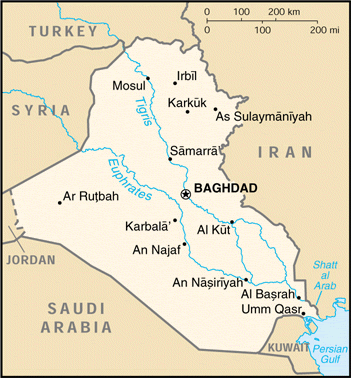
From the U.S. Department of Energy:
Iraq now finds itself in a period of uncertainty and transition after more than three decades of Ba'ath party rule. Following the end of Saddam Hussein's rule in the spring of 2003, Iraq was governed for a year by the "Coalition Provisional Authority (CPA)" led by the United States and the United Kingdom. On June 28, 2004, the CPA transferred power to a sovereign Iraqi interim government, with national elections held on January 30, 2005. On May 3, 2005, the new transitional government was sworn in, with a new Prime Minister. A constitutional referendum was held in October 2005, with the constitution being approved overwhelmingly. Elections for a permanent government were held in mid-December 2005. After six months of debate, a national-unity government emerged, replacing the former prime minister with Nuri al-Maliki. The constitution (articles 108-111) addressed the control and distribution of oil resources in general terms, but many details (e.g., exactly how oil revenues will be distributed) were not spelled out exactly. Another question that remains outstanding is whether or not Iraq will form a new Iraqi National Oil Company (INOC).
Although Iraq's unemployment rate remains high (27-40 percent), the overall Iraqi economy appears to be recovering after more than a decade of economic stagnation, sanctions, and war. However, it is important to note that estimates of economic growth vary widely. For instance, Iraqi real GDP growth is estimated by Global Insight at 34 percent growth for 2005 and 22 percent for 2006. In contrast, the International Monetary Fund (IMF) recently lowered its Iraq GDP growth forecast to just 3.7 percent, citing “the continuing sabotage of oil installations,” with forecast growth of 17 percent for 2006.
On October 15, 2003, a new Iraqi currency -- the "New Iraqi Dinar" (NID) -- was introduced, replacing the "old dinar" and the "Swiss dinar" used in the north of the country. Since then, the NID has appreciated sharply, from around 1,950 NID per $U.S. in October 2003 to around 1,470 NID per $U.S. by mid-December 2005. In early February 2004, Iraq was granted observer status at the World Trade Organization (WTO). In late September 2004, Iraq sent the WTO a formal request for membership.
Total, long-term Iraqi reconstruction costs could run to $100 billion or higher, with an October 2003 donors conference in Madrid resulting in pledges of $33 billion (channeled partly through the International Reconstruction Facility Fund for Iraq -- IRFFI). In mid-October 2004, donor countries meeting in Tokyo agreed on the need to speed up the disbursement or promised assistance to Iraq. To date, only a small fraction of the money pledged in Madrid has been disbursed. In late November 2005, the World Bank approved a $100 million loan (for education projects) to Iraq, the first such loan in 30 years.
On May 22, 2003, the U.N. Security Council passed Resolution 1483, lifting sanctions on Iraq, phasing out the 6-year-old U.N. oil-for-food program over six months (the program ended on November 21, 2003), and designating a U.N. "special representative" to assist Iraq in its reconstruction efforts. On May 27, 2003, the U.S. Treasury Department lifted most U.S. sanctions on Iraq, thereby implementing U.N. Security Council Resolution 1483.
In November 2003, the U.S. Congress authorized $18.4 billion for Iraq in a "supplemental allocation" aimed at boosting Iraqi reconstruction and economic development. As of late October 2005, only around 79 percent of that total had been committed to projects. About $2 billion reportedly had been spent on oil projects and over $4 billion on power projects, with mixed results.
Iraq assumed a heavy debt burden during the Saddam Hussein years, around $100 billion if debts to Gulf states and Russia are counted, and even more if $250 billion in reparations payment claims stemming from Iraq's 1990 invasion of Kuwait are included. Under U.N. Security Council Resolution 1483, Iraq's oil export earnings are immune from legal proceedings, such as debt collection, until the end of 2007. In November 2004, the Paris Club group of 19 creditor nations agreed to forgive, in stages, up to 80 percent on $42 billion worth of loans. The relief is contingent upon Iraq reaching an economic stabilization program with the IMF.
Monday, June 26, 2006
| [+/-] |
Oil Privatization Through The Back Door |
At Niqash, Greg Muttit writes:
In a survey in July 2003, Baghdad residents were asked what they thought was the main reason for America and Britain to go to war in Iraq. The most popular answer, with 47% of responses, was “to secure oil supplies”.
At first glance, it would seem that America and Britain have failed in this aim. Post-war Iraqi oil production peaked in April 2004 at 2.3 million barrels per day – still below the pre-war level of 2.5 mbpd – and has since dropped to around 2 mbpd.
But this reading would misunderstand the foreign oil interest. The aim for Iraq’s oil was not simply to obtain greater supplies – that could have been done by purchasing more oil from the former regime, and by removing sanctions. Rather, the US/UK interest was in controlling oil over the long term, through multinational companies based in their own countries.
In this respect, things now seem to be moving fast. On US President George Bush’s recent visit to Baghdad, oil was one of the key topics discussed. And last week, Bush’s Energy Secretary Sam Bodman called for an Iraqi oil law to lay out the rules of private investment.
The new Iraqi Oil Minister plans to pass an oil law through parliament by the end of the year – the timescale imposed by the International Monetary Fund – to enable the Iraqi government to sign contracts with “the largest oil companies”.
It seems the most likely type of contract being considered is the one advocated by the oil companies themselves, known as a ‘production sharing agreement’ (PSA). Four PSA contracts have already been signed by the Kurdistan Regional Government, with Norwegian, Turkish and Canadian companies.
So, what is a PSA? It is a structure which allows a foreign company to invest capital in developing an oilfield, in exchange for managing the oil production, and keeping a share of the oil.
Such contracts are often used in countries with small or difficult oilfields, or where high-risk exploration is required. They are not generally used in countries like Iraq, where there are large fields which are already known and which are cheap to extract. For example, they are not used in Iran, Kuwait or Saudi Arabia, all of which maintain state control of oil.
In fact, of the top seven countries with the largest oil reserves, only Russia – which has the World’s seventh largest – has any PSAs. Russia signed three PSAs in the early 1990s, during its own rapid political and economic transition, but has signed no more since then. Those PSAs have been so controversial, due to the poor deal they give the state, that it is unlikely any more will be signed.
Now some of the very same people who pushed PSAs in Russia and the other former Soviet states of Kazakhstan and Azerbaijan are advocating their use in Iraq.
Part of the appeal of PSAs is that they give the appearance of sovereignty over natural resources: the state is described as “owner” of the resource, and the foreign company as its “contractor”. However, in practice, most oil industry analysts acknowledge that the terms of the contract can be written so as to have exactly the same effect as a more traditional privatisation, giving the company management control, and potentially huge profits.
And with PSAs commonly lasting for 30 or 40 years, or even longer, decisions made now could sow the seeds of economic and political difficulties for decades to come.
The most obvious impact of this is that the state would obtain less revenue, as a share would go to the foreign companies. The cost to the Iraqi economy over the length of the contracts could be in the hundreds of billions of dollars. Given that oil provides more than 90% of government revenue, giving away a significant chunk of this could have a major effect on public programmes of health, education and infrastructure.
A second consequence would be the effect on the workforce. Whereas publicly-owned enterprises can include employment or the development of the national skills base among their objectives, private companies’ sole aim is to maximise profit. The international oil companies have consistently done this by reducing the size of the workforce. Similarly, they bring in many of their workers from abroad. Although the government may negotiate a percentage of local workers to be specified in a PSA contract, generally the technical and management roles go to foreigners: the Iraqis would be left with the lowest-paid and least-skilled jobs.
Furthermore, the companies would have control over the rate of oil production. For an oil-dependent country such as Iraq, the rate of depletion of its non-renewable resources – the balance between maximising production now versus saving some for later – is one of the most important economic decisions.
This may also undermine Iraq’s future relationship with OPEC. Two OPEC members with major foreign investment, Algeria and Nigeria, have repeatedly failed to control foreign companies’ production in order to comply with OPEC quotas.
If this is not worrying enough, PSAs frequently contain a ‘stabilisation clause’, making the companies effectively immune to any future legislation or regulation. As a result, future governments for the next 40 years could be constrained in their ability to pass new laws or policies.
For example, imagine that in ten years’ time a new Iraqi government wanted to pass a human rights law, or wanted to introduce a minimum wage. If this affected the company’s profits, either the law would not apply to the company’s operations, or the government would have to compensate the company for any reduction in profits.
Perhaps the government might insist that the law must be applied. In that case the company could apply to an international investment court – most likely in Geneva or Washington, DC – whichever is specified in the contract. These courts, which often sit in secret, cannot consider the body of Iraqi law, let alone the Iraqi public interest: they only consider the commercial terms of the contract. If such a court found against the Iraqi government, the government would either have to comply, or would face having its assets seized in other countries.
The human rights organisation Amnesty International has described such contracts as having a “chilling effect” on human rights, meaning that the financial disincentives are likely to discourage governments from passing any progressive human rights policies.
Production sharing agreements thus make a pretence of preserving national control, while in fact handing it over to foreign companies – in effect, privatising by the back door.
No-one doubts that the Iraqi oil sector needs investment. The advocates of PSAs argue that, because PSAs are favoured by oil companies, they are the only way to provide investment. But this ignores a range of other options: investment could be provided from public budgets, by borrowing from international banks, or by inviting foreign companies under less extreme forms of contract – for example, the buyback contract used in Iran or the risk service contracts being considered in Kuwait. Indeed, in both of those countries foreign ownership of oil is forbidden by their constitutions.
The oil companies insist that to finance oil development from public expenditure would deprive the Iraqi government of the opportunity to spend its limited funds on other public priorities. It is true that if foreign companies provide the investment now, the government would not have to.
But the Iraqi people must ask whether relinquishing future revenue and surrendering sovereignty over Iraq’s natural resources are a fair price to pay.
Friday, June 23, 2006
| [+/-] |
The American Dream - A Summer Home of Your Own |
John Roberts, the chief justice of the U.S. Supreme Court, has bought a seasonal home on an island off the midcoast of Maine.
The Boston Globe reports:
Roberts and his wife bought a house and land on Hupper Island off of Port Clyde from Steve Thomas, the former host of the "This Old House" television show, according to the Knox County Registry of Deeds.
The home sits about 225 feet from shore with a water view toward the Port Clyde General Store on the mainland. It has a right of way to the beach.
The home and the 2.1-acre lot it sits on are assessed by the town at $172,800. The island has 20 to 30 seasonal homes on it.
Roberts, who was confirmed as chief justice last fall, lives in Chevy Chase, Md., outside of Washington.
Rockland attorney James Brannan said the Roberts have also inquired about registering a skiff and purchasing a mooring in town.
Wednesday, June 21, 2006
| [+/-] |
Who Controls Iraq's Oil Decisions? |
At Niqash, Greg Muttit writes:
The debate over national vs. regional control of Iraq’s oil sector intensified last week, as the new Natural Resources Minister of the Kurdistan Regional Government (KRG) stated his opposition to amending the oil-related articles of the Constitution.
In his first public statement since his appointment, Dr Ashti Hawrami argued that, “the Constitution was adopted as a package by all the people; it is a single document … The rights of the regions and governorates are clear and cannot be modified in any way to enhance the powers of federal authorities.”
He was responding to calls by Iraqi oil experts to use the agreed constitutional review process, culminating in a second referendum, to change the controversial articles, which are seen by some as ambiguous, contradictory or impractical.
The Constitution grants the federal government control only over “current fields”. In most interpretations, the regions and governorates would control all other fields. However, the meaning of “current fields” is unclear.
Iraq has about 80 known oilfields, and many more fields likely still to be found in unexplored areas. Of these 80, only about 20 have ever been developed, and some of those have only partially been developed, producing oil at a fraction of their potential rate. These latter include the four super-giant fields of Majnoon, West Qurna, Nahr Umar and East Baghdad, which between them contain nearly half of Iraq’s total reserves.
A recent research paper by oil expert Kamil Mehaidi pointed out that it is unclear whether the term “current fields” refers to all discovered fields, to those currently in production (accounting for about 78% of Iraq’s known reserves), or just to those which have been fully developed (about 36% of reserves).
Natural Resources Minister Hawrami interpreted current fields as those which are producing oil now. But he went much further, arguing that the regions and governorates should control all of the revenue from undeveloped fields, and should have effective veto power even over the limited roles he prescribed for the federal government.
It is worth considering separately the political issue of who takes the revenue and the more technical issue of who has management control.
Most people accept that some share of revenue should stay in the region in which it was produced, and this is common around the world – it compensates regions for their investment in infrastructure and for the environmental impacts of oil production. However, over time the balance of Iraq’s oil production will shift from fields which are now “current” to those which are new. Thus, with Iraq’s oil mostly concentrated in the south and the north of the country, to give all revenue from non-“current fields” to producing regions could leave other areas – notably the centre and west – impoverished.
The greatest disputes are over who should control oil decisions, such as strategy, policy, operational management, and the role of the private sector, including signing of contracts. Those who argue that regional autonomy should be maximised are concerned that in a centralised system some regions might be de-prioritised for investment and access to resources, a concern felt especially by many Kurds. Others fear that too much autonomy could sow the seeds of division of the country.
Meanwhile, many technocrats argue that too much decentralisation brings the risk of an uncoordinated and bureaucratic system, in which each region has its own approach and procedures. The need for coordination is most obvious with strategic infrastructure that either physically spans more than one region or province, such as pipelines, or serves more than one, such as refineries. Similarly, geology does not recognise administrative borders, and several oilfields straddle more than one province, and potentially more than one region. In the absence of clear coordination, competing authorities keen to maximise their production could damage the geology of an oilfield by overproducing on their side – the problem that at a national level has caused disputes between Iraq and Kuwait.
But the oil federalism issue should not be isolated from the equally big issue of privatisation. Dr Hawrami’s comments on the Constitution came two weeks after the Kurdistan Regional Government signed an oil-production contract with the Canadian company Western Oilsands, the fourth such deal signed by the KRG. It had previously signed contracts with Norwegian company DNO in June 2004, and with Turkish companies Genel Enerji in January 2004 and Petoil in April 2003. DNO recently announced the discovery of oil near Zakho in Dohuk province.
The legal status of these deals is hotly contested, with the Oil Ministry in Baghdad arguing that only it has the right to sign such contracts. On the other hand, Kurdish authorities have argued that the KRG is authorised by the Constitution to sign contracts – even though the first three were signed even before the Constitution was first drafted. It is far from clear how this dispute will be resolved.
All four contracts are with small companies. The major international oil companies are unlikely to invest while there is such legal uncertainty, at least until the finalisation of the Constitution, due to the high risk of losing their investments if the contracts are ultimately found not to be valid. As in any investment, the higher the risk taken by an investor, the higher the profit they will expect, to make it worth their while. So it is likely that these contracts give a very high share of revenue to the companies, with a correspondingly lower share going to the public authorities.
However, the detailed terms of the deals – the revenue split, the legal terms and even the duration of the contracts – are mostly unknown, as they have not been disclosed. For citizens and civil society organisations to know what the revenue terms are is an important defence against corruption, as well as providing for democratic scrutiny.
But although private companies are cautious about legal uncertainty, they benefit from negotiating with weaker public institutions. The regions and provinces do not have the strategic and negotiation experience that is possessed by the Oil Ministry in Baghdad. And if the Kurds’ precedent is followed elsewhere, the result could be a race to the bottom, in which different regions compete with each other to attract investment by offering greater shares of revenue – and more generous legal terms – to private companies.
While the desire for greater regional autonomy is understandable, it could in fact end up also transferring power – and more of Iraq’s oil wealth – from public to private sector, and from Iraqis to foreign companies.
Thursday, June 15, 2006
| [+/-] |
The Black Gold Rush In Iraq |
It is an old cliché that politics is too important to be left to the politicians. But are new moves to decide the future shape of Iraq’s oil industry happening too fast to achieve public consensus – on issues that could both redraw the map and rewrite the history of Iraq?
In Niqash, Greg Muttitt writes:
The new Oil Minister, Husayn al-Sharistani, announced on Saturday that within two months he will draft legislation to govern Iraq’s oil sector, and aims to have his oil law passed by Parliament by the end of the year. The law will define the relative roles of the federal government, of the regions and governorates, and of private companies.
The issues could hardly be more important.
The degree of centralisation in the control of oil, and the revenues from it, are important aspects of the question of federalism. If misjudged – either by denying a fair share to the regions in which oil is located, or by giving regions too much autonomy at the expense of national cohesion – these oil decisions could fracture, and ultimately break apart, the country. However, given that the federalism issue is one of the most contentious aspects of the constitution, it is surprising that the oil law will be drafted – and possibly even passed – before the constitutional review process is complete.
Meanwhile, while there has been discussion on the question of the split of revenues between the centre and the regions, there has been almost no debate on the split between state entities and private companies.
Just three days after his appointment, Mr Al-Shahristani told a press conference that he planned to sign contracts with “the largest oil companies”. This would be the first time for more than thirty years that foreign companies have a major stake in Iraq’s oil. Oil was brought into public ownership and control in a process that began with Law 80 of 1961, to be completed in 1975. Public ownership of natural resources and industry is an issue about which many Iraqis feel very strongly. Yet decisions made in the coming months will not be reversible, as once contracts are signed, they will have a major bearing on Iraq’s economy and politics for decades to come, especially as oil accounts for more than 90% of government revenue.
“Federalism” and “privatisation” are not the only potentially divisive issues. The oil industry – like the rest of the country – has been plagued by corruption, and by the worsening security situation. The oil law will have an impact on both problems. A transparent and coordinated approach will be necessary in the fight against corruption. On the other hand, if deals with foreign companies are seen as secretive or unfair, they will only feed resentment, and in consequence the violence that has gripped the country.
Mr Al-Shahristani’s desire to move forward decisively and assertively may be his antidote to the ministry’s stagnation over recent months, hampered by political infighting. However, to do so before political and public consensus is achieved would create more problems than it would solve. Throughout Iraq’s history, the management of oil has been carried out in favour of narrow interests, whether foreign companies, the dictatorship or more recently, criminal elements and certain political interests.
That is not to say the government should do nothing. There is certainly an urgent need to address corruption, to improve security, and to carry out the technical rehabilitation of Iraq’s existing fields. On these issues, there is no major dispute. But before making the bigger decisions, proper public consultation and participation is vital.
Some interest groups have already insisted on having a say in the oil law. Most major international oil companies have been in contact with the Oil Ministry. And the International Monetary Fund required that it be involved in the drafting of the oil law, as part of the economic conditions it imposed on Iraq in December 2005. The fulfilment of these conditions is a requirement of the Paris Club of wealthy creditor nations, in exchange for relief of another portion of the international debts accumulated by the former regime.
The US government is also ensuring that its views are represented. It has appointed an adviser to work with the Oil Ministry on the law, from BearingPoint, the company that was hired by the Coalition Provisional Authority in 2003 to design the blueprint for the privatisation of the Iraqi economy.
But the oil in Iraq belongs to the Iraqi people – as is stated in the constitution. If that clause of the constitution is not to be considered meaningless, it should be the Iraqi people who decide how oil is managed, and the Oil Ministry should make provision for genuine public consultation.
The Oil Ministry should request and consider the views not just of political parties, but of civil society groups, experts, trade unions and others. It should open a process of informing and seeking the opinions of the general public, through workshops and meetings around the country, through publicising proposals in newspapers and on TV.
This is not a process that can be completed in two months. While the impatience is understandable, it is dangerous. Will oil be a blessing or a curse for Iraq? Public debate could make a difference.
| [+/-] |
Hill Ties Reap Rewards For Top Defense Firms |
The Hill reports:
Letitia White, former defense appropriations staff member for Rep. Jerry Lewis (R-Calif.), is known on the Hill and in industry circles as the golden girl of earmarks.
It is those earmarks and the hefty price paid for them — in campaign contributions and lobbying fees — that have spurred federal investigators to look into the connection between White, now a partner at the firm of Copeland Lowery Jacquez Denton & White; Jeff Shockey, a former lobbyist at the firm and one of Lewis’s top committee staff members; and Lewis, the chairman of the House Appropriations Committee.
Former Rep. Bill Lowery (R-Calif.), Lewis’s longtime friend, is also a founding partner of Copeland Lowery.
The probe, which grew out of the investigation into former Rep. Randy “Duke” Cunningham (R-Calif.) that led to his resignation from Congress and his imprisonment, has prompted increased scrutiny of the defense-contracting business.
But the defense-contracting lobbying business has been a lucrative part of the K Street community for years, lawfully helping sell defense industry products to Capitol Hill and the Pentagon.
While Copeland Lowery targeted all appropriations bills, not just defense, there are several lobby shops that specialize almost solely in defense. They provide what Washington insiders argue is a necessary service.
Here is a look at the top defense-contracting lobbying firms and their connections to Congress and the Pentagon:
THE PMA GROUP
In 2006 alone, the PMA Group accounted for at least 60 earmarks in the conference report of the defense spending bill, according to data compiled by Taxpayers for Common Sense, a watchdog organization tracking earmarks in bills. That amounted to roughly $95.1 million, according to an analysis of that data.
Determining exactly how many earmarks a certain firm has secured is difficult because that information is not publicly available and defense companies often hire several lobbying firms to represent them.
Paul Magliocchetti, a nine-year veteran of the House Defense Appropriations Subcommittee, is the founder of the PMA Group. Out of its team of 35 lobbyists, at least 30 have worked on Capitol Hill, in the Pentagon or both.
One member of the team, Richard Kaelin, was the chief of staff to longtime House Appropriations Committee member Rep. Pete Visclosky (D-Ind.).
Kaelin also served as the lawmaker’s appropriations director, focusing on national security, energy and water development. That position “allowed him to develop keen negotiating skills essential to protecting multimillion-dollar projects and programs of national significance,” according to his company bio.
Another, Melissa Koloszar, was chief of staff to Rep. Jim Moran (D-Va.), also a member of the Defense Appropriations Subcommittee. For five years Koloszar also served as Moran’s legislative director. As an associate staff member on the Appropriations Committee, she was the primary contact to the defense subcommittee.
And if Moran ever becomes a chairman of a spending panel, PMA could be in luck. The lawmaker said Tuesday that if he were a chairman of a spending panel he would “earmark the [expletive] out of it.”
PMA’s Dan Cunningham has a close relationship with subcommittee ranking member Rep. John Murtha (D-Pa.), according to K Street sources.
Cunningham also served as the director and deputy director for the Army’s congressional liaison team. He directed the legislative strategy for presenting the Army’s budget for military pay, operations and maintenance, military construction, acquisition, and research and development, according to his bio.
PMA is also a heavyweight when it comes to political contributions.
For the 2006 cycle alone, PMA’s PAC doled out more than $250,000 to federal candidates. Since 2000, the PAC contributed close to $1 million to members of the House and the Senate, focusing on GOP and Democratic members of the authorization and appropriations committees.
With its 139 clients, the firm ranked as No. 10, with revenue of $7.8 million in 2005, on a list of the most profitable lobbying firms compiled by PoliticalMoneyLine.
ADI
American Defense International (ADI), with 105 clients, mostly defense and technology, was able to secure at least 32 earmarks for its clients in the 2006 defense spending bill, according to data compiled by Taxpayers for Common Sense.
ADI also has attracted an all-star cast. The chairman, Van Hipp Jr., headed the South Carolina Republican Party in 1988. He was deputy assistant secretary of the Army for reserve forces and mobilization and was appointed by then-Secretary of Defense Dick Cheney as the principal deputy general counsel of the Navy.
John Barth, meanwhile, was chosen to serve as the secretary of the Navy’s personal liaison to the House and Senate Appropriations committees for all Marine Corps matters.
Michael Khatchadurian served on the House Armed Services Committee, was military legislative assistant for Reps. Jim Ryun (R-Kan.) and Ander Crenshaw (R-Fla.), who was then a member of the House Armed Services Committee and is now a member of the Appropriations Committee. After leaving Congress, he worked in the public-affairs office of the Joint Chiefs of Staff.
Former House Armed Services Committee Chairman Ron Dellums (D-Calif.) serves as ADI’s senior national-security adviser.
ADI’s president, Michael Herson, also has experience at the Pentagon. During Cheney’s tenure there, Herson was the special assistant to the assistant secretary of defense for force management and personnel. After that, Herson joined the Alexis de Tocqueville Institution as a visiting fellow for national-security affairs.
“It is important to be a good practitioner with what you do,” Herson said. “You have to have a story to tell, have all the forms filled out and all the material that the staff needs. It is more about relationships, and you can establish those by being well-prepared and having a good story to tell.”
Several media reports have noted that Herson is married to a legislative assistant to Sen. Arlen Specter (R-Pa.). She works part time for Specter and does not handle appropriations matters.
It has also been reported that ADI does not take clients into Specter’s office.
ADI’s total earmarks for the 2006 Pentagon budget amount to at least $81 million.
ADI employees also donate mightily to the political process. For the 2002, 2004 and 2006 cycles, they contributed a total of $284,000.
ADI was ranks No. 29 with revenue of $3.9 million in PoliticalMoneyLine’s list of top lobbying firms.
COPELAND LOWERY AND OTHERS
Meanwhile, Letitia White’s firm, Copeland Lowery, with its 105 clients, ranks No. 32 with revenue of $3.7 million.
While PMA, ADI and Copeland Lowery have a large number of defense clients, other smaller, well-connected and successful shops that focus almost exclusively on defense issues are also major players.
One of them is Robison International, which is run by retired Maj. Gen. Randall West. Robison International is a steady contributor to Rep. Alan Mollohan (D-W.Va.)
Ervin Technical Associates is yet another powerful force in the defense lobbying world. Founding partner Jim Ervin’s experience includes program management and international sales with the Air Force. He also served as a congressional liaison.
