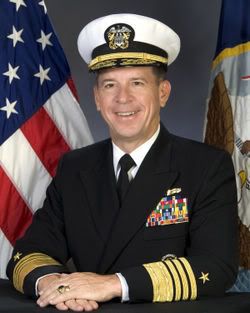
Secretary of Defense Robert Gates has decided to replace Joint Chiefs Chairman General Peter Pace with Admiral Mike Mullen. Gates wanted to renominate General Pace and Vice Chairman Admiral Edmund P. Giambastiani, Jr., but members of the Senate Armed Services Committee told Gates that confirmation would be a "backward looking and very contentious process" should that happen.
Wikipedia bio:Admiral Michael G. Mullen (born October 4, 1946) became the 28th Chief of Naval Operations of the United States Navy, relieving Admiral Vern Clark on 22 July 2005. He served as Vice Chief of Naval Operations under Clark, and as the Commander of U.S. Naval Forces Europe & Commander of Allied Joint Force Command Naples.
A 1968 graduate of the United States Naval Academy, Mullen has served in a wide range of assignments at sea and ashore, in both the Atlantic and the Pacific Fleets.
He has commanded three ships, Noxubee (AOG-56), Goldsborough (DDG-20), and Yorktown (CG-48); and has also commanded Cruiser-Destroyer Group Two and the George Washington Battle Group. Mullen’s last command at sea was as Commander, U.S. Second Fleet/Commander, Striking Fleet Atlantic.
Mullen’s shore assignments include duty on the staffs of the Secretary of Defense and the Chief of Naval Operations. He has served as Director of Surface Warfare and he was the 32nd Vice Chief of Naval Operations from 2003 to 2004.
In 1985, Mullen graduated from the Naval Postgraduate School with a Master's of Science degree in Operations Research, and in 1991, he completed the Harvard Business School Advanced Management Program.
As Commander, Allied Joint Force Command Naples, Mullen had operational responsibility for NATO missions in the Balkans, Iraq, and the Mediterranean. As Commander, U.S. Naval Forces Europe, he was responsible for providing overall command, operational control, and coordination of U.S. naval forces in the European Command area of responsibility. He assumed these duties on 8 October 2004 and was relieved of them upon his becoming Chief of Naval Operations.
Links to Mullen's speeches and interviews.
Friday, June 8, 2007
| [+/-] |
Admiral Mullen to Replace Peter Pace As Chairman of the Joint Chiefs |
| [+/-] |
Paris Hilton |
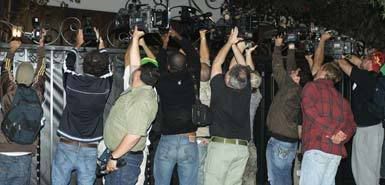 The scene outside of Paris Hilton's home. (photo by Mark J Terrill/AP)
Times Online reports:
A US judge ordered Paris Hilton to appear in court in person today and ordered sheriffs to go and fetch her for a hearing to reconsider her early release from jail.
The ruling was made after a furious row erupted over an earlier decision to allow the celebrity heiress to appear in court via a telephone link.
Hilton's on-off bid for freedom will continue in front of Superior Court Judge Michael T. Sauer, who dispatched a court vehicle to collect the socialite from her home in the Hollywood Hills, which is surrounded by paparazzi and reporters.
She was allowed to return home yesterday after serving just three days of her 45-day sentence for driving offences and told she that could complete her punishment under house arrest.
The decision to allow her to complete her sentence in the comfort of her own home for “medical reasons” was met with outrage.
Don Knabe, County Supervisor, said he had received more than 400 angry e-mails and hundreds more phone calls from around the country complaining about the decision to release Hilton from prison. “What transpired here is outrageous,” he said. “[It] gives the impression of ...celebrity justice being handed out.”
Public denunciations flowed from the sheriff’s deputies union, local politicians, civil rights leaders, defence attorneys and, most crucially, from Judge Sauer himself, the judge who originally sentenced the hotel heiress to jail time.
The judge had specifically ruled that the socialite must serve her term in prison rather than at home. When he learned of the decision by the Los Angeles County Sheriff’s Department to release Hilton early, he demanded that she return to court, where she may be sent back to jail today.
Prosecutors have also threatened to hold the Sheriff’s Department in contempt of court for releasing Hilton early contrary to the orders of the court.
Sheriff Lee Baca has defended his decision to release her early. “It isn’t wise to keep a person in jail with her problem over an extended period of time and let the problem get worse,” Baca told the Los Angeles Times.
Hilton was driven out of jail in the dead of night on Thursday. Reports have suggested that Hilton had not been eating or sleeping since her arrival last Sunday at the Los Angeles County jail. She has phoned her lawyers to complain about her pillows and blankets and is said to have spent hours sobbing in her cell.
“Paris Hilton has been fitted for an ankle bracelet and put under house arrest, after authorities determined to release Hilton from prison due to medical reasons,” said Steve Whitmore, Los Angeles County Sheriff’s Department spokesman.
Officials would not discuss Hilton’s medical condition, but confirmed that the decision to release her from jail was made after extensive consultation with medical personnel.
The New York Post reported that she has been seeing a councillor and refused to eat her prison-issue hot dog on Tuesday night.
Hilton’s sentence had been reduced from 45 to 23 days for good behaviour, but under the deal to release her into the community she would now serve the full term.
The star of the Simple Life reality television show would not be able to travel more than 30 yards from her house for the next 40 days.
Hilton is likely to host some well-known visitors during house arrest in her mansion in the Hollywood Hills. One of her legendary parties was broken up by police earlier this year and guests have included Cameron Diaz, Nicole Ritchie and Britney Spears.
Hilton was jailed for driving while banned. She was arrested in Hollywood last September for reckless driving and had her licence suspended, she was told to attend alcohol education classes.
In January she was pulled over by the California Highway Patrol and forced to sign a document reminding her that she was not allowed to drive her car. A month later she was caught at the wheel once again, this time she was charged with violating her probation.
Hilton remained defiant on the eve of her incarceration and made a surprise appearance at the MTV Movie Awards a few hours before checking into jail.
“I hope that I’m an example to other young people,” she told a confused crowd outside the film awards show. “I did have a choice to go to a pay jail. But I declined because I feel like the media portrays me in a way that I’m not and that’s why I wanted to go to county, to show that I can do it and I’m going to be treated like everyone else. I’m going to do the time, I’m going to do it the right way.”
She was housed in the “special needs” unit at the jail in Lynwood and not forced to interact with most of her 2,200 fellow inmates.
| [+/-] |
Bandar Bush Named in British Scandal |
An aerospace company reportedly placed up to $2 billion into accounts held by a key ally of the Bush administration.
The LATimes reports:
Prince Bandar bin Sultan, the powerful former Saudi ambassador to the U.S. who has been one of the Bush administration's strongest allies in the Middle East, was publicly linked to a widening British corruption scandal Thursday with reports that a British aerospace company secretly transferred up to $2 billion into bank accounts at the Saudi Embassy in Washington.
The new allegations point a finger directly at Bandar, the son of the Saudi crown prince and a man who has been a key ally for President Bush and his father, as well as a frequent contact of Vice President Dick Cheney. For years, the prince has been considered the most important go-between in the close and often secretive relationship between the U.S. and the royal family.
According to reports by the BBC and London's Guardian newspaper, documents show that BAE Systems made cash transfers to Bandar every three months for 10 years or more, drawn from a confidential account to which British government departments had access.
The alleged payments grew out of a 20-year, $86-billion oil-for-arms deal under which Britain supplied Saudi Arabia with 120 Tornado warplanes, Hawk training jets and other military equipment. The deal, known as Yamamah ("dove" in Arabic), was Britain's largest export contract.
A former BAE official has said the company made legal payments to "agents" beginning in the 1980s. But the news reports said that money was funneled to Bandar, with some of the cash going to fund the prince's private Airbus. The money reportedly was described as fees for marketing services.
"Hundreds of thousands and millions of dollars were involved," U.S. bank investigator David Caruso told the BBC. He confirmed his account in a brief interview with the Los Angeles Times. "There wasn't a distinction between the accounts of the embassy, or official government accounts as we would call them, and the accounts of the royal family," he said.
The reports suggested for the first time that Britain's Ministry of Defense had authorized the secret payments, and they also left open the possibility that payments occurred after 2001, when Britain made it illegal to bribe foreign officials.
The Yamamah contract already was the center of a government investigation. But in December, that three-year probe was halted in the interests of Britain's "national and international security" with the approval of Prime Minister Tony Blair. The new allegations reignited controversy over that decision.
The Serious Fraud Office's decision to close its probe led to charges that Britain was attempting to shore up its negotiations to sell a $20-billion new fleet of Eurofighter Typhoon jets to the desert kingdom.
But British officials said their real fear was losing Saudi Arabia's cooperation in the war on terrorism. Atty. Gen. Peter Goldsmith told Parliament the heads of Britain's security and intelligence agencies, as well as the nation's ambassador in Riyadh, the Saudi capital, had warned that the investigation could seriously damage relations.
Blair, whose final weeks as prime minister threaten to be shadowed by talk of slush funds and coverups, again defended the decision to call off the probe.
"This investigation, if it had gone ahead, would have involved the most serious allegations and investigations being made into the Saudi royal family," Blair told reporters Thursday in Germany, where he was attending the Group of 8 summit.
"My job is to give advice as to whether that is a sensible thing in circumstances where I don't believe the investigations would have led anywhere except to the complete wreckage of a vital, strategic relationship for our country in terms of fighting terrorism," he said.
But in London there were calls for reopening the inquiry.
"What's new about these revelations are several things. First of all, it's the sheer scale of the payments: It may well be a billion pounds being paid to this one prince," Vincent Cable, a Liberal Democratic member of Parliament who earlier had identified Bandar as a possible target of the probe, said in an interview.
"Secondly, this is the first time [Bandar] has been fingered in quite such a direct and clear way," he said. "The other key point, what's really new about all this and very alarming, is that it does appear that the British government was first of all aware of these payments, and very complicit in them, and moreover, they were made until very recently."
The Ministry of Defense said it could not comment on the reports "as to do so would involve confidential information about al-Yamamah, and that would cause the damage that ending the investigation was designed to prevent."
BAE spokeswoman Lisa Hillary-Tee said in a statement that the company had already handed all information on the contract in its possession to the Serious Fraud Office. "After an exhaustive investigation, it was concluded, over and above the interests of national security, that there was and is no case to answer," she said.
"The al-Yamamah program is a government-to-government agreement, and all such payments made under those agreements were made with the express approval of both the Saudi and the UK governments," she said. "We deny all allegations of wrongdoing," she added.
Payments to foreign officials to win contracts are also illegal under U.S. law. But such payments have long been a feature of contracts in the Middle East, and have been considered an important source of revenue for the Saudi royal family.
"It's widely assumed that members of the royal family get a share in business deals whether they do anything for that share or not," said Jon Alterman, Middle East program director at the Center for Strategic and International Studies in Washington.
"It's part of the way the system works, and in return the princes are often extraordinarily generous with charities and other institutions," he added.
He said Britain's concern over jeopardizing cooperation on security issues reflects the "deep and intimate contact between the Saudi government and Western governments on counter-terrorism" that is considered vital.
"It's not only counter-terrorism inside the kingdom of Saudi Arabia. Muslims pass through Saudi Arabia to go on pilgrimage, so the Saudis have some of the best information about Muslims throughout the world. Their involvement in religious networks means they have both information and influence that reaches throughout the world."
"But to get things done, you need the cooperation of Saudi princes. And it's hard to get the cooperation of individuals who you are simultaneously investigating and accusing of crimes."
Thursday, June 7, 2007
| [+/-] |
Wyoming U.S. Attorney Announces Resignation In Anticipation Of Senate Appointment? |
The Billings Gazette reports:
Wyoming U.S. Attorney Matthew Mead, mentioned as a potential nominee for Wyoming's open U.S. Senate seat, announced Thursday that he would resign at midnight.
Mead said in a prepared statement that he submitted his resignation Wednesday. He offered no explanation and could not immediately be reached for comment.
Mead was appointed by President Bush in October 2001. He succeeded Dave Freudenthal, a Democrat appointed by President Clinton. Freudenthal is now governor of Wyoming.
Speculation has circulated since Monday's death of Sen. Craig Thomas, R-Wyo., that Mead might be interested in taking that job. Mead did not confirm the speculation, however.
"Sorry, I am going to dodge that one," he told the Jackson Hole News & Guide.
Last month, Mead confirmed that he was on the "third tier" of a list of U.S. attorneys drawn up by Justice Department officials who have since resigned. Eight U.S. attorneys were fired last year, but Mead pointed out that no one on the third tier resigned or was fired.
He wrote on the Casper Star-Tribune opinion page that he has never been told why he was on the list or what the third tier of the list meant.
"Perhaps my value system differed from those of the departed list makers. They are no longer with the Department; I am," he wrote. "Hopefully, with the list makers' recent departures, our ship will now track true and list no more."
But it was not clear, either, whether the list played a role in Mead's resignation.
Mead is a Jackson native and said in the release that he was returning to his family ranching operation.
"I have deeply valued pursuing the mission of the U.S. Department of Justice and working closely with our federal, state and local law enforcement partners and the Northern Arapaho and Eastern Shoshone tribal members," the release said.
"I am very pleased with the level of law enforcement cooperation in Wyoming that has developed over the last five and a half years. I leave office with the highest regard for Wyoming law enforcement and the good people at the U.S. Attorney's Office and the work that they all do."
Wednesday, June 6, 2007
| [+/-] |
China to Revise Food and Drug Safety Rules |
The NYT reports:
Responding to growing international concerns about tainted food and counterfeit drugs, China said late Tuesday that it was overhauling its food and drug safety regulations and would introduce nationwide inspections.
The announcement, from the State Council, the nation’s highest administrative body, is the strongest signal yet that Beijing is moving to crack down on the sale of dangerous food and medicine and also trying to calm fears that some of its exports pose health problems.
The move follows a series of embarrassing episodes this year involving China’s export of contaminated pet food ingredients and toothpaste. The shipments of tainted pet food ingredients set off one of the largest pet food recalls in United States history.
Last month, an article in The New York Times revealed that at least 100 people had died in Panama after taking medicine containing a toxic chemical called diethylene glycol that had been produced in China and exported as the harmless syrup glycerine.
And in recent weeks, several countries, including the United States, Panama and Nicaragua, recalled or issued warnings about toothpaste made in China because it contained diethylene glycol.
While Beijing has strongly defended the quality and safety of its food and drug exports, and even denied that toothpaste it exported was unsafe, government regulators at the same time have stepped up safety inspections and shut down companies accused of producing unsafe food or counterfeit drugs.
But with pressure growing from regulators in the United States, Europe and other parts of the world, and international food companies expressing concern about the risks of importing Chinese-made food and feed ingredients, Beijing is pushing for a more forceful response to the crisis.
In its announcement on Tuesday, which was posted on a government Web site, China said that the state council had approved a new food and drug safety guarantee system on April 17 and that an outline of the new program was being distributed to government agencies nationwide.
The government said in its announcement that it planned by 2010 to place new controls on food and drug imports and exports, to step up random testing on medicines and have inspection information on 90 percent of all food products.
It said it also planned safety checks on a large majority of food makers and said that regulators would crack down on the sale of counterfeit drugs and medical devices.
The government did not indicate whether it would provide more funds for the efforts or which agencies would carry out the bulk of the functions.
But in announcing the new measures, the government hinted at its weaknesses in enforcement, saying that after five years one goal was that “100 percent of the significant food safety accidents are investigated and dealt with” and that “80 percent of the food that needs to be recalled is recalled.”
A few weeks ago, the government had announced that it was planning to set up a food recall system.
On Tuesday, the General Administration of Quality Supervision, Inspection and Quarantine, which oversees food and drug exports, also posted statements on its Web site about the issue.
“Recently, our country has had a series of export food problems, and that has triggered a lot of overseas attention about China’s food safety,” said Wei Chuanzhong, deputy director of the agency. “This has put us on high alert, and led us to seriously look into the reasons for the problem.”
Food and drug safety experts have complained for years about an incredibly flawed system that has led to food scares or mass poisonings tied to counterfeit or substandard medicines on the market.
Much of the blame has centered on weak enforcement of the nation’s food and drug regulations, as well as corruption, bribery and a business culture where counterfeiting thrives.
China’s food and drug administration, which is supposed to safeguard the nation’s health, has also been implicated.
Last week, a Chinese court handed down a death sentence against Zheng Xiaoyu, the head of the Food and Drug Administration in China from 1998 to 2005, after he pleaded guilty to bribery and corruption. The government also said that he took bribes to approve drug production licenses and that it was reviewing production licenses the agency had issued.
Some experts say the new food and drug safety program suggests that the nation’s top leaders are taking up the call for reforms and new enforcement measures.
“There’s been concern for a while about food safety in this country, and now that there are growing concerns about China’s international image, the state council has decided to act,” said Russell Leigh Moses, an analyst of Chinese politics who is based in Beijing. “This may be a sign that everyone in the government ought to get in line.”
But the challenges facing China are enormous because its regulatory system is weak and enforcement is particularly difficult, partly because the economy is growing so fast and also because local officials accept bribes and sometimes allow small companies to flout regulations.
Also, regulators here say many exporters of food and medicines are mislabeling goods and shipping them illegally.
Two weeks ago, food and drug safety issues were even on the table in Washington during the strategic economic dialogue hosted by Treasury Secretary Henry M. Paulson Jr.
“These are issues China has to deal with over time,” says Rio D. Praaning, secretary general of the Public Advice International Foundation in Belgium, an advisory group that is working on food and drug safety issues around the world. “But we can’t wait. We have interim developments. We have patience, but frankly patience is out the window when people start dying.”
| [+/-] |
More Than Fair |
Jail Time for Scooter Libby
The NYT opines:
The jail sentence and fine imposed on Scooter Libby, the former chief of staff for Vice President Dick Cheney, are an appropriate — indeed necessary — punishment for his repeated lies to a grand jury and to F.B.I. agents investigating a possible smear campaign orchestrated by the White House. Although Mr. Libby plans to appeal, as he has every legal right to, the judge ought to send him to jail now as a lesson that such efforts to frustrate justice will not be tolerated.
Mr. Libby was convicted in March for lying about his role in revealing the identity of Valerie Plame Wilson, a C.I.A. officer, as part of a campaign to discredit her husband, Joseph Wilson. He was a diplomat whose inquiries abroad had shot holes through a key premise for the war in Iraq, that Saddam Hussein had recently tried to buy uranium from Niger for a secret nuclear weapons program. Although Mr. Libby’s supporters make much of the fact that no one was ever indicted for leaking Ms. Wilson’s name, that should not obscure the fact that Mr. Libby did his best to derail efforts to find out who did it and why.
Federal District Judge Reggie Walton sentenced Mr. Libby to two and a half years in prison and fined him $250,000 based on “overwhelming evidence” of Mr. Libby’s guilt on four counts, including obstruction of justice, perjury and giving false statements. The jail term was at the low end of what the prosecutor had recommended but much harsher than the probation sought by Mr. Libby’s attorneys.
Although Libby partisans sometimes suggest that he is being railroaded because of anger over his zeal in promoting the disastrous war in Iraq, that is hardly the case here. Judge Walton, who was appointed to the federal bench by the current President Bush, is simply known for a tough-on-crime attitude that transcends politics.
Mr. Libby’s attorneys are asking that he be allowed to remain free while his appeal goes forward, but there is no good reason for Judge Walton to grant such undeserved leniency. Some analysts suggest that the Libby strategy is to run out the clock with an appeal and then count on a last-minute pardon from President Bush as he leaves office. At a time when high administration officials routinely dissemble and claim lapses of memory, immediate jail time for Mr. Libby, a convicted felon, is the best way to send a message that obstruction of justice will be severely punished.
Tuesday, June 5, 2007
| [+/-] |
Letters Cast Light on Cheney's Inner Circle |
Dozens of Prominent Figures and Insiders Praise Libby as Fundamentally Decent
The Washington Post reports:
For nearly seven years, the office of the vice president has been a virtual black hole for information about the Bush administration. But yesterday, a series of letters aimed at securing leniency for Vice President Cheney's former chief of staff, I. Lewis "Scooter" Libby, provided a small, if selective, window on the world of Cheney and his aides.
Lewis A. Hoffman, the vice president's White House physician, asked Judge Reggie B. Walton to understand "the mindset that was pervasive" in the vice president's office after the Sept. 11, 2001, attacks, and the "real fear about what the future held."
"I can tell you for certain that Mr. Libby worked himself to exhaustion day after day," Hoffman wrote in a letter dated April 26. "This is a testimony to his devotion to our nation and the Vice President. I also believe that such continuous stress and total exhaustion is just the setting where a person might honestly confuse what he said to who on what day."
Elizabeth A. Denny, who worked with Libby as the vice president's social secretary, wrote that her "heart broke" the day Libby walked out of the White House after his indictment on perjury charges in 2005. "I could feel a vacuum sucking the wind out of our office, out of the White House," she said. "I could feel his absence immediately in a very large way. I still can't figure it out."
The letters were among more than 150 released by the U.S. District Court in Washington shortly before Walton sentenced Libby to 30 months in prison and ordered him to pay a $250,000 fine. [.pdf of all letters]
Most came from former colleagues and law partners, friends, neighbors and players in Libby's regular touch football game -- as well as a collection of prominent conservative intellectuals -- who urged the judge to take into account what they described as a lifetime of selfless public service and devotion to family. Some appear to have been solicited by Libby's lawyers; other letter writers said they were writing voluntarily to try to provide a fuller view of Libby's life.
"I regard him as among the most gifted and valuable public servants of his generation," wrote Norman Podhoretz, the former editor of conservative opinion journal Commentary. "I find it inconceivable that a man of his sterling character, who is also famous for his lawyerly scrupulousness, could deliberately have told lies to a grand jury, or for that matter to anyone else."
A smaller number came from ordinary citizens who expressed outrage over Libby's actions and urged the stiffest possible sentence.
"The message sent by this man's actions and the posturing of his cronies that Mr. Libby has been convicted wrongfully for innocent misstatements, at most legal technicalities, is an appalling approval of outrageous behavior that undermines the justice system and undermines faith in government," wrote Steven C. Hychka, whose home address was blacked out by the court, as were all the others.
The writers included some of the most prominent names in conservative thinking about foreign policy, as well as current and former senior government officials -- Donald H. Rumsfeld, Paul D. Wolfowitz, Gen. Peter Pace and Henry A. Kissinger.
"He is a man of strong views, some of which I do not share," Kissinger wrote. "But in my observations, he pursued his objectives with integrity and a sense of responsibility. I would never have associated his actions for which he was convicted with his character. . . . Having served in the White House and under pressure, I have seen how difficult it sometimes is to recall precisely a particular sequence of events. This does not justify the action, but it might help you consider mitigating circumstances."
Cheney did not write a letter. His spokeswoman declined to answer questions about the case, saying his statement after the sentencing -- which lamented the sentence and praised Libby -- spoke for itself. She said she did not know whether aides wrote letters on their own or were solicited by Cheney's lawyers.
Some letters came from prominent Democrats, including Richard Danzig, secretary of the Navy during the Clinton administration, and James Carville, who signed a supportive message with his wife, Mary Matalin.
Several letter writers, even some who indicated they disagreed with Libby, said they found Libby to be a man of uncommon decency. "While he has been portrayed in the press as an ideologue and highly partisan, this characterization is very far from the truth in all of my dealings with him over the years," wrote Francis Fukuyama, a prominent foreign-policy thinker. "To the contrary, in my discussions with him on issues from Middle East diplomacy to his work on the Cox Commission to the Iraq war, he has always been open to different views and notably without rancor."
Like Kissinger, other letter writers sought to buttress a major line of Libby's defense, that he innocently forgot some of his conversations in the Valerie Plame case because of his crushing workload. John R. Bolton, the former U.N. ambassador, wrote of how "information flowed across his desk on a daily basis like water coming out of a high-pressure fire hydrant, with more demands for action than could humanly be met."
"In the face of all these demands, keeping every detail straight is impossible," Bolton wrote.
Others offered details of what they described as Libby's crucial role in key administration decisions. Former ambassador and White House aide Robert D. Blackwill called Libby a "crucial voice" in President Bush's decision to accelerate transfer of sovereignty to the Iraqis after the ouster of Saddam Hussein.
"Sadly I believe that Mr. Libby's premature departure from the Administration has been a major reason for the downward spiral of the situation in Iraq and the consuming mess in which we find ourselves today regarding that country," he wrote.
Many letter writers expressed frustration over the Libby saga's conclusion. Former senator Alan K. Simpson (R-Wyo.) wrote that he "shall always remain eternally puzzled how the situation ever 'came to this.' Some are of the opinion that he has 'fallen upon his sword' and yet, it is my perception that the sword has fallen upon him!"
