Torture's Dirty Secret: It Works, Naomi Klein reports in The Nation:
I recently caught a glimpse of the effects of torture in action at an event honoring Maher Arar. The Syrian-born Canadian is the world's most famous victim of "rendition," the process by which US officials outsource torture to foreign countries. Arar was switching planes in New York when US interrogators detained him and "rendered" him to Syria, where he was held for ten months in a cell slightly larger than a grave and taken out periodically for beatings.
Arar was being honored for his courage by the Canadian Council on American-Islamic Relations, a mainstream advocacy organization. The audience gave him a heartfelt standing ovation, but there was fear mixed in with the celebration. Many of the prominent community leaders kept their distance from Arar, responding to him only tentatively. Some speakers were unable even to mention the honored guest by name, as if he had something they could catch. And perhaps they were right: The tenuous "evidence"--later discredited--that landed Arar in a rat-infested cell was guilt by association. And if that could happen to Arar, a successful software engineer and family man, who is safe?
In a rare public speech, Arar addressed this fear directly. He told the audience that an independent commissioner has been trying to gather evidence of law-enforcement officials breaking the rules when investigating Muslim Canadians. The commissioner has heard dozens of stories of threats, harassment and inappropriate home visits. But, Arar said, "not a single person made a public complaint. Fear prevented them from doing so." Fear of being the next Maher Arar.
The fear is even thicker among Muslims in the United States, where the Patriot Act gives police the power to seize the records of any mosque, school, library or community group on mere suspicion of terrorist links. When this intense surveillance is paired with the ever-present threat of torture, the message is clear: You are being watched, your neighbor may be a spy, the government can find out anything about you. If you misstep, you could disappear onto a plane bound for Syria, or into "the deep dark hole that is Guantánamo Bay," to borrow a phrase from Michael Ratner, president of the Center for Constitutional Rights.
But this fear has to be finely calibrated. The people being intimidated need to know enough to be afraid but not so much that they demand justice. This helps explain why the Defense Department will release certain kinds of seemingly incriminating information about Guantánamo--pictures of men in cages, for instance--at the same time that it acts to suppress photographs on a par with what escaped from Abu Ghraib. And it might also explain why the Pentagon approved the new book by a former military translator, including the passages about prisoners being sexually humiliated, but prevented him from writing about the widespread use of attack dogs. This strategic leaking of information, combined with official denials, induces a state of mind that Argentines describe as "knowing/not knowing," a vestige of their "dirty war."
"Obviously, intelligence agents have an incentive to hide the use of unlawful methods," says the ACLU's Jameel Jaffer. "On the other hand, when they use rendition and torture as a threat, it's undeniable that they benefit, in some sense, from the fact that people know that intelligence agents are willing to act unlawfully. They benefit from the fact that people understand the threat and believe it to be credible."
And the threats have been received. In an affidavit filed with an ACLU court challenge to Section 215 of the Patriot Act, Nazih Hassan, president of the Muslim Community Association of Ann Arbor, Michigan, describes this new climate. Membership and attendance are down, donations are way down, board members have resigned--Hassan says his members fear doing anything that could get their names on lists. One member testified anonymously that he has "stopped speaking out on political and social issues" because he doesn't want to draw attention to himself.
This is torture's true purpose: to terrorize--not only the people in Guantánamo's cages and Syria's isolation cells but also, and more important, the broader community that hears about these abuses. Torture is a machine designed to break the will to resist--the individual prisoner's will and the collective will.
This is not a controversial claim. In 2001 the US NGO Physicians for Human Rights published a manual on treating torture survivors that noted: "perpetrators often attempt to justify their acts of torture and ill treatment by the need to gather information. Such conceptualizations obscure the purpose of torture....The aim of torture is to dehumanize the victim, break his/her will, and at the same time, set horrific examples for those who come in contact with the victim. In this way, torture can break or damage the will and coherence of entire communities."
Yet despite this body of knowledge, torture continues to be debated in the United States as if it were merely a morally questionable way to extract information, not an instrument of state terror. But there's a problem: No one claims that torture is an effective interrogation tool--least of all the people who practice it. Torture "doesn't work. There are better ways to deal with captives," CIA director Porter Goss told the Senate Intelligence Committee on February 16. And a recently declassified memo written by an FBI official in Guantánamo states that extreme coercion produced "nothing more than what FBI got using simple investigative techniques." The Army's own interrogation field manual states that force "can induce the source to say whatever he thinks the interrogator wants to hear."
And yet the abuses keep on coming--Uzbekistan as the new hot spot for renditions; the "El Salvador model" imported to Iraq. And the only sensible explanation for torture's persistent popularity comes from a most unlikely source. Lynndie England, the fall girl for Abu Ghraib, was asked during her botched trial why she and her colleagues had forced naked prisoners into a human pyramid. "As a way to control them," she replied.
Exactly. As an interrogation tool, torture is a bust. But when it comes to social control, nothing works quite like torture.
Thursday, May 12, 2005
| [+/-] |
Torture As a Tool Of Terror |
Tuesday, April 5, 2005
| [+/-] |
FBI Seeks Expanded Search Powers |
MSNBC.com reports:
FBI Director Robert Mueller on Tuesday asked lawmakers to expand the bureau’s ability to obtain records without first asking a judge, and he joined Attorney General Alberto Gonzales in seeking that every temporary provision of the anti-terrorism Patriot Act be renewed.
“Now is not the time for us to be engaging in unilateral disarmament” on the legal weapons now available for fighting terrorism, Gonzales, for his part, told senators.
He said that some of the most controversial provisions of the Patriot Act have proven invaluable in fighting terrorism and aiding other investigations. “It’s important that these authorities remain available,” Gonzales told the Senate Judiciary Committee.
Mueller said sections of the law that allow intelligence and law enforcement agencies to share information are especially important.
“Experience has taught the FBI that there are no neat dividing lines that distinguish criminal, terrorist and foreign intelligence activity,” Mueller said in his prepared testimony.
He also asked Congress to expand the FBI’s administrative subpoena powers, which allow the bureau to obtain records without approval or a judge or grand jury.
"For many years, the FBI has had administrative subpoena authority for investigations of crimes ranging from drug trafficking to health care fraud to child exploitation," he stated. "Yet, when it comes to terrorism investigations, the FBI has no such authority."
15 Provisions at Stake
The Patriot Act is the post-Sept. 11 law that expanded the government’s surveillance and prosecutorial powers against suspected terrorists, their associates and financiers. Most of the law is permanent, but 15 provisions will expire in December unless renewed by Congress.
On the same day Gonzales was speaking to the Senate committee, Sens. Larry Craig, R-Idaho, and Dick Durbin, D-Ill., planned to reintroduce legislation designed to curb major parts of the Patriot Act that they say went too far.
“Cooler heads can now see that the Patriot Act went too far, too fast and that it must be brought back in line with the Constitution,” said Gregory Nojeim, associate director of the American Civil Liberties Union’s Washington legislative office.
The ACLU is part of an unusual coalition of liberal and conservative groups, including the American Conservative Union, that have come together in a joint effort to lobby Congress to repeal key provisions of the Patriot Act.
'Library provision' is controversial
Among the controversial provisions is a section permitting secret warrants for “books, records, papers, documents and other items” from businesses, hospitals and other organizations.
That section is known as the “library provision” by its critics. While it does not specifically mention bookstores or libraries, critics say the government could use it to subpoena library and bookstore records and snoop into the reading habits of innocent Americans.
Gonzales told lawmakers Tuesday the provision has been used 35 times, but never to obtain library, bookstore, medical or gun sale records.
But the criticism has led five states and 375 communities in 43 states to pass anti-Patriot Act resolutions, the ACLU says.
Even some Republicans are concerned. Senate Judiciary Chairman Arlen Specter, R-Pa., has suggested it should be tougher for federal officials to use that provision.
Gonzales already has agreed to two minor changes to the provision, and was expected to support giving someone who receives a secret warrant under the provision the right to consult a lawyer and challenge the warrant in court. He was expected to also back slightly tightening the standard for issuing subpoenas.
Bigger concerns
Neither change addresses the central concern of opponents, which is that it allows the government to seize records of people who are not suspected terrorists or spies.
Critics say the law allows the government to target certain groups, but the Justice Department counters that no Patriot Act-related civil rights abuses have been proven.
Just in case, Craig and Durbin want Congress to curb both expiring and nonexpiring parts of the Patriot Act, including the expiring “library” provision and “sneak and peek” or delayed notification warrants. Those warrants — which will not expire in December — allow federal officials to search suspects’ homes without telling them until later.
The Justice Department said federal prosecutors have asked for 155 such warrants since 2001.
That's just two-tenths of one percent of all search warrants, but their use is growing. The warrants were sought 47 times between the time the law was passed and April of 2003. Since then, it's been invoked 108 times.
Gonzales also notes that the law has been used in non-terrorism cases. For example, federal officials used it to track over the Internet a woman who ultimately confessed to strangling a pregnant woman and cutting the fetus from her womb.
And such searches have been allowed for years in drug and organized crime cases.
Monday, April 4, 2005
| [+/-] |
2005 Pulitzer Prize Winners - Breaking News Photography |
For a distinguished example of breaking news photography in black and white or color, which may consist of a photograph or photographs, a sequence or an album, Ten thousand dollars ($10,000).
Awarded to the Associated Press Staff for its stunning series of photographs of bloody yearlong combat inside Iraqi cities.
Also nominated as finalists in this category were: Arko Datta of Reuters for his picture that captured a woman’s anguish in the aftermath of the Indian Ocean tsunami, and The Palm Beach Post Staff for its imaginative and panoramic coverage of hurricanes that struck Florida.
A team of Associated Press photographers – including five Iraqis covering the war in their homeland – have won The Pulitzer Prize for breaking news photography. It's the 48th Pulitzer for the world's oldest and largest news cooperative and the 29th awarded for AP photos.
The AP won for a series of graphic and heartbreaking pictures of bloody combat in Iraq. Some of the photos had already won prizes. Many were taken at great personal risk to the photographers, including pictures of gunmen executing Iraqi election workers in the midst of morning traffic, and the charred remains of U.S. contractors who had been killed, dismembered, burned and hung from a bridge in Fallujah.
"These photographers showed extraordinary courage," said AP President and CEO Tom Curley, who celebrated the first Pulitzer AP has won since he became leader of the news cooperative June 1, 2003.
"This is a real testament to the best that AP can be that this prize was won by photographers who came into Iraq on assignment, and five Iraqis who work in the most dangerous place on the earth, to tell the story." said AP Senior Vice President and Executive Editor Kathleen Carroll.
"Their images have a power that will last through history. When we want to look back at what happened in 2004, we'll look at their images."
The photographers cited were Bilal Hussein, Karim Kadim, Brennan Linsley, Jim MacMillan, Samir Mizban, Khalid Mohammed, John B. Moore, Muhammad Muheisen, Anja Niedringhaus, Murad Sezer and Mohammed Uraibi. An unnamed stringer was credited in the photo package for the picture of a daytime execution of vote workers, with the anonymity due to security concerns.
The Iraqi team included Hussein, Kadim, Mizban, Mohammed and Uraibi. The photographers who were on assignment in Iraq were Linsley, from Jerusalem; MacMillan, who is returning to the Philadelphia Daily News from Baghdad; Niedringhaus from Geneva; and Moore, who has since left the AP. All the Iraqi photographers have been recruited, tested and trained on an ongoing basis by the visiting photographers.
The Iraqi photojournalists risked their lives in frequently dangerous situations to get all sides of the story for the AP and to provide readers, listeners and viewers around the world with a level of access to their homeland unmatched by any other news organization.
As a crowd gathered around the photo desk at AP headquarters in New York on Monday, April 4, to hear an announcement, CEO Curley stood atop a chair beside Executive Editor Carroll to congratulate the staff. "They took some extraordinary pictures, they captured some incredible moments in history and they did it in a way that made all of us proud," he said.
Here are abbreviated bios:
Khalid Mohammed, Baghdad, worked with AP for the past two years, spent
significant time in Fallujah and at great personal risk, took the photos of the U.S. contractors killed, then dismembered, burned and their charred remains hung from a bridge. Mohammed said he was threatened immediately after taking the picture and had to escape quickly by car. "I told the driver to keep the engine running, just in case," he said.
Bilal Hussein remained behind in his hometown neighborhood so he could
document the events of the battle for Fallujah, obtaining for AP a stunning and exclusive photo showing Iraqi insurgents firing their weapons. When he was forced to flee to Baghdad, his house – and his cameras – were destroyed in the fighting.
Mohammed Uraibi, Baghdad was hired and trained by AP's visiting
non-Iraqi photographers.
Samir Mizban and Karim Kadim, Baghdad, navigated the hostile areas in the Iraqi capital, including the Sadr City neighborhood.
Jim MacMillan, a Philadelphia Daily News photographer who is wrapping up a one-year assignment for AP in Iraq at the end of April, has been primarily embedded with U.S. forces, and involved in editing the work of Iraqi photographers from the field. Of the Pulitzer notification, MacMillan said he found out when AP Director of Photography Santiago Lyon sent him an instant message saying he should call New York – now.
"I didn't suppose he wanted a call immediately to tell us we lost," MacMillan said.
Brennan Linsley, Jerusalem, was on assignment in central Iraq. On another assignment, he was lightly wounded – scratched by shrapnel.
Muhammed Muheisen, Jerusalem, based in West Bank, was on his first assignment in Iraq.
Murad Sezer, Istanbul, has the versatility to shoot sports, news and feature work, and has been on several tours in Iraq.
Anja Niedringhaus, Geneva-based photographer, has spent many tours in Iraq, and covered the U.S. Marines in their assault on Fallujah.
John B. Moore, who had been based in Cairo, got exclusive access to the U.S. military hospital in Baghdad and took a memorable shot of medics attempting to resuscitate a dying soldier.
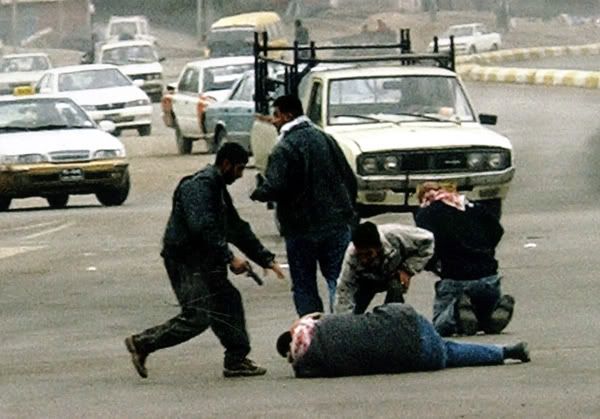 Baghdad - A gunman, left, shoots an Iraqi election worker during an attack on Haifa Street, a base of Sunni Arab insurgents. About 30 men attacked a car carrying five of the workers, executing three at point blank range. (Photo by AP stringer, December 19, 2004)
 Baghdad - An Iraqi man celebrates atop a burning U.S. Humvee after an explosion that destroyed a building and set four Humvees on fire, killing at least one U.S. soldier. (Photo by Muhammad Muheisen, April 26, 2004)
 Karbala - Moments after a series of bomb blasts on the Muslim day of Ashoura, a youth runs past victims and debris in a busy area of the holy city. (Photo by Brennan Linsley, March 2, 2004)
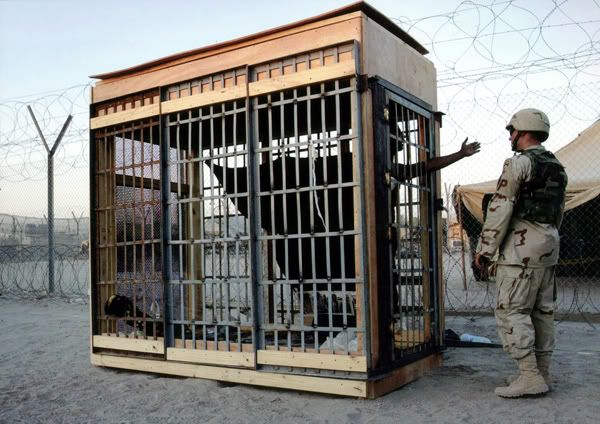 Baghdad - A detainee in a solitary confinement cage talks with a military policeman at Abu Ghraib prison. U.S. soldiers said the prisoner had frequently fought with other inmates. (Photo by John Moore, June 22, 2004)
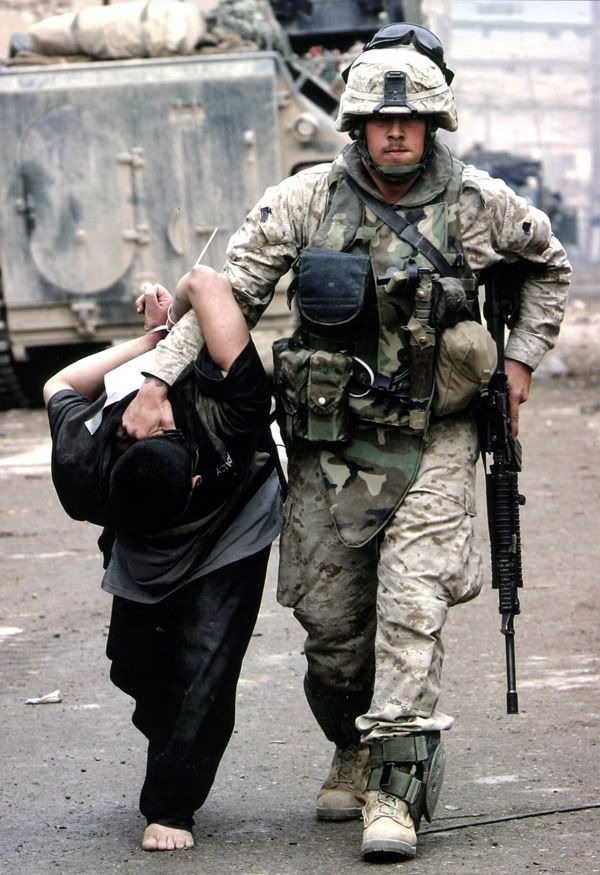 Fallujah - A U.S. Marine leads an Iraqi prisoner during fighting in the center of the city. (Photo by Anja Niedringhaus, November 12, 2004)
 Fallujah - Iraqi insurgents fire a mortar and small arms during the U.S.-led offensive against insurgents in the city. (Photo by Bilal Hussein, November 8, 2004)
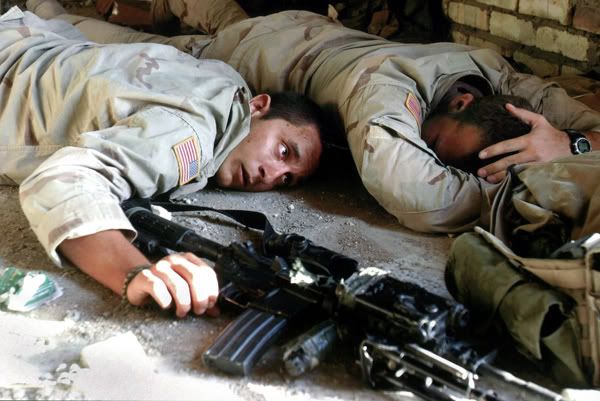 Najaf - U.S. soldiers take cover in a fortified position after a second week of fighting against Shiite militiamen in the holy city. (Photo by Jim MacMillan, August 20. 2004)
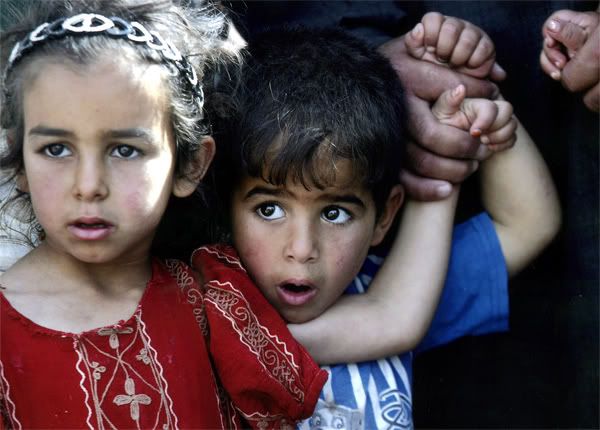 Fallujah - Displaced Iraqi children watch U.S. soldiers while waiting at a checkpoint before returning to their home in Fallujah. (Photo by John Moore, April 27, 2004)
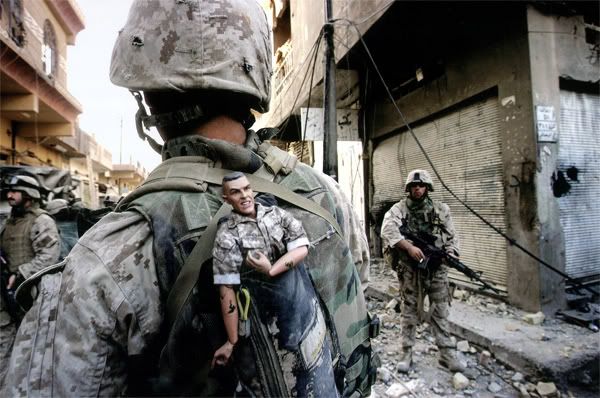 Fallujah - A 1st Division Marine carries a good luck mascot in his backpack as his unit pushed into western neighborhoods of Fallujah. Coalition forces launched a major November offensive for control of the city. (Photo by Anja Niedringhaus, November 14, 2004)
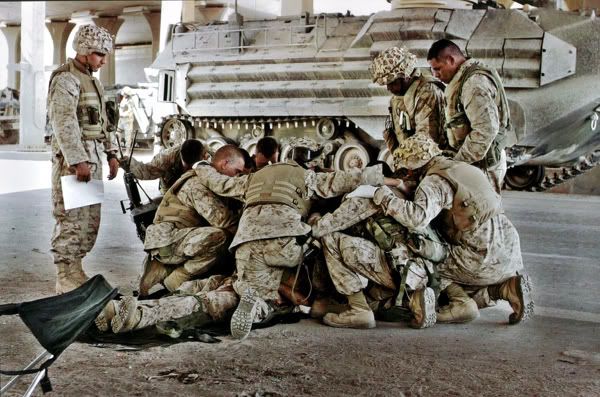 Fallujah - U.S. Marines pray over a fellow Marine killed while fighting insurgent strongholds. (Photo by Murad Sezer, April 8, 2004)
 Baqouba - At a hospital morgue, relatives mourn the death of Iraqi national guardsman Ryaad Khudayar, one of at least four guardsmen killed in a car bombing at a checkpoint outside Baqouba. (Photo by Khalid Mohammed, August 3, 2004)
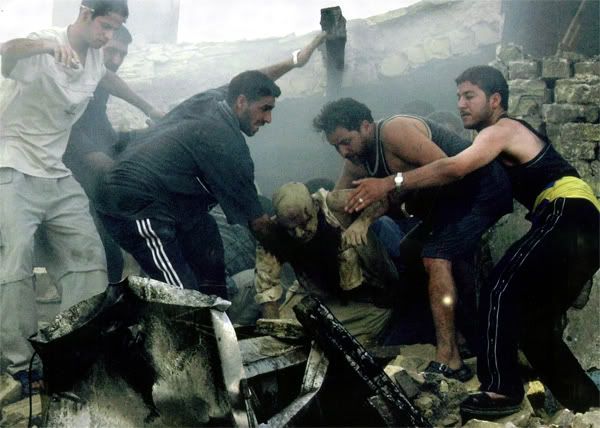 Baghdad - Iraqis rescue a man from the ruins of a building after a car bombing in central Baghdad. At least 10 people were killed, including three foreigners working to rebuild Iraqi power plants. (Photo by Mohammed Uraibi, June 14, 2004)
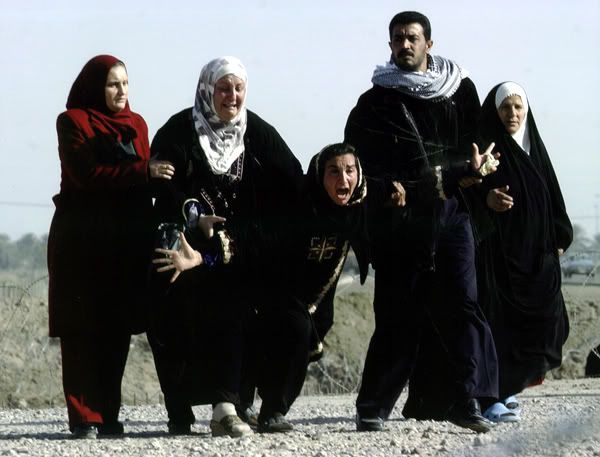 Baghdad - An Iraqi woman reacts as she waits for the release of a family member from Abu Ghrab prison. Hundreds of people waited in frustration for hours, hoping relatives would be among the first detainees freed under a much-publicized amnesty. (Photo by Muhammed Muheisen, January 8, 2004)
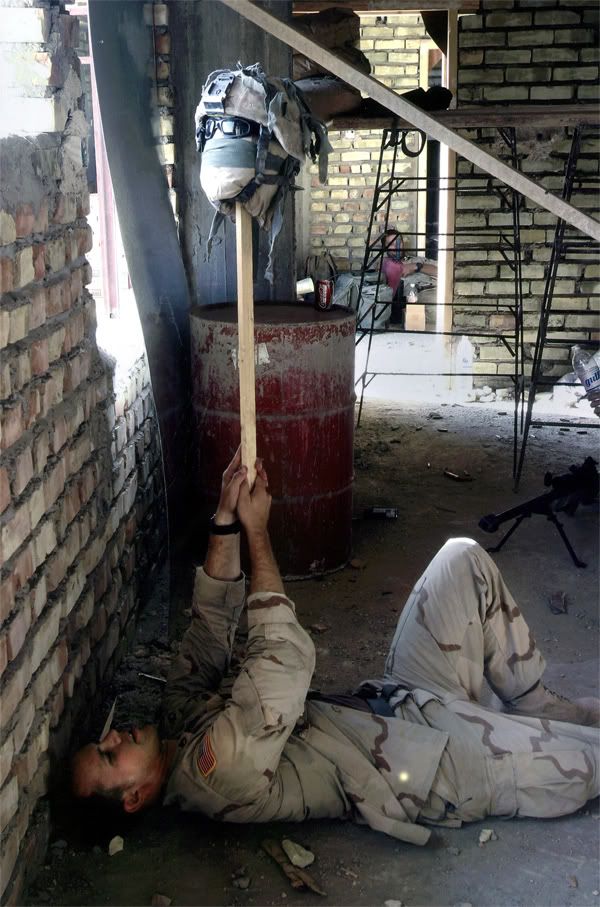 Najaf - A U.S. soldier uses a dummy to draw an insurgent sniper into view. (Photo by Jim MacMillan, August 20, 2004)
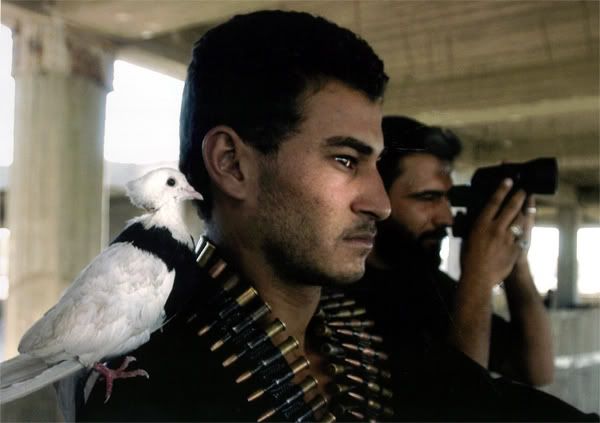 Najaf - A dove sits on the shoulder of a Mahdi Army soldier standing guard near the ancient Imam Ali mosque. The Mahdi Army, a Shiite militia, was fighting U.S.-Iraqi forces for control of the holy city. (Photo by Khalid Mohammed, August 15, 2004)
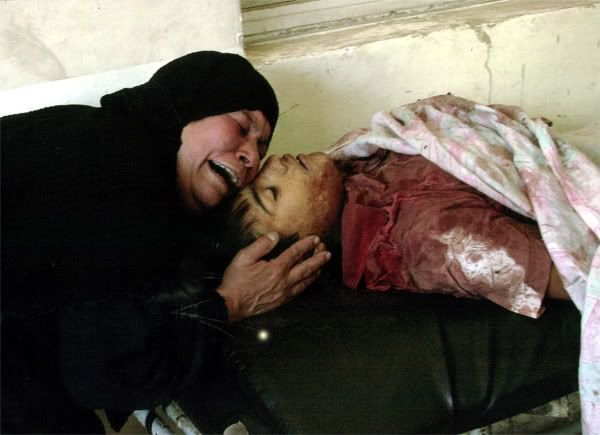 Baghdad - The mother of Samah Hussein grieves over the body at a Baghdad morgue. The boy was among 12 people reportedly killed by a suicide car bombing outside the U.S. military's Camp Cuervo. (Photo by Samir Mizban, June 13, 2004)
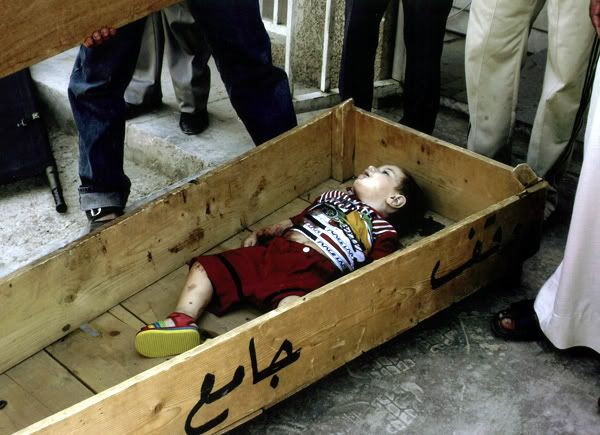 Baghdad - Mohammed Saleem, 18 months, lies in a coffin at a Sadr City morgue. Relatives said the boy and four other family members were killed in their car when U.S. forces opened fire overnight. (Photo by Karim Kadim, June 6, 2004)
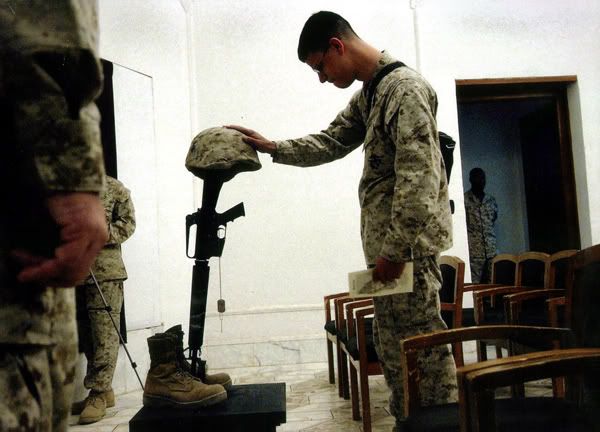 Ramadi - U.S. Marines pay their respects at a memorial service for 1st Marine Division Combat Photographer Cpl. William Salazar, 26, at Camp Blue Diamond. Salazar, of Las Vegas, Nev., was killed in action in Anbar Province. (Photo by Jim MacMillan, October 18, 2004)
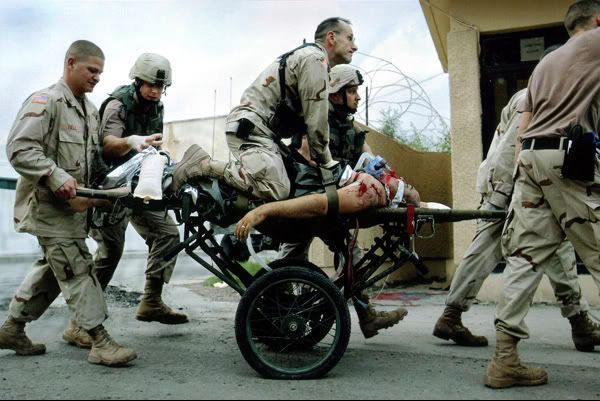 Baghdad - Nurse supervisor Patrick McAndrew kneels over Army Spc. Travis S. Babbit, 24, administering CPR upon arrival at the 31st Combat Support Hospital. Spc. Babbit, of Uvalde, Texas, later died of his wounds. His patrol was attacked in Baghdad by a rocket-propelled grenade and small arms fire, the Pentagon said. (Photo by John Moore, November 9, 2004)
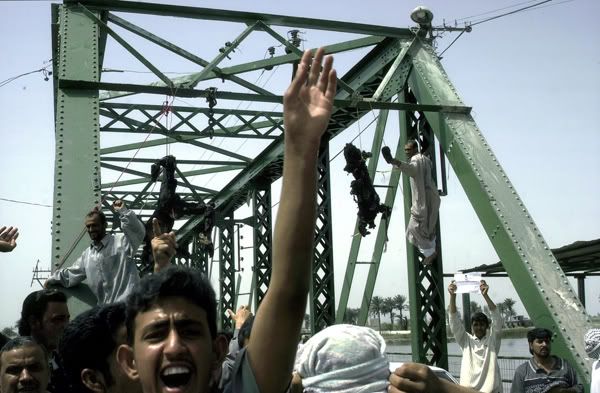 Fallujah - Iraqis chant anti-American slogans as the charred bodies of four U.S. contractors hang from a bridge over the Euphrates River. The incident marked increased violence by insurgents based in Fallujah. (Photo by Khalid Mohammed, March 31, 2004)
Wednesday, March 30, 2005
| [+/-] |
Two-Thirds Of World's Resources 'Used Up' |
The Guardian reports:
The human race is living beyond its means. A report backed by 1,360 scientists from 95 countries - some of them world leaders in their fields - today warns that the almost two-thirds of the natural machinery that supports life on Earth is being degraded by human pressure.
The study contains what its authors call "a stark warning" for the entire world. The wetlands, forests, savannahs, estuaries, coastal fisheries and other habitats that recycle air, water and nutrients for all living creatures are being irretrievably damaged. In effect, one species is now a hazard to the other 10 million or so on the planet, and to itself.
"Human activity is putting such a strain on the natural functions of Earth that the ability of the planet's ecosystems to sustain future generations can no longer be taken for granted," it says.
The report, prepared in Washington under the supervision of a board chaired by Robert Watson, the British-born chief scientist at the World Bank and a former scientific adviser to the White House, will be launched today at the Royal Society in London. It warns that:
· Because of human demand for food, fresh water, timber, fibre and fuel, more land has been claimed for agriculture in the last 60 years than in the 18th and 19th centuries combined.
· An estimated 24% of the Earth's land surface is now cultivated.
· Water withdrawals from lakes and rivers has doubled in the last 40 years. Humans now use between 40% and 50% of all available freshwater running off the land.
· At least a quarter of all fish stocks are overharvested. In some areas, the catch is now less than a hundredth of that before industrial fishing.
· Since 1980, about 35% of mangroves have been lost, 20% of the world's coral reefs have been destroyed and another 20% badly degraded.
· Deforestation and other changes could increase the risks of malaria and cholera, and open the way for new and so far unknown disease to emerge.
In 1997, a team of biologists and economists tried to put a value on the "business services" provided by nature - the free pollination of crops, the air conditioning provided by wild plants, the recycling of nutrients by the oceans. They came up with an estimate of $33 trillion, almost twice the global gross national product for that year. But after what today's report, Millennium Ecosystem Assessment, calls "an unprecedented period of spending Earth's natural bounty" it was time to check the accounts.
"That is what this assessment has done, and it is a sobering statement with much more red than black on the balance sheet," the scientists warn. "In many cases, it is literally a matter of living on borrowed time. By using up supplies of fresh groundwater faster than they can be recharged, for example, we are depleting assets at the expense of our children."
Flow from rivers has been reduced dramatically. For parts of the year, the Yellow River in China, the Nile in Africa and the Colorado in North America dry up before they reach the ocean. An estimated 90% of the total weight of the ocean's large predators - tuna, swordfish and sharks - has disappeared in recent years. An estimated 12% of bird species, 25% of mammals and more than 30% of all amphibians are threatened with extinction within the next century. Some of them are threatened by invaders.
The Baltic Sea is now home to 100 creatures from other parts of the world, a third of them native to the Great Lakes of America. Conversely, a third of the 170 alien species in the Great Lakes are originally from the Baltic.
Invaders can make dramatic changes: the arrival of the American comb jellyfish in the Black Sea led to the destruction of 26 commercially important stocks of fish. Global warming and climate change, could make it increasingly difficult for surviving species to adapt.
A growing proportion of the world lives in cities, exploiting advanced technology. But nature, the scientists warn, is not something to be enjoyed at the weekend. Conservation of natural spaces is not just a luxury.
"These are dangerous illusions that ignore the vast benefits of nature to the lives of 6 billion people on the planet. We may have distanced ourselves from nature, but we rely completely on the services it delivers."
| [+/-] |
Children 'Starving' in New Iraq |
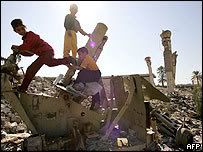 More and more children in Iraq do not have enough food to eat
The BBC reports:
Increasing numbers of children in Iraq do not have enough food to eat and more than a quarter are chronically undernourished, a UN report says.
Malnutrition rates in children under five have almost doubled since the US-led invasion - to nearly 8% by the end of last year, it says.
The report was prepared for the annual meeting of the UN Human Rights Commission in Geneva.
It also expressed concern over North Korea and Sudan's Darfur province.
Jean Ziegler, a UN specialist on hunger who prepared the report, blamed the worsening situation in Iraq on the war led by coalition forces.
The silent daily massacre by hunger is a form of murder - it must be battled and eliminated
Jean Ziegler
He was addressing a meeting of the 53-nation commission, the top UN rights watchdog, which is halfway through its annual six-week session.
When Saddam Hussein was overthrown, about 4% of Iraqi children under five were going hungry; now that figure has almost doubled to 8%, his report says.
Governments must recognise their extra-territorial obligations towards the right to food and should not do anything that might undermine access to it of people living outside their borders, it says.
That point is aimed clearly at the US, but Washington, which has sent a large delegation to the Human Rights Commission, declined to respond to the charges, says the BBC's Imogen Foulkes in Geneva.
Increasing hunger
Mr Ziegler also said he was very concerned about the lack of food in North Korea, where there are reports that UN food aid is not being distributed fairly.
In Darfur, the continuing conflict has prevented people from planting vital crops, he said.
Overall, Mr Ziegler said he was shocked by the fact that hunger is actually increasing worldwide.
Some 17,000 children die every day from hunger-related diseases, the report claims, calling the situation a scandal in a world that is richer than ever before.
"The silent daily massacre by hunger is a form of murder," Mr Ziegler said. "It must be battled and eliminated."
| [+/-] |
Malnutrition Rate of Iraqi Children Doubled After U.S. Invasion |
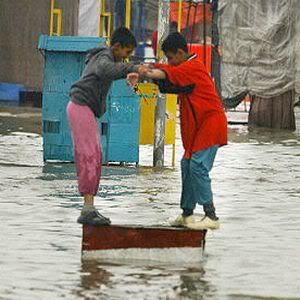 Iraqi children try to balance on a box in a flooded street on the outskirts of Sadr City, Baghdad.
The UN's Human Rights Commission's special expert on the right to food said that by last fall 7.7 per cent of children under the age of 5 in Iraq suffered from acute malnutrition.
Malnutrition, a disease which is exacerbated by the lack of clean water and adequate sanitation, is a major killer of children in poor countries. Children who survive are usually physically and mentally impaired for life, and are more vulnerable to disease.
The situation facing Iraqi youngsters is "a result of the war led by coalition forces," said Ziegler, an outspoken Swiss sociology professor and former lawmaker whose previous targets have included Swiss banks, China, Brazil and Israels treatment of Palestinians.
Overall, more than a quarter of Iraqi children don't get enough to eat, Ziegler told the 53-nation commission, which is halfway through its annual six-week session.
The U.S. delegation and other coalition countries declined to respond to his presentation, which compiled the findings of studies conducted by other specialists.
In reporting the 7.7 percent malnutrition rate for Iraqi youngsters, the Norwegian-based Fafo Institute for Applied Social Science said last November that the figure was similar to the levels witnessed in some African countries.
During the 1970s and 1980s Iraq was generally regarded as having good nutrition, but health problems only emerged when the Security Council imposed sanctions after Iraq's invasion of Kuwait in 1990.
Ziegler did not mention the role violence is playing in the nutrition problem, something often cited by aid groups.
Last year, Carol Bellamy, head of UNICEF, said the violence hampers the delivery of adequate supplies of food.
Ziegler also cited an October 2004 U.S. study that estimated as many as 100,000 more Iraqis, most of whom are women and children, have died since the start of the U.S.-led invasion of Iraq. The number is higher than those who would have normally have died, based on the death rate before the war.
"Most died as a result of the violence, but many others died as a result of the increasingly difficult living conditions, reflected in increasing child mortality levels," he said.
The authors of the U.S. study in the British-based medical journal The Lancet, who the researchers for hailed from Johns Hopkins University, Columbia University and the Al-Mustansiriya University in Baghdad, conceded their data were of "limited precision."
Ziegler also told the commission he was concerned about hunger in North Korea, Palestinian areas, Sudan's conflict-ravaged Darfur region, Zimbabwe, India, Myanmar, the Philippines and Romania.
Worldwide, he said, more than 17,000 children under 5 die daily from hunger-related diseases.
"The silent daily massacre by hunger is a form of murder," Ziegler said. "It must be battled and eliminated."
| [+/-] |
U.S. Scatters Bases To Control Eurasia |
Asia Times Online reports:
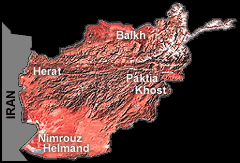
The United States is beefing up its military presence in Afghanistan, at the same time encircling Iran. Washington will set up nine new bases in Afghanistan in the provinces of Helmand, Herat, Nimrouz, Balkh, Khost and Paktia.
Reports also make it clear that the decision to set up new US military bases was made during Secretary of Defense Donald Rumsfeld's visit to Kabul last December. Subsequently, Afghan President Hamid Karzai accepted the Pentagon diktat. Not that Karzai had a choice: US intelligence is of the view that he will not be able to hold on to his throne beyond June unless the US Army can speed up training of a large number of Afghan army recruits and protect Kabul. Even today, the inner core of Karzai's security is run by the US State Department with personnel provided by private US contractors.
Admittedly, Afghanistan is far from stable, even after four years of US presence. Still, the establishment of a rash of bases would seem to be overkill. Indeed, according to observers, the base expansion could be part of a US global military plan calling for small but flexible bases that make it easy to ferry supplies and can be used in due time as a springboard to assert a presence far beyond Afghanistan.
Afghanistan under control?
On February 23, according to the official Bakhter News Agency, 196 American military instructors arrived in Kabul. These instructors are scheduled to be in Afghanistan until the end of 2006. According to General H Head, commander of the US Phoenix Joint Working Force, the objective of the team is to expedite the educational and training programs of Afghan army personnel. The plan to protect Karzai and the new-found "democracy" in Afghanistan rests on the creation of a well-trained 70,000-man Afghan National Army (ANA) by the end of 2006. As of now, 20,000 ANA personnel help out 17,000-plus US troops and some 5,000-plus North Atlantic Treaty Organization (NATO) troops currently based in Afghanistan.
In addition, on February 28, in a move to bring a large number of militiamen into the ANA quickly, Karzai appointed General Abdur Rashid Dostum, a regional Uzbek-Afghan warlord of disrepute, as his personal military chief of staff. The list of what is wrong with Dostum is too long for this article, but he is important to Karzai and the Pentagon.
Dostum has at least 30,000 militiamen, members of his Jumbush-e-Milli, under him. A quick change of their uniforms would increase the ANA by 30,000 at a minimal cost. Moreover, Dostum's men do not need military training (what they do need is some understanding of and respect for law and order). Another important factor that comes into play with this union is the Pentagon-Karzai plan to counter the other major north Afghan ethnic grouping, the Tajik-Afghans.
Since the presidential election took place in Afghanistan last October, Washington has conveyed repeatedly that the poison fangs of al-Qaeda have been uprooted and the Taliban is split. There was also reliable news suggesting that a section of Taliban leaders have accepted the leadership of two fellow Pashtuns, Karzai and US Ambassador Zalmay Khalilzad, and are making their way into the Kabul government.
With al-Qaeda defanged and the Taliban split, one would tend to believe that the Afghan situation is well under control. But then, how does one explain that a bomb went off in the southern city of Kandahar, killing five people on March 17, the very day US Secretary of State Condoleezza Rice landed in Kabul on her first visit to Afghanistan? And why has Karzai pushed back the dates for Afghanistan's historical parliamentary elections, originally planned for 2004, and then to May 2005, now to September 2005?
One thing that is certainly not under control, and is surely the source of many threats to the region, is opium production. During the US occupation, opium production grew at a much faster rate than Washington's, and Karzai's, enemies weakened. In 2003, US-occupied Afghanistan produced 4,200 tons of opium. In 2004, US-occupied and semi-democratic Afghanistan produced a record 4,950 tons, breaking the all-time high of 4,600 tons produced under the Taliban in the year 2000.
Though the problem is known to the world, the Pentagon refuses to deal with it. It is not the military's job to eradicate poppy fields, says the Pentagon. Indeed, it would antagonize the warlords who remain the mainstays of the Pentagon in Afghanistan, say observers.
Back on the base
When all is said and done, one cannot but wonder why the new military bases are being set up. Given that al-Qaeda is only a shadow of the past, the Taliban leaders are queuing up to join the Kabul government, and the US military is not interested in tackling the opium explosion, why are the bases needed?
A ray of light was shed on this question during the recent trip to Afghanistan by five US senators, led by John McCain. On February 22, McCain, accompanied by Senators Hillary Clinton, Susan Collins, Lindsey Graham and Russ Feingold, held talks with Karzai.
After the talks, McCain, the No 2 Republican on the Senate Armed Services Committee, said he was committed to a "strategic partnership that we believe must endure for many, many years". McCain told reporters in Kabul that America's strategic partnership with Afghanistan should include "permanent bases" for US military forces. A spokesman for the Afghan president told news reporters that establishing permanent US bases required approval from the yet-to-be-created Afghan parliament.
Later, perhaps realizing that the image that Washington would like to project of Afghanistan is that of a sovereign nation, McCain's office amended his comments with a clarification: "The US will need to remain in Afghanistan to help the country rid itself of the last vestiges of Taliban and al-Qaeda." His office also indicated that what McCain meant was that the US needs to make a long-term commitment, not necessarily "permanent" bases.
On March 16, General Richard Myers, chairman of the US Joint Chiefs of Staff, said no decision had been reached on whether to seek permanent bases on Afghan soil. "But clearly we've developed good relationships and good partnerships in this part of the world, not only in Afghanistan," he added, also mentioning existing US bases in Uzbekistan and Kyrgyzstan.
A military pattern
But this is mere word play. Media reports coming out of the South Asian subcontinent point to a US intent that goes beyond bringing Afghanistan under control, to playing a determining role in the vast Eurasian region. In fact, one can argue that the landing of US troops in Afghanistan in the winter of 2001 was a deliberate policy to set up forward bases at the crossroads of three major areas: the Middle East, Central Asia and South Asia. Not only is the area energy-rich, but it is also the meeting point of three growing powers - China, India and Russia.
On February 23, the day after McCain called for "permanent bases" in Afghanistan, a senior political analyst and chief editor of the Kabul Journal, Mohammad Hassan Wulasmal, said, "The US wants to dominate Iran, Uzbekistan and China by using Afghanistan as a military base."
Other recent developments cohere with a US Air Force strategy to expand its operational scope across Afghanistan and the Caspian Sea region - with its vital oil reserves and natural resources: Central Asia, all of Iran, the Persian Gulf, the Strait of Hormuz and the northern Arabian Sea up to Yemen's Socotra Islands. This may also provide the US a commanding position in relation to Pakistan, India and the western fringes of China.
The base set up at Manas outside Bishkek, the capital of Kyrgyzstan - where, according to Central Asian reports, about 3,000 US troops are based - looks to be part of the same military pattern. It embodies a major commitment to maintain not just air operations over Afghanistan for the foreseeable future, but also a robust military presence in the region well after the war.
Prior to setting up the Manas Air Base, the US paid off the Uzbek government handsomely to set up an air base in Qarshi Hanabad. Qarshi Hanabad holds about 1,500 US soldiers, and agreements have been made for the use of Tajik and Kazakh airfields for military operations. Even neutral Turkmenistan has granted permission for military overflights. Ostensibly, the leaders of these Central Asian nations are providing military facilities to the US to help them eradicate the Islamic and other sorts of terrorists that threaten their nations.
These developments, particularly setting up bases in Manas and Qarshi Hanabad, are not an attempt by the US to find an exit strategy for Afghanistan, but the opposite: establishing a military presence.
Encircling Iran
On February 28, Asia Times Online pointed out that construction work had begun on a new NATO base in Herat, western Afghanistan (US digs in deeper in Afghanistan ). Another Asia Times Online article said US officials had confirmed that they would like more military bases in the country, in addition to the use of bases in Pakistan (see The remaking of al-Qaeda , February 25).
Last December, US Army spokesman Major Mark McCann said the United States was building four military bases in Afghanistan that would only be used by the Afghan National Army. On that occasion, McCann stated, "We are building a base in Herat. It is true." McCann added that Herat was one of four bases being built; the others were in the southern province of Kandahar, the southeastern city of Gardez in Paktia province, and Mazar-i-Sharif, the northern city controlling the main route to central Afghanistan.
The US already has three operational bases inside Afghanistan; the main logistical center for the US-led coalition in Afghanistan is Bagram Air Field north of Kabul - known by US military forces as "BAF". Observers point out that Bagram is not a full-fledged air base.
Other key US-run logistical centers in Afghanistan include Kandahar Air Field, or "KAF", in southern Afghanistan and Shindand Air Field in the western province of Herat. Shindand is about 100 kilometers from the border with Iran, a location that makes it controversial. Moreover, according to the US-based think-tank Global Security, Shindand is the largest air base in Afghanistan.
The US is spending US$83 million to upgrade its bases at Bagram and Kandahar. Both are being equipped with new runways. US Brigadier General Jim Hunt, the commander of US air operations in Afghanistan, said at a news conference in Kabul Monday, "We are continuously improving runways, taxiways, navigation aids, airfield lighting, billeting and other facilities to support our demanding mission."
The proximity of Shindand to Iran could give Tehran cause for concern, says Paul Beaver, an independent defense analyst based in London. Beaver points out that with US ships in the Persian Gulf and Shindand sitting next to Iran, Tehran has a reason to claim that Washington is in the process of encircling Iran. But the US plays down the potential of Shindand, saying it will not remain with the US for long. Still, it has not been lost on Iranian strategists that the base in the province of Herat is a link in a formidable chain of new facilities the US is in the process of drawing around their country.
Shindand is not Tehran's only worry. In Pakistan, the Pervez Musharraf government has allowed the commercial airport at Jacobabad, about 420km north of Karachi and 420km southeast of Kandahar, as one of three Pakistani bases used by US and allied forces to support their campaign in Afghanistan. The other bases are at Dalbandin and Pasni. Under the terms of an agreement with Pakistan, the allied forces can use these bases for search and rescue missions, but are not permitted to use them to stage attacks on Taliban targets. Both Jacobabad and Pasni bases have been sealed off and a five-kilometer cordon set up around the bases by Pakistani security forces.
Reports of increased US operations in Pakistan go back to March 2004, when two air bases - Dalbandin and Shahbaz - in Pakistan were the focus for extensive movements to provide logistical support for Special Forces and intelligence operations. Shahbaz Air Base near Jacobabad appeared to be the key to the United States' 2004 spring offensive. At Jacobabad, C-17 transports were reportedly involved in the daily deliveries of supplies. A report in the Pakistani newspaper the Daily Times on March 10, 2004, claimed that the air base was under US control, with an inner ring of facilities off limits to Pakistan's military.
