The Hill reports:
The Pentagon pays an average of $400 to put a gallon of fuel into a combat vehicle or aircraft in Afghanistan.
The statistic is likely to play into the escalating debate in Congress over the cost of a war that entered its ninth year last week.
Pentagon officials have told the House Appropriations Defense Subcommittee a gallon of fuel costs the military about $400 by the time it arrives in the remote locations in Afghanistan where U.S. troops operate.
“It is a number that we were not aware of and it is worrisome,” Rep. John Murtha (D-Pa.), the chairman of the House Appropriations Defense panel, said in an interview with The Hill. “When I heard that figure from the Defense Department, we started looking into it.”
The Pentagon comptroller’s office provided the fuel statistic to the committee staff when it was asked for a breakdown of why every 1,000 troops deployed to Afghanistan costs $1 billion. The Obama administration uses this estimate in calculating the cost of sending more troops to Afghanistan.
The Obama administration is engaged in an internal debate over its future strategy in Afghanistan. Part of this debate concerns whether to increase the number of U.S. troops in that country.
The top U.S. general in Afghanistan, Stanley McChrystal, reportedly has requested that about 40,000 additional troops be sent.
Democrats in Congress are divided over whether to send more combat troops to stabilize Afghanistan in the face of waning public support for the war.
Any additional troops and operations likely will have to be paid for through a supplemental spending bill next year, something Murtha has said he already anticipates.
Afghanistan — with its lack of infrastructure, challenging geography and increased roadside bomb attacks — is a logistical nightmare for the U.S. military, according to congressional sources, and it is expensive to transport fuel and other supplies.
A landlocked country, Afghanistan has no seaports and a shortage of airports and navigable roads. The nearest port is in Karachi, Pakistan, where fuel for U.S. troops is shipped.
From there, commercial trucks transport the fuel through Pakistan and Afghanistan, sometimes changing carriers. Fuel is then transferred to storage locations in Afghanistan for movement within the country. Military transport is used to distribute fuel to forward operating bases. For many remote locations, this means fuel supplies must be provided by air.
One of the most expensive ways to supply fuel is by transporting it in bladders carried by helicopter; the amount that can be flown at one time can barely satisfy the need for fuel.
The cheapest way to transport fuel is usually by ship. Other reasonable methods to provide fuel are by rail and pipeline. The prices go up exponentially when aircraft are used, according to congressional sources.
The $400 per gallon reflects what in Pentagon parlance is known as the “fully burdened cost of fuel.”
“The fully burdened cost of fuel is a recognition that there are a lot of other factors that come into play,” said Mark Iden, the deputy director of operations at the Defense Energy Support Center (DESC), which provides fuel and energy to all U.S. military services worldwide.
The DESC provides one gallon of JP8 fuel, which is used for both aircraft and ground vehicles, at a standard price of $2.78, said Iden.
The Commandant of the Marine Corps, Gen. James Conway, told a Navy Energy Forum this week that transporting fuel miles into Afghanistan and Iraq along risky and dangerous routes can raise the cost of a $1.04 gallon up to $400, according to Aviation Week which covered the forum.
“These are fairly major problems for us,” Conway said, according to the publication.
The fully burdened cost of fuel accounts for the cost of transporting it to where it is needed, said Kevin Geiss, program director for energy security in the Office of the Assistant Secretary of the Army for Installations and Environment.
And moving fuel by convoy or even airlift is expensive, according to the Army news release from July 16, which quoted Geiss. In some places, Geiss said, analysts have estimated the fully burdened cost of fuel might even be as high as $1,000 per gallon.
Energy consumed by a combat vehicle may not even be for actual mobility of the vehicle, Geiss said, but instead to run the systems onboard the vehicle, including the communications equipment and the cooling systems to protect the electronics onboard.
Some 8o percent of U.S. military casualties in Afghanistan are due to improvised explosive devices, many of which are placed in the path of supply convoys — making it even more imperative to use aircraft for transportation.
According to a Government Accountability Office report published earlier this year, 44 trucks and 220,000 gallons of fuel were lost due to attacks or other events while delivering fuel to Bagram Air Field in Afghanistan in June 2008 alone.
High fuel demand, coupled with the volatility of fuel prices, also have significant implications for the Department of Defense’s operating costs, the GAO said. The fully burdened cost of fuel — that is, the total ownership cost of buying, moving and protecting fuel in systems during combat — has been reported to be many times higher than the price of a gallon of fuel itself, according to the report.
The Marines in Afghanistan, for example, reportedly run through some 800,000 gallons of fuel a day. That reflects the logistical challenges of running the counterinsurgency operations but also the need for fuel during the extreme weather conditions in Afghanistan — hot summers and freezing winters.
With the military boosting the number of the all-terrain-mine resistant ambush-protected vehicles (M-ATVs) in Afghanistan meant to survive roadside bombs, the fuel consumption will likely rise even higher, since those vehicles are considered gas-guzzlers.
The Pentagon comptroller’s office did not return requests for comment by press time.
Friday, October 16, 2009
| [+/-] |
$400 Per Gallon Gas To Drive Debate Over Cost Of War In Afghanistan |
Wednesday, August 12, 2009
| [+/-] |
A Window Into CIA's Embrace of Secret Jails |
NY Times reports:
In March 2003, two C.I.A. officials surprised Kyle D. Foggo, then the chief of the agency’s main European supply base, with an unusual request. They wanted his help building secret prisons to hold some of the world’s most threatening terrorists.
 Kyle D. Foggo, who helped build jails for the C.I.A. in the campaign against terrorism, after his arraignment in San Diego in 2007.
 Brent R. Wilkes, right, with his lawyer, Mark Geragos, arriving for a 2007 arraignment connected to dealings with Mr. Foggo.
Mr. Foggo, nicknamed Dusty, was known inside the agency as a cigar-waving, bourbon-drinking operator, someone who could get a cargo plane flying anywhere in the world or quickly obtain weapons, food, money — whatever the C.I.A. needed. His unit in Frankfurt, Germany, was strained by the spy agency’s operations in Afghanistan and Iraq, but Mr. Foggo agreed to the assignment.
“It was too sensitive to be handled by headquarters,” he said in an interview. “I was proud to help my nation.”
With that, Mr. Foggo went on to oversee construction of three detention centers, each built to house about a half-dozen detainees, according to former intelligence officials and others briefed on the matter. One jail was a renovated building on a busy street in Bucharest, Romania, the officials disclosed. Another was a steel-beam structure at a remote site in Morocco that was apparently never used. The third, another remodeling project, was outside another former Eastern bloc city. They were designed to appear identical, so prisoners would be disoriented and not know where they were if they were shuttled back and forth. They were kept in isolated cells.
The existence of the network of prisons to detain and interrogate senior operatives of Al Qaeda has long been known, but details about them have been a closely guarded secret. In recent interviews, though, several former intelligence officials have provided a fuller account of how they were built, where they were located and life inside them.
Mr. Foggo acknowledged a role, which has never been previously reported. He pleaded guilty last year to a fraud charge involving a contractor that equipped the C.I.A. jails and provided other supplies to the agency, and he is now serving a three-year sentence in a Kentucky prison.
The C.I.A. prisons would become one of the Bush administration’s most extraordinary counterterrorism programs, but setting them up was fairly mundane, according to the intelligence officials.
Mr. Foggo relied on C.I.A. finance officers, engineers and contract workers to build the jails. As they neared completion, he turned to a small company linked to Brent R. Wilkes, an old friend and a San Diego military contractor.
The business provided toilets, plumbing equipment, stereos, video games, bedding, night vision goggles, earplugs and wrap-around sunglasses. Some products were bought at Target and Wal-Mart, among other vendors, and flown overseas. Nothing exotic was required for the infamous waterboards — they were built on the spot from locally available materials, the officials said.
Mr. Foggo, 55, would not discuss classified details about the jails. He was not charged with wrongdoing in connection with the secret prisons, but instead accused of steering other C.I.A. business to Mr. Wilkes’ companies in exchange for expensive vacations and other favors. Before leaving the C.I.A. in 2006, he had become its third-highest official, and his plea was an embarrassment for the agency.
After the 2001 terrorist attacks, the intelligence world’s embrace of dark-of-night snatch-and-grabs, hidden prisons and interrogation tactics that critics condemned as torture has stained the C.I.A.’s reputation and led to legal challenges, investigations and internal divisions that may take years to resolve. The Justice Department is now considering opening a criminal investigation, with much of the attention focused on the agency’s network of secret prisons, which have become known as the “black sites.”
From Fringes to Spotlight
The demands of the wars in Iraq and Afghanistan had transformed Mr. Foggo from a fringe player into the C.I.A.’s indispensable man. Before the 9/11 attacks, the Frankfurt base was a relatively sleepy resupply center, running one or two flights a month to outlying stations. Within days of the attacks, Mr. Foggo had a budget of $7 million, which quickly tripled.
He managed dozens of employees, directing nearly daily flights of cargo planes loaded with pallets of supplies, including saddles, bridles and horse feed for the mounted tribal forces that the spy agency recruited. Within weeks, he emptied the C.I.A.’s stockpile of AK-47s and ammunition at a Midwest depot.
He was a logical choice for the prison project: aggressive, resourceful, patriotic, ready to dispense a favor; some inside the C.I.A. jokingly compared him to Milo Minderbinder, the fictional character who rose from mess hall officer to the black-market magnate of Joseph Heller’s World War II novel “Catch-22.”
Early in the fight against Al Qaeda, agency officials relied heavily on American allies to help detain people suspected of terrorism in makeshift facilities in countries like Thailand. But by the time two C.I.A. officials met with Mr. Foggo in 2003, that arrangement was under threat, according to people briefed on the situation. In Thailand, for example, local officials were said to be growing uneasy about a black site outside Bangkok code-named Cat’s Eye. (The agency would eventually change the code name for the Thai prison, fearing it would appear racially insensitive.) The C.I.A. wanted its own, more permanent detention centers.
Eventually, the agency’s network would encompass at least eight detention centers, including one in the Middle East, one each in Iraq and Afghanistan and a maximum-security long-term site at Guantánamo Bay, Cuba, that was dubbed Strawberry Fields, officials said. (It was named after a Beatles song after C.I.A. officials joked that the detainees would be held there, as the lyric put it, “forever.”)
The C.I.A. has never officially disclosed the exact number of prisoners it once held, but top officials have put the figure at fewer than 100.
At the detention centers Mr. Foggo helped build, several former intelligence officials said, the jails were small, and though they were built to house about a half-dozen detainees they rarely held more than four.
The cells were constructed with special features to prevent injury to the prisoners during interrogations: nonslip floors and flexible, plywood-covered walls to soften the impact of being slammed into the wall.
The detainees, held in cells far enough apart to prevent communication with one another, were kept in solitary confinement 23 hours a day. For their one hour of daily exercise, they were taken out of their cells by C.I.A. security officers wearing black ski masks to hide their identities and to intimidate the detainees, according to the intelligence officials.
Just like prisons in the United States, the jailers imposed a reward and punishment system: well-behaved detainees received books, DVDs and other forms of entertainment, which were taken away if they misbehaved, the officials said.
C.I.A. analysts served 90-day tours at the prison sites to assist the interrogations. But by the time the new prisons were built in mid-2003 or later, the harshest C.I.A. interrogation practices — including waterboarding — had been discontinued.
Winning a Promotion
Mr. Foggo’s success in Frankfurt, including his work on the prisons, won him a promotion back in Washington. In November 2004, he was named the C.I.A.’s executive director, in effect its day-to-day administrative chief.
The appointment raised some eyebrows at the agency. “It was like taking a senior NCO and telling him he now runs the regiment,” said A. B. Krongard, the C.I.A.’s executive director from 2001 to 2004. “It popped people’s eyes.”
Mr. Foggo soon became embroiled in agency infighting. The C.I.A. was reeling from criticism that it had exaggerated Iraq’s weapons programs. Mr. Foggo came to Washington as part of a new team that almost immediately began firing top C.I.A. officials, causing anger among veteran clandestine officers. Mr. Foggo’s fast rise and blunt approach unsettled some headquarters officials, according to Brant G. Bassett, a former agency officer and friend who served with Mr. Foggo.
“Dusty went in there with a blowtorch,” Mr. Bassett said. “Some people were overjoyed, but there were a few others who said, we’ve got to take this guy down.”
In 2005, before he came under investigation, Mr. Foggo and other officials, including John Rizzo, the agency’s top lawyer, paid a rare visit to some of the prison sites, assuring C.I.A. employees that their activities were legal, according to former intelligence officials. Mr. Foggo also met with representatives of Eastern European security services that had helped with the prisons. He expressed gratitude and offered assistance — a gesture the officials politely declined.
In February 2007, Mr. Foggo and Mr. Wilkes were indicted. Prosecutors believed that the C.I.A. had paid an inflated price to Archer Logistics, a business connected to Mr. Wilkes that had a $1.7 million C.I.A. supply contract. In return, the prosecutors claimed, Mr. Wilkes had taken Mr. Foggo on expensive vacations, paid for his meals at expensive restaurants and promised him a lucrative job when he retired.
“I was taking a trip with my best friend,” Mr. Foggo said in his defense. “It looked bad, but we had been taking trips together since we were 17 years old.”
Mr. Foggo said he had turned to Mr. Wilkes’ companies to bypass the cumbersome C.I.A. bureaucracy, not to provide a sweetheart deal to his oldest friend. “I needed something done by someone I trusted in private industry,” Mr. Foggo said.
Downfall in Court
Mr. Wilkes maintains his innocence, but he was eventually convicted in a bribery scandal involving former Representative Randall Cunningham of California. Mr. Foggo pleaded guilty and is serving a sentence on the fraud count, but he still maintains that he was unfairly prosecuted.
His lawyer, Mark J. MacDougall, said he believed that Mr. Foggo’s legal problems stemmed in part from controversies over his stint as executive director. “Nobody ever accused Dusty Foggo of putting a dime in his pocket, failing to do his job, or compromising national security,” Mr. MacDougall said. “Dusty may have made some mistakes, but this case was driven by professional animosity at C.I.A. and personal ambition.”
When Mr. Foggo’s lawyers tried unsuccessfully to obtain access to agency files about his role in the prison program, prosecutors complained that he was trying to disclose a secret program. Mr. Foggo claimed that he was reluctant to divulge his role in classified programs and pleaded guilty, in part, to avoid revealing his secrets.
In an Aug. 1, 2007, letter, a C.I.A. lawyer informed Mr. Foggo’s lawyers that they could not review any classified files related to the prisons. The agency’s letter concluded, “In light of the president’s statements regarding the extraordinary value and sensitivity of the C.I.A. terrorist detention and interrogation program, the C.I.A. denies your request in its entirety.”
| [+/-] |
2 U.S. Architects of Harsh Tactics in 9/11's Wake |
NY Times reports:
Jim Mitchell and Bruce Jessen were military retirees and psychologists, on the lookout for business opportunities. They found an excellent customer in the Central Intelligence Agency, where in 2002 they became the architects of the most important interrogation program in the history of American counterterrorism.
 Dr. Bruce Jessen joined his Air Force colleague to build a thriving business that made millions of dollars selling interrogation and training services to the C.I.A.
 A former Air Force explosives expert and a natural salesman, Dr. Jim Mitchell and his colleague had no expertise on Al Qaeda and had never conducted an actual interrogation. But they had psychological credentials and an intimate knowledge of a brutal treatment regimen used decades ago by Chinese Communists.
They had never carried out a real interrogation, only mock sessions in the military training they had overseen. They had no relevant scholarship; their Ph.D. dissertations were on high blood pressure and family therapy. They had no language skills and no expertise on Al Qaeda.
But they had psychology credentials and an intimate knowledge of a brutal treatment regimen used decades ago by Chinese Communists. For an administration eager to get tough on those who had killed 3,000 Americans, that was enough.
So “Doc Mitchell” and “Doc Jessen,” as they had been known in the Air Force, helped lead the United States into a wrenching conflict over torture, terror and values that seven years later has not run its course.
Dr. Mitchell, with a sonorous Southern accent and the sometimes overbearing confidence of a self-made man, was a former Air Force explosives expert and a natural salesman. Dr. Jessen, raised on an Idaho potato farm, joined his Air Force colleague to build a thriving business that made millions of dollars selling interrogation and training services to the C.I.A.
Seven months after President Obama ordered the C.I.A. interrogation program closed, its fallout still commands attention. In the next few weeks, Attorney General Eric H. Holder Jr. is expected to decide whether to begin a criminal torture investigation, in which the psychologists’ role is likely to come under scrutiny. The Justice Department ethics office is expected to complete a report on the lawyers who pronounced the methods legal. And the C.I.A. will soon release a highly critical 2004 report on the program by the agency’s inspector general.
Col. Steven M. Kleinman, an Air Force interrogator and intelligence officer who knows Dr. Mitchell and Dr. Jessen, said he thought loyalty to their country in the panicky wake of the Sept. 11 attacks prompted their excursion into interrogation. He said the result was a tragedy for the country, and for them.
“I feel their primary motivation was they thought they had skills and insights that would make the nation safer,” Colonel Kleinman said. “But good persons in extreme circumstances can do horrific things.”
For the C.I.A., as well as for the gray-goateed Dr. Mitchell, 58, and the trim, dark-haired Dr. Jessen, 60, the change in administrations has been neck-snapping. For years, President George W. Bush declared the interrogation program lawful and praised it for stopping attacks. Mr. Obama, by contrast, asserted that its brutality rallied recruits for Al Qaeda; called one of the methods, waterboarding, torture; and, in his first visit to the C.I.A., suggested that the interrogation program was among the agency’s “mistakes.”
The psychologists’ subsequent fall from official grace has been as swift as their rise in 2002. Today the offices of Mitchell Jessen and Associates, the lucrative business they operated from a handsome century-old building in downtown Spokane, Wash., sit empty, its C.I.A. contracts abruptly terminated last spring.
With a possible criminal inquiry looming, Dr. Mitchell and Dr. Jessen have retained a well-known defense lawyer, Henry F. Schuelke III. Mr. Schuelke said they would not comment for this article, which is based on dozens of interviews with the doctors’ colleagues and present and former government officials.
In a brief e-mail exchange in June, Dr. Mitchell said his nondisclosure agreement with the C.I.A. prevented him from commenting. He suggested that his work had been mischaracterized.
“Ask around,” Dr. Mitchell wrote, “and I’m sure you will find all manner of ‘experts’ who will be willing to make up what you’d like to hear on the spot and unrestrained by reality.”
A Career Shift
At the time of the Sept. 11 attacks, Dr. Mitchell had just retired from his last military job, as psychologist to an elite special operations unit in North Carolina. Showing his entrepreneurial streak, he had started a training company called Knowledge Works, which he operated from his new home in Florida, to supplement retirement pay.
But for someone with Dr. Mitchell’s background, it was evident that the campaign against Al Qaeda would produce opportunities. He began networking in military and intelligence circles where he had a career’s worth of connections.
He had grown up poor in Florida, Dr. Mitchell told friends, and joined the Air Force in 1974, seeking adventure. Stationed in Alaska, he learned the art of disarming bombs and earned bachelor’s and master’s degrees in psychology.
Robert J. Madigan, a psychology professor at the University of Alaska who had worked closely with him, remembered Dr. Mitchell stopping by years later. He had completed his doctorate at the University of South Florida in 1986, comparing diet and exercise in controlling hypertension, and was working for the Air Force in Spokane.
“I remember him saying they were preparing people for intense interrogations,” Dr. Madigan said.
Military survival training was expanded after the Korean War, when false confessions by American prisoners led to sensational charges of communist “brainwashing.” Military officials decided that giving service members a taste of Chinese-style interrogation would prepare them to withstand its agony.
Air Force survival training was consolidated in 1966 at Fairchild Air Force Base in the parched hills outside Spokane. The name of the training, Survival, Evasion, Resistance, Escape, or SERE, suggests its breadth: airmen and women learn to live off the land and avoid capture, as well as how to behave if taken prisoner.
In the 1980s, Dr. Jessen became the SERE psychologist at the Air Force Survival School, screening instructors who posed as enemy interrogators at the mock prison camp and making sure rough treatment did not go too far. He had grown up in a Mormon community with a view of Grand Teton, earning a doctorate at Utah State studying “family sculpting,” in which patients make physical models of their family to portray emotional relationships.
Dr. Jessen moved in 1988 to the top psychologist’s job at a parallel “graduate school” of survival training, a short drive from the Air Force school. Dr. Mitchell took his place.
The two men became part of what some Defense Department officials called the “resistance mafia,” experts on how to resist enemy interrogations. Both lieutenant colonels and both married with children, they took weekend ice-climbing trips together.
While many subordinates considered them brainy and capable leaders, some fellow psychologists were more skeptical. At the annual conference of SERE psychologists, two colleagues recalled, Dr. Mitchell offered lengthy put-downs of presentations that did not suit him.
At the Air Force school, Dr. Mitchell was known for enforcing the safety of interrogations; it might surprise his later critics to learn that he eliminated a tactic called “manhandling” after it produced a spate of neck injuries, a colleague said.
At the SERE graduate school, Dr. Jessen is remembered for an unusual job switch, from supervising psychologist to mock enemy interrogator.
Dr. Jessen became so aggressive in that role that colleagues intervened to rein him in, showing him videotape of his “pretty scary” performance, another official recalled.
Always, former and current SERE officials say, it is understood that the training mimics the methods of unscrupulous foes.
Mark Mays, the first psychologist at the Air Force school, said that to make the fake prison camp realistic, officials consulted American P.O.W.’s who had just returned from harrowing camps in North Vietnam.
“It was clear that this is what we’d expect from our enemies,” said Dr. Mays, now a clinical psychologist and lawyer in Spokane. “It was not something I could ever imagine Americans would do.”
Start of the Program
In December 2001, a small group of professors and law enforcement and intelligence officers gathered outside Philadelphia at the home of a prominent psychologist, Martin E. P. Seligman, to brainstorm about Muslim extremism. Among them was Dr. Mitchell, who attended with a C.I.A. psychologist, Kirk M. Hubbard.
During a break, Dr. Mitchell introduced himself to Dr. Seligman and said how much he admired the older man’s writing on “learned helplessness.” Dr. Seligman was so struck by Dr. Mitchell’s unreserved praise, he recalled in an interview, that he mentioned it to his wife that night. Later, he said, he was “grieved and horrified” to learn that his work had been cited to justify brutal interrogations.
Dr. Seligman had discovered in the 1960s that dogs that learned they could do nothing to avoid small electric shocks would become listless and simply whine and endure the shocks even after being given a chance to escape.
Helplessness, which later became an influential concept in the treatment of human depression, was also much discussed in military survival training. Instructors tried to stop short of producing helplessness in trainees, since their goal was to strengthen the spirit of service members in enemy hands.
Dr. Mitchell, colleagues said, believed that producing learned helplessness in a Qaeda interrogation subject might ensure that he would comply with his captor’s demands. Many experienced interrogators disagreed, asserting that a prisoner so demoralized would say whatever he thought the interrogator expected.
At the C.I.A. in December 2001, Dr. Mitchell’s theories were attracting high-level attention. Agency officials asked him to review a Qaeda manual, seized in England, that coached terrorist operatives to resist interrogations. He contacted Dr. Jessen, and the two men wrote the first proposal to turn the enemy’s brutal techniques — slaps, stress positions, sleep deprivation, wall-slamming and waterboarding — into an American interrogation program.
By the start of 2002, Dr. Mitchell was consulting with the C.I.A.’s Counterterrorist Center, whose director, Cofer Black, and chief operating officer, Jose A. Rodriguez Jr., were impressed by his combination of visceral toughness and psychological jargon. One person who heard some discussions said Dr. Mitchell gave the C.I.A. officials what they wanted to hear. In this person’s words, Dr. Mitchell suggested that interrogations required “a comparable level of fear and brutality to flying planes into buildings.”
By the end of March, when agency operatives captured Abu Zubaydah, initially described as Al Qaeda’s No. 3, the Mitchell-Jessen interrogation plan was ready. At a secret C.I.A. jail in Thailand, as reported in prior news accounts, two F.B.I agents used conventional rapport-building methods to draw vital information from Mr. Zubaydah. Then the C.I.A. team, including Dr. Mitchell, arrived.
With the backing of agency headquarters, Dr. Mitchell ordered Mr. Zubaydah stripped, exposed to cold and blasted with rock music to prevent sleep. Not only the F.B.I. agents but also C.I.A. officers at the scene were uneasy about the harsh treatment. Among those questioning the use of physical pressure, according to one official present, were the Thailand station chief, the officer overseeing the jail, a top interrogator and a top agency psychologist.
Whether they protested to C.I.A. bosses is uncertain, because the voluminous message traffic between headquarters and the Thailand site remains classified. One witness said he believed that “revisionism” in light of the torture controversy had prompted some participants to exaggerate their objections.
As the weeks passed, the senior agency psychologist departed, followed by one F.B.I. agent and then the other. Dr. Mitchell began directing the questioning and occasionally speaking directly to Mr. Zubaydah, one official said.
In late July 2002, Dr. Jessen joined his partner in Thailand. On Aug. 1, the Justice Department completed a formal legal opinion authorizing the SERE methods, and the psychologists turned up the pressure. Over about two weeks, Mr. Zubaydah was confined in a box, slammed into the wall and waterboarded 83 times.
The brutal treatment stopped only after Dr. Mitchell and Dr. Jessen themselves decided that Mr. Zubaydah had no more information to give up. Higher-ups from headquarters arrived and watched one more waterboarding before agreeing that the treatment could stop, according to a Justice Department legal opinion.
Lucrative Work
The Zubaydah case gave reason to question the Mitchell-Jessen plan: the prisoner had given up his most valuable information without coercion.
But top C.I.A. officials made no changes, and the methods would be used on at least 27 more prisoners, including Khalid Shaikh Mohammed, who was waterboarded 183 times.
The business plans of Dr. Mitchell and Dr. Jessen, meanwhile, were working out beautifully. They were paid $1,000 to $2,000 a day apiece, one official said. They had permanent desks in the Counterterrorist Center, and could now claim genuine experience in interrogating high-level Qaeda operatives.
Dr. Mitchell could keep working outside the C.I.A. as well. At the Ritz-Carlton in Maui in October 2003, he was featured at a high-priced seminar for corporations on how to behave if kidnapped. He created new companies, called Wizard Shop, later renamed Mind Science, and What If. His first company, Knowledge Works, was certified by the American Psychological Association in 2004 as a sponsor of continuing professional education. (A.P.A. dropped the certification last year.)
In 2005, the psychologists formed Mitchell Jessen and Associates, with offices in Spokane and Virginia and five additional shareholders, four of them from the military’s SERE program. By 2007, the company employed about 60 people, some with impressive résumés, including Deuce Martinez, a lead C.I.A. interrogator of Mr. Mohammed; Roger L. Aldrich, a legendary military survival trainer; and Karen Gardner, a senior training official at the F.B.I. Academy.
The company’s C.I.A. contracts are classified, but their total was well into the millions of dollars. In 2007 in a suburb of Tampa, Fla., Dr. Mitchell built a house with a swimming pool, now valued at $800,000.
The psychologists’ influence remained strong under four C.I.A. directors. In 2006, in fact, when Secretary of State Condoleezza Rice and her legal adviser, John B. Bellinger III, pushed back against the C.I.A.’s secret detention program and its methods, the director at the time, Michael V. Hayden, asked Dr. Mitchell and Dr. Jessen to brief State Department officials and persuade them to drop their objections. They were unsuccessful.
By then, the national debate over torture had begun, and it would undo the psychologists’ business.
In a statement to employees on April 9, Leon E. Panetta, President Obama’s C.I.A. director, announced the “decommissioning” of the agency’s secret jails and repeated a pledge not to use coercion. And there was another item: “No C.I.A. contractors will conduct interrogations.”
Agency officials terminated the contracts for Mitchell Jessen and Associates, and the psychologists’ lucrative seven-year ride was over. Within days, the company had vacated its Spokane offices. The phones were disconnected, and at neighboring businesses, no one knew of a forwarding address.
This article has been revised to reflect the following correction:
Correction: August 15, 2009
An article on Wednesday about two former military psychologists who designed the Central Intelligence Agency’s interrogation program in 2002 misstated the credentials of an Air Force officer who criticized the interrogation methods but suggested that the two psychologists had acted out of patriotic motives. The officer, Steven M. Kleinman, is a career intelligence officer and former interrogator; he is not a psychologist and is not “Dr. Kleinman.” (He has master’s degrees in strategic intelligence and forensic sciences, but does not have a doctorate.)
Thursday, December 20, 2007
| [+/-] |
A World of Pain and Abuse |
How a UNICEF Photo Makes the West's Heart Ache
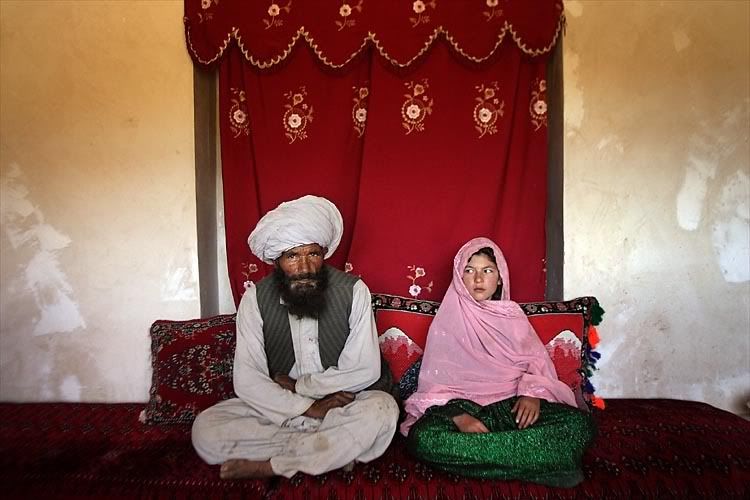 40-year-old groom sitting beside his 11-year-old future bride in Afghanistan, brought Stephanie Sinclair top honors in the annual Photo of the Year contest sponsored by the United Nations Children's Fund (UNICEF).
At Der Spiegle, Leon de Winter writes:
An 11-year-old child bride sits next to her 40-year-old fiance. For UNICEF, this was the Photo of the Year. Dutch writer Leon de Winter laments the perversity of this wedding picture and the frightening relativism of the West.
There are people who will look at this image and be able to continue with business as usual -- without disgust, nausea and rage. We are beholding the fiercest barbarism imaginable. But a carefree cultural relativism -- which this age has donned as its outward manifestation of decadent indifference -- allows many to simply look away. They turn away from the sight of an 11-year-old girl, who is about to be raped by the man sitting next to her.
The girl was sold by her parents, even if they probably wouldn't use that word. The caption that came with the photo quoted the parents as saying that they "needed the money."
The girl's soon-to-be husband promised to send his 11-year-old bride to school, but the women living there in the village of Damarda in Afghanistan's Ghor province don't believe this fairytale. They predict that the girl will bear children soon. "Our men don't need educated women," they point out.
A dowry was paid for the girl. The dowry is part of the cultural fabric of the clan-based society. As producers of newborns, women are valuable possessions. A woman can bear sons and fighters, who will defend the family and its honor. Men are only charged with protecting them against kidnappers and thieves, and women need only accept the power of the male members of the family -- "for their own benefit."
Love Is a Word from the Decadent West
It is likely that all of the female forebears of the girl in the photograph were likewise sold -- and the girl, no doubt, saw it as her fate. At the same time, she realizes that what is happening to her is not right. She might think it is "natural" for a young girl to be sold, but she also knows that it's neither good nor legitimate for her to spend the rest of her life as this man's slave. It is a type of knowledge that has little to do with experience. Rather, it is knowledge that is rooted in humanity, and in the hopes and dreams of a little girl.
The man in the image is oblivious of his wrongdoing. He's only doing what his forefathers did. Sticking to traditions increases the chances of survival. His seed will create a new person and strengthen the clan. He will impregnate this girl without love and without regret, since love is a word from far-off stories and songs, a word from the decadent West, where people have no comprehension of the harshness of life in the desert and of war without end, which is the essence of life in this part of the world.
What we witness in this photograph is an unadorned view of humanity's collective past, of the horror of our brutal nature. Love, tenderness, beauty, individuality and respect are all phenomena that we have imposed upon our nature. Since time immemorial, this nature has allowed only the strongest to survive. In our Western consciousness, we have suppressed this nature with conviction and success. This image shows a small, everyday moment that wouldn't surprise anyone in the Taliban -- but looks quite different to our eyes.
A Bold Statement in the Era of Political Correctness
Our eyes behold an abomination. Our eyes have learned to see the world from the perspective of a slowly acquired sense for humanity. And although more and more voices tell us that we -- the former colonialists and imperialists -- have lost the right to judge other cultures, we know just as well as this girl that this marriage is wrong.
I believe that there are regressive cultures. In an era of political correctness, this is a tricky statement. But there is no other statement that can be made about this image. We behold a regressive man, who is taking what he has purchased.
Many of us in the West are convinced that our presence in Afghanistan cannot be justified, that our troops should withdraw and that Afghanistan should be left to the Afghans. They ask themselves: Who are we to believe that it is inhumane to sell an 11-year-old girl? Who are we to impose our values so vehemently on the Afghans, on this man and on this girl?
I don't have a clue who we are. But I know that this universe is not only a universe of iPods, Disneylands, CO2 penalties, tax write-offs, and New Year's sales in our department stores. No, I know that this is also a universe of human rights. I know that this universe is deeply shaken -- right down to its core -- by the suffering of this lonely, lonely little girl.
 Second-place honors went to GMB Akash, of Bangladesh, whose winning photo shows a 12-year-old boy toiling in a Bangladeshi brickyard. UNICEF studies conclude that 4.7 million children between five and 14 years of age are involved in child labor in that country.
 "A Mother's Journey": The American photographer Renee C. Byer took this picture as part of a series about a single mother with five children and a son suffering from terminal cancer. He died in 2006.
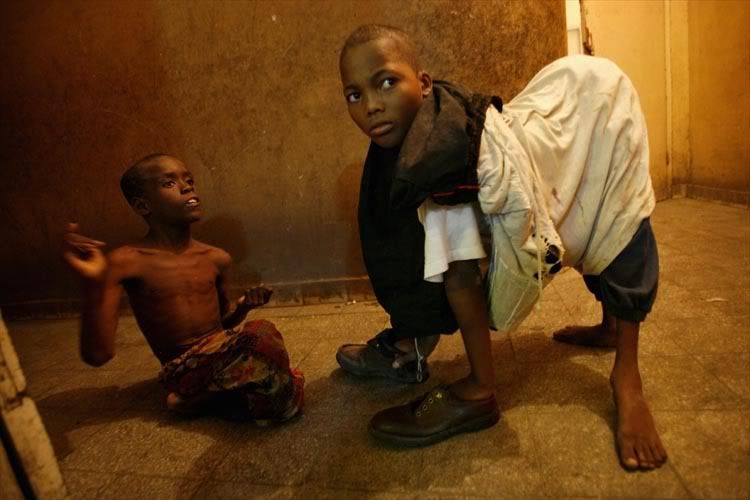 Finbarr O'Reilly recieved an honorable mention for his photo "A House of Hope," an image of Lopez Vidal, right, and Aron Masahuka, both afflicted with polio, languishing in an ill-equipped hospital in Kinshasa, Democratic Republic of Congo.
 Wolfram Hahn made a series of photos titled "A Disenchanted Playroom" to accompany a study about the television-viewing habits of German children.
 The third-place photograph was taken by German photographer Hartmut Schwarzbach. His picture depicts a nine-year-old girl jumping in glee on her birthday in the midst of a smoldering garbage dump outside of Manila.
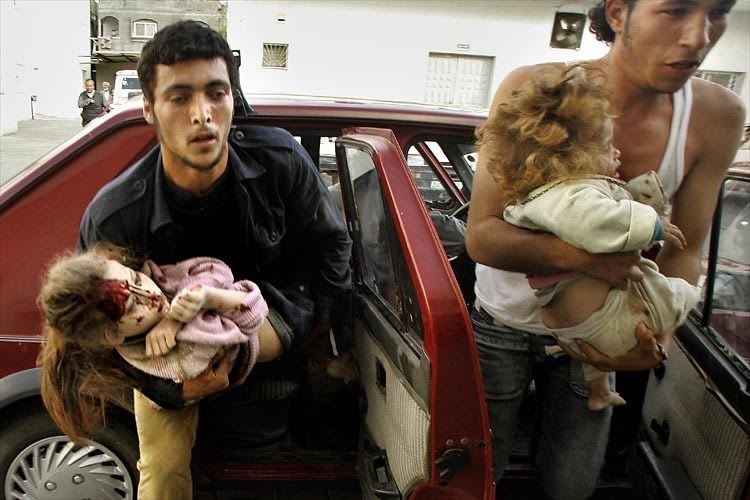 Hatem Moussa won an honorable mention for "Life in Gaza": Palestinian children were rushed from a car into a hospital after their homes were hit by Israeli shelling in the northern Gaza Strip town of Beit Lahiya in April, 2006. An eight-year-old child was killed in the attack and 13 other children were injured.
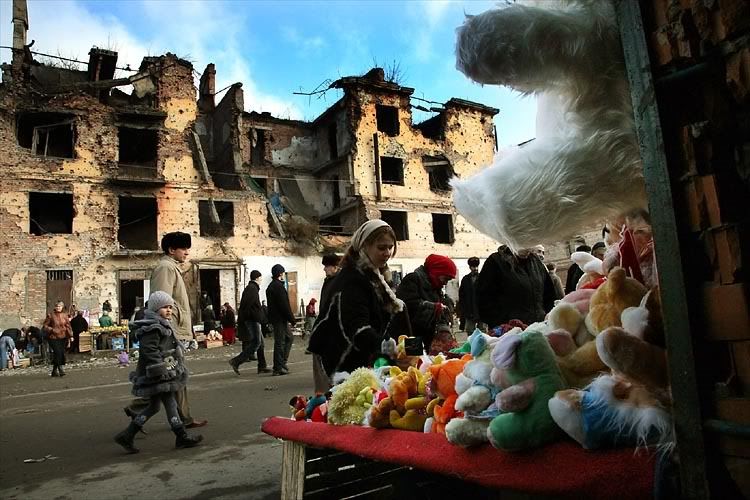 Musa Sadulayew made this photo as a part of a series called "Chechnya's Forgotten Children."
 Boys hang from a bar for five minutes as part of a physical training exercise at the Gymnastics Hall of the Shanghai University of Sports. The photo was part of Nir Elias's series "Pain Threshold -- Sports Education in China."
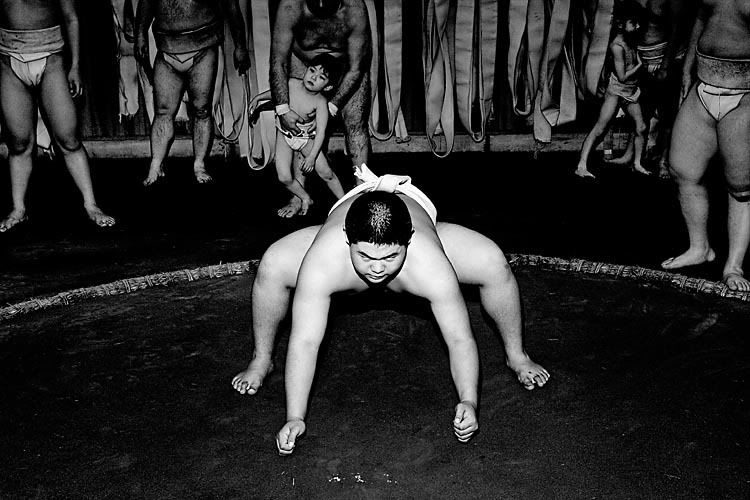 "Sumo Boys in Japan": Steven Achiam took a series of pictures depicting life in the Hiragaya sumo club, where boys train until they have beaten a strong opponent 10 times.
 Joseline Ingabire, 37, an HIV-positive Rwandan woman, is pictured with her daughter Leah Batamuliza, 11. This photo by Jonathon Torgovnik accompanied a story in Newsweek magazine about women who were raped during the Rwandan civil war and their children today.
Friday, October 26, 2007
| [+/-] |
America Could Have Killed Usama bin Laden, But Didn't Again |
Fox News military analyst Colonel David Hunt writes:
Because there is no shortage of things to yell about regarding the War on Terror, Iraq, Afghanistan, Homeland Security, and so on, deciding what to write about is always fun.
This week, I was going to yell about how the Bush administration leaked classified information — again — but we've been there before. Then, I thought I might write about Blackwater, but compared to so many things, Blackwater looks like back water.
I bet the few of you that read this stuff thought I would write about my short stint in the sights of those who complained or used my column last week for their own purposes. Nah, it ain't going to happen. Those who were yelling or using me on their TV shows — without bringing me on to comment — are hardly worth the print space. I am not that big a deal. Besides, these things are of little consequence when you realize how we missed, squandered, screwed up, made a mess of and were massively risk adverse — again — when we did not kill Usama bin Laden in Afghanistan just two short months ago.
We know, with a 70 percent level of certainty — which is huge in the world of intelligence — that in August of 2007, bin Laden was in a convoy headed south from Tora Bora. We had his butt, on camera, on satellite. We were listening to his conversations. We had the world’s best hunters/killers — Seal Team 6 — nearby. We had the world class Joint Special Operations Command (JSOC) coordinating with the CIA and other agencies. We had unmanned drones overhead with missiles on their wings; we had the best Air Force on the planet, begging to drop one on the terrorist. We had him in our sights; we had done it. Nice job again guys — now, pull the damn trigger.
Unbelievably, and in my opinion, criminally, we did not kill Usama bin Laden.
You cannot make this crap up; truth is always stranger and more telling than fiction. Our government, the current administration and yes, our military leaders included, failed to kill bin Laden for no other reason than incompetence.
The current “boneheads” in charge will tell you all day long that we are fighting and dying in Iraq and Afghanistan to stop terrorists there so they do not come here. Nice talk, how about — just for a moment — acting like you mean what you say? You know walk the walk. These incidents, where we displayed a total lack of guts, like the one in August, are just too prevalent. The United States of America’s political and military leadership has, on at least three separate occasions, chosen not capture or kill bin Laden or Ayman al-Zawahri. We have allowed Pakistan to become a safe haven for Al Qaeda. We have allowed Al Qaeda to reconstitute, partially because of money they (Al Qaeda in Iraq) have been sending to Al Qaeda in Pakistan.
We are in a war with terrorists. We are in a war with countries that support terrorists. We are in a war with people that fly planes into buildings and who never, ever hesitate to pull the trigger when given the chance to kill us. We cannot win and, I will tell you this now, we are losing this war every damn time we fail to take every single opportunity to kill murderers like Usama bin Laden. Less than two months ago, we lost again.
Our men and women are being blown up and killed every day in Iraq and Afghanistan. Every family who is separated from a loved one during this war is being insulted by our government when they fail to kill those who have already killed us and will not hesitate to do so again and again. Damn it guys, PULL THE DAMN TRIGGER.
Colonel David Hunt, U.S. Army (Ret.), is a FOX News military analyst and the author of the New York Times bestseller They Just Don’t Get It. He has extensive operational experience in counterterrorism, special operations, and intelligence operations. He has trained the FBI and Special Forces in counterterrorism tactics, served as the security adviser to six different Olympic Games, testified as an expert at many major terrorist trials, and lectured at the CIA, the FBI, and the National Security Agency.
Wednesday, October 10, 2007
| [+/-] |
The Discount War |
ISAF Is Failing in Effort to Secure Afghanistan on the Cheap
Der Spiegel reports:
Germany's parliament votes this Friday on whether to extend Berlin's participation in the military mission in Afghanistan. The country is on the brink of disaster, but German politicians have chosen to ignore Afghanistan's real problems.
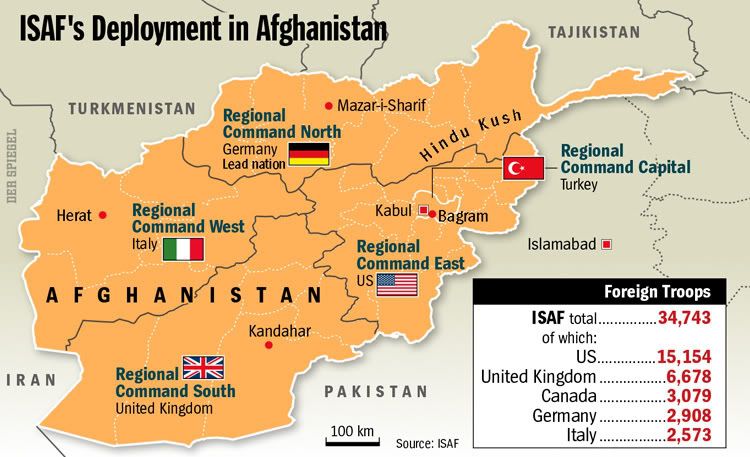
Italian Brigadier General Fausto Macor is the ideal star witness to make the situation in Afghanistan dramatically clear to German politicians. The wiry general from the northern Italian city of Turin has been in charge of the Regional Command West of the NATO-led International Security Assistance Force (ISAF) in Afghanistan since July. He and his men are deployed in what is considered the quietest and safest part of the country.
Macor and his men are barricaded into an area near the airport in Herat, an old trading city of 250,000 inhabitants that has long served as a gateway to nearby Iran. Heavily armed Albanian soldiers guard the entrance to the camp, which is protected against enemy fire by a 1-meter-thick wall of boulders.
On Tuesday of last week, the general met with Eckart von Klaeden, the foreign policy spokesman of Germany's Christian Democratic Union (CDU). Von Klaeden had traveled to the city with the German ambassador to Afghanistan, Hans-Ulrich Seidt.
The general is slightly delayed, having attended a memorial service for two Spanish soldiers who were killed the day before in a bomb attack 80 kilometers (50 miles) to the south. The service was broadcast live on Italian television to a distressed nation. NATO troops have just liberated two kidnapped Italian intelligence officers from Macor's contingent. One of the Italians suffered serious injuries during the raid.
The commander sits in a chair, his back to the television set, and points to a military map on the wall. "You see," he says, "I am responsible for an area half the size of Italy." Then he rattles off the relevant statistics. Of the 1,800 soldiers under his command, only 270 can go on patrol. If he sends two units out on patrol, they can easily find themselves operating 400 kilometers (249 miles) apart. "It's as if one of them were in Turin and the other in Venice," says the general.
He can expect little support from the Afghan army, which has only 400 armed troops in the western sector. As a result, the general is left to his own resources as far as entire regions are concerned. He has no illusions. There is no power vacuum in Afghanistan: Taliban fundamentalists, armed tribal warlords or criminal gangs control the areas where there are no international troops.
In fact, the rule of law ends only a few hundred meters from Macor's headquarters, where the commander of the Herat airport complains about his situation. Outside, the warm late autumn sun shines on the Italians' gray Hercules transport aircraft. The mustachioed police colonel keeps his office cooled to a chilly 19 degrees Celsius (61 degrees Fahrenheit). The law requires that no armed soldiers be allowed on the airport grounds. The police colonel complains that his men, armed with only 30 old Kalashnikov automatic rifles, are poorly equipped to uphold the law at the airport.
This isn't nearly enough firepower to deter the city's powerful men, who often appear on the tarmac with scores of bodyguards armed with pistols, rifles and mobile grenade launchers. In front of the parked aircraft, rival private armies occasionally engage in violent gun battles, while the airport commander's men are forced to look on helplessly.
Welcome to Afghanistan in the sixth year following the Western intervention. Welcome to a country that ranks, sadly, in eighth place in the 2007 edition of the "Failed States Index" compiled by the US magazine Foreign Policy -- just behind Sudan, Iraq, Somalia and Zimbabwe. Welcome to Afghanistan, the country NATO Secretary General Jaap de Hoop Scheffer has proclaimed a test case for the future operability of the world's most powerful military alliance.
A troop withdrawal would be a "serious defeat for international law and the international community," warns Peter Struck, the floor leader of Germany's Social Democratic Party (SPD), while German Chancellor Angela Merkel believes that her country's commitment to the operation in Afghanistan is "the only way to demonstrate that we fight terrorists, and that we do so with great resolve." Welcome to one of the most controversial issues in German foreign policy.
This Friday, Germany's parliament, the Bundestag, will vote on whether to extend two of the three German military mandates in Afghanistan, currently the Bundeswehr's most dangerous mission. Twenty-one German soldiers have already lost their lives in Afghanistan, and last Friday three Germans were lucky to escape from a suicide attack with only minor injuries. The Bundestag will decide the fate of up to 3,500 soldiers and six Tornado reconnaissance aircraft operating in Afghanistan under the auspices of NATO's ISAF force.
Parliament's approval of the mission is considered a done deal, with a broad majority in both the ruling grand coalition and the liberal Free Democratic Party (FDP) likely to vote in favor of keeping the troops in Afghanistan. Even a number of Green parliamentarians intend to support the measure, despite the party's recent decision not to. Only the Left Party is strictly opposed to the Bundeswehr's Afghanistan mission.
The future of Germany's more controversial involvement in the US-led antiterrorism Operation Enduring Freedom (OEF) will not be decided until November, after the SPD convention in Hamburg.
Part 2: An Unpopular Issue
Relatively few members of parliament have traveled to Afghanistan in recent months to get a first-hand impression of the situation in the war-torn country, despite the fact that members of the German Bundestag are normally known for their love of travel. Apparently only very few of Germany's elected representatives feel that Afghanistan is worth a visit.
The ones who choose to stay at home are acutely aware of why they do not want to be associated with the country. The mood among the German public has changed dramatically since the grand coalition took office two years ago. Whereas 60 percent of poll respondents approved of the Bundeswehr's Afghanistan mission in the past, considerably more than half are openly pushing for a withdrawal today.
Although officials at the Chancellery insist that the country is at the top of the chancellor's agenda, Angela Merkel studiously avoids being tainted by unpopular issues like Afghanistan. She expresses her support for Germany's commitment to the shattered country from time to time, perhaps out of a sense of duty, but she has already withdrawn to the sidelines of the debate.
Her predecessor, former Chancellor Gerhard Schröder, made two trips to the crisis-plagued region. Photo ops from Afghanistan were still considered desirable at the time. Merkel, on the other hand, prefers being portrayed as a climate change crusader, posing for the cameras in front of a glacier in Greenland or visiting a school in Ethiopia. But she has yet to make an appearance in Afghanistan. There have been many excuses for her apparent decision to shun the country, ranging from kidnappings to SPD conventions to a busy schedule.
The news that reaches Berlin from Afghanistan these days is simply too horrific. Members of parliament who have visited the country describe a place on the verge of collapse. Instead of declining, the problems of poverty, corruption, violence and sheer hopelessness are on the rise. Government institutions are virtually nonexistent in many parts of the country, the police are corrupt and overworked and the military isn't in much better shape. The effects of Western development aid go largely unnoticed by much of the population.
The security situation is also becoming more and more precarious. More than 5,000 people were killed in attacks or combat during the first nine months of this year alone. According to a United Nations report, acts of violence have increased by close to 30 percent this year. Three-quarters of the attacks are directed against Afghan soldiers, police officers and foreign troops, "in a deliberate and calculated effort to impede the establishment of legitimate government institutions," the UN report states.
The situation on the military front is unclear. In a Sep. 18 classified report labeled "Urgent" to the governments of European Union member states, the EU's special envoy in Kabul, Spain's Francesc Vendrell, identifies a "paradoxical trend." "While ISAF is achieving significant military successes against the insurgents, especially as a result of targeted attacks on Taliban commanders," Vendrell writes, "the unsafe zone in which the insurgents operate is growing." Even a weak Taliban presence is sufficient, Vendrell continues, to bring "normal government activities to an end" and to bring large segments of the population under the influence of the insurgents.
Vendrell's conclusions coincide with the results of a study by the Senlis Council, an international think tank, which conducted a survey in March of 12,000 Afghan men in the southern and eastern sections of the country, regions which have seen fierce fighting. The study's conclusions were devastating. In late 2001, the vast majority of Afghans believed that the Taliban had been defeated once and for all. Today only half of those surveyed are convinced that international forces will win the war against the insurgents in southern Afghanistan. It appears that although the Taliban is unlikely to win the war militarily, it is increasingly emerging victorious in the battle for public opinion.
The loss of confidence in and respect for the international community has political consequences. EU envoy Vendrell reports, with some concern, on a written memo from the Afghan interior minister to all provincial governors and police commanders, in which they were instructed to refrain from visiting international aid organizations and civilian and military reconstruction teams in the future.
Although the consequences of the order would not be significant in practice, writes Vendrell, many of his Afghan contacts are concerned about the impression it conveys, namely that the level of trust between the government and the international community is declining. They also fear that "officials with connections to organized crime could gather incriminating material against non-corrupt officials because of harmless contacts."
There is an odd disparity between the reality in Afghanistan and the political debate in Germany. Seemingly oblivious to the information coming from the country, both the Bundestag and the political parties become embroiled in heated debates over technical details that are in fact irrelevant in Afghanistan. The Green Party and the SPD, in particular, spent weeks in an enthusiastic debate about OEF, ISAF and the Tornado jets.
For many Greens and Social Democrats, the OEF anti-terrorism operation is the epitome of a merciless US-led bombing war that they claim is practically driving Afghans into the arms of the Taliban. At the Green Party convention in the central German city of Göttingen, the party base decided that it would no longer vote in favor of extending the Bundeswehr's Afghanistan mission. The SPD's leadership has scheduled the discussion of Afghanistan at its upcoming convention in Hamburg in late October for Saturday evening, timed to coincide with the popular sports broadcast "Sportschau" -- apparently in an attempt to divert delegates' attention away from the debate over OEF and the ISAF.
The debates being conducted in Berlin are essentially ersatz discussions -- a not-uncommon tactic among German politicians. Last year, a swarm of self-proclaimed naval experts spent weeks debating the marginal issue of whether the German navy's deployment off the Lebanese coast should remain outside a three-mile or a six-mile zone.
Part 3: Redefining Goals
The important questions in the Afghanistan debate are also being ignored. For instance, how does one define success for the mission? Can a discount war -- one that is being waged with a relatively minimal financial commitment -- succeed in the long run? Shouldn't the West, including Germany, increase its commitment to the mission? Should its goals be redefined? Or is it enough to provide the Afghan people with electricity, running water and a little freedom of opinion?
At least some politicians -- those who focus on foreign affairs -- are offering clear answers to many of these questions. Foreign Minister Frank-Walter Steinmeier, for example, says that the goal in Afghanistan is, of course, not to establish a "Westminster democracy" with the corresponding benefits of a social welfare state. Christian Democratic parliamentarian Ruprecht Polenz, the chairman of the Bundestag's Committee on Foreign Affairs, consciously sets the bar low when he says: "The goal is to ensure that no more threats originate from within the Afghan state."
In truth, this objective would represent a dramatic reversal of German policy. In 2002, then Chancellor Schröder insisted that the Afghans ought to be compensated for their "return to the civilized world" by providing them with an adequate "prosperity dividend." The goal of the intervention, the Schröder administration explained, was to achieve human rights, democracy and prosperity for Afghanistan.
These noble objectives are rarely mentioned today. But which criteria must be fulfilled before the mission can be considered a success and the German troops and their allies can return home? No one knows. An exit strategy is "currently not in sight," says one German NATO general.
"We won't let the foreigners leave until our roads are built, our schools, electricity are built, until our police and army are better," Afghan President Hamid Karzai said recently. Some at NATO perceive this statement as a threat. "Our assistance ends," says German Defense Minister Franz Josef Jung, "when Afghanistan can find its way to a positive future on its own two feet."
"NATO will have successfully completed its mission when the Afghan government and its security forces can take responsibility throughout the entire country," NATO Secretary General Jaap de Hoop Scheffer told SPIEGEL in a recent interview (more...). But Scheffer is unwilling to make any predictions, except to say: "NATO will have to stay for the foreseeable future."
Faced with a difficult situation, the allies are now placing their hopes on the plan to train 70,000 soldiers and 82,000 police officers by the next parliamentary election, in three years. The new mantra of the NATO member states, says Scheffer, is "training, training, training." "Those who do not invest in training now," says German General Egon Ramms, who runs the ISAF mission from the NATO command center in the Dutch town of Brunssum, "will have to stay that much longer."
The Germans are eager to distance themselves from the United States in public debates, insisting that, unlike the Americans, the Germans are mainly involved in civilian reconstruction assistance. But this is precisely where Germany has failed miserably -- in developing the Afghan police force (more...), for example, for which Berlin has assumed primary responsibility. After visiting Afghanistan in the summer, a delegation of members of the Bundestag concluded that the work of the German contingent has been disastrous.
Germany, supposedly a "lead nation" in ISAF, has taken a leisurely approach to the Afghanistan effort. In January 2002, a team of high-ranking experts traveled to Afghanistan and recommended sending three German officials to Kabul to serve as advisors to the Afghan interior ministry. The German team, apparently convinced that this would be sufficient, envisioned the trio developing courses for senior bureaucrats and helping the Afghans improve their police academy. It recommended a one-year stint for the three officials. Aside from that, the experts concluded, the Afghans lacked equipment, cars and, most of all, weapons.
But weapons were precisely what the Afghans eventually acquired in abundance. It was an "absurdity," said FDP parliamentarian Elke Hoff, that Berlin planned to supply Afghanistan with up to 100,000 firearms while denying the Afghan police simple equipment like handcuffs. Germany's interior and foreign ministries refused to provide countries that fail to fully satisfy German constitutional standards with equipment designed to "exercise direct coercion."
This defect is only being remedied now -- a full five years after Germany launched its Afghan police training program. According to an internal report by the German foreign ministry, "500 officers of the Kabul riot police will soon be equipped with body armor, helmets, shields, gloves, batons and pepper spray."
Even when the German team of advisors was later expanded to include 60 officials, generally only 40 of them were actually at work at any one time. In the wake of this embarrassing staffing debacle, officials at the interior ministry and chancellery are now quietly examining the possibility of developing a permanent team of specially trained police officers, federal prosecutors and administrative experts that could quickly be deployed to failed states to deal with similar crises. But this is little more than a pipe dream at this point.
Besides, the Americans aren't interested in waiting for Germany to get its act together and have already taken over from the Germans in many respects. While Berlin agonized over the "further training of mid-level and senior officials" and "salary and rank reforms," Washington deployed 2,500 troops as police trainers, backed up with hundreds of contractors working for DynCorp, a private security firm.
Managed by retired US generals, the DynCorp employees are training illiterate Afghans to work as police deputies in paramilitary crash courses. Their goal is to ensure that the men will be passable marksmen by the end of the training. The fact that many desert as soon as they complete the courses is seen as an unpleasant fact of life -- but not as a blemish on DynCorp's training statistics.
Part 4: 'Like a Band-Aid on a Chest Wound'
In the wake of their failures, the Germans are now trying to shift the responsibility for police training to the EU and distribute it among more countries. In May the EU formed its own police training mission, dubbed EUPOL, which has been managed so far by Friedrich Eichele, a German police general. Eichele, the former head of GSG 9, the counterterrorism unit of the German federal police, is a man of few words. His command of the English language is rudimentary and his diplomatic skills are considered limited.
Given such leadership, within only a few months EUPOL has already deteriorated into a directionless tangle of bureaucracy and financial weakness. EUPOL's 195 EU police officers from 17 countries are not even scheduled to assume their new posts until next March. According to officials, this is the earliest possible date, since the group must first build new, and appropriately comfortable, lodgings for its officers.
All of two German police officers are currently assigned to assist the German reconstruction team in the provincial city of Kunduz, which includes more than 400 soldiers. EUPOL plans to replace the pair with five of its team members soon. The new team will be responsible for the training of 7,500 Afghan police officers in two provinces. In the face of such realities, Guido Westerwelle, the head of the FDP, couldn't help but comment sarcastically on the program while visiting Afghanistan two weeks ago: "Well, that certainly takes care of police development."
Despite the efforts of German and British advisors, the interior ministry in Kabul is considered a hotbed of corruption. It costs up to $150,000 in bribes to secure a position as a district police chief. But the investment is worthwhile. Once on the job, a police chief can easily recoup the money from his subordinates.
General Dan McNeill (more...), the American commander of ISAF, likes to entertain visitors to his headquarters in Kabul with small anecdotes from the everyday lives of the Afghan police. He recently instructed his Afghan underlings to set up 20 checkpoints along the road between Kabul and Kandahar. "Which police checkpoints?" a wide-eyed Afghan asked McNeill a few weeks after the initial order. "Oh," the Afghan quickly realized, "you mean the new tollbooths."
Wherever one looks in Afghanistan, officials are busy skimming off their cuts. In fact, police officers often exist only on paper. Local police chiefs line their pockets by collecting funds from the international community's coffers to pay the salaries of nonexistent officers. To add insult to injury, the officers that do exist are paid miserably to perform their life-threatening jobs. At the paltry salary of $70 a month, many police officers complete basic training and then promptly desert to join the private militias of wealthy warlords and drug barons, or even the Taliban. At $400 to $600 a month, the competition pays a lot more than the police.
The situation is hardly any better in the military. According to NATO statistics, 38,000 soldiers have already been trained with Western assistance, a process that will take years and is expected to eventually produce 70,000 soldiers. But these figures do not reflect the real situation.
Last Wednesday, for example, the US commander in charge of training gave a memorable performance at the NATO Council in Brussels. The NATO ambassadors attending the meeting asked Major General Robert Cone, who was in Kabul but was taking part in the session via videoconference, how many men in the Afghan army are now ready for combat.
The general responded that while the goal was to train 70,000 men, 50,000 are already being paid. But, he added, many of these men are simply AWOL ("absent without leave"). In other words, they are either deserters or men who occasionally choose to stay at home instead of appearing for duty. Besides, Cone added, he is having trouble retaining the men who have been trained. The actual force, he told the NATO officials, presumably consists of about 30,000 men, but he was unable to provide them with a more precise figure.
But the ambassadors were insistent. How many of those men are ready for combat? "I really can't say," the general said. Finally he admitted the truth: "To be perfectly honest -- zero."
In fact, Cone continued, not a single Afghan unit is capable of independently running an operation. According to Cone, the Afghan military lacks everything from artillery to helicopters, military hospitals, reconnaissance equipment and support personnel.
This explains why Afghan Defense Minister Abdul Rahim Wardak tells every Western visitor that what he needs most are weapons. A few Leopard 1 tanks would be nice, the portly general told CDU parliamentarian von Klaeden two weeks ago in an effort to solicit more German support, but the modern Leopard 2 wouldn't be so bad, either.
For NATO officers, Wardak's tank fantasies are nothing short of ridiculous. The general, they complain, only wants the expensive combat machinery so that he can stage an impressive military parade. Besides, they add, experience has shown that most Western weapons deliveries to the Afghan army quickly end up on the black market.
The results of the international community's reconstruction efforts have been so sobering that many, including Foreign Minister Steinmeier, are calling for a rethink of Germany's commitment in Afghanistan. Berlin cannot afford to continue its current policy, he explained in the summer. He called for a stronger German commitment, saying that more troops, more police officers and more development aid are necessary.
But such calls for action have done nothing to change the situation. The state of the police training effort remains miserable, while Defense Minister Jung is obstructing efforts to increase the Bundeswehr contingent from 4,000 to 5,000 men -- a move both the Foreign Ministry and the Chancellery have endorsed. The team of 400 military trainers Steinmeier wants to see sent to Afghanistan will likely be reduced to no more than 180. But he does see progress in reconstruction aid: The German government has increased its annual funding of the program from €80 million to €125 million.
For Bruce Riedel, a member of the National Security Council at the White House until 2002, all of these efforts, including those of other Western nations, are a disgrace. "We have tried to rebuild a country devastated by a quarter century of wars, invasion and terror on the cheap," he said in a recent interview. "Instead of a massive economic reconstruction effort akin to the Marshall Plan of the 1940s, Afghans have gotten less economic aid on a per capita basis than Haitians or Bosnians."
His verdict on the Bush administration's approach? "Like trying to put a Band-Aid on a chest wound."
Sunday, April 29, 2007
| [+/-] |
The Afghan Beauty School |
The NYTimes reports:
Beauty salons have long held a certain mythology. In books and films, they are depicted as oases where women can laugh and cry, kibitzing under dryers while dishing on life and love. But sometimes it is not all “Steel Magnolias.”
The latest addition to the salon genre comes via Afghanistan, this time in memoir form: Deborah Rodriguez’s “Kabul Beauty School: An American Woman Goes Behind the Veil.” The book, released April 10 by Random House, is a story of a flame-haired, cigarette-smoking, multiply-divorced Michigan hairdresser who travels to Afghanistan, falls in love with the country, and returns later to set up a beauty school.
Along the way, she helps a bride fake her virginity on her wedding night; saves the school from a hostile governmental takeover; punches a man who fondles her in a marketplace; and marries a former mujahideen fighter.
The book has been widely praised, hitting No. 10 on the New York Times best-seller list this week and receiving a “six figure” deal from Columbia Pictures. Publishers Weekly noted the book’s “terrific opening chapter — colorful, suspenseful, funny.” People magazine called it “a dishy but substantial read.”
And it is all that. Ms. Rodriguez (with her co-author, Kristin Ohlson) portrays herself as a brazen, well-intentioned naïf who just wants to do good. The sort of woman who defiantly drives the streets of Kabul. The kind of person who marries a man she has known for 20 days, though they don’t speak the same language and he has a wife and seven children in Saudi Arabia.
She acknowledges her reputation at home in Michigan as “Crazy Deb.” “As in Crazy Deb with all the weird hairstyles and the long nails and the showgirl makeup,” she writes.
But Crazy Deb has raised the ire of six women who were involved at the founding of the Kabul Beauty School. The women say the book is filled with inaccuracies and inconsistencies. They argue that events did not unfold the way Ms. Rodriguez depicts them, and that she exaggerated her role in the formation of the school.
Though Random House notes on the copyright page that some personal, place and organization names have been changed, and some chronological details adjusted, the women believe that the discrepancies are too vast to call the book a memoir. They even question whether the stories Ms. Rodriguez tells about Afghan women — disturbing, heartbreaking tales of abuse — are real.
And they object to Ms. Rodriguez’s explanation of how she came to be in charge of the school, as she is today. They say that, instead of being its savior, as she represents, she plotted to move the school from the Women’s Ministry to the house she shares with her Afghan/Uzbek husband, Sher (called Sam in the book). And, they said, she did it for personal gain.
“She couldn’t have a for-profit business at the ministry,” said Patricia O’Connor, 42, one of the school’s founders.
Ms. Rodriguez has clearly not perpetrated anything as egregious as, say, James Frey, who fabricated chunks of his best-selling book, “A Million Little Pieces.” Yet the criticisms raise questions: How close to the truth must a memoir be?
Ms. Rodriguez adamantly defends her account. “This is my story,” she said.
Ms. Rodriguez and her critics agree on some basic facts, which were also established in a documentary, “The Beauty Academy of Kabul,” which chronicled the school’s first year: The idea came from Mary MacMakin, an American who had lived in Afghanistan for more than 25 years, who was the subject of a March 2001 Vogue article. Ms. MacMakin, now 78, suggested to Terri Grauel, the stylist on the photo shoot, that learning hairdressing and makeup techniques would help Afghan women gain financial independence and self-esteem.
Ms. Grauel enlisted the help of Ms. O’Connor, a beauty industry consultant, and together they rallied Vogue, Clairol, MAC Cosmetics and others, collecting mascaras, lipsticks, dyes and shampoos. Eventually, they hoped to take the program, which they called Beauty Without Borders, to women around the world.
With donations, they erected a building at the Afghan Women’s Ministry, an “oasis in the middle of chaos,” said Sheila McGurk, 54, the owner of a salon and spa in Alexandria, Va., and a teacher in the first group.
That is about when Ms. Rodriguez came into the picture. Arriving in Afghanistan in 2002, she determined that women in the post-Taliban era needed a place to congregate and feel beautiful: a school of their own. Soon, Ms. Rodriguez, back home with her husband, a traveling preacher, had a garage and storage unit worth of products donated by Paul Mitchell, she said in an interview Wednesday.
But when she learned about Beauty Without Borders, she called Ms. O’Connor and joined her group.
The first class started in August 2003, with 21 women and 6 rotating American volunteer teachers, including Ms. Rodriguez and three interpreters.
In November 2003, the students graduated and Ms. O’Connor and the others returned to the United States. The school was closed for winter. And that is when the alliance disintegrated.
According to Ms. O’Connor, she and the other women were back home desperately trying to raise cash.
But according to Ms. Rodriguez and Ms. MacMakin, the women’s minister was angry that the school was dormant too long while Ms. O’Connor was paid $5,000 a month.
Ms. O’Connor confirms that she was paid about $70,000 over two years, but said she contributed $40,000, and has the receipts to prove it.
Ms. Rodriguez writes only vaguely about these issues and never mentions Ms. O’Connor and some of the others, but she dramatically describes how she arrived back to resume her work at the school and found an eviction notice on the door and a gun at her back. To save the school, she wrote, she enlisted friends to help her sneak into the building to remove supplies and furniture. They moved them to a guesthouse she and her new husband had rented for $22,000.
Ms. O’Connor said there is no reason the Women’s Ministry would be unhappy. Further, she said, “If the Women’s Ministry wanted to run the school, why didn’t Debbie work with the Women’s Ministry?”
Ms. O’Connor said she was devastated, as were the others. Shaima Ali, 50, a Queens hairstylist who helped translate the school’s curriculum, said, “I left my home and business to do something good there and within three months everything was destroyed.”
Ms. McGurk said, “It makes Debbie out to be Mother Theresa. And it’s wrong.”
Calls and an e-mail message to the women’s minister, who is now governor of another region, went unanswered.
Still, there are other questions in Ms. Rodriguez’s book. For example, the opening chapter tells of “Roshanna,” a friend who had been raped and thus was no longer a virgin. Roshanna was terrified of her wedding night, when eager crowds await a bloody rag — the telltale sign of virginity.
Ms. Rodriguez sprung into action, whipping out nail clippers, cutting her finger, dripping blood on a handkerchief and instructing Roshanna to place it under a cushion. When the time came, she could swap it with another one. The next morning, she writes: “When I rush into the hallway, I see that Roshanna’s mother is wailing for joy. ‘Virgin!’ she shouts at me triumphantly, waving the handkerchief stained with my blood. ‘Virgin!’ ”
Sima Calkin, 51, an Afghan American living in Falls Church, Va., and former volunteer, questioned why Debbie, and not the mother, fixed the problem.
Ms. O’Connor said: “These women have been through gazillions of wars, and survived all sorts of unbelievable circumstances and this one thing they couldn’t handle?”
Roshanna figures in numerous scenes, but none of the women recalled ever having met anyone fitting her description. Ms. Rodriguez, when queried, said that while the Roshanna story was real, the details were not. The other women would not have known her, she explained, because she was a part of her “private life.”
The same applies to other women in the book. Jane von Mehren of Random House, the book’s editor, said the events were true, but they wanted to protect the women. “They can be stoned, thrown in jail, because of some of the things they did,” she said. “We in no way wanted to get them in trouble.”
When Ms. O’Connor, Ms. Grauel and Ms. McGurk first learned of the book they contacted Random House to voice their concern that the story be told accurately. Ms. Rodriguez does state in the book that Ms. Grauel “and some associates” had “galvanized the New York beauty industry to launch and support a school.” She also wrote: “I was actually relieved to find out that someone else with more clout and connections was working on the idea.”
But even many reviewers seem to have come away with the impression that Ms. Rodriguez was the founder. Typical is USA Today: “With contributions from hair-care companies and nonprofit groups, Rodriguez opened a salon and school where Afghan women could learn new skills.”
On April 12, NPR’s Diane Rehm conducted a live one-hour interview with Ms. Rodriguez, repeatedly referring to her as the school’s founder — until Ms. Calkin phoned in and asked Ms. Rodriguez why she hadn’t credited the other women. Ms. Rodriguez said later that she was inexperienced at doing interviews, which was why she didn’t contradict Ms. Rehm’s description of her.
Random House did not help the confusion, having sent out news releases describing Ms. Rodriguez as founder of the Kabul Beauty School. After being asked about it, Random House said the release was written before the manuscript arrived. The wording has since been changed to “runs.”
“There was no intention on the part of Random House to present Debbie as the founder of the school,” said Carol Schneider, a spokeswoman. “She wrote honestly about the school’s origins in the book and we as publishers have no reason to dissemble about that.”
Yet Ms. Rodriguez provides an incomplete history of the beauty school. In a memoir, was she obligated to do more?
Richard S. Pine, a literary agent and partner at InkWell Management LLC, in Manhattan, said she was not. “Journalists know about fact-checking,” he said. “Beauticians know about hair dye and shampoo.”
“It’s natural to expect that people with divergent backgrounds will approach telling their own story in very different ways,” he said.
One thing both camps agree on is that the real concern should be for Afghan women.
“There’s not a day that passes that I don’t think of those women and feel I deserted them,” Ms. McGurk said.
As for Ms. Rodriguez, after a 12-city book tour in the United States, she will return to Kabul and the beauty school, hair salon and coffeehouse she runs. She said some of the proceeds from the movie deal will go toward the school.
“I wanted the book to be about the women, not about me,” she said. “I’m just the voice.”
Monday, April 16, 2007
| [+/-] |
Heroes and Villains |
Among the things I hate most about the nature of the woebegone wars we're fighting now is how easily our troops can become the bad guys. The New York Times recently reported on yet another collateral damage incident, this time in Afghanistan.
At Military.com, Jeffrey Huber writes:
American marines reacted to a bomb ambush with excessive force in eastern Afghanistan last month, hitting groups of bystanders and vehicles with machine-gun fire in a series of attacks that covered 10 miles of highway and left 12 civilians dead, including an infant and three elderly men, according to a report published by an Afghan human rights commission on Saturday… …One victim, a newly married 16-year-old girl, was cut down while she was carrying a bundle of grass to her family’s farmhouse, according to her family and the report. A 75-year-old man walking to his shop was hit by so many bullets that his son said he did not recognize the body when he came to the scene.
The incident took place on March 4 in Nangarhar Province. The military began an investigation shortly afterwards, and is now considering criminal charges against the Marines involved. I have no interest in condemning or condoning those Marines, and have no means of doing so. The Afghan Independent Human Rights Commission report on the incident condemned the suicide bomb attack that started things, but also said that: “In failing to distinguish between civilians and legitimate military targets, the U.S. Marine Corps Special Forces employed indiscriminate force. Their actions thus constitute a serious violation of international humanitarian standards.”
That might be true, but it appears that the Commission's report is largely based on anecdotal evidence from eyewitnesses. Eyewitness reports are seldom reliable, and we have no way of knowing the underlying motives of these particular eyewitnesses, most of whom are families and friends of the victims and who may or may not have direct or indirect connections with al-Qaeda and/or the Taliban.
That the U.S. military is in the final stages of approving condolence payments to the families of the killed and wounded doesn't tell us much. We've been doing that sort of thing for a long, long time. But the outrage among Afghanis seems to be genuine.
“This is not an isolated case,” said Nader Nadery, deputy director of the human rights commission. Nadery said this incident and others like it are defeating the U.S. goal of winning the hearts and minds of the Afghani people away from the Taliban. I'll second that sentiment.
The Afghan commission's report has been forwarded to Admiral William Fallon, chief of Central Command, for review. That's just the kind of administrative headache Fallon and his staff need right now. They're already presiding over two failed wars, some kind of murky monkey business or other in Somalia, plus the possibility of an air and maritime operation against Iran.
The Marines involved in the Nangarhar Province incident are still in theater, but the rest of their 120-man company has been pulled out of the country. The entire company will no doubt be subjected to intense scrutiny over the affair, and its morale and readiness will suffer for it. Platoons of rear echelon merry fellows will wipe out mighty forests coming up with lessons learned and corrective training syllabi that no one will ever read.
The Marines under investigation may get a fair shake from the military justice system and they may not. Military justice is always a crapshoot. You could be Private Lynndie England, who got 36 months in the Naval Brig in San Diego for her part in the Abu Ghraib scandal. Or you could be Major General Geoffrey Miller, Donald Rumsfeld's interrogation czar at Guantanamo Bay, Abu Ghraib and elsewhere, who was allowed to retire as a two-star. Or you could be Donald Rumsfeld, the man perhaps most singularly responsible for every crime and disaster committed in our Middle East misadventure, and retire as Secretary of Defense to a life of luxury that very few of us dare to dream of.
Funny how that works, isn't it? Lynndie England will be lucky to get back her civilian job at a fast food joint. Miller and Rumsfeld will never have to eat at one.
Like I said, I can't condone or condemn the Marines in this story because I don't really know what happened. But I find myself sympathizing with them because it's a travesty that they were in Afghanistan in the first place.
The fourth anniversary of the Mesopotamia Mistake took most of the public's eye off the fact that we've been flopping around in Afghanistan since October of 2001. Five and a half years later, Afghanistan is a narco-state, the Taliban are launching a spring offensive, the Karzai government is a joke and, oh yeah, the tallest Arab ever wanted dead or alive by an American president is still on the loose.
None of that is the fault of the Marines under investigation for using "indiscriminate force" at Nangarhar Province. None of those Marines concocted the elaborate hoax that led to our invasion of Iraq, none of them lied to us year after year about how well things were going there, and none of them tried to blame the "hostile media" or "Defeato-crats" for their own culpability in running two of the most mismanaged wars in U.S. history.
Nor will they live comfortably the rest of their lives on the cushion of their war profits. Whatever the results of their investigation or trials, none of those Marines will land seven-figure book deals, or cushy fellowships with neoconservative think tanks, or high dollar jobs as pundits in Rupert Murdoch's right wing media empire, and they're not likely to pick up executive positions with big profile defense contractors.
And come January 2009, none of them will retire to their ranches in Texas and erect libraries dedicated to the redemption of their legacies.
Thursday, January 12, 2006
| [+/-] |
Abu Ghraib & Gitmo Major General Invokes 5th Amendment At Court Martial For Underlings |
The Washington Post reports:
Maj. Gen. Geoffrey D. Miller, a central figure in the U.S. detainee-abuse scandal, this week invoked his right not to incriminate himself in court-martial proceedings against two soldiers accused of using dogs to intimidate captives at the Abu Ghraib prison in Iraq, according to lawyers involved in the case.
The move by Miller -- who once supervised the U.S. detention facility at Guantanamo Bay, Cuba, and helped set up operations at Abu Ghraib -- is the first time the general has given an indication that he might have information that could implicate him in wrongdoing, according to military lawyers.
Harvey Volzer, an attorney for one of the dog handlers, has been seeking to question Miller to determine whether Miller ordered the use of military working dogs to frighten detainees during interrogations at Abu Ghraib. Volzer has argued that the dog handlers were following orders when the animals were used against detainees.
Maj. Michelle E. Crawford, a defense lawyer representing Miller, said the general decided not to answer further questions because he has "been interviewed repeatedly over the last several years" about his role at Guantanamo Bay and his visit to Iraq and he stands by his many statements to Congress, Army investigators and lawyers.
Miller's "choice to no longer answer the same questions . . . was based on the advice of counsel and includes the fact that he has already, and repeatedly, answered all inquiries fully," Crawford said.
Miller's decision came shortly after Col. Thomas M. Pappas, the commanding officer at Abu Ghraib, accepted immunity from prosecution this week and was ordered to testify at upcoming courts-martial. Pappas, a military intelligence officer, could be asked to detail high-level policies relating to the treatment of detainees at Abu Ghraib.
He also could shed light on how abusive tactics emerged, who ordered their use and their possible connection to officials in Washington, according to lawyers and human rights advocates who have closely followed the case. Pappas has never spoken publicly. Crawford said Miller was unaware of Pappas's grant of immunity. "This could be a big break if Pappas testifies as to why those dogs were used and who ordered the dogs to be used," said Michael Ratner, president of the Center for Constitutional Rights. "It's a steppingstone going up the chain of command, and that's positive. It might demonstrate that it wasn't just a few rotten apples."
Pappas's attorney, Maj. Jeffery D. Lippert, said yesterday that Pappas would not comment. But he added in an e-mail that "the Commanding General of the Military District of Washington has ordered Col. Pappas to testify if called as a witness in pending courts-martial, and granted him testimonial immunity to facilitate his appearance as a witness."
Miller invoked his military Article 31 rights through his Army lawyer on Tuesday, after a Navy judge in the Military District of Washington ruled that lawyers defending the two dog handlers could interview Miller this week. Article 31 rights are almost identical to those afforded civilians by the Fifth Amendment, and invoking them does not legally imply guilt. Miller now will not meet with the defense lawyers.
Eugene R. Fidell, a Washington expert in military law, said that Miller's decision is "consistent with his being concerned that he may have some exposure to worry about." Fidell added: "It's very unusual for senior officers to invoke their Article 31 rights. The culture in the military tends to encourage cooperation rather than the opposite."
Miller has long been in the spotlight of the Abu Ghraib abuse investigations, largely because he was sent to the Iraq prison in August and September 2003 with the goal of streamlining its intelligence-gathering operations, using Guantanamo Bay, commonly called "Gitmo," as a model. Officers at Abu Ghraib have said that Miller wanted to "Gitmo-ize" the facility, and that harsh tactics migrated from the Cuba facility via "Tiger Teams" that Miller sent to Iraq as trainers.
Photographs documenting a wide array of abuse against dozens of detainees at Abu Ghraib in late 2003 were turned over to military investigators in January 2004. The photographs were revealed publicly in April 2004, and seven low-ranking military police soldiers have taken most of the blame for the treatment of captives, which included sexual humiliation, stress positions and beatings. All seven were convicted on various charges, the most serious of which led to a 10-year prison sentence for Pvt. Charles A. Graner.
In an interview with defense attorneys for those MPs in August 2004, Miller said he never told Pappas to use dogs in questioning detainees. Photos of the dog handlers scaring detainees at Abu Ghraib were among the most notorious to emerge from the prison. Dogs were also used at Guantanamo Bay.
"At no time did we discuss the use of dogs in interrogations," Miller said, according to a transcript.
Volzer, who represents Sgt. Santos A. Cardona, one of the military dog handlers charged with abuse, said he believes the grant of immunity to Pappas will essentially clear his client, because Pappas already has admitted in administrative hearings that he improperly ordered the use of dogs. Volzer said he believes that Pappas was taking direction from Miller, and that Miller was acting on instructions from Defense Department officials. Cardona and Sgt. Michael J. Smith are scheduled to be tried in separate courts-martial in February and March.
"I think the command is hiding something, and I think what they're hiding is material that is exculpatory that says the interrogation techniques were approved by powers above General Miller," Volzer said. "Having Pappas available to testify may have given Miller the impression that he is next to be accused of doing something inappropriate or giving inappropriate orders."
Miller, now based at the Pentagon as a senior official managing Army installations, was recommended for administrative punishment for his alleged mishandling of interrogations of a valuable detainee in Guantanamo Bay. But high-ranking military officials have declined to impose the penalty. The detainee was subjected to a number of abuses that mirrored the ones that later emerged in the Abu Ghraib photographs.
Maj. Christopher Graveline, who has prosecuted several of the Abu Ghraib abuse cases, said yesterday that Pappas might be called to testify in upcoming courts-martial, but declined to comment on "any current or future prosecutions."
Asked whether prosecutors are looking at additional charges arising out of the Abu Ghraib investigation, Graveline said: "We're taking it where the evidence leads it."
