At the Baltimore Sun, Josh Drobnyk writes:
Sen. Arlen Specter added more than two dozen spending requests for abstinence education programs in Pennsylvania to a bill that passed a Senate committee this summer, the latest effort by the Pennsylvania Republican to boost federal spending on such programs, as I write in today's Allentown Morning Call.
The more than $1 million -- to be doled out in 25 grants each worth between $30,000 and $80,000 -- would go to hospitals, school districts and social service organizations throughout the state and supplement a growing federal effort to persuade unmarried people to abstain from sex. But critics say the requests bypass the government's competitive bidding process.
Specter, who added the ''earmarks'' to the Labor and Health and Human Services appropriations measure that passed the panel in June, is the only lawmaker in Congress to sponsor a spending request for abstinence education, according to a database of appropriations bills compiled by Washington-based watchdog Taxpayers for Common Sense. The bill still needs Senate, House and White House approval.
Specter's support for abstinence education is a long-held but lesser-known position of the five-term lawmaker, a move that could soften his image among moral conservatives as an abortion-rights supporter.
He has pushed for more federal money toward abstinence programs since at least the mid-1990s, but not until a few years ago did he add a spending request directly into an appropriations bill, requiring the Department of Health and Human Services to fund a project.
In 2003 and 2004, he added about 65 earmarks for abstinence education totaling $5.6 million into appropriations measures, according to Taxpayers for Common Sense.
Unlike past years, though, when earmark sponsors were determined mainly through piecing together news releases and line items within spending bills, this year's appropriations measures highlight exactly who has sponsored each request. They offer the first comprehensive glimpse of Specter's support for specific abstinence programs.
''Sen. Specter recognizes the need for comprehensive sex education,'' Specter chief of staff Scott Hoeflich said in an e-mail. ''Thus, he supports funding for abstinence-only education programs in response to a significant segment of his constituency which he believes is entitled to implement programs most consistent with their values.''
The year's requests are sprinkled throughout the state. Among them: $55,000 for LaSalle University in Philadelphia, $30,000 for Shepherd's Maternity House in East Stroudsburg and $45,000 for Washington Hospital Teen Outreach in Washington County.
One such program, Human Life Services in York, has twice before received grants earmarked by Specter. Executive Director Ron Sisto said the organization's abstinence program gives seminars at hundreds of schools every year. ''We explain to them that to have the healthiest lifestyle is to remain abstinent until marriage,'' Sisto said. That involves teaching about sexually transmitted diseases but not contraception.
This year's Pennsylvania earmarks would add to federally funded abstinence programs that have more than doubled in total dollars since 2000 to $213 million this year, all administered by Health and Human Services. Most of the money is through the Community-Based Abstinence Education program, which began in 2000 and awards grants directly to states and local organizations.
The earmarks touch on two raging debates on Capitol Hill: Whether the programs funded are properly vetted and whether abstinence education is effective. ''It is not necessarily that there is anything wrong with the program,'' said Ryan Alexander, president of Taxpayers for Common Sense. ''We don't have the evidence to support the fact that this is a federal priority. We don't know what they are saying no to.''
Added Valerie Huber, executive director of the National Abstinence Education Association, which lobbies for more federal money for the effort: ''It is really a little more difficult [to know] that the funds are being used as they are intended to when they don't have the oversight of HHS.''
But Specter's office said each application goes through a competitive process that is ''thoroughly reviewed'' by the senator's office -- not normal channels through the Department of Health and Human Services. Once funded, the project is held accountable by the department like any government-funded project.
Whether or not the programs are effective is a different question. Supporters and opponents point to varying evidence that backs their position.
''There has never been any research that showed these programs were effective,'' said Martha Kempner, spokeswoman for Sexuality Information and Education Council of the United States. She noted that a federally funded study released early this year showed abstinence education is not effective in delaying sexual activity among unmarried youth.
Huber, though, said dozens of other studies show positive effects. ''It is effective in delaying sexual onset,'' she said.
Tuesday, September 18, 2007
| [+/-] |
Arlen Specter Adds Earmarks For Abstinence Education |
Thursday, June 21, 2007
| [+/-] |
House Panel Approves Pet Projects |
The AP reports:
The House Appropriations Committee on Thursday approved $153 million in pet projects, rewarding both powerful and not-so-powerful lawmakers alike with 377 cherished "earmarks" for their home districts.
The unusual session was made necessary after Republicans forced Democrats to reverse plans to insert pet projects into bills before House debates rather than add them in closed-door House-Senate talks when it would be too late to challenge them.
Of more pressing importance to lawmakers, however, is that Speaker Nancy Pelosi, D-Calif., and Appropriations Committee Chairman David Obey, D-Wis., have issued an edict cutting the amount of money devoted to earmarks in half. Obey denied all earmarks when passing a wrap-up spending bill earlier this year.
"Many members will be disappointed," said Rep. Norm Dicks, D-Wash., chairman of a panel responsible for local clean water and sewer grants and national parks projects.
Republicans are especially feeling the pinch. Now that they're in the minority, they only get about 40 percent of the money for projects rather than the 60 percent they enjoyed when controlling Congress. The fact that earmarks are being cut in half doubles the pinch.
Seven-term GOP Rep. Zach Wamp's requests for Environmental Protection Agency water and sewer grants in Tennessee were not granted, though Democrats heeded calls for freshmen lawmakers facing potentially difficult re-election campaigns.
For example, Joe Donnelly, D-Ind., obtained $500,000 for South Bend's sewer systems and homestate colleague Brad Ellsworth won an equal amount for Evansville. Jason Altmire and Christopher Carney, freshman Democrats from Pennsylvania, also won projects.
New rules require the sponsors of earmarks to be identified and certify that they don't have a financial interest in them.
By long-standing tradition, senior lawmakers and members of the Appropriations Committee get more for their districts than rank and file lawmakers. With the explosion of earmarks under GOP control of Congress, however, more and more earmarks went out to the rank and file as a means of rewarding loyalty to GOP leaders and cementing the political standing of lawmakers back home.
Rep. Jose Serrano, D-N.Y., chairman of a panel responsible for Small Business Administration grants, resisted the temptation to grab more than his share, instead awarding $231,000 to each of more than 100 Democrats winning earmarks, including himself.
In the bill funding EPA and Forest Service projects, Speaker Pelosi obtained $700,000 for a grant for San Francisco for use in the Lower Mission District while Obey obtained $2 million for a biomass-to-ethanol demonstration project.
Rep. Patrick McHenry, R-N.C., won $129,000 for the Home of the Perfect Christmas Tree Project, an economic development initiative in economically distressed Mitchell County. The money would double retail space available for a gift shop selling products — typically made by former factory workers whose plants have been shuttered — such as Christmas tree ornaments, handmade soaps and pottery.
McHenry is a vocal conservative and burr in the side of Democrats running the House. He's not popular with some Republicans; a senior GOP member of the Appropriations Committee pointed McHenry's earmark out to reporters, calling it "interesting."
Senate Appropriations Committee Chairman Robert Byrd, D-W.Va., has promised a substantial reduction in earmarks, but the free-spending Senate won't go as far as the House as to cut them in half.
The Senate panel Thursday approved three bills funding budget increases for health, medical research and the National Parks system.
The bills were a $27.2 billion Senate version of the EPA and Interior Department measure, a $152 billion bill funding education, labor and health funding measure, and Congress' own budget bill.
The health and education funding measure, the largest domestic funding bill, has been a favorite target of President Bush, whose budget is seeking cuts of more than $4 billion from current levels.
The committee instead added more than $10 billion to Bush's request.
Wednesday, June 13, 2007
| [+/-] |
Earmarks Gone Wild |
 The White Holly cutter approaching the Golden Gate Bridge.
The New York Times reports:
In theory, it was simple: Congress gave two decommissioned Coast Guard cutters to a faith-based group in California, directing that the ships be used only to provide medical services to islands in the South Pacific.
Coast Guard records show that the ships have been providing those services in the South Pacific since the medical mission took possession of them in 1999.
In reality, the ships never got any closer to the South Pacific islands than the San Francisco Bay. The mission group quickly sold one to a maritime equipment company, which sold it for substantially more to a pig farmer who uses it as a commercial ferry off Nicaragua. The group sold the other ship to a Bay Area couple who rent it for eco-tours and marine research.
The gift of the two cutters was one of almost 900 grants Congress has made to faith-based organizations since 1987 through the use of provisions, called earmarks, that are tucked into bills to bypass normal government review and bidding procedures.
Skipping those safeguards can generate more than accusations of political favoritism. As the case of the Coast Guard cutters shows, it also can give rise to grants that never achieve their intended purpose, with the government never even realizing it.
Canvasback Missions, in Benicia, Calif., took ownership of the cutters, the White Sage and the White Holly, in Baltimore in September 1999. This was the first time such ships had been given away through an earmark, the Coast Guard said.
Pressed for cash, Canvasback sold the White Sage a few months later for about $85,000. Two years later, the struggling mission sold the White Holly to the Bay Area couple for $330,000. The mission did not inform the Coast Guard property office about the sales.
Typically, decommissioned Coast Guard vessels are sold at auction, are included in foreign aid packages or are added to the nation’s mothball fleet.
If the two cutters had been sold at auction, the General Services Administration would have monitored their use for five years. But the Canvasback earmark required no such monitoring, and Coast Guard officials said they did not know about the sales until The New York Times asked about them.
The fate of the White Holly and the White Sage comes as a surprise to people who supported the Canvasback earmark.
Former Representative Frank D. Riggs, Republican of California, whose staff drafted the earmark, said it “would raise concerns” if the ships were “not used as intended.”
 Former California Congressman Frank Riggs
Senator Olympia J. Snowe, Republican of Maine, was also credited by Canvasback with working on the earmark. But David Snepp, Ms. Snowe’s spokesman, said she had merely voted for it. Mr. Snepp called Canvasback’s actions troubling and said the senator had asked her staff to research what is now a gray area: whether selling the two ships was legal.
 Maine Senator Olympia Snowe
“If they were not used in Micronesia, they were definitely not used in the spirit of the way this was written,” Mr. Snepp said. The text of the earmark gave the government the right to reclaim the ships, he added. While that was perhaps unlikely, he continued: “They were supposed to retain the vessels in case the Coast Guard needed them back. The charity does not have the option to sell.”
A harsher assessment came from Steve Ellis, vice president of Taxpayers for Common Sense, a watchdog group that opposes earmarks, and a former Coast Guard officer. “They are flipping the property,” Mr. Ellis said.
Jamie W. Spence, president and founder of Canvasback Missions, said all the sales proceeds supported the organization’s work in the Marshall Islands, where it has provided eye and dental care and counseling on diabetes prevention to thousands of people since it was founded in 1981.
 Jacque Spence, left, and her husband, Jamie, at their Canvasback Missions office in Benicia, Calif.
“We did everything in our power to put these ships into service,” Mr. Spence said. But when the group could not raise the money to repair and maintain the vessels, it sold them instead, using the proceeds to cope with its financial difficulties, he said.
Mr. Spence said he had consulted with Canvasback’s legal advisers and was confident the sales were ethical and legal.
Coast Guard officials were surprised at the cutters’ fate. “The White Holly and the White Sage are in the South Pacific,” Lynn Brown, the personal property manager in the decommissioning office, said in March. She affirmed recently that her office had not known that Canvasback sold the ships.
Mr. Spence acknowledged that he did not give notice to Ms. Brown’s office. But he said he told Coast Guard employees in the Bay Area about the White Holly sale and mentioned the White Sage sale to the Coast Guard officer in charge of the Baltimore yard before the deal and to civilian Coast Guard officials afterward. He did not respond to requests to identify those people.
While all earmarks are troublesome to critics like Mr. Ellis, who called the Canvasback gift an “utter indictment of earmarks,” those made for faith-based groups involve special questions about the constitutional borders between church and state.
 Vince Backen with students and teachers after giving them a cruise on the White Holly, a former Coast Guard cutter sold to him by Canvasback Missions.
[photo: Jim Wilson/NYT]
The Coast Guard ships were given to Canvasback for a secular purpose, providing medical services. But Mr. Spence said Canvasback did not isolate the sales proceeds; instead it mingled them with its general revenues, which also cover activities that include evangelism. And under most court decisions, evangelism cannot be paid for with federal grants.
Mr. Spence said no constitutional violations occurred. “I’m very certain that the proceeds were used for supporting our medical program,” he said, “and I’m absolutely sure they were not used for evangelism.” He said Canvasback, a nondenominational Christian mission, raises donations separately for its evangelism activities, which included donating Bibles translated into local languages and constructing a chapel.
Mr. Spence and his wife, Jacque, established their medical mission 26 years ago, using a 71-foot catamaran, the Canvasback, to navigate the shallow coasts of the poorer, more remote islands of Micronesia. As the ministry grew, it mobilized medical professionals to volunteer for short stints in the islands and delivered donated medical equipment and supplies.
When they sought the Congressional earmark, the Spences were hoping the two cutters would allow them to expand their medical ministry, Mr. Spence said. But the mission acquired and then sold those vessels, and a third vessel that was privately donated, because Canvasback determined that maintaining and operating the ships was too big a financial burden, he explained. But few of these details can be found in the annual statements Canvasback files with the Internal Revenue Service. Two leading nonprofit accounting experts examined the statements and found them to be incomplete and internally inconsistent.
“There is no clear audit trail for the boats,” said Julie L. Floch of Eisner L.L.P. in Manhattan, a member of the I.R.S.’s national advisory panel on nonprofits. Her view was echoed by Jody Blazek of Blazek & Vetterling L.L.P. in Houston, the author of six books on nonprofit tax law and accounting.
William J. MacLean, the accountant in Seaside, Ore., who prepared the filings, declined to comment.
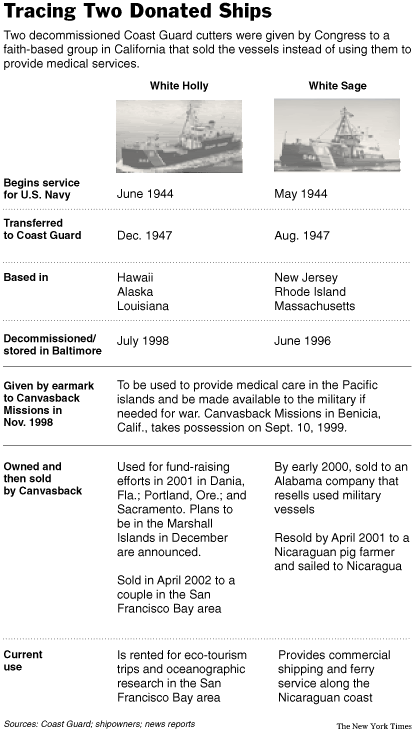
These days, Canvasback has redirected its efforts from ship-based medical care in the remote islands to land-based clinics on the more populated islands, Mr. Spence said.
That work has won praise from health officials in the Marshall Islands — and fresh support from Congress. The tiny mission is now the lead contractor on a diabetes research program being financed through two $1 million Defense Department contracts. Those grants were directed to Canvasback by Congress through a pair of earmarks.
Thursday, June 15, 2006
| [+/-] |
Hill Ties Reap Rewards For Top Defense Firms |
The Hill reports:
Letitia White, former defense appropriations staff member for Rep. Jerry Lewis (R-Calif.), is known on the Hill and in industry circles as the golden girl of earmarks.
It is those earmarks and the hefty price paid for them — in campaign contributions and lobbying fees — that have spurred federal investigators to look into the connection between White, now a partner at the firm of Copeland Lowery Jacquez Denton & White; Jeff Shockey, a former lobbyist at the firm and one of Lewis’s top committee staff members; and Lewis, the chairman of the House Appropriations Committee.
Former Rep. Bill Lowery (R-Calif.), Lewis’s longtime friend, is also a founding partner of Copeland Lowery.
The probe, which grew out of the investigation into former Rep. Randy “Duke” Cunningham (R-Calif.) that led to his resignation from Congress and his imprisonment, has prompted increased scrutiny of the defense-contracting business.
But the defense-contracting lobbying business has been a lucrative part of the K Street community for years, lawfully helping sell defense industry products to Capitol Hill and the Pentagon.
While Copeland Lowery targeted all appropriations bills, not just defense, there are several lobby shops that specialize almost solely in defense. They provide what Washington insiders argue is a necessary service.
Here is a look at the top defense-contracting lobbying firms and their connections to Congress and the Pentagon:
THE PMA GROUP
In 2006 alone, the PMA Group accounted for at least 60 earmarks in the conference report of the defense spending bill, according to data compiled by Taxpayers for Common Sense, a watchdog organization tracking earmarks in bills. That amounted to roughly $95.1 million, according to an analysis of that data.
Determining exactly how many earmarks a certain firm has secured is difficult because that information is not publicly available and defense companies often hire several lobbying firms to represent them.
Paul Magliocchetti, a nine-year veteran of the House Defense Appropriations Subcommittee, is the founder of the PMA Group. Out of its team of 35 lobbyists, at least 30 have worked on Capitol Hill, in the Pentagon or both.
One member of the team, Richard Kaelin, was the chief of staff to longtime House Appropriations Committee member Rep. Pete Visclosky (D-Ind.).
Kaelin also served as the lawmaker’s appropriations director, focusing on national security, energy and water development. That position “allowed him to develop keen negotiating skills essential to protecting multimillion-dollar projects and programs of national significance,” according to his company bio.
Another, Melissa Koloszar, was chief of staff to Rep. Jim Moran (D-Va.), also a member of the Defense Appropriations Subcommittee. For five years Koloszar also served as Moran’s legislative director. As an associate staff member on the Appropriations Committee, she was the primary contact to the defense subcommittee.
And if Moran ever becomes a chairman of a spending panel, PMA could be in luck. The lawmaker said Tuesday that if he were a chairman of a spending panel he would “earmark the [expletive] out of it.”
PMA’s Dan Cunningham has a close relationship with subcommittee ranking member Rep. John Murtha (D-Pa.), according to K Street sources.
Cunningham also served as the director and deputy director for the Army’s congressional liaison team. He directed the legislative strategy for presenting the Army’s budget for military pay, operations and maintenance, military construction, acquisition, and research and development, according to his bio.
PMA is also a heavyweight when it comes to political contributions.
For the 2006 cycle alone, PMA’s PAC doled out more than $250,000 to federal candidates. Since 2000, the PAC contributed close to $1 million to members of the House and the Senate, focusing on GOP and Democratic members of the authorization and appropriations committees.
With its 139 clients, the firm ranked as No. 10, with revenue of $7.8 million in 2005, on a list of the most profitable lobbying firms compiled by PoliticalMoneyLine.
ADI
American Defense International (ADI), with 105 clients, mostly defense and technology, was able to secure at least 32 earmarks for its clients in the 2006 defense spending bill, according to data compiled by Taxpayers for Common Sense.
ADI also has attracted an all-star cast. The chairman, Van Hipp Jr., headed the South Carolina Republican Party in 1988. He was deputy assistant secretary of the Army for reserve forces and mobilization and was appointed by then-Secretary of Defense Dick Cheney as the principal deputy general counsel of the Navy.
John Barth, meanwhile, was chosen to serve as the secretary of the Navy’s personal liaison to the House and Senate Appropriations committees for all Marine Corps matters.
Michael Khatchadurian served on the House Armed Services Committee, was military legislative assistant for Reps. Jim Ryun (R-Kan.) and Ander Crenshaw (R-Fla.), who was then a member of the House Armed Services Committee and is now a member of the Appropriations Committee. After leaving Congress, he worked in the public-affairs office of the Joint Chiefs of Staff.
Former House Armed Services Committee Chairman Ron Dellums (D-Calif.) serves as ADI’s senior national-security adviser.
ADI’s president, Michael Herson, also has experience at the Pentagon. During Cheney’s tenure there, Herson was the special assistant to the assistant secretary of defense for force management and personnel. After that, Herson joined the Alexis de Tocqueville Institution as a visiting fellow for national-security affairs.
“It is important to be a good practitioner with what you do,” Herson said. “You have to have a story to tell, have all the forms filled out and all the material that the staff needs. It is more about relationships, and you can establish those by being well-prepared and having a good story to tell.”
Several media reports have noted that Herson is married to a legislative assistant to Sen. Arlen Specter (R-Pa.). She works part time for Specter and does not handle appropriations matters.
It has also been reported that ADI does not take clients into Specter’s office.
ADI’s total earmarks for the 2006 Pentagon budget amount to at least $81 million.
ADI employees also donate mightily to the political process. For the 2002, 2004 and 2006 cycles, they contributed a total of $284,000.
ADI was ranks No. 29 with revenue of $3.9 million in PoliticalMoneyLine’s list of top lobbying firms.
COPELAND LOWERY AND OTHERS
Meanwhile, Letitia White’s firm, Copeland Lowery, with its 105 clients, ranks No. 32 with revenue of $3.7 million.
While PMA, ADI and Copeland Lowery have a large number of defense clients, other smaller, well-connected and successful shops that focus almost exclusively on defense issues are also major players.
One of them is Robison International, which is run by retired Maj. Gen. Randall West. Robison International is a steady contributor to Rep. Alan Mollohan (D-W.Va.)
Ervin Technical Associates is yet another powerful force in the defense lobbying world. Founding partner Jim Ervin’s experience includes program management and international sales with the Air Force. He also served as a congressional liaison.
