At AlterNet.org, Tara Lohan writes:
From Chile to the Philippines to South Africa to her home country of Canada, Maude Barlow is one of a few people who truly understands the scope of the world's water woes. Her newest book, Blue Covenant: The Global Water Crisis and the Coming Battle for the Right to Water, details her discoveries around the globe about our diminishing water resources, the increasing privatization trend and the grassroots groups that are fighting back against corporate theft, government mismanagement and a changing climate.
If you want to know where the water is running low (including 36 U.S. states), why we haven't been able to protect it and what we can do to ensure everyone has the right to water, Barlow's book is an essential read. It is part science, part policy and part impassioned call. And the information in Blue Covenant couldn't come from a more reliable source. Barlow is the national chairperson of the Council of Canadians and co-founder of the Blue Planet Project, which is instrumental in the international community in working for the right to water for all people. She also authored Blue Gold: The Fight to Stop Corporate Theft of the World's Water with Tony Clarke. And she's the recipient of the Right Livelihood Award (known as the "Alternative Nobel") for her global water justice work.
She took a moment to talk to AlterNet in between the Canadian and U.S. legs of a book tour for Blue Covenant:Tara Lohan: This year in the U.S. there has been a whole lot press about the drought in Atlanta and the Southeast, and I think for a lot of people in the U.S. it is the first they are hearing about drought, but the crisis here in North America is really pretty extreme isn't it?
Maude Barlow: It really is, and it kind of surprises me when I hear people, for instance in Atlanta say, "We didn't know it was coming." I don't know how that could be possible, and I do have to say that I blame our political leaders. I don't understand how they could not have been reading what I've been reading and what anyone who is watching this has been reading.
I remember attending a conference in Boise, Idaho, three years ago and hearing a lot of scientists get up and say, "Read my lips, this isn't a drought, this is permanent drying out." We are overpumping the Ogallala, Lake Powell and Lake Meade. The back up systems are now being depleted. This is by no means a drought ...
The thing that I'm trying to establish with the first chapter, which is called "Where Has All the Water Gone," is that what we learned in grade five about the hydrologic cycle being a closed, fixed cycle that could never be interrupted and could never go anywhere, is not true. They weren't lying to us, but they weren't aware of the human capacity to destroy it, and the reality is that we've interrupted the hydrologic cycle in many parts of the world and the American Southwest is one of them.
TL: How is this happening?
MB: By farming in deserts and taking up water from aquifers or watersheds. Or by urbanizing -- massive urbanization causes the hydrologic cycle to not function correctly because rain needs to fall back on green stuff -- vegetation and grass -- so that the process can repeat itself. Or we are sending huge amounts of water from large watersheds to megacities and some of them are 10 to 20 million people, and if those cities are on the ocean, some of that water gets dumped into the ocean. It is not returned to the cycle.
We are massively polluting surface water, so that the water may be there, but we can't use it. And we are also mining groundwater faster than it can be replenished by nature, which means we are not allowing the cycle to renew itself. The Ogallala aquifer is one example of massive overpumping. There are bore wells in the Lake Michigan shore that go as deep into the ground as Chicago skyscrapers go into the ground and they are sucking groundwater that should be feeding the lake so hard that they are pulling up lake water now, and they are reversing the flow of water in Lake Michigan for the first time.
We are interrupting the natural cycle. And another thing we are doing is something called virtual water trade. That is where you send water out of the watershed in the form of products or agriculture. You've used the water to produce something and then you export it, and about 20 percent of water used in the world is exported out of watershed in this way, because so much of our economy is about export. In the U.S. you are sending about one-third of your water out of watersheds -- it is not sustainable.
This is not a cyclical drought. We are actually creating hot stains, as I and some scientists call them, around the world. These are parts of the world that are running out of water and will be, or are, in crisis. Which means that millions more people will be without water. I argue that this is one of the causes of global warming. We usually hear water being a result of climate change, and it is, particularly with the melting of the glaciers. But our abuse, mismanagement and treatment of water is actually one of the causes, and we have not placed that analysis at the center of our thinking about climate change and environmental destruction, and until we do, we are only addressing half the question.
I do blame in a very big way, the political leadership in most of our countries for having failed to heed the call of scientists and ecologists and water managers who've been telling us for years now there is a crisis coming -- there are 36 states in the U.S. in some form of water stress, from serious to severe. Thirty-six states! Most Americans don't know this -- why is this not part of people's everyday concerns? That is what I'm hoping this book will help do.
TL: Do you think governments, like the U.S. or Canada, have any kind of a contingency plan?
MB: No. There are people in the U.S. who believe Canada is the contingency plant. Or Northeast water or Alaska water. So, moving water is one of the contingency plans, likely by pipeline. You could also ship it by tanker. Other than that, no. And not only are there no backup plans, but there is not even an understanding that you've got to stop increasing the demand on water. In the U.S., people are moving into the very area of the country that has no water -- a huge migration is taking place to to the American Southwest where they're building more golf courses.
I just read about a new water theme park in Arizona that will have waves so big you can have serious surfers, like real surfing in the desert. There is just this lack of understanding about how nature works, how the hydrologic cycle needs to be protected and how watersheds need to be protected, and when you start playing god by moving this stuff around like this we are just creating this massive crisis. There is not enough water for the demands being made on it in the American Southwest.
TL: You said 36 states in the U.S. are water stressed -- what does that actually mean for the people who live there?
MB: Well, in a dire case, literally running out of water. In many other cases, the predictions are that the demand will increase seriously and they've got to start planning. I quote in the book that the demand in Florida is growing so much and overpumping is happening so much that there are actually sink holes opening up and swallowing homes and streets and sometimes whole shopping centers. It is called subsidence. Mexico City is sinking in on itself because all the water under the city has been taken out and now they are going farther afield pumping water.
It can go from that kind of crisis, or as in some communities in the Midwest, you face having no water to the Chicago area, where the demand is going to grow hugely, and therefore the demand will be on the Great Lakes, which are already in trouble. There are four trillion liters taken out of the Great Lakes every single day and believe me, nature is not putting a trillion gallons back in. It is not rocket science that we are not allowing nature to refill and replenish. And now there are new demands on the Great Lakes because communities and industries off the basin are now demanding access to it.
TL: You mentioned global warming earlier, and I just want to come back to that for a moment. Are we approaching climate change in the wrong way by not recognizing its connection to water?
MB: Yes.
TL: So what should we be doing?
MB: Well, we have to put it into the equation. I've found that some politicians are actually using global warming as an excuse not to do anything, and I'll give you an example. It is the polar opposite of the Bush administration, which is that global warming doesn't exist. In Australia, which thankfully has gone through a government change, they are disengaging the water from the countryside and letting farmers sell it through brokers, they are disrupting streams and aquifers. They are draining the wetlands. They are privatizing. They are doing all sorts of things wrong, including overusing and polluting it, and so on. And what did the prime minister say? "It's got nothing to do with anything we're doing; it's global warming, and it blew here from away -- we didn't even create it."
I think global warming is becoming a little bit of a catch all for some governments to do nothing or to put off a solution to other things until they find a solution to global warming, and there is no excuse. Right now we have got to stop the abuse of water. The single most important thing that we can do for global warming, aside from stopping the overpumping of greenhouse gas emissions, but the twin to that is to retain water in watersheds. Because the hydrologic cycle is what cools the temperature.
Global warming can be averted through a great extent if we could maintain watersheds and maintain the cycle in its purest form. That means keeping green spaces, building green rings around urban centers -- everything from parks and gardens -- stop polluting, stop overmining groundwater and retain water in watersheds, which means we have to live more sustainably, we have to grow our food differently, we have to stop believing in unlimited growth and more stuff and more competition, and all of that.
I find that global warming is such a crisis that we won't do anything on any other front because all our attention is going there. I think we are terribly missing the boat on this, and I'm very interested in getting a debate going on this in the climate-change community so that when people are talking about the causes of climate change, our drying up of the earth from below will be considered as serious a cause as the trapping of heat from greenhouse gas emissions. It is not only part of the analysis we are missing, but part of the solution.
TL: That is interesting. I haven't heard a lot of people talking about it from that angle.
MB: Nobody.
I'm working with a group of scientists in Slovakia and a few other places, voices in the wilderness, but when you start putting it together, honestly, it makes such sense. I mean if you start to look at the growth of deserts -- in the last 30 years we've doubled the growth of deserts in the world, and it will double again in 20 years. Well, if you are creating deserts and you've got heat rising from the earth with urban heat islands, the inability for the hydrologic cycle to be maintained because of urbanization, it makes a lot of sense. Of course that is all exacerbated by melting glaciers and the lowering of the ice packs, which protects from evaporation. It is kind of a deadly combination. I spoke at a conference about this recently in London, England, and was received by people from the climate change world, really, really well, and I thought "This is a good sign."
TL: You spent a lot of time in this book, and also in Blue Gold, talking about privatization. Can you talk a little about why we should be concerned about it?
MB: Well, as water dwindles in the world and available fresh water is becoming more scarce, the demand is growing, water is becoming a commodity, it is becoming valuable to those who want to put a price on it, which is why I called the first book Blue Gold. And this blue gold is attracting private sector interest in many, many ways, and there is a private sector interest coming together to control every level of water, from when we take it out of the ground, bottle it, to how we deliver it, to wastewater treatment, and now the biggest and newest is water reuse and recycling. That sounds benign at first, but when you really start to look at it, really it is about big, big corporations like GE, Dow Chemical, Proctor & Gamble getting into the ownership, control, and recycling of dirty water, which because there are billions of dollars at stake, in my opinion, becomes a disincentive to protect source water. And you can start to understand why governments, in collusion with these companies, are starting to spend millions of dollars on cleanup technology but will not enforce rules to stop pollution in the first place.
And then we have desalination. There are 30 desal plants planned for California alone. They are now talking about nuclear-powered desalination. They are talking about building those plants as we speak. The people in the anti-nuclear movement had better dust off and come back because it is all coming back with desalination. And then there is nanotechnology, which they want to be totally deregulated. I've got a great quote in the book where this guy says, "We are going to do to water what we did to telecommunications in the 1990s," which is total deregulation. They want governments out of the business of water.
I have a whole section in the book on how water has become such a hot commodity. When I wrote Blue Gold there was no water being exchanged on the Stock Exchange, now there are over a dozen indexes just for trading water. It has become a multi-multibillion-dollar industry just overnight. A lot of it is this water reuse -- it is the fast-growing section of the water industry. I argue that there is a race going on over who's going to control water, whether it will be seen as a public commons, a public trust, and part of our collective heritage that also belongs to the earth -- or whether it will be controlled by private corporations, and I don't know who will win.
TL: But it is not all bad news.
MB: No, we are making good inroads in the bottled water area -- a lot of universities, high schools, are having drives to reject bottled water. We're getting restaurants now taking the challenge up to not serve bottled water, and we're getting people to take a pledge not to drink bottled water.
There has been a huge fight back from the big utility companies, particularly in the global south, to the extent that Suez has basically announced it is going to leave Latin America because people are so furious with them, which has been the result of fabulous grass-roots activism. So, it is not that this is a done deal, but most of the our governments are supportive of these private-sector incursions.
It is all about technology and not about lifestyle and alternative ways and decreasing growth and stuff -- they are saying we are not going to challenge the model, it is unlimited growth, continued competition, continued economical globalization, continued privatization, continued deregulation -- we'll just continue to find ways to clean up the mess as we go along.
TL: Water is not just an environmental issue, but a national security issue, you discovered with this book.
MB: Yes, water has become an issue of national security in the U.S. Six years ago I couldn't find any inkling at the national level -- the Pentagon or White House -- of a coming water crisis, either globally or in the U.S. But in the last, two to three years, this has been hugely changed. There is now a consortium advising the Bush administration and the Pentagon -- it is called Global Water Futures. It is made up of this think tank called the Center for International Studies and Sandia Laboratories. Then I dug deeper and found it is being contracted out to be run by Lockheed Martin. And this consortium involves Coke and Proctor & Gamble and others. So you finally have the U.S. government saying, "Holy crap, we're in trouble here, you can't be a super power if you don't have energy and water." Now they've got this advisory body that not only has this think tank and the corporate side too, and the high technology side, and the military side. It becomes very clear what you are dealing with.
TL: Can you talk more about the grass-roots resistance to all of this?
MB: The thing that is so stunning, especially in the global south, is that when you are dealing with water, you are dealing with life and death. For a lot of people it is like, "Well, we didn't know what to do when they privatized our education or shut down our public hospitals -- but water is different." They are willing to go the wall for it -- as one person said to me, "You may as well kill me with a bullet as dirty water." People just take a stand and are determined they are not going to compromise.
We took the time as a movement ... whenever anybody always asks me how to build a campaign, I always include these steps. We took the time to find language that we all jointly agreed on -- that water is not a commodity, that it belongs to the earth and all species, it is a public trust and human right, and so on. We've taken the time to work this out so that if you ask any of us around the world, you are going to hear the same kind of language. There is a trust that we have built in this shared philosophy and shared vision.
TL: How is it that you've managed to create such as worldwide message and come together?
MB: Part of the origin was when I wrote a report for the International Forum on Globalization back in 1999. It was called Blue Gold: The Global Water Crisis and the Commodification of the World's Water Supply. It took off, and a bunch of people from around the world started reading it. We got it translated into many, many languages, and I started hearing from people saying, "I thought this was personal and we were fighting this particular company in our community, and we didn't know that this was a global fight."
So, to my knowledge, that was the first analysis, and that morphed into the book. I started traveling and meeting people and Food & Water Watch got set up in the U.S. And then there was meeting people in Europe who were fighting big water companies, coming together at the big World Water Forum and bringing folks together from the global south to challenge what we call the "lords of water." And, of course, technology has been incredible. You don't have to have a computer in every house -- you just have to have somebody on the other end who has the capacity to receive this information.
TL: What else do we need to be doing?
MB: We need laws. Martin Luther King Jr. said, "Legislation won't change the heart, but it will restrain the heartless." We need legislation at every level of our government. It is all well for grass-roots people to do all their wonderful work -- but they shouldn't have to do all the work. We need laws at every level, from municipal up to state to national to international, that protect water ecologically on one hand and protect the notion of a human right and right of the earth, and not a commodity, and that is so fundamental.
That is why I call the book "blue covenant" -- we need a covenant of three parts -- from humans to the earth to stop destroying the lifeblood of the earth, from the rich to the poor (global north to the south) for water justice, not charity -- justice. Water should be a fundamental right for all generations, and no one should be allowed to sell it for profit. We want this right up to the United Nations. It is a struggle at every level. But we just keep going. The fight back around the world is claiming space, but we have to have the weight of law behind us. We have to make, as a society, decisions about what matters. And if we believe that people shouldn't die because they can't afford water, then we have to bring things to bear to make that happen -- we have to change things. If the World Bank has money to give to Suez or Veolia, they've got the money to give to a public agency.
TL: So are you hopeful we can move change in the right direction?
MB: I'm always hopeful -- it is part of my job. I consider hope to be a moral imperative, and I also don't think you have any right to go around alarming people with these facts unless you are also prepared to talk about what needs to be done, and success stories, and be hopeful. I am very very hopeful that we can collectively do this.
If I'm worried -- it is about the exponential abuse of water -- can we catch this and stop it fast enough?
List of stops and dates for Barlow's book tour.
Thursday, February 14, 2008
| [+/-] |
The Growing Battle for the Right to Water |
Saturday, January 19, 2008
| [+/-] |
A New, Global Quandary: Costly Fuel Means Costly Calories |
The New York Times reports:
Rising prices for cooking oil are forcing residents of Asia’s largest slum, in Mumbai, India, to ration every drop. Bakeries in the United States are fretting over higher shortening costs. And here in Malaysia, brand-new factories built to convert vegetable oil into diesel sit idle, their owners unable to afford the raw material.
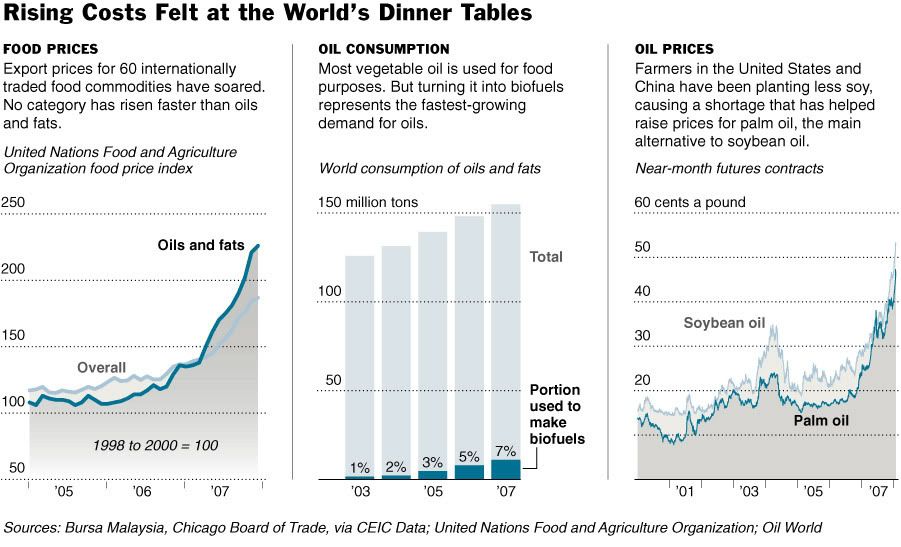
The food price index of the Food and Agriculture Organization of the United Nations, based on export prices for 60 internationally traded foodstuffs, climbed 37 percent last year. That was on top of a 14 percent increase in 2006, and the trend has accelerated this winter.
In some poor countries, desperation is taking hold. Just in the last week, protests have erupted in Pakistan over wheat shortages, and in Indonesia over soybean shortages. Egypt has banned rice exports to keep food at home, and China has put price controls on cooking oil, grain, meat, milk and eggs.
According to the F.A.O., food riots have erupted in recent months in Guinea, Mauritania, Mexico, Morocco, Senegal, Uzbekistan and Yemen.
“The urban poor, the rural landless and small and marginal farmers stand to lose,” said He Changchui, the agency’s chief representative for Asia and the Pacific.
A startling change is unfolding in the world’s food markets. Soaring fuel prices have altered the equation for growing food and transporting it across the globe. Huge demand for biofuels has created tension between using land to produce fuel and using it for food.
A growing middle class in the developing world is demanding more protein, from pork and hamburgers to chicken and ice cream. And all this is happening even as global climate change may be starting to make it harder to grow food in some of the places best equipped to do so, like Australia.
In the last few years, world demand for crops and meat has been rising sharply. It remains an open question how and when the supply will catch up. For the foreseeable future, that probably means higher prices at the grocery store and fatter paychecks for farmers of major crops like corn, wheat and soybeans.
There may be worse inflation to come. Food experts say steep increases in commodity prices have not fully made their way to street stalls in the developing world or supermarkets in the West.
Governments in many poor countries have tried to respond by stepping up food subsidies, imposing or tightening price controls, restricting exports and cutting food import duties.
These temporary measures are already breaking down. Across Southeast Asia, for example, families have been hoarding palm oil. Smugglers have been bidding up prices as they move the oil from more subsidized markets, like Malaysia’s, to less subsidized markets, like Singapore’s.
No category of food prices has risen as quickly this winter as so-called edible oils — with sometimes tragic results. When a Carrefour store in Chongqing, China, announced a limited-time cooking oil promotion in November, a stampede of would-be buyers left 3 people dead and 31 injured.
Cooking oil may seem a trifling expense in the West. But in the developing world, cooking oil is an important source of calories and represents one of the biggest cash outlays for poor families, which grow much of their own food but have to buy oil in which to cook it.
Few crops illustrate the emerging problems in the global food chain as well as palm oil, a vital commodity in much of the world and particularly Asia. From jungles and street markets in Southeast Asia to food companies in the United States and biodiesel factories in Europe, soaring prices for the oil are drawing environmentalists, energy companies, consumers, indigenous peoples and governments into acrimonious disputes.
The oil palm is a stout-trunked tree with a spray of frilly fronds at the top that make it look like an enormous sea anemone. The trees, with their distinctive, star-like patterns of leaves, cover an eighth of the entire land area of Malaysia and even greater acreage in nearby Indonesia.
An Efficient Producer
The palm is a highly efficient producer of vegetable oil, squeezed from the tree’s thick bunches of plum-size bright red fruit. An acre of oil palms yields as much oil as eight acres of soybeans, the main rival for oil palms; rapeseed, used to make canola oil, is a distant third. Among major crops, only sugar cane comes close to rivaling oil palms in calories of human food per acre.
Palm oil prices have jumped nearly 70 percent in the last year because supply has grown slowly while demand has soared.
Farmers and plantation companies are responding to the higher prices, clearing hundreds of thousands of acres of tropical forest to replant with rows of oil palms. But an oil palm takes eight years to reach full production. A drought last year in Indonesia and flooding in Peninsular Malaysia helped constrain supply. Worldwide palm oil output climbed just 2.7 percent last year, to 42.1 million tons.
At the same time, palm oil demand is growing steeply for a variety of reasons around the globe. They include shifting decisions among farmers about what to plant, rising consumer demand in China and India for edible oils, and Western subsidies for biofuel production.
American farmers have been planting more corn and less soy because demand for corn-based ethanol has pushed up corn prices. American soybean acreage plunged 19 percent last year, producing a drop in soybean oil output and inventories.
Chinese farmers also cut back soybean acreage last year, as urban sprawl covered prime farmland and the Chinese government provided more incentives for grain.
Yet people in China are also consuming more oils. China not only was the world’s biggest palm oil importer last year, holding steady at 5.2 million tons in the first 11 months of the year, but it also doubled its soybean oil imports to 2.9 million tons, forcing buyers elsewhere to switch to palm oil.
Concerns about nutrition used to hurt palm oil sales, but they are now starting to help. The oil was long regarded in the West as unhealthy, but it has become an attractive option to replace the chemically altered fats known as trans fats, which have lately come to be seen as the least healthy of all fats.
New York City banned trans fats in frying at food service establishments last summer and will ban them in bakery goods this summer. Across the country, manufacturers are trying to replace trans fats. American palm oil imports nearly doubled in the first 11 months of last year, rising by 200,000 tons.
“Four years ago, when this whole no-trans issue started, we processed no palm here," said Mark Weyland, a United States product manager for Loders Croklaan, a Dutch company that supplies palm oil. “Now it’s our biggest seller.”
Last year, conversion of palm oil into fuel was a fast-growing source of demand, but in recent weeks, rising prices have thrown that business into turmoil.
Here on Malaysia’s eastern shore, a series of 45-foot-high green and gray storage tanks connect to a labyrinth of yellow and silver pipes. The gleaming new refinery has the capacity to turn 116,000 tons a year of palm oil into 110,000 tons of a fuel called biodiesel, as well as valuable byproducts like glycerin. Mission Biofuels, an Australian company, finished the refinery last month and is working on an even larger factory next door at the base of a jungle hillside.
But prices have spiked so much that the company cannot cover all its costs and has idled the finished refinery while looking for a new strategy, such as asking a biodiesel buyer to pay a price linked to palm oil costs, and someday switching from palm oil to jatropha, a roadside weed.
“We took a view that palm oil prices were already high; we didn’t think they could go even higher, and then they did,” said Nathan Mahalingam, the company’s managing director.
Growth in Biofuels
Biofuels accounted for almost half the increase in worldwide demand for vegetable oils last year, and represented 7 percent of total consumption of the oils, according to Oil World, a forecasting service in Hamburg, Germany.
The growth of biodiesel, which can be mixed with regular diesel, has been controversial, not only because it competes with food uses of oil but also because of environmental concerns. European conservation groups have been warning that tropical forests are being leveled to make way for oil palm plantations, destroying habitat for orangutans and Sumatran rhinoceroses while also releasing greenhouse gases.
The European Union has moved to restrict imports of palm oil grown in unsustainable ways. The measure has incensed the Malaysian palm oil industry, which had plunged into biofuel production in part to satisfy European demand.
Another controversy involves the treatment of indigenous peoples whose lands have been seized by oil plantations. This has been a particular issue on Borneo.
Anne B. Lasimbang, executive director of the Pacos Trust in the Malaysian state of Sabah in northern Borneo, said that while some indigenous people had benefited from selling palm oil that they grow themselves, many had lost ancestral lands with little to show for it, including lands that used to provide habitats for endangered orangutans.
“Finally, some of the pressures internationally have trickled down. Some of the companies are more open to dialogue; they want to talk to communities,” said Ms. Lasimbang, a member of the Dusun indigenous group. “On our side, we are still suspicious.”
Demand Outstrips Supply
As the multiple conflicts and economic pressures associated with palm oil play out in the global economy, the bottom line seems to be that the world wants more of the oil than it can get.
Even in Malaysia, the center of the global palm oil industry for half a century, spot shortages have cropped up. Recently, as wholesale prices soared, cooking oil refiners complained of inadequate subsidies and cut back production of household oil, sold at low, regulated prices.
Street vendors in the capital, Kuala Lumpur, complain that they cannot find enough cooking oil to prepare roti canai, the flatbread that is the national snack. “It’s very difficult; it’s hard to find,” said one vendor who gave only his first name, Palani, after admitting that he was secretly buying cooking oil intended for households instead of paying the much higher price for commercial use.
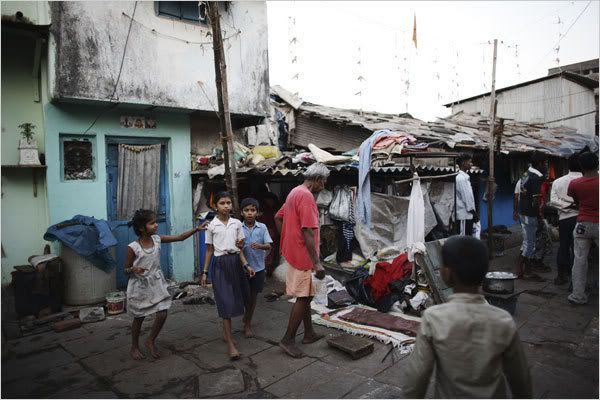
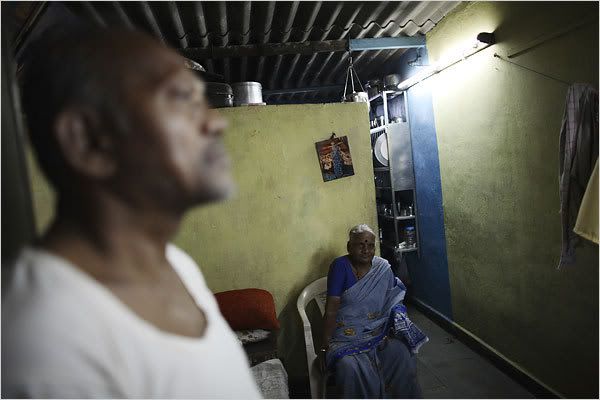
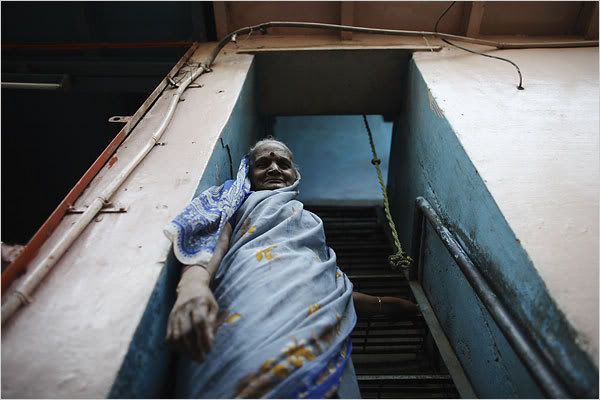
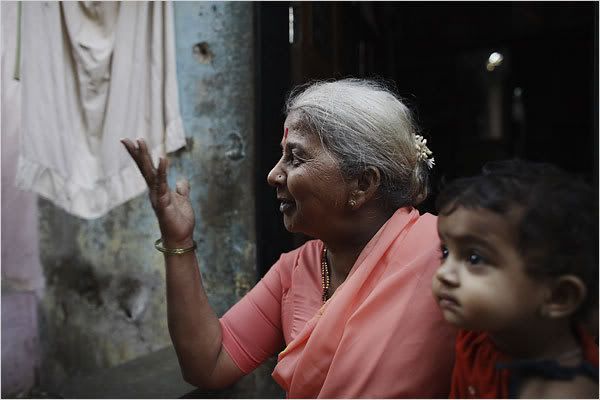
Many of the hardest-hit victims of rising food prices are in the vast slums that surround cities in poorer Asian nations. The Kawle family in Mumbai’s sprawling Dharavi slum, a household of nine with just one member working as a laborer for $60 a month, is coping with recent price increases for palm oil.
The family has responded by eating fish once a week instead of twice, seldom cooking vegetables and cutting its monthly rice consumption. Next to go will be the weekly smidgen of lamb.
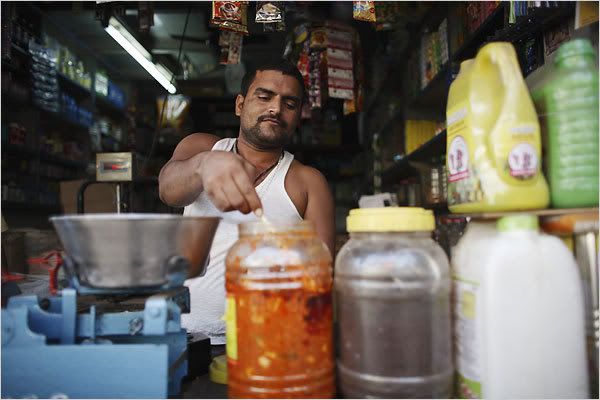
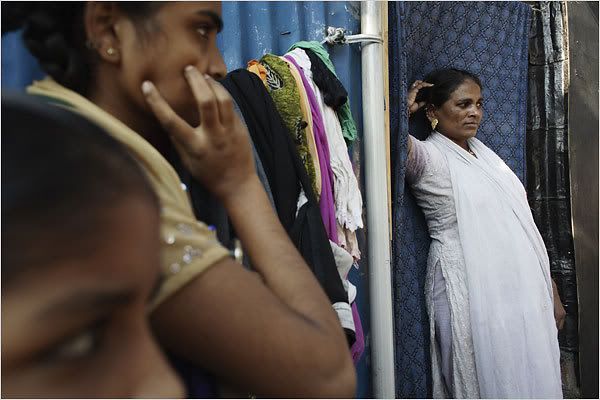
“If the prices go up again,” said Janaron Kawle, the family patriarch, “we’ll cut the mutton to twice a month and use less oil.”"The Struggle for Palm Oil" (photos by Michael Rubenstein for The New York Times) In the developing world, cooking oil is an important source of calories and represents one of the biggest cash outlays for poor households. A steep rise in prices for palm oil has forced many families in Dharavi, a sprawling slum in Mumbai, India, to use less oil or even cut back on food:


Thursday, January 3, 2008
| [+/-] |
Forests Soak Up Less and Less CO2 |
Canada's trees getting worse at filtering gases, researchers say
The Ottawa Citizen reports:
Last year brought glum news that Canada's forests were only a so-so defence against global warming. Now, we find out our forests are getting worse at soaking up greenhouse gases.
A study by Canadian, Chinese and European researchers shows that, as the climate gets warmer, northern forests aren't soaking up extra carbon dioxide from the air after all.
Forests may, in fact, become worse at storing carbon if climate trends continue.
Canada has always argued that our forests strongly "offset" some of the fossil fuels we burn. Our official position is that Kyoto-style climate plans should give Canada credit for the good work our forests do.
However, a series of studies in the past two years and continuing today in the journal Nature call that into question.
Forests soak up less pollution that we'd hoped. Even as Canada realized it had over-hyped the air-cleaning work done by forests, though, one apparent piece of good news emerged.
Scientists noticed that the global warming trend was waking up trees earlier each spring. As well, the trees were staying green longer into the autumn.
This longer growing season, they reasoned, meant trees should work longer at building new branches and leaves, the process that soaks up carbon from the air. So, shouldn't that get rid of more carbon dioxide?
No, says today's study by the Global Carbon Project, a multinational science network that includes Canada. The study focuses on years of data-gathering -- largely from Canadian forests -- that record precisely how much carbon dioxide is in the air of a forest day by day.
In the past 20 years, two things have happened. The autumn in many forests of Canada, Europe and China has warmed by 1.1 degrees. The autumn forests are also releasing carbon dioxide back into the air faster than they soak it up.
This trend is so strong, University of Colorado atmospheric scientist John Miller writes in Nature, that it "seems to largely cancel" gains made through the earlier arrival of spring and its extra forest growth.
Shilong Piao and colleagues at the Laboratory of Sciences on Climate and the Environment in France's national science agency said although plants' respiration (emitting carbon dioxide) and photosynthesis (storing carbon dioxide) are both stepped up, the respiration outstrips the photosynthesis to cause a net loss of carbon from plants into the air.
"If warming in autumn occurs at a faster rate than in spring, the ability of northern ecosystems to sequester carbon will diminish in the future," Mr. Piao says in a written announcement of his results.
Saturday, December 29, 2007
| [+/-] |
Global Warming to Alter California Landscape |
The AP reports:
California is defined by its scenery, from the mountains that enchanted John Muir to the wine country and beaches that define its culture around the world.
But as scientists try to forecast how global warming might affect the nation's most geographically diverse state, they envision a landscape that could look quite different by the end of this century, if not sooner.
Where celebrities, surfers and wannabes mingle on Malibu's world-famous beaches, there may be only sea walls defending fading mansions from the encroaching Pacific. In Northern California, tourists could have to drive farther north or to the cool edge of the Pacific to find what is left of the region's signature wine country.
Abandoned ski lifts might dangle above snowless trails more suitable for mountain biking even during much of the winter. In the deserts, Joshua trees that once extended their tangled, shaggy arms into the sky by the thousands may have all but disappeared.
"We need to be attentive to the fact that changes are going to occur, whether it's sea level rising or increased temperatures, droughts and potentially increased fires," said Lisa Sloan, a scientist who directs the Climate Change and Impacts Laboratory at the University of California, Santa Cruz. "These things are going to be happening."
Among the earliest and most noticeable casualties is expected to be California's ski season.
Snow is expected to fall for a shorter period and melt more quickly. That could shorten the ski season by a month even in wetter areas and perhaps end it in others.
Whether from short-term drought or long-term changes, the ski season already has begun to shrivel in Southern California, ringed by mountain ranges that cradle several winter resorts.
"There's always plenty of snow, but you may just have to go out of state for it," said Rinda Wohlwend, 62, who belongs to two ski clubs in Southern California. "I'm a very avid tennis player, so I'd probably play more tennis."
---
Because California has myriad microclimates, covering an area a third larger than Italy, predicting what will happen by the end of the century is a challenge.
But through a series of interviews with scientists who are studying the phenomenon, a general description of the state's future emerges.
By the end of the century, temperatures are predicted to increase by 3 to 10 degrees Fahrenheit statewide. That could translate into even less rainfall across the southern half of the state, already under pressure from the increased frequency of wildfires and relentless population growth.
Small mammals, reptiles and colonies of wildflowers in the deserts east of Los Angeles are accustomed to periodic three-year dry spells. But they might not be able to withstand the 10-year drought cycles that could become commonplace as the planet warms.
Scientists already are considering relocating Joshua tree seedlings to areas where the plants, a hallmark of the high desert and namesake of a national park, might survive climate change.
"They could be wiped out of California depending on how quickly the change happens," said Cameron Barrows, who studies the effects of climate change for the Center for Conservation Biology in Riverside.
Farther north, where wet, cold winters are crucial for the water supply of the entire state, warmer temperatures will lead to more rain than snow in the Sierra Nevada and faster melting in the spring.
Because 35 percent of the state's water supply is stored annually in the Sierra snowpack, changes to that hydrologic system will lead to far-reaching consequences for California and its ever-growing population.
Some transformations already are apparent, from the Sierra high country to the great valleys that have made California the nation's top agricultural state.
The snow line is receding, as it is in many other alpine regions around the world. Throughout the 400-mile-long Sierra, trees are under stress, leading scientists to speculate that the mix of flora could change significantly as the climate warms. The death rate of fir and pine trees has accelerated over the past two decades.
In the central and southern Sierra, the giant sequoias that are among the biggest living things on Earth might be imperiled.
"I suspect as things get warmer, we'll start seeing sequoias just die on their feet where their foliage turns brown," said Nate Stephenson, a U.S. Geological Survey ecologist who is studying the effects of climate change in the Sierra Nevada. "Even if they don't die of drought stress, just think of the wildfires. If you dry out that vegetation, they're going to be so much more flammable."
Changes in the mountain snowpack could lead to expensive water disputes between cities and farmers. Without consistent water from rivers draining the melting snow, farmers in the Central and Salinas valleys could lose as much as a quarter of their water supply.
Any drastic changes to the state's $30 billion agriculture industry would have national implications, since California's fertile valleys provide half the country's fresh fruits, nuts and vegetables, according to the Union of Concerned Scientists' study.
"Obviously, it's going to mean that choices are going to be made about who's going to get the water," said Brian Nowicki, a biologist with the Center for Biological Diversity in Tucson, Ariz.
Among the biggest unknowns is what will happen along California's coast as the world's ice sheets and glaciers melt. One scenario suggests the sea level could rise by more than 20 feet.
Will the rising sea swamp the ports of Long Beach and Los Angeles, the nation's busiest harbor complex, turning them into a series of saltwater lakes? Will funky Ocean Beach, an island of liberalism in conservative San Diego County, become, literally, its own island?
Among the more sobering projections is what is in store for marine life.
The upwelling season, the time when nutrient-rich water is brought from the ocean's depths to the surface, nourishes one of the world's richest marine environments.
That period, from late spring until early fall, is expected to become weaker earlier in the season and more intense later. Upwelling along the Southern California coast will become weaker overall.
As a result, sea lions, blue whales and other marine mammals that follow these systems up and down the coast are expected to decline.
The changing sea will present trouble for much of the state's land-dwelling population, too. A sea level rise of 3 to 6 feet would inundate the airports in San Francisco and Oakland. Many of the state's beaches would shrink.
"If you raise sea level by a foot, you push a cliff back 100 feet," said Jeff Severinghaus, professor of geosciences at the Scripps Institution of Oceanography in San Diego. "There will be a lot of houses that will fall into the ocean."
Thursday, December 6, 2007
| [+/-] |
More Than Half of Amazon Will Be Lost By 2030, Report Warns |
The Guardian reports:
Climate change could speed up the large-scale destruction of the Amazon rainforest and bring the "point of no return" much closer than previously thought, conservationists warned today.
Almost 60% of the region's forests could be wiped out or severely damaged by 2030, as a result of climate change and deforestation, according to a report published today by WWF.
The damage could release somewhere between 55.5bn-96.9bn tons of carbon dioxide into the atmosphere from the Amazon's forests and speed up global warming, according to the report, Amazon's Vicious Cycles: Drought and Fire.
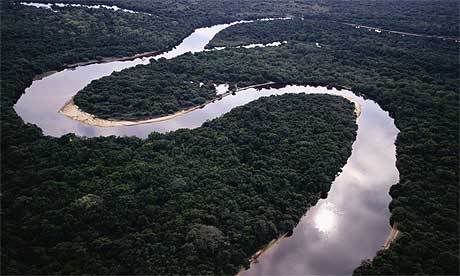
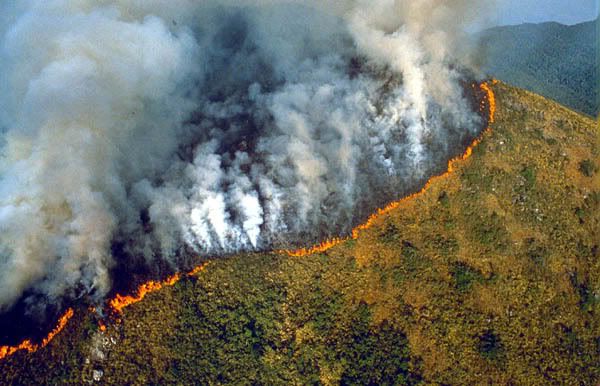 June 1989, Brazil: The forest burns. The Amazon is the largest rainforest in the world and is home to 15% of the world’s known land-based plant species, and nearly 10% of the world’s mammals. It has as many as 300 species of tree in a single hectare. Photograph: Sipa Press/Rex Features
Trends in agriculture and livestock expansion, fire, drought and logging could severely damage 55% of the Amazon rainforest by 2030, the report says. And, in turn, climate change could speed up the process of destruction by reducing rainfall by as much as 10% by 2030, damaging an extra 4% of the forests during that time.
By the end of the century, global warming is likely to reduce rainfall by 20% in eastern Amazonia, pushing up temperatures by more than 2C and causing forest fires, the report said.
 September 1988, Rondonia State, Brazil: Newly cleared land. Soya farming is one of the primary drivers of deforestation in the Amazon.
Photograph: Stephen Ferry/Liaison/Getty Images
Destroying almost 60% of tropical rainforest by 2030 would do away with one of the key stabilisers of the global climate system, it warned.
Such damage could have a knock-on effect on rainfall in places such as central America and India, and would also destroy livelihoods for indigenous people and some 80% of habitats for animal species in the region.
The "point of no return", in which extensive degradation of the rainforest occurs and conservation prospects are greatly reduced, is just 15-25 years away - much sooner than some models suggest, the report warns.
Releasing the report at the UN conference in Bali, which aims to begin negotiations on a new international climate change deal, the WWF called for a strategy to reduce emissions from forests and stop deforestation.
Beatrix Richards, the head of forests at WWF-UK, said: "The Amazon is on a knife-edge due to the dual threats of deforestation and climate change.
"Developed countries have a key role to play in throwing a lifeline to forest around the world. At the international negotiations currently underway in Bali governments must agree a process which results in ambitious global emission reduction targets beyond the current phase of Kyoto which ends in 2012.
"Crucially this must include a strategy to reduce emissions from forests and help break the cycle of deforestation."
The report's author, Dan Nepstead, senior scientist at the Woods Hole research centre in Massachusetts, said: "The importance of the Amazon forest for the globe's climate cannot be underplayed.
"It's not only essential for cooling the world's temperature but such a large source of freshwater that it may be enough to influence some of the great ocean currents, and on top of that it's a massive store of carbon."
Saturday, October 20, 2007
| [+/-] |
Georgia Governor Declares State of Emergency Due to Drought |
The Atlanta Journal-Constitution reports:
Gov. Sonny Perdue declared a state of emergency in most of Georgia on Saturday, and called on President Bush to recognize that the historic drought had created a disaster for 85 counties.
In a defiant plea Saturday at Lake Lanier, Perdue asked Bush to issue a federal disaster designation that would:
• Empower the president to order less water released from Lake Lanier.
• Make federal funds available to state and local governments.
• Offer low-interest loans to Georgia businesses hurt by the drought.
"We will continue to conserve," the governor said, "but we have to have help."
Perdue's actions came as the federal government continued to release water from Lake Lanier to protect endangered mussels in Florida at the expense of water-starved North Georgia.
The governor, lieutenant governor, two congressmen and several legislators and state officials gathered at the top of a trio of now-landlocked boat ramps at Lake Lanier to deride the U.S. Army Corps of Engineers and the U.S. Department of Fish and Wildlife for "putting mussels in front of people."
They also accused the federal agencies of endangering one of the country's most populated areas, which is seeing its drinking water disappear down the Chattahoochee River for the Gulf of Mexico.
Perdue's state of emergency declaration and request of a federal disaster declaration are the latest tactics in the escalating war between Georgia and the federal government over how much water can be released from Lake Lanier.
"The actions of the Army Corps of Engineers and the Fish and Wildlife Service are not only irresponsible, they are downright dangerous," Perdue said at Saturday's news conference at Mary Alice Park, just yards from the retreating lake.
"If the Corps and the Fish and Wildlife Service do not act now, I will hold them fully responsible for endangering the people of Georgia. Any harm that comes to humans is 100 percent on their hands."
Perdue said he had asked for the federal disaster designation because "we need the president to cut through the tangle of unnecessary bureaucracy to manage our resources prudently so that, in the long term, all species may have access to clean water."
Until now, Georgia's efforts to ride out the dry spell and a shrinking water source have focused on conservation. But Perdue insisted conservation was not enough.
Georgia on Friday filed a federal lawsuit in Jacksonville, asking the court to force the Corps to reduce releases from Lake Lanier until March 1.
"We are experiencing the single worst drought in Georgia history," Perdue said. "On top of that, we are mired in a manmade disaster of federal bureaucracy."
Officials estimate Lake Lanier will be at the "dead pool level" within 80 days. At that point, also known as the "bottom of the conservation pool," the water level will be below pipes used to remove the water. Special equipment will be needed to retrieve it.
"Is there water in there that can be use? Yes. But it's not high quality," said Carol Couch, director of the Georgia Environmental Protection Division.
That water will contain more sediment and minerals, some of which are difficult to remove, and likely will have a different taste and color even after treatment, Couch said.
Col. Byron Jorns — head of the U.S. Army Corps of Engineers' Mobile District, which oversees Lake Lanier — insisted the Atlanta area is not at immediate risk of running out of drinking water.
"There is water available for the drinking water needs of metro Atlanta for the next several months and well beyond," Jorns said. "The bottom of the conservation pool does not mean the bottom of the lake."
"That water is still available. In terms of folks going thirsty, that is an event that is well into the future."
Tuesday, October 16, 2007
| [+/-] |
Drought Tightens Its Grip on Southeast U.S. |
The Associated Press reports:
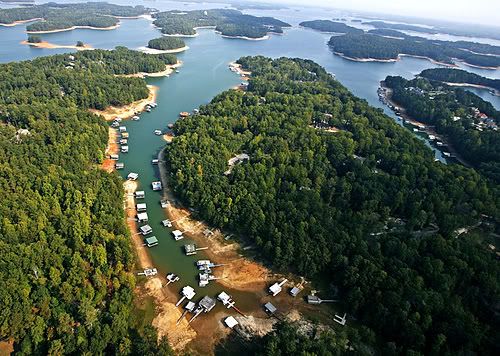
If there's a ground zero for the epic drought that's tightening its grip on the South, it's once-mighty Lake Lanier, the Atlanta water source that's now a relative puddle surrounded by acres of dusty red clay.
Tall measuring sticks once covered by a dozen feet of water stand bone dry. "No Diving" signs rise from rocks 25 feet from the water. Crowds of boaters have been replaced by men with metal detectors searching the arid lake bed for lost treasure.
"This lake is a survivor," Jeff "Buddha" Powell told a worried customer at his bait shop along the barren banks.
"If you panic, you don't help Mother Nature," he added. "It's going to rain when it rains."
But little rain is in the forecast, and without it climatologists say the water source for more than 3 million people could run dry in just 90 days.
That dire prediction has some towns considering more drastic measures than mere lawn-watering bans, including mandatory rationing that would penalize homeowners and businesses if they don't reduce water usage.
"We're way beyond limiting outdoor water use. We're talking about indoor water use," said Jeff Knight, an environmental engineer for the college town of Athens, 60 miles northeast of Atlanta, which is preparing a last-ditch rationing program as its reservoir dries up.
"There has to be limits to where government intrudes on someone's life, but we have to impose a penalty on some people," he added. "The problem is how much and who. That gets political. But it's going to hurt everyone. We're all going to share the pain."
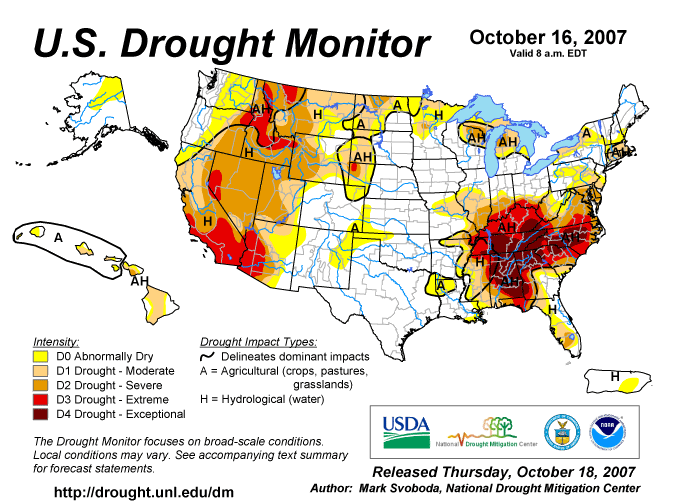
About 26 percent of the Southeast is covered by an "exceptional" drought — the National Weather Service's worst drought category. The affected area extends like a dark cloud over most of Tennessee, Alabama and the northern half of Georgia, as well as parts of North and South Carolina, Kentucky and Virginia.
The only spots in the region not suffering from abnormally dry conditions are parts of southern and eastern Florida and southeast Georgia.
Government forecasters say the drought started in parts of Georgia and Alabama in early 2006 and spread quickly. Sweltering temperatures and a drier-than-normal hurricane season contributed to the parched landscape.
Now residents are starting to feel the pinch.
Restaurants are being asked to serve water only at a customer's request, and Gov. Sonny Perdue has called on Georgians to take shorter showers. The state could also impose more limits within the next two weeks, possibly restricting water for commercial and industrial users.
In North Carlina, Gov. Mike Easley stopped short of imposing statewide water rationing but asked people to stop watering lawns and washing cars.
"A bit of mud on the car or patches of brown on the lawn must be a badge of honor," Easley said today. "It means you are doing the right thing for your community and our state."
As conditions worsen, the Army Corps of Engineers has become a favorite target of lawmakers in Georgia, Florida and Alabama, where the drought has intensified a decades-old feud involving how the Corps manages water rights.
"I particularly am disappointed that the Corps has allowed so much water to drain out of our reservoirs, out of our lakes, as they have," said Georgia Lt. Gov. Casey Cagle, a Republican. "It's not that we haven't had enough water. It's more a function of allowing so much of it to go downstream."
On Friday, Perdue threatened to take legal action if the Corps continued to let more water out of a north Georgia water basin than it collects. And the president of the Metro Atlanta Chamber of Commerce said that businesses could also line up behind a legal challenge.
"We have an ongoing water crisis in metro Atlanta. And it is the biggest and most imminent economic threat to our region," said Sam Williams, the chamber's president.
Scientists have little reason to hope the drought will ease anytime soon.
The Southeast Climate Consortium warns that a La Nina weather system is forming, which could bring drier and warmer weather for Florida and most parts of Alabama and Georgia.
"When we need to recharge our water system, this is what we don't want," said state climatologist David Stooksbury, who predicted that it will take months of above-average rainfall to recoup the losses.
In Atlanta, officials are nervously watching the dropping level of Lake Lanier, the sprawling north Georgia reservoir that provides water for 1 in 3 Georgia residents. The latest measurements have become a fixture on nightly television newscasts in Atlanta, where the drought is often the top story.
There is a silver lining of sorts in the middle of the drought: Guides say the lake's fishing is as good as ever, if not better.
"Less water, less places to hide, I guess," said Chuck Biggers, a guide who has roamed the lake's waters for four years.
Sunday, April 15, 2007
| [+/-] |
U.S. Military Sharpens Focus On Climate Change |
The U.S. military is increasingly focused on a potential national security threat: climate change. A decline in resources is projected to cause increasing instability overseas.
The Washington Post reports:
Just last month the U.S. Army War College funded a two-day conference at the Triangle Institute for Security Studies titled "The National Security Implications of Global Climate Change." And tomorrow, a group of 11 retired senior generals will release a report saying that global warming "presents significant national security challenges to the United States," which it must address or face serious consequences.
The 63-page report -- which is being released a day before the U.N. Security Council holds its first-ever briefing on climate change -- lays out a detailed case for how global warming could destabilize vulnerable states in Africa and Asia and drive a flood of migrants to richer countries. It focuses on how climate change "can act as a threat multiplier for instability in some of the most volatile regions of the world," in part by causing water shortages and damaging food production.
The study's authors, along with several other national security experts, confirmed last week that the military has begun studying possible future impacts of global warming with new intensity.
"It's only in the last six months that climate change itself has surfaced as a term that's commonly recognized as having security implications," said Kent H. Butts, a professor of political military strategy at the War College's Center for Strategic Leadership. Butts added that when he meets with military leaders to discuss how to tackle terrorism and regional instability, "Each time they're saying, 'This is getting worse because of changes in the climate.' "
Commissioned by the Center for Naval Analyses, a government-funded think tank, the report boasts a list of contributors that includes eight retired four-star generals and three three-stars. Many have significant technological expertise, and some, such as Admiral T. Joseph Lopez, are close to Vice President Cheney. Others, including Gen. Anthony C. Zinni, have criticized President Bush in recent years.
The Army's former chief of staff, Gen. Gordon R. Sullivan, who is one of the authors, noted he had been "a little bit of a skeptic" when the study group began meeting in September. But, after being briefed by top climate scientists and observing changes in his native New England, Sullivan said he was now convinced that global warming presents a grave challenge to the country's military preparedness.
"The trends are not good, and if I just sat around in my former life as a soldier, if I just waited around for someone to walk in and say, 'This is with a hundred percent certainty,' I'd be waiting forever," he said.
Part of the sense of urgency, the generals said in interviews last week, stems from the fact that changing climatic conditions will make it harder for weak nation-states to address their citizens' basic needs. The report notes, for example, that 40 percent of the world's population gets at least half its drinking water from the summer melt of mountain glaciers that are rapidly disappearing.
"Many developing nations do not have the government and social infrastructures in place to cope with the type of stressors that could be brought about by global climate change," the report states. "When a government can no longer deliver services to its people, ensure domestic order, and protect the nation's borders from invasion, conditions are ripe for turmoil, extremism and terrorism to fill the vacuum."
The study states that conflicts in regions such as Darfur and Somalia stemmed initially from a lack of resources, something that will only worsen with global warming.
Climate change is different from traditional military threats, according to report author Vice Adm. Richard H. Truly, because it's not like "some hot spot we're trying to handle."
"It's going to happen to every country and every person in the whole world at the same time," Truly said.
The report also notes that some military bases probably will be compromised by climate change. Diego Garcia, an atoll in the southern Indian Ocean that U.S. and British forces use as a logistic hub for their Middle East operations, lies just a few feet above sea level. "Although the consequences to military readiness are not insurmountable, the loss of some forward bases would require longer range lift and strike capabilities and would increase the military's energy needs," the study says.
The military has contemplated the implications of climate change before: In 2004 it released a study of possible catastrophic global warming that was commissioned by Andrew Marshall, who directs the Pentagon's Office of Net Assessment; four years earlier the Defense Department issued a report titled "Climate Change, Energy Efficiency and Ozone Protection."
Pentagon and Army officials declined repeated requests for interviews last week. But several former officers involved in the study who maintain contacts inside the Defense Department said several branches of the military are examining how to cope with climate change.
Sullivan said he plans to talk to military officials about his group's report, and he expects they'll be sympathetic to his message. "I don't think this is a hard sell," he said.
