Bangor Daily News reports:
For the first time, Congress has put conditions on its approval of funding for the war in Iraq. Although the president has leeway in meeting these conditions, this is an important step in better assessing progress in Iraq, which in turn should lead to a clearer understanding of how long U.S. troops should remain there.
The House and Senate on Thursday approved more than $100 billion for the wars in Iraq and Afghanistan and some domestic projects. The bill did not include a timetable for the withdrawal of U.S. troops — the reason President Bush vetoed an earlier funding bill. But it does include provisions from Sens. Susan Collins, John Warner and Ben Nelson to set benchmarks for the Iraqi government to meet in order to receive U.S. reconstruction funds. It is the first time Congress has supported economic consequences if the Iraqis do not meet certain benchmarks.
The benchmarks include increasing the number of Iraqi security forces capable of operating independently, enactment and implementation of de-Baathification legislation, enactment of constitutional and electoral reforms, and passage of legislation to ensure the equitable distribution of oil revenues.
The legislation also requires the president to submit reports — in July and September — on whether the Iraqis are making satisfactory progress.
"This sends a very strong message to the Iraqi leaders that the status quo is not acceptable," Sen. Collins said. "It also tells the Iraqis that our presence and our commitment in Iraq is neither open-ended nor unconditional."
It also mirrors the recommendations of the Iraq Study Group. When it was released six months ago, the report landed with a thud. Its recommendations for incentives to encourage the Iraqi government and talks with Iraq’s neighbors were largely ignored as focus remained on military action. As the Bush administration and Congress struggle to find a new direction for Iraq, it is not surprising that they are following the advice of the study group since few other options exist.
The group’s call for a diminished U.S. military presence, greater Iraqi government authority and regional diplomacy is as relevant today as when it was first issued in December. The question remains, however, how to implement such a policy as Iraq descends further into sectarian chaos.
Requiring reports from the president and tying financial assistance to the Iraqis meeting benchmarks they had devised, although small steps, set the stage for a fuller debate on the U.S. role in Iraq.
The debate will become more serious this summer after Gen. David Petraeus, the commander of American forces in Iraq, issues his report. After that, expect more focus on benchmarks and diplomacy as military options are exhausted.
Saturday, May 26, 2007
| [+/-] |
Military Funding Bill Includes Benchmark For Giving Up Oil Rights |
Sunday, May 13, 2007
| [+/-] |
Iraqi Prime Minister Agrees To Bigger Sunni Role |
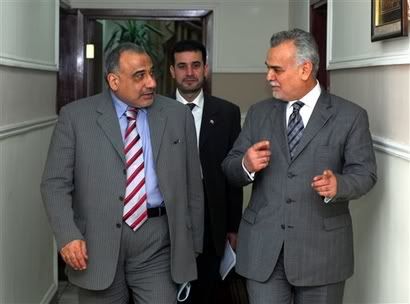
The AP reports:
Prime Minister Nouri al-Maliki agreed to give Sunnis a bigger role in security operations in their areas, lawmakers said Sunday, in a deal that staves off a threatened Sunni walkout that could have toppled the Shiite leader's embattled government.
The deal reached with Iraq's Sunni vice president could help assuage long-standing Sunni complaints that Shiite-dominated security forces unfairly target Sunni areas but avoid cracking down on Shiite militias linked to influential politicians.
The Bush administration has been pushing al-Maliki for months to reach out more to the once-dominant Sunni Arab minority, giving them a genuine role in the running of the country as part of a wider drive toward national unity that officials hope will reduce the country's rampant violence.
The lawmakers said the deal was reached in talks last week between al-Maliki and Vice President Tariq al-Hashemi, who had threatened to withdraw his bloc from the government if Sunni demands were not met. His bloc controls 44 of the 275 parliament seats.
Under the terms, al-Hashemi will have an "executive role" in the fight against insurgents in Sunni areas inside and outside the capital of Baghdad, the lawmakers said. Al-Maliki remains the armed forces' commander in chief, they said.
However, the agreement was described by lawmakers as an understanding rather than a formal pact, and similar arrangements have broken down in the past.
"The government realized that we were not just making empty threats, so they took us seriously" said Sunni lawmaker Salim Abdullah, a member of al-Hashemi's Iraqi Islamic Party, the country's biggest Sunni political group.
"The ball is now in the government's court," said Abdullah, who confirmed the deal along with a Shiite lawmaker close to al-Maliki. The Shiite spoke on condition of anonymity because he was not authorized to release information to the media.
One Sunni Arab politician, Omar Abdul-Sattar, said 11,000 volunteers from Sunni areas west of the capital have been waiting for months to hear news about their applications to join the army.
Reconciliation is a key benchmark the U.S. wants al-Maliki's government to meet at a time of growing congressional opposition to the war. Other benchmarks include a new law to distribute oil revenues equitably among all Iraqis and amendments to the constitution to address Sunni demands.
Vice President Dick Cheney pressed al-Maliki during a visit last week to reach out to the Sunnis. A government official familiar with the talks said the pressure may have brought about the deal with al-Hashemi. The official spoke on condition of anonymity because of the sensitivity of the subject.
Cheney met al-Hashemi twice during his two-day stay in Iraq. He conferred with the three-man presidential council — comprising Kurdish President Jalal Talabani, Shiite vice president Adil Abdul-Mahdi and al-Hashemi — and later had a one-on-one session with al-Hashemi.
Al-Maliki's administration is supposed to be a "national unity government," with a Sunni Arab serving as his deputy for security and another in the key defense job. But Sunni Cabinet members have repeatedly complained of being marginalized and kept out of the decision-making process.
Al-Hashemi himself complained in a recent interview that al-Maliki was running the country as a "one-man show."
In the deal with al-Hashemi, al-Maliki also agreed not to stand in the way when judicial authorities release Sunni Arab detainees suspected of having links to insurgent groups, but have not been formally charged. The U.N. says more than 37,000 detainees, most of them believed to be Sunnis, were being held by Iraqi and U.S.-led forces as of March 31.
It also provides for an end to government threats to lift the parliamentary immunity of Sunni lawmakers so they can be questioned about suspected links to insurgent groups.
Al-Hashemi had wanted a halt to security raids targeting the homes and offices of Sunni lawmakers and the arrest of their personal security details, but it was unclear if al-Maliki accepted those demands.
Friday, May 4, 2007
| [+/-] |
Some Republicans Split With Bush On The Iraq War |
Republicans say a new spending bill should include benchmarks for the Iraqi government to meet.
Distressed by the violence in Iraq and worried about tying their political fate to an unpopular president, some Republicans on Capitol Hill are beginning to move away from the White House to stake out a more critical position on the U.S. role in the war.
These lawmakers are advocating proposals that would tie the U.S. commitment in the war to the Iraqi government's ability to demonstrate that it is working to quell the sectarian conflict.
The LATimes reports:
As Democrats start work on a new war spending bill to replace the one President Bush vetoed, at least three Republican senators who opposed the Democratic withdrawal plan said Wednesday that the new bill should include so-called benchmarks for the Iraqi government to meet.
"Obviously, the president would prefer a straight funding bill with no benchmarks, no conditions, no reports," said Sen. Susan Collins (R-Maine). "Many of us, on both sides of the aisle, don't see that as viable."
Collins, who opposed Bush's troop buildup but balked at the Democratic withdrawal plan, is working on legislation that would require Iraqis to meet certain goals to receive U.S. reconstruction aid.
Most Republicans are expected to stick with the White House until September, when the U.S. military commander in Iraq plans to deliver a major assessment of the president's war strategy. Bush in January ordered the deployment of an additional 21,500 troops to try to stabilize Iraq.
But the call for establishing benchmarks with concrete consequences challenges the position of the president and GOP leaders, much as the Democrats did when they tried to link the same measurements with a troop withdrawal.
And it comes as some Republicans are calling on colleagues to take a more independent position on the war after years of deferring to the White House.
"We have to be engaged developing our own proposals and not just going along with what the executive branch is doing," said Rep. Charles Boustany Jr., a Louisiana Republican who voted against the Democratic plan to force Bush to start withdrawing troops.
Rep. Jack Kingston, a Georgia Republican who has supported Bush's war strategy even as the public has turned against it, said, "The marketplace has become ripe for a new idea."
GOP leaders in the House and Senate continue to criticize the Democratic drive to force an end to the 4-year-old war. Senior Republicans have not embraced any proposals that would put them at odds with the White House, which has consistently declined to articulate any consequences for the Iraqis if they failed to meet the benchmarks.
On Wednesday, House Minority Leader John A. Boehner (R-Ohio) refused to discuss what a tougher benchmark plan would look like, shifting the focus instead to Democrats.
"They have a responsibility to bring forward a clean bill that supports our troops and supports our effort in Iraq," Boehner said, flanked by his senior legislative lieutenants.
Democratic leaders are trying to decide how they will respond to Bush's veto of their $124-billion war spending bill.
The bill mandated that the president begin to withdraw U.S. troops by July 1, unless the Iraqi government made substantial progress on a number of benchmarks, such as disarming sectarian militias. Even if Iraq met them, the bill ordered a withdrawal to start Oct. 1.
The measure officially died Wednesday when Democrats in the House voted 222 to 203 to override the president's veto, failing to muster the necessary two-thirds majority.
Democratic leaders have said they plan to drop the withdrawal timelines from the next spending bill, which they hope to send to Bush by the end of the month.
They have indicated, however, that they want to include benchmarks for the Iraqi government to keep pressure on its leaders to take political steps to match the U.S. military effort.
Democrats emphasize that the benchmarks must be accompanied by dates and clear consequences should the Iraqi government fail.
But House Majority Leader Steny H. Hoyer (D-Md.) said the next bill might only require that military commanders in Iraq file more reports if the benchmarks are not met.
Some Republicans, including Collins, are already talking about tougher standards.
Among the most influential is Sen. John W. Warner (R-Va.), a former chairman of the Senate Armed Services Committee who led a bipartisan effort to oppose the troop buildup. He said he was working on a compromise measure that would include some benchmarks.
"I'm optimistic that something can be worked out … that we can achieve a document that will get 70 votes," Warner said, citing a Senate vote tally that would make the war spending bill veto-proof.
Sen. Olympia J. Snowe (R-Maine) has introduced legislation that would require the U.S. military commander in Iraq to begin planning a withdrawal unless the Iraqi government met the benchmarks.
Collins said she was having discussions with many of her colleagues.
Sen. Ben Nelson, a conservative Democrat from Nebraska who has often worked with Republicans on legislation related to Iraq and other matters, said there had been a marked increase in Republican overtures recently.
"I've gotten a lot of calls," he said.
The Republican interest in charting an independent course from Bush is not unprecedented.
In January, seven Republicans got behind a nonbinding resolution criticizing the president's plan to deploy more troops in Iraq before the legislative effort collapsed amid partisan battling.
Today, Republican interest in a new course is being stoked by the slow pace of progress in Iraq, four months after Bush announced his "surge."
"Not only does this issue have to be addressed in a bipartisan manner to effect change in Iraq, it's also the right thing to do," Snowe said.
The congressional demands for action got a boost from Defense Secretary Robert M. Gates, who said Wednesday that he thought the debate over timelines was useful because it illustrated to Iraqi leaders that Americans were growing impatient.
Republicans acknowledge privately that impatience with the White House — whose Iraq policies helped sweep Democrats into the majority on Capitol Hill last year — is driving the search for an independent position.
"They feel like they have taken a couple hits for this president. They are not in the mood to take another," said one Republican aide, who spoke on condition of anonymity because of party tensions. "Folks have just about given as much blood as they can give."
But many Republicans continue to think any benchmark plan with dates and consequences would be counterproductive for the Iraqi government.
"Benchmarks focus their attention on what they need to do. It informs the public here's what we expect," said Sen. Lindsey Graham (R-S.C.). "But when you get timelines, deadlines and denying funding, you're basically empowering the enemy to make sure you fail."
Democrats and Republicans talked about a compromise after meeting with Bush at the White House on Wednesday, but they have moved little from the positions they staked out months ago.
"I think we're still in a fairly toxic political environment," said Sen. Norm Coleman (R-Minn.), who opposed the president's troop buildup but voted against the Democratic withdrawal plan. "And I think it will continue like this for a while. That's the reality."Benchmarks
The war spending bill that President Bush vetoed contained benchmarks that congressional Democrats wanted the Iraqi government to meet. The benchmarks, which now are gaining support among Republicans, would require the Iraqi government to:
• Give U.S. and Iraqi security forces the authority to pursue all extremists, including Sunni insurgents and Shiite militias.
• Move Iraqi forces into Baghdad and shield them from political interference.
• Step up efforts to build ethnically balanced forces throughout Iraq.
• Ensure that Iraq's political authorities are not undermining or making false accusations against members of the Iraqi forces.
• End militia control of local security.
• Create a strong militia disarmament program.
• Ensure fair and just enforcement of laws.
• Establish political, media, economic and service committees to support the troop buildup in Baghdad.
• Eradicate safe havens for insurgents and terrorists.
• Make progress on reconciliation initiatives, including enactment of a law to distribute oil profits fairly among Iraq's sectarian communities.
• Adopt laws to allow provincial and local elections.
• Reform laws governing the de-Baathification process, the amendment of the constitution and allocation of Iraqi revenue for reconstruction projects.
• Reduce the level of sectarian violence in Iraq.
• Protect the rights of minority parties in the Iraqi parliament.
Source: H.R. 1591, Global War On Terror Supplemental Appropriations
