The Atlanta-Journal Constitution reports:
Former House Speaker Newt Gingrich said Thursday the Bush administration is waging a "phony war" on terrorism, warning that the country is losing ground against the kind of Islamic radicals who attacked the country on Sept. 11, 2001.
A more effective approach, said Gingrich, would begin with a national energy strategy aimed at weaning the country from its reliance on imported oil and some of the regimes that petro-dollars support.
"None of you should believe we are winning this war. There is no evidence that we are winning this war," the ex-Georgian told a group of about 300 students attending a conference for collegiate conservatives.
Gingrich, who led the so-called Republican Revolution that won the GOP control of both houses of Congress in 1994 midterm elections, said more must be done to marshal national resources to combat Islamic militants at home and abroad and to prepare the country for future attack. He was unstinting in his criticism of his fellow Republicans, in the White House and on Capitol Hill.
"We were in charge for six years," he said, referring to the period between 2001 and early 2007, when the GOP controlled the White House and both houses of Congress. "I don't think you can look and say that was a great success."
Thursday's National Conservative Student Conference was sponsored by the Young America's Foundation, a Herndon, Va.-based group founded in the 1960s as a political counterpoint to the left-leaning activists who coalesced around the civil rights movement and opposition to the Vietnam War.
Gingrich retains strong support among conservatives and ranked fifth among possible Republican nominees behind former Massachusetts Gov. Mitt Romney, with the backing of 7 percent of those queried in a ABC News/Washington Post poll taken last week. The poll surveyed 403 Republicans and Republican-leaning adults nationwide and has a 5 percentage-point margin of error.
"I believe we need to find leaders who are prepared to tell the truth ... about the failures of the performance of Republicans ... failed bureaucracies ... about how dangerous the world is," he said when asked what kind of Republican he would back for president.
Gingrich has been promoting a weekly political newsletter he calls "Winning the Future." It's available free to those who leave their e-mail addresses at www.winningthefuture.net, one of several Web sites he is connected with or operating. Gingrich began writing the newsletter in April 2006, and it now goes out to 311,000 readers each week, said Gingrich spokesman Rick Tyler.
Political salon
At another Web site — www.americansolutions.com — Gingrich is running a virtual political salon, with video clips, organizational information and contacts revolving around his conservative vision for the country's future. It asks supporters to join in an Internet "Solutions Day" on Sept. 27, the anniversary of Gingrich's so-called Contract With America, a slate of conservative policies he led through Congress as speaker of the House a decade and a half ago.
"What I'm trying to start is a new dialogue that is evidence-based," Gingrich said Thursday. "It doesn't start from the right wing, it doesn't start from the left wing," he said, but is an effort to get politicians and voters to "look honestly at the evidence of what isn't working and tell us how to change it."
Gingrich was interrupted with applause once, when he called for an end to the biting partisanship critics say has polarized national politics and paralyzed the workings of government.
"We have got to get past this partisan baloney, where I'm not allowed to say anything good about Hillary Clinton because 'I'm not a loyal Republican,' and she's not allowed to say anything good about me, or she's not a 'loyal' Democrat. What a stupid way to run a country."
He reserved his most pointed criticism for the administration's handling of the global campaign against terrorist groups.
"We've been engaged in a phony war," said Gingrich. "The only people who have been taking this seriously are the combat military."
His remarks seemed to reflect, in part, the findings of a National Intelligence Estimate made public last month.
In the estimate, the U.S. intelligence community concluded that six years of U.S. efforts to degrade the al-Qaida terrorist group had left the organization constrained but still potent, having "protected or regenerated" the capability to attack the United States in ways that have left the country "in a heightened threat environment."
"We have to take this seriously," said Gingrich.
"We used to be a serious country. When we got attacked at Pearl Harbor, we took on Imperial Japan, Fascist Italy and Nazi Germany," he said, referring to World War II.
"We beat all three in less than four years. We're about to enter the seventh year of this phony war against ... [terrorist groups], and we're losing."
Successful approach
Gingrich said he would lay out in a Sept. 10 speech what a successful U.S. approach to this threat would have looked like over the past six years.
"First of all, we have to have a national energy strategy, which basically says to the Saudis, 'We're not going to rely on you,' " he said.
The United States imports about 14 million barrels of oil a day, making up two-thirds of its total consumption.
Friday, August 3, 2007
| [+/-] |
Gingrich Says War On Terror 'Phony' |
Friday, July 13, 2007
| [+/-] |
Will Georgia Kill An Innocent Man? |
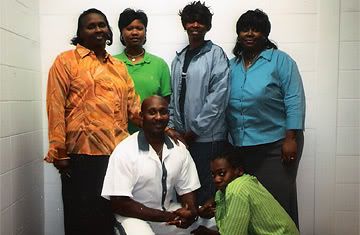
Time reports:
The pending execution of Troy Anthony Davis, scheduled to take place on July 17, is raising serious questions about his guilt — and about the Newt Gingrich-era federal law that has limited his appeals options and prevented him, say his supporters, from getting a fair shake.
Davis, 38, a former coach in the Savannah Police Athletic League who had signed up for the Marines, was convicted in the 1989 murder of Mark Allen MacPhail, a Savannah, Ga., police officer. MacPhail was off-duty when he was shot dead in a Savannah parking lot while responding to an assault. Davis was at the scene of the crime, and an acquaintance who was there with him accused Davis of being the shooter. Since his conviction in 1991, Davis has seen each of his state and federal appeals fail. But in the court of public opinion, Davis presents a compelling argument. Seven of the nine main witnesses whose testimony led to his conviction have since recanted. The murder weapon has never been found, and there is no physical evidence linking the crime to Davis, who has asserted his innocence throughout.
Earlier this month, two of the jurors who sentenced Davis to death signed sworn affidavits saying that based on the recanted testimony, he should not be executed. "In light of this new evidence," wrote one juror, "I have genuine concerns about the fairness of Mr. Davis' death sentence."
One of Davis' major obstacles has been the federal Antiterrorism and Effective Death Penalty Act (AEDPA), legislation championed by former House Speaker Newt Gingrich as part of his Contract with America and signed by former president Bill Clinton. The act was passed in 1996 as a way of reforming what Gingrich called "the current interminable, frivolous appeals process." Its major provisions reduced new trials for convicted criminals and sped up their sentences by restricting a federal court's ability to judge whether a state court had correctly interpreted the U.S. Constitution.
Facing political pressure one year after the Oklahoma City bombing and seven months before the presidential election, Clinton signed the bill, but inserted a somewhat incongruous signing statement that called for the federal courts to continue their oversight role.
That was wishful thinking, say many legal experts. "President Clinton was trying to have his cake and eat it, too," said George Kendall, senior counsel at Holland and Knight and a board member of the Death Penalty Information Center. The reality since 1996, legal analysts say, has been a U.S. Supreme Court that has narrowly interpreted the act, further restraining the ability of federal courts to grant new trials (on June 25, the U.S. Supreme Court refused to give Davis one last hearing). "The bottom line," said Dale Baich, an assistant federal public defender in Arizona, "is that the AEDPA is very harsh and unforgiving."
So now there are serious questions whether, as Gingrich famously said, justice delayed is justice denied. The system of appeals can still stretch out over decades, but in Davis' case, many of those appeals are now being denied for procedural reasons. In his 2004 petition to the federal district court in Savannah, Davis presented recanted testimony, most of which involves witnesses who say police coercion caused them to wrongly implicate Davis. He also presented nine individuals' affidavits that suggested that the real murderer was actually the former acquaintance who first accused Davis of the crime.
The federal judge rejected the petition since, under the current law, the evidence must first be presented in state court. But Tom Dunn, the executive director of the Georgia Resource Center, which helped represent Davis, says that funding trouble prevented the center from presenting the evidence in state court in the first place. Tracking down witnesses costs money, but in 1995, just as Dunn's colleagues had been preparing Davis' appeal, Congress eliminated $20 million in funding to post-conviction defender organizations like the Georgia center, which lost 70% of its budget. Six of the center's eight lawyers left, as well as three of its four investigators, and Davis' case became one of about 80 that Beth Wells, then executive director, had to handle with her co-director.
"The work conducted on Mr. Davis' case was akin to triage," Wells wrote in an affidavit, "where we were simply trying to avert total disaster rather than provide any kind of active or effective representation...There were numerous witnesses that we knew should have been interviewed, but lacked the resources to do so."
Georgia officials insist that Davis' failed 2004 federal court hearing is proof he has had his opportunity in court with the new evidence. "They've had a chance to challenge the conviction," said David Lock, chief assistant district attorney in Chatham County, where Savannah is located.
Davis' attorney has been filing a flurry of requests for a stay of execution until a new trial can be held. Meanwhile Davis' sister, Martina Correia, has helped assemble an diverse group of advocates — from Dead Man Walking author Sister Helen Prejean to South African Archbishop Desmond Tutu to former FBI director William S. Sessions (a death penalty supporter) — to petition the Georgia Board of Pardons and Paroles to commute Davis' sentence to life in prison when it meets on July 16, the day before he's scheduled to die by lethal injection.
Correia has watched her brother spend half his life in prison. This case is not only about him, she says, but it's also about a law that short-changes the convicted. "If for any reason [the last-minute appeal] doesn't go the right way, Georgia is going to be so shamed," she said. "I just don't want my brother to have to be executed to be the catalyst for change."
