No OK from Congress seen; Constitutional issues raised
The Boston Globe reports:
President Bush's plan to forge a long-term agreement with the Iraqi government that could commit the US military to defending Iraq's security would be the first time such a sweeping mutual defense compact has been enacted without congressional approval, according to legal specialists.
After World War II, for example - when the United States gave security commitments to Japan, South Korea, the Philippines, Australia, New Zealand, and NATO members - Presidents Truman and Eisenhower designated the agreements as treaties requiring Senate ratification. In 1985, when President Ronald Reagan guaranteed that the US military would defend the Marshall Islands and Micronesia if they were attacked, the compacts were put to a vote by both chambers of Congress.
By contrast, Bush and Iraqi Prime Minister Nouri Al-Maliki have already agreed that a coming compact will include the United States providing "security assurances and commitments" to Iraq to deter any foreign invasion or internal terrorism by "outlaw groups." But a top White House official has also said that Bush does not intend to submit the deal to Congress.
"We don't anticipate now that these negotiations will lead to the status of a formal treaty which would then bring us to formal negotiations or formal inputs from the Congress," General Douglas Lute, Bush's deputy national security adviser for Iraq and Afghanistan, said in November when the White House announced the plan.
Lute's disclosure initially attracted little scrutiny. Most of the attention has instead focused on whether the pact could make it more difficult for the United States to withdraw from Iraq after Bush leaves office. Although the next president could scrap the agreement, reneging on the compact would create diplomatic problems by showing that the nation does not live up to its obligations, specialists say.
But there is now also growing alarm about the constitutional issues raised by Bush's plan. Legal specialists and lawmakers of both parties are raising questions about whether it would be unconstitutional for Bush to complete such a sweeping deal on behalf of the United States without the consent of the legislative branch.
"There is literally no question that this is unprecedented," said Oona Hathaway, a Yale Law School professor who has written a forthcoming law journal article about the proposed Iraq agreement. "The country has never entered into this kind of commitment without Congress being involved, period."
At a House hearing on the pact on Wednesday, Representative Dana Rohrabacher, Republican of California and a former Reagan administration official, accused the Bush administration of "arrogance" for not consulting with Congress about the pact. If it includes any guarantees to Iraq, he said, Congress must sign off.
"We are here to fulfill the constitutional role established by the founding fathers," Rohrabacher said, adding, "It is not all in the hands of the president and his appointees. We play a major role."
Bush and Maliki have said they intend to complete the agreement by July 31. The two countries need to reach some kind of an agreement this year in order to create a legal framework for the continued presence of US troops in Iraq after Dec. 31, when a United Nations Security Counsel mandate is due to expire.
But the "long-term relationship of cooperation and friendship" outlined in November goes far beyond an ordinary status-of-forces agreement. It would include promises of debt forgiveness, economic and technical aid, facilitating "especially American investments" in Iraq - and the security commitments, according to Bush and Maliki's joint declaration last November.
Facing mounting criticism over its assertion that Bush can reach such an agreement on his own, the administration has sent mixed signals about whether it intends to follow through on the plan. The New York Times today reported that administration officials told a reporter that the final pact may not have security guarantees after all, but the article did not identify its sources.
Officially, the administration has not changed the plans it announced in November. Asked to respond to the critics who say that such a pact must be approved by Congress, White House National Security Council spokesman Gordon Johndroe and Secretary of Defense Robert Gates each said that it was premature to talk about the pact because its final text has not yet been negotiated.
"I haven't been involved in any discussions of what kind of form the agreement would take or anything else," Gates said at press conference yesterday. "I do know there's a strong commitment inside the administration to consult very closely with the Congress on this."
But Representative Bill Delahunt, Democrat of Massachusetts, who chaired the hearing on Wednesday, asked four top administration officials - Lute, Undersecretary of Defense for Policy Eric Edelman, and the State Department's top legal and Iraq advisers, John Bellinger and David Satterfield - to appear and explain the administration's intentions. All four declined.
However, Lute may have offered a clue to the administration's legal arguments during the November press conference when he noted that "We have about a hundred agreements similar to the one envisioned for the US and Iraq already in place, and the vast majority of those are below the level of a treaty." Johndroe, the White House spokesman, also mentioned the existence of such agreements in a Globe interview this week.
Legal specialists, however, say that the numerous pacts that were completed without congressional consent are not similar to the agreement Bush and Maliki outlined in November.
Other such "status-of-forces agreements" are far more limited contracts with countries that host US military bases, covering comparatively minor issues such as leasing arrangements and which country will prosecute any US soldiers accused of committing a crime.
By contrast, Senate Foreign Relations Committee Chairman Joe Biden told Bush in a letter released yesterday, "As a matter of constitutional law, and based on over 200 years of practice," Bush could not commit the US military to protecting Iraq's security without congressional consent.
"A commitment that the United States will act to assist Iraq, potentially through the use of our armed forces in the event of an attack on Iraq, could effectively commit the nation to engage in hostilities," Biden wrote. "Such a commitment cannot be made by the executive branch alone under our Constitution."
Biden said yesterday he had received no reply to the letter, which he sent late last month.
Adding to the pressure, Democratic presidential candidate Hillary Clinton has also repeatedly raised the topic in recent days. The New York senator has filed legislation that would block the expenditure of funds to implement any agreement with Iraq that was not submitted to Congress for approval. Her rival, Senator Barack Obama of Illinois, became a cosponsor to the bill on Tuesday.
"We've got to rein in President Bush," Clinton said Monday in a South Carolina debate. "We need legislation in a hurry."
Friday, January 25, 2008
| [+/-] |
Bush Plan For Iraq Would Be A First |
Tuesday, May 15, 2007
| [+/-] |
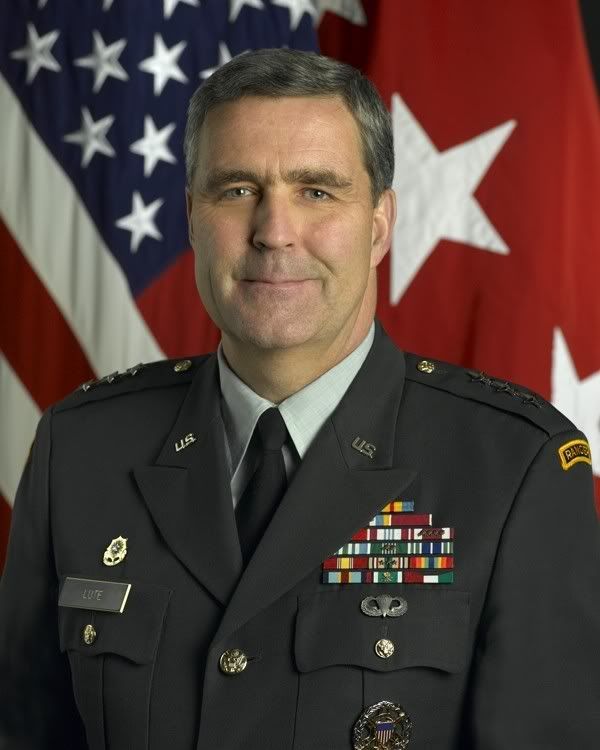
Profiles: Lt. General Douglas Lute |
Bio - Lieutenant General Douglas Lute:
Director for Operations, J-3
Douglas E. Lute, originally from Michigan City, Indiana, graduated from the United States Military Academy at West Point in 1975. His first assignment was to the Second Armored Cavalry Regiment in Bindlach, Germany, where he commanded C Troop. He received a master's degree from Harvard University and taught in the Social Sciences department at West Point.
Following attendance at the British Army Staff College, he returned to the Second Cavalry as operations officer, serving both at the squadron and regimental levels. In 1990-91 he deployed and fought with the Regiment in Operation DESERT STORM, and later served on the staff of the Chief of Staff of the Army.
He commanded 1st Squadron, 7th Cavalry at Fort Hood, Texas from 1992-94. He then served on the Joint Staff in the Directorate for Strategic Plans and Policy, J-5, and held a War College Fellowship at the Atlantic Council in Washington.
From 1998-2000 he commanded the Second Cavalry Regiment, part of XVIII Airborne Corps, at Fort Polk, Louisiana. He served next as the executive assistant to the Chairman of the Joint Chiefs of Staff for 14 months before joining the First Infantry Division in Schweinfurt, Germany, as the Assistant Division Commander. He commanded Multi-national Brigade East in Kosovo for 6 months in 2002 before being assigned to US European Command in January 2003 as the Deputy Director of Operations.
In June 2004, he began more than two years as Director of Operations (J-3) at US Central Command during which he oversaw combat operations in Iraq and Afghanistan as well as other operations in the Middle East, Central Asia, and the Horn of Africa. He assumed duties as Director of Operations, the Joint Staff, in September 2006.
| [+/-] |
Bush Selects 'War Czar' |
The NY Times reports:
The White House said this afternoon that President Bush ended his lengthy search for a “war czar” to carry out Iraq and Afghanistan policy by offering the job to an active duty three-star Army general who said in his interview that he had been skeptical of the troop buildup in Iraq.
Mr. Bush selected Lt. Gen. Douglas Lute, currently the top operations officer for the Pentagon’s Joint Chiefs of Staff, for the position. It would carry the rank of assistant to the president and deputy national security adviser; General Lute will retain his active military status and, therefore, must be confirmed by the Senate, which approves new assignments for three- and four-star generals.
“We needed to get the right concept, the right man — or woman — and we have,” said Stephen J. Hadley, the national security adviser, who led the search, in an interview this evening.
If he is confirmed, General Lute would report directly to the president. His job, which is part of a broader reorganization of the National Security Council staff responsible for Iraq and Afghanistan, would be to brief Mr. Bush every day on the two conflicts, and work with other government agencies — the Pentagon, State Department and others – to carry out the policy.
In a statement, Mr. Bush called General Lute “a tremendously accomplished military leader who understands war and government and knows how to get things done,” adding that the general had “played an integral role in implementing combat operation plans in Iraq and Afghanistan.”
But even before the White House had made the news public, war opponents were using the impending announcement to take shots at the administration’s Iraq policy. Americans Against Escalation in Iraq, an advocacy group, quickly issued a statement citing a remark General Lute made in an interview with The Financial Times in August 2005, in which he argued for significant troop reductions. “You simply have to back off and let the Iraqis step forward,” General Lute said at the time, , adding, “You have to undercut the perception of occupation in Iraq.”
A spokesman said General Lute was not available for comment this evening. But Mr. Hadley said the general had expressed his doubts, but now supports the strategy.
“He said to me when he interviewed for this position, ‘Now, you need to understand that I was skeptical of the surge,’ ” Mr. Hadley recalled. He said that General Lute, who helped to develop the so-called surge strategy of adding about 30,000 troops to Iraq, had raised questions about whether “Iraqi security forces would step up and contribute what they were supposed to do,” and whether the Iraqi government was committed to political reconciliation and providing economic resources.
“We developed a strategy that we thought answered those questions,” Mr. Hadley said, adding, “He’s saying that he supports the strategy, very clearly supports the strategy.”
The White House has spent more than a month searching for a high-profile general to fill what Mr. Hadley has described as an “implementation and execution manager” for the conflicts.
The idea for the position has proven controversial. Some critics have said Mr. Hadley was abandoning responsibility for Iraq and Afghanistan, while others cautioned against putting a military person in what had traditionally been a civilian role.
And the job proved difficult to fill. Several retired generals said they were not interested; one, Jack Sheehan, wrote about his discussions with the White House in an opinion piece in The Washington Post, saying: “We got it right during the early days of Afghanistan — and then lost focus. We have never gotten it right in Iraq.” .
Mr. Hadley said this evening that while he had spoken to a number of people about their interest and availability for the new position, no one had received a formal offer until General Lute met with the president on Monday. Mr. Hadley said the White House is also in the process of hiring two deputies to work for the general, one to cover Iraq and the other to cover Afghanistan.
Anthony H. Cordesman, a military analyst at the Center for Strategic and International Studies in Washington, said it was no surprise that people were reluctant to take the job. “It certainly isn’t a big catch for the appointee,” Mr. Cordesman said of General Lute. “You have a very competent person perhaps placed in an impossible job who almost certainly sees this as standing up to a duty which is anything but likely to be career enhancing.”
