Halloween incident where police shocked teen sheds light on issue; critics complain kids as young as 6 can be Tasered.
The Atlanta Journal-Constitution reports:
Last week's use of a Taser stun gun on a handcuffed 14-year-old trick or treater is within Gwinnett County police policy, which has no age provision, police said.
The only protection in the policy is for pregnant women because it could induce labor.
So what about a 5- or 6-year-old?
That's OK, according to Gwinnett police policy.
"People who are handcuffed are still a threat no matter what age," said Cpl. Illana Spellman, a Gwinnett County Police Department spokeswoman.
Taser shocks of youths, though, have been questioned by critics, including Amnesty International.
"We have heard about cases all over the nation, even the tasing of a 6-year-old boy in Miami," said Jared Feuer, a spokesman for the organization. "We believe the use of force on any child is excessive force. It doesn't matter if it does not violate police policy."
The Halloween night Taser shock of the teen is being reviewed by Gwinnett police supervisors.
But police brass have said that they don't believe the incident warrants an internal affairs investigation.
During the incident in a subdivision near Snellville, Officer W.A. Bohn was working off-duty detail when he heard the teen cursing loudly near young children, according to a police report.
After the teen tried to punch the officer, he called for backup and was able to get the girl handcuffed with the help of another officer.
The girl was shocked one time with the Taser after she continued to struggle, police said.
The use of the Taser has been a controversial subject across the nation.
Proponents say the 50,000-volt stun gun saves lives and injuries by stopping incidents from escalating to deadly force.
Opponents say the device needs to be studied more, can be misused and may have led to numerous deaths.
Frank Rotondo, director of the Georgia Association of Chiefs of Police, said his organization has studied the Taser and believes age should not be the deciding factor in use. "You would hope that you would not have to use the Taser on anyone, especially a child," Rotondo said Monday. "But you have to look at the behavior of the individual rather than the age. And in the Gwinnett case, the Taser was able to stop the behavior."
Gwinnett police Maj. Keybo Taylor said he is reviewing the incident.
Taylor said he has asked the foster mother of the teen to come to the Police Department to discuss the incident. However, the woman has refused.
"We are still reviewing it to see if any policies were violated, and so far we do not see any policies violated," Taylor said.
Tuesday, November 6, 2007
| [+/-] |
No Age Limit on Gwinnett, Georgia Police Taser Policy |
Sunday, November 4, 2007
| [+/-] |
Atlanta Water Use is Called 'Shortsighted' |
The rapidly growing metropolis' 'cavalier' attitude toward conservation is the real problem, critics say.
The LA Times reports:
When Rick McKee, the editorial cartoonist of the Augusta Chronicle newspaper, set out to capture the historic and severe drought that is afflicting the Southeast, he did not draw parched rivers or shriveled crops or brown lawns: He drew an oafish, bloated hulk of a boy holding up a straw to slurp up water from a smaller boy's water fountain.
Above the larger boy, a sign reads "Atlanta," above the other, "Everybody else."
It is, in many ways, a cartoon that sums up feelings across the Southeast now that Lake Lanier, the reservoir that supplies drinking water to most of metropolitan Atlanta's 5 million residents, is draining to historic lows. With government officials issuing stark projections that Atlanta could run out of water within three months, Georgia politicians have pleaded with the U.S. Army Corps of Engineers to decrease the amount of water being released. The flow has been required to save two species of mussels 200 miles downriver.
Yet while Georgia's leaders try to cast the water shortage as a battle between 5 million people and a few mussels -- with the message that greater priority should be given to Atlanta residents -- there is a growing sense that the metropolis itself is the problem: Critics say Atlanta's rapid population growth, coupled with blithe disregard for water conservation, is straining the region's ecosystem.
A break came Thursday in Georgia's 17-year water war with Florida and Alabama: The GOP governors of the three states agreed to reduce by 16% the amount of water released downriverfrom Lake Lanier, which would slow the drain on Atlanta's main water source.
But experts say the Southeast's struggles over water resources are far from over.
"What was not on the table, and what has got to be on the table, is Atlanta's unrestricted growth and cavalier attitude to water use," said Sally Bethea, executive director of Upper Chattahoochee Riverkeeper, a watchdog group.
Such concerns are not coming just from environmental lobbyists, who have long argued that Atlanta must do more to conserve water.
Florida Gov. Charlie Crist, in opposing a request by Georgia Gov. Sonny Perdue to President Bush to permit a reduced downstream flow, wrote in his own letter to Bush that Florida's $134-million commercial seafood industry depended on the water. Crist added that his state had acted responsibly in enacting water legislation. Alabama Gov. Bob Riley argues that downstream communities and a nuclear power plant in his state require water too.
Even within Georgia, the drought has brought to the fore long-simmering resentment against the booming capital of the New South. About 140 miles east in Augusta, which sits on the Savannah River, there is concern that Atlanta could slake its thirst on Augusta's water supplies. Last month, Atlanta Mayor Shirley Franklin suggested that Atlanta explore piping in water from the Savannah or Tennessee rivers.
"Atlanta is a greedy, poorly designed behemoth of a city incapable of hearing the word 'no' and dealing with it," said a recent editorial in the Valdosta (Ga.) Daily Times.
The editorial said Atlanta's "politicians can't bring themselves to tell their greedy constituents complaining about the low flows in their toilets this week that perhaps if they didn't have six bathrooms, it might ease the situation a bit."
Atlanta is not the only city grappling with water shortages. In 2003, a Government Accountability Office report on the nation's freshwater supply found that 36 states anticipated water shortages in the next decade.
Two months ago, a federal judge in California ordered protective measures for the tiny endangered smelt fish in the Sacramento-San Joaquin River Delta, a mandate that water officials said could cut by a third the flow of water to Southern California from the north.
Yet while cities such as Los Angeles, Las Vegas and Denver have ushered in water conservation measures -- including offering incentives, installing high-efficiency toilets and low-flow shower heads, and increasing monthly water bills for big water users -- experts say Atlanta, one of the fastest-growing metropolitan regions in the country, has been particularly shortsighted.
Atlanta was founded far from any major river or lake. The metro area had a population of 2.9 million in 1990 and 4.1 million in 2000, and its daily draw on the water reserve was 320 million gallons in 1990 and 420 million in 2000.
With 2 million more residents projected by 2030, water use is expected to rise to more than 700 million gallons a day.
For its drinking water, Atlanta relies almost entirely on Lake Lanier, a 38,000-acre reservoir in northern Georgia built in the 1950s.
"If your population is growing, you cannot expect to do the same old things you did a decade ago," said Chris Brown, executive director of the California Urban Water Conservation Council. "You have to change the way you behave."
This has not happened in Atlanta, conservationists say. In 2003, the area's 16-county Metropolitan North Georgia Water Planning District adopted a water conservation plan. Yet most counties have not implemented the recommendations, such as reducing leaks and raising billing rates for those who use more water.
Last year, a bill failed in the state House of Representatives that would have required older homes to be retrofitted with low-flow fixtures before they were resold.
Some environmentalists are questioning whether Atlanta can handle 2 million more people.
"Conservation may not be the answer in and of itself," said Elizabeth Nicholas, general counsel for Upper Chattahoochee Riverkeeper. "There just isn't enough fresh water here to support major growth. We need to be smarter about how and where we're growing."
Conservationists' suggestion that the state should prohibit building if no water is available rankles developers and the business community.
"People are coming to this state whether environmentalists like it or not," said Ed Phillips, executive vice president of the Home Builders Assn. of Georgia. "What are we going to do? Put up a fence?"
Many of Georgia's political leaders say the solution to the drought is not to stop developing but to manage water more efficiently, building more reservoirs to enhance water storage.
"We have not consumed our way into drought," said Carol Couch, director of the Environmental Protection Division of the Georgia Department of Natural Resources. She said there must be planning to accommodate growth, including building more reservoirs and encouraging residents to conserve and reuse water.
Conservationists have traditionally opposed additional reservoirs, arguing they would lead to much water loss through evaporation and would severely affect the environment.
Last month, Georgia Republicans Lt. Gov. Casey Cagle and House Speaker Glenn Richardson proposed legislation that would commit millions of dollars in the 2008 session to build reservoirs and enlarge existing ones.
For now, as water levels at Lake Lanier drop about a foot a week, Atlantans have been urged to shorten showers and to report neighbors who violate the ban on outdoor watering. Businesses have been asked to cut water use by 10%.
Last week's tri-state compromise is awaiting approval by the U.S. Fish and Wildlife Service. The agency is expected to issue its opinion by the middle of this month after assessing how the reduced flows could affect the endangered fat threeridge and threatened purple bankclimber mussels in Florida's Apalachicola River. The U.S. Army Corps of Engineers would execute any change.
Saturday, October 20, 2007
| [+/-] |
Georgia Governor Declares State of Emergency Due to Drought |
The Atlanta Journal-Constitution reports:
Gov. Sonny Perdue declared a state of emergency in most of Georgia on Saturday, and called on President Bush to recognize that the historic drought had created a disaster for 85 counties.
In a defiant plea Saturday at Lake Lanier, Perdue asked Bush to issue a federal disaster designation that would:
• Empower the president to order less water released from Lake Lanier.
• Make federal funds available to state and local governments.
• Offer low-interest loans to Georgia businesses hurt by the drought.
"We will continue to conserve," the governor said, "but we have to have help."
Perdue's actions came as the federal government continued to release water from Lake Lanier to protect endangered mussels in Florida at the expense of water-starved North Georgia.
The governor, lieutenant governor, two congressmen and several legislators and state officials gathered at the top of a trio of now-landlocked boat ramps at Lake Lanier to deride the U.S. Army Corps of Engineers and the U.S. Department of Fish and Wildlife for "putting mussels in front of people."
They also accused the federal agencies of endangering one of the country's most populated areas, which is seeing its drinking water disappear down the Chattahoochee River for the Gulf of Mexico.
Perdue's state of emergency declaration and request of a federal disaster declaration are the latest tactics in the escalating war between Georgia and the federal government over how much water can be released from Lake Lanier.
"The actions of the Army Corps of Engineers and the Fish and Wildlife Service are not only irresponsible, they are downright dangerous," Perdue said at Saturday's news conference at Mary Alice Park, just yards from the retreating lake.
"If the Corps and the Fish and Wildlife Service do not act now, I will hold them fully responsible for endangering the people of Georgia. Any harm that comes to humans is 100 percent on their hands."
Perdue said he had asked for the federal disaster designation because "we need the president to cut through the tangle of unnecessary bureaucracy to manage our resources prudently so that, in the long term, all species may have access to clean water."
Until now, Georgia's efforts to ride out the dry spell and a shrinking water source have focused on conservation. But Perdue insisted conservation was not enough.
Georgia on Friday filed a federal lawsuit in Jacksonville, asking the court to force the Corps to reduce releases from Lake Lanier until March 1.
"We are experiencing the single worst drought in Georgia history," Perdue said. "On top of that, we are mired in a manmade disaster of federal bureaucracy."
Officials estimate Lake Lanier will be at the "dead pool level" within 80 days. At that point, also known as the "bottom of the conservation pool," the water level will be below pipes used to remove the water. Special equipment will be needed to retrieve it.
"Is there water in there that can be use? Yes. But it's not high quality," said Carol Couch, director of the Georgia Environmental Protection Division.
That water will contain more sediment and minerals, some of which are difficult to remove, and likely will have a different taste and color even after treatment, Couch said.
Col. Byron Jorns — head of the U.S. Army Corps of Engineers' Mobile District, which oversees Lake Lanier — insisted the Atlanta area is not at immediate risk of running out of drinking water.
"There is water available for the drinking water needs of metro Atlanta for the next several months and well beyond," Jorns said. "The bottom of the conservation pool does not mean the bottom of the lake."
"That water is still available. In terms of folks going thirsty, that is an event that is well into the future."
Tuesday, October 16, 2007
| [+/-] |
Drought Tightens Its Grip on Southeast U.S. |
The Associated Press reports:
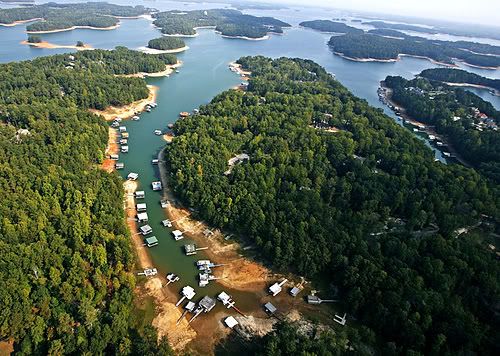
If there's a ground zero for the epic drought that's tightening its grip on the South, it's once-mighty Lake Lanier, the Atlanta water source that's now a relative puddle surrounded by acres of dusty red clay.
Tall measuring sticks once covered by a dozen feet of water stand bone dry. "No Diving" signs rise from rocks 25 feet from the water. Crowds of boaters have been replaced by men with metal detectors searching the arid lake bed for lost treasure.
"This lake is a survivor," Jeff "Buddha" Powell told a worried customer at his bait shop along the barren banks.
"If you panic, you don't help Mother Nature," he added. "It's going to rain when it rains."
But little rain is in the forecast, and without it climatologists say the water source for more than 3 million people could run dry in just 90 days.
That dire prediction has some towns considering more drastic measures than mere lawn-watering bans, including mandatory rationing that would penalize homeowners and businesses if they don't reduce water usage.
"We're way beyond limiting outdoor water use. We're talking about indoor water use," said Jeff Knight, an environmental engineer for the college town of Athens, 60 miles northeast of Atlanta, which is preparing a last-ditch rationing program as its reservoir dries up.
"There has to be limits to where government intrudes on someone's life, but we have to impose a penalty on some people," he added. "The problem is how much and who. That gets political. But it's going to hurt everyone. We're all going to share the pain."
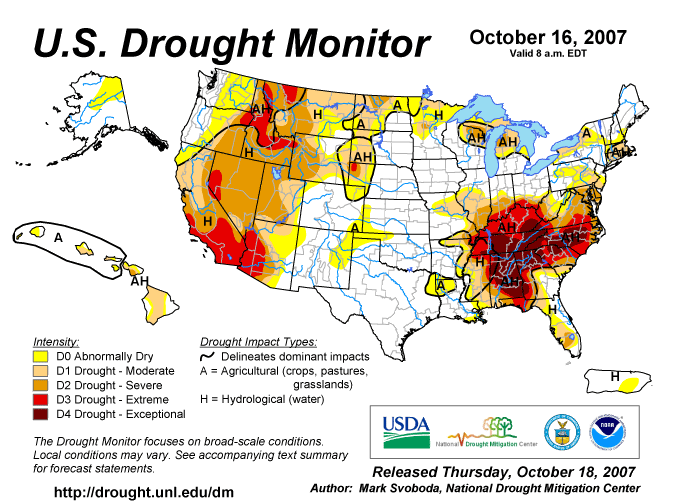
About 26 percent of the Southeast is covered by an "exceptional" drought — the National Weather Service's worst drought category. The affected area extends like a dark cloud over most of Tennessee, Alabama and the northern half of Georgia, as well as parts of North and South Carolina, Kentucky and Virginia.
The only spots in the region not suffering from abnormally dry conditions are parts of southern and eastern Florida and southeast Georgia.
Government forecasters say the drought started in parts of Georgia and Alabama in early 2006 and spread quickly. Sweltering temperatures and a drier-than-normal hurricane season contributed to the parched landscape.
Now residents are starting to feel the pinch.
Restaurants are being asked to serve water only at a customer's request, and Gov. Sonny Perdue has called on Georgians to take shorter showers. The state could also impose more limits within the next two weeks, possibly restricting water for commercial and industrial users.
In North Carlina, Gov. Mike Easley stopped short of imposing statewide water rationing but asked people to stop watering lawns and washing cars.
"A bit of mud on the car or patches of brown on the lawn must be a badge of honor," Easley said today. "It means you are doing the right thing for your community and our state."
As conditions worsen, the Army Corps of Engineers has become a favorite target of lawmakers in Georgia, Florida and Alabama, where the drought has intensified a decades-old feud involving how the Corps manages water rights.
"I particularly am disappointed that the Corps has allowed so much water to drain out of our reservoirs, out of our lakes, as they have," said Georgia Lt. Gov. Casey Cagle, a Republican. "It's not that we haven't had enough water. It's more a function of allowing so much of it to go downstream."
On Friday, Perdue threatened to take legal action if the Corps continued to let more water out of a north Georgia water basin than it collects. And the president of the Metro Atlanta Chamber of Commerce said that businesses could also line up behind a legal challenge.
"We have an ongoing water crisis in metro Atlanta. And it is the biggest and most imminent economic threat to our region," said Sam Williams, the chamber's president.
Scientists have little reason to hope the drought will ease anytime soon.
The Southeast Climate Consortium warns that a La Nina weather system is forming, which could bring drier and warmer weather for Florida and most parts of Alabama and Georgia.
"When we need to recharge our water system, this is what we don't want," said state climatologist David Stooksbury, who predicted that it will take months of above-average rainfall to recoup the losses.
In Atlanta, officials are nervously watching the dropping level of Lake Lanier, the sprawling north Georgia reservoir that provides water for 1 in 3 Georgia residents. The latest measurements have become a fixture on nightly television newscasts in Atlanta, where the drought is often the top story.
There is a silver lining of sorts in the middle of the drought: Guides say the lake's fishing is as good as ever, if not better.
"Less water, less places to hide, I guess," said Chuck Biggers, a guide who has roamed the lake's waters for four years.
Friday, July 13, 2007
| [+/-] |
Will Georgia Kill An Innocent Man? |
Time reports:
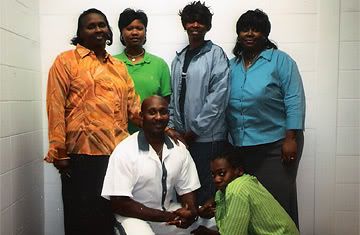
The pending execution of Troy Anthony Davis, scheduled to take place on July 17, is raising serious questions about his guilt — and about the Newt Gingrich-era federal law that has limited his appeals options and prevented him, say his supporters, from getting a fair shake.
Davis, 38, a former coach in the Savannah Police Athletic League who had signed up for the Marines, was convicted in the 1989 murder of Mark Allen MacPhail, a Savannah, Ga., police officer. MacPhail was off-duty when he was shot dead in a Savannah parking lot while responding to an assault. Davis was at the scene of the crime, and an acquaintance who was there with him accused Davis of being the shooter. Since his conviction in 1991, Davis has seen each of his state and federal appeals fail. But in the court of public opinion, Davis presents a compelling argument. Seven of the nine main witnesses whose testimony led to his conviction have since recanted. The murder weapon has never been found, and there is no physical evidence linking the crime to Davis, who has asserted his innocence throughout.
Earlier this month, two of the jurors who sentenced Davis to death signed sworn affidavits saying that based on the recanted testimony, he should not be executed. "In light of this new evidence," wrote one juror, "I have genuine concerns about the fairness of Mr. Davis' death sentence."
One of Davis' major obstacles has been the federal Antiterrorism and Effective Death Penalty Act (AEDPA), legislation championed by former House Speaker Newt Gingrich as part of his Contract with America and signed by former president Bill Clinton. The act was passed in 1996 as a way of reforming what Gingrich called "the current interminable, frivolous appeals process." Its major provisions reduced new trials for convicted criminals and sped up their sentences by restricting a federal court's ability to judge whether a state court had correctly interpreted the U.S. Constitution.
Facing political pressure one year after the Oklahoma City bombing and seven months before the presidential election, Clinton signed the bill, but inserted a somewhat incongruous signing statement that called for the federal courts to continue their oversight role.
That was wishful thinking, say many legal experts. "President Clinton was trying to have his cake and eat it, too," said George Kendall, senior counsel at Holland and Knight and a board member of the Death Penalty Information Center. The reality since 1996, legal analysts say, has been a U.S. Supreme Court that has narrowly interpreted the act, further restraining the ability of federal courts to grant new trials (on June 25, the U.S. Supreme Court refused to give Davis one last hearing). "The bottom line," said Dale Baich, an assistant federal public defender in Arizona, "is that the AEDPA is very harsh and unforgiving."
So now there are serious questions whether, as Gingrich famously said, justice delayed is justice denied. The system of appeals can still stretch out over decades, but in Davis' case, many of those appeals are now being denied for procedural reasons. In his 2004 petition to the federal district court in Savannah, Davis presented recanted testimony, most of which involves witnesses who say police coercion caused them to wrongly implicate Davis. He also presented nine individuals' affidavits that suggested that the real murderer was actually the former acquaintance who first accused Davis of the crime.
The federal judge rejected the petition since, under the current law, the evidence must first be presented in state court. But Tom Dunn, the executive director of the Georgia Resource Center, which helped represent Davis, says that funding trouble prevented the center from presenting the evidence in state court in the first place. Tracking down witnesses costs money, but in 1995, just as Dunn's colleagues had been preparing Davis' appeal, Congress eliminated $20 million in funding to post-conviction defender organizations like the Georgia center, which lost 70% of its budget. Six of the center's eight lawyers left, as well as three of its four investigators, and Davis' case became one of about 80 that Beth Wells, then executive director, had to handle with her co-director.
"The work conducted on Mr. Davis' case was akin to triage," Wells wrote in an affidavit, "where we were simply trying to avert total disaster rather than provide any kind of active or effective representation...There were numerous witnesses that we knew should have been interviewed, but lacked the resources to do so."
Georgia officials insist that Davis' failed 2004 federal court hearing is proof he has had his opportunity in court with the new evidence. "They've had a chance to challenge the conviction," said David Lock, chief assistant district attorney in Chatham County, where Savannah is located.
Davis' attorney has been filing a flurry of requests for a stay of execution until a new trial can be held. Meanwhile Davis' sister, Martina Correia, has helped assemble an diverse group of advocates — from Dead Man Walking author Sister Helen Prejean to South African Archbishop Desmond Tutu to former FBI director William S. Sessions (a death penalty supporter) — to petition the Georgia Board of Pardons and Paroles to commute Davis' sentence to life in prison when it meets on July 16, the day before he's scheduled to die by lethal injection.
Correia has watched her brother spend half his life in prison. This case is not only about him, she says, but it's also about a law that short-changes the convicted. "If for any reason [the last-minute appeal] doesn't go the right way, Georgia is going to be so shamed," she said. "I just don't want my brother to have to be executed to be the catalyst for change."
Wednesday, June 27, 2007
| [+/-] |
Justice Georgia-Style |
Judge rules "No bond for Genarlow Wilson"; Bond hearing canceled, ruling could keep him in jail for months
The Atlanta Journal-Constitution reports:
A Douglas County judge ruled Wednesday Genarlow Wilson is not eligible for bond in his child molestation case, a development that could keep Wilson behind bars for at least several more months pending an appeal.
Superior Court Judge David Emerson issued an order canceling a July 5 bond hearing for Wilson. He cited a state law that prohibits appeal bonds for people convicted of Wilson's crime -- aggravated child molestation -- and who have been sentenced to five years or more in prison. Wilson is now serving a 10-year prison sentence.
"As the court has no authority to grant an appeal bond in this case, there is no need for an evidentiary hearing on the defendant's eligibility for a bond," Emerson wrote in his three-page order. "The motion for bond is dismissed. The hearing scheduled for July 5, 2007, is therefore cancelled."
Civil rights officials reacted angrily to Emerson's ruling.
"The NAACP is convinced that justice has taken a summer vacation in Georgia," said Dr. Francys Johnson, the organization's Southeast Regional Director.
Johnson called the order "the latest of series of rulings that strains common sense and leave the overwhelming impression that the system is working overtime to keep Genarlow Wilson behind bars."
The Rev. Joseph Lowery, a veteran civil rights activist and former Southern Christian Leadership Conference president, said he suspects racism and classism are at play in Wilson's case.
"I suspect it transcends race," he said at an impromptu news conference beside the tomb of the Rev. Martin Luther King Jr. "I suspect a Latino, a poor white as well as a black probably get the same treatment.
"I doubt that one of the affluent Caucasians of Douglas County would get that kind of treatment," said Lowery.
All the defendants and victims in the case as well as state Attorney General Thurbert Baker, however, are black. And of the 1,322 men and women who are in prison for aggravated child molestation charges, 967 are white, 344 are black and the rest are of other races.
Wilson was convicted of aggravated child molestation for receiving oral sex from the 15-year-old girl at a 2003 New Year's Eve party. The age of consent in Georgia is 16. The law at the time required a minimum 10-year prison sentence for the crime.
The Legislature, however, changed the law last year to make the same offense a misdemeanor, punishable by up to a year in prison. Wilson, now 21, has served more than two years of his sentence.
This month, a Monroe County Superior Court judge threw out Wilson's prison sentence and reduced his conviction to a misdemeanor, calling his case a "grave miscarriage of justice." In making his ruling, the judge granted an appeal from Wilson's attorneys, who argued his prison sentence is cruel and unusual punishment under the Constitution.
Baker has appealed the Monroe County judge's decision to the Georgia Supreme Court, arguing the judge overstepped his authority.
Baker filed a request for an expedited review by the court, but the court rejected his request last week. The earliest date the case could come before the court is October. And it could take until April of next year to be decided.
Judge Emerson had scheduled the July 5 hearing to decide whether Wilson should be freed on bond pending the appeal. Douglas County District Attorney David McDade and Wilson's attorney, B.J. Bernstein, did not immediately respond to telephone calls for comment on Wednesday. Baker's office did not have an immediate comment.
However, McDade has previously argued Wilson is not eligible for bond since his crime is one of Georgia's so-called seven deadly sins. He also has said Bernstein was being "totally disingenuous" Monday when she held a news conference and called on him to consent to a bond for Wilson.
"The law is clear that he is not eligible for an appeal bond," McDade, whose office originally prosecuted Wilson, said Monday. "I don't know if Ms. Bernstein knows the law or not. I know the judge knows. This is a continuing saga in her three-ring circus.
"I don't try cases in the media," he said. "It is not where you're supposed to try your cases."
Bernstein denied McDade's assertions Monday, insisting that state law does allow for bond in Wilson's situation.
"He is looking at the wrong statute," Bernstein said Monday. "Georgia law allows bond for habeas cases. McDade does not know what he is talking about."
Tuesday, December 19, 2006
| [+/-] |
What's The Matter With Georgia? |

The New York Times reports:
Genarlow Wilson, 20, is serving a prison sentence that shocked his jury, elicited charges of racism from critics of the justice system and even acknowledgment by prosecutors and the State Legislature that it is unjust.
He was sentenced to 10 years in prison without parole for having consensual oral sex with a 15-year-old girl at a New Year’s Eve party, an offense that constituted aggravated child molesting, even though Mr. Wilson was 17.
With Mr. Wilson — a football player, honor student and the first homecoming king at Douglas County High School — nearing two years in prison, the Georgia Supreme Court declined last Friday to hear his appeal.
Mr. Wilson, who is black, is trapped in a legal vise intended to ensure severe penalties for child molesters and other sex offenders, navigating a maze of legal technicalities that for him seems to hold nothing but dead ends. Some critics of the sentence also say Mr. Wilson is caught in a system that metes out disproportionately harsh sentences to black defendants.
Disturbed by Mr. Wilson’s conviction, the Legislature changed the law in March to ensure that most sex between teenagers be treated as a misdemeanor. But the State Supreme Court said legislators had chosen not to make the law retroactive.
“While I am very sympathetic to Wilson’s argument regarding the injustice of sentencing this promising young man with good grades and no criminal history to 10 years in prison without parole and a lifetime registration as a sexual offender,” wrote Justice Carol W. Hunstein, “this court is bound by the Legislature’s determination that young persons in Wilson’s situation are not entitled to the misdemeanor treatment.”
The problem with that argument, legislators on the judicial committee said in interviews Monday, is that the State Constitution prohibits retroactive laws.
Even more confounding, at the time of Mr. Wilson’s offense, a so-called “Romeo and Juliet” exception had already been made for sexual intercourse between teenagers.
“Had Genarlow had intercourse with this girl, had he gotten her pregnant, he could only have been charged with a misdemeanor and punished up to 12 months,” said Brenda Joy Bernstein, Mr. Wilson’s lawyer.
Her client is not eligible for parole, only a reprieve that would not remove his name from the sex offender registry, Ms. Bernstein said.
The prosecutor, David McDade, the district attorney in Douglas County, west of Atlanta, says he has repeatedly offered Mr. Wilson the opportunity to resolve the case with a plea deal, adding that he would have to be treated similarly to the other defendants in the case, who are serving five- to seven-year prison sentences with a chance at parole. They, too, will have to register as sex offenders.
Mr. Wilson is adamant that he will not plead.
“Even after serving time in prison, I would have to register as a sex offender wherever I lived and if I applied for a job for the rest of my life, all for participating in a consensual sex act with a girl just two years younger than me,” he told a reporter for Atlanta magazine last year, adding that he would not even be able to move back in with his mother because he has an 8-year-old sister. “It’s a lifelong sentence in itself. I am not a child molester.”
On New Year’s Eve in 2003, Mr. Wilson and several friends rented a hotel room for a party at which they planned to have plenty of alcohol, marijuana and sex. One friend, goofing around with a video camera, captured much of the action on videotape. A 17-year-old girl reported after leaving the party that she had been gang raped. The tape showed that she was severely intoxicated.
A second girl, 15, also attended the party, but did not drink or smoke. She had what she later said was consensual oral sex with Mr. Wilson. But according to the law, a 15-year-old is below the age of consent. Mr. Wilson went to trial on charges of rape and aggravated child molesting.
After watching parts of the tape, the jury decided that Mr. Wilson had not raped the older girl. But it was bound by law to find him guilty of molesting the 15-year-old. Jurors said afterward they did not know that the charge carried a minimum sentence of 11 years, including 10 without parole.
Juannessa Bennett, Mr. Wilson’s mother, said her son was crushed by the Supreme Court decision.
“We’ve got people that is in power that don’t have no emotions,” Ms. Bennett said. “They don’t sympathize.”
