At Huffington Post, Thomas Edsall writes:
Hillary Clinton, who for seven weeks has crawled, kicked and bitten her way back into contention, suffered a blow on Tuesday, halting the momentum behind her bid for the nomination just when she had begun to regain credibility.
In the universe of political clichés, she is on life support, her oxygen choked off, her knees buckling, unable to stanch the bleeding, down for an eight count, on the ropes, praying for the bell to ring, desperate to get her wind back.
The results yesterday were a split decision, with Obama winning big in North Carolina and Clinton apparently carrying Indiana by a few percentage points. Clinton was widely viewed as needing a double-digit win in Indiana, and either a close loss or actual victory in North Carolina.
In North Carolina, she suffered a crushing, 15-point-plus defeat at the hands of Barack Obama with 115 convention delegates at stake. He won black voters, who are roughly a third of the state's Democratic primary electorate, by a 91-7 margin. White voters, who make up just over 60 percent of the state's Democratic voters, backed Clinton 61-37.
In Indiana, Clinton appeared headed for a more modest 2 point or less victory. There, she won 60-40 among white voters, who made up 80 percent of the turnout, while losing black voters 8-92.
Clinton's success among white voters is very likely to continue to raise questions concerning Obama's viability among whites, who play a larger role in general elections than in Democratic primaries.
For Hillary, the outcome in Tuesday's primaries was particularly painful, coming after an extraordinary revival of her campaign with solid victories in Texas, Ohio and Pennsylvania.
"After the Reverend Wright controversy, Hillary Clinton had the nomination in her hands. Obama was suffering the worst press month of his campaign," said Republican media consultant Alex Castellanos. "Then she had a choice. She could have gotten bigger, more presidential, less political, could have risen to defend Obama. 'This is outrageous and has no place in politics.' She didn't do that. Instead, she chose to become smaller, more political, less presidential. Her own political instincts betrayed her."
The demographic patterns on Tuesday suggest an intensification of racially polarized voting.
In the March 4 Texas primary, Clinton won whites (46 percent of the total), by 55-44; she won Latinos (32 percent of the total) by 66-32, while Obama carried blacks by 84-16.
In Ohio, also on March 4, white Democrats (76 percent of the primary turnout) backed Hillary 64-34, while blacks (18 percent of primary voters) supported Obama 87-13.
Seven weeks later, in the April 22 Pennsylvania primary, white Democrats (80 percent of primary turnout) voted 63-37 for Clinton while blacks (15 percent of the total) votes 90-10 for Obama.
"It looks like a big win for Obama in North Carolina and a narrow win for Clinton in Indiana," said Emory political scientist Alan Abramowitz as the first exit polls were released. "That's not good for Hillary. She needed a breakthrough -- a big win in Indiana and a win or a narrow loss in North Carolina. It looks like she's not going to get either. Obama will add to his delegate lead."
It is unlikely, however, that Clinton will give up at this stage.
"I can tell you right now [what the Clinton people will argue]. The battle goes on, a fight to the death, one delegate at a time, never say die, millions of Democratic voters yet to be heard, white working class people will vote for McCain instead of 'him,' blah, blah, blah," declared Lawrence F. O'Brien, Democratic lobbyist, donor, and the son and namesake of the Democratic National Committee chair in the late 1960s and early 1970s.
Open Left's Chris Bowers wrote: "Given that Obama was already ahead... and that there are now very few states remaining, that is a very good night for him....it is just what he needed to help turn around the media narrative."
Clinton has demonstrated an extraordinary will to win, and a refusal to quit when she was losing primary after caucus after primary. Her campaign is now arguably at the stage where it is dependent on miracles -- like the surfacing of a new, and worse, Jeremiah Wright controversy or a Chicago scandal implicating Obama.
Norman Ornstein, of the American Enterprise Institute, contended, in effect, that it's all over but the shouting:
"I have long viewed this in a simple way: two things matter, delegates and popular votes. If Obama wins both, he cannot be denied the nomination. If these numbers [early returns] hold up, he will erase her gains in Pennsylvania and have a near-insurmountable popular vote lead. That will do it, and I expect a stream of superdelegates to move to him in the coming week-plus."
While it was clearly Obama's night, there were some small glimmers of hope for Clinton in the exit poll data.
In Indiana, she very narrowly beat Obama (51-49) among men, held her own (56-44) with working and lower middle class voters without college degrees, and won among the one in five white, self-described "independents" -- often an Obama constituency -- by a slim, 52-48 margin.
In addition, the 67 percent of Indiana voters primarily concerned with the economy now completely eclipse the 18 percent who give top priory to the Iraq war. Hillary wins the economy voters by 53-47, while Obama carries the Iraq-priority voters by 54-46.
Conversely, the significance of Clinton's victory in Indiana was undermined by indications that a statistically significant number of Republicans, perhaps as many as 7 percent of all the votes cast, were following the suggestion of conservative talk show host Rush Limbaugh to cast ballots for her in the Democratic primary.
Further elaboration can be found in the analysis of my colleague Sam Stein. Just over one in ten Indiana Democratic primary voters was a Republican, a constituency that has backed Obama on other contests, but in Indiana Clinton won them 53-47, possibly as a result of Limbaugh's exhortations.
Wednesday, May 7, 2008
| [+/-] |
Obama Victorious, Clinton On The Ropes |
Saturday, January 19, 2008
| [+/-] |
A New, Global Quandary: Costly Fuel Means Costly Calories |
The New York Times reports:
Rising prices for cooking oil are forcing residents of Asia’s largest slum, in Mumbai, India, to ration every drop. Bakeries in the United States are fretting over higher shortening costs. And here in Malaysia, brand-new factories built to convert vegetable oil into diesel sit idle, their owners unable to afford the raw material.
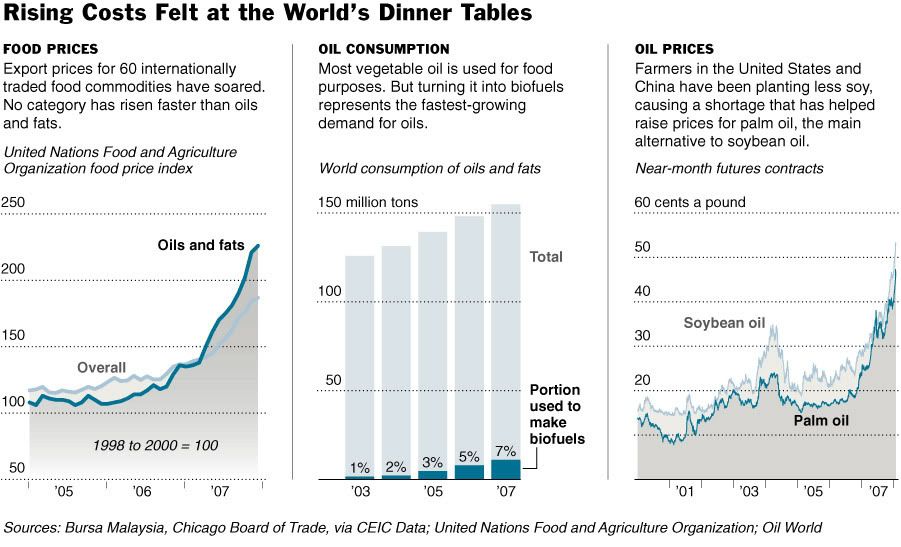
The food price index of the Food and Agriculture Organization of the United Nations, based on export prices for 60 internationally traded foodstuffs, climbed 37 percent last year. That was on top of a 14 percent increase in 2006, and the trend has accelerated this winter.
In some poor countries, desperation is taking hold. Just in the last week, protests have erupted in Pakistan over wheat shortages, and in Indonesia over soybean shortages. Egypt has banned rice exports to keep food at home, and China has put price controls on cooking oil, grain, meat, milk and eggs.
According to the F.A.O., food riots have erupted in recent months in Guinea, Mauritania, Mexico, Morocco, Senegal, Uzbekistan and Yemen.
“The urban poor, the rural landless and small and marginal farmers stand to lose,” said He Changchui, the agency’s chief representative for Asia and the Pacific.
A startling change is unfolding in the world’s food markets. Soaring fuel prices have altered the equation for growing food and transporting it across the globe. Huge demand for biofuels has created tension between using land to produce fuel and using it for food.
A growing middle class in the developing world is demanding more protein, from pork and hamburgers to chicken and ice cream. And all this is happening even as global climate change may be starting to make it harder to grow food in some of the places best equipped to do so, like Australia.
In the last few years, world demand for crops and meat has been rising sharply. It remains an open question how and when the supply will catch up. For the foreseeable future, that probably means higher prices at the grocery store and fatter paychecks for farmers of major crops like corn, wheat and soybeans.
There may be worse inflation to come. Food experts say steep increases in commodity prices have not fully made their way to street stalls in the developing world or supermarkets in the West.
Governments in many poor countries have tried to respond by stepping up food subsidies, imposing or tightening price controls, restricting exports and cutting food import duties.
These temporary measures are already breaking down. Across Southeast Asia, for example, families have been hoarding palm oil. Smugglers have been bidding up prices as they move the oil from more subsidized markets, like Malaysia’s, to less subsidized markets, like Singapore’s.
No category of food prices has risen as quickly this winter as so-called edible oils — with sometimes tragic results. When a Carrefour store in Chongqing, China, announced a limited-time cooking oil promotion in November, a stampede of would-be buyers left 3 people dead and 31 injured.
Cooking oil may seem a trifling expense in the West. But in the developing world, cooking oil is an important source of calories and represents one of the biggest cash outlays for poor families, which grow much of their own food but have to buy oil in which to cook it.
Few crops illustrate the emerging problems in the global food chain as well as palm oil, a vital commodity in much of the world and particularly Asia. From jungles and street markets in Southeast Asia to food companies in the United States and biodiesel factories in Europe, soaring prices for the oil are drawing environmentalists, energy companies, consumers, indigenous peoples and governments into acrimonious disputes.
The oil palm is a stout-trunked tree with a spray of frilly fronds at the top that make it look like an enormous sea anemone. The trees, with their distinctive, star-like patterns of leaves, cover an eighth of the entire land area of Malaysia and even greater acreage in nearby Indonesia.
An Efficient Producer
The palm is a highly efficient producer of vegetable oil, squeezed from the tree’s thick bunches of plum-size bright red fruit. An acre of oil palms yields as much oil as eight acres of soybeans, the main rival for oil palms; rapeseed, used to make canola oil, is a distant third. Among major crops, only sugar cane comes close to rivaling oil palms in calories of human food per acre.
Palm oil prices have jumped nearly 70 percent in the last year because supply has grown slowly while demand has soared.
Farmers and plantation companies are responding to the higher prices, clearing hundreds of thousands of acres of tropical forest to replant with rows of oil palms. But an oil palm takes eight years to reach full production. A drought last year in Indonesia and flooding in Peninsular Malaysia helped constrain supply. Worldwide palm oil output climbed just 2.7 percent last year, to 42.1 million tons.
At the same time, palm oil demand is growing steeply for a variety of reasons around the globe. They include shifting decisions among farmers about what to plant, rising consumer demand in China and India for edible oils, and Western subsidies for biofuel production.
American farmers have been planting more corn and less soy because demand for corn-based ethanol has pushed up corn prices. American soybean acreage plunged 19 percent last year, producing a drop in soybean oil output and inventories.
Chinese farmers also cut back soybean acreage last year, as urban sprawl covered prime farmland and the Chinese government provided more incentives for grain.
Yet people in China are also consuming more oils. China not only was the world’s biggest palm oil importer last year, holding steady at 5.2 million tons in the first 11 months of the year, but it also doubled its soybean oil imports to 2.9 million tons, forcing buyers elsewhere to switch to palm oil.
Concerns about nutrition used to hurt palm oil sales, but they are now starting to help. The oil was long regarded in the West as unhealthy, but it has become an attractive option to replace the chemically altered fats known as trans fats, which have lately come to be seen as the least healthy of all fats.
New York City banned trans fats in frying at food service establishments last summer and will ban them in bakery goods this summer. Across the country, manufacturers are trying to replace trans fats. American palm oil imports nearly doubled in the first 11 months of last year, rising by 200,000 tons.
“Four years ago, when this whole no-trans issue started, we processed no palm here," said Mark Weyland, a United States product manager for Loders Croklaan, a Dutch company that supplies palm oil. “Now it’s our biggest seller.”
Last year, conversion of palm oil into fuel was a fast-growing source of demand, but in recent weeks, rising prices have thrown that business into turmoil.
Here on Malaysia’s eastern shore, a series of 45-foot-high green and gray storage tanks connect to a labyrinth of yellow and silver pipes. The gleaming new refinery has the capacity to turn 116,000 tons a year of palm oil into 110,000 tons of a fuel called biodiesel, as well as valuable byproducts like glycerin. Mission Biofuels, an Australian company, finished the refinery last month and is working on an even larger factory next door at the base of a jungle hillside.
But prices have spiked so much that the company cannot cover all its costs and has idled the finished refinery while looking for a new strategy, such as asking a biodiesel buyer to pay a price linked to palm oil costs, and someday switching from palm oil to jatropha, a roadside weed.
“We took a view that palm oil prices were already high; we didn’t think they could go even higher, and then they did,” said Nathan Mahalingam, the company’s managing director.
Growth in Biofuels
Biofuels accounted for almost half the increase in worldwide demand for vegetable oils last year, and represented 7 percent of total consumption of the oils, according to Oil World, a forecasting service in Hamburg, Germany.
The growth of biodiesel, which can be mixed with regular diesel, has been controversial, not only because it competes with food uses of oil but also because of environmental concerns. European conservation groups have been warning that tropical forests are being leveled to make way for oil palm plantations, destroying habitat for orangutans and Sumatran rhinoceroses while also releasing greenhouse gases.
The European Union has moved to restrict imports of palm oil grown in unsustainable ways. The measure has incensed the Malaysian palm oil industry, which had plunged into biofuel production in part to satisfy European demand.
Another controversy involves the treatment of indigenous peoples whose lands have been seized by oil plantations. This has been a particular issue on Borneo.
Anne B. Lasimbang, executive director of the Pacos Trust in the Malaysian state of Sabah in northern Borneo, said that while some indigenous people had benefited from selling palm oil that they grow themselves, many had lost ancestral lands with little to show for it, including lands that used to provide habitats for endangered orangutans.
“Finally, some of the pressures internationally have trickled down. Some of the companies are more open to dialogue; they want to talk to communities,” said Ms. Lasimbang, a member of the Dusun indigenous group. “On our side, we are still suspicious.”
Demand Outstrips Supply
As the multiple conflicts and economic pressures associated with palm oil play out in the global economy, the bottom line seems to be that the world wants more of the oil than it can get.
Even in Malaysia, the center of the global palm oil industry for half a century, spot shortages have cropped up. Recently, as wholesale prices soared, cooking oil refiners complained of inadequate subsidies and cut back production of household oil, sold at low, regulated prices.
Street vendors in the capital, Kuala Lumpur, complain that they cannot find enough cooking oil to prepare roti canai, the flatbread that is the national snack. “It’s very difficult; it’s hard to find,” said one vendor who gave only his first name, Palani, after admitting that he was secretly buying cooking oil intended for households instead of paying the much higher price for commercial use.
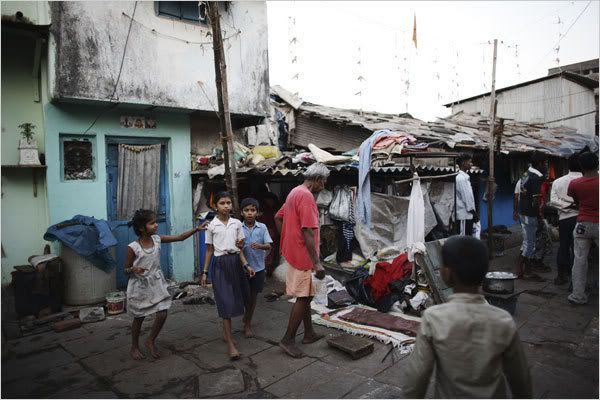
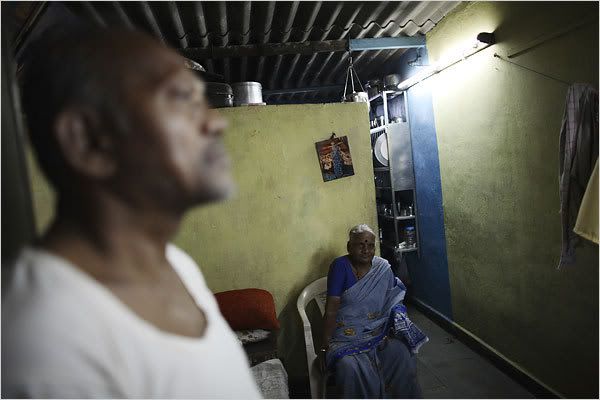
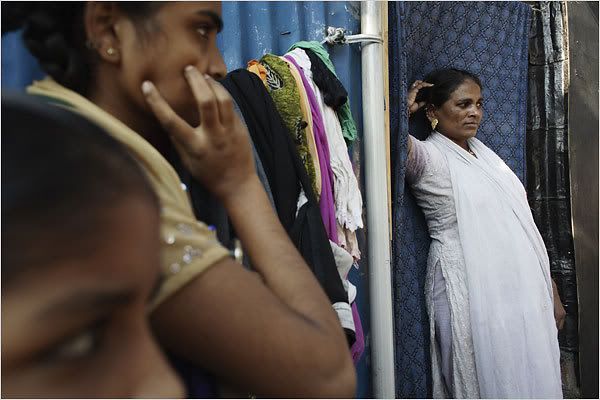
Many of the hardest-hit victims of rising food prices are in the vast slums that surround cities in poorer Asian nations. The Kawle family in Mumbai’s sprawling Dharavi slum, a household of nine with just one member working as a laborer for $60 a month, is coping with recent price increases for palm oil.
The family has responded by eating fish once a week instead of twice, seldom cooking vegetables and cutting its monthly rice consumption. Next to go will be the weekly smidgen of lamb.
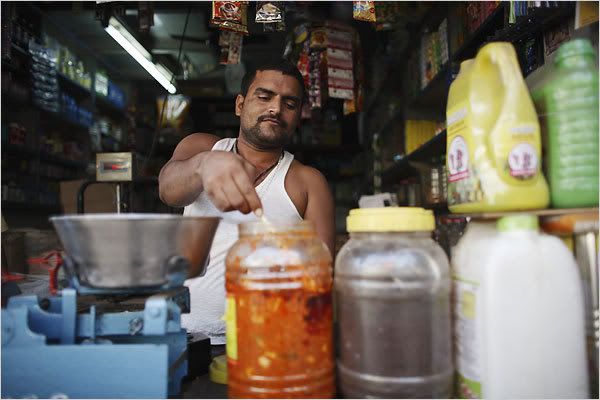
“If the prices go up again,” said Janaron Kawle, the family patriarch, “we’ll cut the mutton to twice a month and use less oil.”"The Struggle for Palm Oil" (photos by Michael Rubenstein for The New York Times) In the developing world, cooking oil is an important source of calories and represents one of the biggest cash outlays for poor households. A steep rise in prices for palm oil has forced many families in Dharavi, a sprawling slum in Mumbai, India, to use less oil or even cut back on food:




Saturday, November 10, 2007
| [+/-] |
Voters Split on Spending Initiatives on States' Ballots |
The NY Times reports:
In Texas, voters were in a spending mood on Tuesday. In New Jersey and Oregon, they were not.
Five statewide bond initiatives were approved by Texas residents this week, including $3 billion for cancer research and prevention that was championed by Lance Armstrong and up to $5 billion for highway improvement projects.
But in New Jersey voters rejected $450 million in new spending for stem cell research, and in Oregon they blocked a plan for increased taxes for health care.
Backing an effort for increased fiscal restraint, Washington residents approved statewide measures to require a two-thirds vote by the Legislature for fee increases and a constitutional amendment requiring that 1 percent of general state revenue for each fiscal year be placed in a budget stabilization account.
Heading the other direction, voters in Maine approved a total of $134 million in bonds for research and development, campus improvements and land conservation.
Isolated voting problems were reported in Colorado, Georgia, Maryland and Pennsylvania because of a combination of poll worker error and machine failures.
Contests in three states offered clues to how certain hot-button issues might play in the 2008 presidential race.
In Virginia, concerns about illegal immigration did not produce the voter turnout and fervor that Republicans sought. The state has become a national testing ground for some of the strictest anti-immigration policies, and Republican lawmakers promised to crack down with plans in some counties to deny services to illegal immigrants.
But Democrats picked up four seats in the State Senate, to take the majority for the first time in more than a decade. They also gained three seats in the House, cutting into the Republican majority.
In Utah, voters resoundingly rejected a school voucher program that was supported by the Republican governor and Republican-controlled Legislature. The measure was controversial because, rather than focusing on low-income students in poor-performing schools, the program would have been available to families regardless of income or school performance.
Supporters said the measure would widen options for parents, but critics, including national teachers unions, faulted it as undercutting money for public education. Had the measure been approved, political strategists say, it would probably have been pushed in other Republican-leaning states next year.
Oregon voters approved a measure that curbs the land-use rights of developers of subdivisions and industrial and commercial sites. Supporters of the measure, especially environmental groups, raised twice as much money as opponents, who received most of their money from timber companies and related interests.
Property rights measures that empowered large landowners were blocked in 2006 in California, Idaho and Washington but passed in Arizona, according to the Ballot Initiative Strategy Center, a liberal advocacy group that tracks ballot trends.
Plenty of new spending was approved on local initiatives. For example, voters in Mecklenburg County, N.C., home of Charlotte, approved $582 million in municipal bonds for public school construction, community colleges and open-space projects.
County and city voters in Denver approved $430 million in bonds for transportation, parks, cultural centers, public safety and libraries.
For poll workers in some counties, low turnouts prevented voting problems from escalating.
The most serious failures occurred in Rockville, Md., where thousands of voters were mistakenly identified as having already voted by absentee ballot when they arrived at the polls. Poll workers kept handwritten lists of the names of everyone who voted. To ensure that no one voted twice, they said they planned to compare the list to the names of those who cast absentee ballots.
More than 60 touch-screen machines failed in Marion County, Ind., for several hours, possibly because of battery problems or the memory cards’ being inserted upside-down, election officials said.
Voting officials in southwest Fulton County, Ga., received court approval on Tuesday afternoon to extend the voting day by an hour after machines did not work because of poll workers’ error, election officials said. Eighteen to 30 voters left without voting before the machines were repaired.
Voters in Weld County, Colo., were given paper ballots for about an hour in the morning until officials repaired a handful of voting machines.
When poll workers in Denver starting falling behind deadline in counting ballots, the county called in several dozen SWAT and other police officers to help. Election officials said the police had assisted in past elections because they had undergone the background checks required to count votes.
Technicians in Bedford County, Pa., had to visit all 40 precincts to repair every optical scanning machine used to read ballots.
Thursday, September 27, 2007
| [+/-] |
Corn Farms Prosper, But Subsidies Still Flow |
The Washington Post reports:
Corn farmer Jim Handsaker has found a slew of ways to ride the heartland boom in biofuels that is reshaping the economy of rural Iowa.
He sold some of his 2006 crop this year for more than $4 a bushel, the highest price in a decade. His stake in two nearby ethanol plants brought in several thousand dollars more in dividends. Meanwhile, soaring farmland prices have pushed the value of the 400 acres he owns to around $2 million.
Even so, come October he will get a subsidy check from the government, part of a $1.6 billion installment that the U.S. Department of Agriculture will send to corn farmers.
Those annual automatic payments to Handsaker and thousands of other prospering corn growers have long been controversial. But coming at a time when taxpayers are already subsidizing the ethanol industry to the tune of $3 billion a year, the double-barreled support system for those who grow corn and those who turn it into fuel has begun to draw fire in Congress.
"Federal farm subsidies are already narrowly focused on certain crops and are excessive," said Sen. Richard G. Lugar (R-Ind.), a farmer and former chairman of the Senate agriculture committee. "They become ridiculous given the exploding possibilities to grow crops for biofuels production."
So far, Congress has shown little inclination to adjust the subsidies to account for the new energy-driven rural economy.
A House-passed farm bill would give corn growers $10.5 billion over the next five years, even if prices stay high. These "direct payments," a kind of annual allowance, are set by formula and go out automatically, regardless of prices, profits, yields or weather.
At the same time, a Senate-approved energy bill would double the federal requirement for the use of ethanol from corn -- a move that should further buttress corn prices.
Handsaker, a Republican who keeps a framed picture of President and Mrs. Bush in his office, argues that such farm subsidies help keep agricultural land in the hands of family farmers and away from corporate monopolies.
Handsaker is not banking on the ethanol boom lasting. "We've all been down the road of price plateaus," he said.
But he acknowledges that justifying the payments is not easy in the midst of an energy renaissance in the heartland. Country roads are dotted with signs advertising "ethanol corn" -- genetically engineered seeds with the high starch content ideal for making 200-proof, high-octane ethanol.
Just weeks before the October harvest, Hardin County, Handsaker's home in central Iowa, was a sea of corn rolling southwest from Iowa Falls. Handsaker once grew a mix of corn and soybeans on the farmland he and his brothers own or rent. "Now we're 100 percent corn," he said.
On a once quiet highway west of Iowa Falls, a constant stream of tractor-trailers pound the road, hauling corn to the Hawkeye Renewables ethanol refinery and soybeans to Cargill Inc.'s biodiesel plant.
To celebrate a banner year, Hawkeye founder and chief executive Bruce Rastetter pulled out the stops for his annual midsummer bash. Several hundred politicians, businessmen and farmers mingled at his richly landscaped hilltop estate, and Sen. Charles E. Grassley (R-Iowa) made his entrance in a wagon pulled by Rastetter's team of Percheron draft horses.
"It's a great country," said Rastetter, a Hardin County native who started with a few acres of farmland and a small feed business 20 years ago. He recently pledged $1.75 million to Iowa State University. In addition to his Iowa Falls plant, he operates a second one in a nearby county and has two more under construction.
The boom has helped push shares in Iowa ethanol plants to double or triple the initial price. Bill Couser, a corn grower and cattleman who was a driving force behind a new ethanol plant in neighboring Story County, says a grateful local school bus driver who bought shares "waves and honks every time she drives by."
"That's the secret of this ethanol industry," Couser said. "It's keeping the dollars at home."
In July, Pine Lake Corn Processors, the second Hardin County plant after Hawkeye's, announced profits for the previous eight months of $3,800 a share, more than the $3,250 cost of the initial investment. "It's worked out better than my wildest dreams," said Pine Lake President Larry Meints, a corn grower who pushed for the new plant after becoming fed up with hauling grain to distant elevators.
The new market means corn-rich Hardin County has to import the crop even though it grows 35 million bushels a year. The county can't supply its two ethanol refineries and its thriving pork, beef and poultry industries.
"Things are good here," said Howard B. Wenger, president of Iowa Falls State Bank, who reviews the balance sheets of hundreds of farmers.
He estimates that most farmers earned between $100 and $400 an acre on their 2006 crop after expenses, depending on whether they owned or rented their land. That translates into profits of $100,000 to $400,000 on a 1,000-acre farm. The USDA predicts that net farm income will be $87.1 billion this year, up nearly 50 percent over 2006.
Iowa farmland values are up 18 percent in the past 12 months, according to Federal Reserve Board surveys, making millionaires on paper out of any farmers owning 200 acres free and clear.
The rural prosperity is due in large measure to billions of dollars in federal subsidies and incentives for corn-based energy. These include a 51-cent tax credit that gasoline manufacturers get on every gallon of ethanol they mix with their blends, and more than $500 million in federal cash to ethanol refiners between 2001 and 2006.
In 2005, Congress required the use of at least 7.5 billion gallons of ethanol a year by 2012. Then in 2006 came new demand for ethanol as a pollution-curbing additive, along with a jump in gasoline prices that made the corn-based fuel competitive.
"We're harvesting the sun out here," said Handsaker, a genial man who typifies the new breed of businessman-farmer. "We're creating something with sun and chemicals and water and making a renewable product instead of unloading an oil tanker."
When he started in 1971, he recalled, farmers sold their crops to the local livestock industry or sent them "down the river" to volatile export markets.
Prices soared when the Soviet harvest failed or Argentina's corn crop fell short. In between, government payments bridged the gap between solvency and bankruptcy. From 2001 through 2005, Handsaker and his two brothers collected more than $500,000, according to USDA records.
Now four ethanol plants have sprouted within easy trucking distance of their farms and will get about half the 450,000 bushels they produce.
Still, the three brothers stand to collect about $45,000 in direct payments this year, based solely on their previous crop acreage and yields, according to USDA records. Congress created the payments in 1996 as part of a plan to temporarily buttress farm incomes while other traditional subsidies were eliminated. They were supposed to be phased out. Instead, the 2002 farm bill continued them.
"It's a bonus program, not a safety net," said Sen. Richard J. Durbin (D-Ill.). "Farmers I talk to know it's not politically sustainable to ask taxpayers to make payments to them in highly profitable years."
Durbin plans to offer a farm bill amendment that would gradually replace the automatic payments with a program to compensate growers when statewide farm revenues fall below the norm. The National Corn Growers Association embraces a similar plan. This week, the Senate agriculture committee's chairman, Tom Harkin (D-Iowa), circulated a proposal to cut direct payments by $4.5 billion over five years.
The American Farm Bureau Federation, the country's largest farm organization, opposes any changes, but the National Farmers Union, the nation's second-largest, supports an overhaul of direct payments. "It's the most costly and inefficient method for providing a safety net," said the union's president, Tom Buis.
Lugar, the senator from Indiana, favors scrapping the current farm program and using crop insurance and tax-exempt savings accounts to tide farmers over in bad years.
"A farmer's best friend in Iowa is the energy bill," said Bruce Babcock, a professor of economics at Iowa State. "What do you need the direct payments for? It's money for nothing."
Rastetter, along with most others in the ethanol industry, argues that increasing requirements for ethanol use would do more for corn growers than farm programs would. If the government expands its support for ethanol, he said, "then the market price of corn will support farmers and provide the safety net."
But relying on energy policy instead of the traditional farm program worries many in rural Iowa who remember previous bubbles.
The bank still holds a mortgage on his land, Handsaker notes.
Ethanol prices have been tumbling recently as supply catches up with demand. Some ethanol companies, including Rastetter's, have put plans for new refineries on hold pending action by Congress to expand required use.
But such action faces stiff opposition from the livestock industry, which contends that the added demand for corn could mean higher feed and food costs. Environmental groups say it could jeopardize water supplies and sensitive lands in exchange for only minimal savings in the use of fossil fuels, given the amounts of gasoline and chemical fertilizer needed to raise corn.
Meanwhile, the prices of fertilizer, seed and land have been rising rapidly as landlords and corporations move to capture their share of higher grain prices. "As far as the bioeconomy, I don't think any of us thinks it's the golden egg," said April Hemmes, who owns 1,000 acres of prime farmland near Iowa City.
