John King intervews Valerie Jarrett, Lindsey Graham, Dianne Feinstein and Joe Lieberman
Transcript of State of the Union with John King:
JOHN KING, HOST: I'm John King, and this is our STATE OF THE UNION report for this Sunday, April 26th. Today, a special look at President Obama's first 100 days in the White House, including unique behind- the-scenes accounts and images.
One of the president's closest aides and friends, senior adviser Valerie Jarrett, joins us for an exclusive look at both the policy and the personal challenges.
The release of top secret memos on CIA interrogations is fueling one of the most sensitive debates of Barack Obama's presidency. Three key senators, Lindsey Graham, Dianne Feinstein, and Joe Lieberman, on whether making the documents public undermines national security and what happens next.
Plus, strides and missteps. Two of the best political strategists assess the first 100 days, appearing together only on STATE OF THE UNION, James Carville and Mary Matalin on the first chapter of a historic presidency.
That's all ahead in this hour of STATE OF THE UNION.
A live picture there of the White House on day 97, day 97 of the Obama presidency. I asked the president about our first guest, and he'll tell you he doesn't like to make any major decisions without consulting her. A woman who has earned several nicknames like "first friend" and "the other side of Obama's brain." So who better to talk about it as we approach that important benchmark, the 100 days of the Obama presidency, than Valerie Jarrett. Valerie Jarrett, thanks for joining us on STATE OF THE UNION.
JARRETT: Thank you, John. And good morning and congratulations on your 100th day as well.
KING: Thank you. Yours is a bit more important than ours, but thank you very much. I want to start -- I want to get to some of your personal reflections on history. But I want to start with the news dominating the headlines this morning. This is The San Diego Union- Tribune. "Swine flu outbreak gets more worrisome."
The San Antonio Express-News, "In Texas flu fears shut down a high school." The administration has been aware of this since late last week, had a number of meetings and will have a briefing later today. What do we expect from the White House? Will it include, say, travel restrictions on going to Mexico? JARRETT: Well, I don't want to prejudge what the officials are going to say later today. But let's just put it this way, the president is taking this very seriously. He has assembled his teams from the Centers for Disease Control and Homeland Security. He has been briefed regularly. And he has asked them to speak to the American people and give the appropriate counsel later today.
So I'll let the experts speak to that.
KING: An interesting circumstance in that he and a number of senior officials had just been to Mexico. I understand he has been tested and he's in the clear?
JARRETT: He's fine. He is just fine. Thank you for asking, though.
KING: Let's move on to this momentous decision he has made in the past week, which was to release the CIA documents, the internal legal documents about the CIA interrogations. And I want to get your sense. You have watched him make hard decisions.
And I'm told by senior officials that this one weighs right up there with the decision to send more troops into Afghanistan as the toughest he has had to make in his first 100 days in office, in part, because only 44 men have been president of the United States, and in making this decision, he did something no president before him has done, put out former top secret memos on the previous administration so soon after taking office. Why?
JARRETT: Well, look, first of all, we are a nation of laws and the law requires us to release the documents unless there's some national security interest that would make it more important to keep them secret.
But the fact of the matter is there is nothing in the documents that the American people hadn't already seen all over the news. The techniques that were being used by the prior administration were well- known. When the president came in office, he said, we're not going to use those techniques anymore. That's not who we are as a country. In fact, Denny Blair, his intelligence adviser, has said in fact using those techniques makes us less safe. So the president said, let's release them and then let's move forward.
KING: In the context of let's move forward, there is a question about should there be a truth commission, should there be investigations, should there be prosecutions? And there is a big policy debate, but there's also a political debate that some say has been intensified by what they see as mixed messages from the White House.
If you turn over your right shoulder, I want to you take through some of the timeline. When the president released the memos on April 16th, he said, this is a time for reflection, not retribution. Three days later, his chief of staff, Rahm Emanuel, echoed the president, saying, the president believes those who devised the policy should not be prosecuted. But then on April 23rd, just a few days after the chief of staff was out, the president seemed to give a different message. Let's listen.
(BEGIN VIDEO CLIP)
PRESIDENT BARACK OBAMA: With respect to those who formulated those legal decisions, I would say that that is going to be more of a decision for the attorney general within the parameters of various laws, and I don't want to prejudge that.
(END VIDEO CLIP)
KING: Why did the president change his mind? He seems open now to possible prosecution.
JARRETT: No. Let me be clear where the president stands on this. What he has said is that anyone who followed the advice of the Justice Department and did any kind of acts that were within the confines of that advice, he doesn't think we should prosecute.
The rest of it, he leaves up to the U.S. Attorney General. That is who is supposed to make decisions about prosecution. So I think the president has been very clear and what he said is, we need to be a nation of laws, we need to be consistent, and he leaves it to the attorney general to figure out who should be prosecuted for what.
KING: Who should be prosecuted for what. If it's not those who acted on the advice they were given, who were told it was legal, what are we talking about here? Are we talking about the attorney general in the previous administration, the CIA director, Secretary Rumsfeld?
JARRETT: You and I aren't talking about anything. We are going to leave that all up to the attorney general. As you know, the Senate Intelligence Committee is having hearings as well. That is the appropriate place I think for any further investigation. And then the rest we leave to the attorney general. KING: You have a fascinating job because you have the trust of the president and you have become his conduit to many of the CEOs around America right now. He is dealing with the auto bailout. He is dealing with the financial institutions and the banks. He is in negotiations now over credit card reforms.
And you are the person who is often in touch with these CEOs, getting their advice and telling the administration things, seeking their input. One of the questions on the table is these stress test for all of the banks.
JARRETT: Yes.
KING: And without naming names, are there banks out there that are in deep trouble, and, if so, will the president and the White House, as in the case of General Motors, say, you know what, you're in trouble, you're not doing this as fast or as aggressively we thought you should do, if you want more money from us, the CEO has to go? JARRETT: Let's not leap forward. Let's look at where we are. The stress test results are just now being shared with the banks. We're going to have an announcement, I believe it's May 4th, coming from the Treasury Department and the Federal Reserve.
They've been going through an in-depth analysis of those top largest 19 banks over the course of the last several months. Let's see where we are and let's not prejudge the outcome. I think what the president's direction has been very clearly is we want to help the economy.
In order to have a healthy economy, we need to have strong banks. They need to be well-capitalized. They need to be able to lend dollars and help support our economy. And so at the end of the stress test, we want to make sure that those are -- that the banks are in a position to do that.
And so whether management changes occur, whether banks are asked to raise more capital, all of that is going to come forth in the coming week.
KING: You helped the president in the campaign. You were one of his a big fundraisers, one of his top advisers. One of the messages he gave to the American people in the campaign is, elect me and I will change the way that crazy town of Washington works, I'm not afraid to deal with Republicans, I will be bipartisan, will change the partisan, nasty tone in Washington.
I want you to listen something he said just after the election.
(BEGIN VIDEO CLIP)
OBAMA: I know we will succeed, once again, if we put aside partisanship and politics and work together. That's exactly what I intend to do as president of the United States.
(END VIDEO CLIP) KING: And, yet, in the first 100 days, only three Republican votes on the stimulus plan, no Republican votes on the Obama budget, and now the White House has pressured Democrats in Congress to use their power in the rules so, that if necessary, you can pass health care reform with 51 votes, a majority, not 60 votes.
Has the president decided that because of the mood in this town and because of the unwillingness of this town and both sides to perhaps change, that it is more important to get things done, like health care reform, like climate change, like education policy, than to make friends with the Republicans right off the bat?
JARRETT: Look, what the president has said throughout, he said in the campaign, he said it in his address the night of his election, and the way he has behaved since he took office is one of reaching out to both sides.
He includes everybody in the dialogue. He has reached out more aggressively, I think, to the Republican Party than I've ever imagined a president could possibly do. So I think the burden is on him to reach out his hand and that is what he has done. And that is what he is going to continue to do throughout this administration.
He has not changed tactics whatsoever. That is who he is as a person.
KING: Let's close -- sorry, go ahead.
JARRETT: But let me -- on the issue of health care, health care is extraordinarily important. I think there is bipartisan support for pushing health care forward. It's good for our country. It's good for our economy. And the president is determined to get it done this year.
KING: Let's close with a bit of history. I want to ask you to get up and walk over here with me as we walk over to the wall. This is a diagram of the West Wing of the White House. And you see the Oval Office here, the president's study, some of the cabinet rooms and the Roosevelt rooms, some of these offices, this is the second floor here, I believe this is Valerie Jarrett's office up here, they are highlighted for a reason.
I was a reporter at the White House for almost nine years. I walked those halls every day and never did you see this, an African- American first lady, an African-American senior adviser, an African- American deputy chief of staff, an African-American woman as the domestic policy adviser, as the deputy legal counsel, as the White House social secretary.
Barack Obama has made history. What is it like to work in a White House like this, African-American women in such positions of power?
JARRETT: Well, it's terrific. You are seeing very strong, I hope smart, intelligent African-American women. But I think have to round it out and look at the whole diversity of team. And I think what has been so extraordinary about President Obama is he appreciates diversity and he thinks it will make him think harder.
We push him to make sure that he has had a wide range of ideas as he makes decisions. And so as you fill out the rest of the team, it's extraordinary as well. But these are some pretty terrific women.
KING: And I want you to look over here at this picture. This has never been released before. We're going to have Pete Souza in here at the end of the program today to talk about looking at history through the lens of his camera.
This is a picture of the president and the first lady dancing. I believe that is the East Room of the White House right there. Take us inside and what is it like from a personal standpoint to see your two close friends in this position now? Can you believe it yet?
JARRETT: I still pinch myself every day. It's a terrific picture. It was the night of the Governors Ball, our first state dinner. And I think the president left right before they broke out into a conga line. And I think all of the folks who were there said they never had a conga line in the White House before. So it makes me happy. I'm so just extraordinarily proud of both of them. And I know that they wake up every day and they think about the American people.
And there so many people out there who are suffering and they need our help here in government. And it's his job to make sure that he delivers on the promises he made to the American people.
KING: Valerie Jarrett, here to mark the 100 days. A lot of challenges will be dealt in the second 100 days. We'll have you right back here to assess them at the end of that.
JARRETT: Look forward to it. I look forward to it.
KING: Thank you so much.
JARRETT: Thank you for having me.
KING: Thank you so much.
KING: Now we just heard Team Obama's position on the release of the so-called torture memos. What happens next? We ask three key senators about calls for investigations and prosecutions just ahead.
(BEGIN VIDEO CLIP)
OBAMA: If can you think about what Washington, D.C. was like 50 years ago or 60 years ago. And the notion that I now will be standing there and sworn in as the 44th president, I think, is something that hopefully our children take for granted, but our grandparents, I think, are still stunned by it and it's a remarkable moment.
(END VIDEO CLIP)
(COMMERCIAL BREAK)
(BEGIN VIDEO CLIP)
KING: Do you believe the president of the United States has made Americans less safe?
FORMER VICE PRESIDENT DICK CHENEY: I do. And now he is making some choices that, in my mind, will, in fact, raise the risk to the American people of another attack.
(END VIDEO CLIP)
KING: Vice President Dick Cheney there on this program just about a month ago. President Obama's election mandate was to fix a struggling U.S. economy but as he starts his 97th day in office today national security challenges are front and center. A debate whether releasing Bush administration terror policies was a blunder and over whether some of the Bush officials should be prosecuted and fresh violence in both Iraq and Pakistan will test the new administration's military and diplomatic strategies. Joining us to talk about this and assess the president's first 100 days, Democratic Senator Dianne Feinstein of California, the chairwoman of the Select Committee on Intelligence, Senator Joe Lieberman of Connecticut, the independent, former Democrat and from South Carolina, Republican Senator Lindsey Graham.
Chairwoman, I want to start with you. On the vice president's point, you heard the vice president say there he thinks the new administration is making the American people less safe. He also says that there are other memos not released into the public that prove his point that these controversial interrogation tactics used in limited circumstances actually produced intelligence that saved U.S. lives, including preventing an attack in your home State of California, the City of Los Angeles. Is he right?
FEINSTEIN: Well, I've received those memos. I asked him for them and he sent them to me. They are classified memos so I won't go into them. That's the reason why I believe the Intelligence Committee is the oversight agency for 16 intelligence agencies, including the CIA. It is our responsibility to do oversight. We have access to the classified information. And we have set upon a course, a bipartisan course with a program scope, approved by the committee, to review the conditions of detention and the techniques of interrogation of each of the high value detainees. We estimate that will take six to eight months. My hope is that the public debate quells, that we have an opportunity to do our work. The committee will consider it and then we will release, most likely, findings and recommendations.
KING: Findings and recommendations. I want to get to the other senators but to the vice president's point he believes the documents would show that the tactics worked, saved lives.
FEINSTEIN: It's very hard to tell on the face, because you have to go into who learned what at the time. Now I can go into one, at least one specific case, and it's very uncertain. So we need to find these things out and we need to do it in a way that's calm and deliberative and professional, because I think all of this, on the front burner, before the public, does harm our intelligence gathering, it does harm America's position in the world. And President Obama has worked so hard now to open a new page, to go to so many countries, to say that America is now on a different course. Let us do our work and let us do it the way it should be done.
KING: Senator Graham, you and Senator Lieberman opposed relieving these documents even though you were critics of the interrogation tactics, you thought it would undermine the mission of the united states and the CIA and now that some are out does the former vice president have a point? If some are out, should all be out?
GRAHAM: Well, here is my concern, is that, one, I think it was a mistake to release the techniques that we're talking about and inform our enemy as to what may come their way. I like what Senator Feinstein said, to go through it. And there's no doubt in my mind you may have gotten some useful information out of these techniques but the other side of the story is very real. The more than America embraces these techniques like waterboarding that comes from the Inquisition, the harder to get allies to go with us into the Mid East to fight the insurgents. You inflame the opposition. Our energy uses these images against us.
To say these techniques have brought about no good or no information is wrong, but also to say that it's been a net positive is wrong. There's a way to get good information in an aggressive manner to protect this nation without having to go into the Inquisition era. I believe you can do both. KING: And what about going forward, Senator Lieberman? The president, in relieving these memos, you didn't like that he did, but the president's message let's look forward, not look back but then the president said I'll leave this up to my attorney general who should be prosecuted. Let's listen to Mr. Holder.
(BEGIN VIDEO CLIP)
ATTORNEY GENERAL ERIC HOLDER: I will not permit the criminalization of policy differences. However, it is my responsibility, as the attorney general, to enforce the law. It is my duty to enforce the law. If I see evidence of wrongdoing, I will pursue it to the full extent of the law.
(END VIDEO CLIP)
KING: Are you comfortable with that? Do you think this should be pursued and if you rule out the interrogators saying they were told, they were following orders and acting on legal advice what they were doing was right, what are we talking about here? Are we talking about the CIA director, are we talking about the attorney general in the previous administration, Secretary Rumsfeld, somebody in the White House?
LIEBERMAN: Yeah, no, it is not clear who we are talking about. And I think it is a mistake. I go back to what the president said at the beginning, it is time to look forward. These are top secret documents. These were lawyers, you could disagree with them but in my opinion they were trying to do what they thought would protect our country.
And here is the most important point. This whole debate is moot. President Obama has prohibited these tactics from being used in interrogation, so what do we gain -- well, what do we gain, first, by releasing the memos, but, secondly, what do we gain from indicting lawyers for their opinions, if that is a possibility here, or holding a so-called Truth Commission that the reality is, it will poison the water here in Washington. It will achieve nothing.
LIEBERMAN: It will make it harder for the president to do some of the big things he wants to do for the country -- not just get the economy going, but get some Republican support for health care reform, energy independence and education reform.
So let the Intelligence Committee do its work. That should be the end of it. KING: And one of the questions in the political debate, as you well know, there are people out there saying, wait a minute. You have all these politicians -- and largely Democrats, now -- saying, you know, investigate; truth commission; investigate; we had no idea.
A timeline released by your committee, Senator Feinstein, says -- and this is backed up the former chairman of the House Intelligence Committee -- and then-CIA Director Porter Goss -- Pete Hoekstra -- you know, select members of Congress were briefed -- were briefed, way back at the beginning, including now-Speaker Nancy Pelosi.
And the timeline by your committee says that they were briefed on the use of waterboarding on three detainees, Abu Zubaydah, Abdul Rahim al-Nashiri, and Khalid Shaikh Mohammed.
The now-Speaker Pelosi says, no way; she was told there were legal -- there were -- legal opinions were written but not that the tactics had been used. Is she telling the truth?
FEINSTEIN: Well, I can't comment on that. I wasn't there. Just four people were briefed. The full committee, including myself, were briefed in September of '06. Now, that's four years later or so. So there is a big gap.
I am really strongly opposed to just certain members being briefed on something this seriously. It seems to me the whole committee should be briefed at a given time. We've been very good at retaining security, and I think it's a real disadvantage to the system just to have a few people briefed.
Because it really is a notification; there is no real discussion. When you deal with the whole committee, everybody fires back questions; there's a discussion; there's a dialogue. And I think a point of view emerges.
KING: Well, if -- to Senator Feinstein's point, Senator Graham, if the committee, the Intelligence Committee is going to look into this, and you all think that's the more responsible, measured way to do it, should the committee also look into whether Porter Goss or Nancy Pelosi is telling the truth about what came up at those briefings?
GRAHAM: Well, I'll leave that up to the committee. But the point is, if a member of Congress was read into this program, does it matter?
Yes, I think it matters. It's clear to me that the people who were devising these interrogation techniques were not trying to commit a crime against an individual person. They were trying to create tools for our intelligence community to get information to prevent what we all thought was going to be an imminent attack.
The Geneva Convention did not apply, until 2005, to the war on terror. So I can't conceive of a statute that you could prosecute anyone under because their endeavor was not to commit a crime but to look at the law and come up with aggressive interrogation techniques to get information from an enemy that we all thought was coming after us again.
So, however, if you think what they did was a crime, and you read someone into it, they're part of the crime.
So I think it's ridiculous to say the lawyers were trying to break the law. They were trying to interpret the law to protect the nation. And any member of Congress that was read into the program, I don't think they have any culpability either, because what we were trying to do is defend the nation, not conspire to hurt somebody individually, but techniques to protect us all.
KING: I want to move on to other big challenges facing the country right now.
But, before we do that and before we take a quick break, early in the Bush administration, the criticism in Congress was they never pick up the phone; they never consult us; you know, we've got some pretty smart people up here; we can help you.
I'm told that this decision was anguished; the president came in inclined to release them, changed his mind a couple times during the debate and then came back in the end and decided to release them.
At any point in that process -- I'll start with you, Senator Lieberman -- anybody from the White House pick up the phone and say, "What do you think?"
LIEBERMAN: They did not. And I can tell you, listening to what Lindsey said about looking at these decisions that were made early in the Bush administration, remembering that it was immediately after 9/11/01 there was worry about another attack imminently -- I'm proud to be the chairman of the Senate Homeland Security Committee. Our enemies are out there planning and plotting to attack us every day.
So, as we think about what we want to release, how much information we want to make public, what kind of mud fight we want to get into about something that happened seven years ago, we better remember that and focus on our security today, not back-biting and vendettas from a time passed.
KING: Quickly to you, you're the chairwoman of the committee. You're investigating these matters, anyway. Do they pick up the phone and call you?
FEINSTEIN: No. They did not.
KING: Is that a mistake?
FEINSTEIN: Well, if they had, I probably would have said, as I said, let us do our work first. Since the first two cases have already been done, let us do the rest of it before anything is released, so that at least the Intelligence Committee can see everything in context and make some decisions.
KING: All right. Much more with our Senate guests in just a moment. We ask them to lay out the stakes in the tough choices facing the United States in three major hot spots, Iraq, Pakistan and Afghanistan. "State of the Union" will be right back.
(COMMERCIAL BREAK)
(BEGIN VIDEO CLIP)
KING: On a scale of 1 to 10, sir, how confident are you, 10 being fully confident, that you will meet that deadline, that all U.S. troops will be gone at the end of 2011?
GENERAL RAY ODIERNO (USA), COMMANDER, MULTI-NATIONAL FORCE-IRAQ: As you ask me today, I believe it's a 10 that we will be gone by 2011.
(END VIDEO CLIP)
KING: We're back with our three senators, Democrat Dianne Feinstein, Independent Joe Lieberman and Republican Lindsey Graham.
That was General Odierno on this program, Easter Sunday morning. Since then, as you're all aware, there has been an uptick, as the military would call it, in violence across Iraq, Mosul, Baqubah, including in Baghdad.
And on the front page of the New York Times today, "Iraq Resists Pleas by U.S. to Placate Hussein's Party."
Essentially, Nouri al-Maliki, the prime minister, has not, at least if you believe U.S. officials, reached out to former Baath Party members and said, it's time to move on; it's time to reconcile.
Senator Lieberman, to you first, are you worried at all about the combination of those things, more violence and the slower pace of political reconciliation will knock the U.S. timetable off track?
LIEBERMAN: Sure, I am. I'm concerned about it. And incidentally, it's part of why I'm so grateful that President Obama did not yield to the calls for a precipitous rapid withdrawal of our troops from Iraq. He's got us on a timeline. It's based on conditions on the ground. And what's happening now shows that all that we've sacrificed so much and worked so hard to gain is not quite set. So we need to be careful here.
LIEBERMAN: But I think Prime Minister Maliki has really done a pretty good job at reconciling a lot of the divisions in Iraqi politics. The Sunnis are much more involved than they used to be. I know that there's some problems with former leaders what was basically Saddam Hussein's party. We ought to encourage Prime Minister Maliki to try to bring them in as well so they all could be united at what seems to be remnants of al Qaeda in Iraq that are carrying out these brutal bombings against Shia, this an attempt by al Qaeda to try to stimulate sectarian conflict again in Iraq and neither Prime Minister Maliki or the American forces or the Iraqi forces can let that happen.
KING: And if that challenge were not great enough for the military to deal with and the president to deal with, Senator Graham, you also have this expansion of the Taliban influence inside Pakistan. And ... GRAHAM: Right.
KING: ... Admiral Mullen was just there, the is due back for a White House meeting on Monday, administration officials say they have some big decisions to make based on what Admiral Mullen tells them. There are now more U.S. troops heading into Afghanistan and the question to you is if Pakistan is in such trouble and you have the Taliban on the move inside Pakistan, is it time for the president to slow down the deployment of U.S. troops in Afghanistan? Will they be at risk on the other side of the border or will we need perhaps more troops because of the uncertainty in Pakistan?
GRAHAM: I would counsel the president to do what General Petraeus and others in the region tell him about troops. There is a provision in the supplemental that is coming up in about a month that provides economic aid to Pakistan and $400 million to help them create a counterinsurgency program. I've been talking with administration officials, Republican Party leaders, to see if we can break some of that money out and pass it as a standalone provision soon to show the Pakistani people and government that we're with you, to give them some money to accelerate their counterinsurgency program and give them some money to provide economic aid to their people, the people do not want the Taliban to run Pakistan, but the economy in Pakistan is on its knees and we've got to get the Pakistani Army focused on the insurgency, as well as the government.
The threat the Pakistan is not an invasion by India. It's insurgents, the Taliban and others destabilizing the country and I think we need to be all in in helping Pakistan As to Iraq in 2011, I hope we will have a strong contingent of Americans there training their Air Force, their Navy. It is in our long-term best interest to have an enduring relationship with the people of Iraq, militarily and otherwise.
KING: Admiral Mullen says Pakistan could be at a tipping point. You see the intelligence. Is the Taliban, Senator Feinstein, a threat to the government, the central government of Pakistan?
FEINSTEIN: Oh, in my opinion, yes. I also think that these bombings, the size of the bombings in Iraq are a real danger signal. And I think that Mr. Maliki has to step up to the plate on this. And it's going to be very interesting in the next few weeks to see how he handles this. If these bombings continue and there is an escalation of violence, I think it jeopardizes everything the united states is trying to do.
With respect to the Taliban and particularly in both Afghanistan, as well as Pakistan, I think the takeover of the Swat Valley, the movement up north is a very serious thing. The fact that, despite the fact that we provide money for the Pakistani military, they have done nothing to stop this Taliban advance, I think, causes me great concern that Pakistan may be in very deep trouble. And I would think that -- and most of us, I think, do agree that Pakistan is sort of Ground Zero for terror today and that this thing has to get sorted out and sorted out quickly or you could lose the government of Pakistan and Pakistan is a in nuclear power and that concerns me deeply. KING: A grave issue there. I want to close on a lighter note.
And that is, as we approach the 100 day note we are in a political environment where people are making assessments.
I want to take you, Senator Lieberman back to something you said when you were campaigning for John McCain at the Republican National Convention. Let's listen.
(BEGIN VIDEO CLIP)
LIEBERMAN: Senator Barack Obama is a gifted and eloquent young man who I think can do great things for our country in the years ahead, but, my friends, eloquence is no substitute for a record. Not in these tough times for America.
(END VIDEO CLIP)
KING: We've been discussing a number of tough issues and there are many more, senator, has he proven you wrong, Barack Obama, in his first 100 days.
LIEBERMAN: First, John, let me thank you for running that tape.
KING: Tape is a dangerous thing.
LIEBERMAN: I have no regrets about supporting John McCain and really what I said then, I meant. Barack Obama is extremely gifted. Coming in at a very difficult time. I was thinking particularly about Iraq and Afghanistan, the war on terror. And McCain, of course, great experience, bipartisan record. Once the election was over, I said I would do everything to support Barack Obama as president. He is our president. I have, but I'll say this. I've been impressed by what he has done. He is a young man but he is extremely gifted. He has acted with strength, I think, and purpose in Iraq and Afghanistan, rebuilt some of our relations around the world and acted very boldly here at home on the economy where we needed him to particularly with the stimulus package.
But it's early but I would say he is off to a very good start. Maybe the most important thing he's done overall is that he has restored the confidence of the American people in the American presidency and he has raised their hopes about the future of our country. That is critically important.
KING: We're out of time. I want to give Senators Graham and Feinstein one sentence each. Senator Graham, to you the question is what does the Republican Party need to do in the second 100 days?
GRAHAM: To stand up for fiscal responsibility, work with the president and to make sure that we end Iraq right, win in Afghanistan and stabilize Pakistan, be a partner where we can and loyal opposition where we need to.
KING: There is a question as to whether you want to be the next governor of California. FEINSTEIN: Well, let me answer the prior question. No. You said in a sentence so give me an opportunity.
KING: All right.
FEINSTEIN: I think the Republican Party should stop being the party of no. This is a president well elected by a large number of people. He has had a very strong first 100 days. He has traveled to countries abroad, he has turned the page, he has opened a new day, he has taken strong executive actions, he has put together programs. He has delved into the economy. And I would hope that the second 100 days would find more Republican cooperation.
KING: When do we get the answer to that other question?
FEINSTEIN: Oh, you'll see.
KING: We'll see. Great. We're out of time. Senators Feinstein and Lieberman and Graham, thanks so much for coming.
Part 1
Part 2
Part 3
Up next, Mary Matalin and James Carville have both counseled presidents in crisis. Their take on the challenges and the 100 day mark, something you will see only right here on STATE OF THE UNION. Stay with us.
(COMMERCIAL BREAK)
KING: We've added a sharp and occasionally spicy political team to our "State of the Union" report. The only place you'll see these tested strategists together on TV is right here.
And joining us now from New Orleans, our newest CNN political contributor, Republican Mary Matalin, alongside our longtime contributor Democrat James Carville.
I want to get, from both of you -- good morning from Jackson Square. It looks beautiful there, this morning -- a little breezy.
I want to get, from both of you, your 100-day headline, your assessment. But first, I want to share with you the assessment of somebody we got to know in the last campaign; that is the Alaska governor, Sarah Palin.
She says this of the first 100 days, the former vice presidential nominee, "For now, Obama's back-peddle on the bipartisanship promise just makes him look insincere. At some point, Obama will need Republicans on his side. He'd be smart to spend his second 100 days making up for the serious snubs of his first."
James Carville, does Sarah Palin have a point?
CARVILLE: Well, you know, I'd rather go with Senator Lieberman's point, who supported Senator McCain, and I completely agree with him -- without going through a recital of all the accomplishments, the signature accomplishment of this president is we have a restoration of confidence in this country. People are feeling better about the country. And that's a magnificent achievement.
And I thought that Senator Lieberman did a very good job of bringing that out. And I would prefer to go with his definition of the first 100 days than Governor Palin's.
KING: And what does Mary Matalin think, at this point?
If you look at the numbers, Mary, this president does have -- about two-thirds of the American people approve of his job. Even a higher number like him as a person and like the imagery of this presidency.
What do you think? MATALIN: Yes, he's maintained his personal popularity, but -- which is on par with his predecessors, but what he's lost, after starting out with record-setting approval ratings which included a goodly amount of Republicans, a lot of independents, he has lost that support, because what he is not is what he was perceived to be in the campaign, a centrist.
He's spent more than all of his predecessors since the beginning of this country. He's expanded government, the greatest in two generations. So he's not a centrist. He's also not post-partisan.
It's not just that he demonizes his opponents, which is old politics. He'd knee-cap his own guys. He's got Valerie Jarrett, who's the liaison -- your former guest is the liaison to MoveOn.org, who is running ads against moderate Democrats. He's not a centrist. He's not post-partisan. But he is -- elections have consequences. We lost, fair and square, and let's -- that's what this debate is about. I hope Republicans can rise to the challenge and oppose him and stop some of this expansion.
KING: Well, I want to talk about some terror policy in a minute. But since you raised that point, Mary, that you lost and you hope Republicans rise to the challenge, I want you to listen to something that your friend and your former colleague in the Bush White House, Steve Schmidt, said the other day about the decline of the Republican Party. Let's listen.
(BEGIN VIDEO CLIP)
STEVE SCHMIDT, REPUBLICAN STRATEGIST: It is near-extinct, in many ways, in the Northeast. It is extinct, in many ways, on the West Coast. And it is endangered in the Mountain West, increasingly endangered in the Southwest, particularly with Hispanic demographics. And if you look at the state of the party, it is a shrinking entity.
(END VIDEO CLIP)
KING: Mary, Steve Schmidt says the leadership vacuum has him thinking you're in the "Lord of the Flies" phase of the Republican Party.
What's the road back?
MATALIN: You know, one of the advantages of age -- I didn't think I'd ever brag about this, but I'm much older than Steve and I've been through this before. And we will come back.
The Republican Party brand is irrefutably ruined, but that's because they lost their connection to conviction conservatism, common- sense conservatism. We've been here before and we've come back, not only strong but to ascend to the majority.
And there are many -- and there's a good nucleus of smart fiscal conservatives, strong defense, back to basics, personal liberty Republicans who will restore the brand and reassociate it with conservatism as we know it: Eric Cantor, Paul Ryan. You know who they are.
So the advantage of being aged is that you've been through it a couple, two or three times.
(LAUGHTER)
KING: James, I want to ask you, on this...
MATALIN: You went down, honey. You've been down.
CARVILLE: Yes, if age confers any wisdom, then you're looking at -- our combined age would make us very wise.
(LAUGHTER)
But, look, I think Steve is a very bright guy. He came down to my class at Tulane, and of course, as you know, Speaker Gingrich did, too.
But I think there's a lot of people who are trying to get under the hood of the Republican Party because, as Ross Perot said, it really needs some fixing. And there's a lot of different voices, here, and we're going to have to see what emerges.
But while all of that is going on, it's indisputable this president's enjoying a 69 percent approval rating. He's getting things done, left and right. He's got any number of things to deal with. And I think he's off to one heck of a start here. And it's understandable because the Republicans are all -- have a cacophony (ph) because they're not doing very well right now.
It's not...
KING: Mary...
MATALIN: It's not a -- it's not a cacophony (ph).
You know, John, can I just add to that?
We keep looking -- and all the pundits like to look at his top number, which is high, but as I said earlier, comparable to his predecessors. The danger spots for this president -- I'm just looking at all the polls, and they're 100 percent consistent on this. It's an 80 percent issue that people of all stripes, across the aisle, are concerned about the rapid and expansive growth of government that this president has ushered in.
That's not an old idea; it's not a stale idea; it's not Republican obstructionism. People just do not like how fast and how far this president has gone. That's an 80 percent issue.
So he's at -- he may be at 60 percent, but concerns over the things that he's done so far -- and that doesn't even include his foreign policy problems, you know -- he's got some undercurrents of issues, here, in this first 100 days. KING: Let me -- let me close on a lighter note, and that is, to James, you are a friend of now-Secretary of State Clinton. You were trying to help her retire her campaign debt when she was Senator Clinton...
(LAUGHTER)
... running against now-President Obama. And the Clinton campaign organization, trying to reduce its debt, has put out a letter offering people who contribute three potential prizes.
One is a day with former President Clinton in New York City. One is tickets to the "American Idol" season finale. And the third is, spend a weekend in Washington, D.C. with James Carville and Paul Begala.
(LAUGHTER)
Mary, you've got the checkbook there?
(LAUGHTER)
MATALIN: Oh, well, as you can see, I'd rather be here at Jazz Fest and the Zurich Classic and the Bubba Gump Run. And good luck in Washington with your crazy, loony lefties.
(LAUGHTER)
CARVILLE: I don't know.
MATALIN: That's a prize. What's the second prize, James?
CARVILLE: I always insist, the last two words, with Secretary of State Clinton and any conversation we have -- and they have always been, "Yes, ma'am."
(LAUGHTER)
So, whatever she wants, I'm delighted to do.
KING: James Carville and Mary Matalin, we are -- we are thrilled to have you back with us, together. We will see you again on "State of the Union" in the near future. Enjoy what looks like a beautiful morning, there in New Orleans.
(CROSSTALK)
KING: Take care, guys.
KING: During President Obama's time in office, we've traveled to 17 different states to hear your concerns and opinions. A unique perspective on the first 100 days from people we've been lucky to meet all across the country, next.
(COMMERCIAL BREAK)
KING: We launched STATE OF THE UNION the weekend of the Obama inauguration, promising to chronicle the big issues here in Washington and also to come see how the debates affect you. Our first of 17 states in these 100 days was Ohio, where on a factory floor, we asked the man about to make history to assess the many challenges and the moment.
(BEGIN VIDEO CLIP)
KING: You took your family to the Lincoln Memorial.
OBAMA: Now, this is a good story. I love the Lincoln Memorial at night. We go and look at the Lincoln Second Inaugural, Sasha looks up and she says that's a long speech. Do you have to give one of those? I said, actually, that one's pretty short. Mine may even be longer. At which point, the Malia turns to me and says, first African American president. Better be good.
Today I say to you that the challenges we face are real. They are serious and they are many. They will not be met easily or in a short span of time, but know this, America, they will be met.
(END VIDEO CLIP)
KING: A hundred days, of course, is far too soon to judge whether this new president will get his way and whether his way will work. But in our travels to 17 states in those 100 days, from Vermont and New York in the Northeast to Nevada and Arizona out in the Southwest, a fascinating look through your eyes of the many challenges, the uncertainty, and right here early on in Peoria, Illinois, of the pain.
(BEGIN VIDEO CLIP)
(UNKNOWN): I don't want to be on unemployment. I have never been on unemployment before.
KING (voice-over): For John and Mary Beth Fagan (ph), a double whammy. Both worked at Caterpillar, both out of work effective Friday. Three children, two cars and a mortgage.
(UNKNOWN): If things really got that bad, I would probably volunteer to go back overseas, and that's pretty bad to say.
KING: You would volunteer to go to Iraq or Afghanistan?
(UNKNOWN): For my family, I would, yes.
(END VIDEO CLIP) KING: One swift achievement in the first 100 days was passage of a $787 billion economic stimulus. The president signed it into law less than one month into his administration.
(BEGIN VIDEO CLIP)
OBAMA: We have begun the essential work of keeping the American dream alive.
(END VIDEO CLIP)
KING: Just a few weeks later, a $75 billion administration plan to help millions of homeowners make their mortgage payments.
Another bold and controversial White House move, forcing the CEO of General Motors to step down as a condition for more government bailout money.
(BEGIN VIDEO CLIP)
OBAMA: This restructuring, as painful as it will be in the short-term, will mark not an end, but a new beginning for a great American industry, an auto industry that is once more out-competing the world.
(END VIDEO CLIP)
KING: Speaking of the auto industry, we have visited a handful of states with auto plants over the past hundred days, including Ohio, Michigan, Indiana, and down here in Springhill, Tennessee, many union autoworkers told us they believe the president is overreaching.
(BEGIN VIDEO CLIP)
(UNKNOWN): Yeah, we need help, but to say that the president tells a company's CEO that he has to leave, I just don't believe that should happen.
KING: Make no mistake, Brenda Carter says she loves President Obama, but her concerns, a proof of the risks Mr. Obama faces as he takes an aggressive role in the restructuring of GM and Chrysler. The Lansing Grand River assembly line. Modern, clean and efficient. These Cadillacs among GM's best-selling models. And yet, this plant is down from two shifts to one. New cars just aren't selling.
(UNKNOWN): It's scary times right now for a lot of people.
KING: To listen, to look around is to hear and see a way of life fading. Generous Motors was the nickname when Brad Fredline was growing up. Both grandfathers retired from GM. His father, too. (UNKNOWN): You graduated on a Friday and by Monday you were working at the factory, you knew you had a rock solid job for 30 years, you buy a little place up north and you retire. Those days are gone, I'm afraid.
(END VIDEO CLIP) (COMMERCIAL BREAK)
KING: I'm John King and this is what's coming up this next hour of our STATE OF THE UNION report for this Sunday, April 26th, 2009.
Did the United States use torture to get information from suspected terrorists? The story is being covered by virtually every media outlet, but is it being done right? Howie Kurtz will grill a panel of top Washington journalists.
A pair of new movies with journalists as the stars. No problem. Just play ourselves, right? Wrong. Ahead, the real life newspaper man who helped turn Russell Crowe and Robert Downey Jr. into convincing reporters.
And as we continue CNN's special coverage of Barack Obama's first 100 days, we'll get real-world perspective from three former White House staffers who know just how tough things can get inside the Oval Office. That's all ahead this hour on STATE OF THE UNION.
Monday, April 27, 2009
| [+/-] |
Transcript & Video of State of the Union with John King - April 26, 2009 |
Monday, November 12, 2007
| [+/-] |
John Edwards To Congress on Universal Health Care |
"If you don't pass universal health care by July, 2009, I'm going to use my power as president to take your health care away from you. There's no excuse for politicians in Washington having health care when American citizens don't have health care."
Sunday, September 9, 2007
| [+/-] |
Iran's Unlikely TV Hit |

The Wall Street Journal reports:
Every Monday night at 10 o'clock, Iranians by the millions tune into Channel One to watch the most expensive show ever aired on the Islamic republic's state-owned television. Its elaborate 1940s costumes and European locations are a far cry from the typical Iranian TV fare of scarf-clad women and gray-suited men.
But the most surprising thing about the wildly popular show is that it is a heart-wrenching tale of European Jews during World War II.
The hour-long drama, "Zero Degree Turn," centers on a love story between an Iranian-Palestinian Muslim man and a French Jewish woman. Over the course of the 22 episodes, the hero saves his love from Nazi detention camps, and Iranian diplomats in France forge passports for the woman and her family to sneak on to airplanes carrying Iranian Jews to their homeland.
On the surface, the message of the lavish, state-funded production appears sharply at odds with that sent out by Iranian President Mahmoud Ahmadinejad, who has repeatedly called the Holocaust a myth.
In fact, the government's spending on the show underscores the subtle and often sophisticated way in which the Iranian state uses its TV empire to send out political messages. The aim of the show, according to many inside and outside the country, is to draw a clear distinction between the government's views about Judaism -- which is accepted across Iranian society -- and its stance on Israel -- which the leadership denounces every chance it gets.
"Iranians have always differentiated between ordinary Jews and a minority of Zionists," says Hassan Fatthi, the show's writer and director. "The murder of innocent Jews during World War II is just as despicable, sad and shocking as the killing of innocent Palestinian women and children by racist Zionist soldiers," he says.
Mr. Fatthi, 48 years old, is a well-known director of historical fiction for television. In the past, his work has focused on Iranian history. But he also dabbles in comedy, winning international critical acclaim two years ago for a hit feature, "Marriage, Iranian Style."
He says he came up with the idea for "Zero Degree Turn" four years ago as he was reading books about World War II and stumbled across literature about charge d'affaires at the Iranian embassy in Paris. Abdol Hussein Sardari saved over a thousand European Jews by forging Iranian passports and claiming they belonged to an Iranian tribe.
Mr. Fatthi says he chose the title because the world at the time was in dire circumstances, offering few options for avoiding the terrors to come. Shot on location in Paris and Budapest, the show stars Iranian heartthrob Shahab Husseini and is so popular that its theme song -- an ode to getting lost in love -- is a hit, too.
"It's captivating. No matter where I am or what I'm doing, on Monday nights I find a television set and watch the show. So does every Jewish person I know here," says Morris Motamed, the lone Jew in parliament.
Mr. Fatthi enlisted the help of Iran's Jewish Association, an independent body that safeguards the community's culture and heritage. The association has criticized Mr. Ahmadinejad's comments about the Holocaust but has praised Mr. Fatthi's show.
Iran is home to some 25,000 Jews, the largest population in the Middle East outside of Israel. Iran's Jews -- along with Christians and Zorastrians -- are guaranteed equal rights in the country's constitution. Iran's Jews are guaranteed one member of parliament and are free to study Hebrew in school, pray in synagogues and shop at kosher supermarkets. Despite Mr. Ahmadinejad's statements, it isn't government policy to question the Holocaust, and the country's supreme leader, Ayatollah Ali Khamenei, hasn't endorsed those views.
While Iran makes it no secret that it considers Israel an enemy, it has been extremely touchy about criticism of its treatment of Jewish citizens. The show is seen as an effort by the government to erase the image that it may be anti-Semitic -- both at home among Jews and non-Jews, and abroad.
"In this show, you notice that a new method of political dialogue is being promoted that is more in line with the modern world," says Mohammad Ali Abtahi, a reformist cleric and former Iranian vice president.
The message appears to be grabbing the public. Sara Khatibi, a 35-year-old mother and chemist in Tehran, says she and her husband never miss an episode. "All we ever hear about Jews is rants from the government about Israel," she says. "This is the first time we are seeing another side of the story and learning about their plight."
The show also pushes Iran's political line regarding the legitimacy of Israel: The Jewish state was conceived in modern times by Western powers rather than as part of a centuries-old desire of Jews for a return to their ancestral homeland. In one scene, a rabbi declares it a bad idea for Jews to resettle in Arab lands. In another, the French Jewish protagonist refuses a marriage offer by a cousin, who is advocating the creation of Israel.
Iran has long used TV to shape public opinion, where newspapers and the Internet are seen as media for the elite. The state's control over radio and television is enshrined in the constitution. Ayatollah Khamenei, the supreme leader, is not only head of the armed forces and the judiciary, but also the national broadcast authority.
"The regime appreciates the fact that to appeal to the masses, both in Iran and the Muslim world, television is the most important outlet," says Karim Sadjadpour, an expert on Iran at the Carnegie Endowment for International Peace in Washington.
On any given day, the country's seven state-run channels broadcast a mostly drab offering of news, sports, cooking shows, soap operas and religious sermons. Political propaganda is constantly fed into the mix. Dissidents such as students or reformers are routinely paraded before cameras to read confessions after stints of solitary imprisonment.
A slick documentary-style program recently aired long interviews with two Iranian-Americans who were detained on allegations of working to overthrow the regime. The interviews -- in which the pair blandly admitted to meeting with Iranian scholars and dissidents, but not to attempting to topple the government -- were intercut with provocative scenes of demonstrations in Ukraine, where the U.S. encouraged groups that eventually staged the successful Orange Revolution in late 2004.
In July, Iran launched a 24-hour English-language satellite news channel called Press TV, joining the ranks of the BBC, CNN and Al Jazeera. Its Arabic news channel, Al Alam, has been broadcasting news with an Iranian slant in the Arab world for several years.
Episodes of "Zero Degree Turn," broadcast in Farsi, can be seen outside of Iran on the Internet, either streaming live or downloaded at tv1.irib.ir/barnameha/sharhefilm.asp?code=0011109036106. It is also broadcast with English subtitles on the state-controlled Jameh Jam satellite channel, which is available on Europe's Hot Bird satellite network. Mr. Fatthi also says Islamic Republic of Iran Broadcasting has been contacted about selling the show to networks in other countries, but he doesn't know which ones.
Zero Degree Orbit, Part 1 of Episode 1
Zero Degree Orbit, Part 2 of Episode 1
Tuesday, September 4, 2007
Friday, August 24, 2007
| [+/-] |
How The House Committee on Oversight & Govt Reform's Ranking Member's Summer Vacation Is Going |
Americans Against Escalation of the War in Iraq hosted a Town Hall Meeting with Representative Tom Davis (R-VA) and Rand Beers (former Counterterrorism Adviser in the Bush administration, 2002-03) on 8/23/07.
Videos of the meeting:
Saturday, August 11, 2007
| [+/-] |
Dick Cheney, Circa 1994 |
In this interview from April 15th, 1994, Dick Cheney reveals the reasons why invading Baghdad and toppling Saddam Hussein wouldn't be a great idea. He also stipulates that "not very many" American soldiers' lives were worth losing to take out Saddam during the Gulf War.
This clip was originally aired on C-SPAN3 [History] on the evening of Thursday, August 9, 2007.
Sunday, August 5, 2007
| [+/-] |
Video: Vet Speaks on Impeachment |
Members of Iraq Veterans Against the War (IVAW) speak out against the occupation and for blogging and a veterans movement at YearlyKos Convention in a talk sponsored by the Center for Media and Democracy, August 5, 2007.
| [+/-] |
Video: John Stauber, "Speaking out is a Geneva Accord Responsibility" |
Members of Iraq Veterans Against the War (IVAW) speak out against the occupation and for blogging and a veterans movement at YearlyKos Convention in a talk sponsored by the Center for Media and Democracy, August 5, 2007.
| [+/-] |
Video: Distraction of U.S. Presidential Elections |
Members of Iraq Veterans Against the War (IVAW) speak out against the occupation and for blogging and a veterans movement at YearlyKos Convention in a talk sponsored by the Center for Media and Democracy, August 5, 2007.
| [+/-] |
Video: PTSD and the Mission |
Members of Iraq Veterans Against the War (IVAW) speak out against the occupation and for blogging and a veterans movement at YearlyKos Convention in a talk sponsored by the Center for Media and Democracy, August 5, 2007.
| [+/-] |
Video: Vets Speak on the Myth of Reenlistment |
Members of Iraq Veterans Against the War (IVAW) speak out against the occupation and for blogging and a veterans movement at YearlyKos Convention in a talk sponsored by the Center for Media and Democracy, August 5, 2007.
| [+/-] |
Video: The Surge is Responsible for More U.S. Casualties |
Members of Iraq Veterans Against the War (IVAW) speak out against the occupation and for blogging and a veterans movement at YearlyKos Convention in a talk sponsored by the Center for Media and Democracy, August 5, 2007.
| [+/-] |
Video: The Vet Movement, Blogging & Ending the Iraq Occupation |
Members of Iraq Veterans Against the War (IVAW) speak out against the occupation and for blogging and a veterans movement at YearlyKos Convention in a talk sponsored by the Center for Media and Democracy, August 5, 2007.
| [+/-] |
Video: Iraq Vets on Blogging as an Alternative to Corporate Media |
Members of Iraq Veterans Against the War (IVAW) speak out against the occupation and for blogging and a veterans movement at YearlyKos Convention in a talk sponsored by the Center for Media and Democracy, August 5, 2007.
Saturday, August 4, 2007
| [+/-] |
Rep. Gerald Nadler: "This (FISA) Bill Is What Karl Rove Decided He Needed To Win Elections" |
Democratic Congressman Jerrold Nadler accuses the Bush administration of illegal actions:
Friday, August 3, 2007
| [+/-] |
Following Bridge Collapse, New Scrutiny for Privatizing U.S. Roads |
Transcript:
AMY GOODMAN: In the wake of Wednesday’s fatal bridge collapse over the Mississippi River in Minneapolis, the condition of the nation’s highway system is coming under increased scrutiny. In 1990 the US government rated the Minneapolis Bridge as structurally deficient and possibly in need of replacement. That rating was contained in the Department of Transportation’s National Bridge Inventory database. More than 70,000 bridges across the country have also been rated structurally deficient. The American Society of Civil Engineers estimates it would take nearly $190 billion to fix these bridges over the next two decades.
In Minnesota, many residents have begun questioning the spending priorities of the state and the nation. Nick Coleman of the Star Tribune wrote a column yesterday entitled "Public Anger Will Follow Our Sorrow." He points out the motto of Governor Tim Pawlenty has been “No New Taxes.” Last spring, Pawlenty vetoed a five-cent gas tax increase, the first in twenty years, that would have produced millions of dollars in revenue to help fix roads. Nick Coleman wrote, "At the federal level, the parsimony is worse, and so is the negligence. A trillion spent in Iraq, while schools crumble, there aren't enough cops on the street and bridges decay while our leaders cross their fingers and ignore the rising chances of disaster."
On the national level, the highway trust fund is about to go broke. When President Bush took office the fund had a $23 billion surplus, but it’s expected to be running a deficit by next year, in part because Bush killed an increase in gas taxes two years ago.
The columnist Jim Hightower recently accused the government of deliberately defunding these vital infrastructure projects in an effort to open the door to privatization. Investment firms including Goldman Sachs, the Carlyle Group, Merrill Lynch and Morgan Stanley are forming large funds to purchase publicly owned infrastructure projects.
And the privatization of the nation's roads has already begun. In Indiana, Governor Mitch Daniels has leased the 157-mile Indiana Toll Road to a foreign consortium from Spain and Australia for $3.85 billion over the next seventy-five years. By one calculation, the Toll Road will generate $11 billion over the life of the lease. Indiana's Governor Mitch Daniels has been nicknamed “Mr. Privatize” by some for his willingness to sell off public assets. Before coming to Indiana, Daniels served as the President Bush's White House budget director. And Indiana is not alone. In Illinois, officials signed a ninety-nine-year, $1.8 billion lease to hand over the Chicago Skyway.
To talk more about the privatization of the nation's highways, we’re joined by two reporters from Mothers Jones magazine: James Ridgeway and Daniel Schulman. Earlier this year they co-wrote an article entitled "The Highwaymen: Why You Could Soon Be Paying Wall Street Investors, Australian Bankers and Spanish Builders for the Privilege of Driving on American Roads.”
We welcome you both to Democracy Now! And I want to begin with Daniel Schulman. Why don’t you start off by giving us the background on the privatization -- or the building of US highways. You talk about President Eisenhower.
DANIEL SCHULMAN: Right. Well, he signed into law the Federal Aid Highway Act in 1956, which really brought the federal interstate highway system that we know now, and it was supposed to be free, and it was supposed to be accessible to everyone, and it was supposed to interconnect the communities in this country. It was really one of the major initiatives of his administration.
AMY GOODMAN: And so, what happened from there?
DANIEL SCHULMAN: Well, over time, there hasn’t been very much commitment at the federal or state level to funding infrastructure projects. As you see in Minnesota, people are very afraid to raise the gas tax. They’re afraid that this is going to impact -- I’m talking about elected officials -- this is going to impact their reelection chances. So, over time, it’s just become a lot easier for them to look to get a big upfront payment. They can use that in the interim to pay down debt or, in the case of Indiana, to put towards other infrastructure projects. And down the road, you know, people are going to have to bear the costs of that, because this asset is not going to be under their control anymore.
AMY GOODMAN: Jim Ridgeway, the piece is called “The Highwaymen: Why You [Could Soon] Be Paying Wall Street Investors, Australian Bankers and Spanish Builders for the Privilege of Driving on American Roads.” Explain who the players are right now. Who’s taking over US highways?
JAMES RIDGEWAY: Well, you know, it’s all in process. I mean, the thing is that the major Wall Street investment companies are trying to link up with various international partners in Australia, in Spain, elsewhere, to essentially buy this sort of decaying -- or infrastructure that is in need of repair. And this is -- you know, it’s appealing, as Dan, I think, mentioned. It’s appealing to the local politicians, because it looks like they’re getting some cash from these guys on Wall Street, and they’re not going to have to raise taxes to fix the roads, and there’s the illusion that sooner or later these roads will get fixed. Now, you know, whether that happens or not is like anybody's guess, because when this actually takes place, when the actual improvement of the roads is done, it's going to be when all these politicians are dead and gone.
AMY GOODMAN: Daniel Schulman, in the piece, you write, “Fifty years to the day after Ike put his pen to the Highway Act, another Republican signed off on another historic highway project. On June 29, 2006, Mitch Daniels, the former Bush administration official turned governor of Indiana, was greeted with a round of applause as he stepped into a conference room packed with reporters and state lawmakers. The last of eight wire transfers had landed in the state's account, making it official: Indiana had received $3.8 billion from a foreign consortium made up of the Spanish construction firm Cintra and the Macquarie Infrastructure Group (mig) of Australia, and in exchange the state would hand over operation of the 157-mile Indiana Toll Road for the next 75 years.” And it goes on from there.
Talk about the political climate. How did people in Indiana, how did Hoosiers feel about this?
DANIEL SCHULMAN: People were absolutely -- I went to Indiana shortly after that, and people were absolutely outraged. If you travel that toll road even now, I think, and talk to people, they still don't understand why this road that really is part of their, you know, cultural -- it's just like the rest of the roads in this country, we really feel a deep affinity for them -- why this is in the hands of a foreign consortium. And some of it is xenophobia. Some of it, they don't want foreigners running their roads. But some of it is also, they've got -- you know, they’ve asked really hard questions about this. “Are we getting a good deal?” And, you know, frankly, a lot of people are saying no.
You cited the figure before that some say that Indiana -- over the life of this contract, the road could have generated $11 billion. So that's a $7 billion net loss for the taxpayers of Indiana. No, people in Indiana are outraged, and elsewhere, too. You’ve seen in New Jersey recently, there was a backlash against the potential plan to privatize the New Jersey Turnpike, which some said could bring in as much as $20 billion. I was driving that road recently, and there was a big sign, a big billboard, you know, against this privatization plan, and the plan has been pulled at this point.
AMY GOODMAN: You write, “In fact, Daniels argued in a paper he wrote for the Reason Foundation last spring, ‘any businessperson will recognize our decision here as the freeing of trapped value from an underperforming asset, to be redeployed into a better use with higher returns,’” Daniel.
DANIEL SCHULMAN: Yeah, well, that's kind of the euphemisms that they’re using right now, but there are other ways to do this. If a state wanted to -- if the state needed to generate more money, they could try to refinance the road, and they could get their $3.8 billion, put it into infrastructure, and still keep control of the road. So, yes, you'll hear Daniels, and you’ll hear the investment bankers say it. I just don’t know if it’s completely true.
AMY GOODMAN: We're going to continue our discussion and talk about what Minneapolis has to do with this with Jim Ridgeway, Washington bureau chief for Mother Jones, and Daniel Schulman, associate editor of Mother Jones. And then we're going to go on to talk about Oklahoma City with Jim Ridgeway, and why talk about that more than a decade later? Stay with us.
[break]
AMY GOODMAN: We're talking to Jim Ridgeway and Daniel Schulman. They have written the piece for Mother Jones magazine called “The Highwaymen: Why You Could Soon Be Paying Wall Street Investors, Australian Bankers and Spanish Builders for the Privilege of Driving on American Roads.”
I want to take this back to Minneapolis and the horror that they’ve experienced now after the Interstate 35W bridge collapsed on Wednesday evening. Nick Coleman, in this very moving piece, "Public Anger Will Follow Our Sorrow," says, “Minneapolis suffered a perfect storm of nightmares Wednesday evening, as anyone who couldn't sleep [last night can] tell you. Including the parents who clench their jaws and tighten their hands on the wheel every time they drive a carload of strapped-in kids across a steep chasm or a rushing river. Don't panic, you tell yourself. The people in charge of this know what they are doing. They make sure that the bridges stay standing. And if there were a problem, they would tell us. Wouldn't they?
“What if they didn't?”
He goes on to write, “The death bridge was ‘structurally deficient,’ we now learn, and had a rating of just 50 percent, the threshold for replacement. But no one appears to have erred on the side of public safety. The errors were all the other way.
“Would you drive your kids or let your spouse drive over a bridge that had a sign saying, ‘CAUTION: Fifty-Percent Bridge Ahead’?”
Jim Ridgeway, can you put what happened in Minneapolis, as they’re still trying to dredge the bodies out, into context of this larger story, the larger story of highway and infrastructure privatization?
JAMES RIDGEWAY: Well, yeah. It's absolutely horrible. I mean, what's going on here is this horrible disaster is going to be used as yet one more reason to privatize all this stuff. They'll say, “Well, you know, we didn't have the money. These Wall Street guys will give us some money, and we'll fix this decaying infrastructure.”
But, look, what's going on in Minneapolis is exactly the same thing that happened with Katrina. What happened in Katrina is that after this storm, Bush goes down there and does his meet-and-greet, and then, under a plan devised by Rove, they start blaming it on the states.
So, what happens here in Minneapolis yesterday? You know, we find out that this bridge was basically marked as deficient years ago, beginning seventeen years ago. This is a bridge that’s under the control -- a highway system that’s under control of the federal government, the Department of Transportation. This is a navigable river, interstate river, which is dominated by the Army Corps of Engineers. It is policed and regulated by the US Coast Guard. And what happens? The President's press secretary gets up, and he says, “Well, we told the state what to do, and it's their problem.” That's exactly what they did in New Orleans. That’s exactly the problem here.
These federal officials get away with murder, and it remains to be seen whether the members of Congress -- and I'm talking about the Democratic members of Congress -- have the guts, you know, to call the Secretary of Transportation and the other appropriate officials before committees in Congress and in a public session ask them what in the world they were doing.
AMY GOODMAN: How much difference, Daniel Schulman, how much effect do you think this bridge collapse in Minneapolis is going to have on this trend right now? Talk about the major forces that could be held to account around the country.
DANIEL SCHULMAN: It's very hard to say what type of impact this is going to have on this trend, but it's definitely picking up pace. And what I think this horrible accident did is it really highlights the fact that the nation's transportation infrastructure is crumbling, and something needs to be done. And as Jim says, hopefully this forces members of Congress to take a better look at this, because right now -- you mentioned the federal highway trust fund earlier. It's going to run out of money in 2009, and not very much is being done about that. And if it does run out of money, then you're going to see this privatization trend pick up, because we're going to no longer be able to afford to keep up these interstate highways, and they will have to go into the hands of multinationals and investment banks.
AMY GOODMAN: Finally, Jim, before we go on to your story on Oklahoma City, what does the infrastructure of this country have to do with war, have to do with the war in Iraq?
JAMES RIDGEWAY: Well, it has everything to do with the war in Iraq. I mean, first of all, I mean, we're spending all the money in Iraq we ought to be spending on infrastructure. This infrastructure has been going down the slope since 1970s. There’s nothing new about any of this. We've been told since the 1970s -- it’s been on and on and on -- and no one's done anything about it or have done very little about it.
The second thing is, that Eisenhower knew, that the infrastructure of the United States is absolutely crucial if you’re going to defend yourself in a war. And we’re supposedly in this war on terrorism. You know, I mean, the terrorists could attack any number of these, you know, susceptible targets, which are scattered around the infrastructure, on railways, bridges, tunnels, etc. So it's in our own, you know, very best interest to make sure that this infrastructure of ours, which is a public endeavor, after all -- it’s not an endeavor of Wall Street, it’s something that the citizenry owns -- that this is, you know, kept up to snuff.
AMY GOODMAN: Well, I want to thank Daniel Schulman for joining us, editor for Mother Jones, D.C. bureau, co-wrote the article with Jim Ridgeway of “The Highwaymen: Why You Could Soon Be Paying Wall Street Investors, Australian Bankers and Spanish Builders for the Privilege of Driving on American Roads.”
Wednesday, July 11, 2007
Friday, June 29, 2007
| [+/-] |
Two Explosive-Laden Cars in London Linked |
Story Highlights
• NEW: Anti-terror chief: "These vehicles are clearly linked"
• Two vehicles loaded with fuel and nails safely removed
• Police hunt driver who abandoned explosives-packed car outside nightclub
• Bomb could have resulted in serious loss of life, anti-terror chief says
CNN reports:
As authorities were investigating an explosives-packed car discovered outside a nightclub near Piccadilly Circus on Friday, a second vehicle was found in London that had similar explosive material inside, security sources said.
Both cars were laden with large amounts of fuel, gas canisters and "a substantial quantity of nails," British police anti-terror chief Peter Clarke said.
"These vehicles are clearly linked," he said.
The second car had been parked underground near Trafalgar Square in an area where parking was not allowed.
Workers towed it to a lot on Park Lane near Buckingham Palace and thought it smelled of gasoline. Given the reports that gas canisters were among the explosive material found in the other car, they became suspicious, security sources said.
Authorities then blocked off a section of Park Lane while they examined the car and discovered the material.
Earlier Friday, a section of Fleet Street also was cordoned off briefly, then reopened without incident.
Inside the first car near Piccadilly Circus, a device was found loaded with fuel, gas cylinders and nails, said security sources, and it was set up for remote detonation.
Security sources said the "relatively crude device" contained at least 200 liters, or about 50 gallons, of fuel in canisters.
Police said the car was found shortly before 2 a.m. Friday and deactivated. The device could have caused huge numbers of casualties, police said.
Clarke said detectives were examining security camera footage for clues to the driver of the vehicle.
The incident renewed fears of a terrorist strike almost two years after London's transport network was hit by suicide bombers.
Security sources with knowledge of the investigation said a cell phone was found as part of the first device, but it was not immediately clear whether it was to be used as a detonator or timer, or in some other way.
Clarke said the car was discovered when a quick-thinking ambulance crew noticed it was filled with smoke outside the popular Tiger Tiger nightclub.
Explosives officers discovered the fuel and nails attached to a "potential means of detonation" inside the vehicle. Officers "courageously" disabled the trigger by hand, Clarke said.
"Even at this stage it is obvious that if the device had detonated, there could have been severe injuries and loss of life," Clarke said. He said it was too early to say who was responsible.
Witness Daniel Weir said he was walking home from work when he noticed police had cordoned off the area around the nightclub and a nearby vehicle.
He snapped several photos, including one that showed a canister labeled "patio gas." (See the photos)
"If I had known what was actually ... going on, I don't think I would have been hanging about," he told CNN hours later.
British Prime Minister Gordon Brown, appointed two days earlier in a transition of power seen as a potential spur for extremists to mount an attack, said the incident was a reminder of the dangers facing the country. (Full story)
Brown, whose predecessor Tony Blair's support of the Iraq war provoked anger among Islamic militants, said Britain faced "a serious and continuous threat" and the public needs to be alert at all times.
The incident came a little more than a week before the second anniversary of July 7, 2005, when four Islamic extremist suicide bombers killed 52 people and injured hundreds more on London's transport system in the deadliest strike on the city since World War II.
'Rude awakening'
CNN international security correspondent Paula Newton said the Piccadilly Circus bomb was potentially aimed at theatergoers or nightclubbers, echoing plots recently thwarted by anti-terror police in which Islamic militants intended to attack prominent dance venues and shopping malls.
London has a long history of bomb attacks and alerts during decades of violence mounted by Northern Irish guerrilla groups. Lone attackers also have previously targeted the city's gay and immigrant communities. (Timeline of attacks)
Friday's incident could prove to be the first major test for Brown, a former finance minister, who has only just appointed his Cabinet, including new Home Secretary Jacqui Smith, in charge of domestic security.
"For Gordon Brown, it is a rude awakening to the realities you take on as prime minister," CNN's European political editor Robin Oakley said.
Smith on Friday attended a meeting of Britain's so-called Cobra emergency committee -- consisting of intelligence and security chiefs -- and later briefed Brown's Cabinet.
"As the police and security services have frequently said, we face one of the most serious and sustained threats to our security at the moment," Smith told reporters.
Police later said they were deploying an enhanced presence to provide extra security across the capital, but said the reinforcements were not in response to a specific incident.
Wednesday, June 13, 2007
| [+/-] |
Earmarks Gone Wild |
 The White Holly cutter approaching the Golden Gate Bridge.
The New York Times reports:
In theory, it was simple: Congress gave two decommissioned Coast Guard cutters to a faith-based group in California, directing that the ships be used only to provide medical services to islands in the South Pacific.
Coast Guard records show that the ships have been providing those services in the South Pacific since the medical mission took possession of them in 1999.
In reality, the ships never got any closer to the South Pacific islands than the San Francisco Bay. The mission group quickly sold one to a maritime equipment company, which sold it for substantially more to a pig farmer who uses it as a commercial ferry off Nicaragua. The group sold the other ship to a Bay Area couple who rent it for eco-tours and marine research.
The gift of the two cutters was one of almost 900 grants Congress has made to faith-based organizations since 1987 through the use of provisions, called earmarks, that are tucked into bills to bypass normal government review and bidding procedures.
Skipping those safeguards can generate more than accusations of political favoritism. As the case of the Coast Guard cutters shows, it also can give rise to grants that never achieve their intended purpose, with the government never even realizing it.
Canvasback Missions, in Benicia, Calif., took ownership of the cutters, the White Sage and the White Holly, in Baltimore in September 1999. This was the first time such ships had been given away through an earmark, the Coast Guard said.
Pressed for cash, Canvasback sold the White Sage a few months later for about $85,000. Two years later, the struggling mission sold the White Holly to the Bay Area couple for $330,000. The mission did not inform the Coast Guard property office about the sales.
Typically, decommissioned Coast Guard vessels are sold at auction, are included in foreign aid packages or are added to the nation’s mothball fleet.
If the two cutters had been sold at auction, the General Services Administration would have monitored their use for five years. But the Canvasback earmark required no such monitoring, and Coast Guard officials said they did not know about the sales until The New York Times asked about them.
The fate of the White Holly and the White Sage comes as a surprise to people who supported the Canvasback earmark.
Former Representative Frank D. Riggs, Republican of California, whose staff drafted the earmark, said it “would raise concerns” if the ships were “not used as intended.”
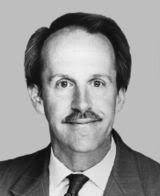 Former California Congressman Frank Riggs
Senator Olympia J. Snowe, Republican of Maine, was also credited by Canvasback with working on the earmark. But David Snepp, Ms. Snowe’s spokesman, said she had merely voted for it. Mr. Snepp called Canvasback’s actions troubling and said the senator had asked her staff to research what is now a gray area: whether selling the two ships was legal.
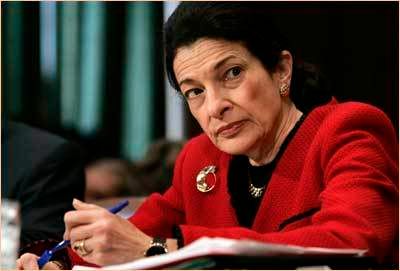 Maine Senator Olympia Snowe
“If they were not used in Micronesia, they were definitely not used in the spirit of the way this was written,” Mr. Snepp said. The text of the earmark gave the government the right to reclaim the ships, he added. While that was perhaps unlikely, he continued: “They were supposed to retain the vessels in case the Coast Guard needed them back. The charity does not have the option to sell.”
A harsher assessment came from Steve Ellis, vice president of Taxpayers for Common Sense, a watchdog group that opposes earmarks, and a former Coast Guard officer. “They are flipping the property,” Mr. Ellis said.
Jamie W. Spence, president and founder of Canvasback Missions, said all the sales proceeds supported the organization’s work in the Marshall Islands, where it has provided eye and dental care and counseling on diabetes prevention to thousands of people since it was founded in 1981.
 Jacque Spence, left, and her husband, Jamie, at their Canvasback Missions office in Benicia, Calif.
“We did everything in our power to put these ships into service,” Mr. Spence said. But when the group could not raise the money to repair and maintain the vessels, it sold them instead, using the proceeds to cope with its financial difficulties, he said.
Mr. Spence said he had consulted with Canvasback’s legal advisers and was confident the sales were ethical and legal.
Coast Guard officials were surprised at the cutters’ fate. “The White Holly and the White Sage are in the South Pacific,” Lynn Brown, the personal property manager in the decommissioning office, said in March. She affirmed recently that her office had not known that Canvasback sold the ships.
Mr. Spence acknowledged that he did not give notice to Ms. Brown’s office. But he said he told Coast Guard employees in the Bay Area about the White Holly sale and mentioned the White Sage sale to the Coast Guard officer in charge of the Baltimore yard before the deal and to civilian Coast Guard officials afterward. He did not respond to requests to identify those people.
While all earmarks are troublesome to critics like Mr. Ellis, who called the Canvasback gift an “utter indictment of earmarks,” those made for faith-based groups involve special questions about the constitutional borders between church and state.
 Vince Backen with students and teachers after giving them a cruise on the White Holly, a former Coast Guard cutter sold to him by Canvasback Missions.
[photo: Jim Wilson/NYT]
The Coast Guard ships were given to Canvasback for a secular purpose, providing medical services. But Mr. Spence said Canvasback did not isolate the sales proceeds; instead it mingled them with its general revenues, which also cover activities that include evangelism. And under most court decisions, evangelism cannot be paid for with federal grants.
Mr. Spence said no constitutional violations occurred. “I’m very certain that the proceeds were used for supporting our medical program,” he said, “and I’m absolutely sure they were not used for evangelism.” He said Canvasback, a nondenominational Christian mission, raises donations separately for its evangelism activities, which included donating Bibles translated into local languages and constructing a chapel.
Mr. Spence and his wife, Jacque, established their medical mission 26 years ago, using a 71-foot catamaran, the Canvasback, to navigate the shallow coasts of the poorer, more remote islands of Micronesia. As the ministry grew, it mobilized medical professionals to volunteer for short stints in the islands and delivered donated medical equipment and supplies.
When they sought the Congressional earmark, the Spences were hoping the two cutters would allow them to expand their medical ministry, Mr. Spence said. But the mission acquired and then sold those vessels, and a third vessel that was privately donated, because Canvasback determined that maintaining and operating the ships was too big a financial burden, he explained. But few of these details can be found in the annual statements Canvasback files with the Internal Revenue Service. Two leading nonprofit accounting experts examined the statements and found them to be incomplete and internally inconsistent.
“There is no clear audit trail for the boats,” said Julie L. Floch of Eisner L.L.P. in Manhattan, a member of the I.R.S.’s national advisory panel on nonprofits. Her view was echoed by Jody Blazek of Blazek & Vetterling L.L.P. in Houston, the author of six books on nonprofit tax law and accounting.
William J. MacLean, the accountant in Seaside, Ore., who prepared the filings, declined to comment.
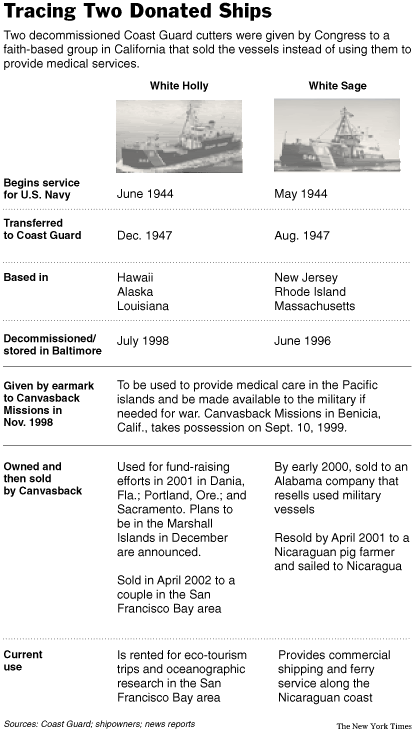
These days, Canvasback has redirected its efforts from ship-based medical care in the remote islands to land-based clinics on the more populated islands, Mr. Spence said.
That work has won praise from health officials in the Marshall Islands — and fresh support from Congress. The tiny mission is now the lead contractor on a diabetes research program being financed through two $1 million Defense Department contracts. Those grants were directed to Canvasback by Congress through a pair of earmarks.
