The Washington Post reports:
Attorney General Michael B. Mukasey today sharply rebuffed congressional demands for details about the Justice Department's inquiry into the destruction of CIA interrogation tapes, saying that providing such information would make it appear that the department was "subject to political influence."
In letters to the leaders of the Senate Judiciary Committee and others, Mukasey also reiterated his opposition to appointing a special prosecutor to the tapes investigation, saying he was "aware of no facts at present" that would require such a step.
"At my confirmation hearing, I testified that I would act independently, resist political pressure and ensure that politics plays no role in cases brought by the Department of Justice," Mukasey wrote. "Consistent with that testimony, the facts will be followed wherever they lead in this inquiry, and the relevant law applied."
One letter was sent to Sens. Patrick J. Leahy (D-Vt.) and Arlen Specter (R-Pa.), the leaders of the Senate Judiciary Committee. Similar correspondence was sent to Senate Majority Whip Richard Durbin (D-Ill.) and to House Judiciary Chairman John Conyers (D-Mich.) and other House Democrats.
The three letters represent an attempt by Mukasey to push back against growing pressure from lawmakers, primarily Democrats, who have showered the Justice Department with demands for investigations or information on topics ranging from the baseball steroids scandal to allegations of rape by a former military contractor employee.
The letters also are an assertive move by the new attorney general, who was confirmed last month with the lowest level of Senate support in the past half century because of his refusal to say whether a form of simulated drowning known as waterboarding amounts to torture under U.S. law.
Mukasey replaced former attorney general Alberto R. Gonzales, who left office in September after the furor over his handling of the firings of nine U.S. attorneys and allegations that he misled Congress in sworn testimony.
The CIA disclosed last week that it destroyed videotapes in 2005 depicting interrogation sessions for alleged al-Qaeda operatives Zayn al-Abidin Muhammed Hussein, commonly known as Abu Zubaida, and Abd al-Rahim al-Nashiri. Administration officials have said that lawyers at the Justice Department and the White House, including former counsel Harriet E. Miers, advised the CIA against destroying the tapes but that CIA lawyers ruled their preservation was not required.
The Justice Department announced Saturday it had joined the CIA's inspector general in launching a preliminary inquiry into the tape destruction, and prosecutors asked the CIA to preserve any related evidence.
Leahy and Specter asked Mukasey on Dec. 10 for "a complete account of the Justice Department's own knowledge of and involvement with" the tape destruction. The two senators included a list of 16 separate questions, including whether the Justice Department had offered legal advice to the CIA about the tapes or had communicated with the White House about the issue.
Durbin had sent a letter to Mukasey Dec. 7 asking whether an investigation into the tape destruction would be pursued. Conyers and three other House Democrats authored a similar letter on the same day.
Mukasey wrote to the lawmakers that Justice "has a long-standing policy of declining to provide non-public information about pending matters.
Friday, December 14, 2007
| [+/-] |
Mukasey Rejects Call for CIA Tape Details |
Tuesday, November 6, 2007
| [+/-] |
Senate Judiciary Committee Approves Mukasey Nomination |
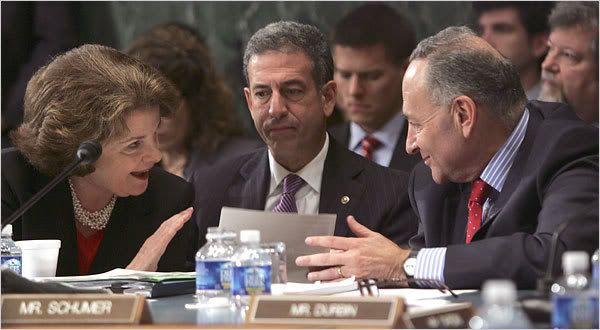 Senators Dianne Feinstein, Russ Feingold and Chuck Schumer after the vote on Tuesday.
The NY Times reports:
The Senate Judiciary Committee voted on Tuesday to approve the nomination of Michael B. Mukasey as attorney general despite opposition from most of the committee’s Democrats over Mr. Mukasey’s refusal to label a harsh interrogation technique used on terrorist suspects as torture.
Protesters opposed the Mukasey nomination and votes of two Democratic senators.
The vote, 11 to 8, with two Democrats joining all of the committee’s Republicans in supporting Mr. Mukasey, all but assured him of final confirmation by the full Senate. The Senate’s Democratic leaders are expected to schedule a vote by next week.
Mr. Mukasey, a retired federal judge from New York, ultimately owed his approval by the Judiciary Committee to the two Democrats who broke with their party to support him, Senators Dianne Feinstein of California and Charles E. Schumer, a fellow New Yorker who had initially recommended Mr. Mukasey to the White House.
The nomination of Mr. Mukasey was almost derailed by his refusal at his confirmation hearings to define as torture the interrogation technique known as waterboarding, which simulates drowning and is reported to have been used by the Central Intelligence Agency on a handful of Qaeda leaders since the Sept. 11 terror attacks.
In a letter to senators last week, Mr. Mukasey said the practice of waterboarding was “repugnant” but added that he could not judge its legality until he had been given access to classified information about interrogation techniques.
The White House welcomed the Judiciary Committee’s vote and urged that the nomination be moved quickly to the Senate floor. “Judge Mukasey has clearly demonstrated that he will be an exceptional attorney general at this critical time,” the White House spokeswoman, Dana Perino, said Tuesday.
Even some of Mr. Mukasey’s supporters said at the hearing to vote on the nomination that they were troubled by the way Mr. Mukasey handled questions about waterboarding, which the United States has fiercely condemned when carried out by other nations and had prosecuted as a war crime after World War II.
“I understand and greatly respect the view of some of my colleagues that the torture question trumps all other considerations,” Mr. Schumer said. But in explaining his vote for the nomination, Mr. Schumer said rejection of an otherwise highly praised nominee like Mr. Mukasey would allow the White House to appoint a caretaker attorney general who would not end the management turmoil and political scandals that plagued the Justice Department under Attorney General Alberto R. Gonzales.
“Judge Mukasey would be more likely than a caretaker to find on his own that waterboarding is illegal,” Mr. Schumer said.
In voting against Mr. Mukasey, the committee’s chairman, Patrick J. Leahy, and other Democrats portrayed their opposition as a defining moment for Congress in standing up to the Bush administration in upholding basic human rights and constitutional values in battling terrorism.
“America, the great and good nation that has been a beacon to the world on human rights, does not torture and should stand against torture,” Mr. Leahy said.
Senator Richard J. Durbin of Illinois, the Senate’s No. 2 Democratic leader, accused Mr. Mukasey of a “legal dodge” in refusing to repudiate “a cruel, abusive technique that has been regarded as torture in the civilized world for over 500 years.”
“When the history of this time is written, the issue of torture will define America’s values in the age of terrorism,” he continued. “Judge Mukasey’s responses to our questions on the issue of torture make it clear that he does not understand the challenge of this moment in history.”
The committee’s ranking Republican, Arlen Specter of Pennsylvania, said he had also been disturbed by Mr. Mukasey’s responses to the committee’s questions on torture, as well as on the nominee’s embrace of the Bush administration’s expansive view of the powers of the executive branch in wartime.
Mr. Specter said Mr. Mukasey’s assertion that he could not address the legality of waterboarding because he had not been briefed about it was “an excuse, and a flimsy excuse.”
But he said he decided to support the nomination after talking on Monday with Mr. Mukasey, who said he believed that if Congress outlawed waterboarding, which the Senate is now considering, the president would have no authority to overrule it. Mr. Specter said: “All factors considered, I think that the balance is decisively in favor of confirming Judge Mukasey. And I look forward to Congressional consideration of this issue of waterboarding. We’re the people who ought to decide it.”
Tuesday, October 16, 2007
| [+/-] |
White House to Give Senate Panel Surveillance Program Documents |
The Washington Post reports:
The White House agreed yesterday to give Senate intelligence committee members and staff access to internal documents related to its domestic surveillance program in a bid to win Democratic lawmakers' support for the administration's version of an intelligence measure.
The move was meant in part to defuse a months-long clash between Congress and the Bush administration over access to legal memoranda and presidential decisions underpinning the Terrorist Surveillance Program, which allowed the government to eavesdrop without court warrants on communications between people in the United States and abroad when one of the parties is a terrorism-related suspect.
Some of the documents had been demanded by Senate Judiciary Committee members as a condition for considering the administration's nomination of former judge Michael B. Mukasey as the nation's 81st attorney general. Sen. Patrick J. Leahy (D-Vt.), the committee's chairman, dropped that condition weeks ago but said yesterday that he still wants to see the documents.
Leahy told reporters after a meeting with Mukasey yesterday that he nonetheless expects Mukasey "to be confirmed" after a nomination hearing today, at which Mukasey is to be escorted into the room by Leahy and the committee's ranking Republican, Sen. Arlen Specter (Pa.). Mukasey is to be formally introduced by Sens. Joseph I. Lieberman (I-Conn.) and Charles E. Schumer (D-N.Y.).
Schumer indicated after meeting separately with Mukasey yesterday that he expects the judge to promise to undertake a review of the department's legal justifications for the administration's counterterrorism policies, which are the subject of some of the documents made available to intelligence committee staff and members for review at the White House.
Mukasey has indicated that he strongly supports the administration's counterterrorism effort.
Committee member Dianne Feinstein (D-Calif.), who also sits on the Judiciary panel, said however that when one of her staff members reviewed the documents, "he wasn't impressed." She added that she was unsure whether the documents the staff member saw were exactly what Leahy was seeking.
Sen. Christopher S. Bond (Mo.), the intelligence committee's ranking Republican, was more positive. "We're getting the information I think we need."
But House Democrats, who plan to vote today on a bill that would restrict domestic surveillance powers more tightly than the administration wants, complained yesterday that they should have been permitted the same access.
"Although even these materials are far short of the information that Congress has requested for more than a year on this crucial subject, we are extremely disappointed that the available information is being withheld from the House," Judiciary Committee Chairman John Conyers Jr. (D-Mich.) said in a letter yesterday to White House counsel Fred F. Fielding.
Besides trying to quiet congressional accusations of a coverup, the administration wants in particular to win support for a legal provision providing immunity for telecommunications companies that have been sued for violating privacy rights when they assisted the government's domestic surveillance effort.
White House spokesman Tony Fratto said that administration officials "routinely meet with members of Congress and their staffs to provide them with information they need when they are considering and drafting legislation." In this case, he said, members of the Senate intelligence panel "requested access to certain materials to assist their consideration" of relief for the companies.
In addition to seeking documents related to the surveillance program, Leahy has sought internal legal opinions related to torture issues involving terrorism suspects and testimony from White House advisers connected to the firing of nine U.S. attorneys last year.
Leahy said his questioning at the hearing today will be aimed at eliciting statements from Mukasey about the legality of torturing terrorism suspects and threats to the independence of federal prosecutors that impinge on their efforts to pursue cases regardless of political sensitivities. "How are you going to clean up this mess?" Leahy said he probably will ask Mukasey.
Mukasey has already sought to assure lawmakers in private that he will not let politics intrude on the department's decisions. "He will be light-years better than his predecessor," Leahy said, referring to former attorney general Alberto R. Gonzales, who resigned in late August after making a series of statements about the attorney firings and surveillance programs that were disputed by his former colleagues and lawmakers from both parties.
Thursday, October 4, 2007
| [+/-] |
Senate Judiciary Committee Backs Journalist Shield Bill |
The JURIST reports:
The US Senate Judiciary Committee [official website] Thursday voted 15-2 to send a federal shield bill, which would protect reporters from being compelled to disclose confidential sources, to the full Senate for consideration. The Bush administration and the US Department of Justice have continuously opposed the enactment of a federal reporter shield law citing national security concerns, while proponents of the bill, including media outlets, argue the legislation is necessary to protect freedom of the press.
According to a statement from one of the bill's sponsors, Sen. Arlen Specter (R-PA):
This legislation establishes a federal reporters' privilege to protect and encourage the free flow of information between journalists and confidential sources. It seeks to reconcile reporters' need to maintain confidentiality, in order to ensure that sources will speak openly and freely, with the public's right to effective law enforcement and fair trials.
In order to balance these competing interests, this bill creates a qualified privilege for reporters to withhold information they obtain under a promise of confidentiality. It ensures that a federal court can only force a journalist to reveal confidential source information where the information is truly critical to a case or investigation. It also requires the party seeking a reporter's confidential information to exhaust all reasonable alternative sources before turning to the media.
The bill also contains exceptions to the privilege for those situations where information sharing is critical. A reporter may not withhold his source information where it is needed to prevent a terrorist attack, significant harm to our national security, death, kidnapping, or substantial bodily harm. Journalists who witness crimes also cannot refuse to share their eyewitness observations.
The US House Judiciary Committee approved similar legislation in August. That bill has not yet been debated on the House floor. AP has more.
The Senate Judiciary Committee postponed further consideration of a similar proposed shield bill in September 2006 in the wake of strong opposition from Justice Department officials.
Tuesday, October 2, 2007
| [+/-] |
Arlen Specter Cleared for Air Force One Takeoff |
PennLive.com reports:
The last time U.S. Sen. Arlen Specter, R-Pa., caught a ride about Air Force One, Pennsyltucky's senior senator violated two of the cardinal rules of traveling aboard the president's airplane.
He wandered back to talk with the press and criticized then Attorney General Alberto Gonzales during a July presidential visit to Philadelphia, thereby flouting the unwritten rules against hobnobbing with the press and criticizing the president or his team.
Despite his rule violations, Specter will once again be traveling in style Wednesday when he joins President Bush aboard Air Force One for Wednesday's quick flight from Washington, D.C. to Lancaster.
U.S. Sen. Bob Casey Jr., D-Pa., will not be making the flight.
Bush will be addressing about 400 members of the Lancaster Chamber of Business and Industry in a town hall-style meeting about spending disagreements with Congress during an hour-long forum at the new Hempfield Twp. headquarters of the Jay Group Inc.
Though Specter disagrees with the president on many of the spending fights, it's protocol to invite the local lawmakers and senators for the trip. And with his approval rating hovering around 30 percent, the president can use all the friends he can get.
Besides, it's a short trip.
Tuesday, September 18, 2007
| [+/-] |
Arlen Specter Adds Earmarks For Abstinence Education |
At the Baltimore Sun, Josh Drobnyk writes:
Sen. Arlen Specter added more than two dozen spending requests for abstinence education programs in Pennsylvania to a bill that passed a Senate committee this summer, the latest effort by the Pennsylvania Republican to boost federal spending on such programs, as I write in today's Allentown Morning Call.
The more than $1 million -- to be doled out in 25 grants each worth between $30,000 and $80,000 -- would go to hospitals, school districts and social service organizations throughout the state and supplement a growing federal effort to persuade unmarried people to abstain from sex. But critics say the requests bypass the government's competitive bidding process.
Specter, who added the ''earmarks'' to the Labor and Health and Human Services appropriations measure that passed the panel in June, is the only lawmaker in Congress to sponsor a spending request for abstinence education, according to a database of appropriations bills compiled by Washington-based watchdog Taxpayers for Common Sense. The bill still needs Senate, House and White House approval.
Specter's support for abstinence education is a long-held but lesser-known position of the five-term lawmaker, a move that could soften his image among moral conservatives as an abortion-rights supporter.
He has pushed for more federal money toward abstinence programs since at least the mid-1990s, but not until a few years ago did he add a spending request directly into an appropriations bill, requiring the Department of Health and Human Services to fund a project.
In 2003 and 2004, he added about 65 earmarks for abstinence education totaling $5.6 million into appropriations measures, according to Taxpayers for Common Sense.
Unlike past years, though, when earmark sponsors were determined mainly through piecing together news releases and line items within spending bills, this year's appropriations measures highlight exactly who has sponsored each request. They offer the first comprehensive glimpse of Specter's support for specific abstinence programs.
''Sen. Specter recognizes the need for comprehensive sex education,'' Specter chief of staff Scott Hoeflich said in an e-mail. ''Thus, he supports funding for abstinence-only education programs in response to a significant segment of his constituency which he believes is entitled to implement programs most consistent with their values.''
The year's requests are sprinkled throughout the state. Among them: $55,000 for LaSalle University in Philadelphia, $30,000 for Shepherd's Maternity House in East Stroudsburg and $45,000 for Washington Hospital Teen Outreach in Washington County.
One such program, Human Life Services in York, has twice before received grants earmarked by Specter. Executive Director Ron Sisto said the organization's abstinence program gives seminars at hundreds of schools every year. ''We explain to them that to have the healthiest lifestyle is to remain abstinent until marriage,'' Sisto said. That involves teaching about sexually transmitted diseases but not contraception.
This year's Pennsylvania earmarks would add to federally funded abstinence programs that have more than doubled in total dollars since 2000 to $213 million this year, all administered by Health and Human Services. Most of the money is through the Community-Based Abstinence Education program, which began in 2000 and awards grants directly to states and local organizations.
The earmarks touch on two raging debates on Capitol Hill: Whether the programs funded are properly vetted and whether abstinence education is effective. ''It is not necessarily that there is anything wrong with the program,'' said Ryan Alexander, president of Taxpayers for Common Sense. ''We don't have the evidence to support the fact that this is a federal priority. We don't know what they are saying no to.''
Added Valerie Huber, executive director of the National Abstinence Education Association, which lobbies for more federal money for the effort: ''It is really a little more difficult [to know] that the funds are being used as they are intended to when they don't have the oversight of HHS.''
But Specter's office said each application goes through a competitive process that is ''thoroughly reviewed'' by the senator's office -- not normal channels through the Department of Health and Human Services. Once funded, the project is held accountable by the department like any government-funded project.
Whether or not the programs are effective is a different question. Supporters and opponents point to varying evidence that backs their position.
''There has never been any research that showed these programs were effective,'' said Martha Kempner, spokeswoman for Sexuality Information and Education Council of the United States. She noted that a federally funded study released early this year showed abstinence education is not effective in delaying sexual activity among unmarried youth.
Huber, though, said dozens of other studies show positive effects. ''It is effective in delaying sexual onset,'' she said.
Sunday, September 9, 2007
| [+/-] |
Specter's Support for Craig Angers Senate Republicans |
In the Chicago Sun Times, Robert Novak writes:
While Senate Republicans reflected outrage that Sen. Larry Craig was retreating from his earlier statement that he would resign from the Senate, their privately expressed anger was directed toward Sen. Arlen Specter for encouraging Craig to reconsider.
The Idaho senator appeared ready to resign because he pleaded guilty to improper conduct in a Minnesota airport restroom, but he modified his position after he heard Specter on the Fox News Network say he should not quit. A misdirected voicemail disclosing Craig's tactics cited Specter's comments as reason for contemplating a fight.
Specter, a moderate from Pennsylvania, was grateful to Craig as a rare conservative senator who backed him vigorously when an effort was made after the 2004 elections to prevent Specter from becoming Judiciary Committee chairman.
After privately being told by Republicans to stop boosting Craig, Specter on Thursday contended he had said all he would say about the controversy.
The Idaho senator seemed ready to resign until he heard Specter say he should stay.
Wednesday, August 22, 2007
| [+/-] |
Transcript: Interview with Mike McConnell on the Foreign Intelligence Surveillance Act |
From the El Paso Times, the following is the transcript of a question and answer session with National Intelligence Director Mike McConnell:
Question: How much has President Bush or members of his administration formed your response to the FISA debate?
Answer: Not at all. When I came back in, remember my previous assignment was director of the NSA, so this was an area I have known a little bit about. So I came back in. I was nominated the first week of January. The administration had made a decision to put the terrorist surveillance program into the FISA court. I think that happened the 7th of Jan. So as I come in the door and I'm prepping for the hearings, this sort of all happened. So the first thing I want to know is what's this program and what's the background and I was pretty surprised at what I learned. First off, the issue was the technology had changed and we had worked ourselves into a position that we were focusing on foreign terrorist communications, and this was a terrorist foreigner in a foreign country. The issue was international communications are on a wire so all of a sudden we were in a position because of the wording in the law that we had to have a warrant to do that. So the most important thing to capture is that it's a foreigner in a foreign country, required to get a warrant. Now if it were wireless, we would not be required to get a warrant. Plus we were limited in what we were doing to terrorism only and the last time I checked we had a mission called foreign
intelligence, which should be construed to mean anything of a foreign intelligence interest, North Korea, China, Russia, Syria, weapons of mass destruction proliferation, military development and it goes on and on and on. So when I engaged with the administration, I said we've gotten ourselves into a position here where we need to clarify, so the FISA issue had been debated and legislation had been passed in the house in 2006, did not pass the Senate. Two bills were introduced in the Senate, I don't know if it was co-sponsorship or two different bills, but Sen. (Dianne Feinstein, D-Calif.) had a bill and Sen. Specter had a bill and it may have been the same bill, I don't know, but the point is a lot of debate, a lot of dialogue. So, it was submitted to the FISA court and the first ruling in the FISA court was what we needed to do we could do with an approval process that was at a summary level and that was OK, we stayed in business and we're doing our mission. Well in the FISA process, you may or may not be aware ...
Q: When you say summary level, do you mean the FISA court?
A: The FISA court. The FISA court ruled presented the program to them and they said the program is what you say it is and it's appropriate and it's legitimate, it's not an issue and was had approval. But the FISA process has a renewal. It comes up every so many days and there are 11 FISA judges. So the second judge looked at the same data and said well wait a minute I interpret the law, which is the FISA law, differently. And it came down to, if it's on a wire and it's foreign in a foreign country, you have to have a warrant and so we found ourselves in a position of actually losing ground because it was the first review was less capability, we got a stay and that took us to the 31st of May. After the 31st of May we were in extremis because now we have significantly less capability. And meantime, the community, before I came back, had been working on a National Intelligence Estimate on terrorist threat to the homeland. And the key elements of the terrorist threat to the homeland, there were four key elements, a resilient determined adversary with senior leadership willing to die for the cause, requiring a place to train and develop, think of it as safe haven, they had discovered that in the border area between Pakistan and Afghanistan. Now the Pakistani government is pushing and pressing and attempting to do something about it, but by and large they have areas of safe haven. So leadership that can adapt, safe haven, intermediate leadership, these are think of them as trainers, facilitators, operational control guys. And the fourth part is recruits. They have them, they've taken them. This area is referred to as the FATA, federally administered tribal areas, they have the recruits and now the objective is to get them into the United States for mass casualties to conduct terrorist operations to achieve mass casualties. All of those four parts have been carried out except the fourth. They have em, but they haven't been successful. One of the major tools for us to keep them out is the FISA program, a significant tool and we're going the wrong direction. So, for me it was extremis to start talking not only to the administration, but to members of the hill. So from June until the bill was passed, I think I talked to probably 260 members, senators and congressmen. We submitted the bill in April, had an open hearing 1 May, we had a closed hearing in May, I don't remember the exact date. Chairman (U.S. Rep. Silvestre Reyes, D-Texas) had two hearings and I had a chance to brief the judiciary committee in the house, the intelligence committee in the house and I just mentioned the Senate, did not brief the full judiciary committee in the Senate, but I did meet with Sen. (Patrick Leahy, D-Vt.) and Sen. (Arlen Specter, R-Pa.), and I did have an opportunity on the Senate side, they have a tradition there of every quarter they invite the director of national intelligence in to talk to them update them on topics of interest. And that happened in (June 27). Well what they wanted to hear about was Iraq and Afghanistan and for whatever reason, I'm giving them my review and they ask questions in the order in which they arrive in the room. The second question was on FISA, so it gave me an opportunity to, here I am worrying about this problem and I have 41 senators and I said several things. The current threat is increasing, I'm worried about it. Our capability is decreasing and let me explain the problem.
Q: Can't you get the warrant after the fact?
A: The issue is volume and time. Think about foreign intelligence. What it presented me with an opportunity is to make the case for something current, but what I was really also trying to put a strong emphasis on is the need to do foreign intelligence in any context. My argument was that the intelligence community should not be restricted when we are conducting foreign surveillance against a foreigner in a foreign country, just by dint of the fact that it happened to touch a wire. We haven't done that in wireless for years.
Q: So you end up with people tied up doing paperwork?
A: It takes about 200 man hours to do one telephone number. Think about it from the judges standpoint. Well, is this foreign intelligence? Well how do you know it's foreign intelligence? Well what does Abdul calling Mohammed mean, and how do I interpret that? So, it's a very complex process, so now, I've got people speaking Urdu and Farsi and, you know, whatever, Arabic, pull them off the line have them go through this process to justify what it is they know and why and so on. And now you've got to write it all up and it goes through the signature process, take it through (the Justice Department), and take it down to the FISA court. So all that process is about 200 man hours for one number. We're going backwards, we couldn't keep up. So the issue was ...
Q: How many calls? Thousands?
A: Don't want to go there. Just think, lots. Too many. Now the second part of the issue was under the president's program, the terrorist surveillance program, the private sector had assisted us. Because if you're going to get access you've got to have a partner and they were being sued. Now if you play out the suits at the value they're claimed, it would bankrupt these companies. So my position was we have to provide liability protection to these private sector entities. So that was part of the request. So we went through that and we argued it. Some wanted to limit us to terrorism. My argument was, wait a minute, why would I want to limit it to terrorism. It may be that terrorists are achieving weapons of mass destruction, the only way I would know that is if I'm doing foreign intelligence by who might be providing a weapon of mass destruction.
Q: And this is still all foreign to foreign communication?
A: All foreign to foreign. So, in the final analysis, I was after three points, no warrant for a foreigner overseas, a foreign intelligence target located overseas, liability protection for the private sector and the third point was we must be required to have a warrant for surveillance against a U.S. person. And when I say U.S. person I want to make sure you capture what that means. That does not mean citizen. That means a foreigner, who is here, we still have to have a warrant because he's here. My view is that that's the right check and balances and it's the right protection for the country and lets us still do our mission for protection of the country. And we're trying to fend off foreign threats.
Q: So are you satisfied with it the way it is now?
A: I am. The issue that we did not address, which has to be addressed is the liability protection for the private sector now is proscriptive, meaning going forward. We've got a retroactive problem. When I went through and briefed the various senators and congressmen, the issue was alright, look, we don't want to work that right now, it's too hard because we want to find out about some issues of the past. So what I recommended to the administration is, 'Let's take that off the table for now and take it up when Congress reconvenes in September.'
Q: With an eye toward the six-month review?
A: No, the retroactive liability protection has got to be addressed.
Q: And that's not in the current law?
A: It is not. Now people have said that I negotiated in bad faith, or I did not keep my word or whatever...
Q: That you had an agenda that you weren't honest about.
A: I'll give you the facts from my point of view. When I checked on board I had my discussion with the president. I'm an apolitical figure. I'm not a Republican, I'm not a Democrat. I have voted for both. My job is as a professional to try to do this job the best way I can in terms of, from the intelligence community, protect the nation. So I made my argument that we should have the ability to do surveillance the same way we've done it for the past 50 years and not be inhibited when it's a foreigner in a foreign country. The president's guidance to me early in the process, was, 'You've got the experience. I trust your judgement. You make the right call. There's no pressure from anybody here to tell you how to do it. He did that early. He revisited with me in June. He did it again in July and he said it publicly on Friday before the bill was passed. We were at the FBI, it's an annual thing, we go to the FBI and do a homeland security kind of update. So he came out at noon and said, 'I'm requesting that Congress pass this bill. It's essential. Do it before you go on recess. I'm depending on Mike McConnell's recommendations. And that was the total sum and substance of the guidance and the involvement from the White House with regard to how I should make the call. Now, as we negotiated, we started with 66 pages, were trying to get everything cleaned up at once. When I reduced it to my three points, we went from 66 pages to 11. Now, this is a very, very complex bill. I had a team of 20 lawyers working. You can change a word in a paragraph and end up with some major catastrophe down in paragraph 27, subsection 2c, to shut yourself down, you'll be out of business. So when we send up our 11 pages, we had a lot of help in making sure we got it just right so it would come back and we'd say wait a minute we can't live with this or one of the lawyers would say, 'Wait we tried that, it won't work, here's the problem.' So we kept going back and forth, so we sent up a version like Monday, we sent up a version on Wednesday, we sent up a version on Thursday. The House leadership, or the Democratic leadership on Thursday took that bill and we talked about it. And my response was there are some things I can't live with in this bill and they said alright we're going to fix them. Now, here's the issue. I never then had a chance to read it for the fix because, again, it's so complex, if you change a word or phrase, or even a paragraph reference, you can cause unintended ...
Q: You have to make sure it's all consistent?
A: Right. So I can't agree to it until it's in writing and my 20 lawyers, who have been doing this for two years, can work through it. So in the final analysis, I was put in the position of making a call on something I hadn't read. So when it came down to crunch time, we got a copy and it had some of the offending language back in it. So I said, 'I can't support it.' And it played out in the House the way it played out in the House. Meantime on the Senate side, there were two versions being looked at. The Wednesday version and the Thursday version. And one side took one version and the other side took the other version. The Thursday version, we had some help, and I didn't get a chance to review it. So now, it's Friday night, the Senate's voting. They were having their debate and I still had not had a chance to review it. So, I walked over, I was up visiting some senators trying to explain some of the background. So I walked over to the chamber and as I walked into the office just off the chamber, it's the vice president's office, somebody gave me a copy. So I looked at the version and said, 'Can't do it. The same language was back in there.'
Q: What was it?
A: Just let me leave it, not too much detail, there were things with regard to our authorities some language around minimization. So it put us in an untenable position. So then I had another version to take a look at, which was our Wednesday version, which basically was unchanged. So I said, well certainly, I'm going to support that Wednesday version. So that's what I said and the vote happened in the Senate and that was on Friday. So now it rolled to the House on Saturday. They took up the bill, they had a spirited debate, my name was invoked several times, not in a favorable light in some cases. (laughs) And they took a vote and it passed 226 to 182, I think. So it's law. The president signed it on Sunday and here we are.
Q: That's far from unanimous. There's obviously going to be more debate on this.
A: There are a couple of issues to just be sensitive to. There's a claim of reverse targeting. Now what that means is we would target somebody in a foreign country who is calling into the United States and our intent is to not go after the bad guy, but to listen to somebody in the United States. That's not legal, it's, it would be a breach of the Fourth Amendment. You can go to jail for that sort of thing. And If a foreign bad guy is calling into the United States, if there's a need to have a warrant, for the person in the United States, you just get a warrant. And so if a terrorist calls in and it's another terrorist, I think the American public would want us to do surveillance of that U.S. person in this case. So we would just get a warrant and do that. It's a manageable thing. On the U.S. persons side it's 100 or less. And then the foreign side, it's in the thousands. Now there's a sense that we're doing massive data mining. In fact, what we're doing is surgical. A telephone number is surgical. So, if you know what number, you can select it out. So that's, we've got a lot of territory to make up with people believing that we're doing things we're not doing.
Q: Even if it's perception, how do you deal with that? You have to do public relations, I assume.
A: Well, one of the things you do is you talk to reporters. And you give them the facts the best you can. Now part of this is a classified world. The fact we're doing it this way means that some Americans are going to die, because we do this mission unknown to the bad guys because they're using a process that we can exploit and the more we talk about it, the more they will go with an alternative means and when they go to an alternative means, remember what I said, a significant portion of what we do, this is not just threats against the United States, this is war in Afghanistan and Iraq.
Q. So you're saying that the reporting and the debate in Congress means that some Americans are going to die?
A. That's what I mean. Because we have made it so public. We used to do these things very differently, but for whatever reason, you know, it's a democratic process and sunshine's a good thing. We need to have the debate. The reason that the FISA law was passed in 1978 was an arrangement was worked out between the Congress and the administration, we did not want to allow this community to conduct surveillance, electronic surveillance, of Americans for foreign intelligence unless you had a warrant, so that was required. So there was no warrant required for a foreign target in a foreign land. And so we are trying to get back to what was the intention of '78. Now because of the claim, counterclaim, mistrust, suspicion, the only way you could make any progress was to have this debate in an open way.
Q. So you don't think there was an alternative way to do this?
A. There may have been an alternative way, but we are where are ...
Q. A better way, I should say.
A. All of my briefs initially were very classified. But it became apparent that we were not going to be able to carry the day if we don't talk to more people.
Q. Some might say that's the price you pay for living in a free society. Do you think that this is necessary that these Americans die?
A. We could have gotten there a different way. We conducted intelligence since World War II and we've maintained a sensitivity as far as sources and methods. It's basically a sources and methods argument. If you don't protect sources and methods then those you target will choose alternative means, different paths. As it is today al-Qaida in Iraq is targeting Americans, specifically the coalition. There are activities supported by other nations to import electronic, or explosively formed projectiles, to do these roadside attacks and what we know about that is often out of very sensitive sources and methods. So the more public it is, then they take it away from us. So that's the tradeoff.
DIVERSITY IN THE INTELLIGENCE COMMUNITY
Q: I wanted to ask you about the diversity question. This has major ramifications here, we have this center of excellence program that's recruiting high school kids, many of whom wouldn't qualify if first generation American citizens weren't allowed.
A: So you agree with me?
Q: It does sound like something that would benefit this area that would also allow you to get people from here who are bicultural and have an openness to seeing things ...
A: You're talking about Hispanics?
Q: Yes.
A: Hispanics are probably the most under-represented group if you think of America, what the ethic makeup of America, Hispanics are the most under-represented group in my community. Now, that said, and should increase that Hispanic population and programs like this will do that. That's why the outreach. But also we need, particularly with the current problem of terrorism, we need to have speakers of Urdu and Farsi and Arabic and people from those cultures that understand the issues of tribes and clans and all the things that go with understanding that part of the world. Varying religions and so on. Because it is, it's almost impossible, I've had the chance to live in the Middle East for years, I've studied it for years, it's impossible to understand it without having some feel for the culture and so on. So while I'm all for increasing the diversity along the lines we talked about, I'm also very much in favor of first generation Americans from the countries that are causing issues and problems.
Q: What is the status of that program.
A: It is not in statue. It is not in policy. It has been habit. So we've stated, as a matter of policy, that we're not going to abide by those habits.
Q: And that's already the case?
A: Yes, and are we making progress? Not fast enough, but we will make progress over time.
Q: How do you measure that?
A: Very simple, you get to measure what are you and where are you trying go and are you making progress. I wrestled with this years ago when I was NSA ....
Q: You don't want quotas, though?
A: Quotas are forbidden so we set goals. My way of thinking about it is what is your end state? Now some would say that federal governments should look like America, whatever that is. OK, that sounded like a reasonable metric, so I said, 'Alright, what does America look like?' So I got a bunch of numbers. I said, 'Alright, what do we look like?' and it didn't match, and as I just told you, the one place where there's the greatest mismatch is Hispanic. It's much closer, as matter of fact, people would be surprised how close it is across, at least my community among the other minorities. Now, that said, numbers don't necessarily equal positioning in the organization. So that's another feature we have to work on, is placement of women and minorities in leadership positions.
Q: So, you're quantifying that as well?
A: Yes.
TERRORIST ACTIVITY ON THE NATION'S SOUTHWEST BORDER
Q: There seems to be very little terrorist-related activity on the Southwest border, which is watched very closely because of the illegal immigration issue. Can you talk about why it's important to be alert here?
A: Let me go back to my NIE, those are unclassified key judgements, pull them down and look at them. You've got committed leadership. You've got a place to train. They've got trainers and they've got recruits. The key now is getting recruits in. So if the key is getting recruits in. So, if you're key is getting recruits in, how would you do that? And so, how would you do that?
Q: I'd go to the northern border where there's nobody watching.
A: And that's a path. Flying in is a path. Taking a ship in is a path. Coming up through the Mexican border is a path. Now are they doing it in great numbers, no. Because we're finding them and we're identifying them and we've got watch lists and we're keeping them at bay. There are numerous situations where people are alive today because we caught them (terrorists). And my point earlier, we catch them or we prevent them because we've got the sources and methods that lets us identify them and do something about it. And you know the more sources and methods are compromised, we have that problem.
Q: And in many cases we don't hear about them?
A: The vast majority you don't hear about. Remember, let me give you a way to think about this. If you've got an issue, you have three potential outcomes, only three. A diplomatic success, an operational success or an intelligence failure. Because all those diplomatic successes and operations successes where there's intelligence contribution, it's not an intelligence success. It's just part of the process. But if there's an intelligence failure ...
Q: Then you hear about it.
A: So, are terrorists coming across the Southwest border? Not in great numbers.
Q: There are some cases?
A: There are some. And would they use it as a path, given it was available to them? In time they will.
Q: If they're successful at it, then they'll probably repeat it.
A: Sure. There were a significant number of Iraqis who came across last year. Smuggled across illegally.
Q: Where was that?
A: Across the Southwest border.
Q: Can you give me anymore detail?
A: I probably could if I had my notebook. It's significant numbers. I'll have somebody get it for you. I don't remember what it is.
Q: The point is it went from a number to (triple) in a single year, because they figured it out. Now some we caught, some we didn't. The ones that get in, what are they going to do? They're going to write home. So, it's not rocket science, word will move around. There's a program now in South America, where you can, once you're in South American countries, you can move around in South America and Central America without a visa. So you get a forged passport in Lebanon or where ever that gets you to South America. Now, no visa, you can move around, and with you're forged passport, as a citizen of whatever, you could come across that border. So, what I'm highlighting is that something ...
Q: Is this how it happened, the cases you're talking about?
A: Yes.
Tuesday, July 31, 2007
| [+/-] |
Chief Justice's Health Never Came Up In Confirmation Hearings |
There is no record of any discussion of the 1993 seizure or of Roberts's health in general during his confirmation hearings.
Sen. Arlen Specter (R-Pa.), who chaired the hearings, told CNN on Monday night that senators were told about the previous episode but did not find it serious enough to ask Roberts about.
The Washington Post reports:
Chief Justice John G. Roberts Jr. was rushed to a hospital here Monday afternoon after suffering a seizure at his summer island home, a Supreme Court spokeswoman said.
Roberts, 52, fell on a dock after having a "benign idiopathic seizure," said Kathleen Landin Arberg, the court's public information officer. She said that Roberts has "fully recovered from the incident" but that he would remain at Penobscot Bay Medical Center here overnight for observation.
Arberg said that the chief justice, who has presided over the court for two terms, received minor scrapes from the fall but that a "thorough neurological evaluation . . . revealed no cause for concern."
She said he experienced a similar event in 1993 but had no recurrence until Monday.
Seizures are any sudden, abnormal electrical activity in the brain. While some are focused in one part of the brain, others can be generalized. Not all seizures involve convulsions. Arberg's description of a benign idiopathic seizure indicates an episode whose origins are unknown.
Newsweek reported in November 2005 that Roberts suffered a seizure in January 1993 while golfing. "It was stunning and out of the blue and inexplicable," Larry Robbins, a Justice Department colleague, told the magazine. Robbins said Roberts was not allowed to drive for several months after the seizure and took the bus to work. The magazine quoted a senior White House aide as describing the episode as an "isolated, idiosyncratic seizure."
There is no record of any discussion of the 1993 seizure or of Roberts's health in general during his confirmation hearings. Sen. Arlen Specter (R-Pa.), who chaired the hearings, told CNN on Monday night that senators were told about the previous episode but did not find it serious enough to ask Roberts about. Roberts has no known history of major illness.
Roberts, the youngest member of the Supreme Court, took office as chief justice in September 2005 after being nominated by President Bush to replace the late William H. Rehnquist.
Roberts's seizure occurred around 2 p.m., Arberg said, when he was stepping off a boat after doing errands near his home on Hupper Island, which is about halfway up the Maine coast.
Hupper Island is part of the village of Port Clyde, which is contained in the town of St. George, according to Town Manager John M. Falla. He said that the island is not connected to the town by bridge, and that Roberts was brought by private boat to the mainland and taken by ambulance to the hospital, about 20 miles away.
St. George Fire Chief Tim Polky told the Associated Press that Roberts was "conscious and alert when they put him in the rescue [vehicle] and took him to Penobscot Bay Medical Center."
The chief justice was admitted by an emergency room doctor and seen by Judd Jensen, a staff neurologist, said Chris Burke, the hospital's director of marketing and communications.
He said Roberts was "aware and alert" when he arrived at the community medical facility, which is nestled among trees on the edge of Rockport, a picturesque Maine village about 90 miles northeast of Portland. He declined to say what the chief justice's full neurological evaluation entailed.
Burke said some of Roberts's aides had visited the hospital more than a year ago, when the chief justice bought the nearby vacation home. "Folks came by and checked out the facilities. That's a normal precaution for anyone in his position," he said.
Burke said he thinks doctors consulted with Roberts's regular physicians in the Washington area during the chief justice's evaluation.
Roberts was resting in a regular patient room on Monday night and had some friends with him, Burke said.
"Most seizures last from 30 seconds to two minutes and do not cause lasting harm," according to background information posted online by the National Institute of Neurological Disorders and Stroke, part of the National Institutes of Health. "However, it is a medical emergency if seizures last longer than 5 minutes or if a person has many seizures and does not wake up between them."
While seizures can be the result of a brain disorder such as epilepsy, the institute notes that they can also be a consequence of fevers, head injuries or even medication side effects.
Roberts and his wife, Jane Sullivan Roberts, bought the Hupper Island house last summer from Steve Thomas, former host of the PBS home-improvement series "This Old House."
The Bangor Daily News reported last year that the house is about 225 feet from shore, with a right of way to the beach and a water view toward Port Clyde General Store on the mainland. The island has 20 to 30 homes and more than a mile of shoreline.
When Roberts was confirmed by the Senate on Sept. 29, 2005, by a vote of 78 to 22, he became the youngest chief justice in more than 200 years and the third-youngest ever to assume the office.
Since the court adjourned in late June, Roberts has taught at a law school summer program in Europe and attended an international judicial conference in Paris. He was back in Washington last week, and on Friday left work early to attend a party celebrating his daughter's seventh birthday. The Robertses have two young children.
Roberts was originally nominated to succeed Justice Sandra Day O'Connor, who announced in July 2005 that she was retiring. But upon Rehnquist's death, Bush decided to make Roberts his nominee for chief justice and later nominated Samuel A. Alito Jr. to replace O'Connor.
Monday, July 9, 2007
| [+/-] |
All, Or Nothing At All |
Reuters reports:
The White House on Monday dared the Democratic-led Congress to fight it in court by refusing to provide information and testimony demanded in an investigation into the firing of federal prosecutors.
White House counsel Fred Fielding, in a letter to two congressional chairmen, called their demands "unreasonable because it represents a substantial incursion into presidential prerogatives."
Congressional leaders disagreed and made it clear they were prepared for a court battle unless they reach a compromise with the White House on access to documents and witnesses.
"I hope the White House stops this stonewalling and accepts my offer to negotiate a workable solution," said Senate Judiciary Committee Chairman Patrick Leahy, a Vermont Democrat.
Democrats have sought compromise because a fight over whether Congress or the White House is right could take years to weave its way through the court system and still be undecided when President George W. Bush's second term ends in January 2009.
Bush is relying on a legal doctrine known as executive privilege, which has been invoked with mixed success to shield presidents and their aides from having to answer questions or turn over information to Congress.
White House spokesman Tony Snow brushed off the threat of a possible congressional contempt citation, saying, "It's up to them."
"What we do believe is that we are on perfectly solid legal ground," Snow said.
Congress wants the documents and testimony to determine if the firing of nine of the nation's 93 U.S. attorneys last year was the result of partisan politics and White House efforts to reward supporters.
Bush and U.S. Attorney General Alberto Gonzales insist the dismissals of the federal prosecutors were justified but mishandled. Gonzales, with Bush's support, has withstood bipartisan calls to resign.
OFFER TO TALK
The White House has offered to allow current and former aides to talk to lawmakers behind closed doors -- but only if it is not sworn testimony and there is no transcript. Leahy and others say the offer is unacceptable.
Sen. Arlen Specter of Pennsylvania, ranking Republican on the Judiciary Committee, said, "I think, candidly, there's a lot of posturing going on on both sides."
"I hope we can work it out so that we don't test the good faith of the executive branch ... or the good faith of the legislative branch," Specter said.
In his letter, Fielding rejected requests for materials to support Bush's claim of executive privilege last month in refusing to turn over documents. He also wrote Bush, as expected, was asserting presidential privilege to block subpoenaed testimony by two former aides, Sara Taylor and Harriet Miers.
Taylor, who served as White House political director, has been summoned to testify before the Senate Judiciary Committee on Wednesday, while Miers, who served as White House counsel, had been ordered to testify before a House panel on Thursday.
"While we remain willing to negotiate with the White House, they adhere to their unacceptable all-or-nothing position, and now will not even seek to properly justify their privilege claims," said House of Representatives Judiciary Committee Chairman John Conyers, a Michigan Democrat.
"Contrary to what the White House may believe, it is the Congress and the courts that will decide whether an invocation of executive privilege is valid, not the White House unilaterally," Conyers said.
There was no immediate indication how much longer Democrats would seek to reach an agreement with the White House before initiating court action.
Wednesday, June 13, 2007
| [+/-] |
Arlen Specter to White House: "Let's Make a Deal" |
From TPMmuckraker:
Here's Senate Judiciary Committee ranking member Arlen Specter (R-PA) on the floor of the Senate today making an offer to the White House for a compromise:
The standing offer from the White House is that congressional investigators interview White House aides about the U.S. attorney firings behind closed doors, with no oath or no transcript. Democrats have rejected that, and today the chairmen of the House and Senate judiciary committees issued subpoenas for former White House counsel Harriet Miers and Karl Rove's former top aide Sara Taylor.
Specter said that he'd spoken to the current White House counsel Fred Fielding today about the subpoenas for Taylor and Miers. Specter went on to muse about a possible compromise. He'd prefer that there be a public hearing and that the hearing be under oath, but said that's not necessary, given that it's a crime to lie to investigators, even if it's not under oath. But Specter said there needs to be a transcript -- otherwise it would be much more difficult to hold an aide to account for lying.
So if the White House offers to hand over Taylor and Miers for private interviews with a transcript (but no oath), Specter would agree. And given that a court battle between Congress and the White House is likely to drag on for months upon months, you can bet that Democrats would give such a deal serious consideration.
But before any of that happens, the White House has to give ground -- something they haven't done since Congress started knocking on the door in March. Will the subpoenas change that?
Monday, May 21, 2007
| [+/-] |
Bush Calls Vote on Gonzales, "Pure Political Theater" |
Bloomberg.com reports:
President George W. Bush said Attorney General Alberto Gonzales continues to have his full support and called an attempt by Senate Democrats to hold a no-confidence vote on the embattled Justice Department chief ``pure political theater.''
``He has got my confidence, he has done nothing wrong,'' Bush said today in response to a question during a news conference at his Texas ranch. ``I stand by Al Gonzales.''
The Senate and House Judiciary committees are investigating whether the firings of eight federal prosecutors last year were the result of improper political influence. At least six Republicans have joined with Democrats in calling for Gonzales to step down because of the way the situation was handled.
Democratic Senators Charles Schumer of New York and Dianne Feinstein of California are proposing the Senate vote on a no- confidence resolution as soon as this week.
``It is this kind of political theater that has caused the American people to lose confidence in how Washington operates,'' Bush said today. He didn't directly address a question about whether he wants Gonzales to stay through the end of his term.
Schumer, responding to Bush's comments, said Gonzales should be replaced to restore the public's faith in the Justice Department.
``The president should understand that while he has confidence in Attorney General Gonzales, very few others do,'' Schumer said in a statement.
While a largely symbolic gesture, a vote of no confidence would add to the political pressure on Gonzales, 51, a longtime adviser to Bush who the president appointed as attorney general in 2005.
Senator Arlen Specter, the ranking Republican on the Judiciary Committee, said yesterday that Gonzales may resign rather than face a ``very substantial'' no-confidence vote. Specter is among the Republicans who have questioned whether Gonzales can continue to be effective in his job as the nation's chief law enforcement officer.
Thursday, May 17, 2007
| [+/-] |
Joe Lieberman To Raise Money For Republicans |
At the Washington Post Chris Cillizza writes:
Sen. Joe Lieberman (D-Conn.) is never going to win any popularity contests among his party's liberal base -- a fact he seems decidedly unconcerned about despite his 2006 Democratic primary loss to Ned Lamont.
Democrats' 2000 vice-presidential nominee Joe Lieberman, left, is helping raise money for Republican Susan Collins of Maine, right. (Getty Images)
Not only has Lieberman endorsed Sen. Susan Collins (R-Maine.) -- one of Democrats' biggest targets in the 2008 cycle -- but he's planning to co-host a fundraiser for her on June 21 in Washington, D.C.
The event, which will be held in a Capitol Hill location still to be determined, will feature Lieberman and Sen. Arlen Specter (R-Pa.) -- a very rare bipartisan fundraiser. Attendees are being asked to raise $3,000; $2,000 would come in the form of a political action committee donation while the other $1,000 would be a personal contribution, according to an electronic invite for the fundraiser obtained today by The Fix.
"Let's try to make this a bi-partisan tour de force," reads the invite.
"Senator Specter approached Senator Collins with the idea of doing a joint fundraising event with Senator Lieberman," said Collins spokeswoman Jen Burita. "Both senators are colleagues with whom she works well and good friends, so we thought it was a great idea."
Lieberman's willingness to work openly for Collins's reelection will surely not sit well with Democratic strategists who want Rep. Tom Allen (D) to oust the two-term incumbent. For Lieberman, his support of Collins is payback. She was one of a handful of senators who campaigned for him in the general election following his loss in the Democratic primary to Lamont. (He ran for and won reelection as an independent.) Lieberman and Collins also serve together as the chairman and ranking member, respectively, of the Homeland Security and Governmental Affairs Committee in the Senate.
The Republican strategy in the race is clearly to kill Allen's candidacy in the crib. The National Republican Senatorial Committee is up with an Internet ad that dissects Allen's own Web announcement.
Despite the state's Democratic lean -- John Kerry won it by 9 points in 2004 -- Collins cruised to victory in 2002 over a candidate that Democrats were certain could beat her. Collins benefited from President Bush's overall popularity and the strength of the Republican brand at that time.
Over the past six years much has changed. Democrats will work to hang Bush and the war in Iraq around Collins's neck, but the junior Senator from Maine has shown a willingness to punch back when necessary.
Friday, May 14, 2004
| [+/-] |
Abuse Incident Foreshadowed Abu Ghraib |
The Baltimore Sun reports:
At least two U.S. senators received letters and other contacts nearly a year ago from relatives of four Army reservists who were accused of abusing detainees at the Camp Bucca prison in southern Iraq, detailing dangerous conditions and low morale.
The troubles at Camp Bucca, which surfaced as early as a year ago, in some ways foreshadowed what happened last fall at Abu Ghraib prison near Baghdad, where allegations of abuse and humiliation of Iraqi prisoners have triggered investigations by the military and by Congress.
The man who commanded Camp Bucca when four soldiers were accused of assaulting prisoners there, Lt. Col. Jerry L. Phillabaum, was promoted to run Abu Ghraib, where photos and videos of sexual humiliation and brutal treatment of Iraqi detainees shocked the world and led to criminal charges against seven soldiers from the Western Maryland-based 372nd Military Police Company.
The two senators, Rick Santorum and Arlen Specter, both Pennsylvania Republicans, said yesterday that in response, they had contacted the Pentagon and made an attempt to meet with at least one of the soldiers to investigate the charges.
A June 2003 letter to Specter from David J. Girman recounts a "horrifying" incident at Camp Bucca referred to as the "PALM SUNDAY RIOTS, a revolt in which thousands of Iraqi prisoners attempted to overthrow the [military police guards] and create a hostage situation, and from several accounts were within minutes and feet of doing so."
Higher-ranking soldiers "failed to quell the uprising," said Girman, whose sister, Master Sgt. Lisa Girman, was one of four reservists who were accused of abuse at Camp Bucca. She and Staff Sgt. Scott McKenzie, Sgt. Shawna Edmondson and Spc. Timothy Canjar received administrative punishments early this year on charges that included dereliction of duty and maltreatment of prisoners, according to an Army letter sent to Specter.
Girman also asserted that his sister and the other accused soldiers were acting in self-defense and had been accused of abuse by other soldiers as retaliation for complaints she made about higher-ranking officers.
"The morale of the entire camp," he wrote, "is pitiful."
An Army report that details the abuse at Abu Ghraib, written by Maj. Gen. Antonio M. Taguba, also refers back to the case of the four Pennsylvania reservists, who were accused of punching and kicking detainees while transporting them to the prison from an air base.
It describes Camp Bucca as overcrowded and undermanned. The report lists "inexperienced guards, lapses in accountability, complacency, lack of leadership presence, poor visibility, and lack of clear and concise communication between the guards and the leadership."
Many of these problems, Taguba makes clear, were replicated at Abu Ghraib.
In interviews aired Wednesday on CBS' 60 Minutes II, Lisa Girman and Canjar corroborated that account. They described a prison riot by detainees armed with shanks and rocks, and they called their commanders neglectful and often absent.
Edmondson's mother, Linda Edmondson, said her daughter had been "repeatedly stoned" by prisoners at Camp Bucca. "All I can say is that she was following orders," she added.
Her daughter had basic military police training, but no training about how to guard a prison, and was in charge of 500 to 700 people by herself, Edmondson said. She asserted that her daughter's "other-than-honorable-conditions discharge" from the military was far too harsh.
"She was told what to do," Edmondson said of her daughter. "It all stemmed from one incident, not repeated" abuse.
Girman and Canjar told CBS that they had tried to draw attention to the troubles at the prison by writing to the Defense Department and to several senators, including Joseph I. Lieberman, a Connecticut Democrat, and Carl Levin, a Michigan Democrat, as well as Santorum and Specter.
Spokesmen for Levin and Lieberman said they had no record of communication with the families of any of the four soldiers accused of abuse at Camp Bucca.
Santorum and Specter said they heard from the soldiers' families only after the soldiers had been accused of abusing prisoners at Camp Bucca.
Santorum set up a meeting with Girman in February, but a ricin scare on Capitol Hill forced him to cancel the meeting, and an offer to reschedule it was never answered, Santorum said yesterday.
Specter wrote to the Defense Department in July 2003 seeking information about the four reservists' legal status. He said he waited more than six months for a response. In February, the Defense Department wrote to Specter to tell him that the four had received administrative punishments from the Army, including "other than honorable" discharges for Lisa Girman and Edmondson and demotions for Canjar and McKenzie.
Taguba's report faulted the officer who oversaw the military prison system in Iraq - Brig. Gen. Janis Karpinski, whose 800th Military Police Brigade also managed Camp Bucca - for failing to ensure after the incidents at Camp Bucca that all her soldiers were familiar with military rules and international standards guaranteeing humane treatment for detainees.
"Following the abuse of several detainees at Camp Bucca in May 2003," Taguba wrote, "I could find no evidence that [General] Karpinski ever directed corrective training for her soldiers or ensured that [military police] soldiers throughout Iraq clearly understood the requirements of the Geneva Conventions relating to the treatment of detainees."
The Taguba report also severely criticizes Phillabaum, whom it calls an "extremely ineffective commander and leader."
The colonel and his wife, Pamela Phillabaum, sent e-mails to Specter's office several times in March, pleading for the senator's help in bringing him home from Iraq.
"I feel that I am being made a scapegoat by the Army," Phillabaum wrote in an e-mail forwarded to Specter's office by Pamela Phillabaum. "I have suffered pain and humiliation for doing the best job that anyone could have done given the resources I had to work with."
Phillabaum complained to Specter that he was being forced to remain in Iraq while waiting to hear whether he would receive an administrative reprimand for the troubles at Abu Ghraib, while others implicated in the case - including Karpinski - were allowed to return home.
In his official response to the Army's allegations against him, obtained by The Sun, Phillabaum wrote that he lacked enough resources to control individual soldiers, at Camp Bucca or Abu Ghraib, who were bent on abusing prisoners.
He accuses Lisa Girman of having assaulted a prisoner who she believed had raped Pfc. Jessica Lynch, likening Girman's case to that of Cpl. Charles A. Graner Jr., one of the seven members of the 372nd who have been criminally charged in the mistreatment at Abu Ghraib.
"Training alone would not have prevented these acts of abuse," Phillabaum wrote in his rebuttal. "As battalion commander, I could not be everywhere at all times and therefore delegated authority.
"If I were omnipotent, I would have removed MSG Girman and CPL Grainer [sic] from their duties and avoided the abuse of prisoners and the disgrace to the nation."
