The Hill reports:
The Pentagon pays an average of $400 to put a gallon of fuel into a combat vehicle or aircraft in Afghanistan.
The statistic is likely to play into the escalating debate in Congress over the cost of a war that entered its ninth year last week.
Pentagon officials have told the House Appropriations Defense Subcommittee a gallon of fuel costs the military about $400 by the time it arrives in the remote locations in Afghanistan where U.S. troops operate.
“It is a number that we were not aware of and it is worrisome,” Rep. John Murtha (D-Pa.), the chairman of the House Appropriations Defense panel, said in an interview with The Hill. “When I heard that figure from the Defense Department, we started looking into it.”
The Pentagon comptroller’s office provided the fuel statistic to the committee staff when it was asked for a breakdown of why every 1,000 troops deployed to Afghanistan costs $1 billion. The Obama administration uses this estimate in calculating the cost of sending more troops to Afghanistan.
The Obama administration is engaged in an internal debate over its future strategy in Afghanistan. Part of this debate concerns whether to increase the number of U.S. troops in that country.
The top U.S. general in Afghanistan, Stanley McChrystal, reportedly has requested that about 40,000 additional troops be sent.
Democrats in Congress are divided over whether to send more combat troops to stabilize Afghanistan in the face of waning public support for the war.
Any additional troops and operations likely will have to be paid for through a supplemental spending bill next year, something Murtha has said he already anticipates.
Afghanistan — with its lack of infrastructure, challenging geography and increased roadside bomb attacks — is a logistical nightmare for the U.S. military, according to congressional sources, and it is expensive to transport fuel and other supplies.
A landlocked country, Afghanistan has no seaports and a shortage of airports and navigable roads. The nearest port is in Karachi, Pakistan, where fuel for U.S. troops is shipped.
From there, commercial trucks transport the fuel through Pakistan and Afghanistan, sometimes changing carriers. Fuel is then transferred to storage locations in Afghanistan for movement within the country. Military transport is used to distribute fuel to forward operating bases. For many remote locations, this means fuel supplies must be provided by air.
One of the most expensive ways to supply fuel is by transporting it in bladders carried by helicopter; the amount that can be flown at one time can barely satisfy the need for fuel.
The cheapest way to transport fuel is usually by ship. Other reasonable methods to provide fuel are by rail and pipeline. The prices go up exponentially when aircraft are used, according to congressional sources.
The $400 per gallon reflects what in Pentagon parlance is known as the “fully burdened cost of fuel.”
“The fully burdened cost of fuel is a recognition that there are a lot of other factors that come into play,” said Mark Iden, the deputy director of operations at the Defense Energy Support Center (DESC), which provides fuel and energy to all U.S. military services worldwide.
The DESC provides one gallon of JP8 fuel, which is used for both aircraft and ground vehicles, at a standard price of $2.78, said Iden.
The Commandant of the Marine Corps, Gen. James Conway, told a Navy Energy Forum this week that transporting fuel miles into Afghanistan and Iraq along risky and dangerous routes can raise the cost of a $1.04 gallon up to $400, according to Aviation Week which covered the forum.
“These are fairly major problems for us,” Conway said, according to the publication.
The fully burdened cost of fuel accounts for the cost of transporting it to where it is needed, said Kevin Geiss, program director for energy security in the Office of the Assistant Secretary of the Army for Installations and Environment.
And moving fuel by convoy or even airlift is expensive, according to the Army news release from July 16, which quoted Geiss. In some places, Geiss said, analysts have estimated the fully burdened cost of fuel might even be as high as $1,000 per gallon.
Energy consumed by a combat vehicle may not even be for actual mobility of the vehicle, Geiss said, but instead to run the systems onboard the vehicle, including the communications equipment and the cooling systems to protect the electronics onboard.
Some 8o percent of U.S. military casualties in Afghanistan are due to improvised explosive devices, many of which are placed in the path of supply convoys — making it even more imperative to use aircraft for transportation.
According to a Government Accountability Office report published earlier this year, 44 trucks and 220,000 gallons of fuel were lost due to attacks or other events while delivering fuel to Bagram Air Field in Afghanistan in June 2008 alone.
High fuel demand, coupled with the volatility of fuel prices, also have significant implications for the Department of Defense’s operating costs, the GAO said. The fully burdened cost of fuel — that is, the total ownership cost of buying, moving and protecting fuel in systems during combat — has been reported to be many times higher than the price of a gallon of fuel itself, according to the report.
The Marines in Afghanistan, for example, reportedly run through some 800,000 gallons of fuel a day. That reflects the logistical challenges of running the counterinsurgency operations but also the need for fuel during the extreme weather conditions in Afghanistan — hot summers and freezing winters.
With the military boosting the number of the all-terrain-mine resistant ambush-protected vehicles (M-ATVs) in Afghanistan meant to survive roadside bombs, the fuel consumption will likely rise even higher, since those vehicles are considered gas-guzzlers.
The Pentagon comptroller’s office did not return requests for comment by press time.
Showing posts with label war in Afghanistan. Show all posts
Showing posts with label war in Afghanistan. Show all posts
Friday, October 16, 2009
| [+/-] |
$400 Per Gallon Gas To Drive Debate Over Cost Of War In Afghanistan |
| [+/-] |
Stanley McChrystal's Long War |

The NY Times reports:
Gen. Stanley A. McChrystal stepped off the whirring Black Hawk and headed straight into town. He had come to Garmsir, a dusty outpost along the Helmand River in southern Afghanistan, to size up the war that President Obama has asked him to save. McChrystal pulled off his flak jacket and helmet. His face, skeletal and austere, seemed a piece of the desert itself.
He was surrounded by a clutch of bodyguards, normal for a four-star general, and an array of the Marine officers charged with overseeing the town. Garmsir had been under Taliban control until May 2008, when a force of American Marines swept in and cleared it. Since then, the British, then the Americans, have been holding it and trying, ever so slowly, to build something in Garmsir — a government, an army, a police force — for the first time since the war began more than eight years ago.
The Marines around McChrystal, including the local battalion commander, Lt. Col. Christian Cabaniss, looked surprised, even alarmed, when McChrystal removed his protective gear. But as the group walked the rutted streets into Garmsir’s bazaar, they began taking off their helmets, too.
“Who owns the land here?” McChrystal asked, peering up the street and into the shops. “Is it owned by the farmers or by landlords?”
It was the sort of question a sociologist, or an economist, would ask. No one offered an answer.
“If you owned 200 acres here, would you live on it, or would you live somewhere else?” McChrystal asked.
The entourage entered the bazaar. The Afghans sensed that an important American had arrived, and they began to gather in groups inside the stalls. Then the general stopped and turned.
“What do you need here?” McChrystal asked.
A translator turned the general’s words into Pashto.
“We need schools!” one Afghan called back. “Schools!”
“We’re working on that,” McChrystal said. “Those things take time.”
McChrystal walked some more, engaging another group of Afghans. He posed the same question.
“Security,” a man said. “We need security. Security first, then the other things will be possible.”
“That is what we are trying to do,” McChrystal said. “But it’s going to take time. Success takes time.”
The questions kept coming, and the answer was the same. After a couple of hours, McChrystal put on his helmet and flak jacket, boarded the Black Hawk and flew to another town.
Success takes time, but how much time does Stanley McChrystal have? The war in Afghanistan is now in its ninth year. The Taliban, measured by the number of their attacks, are stronger than at any time since the Americans toppled their government at the end of 2001. American soldiers and Marines are dying at a faster rate than ever before. Polls in the United States show that opposition to the war is growing steadily.
Worse yet, for all of America’s time in Afghanistan — for all the money and all the blood — the lack of accomplishment is manifest wherever you go. In Garmsir, there is nothing remotely resembling a modern state that could take over if America and its NATO allies left. Tour the country with a general, and you will see very quickly how vast and forbidding this country is and how paltry the effort has been.
And finally, there is the government in Kabul. President Hamid Karzai, once the darling of the West, rose to the top of nationwide elections in August on what appears to be a tide of fraud. The Americans and their NATO allies are confronting the possibility that the government they are supporting, building and defending is a rotten shell.
In his initial assessment of the country, sent to President Obama early last month, McChrystal described an Afghanistan on the brink of collapse and an America at the edge of defeat. To reverse the course of the war, McChrystal presented President Obama with what could be the most momentous foreign-policy decision of his presidency: escalate or fail. McChrystal has reportedly asked for 40,000 additional American troops — there are 65,000 already here — and an accelerated effort to train Afghan troops and police and build an Afghan state. If President Obama can’t bring himself to step up the fight, McChrystal suggested, then he might as well give up.
“Inadequate resources,” McChrystal wrote, “will likely result in failure.”
The magnitude of the choice presented by McChrystal, and now facing President Obama, is difficult to overstate. For what McChrystal is proposing is not a temporary, Iraq-style surge — a rapid influx of American troops followed by a withdrawal. McChrystal’s plan is a blueprint for an extensive American commitment to build a modern state in Afghanistan, where one has never existed, and to bring order to a place famous for the empires it has exhausted. Even under the best of circumstances, this effort would most likely last many more years, cost hundreds of billions of dollars and entail the deaths of many more American women and men.
And that’s if it succeeds.
A few days after McChrystal filed his report, I sat down with him in his headquarters in Kabul. He seemed upbeat and relaxed. The report was still secret — it hadn’t yet leaked to the public. The ensuing furor was still to come, as was talk that McChrystal was considering resigning, which he was forced to publicly dispel. The atmosphere was not tense — not yet. Only urgent.
“I took this job because I was asked to take it, and because it is very, very important,” McChrystal told me. “Admiral Mullen” — head of the Joint Chiefs of Staff — “specifically said to me: ‘You go out, you decide what needs to be done, and you tell me whatever you need to do that. Don’t constrain yourself because of politics. You tell me what you need.’ ”
I asked him about Obama.
“I didn’t get any assurances from anyone that I would be given any amount of time,” McChrystal said. “I didn’t get any assurances from anyone that I would be given any amount of resources. I didn’t ask for any assurances.”
For a moment, McChrystal paused.
“I don’t feel like the lonely man in the arena,” he said, “with all the pressure on my shoulders.”
II.
THE MARINES WERE walking along the sandy road when the Afghans lined up to watch the bomb.
The Marines, members of Echo Company of the Second Battalion, Eighth Marine Regiment, had plodded through a mile of sodden cornfields in the heat of Helmand Province and climbed a rock promontory to an observation post once manned by soldiers of the Soviet Union. They arrived in early July as part of the big push ordered by President Obama; General McChrystal had visited their command post in Garmsir, 12 miles up the road, three days before.
The Marines had been in plain view for more than two hours. And when they moved down from the old Soviet lookout and walked up the dirt path that runs alongside the hamlet of Mian Poshteh, the Afghans started to come out.
At first, a lone man walked along the edge of one of Mian Poshteh’s mud-brick houses. Then he stopped and turned and stood, watching. Then another man, this one in an irrigation ditch, stuck his head up over the ledge. A pair of children stopped playing. They turned to watch.
“Something’s going down,” Sgt. Jonathan Delgado said. He was 22 and from Kissimmee, Fla.
“Watch that guy,” said Lance Cpl. Joshua Vance, pointing. He was also 22, from Raleigh, N.C.
Two more Afghans arrived. They stopped and stood and looked at a spot just ahead of the Marines. A man on a motorcycle drove past, driving slowly, turning his head. Then the bomb went off. It had been buried in the path itself, a few feet under the sand, a few feet in front of the Marines.
The blast from the bomb was sharp and deep, and a dirty cloud shot up a hundred feet. Waves from the blast shot out, toward the village and toward us. Ten Marines at the front of the line disappeared.
“We’re hit! We’re hit!” Delgado shouted, and everyone ran to the front.
Marines began staggering out of the cloud. They were holding their ears and eyes.
“God, I’m still here,” Cpl. Matt Kaiser said, rubbing his ears. Kaiser had been at the front, sweeping the ground with a mine detector. He was from Oak Harbor, Ohio. “I’m still here.”
“No one’s hit,” Delgado said. “Jesus, no one’s hit.”
The rest of the young men staggered out of the cloud while the Marines trained their guns on Mian Poshteh.
The Afghans were gone.
“My bell’s rung pretty bad,” Kaiser said. He was shaking his head and glancing up and down and half laughing.
The bomber had missed. The weapon had been what the Marines refer to as “command-detonated,” which meant that someone, probably in Mian Poshteh, had punched a trigger — on a wire leading to the bomb — when the Marines came up the path. The triggerman needed to remember precisely where he had buried his bomb. Clearly, he had forgotten. If he had waited five more seconds, he would have killed several Marines.
Delgado, Kaiser and the others gathered themselves and walked toward Mian Poshteh. On their radio, the Marines could hear voices coming from inside the village.
“Is everything ready?” a voice said in Pashto.
“Everything is ready,” another voice said. “Let’s see what they do.”
The Marines stayed back. Earlier in the war, they would have gone into Mian Poshteh; they would have surrounded the village and kicked in doors until they found the bomber. Most likely they would have found him — and maybe along the way they would have killed some civilians and smashed up some homes. And made a lot of enemies. The Marines are a very different force now, with very different goals. They walked to within 50 feet of Mian Poshteh, and Lt. Patrick Bragan shouted: “Send us five men. Five men.”
Minutes passed, and five Afghans appeared. They were unarmed and ordinary looking.
“I have no idea who did that,” an old man named Fazul Mohammed said.
“Maybe they came at night,” a man named Assadullah said.
“I only heard the explosion,” a man named Syed Wali said.
The face of Lieutenant Bragan was pink from the heat and from pleading.
“All you have to do is tell us,” he said. “We’re here to help you.”
The Marines gave up. Near sunset, they started back the way they came, through the head-high corn. Delgado turned to one of his buddies, Cpl. John Shymanik, 22.
“They didn’t get us today,” Delgado said.
“They’re still trying, though,” Shymanik said.
III.
STANLEY MCCHRYSTAL SAT at the head of a U-shaped bank of tables in a sealed room at Bagram Airfield, a main hub of the war. He was surrounded by five giant video screens. On each screen was another general — American, German, Dutch, French, Italian — each commanding a different part of Afghanistan. It was McChrystal’s morning briefing, known as the commander’s update.
One by one, the generals scrolled through the events from the day before: a roadside bomb in Khost, small-arms fire in Ghazni, a British soldier killed in Helmand Province. Then one of the European generals started talking about an airstrike. A group of Taliban insurgents had attacked a coalition convoy, and the soldiers called for air support. A Hellfire missile, the European general said, obliterated an Afghan compound. The general — he cannot be named because of the confidentiality of the meeting — was moving on to the next topic when McChrystal stopped him.
“Can you come back to that, please?” McChrystal said.
McChrystal’s voice is higher than you would expect for a four-star general.
“Yes, sir,” the European general said.
“We just struck a compound,” McChrystal said. “I would like for you to explain to me the process you used to shoot a Hellfire missile into a compound that might have had civilians in it.”
The European commander looked at an aide and muttered something. The killing of Afghan civilians, usually caused by inadvertent American and NATO airstrikes, has become the most sensitive issue between the Afghans and their Western guests. Each time civilians are killed, the Taliban launch a campaign of very public propaganda.
“Were there civilians in that compound?” McChrystal asked. He was leaning into the microphone on the table.
The commander started to talk, but McChrystal kept going.
“Who made that decision?” McChrystal said.
An aide handed the European general a sheaf of papers.
“I’m sorry, but the system is not responsive enough for us to get that kind of information that quickly,” the general said.
McChrystal’s face began to tighten. Generals tend to treat one another with the utmost deference.
“We bomb a compound, and I don’t know about it until the next morning?” McChrystal said. “Don’t just tell me, ‘Yeah, it’s O.K.’ I want to know about it. I’m being a hard-ass about it.”
The European general looked down at his papers.
“It seems it was not a Hellfire missile but a 500-pound bomb,” he said.
McChrystal took off his reading glasses and looked around the room — at the video screens and the other American officers.
“Gentlemen, we need to understand the implications of what we are doing,” he said. “Air power contains the seeds of our own destruction. A guy with a long-barrel rifle runs into a compound, and we drop a 500-pound bomb on it? Civilian casualties are not just some reality with the Washington press. They are a reality for the Afghan people. If we use airpower irresponsibly, we can lose this fight.”
IV.
LATER THAT DAY, during a drive through Kabul, McChrystal told me that he had decided to drastically restrict the circumstances under which airstrikes would be permitted: for all practical purposes, he was banning bombs and missiles in populated areas unless his men were in danger of being overrun.
“Even if it means we are going to step away from a firefight and fight them another day, that’s O.K.,” McChrystal told me.
McChrystal’s missive was the first in an array he has drafted aimed at radically transforming the way America and its allies wage war here. In his first weeks on the job, McChrystal issued directives instructing his men on how to comport themselves with Afghans (“Think of how you would expect a foreign army to operate in your neighborhood, among your families and your children, and act accordingly”); how to fight (“Think of counterinsurgency as an argument to win the support of the people”); even how to drive (“in ways that respect the safety and well-being of the Afghan people”). At the heart of McChrystal’s strategy are three principles: protect the Afghan people, build an Afghan state and make friends with whomever you can, including insurgents. Killing the Taliban is now among the least important things that are expected of NATO soldiers.
“You can kill Taliban forever,” McChrystal said, “because they are not a finite number.”
That strategy is underscored by an extraordinary sense of urgency — that eight years into this war the margin for error for the Americans has shrunk to zero. “If every soldier is authorized to make one mistake,” McChrystal said, “then we lose the war.”
While Afghanistan is not Iraq, McChrystal’s plan does resemble in some ways that of General David H. Petraeus, who took command of American forces in Iraq in early 2007, when the country was disintegrating in a civil war. For four years, the American military had tried to crush the Iraqi insurgency and got the opposite: the insurgency bloomed, and the country imploded.
By refocusing their efforts on protecting Iraqi civilians, American troops were able to cut off the insurgents from their base of support. Then the Americans struck peace deals with tens of thousands of former fighters — the phenomenon known as the Sunni Awakening — while at the same time fashioning a formidable Iraqi army. After a bloody first push, violence in Iraq dropped to its lowest levels since the war began.
“It was all in,” Petraeus told me about that time.
And so if it was Petraeus who saved Iraq from cataclysm, it now falls to McChrystal to save Afghanistan.
Petraeus and McChrystal are in fact close — their bond solidified in the crucible of Iraq. Petraeus, now head of the U.S. military’s Central Command, with overall responsibility for both Iraq and Afghanistan, pushed McChrystal for the job. “He was a key part of the team in Iraq,” Petraeus told me.
Now 55, Stanley McChrystal is the son of Herbert J. McChrystal Jr., an Army general who served in Germany during the American occupation and fought in Korea and Vietnam. Stanley McChrystal was the fourth child in a family of five boys and one girl; all of them grew up to serve in the military or marry someone who did. “My dad was always the soldier I wanted to be,” McChrystal said.
He graduated from West Point in 1976, at the Army’s post-Vietnam nadir. Over the next 30 years, McChrystal ascended the ranks, mostly by way of the elite, secretive wing of Special Operations, in units like the Rangers. He served as a staff officer and an operations officer in the first gulf war and did stints at Harvard and the Council on Foreign Relations (where he is remembered for running a dozen miles each morning to the council’s offices on the Upper East Side).
With his long and gaunt face and his long and lean body, McChrystal looks almost preternaturally alert — coiled, hungry. He pushes himself mercilessly, sleeping four or five hours a night, eating one meal a day. He runs eight miles at a clip, usually with an audiobook at his ears. “I was the fastest runner at Fort Stewart, Ga., until he arrived,” Petraeus told me recently. “He’s a tremendous athlete.” On a recent daylong helicopter trip touring bases around the country, McChrystal yawned throughout the day — the only evidence of his exhaustion. He drank regularly from a large mug of coffee, black.
As McChrystal drives himself, he sometimes affords little tolerance to those who do not.
V.
MCCHRYSTAL WAS ONLY a month into his new job when he strode into the area inside NATO’s International Security Assistance Force headquarters in Kabul known as Destille Gardens. A collection of one-story buildings with a courtyard and patio, it is the only thing at headquarters that resembles a lounge or a recreation area. Soldiers and Marines — most of them staff officers — would gather there for coffee and even, if they were European, a glass of beer or wine. It’s a world away from Helmand Province.
McChrystal was coming for a haircut, and as he walked through the courtyard, he passed a table of coalition officers chatting and drinking. According to several officers present, his face showed immediate disapproval, but no one noticed and he kept on going. Twenty minutes later, when McChrystal walked back across the courtyard, his hair freshly trimmed, the officers were still at their table. Some of them had dozed off. The general’s mouth tightened. He walked over to their table.
He woke one officer and said: “Good afternoon, I’m Stan McChrystal. Is there a problem with your office space?”
He turned and walked off. Six weeks later, McChrystal issued an order banning alcohol from I.S.A.F. headquarters.
Yet for all his asceticism, McChrystal displays a subtlety that suggests a wider view of the world. “If you were to go into his house, he has this unreal library,” Maj. Gen. Michael Flynn, McChrystal’s intelligence chief and longtime friend, told me this summer. “You can go over and touch a binding and ask him, ‘What’s that one about?’ And he’ll just start. His bad habit is wandering around old bookstores. He’s not one of these guys that just reads military books. He reads about weird things too. He’s reading a book about Shakespeare right now.”
Also on his recent reading list this past summer: “Vietnam: A History,” Stanley Karnow’s unsparing account of America’s defeat.
When McChrystal decided to come to Afghanistan, a lot of people signed up to come with him. “I first worked for him in the gulf war, and General McChrystal was the sharpest, fastest staff officer I have ever come across — and I had been serving for 20 years at that point,” said Graeme Lamb, a retired British general and former commander of the Special Air Service, Britain’s equivalent of Delta Force. “He could take ideas, concepts, directions, and he could turn them into language, into understanding, and pass it out at an electric rate.”
Lamb was getting ready to retire earlier this year when McChrystal asked him to join his team. Lamb flew to Washington to talk it over, and the two men sealed the deal at a Mexican restaurant in Arlington, Va. “I don’t think there is a Brit that could have made the same call,” Lamb told me.
One big question hovering over McChrystal is whether his experience in Iraq truly prepares him for the multiheaded challenge that faces him now. For nearly five years, McChrystal served as chief of the Joint Special Operations Command, which oversees the military’s commando units, including the Army Delta Force and the Navy Seals. (Until recently, the Pentagon refused to acknowledge that the command even existed.)
As JSOC’s commander, McChrystal spent no time trying to win over the Iraqis or training Iraqi forces or building the governing capacity of the Iraqi state. In Iraq (and, for about a third of his time, in Afghanistan), McChrystal’s job, and that of the men under his command, was, almost exclusively, to kill and capture insurgents and terrorists.
The rescue of Iraq from the cataclysm that it had become by 2006 is an epic tale of grit and blood and luck. By February of that year, Iraq had descended into a full-blown civil war, with a thousand civilians dying every month. Its central actors were the gunmen of Al Qaeda, who, with their suicide bombers, carried out large-scale massacres of Shiite civilians; and the Shiite militias, some of them in Iraqi uniforms, who retaliated by massacring thousands of young Sunni men.
Breaking the cycle of attack and revenge was crucial to stopping the civil war, and it was here, McChrystal and his colleagues say, that JSOC played a critical role. In a series of operations that climaxed in 2006 and 2007, McChrystal’s commandos set out to destroy Al Qaeda of Mesopotamia.
“The aim was to go after the middle of their network — in a regular army, their senior noncommissioned officers. We tried to cause the network to collapse,” McChrystal told me. “We took it to an art form. It really became a machine.”
McChrystal said that as early as the fall of 2006 — when Al Qaeda was at its murderous peak — it looked like the group was coming apart. “We sensed that Al Qaeda was going to implode,” he said. “We could just feel it. We were watching it and feeling it and seeing it.” In addition to driving the civil war, Al Qaeda gunmen were seen as a main obstacle to Iraq’s Sunnis’ reconciling with the Americans and the Iraqi government. By degrading Al Qaeda, McChrystal and others say, they helped significantly reduce the civil war, and by so doing created a space that allowed a broader movement of reconciliation — the Sunni Awakening — to succeed.
“What General McChrystal was doing with the forces he had under command in Iraq was absolutely essential to setting the conditions that allowed the Awakening to move forward,” Lamb, the former S.A.S. head, told me.
The most significant moment in McChrystal’s tenure was on June 6, 2006, when a crucial piece of information came across one of JSOC’s video screens. For months, according to sources involved in the operation (though not McChrystal), McChrystal and his commandos had been hunting Abu Musab al-Zarqawi, the Jordanian head of Al Qaeda in Mesopotamia. Zarqawi, of course, was the man responsible for the murder of many hundreds of innocents in car bombings and suicide attacks. McChrystal was so desperate that he created a separate task force to get him. The task force narrowly missed Zarqawi several times; a few months before the June sighting, the operator of a Predator drone, a pilotless airplane, had spotted Zarqawi in a taxicab in Anbar Province. He lost him — and Zarqawi jumped out — when the operator changed the focus on the Predator’s camera lens.
This time, McChrystal believed, Zarqawi was in his sights. The tip was long in coming, a result of thousands of hours of intelligence work, but according to several sources, it boiled down to this: Under interrogation, an Iraqi insurgent who was a member of Zarqawi’s inner circle pointed to an Iraqi named Abd al-Rahman, who, the insurgent said, served as Zarqawi’s spiritual adviser. Whenever Rahman was preparing to meet Zarqawi, the source told the Americans, he would send his wife and family out of Baghdad the day before.
McChrystal and his JSOC team watched Rahman for 17 consecutive days. Then, on June 6, 2006, it happened — Rahman’s family was seen piling into a vehicle and leaving the city. The next day, a Predator drone followed Rahman himself as he made his way northeast out of Baghdad, to a small house in a palm grove near the village of Hibhib. Rahman went inside. McChrystal had a commando team on the ground, 18 minutes away.
As McChrystal and his staff watched through the Predator camera, a man, dressed in black, walked from the house to the edge of the road. The man looked to his right, then to his left. It was Zarqawi. He walked back inside. They were sure it was him.
At an operations center, a senior Special Forces commander, realizing that time was short, ordered an airstrike. Two F-16’s were dispatched; one of them was hooked up to a refueling plane; the second jet was told to go alone. A pair of 500-pound bombs killed Zarqawi. McChrystal and his staff were waiting at JSOC’s headquarters in Balad when the corpse came in.
McChrystal’s tenure as JSOC’s commander was not flawless. JSOC never got its most wanted quarry, neither Osama bin Laden nor Ayman al-Zawahiri. One of JSOC’s units, Task Force 6-26, was cited for abusing detainees, many of them at a site known as Camp Nama, in Baghdad. McChrystal himself was not implicated, but at least 34 task-force members were disciplined. “There were cases where people made mistakes, and they were punished,” McChrystal told me. “What we did was establish a policy and atmosphere that said that is not what you do. That is not acceptable.”
He also signed off on the Silver Star recommendation for Cpl. Pat Tillman, the N.F.L. star and Army Ranger killed in Afghanistan in April 2004. The medal recommendation erroneously suggested that Tillman was killed by enemy fire; in fact he was killed accidentally by his own men, which McChrystal suspected at the time. The medal was awarded at a memorial service for Tillman, in which he was lionized as a man killed by the enemy.
McChrystal said he did indeed sign off on the recommendation for Tillman, because he believed it was warranted. The award was for valor, and Tillman had been extraordinarily brave, regardless of who killed him. McChrystal said he never intended for Tillman’s death to be exploited politically or to convey an incorrect impression about his death. “I certainly regret the way this came out,” McChrystal told me.
As for his current job, McChrystal said there are two lessons from Iraq that apply to Afghanistan. The first is that his role — killing insurgents — worked there only because it was part of a much larger effort to not only defeat the insurgency but also to build an Iraqi state that could stand on its own. “Ours was just a supporting effort,” he said. The second lesson is perhaps more startling. It is that no situation, no matter how dire, is ever irredeemable — if you have the time, resources and the correct strategy. In the spring of 2006, Iraq seemed lost. The dead were piling up. The society was disintegrating. One possible conclusion was that it was time for the United States to cut its losses in a country that it never truly understood. But the American military believed it had found a strategy that worked, and it hung in there, and it finally turned the tide.
“One of the big take-aways from Iraq was that you have to not lose confidence in what you are doing,” McChrystal said. “We were able to go to the edge of the abyss without losing hope.”
VI.
SHORTLY AFTER HIS ARRIVAL in Afghanistan in June 2009, McChrystal sat down with the commanders of the 82nd Airborne Division, which oversees a broad swath of eastern Afghanistan. The briefing, given by the 82nd’s officers, was sophisticated but sobering: corruption in the Afghan government is pervasive, the officers said; the insurgency, supported from Pakistan, is resilient. Every valley and every village is different, each its own patchwork of ethnic groups and tribes, each with its own history. The Americans are having to learn them all.
“The environment is so complex that there is no overarching solution,” Brig. Gen. William Fuller told McChrystal.
When the briefing was finished, McChrystal looked around the room. “Gentlemen, I am coming into this job with 12 months to show demonstrable progress here — and 24 months to have a decisive impact,” he said. “That’s how long we have to convince the Taliban, the Afghan people and the American people that we’re going to be successful. In 24 months, it has to be obvious that we have the clear upper hand and that things are moving in the right direction. That’s not a choice. That’s a reality.”
In a tour of bases around Afghanistan, McChrystal repeated this mantra to all his field commanders: Time is running out.
Yet even if McChrystal’s plan succeeds, even if he can turn the Afghan venture around, neither he nor anyone else in the upper echelons of the military believes that the job — the one President Obama has given them to do — will be finished then.
“It feels like Iraq in 2004,” said Michael Flynn, McChrystal’s deputy. “Part of it is that the insurgency is stronger — we didn’t realize how strong it was. What we are trying to do is make sure everyone understands what it is we are facing — a much stronger insurgency, certainly much more capable. Their capacity to lay I.E.D.’s on the battlefield, for instance — it’s just stunning.”
I asked General Flynn to imagine the future here. “We are going to go in and ask for some resources,” he told me. “If those resources are brought to bear in a timely manner, I believe that it’s probably going to take us three years to really turn the insurgency to the point where it’s waning instead of waxing. To do that we have to fix the Afghan security forces, we have to build their capacity and capability, and we have to absolutely culturally change the way they operate. And then I think beyond those three years, we are looking at another two years when the government of Afghanistan and the security forces of Afghanistan begin to take a lot more personal responsibility. The challenge to us is: What can we do in 12 months? What should we expect? If people’s expectations are that we are going to have the south turned around, for instance, it’s not going to happen.”
The strategy that McChrystal, Flynn and the other senior commanders want to employ in Afghanistan has two main prongs: one hard, one soft.
In the military arena, McChrystal wants to put as many of his men as close to the Afghan people as he can. That means closing some of the smaller bases in remote valleys and opening them in densely populated areas like the Helmand River valley. Here, at least, military force will play a central role, at least in the early phase of his strategy, as the Americans fight their way into areas they have not been in before.
“The insurgency has to have access to the people,” McChrystal told me. “So we literally want to go in there and squat among the people. We want to make the insurgents come to us. Make them be the aggressors. What I want to do is get on the inside, looking out — instead of being on the outside looking in.”
“There will be a lot of fighting,” McChrystal added. “If we do this right, the insurgents will have to fight us. They will have no choice.”
And that’s the rub: the population-focused strategy requires more troops — as many as 40,000 more. This is the decision that confronts President Obama and his advisers now.
The other part of the military option is one with which McChrystal is familiar but does not completely control. It’s his old portfolio — killing and capturing insurgents and terrorists. Much of that is being carried out in Pakistan, where Al Qaeda’s leadership has gathered in havens just across the border from Afghanistan. Both bin Laden and Zawahiri are believed to be hiding there.
In Pakistan, a C.I.A.-led program using Predator drones to hunt down and kill leaders of Al Qaeda and the Taliban has proved remarkably successful, even if controversial inside Pakistan itself. To date, American officials say, they have killed 11 of the top 20 Al Qaeda leaders, without having to launch large-scale military operations across the border.
With its 180 million people, several dozen nuclear warheads and havens for Al Qaeda and the Taliban, Pakistan is one wild card in McChrystal’s campaign. “If we are good here, it will have a good effect on Pakistan,” he told me. “But if we fail here, Pakistan will not be able to solve their problems — it would be like burning leaves on a windy day next door. And if Pakistan implodes, it will be very hard for us to succeed.”
The softer side of McChrystal’s strategy has two main thrusts: training Afghan soldiers and police and persuading insurgents to change sides. It is here where the best chances of long-term success in Afghanistan may lie.
The first of these is a vast, expensive and painstaking project. In the ninth year of the war, Afghan forces are neither large nor able enough to take over for NATO. The Afghan Army has about 85,000 soldiers, and the police force has about 80,000 men. McChrystal wants to boost the size of the army to about 240,000 and the police to 160,000. “I think we can do it,” he told me.
But experience suggests that it won’t be easy. In Iraq, the building of the security forces was fraught with disaster: in 2004 and 2005, Iraqi soldiers and the police disintegrated whenever they came under attack. In later years, Iraqi forces became more sectarian, with some Shiite-dominated units carrying out massacres of Sunni civilians. It was only much later — by early 2008 — that the Iraqi Army and the police began to show promise.
And Iraq was an urban and literate society. Afghanistan is neither. The Afghan police are widely seen as corrupt and complicit in the opium trade — the world’s largest. And while many Afghan soldiers have shown themselves willing to fight, it usually falls to the Americans and their NATO allies to pay them, feed them and support them in the field.
Earlier this year, Maj. Gen. Richard Formica, who oversees the training of the Afghan security forces, spoke to me about the difficulties of creating an army in a country where only one in four adults is literate. “What percentage of police recruits can read?” Formica asked when we met at his headquarters in Kabul. “When I was down in Helmand, where the Brits were training police officers, they said not only could none of them read but they didn’t understand what a classroom was. How can you train officers if they can’t write arrest reports?”
Perhaps McChrystal’s most intriguing idea is his belief that he can persuade large numbers of Taliban to change sides. Coaxing insurgents back into the fold was, after all, one key to pulling Iraq back from the brink of apocalypse. Beginning in late 2006, tens of thousands of Sunni tribesmen, many of them former insurgents, agreed to stop fighting and to come onto the payroll, usually as policemen. Almost overnight, the Iraqi insurgency was reduced to Al Qaeda fanatics and a handful of others who could be targeted by McChrystal’s commandos in JSOC. This shaky — very shaky — arrangement is still keeping what peace there is in Iraq today.
McChrystal says he intends to begin a similar effort in Afghanistan. The idea, he said, would not be to try to flip the Taliban’s leaders — that’s not likely — but rather its foot soldiers. The premise of the program, McChrystal says, is that most of the Taliban’s fighters are not especially committed ideologically and could be brought into society with promises of jobs and protection. “I’d like to go pretty high up,” McChrystal said, referring to the Taliban’s hierarchy. “It could be people who are commanders with significant numbers of troops. I think they can be given the opportunity to come in.”
The effort, McChrystal said, is based on his own reading of the Taliban and of Pashtun culture: most of the people fighting the United States, he argued, are motivated by local and personal grievances. They want more of a voice in local governance, for instance, or they want jobs. “Historically, the Pashtuns are very practical people,” McChrystal told me. “Pashtun culture adjudicates disagreements in a way that mitigates blood feuds. The Pashtun people go out of their way not to do things that cause permanent feuds. They have always been willing to change positions, change sides. I don’t think much of the Taliban are ideologically driven; I think they are practically driven. I’m not sure they wouldn’t flip to our side.”
To help him achieve this, McChrystal recruited his old friend Graeme Lamb, who played a similar role in Iraq. The trick in Iraq, Lamb said, was timing: by late 2006, many Iraqis, even the insurgents, had grown tired of fighting. “What we did in Iraq in mid-2006 — had we tried to do it in mid-2004, it would have crashed and burned,” Lamb told me. “Because at the end of the day, people hadn’t exercised their revenge. They hadn’t stood at the edge of the abyss and looked into it.”
Lamb said the time may have arrived for something similar in Afghanistan, if only because everyone is exhausted by so much war. “Now is a good time,” he said, “because people are very serious on all sides.”
The reconciliation plan might end up bringing into the fold some disreputable characters, but neither Lamb nor McChrystal has much of a problem with that. “In my view,” McChrystal said of the insurgents, “their past is not important. Some people say, ‘Well, they have blood on their hands.’ I’d say, ‘So do a lot of people.’ I think we focus on future behavior. They can enter the political process if they want to.”
The notion that large groups of Taliban fighters could be persuaded to quit is not new. Previous efforts have ended in failure, often because neither the Americans nor their allies were able to protect people who changed sides.
Earlier this year, for example, a local Taliban commander in Wardak Province named Abdul Jameel came forward with a group of fighters and declared that he wanted to quit. Wardak’s governor, Halim Fidai, accepted his surrender and told him he was free to go home. Two weeks later, Taliban gunmen entered Jameel’s home and killed him, his wife, his uncle, his brother and his daughter.
“We had nothing to offer him,” Fidai told me.
In another case, Gulab Mangal, the governor of Helmand Province, told me that during a recent American military operation he got a telephone call from a Taliban commander. “He wanted to surrender,” Mangal said. And then the military operation was over — and the American troops went back to their bases. “He never called back after that,” Mangal said.
With more American troops, McChrystal told me, he would be better able to squeeze the insurgents into changing sides. “I think a lot of them need to be convinced that they are not going to be successful,” he said.
So many things could scuttle McChrystal’s plans: a Taliban more intractable than imagined, the fractured nature of Afghan society and, no matter what President Obama does, a lack of soldiers and time. But there is something even worse, over which neither McChrystal nor his civilian comrades in the American government exercise much control: the government of Hamid Karzai, already among the most corrupt in the world, appears to have secured its large victory in nationwide elections in August by orchestrating the stealing of votes. A United Nations-backed group is trying to sort through the fraud allegations, and American diplomats are trying to broker some sort of power-sharing agreement with Karzai and his main rival, Abdullah Abdullah.
But increasingly, McChrystal, as well as President Obama and the American people, are being forced to confront the possibility that they will be stuck fighting and dying and paying for a government that is widely viewed as illegitimate.
When I asked McChrystal about this, it was the one issue that he seemed not to have thought through. What if the Afghan people see their own government as illegitimate? How would you fight for something like that?
“Then we are going to have to avoid looking like we are part of the illegitimacy,” the general said. “That is the key thing.”
VII.
A GROUP OF American Marines were bumping along a sandy road in their Humvee as the twilight turned to dark.
“One guy lost his legs,” Sgt. David Spaulding said, riding in the front passenger’s seat. “They were walking in a field.”
The Humvee bounced along some more.
“You know the guy who got shot in the head?” Lance Cpl. Jeremy Dones said, from a seat in the back. “They got him to Germany. His parents flew to Germany. They took him off life support.”
A moment passed.
“Apparently a guy got blown to pieces, and they can’t find all of him,” Spaulding said. “They don’t know if they have all the pieces.”
The men rode together in silence.
McChrystal’s plans come to earth along the banks of the Helmand River, where members of the 2/8 Battalion are trying to retake a 20-mile stretch of orchards and villages around the city of Garmsir. The 2/8 Battalion, about 800 men, is part of the 10,000 Marines dispatched to Helmand by President Obama earlier this year.
Since arriving in early July, the 2/8 has lost 13 men, most to homemade bombs. About five times that number have been wounded. The Marines here fight nearly every day.
Yet for all their difficulties, the battalion’s progress has been real. Garmsir, a district of about 90,000 people, boasts a functioning government with a governor and a local council. About 300 Afghan soldiers are deployed here, led by an Afghan colonel educated at the United States Army’s school for its best junior officers. About 250 Afghan police officers are stationed at bridges and checkpoints. An array of public-works projects is under way.
Most important, the town of Garmsir and the villages around it are quiet. They are part of an area, roughly six miles wide and six miles long, that has been secured by the Marines along the east bank of the Helmand. They call the area “the snake’s head” for its oblong shape. Outside of Garmsir, the Taliban roam and attack. Inside, life for local Afghans is remarkably sane.
Garmsir is a devastated and impoverished place; 30 years of war has seen to that. None of its roads are paved, leaving the farmers unable to sell their grapes and corn in markets outside of town. There are no cellphones, no electricity, no running water. Building a city here that could function on its own would take many years. But in Garmsir’s calm, the first hints of normal life are beginning to show.
One day in August, I tagged along with a group of Marines to the monthly meeting of Garmsir’s district council. Our leader was Capt. Micah Caskey, a civil-affairs officer from Irmo, S.C. At 28, Caskey had already done two tours in the hardest years of the Iraq war. In 2007, he left the Marines to begin a dual graduate degree in law and business at the University of South Carolina. He spent the summer of 2008 studying law abroad. But he stayed in the Marine Reserve, and a few months ago they called him back.
“I had a job all lined up for the summer,” Caskey said. “And now I’m here for seven months. I can’t tell you it was easy. Sometimes it really makes me wonder.”
Garmsir’s governor, Abdullah Jan, arrived ahead of the meeting, and he and Caskey and a group of Marines sat in the courtyard of the district headquarters in a circle of plastic chairs. Governor Jan is the beneficiary of Afghanistan’s strangely centralized political system; he was appointed by Helmand’s governor, Mangal, who was directly appointed by Karzai.
Caskey’s experience in Iraq shows immediately. He is unfailingly polite, even deferential, to Jan. And each time one of the councilmen enters, he stops the conversation and rises to shake his hand.
“Peace be upon you,” Caskey said to Jan. “It’s very nice to see you after so long.”
Jan, who grew up in the district, told Caskey not to worry about local support for the Taliban — there wasn’t any. But in the absence of a stable government, and with no guarantee of safety, ordinary Afghans were often forced to go along. “I can assure you that the people of Garmsir appreciate what you are doing here,” Jan said. “Unfortunately the people are held hostage by the Taliban.”
An Afghan — one of Jan’s assistants — arrived bearing a tray of tea and cakes while Jan talked.
“Ninety percent of the local people support the government,” Jan told Caskey. “Maybe 10 percent really like the Taliban.”
That seemed an overstatement; there were too many roadside bombs in the area — even inside the snake’s head. But the point Jan was making seemed valid enough: once there is law and order, public opinion begins to change.
“You guys,” Jan said, looking at Caskey and the other Americans, “you come in, you help and then you leave. The Afghan people are not 100 percent sure that you are going to stay. They are not sure they won’t have their throats cut if they tell the Americans where a bomb is.”
The council’s meeting began with its 16 members taking their seats on the floor of a large, airy room. Caskey and the other Americans sat in the back. The agenda for the meeting was to decide on a list of development projects, which the Americans would pay for. As Caskey explained, the Americans didn’t want to direct the projects — they wanted to strengthen the Afghan leaders by funneling the money through them.
“The Americans are only going to pay for projects that we decide on,” Jan announced. “It’s up to us.”
The Afghans — all men — began to talk. Their first choice was unanimous: the main sluice gates that lead to the irrigation canals off the Helmand River, built by American aid workers in the 1950s, were badly in need of repair. Some of the fields were going dry.
“It’s been 30 years since anyone did any work on that canal,” Hajji Anwar, one of the councilmen, said.
With the meeting under way, Caskey and the other Americans got up to leave. “I have one request,” Caskey said to one mullah. “Would you be willing to record a message that we can play over the radio station saying that fighting the government violates the idea of jihad — that it’s not jihad?”
Jan thought for a second and nodded. Caskey and the other Marines strapped on their helmets.
“May you have a son just like yourself,” Jan told him.
VIII.
THE ABANDONED ELEMENTARY school in Mian Poshteh that houses the 240 Marines of 2/8’s Echo Company has no bedrooms, no beds, no electricity, no water. It’s a vacant, dirty building filled with tired and dirty men. They sleep on the floor, a dozen to a room, or they sleep in the dirt outside, shirtless in the heat. They fight every day. When the Marines don’t attack the Taliban, the Taliban attack the Marines.
No Americans have ever come this far south before, at least not permanently. With fewer than 8,000 British troops covering all of Helmand, there never were enough to go around. Garmsir is 12 miles up a single dusty road, where Echo Company’s supply convoys get bombed nearly every day.
Mian Poshteh is like Garmsir but worse. There is no government: no mayor, no city council, no police. Thirty Afghan soldiers live here, only 10 of whom leave the base at any given time. As in Garmsir, the Marines in Mian Poshteh have come to build a government — but they have to defeat the Taliban first.
“We’re not going to clear anything that we can’t hold onto,” said Capt. Eric Meador, Echo Company’s commander.
Even with 240 men, they can’t hold onto much. By the time Echo Company and the rest of the 2/8 leave at the end of October, Meador said, he would like to control a perimeter that extends perhaps a mile and a half around his fort. “I’d be doing pretty well,” he said. To the south, there isn’t another Marine base for miles.
When you see a place like Mian Poshteh — wild, broken and isolated — it’s not difficult to see why McChrystal believes he doesn’t have enough troops to do what President Obama has asked him to.
One of Echo Company’s typical days unfolded in late August, when the Marines set out on foot for a village named Tarakai. Led by a young lieutenant, Patrick Nevins, 24, from Chapel Hill, N.C., Echo Company’s First Platoon walked through a vast field of shoulder-high corn. The fields had been flooded recently, so they were filled with muck. The trek might have been easier had the Marines taken the farmers’ raised footpaths, but the Taliban had taken to laying land mines in those, so the Marines waded straight into the field itself. The mud below was crisscrossed by gullies and rows of broken ground. The helmets of the Marines bobbed above the top of the corn.
The fields, deep and green, were eerily empty of other men.
“I guess all the farmers took the day off,” Nevins said, hacking his way through the corn.
Helmand’s summers are long and merciless, and on this day the temperature hovered around 120 degrees. Crossing the fields, with all the muck, it was hotter still. Nevins and his men tromped through the corn in full gear, including helmets and flak jackets. In the heat, my own boots fell apart.
As he walked, Nevins talked a little about himself. He seemed an unlikely presence in the fields of Helmand. His father is a cancer researcher at Duke University. “My dad is really good at what he does,” Nevins said, hacking and pushing his way through the mud and corn. “I guess I didn’t want to compete with him.”
An hour later, Nevins’s platoon popped out on the other side. Behind them were trails of toppled corn. “Sorry about your field,” Nevins said to an Afghan man standing nearby.
“It’s O.K.,” he said.
We arrived at Tarakai. A group of Afghans lined up. They were talking about the Afghan presidential election, to be held only a few days later.
“We can’t vote,” said Hakmatullah, who, like many Afghans, has only one name. “Everybody knows it. We are farmers, and we cannot do a thing against the Taliban.”
The others said much the same. The Taliban had passed word that they would cut off the right index finger of anyone caught casting a ballot. Not that there was much chance of that: the area around Mian Poshteh was so anarchic that the Afghan government didn’t send anyone to register voters. The closest polling place was in Garmsir.
But there was more to talk about. “The children are frightened,” one of the men said.
And so were the adults. The Taliban owned Tarakai; they taxed the corn and kept watch over the town.
“When you leave here, the Taliban will come at night and ask us why we were talking to you,” a villager told Nevins. “If we cooperate, they would kill us.”
“They will cut out our stomachs,” another man said.
“Is there anything I can do for you?” Nevins asked.
“Don’t come close to our houses,” the first villager said. “Don’t try to negotiate with us.”
Nevins was polite but insistent. The Americans were here now, and they were going to stay. “I will try to be respectful, and I will try to keep my distance,” Nevins told the men. “But I have a job to do, and I need to be able to come by from time to time.”
An old man with a long white beard stepped forward. “We’re afraid you’re going to leave this place after a few months,” the old man said. “And the Taliban will take their revenge.”
“I promise you,” Lieutenant Nevins said, “we will be here when the weather gets cold, and when it gets hot again.”
Nevins shook hands with the Afghans and said goodbye. Then he turned, and his men disappeared into the cornfield.
IX.
IN AMERICA, the chorus is insistent and growing: scale back the Afghan mission. It’s too hard and too expensive, and we’ve overstayed our welcome.
George F. Will, the columnist, recently said as much. So did Rory Stewart, the British scholar-diplomat who has spent years in the region. Vice President Biden is said to favor such a choice.
The exact shape of a scaled-down commitment is not clear, but it goes something like this: American Special Forces units, aided by Predator drones, can keep Al Qaeda off-balance, while American soldiers stay on to train the Afghan Army and the police.
It’s an attractive argument, of course: it offers the hope that the United States can achieve the same thing — American security — at a much-reduced cost. (The fate of the Afghan people themselves is basically left out of this equation.)
Last month, I visited Richard Haass, one of the idea’s chief proponents, at his office in New York, where he is president of the Council on Foreign Relations. (Before that, through June 2003, Haass was director of policy planning at the State Department under President George W. Bush.)
Haass is particularly persuasive, in part because he does not pretend to have easy answers. After eight years of mismanagement and neglect, Haass says, every choice the United States faces in Afghanistan is dreadful. The weight of the evidence, he says, suggests that curtailing our ambitions is the option least dreadful.
“It’s not self-evident that doing more will accomplish more,” Haass told me. “And I’m skeptical about how central Afghanistan is anymore to the global effort against terror. I’m not persuaded that you can transform the situation there.”
The bulk of Al Qaeda’s leadership, Haass pointed out, is now in Pakistan. That’s where the United States should really be focused — in Pakistan, with a population six times larger than Afghanistan’s and with at least 60 nuclear warheads. “No one wants Afghanistan to become a sponge that absorbs a disproportionate share of our country’s resources,” he said.
General McChrystal and most of the rest of the Pentagon say that Haass’s argument is essentially an illusion. If the United States drew down substantially in Afghanistan, they say, much of the country would quickly be overrun by the Taliban, rendering the other things — training and counterterrorism — impossible. Al Qaeda would return, possibly to the place it had before the 9/11 attacks, and Pakistan would be likely to follow.
When I pitched McChrystal’s counterargument to Haass, he said he was glad that he wasn’t in Obama’s shoes. “Let’s not kid ourselves,” he said. “We’re not going to find some wonderful thing that’s going to deliver large positive results at modest costs. It’s not going to happen.”
Haass went on to say: “I keep going back to Yogi Berra. You know: ‘When you reach a fork in the road, take it.’ I bet there are days when Obama wakes up and sees the fork in the road and decides he’s not going to take it. Because both choices are so bad.”
X.
DURING HIS TRIP to Garmsir, Stanley McChrystal took a moment to meet with Abdullah Jan, the governor. The two sat down in the same council chambers where Jan had met with Captain Caskey.
“Tell me how we can do better,” McChrystal said.
Jan thought for a second, then offered an unusual answer.
“You need to live in a building, not a bunch of tents,” he said.
McChrystal gave him a quizzical look.
“Everyone in Garmsir sees that you are living in tents, and they know that you are going to be leaving soon,” Jan told McChrystal. “You need to build something permanent — a building. Because your job here is going to take years. Only then will people be persuaded that you are going to stay.”
McChrystal nodded.
“We’ll stay as long as we have to until our Afghan partners are completely secure,” he said. “Even if that means years.”
McChrystal started to get up, but Jan wasn’t finished yet.
“The Afghan people are impatient,” he said. “We’ve been waiting for 30 years! We don’t want to wait any longer. We’re impatient!”
McChrystal held back a smile.
“Believe me,” he told Jan. “I work for a lot of impatient people, too.”
Saturday, February 23, 2008
| [+/-] |
A Bloody Stalemate In Afghanistan |
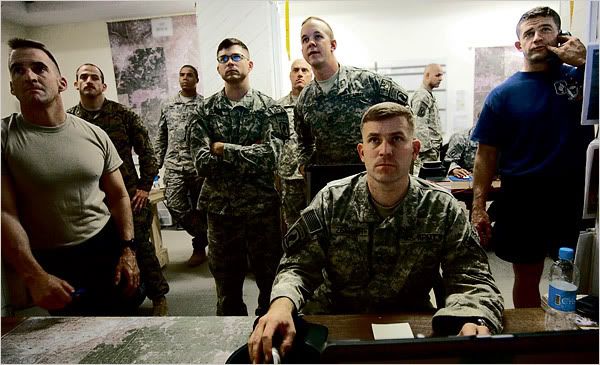 Eyes in the Sky: At Camp Blessing, battalion members — led by Lt. Col. Bill Ostlund, far right — watch a monitor showing Capt. Dan Kearney’s troops six miles away. [photos by Lynsey Addario]
In the New York Times magazine, Elizabeth Rubin writes:
We tumbled out of two Black Hawks onto a shrub-dusted mountainside. It was a windy, cold October evening. A half-moon illuminated the tall pines and peaks. Through night-vision goggles the soldiers and landscape glowed in a blurry green-and-white static. Just across the valley, lights flickered from a few homes nestled in the terraced farmlands of Yaka China, a notorious village in the Korengal River valley in Afghanistan’s northeastern province of Kunar. Yaka China was just a few villages south and around a bend in the river from the Americans’ small mountain outposts, but the area’s reputation among the soldiers was mythic. It was a known safe haven for insurgents. American troops have tended to avoid the place since a nasty fight a year or so earlier. And as Halloween approached, the soldiers I was with, under the command of 26-year-old Capt. Dan Kearney, were predicting their own Yaka China doom.
The Korengal Valley is a lonely outpost of regress: most of the valley’s people practice Wahhabism, a more rigid variety of Islam than that followed by most Afghans, and about half of the fighters confronting the U.S. there are homegrown. The rest are Arabs, Pakistanis, Chechens, Uzbeks; the area is close to Pakistan’s frontier regions where Osama bin Laden, Ayman al-Zawahiri and other Al Qaeda figures are often said to be hiding out. The Korengal fighters are fierce, know the terrain and watch the Americans’ every move. On their hand-held radios, the old jihadis call the Americans “monkeys,” “infidels,” ‘’bastards” and “the kids.” It’s psychological warfare; they know the Americans monitor their radio chatter.
As far as “the kids” are concerned, the insurgents are ghosts — so the soldiers’ tactics often come down to using themselves as bait. The insurgents specialize in ambushes, harassing fire and hit-and-run attacks. NATO’s military advantage in such a war is air power. The soldiers don’t hesitate to call in Big Daddy (who, in today’s military, often flies in with the voice of a female pilot). But while these flying war machines are saviors to the soldiers, they cannot distinguish between insurgents and civilians.
I went to Afghanistan last fall with a question: Why, with all our technology, were we killing so many civilians in air strikes? As of September of last year, according to Human Rights Watch, NATO was causing alarmingly high numbers of civilian deaths — 350 by the coalition, compared with 438 by the insurgents. The sheer tonnage of metal raining down on Afghanistan was mind-boggling: a million pounds between January and September of 2007, compared with half a million in all of 2006.
After a few days, the first question sparked more: Was there a deeper problem in the counterinsurgency campaign? More than 100 American soldiers were killed last year, the highest rate since the invasion. Why were so many more American troops being killed? To find out, I spent much of the fall in the Korengal Valley and elsewhere in Kunar province alongside soldiers who were making life-and-death decisions almost every day — decisions that led to the deaths of soldiers and of civilians.
Subduing the Valley
Over the last two years, the Americans have steadily increased their presence in Kunar province, fanning out to the small platoon-size outposts that have become the signature of the new counterinsurgency doctrine in both Afghanistan and Iraq. The Korengal Outpost, nicknamed the KOP, was built in April 2006 on the site of a former timber mill and motel. The soldiers of Battle Company of the 173rd Airborne Brigade Combat Team live there in dusty tents and little wooden huts. They now have hot food and a small chow tent with an Internet linkup and a few phones for calling home. But the place was protected by not much more than concertina wire and sentries. Nearly every time I arrived at the KOP our helicopter was greeted by sniper fire or the dushka — a Russian-made antiaircraft gun.
Dan Kearney was essentially lord of the Korengal Valley. A self-described Georgia army brat, he grew up idolizing his warrior dad, Frank Kearney, and wanted to move in his father’s world of covert and overt operations. (His father is now a lieutenant general in Special Operations command.) Kearney often calls himself a dumb jock, playing the crass, loudmouthed tough guy with his soldiers. He had been in Iraq and told me he had gone emotionally dead there with all the dying and killing, and stayed that way until the birth of his son a year ago. His hardest day in Iraq was when a close friend, Rob Shaw, was severely wounded by an improvised explosive device that killed his first sergeant and a bunch of their friends — and the next thing he knew their colonel was asking Kearney to step in for Shaw and lead the company.
But as hard as Iraq was, he said, nothing was as tough as the Korengal. Unlike in Iraq, where the captains and lieutenants could let down their guard in a relatively safe, fortified operating base, swapping stories and ideas, here they had no one to talk to and were almost as vulnerable to enemy fire inside the wire as out. Last summer, insurgents stormed one of the bases in a nearby valley and wounded 16.
And unlike every other place I’ve been in Afghanistan — even the Pech River valley, just an hour’s drive away — the Korengal had no Afghan police or district leaders for the Americans to work with. The Afghan government, and Afghans down the valley, seemed to have washed their hands of the Korengalis. As Kearney put it to me one day at the KOP, the Korengal is like a tough Los Angeles neighborhood, “and we’re the L.A.P.D. kicking in the door, arresting guys, demanding information about the gangs, and slowly the people say, ‘No, we don’t know anything, because that guy in the gang, he’s with my sister, and that other guy, he’s my uncle’s cousin.’ Now we’ve angered them for so many years that they’ve decided: ‘I’m gonna stick with the A.C.M.’ ” — anticoalition militants — “ ‘who are my brothers and I’m not gonna rat them out.’ ”
So what exactly was his job out here? To subdue the valley. It’s a task the Marines had tried, and then the soldiers of the Army’s 10th Mountain Division — a task so bloody it seemed to drive the 10th Mountain’s soldiers to a kind of madness. Kearney’s soldiers told me they’d been spooked by the weird behavior of their predecessors last May: near the end of their tour, many would sit alone on the fire base talking to themselves. Privates disobeyed their sergeants, and squad leaders refused to step outside the wire to show the new boys the terrain. No one wanted to be shot in the last days of his tour.
Kearney kept his soldiers on a tight leash at first. Col. John Nicholson, a brigade commander with the 10th Mountain Division, had promised the Afghans he would not bomb their homes. When Kearney and the 173rd Airborne Brigade Combat Team officially took over from the division’s 3rd Brigade Combat Team on June 5, they kept that promise. “My guys would tell me they didn’t know which houses they’re shooting from, and I’d tell them they can’t shoot back into the villages,” Kearney recalled. “They hated me.” The insurgents were testing the new captain, he suspected, by deliberately shooting from homes. On July 10, the Korengalis ambushed his soldiers from one house they often used — a three-story mansion on a fertile outcropping, with balconies overlooking the valley, that belonged to Haji Matin, a timber baron turned insurgent leader. It had been the scene of fighting in the past.
When Kearney’s moment of decision came, two of 2nd Platoon’s sergeants, Kevin Rice and Tanner Stichter, had been shot, and the fight was still going on. Kearney could see a woman and child in the house. “We saw people moving weapons around,” Kearney told me. “I tried everything. I fired mortars to the back side to get the kids to run out the front. I shot to the left, to the right. The Apache” — an attack helicopter — “got shot at and left. I kept asking for a bomb drop, but no one wanted to sign off on the collateral damage of dropping a bomb on a house.” Finally, he said, “We shot a javelin and a tow” — both armor-piercing missiles. “I didn’t get shot at from there for two months,” Kearney said. “I ended up killing that woman and that kid.”
Kearney could often sound cold-blooded, like when he’d march into the mess tent in shorts, improvising rap lyrics about killing bad guys. But then he’d switch to counselor, trying to salvage a soldier’s marriage, or he’d joke with a Korengali elder about arranging a marriage between his own infant son and the elder’s daughter to make peace. The performances steeled him against shouldering so much mortality. As he put it, “The only reason anyone’s listening to me in this valley right now is ’cause I’m dropping bombs on them.” Still, he wasn’t going to let himself shoot at houses every time his unit took fire: “I’d just create more people that hate me.”
A Blood Feud
In late 2001, the B-52 symbolized, for many Afghans, liberation from Taliban rule. They wove images of the plane into their carpets. Urban legends sprang up about the B-52’s power, how the planes glided along unscathed, even as the Taliban barraged them with antiaircraft fire. Kabulis spread the story that the B-52s had dropped thousands of leaflets saying, “Hit us if you can!” — and afterward the Taliban didn’t waste their bullets on the B-52s.
But the jets that defeated the Taliban were wiping out innocent families as well. In July 2002, Special Forces in the mountains of Oruzgan thought they were destroying a high-value Taliban target, but instead they rocketed and bombed an engagement party. About 40 Afghans were killed and nearly 100 were wounded.
Such mistakes have continued, though the causes can change. The insurgents regularly use civilians as shields, children as spotters and women as food suppliers. NATO killing civilians is great propaganda for the Taliban. At the same time, to Afghans with little technological sophistication, the scale and impersonality make the accidents seem intentional. Many are convinced the Americans are deliberately bombing them and even deliberately aiding a Taliban comeback. The reality is that bombs are only as accurate as the intelligence on the ground — and since 9/11, the U.S. and NATO have used air power as a substitute for ground troops.
By now, seven years of air strikes and civilian casualties, humiliating house searches and arbitrary detentions have pushed many families and tribes to revenge. The Americans then see every Afghan in those pockets of recalcitrance as an enemy. If you peel back the layers, however, there’s always a local political story at the root of the killing and dying. That original misunderstanding and grievance fertilizes the land for the Islamists. Whom do you want to side with: your brothers in God’s world or the infidel thieves?
Hostile Fire: U.S. troops carry the body of Staff Sgt. Larry Rougle, who was killed when the insurgents ambushed their squad in the Korengal Valley. More Photos >
In the case of the Korengal Valley, the story began about a century ago, when the tribesmen now known as Korengalis were kicked out of the province of Nuristan (immediately north of Kunar province) and settled in the Korengal, which was rich with timber forests and farmland. Over time they made an alliance with one branch of the large Safi tribe, which once dominated Kunar politics. But down the road along the Pech River valley, the rest of the Safis opposed the Korengalis.
As the Afghans tell the story, from the moment the Americans arrived in 2001, the Pech Valley timber lords and warlords had their ear. Early on, they led the Americans to drop bombs on the mansion of their biggest rival — Haji Matin. The air strikes killed several members of his family, according to local residents, and the Americans arrested others and sent them to the prison at Bagram Air Base. The Pech Valley fighters working alongside the Americans then pillaged the mansion. And that was that. Haji Matin, already deeply religious, became ideological and joined with Abu Ikhlas, a local Arab linked to the foreign jihadis.
By 2007, the Americans understood what happened. Last year, the governor of Nuristan even sat them down with the Korengali elders to try and mediate between the two sides. Nothing came of it. Kearney tried to dig deeper, sending e-mail messages to anthropologists and Afghan experts to get their guidance. He spent hours listening to Haji Zalwar Khan — who acted as the valley’s representative to the Americans and the government — talk about history and grievances. Haji Zalwar, a jihadi veteran of the anti-Soviet fight, bore the valley’s burden almost alone and had the grim demeanor to prove it. Kearney met as many villagers as possible to learn the names of all the elders and their families. But he inherited a blood feud between the Korengalis and the Americans that he hadn’t started, and he was being sucked into its logic.
“Serious P.T.S.D.”
Last autumn, after five months of grueling foot patrols up and down the mountains, after fruitless encounters with elders who smiled in the morning and were host to insurgents in the evening and after losing friends to enemy fire, Captain Kearney’s men could relate to the sullen, jittery rage of their predecessors in the 10th Mountain Division. Many wondered what they were doing out there at all.
Kearney refused to entertain that thought. He would tell his visitors, whether generals or reconstruction teams, that his campaign plan was clear, if modest: “It’s World War II Pacific-island hopping, turning one village at a time.” Over five months, he had gained about 400 yards of terrain. When some generals and colonels had flown in for a quick tour, and Kearney was showing them the lay of the land, one officer said to another, as Kearney later recalled it, “I don’t know why we’re even out here.” Another officer jumped in to talk up the logic of the operation. Kearney told me he thought: Sort your stuff out before you come out here. My boys are sucking it up and dying. . . . For besides being lord of the valley, he had another role to play — motivator, disciplinarian and confidant to his soldiers. “It’s like being in charge of a soap opera,” he told me. “I feel like Dr. Phil with guns.”
One full-moon night I was sitting outside a sandbag-reinforced hut with Kearney when a young sergeant stepped out hauling the garbage. He looked around at the illuminated mountains, the dust, the rocks, the garbage bin. The monkeys were screeching. “I hate this country!” he shouted. Then he smiled and walked back into the hut. “He’s on medication,” Kearney said quietly to me.
Then another soldier walked by and shouted, “Hey, I’m with you, sir!” and Kearney said to me, “Prozac. Serious P.T.S.D. from last tour.” Another one popped out of the HQ cursing and muttering. “Medicated,” Kearney said. “Last tour, if you didn’t give him information, he’d burn down your house. He killed so many people. He’s checked out.”
As I went to get some hot chocolate in the dining tent, the peaceful night was shattered by mortars, rockets and machine-gun fire banging and bursting around us. It was a coordinated attack on all the fire bases. It didn’t take long to understand why so many soldiers were taking antidepressants. The soldiers were on a 15-month tour that included just 18 days off. Many of them were “stop-lossed,” meaning their contracts were extended because the army is stretched so thin. You are not allowed to refuse these extensions. And they felt eclipsed by Iraq. As Sgt. Erick Gallardo put it: “We don’t get supplies, assets. We scrounge for everything and live a lot more rugged. But we know the war is here. We got unfinished business.”
For sanity, all they had was the medics’ tent, video games and movies — “Gladiator,” “Conan the Barbarian,” “Dogma,” Monty Python. Down the road in the Pech Valley, soldiers played cricket with Afghan kids and had organized boxing and soccer matches. Lt. Kareem Hernandez, a New Yorker running a base on the Pech River, regularly bantered over dinner with the Afghan police. Neighbors would come by with tips. But here in the Korengal, the soldiers were completely alienated from the local culture. One night while watching a scene from HBO’s “Rome” in which a Roman soldier tells a slave he wants to marry her, a soldier asked which century the story was set in. “First B.C. or A.D.,” said another soldier. The first shook his head: “And they’re still living like this 800 meters outside the wire.”
At the end of the summer, Kearney told his dad, “My boys are gonna go crazy out here.” The army sent a shrink, and Kearney got a wake-up call about his own leadership. He discovered that half his men thought he was playing Russian roulette with their lives and the other half thought he stuck too closely to the rules of engagement. “The moral compass of the army is the P.L. and the C.O.” — the platoon leader and the commanding officer, Kearney told me. “I told every one of my P.L.’s that they have to set that moral standard, that once you slip to the left, you can’t pull your guys back in.”
Operation Rock Avalanche
On October 19, Kearney and Battle Company were air assaulted into the insurgents’ backyard for a mission that many thought insane. It was called Rock Avalanche and would last about six days. One of its main targets was the village of Yaka China.
Kearney, being the good soldier, tried to pump up his boys with the promise that they would be going after insurgents who had killed their friends and whose grizzled faces were plastered on their bad-guy family-tree wall at the KOP. They would upset the guerrillas’ safe haven and their transit routes from Pakistan. They would persuade the villagers to stop harboring the bad guys by offering an $11 million road project that had just been approved by NATO and Kabul and would be built by the Kunar Provincial Reconstruction Team. And they’d complete the “human terrain mapping” that is part of the new counterinsurgency doctrine — what families dominate, who’s married, who’s feuding, are there divisions to be exploited?
It was a lot to ask of young soldiers: play killer, cultural anthropologist, hearts-and-minds winner and then killer again. Which is why, just hours before the mission was to begin, some soldiers were smearing black-and-green war paint on their faces when their sergeant shouted: “Take it off. Now!” Why? They’d frighten the villagers.
It seemed a moot point as Rock Avalanche got under way. Apache gunships were scanning the ridges for insurgents. Other helicopters were dropping off more soldiers. An unmanned drone was whining overhead as it sent infrared video feeds to a large screen back at the battalion’s headquarters, Camp Blessing, six miles north of the KOP.
Almost immediately, high on a mountainside looking down on Yaka China, Kearney had to play God. In a ditch to his left, Jesse Yarnell, a young intelligence officer, along with John, an Afghan interpreter, were intercepting insurgents on their two-way radios saying, “We see them, we’re going to wait.”
“They’re right down there!” said Kevin Caroon as he gazed out of his night vision. Caroon, from Connecticut and a father of two, was an Air Force JTAC — the joint terminal attack controller who talks the combat pilots onto their targets. “See that? Two people moving south 400 meters away from us,” Caroon said, pointing down the mountain face. More insurgents were located nearby.
“Sir, what do you want to do?” Caroon asked Kearney.
“I want them dead,” Kearney said.
“Engage them?”
“Yes. Take ’em out.”
Caroon radioed the pilot his instructions, “On-scene commander’s intent is to engage.” And that was it.
A sudden wail pierced the night sky. It was Slasher, an AC-130 gunship, firing bullets the size of Coke bottles. Flaming shapes ricocheted all around the village. Kearney was in overdrive. The soldiers back at the KOP were radioing in that the drone was tracking 10 men near the tree line. Yarnell was picking up insurgent radio traffic. “They’re talking about getting ready to hit us,” someone said. The pilot could see five men, one entering a house, then, no, some were in the trees, some inside, and then, multiple houses. He wanted confirmation — were all these targets hostile? Did Kearney have any collateral-damage concerns? Cursing, Kearney told them to engage the men outside but not to hit the house. The pilots radioed back that men had just run inside. No doubt there would be a family. Caroon reminded Kearney that Slasher had only enough fuel to stay in position for 10 more minutes.
“What do you want to do, sir?” Caroon asked him.
Kearney radioed his soldiers back at the KOP to contact his boss, Lt. Col. Bill Ostlund. Ostlund, a Nebraska social scientist who could switch effortlessly from aggressive bomber to political negotiator talking family values with Afghan tribal elders, was in the crowded tactical-operations room at Camp Blessing watching the drone’s video feed and getting the same intelligence. He signed off on collateral damage, and Kearney turned to Caroon: “Take out the compound. And anyone that comes out.”
Flaming rockets flashed through the sky. Thunder rumbled and echoed through the valley. Then there was a pause. Slasher asked Caroon whether the insurgents were still talking. Kearney shouted over to Yarnell in his ditch, “You picking anything up?” Nothing. More spitting rockets.
The night seemed incomprehensible and interminable. Slasher departed and Gunmetal — an Apache helicopter — swept in. Radio communication kept breaking down. At one point the crew of Gunmetal, sensing no hostile intent, refused Kearney’s orders to fire. Then suddenly Gunmetal was rocketing at figures scattering for cover. Then Slasher was back in the sky doing more “work.” In the predawn light Bone — the nickname for the B-1 bomber that seemed to be the soldiers’ favorite — winged in and dropped two 2,000-pound bombs above the village. Finally, around dawn, a weary Kearney, succumbing to gallows humor, adrenaline and exhaustion, said: “O.K., I’ve done my killing for the week. I’m ready to go home.”
Kearney estimated that they killed about 20 people, adding: “I’m not gonna lie. Some are probably civilians.”
In the logic of war, the best antidote for the menacing ghostliness of the ambushing enemy is killing and knowing you’ve killed them. The soldiers in the Korengal almost never had that kind of satisfaction. Any insurgents, if they were killed, would be buried fast, and all that was left in their wake were wounded civilians. That morning, after a long night of fighting, was no different. Within an hour or so, Lt. Matt Piosa, an earnest, 24-year-old West Point grad, and his patrol were in Yaka China. They radioed that the village elders were asking to bury their dead. They’d also collected wounded civilians. The tally was bad — 5 killed and 11 wounded, all of them women, girls and boys.
Kearney radioed Camp Blessing the bad news and dropped his head between his knees. Killing women and children was tragedy enough. But civilian casualties are also a political issue. If he didn’t manage to explain his actions to the Yaka China villagers and get them to understand his intentions, he could lose them to the enemy. Meanwhile, Yarnell and his team were intercepting radio messages like: “Be very quiet. Move the things over here. Pray for us.” At least some of the insurgents from the previous night’s fight had survived to fight again. The planes were tracking them hiding along a creek. But after the civilian casualties of the night before, senior commanders were refusing to give Kearney clearance to bomb or rocket them.
The short day was fading. The sun dropped behind the peaks. The cold winds rattled our bones. The soldiers tried to make light of their conviction that they’d be attacked by those insurgents dissolving into the villages. Their fears were realized.
Hearts and Minds
To try to acquire allies, Kearney and some of his men flew down the next day to Yaka China. With nowhere else to land, the Black Hawk helicopters descended on the roof of a house not far below the compound that Slasher, the AC-130, had rocketed the night of the 19th. Dust and dried grass whipped across the house and the villagers’ faces. Just to endear themselves even more, the soldiers from Battle Company had to step on harvested corn as they climbed down; it was drying on the second story.
The adversaries faced off in the courtyard as chickens sprinted in and out. On one side were Kearney, Ostlund and Larry LeGree, a naval nuclear engineer and head of the Provincial Reconstruction Team, together with their entourage, including interpreters, all in futuristic high-tech gear. On the other side were the Korengali elders, who looked as if they stepped out of “Lord of the Rings” with their crooked walking sticks, beards dyed red and blue eyes framed by kohl. With no Afghan government out here, the elders are the only channel for communication. The younger men sat on the ground, wrapped in shawls and bold indifference.
Kearney squatted and told the Korengalis that when he came to this region he hoped to walk into Yaka China and find out what the villagers needed. Instead, he found that there were some 50 insurgents in and around the village. He pointed to the evidence — military radio batteries that his men had found, binoculars, rockets, an old pistol, a small pamphlet titled, in Arabic, “How to Kill,” and one in Pashto, “The Concise Book on the Virtues of Jihad” — that had been collected in the general area by Afghan soldiers and Americans. It was not a very incriminating haul, and everyone knew it.
The day before, a U.S. medevac had airlifted out the wounded civilians from the village. Humanitarian assistance was air-dropped in, including concrete for retaining walls, rice and blankets for winter. The provisions were not compensation, Kearney told the elders. “It’s what the government does for their people when there is security here,” he said. He asked them to tell him where in the mountains the insurgents were hiding their supplies. “That way I don’t have to come in here and shoot at you and identify the good guys from the bad guys,” he said.
To keep his bearings amid the hostile faces, Kearney kept appealing to Haji Zalwar Khan, the leading go-between among the valley’s elders. He made his fortune in the timber trade and blamed the Americans for shutting it down. He tried to placate both the Americans and the insurgents. He was not about to side with Kearney in public. “How can I know where you found these things?” he asked, referring to the jihadi items. “In the mountain? The house? How do I know whom they belong to?”
Kearney smiled. He was getting used to the routine between the Americans and the villagers — miscommunication and deception. The encounter felt as much performative, a necessary part of the play, as substantive. And I wondered how Kearney was going to keep his sanity for 10 more months.
Just a week or so earlier, I had been at the KOP when villagers from Aliabad — a mile south of the KOP, and the home village of Haji Zalwar Khan — complained to Kearney that some ordinance had hit a house. Later they sent up the homeowner’s teenage son to wrest compensation from Kearney. As we walked to the KOP’s entrance to meet the boy, a shot rang out, then another. The bullets smacked the dirt in front of us. Kearney shoved me into a shack where an Afghan was cooking bread. A few more shots were fired. It was “One-Shot Freddy,” as the soldiers refer to him, an insurgent shooter everyone had a theory about regarding the vintage of his gun, his identity, his tactics — but neither Kearney’s scouts nor Shadow the drone could ever track him. I accidentally slashed my forearm on a nail in the shack and as I watched the blood pool I thought that if I had to live with Freddy and his ilk for months on end I, too, would see a forked tongue in every villager and start dreaming of revenge.
Kearney was angry. “Taliban shot your house?” he asked the boy from Aliabad. An interpreter translated.
No, said the boy, Americans did.
“What’d we shoot with?”
“I don’t know the weapon, but there’s little holes and two big holes.”
“I didn’t shoot into Aliabad,” said Kearney, adding that if one of his soldiers had, it was because insurgents were firing from the village.
“No one shoots from the village,” said the boy, though everyone knew insurgents had wounded several of Kearney’s soldiers by shooting from the mosque, the cemetery, the school. . . .
The boy changed course, “God knows better than me,” and that sent Kearney on a riff: “Yes. God does and God talks to me and told me they do.” And by the way, hadn’t the boy noticed that the bad guys always start shooting first?
“O.K., then shoot them, not our house,” the boy said.
“Then tell me where the bad guys are,” Kearney said. The boy said he didn’t know. What he knew was that the Americans were always shooting at the village.
This went on for some time. When the boy again protested that no one shoots from his village, Kearney interrupted him. “Aminullah does,” he said. Aminullah was a native of Aliabad and a rising figure in the valley’s insurgency.
The boy smiled.
“You’re smiling because you know I’m right,” Kearney said.
“You’re right,” the boy said. “So shoot the cemetery, not our house.”
Kearney moved closer to him. “Look, if you want help with your house, all you have to do is ask. But don’t accuse us every time something goes wrong.”
The boy laughed and repeated that he didn’t know where the bad guys were.
“It’s crazy, man. They must be ghosts!” Kearney said, laughing.
“Aminullah doesn’t come to Aliabad anymore,” the boy said, perhaps trying to give Kearney a bone.
Kearney leapt at it. “So Aminullah is bad?”
“Yes.”
“Ah! Finally! We’re getting somewhere.” Kearney took off his helmet and squeezed his hands together and rocked as he sat on a wall. “What about Mohammad Tali, he’s a good guy isn’t he?” Kearney asked.
Smiling again, the boy looked at the dirt: “No. You already told us he’s a bad guy.”
“Ah!” Kearney said, throwing up his hands. “So you were down there in the village when I gave radios and food. But instead you say I shoot at you all the time?” Kearney swung his legs back and forth. “Hey dude, ask yourself. Why would I bring you radios and food and shoot at you? Does Aminullah? No. What happened that day after I left?” The boy said all he knew was that the villagers went home and “they” started shooting. “Where?” Kearney asked, “from your village?”
“What can I say? The Americans were in my village.”
“Yeah, so I was doing good stuff for you guys and they shot at me. And what I’m trying to say is they could have shot at you again. And if I shoot at your house I’ll help. We’ll fix up that wall. I’m not here to hurt you.”
Everyone was getting restless in the little check post. Kearney tried to lighten up a bit. He asked the boy what he thought about the Americans.
“You build roads and clinics and schools and are here to help,” the boy said.
“Cop out,” Kearney shouted, chuckling. “Easy answer. Hey dude, you can say we’re rotten and messing up your lumber trade.” The boy laughed. Kearney laughed. Pfc. Michael Cunningham, the radio operator, and Sgt. Taylor White, who always manned the check post, both laughed.
“See, I knew it,” Kearney said. “That’s what you really think. Think I want to be here?”
“Yeah,” the boy said. “I think so.”
“Dude. I got a wife and son. I came here to help you out. If you give me as much help as possible I’ll get out of here a hell of a lot faster.”
Kearney told him to enjoy Ramadan, and then shouted, “Where’s my fuzzy friend?” as he looked about for Jericho, the puppy whose ears were chopped off by an Afghan worker: it was pre-emptive preparation for dog fighting — the ears would just give an enemy dog something to grab onto. “I need someone to make me happy. Jericho, I need some love.” Jericho appeared, leaping about. Kearney picked him up. “Hey, what’s up buddy? You’re a good boy. You smell like dirt.”
Kearney turned to Cunningham and White and said, “Well, he’s the first to admit Aminullah’s bad.” And give or take a little unreliable information shared here and there, that was the Korengal routine.
Fight Time
The day after the meeting with the elders of Yaka China, Yarnell and John could hear insurgents trying to pinpoint where Kearney and his men were. The helicopters had moved us to a ridge line, about 8,400 feet high, straddling the Korengal and Shuriak Valleys. The insurgents used the deep caves, boulders and forests as hideouts and transit routes between Pakistan and Afghanistan. We could hear someone who called himself Obeid saying he’d do whatever the Yaka China elders decided — whether to cooperate with the Americans or take revenge. By evening the elders had apparently reached their verdict. It was fight time.
Kearney, too, had reached a verdict. He would fool the insurgents, feigning a troop extraction when the helicopters came for resupply and pushing out his best guys in small “kill teams.” We heard the insurgents say, “We have wolves on them,” meaning spotters. A hoarse, whispering insurgent had eyes on either Sgt. Larry Rougle and his scouts or on Lieutenant Piosa and his rear guard. There was joking that Rougle and Piosa should dance and see which one the whisperer was spying on. Then nothing happened for almost 24 hours.
Rougle — who was called Wildcat — was on his sixth deployment since Sept. 11, 2001. He was with the first group of Rangers in Afghanistan. Even his rough background was something of a legend; he would tell how he grew up in a South Jersey gang, shot a guy, went to “juvie,” and there taught himself Russian (though he was estranged from his Russian father), taught himself politics, history, zoology. At night out in the woods, he’d tell his fellow scouts, “You know penguins are monogamous?”
I hung out with Piosa and his crew. His white skin, red hair and blue eyes belied the months of constant warfare he and his platoon had scraped through. It was a beautiful autumn afternoon and the soldiers were joking around, heating up Meals Ready to Eat, spitting gobs of Copenhagen and then, in a moment, recess was over. The insurgents were on them. Bullets ricocheted all through the woods. A strange silence fell as everyone scrambled for cover. Three of us crouched behind a skinny pine tree. And the silence broke: curses, shouting.
“Where’s it coming from?”
“Where are my guys?”
“Jones, are you seeing things?”
More bullets. Cracks against the tree trunks. Bits of confusing information were coming in on Piosa’s radio.
“They’re comin’ up the low ground at 2-4” — Sergeant Rice’s call sign.
“One W.I.A. hit in the arm.” Then there was panic and screaming.
“The enemy’s overtaken the hill,” bellowed Pvt. Sterling Dunn from further down the trees.
“2-4 is hit” — that was Rice.
“Wildcat is run over the hill” — that was Rougle.
“Get a team to run up there and take that hill. They pushed Wildcat over the hill!” Piosa shouted, trying over and over to reach Rice and Rougle, but getting no answer. The battalion surgeon, Capt. Joel Dean, and a sergeant sprinted up the hill to get to the wounded. As the first Americans neared Rice and Rougle’s positions they were fired on from those same positions. What was going on?
I followed Piosa through the brush toward the ridge. We came upon Rice and Specialist Carl Vandenberge behind some trees. Vandenberge was drenched in blood. The shot to his arm had hit an artery. Rice was shot in the stomach. A soldier was using the heating chemicals from a Meal Ready to Eat to warm Vandenberge and keep him from going into shock.
Piosa moved on to the hill where the men had been overrun. I saw big blue-eyed John Clinard, a sergeant from North Carolina, falling to pieces. He worshiped Rougle. “Sergeant Rougle is dying. It’s my fault. . . . I’m sorry. . . . I tried to get up the hill. . . .” Sergeant Rougle was lying behind him. Someone had already covered him with a blanket. Only the soles of his boots were visible.
“There’s nothing you could do,” Piosa said, grabbing Clinard’s shoulder. “You got to be the man now. You can do it. I need you to get down to Rice and Vandenberge and get them to the medevac.” Clinard wiped his face, seemed to snap to and headed off through the trees.
Two of Rice’s squad mates appeared, eyes dilated. They couldn’t believe they’d seen, up close, the ghosts they’d been fighting for the last five months. “I saw him in the eyes,” Specialist Marc Solowski said. “He looked at me. I shot him.” He and Specialist Michael Jackson had crawled up the hill twice trying to retake it. Each time the insurgents in “manjammies” whipped them back with machine-gun fire. There was blood on the stones around us. Some thought they saw blood trailing down toward the village of Landigal, where they were sure an insurgent had dashed into a cottage.
“We’re not losing this hill again,” Piosa shouted. “This hill is ours!” He wanted bombs to be dropped immediately.
“There’s women praying in that house,” Dunn shouted back.
I was fixating on Rougle’s black hat, lying by the bloodied rock patch where Dunn was sitting, when Sergeant Stichter, Dunn’s senior, appeared, out of breath and shaking, back from tending to Vandenberge. He needed water. The F-15 known as Dude was en route, the Apaches were chasing men and Kearney — who had bolted down the mountain, throwing grenades in caves — was barking orders. Kearney was badly shaken. He adored Rougle, and he’d broken down when he saw his big old buddy Rice bleeding at the landing zone. Rice comforted him and then lumbered to the helicopter, just asking to talk to his wife before they put him under.
The insurgents had run off with some of Rougle, Rice and Vandenberge’s stuff — ammunition, communication equipment, night vision goggles, machine guns. Kearney wanted the equipment back. He wanted to punish the valley. Stichter had his eyes on a guy pacing a rooftop in Landigal and wanted to blow his head off. Specialist Mitchell Raeon, whose uniform was now soaked in Rougle’s blood, had the guy in his scope but couldn’t range that far. “That’s a female,” Dunn said.
Kearney had identified insurgents who’d dashed into a house and wanted to hit them, but Stichter got back word from Camp Blessing saying the target was too close to other houses. Kearney sent back a reminder — you let some guys get away the other night. It was impossible to know for sure, but Kearney believed they were the guys who had killed Rougle, and now, he said, you’re going to let another group get away?
Someone cursed, then said, “They’re all leaving the house.”
Kearney radioed down to one of his lieutenants at an observation post. “Where are they going?” Yarnell heard the insurgents say they were coming back for the rest of the equipment. And then, with no warning, an F-15 dropped a bomb on Landigal, but off target, or so it seemed. Kearney was furious. He was sure headquarters had intentionally missed the house he had wanted hit.
I noticed Raeon was packing and unpacking Rougle’s things. Rougle’s scouts were in disarray, rudderless, and admitting it. Raeon said he kept seeing in his mind Rougle’s face alert and then dead, switching back and forth; he wanted it to stop.
The next day brought another brief firefight, and Rougle’s scouts rallied swiftly. They said they felt him watching and proud. There were more bomb drops and refusals to drop bombs, and then Becky, everyone’s favorite Apache pilot, swept in. Not only did she offer the comforting voice of a woman seeping right into their ears, but Becky was one of the most aggressive shooters. She flew up and down the canyon walls seeking out and rocketing insurgents. We heard them on the radio again boasting about retreating to safety under fire. They talked about the strike in Landigal that they thought might have killed Azizullah — “a real bad guy,” the radio operator told me.
Kearney was watching a crow flying above us. “Taliban are right,” he said. “Like they said yesterday, follow the birds, they follow the Americans. I wish I was made as strong as haj” — their nickname for insurgents. “They were balls to do what they did. And guess what? I’m not gonna lie. They won.”
Killing Together
As we waited for dusk to get back to the KOP, we all knew the insurgents were nearby, eyes on Kearney, eyes on the soldiers down in the valley. Even nightfall was no comfort because the full moon was floodlighting the Korengal. I returned to the KOP by helicopter with Kearney, while 1st and 2nd Platoons had to make the long trek back on foot. As soon as 1st Platoon set off, the insurgents struck with a devastating L-shaped ambush. All Kearney could do, back at the KOP, was calm his boys on the radio, get in the medevac and invoke the gods of war. The Apaches, Slasher and Bone dropped bombs all night. The soldiers and insurgents were so close that when Slasher, the AC-130, flew in, the pilot coordinated not with the JTAC but with Sgt. Roberto Sandifer, the platoon’s forward observer, who at that moment was under fire watching one of his guys die.
Around midnight, 1st Platoon filed into the KOP, eyes bulging, drenched in sweat, river water and blood. They were hauling the belongings of Mohammad Tali, a high-value target. Specialist Sal Giunta had killed him.
The next day I climbed up to the KOP and found Specialist Giunta, a quiet Iowan lofted into a heroism he didn’t want. His officers were putting him up for a medal of honor. Giunta told me the story of that night, how they’d barely moved 300 yards before they were blasted. Giunta was fourth in the file when it happened, and he jumped into a ditch. He couldn’t figure out why they were getting hit from where Joshua Brennan and baby-faced Franklin Eckrode should have been leading up ahead. He knew it must be bad, but as he leapt up to check he got whacked with a bullet in his armored chest plate. It threw him down. They were taking fire from three sides. He grabbed some grenades: “I couldn’t throw as far as Sergeant Gallardo. We were looking like retards and I decided to run out in front of the grenades.” He found Eckrode with gunshot wounds. “He was down but moving and trying to fix his SAW” — a heavy machine gun — “so I just kept on running up the trail. It was cloudy. I was running and saw dudes. Plural.”
He couldn’t figure out who they were. Then he realized they were hauling Brennan off through the forest. “I started shooting,” he recalled. “I emptied that magazine. They dropped Brennan.” Giunta scrambled up to Brennan. He was a mess. His lower jaw was shot off. “He was still conscious. He was breathing. He was asking for morphine. I said, ‘You’ll get out and tell your hero stories,’ and he was like, ‘I will, I will.’”
They were still taking fire. No one was there to help. Hugo Mendoza, their platoon medic, was back in another ditch, calling: “I’m bleeding out. I’m dying.” Giunta saw Brennan’s eyes go back. His breathing was bad. Giunta got Brennan to squeeze his hand. A medic showed up out of the sky. They prepared Brennan to be hoisted to the medevac in a basket. Soon he would be dead.
As the medevacs flew out, Sergeant Sandifer had talked in air cover: Slasher, the AC-130. The pilot was a woman and, Sandifer later told me, “It was so reassuring for us to hear her voice.” She spotted guys hiding and asked if she was clear to engage. “ ‘You’re cleared hot,’ I told her. And we killed two people together.” But, at this point, the killings were no consolation to Sandifer.
As Giunta said, “The richest, most-trained army got beat by dudes in manjammies and A.K.’s.” His voice cracked. He was not just hurting, he was in a rage. And there was nothing for him to do with it but hold back his tears, and bark — at the Afghans for betraying them, at the Army for betraying them. He didn’t run to the front because he was a hero. He ran up to get to Brennan, his friend. “But they” — he meant the military — “just keep asking for more from us.” His contract would be up in 18 days but he had been stop-lossed and couldn’t go home. Brennan himself was supposed to have gotten out in September. He’d been planning to go back to Wisconsin where his dad lived, play his guitar and become a cop.
Sandifer was questioning why they were sticking it out in the Korengal when the people so clearly hated them. He was haunted by Mendoza’s voice calling to him: “I’m bleeding out. I’m dying.” He worried that the Korengal was going to push them off the deep end. In his imagination it had already happened. One day an Afghan visited their fire base, Sandifer told me. “I was staring at him, on the verge of picking up my weapon to shoot him,” he said. “I know right from wrong, but even if I did shoot him everyone at the fire base would have been O.K. We’re all to the point of ‘Lord of the Flies.’ ” And they still had 10 months to go in the Korengal.
I wondered how Kearney was going to win back his own guys, let alone win over the Korengalis. Just before I left, Kearney told me his biggest struggle would be holding his guys in check. “I’ve got too many geeking out, wanting to go off the deep end and kill people,” he said. One of his lieutenants wanted to shoot every Afghan in the face. Kearney shook his head. He wished he could buy 20 goats and let the boys beat and burn them and let loose their rage. He tried to tell them the restraints were a product of their success — that there was an Afghan government with its own rules. “I’m balancing plates on my goddamn nose is what I’m doing,” he said. “All it’s gonna take is for one of these guys to snap.”
But leave the Korengal, as the colonel had suggested, and let some other company deal with it? No way. He’d spent five months learning the valley, getting involved in it; he couldn’t just pull out. At least he would keep the insurgents busy here so the other companies could do hearts and minds unimpeded down along the Pech river. “I lost seven dudes here,” he told me. “It’s too much blood. I don’t want to give this up. This is mine.”
Colonel Ostlund and his officers, and the governor of Kunar and his officials, held an all-day meeting with the Korengali elders. The elders wanted to talk about Rock Avalanche and the devastation that had rained down on them. Colonel Ostlund told them, “If anything should happen to Captain Kearney, pain and misery will knock on many doors in the Korengal.” He gave them 10 days to pick sides — the insurgents or the government. Only then would he consider going ahead with the road project. Their answer came back. They would leave the valley altogether. But they didn’t, and 10 days later insurgents pulled off another ambush of a platoon from the 173rd. The entire patrol went down, either wounded or killed. Kearney told me recently that they had wounded Abu Ikhlas and killed some other bad guys. He said he was pretty sure that Haji Matin, the embittered timber lord, had been killed, too. But the dialogue with the Korengalis was pretty much the same as it had been. Only the winter snows have brought some minor respite to the valley.
 Joint Terminal Attack Controller Gabe Beck, center, speaks with a bomber pilot while a "troops in contact" incident unfolds in the Korengal Valley. Working with pilots, Beck calls in airstrikes while weighing the possibility of collateral damage.
 Lt. Matt Piosa rests inside a bunker. The 173rd Airborne division Battle Company established the bunker after a difficult battle with insurgents to control the strategic high grounds near the Korengal Outpost.
 Captain Dan Kearney, second from left, and Staff Sgt. Mike Nestell discuss recent fighting with village elders. Haji Zalwar Khan is at far right.
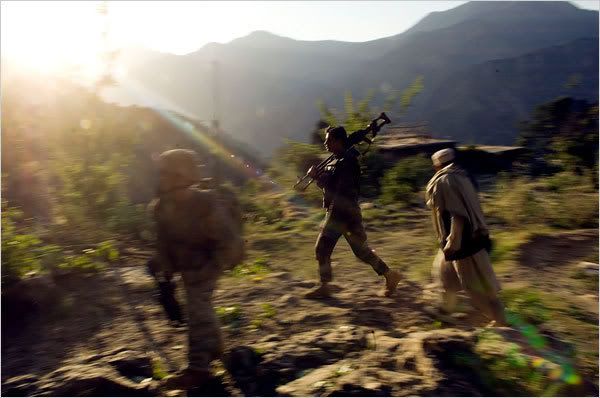 A soldier with the battle company, left, and an Afghan Army soldier walk with an elder as they conduct a patrol in the Korengal Valley.
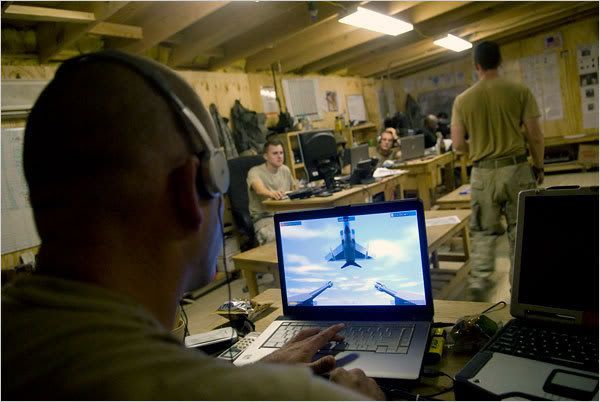 A soldier plays a video game in the Korengal Outpost command center.
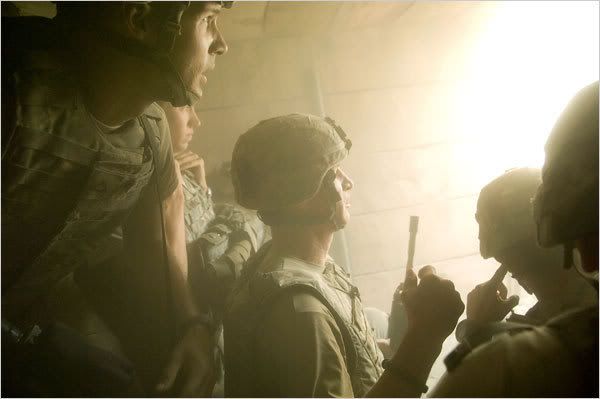 Soldiers with the battle company take shelter from a mortar barrage in a bunker at the Korengal Outpost.
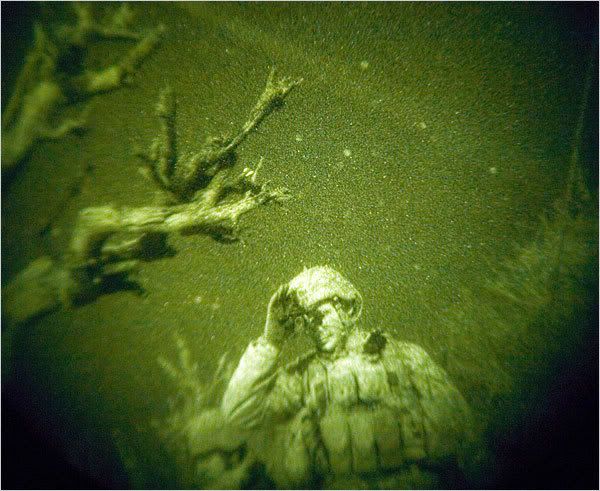 Capt. Dan Kearney bows his head in frustration after the denial of his request for an air strike against men walking nearby with weapons. Above his head, the laser of an AC-130 plane tracks a potential target.
 Cpt. Dan Kearney, kneeling, arrives to check on Staff Sgt. Rice, after Rice was shot in an insurgent ambush.
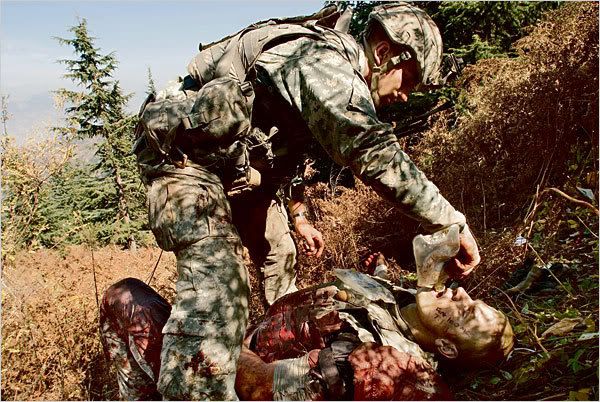 Sgt. Tanner Stichter tends to a wounded Specialist Carl Vandenberge.
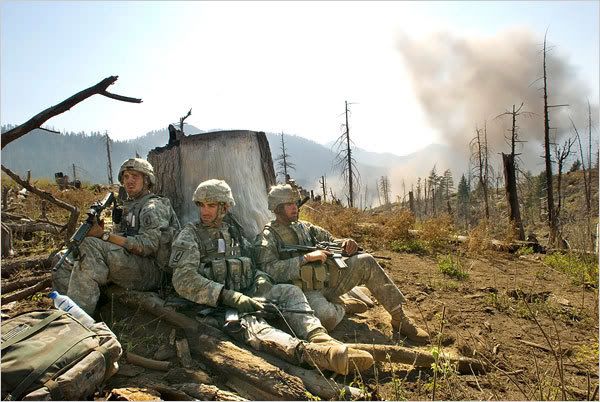 Soldiers take shelter behind a tree trunk as they await the arrival of a medevac helicopter. The helicopter will airlift the body of Staff Sgt. Larry Rougle, who was killed in the insurgent ambush.
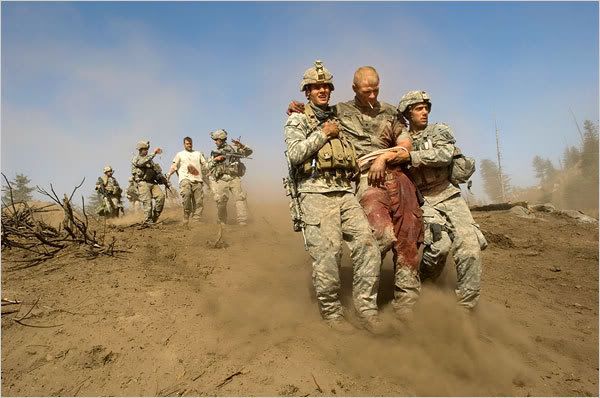 Specialist Carl Vandenberge, right, and Staff Sgt. Kevin Rice, left, are assisted as they walk to a medevac helicopter after being shot by insurgents in the ambush.
 U.S. troops carry the body of Staff Sgt. Larry Rougle, who was killed when the insurgents ambushed their squad in the Korengal Valley.
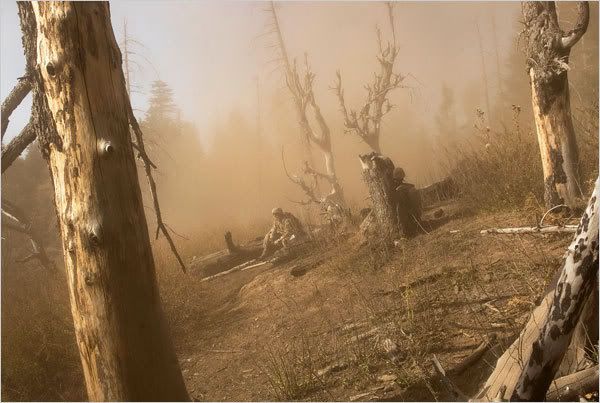 A soldier sits alone in the dust of a medevac helicopter as it departs with the body of his comrade Staff Sgt. Rougle.
Subscribe to:
Posts (Atom)
