At Huffington Post, Elizabeth Holtzman writes:
Though it failed to send his nomination the way of Robert Bork, Attorney General nominee Michael Mukasey's evasiveness on the definition of torture has done something historic. It has made it unmistakably clear to mainstream observers that the President may be criminally liable for violating anti-torture laws. Criminal liability of this White House will have wider repercussions than Mr. Mukasey's confirmation. It will reverberate through his tenure as Attorney General, and beyond the end of the Bush administration.
We now know the reason why Mr. Mukasey refused to acknowledge that waterboarding meets the legal definition of torture, or at the very least cruel, degrading and inhuman treatment clearly had nothing to do with not being briefed about the procedure. If he didn't know at the time of the Senate committee hearing, he certainly learned afterwards that the US considered waterboarding criminal and prosecuted it for at least a century. The real reason, as to mainstream news analysts now acknowledge, was that publicly admitting waterboarding is torture or cruel and inhuman would have put the President in jeopardy of criminal charges.
The War Crimes Act of 1996 makes cruel, inhuman and degrading treatment of detainees a violation of the Geneva Conventions and a federal crime. In addition, a 1994 law, 18 USC Section 2340 (a), makes it a federal crime to engage in torture outside the US, it also applies to those who conspire with (or aid and abet or order) torture outside the US. Both statutes apply to any US national, including the President, the Vice President and other top officials, as well as subordinates, such as CIA officers or other US personnel. If the President ordered, directed or authorized waterboarding or other forms of torture or mistreatment, he may have violated these laws. They carry the death penalty in cases where victim dies. In such cases there is no statute of limitations, so the President could be subject to prosecution for the rest of his life.
Some contend that imposing criminal liability for acts performed in the heat of combat is wrong and that we can't hold the administration to 20/20 hindsight. But we know these acts were not spontaneous, but part of a premeditated pattern of legal manipulation dating back years. At least since 2002, President Bush, Attorney General Gonzales and possibly others including the Vice President knew that torture and detainee mistreatment entailed criminal liability, which they sought to defuse with novel legal theories and retroactive suspensions of established law.
In a February 2002 memo, then White House counsel Alberto Gonzales warned President Bush about exposure to criminal liability under the War Crimes Act, mentioning the danger that future independent counsels or prosecutors might seek to enforce the law (they generally prosecute top government officials, including presidents). He therefore recommended opting out of the Geneva Conventions, famously calling them "obsolete." His theory was that if the Conventions didn't apply, then the War Crimes Act wouldn't apply, so no prosecutions could be brought. The President accepted Gonzales' theory and suspended the Conventions 's protections for suspected Al Qaeda detainees.
But in June 2006 the Supreme Court rejected this theory and held the Geneva Conventions applicable to the treatment of all detainees, leaving the President open to liability for violating the War Crimes Act. So in October 2006 the White House effectively pardoned itself by slipping a little-noticed provision into the Military Tribunals Act, conferring effective immunity from the War Crimes Act on high-level officials by making it retroactively inoperative, from 1996 to 2006. Public attention was focused on habeas corpus and other controversial provisions in the bill, so it passed more or less unscrutinized.
Still, holes remain in the legal barricades the Bush administration has tried to erect around itself. Even if immunity from prosecution under the War Crimes Act stands, it only applies through 2006, not for mistreatment of detainees after that. And the 1994 anti-torture law applies throughout.
As Attorney General, Mr. Mukasey can try to plug these holes. He may shield President Bush and others from criminal liability; he may resist appointing an independent prosecutor to investigate White House actions. But he cannot, as the 2002 Gonzales memo recognized, tie the hands of future prosecutors. In lethal cases our anti-torture laws have no statute of limitations. Sooner or later, those who violated US law will be held accountable to them, if not by Mukasey, then by some future AG.
Former Congresswoman Elizabeth Holtzman served on the House Judiciary Committee during Nixon's impeachment. She co-authored the 1973 special prosecutor statute, and co-wrote (with Cynthia L. Cooper) the 2006 book The Impeachment of George W. Bush.
Tuesday, November 13, 2007
| [+/-] |
Beyond Mukasey's Confirmation, White House Liability Issues Loom Large |
Tuesday, November 6, 2007
| [+/-] |
Senate Judiciary Committee Approves Mukasey Nomination |
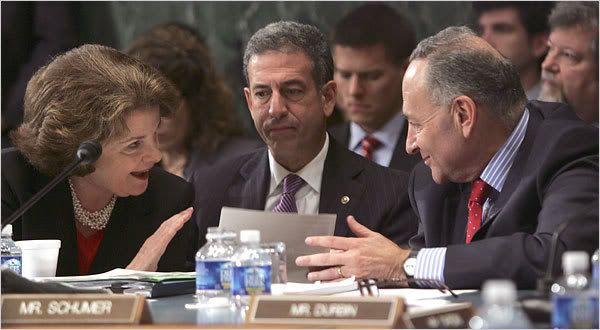 Senators Dianne Feinstein, Russ Feingold and Chuck Schumer after the vote on Tuesday.
The NY Times reports:
The Senate Judiciary Committee voted on Tuesday to approve the nomination of Michael B. Mukasey as attorney general despite opposition from most of the committee’s Democrats over Mr. Mukasey’s refusal to label a harsh interrogation technique used on terrorist suspects as torture.
Protesters opposed the Mukasey nomination and votes of two Democratic senators.
The vote, 11 to 8, with two Democrats joining all of the committee’s Republicans in supporting Mr. Mukasey, all but assured him of final confirmation by the full Senate. The Senate’s Democratic leaders are expected to schedule a vote by next week.
Mr. Mukasey, a retired federal judge from New York, ultimately owed his approval by the Judiciary Committee to the two Democrats who broke with their party to support him, Senators Dianne Feinstein of California and Charles E. Schumer, a fellow New Yorker who had initially recommended Mr. Mukasey to the White House.
The nomination of Mr. Mukasey was almost derailed by his refusal at his confirmation hearings to define as torture the interrogation technique known as waterboarding, which simulates drowning and is reported to have been used by the Central Intelligence Agency on a handful of Qaeda leaders since the Sept. 11 terror attacks.
In a letter to senators last week, Mr. Mukasey said the practice of waterboarding was “repugnant” but added that he could not judge its legality until he had been given access to classified information about interrogation techniques.
The White House welcomed the Judiciary Committee’s vote and urged that the nomination be moved quickly to the Senate floor. “Judge Mukasey has clearly demonstrated that he will be an exceptional attorney general at this critical time,” the White House spokeswoman, Dana Perino, said Tuesday.
Even some of Mr. Mukasey’s supporters said at the hearing to vote on the nomination that they were troubled by the way Mr. Mukasey handled questions about waterboarding, which the United States has fiercely condemned when carried out by other nations and had prosecuted as a war crime after World War II.
“I understand and greatly respect the view of some of my colleagues that the torture question trumps all other considerations,” Mr. Schumer said. But in explaining his vote for the nomination, Mr. Schumer said rejection of an otherwise highly praised nominee like Mr. Mukasey would allow the White House to appoint a caretaker attorney general who would not end the management turmoil and political scandals that plagued the Justice Department under Attorney General Alberto R. Gonzales.
“Judge Mukasey would be more likely than a caretaker to find on his own that waterboarding is illegal,” Mr. Schumer said.
In voting against Mr. Mukasey, the committee’s chairman, Patrick J. Leahy, and other Democrats portrayed their opposition as a defining moment for Congress in standing up to the Bush administration in upholding basic human rights and constitutional values in battling terrorism.
“America, the great and good nation that has been a beacon to the world on human rights, does not torture and should stand against torture,” Mr. Leahy said.
Senator Richard J. Durbin of Illinois, the Senate’s No. 2 Democratic leader, accused Mr. Mukasey of a “legal dodge” in refusing to repudiate “a cruel, abusive technique that has been regarded as torture in the civilized world for over 500 years.”
“When the history of this time is written, the issue of torture will define America’s values in the age of terrorism,” he continued. “Judge Mukasey’s responses to our questions on the issue of torture make it clear that he does not understand the challenge of this moment in history.”
The committee’s ranking Republican, Arlen Specter of Pennsylvania, said he had also been disturbed by Mr. Mukasey’s responses to the committee’s questions on torture, as well as on the nominee’s embrace of the Bush administration’s expansive view of the powers of the executive branch in wartime.
Mr. Specter said Mr. Mukasey’s assertion that he could not address the legality of waterboarding because he had not been briefed about it was “an excuse, and a flimsy excuse.”
But he said he decided to support the nomination after talking on Monday with Mr. Mukasey, who said he believed that if Congress outlawed waterboarding, which the Senate is now considering, the president would have no authority to overrule it. Mr. Specter said: “All factors considered, I think that the balance is decisively in favor of confirming Judge Mukasey. And I look forward to Congressional consideration of this issue of waterboarding. We’re the people who ought to decide it.”
Monday, November 5, 2007
| [+/-] |
Schumer & Feinstein Coordinate Efforts To Thwart Democrats' Base |
The Hill reports:
The coordinated statements released late Friday afternoon by two Democratic senators that they would break ranks and support President Bush’s attorney general nominee largely muted opposition from a Democratic base that has become increasingly frustrated with Congress, activist leaders said Monday.
Sens. Charles Schumer (D-N.Y.) and Dianne Feinstein (D-Calif.) effectively thwarted plans by the activist left to use the weekend to mobilize ahead of Tuesday’s Judiciary Committee vote and pressure wayward senators to reject the nominee, activists said.
“It was a surprise attack,” said Caroline Fredrickson, director of the Washington legislative office for the American Civil Liberties Union, which wants the Judiciary Committee to defeat the nomination. “There was a limited opportunity to say much about what Schumer and Feinstein had done because the timing was very cleverly calculated to avoid scrutiny.”
With the support of Schumer, Feinstein and the committee’s nine Republicans, Mukasey has garnered enough support to clear the panel and move to the Senate floor.
Before Feinstein’s announcement, sent to the media by e-mail at about 4:28 p.m., the nomination had seemed in doubt, especially after Judiciary Chairman Patrick Leahy (D-Vt.) announced his opposition to Mukasey at a 3 p.m. news conference in Burlington, Vt. Leahy became the fifth Judiciary Committee Democrat to announce his opposition over Mukasey’s refusal to state explicitly that the interrogation technique known as waterboarding constitutes torture.
Hours before Leahy’s press conference, however, Schumer in a telephone call already had laid out his thoughts to the chairman and also relayed a message that Feinstein had planned to support the nominee, according to aides.
But Schumer and Feinstein withheld announcing their decisions until late that afternoon. For Schumer, a decisive meeting came later in the day, around the same time as Leahy’s press conference. Mukasey assured him he would enforce any law Congress passes to explicitly state that certain interrogation techniques — such as waterboarding — are illegal under U.S. torture laws.
“Judge Mukasey is a lawyer’s lawyer. He will not leap to quick judgments,” Schumer said in his statement. “When we want him to do so, such as on torture, we will be disappointed. But when he resists those in the administration who want quick and facile answers . . . it is they who will be disappointed.”
The New Yorker, one of the most outspoken critics of the Bush administration, had been in an awkward position because he recommended Mukasey for the post before Democratic opposition grew. Both Schumer and Feinstein said they believed a Mukasey Justice Department would be markedly better than the tumultuous tenure of the resigned Alberto Gonzales.
Feinstein had made up her mind Thursday that she would support the nomination, but her office was still finalizing a statement when they caught wind of Schumer’s decision on Friday, one of her aides said. They decided to withhold the statement until Schumer was ready to make his announcement after both his afternoon meeting with Mukasey and the Leahy press conference. She followed up with a guest column explaining her views in Saturday’s edition of the Los Angeles Times.
“Judge Mukasey’s answers were quick and to the point, and reflected an independent mind,” Feinstein said in the column. “I truly believe he will be a strong advocate for the American people.”
By issuing coordinated statements late on a Friday afternoon, the senators employed the old Washington trick of breaking news at the end of a news cycle. Simultaneously, they undermined efforts by both the left and the right to pressure them into voting either for or against the nominee.
But they also undermined Leahy’s announcement, which would have dominated the weekend’s news. A Judiciary Committee aide, however, said there was no ill-will towards the senators for doing that.
“As you know, Sen. Leahy and Sen. Reid have not made this a caucus vote,
and as chairman, Sen. Leahy has not twisted any arms,” the aide said, referring to Senate Majority Leader Harry Reid (D-Nev.). What he does feel strongly about is knocking down, during this debate, the falsehood that waterboarding is not already torture and illegal.”
One leader of an activist group opposed to the nomination said the coordinated statements by the senators had a “chilling effect” on efforts to drum up opposition over the weekend.
“They wanted to decrease the intense focus on the two of them, and each reinforces the other by doing this together,” said Carl Tobias, a law professor at the University of Richmond. “It takes some of the heat off of each of them.”
Feinstein is familiar with being the lone Democrat to side with Republicans on the Judiciary Committee. She did so in August by joining all nine Republicans in voting for the nomination of Leslie Southwick for a lifetime seat on a New Orleans-based appeals court – over the strong objections of the other nine committee Democrats because of the nominee’s civil rights record.
Among some activist groups, the feelings are still raw with Feinstein for not joining Democrats to defeat the Southwick nomination in the committee. More broadly, the base has grown increasingly angry at Democrats for capitulating to Republicans on major issues, such as the Iraq war and Bush’s domestic spying program.
One leading Democratic activist expected Schumer to get earfuls during fundraisers for the Democratic Senatorial Campaign Committee, which he chairs. Also, one grassroots group, Democrats.com, has called for a moratorium on donations to the committee, which is trying to expand the Democratic majority in the Senate.
It’s unlikely that calls to cut off donating to the DSCC will pick up steam, activists said.
Even though Mukasey’s nomination is virtually assured, activists are still planning on airing their concerns. The Leadership Conference on Civil Rights is putting together a letter laying out its opposition and the concerns of a slew of other left-leaning groups.
Friday, November 2, 2007
| [+/-] |
Schumer and Feinstein Back Mukasey |
The NY Times reports:
The nomination of Michael B. Mukasey to be attorney general seemed all but assured late this afternoon when Senators Charles E. Schumer and Dianne Feinstein, two Democrats on the Senate Judiciary Committee, announced that they would vote in favor of the nominee.
Mr. Schumer announced his support after meeting with Mr. Mukasey this afternoon. “Judge Mukasey is not my ideal choice,” Mr. Schumer said in a statement afterward. “However, Judge Mukasey, whose integrity and independence is respected even by those who oppose him, is far better than anyone could expect from this administration.”
The statement from Mr. Schumer of New York, and late word from the office of Senator Feinstein of California that she too would endorse Mr. Mukasey, virtually assured that he would win the backing of the Judiciary Committee when it meets on Tuesday, and in all probability confirmation by the full Senate.
There are nine Republicans on the Judiciary Committee, versus 10 Democrats. So with the support of Mr. Schumer and Ms. Feinstein, the numbers are on Mr. Mukasey’s side, even though Senator Patrick J. Leahy, the Vermonter who heads the Judiciary Committee, this afternoon became the fifth Democrat on the panel to announce that he would vote against the nominee.
Mr. Schumer said his decision had been “extremely difficult,” and that a big factor was Mr. Mukasey’s opinion, conveyed to him this afternoon, that “were Congress to pass a law banning certain interrogation techniques, we would clearly be acting within our constitutional authority.”
The responses of Mr. Mukasey, a former federal judge from New York City, to committee questions about the definition of torture in interrogating suspected terrorists, and the bounds of presidential authority, have been the main obstacles to his cause.
For Mr. Leahy, those questions have not been satisfactorily answered.
“I like Michael Mukasey; I wish that I could support his nomination,” Mr. Leahy said this afternoon in Montpelier, Vt. “But I cannot.”
The senator went on to say that “no American should need a classified briefing to determine whether waterboarding is torture.”
The four other committee Democrats who have announced their opposition are Senators Edward M. Kennedy of Massachusetts, Joseph R. Biden Jr. of Delaware, Richard J. Durbin of Illinois and Sheldon Whitehouse of Rhode Island. But it seems clear now that there is not enough Democratic opposition to be fatal to the nomination.
The declarations of Senators Feinstein and Schumer would be enough to combine with the votes of the body’s 49 Republicans to win the nomination for Mr. Mukasey, barring some startling turn of events in the next several days.
Another committee Democrat, Senator Russell D. Feingold of Wisconsin, said today that he was undecided. “He may be the best nominee we can get from this administration,” Mr. Feingold said, calling Mr. Mukasey “a marked improvement” over former Attorney General Alberto R. Gonzales.
The remaining two Democrats on the panel — Herb Kohl of Wisconsin and Benjamin L. Cardin of Maryland — have yet to state their positions in advance of the committee vote.
All four Democrats running for president have said they will vote against Mr. Mukasey. In addition to Mr. Biden, Senators Hillary Rodham Clinton of New York, Barack Obama of Illinois and Christopher J. Dodd of Connecticut have said they will vote “no.”
President Bush showed his concern by campaigning again today for his embattled nominee, envisioning a “fight on the Senate floor coming next week,” and declaring that Mr. Mukasey must win for the good of the country.
“He’s a good man, he’s a fair man, he’s an independent man, and he’s plenty qualified to be the attorney general,” Mr. Bush said at the airport in Columbia, S.C. “And I strongly urge the United States Senate to confirm this man, so that I can have an attorney general to work with to protect the United States of America from further attack.”
Mr. Bush spoke just before heading to a campaign fund-raiser for Senator Lindsey Graham, a member of the Judiciary Committee, who is running for re-election.
Mr. Bush began his campaign to save the candidacy of Mr. Mukasey on Thursday, defending him in a speech and in an Oval Office interview, where he complained that Mr. Mukasey was “not being treated fairly” on Capitol Hill.
| [+/-] |
Leahy Announces Intention to Vote Against Mukasey |
The Boston Herald reports:
The chairman of the Senate Judiciary Committee said Friday he won’t support Attorney General nominee Michael Mukasey, further undercutting his chances for a quick confirmation, because Mukasey hasn’t taken a firm enough stand against torture.
"No American should need a classified briefing to determine whether waterboarding is torture," said U.S. Sen. Patrick J. Leahy, D-Vt. He planned an afternoon news conference to make the announcement in Burlington.
Sliding support among Democrats on the panel, which will vote on the nomination Tuesday, makes it somewhat less likely the full Senate will send Mukasey to a Justice Department that has been leaderless for weeks.
Leahy became the first of the panel’s 10 Democrats so far to say they will not support him.
Once viewed as a sure thing, Mukasey’s nomination was threatened during hearings last month in which he repeatedly refused to say whether he considers the simulated drowning interrogation technique known as waterboarding to be a form of torture.
Torture is considered a war crime by the international community and waterboarding has been banned by the U.S. military, but CIA interrogators are believed to have used the technique on terror detainees as recently as a few years ago.
Mukasey has called waterboarding personally "repugnant," but said he did not know enough about how it has been used to define it as torture. He also said he thought it would be irresponsible to discuss it since doing so could make interrogators and other government officials vulnerable to lawsuits.
"I am eager to restore strong leadership and independence to the Department of Justice," said Leahy. "I like Michael Mukasey. I wish that I could support his nomination. But I cannot. America needs to be certain and confident of the bedrock principle— deeply embedded in our laws and our values — that no one, not even the president, is above the law."
Mukasey, a retired federal judge, was nominated in September to replace former Attorney General Alberto Gonzales, who resigned after months of questions about his honesty in congressional testimony and whether he allowed the Justice Department to become too entwined in White House politics.
Mukasey needs support from at least one Democrat on the 19-member Senate Judiciary Committee for his nomination to be sent to the full Senate for a vote. The four Democrats who sit on the panel and already have said they will oppose him are: Joe Biden of Delaware, Edward M. Kennedy of Massachusetts, Richard Durbin of Illinois and Sheldon Whitehouse of Rhode Island.
Earlier Friday, President Bush renewed his plea for Mukasey’s confirmation.
"He’s a good man. He’s a fair man. He’s an independent man, and he’s plenty qualified to be attorney general," Bush said of Mukasey, just after landing in Columbia, S.C., on his way to a political fundraiser and to give a speech at Fort Jackson.
On Thursday, Bush had warned that the Justice Department would go without a leader in a time of war if Democrats thwarted Mukasey.
Bush also said that if the Judiciary Committee were to block Mukasey because of his noncommittal stance on the legality of waterboarding, it would set a new standard for confirmation that could not be met by any responsible nominee for attorney general.
Another Democrat on the Judiciary Committee who was critical of Mukasey during the hearings, Sen. Russ Feingold of Wisconsin, said he has not yet decided how he’ll vote.
"He may be the best nominee we can get from this administration in this respect," Feingold said of Mukasey. "But I am concerned about his views on executive power, and I am weighing whether his answers to questions in that area adequately demonstrate a commitment to the rule of law."
Thursday, November 1, 2007
| [+/-] |
Bush says, "No Attorney General If Not Mukasey" |
The LA Times reports:
President Bush sought to save Michael Mukasey's troubled nomination for attorney general Thursday, defending the retired judge's refusal to say whether he considers waterboarding torture and warning of a leaderless Justice Department if Democrats don't confirm him.
"If the Senate Judiciary Committee were to block Judge Mukasey on these grounds, they would set a new standard for confirmation that could not be met by any responsible nominee for attorney general," Bush said in a speech at the Heritage Foundation, a conservative think tank.
"That would guarantee that America would have no attorney general during this time of war," the president said.
Nonetheless, opposition continued to grow. Sen. Edward M. Kennedy, D-Mass., became the fourth of 10 Democrats on the 19-member Judiciary Committee to declare he will vote against Mukasey when the panel decides Tuesday whether to endorse or reject his nomination.
Kennedy said Mukasey's unwillingness to say that waterboarding, an interrogation technique that simulates drowning, is torture increases the chances that it will be used against U.S. troops.
"Judge Mukasey appears to be a careful, conscientious and intelligent lawyer and he has served our country honorably for many years," Kennedy said in a Senate speech announcing his opposition. "But those qualities are not enough for this critical position at this critical time."
Judiciary Committee Chairman Patrick Leahy, D-Vt., planned to announce Friday in his state how he will vote next week.
Bush framed Mukasey's nomination with the familiar theme of national security and the attorney general's role in it.
"It's important for Congress to pass laws and/or confirm nominees that will enable this government to more effectively defend the country and pursue terrorists and radicals that would like to do us harm," the president said earlier Thursday during a rare Oval Office session with reporters.
The comments raised questions about whether Bush would nominate anyone else to succeed Alberto Gonzales as the nation's top law enforcer. Bush could bypass Congress by filling the job with someone serving in an acting capacity or appointing someone while lawmakers are in recess to serve out the last 14 months of his administration.
Asked if Bush was saying he would not nominate anyone if Mukasey is rejected, White House spokeswoman Dana Perino said: "We don't believe it would come to that. No nominee could meet the test they've presented."
There is a way for Mukasey to get a full Senate vote even if committee Democrats are united in opposing him. The Senate Judiciary Committee could agree to advance the nomination with "no recommendation," allowing Mukasey the chance to be confirmed by a majority of the 100-member Senate. Several vote-counters in each party said Mukasey probably would get 70 "yes" votes.
Despite that prospect, opposition to Mukasey was growing among Senate Democrats. Most cited his refusal to say whether waterboarding is torture and thus illegal under U.S. and international law.
In a letter to Senate Democrats this week, Mukasey said waterboarding is "repugnant to me" but added he wanted to review legal and other issues surrounding it before saying whether it is torture.
Democratic Sens. Joe Biden of Delaware, Sheldon Whitehouse of Rhode Island and Dick Durbin of Illinois said this week they will vote "no" in committee. Assuming all nine of the panel's Republicans vote for Mukasey, only one Democrat would have to side with the president for the nomination to move to the full Senate with a favorable recommendation.
So far, the committee's other Democrats have declined to announce their positions. That includes Mukasey's chief Democratic sponsor, Sen. Chuck Schumer, D-N.Y.
Majority Leader Harry Reid, D-Nev., told reporters he could not guarantee a full Senate vote if the nomination fails in committee.
"I really believe in the committee process," said Reid, who has not said how he would vote. "If I'm asked by members of the committee to stay out of the fray, I am willing to do that."
Two Republicans troubled by Mukasey's initial answers said they would vote for him in the full Senate.
But in a letter to Mukasey, GOP Sens. John McCain of Arizona and Lindsey Graham of South Carolina urged the nominee never to let waterboarding be used if he were to become attorney general.
| [+/-] |
Undecided Schumer May Be Key to Mukasey's Chances |
Judiciary Chairman Endorsed Justice Nominee but Says He, Like Other Democrats, Is Concerned About Torture Question
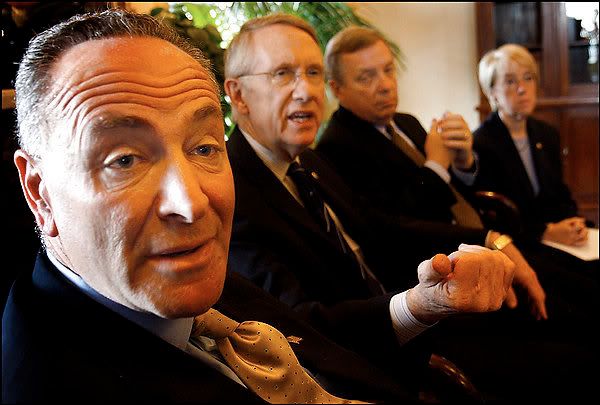 Sen. Charles Schumer, foreground, said he is "wrestling" with the decision of whether to recommend a full Senate confirmation vote for Michael Mukasey. Schumer talked to reporters about Mukasey and other topics yesterday with fellow Senate Democrats, from left, Harry Reid, Richard Durbin and Patty Murray. (By Melina Mara -- The Washington Post)
The Washington Post reports:
As Democratic opposition builds over attorney general nominee Michael B. Mukasey, no Democratic lawmaker has found himself in a tighter spot than Sen. Charles E. Schumer (N.Y.), who had eagerly recommended the former federal judge as a consensus candidate.
After Mukasey refused to say whether an interrogation technique called waterboarding amounts to illegal torture, Schumer has watched a growing number of his colleagues announce their opposition to the judge.
Schumer, who has remained uncharacteristically quiet throughout the furor, said in an interview yesterday that he is now "wrestling" with whether to vote against a nomination that he was instrumental in bringing about. He compared the controversy to the 2005 nomination battle over Chief Justice John G. Roberts Jr.
"From this administration, we will never get somebody who agrees with us on issues like torture and wiretapping," Schumer said at one point, suggesting an argument in favor of Mukasey, who faces a Senate Judiciary Committee vote on Tuesday. "The best thing we can hope for is someone who will depoliticize the Justice Department and put rule of law first."
But Schumer said minutes later that his mind is not made up: "He's the best we can get, but that doesn't necessarily ensure a yes vote. I thought John Roberts was the best we could get, but I voted no."
The outcome of Schumer's internal struggle could prove pivotal to Mukasey's chances, as a growing number of Democrats, including four other members of the Judiciary Committee, have announced their opposition to the nominee, as have all four senators who are seeking the Democratic presidential nomination.
The deteriorating political situation led President Bush yesterday to mount a vigorous defense of Mukasey, saying that Democrats are subjecting the former federal judge to standards that no candidate for attorney general could meet.
"It's wrong for congressional leaders to make Judge Mukasey's confirmation dependent on his willingness to go on the record about details of a classified program he has not been briefed on," Bush said in a speech at the Heritage Foundation in Washington. "If the Senate Judiciary Committee were to block Judge Mukasey on these grounds, they would set a new standard for confirmation that could not be met by any responsible nominee for attorney general. That would guarantee that America would have no attorney general during this time of war."
But key Democrats continued to signal opposition to the suddenly controversial nominee. Senate Majority Leader Harry M. Reid (D-Nev.) said his position is not "much of a secret," saying Mukasey's attempt at explaining his view on waterboarding has left his nomination in doubt.
Sen. Edward M. Kennedy (D-Mass.) announced his opposition yesterday, becoming the fourth Democrat on the Judiciary Committee to promise a no vote. Judiciary Chairman Patrick J. Leahy (D-Vt.), who originally predicted easy confirmation but has since become deeply critical of Mukasey, is expected to announce his position today in Vermont.
All nine Republicans on the committee are likely to support Mukasey, but if all 10 Democrats oppose the nominee, the confirmation would die in committee.
Republicans privately say that the nominee's prospects hang on a few votes, particularly those of Schumer and Sen. Dianne Feinstein (D-Calif.), who has broken ranks with her party in the past. Should Schumer and Feinstein side with other Democrats in opposition, Judiciary Republicans are likely to seek to forward the nomination with a neutral or negative recommendation to the full Senate for a confirmation vote.
Schumer originally suggested Mukasey to head the Justice Department eight months ago, after the senator became the first Democrat to call for the resignation of then-Attorney General Alberto R. Gonzales over his handling of the firings of nine U.S. attorneys. Schumer, whose chief counsel is a former federal prosecutor in the Manhattan courts that were overseen by Mukasey, had also recommended him as a worthy Supreme Court candidate in 2005.
But Mukasey, who was sailing to an easy confirmation, alarmed many Democrats on Oct. 18 when he repeatedly refused to say whether waterboarding is torture. The technique, which simulates drowning, has been used by the CIA but is barred by the U.S. military and has been widely condemned as torture by human rights groups.
Mukasey tried to mollify Democrats by saying in a letter earlier this week that he found the technique personally "repugnant," but he reiterated that he could not determine whether it is illegal without being privy to classified details.
Mukasey's response has been deemed insufficient by many Democrats and sparked an outcry among antiwar liberals who provided much of the political energy -- and financial contributions -- that propelled Democrats to the majority. Schumer, who chairs the Democratic Senatorial Campaign Committee, needs those supporters as he tries to expand the majority next year. One group, Democrats.com, began an e-mail campaign last night urging its supporters to withhold donations to Schumer if he votes for Mukasey.
During yesterday's telephone interview, Schumer said that his decision will hinge largely on whether he believes Mukasey would be independent of the White House. He said that was "called into question" by some of Mukasey's views.
"The question is whether he will show the requisite independence," Schumer said. "That's what I want to clear in my own head. . . . If Congress passes a law forbidding waterboarding, would he enforce that?"
Schumer's colleagues are keenly aware of his awkward position. In announcing his opposition to Mukasey on Wednesday, Majority Whip Richard J. Durbin (D-Ill.) said he could not predict the outcome of the close vote and noted the undecided posture of Schumer, with whom Durbin lives in a group house of Democrats. "I haven't polled my colleagues, including the one I live with," Durbin said.
Some Republicans, meanwhile, are openly chortling at Schumer's dilemma.
"Mukasey and Schumer, aren't they partners? Wasn't that the Schumer pick?" Sen. Trent Lott (R-Miss.) said yesterday. "It's become a problem for him."
Wednesday, October 31, 2007
| [+/-] |
A Lesson For Mukasey |
Kaj Larsen on, Why I Had Myself Water-Boarded:
As a journalist for Current TV, a former military officer, and a student of public policy I have been involved in the debate about the War on Terror from the frontlines in Afghanistan to the policy discussions of academia. In the spring of 2006 a battle was brewing between the Bush Administration and some influential members of Congress over the use coercive interrogation techniques. The conflict over what techniques were legally and morally permissible had been a subtext of the War on Terror for years, but for the most part the debate was occurring inside of the intelligence community, the human rights community, and in small legal circles. It was outside the purview of the American public.
By April of 2006 the debate about coercive interrogation and its most controversial technique, water-boarding, had started to spill into the headlines. I was in graduate school at the time. As I watched the debate unfold, and listened to both pundits and policymakers give their opinion on whether this technique constituted torture, I was struck by the strangeness of the debate. All of these people were lobbying opinions about a subject they had never seen or witnessed, and that struck me as problematic in a healthy democracy. See, in full disclosure I had a unique knowledge of water-boarding. I had the technique performed on me during my time in the service as part of my SERE training (Survival Evasion Resistance Escape). I, like all Special Forces operatives who deploy overseas, was sent to a training camp where we learned to resist interrogation and survive captivity, god forbid that ever happened to us overseas. Ironically, one of the many techniques we learned during this training was to assert our rights as told under Article III of the Geneva Convention. So, because I was familiar with water-boarding, I was intrigued by this national conversation that was going on about this thing that few people really understood. But, like many Americans, the pre-occupations of everyday life, for me the pressure of mid-terms and exams, pushed the controversy to the back of my mind.
Then, in mid March I traveled to Cambodia for Spring Break. While there I visited the Tuol Sleng (also known as S-21) prison in Phnom Penh. The Tuol Sleng prison had been converted to a museum and memorial for the victims of the Cambodian Genocide under the Pol Pot regime. As I walked through the museum and saw the photographs of the victims of the genocide, I was shocked to see a picture of the Khmer Rouge Water-boarding a Cambodian villager. At that moment I saw a throughline between the debate we were having domestically and the picture I was standing in front of. I was spurred into action, and upon my return to the United States, I decided to have myself water-boarded, this time on national TV, as a public service, so that this controversial technique could be judged in the court of public opinion.
