Friday, January 18, 2008
| [+/-] |
Who's Getting Abortions? Not Who You'd Think |
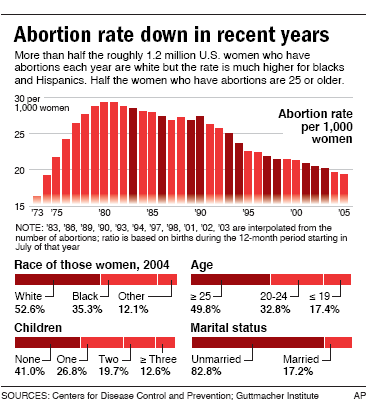
Half of the women are 25 or older; most already have a child:
In American pop culture, the face of abortion is often a frightened teenager, nervously choosing to terminate an unexpected pregnancy. The numbers tell a far more complex story in which financial stress can play a pivotal role.
Half of the roughly 1.2 million U.S. women who have abortions each year are 25 or older. Only about 17 percent are teens. About 60 percent have given birth to least one child prior to getting an abortion.
A disproportionately high number are black or Hispanic. And regardless of race, high abortion rates are linked to hard times.
“It doesn’t just happen to young people, it doesn’t necessarily have to do with irresponsibility,” said Miriam Inocencio, president of Planned Parenthood of Rhode Island. “Women face years and years of reproductive life after they’ve completed their families, and they’re at risk of an unintended pregnancy that can create an economic strain.”
Who has abortions?
Activists on both sides of the abortion debate will soon be marking the 35th anniversary of the Supreme Court’s Roe v. Wade decision, which established a nationwide right to abortion. Since Jan. 22, 1973, there have been roughly 50 million abortions in the United States, and more than one-third of adult women are estimated to have had at least one.
Who are these women?
Much of the public debate focuses on teens, as evidenced by the constant wranging over parental notification laws and movies like the current hit “Juno,” in which the pregnant heroine heads to an abortion clinic, then decides to have the baby.
In fact, the women come from virtually every demographic sector. But year after year the statistics reveal that black women and economically struggling women — who have above-average rates of unintended pregnancies — are far more likely than others to have abortions. About 13 percent of American women are black, yet new figures from the Centers for Disease Control show they account for 35 percent of the abortions.
Black anti-abortion activists depict this phenomenon in dire terms — “genocide” and “holocaust,” for example. But often the women getting the abortions say they act in the interests of children they already have.
“It wasn’t a hard decision for me to make, because I knew where I wanted to go in my life — I’ve never regretted it,” said Kimberly Mathias, 28, an African-American single mother from Missouri.
She had an abortion at 19, when she already raising a 2-year-old son.
“It wasn’t hard to realize I didn’t want another child at that time,” Mathias said. “I was trying to take care of the one I had, and going to college and working at the same time.”
She was able to graduate, now has an insurance job, and — still a single mother — has a 3-year-old son as well as her first-born, now 11.
'A silent killer'
By contrast, Alveda King, a niece of Martin Luther King Jr., calls herself a “reformed murderer” for undergoing two abortions when she was young.
Now an outspoken anti-abortion campaigner, King says the best way to reduce abortions among black women is to dissuade more of them from premarital sex.
“We give free sex education, free condoms, free birth control,” she complained. “That’s almost like permission to have free sex, and the higher the rate of sexual activity, the higher the rate of unintended pregnancy.”
Anti-abortion activist Day Gardner of the National Black Pro-Life Union says many blacks are unaware of their community’s high abortion rate.
“We don’t talk about it,” Gardner said. “It’s a silent killer among us.”
She contends that abortion-rights supporters tempt black women into abortion by suggesting they can’t afford to raise the child. But Gardner also acknowledges that some black women make this argument on their own.
“We had the whole civil rights movement — now we’re in a place where we’re moving further toward equality,” Gardner said. “So women think, ‘For once, I can see the American dream. I can have the house and the job, but it would postpone it to have another child. I can’t afford to take time off.’ ”
Dr. Vanessa Cullins, a black physician who is Planned Parenthood’s national vice president for medical affairs, said the allegations of “black genocide” do not help women meet day-to-day challenges.
“These actions take attention away from medically proven ways to reduce unintended pregnancy — comprehensive sex education, affordable birth control, and open and honest conversations about relationships,” she said
Looking beyond racial dividing lines, Cullins views the right to abortion as an important component in the ability of all American women to determine the right size for their family.
“Groups that become assimilated in U.S. culture and experience economic opportunities naturally decide to limit family size, because they want to take part in the American dream,” she said. “If you’re a single mother, achieving the dream is all the harder, so it makes sense to limit family size so you can shower as much support as you can on the children you have.”
Financial pressures
Georgette Forney, who had an abortion when she was 16 and is now an anti-abortion campaigner leading Anglicans for Life, says she often sees economic pressures triggering abortions, even in middle-class families.
“In one situation, the husband was adamant that they were on track to pay for their two sons’ college education, and a third child would throw off his whole calculation,” Forney recounted. “So that baby was aborted and that woman was devastated. It was a five-year process to recover.”
Forney said she also encountered a single mother who was worried she might lose custody of her daughter in light of a suit by the biological father. The woman then became pregnant, Forney said, and had an abortion in violation of her own beliefs because she feared having a second child would jeopardize prospects for keeping her daughter.
“We’ve begun to depend on abortions,” Forney said. “We feel we have to choose between our unborn child and our born children.”
Martha Girard, on the other hand, says she’s appalled by the notion that women should lose the right to choose.
A hospital ultrasound technician from Pleasant Prairie, Wis., and a mother of three, Girard had an abortion two years ago, at the age of 44, when she mistakenly thought she was too old to get pregnant.
Having been through three difficult pregnancies previously, and coping with a mentally disabled eldest son, she felt abortion was the prudent choice.
“I knew that this pregnancy would end up badly — I could feel it — and we’ve already got enough problems with the mentally ill son,” Girard said.
“I was very sad and depressed the first week,” she added. “But because it’s hard on you emotionally and some women regret it, that doesn’t mean it’s wrong, that someone else should decide for you.”
The Journal of Family Issues published a report earlier this month asserting that women often choose abortion because of their wish to be good parents.
That means women who have no children want the conditions to be right when they do, and women who already are mothers want to care responsibly for their existing children, said the lead author, Rachel Jones, a researcher with the Guttmacher Institute.
“These women believed that it was more responsible to terminate a pregnancy than to have a child whose health and welfare could be in question,” Jones said.
Number of abortions declining
Even among many abortion opponents, the Guttmacher Institute — which supports abortion rights — is considered the nation’s best source of abortion statistics.
Federal statistics do not include California, the most populous state, because its government does not provide data. But Guttmacher researchers surveyed abortion providers there as well as in other states to produce the latest national estimate of 1.2 million abortions in 2005. That’s down from a peak of 1.6 million in 1990 but still represents more than 20 percent of all pregnancies.
One of the Guttmacher’s top researchers, Stanley Henshaw, said the recent drop may disguise the fact abortion rates remain relatively high for black and Hispanic women. He believes the most effective countermeasure would be wider availability of contraceptives such as intrauterine device, or IUDs, that don’t require attention as frequently as condoms or birth-control pills.
Though abortion is commonplace across the country, urban areas have far higher rates than rural areas where access to abortion providers can be difficult.
New York, New Jersey, California, Delaware, Nevada, Maryland and Florida had the highest abortion rates in 2005, according to the new Guttmacher report released this week. Wyoming, Idaho, Kentucky, South Dakota and Mississippi had the lowest rates — the latter two states have just a single abortion clinic in operation.
Susan Hill, founder of the National Women’s Health Organization that runs the remaining Mississippi clinic, says the statistics may not fully reflect a subgroup of relatively affluent women who obtain unreported abortions through their private doctors.
“In Mississippi, it’s the poor women who don’t have access to that who have to run through the maze of protesters screaming and yelling abuse,” Hill said. “Wealthier women can be more creative about their alternatives.”
According to Guttmacher data, the abortion rate among women living below the federal poverty level is more than four times higher that among women from middle-income and affluent households.
An increasing number of women avoid surgery by using the RU-486 abortion pill or other early medication — these now account for about 13 percent of all abortions.
Of all U.S. women getting abortions, about 54 percent are doing so for the first time, while one-fifth have had at least two previous abortions. Of those over 20, the majority have attended college. Almost a third have been married at some point. About 60 percent have at least one child; one-third have two or more.
“I don’t think most people understand that these are women who have families, who are making a very serious decision about their reproductive health,” said Nancy Keenan, president of NARAL Pro-Choice America. “The stereotype is that the decision is made lightly. It is not.”
Sunday, December 30, 2007
| [+/-] |
Huckabee Would Criminalize Abortion Providers |
At The Trail blog at the Washington Post, John Solomon writes:
Former Arkansas governor Mike Huckabee, locked in a tight GOP race in Iowa, said Sunday he would seek to punish doctors who took money to provide abortions to women if he succeeded in outlawing the procedure, as he has long advocated.
"I think if a doctor knowingly took the life of an unborn child for money, and that's why he was doing it, yeah, I think you would, you would find some way to sanction that doctor," Huckabee said during an appearance on NBC's Meet the Press. "I don't know that you'd put him in prison, but there's something to me untoward about a person who has committed himself to healing people and to making people alive who would take money to take an innocent life and to make that life dead."
The former governor said he would not support penalizing women who sought abortions even if they were outlawed. "I think you don't punish the woman, first of all, because it's not about ... I consider her a victim, not a criminal."
Huckabee, whose campaign surged to the lead in Iowa polls but has cooled in recent days, also used the appearance on the Sunday show to launch his most pointed attack yet on rival Mitt Romney. He accused the former Massachusetts governor of running a "very desperate and, frankly, distorted" campaign for the presidency.
"If you aren't being honest in obtaining the job, can we trust you if you get the job?" Huckabee asked, citing instances in which he alleged Romney distorted Huckabee's record as governor. Huckabee also came to the defense of a fellow rival, saying that when Romney "went after the integrity of John McCain, he stepped over the line. John McCain's a hero in this country. He's a hero to me."
McCain, whose campaign also has been targeted by Romney since it began rising in New Hampshire polls, also got into the mix during an appearance on ABC's This Week. McCain declined to call Romney a "phony" but said "I think he's a person who changed his positions on many issues."
Tuesday, September 18, 2007
| [+/-] |
Arlen Specter Adds Earmarks For Abstinence Education |
At the Baltimore Sun, Josh Drobnyk writes:
Sen. Arlen Specter added more than two dozen spending requests for abstinence education programs in Pennsylvania to a bill that passed a Senate committee this summer, the latest effort by the Pennsylvania Republican to boost federal spending on such programs, as I write in today's Allentown Morning Call.
The more than $1 million -- to be doled out in 25 grants each worth between $30,000 and $80,000 -- would go to hospitals, school districts and social service organizations throughout the state and supplement a growing federal effort to persuade unmarried people to abstain from sex. But critics say the requests bypass the government's competitive bidding process.
Specter, who added the ''earmarks'' to the Labor and Health and Human Services appropriations measure that passed the panel in June, is the only lawmaker in Congress to sponsor a spending request for abstinence education, according to a database of appropriations bills compiled by Washington-based watchdog Taxpayers for Common Sense. The bill still needs Senate, House and White House approval.
Specter's support for abstinence education is a long-held but lesser-known position of the five-term lawmaker, a move that could soften his image among moral conservatives as an abortion-rights supporter.
He has pushed for more federal money toward abstinence programs since at least the mid-1990s, but not until a few years ago did he add a spending request directly into an appropriations bill, requiring the Department of Health and Human Services to fund a project.
In 2003 and 2004, he added about 65 earmarks for abstinence education totaling $5.6 million into appropriations measures, according to Taxpayers for Common Sense.
Unlike past years, though, when earmark sponsors were determined mainly through piecing together news releases and line items within spending bills, this year's appropriations measures highlight exactly who has sponsored each request. They offer the first comprehensive glimpse of Specter's support for specific abstinence programs.
''Sen. Specter recognizes the need for comprehensive sex education,'' Specter chief of staff Scott Hoeflich said in an e-mail. ''Thus, he supports funding for abstinence-only education programs in response to a significant segment of his constituency which he believes is entitled to implement programs most consistent with their values.''
The year's requests are sprinkled throughout the state. Among them: $55,000 for LaSalle University in Philadelphia, $30,000 for Shepherd's Maternity House in East Stroudsburg and $45,000 for Washington Hospital Teen Outreach in Washington County.
One such program, Human Life Services in York, has twice before received grants earmarked by Specter. Executive Director Ron Sisto said the organization's abstinence program gives seminars at hundreds of schools every year. ''We explain to them that to have the healthiest lifestyle is to remain abstinent until marriage,'' Sisto said. That involves teaching about sexually transmitted diseases but not contraception.
This year's Pennsylvania earmarks would add to federally funded abstinence programs that have more than doubled in total dollars since 2000 to $213 million this year, all administered by Health and Human Services. Most of the money is through the Community-Based Abstinence Education program, which began in 2000 and awards grants directly to states and local organizations.
The earmarks touch on two raging debates on Capitol Hill: Whether the programs funded are properly vetted and whether abstinence education is effective. ''It is not necessarily that there is anything wrong with the program,'' said Ryan Alexander, president of Taxpayers for Common Sense. ''We don't have the evidence to support the fact that this is a federal priority. We don't know what they are saying no to.''
Added Valerie Huber, executive director of the National Abstinence Education Association, which lobbies for more federal money for the effort: ''It is really a little more difficult [to know] that the funds are being used as they are intended to when they don't have the oversight of HHS.''
But Specter's office said each application goes through a competitive process that is ''thoroughly reviewed'' by the senator's office -- not normal channels through the Department of Health and Human Services. Once funded, the project is held accountable by the department like any government-funded project.
Whether or not the programs are effective is a different question. Supporters and opponents point to varying evidence that backs their position.
''There has never been any research that showed these programs were effective,'' said Martha Kempner, spokeswoman for Sexuality Information and Education Council of the United States. She noted that a federally funded study released early this year showed abstinence education is not effective in delaying sexual activity among unmarried youth.
Huber, though, said dozens of other studies show positive effects. ''It is effective in delaying sexual onset,'' she said.
Wednesday, August 15, 2007
| [+/-] |
Study Says, "Abortion Pill Doesn't Raise Pregnancy Risk" |
The Associated Press reports:
Women who use abortion pills rather than the more common surgical method seem to face no greater risk of tubal pregnancy or miscarriage in later pregnancies, according to a new study.
The federally funded research -- based on a study of nearly 12,000 Danish women -- is considered the best study to date of the impact of this newer abortion method on subsequent pregnancies.
The vast majority of abortions are called surgical abortions, usually done by removing an embryo or fetus from the uterus with a syringe or electric pump.
The U.S. and Danish researchers studied medical abortions, which generally involve a woman ending a pregnancy by taking one tablet of mifepristone -- formerly known as RU-486 -- followed by about four misoprostol pills a day or two later. The mifepristone destabilizes the connecting tissue between an embryo and the uterus, and the misoprostol causes the uterus to expel the embryo.
Medical abortions may appeal more to women because they can happen at home, can seem less intimidating than surgical abortion and just about any doctor can prescribe the pills, experts said.
The U.S. government approved the marketing of mifepristone for medical abortions in 2000, and European countries approved it years earlier.
Today, an estimated 8 percent to 10 percent of the roughly 1.3 million abortions in the United States are done using the pills.
Although previous research has shown that surgical abortions don't increase the risk of problems in later pregnancies, little research had been done on the impact of medical abortions.
Generally, surgical abortions completely remove an embryo or fetus and the surrounding uterine tissue, but abortions done with pills may leave bits of placenta or other embryonic material. Some doctors have wondered whether that might interfere with subsequent pregnancies, said Dr. Matthew Reeves, a reproductive medicine expert at the University of Pittsburgh School of Medicine.
The paper is published in today's New England Journal of Medicine.
In the new study, researchers used a national abortion registry to identify all women in Denmark who had abortions from 1999 to 2004. They got information on later pregnancies from national patient and birth registries.
Denmark is the only country with an abortion registry, said study co-author Dr. Jun "Jim" Zhang of the National Institutes of Health.
Researchers looked at tubal pregnancies, in which a fertilized egg implants outside the uterus -- usually in the fallopian tubes. Such a situation fails to nurture the embryo and endangers the mother.
Medical abortions appeal to women because they can do it in the privacy of their home, can seem less intimidating than surgical abortion and just about any doctor can prescribe the pills, experts said.
The new study found tubal pregnancies occurred at the same frequency — about 2.5 percent of the time — in both the medical and surgical groups. The rates of miscarriage, early deliveries and low birth weight babies also were similar.
Generally, the number of reported abortions in the U.S. have been declining since the early 1990s, although there was a slight increase in 2002, according to federal statistics. There is about one abortion for every four live births each year, according to the CDC‘s most recent statistics, which do not include every state.
Friday, June 22, 2007
| [+/-] |
Melinda Henneberger: "Why Pro-Choice Is A Bad Choice For Democrats" |
In an op-ed for the New York Times, Melinda Henneberger, the author of “If They Only Listened to Us: What Women Voters Want Politicians to Hear,” writes:
I keep reading about a universe in which social conservatives are warming to Rudy Giuliani. But this would have to be a place where his estranged children and three wives and multiple appearances in fishnets were irrelevant to the Republican base. Where the nice gay couple he moved in with between marriages would be asked to appear in the film montage at the nominating convention in St. Paul.
Even in the real world, a pro-choice Republican nominee would be a gift to the Democrats, because the Republican Party wins over so many swing voters on abortion alone. Which is why Fred Thompson, who is against abortion rights, is getting so much grateful attention from his party now. And why, despite wide opposition to the war in Iraq, Democrats must still win back such voters to take the White House next year.
Over 18 months, I traveled to 20 states listening to women of all ages, races, tax brackets and points of view speak at length on the issues they care about heading into ’08. They convinced me that the conventional wisdom was wrong about the last presidential contest, that Democrats did not lose support among women because “security moms” saw President Bush as the better protector against terrorism. What first-time defectors mentioned most often was abortion.
Why would that be, given that Roe v. Wade was decided almost 35 years ago? Opponents of abortion rights saw 2004 as the chance of a lifetime to overturn Roe, with a movement favorite already in the Oval Office and several spots on the Supreme Court likely to open up. A handful of Catholic bishops spoke out more plainly than in any previous election season and moved the Catholic swing vote that Al Gore had won in 2000 to Mr. Bush.
The standard response from Democratic leaders has been that anyone lost to them over this issue is not coming back — and that regrettable as that might be, there is nothing to be done. But that is not what I heard from these voters.
Many of them, Catholic women in particular, are liberal, deep-in-their-heart Democrats who support social spending, who opposed the war from the start and who cross their arms over their chests reflexively when they say the word “Republican.” Some could fairly be described as desperate to find a way home. And if the party they’d prefer doesn’t send a car for them, with a really polite driver, it will have only itself to blame.
What would it take to win them back? Respect, for starters — and not only on the night of the candidate forum on faith. As it turns out, you cannot call people extremists and expect them to vote for you. But real respect would require an understanding that what supporters of abortion rights genuinely see as a hard-earned freedom, opponents genuinely see as a self-inflicted wound and — though I can feel some of you tensing as you read this — a human rights issue comparable to slavery.
Again and again, these voters said Democrats are too unwilling to tolerate dissent on abortion. It is a point of orthodoxy no more open to debate within the party than the ordination of women is in Rome.
Democratic Party leaders should also stop pushing the perception that Republicans are natural defenders of the faithful. For years, they have done just that by tirelessly portraying our current president as this committed — indeed, obsessed — pro-lifer who would stop at nothing to see Roe overturned. Karl Rove couldn’t have said it better himself; this was better advertising than hard money could buy.
Today, in a similarly oblivious way, the leading Democratic presidential contenders are condemning the Supreme Court’s recent decision to uphold a ban on the procedure known as partial-birth abortion. An overwhelming majority of Americans, polls show, support a ban. Legal scholars have underscored the narrowness of the ruling in the partial-birth case, Gonzales v. Carhart, which does not even outlaw all late-term abortions. Yet the leading Democratic candidates, all of whom are lawyers, choose to overstate its impact.
Hillary Clinton called the decision “a dramatic departure from four decades of Supreme Court rulings that ... recognized the importance of women’s health.” Barack Obama echoed that it “dramatically departs from previous precedents safeguarding the health of pregnant women.” Though John Edwards was one of only two United States senators who did not cast a vote on the bill in 2003, he, too, found the decision to uphold that law “ill-considered and sweeping,” and “a stark reminder of why Democrats cannot afford to lose the 2008 election.”
Actually, it is a stark reminder of how fully capable they all are of losing it. A Democratic senator I spoke with recently did not see the disconnect between public opinion and the party’s position on Carhart as any reason to worry: “Make no mistake; this is a pro-choice country, period.”
But in a recent New York Times/CBS News poll, 41 percent of respondents favored stricter limits on abortion, with an additional 23 percent saying it should not be permitted at all.
What are we to make of all this? Surely at a minimum that our enduring reluctance to acknowledge the complexity of the abortion issue has only prolonged and hardened the debate. Most Americans fall somewhere between the extremes of “never” and “no problem” when it comes to abortion.
What polling can’t capture and politicians won’t hear is the voice of the nun I interviewed who considers herself pro-choice — and has been disciplined by her diocese as a result — because she does not think abortion is wrong for rape victims. Or the voices of the many women I spoke to who hold far more expansive views yet call themselves pro-life. Most people differentiate between a fetus in the early weeks of development and at nearly full term, and draw the line at a procedure that Democratic Senator Pat Moynihan regarded as infanticide.
Would Democrats who hate Carhart really switch parties or stay home on Election Day if their leaders began to acknowledge such distinctions? After the last seven years, I don’t think so. Yes, the abortion-rights lobby has raised a lot of money since the ban, but the statements of the Democratic candidates will cost them, too. This issue has been very, very good to the Republican Party — and there is plenty more where that came from.
| [+/-] |
Women's Health Care Sliding Back To The Middle Ages |
MSNBC reports:
Lori Boyer couldn't stop trembling as she sat on the examining table, hugging her hospital gown around her. Her mind was reeling. She'd been raped hours earlier by a man she knew — a man who had assured Boyer, 35, that he only wanted to hang out at his place and talk. Instead, he had thrown her onto his bed and assaulted her. "I'm done with you," he'd tonelessly told her afterward. Boyer had grabbed her clothes and dashed for her car in the freezing predawn darkness. Yet she'd had the clarity to drive straight to the nearest emergency room — Good Samaritan Hospital in Lebanon, Pennsylvania — to ask for a rape kit and talk to a sexual assault counselor. Bruised and in pain, she grimaced through the pelvic exam. Now, as Boyer watched Martin Gish, M.D., jot some final notes into her chart, she thought of something the rape counselor had mentioned earlier.
"I'll need the morning-after pill," she told him.
Dr. Gish looked up. He was a trim, middle-aged man with graying hair and, Boyer thought, an aloof manner. "No," Boyer says he replied abruptly. "I can't do that." He turned back to his writing.
In a survey published this year in The New England Journal of Medicine, 63 percent of doctors said it is acceptable to tell patients they have moral objections to treatments, and 18 percent felt no obligation to refer patients elsewhere.
Boyer stared in disbelief. No? She tried vainly to hold back tears as she reasoned with the doctor: She was midcycle, putting her in danger of getting pregnant. Emergency contraception is most effective within a short time frame, ideally 72 hours. If he wasn't willing to write an EC prescription, she'd be glad to see a different doctor. Dr. Gish simply shook his head. "It's against my religion," he said, according to Boyer. (When contacted, the doctor declined to comment for this article.)
Boyer left the emergency room empty-handed. "I was so vulnerable," she says. "I felt victimized all over again. First the rape, and then the doctor making me feel powerless." Later that day, her rape counselor found Boyer a physician who would prescribe her EC. But Boyer remained haunted by the ER doctor's refusal — so profoundly, she hasn't been to see a gynecologist in the two and a half years since. "I haven't gotten the nerve up to go, for fear of being judged again," she says.
Doctors refusing treatment
Even under less dire circumstances than Boyer's, it's not always easy talking to your doctor about sex. Whether you're asking about birth control, STDs or infertility, these discussions can be tinged with self-consciousness, even embarrassment. Now imagine those same conversations, but supercharged by the anxiety that your doctor might respond with moral condemnation — and actually refuse your requests.
That's exactly what's happening in medical offices and hospitals around the country: Catholic and conservative Christian health care providers are denying women a range of standard, legal medical care. Planned Parenthood M.D.s report patients coming to them because other gynecologists would not dole out birth control prescriptions or abortion referrals. Infertility clinics have turned away lesbians and unmarried women; anesthesiologists and obstetricians are refusing to do sterilizations; Catholic hospitals have delayed ending doomed pregnancies because abortions are only allowed to save the life of the mother. In a survey published this year in The New England Journal of Medicine, 63 percent of doctors said it is acceptable to tell patients they have moral objections to treatments, and 18 percent felt no obligation to refer patients elsewhere. And in a recent SELF.com poll, nearly 1 in 20 respondents said their doctors had refused to treat them for moral, ethical or religious reasons. "It's obscene," says Jamie D. Brooks, a former staff attorney for the National Health Law Program who continues to work on projects with the Los Angeles advocacy group. "Doctors swear an oath to serve their patients. But instead, they are allowing their religious beliefs to compromise patient care. And too often, the victims of this practice are women."
The state of doctor refusals
Physicians anywhere can deny you care. But some states back up M.D.s with specific laws allowing them to do so, says Elizabeth Nash, public policy associate at the Guttmacher Institute research group. Whose side is your state on?
States that allow doctors to refuse care:
Contraception
AR, CO, FL, IL, ME, MS, TN, WA
Abortion
Every state has a law except AL, NH, VT, WV.
Sterilization
AR, GA, ID, IL, KS, KY, MD, MA, MS, MT, NJ, PA, RI, WA, WV, WI
States that allow hospitals to refuse care:
Contraception
All hospitals
IL, MS, WA
Private hospitals only
AR, CO, ME, MA, NJ, TN
Abortion
All hospitals
AZ, AR, CO, DE, FL, GA, HI, ID, KS, KY, LA, ME, MD, MA, MI, MS, MO, NE, NM, NC, ND, OH, SD, TN, VA, WA, WI
Private hospitals only
AK, IL, IN, IA, MN, MT, NV, NJ, OK, OR, PA, SC, TX, UT, WY
Religious hospitals only
CA
Sterilization
All hospitals
AR, GA, ID, IL, KS, MD, MS, NM, WA, WV, WI
Private hospitals only
MA, MT, NJ, PA
States considering new laws
Lawmakers in Missouri, Rhode Island, South Carolina and Vermont are considering sweeping bills that would allow medical professionals to refuse to provide any service they object to.
Compared with the highly publicized issue of pharmacists who refuse to dispense birth control and emergency contraception, physician refusals are a little-discussed topic. Patients denied treatment rarely complain — the situation tends to feel so humiliatingly personal. And when patients do make noise, the case is usually resolved quietly. "The whole situation was traumatizing and embarrassing, and I just wanted to put it behind me," Boyer says. She came forward only after a local newspaper reported an almost identical story: In July 2006, retail clerk Tara Harnish visited the same ER after being sexually assaulted by a stranger, was examined by the same Dr. Gish — and when her mother called Dr. Gish's office the next day to get EC for Harnish, she was refused. "Then I knew it wasn't just me, that this was a larger problem and it could happen to anybody," Boyer says.
Harnish, 21, was shocked by the way the doctor treated her. "He seemed more concerned with saving the (potential) pregnancy than he was with my health," she says. "He turned me away when I needed medical help. That's not what a doctor is supposed to do." Harnish was too shaken by her rape to pursue the matter; her mother called Harnish's gynecologist for a prescription. Then she called the newspaper. Despite the attention the story attracted, Dr. Gish continues to work at Good Samaritan Hospital. Spokesman Bill Carpenter will only say that "the issue has been resolved internally, and we're going to move forward."
In many cases, women don't even know a doctor is withholding treatment. Boyer and Harnish, for example, wouldn't have realized they'd been denied care if they'd been among the estimated one in three women who don't know about EC. In the New England Journal of Medicine survey, 8 percent of physicians said they felt no obligation to present all options to their patients. "When you see a doctor, you presume you're getting all the information you need to make a decision," notes Jill Morrison, senior counsel for health and reproductive rights at the National Women's Law Center in Washington, D.C. "Especially in a crisis situation, like a rape, you often don't think to question your care. But unfortunately, now we can't even trust doctors to tell us what we need to know."
An ethical dilemma
To many doctors, however, the issue represents a genuine ethical dilemma. "The physician's number-one creed is 'First, do no harm,' " says Sandy Christiansen, M.D., an ob/gyn in Frederick, Maryland, who is active in the Christian Medical and Dental Associations, a 16,000-member group for health care professionals based in Bristol, Tennessee. "I know that life begins at conception, and that each person has inherent value. That includes the life of the unborn." Dr. Christiansen says she will not give abortion referrals, opposes EC and, while she has prescribed birth control, is reconsidering the morality of that position. "Doctors are people, too," she adds. "We have to be able to leave the hospital and live with ourselves. If you feel in your heart an action would cause harm to somebody — born or unborn — it's legitimate to decline to participate."
The American Medical Association in Chicago, the nation's largest physician group, effectively agrees with her; its policy allows a doctor to decline a procedure if it conflicts with her moral ideology. The law also favors medical professionals. In 1973, following Roe v. Wade, Congress passed the so-called Church Amendment, allowing federally funded health care providers to refuse to do abortions. In the years since, 46 states have adopted their own abortion refusal clauses — or, as proponents call them, conscience clauses — allowing doctors to opt out. Now many states have gone further. Sixteen legislatures have given doctors the right to refuse to perform sterilizations; eight states say doctors don't have to prescribe contraception. "This is about the rights of the individual, about our constitutional right to freedom of religion," says Frank Manion, an attorney with the American Center for Law and Justice, a legal group in Washington, D.C. Founded by minister Pat Robertson, the organization has represented health care providers and lobbied for laws that protect them. "We're not trying to deny anybody access to treatment," Manion adds. "We're saying, 'Don't make your choice my choice.' "
When Elizabeth Dotts walked into her new doctor's office for a gynecologic exam and checkup, she didn't realize she was treading into the front lines of a culture war. "I was just going for my annual visit, nothing out of the ordinary," says the 26-year-old YWCA grant coordinator. Dotts, who was single, had recently moved to Birmingham, Alabama, and was seeing an M.D. recommended by a coworker. The visit was unremarkable until she asked for a refill of her birth control prescription. That's when the doctor informed her that he was Catholic and the pills were against his religion.
"The look he gave me actually made me feel ashamed," Dotts says. "Like I had this wild and crazy sex life. Like he was trying to protect me from myself." Her bewilderment quickly turned to anger — "I thought, 'Wait, what in the world? Where am I?' " — especially when she remembered that her insurance covered only one annual gynecology checkup. Dotts, who'd majored in religion in college, got tough with the doctor.
"I'm glad for you that you're faithful," she told him. "But don't push it on me. I'm here for my treatment, and I expect you to give it to me." Five minutes of verbal sparring later, the doctor relented with a six-month prescription — but only after Dotts told him she had been put on the Pill to relieve menstrual cramping, not to prevent pregnancy. Dotts grabbed the prescription and left, resolving to find herself a new gynecologist. "Before, walking into a doctor's office, I assumed we were on the same side," she says. "I don't make that assumption now. I ask a million questions and advocate for myself."
Bills to protect patients
This tug-of-war between physicians and patients is playing out in state legislatures, where a handful of bills aim to protect women. A Pennsylvania proposal, for example, would compel ER doctors to provide rape victims with information about emergency contraception and to dispense it on request — a law already on the books in California, Massachusetts, New Jersey, New Mexico, New York, Ohio and Washington. A federal version of the bill is under consideration by a House subcommittee.
But such efforts have been more than matched by those of conscience-clause activists. Since 2005, 27 states introduced bills to widen refusal clauses. Four states are considering granting carte blanche refusal rights — much like the law adopted by Mississippi in 2004, which allows any health care provider to refuse practically anything on moral grounds. "It's written so broadly, there's virtually no protection for patients," says Adam Sonfield, senior public policy associate for the Washington, D.C., office of the Guttmacher Institute, a reproductive-health research group. Sonfield notes that many refusal clauses do not require providers to warn women about restrictions on services or to refer them elsewhere. "You have to balance doctors' rights with their responsibilities to patients, employers and communities," he adds. "Doctors shouldn't be forced to provide services, but they can't just abandon patients."
In theory, the laws aren't aimed solely at women's health — a bill in New Jersey lists eye doctors and prosthetics technicians as examples of providers who'd be allowed to refuse care based on their beliefs. But Morrison warns women not to be fooled. "I ask you, what belief would keep someone from fitting a patient with a prosthetic limb?" she asks. "What they're really after is limiting access to women's health care. Reproductive health is seen as something other than regular health care" — not a straightforward matter of treating and healing, but something laden with morality — "and if you treat it that way, it becomes something providers can say yes or no to." Men, for the most part, escape such scrutiny: It's pretty hard to imagine someone being made to feel he's going straight to hell for choosing to take Viagra or get a vasectomy. And if women come to fear their doctors' judgments, a new set of problems can develop. "Then you have women who don't communicate with their doctors or avoid getting care," Morrison warns. "Any way you look at it, it's dangerous for women."
Complaint filed, but case closed
The stakes were high for Realtor Cheryl Bray when she visited a physician in Encinitas, California, two and a half years ago. Though she was there for a routine physical, the reason for the exam was anything but routine: Then a single 41-year-old, Bray had decided to adopt a baby in Mexico and needed to prove to authorities there that she was healthy. "I was under a tight deadline," Bray remembers; she had been matched with a birth mother who was less than two months from delivering. Bray had already passed a daunting number of tests — having her taxes certified, multiple background checks, home inspections by a social worker, psychological evaluations. When she showed up at the office of Fred Salley, M.D., a new doctor a friend had recommended, she was looking forward to crossing another task off her list. Instead, 10 minutes into the appointment, Dr. Salley asked, "So, your husband is in agreement with your decision to adopt?"
"I'm not married," Bray told him.
"You're not?" He calmly put down his pen. "Then I'm not comfortable continuing this exam."
Bray says she tried to reason with Dr. Salley but received only an offer for a referral at some future date. Dr. Salley disputes this, telling SELF that he offered to send Bray to another doctor in his group that day. "My decision to refer Ms. Bray was not because she was unmarried; rather, it was based on my moral belief that a child should have two parental units," he adds. "Such religious beliefs are a fundamental right guaranteed by the Constitution of the United States."
Bray sobbed in her parked car for another 45 minutes before she could collect herself for the drive home. "I had a lot of pent-up emotions," she remembers. "When you are going through an adoption, you have to prove that you are a fit parent at every stage. I really felt put through the ringer, and the doctor compounded that feeling."
Bray managed to get an appointment with another physician about a month later and was approved for the adoption two weeks before her daughter, Paolina, was born. But she remained furious enough that she filed a complaint against Dr. Salley with the Medical Board of California — and then was shocked when, in April 2006, the board closed the case without taking any action. When she complained to Dr. Salley's employer, a clinic official wrote back that "based on personally held conscience and moral principles" her doctor had been within his rights to refuse her as a patient. "Apparently," she says, "it's OK to discriminate against somebody, as long as it's for religious reasons."
Providers often prevail
It's true that several lawsuits have favored health providers who refuse services based on their principles. In a 2002 wrongful-termination case in Riverside County, California, for example, a born-again Christian nurse was fired for refusing to give out emergency contraception — but she was vindicated when the jury agreed that her rights had been violated, awarding her $19,000 in back pay and $28,000 for emotional distress. And in a recent case in San Diego, an appeals court ruled against 35-year-old Guadalupe Benitez. Hoping to start a family with her lesbian partner, Benitez received fertility treatments for nearly a year at North Coast Women's Care Medical Group in Encinitas. But when drugs and home inseminations failed, two doctors and a nurse all bowed out of doing an intrauterine insemination, saying their religion would not allow it.
Their reasoning is in dispute: Benitez has claimed both doctors told her they objected to her sexual orientation. Carlo Coppo, a lawyer for the doctors, says they refused because she was unmarried. Benitez, who went on to have three children with the help of another clinic, has appealed to the California Supreme Court and is awaiting its decision.
Her attorney, Jennifer C. Pizer of Lambda Legal in Los Angeles, says she's heard from numerous lesbians denied access to fertility treatments. "Reproductive medicine has given human beings choices that didn't exist in previous generations, but the rules about how we exercise those choices should be the same for all groups of people," she argues. Allowing doctors to refer a patient to someone else, she adds, is the equivalent of a restaurant telling a black person, "Go next door. We don't serve your kind here."
In the end, the women in all of the incidents above were able to get the treatment they wanted, even if they had to go elsewhere. So one could see doctor refusals as a mere inconvenience. "In 99.9 percent of these cases, the patients walk away with what they came for, and everyone's satisfied," Manion asserts. "I know there's the horror story of the lonely person in the middle of nowhere who meets one of my clients. But those cases are so rare." Access to reproductive health care, however, is already a challenge in some areas. "Out here, it's a very real issue," says Stacey Anderson of Planned Parenthood of Montana in Helena. "We have some really gigantic counties where if you're refused a service by a primary care physician or a gynecologist, you might have to drive two, three hours to find another."
Moreover, you don't need to be in a rural area to have limited access, points out attorney Brooks; all you need to be is poor. "Lower-income people who are refused health care are trapped," Brooks says. "They can't pay out of pocket for these services. And they may not have transportation to go elsewhere. So they really don't have options."
What's best for the patient
If there's one thing both sides can agree on, it's this: In an emergency, doctors need to put aside personal beliefs to do what's best for the patient. But in a world guided by religious directives, even this can be a slippery proposition.
Ob/gyn Wayne Goldner, M.D., learned this lesson a few years back when a patient named Kathleen Hutchins came to his office in Manchester, New Hampshire. She was only 14 weeks pregnant, but her water had broken. Dr. Goldner delivered the bad news: Because there wasn't enough amniotic fluid left and it was too early for the fetus to survive on its own, the pregnancy was hopeless. Hutchins would likely miscarry in a matter of weeks. But in the meanwhile, she stood at risk for serious infection, which could lead to infertility or death. Dr. Goldner says his devastated patient chose to get an abortion at local Elliot Hospital. But there was a problem. Elliot had recently merged with nearby Catholic Medical Center — and as a result, the hospital forbade abortions.
"I was told I could not admit her unless there was a risk to her life," Dr. Goldner remembers. "They said, 'Why don't you wait until she has an infection or she gets a fever?' They were asking me to do something other than the standard of care. They wanted me to put her health in jeopardy." He tried admitting Hutchins elsewhere, only to discover that the nearest abortion provider was nearly 80 miles away in Lebanon, New Hampshire — and that she had no car. Ultimately, Dr. Goldner paid a taxi to drive her the hour and a half to the procedure. (The hospital merger has since dissolved, and Elliot is secular once again.)
"Unfortunately, her story is the tip of the iceberg," Dr. Goldner says. Since the early 1990s, hospitals have been steadily consolidating operations to save money; so many secular community hospitals have been bought up that, today, nearly one in five hospital beds is in a religiously owned institution, according to the nonprofit group MergerWatch in New York City.
What is standard of care?
Every Catholic hospital is bound by the ethical directives of the U.S. Conference of Catholic Bishops, which forbid abortion and sterilization (unless they are lifesaving), in vitro fertilization, surrogate motherhood, some prenatal genetic testing, all artificial forms of birth control and the use of condoms for HIV prevention. Baptist and Seventh Day Adventist hospitals may also restrict abortions. Which means that if your local hospital has been taken over — or if you're ever rushed to the nearest hospital in an emergency — you could be in for a surprise at the services you can't get.
You wouldn't necessarily know a hospital's affiliation upon your arrival. "The name of the hospital may not change after a merger, even if its philosophy has," Morrison notes. "The community is often in the dark that changes have taken place at all." The burden to know falls entirely on the patient, who can either search the Catholic Health Association's directory of member hospitals (at CHAUSA.org) or ask her doctor outright. Either way, says Morrison, "it requires you to be an extremely educated consumer."
Family physician Debra Stulberg, M.D., was completing her residency in 2004 when West Suburban Medical Center in Oak Park, Illinois, was acquired by the large Catholic system Resurrection Health Care. "They assured us that patient care would be unaffected," Dr. Stulberg says. "But then I got to see the reality." The doctor was struck by the hoops women had to jump through to get basic care. "One of my patients was a mother of four who had wanted a tubal ligation at delivery but was turned down," she says. "When I saw her not long afterward, she was pregnant with unwanted twins."
And in emergency scenarios, Dr. Stulberg says, the newly merged hospital did not offer standard-of-care treatments. In one case that made the local paper, a patient came in with an ectopic pregnancy: an embryo had implanted in her fallopian tube. Such an embryo has zero chance of survival and is a serious threat to the mother, as its growth can rupture the tube. The more invasive way to treat an ectopic is to surgically remove the tube. An alternative, generally less risky way is to administer methotrexate, a drug also used for cancer. It dissolves the pregnancy but spares the tube, preserving the women's fertility. "The doctor thought the noninvasive treatment was best," Dr. Stulberg recounts. But Catholic directives specify that even in an ectopic pregnancy, doctors cannot perform "a direct abortion" — which, the on-call ob/gyn reasoned, would nix the drug option. (Surgery, on the other hand, could be considered a lifesaving measure that indirectly kills the embryo, and may be permitted.) The doctor didn't wait to take it up with the hospital's ethical committee; she told the patient to check out and head to another ER. (Citing patient confidentiality, West Suburban declined to comment, confirming only that as a Catholic hospital, it adheres to religious directives "in every instance.")
Turns out, the definition of emergency depends on whom you ask. Dr. Christiansen, the pro-life ob/gyn, says she would not object to either method of ending an ectopic pregnancy. "I do feel that the one indication for abortion is to save the mother's life — that's clear in my mind," she says. "But the reality is, the vast majority of abortions are elective. There are very, very few instances where the mother's life is truly in jeopardy." She can recall having seen only one such situation: During Dr. Christiansen's residency, a patient in the second trimester of pregnancy had a detached placenta; the attending physician performed an abortion to save the woman from bleeding to death. "That was a legitimate situation," Dr. Christiansen says. But in general, "it's a pure judgment call. A doctor would have to be in the situation and decide whether it constitutes a life-threatening emergency or not."
Raise your hand if you'd like to be the test case.
Tuesday, June 19, 2007
| [+/-] |
Report: Iraq Violence Leading to Abortions, Drug Abuse Among Civilians |
ABC News reports:
Pregnant Iraqi women who have been forced from their homes by worsening violence are obtaining illegal abortions because they are unable to get medical care for themselves and their unborn, according to a new report by a national humanitarian group.
A record number of Iraqis -- most of them women and children -- are fleeing their homes to escape the bloodshed of sectarian violence and anti-U.S. attacks, according to a new report by the Iraqi Red Crescent organization, the largest aid group operating in Iraq.
Health care is inadequate and difficult to access for those people, according to the IRC report.
"Pregnant women, infants and children are unable to get...required medical care," states the report, which was translated from Arabic, "and criminal abortion became [sic] the norms."
Rape, theft and drug addiction have also become "commonplace" among the displaced, who live in government buildings, at relatives' homes, tents, or squat in abandoned homes or makeshift huts on empty land, according to the report, which was first noted on the Iraq news site Iraqslogger.com.
The number of "internally displaced persons" -- refugees who leave their homes but remain in the country -- has quadrupled since January, the group found. As of May 2007, 1,024,430 Iraqis have left their neighborhoods to live in safer regions, the group reported, with more than 400,000 people pouring out of the areas around Baghdad and Mosul, which have been plagued by sectarian violence and anti-U.S. attacks.
More than 1.8 million Iraqis have fled the country entirely, according to the United Nations.
The report by Iraqi Red Crescent, which says its personnel reach every village in Iraq, comes on the heels of a May report from the International Committee of the Red Cross, which warned of the "immense suffering" caused by the ongoing conflict.
"Shootings, bombings, abductions, murders, military operations and other forms of violence are forcing thousands of people to flee their homes and seek safety elsewhere in Iraq or in neighbouring countries," the group said, noting that food is scarce in some regions, and power shortages are worsening.
"The outlook is bleak," the Red Cross noted, and "likely to worsen."
Wednesday, April 25, 2007
| [+/-] |
Who Decides? |
The Real, Unspeakable Reason For Out-Of-Control Health Costs & The Growing Numbers Of Uninsured in America
Fight over baby's life support divides ethicists:
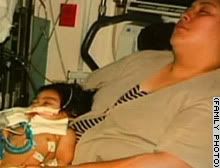
In Austin, Texas, when Emilio Gonzales lies in his mother's arms, sometimes he'll make a facial expression that his mother says is a smile.
But the nurse who's standing right next to her thinks he's grimacing in pain.
Which one it is -- an expression of happiness or of suffering -- is a crucial point in an ethical debate that has pitted the mother of a dying child against a children's hospital, and medical ethicists against each other.
Emilio is 17 months old and has a rare genetic disorder that's ravaging his central nervous system. He cannot see, speak, or eat. A ventilator breathes for him in the Pediatric Intensive Care Unit at Austin Children's Hospital, where he's been since December. Without the ventilator, Emilio would die within hours.
The hospital contends that keeping Emilio alive on a ventilator is painful for the toddler and useless against his illness -- Leigh's disease, a rare degenerative disorder that has no cure.
Under Texas law, Children's has the right to withdraw life support if medical experts deem it medically inappropriate.
Emilio's mother, Catarina Gonzales, on the other hand, is fighting to keep her son on the ventilator, allowing him to die "naturally, the way God intended."
The two sides have been in and out of courts, with the next hearing scheduled for May 8.
The case, and the Texas law, have divided medical ethicists. Art Caplan, an ethicist at the University of Pennsylvania, supports the Texas law giving the hospital the right to make life or death decisions even if the family disagrees. "There are occasions when family members just don't get it right," he said. "No parent should have the right to cause suffering to a kid in a futile situation."
But Dr. Lainie Ross, a pediatrician and medical ethicist at the University of Chicago, says she thinks Emilio's mother, not the doctors, should be able to decide whether Emilio's life is worth living. "Who am I to judge what's a good quality of life?" she said. "If this were my kid, I'd have pulled the ventilator months ago, but this isn't my kid."
The law, signed in 1999 by then-Gov. George W. Bush, gives Texas hospitals the authority to stop treatment if doctors say the treatment is "inappropriate" -- even if the family wants the medical care to continue. The statute was inspired by a growing debate in medical and legal communities over when to declare medical treatment futile.
Dr. Ross says that under the law, some dozen times hospitals have pulled the plug against the family's wishes. She says more often than not, the law is used against poor families. "The law is going to be used more commonly against poor, vulnerable populations. If this family could pay for a nurse to take care of the boy at home, we wouldn't be having this conversation," she said.
Emilio is on Medicaid, which usually doesn't pay for all hospital charges. The hospital's spokesman said that he doesn't know how much it's costing the hospital to keep Emilio alive, but that cost was not a consideration in the hospital's decision.
"[Our medical treatments] are inflicting suffering," said Michael Regier, senior vice president for legal affairs and general counsel for the Seton Family of Hospitals, of which Austin Children's is a member. "We are inflicting harm on this child. And it's harm that is without a corresponding medical benefit."
"It's one thing to harm a child and know this is something I can cure," he added. "But that's not the case here." Regier says Emilio is unaware of his surroundings, and grimaces in pain. He said the ventilator tube down his throat is painful, as is a therapy in which hospital staff beat on his chest to loosen thick secretions.
But Gonzales says her son is on heavy doses of morphine and not in pain. She said her son does react to her. "I put my finger in his hand, and I'm talking to him, and he'll squeeze it," she says. "Then he'll open his eyes and look at me."
Gonzales said she'll continue to fight for treatment for her son. "I love my kid so much, I have to fight for him," she said. "That's your job -- you fight for your son or your daughter. You don't let nobody push you around or make decisions for you."
Wednesday, April 18, 2007
| [+/-] |
Giuliani Shifts Stance On Abortion Method |
The GOP candidate’s support for a high court ruling contrasts his position in 1997.
The LATimes reports:
The Supreme Court decision Wednesday upholding a ban on a controversial abortion procedure heightens the issue's visibility in the 2008 presidential race and spotlights a shift in position by Republican candidate Rudolph W. Giuliani.
The former New York mayor and other top Republicans vying for the White House welcomed the ruling while leading Democratic contenders said they deplored it.
Giuliani, the only major Republican candidate who supports abortion rights, has tried for months to mollify conservative critics.
On Wednesday, he praised the court for upholding the ban on the midterm procedure. "The Supreme Court reached the correct conclusion in upholding the congressional ban on partial-birth abortion," Giuliani said in a statement released by his campaign. "I agree with it."
His praise for the ruling contrasts his position while seeking reelection as mayor in 1997. On an abortion rights group's questionnaire, Giuliani circled "yes" next to the question of whether he would oppose "legislation that would make criminals of doctors who perform intact D&X abortions" — the technical term for what critics call "partial-birth" abortions.
Kelli Conlin, president of the abortion rights group, now known as NARAL Pro-Choice New York, accused Giuliani of "flip-flopping." "I am absolutely astounded that Mayor Giuliani would do a 180-degree pivot on his former position," she said.
Asked to explain his change in views, Giuliani spokeswoman Maria Comella said the 2003 ban upheld Wednesday included "an appropriate exception for threats to the life of the mother."
In addition to supporting abortion rights, Giuliani supports public funding of abortion. But he often says he hates abortion and would advise women not to have one. He has also vowed to appoint "strict constructionists" to the federal bench, a term antiabortion groups often use to refer to judges who would overturn Roe vs. Wade.
But on Saturday, Giuliani irked abortion opponents by telling a group of Iowa Republicans that the party "has to get beyond issues like that."
"That wasn't received very well by the pro-life movement," said Jim Backlin, vice president for legislative affairs at the Christian Coalition of America.
For Republicans, abortion is a key issue in the 2008 race for the White House. Sen. John McCain of Arizona has highlighted his support for outlawing abortion in an effort to mend his own frayed relations with conservatives. Mitt Romney, who supported abortion rights when he ran for Massachusetts governor in 2002, now describes himself as "pro-life," fueling accusations that he vacillates on core issues for political gain.
| [+/-] |
Anti-abortion activists look to build on court victory |
Gonzales vs. Carhart - Elated and emboldened, anti-abortion activists in state after state are planning to push for stringent new limits on second- and third-trimester abortions in the hopes of building on their victory Wednesday at the Supreme Court.
The LATimes reports:
By a 5-4 vote, the justices upheld a federal ban on a procedure critics call "partial-birth abortion," which involves partially delivering the fetus, then crushing its skull. The ruling included strong language asserting the state's "legitimate, substantial interest in preserving and promoting fetal life."
Advocates on both sides of the abortion debate predicted the ruling would spur a flood of legislation.
"We're moving beyond putting roadblocks in front of abortions to actually prohibiting them," said Troy Newman, president of Operation Rescue, a national anti-abortion group based in Wichita, Kan. "This swings the door wide open."
He and other strategists said they hope to introduce legislation in a number of states that would:
-- Ban all abortion of viable fetuses, unless the mother's life is endangered.
-- Ban mid- and late-term abortion for fetal abnormality, such as Down syndrome or a malformed brain.
-- Require doctors to tell patients in explicit detail what the abortion will involve, show them ultrasound images of the fetus and warn them that they might become suicidal after the procedure.
-- Lengthen waiting periods so women must reflect on such counseling for several days before obtaining the abortion.
It is far from certain that the Supreme Court would uphold all these proposals. But anti-abortion activists clearly feel momentum is on their side.
In particular, they're pleased that the court upheld an outright ban -- with no exceptions -- on a surgical procedure performed in the second trimester, when the fetus is too large to be evacuated through a suction tube.
For more than 30 years, the Supreme Court has required every major restriction on abortion to include an exception waiving the law if a woman's physical or emotional health is at stake.
As a result, many abortion bans have been largely symbolic. At least 40 states, for instance, outlaw abortion of viable fetuses -- but because of the health exception, doctors still can terminate such pregnancies if they certify that the woman suffers depression or anxiety.
Abortion opponents consider that a major loophole, leading to what they call "abortion on demand." The ruling Wednesday gave them hope for a new standard. The procedure at issue is used only rarely -- it's more common in second-trimester abortions to dismember the fetus inside the womb -- but abortion doctors had argued that they should be able to use it when they considered it better for the woman's health. The justices disagreed.
"I'm ecstatic," said Leslee Unruh, an anti-abortion activist in South Dakota. "It's like someone gave me $1 million and told me, 'Leslee, go shopping.' That's how I feel."
She spent the day conferring with attorneys on how to leverage the ruling to maximum effect in the states: "We're brainstorming and we're having fun."
Abortion-rights attorney Katherine Grainger predicted that the ruling would "open the floodgates" in state after state.
"The state's interest in the fetus has now been elevated above the woman's health, whereas before, the women's health always trumped," said Grainger, who directs state policy for the Center for Reproductive Rights. "States are going to push the boundaries and try to restrict access on all fronts."
Because most state legislatures have just a few more weeks in session, Grainger said she expects the bulk of the proposals to come next year. When the bills are filed, anti-abortion activists plan to pursue two strategies that won tacit endorsement in the Supreme Court ruling.
First, they intend to try stirring public discomfort about specific abortion techniques. The Supreme Court opinion referred to the partial delivery of a live fetus during an abortion as "shocking." Activists plan to argue that other, far more common, methods of ending pregnancy are just as distasteful.
"This procedure was outlawed because it was exposed. If every procedure were exposed in this way, they would all be deemed equally cruel," said Terri Herring, an anti-abortion lobbyist in Mississippi. She envisions introducing bans on one procedure after another in an attempt to build on Wednesday's ruling.
That could be an effective strategy, said Ted G. Jelen, a political scientist who studies abortion politics at the University of Nevada, Las Vegas. "If they can shift the debate to what happens to the fetus, rather than who decides, that's a useful frame for them," he said.
The second linchpin of the anti-abortion strategy is the testimony of women who have had abortions -- and regret them.
Kennedy's ruling cited an affidavit from Sandra Cano, whose lawsuit in the 1970s established the health exception. (Back then, she was referred to as "Mary Doe" to protect her privacy; the case was Doe v. Bolton.) Cano now says her abortion caused her lasting psychological trauma.
The justices found her testimony compelling. Though they said they could find "no reliable data to measure the phenomenon," they described abortion as "fraught with emotional consequence."
"That's very good, strong language and I think it sets the foundation for future rulings," said Anne Newman, policy director for Operation Outcry, which has collected 2,000 affidavits from women remorseful about their abortions. Their written testimony is making the rounds of statehouses.
Abortion-rights supporters have tried to fight back against such tactics. They've told the stories of women who were raped or who felt they had no choice but to abort a severely deformed fetus. They've argued that abortion restrictions fall most heavily on the young and the poor. And they've tried to rally broad support for reproductive freedom.
"This is going to be a wake-up call for Americans who care about women's health," said Nancy Northrup, president of the Center for Reproductive Rights.
Political scientist Alan Abramowitz at Emory University said it was too early to know how the debate will unfold -- though he's certain it will be polarizing. As he put it: "This will exacerbate the divisions that already exist."