The NY Times reports:
Business lobbyists, nervously anticipating Democratic gains in next year’s elections, are racing to secure final approval for a wide range of health, safety, labor and economic rules, in the belief that they can get better deals from the Bush administration than from its successor.
Ivan H. Adler, an executive recruiter, says Democratic lobbyists are in demand.
Hoping to lock in policies backed by a pro-business administration, poultry farmers are seeking an exemption for the smelly fumes produced by tons of chicken manure. Businesses are lobbying the Bush administration to roll back rules that let employees take time off for family needs and medical problems. And electric power companies are pushing the government to relax pollution-control requirements.
“There’s a growing sense, a growing probability, that the next administration could be Democratic,” said Craig L. Fuller, executive vice president of Apco Worldwide, a lobbying and public relations firm, who was a White House official in the Reagan administration. “Corporate executives, trade associations and lobbying firms have begun to recalibrate their strategies.”
The Federal Register typically grows fat with regulations churned out in the final weeks of any administration. But the push for such rules has become unusually intense because of the possibility that Democrats in 2009 may consolidate control of the White House, the Senate and the House of Representatives for the first time in 14 years.
Even as they try to shape pending regulations, business lobbies are also looking beyond President Bush. Corporations and trade associations are recruiting Democratic lobbyists. And lobbyists, expecting battles over taxes and health care in 2009, are pouring money into the campaigns of Democratic candidates for Congress and the White House.
Randel K. Johnson, a vice president of the United States Chamber of Commerce, said, “I am beefing up my staff, putting more money aside for economic analysis of regulations that I foresee coming out of a possible new Democratic administration.”
At the Transportation Department, trucking companies are trying to get final approval for a rule increasing the maximum number of hours commercial truck drivers can work. And automakers are trying to persuade officials to set new standards for the strength of car roofs — standards far less stringent than what consumer advocates say is needed to protect riders in a rollover.
Business groups generally argue that federal regulations are onerous and needlessly add costs that are passed on to consumers, while their opponents accuse them of trying to whittle down regulations that are vital to safety and quality of life. Documents on file at several agencies show that business groups have stepped up lobbying in recent months, as they try to help the Bush administration finish work on rules that have been hotly debated and, in some cases, litigated for years.
At the Interior Department, coal companies are lobbying for a regulation that would allow them to dump rock and dirt from mountaintop mining operations into nearby streams and valleys. It would be prohibitively expensive to haul away the material, they say, and there are no waste sites in the area. Luke Popovich, a vice president of the National Mining Association, said that a Democratic president was more likely to side with “the greens.”
A coalition of environmental groups has condemned the proposed rule, saying it would accelerate “the destruction of mountains, forests and streams throughout Appalachia.”
A priority for many employers in 2008 is to secure changes in the rules for family and medical leave. Under a 1993 law, people who work for a company with 50 or more employees are generally entitled to 12 weeks of unpaid leave to care for newborn children or sick relatives or to tend to medical problems of their own. The Labor Department has signaled its interest in changes by soliciting public comments.
The National Association of Manufacturers said the law had been widely abused and had caused “a staggering loss of work hours” as employees took unscheduled, intermittent time off for health conditions that could not be verified. The use of such leave time tends to rise sharply before holiday weekends, on the day after Super Bowl Sunday and on the first day of the local hunting season, employers said.
Debra L. Ness, president of the National Partnership for Women and Families, an advocacy group, said she was “very concerned that the Bush administration will issue new rules that cut back on family and medical leave for those who need it.”
That could be done, for example, by narrowing the definition of a “serious health condition” or by establishing stricter requirements for taking intermittent leave for chronic conditions that flare up unexpectedly.
The Chamber of Commerce is seeking such changes. “We want to get this done before the election,” Mr. Johnson said. “The next White House may be less hospitable to our position.”
Indeed, most of the Democratic candidates for president have offered proposals to expand the 1993 law, to provide paid leave and to cover millions of additional workers. Senator Christopher J. Dodd of Connecticut was a principal author of the law. Senator Hillary Rodham Clinton of New York says it has been “enormously successful.” And Senator Barack Obama of Illinois says that more generous family leave is an essential part of his plan to “reclaim the American dream.”
Susan E. Dudley, administrator of the White House Office of Information and Regulatory Affairs, said, “Research suggests that regulatory activity increases in the final year of an administration, regardless of party.”
Whoever becomes the next president, Democrat or Republican, will find that it is not so easy to make immediate and sweeping changes. The Supreme Court has held that a new president cannot arbitrarily revoke final regulations that already have the force of law. To undo such rules, a new administration must provide a compelling justification and go through a formal rule-making process, which can take months or years.
Within hours of taking office in 2001, Mr. Bush slammed the brakes on scores of regulations issued just before he took office, so his administration could review them. A study in the Wake Forest Law Review found that one-fifth of those “midnight regulations” were amended or repealed by the Bush administration, while four-fifths survived.
Some of the biggest battles now involve rules affecting the quality of air, water and soil.
The National Chicken Council and the U.S. Poultry and Egg Association have petitioned for an exemption from laws and rules that require them to report emissions of ammonia exceeding 100 pounds a day. They argue that “emissions from poultry houses pose little or no risk to public health” because the ammonia disperses quickly in the air.
Perdue Farms, one of the nation’s largest poultry producers, said that it was “essentially impossible to provide an accurate estimate of any ammonia releases,” and that a reporting requirement would place “an undue and useless burden” on farmers.
But environmental groups told the Bush administration that “ammonia emissions from poultry operations pose great risk to public health.” And, they noted, a federal judge in Kentucky has found that farmers discharge ammonia from their barns, into the environment, so it will not sicken or kill the chickens.
On another issue, the Environmental Protection Agency is drafting final rules that would allow utility companies to modify coal-fired power plants and increase their emissions without installing new pollution-control equipment.
The Edison Electric Institute, the lobby for power companies, said the companies needed regulatory relief to meet the growing demand for “safe, reliable and affordable electricity.”
But John D. Walke, director of the clean air program at the Natural Resources Defense Council, said the rules would be “the Bush administration’s parting gift to the utility industry.”
If Democrats gain seats in Congress or win the White House, that could pose problems for all-Republican lobbying firms like Barbour, Griffith & Rogers, whose founders include Gov. Haley Barbour of Mississippi, a former chairman of the Republican National Committee.
Loren Monroe, chief operating officer of the Barbour firm, said: “If the right person came along, we might hire a Democrat. And it’s quite possible we could team up in an alliance with a Democratic firm.”
Two executive recruiters, Ivan H. Adler of the McCormick Group and Nels B. Olson of Korn/Ferry International, said they had seen a growing demand for Democratic lobbyists. “It’s a bull market for Democrats, especially those who have worked for the Congressional leadership” or a powerful committee, Mr. Adler said.
Few industries have more cause for concern than drug companies, which have been a favorite target of Democrats. Republicans run the Washington offices of most major drug companies, and a former Republican House member, Billy Tauzin, is president of their trade association, the Pharmaceutical Research and Manufacturers of America.
The association has hired three Democrats this year, so its lobbying team is split evenly between Republicans and Democrats.
Loren B. Thompson, a military analyst at the Lexington Institute, a policy research organization, said: “Defense contractors have not only begun to prepare for the next administration. They have begun to shape it. They’ve met with Hillary Clinton and other candidates.”
Sunday, December 2, 2007
| [+/-] |
Business Lobby Presses Agenda Before '08 Vote |
Wednesday, November 7, 2007
| [+/-] |
Impeachment Fuse is Briefly Lighted |
A resolution against Cheney gets parked in committee. Republicans sought an immediate vote in order to spark a House floor fight.
The LA Times reports:
House Democrats on Tuesday beat back a Republican attempt to force them to vote on a divisive resolution to impeach Vice President Dick Cheney for "fabricating a threat of Iraqi weapons of mass destruction" to justify the war in Iraq.
The 218-194 party-line vote waylaying the measure by sending it to the judiciary committee capped a remarkable afternoon in which Republicans tried to outfox Democrats, switching their votes in a strategy that could have triggered an immediate vote.
"We're going to help them out," explained Rep. Pete Sessions (R-Texas). "We're going to give them their day in court."
House Speaker Nancy Pelosi (D-San Francisco) and her lieutenants maneuvered to avoid a bruising floor fight. Such a clash would have forced Democrats to choose between their liberal base, which might cheer a Cheney impeachment, and a broader electorate, which might view the resolution as a partisan game in a time of war.
With the vote technically slated to last 15 minutes, she held voting open for more than an hour and finally forced the measure to an uncertain future in the committee.
That referral effectively shelved the issue for now, but not before the resolution's sponsor, Rep. Dennis J. Kucinich, a far-left Ohio Democrat running for president, had a chance to read into the record three articles of impeachment against the vice president.
"Impeachment is not on our agenda," said House Majority Leader Steny Hoyer (D-Md.). "We have some major priorities. We need to focus on those."
House Judiciary Committee Chairman John Conyers Jr. (D-Mich.) agreed that it was not in Pelosi's interest to advance the articles of impeachment. "If she were to let this thing out of the box, considering the number of legislative issues we have pending . . . it could create a split that could affect our productivity for the rest of the Congress," Conyers told Fox News.
The resolution said that Cheney, "in violation of his constitutional oath to faithfully execute the office of vice president," had "purposely manipulated the intelligence process to deceive the citizens and Congress of the United States by fabricating a threat of Iraqi weapons of mass destruction to justify the use of the U.S. Armed Forces against the nation of Iraq in a manner damaging to our national security interests."
The 11-page resolution also charged that Cheney purposely deceived the nation about an alleged relationship between Iraq and Al Qaeda and has also "openly threatened aggression against the Republic of Iran absent any real threat to the United States."
If the judiciary committee were to vote out any of the impeachment articles, the issue would then go to the House floor. If the House were to vote to impeach Cheney, the Senate could try him and, with a two-thirds vote, remove him from office. "This vote sends a message that the administration's conduct in office is no longer unchallenged," Kucinich said afterward. Predicting that the judiciary committee will be forced by public opinion to hold hearings, he added, "Hopefully, it will have a restraining effect on this administration to stop this madness."
Four Democrats joined Kucinich to vote against sending the impeachment resolution to committee.
They included Reps. Bob Filner of Chula Vista and Maxine Waters of Los Angeles.
At day's end, Republicans and Democrats were accusing each other of petty political ploys at the expense of important business.
At the White House, Press Secretary Dana Perino noted that Congress "has not sent a single appropriations bill to the president's desk this year . . . yet they find time to spend an entire work period on futile votes to impeach the vice president. It is this behavior that leaves the American people shaking their head in wonder at this Congress."
Cheney spokeswoman Megan M. Mitchell added, "It is one thing for Congressman Kucinich to use this political ploy in his presidential campaign. It is another thing to do so on the floor of the U.S. House of Representatives."
Hoyer issued a statement chiding Republicans for turning the potential impeachment of a vice president into "a petty political game."
Insisting that House leaders have their eye on the ball, he added, "Speaker Pelosi and I have made it clear that this Congress is not going to proceed with impeachment, and is going to focus on critical issues facing our nation, such as healthcare for children and the war in Iraq."
Wednesday, October 10, 2007
| [+/-] |
Smile, Though Your Head Is Aching |
The Washington Post reports:
House Speaker Nancy Pelosi was in a determinedly good mood when she sat down to lunch with reporters yesterday. She entered the room beaming and, over the course of an hour, smiled no fewer than 31 times and got off at least 23 laughs.
But her spirits soured instantly when somebody asked about the anger of the Democratic "base" over her failure to end the war in Iraq.
"Look," she said, the chicken breast on her plate untouched. "I had, for five months, people sitting outside my home, going into my garden in San Francisco, angering neighbors, hanging their clothes from trees, building all kinds of things -- Buddhas? I don't know what they were -- couches, sofas, chairs, permanent living facilities on my front sidewalk."
Unsmilingly, she continued: "If they were poor and they were sleeping on my sidewalk, they would be arrested for loitering, but because they have 'Impeach Bush' across their chest, it's the First Amendment."
Though opposed to the war herself, Pelosi has for months been a target of an antiwar movement that believes she hasn't done enough. Cindy Sheehan has announced a symbolic challenge to Pelosi in California's 8th Congressional District. And the speaker is seething.
"We have to make responsible decisions in the Congress that are not driven by the dissatisfaction of anybody who wants the war to end tomorrow," Pelosi told the gathering at the Sofitel, arranged by the Christian Science Monitor. Though crediting activists for their "passion," Pelosi called it "a waste of time" for them to target Democrats. "They are advocates," she said. "We are leaders."
It was a rather fierce response to the party's liberal base, which frightens many a congressional Democrat. But it wasn't out of character for the new speaker. Pelosi's fixed and constant smile makes her appear as if she is cutting an ad for a whitening toothpaste. But when you listen to the words that come from her grinning maw, the smile seems more akin to that of a barracuda.
One reporter asked about Democratic lawmakers who proposed a tax increase for the war. "They were not making legislation; they were making a point," Pelosi judged.
Another asked about a Republican congressman's complaints that the word "God" was removed from certificates accompanying congressional flags. "I don't know what his point is," Pelosi volleyed.
Complaints that she didn't go far enough on climate-change legislation? "We did not say we were going to do any more than we did."
The Senate's stalemate on the war? "We in the House will not be confining our legislation initiatives to what is legislatively possible in the Senate."
Pelosi admitted no mistakes and claimed no regrets as she reflected on her first session in the speaker's chair. "I'm very proud of the work of this Congress," she declared. Evidently so: She repeated how "proud" she was nine times. Passing the recommendations of the 9/11 commission made her "very proud," while energy legislation made her "very, very proud," and new ethics rules made her "especially proud."
"What do you see as your greatest mistake?" asked one reporter.
Pelosi smiled. "Why don't you tell me?" she proposed. She smiled again, then laughed. " 'Cause I think we're doing just great." She laughed again.
Even those approval ratings for Congress, in the teens and 20s, didn't evoke regrets. "I don't like the numbers for Congress," she admitted, but "I'm very pleased with the Democratic numbers." She then took an unusual detour into polling minutiae. "Today the Rasmussen numbers were the third time that we were double-digit ahead in the generic," she reported, "and the third month in a row we were in the high 40s."
Holders of high office typically avoid discussions like that because it makes them look, well, political. But Pelosi did not hesitate to plunge into the political, explaining that "it was so important for us to bring the president's numbers down two years ago on Social Security" because it discouraged Republican candidates from running for Congress.
Pelosi may have realized that her words sounded too calculating, for at one point she begged the reporters' indulgence for her to "be allowed a partisan moment." She smiled at her joke, then chuckled.
The ready grin seemed at odds with other body language that suggested Pelosi was not having an enjoyable lunch. She ignored her salad and roll, then waved off the chicken and vegetables and left her dessert untouched. "The tea is fine," she told the waiter, taking her first sip more than halfway through the lunch.
But the smile had its uses. She smiled warmly while telling a reporter in the room that his story was completely wrong. She laughed heartily when somebody mentioned the awkward interview in which Whoopi Goldberg expressed a lust for Pelosi's husband. She grinned when mentioning the fight over children's health care. And she laughed while discussing how she has "striven" to work with Bush on Iraq. "Is that a word? 'Striven'? " she asked.
It seemed that only the antiwar advocates had the power to wipe the smile off Pelosi's face. Speaking about ethics legislation, she boasted that "we have drained the swamp" in Congress and pleased government watchdog groups. "At last," she added, "some advocates from the outside who are satisfied."
| [+/-] |
There Goes The Neighborhood |
Roll Call reports:
One might think it would be great to have Speaker Nancy Pelosi (D-Calif.) as a neighbor (imagine the block parties!). But the Speaker apparently is not making herself popular in her high-dollar 'hood, telling reporters on Tuesday that protesters have taken up residence outside her house and are driving the natives wild.
"I've had four or five months of people sitting outside my home, going into my garden in San Francisco and angering my neighbors," Pelosi said at a gathering sponsored by the Christian Science Monitor.
Pelosi added that the squatters have engaged in decidedly non-neighborly behavior like hanging their clothes from the trees; moving in sofas, chairs and other "permanent living facilities"; and, oddly, building a large Buddha on the sidewalk in front of her home. "You can just imagine my neighbors' reactions to all of this," she said. "And if they were poor, and they were sleeping on my sidewalk, they'd be arrested for loitering, but because they have 'impeach Bush' across their chest, it's the First Amendment."
Friday, October 5, 2007
| [+/-] |
Why Not Impeachment? |
At ConsortiumNews.com, Robert Parry writes:
The disclosure that the Bush administration secretly reestablished a policy of abusing “war on terror” detainees even as it assured Congress and the public that it had mended its ways again raises the question: Why are the Democrats keeping impeachment of George W. Bush and Dick Cheney “off the table”?
After the Democratic congressional victory last Nov. 7, Washington Democrats rejected calls for impeachment from rank-and-file Democrats and many other Americans, considering it an extreme step that would derail a bipartisan strategy of winning over Republicans to help bring the Iraq War to an end.
That thinking got a boost on Nov. 8, the day after the election, when President Bush announced the resignation of Defense Secretary Donald Rumsfeld and the appointment of former CIA Director Robert Gates, who had been a member of the Iraq Study Group and was believed to represent the “realist” wing of the Republican Party.
One Democratic strategist called me that day with a celebratory assertion that “the neocons are dead” and rebuffed my warning that Gates had a troubling history of putting his career ahead of principle, that he was a classic apple-polisher to the powerful. [See the Consortiumnews.com’s Archive, “Who Is Bob Gates?”]
The Democrats also missed the fact that Rumsfeld submitted his resignation the day before the election – not the day after – along with a memo urging an “accelerated draw-down of U.S. bases” in Iraq from a high of 110, to 10 to 15 by April 2007, and to five by July 2007.
In other words, Rumsfeld’s ouster didn’t signal Bush’s new flexibility on ending the war, as the Democrats hoped, but a repudiation of Rumsfeld for going wobbly on Iraq.
Even when the Rumsfeld memo surfaced in early December, the Democrats ignored it, sticking to their wishful script that the Rumsfeld-Gates switch marked a recognition by Bush that it was time to begin extricating U.S. forces from Iraq.
Those rose-colored glasses got smudged badly when Bush instead announced in January that he was ordering an escalation, sending more than 20,000 additional troops to Iraq.
But instead of responding with their own escalation – and putting impeachment back “on the table” – the Democrats opted for a strategy of wooing moderate Republicans to mild-mannered legislative protests.
As an opening shot in this Nerf-ball battle, Senate Majority Leader Harry Reid fired off a symbolic resolution to express disapproval of Bush’s “surge,” a meaningless gesture that Republicans kept bottled up for weeks making the Democrats look both feckless and inept.
Dangling Moderates
The failed “anti-surge” resolution should have clued in the Democrats to what was in store. The congressional Republicans would keep dangling the prospect that a handful of moderate Republicans finally might abandon Bush’s war policy.
But, like the end of a rainbow that keeps receding as one pursues it, the promise of moderate Republicans switching sides could never be reached.
The final act of legislative disillusionment came on Sept. 19 when Sen. John Warner, R-Virginia, reneged on a commitment to support a bill by Sen. Jim Webb, D-Virginia, to guarantee longer home leave for combat troops.
Warner said he reversed himself after he was lobbied by Defense Secretary Gates. “I endorsed it,” Warner said. “I intend now to cast a vote against it.”
With Warner’s help, Republicans blocked Webb’s amendment on a procedural vote that fell four votes short of the 60 needed.
Neoconservative pro-war Sen. Joe Lieberman, I-Connecticut, hailed the defeat of Webb’s proposal as proof “Congress will not intervene in the foreseeable future, … that Congress doesn’t have the votes to stop this [Bush] strategy of success from going forward.”
Soon, the Republicans were stampeding the Democrats into supporting condemnations of MoveOn.org for its “General Betray Us” ad and into urging Bush to adopt an even more belligerent posture against Iran by labeling its Revolutionary Guards a terrorist organization. [See Consortiumnews.com’s “Hillary Prods Bush to Go After Iran.”]
Still, despite nearly a full year of futility in challenging Bush’s war – as public approval of the Democratic Congress sank to near record lows – the leadership kept the issue of impeachment off the table. It was as if national Democrats had concluded that the American people admired timidity and incompetence.
New Slap
Now, President Bush has slapped the Democrats in the face again by misleading them on his continuing policy of allowing harsh interrogations (that many would call torture) of terror suspects. Bush apparently is confident that the Democrats will swallow whatever humiliation he serves up.
The New York Times revealed on Oct. 4 that the Bush administration only pretended to repudiate earlier legal opinions that Bush had the right to abuse and torture detainees. Secret memos from 2005, which reaffirmed that right, were kept from Congress.
“When the Justice Department publicly declared torture ‘abhorrent’ in a legal opinion in December 2004, the Bush administration appeared to have abandoned its assertion of nearly unlimited presidential authority to order brutal interrogations,” the Times reported.
“But soon after Alberto R. Gonzales’s arrival as attorney general in February 2005, the Justice Department issued another opinion, this one in secret. It was a very different document, according to officials briefed on it, an expansive endorsement of the harshest interrogation techniques ever used by the Central Intelligence Agency.
“The new opinion, the officials said, for the first time provided explicit authorization to barrage terror suspects with a combination of painful physical and psychological tactics, including head-slapping, simulated drowning and frigid temperatures.” [NYT, Oct. 4, 2007]
The Bush administration achieved its sleight of hand on torture policy by purging traditional conservative lawyers, such as former Assistant Attorney General Jack Goldsmith and former Deputy Attorney General James Comey, who had resisted White House assertions of virtually unlimited powers for Bush as Commander in Chief.
In 2004, those lawyers – under Attorney General John Ashcroft – mounted a remarkable rebellion against the White House theories of an imperial presidency. Goldsmith and Comey objected to the legality of several anti-terror operations approved by Bush, including the memos permitting torture and warrantless wiretaps.
Their opposition to Bush’s program for warrantless spying on Americans led to a dramatic showdown when then-White House counsel Gonzales and White House chief of staff Andrew Card went to Ashcroft’s hospital room where he was recovering from surgery. They urged him to overrule Comey who had balked at reauthorizing the spying, but Ashcroft refused.
Soon, the dissident Justice Department lawyers were headed out the door. Ashcroft, Comey and Goldsmith all resigned and were replaced by more compliant lawyers, led by Bush’s longtime legal adviser Gonzales.
The Times reported that the memo reaffirming Bush’s broad authority over treatment of detainees was signed by Steven Bradbury, who followed Goldsmith as head of the elite Office of Legal Counsel, the Justice Department office responsible for opinions relating to issues of presidential authority.
Unlike other lawyers in that sensitive job, Bradbury also has emerged as a vocal defender of Bush’s detention policies and wiretapping operations. In an interview with the Times, Bradbury said, “In my experience, the White House has not told me how an opinion should come out.”
However, the Times also reported that the White House kept Bradbury on a tight leash by delaying his formal appointment in hopes of avoiding another situation like the one with the independent-thinking Goldsmith.
Harriet Miers, who replaced Gonzales as White House counsel, “decided to watch Bradbury for a month or two. He was sort of on trial,” one Justice Department official told the Times.
After the Times’ article appeared, congressional Democrats – feeling misled again by the White House – demanded to see the confidential memos on interrogations. But Sen. Christopher Bond of Missouri, ranking Republican on the Senate Intelligence Committee, said the White House would resist turning over the memos.
At some point, the congressional Democrats may have to face up to the hard choice before them: either put impeachment of Bush and Cheney back “on the table” or accept that the United States has ceased being a constitutional Republic governed by the principle that no man is above the law.
Wednesday, August 15, 2007
| [+/-] |
The Mine Disaster & Bush's Recess Appointee |
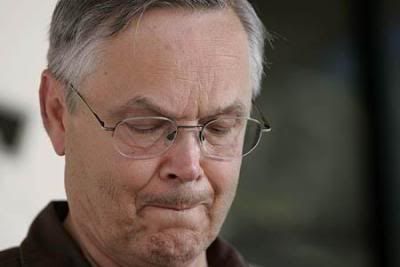
In the Huffington Post, Max Follmer writes:
The man who will oversee the federal government's investigation into the disaster that has trapped six workers in a Utah coal mine for over a week was twice rejected for his current job by senators concerned about his own safety record when he managed mines in the private sector.
President George W. Bush resorted to a recess appointment in October 2006 to anoint Richard Stickler as the nation's mine safety czar after it became clear he could not receive enough support even in a GOP-controlled Senate.
In the wake of the January 2006 Sago mine disaster in West Virginia, senators from both sides of the aisle expressed concern that Stickler was not the right person to combat climbing death rates in the nation's mines.
Democrats, led by West Virginia Sens. Robert Byrd and Jay Rockefeller, and Massachusetts Sen. Ted Kennedy, questioned the safety record of the mines Stickler ran when he was a coal company executive.
Over the course of his career in the private sector, Stickler managed various mining operations for Bethlehem Steel subsidiary BethEnergy Mines, Inc.
The Charleston (W.Va.) Gazette reported in January 2006 that three workers died at BethEnergy mines managed by Stickler during the 1980s and 1990s.
Gazette reporter Ken Ward, Jr. wrote that in the worst of the incidents, one mechanic was killed, and eight other workers were injured when the portal bus that was carrying them to the mine-shaft bottom derailed. A report later said the portal bus had not been properly maintained.
Stickler began his career as a general laborer at BethEnergy, eventually rising to manage the company's operations in Pennsylvania and Boone County, West Virginia.
He worked briefly for Massey Energy subsidiary Performance Coal in 1996 and 1997 before becoming head of the Pennsylvania mine safety office. Stickler retired from the post in 2003.
In addition to concerns about the safety record at his mines, Stickler also faced opposition from senators, union leaders and relatives of those killed in mine accidents who felt an industry insider should not oversee safety inspectors.
United Mine Workers of America President Cecil Roberts said that miners "could not tolerate" another industry executive overseeing their health and safety.
"Too often these mining executives place priority on productivity, but fail to focus on miners' health and safety," Roberts told Mike Hall at the AFL-CIO's blog in June 2006.
The wife and daughter of a miner killed at Sago wrote a letter to lawmakers that same month urging them to reject Stickler's nomination.
"Mr. Stickler is a longtime coal executive and because of his connections with the coal industry, we are concerned that his primary objectives may be solely on compliance and production, not on miners' health and safety,'' Debbie Hamner and Sara Bailey wrote in a letter quoted by the Gazette.
Bush first nominated Stickler to head the Mine Safety and Health Administration in September 2005. He received renewed attention from lawmakers following the Sago disaster. By May 2006 it was clear that Byrd and other Senate opponents would not allow Stickler's nomination to pass, and Republicans withdrew a scheduled vote on his job.
In July 2006, Labor Secretary Elaine Chao hired Stickler as a consultant and adviser, but insisted through a spokeswoman that she was not attempting to circumvent the nomination process.
In August and September of the same year, the Senate twice voted to send the Stickler nomination back to the White House.
In October 2006, Bush used a recess appointment to install Stickler -- a decision that was quickly denounced by senators from both sides of the aisle.
Pennsylvania Sen. Arlen Specter, a Republican, told the Pittsburgh Post-Gazette that he "didn't think Mr. Stickler was the right man for the job." Another Pennsylvania Republican, Rick Santorum, also told the paper he was "disappointed" the White House had not let senators debate and vote on the nomination.
In a written statement Wednesday, Byrd told The Huffington Post that MSHA's response to the Crandall Canyon incident will be a test of Stickler's "worthiness to be properly confirmed by the United States Senate."
Byrd also expressed concern about the slow pace of the implementation of new mining safety laws established in the wake of the Sago disaster.
"I told Mr. Stickler about my concerns earlier this summer," he said. "Until I see better progress from MSHA, I will retain my hold on Mr. Stickler's nomination."
Sunday, July 22, 2007
| [+/-] |
"Impeach George bush To Stop War Lies, Deaths" |
In Newsday, Jimmy Breslin writes:
I am walking in Rosedale on this day early in the week while I wait for the funeral of Army soldier Le Ron Wilson, who died at age 18 in Iraq. He was 17 1/2 when he had his mother sign his enlistment papers at the Jamaica recruiting office. If she didn't, he told her, he would just wait for the months to his 18th birthday and go in anyway. He graduated from Thomas Edison High School at noon one day in May. He left right away for basic training. He came home in a box last weekend. He had a fast war.
The war was there to take his life because George Bush started it with bold-faced lies.
He got this lovely kid killed by lying.
If Bush did this in Queens, he would be in court on Queens Boulevard on a murder charge.
He did it in the White House, and it is appropriate, and mandatory for the good of the nation, that impeachment proceedings be started. You can't live with lies. You can't permit them to be passed on as if it is the thing to do.
Yesterday, Bush didn't run the country for a couple of hours while he had a colonoscopy at the presidential retreat, Camp David. He came out of it all right. He should now take his good health and go home, quit a job he doesn't have a clue as to how to do.
The other day, Bush said he couldn't understand why in the world would some people say that millions of Americans have no health insurance. "Why, all they have to do is go to the emergency room," he said.
Said this with the smirk, the insolent smug, contemptuous way he speaks to citizens.
People, particularly these politicians, these frightened beggars in suits, seem petrified about impeachment. It could wreck the country. Ridiculous. I've been around this business twice and we're all still here and no politician was even injured. Richard Nixon lied during a war and helped get some 58,500 Americans killed and many escaped by hanging onto helicopter skids. Nixon left peacefully. Mike Mansfield of Montana, the Democratic Senate majority leader, said on television that the Senate impeachment trial of Nixon would be televised and there would be no immunity. That meant Nixon would have to face the country under oath and if he lied he would go to prison. He knew he was finished as he heard this. Mansfield said no more. He got up and left. Barbara Walters, on the "Today" show, said, "He doesn't say very much, does he?"
The second time the subject was Bill Clinton for illegal holding in the hallway.
This time, we have dead bodies involved. Consider what is accomplished by the simple power of the word impeachment. If you read these broken-down news writers or terrified politicians claiming that an impeachment would leave the nation in pieces, don't give a moment to them.
It opens with the appointing of an investigator to report to the House on evidence that calls for impeachment. He could bring witnesses forward. That would be all you'd need. Here in the impeachment proceedings against Richard Nixon came John Dean. His history shows how far down the honesty and honor of this country has gone. Dean was the White House counsel. Richard Nixon, at his worst, never told him not to appear or to remain silent in front of the Congress. Dean went on and did his best to fill prisons. After that came Alexander Butterfield, a nobody. All he had to say was that the White House had a taping system that caught all the conversations in the White House. Any of them not on tape were erased by a participant.
The same is desperately needed now. Curious, following the words, an investigator - the mind here sees George Mitchell and Warren Rudman, and you name me better - can slap a hand on the slitherers and sneaks who have kept us in war for five years and who use failing generals to beg for more time and more lives of our young. A final word in September? Two years more, the generals and Bush people say.
Say impeachment and you'll get your troops home.
As I am walking in Rosedale, on these streets sparkling with sun, I remember the places I have been in the cold rain for the deaths of our young in this war. Rosedale now, Washington Heights before, and the South Bronx, and Bay Shore and Hauppauge and too many other places around here.
And in Washington we had this Bush, and it is implausible to have anyone who is this dumb running anything, smirking at his country. He sure doesn't mind copying those people. On his PBS television show the other night, Bill Moyers said he was amazed at Sara Taylor of the White House staff saying that she didn't have to talk to a congressional committee because George Bush had ordered her not to. "I took an oath to uphold the president," she said.
That president had been in charge of a government that kidnapped, tortured, lied, intercepted mail and calls, all in the name of opposing people who are willing to kill themselves right in front of you. You have to get rid of a government like this. Ask anybody in Rosedale, where Le Ron Wilson wanted to live his young life. His grave speaks out that this is an impeachable offense.
| [+/-] |
Pelosi Promises Congressional Contempt of Harriet Miers |
Speaker reiterates impeachment is not on her agenda.
SFGate.com reports:
Congress this week will take the next step to force the Bush administration to hand over information about the dismissal of U.S. attorneys and the politicization of the Justice Department, House Speaker Nancy Pelosi said Saturday.
The House Judiciary Committee will bring contempt of Congress charges against the administration this week, said the San Francisco Democrat. She did not specify who the subject of the action would be, but Pelosi spokesman, Brendan Daly, said later it would be former White House counsel Harriet Miers, who defied a House Judiciary Committee subpoena to appear.
"They have disregarded the call of Congress for information about their politicizing the Department of Justice. We can document that. Those are actual facts and we will bring the contempt of Congress forth," said Pelosi, who spoke with reporters at a San Francisco workshop for people who want to become U.S. citizens.
She also addressed criticism of the farm bill and reiterated her opposition to impeaching President Bush.
Lawmakers have increasingly put pressure on the administration to share documents and records -- and for officials to testify, under oath, in front of Congress -- about why nine U.S. attorneys, including Kevin Ryan in San Francisco, were dismissed from their jobs in December 2006.
Congress has for months been seeking information about which administration officials were involved in the dismissals of the attorneys. The White House, however, has claimed "executive privilege" for many of those requests, meaning the executive branch is free from oversight of the legislative and judiciary branches of the government in those instances. A House judiciary subcommittee has voted to reject such reasoning.
Contempt of Congress is defined by federal law as action that obstructs the work of Congress, including investigations. If both the White House and Congress stick to these positions, the matter could become a constitutional question for the courts to decide.
White House spokesman Rob Saliterman said such an action by the House Judiciary Committee shows an interest in "partisan attacks" above real finding of facts.
"It's unfortunate congressional Democrats are continuing on the course of confrontation," Saliterman said.
Pelosi also reiterated Saturday that she would not engage in what would perhaps be the biggest confrontation possible with the White House -- seeking the impeachment of Bush over the Iraq war.
The speaker said she had "no hesitation" criticizing the president about his handling of the war, but said there were more important priorities for lawmakers -- such as health care and creating jobs -- than the divisive pursuit of impeachment.
"Look, it's hard enough for us to end the war. I don't know how we would be successful in impeaching the president," Pelosi said.
She did note that calls for the president's removal are not coming just from San Francisco.
"I'm not unsympathetic to the concern people have -- I hear it all over the country. People here have said to me, 'Well, people on the left want the president to be impeached.' I hear it across the board across the country. It's not just the left," Pelosi said.
The speaker also addressed criticism that the version of the farm bill moving through the House does not go far enough with reforms. The bill, which Pelosi supports, is expected to be up for a vote by the House this week.
Bay Area food and environmental activists had formed a new coalition to compete with the traditional farm lobby on the bill. They wanted the bill to put more of a focus on diversity of crops, local farming and increasing fresh fruits and vegetables in school lunches and the food stamp program.
Activists also wanted lawmakers to move money from subsidizing crops to environmental and nutrition programs.
Pelosi said she is "very proud" of the bill and that reforms were made in it that will shift the country's agricultural policies.
"It is a careful balance that I think says you're never going to see a farm bill that looks like past farm bills again," Pelosi said. "This one takes us into the future."
Thursday, July 19, 2007
| [+/-] |
Old-Line Republican Warns "Something's In The Works" To Trigger A Police State |
Raw Story reports:
Thom Hartmann began his program on Thursday by reading from a new Executive Order which allows the government to seize the assets of anyone who interferes with its Iraq policies.
He then introduced old-line conservative Paul Craig Roberts -- a former Assistant Secretary of the Treasury under Reagan who has recently become known for his strong opposition to the Bush administration and the Iraq War -- by quoting the "strong words" which open Roberts' latest column: "Unless Congress immediately impeaches Bush and Cheney, a year from now the US could be a dictatorial police state at war with Iran."
"I don't actually think they're very strong," said Roberts of his words. "I get a lot of flak that they're understated and the situation is worse than I say. ... When Bush exercises this authority [under the new Executive Order] ... there's no check to it. It doesn't have to be ratified by Congress. The people who bear the brunt of these dictatorial police state actions have no recourse to the judiciary. So it really is a form of total, absolute, one-man rule.... The American people don't really understand the danger that they face."
Roberts said that because of Bush's unpopularity, the Republicans face a total wipeout in 2008, and this may be why "the Democrats have not brought a halt to Bush's follies or the war, because they expect his unpopular policies to provide them with a landslide victory in next year's election."
However, Roberts emphasized, "the problem with this reasoning is that it assumes that Cheney and Rove and the Republicans are ignorant of these facts, or it assumes that they are content for the Republican Party to be destroyed after Bush has his fling." Roberts believes instead that Cheney and Rove intend to use a renewal of the War on Terror to rally the American people around the Republican Party. "Something's in the works," he said, adding that the Executive Orders need to create a police state are already in place.
"The administration figures themselves and prominent Republican propagandists ... are preparing us for another 9/11 event or series of events," Roberts continued. "Chertoff has predicted them. ... The National Intelligence Estimate is saying that al Qaeda has regrouped.... You have to count on the fact that if al Qaeda's not going to do it, it's going to be orchestrated.... The Republicans are praying for another 9/11."
Hartmann asked what we as the people can do if impeachment isn't about to happen. "If enough people were suspicious and alert, it would be harder for the administration to get away with it," Roberts replied. However, he added, "I don't think these wake-up calls are likely to be effective," pointing out the dominance of the mainstream media.
"Americans think their danger is terrorists," said Roberts. "They don't understand the terrorists cannot take away habeas corpus, the Bill of Rights, the Constitution. ... The terrorists are not anything like the threat that we face to the Bill of Rights and the Constitution from our own government in the name of fighting terrorism. Americans just aren't able to perceive that."
Roberts pointed out that it's old-line Republicans like himself, former Reagan associate deputy attorney general Bruce Fein, and Pat Buchanan who are the diehards in warning of the danger. "It's so obvious to people like us who have long been associated in the corridors of power," he said. "There's no belief in the people or anything like that. They have agendas. The people are in the way. The Constitution is in the way.... Americans need to comprehend and look at how ruthless Cheney is.... A person like that would do anything."
Roberts final suggestion was that, in the absence of a massive popular outcry, "the only constraints on what's going to happen will come from the federal bureaucracy and perhaps the military. They may have had enough. They may not go along with it."
The full audio of Thom Hartmann's interview with Paul Craig Roberts can be found here.
Friday, July 13, 2007
| [+/-] |
Transcript of Bill Moyers' Journal, with Bruce Fein & John Nichols, "Impeaching Bush & Cheney" |
Transcript of Bill Moyers Journal:
BILL MOYERS: Welcome to the Journal.
Impeachment...the word feared and loathed by every sitting president is back. It's in the air and on your computer screen, a growing clamor aimed at both President Bush and Vice-President Cheney.
This week's news only agitated the clamor. The president acknowledged that someone in his administration did leak the name of a CIA agent to the press, but he said let's move on — even as he refused to let his former White House counsel testify to Congress about political influence at the Justice Department.
So the talk in Washington was of executive arrogance. All the more so as the Democratic House voted to withdraw US troops from Iraq by next spring despite a threat of veto by President Bush. A public opinion poll from the American Research Group reports that more than four in ten Americans — 45 per cent-favor impeachment hearings for President Bush and more than half -54 per cent — favor putting Vice President Cheney in the dock.
Are these the first tremors of a major shock wave…or just much ado about nothing? First, let's take a look at the last time a president found himself fighting off an impeachment campaign. It happened less than a dozen years ago. And what was the issue:PRESIDENT BILL CLINTON: I did not have sexual relations with that woman, Miss Lewinsky...
BILL MOYERS: But he did. And even after that denial in early 1998, President Clinton lied again seven months later - this time under oath to a federal grand jury. But that very evening he had a change of heart.PRESIDENT BILL CLINTON: "Indeed, I did have a relationship with Miss Lewinsky that was not appropriate. In fact, it was wrong….I know that my public comments and my silence about this matter gave a false impression. I misled people, including even my wife. I deeply regret that."
BILL MOYERS: For one powerful Republican member of Congress, an apology wasn't enough. Tom Delay, then the majority whip of the House, convinced speaker Newt Gingrich and Republican leaders that Clinton's lie called for nothing less than removing the president from office - impeachment. Special prosecutor Kenneth Starr was commissioned to gather the evidence. Starr eventually sent 36 boxes of evidence to the capitol. They catalogued his investigation of Clinton's finances, a sexual harassment suit filed by Paula Jones and sting operations mounted by the prosecutor to uncover the details of the Lewinsky affair. Nearly 500 pages summarizing the report were quickly posted on the internet. For the next month, the house judiciary committee waded through the report. What the case meant depended largely on party affiliation. Democrats insisted it all came down to lying about sex.REP. ROBERT WEXLER (D-FL): The president betrayed his wife ...he did not betray his country
BILL MOYERS: Republicans, who controlled the House, argued it was about something more important.U.S. REPRESENTATIVE BILL MCCOLLUM (R-FL): Truthfullness is the glue that holds our justice system together
REP. BOB BARR (R-GA): With his conduct and his arrogance...William Jefferson Clinton has thrown a gauntlet at the feet of the Congress.
REP. JOHN CONYERS JR. (D-MI): This is not Watergate. This is an extramarital affair.
REP. JAMES SENSENBRENNER (R - WI): Even the president of the United States does not have the license to lie.
REP. ROBERT WEXLER (D-FL): Wake up, America, they are about to impeach our president.
BILL MOYERS: on october 5, 1998, the house judiciary committee authorized a full impeachment inquiry……only the third u.s. president in history to be seriously threatened with removal from office. The constitution says a president may be impeached for "treason, bribery or other high crimes and misdemeanors". Experts were called to interpret those words:A. LEON HIGGINBOTHAM JR., FORMER U.S. APPEALS COURT JUDGE: There has never been, never been an impeachment proceeding on this miniscule level...
ARTHUR SCHLESINGER, JR., UNIVERSITY OF NEW YORK: All the independent counsel's charges thus far derive from the president's lies about his sex life. His attempts to hide personal misbehavior are certainly disgraceful. But if they are to be deemed impeachable, then we reject the standards laid down by the framers in the Constitution and trivialize the process of impeachment.
PROF. ALAN DERSHOWITZ, HARVARD UNIVERSITY: The only reason the majority of this committee cares about perjury is because they believe that President Clinton, their political opponent, is guilty of it.
BILL MOYERS: The House Judiciary listened…and then drafted two articles of impeachment accusing Clinton of perjury…a third accusing him of obstruction of justice and yet a fourth, of making false statements. A week later, December 19, 1998, the full House met to consider the articles. They approved two of them…one for perjury…another for obstruction of justice. Republican leaders called for Clinton to resign. He didn't, and now it was the Senate's constitutional task to conduct the impeachment trial ordered by the House. The Senators met behind closed doors …and on Friday, February 12, 1999, the verdict was delivered to the chief justice of the Supreme Court.CHIEF JUSTICE WILLIAM REHNQUIST: Is not guilty as charged in the second article of impeachment.
BILL MOYERS: One of the fellows you're about to meet wrote the first article of impeachment against President Clinton. Bruce Fein did so because perjury is a legal crime. And Fein believed no one is above the law. A constitutional scholar, Bruce Fein served in the Justice Department during the Reagan administration and as general counsel of the Federal Communications Commission. Bruce Fein has been affiliated with conservative think tanks such as the American Enterprise Institute and the Heritage Foundation and now writes a weekly column for THE WASHINGTON TIMES and Politico.com.
PRESIDENT CLINTON: I want to say again to the American people how profoundly sorry I am for what I said and did to trigger these events and the great burden they have imposed on the Congress and on the American people.
He's joined by John Nichols, the Washington correspondent for THE NATION and an associate editor of the CAPITOL TIMES. Among his many books is this most recent one, THE GENIUS OF IMPEACHMENT: THE FOUNDERS' CURE FOR ROYALISM. Good to see you both. Bruce, you wrote that article of impeachment against Bill Clinton. Why did you think he should be impeached?
BILL MOYERS: Bruce you wrote that article of impeachment against Bill Clinton. Why did you think he should be impeached?
BRUCE FEIN: I think he was setting a precedent that placed the president above the law. I did not believe that the initial perjury or misstatements-- that came perhaps in a moment of embarrassment stemming from the Paula Jones lawsuit was justified impeachment if he apologized. Even his second perjury before the grand jury when Ken Starr's staff was questioning him, as long as he expressed repentance, would not have set an example of saying every man, if you're president, is entitled to be a law unto himself. I think Bush's crimes are a little bit different. I think they're a little bit more worrisome than Clinton's. You don't have to have--
BILL MOYERS: More worrisome?
BRUCE FEIN: More worrisome than Clinton's-- because he is seeking more institutionally to cripple checks and balances and the authority of Congress and the judiciary to superintend his assertions of power. He has claimed the authority to tell Congress they don't have any right to know what he's doing with relation to spying on American citizens, using that information in any way that he wants in contradiction to a federal statute called the Foreign Intelligence Surveillance Act. He's claimed authority to say he can kidnap people, throw them into dungeons abroad, dump them out into Siberia without any political or legal accountability. These are standards that are totally anathema to a democratic society devoted to the rule of law.
BILL MOYERS: You're talking about terrifying power but this is a terrifying time. People are afraid of those people abroad who want to kill us. Do you think, in any way, that justifies the claims that Bruce just said Bush has made?
JOHN NICHOLS: I think that the war on terror, as defined by our president, is perpetual war. And I think that he has acted precisely as Madison feared. He has taken powers unto himself that were never intended to be in the executive. And, frankly, that when an executive uses them, in the way that this president has, you actually undermine the process of uniting the country and really focusing the country on the issues that need to be dealt with. Let's be clear. If we had a president who was seeking to inspire us to take seriously the issues that are in play and to bring all the government together, he'd be consulting with Congress. He'd be working with Congress. And, frankly, Congress, through the system of checks and balances, would be preventing him from doing insane things like invading Iraq.
BRUCE FEIN: In the past, presidents like Abe Lincoln, who confronted a far dire emergency in the Civil War than today, sought congressional ratification approval of his emergency measures. He didn't seek to hide them from the people and from Congress and to prevent there to be accountability. And, of course, Congress did ratify what he had done. Secondly, sure, times can be terrifying. But that also should alert us to the fact that we can make mistakes. The executive can make mistakes.
Take World War II. We locked up 120,000 Japanese Americans, said they were all disloyal. Well, we got 120,000 mistakes. They lost their property. They lost their liberty for years and years because we made a huge mistake. And that can be true after 9/11 as well. No one wants other downgrade the fact that we have abominations out there and people want to kill us. But we should not inflate the danger and we should not cast aside what we are as a people. We can fight and defeat these individuals, these criminals, based upon our system of law and justice. It's not a-- we have a fighting constitution. It's always worked in the past. But it still remains the constitution of checks of balances.
BILL MOYERS: A fighting constitution--
BRUCE FEIN: It's a fighting constitution that enables us-
BILL MOYERS: What do you mean?
BRUCE FEIN: That with the-- with the consent of Congress and the president working hand in glove with consistent with due process of law, we have the authority to suspend habeas corpus in times of invasion or rebellion. It has enabled us to defeat all of our enemies consistent with the law.
BILL MOYERS: Congress did not stand up to George Bush for five years when it was controlled by Republicans. And I don't see any strong evidence that the Democrats are playing the role that you think the Congress should be playing.
BRUCE FEIN: That is correct. But it doesn't exculpate the president that Congress has not sought immediately to sanctions his excesses.
BRUCE FEIN: --exactly right. And Bill, this could not happen if we had a Congress that was aggressive, if we had a Congress the likes of Watergate when Nixon was president and he tried to-- obstruct justice and defeat the course of law. We have a Congress that basically is an invertebrate.
BILL MOYERS: But why is Congress supine?
JOHN NICHOLS: They are supine for two reasons. One, they are politicians who do not-- quite know how to handle the moment. And they know that something very bad happened on September 11th, 2001, now five years ago, six years ago. And they don't know how to respond to it. Whereas Bush and Karl Rove have responded in a supremely political manner to it and, frankly, jumped around them. That's one part of the problem.
BILL MOYERS: Jumped around Congress?
JOHN NICHOLS: Jumped around Congress at every turn. I mean, they don't even tell them, they don't consult with them. They clearly have no regard for the checks and balances. But the other thing that's-- in play here-- and I think this is a-- much deeper problem. I think the members of our Congress have no understanding of the Constitution. And as a result, they-- don't understand their critical role in the governance of the country.
They-- it-- when the Republicans are in charge, they see their job as challenging-- or as supporting the president in whatever he does, defending him, making it possible for him to do whatever he wants. When the Democrats are in charge, they seem to see their role as trying to score political points as opposed to what ought to be sort of a-- common ground of--
BILL MOYERS: --because the fact of the matter is approaching an-- election year, you don't really think, do you, that the Democrats want to experience a backlash by taking on a Republican president in an election-
JOHN NICHOLS: Well, it--
BILL MOYERS: --or that the Republicans want to impeach an administration that they elected in 2000 and reelected in 2004? There is a political element here, right?
BRUCE FEIN: There's always going to be a political element, Bill. But in the past, there's always been a few statesmen who have said, "You know, the political fallout doesn't concern me as much as the Constitution of the United States." We have to keep that undefiled throughout posterity 'cause if it's not us, it will corrode. It will disappear on the installment plan. And that has been true in the past. When we had during Watergate Republicans and remember Barry Goldwater, Mr. Republican, who approached the president and said, "You've got to resign." There have always been that cream who said the country is more important than my party. We don't have that anymore.
BILL MOYERS: It seems to me the country is ahead of Congress on this. How do you explain all this talk about impeachment today out across the country?
JOHN NICHOLS: People don't want to let this go. They do not accept Nancy Pelosi's argument that impeachment is, quote/unquote, off the table. Because I guess maybe they're glad she didn't take some other part of the Constitution off the table like freedom of speech. But they also don't accept the argument that, oh, well, there's a presidential campaign going on. So let's just hold our breath till Bush and Cheney get done.
When I go out across America, what I hear is something that's really very refreshing and very hopeful about this country. An awfully lot of Americans understand what Thomas Jefferson understood. And that is that the election of a president does not make him a king for four years. That if a president sins against the Constitution-- and does damage to the republic, the people have a right in an organic process to demand of their House of Representatives, the branch of government closest to the people, that it act to remove that president. And I think that sentiment is afoot in the land.
BILL MOYERS: This is the first time I've heard talk of impeaching both a president and a vice-president. I mean, this-- as you saw in that poll, more people want to impeach Dick Cheney than George Bush. What's going on?
BRUCE FEIN: Well, this is an unusual affair of president/vice-president, where the vice-president is de facto president most of the time. And that's why most of people recognize that these decisions, especially when it comes to overreaching with executive power, are the product of Dick Cheney and his aide, David Addington, not George Bush and Alberto Gonzalez or Harriet Miers, who don't have the cerebral capacity to think of these devilish ideas. And for that reason, they equate the administration more with Dick Cheney than with George Bush.
BILL MOYERS: Bruce, you talk about overreaching. What, in practical terms, do you mean by that?
BRUCE FEIN: It means asserting powers and claiming that there are no other branches that have the authority to question it. Take, for instance, the assertion that he's made that when he is out to collect foreign intelligence, no other branch can tell him what to do. That means he can intercept your e-mails, your phone calls, open your regular mail, he can break and enter your home. He can even kidnap you, claiming I am seeking foreign intelligence and there's no other branch Congress can't say it's illegal--judges can't say this is illegal. I can do anything I want. That is overreaching. When he says that all of the world, all of the United States is a military battlefield because Osama bin Laden says he wants to kill us there, and I can then use the military to go into your homes and kill anyone there who I think is al-Qaeda or drop a rocket, that is overreaching. That is a claim even King George III didn't make--
BRUCE FEIN: --at the time of the Revolution.
JOHN NICHOLS: Can I-- can I--
BRUCE FEIN: That is clearly overreaching.
JOHN NICHOLS: Let me keep us on Cheney for a second here, because that is--
BILL MOYERS: You think Cheney should be subject to impeachment hearings?
JOHN NICHOLS: Without a doubt. Cheney is, for all practical purposes, the foreign policy president of the United States. There are many domestic policies in which George Bush really is the dominant player. But on foreign policy Dick Cheney has been calling the shots for six years and he continues to call the shots. Remember back in 2000, in the presidential debates, George Bush said America should be a humble country in the world, shouldn't go about nation building. And Dick Cheney, in the vice-presidential debate, spent eight minutes talking about Iraq.
Now the fact of the matter is that on foreign policy, Dick Cheney believes that the executive branch should be supreme. He said this back to the days when he was in the House during Iran-Contra. He wrote the minority report saying Congress shouldn't sanction the president in any way, President Reagan.
BILL MOYERS: And he's always taken an expansive--
JOHN NICHOLS: Right.
BILL MOYERS: --view of presidential power.
JOHN NICHOLS: And put these pieces together. If Cheney believes in this expansive power. You've got a-- unique crisis, a unique problem because the vice-president of the United States believes that Congress shouldn't even be a part of the foreign policy debate. And he is setting the foreign policy. I mean--
BILL MOYERS: I served a president who went to war on his own initiative, and it was a mess, Vietnam, Lyndon Johnson. There wasn't serious talk about impeaching Lyndon Johnson or Hubert Humphrey. Something is different today.
BRUCE FEIN: Yeah, of course, the-- difference is one thing to claim that, you know, Gulf of Tonkin resolution, was too broadly drafted. But we're talking about assertions of power that affect the individual liberties of every American citizen. Opening your mail, your e-mails, your phone calls. Breaking and entering your homes. Creating a pall of fear and intimidation if you say anything against the president you may find retaliation very quickly. We're claiming he's setting precedents that will lie around like loaded weapons anytime there's another 9/11.
Right now the victims are people whose names most Americans can't pronounce. And that's why they're not so concerned. They will start being Browns and Jones and Smiths. And that precedent is being set right now. And one of the dangers that I see is it's not just President Bush but the presidential candidates for 2008 aren't standing up and saying--
BRUCE FEIN: --"If I'm president, I won't imitate George Bush." That shows me that this is a far deeper problem than Mr. Bush and Cheney.
BILL MOYERS: That struck me about your writings and your book. You say your great-- your great fear is that Bush and Cheney will hand off to their successors a toolbox that they will not avoid using.
JOHN NICHOLS: Well, let's try a metaphor. Let's say that-- when George Washington chopped down the cherry tree, he used the wood to make a little box. And in that box the president puts his powers. We've taken things out. We've put things in over the years.
On January 20th, 2009, if George Bush and Dick Cheney are not appropriately held to account this administration will hand off a toolbox with more powers than any president has ever had, more powers than the founders could have imagined. And that box may be handed to Hillary Clinton or it may be handed to Mitt Romney or Barack Obama or someone else. But whoever gets it, one of the things we know about power is that people don't give away the tools. They don't give them up. The only way we take tools out of that box is if we sanction George Bush and Dick Cheney now and say the next president cannot govern as these men have.
BRUCE FEIN: Well, that's accurate but also we do find this peculiarity that Congress is giving up powers voluntarily. because there's nothing right now, Bill, that would prevent Congress from the immediate shutting down all of George Bush's and Dick Cheney's illegal programs. Simply saying there's no money to collect foreign intelligence-
BILL MOYERS: The power of the purse-
BRUCE FEIN: --the power of the purse. That is an absolute power. And yet Congress shies from it. It was utilized during the Vietnam War, you may recall, in 1973. Congress said there's no money to go and extend the war into Laos and Cambodia. And even President Nixon said okay. This was a president who at one time said, "If I do it, it's legal." So that it we do find Congress yielding the power to the executive branch. It's the very puzzle that the founding fathers would have been stunned at. They worried most over the legislative branch in, you know, usurping powers of the other branches. And--
BILL MOYERS: Well, what you just said indicts the Congress more than you're indicting George Bush and Dick Cheney.
BRUCE FEIN: In some sense, yes, because the founding fathers expected an executive to try to overreach and expected the executive would be hampered and curtailed by the legislative branch. And you're right. They have basically renounced-- walked away from their responsibility to oversee and check. It's not an option. It's an obligation when they take that oath to faithfully uphold and defend the Constitution of the United States. And I think the reason why this is. They do not have convictions about the importance of the Constitution. It's what in politics you would call the scientific method of discovering political truths and of preventing excesses because you require through the processes of review and vetting one individual's perception to be checked and-- counterbalanced by another's. And when you abandon that process, you abandon the ship of state basically and it's going to capsize.
JOHN NICHOLS: Can I mention another branch of government?
BILL MOYERS: Yeah, sure.
JOHN NICHOLS: Let me mention the unspoken branch of government, which is the fourth estate: The media. The fact of the matter is the founders anticipated that presidents would overreach. And they anticipated that at times politics would cause Congress to be a weaker player or a dysfunctional player. But they always assumed that the press would alert the people, that the press would tell the people. And the fact of the matter is I think that our media in the last few years has done an absolutely miserable job of highlighting the constitutional issues that are in play. You know, you can't have torture and extraordinary rendition. You cannot have spying. You cannot have a-- lying to Congress. You cannot have what happened to Joe Wilson and Valerie Plame, you know?
BILL MOYERS: When she was outed and they tried to punish--
JOHN NICHOLS: Plotted out of the vice-president's office without question. Notations of the vice-president on news articles saying, "Let's go get this guy." Right? You know, you can't have that and not have a media going and saying to the president at press conferences, you know, "Aren't-- isn't what you're doing a violation of the Constitution?" Now, just imagine if the-- if the members of the White House Press Corps on a regular basis were saying to Tony Snow, "But hasn't what the president's done here violated the Constitution?" The whole national dialogue would shift. And Congress itself would suddenly become a better player. So I'm not absolving Congress. I'm certainly not absolving Bush and Cheney. But I am saying that we have a media problem here as well.
BRUCE FEIN: Let me underscore one of the things that you remember, Bill, 'cause I was there at the time of Watergate. And this relates to one political-- official in the White House, Sara Taylor's testimony. And claiming that George Bush could tell her to be silent.
BILL MOYERS: That was a great moment when Sara Taylor said, "I took an oath to uphold the president." Did you see that?
BRUCE FEIN: Yes. And that was like the military in Germany saying, "My oath is to the Fuhrer, not to the country." She took an oath to uphold the Constitution of the United States. I did, too, when I was in the government. There's no oath that says, "I'm loyal to a president even if he defiles the Constitution."
JOHN NICHOLS: Ever.
BILL MOYERS: Just this week Harriet Miers, the president's former counsel, did not show up to testify before the congressional hearing. What do you make of that in regard to this issue of power?
BRUCE FEIN: Well, it shows how far we've come from even the mon-- monarchical days of Richard Nixon where he didn't have the audacity to tell John Dean, "No, you can't testify before the Watergate committee about conversations you had with me about obstructing justice or otherwise."
BILL MOYERS: John Dean was his counsel--
BRUCE FEIN: White House counsel--
BILL MOYERS: --just as Harriet Miers--
BRUCE FEIN: --is to President Bush. Yes.
BILL MOYERS: And Nixon said to Dean, "You must go up there and testify"?
BRUCE FEIN: No. He didn't attempt to impose any objection at all. And Dean, of course, broke the Watergate story that led to Nixon's impeachment and the House's judiciary committee--
BILL MOYERS: And look what--
BRUCE FEIN: --and resignation. And now we have a comparable situation where a Harriet Miers could perhaps expose things regarding President-- Bush's knowledge of the electronic surveillance program or the firing of U.S. attorneys, which seems to contradict what Alberto Gonzalez has said about White House involvement. And yet President Bush is saying, "You can't talk, Harriet Miers, because I don't want any of that political or legal embarrassment." And unlike John Dean who brought the Constitution forward with his testimony, Harriet Miers still is silent.
BILL MOYERS: And you would put that in the bill of particular about impeachment?
BRUCE FEIN: Certainly with regard to the one example of the abuse of presidential authority, seeking to obstruct a legitimate congressional investigation by a preposterous assertion of executive privilege. Remember, in a democracy, in-- under the Constitution, transparency and sunshine is the rule. The exception is only for matters of grave national security secrets. That certainly doesn't apply here.
BILL MOYERS: How does the Scooter Libby affair play into this? Do you think that people-- I mean, how did the Scooter Libby thing play into this? People seem really angry about this. And this is, to me, where the tipping point came.
JOHN NICHOLS: If it wasn't for the president's commutation of Scooter Libby's sentence, we would not be sitting at this table and talking right now.
BILL MOYERS: About impeachment?
JOHN NICHOLS: About impeachment. That sentence opened up a dialogue in this country and even in Congress. A number of members of Congress stepped up and signed on to Dennis Kucinich's articles of impeachment against Vice-president Cheney after the Scooter Libby commutation.
JOHN NICHOLS: We're talking tonight because of the Scooter Libby affair. And--
BILL MOYERS: You mean the impeachment--
JOHN NICHOLS: You-- we're at this table because the fact of the matter is that impeachment has moved well up the list of things we can talk about because of the Scooter Libby affair. Now, should it be the-- one that tipped it? I think Bruce and I would probably both agree no. There are probably more important issues. But the Scooter Libby affair gets to the heart of what I think an awfully lot of Americans are concerned about with this administration and with the executive branch in-- general, that it is lawless, that-- it can rewrite the rules for itself, that it can protect itself.
And, you know, the founders anticipated just such a moment. If you look at the discussions in the Federalist Papers but also at the Constitutional Convention, when they spoke about impeachment, one of the things that Madison and George Mason spoke about was the notion that you needed the power to impeach particularly as regards to pardons and commutations because a president might try to take the burden of the law off members of his administration to prevent them from cooperating with Congress in order to expose wrongdoings by the president himself. And so Madison said that is why we must have the power to impeach. Because otherwise a president might be able to use his authority and pardons and such to prevent an investigation from getting to him.
BILL MOYERS: Are you suggesting that Libby had the goods on Cheney and Bush?
JOHN NICHOLS: I think the bottom line is Scooter Libby was involved in conversations that, frankly, if those conversations were brought up, the American people would be very helpful to our discourse about whether we entered this war illegally and whether we've continued this war in ways which we never should have.
BRUCE FEIN: I think the spark against the Libby commutation is a little bit different focus. I think it's less on the idea he's covering up for Cheney or Bush than the indication that Bush is totally heedless of any honor for law and accountability. That he has special rules for him and his cabinet. You may recall at the outset of the investigation he said, "Anybody in my office who is responsible for this leak will not work for me." Karl Rove was shown to leak and Karl Rove was still sitting in the White House. And he says, "Well, he will issue a commutation here." But he's not issued commutations in similar circumstances to anybody else.
Moreover, the perjury of the obstruction of justice of Libby is a carbon copy of Clinton, which Republicans, including me, supported. That's why I said you've got to give a stiff sentence here. How can you say that Clinton's deserves impeachment and here you're communing someone who did the same thing. And it's that sort of outrage that this is now a sneering attitude towards everybody else. "I am king. You play by other people's rules, but as long as I am in the White House, I get to play by my rules." That is something that-
BRUCE FEIN: --offends everybody.
BILL MOYERS: Sneering is not an impeachable offense.
BRUCE FEIN: Sneering in isolation is not but this is combined with all of the other things he's done outside the law. The intelligence gathering, the enemy combatant status, the kidnappings in-- dungeons abroad, all in secret and never disclosing anything to Congress or the American people. Indeed, we couldn't even be discussing some of these issues here like the foreign intelligence collection program if it weren't leaked to THE NEW YORK TIMES. If he had his way, this would be secret forever.
JOHN NICHOLS: Sneering is not an impeachable sentence. But the founders who had recently fought a revolution against a king named George would tell you that monarchical behavior, the behavior of a king, acting like a king, is an impeachable offense. You need not look for specific laws or statutes. What you need to look for is a pattern of behavior that says that the presidency is superior not merely to Congress but to the laws of the land, to the rules of law. And that is why we ought to be discussing impeachment. Not because of George Bush and Dick Cheney but because we are establishing a presidency that does not respect the rule of law. And people, Americans, are rightly frightened by that. Their fear is the fear of the founders. It is appropriate. It is necessary.
BILL MOYERS: So practically, what do you think should happen now? And what do people listening, what can they do?
BRUCE FEIN: I think what ought to happen is there needs to be these hearings in the judiciary hearing this is why we care.
BILL MOYERS: Impeachment hearing--
BRUCE FEIN: Impeachment--
BRUCE FEIN: This is why these are--
BILL MOYERS: You're saying you want the judiciary committee to call formal hearings on the impeachment of George Bush and Dick Cheney?
BRUCE FEIN: Yes. Because there are political crimes that have been perpetrated in combination. It hasn't been one, the other being in isolation. And the hearings have to be not into this is a Republican or Democrat. This is something that needs to set a precedent, whoever occupies the White House in 2009. You do not want to have that occupant, whether it's John McCain or Hillary Clinton or Rudy Giuliani or John Edwards to have this authority to go outside the law and say, "I am the law. I do what I want. No one else's view matters."
JOHN NICHOLS: The hearings are important. There's no question at that. And we should be at that stage. Remember, Thomas Jefferson and others, the founders, suggested that impeachment was an organic process. That information would come out. The people would be horrified. They would tell their representatives in Congress, "You must act upon this." Well, the interesting thing is we are well down the track in the organic process. The people are saying it's time. We need some accountability.
BILL MOYERS: But Nancy Pelosi doesn't agree.
JOHN NICHOLS: Nancy Pelosi is wrong. Nancy Pelosi is disregarding her oath of office. She should change course now. And more importantly, members of her caucus and responsible Republicans should step up. It is not enough--
BILL MOYERS: Well, Bruce is not the only conservative--
JOHN NICHOLS: --and others are. But--
BILL MOYERS: And Bob Barr, who's been here.
BRUCE FEIN: David Keene
JOHN NICHOLS: But they do so, by and large, in a cautious way. They say, "Well, the president's done too much." Let's start to use the "i" word. Impeach is a useful word. It is a necessary word. The founders in the Constitution made no mention of corporation or political parties or conventions or primaries or caucuses. But they made six separate references to impeachment. They wanted us to know this word, and they wanted us to use it.
BILL MOYERS: You're-- does this process have to go all the way to the end? Do Bush and Cheney have to be impeached before it serves the public?
JOHN NICHOLS: I think that what Bush and Cheney have done makes a very good case that the public and the future would be well served if it did go all the way to the end. But there is absolutely a good that comes of this if the process begins, if we take it seriously. And the founders would have told you that, -- that impeachment is a dialogue. It is a discourse. And it is an educational process. If Congress were to get serious about the impeachment discussions, to hold the hearings, to begin that dialogue, they would begin to educate the American people and perhaps themselves about the system of checks and balances, about the powers of the presidency, about, you know, what we can expect and what we should expect of our government.
And so I think that when Jefferson spoke about this wonderful notion of his that said the tree of liberty must be watered every 20 years with the blood of patriots, I don't know that he was necessarily talked about warfare. I think he was saying that at a pretty regular basis we ought to seek to hold our-- highest officials to account and that process, the seeking to hold them to account, wherever it holds up, is-- a necessary function of the republic. If we don't do it, we move further and further toward an imperial presidency.
BRUCE FEIN: The great genius of the founding fathers, their revolutionary idea, with the chief mission of the state is to make you and them free to pursue their ambitions and faculties. Not to build empires, not to aggrandize government. That's the mission of the state, to make them free, to think, to chart their own destiny. And the burden is on government to give really good explanations as to why they're taking these extraordinary measures. And on that score, Bush has flunked on every single occasion. And we need to get the American people to think. Every time that there's an incursion on freedom, they have to demand why. What is the explanation? Give me a good reason before I give up my freedom.
BILL MOYERS: But read that prologue of the Constitution. The first obligation is to defend the people, to defend their freedom, to defend their rights. And I hear people out there talking in their living rooms right now, Bruce and John, saying, "But wait a minute, you know, we've got these terrorists. We know. Look what happened in London just two weeks ago. We know they're out there. Who else is looking out for us except Bush and Cheney?"
BRUCE FEIN: And Cheney and Bush have shown that these measures are optical. Take, for instance, these military conditions that combine judge, jury, and prosecutors. What have they done? They tried the same offenses that are tried in civilian courts. American Taliban John Walker Lindh got 20 years in the civilian courts. And then we have the same offense, David Hicks, he gets nine months in military prison. Why are you creating these extraordinary measures? They aren't needed. We have the foreign intelligence--
BILL MOYERS: --we don't need to do what Bush-
BRUCE FEIN: No, we don't. They're doing these for optical purposes.
BILL MOYERS: What do you mean "optical"?
BRUCE FEIN: They're trying to create the appearance that they're tougher than all of their opponents 'cause they're willing to violate the law, even though the violations have nothing to do with actually defeating the terrorism. And we have instances where the president now for years has flouted the Foreign Intelligence Act. He's never said why the act has ever inhibited anybody. Remember, this act has been around for over a quarter of a century, and no president ever said it impaired his gathering of foreign intelligence. And suddenly the president's, "No, we have to violate it and flout it because it doesn't work." Well, why? He's never explained it. He's never explained why this act stopped gathering of all the intelligence that was needed to fight the terrorists.
BILL MOYERS: No president and no vice-president have been sitting in the White House or sitting in Washington when terrorists, when killers tried to come in airplanes and crashed into the White House, crashed into the Capitol. Can-- isn't there something to be said for--
BRUCE FEIN: Let me-- there's truth and then there's an inaccuracies. Certainly in the immediate aftermath of 9/11 we were in a fog. There could have been hundreds of thousands terrorist cells. You could understand the president, "I've got to take any action I need right now to uncover a possible second edition of 9/11." And, of course, as soon as I do that, I will go to Congress as soon as possible. I will seek ratification. That's an immediate aftermath of 9/11. We know a lot more in 2007, in July. We know this is not 100 or 1,000 terrorist cells.
We know this is not the danger of the Soviet Union or Hirohito or the Third Reich. And yet the president continues to insist. That's why we need military commissions. We need to say you're an enemy combatant and stick you in prison forever without any judicial review and otherwise.That is a total distortion of what the genuine nature of the problem is and our ability to fight and defeat these terrorists with ordinary civil-- the criminal proceedings. And then-- and as you say, they have utilized, Bill, repeatedly. The World Trade Center bombings in 1993, in the aftermath of 9/11 we've had countless conspiracy cases that stopped the terrorist-- enterprises in the bud. And the-- fact is that the utilization of these extraordinary measures has been relatively infrequent, showing that they're largely, they're relevant to the quest to defeat al-Qaeda.
JOHN NICHOLS: Let's go to another zone of this where, you know, they've really been way off the deep end and that is torture. Has the use of torture has the vice-president sort of winking and nodding enthusiasm for the use of torture, has Abu Ghraib helped America? Are we in a better position in the world, in-- getting cooperation from other countries? Are we in a better position in Iraq because of those pictures from Abu Ghraib? I would suggest to you that using these extraordinary powers and doing so in a non-transparent way, in a secretive way, which certainly suggests that even a-- an awareness of the illegality of it, that-- does more harm than good.
And this is, again, what the founders intended. They intended a consultative process. When the president seizes power, extraordinary power unto himself, he isolates himself. He isolates himself from the rest of the government, and he isolates himself from the people. And so I think that people out there in America who are worried, you know, "Wow, if we take on and try and constrain the president in a time of war, in a time of danger, we may be endangering the country," are actually going the wrong direction.
BRUCE FEIN: And, in fact, without the dialogue you continue the folly like in Vietnam when you shut off debate. And that's what's happened in Iraq, why we continue to persist. Like the 88th charge of the Light Brigade that keeps failing. You think it'll work on the 89th time. But I want to go to a more important point that John mentioned, with specifics as to how-- what the president has done, has made us less safe. We have now indictments in both Italy and Germany against CIA operatives because they abducted and threw into dungeons and tortured people abroad. We need their cooperation if we're going to defeat al-Qaeda.
BILL MOYERS: You mean the cooperation of those governments.
BRUCE FEIN: Of those governments. And now they're saying, "The heck with it. You know, you can't come on our soil and kidnap people outside the law and throw them into dungeons."
BILL MOYERS: That's what Putin does. Putin is doing that--
BRUCE FEIN: Polonium 210, you know? You-- can we borrow some from you? And moreover, think, Bill, of the precedent it sets. It is basically saying, "Mr. Putin, you can kidnap an American outside the Louvre in Paris, throw him in a dungeon in Belarus and say, "Hey, he said sympathetic things about the Chechyans." And therefore, you can operate outside the law because the Chechyans are people you oppose. That's the precedent the president is saying is legal. But the other element with regard to the abuses to point out are Abu Ghraib. That's-- those pictures are all on al-Jazeera television. And they get shown every single day, 24 hours a day, to the Muslim youth that's seeking some meaning in their life. And that's what increases the recruitment attractiveness of al-Qaeda. Those Abu Ghraib abuses--
BILL MOYERS: Well, did you see the Associated Press reported a day or two ago that al-Qaeda, according to intelligence reports, al-Qaeda is now at greater strength than it was before 9/11.
BRUCE FEIN: And that's because of the recruitment. That's-- and because of the abuses, they are able to portray the United States' conflict with terrorism as a conflict with Islam, not with terrorists.
JOHN NICHOLS: And let us--
BRUCE FEIN: And that is a terrible, terrible danger for the American people.
JOHN NICHOLS: But let's take President Bush at his word. Let's take him at his word. He says that what he is doing is that this is a war on terror. That the goal is to weaken al-Qaeda, that is to make America more secure. And so throw out all this other discussion, all the other dialogue we've had. Has he been successful? Has-- is he doing it the right way? Well, I think we have an awful lot of evidence from the government itself, from the CIA itself is that it hasn't worked. It has been a highly ineffective strategy. And so the question of whether he's making us more secure really is a debatable one. And the role of Congress at such a point becomes absolutely critical. We don't-- you don't say, "Oh, well, you know, the Congress-- the president seems to be screwing up. And so-- well, let's sit back and see what he does next." And that seems to be what Democrats in Congress are saying.
BILL MOYERS: Remember in the setup to our discussion I pointed out that Tom DeLay, then the third most powerful Republican in the House, made it his mission to impeach Bill Clinton. Is there a Tom DeLay in the Congress today making it his or her mission to impeach Bush and Cheney?
JOHN NICHOLS: Look-- I'm glad there-- I'm glad there isn't a Tom DeLay. Because Tom DeLay was seeking to impeach Bill Clinton for political reasons. He did not--
BILL MOYERS: Infidelity.
JOHN NICHOLS: No, it wasn't infidelity. It was he didn't like the fact that Bill Clinton was president. He wanted to remove the president by means other than an election. I hope there is someone there who seeks to constrain the presidents of the United States and constrains the presidency of the United States, not merely because they happen to disagree with the guy but because--
BILL MOYERS: I have to interrupt you and say, look, you guys don't live in la-la land. Both of you are in-- in and around power all the time. Why doesn't Nancy Pelosi see it her duty to take on at least the impeachment hearings that you say would educate the public about the states that you think--
BRUCE FEIN: Because I think that politics has become debased so that it's a matter of one party against another and jockeying and maneuvering. There is no longer any statesmanship.
BRUCE FEIN: I go back to the real vulnerability and weakness of Congress, that they don't have anybody who can, as a chairman or even asking a question like John or me say, "Mr. Attorney General, you answer that question. This is the United States of America. Transparency is the rule here. We don't have secret government. That's what Alexander Solzhenitsyn wrote about in the Gulag. That's not the United States of America. We pay your salary. We have a right to know 'cause it's our duty to decide whether what you're doing is legal and wise, not yours. Answer that question or you're held in contempt right now." And that's-- and all you need is that tone of voice. But what happens up there? "Well, would you please answer?" Well, are you sure? When-- could you get John Ashcroft? I mean, it's just staggering.
JOHN NICHOLS: And you know what?
BRUCE FEIN: All you would need a lecture like that and they'd answer. They'd be embarrassed--And you have to have a certain vision, Bill. You have-- you have to have a certain depth of conviction about philosophy and what the Constitution means, why those people died. They reached that last full measure of devotion, Cemetery Hill, Guadalcanal, Iwo Jima, the Battle of the Bulge, because there was something higher. You have to feel that in your body and your stomach cause you've mastered all those people who have sacrificed in the past and you know the danger of unchecked power 'cause you read history. You're not a novice. There isn't anybody in the Congress who's able to do that because they don't have that background. But they don't have that temperament.
JOHN NICHOLS: --there may be such people but their first step, their first step must be something that is very hard in these days of extreme partisanship and these days in money and politics and a media that doesn't cover politics very well. Their first step has to be to say, "I cherish my country more than my party and more than the next election." And so-- probably. We're talking about a Democrat.
BILL MOYERS: --to take the lead?
JOHN NICHOLS: And that Democrat's first responsibility is to go to Nancy Pelosi, the speaker of the House, the person who decides what committee assignments they may have and even how nice an office they may get, and say, "You know, Nancy, I respect you. I respect you greatly, Mrs. Speaker. But the country's more important. So you can-- you can get mad at me. You can, you know, push back internally and whatever. But I'm going to the American people and I'm going to talk to them like Bruce Fein just did. Now, my sense is the response to the American people and, frankly, the response of a lot of other members of Congress would be to stand up and applaud. But you have to have that initial courage to do so.
BRUCE FEIN: I think that you have to have not only the courage but you have to have that conviction because it's part of your being.
BILL MOYERS: But the--
BRUCE FEIN: You understand what the United States is about.
BILL MOYERS: But by your-- by what you're saying, you're admitting that nobody has that conviction because it's not happening.
BRUCE FEIN: I agree. And it's hard to know how to just make it happen by spontaneous combustion, Bill. And that's the frustrating element here. Because without that those intellectual and temperamental ingredients, it just isn't going to happen. You do need a leadership element in there. And I don't see it either in the House or the Senate now.
BILL MOYERS: You just said in one sentence there "impeach Bush and Cheney." You're talking about taking that ax against the head of government, both of them.
JOHN NICHOLS: No. No, no, no.
BRUCE FEIN: It's not an ax, Bill.
JOHN NICHOLS: We're talking--
BRUCE FEIN: It's not an ax-- it's not--Impeachment is not a criminal proceeding.
JOHN NICHOLS: You are being--
BRUCE FEIN: --we cannot entrust the reins of power, unchecked power, with these people. They're untrustworthy. They're asserting theories of governments that are monarchical. We don't want them to exercise it. We don't want Hillary Clinton or Rudy Giuliani or anyone in the future to exercise that.
JOHN NICHOLS: Bill Moyers, you are making a mistake. You are making a mistake that too many people make.
BILL MOYERS: Yes.
JOHN NICHOLS: You are seeing impeachment as a constitutional crisis. Impeachment is the cure for a constitutional crisis. Don't mistake the medicine for the disease. When you have a constitutional crisis, the founders are very clear. They said there is a way to deal with this. We don't have to have a war. We don't have to raise an army and go to Washington. We have procedures in place where we can sanction a president appropriately, do what needs to be done up to the point of removing him from office and continue the republic. So we're not talking here about taking an ax to government. Quite the opposite. We are talking about applying some necessary strong medicine that may cure not merely the crisis of the moment but, done right-
BRUCE FEIN: Moreover, it's--
JOHN NICHOLS: --might actually cure--
BRUCE FEIN: It's not an attack on Bush and Cheney in the sense of their personal-- attacks. Listen, if you impeach them, they can live happily ever after into their-
JOHN NICHOLS: And go to San Clemente.
BRUCE FEIN: Yes, go to San Clemente or go back to the ranch or whatever. But it's saying no, it's the Constitution that's more important than your aggrandizing of power. And not just for you because the precedent that would be set would bind every successor in the presidency as well, no matter Republican, Democrat, Independent, or otherwise.
JOHN NICHOLS: The fact of the matter is that, again, the genius of impeachment is it tells the president that, wow, there is a Congress. And that Congress is on your case. And it causes, I think at its best, it causes a president to want to prove he can cooperate, to want to prove he can live within the law.
BRUCE FEIN: Can I interrupt just a second here?
BILL MOYERS: Yeah, sure, sure.
BRUCE FEIN: 'Cause it seems to me very important. I think that if impeachment proceedings began and the president and the vice-president sat back and said, "We understand now. We both understand. We renounce this claim. No military commissions. We're going to comply with the law," the impeachment proceedings ought to stop and they should. It's not trying to be punitive and recriminate against the officials but you've got to get it right. And it's that what I hope would happen.
I've said if the president now renouncing the power and said, "It was wrong and I now respect and honor the separation and the genius of the founding fathers," that's great. And all of the purpose of impeachment would have been accomplished. They could stay in office and we'd have the greatest precedent with regards to executive authority and the separation of powers and checks and balances. This is not an effort to try to blacken the names of the president and vice-president. And nothing would gratify me more than having them stand up and say, "Yeah, I've thought about this now. My mind is concentrated wonderfully," as Sam Johnson would say. The prospect of impeachment, I've been convinced.
JOHN NICHOLS: But also we would have hit that educational moment, that rare moment where a president of the United States has been forced to-- go before the American people and say, "Oh, yeah, I just remembered, you're the boss. You are the bosses. Not me. And that I am not a king." Again, this is why raising impeachment at this point, it's a very late point, is so important. Because we are defining what the presidency will be in the future today because we do know the high crimes and misdemeanors of George Bush and Dick Cheney. They have been well illustrated even by a-- rather lax media. They have been discussed in Congress
. If we know these things and we do not hold them to account, then we are saying, as a people and as a Congress, we are saying that we can find out that you have violated the rule of law. We can find out that you have disregarded the Constitution. You-- we can find out that you've done harm to the republic. But there will still be no penalty for that. If that's the standard that we've set, it will hold. It will not be erased in the future.
BRUCE FEIN: One of the lessons we should have learned from the Nixon impeachment is that it didn't quite fulfill its purpose because Nixon was never compelled to renounce what he'd done.
JOHN NICHOLS: Yes.
BRUCE FEIN: And after which he boasted that what the president does it it's legal. He wasn't repentant at all. If we had insisted maybe as a condition of the pardon or otherwise, you need to repent. We are a government of laws, not of men. And it's wrong for anyone to assert unchecked power. That would have had such a pedagogical effect that would have deterred anything in the future. We've got to make certain this time around we get that proper acknowledgement from the--
JOHN NICHOLS: --there was a group of members, Democratic members of the House, who went to Tipp O'Neil and to-
BILL MOYERS: Then speaker of the House.
JOHN NICHOLS: --back in 1974, after Nixon had resigned, and said, "We must continue the impeachment process." It's-- it is under the Constitution certainly appropriate to do so. And we must continue it because we have to close the circle on presidential power. And the leaders in Congress, the Democratic leaders in Congress at the time said, "No, the-- country has suffered too much." Well, this is the problem. Our leaders treat us as children. They think that we cannot handle a serious dialogue about the future of our republic, about what it will be and how it will operate. And so, you know, to an extent, we begin to act like children. We, you know, follow other interests. We decide to be entertained rather than to be citizens.
Well, you know, and Bruce makes frequent references to the fall of the Roman Empire. You know, that's the point at where the fall comes. It doesn't come because of a bad leader. It doesn't come because of a dysfunctional Congress. It comes when the people accept that-- role of the child or of the subject and are no longer citizens. And so I think this moment becomes so very, very important because we know the high crimes and misdemeanors.
The people themselves have said, if the polls are correct, that, you know, something ought to be done. If nothing is done, if we do not step forward at this point, if we do not step up to this point, then we have, frankly, told the people, you know, you can even recognize that the king has no clothes, but we're not gonna put any clothes on him. And at that point, the country is in very, very dire circumstances.
BILL MOYERS: Bruce Fein and John Nichols, thanks to both of you for being with us on The Journal. It's been a very interesting discussion.
BRUCE FEIN: Thank you.
JOHN NICHOLS: Thank you.
BILL MOYERS: As we just heard from Bruce Fein and John Nichols, our country is in a constitutional crisis that could change the nature of our democracy. There was a sense it earlier in the week as the Senate debated what to do about the war in Iraq. Here are some excerpts:SEN. JOSEPH BIDEN: Do we continue to send our kids into the middle of a meat grinder based on a policy that is fundamentally flawed? I don't think there are a dozen Republicans on that side of the aisle who agree with the President's strategy.
SEN. GORDON SMITH: Some of my colleagues have said just cut off the funding. I have felt that dangerous and dishonorable. President Bush has said stay the course, and I find that troubling.
SEN. LINDSEY GRAHAM: This is a democracy that's less than four years old. Their constitution's less than 18 months old. The army and the police force four years ago was there to support the dictator, not democracy. So if you expect from the ashes of the dictatorship a functioning democracy in four years, I think you're sadly mistaken, because it took us 11 years to write our own Constitution.
SEN. JOE LIEBERMAN: We were elected to defend our beloved country, it's security and it's values. All that is on the line in Iraq today. So I appeal to my colleagues, let's not undercut our troops and legislate a defeat in Iraq where none is occurring.
SEN. JOHN MCCAIN: When you lose a war, the consequences of failure are far, far more severe on the military than the strain that is put on the military when they are fighting. It is a fact. It is a fact of military history. It is a fact of the war that we lost in Vietnam, which took us well over a decade to restore any kind of efficiency in our military.
SEN. BARBARA BOXER: After this weekend's violence, senior Iraqi officials called on Iraqi civilians to arm themselves and fight insurgents. That's from the government. They're not telling the people this government will protect you, the Americans have drained 300,000 of us, no, we're ready to protect you, no. The answer is arm yourselves so that when the insurgents break down your door you can kill them before they kill you. What a situation.
SEN. JOHN MCCAIN: I welcome this debate, as I said earlier. I think it is important to inform the American people. I think it is important to have a respectful exchange of views. And I will continue to respect the views of the Senator from California, but I will tell her that I have seen this movie before, and I have seen what happens when we have a defeated military and we have people who assure us that a withdrawal is without consequences.
SEN. JOSEPH BIDEN: This administration has not made, when given a choice, a single correct decision on Iraq. Hear me. That is a bold statement. I cannot think of a single decision when they have been faced with a choice that theyÕve made the right choice. I cannot think of one. Way back, when the President asked me why I was calling for Rumsfeld's resignation, and the Vice President was in the room, in the Oval Office, I said: With all due respect, Mr. President, Mr. Vice President, if, Mr. Vice President, if you were not a constitutional officer, I would call for your resignation too. He looked at me and said: Why? I said: Because, Mr. President, name me one piece of advice either Rumsfeld or Cheney have given you in Iraq that has turned out to be right. Name me one. One. One.
Bill MOYERS: As that debate revealed Congress is polarized and paralyzed. And down at the other end of Pennsylvania Avenue, President Bush still was insisting Congress should stay out of the war. he and Vice President Cheney are holding out for better news from Iraq in September. But when September comes, you can count on more appeals for delay or excuses. that's the formula for perpetual war -- what our founders most feared, because it would turn our Constituion on its head, throwing off the checks and balances so crucial to liberty, and leaving all power in an imperial executive. Already the war in Iraq is in its 5th year, costing $10 billion a month, with the casualties mounting. All week a line from the poet Marvin Bell floated through my mind:
"What/shall we do, we who are at war but are asked/to pretend we are not?"
What shall we do? impeachment hearings are one way to go, as you heard Fein and Nichols say. In the meantime, those of us in public television have an obligation to make sure viewers like you stay in the loop. I wish we had carried the congressional debate this week in full -- all of it -- in prime time. When we broadcast teach-ins on the Vietnam war, and the Watergate hearings during the trial of Richard Nixon, it was a real public service -- the reason PBS was created. We should keep Iraq in prime time every week -- the fighting and dying, the suffering, the debate, the politics -- the extraordinary costs. It's months until September. This war is killing us now, body and soul.
That's it for the journal. I'm Bill Moyers.
