The District of Columbia has moved a step closer to getting a vote in the House of Representatives. On Thursday, the Senate voted 61-to-37 to expand the size of the House by two seats, giving Washington, D.C. a single seat and giving Utah a fourth seat. Democracy Now! hosts a debate between D.C. Vote’s Eugene Dewitt Kinlow, Public Affairs Director for DC Vote Coalition, who calls the Senate’s vote as a historic victory, and Anise Jenkins, president of Stand Up! for Democracy in DC, who opposes the bill because it falls short of making Washington, D.C. the nation’s fifty-first state.
Transcript:
AMY GOODMAN: We move now to another debate, a debate that’s taking place right there in Washington, D.C. Juan?
JUAN GONZALEZ: Well, the District of Columbia has moved a step closer to getting a vote in the House of Representatives. On Thursday, the Senate voted 61-to-37 to pass the D.C. House Voting Rights Act. The bill will expand the size of the House by two seats, giving Washington, D.C. a single seat and giving Utah a fourth seat. The House is expected to soon pass the measure, and President Obama has said he will sign it into law.
The Senate approved the bill only after Republicans added an amendment to throw out Washington’s gun control laws, including its ban on semi-automatic weapons.
AMY GOODMAN: We’re joined now by two guests from Washington, D.C. Eugene Dewitt Kinlow is the public affairs director for DC Vote. On Thursday, the group hailed the Senate’s vote as a historic victory. We’re also joined by Anise Jenkins, president of Stand Up! for Democracy in DC. She opposes the bill before Congress. She says it falls far short of making Washington, D.C. the nation’s fifty-first state.
Let’s begin with Eugene Dewitt Kinlow. You are celebrating now with the Senate vote. Explain exactly what you get.
EUGENE DEWITT KINLOW: Well, you know, we’re celebrating with some mixed emotions. One, we are happy that there is a bill that has moved forward in the Senate and that actually passed a committee in the judiciary, the House, just two days in support of D.C. voting rights. We think that the residents of the District of Columbia, a city of nearly 600,000 residents, a city where people fight and die in wars, will finally have a vote and a voice in the people’s House. We are happy that a vote moves us in that direction. We are not as happy about the attachments of the amendments that was sponsored by the gun lobby to diminish our own laws in Washington.
JUAN GONZALEZ: How does removing the ban on guns have anything to do with the bill that was being voted on?
EUGENE DEWITT KINLOW: Well, you know, in the House, there’s probably a germaneness. You know, when you attach amendments, they must be germane to the major bill. That rule does not apply in the Senate. But this was directly an effort by the gun lobby and probably the NRA to relax our gun laws in Washington, D.C. You know, people want to use us as a test case, so to be able—for the gun lobby to say that, “Hey, there’s a city, Washington, D.C, people can walk around with guns, semi-automatic weapons.”
I don’t think it’s a good idea. I think that we have our own elected officials. We have a mayor and a city council that has written and has actually crafted very progressive legislation based on the will of the people. You know, for years in Washington, D.C., we’ve had a progressive gun law that says you could not have a gun. And that’s because that’s what the citizens of the District wanted. Now, for Congress to come in and say, “We will tell you what’s best for you,” when we have our own elected officials, is ludicrous.
AMY GOODMAN: Eleanor Holmes Norton, the delegate from D.C., is supportive of this legislation. Anise Jenkins, you’re not, with Stand Up! for Democracy. Why not?
ANISE JENKINS: The fact that the Senate attached the challenge to our handgun law is a perfect example. This bill for one vote, in exchange for an extra district for Utah, demonstrates what will happen if D.C. does not become a state. We will still be subject to congressional rule. Congress will still be able to overturn our laws. Our budget, our local budget, made of our local money, tax money, will have to go to Congress every year for review. If we don’t have the protection of statehood, full statehood, we will never have the equal rights that other American citizens have. That’s why we oppose the bill.
It hurts to oppose this bill. There’s been a lot of enthusiasm drummed up for this bill. There’s been a lot of money backing this bill to go through. But the bill is weak. The bill is a compromise. Statehood is the answer. Statehood is what will protect us and give us our rights.
JUAN GONZALEZ: And the reasoning for why Utah was included with an extra congressional district in addition to D.C.?
ANISE JENKINS: It was presented to the D.C. residents, who, by the way, voted for statehood in 1982, which has been the only referendum about what form of government we should have—1982 we voted for statehood. It was explained to us that Utah was being included, because Utah was the complete cultural, political opposite of D.C., and it would be easier for D.C. to get a vote if Utah got an extra congressional district, which also, by the way, gives it another electoral vote. In Stand Up! for Democracy’s opinion, this is too much of a compromise.
This was done when the Republicans controlled the Congress. This was done when Bush was president, and he said he would not even sign this bill. We need to switch tracks on this train. This train is out of control. We need to switch tracks and go to statehood. We don’t need Utah to balance us out. We don’t need Utah to cancel out our vote.
EUGENE DEWITT KINLOW: Let me just say that—and this is—
AMY GOODMAN: Eugene Dewitt Kinlow?
EUGENE DEWITT KINLOW: Let me just provide a little background. And Anise did indicate that this is a compromise. Yes, I agree. This is a compromise bill, and that’s what happens on Capitol Hill. Generally, for bills to pass, you need people who are Democratic and Republican to support the legislation. Let me be clear, this legislation that’s proposed is a bipartisan piece of legislation, which is great. We need more bipartisanship on Capitol Hill.
The bill provides for a vote in Washington, D.C., a city that is a majority Democratic city, and also provides for a vote—it doesn’t specifically say Utah, but the assumption is that it will be Utah. Utah, at the last census in 2000, narrowly missed getting another congressional seat. Now, why is this? It’s because in Utah, they have a tradition of, those who are of the Mormon faith go out into the states and do their missionary work. They were not in the states when the census was taken, and thus they were not counted. They went to court, and they lost. The compromise was to provide for a one-way, in one fell swoop—it’s not a perfect match, but it is one way of, one, enfranchising the citizens of the District of Columbia, who need this opportunity to participate in the political process fully, and one, for Utah to be made whole for their—for not having that seat at the last census.
AMY GOODMAN: You also don’t get senators here without statehood.
ANISE JENKINS: That’s absolutely true.
EUGENE DEWITT KINLOW: No, right. And the bill, clearly, in front of us is not about statehood. I think that if we talk about the statehood debate, that—there was an effort about in 1983 that failed. And it failed when there was a—you know, despite having a city that is majority Democratic and that supported President Barack Obama by about 93 percent, it failed in the House and the Senate, by two-to-one.
ANISE JENKINS: I would—
EUGENE DEWITT KINLOW: And a lot of those conditions still exist. Back in ’93, when you had a Democratic House, Senate and White House, those same conditions exist right now. And I would say if we had to put it up for statehood, that the votes do not exist for statehood.
ANISE JENKINS: I would add to the—
JUAN GONZALEZ: Anise Jenkins, I’d like to let you respond, but just to throw in a question, as well, to respond to, as well—the argument can be made that at least Congress, by voting now to grant a member of Congress, has recognized the right of political representation for D.C. and that presumably a greater Democratic majority in the future might be able then to pass, as well, the—adding two senators, as well, to the District.
ANISE JENKINS: If they vote for this bill and the bill says, specifically—there’s efforts to make amendments to this bill to say specifically, and it already implies, that this bill will not let us have senators. The Congress could see this as voting for “Case closed. You have your representative. You have your delegate. Your delegate is now a representative in the House. You will not have any senators.”
The bill even says that if we have a larger population—against the Constitution, which says if your population increases proportionately, your representatives will increase—this bill even cuts that out for D.C. So, if we go from 600,000 to a million, we still do not get two representatives. We’re still limited to two representatives and perhaps no senators. So what would the Congress be saying? We have to be very careful about what we’re putting before Congress. Is it constitutional? Is it what the residents of D.C. want? Is it what the residents of D.C. deserve?
EUGENE DEWITT KINLOW: Yes, yes, yes.
ANISE JENKINS: This bill—let me say one more thing. There has been no effort by DC Vote to go out, after they’ve raised over several million dollars, to go out into the community, hold town hall meetings, to go out and talk to the D.C. residents. This is coming from the top. We want what D.C. residents voted for.
EUGENE DEWITT KINLOW: OK, OK, let me be clear—
AMY GOODMAN: We’re going to have to leave it there—I hate to say it—but we will continue this debate. Anise Jenkins, president of Stand Up! for Democracy in DC, and Eugene Dewitt Kinlow, public affairs director for DC Vote Coalition. Just in terms of populations, to let you know the states all have under 700,000, equivalent populations to D.C., Wyoming, Vermont, North Dakota, Alaska; under a million, South Dakota, Delaware, Montana.
Friday, February 27, 2009
| [+/-] |
Senate Backs D.C. Voting Rights, But Some Local Activists Call For Statehood |
Tuesday, February 26, 2008
| [+/-] |
GOP Halts Effort to Retrieve White House E-Mails |
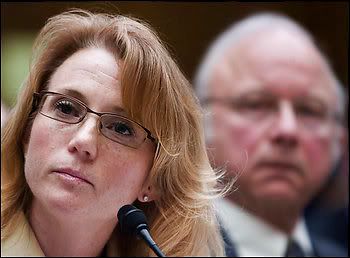 Theresa Payton, White House Office of Administration chief information officer, and Allen Weinstein, United States archivist, testify on Capitol Hill. (By Manuel Balce Ceneta -- Associated Press)
The Washington Post reports:
After promising last year to search its computers for tens of thousands of e-mails sent by White House officials, the Republican National Committee has informed a House committee that it no longer plans to retrieve the communications by restoring computer backup tapes, the panel's chairman said yesterday.
The move increases the likelihood that an untold number of RNC e-mails dealing with official White House business during the first term of the Bush administration -- including many sent or received by former presidential adviser Karl Rove -- will never be recovered, said House Democrats and public records advocates.
The RNC had previously told the House Oversight and Government Reform Committee that it was attempting to restore e-mails from 2001 to 2003, when the RNC had a policy of purging all e-mails, including those to and from White House officials, after 30 days. But Chairman Henry A. Waxman (D-Calif.) disclosed during a hearing yesterday that the RNC has now said it "has no intention of trying to restore the missing White House e-mails."
"The result is a potentially enormous gap in the historical record," Waxman said, including the buildup to the Iraq war.
Spokesman Danny Diaz said in a statement that the RNC "is fully compliant with the spirit and letter of the law." He declined further comment.
Administration officials have acknowledged that Rove and many other White House officials routinely used RNC accounts for government business, despite rules requiring that they conduct such business through official communications channels. The RNC deleted all e-mails until 2004, when it exempted White House officials from its e-mail purging policy.
About 80 White House aides used RNC accounts for official government business, committee staff members said. Rove, for example, sent or received 140,000 e-mails on RNC servers from 2002 to 2007, and more than half involved official ".gov" accounts, the panel has said.
The RNC dispute is part of a broader debate over whether the Bush administration has complied with long-standing statutory requirements to preserve official White House records -- including those reflecting potentially sensitive policy discussions -- for history and in case of future legal demands.
The committee is investigating allegations that vast stores of official Bush administration e-mails have also gone missing from the White House, which scrapped a Clinton-era archiving system and has struggled with data retention problems.
A former White House technology manager told the committee in statements released yesterday that the Bush administration's e-mail system "was primitive and the risk that data would be lost was high."
Steven McDevitt, who left the White House in 2006, said he supervised an internal study that found hundreds of days in which no electronic messages were stored for one or more White House offices from January 2003 to August 2005. The study stated a range when tallying the total number of days in which an office had no recorded e-mails, from 473 -- which had been previously reported -- to more than 1,000, McDevitt said.
McDevitt also said security was so lax that e-mail could be modified by anyone on the computer network until the middle of 2005.
Administration officials defended their efforts to fix the problems, and said they are still working to locate and identify e-mails reported as missing. "We are very energized about getting to the bottom of this," said Theresa Payton, chief information officer at the Office of Administration.
At the hearing, Payton and GOP lawmakers attacked the 2005 White House study overseen by McDevitt, calling it flawed and unreliable. McDevitt said the 250-page study involved numerous senior technology officials as well as outside contractors.
Rep. Thomas M. Davis III (Va.), the committee's ranking Republican, said in a statement that the missing e-mail allegations are "based on a discredited internal report conveniently leaked to the media." He also said that yesterday's hearing was "less about preserving records and more about resurrecting the spurious claim that the White House 'lost millions of official e-mails.'"
Davis also said, based on a briefing by Payton, that the actual number of days with missing e-mails was 202. "A substantial portion of the so-called 'missing' e-mails appear not to be missing at all, just filed in the wrong digital drawer," Davis said. No other committee member followed up on that allegation during the hearing.
| [+/-] |
Politicos Squabble Over 'Missing' White House E-Mails |
At NewsBlog, Anne Broache reports:
Democrats and Republicans were warring Tuesday over reports that the White House has "lost"--or simply failed to keep--archives of e-mails belonging to the president and his advisers.
Since last spring, the U.S. House of Representatives Committee on Oversight and Government Reform has been investigating reports that an estimated 5 million messages from 473 days between 2003 and 2005 allegedly vanished from e-mail servers housed within the president's office.
A hearing convened by the committee gave Democratic leaders a new chance to press White House officials publicly on how and when they expect to recover the files.
"We still know virtually nothing about the status of the alleged missing White House e-mails," said Committee Chairman Henry Waxman (D-Calif.).
Allen Weinstein, archivist of the United States, said the National Archives and Records Administration had similarly gotten no response from the White House to its queries about what's going on. "I'm concerned about maintaining the fullest possible presidential records," he told the committee.
Republican leaders said they were also concerned about the prospect of missing nuggets of presidential history, but they accused the Democrats of failing to acknowledge the White House's ongoing efforts to retrieve the messages. Republican Ranking Member Tom Davis (R-Va.) said the White House has said it has since reduced the number of days' worth of missing e-mails from 473 to 202 after discovering that those messages had been filed "in the wrong digital drawer" as part of a switch from the Lotus Notes to Microsoft Exchange e-mail system in 2002.
White House Chief Information Officer Theresa Payton assured the committee that her office is working actively on a multi-step restoration process. Their early results have identified an unspecified number of the previously "missing" messages, though those results still have to be validated.
When pressed by Davis, Payton also said she felt "very comfortable" that they would be able to reconstruct any remaining lost documents from "disaster recovery backup tapes," although she said that process would be time-consuming and could cost at least $15 million.
Did advisers use Republican National Committee accounts?
A separate issue under scrutiny revolves around charges that Karl Rove and some 50 other presidential advisers were using Republican National Committee accounts to conduct official business and thus subvert federal record-keeping laws. The RNC has said it had virtually no records of e-mails sent on its servers by Rove and others before November 2003, which Democrats argue is troubling because those messages may contain important official information about the president's decision to go to war in Iraq.
Waxman said he heard from RNC officials as recently as Monday that the White House had made no effort to request backup tapes from the committee that may contain those files. He scolded White House officials for their inaction. Both Payton and her boss, White House Office of Administration director Alan Swendiman, said they wouldn't be responsible for making such requests but would look into who is.
Republicans accused the Democrats of pursuing the investigation simply to dig up dirt on Rove and waste hundreds of thousands of dollars of money that the RNC could be using to shore up its candidates' campaigns.
"Are we simply going on a fishing expedition at $40,000 to $50,000 a month?" Rep. Darrell Issa (R-Calif.) asked National Archives and White House officials at the hearing. "Do any of you know of a single document, because this committee doesn't, that should've been in the archives but in fact was done at the RNC?"
"I think the issue is always, were there official government public records on that system?" responded Gary Stern, general counsel to the National Archives.
The loss of documents in either case is potentially significant because federal laws, including the Presidential Records Act, requires the White House to preserve all documents related to the president and vice president's official business and turn them over to the National Archives. Personal records, including political campaign-related materials, are expected to be filed separately and not subject to the same restrictions. The matter has already sparked a lawsuit from an advocacy group called Citizens for Responsibility and Ethics in Washington.
Clinton administration's archiving problems
The Bush administration isn't the first to encounter problems with missing e-mails. During the mid-1990s, the Clinton administration at one point relied on a flawed e-mail archiving system that failed, among other things, to preserve e-mails sent by people whose names began with the letter D. The situation resulted in congressional hearings and some $11 million spent on reconstructing the some 200,000 missing e-mails, Waxman said.
The problems for the Bush administration apparently started soon after the White House decided to shift its e-mail system from Lotus Notes to Microsoft Exchange in 2002. It also replaced the automated records storage system devised by the Clinton administration with a system that one of its own experts described as "primitive," according to Waxman.
According to the committee, the archive system is an "ad hoc" process called "journaling," in which a White House staffer or contractor manually copies e-mails and saves them on various White House servers. Democrats cast more than a little suspicion on that practice. They cited testimony outside the hearing from a former White House technology worker who said, at least during some points in 2005, those files and directories were available to all 3,000 employees under the umbrella of the executive office of the president.
White House CIO Payton, who began her job in May 2006, said she was unaware of anything of the sort. She also said she had no knowledge of anyone intentionally deleting or tampering with files and later said the copying of messages is automatic, not manual.
"We want to make sure we get all the e-mails over to the (National Archives) at transition" to the next president, she told the committee.
Sunday, February 24, 2008
| [+/-] |
The Prosecution of Governor Siegelman |
CBS News reports:
Is Don Siegelman in prison because he’s a criminal or because he belonged to the wrong political party in Alabama? Siegelman is the former governor of Alabama, and he was the most successful Democrat in that Republican state. But while he was governor, the U.S. Justice Department launched multiple investigations that went on year after year until, finally, a jury convicted Siegelman of bribery.
Now, many Democrats and Republicans have become suspicious of the Justice Department’s motivations. As correspondent Scott Pelley reports, 52 former state attorneys-general have asked Congress to investigate whether the prosecution of Siegelman was pursued not because of a crime but because of politics.
Ten years ago life was good for Don Siegelman. After he became governor, many believed he was headed to a career in national politics. In 1999, Siegelman’s pet project was raising money to improve education, so he started a campaign to ask voters to approve a state lottery. He challenged Republicans to come up with a better idea.
“You tell us how you’re going to pay for college scholarships. You tell us how you’re going to put state of the art computers inside every school in this state,” he said.
But now the applause has long faded. Today, Siegelman is at a federal prison camp in Louisiana. He’s doing seven years. The main charge against him was that he took a bribe, giving a position on a state board to businessman Richard Scrushy, who had made a big donation to that lottery campaign. There was a star witness, Nick Bailey, a Siegelman aide who had a vivid story to tell.
“Mr. Bailey had indicated that there had been a meeting with Governor Siegelman and Mr. Scrushy, a private meeting in the Governor's office, just the two of them,” says Doug Jones, who was one of Siegelman’s lawyers. “And then, as soon as Mr. Scrushy left, the governor walked out with a $250,000 check that he said Scrushy have given him for the lottery foundation.”
“Had the check in his hand right then and there? “ Pelley asks.
“Had the check in his hand right then,” Jones says.
“That Scrushy had just handed to him, according to Bailey's testimony?” Pelley asks.
“That's right, showed it to Mr. Bailey. And Nick asked him, ‘Well, what does he want for it?’ And Governor Siegelman allegedly said, ‘A seat on the CON Board.’ Nick asked him, ‘Can we do that?’ And he said, ‘I think so,’” Jones says.
The CON board regulates hospital construction, and Scrushy ran a healthcare company. Both Siegelman and Scrushy were convicted in federal court.
But, as 60 Minutes found out, the imprisonment of Don Siegelman is not nearly as simple as that.
“I haven't seen a case with this many red flags on it that pointed towards a real injustice being done,” says Grant Woods, the former Republican attorney general of Arizona.
Woods is one of the 52 former state attorneys-general, of both parties, who’ve asked Congress to investigate the Siegelman case.
“I personally believe that what happened here is that they targeted Don Siegelman because they could not beat him fair and square. This was a Republican state and he was the one Democrat they could never get rid of,” Woods says.
Now a Republican lawyer from Alabama, Jill Simpson, has come forward to claim that the Siegelman prosecution was part of a five-year secret campaign to ruin the governor. Simpson told 60 Minutes she did what’s called “opposition research” for the Republican party. She says during a meeting in 2001, Karl Rove, President Bush’s senior political advisor, asked her to try to catch Siegelman cheating on his wife.
"Karl Rove asked you to take pictures of Siegelman?" Pelley asks.
"Yes," Simpson replies.
"In a compromising, sexual position with one of his aides," Pelley clarifies.
"Yes, if I could," Simpson says.
She says she spied on Siegelman for months but saw nothing. Even though she was working as a Republican campaign operative, Simpson says she wanted to talk to 60 Minutes because Siegelman’s prison sentence bothers her conscience.
Simpson says she wasn’t surprised that Rove made this request. Asked why not, she tells Pelley, “I had had other requests for intelligence before.”
“From Karl Rove?” Pelley asks.
“Yes,” Simpson says.
Rove was a strategist in Alabama. Simpson says she worked with him on several campaigns.
60 Minutes contacted Rove. Through his lawyer, he denied Simpson’s allegations. One of Rove’s close Alabama associates was Republican consultant Bill Canary. Simpson says she was on a conference call in 2002 when Canary told her she didn’t have to do more intelligence work because, as Canary allegedly said, “My girls” can take care of Siegelman. Simpson says she asked “Who are your girls?”
“And he says, ‘Oh, my wife, Leura. You know, she's the Middle District United States Attorney.’ And he said, ‘And then Alice Martin. She is the Northern District Attorney, and I've helped with her campaign,’” Simpson says.
“Federal prosecutors?” Pelley asks.
“Yes, Sir,” she says.
Bill Canary denies the conversation ever happened. He told 60 Minutes he never tried to influence any government official in the case. His wife Leura Canary and Alice Martin are top federal prosecutors in the state. Both were appointed by President Bush, and their offices investigated Siegelman. Details of some of those investigations leaked to the press. And Siegelman lost his 2002 re-election campaign narrowly to Republican Bob Riley.
Two years later, as Siegelman geared up to run again, the Justice Department took one of its Siegelman investigations to trial-an indictment involving an alleged Medicaid scam.
“He’s indicted. He goes to trial. That's a pretty big deal to have your former governor on trial. Everybody's there. The government gives their opening argument. The judge says, ‘I want to see you in chambers because this case, there's no case here,’" Grant Woods says.
Woods says the judge threw the case out, without a witness testifying. “The case is so lame that he throws it out,” he says.
Vindicated, Siegelman focused on winning the 2006 election. And that’s when Jill Simpson says she heard the Justice Department was going to try again. She says she heard it from a former classmate and work associate Rob Riley, the son of the new Republican governor.
“Rob said that they had gotten wind that Don was going to run again,” she says.
“And Rob Riley said what about that?” Pelley asks.
“They just couldn't have that happen,” Simpson says.
Asked how they were going to prevent that from happening, she says, “Well, they had to re-indict him, is what Rob said.”
Simpson told this same story, under oath, to Congressional investigators in a closed session. Rob Riley told 60 Minutes he never talked to Jill Simpson about this.
Four months after Simpson says they spoke, Siegelman was indicted on new charges. Doug Jones, Siegelman’s lawyer, says one of the prosecutors told him that Justice Department headquarters in Washington had ordered a top to bottom review of the case. Today, the Alabama prosecutors deny that it was Washington - but whoever ordered it, there was a big boost to the investigation.
“They started over. People started getting subpoenas that had never gotten subpoenas before, for testimony, for records. The governor's brother, his bank records started getting subpoenaed. The net was cast much wider than had ever been cast before,” Jones says.
“You know, on the other hand, what's wrong with the Department of Justice vigorously investigating a case if they think there is an indictment to be made on public corruption charges?” Pelley asks.
“Well, you still have to investigate crimes, not people. It undermines the entire system of justice because at that point anybody can be a target. Any prosecutor can look across the table and say, ‘You know what? I just don't like you,’” Jones says.
The prosecution was handled by the office of U.S. Attorney Leura Canary, whose husband Bill Canary had run the campaign of Siegelman’s opponent, Gov. Riley.
“Why would you do it that way?” Woods asks. “Why wouldn't you say, ‘You know what? We're going to bring in someone from another jurisdiction to do it. There's a lot of United States attorneys around the country. We'll have somebody come in and do this case.’ That's not what happened in Alabama. Every time they had the chance to go the extra mile to be independent and objective, they didn't do it.”
Leura Canary handled the case for eight months. When defense attorneys objected, she turned it over to her assistants and says that she had nothing further to do with it.
In this new investigation, prosecutors zeroed in on that vivid story told by Siegelman’s aide, Nick Bailey, who said he saw the governor with a check in his hand after meeting Richard Scrushy. Trouble was, Bailey was wrong about the check, and Siegelman’s lawyer says prosecutors knew it.
“They got a copy of the check. And the check was cut days after that meeting. There was no way possible for Siegelman to have walked out of that meeting with a check in his hand,” Jones explains.
“That would seem like a problem with the prosecution's case,” Pelley remarks.
“It was a huge problem especially when you've got a guy who's credibility was going to be the lynch pin of that case. It was a huge problem,” Jones says.
And there was another problem with the prosecutor’s star witness: Nick Bailey was a crook. Unknown to Siegelman, Bailey had been extorting money from Alabama businessmen. Facing ten years in prison, Bailey agreed to cooperate with prosecutors to get a lighter sentence.
60 Minutes went to talk to Bailey. The Justice Department wouldn’t let our cameras into the prison, but we met with him for hours.
Bailey told 60 Minutes that before the Siegelman trial, he spoke to prosecutors more than 70 times, and he admitted that during those conversations he had trouble remembering details. He told 60 Minutes the prosecutors were so frustrated, they made him write his proposed testimony over and over to get his story straight.
If Bailey’s telling the truth, his notes, by law, should have been turned over to the defense. But Siegelman’s lawyers tell 60 Minutes they never saw any such notes and never had a chance to show the jury just how much Bailey’s story had changed.
No one at the Justice Department would be interviewed for this story, but they did send a statement which read, in part, "This case was brought by career prosecutors … based upon the law and the evidence alone. After considering that evidence … a jury of Mr. Siegelman's peers found him guilty beyond a reasonable doubt.”
But Grant Woods, the former attorney general of Arizona, says the case should never have gone to trial. “The prosecutor's gotta look at it and say, ‘Hey, is this the sort of thing that we're really talking about when we're talking about bribery?’ Because what the public needs to know here is there is no allegation that Don Siegelman ever put one penny in his pocket,” he says.
Richard Scrushy did make donations totaling $500,000 to that education lottery campaign, and after serving on the hospital board under three previous governors, Scrushy was re-appointed by Siegelman.
But Woods says that’s politics, not bribery. “You do a bribery when someone has a real personal benefit. Not, ‘Hey, I would like for you to help out on this project which I think is good for my state.’ If you're going to start indicting people and putting them in prison for that, then you might as well just build nine or ten new federal prisons because that happens everyday in every statehouse, in every city council, and in the Congress of the United States,” he says.
“What you seem to be saying here is that this is analogous to giving a great deal of money to a presidential campaign. And as a result, you become ambassador to Paris,” Pelley remarks.
“Exactly. That's exactly right,” Woods says.
Siegelman was campaigning in the 2006 Democratic primary as he went to trial. “We’re going to turn this bus into what we call the night shift, because after the trial every day we’re gonna be hittin the trail every day,” he said.
But he lost in the primary. After two months, the jury deadlocked twice, then, voted to convict on its third deliberation. Many legal minds were shocked when federal judge Mark Fuller, at sentencing, sent Siegelman directly to prison without allowing the usual 45 days before reporting.
“He had him manacled around his legs like we do with crazed killers. And whisked off to prison just like that. Now what does that tell you? That tells you that this was personal. You would not do that to a former governor,” Woods says.
“Would you do that to any white collar criminal?” Pelley asks.
“No, I haven't seen it done,” Woods says.
“Help me understand something. You're blaming the Republican administration for this prosecution. You're saying it was a political prosecution. You are a Republican. How do I reconcile that?” Pelley asks.
“We're Americans first. And you got to call it as you see it. And you got to stand up for what's right in this country,” Woods says.
Karl Rove and others at the White House were subpoenaed to testify before Congress but they refused to appear. And the Justice Department has refused to turn over hundreds of documents in the case.
Saturday, February 23, 2008
| [+/-] |
Governors Oppose New Medicaid Rules |
The New York Times reports:
Governors of both parties strongly objected on Saturday to a half-dozen new federal Medicaid regulations that they said would shift billions of dollars in costs to the states, forcing them to consider cutbacks in services.
The rules, scheduled to take effect in the next few months, would reduce federal payments for public hospitals, teaching hospitals and services for the disabled, among others.
State officials voiced their concerns as they arrived here for the winter meeting of the National Governors Association.
Federal health officials said the new rules were needed to end creative financing techniques that states had used to obtain excessive amounts of federal Medicaid money.
But governors said the Bush administration was unilaterally reshaping Medicaid in ways that would harm some of their most vulnerable citizens. Moreover, they said, the rules are taking effect at a time when the national economic slowdown is cutting into state tax revenues.
“Governors strongly oppose the changes,” said Gov. Jim Douglas of Vermont, a Republican who is chairman of the association’s Health and Human Services Committee. “The timing could not be worse.”
One of the rules would ban the use of federal Medicaid money to help pay for the training of doctors, a use that has been allowed since the inception of Medicaid more than 40 years ago. Another would set new limits on Medicaid payments to hospitals and nursing homes operated by states, cities, counties and other units of government.
A third rule would limit Medicaid coverage of rehabilitation services for people with disabilities, including serious mental illnesses.
Federal officials estimate that the rules will save the federal government $15 billion over five years. But that figure may be low. California alone says it could lose $12 billion over five years.
Congress delayed some of the rules last year, but they will soon take effect unless Congress intervenes again.
Gov. Arnold Schwarzenegger of California, a Republican, said the rule changes “would effectively end the federal government’s participation in many crucial components of the Medicaid program.”
Dr. Rhonda M. Medows, commissioner of the Georgia Department of Community Health, said: “We understand the need for financial safeguards, but these rules, taken together, would have a tremendous adverse impact. They would undermine the health care safety net for the entire state of Georgia, reducing federal Medicaid payments for hospitals, nursing homes and school clinics.”
The National Conference of State Legislatures joined governors in criticizing what it described as “the regulatory activism” displayed in the new rules.
The federal government and the states share the cost of Medicaid, which provides health insurance to more than 60 million low-income people, including 30 million children.
Dennis G. Smith, director of the federal Center for Medicaid and State Operations, said the rules were needed to “protect the fiscal integrity of the Medicaid program.” Since 2003, he said, federal officials have persuaded 30 states to end “questionable Medicaid financing arrangements.” The purpose of such arrangements is to maximize the use of federal money while holding down the use of state and local revenue.
Although the most blatant problems have been corrected, the administration says, many states still use federal Medicaid money for purposes unrelated to Medicaid.
“We believe that paying for graduate medical education is outside the scope of Medicaid’s role, which is to provide medical care to low-income people,” Mr. Smith said. “There is no explicit authorization under the Medicaid statute to subsidize the training of physicians.”
Robert M. Dickler, chief health care officer at the Association of American Medical Colleges, said, “It’s a little surprising that the federal government would just now discover that there’s no legal basis for the Medicaid payments it’s been making for medical education since 1965.”
Stan Rosenstein, the Medicaid director in California, said the payments were justified because “interns and residents provide a tremendous amount of care to Medicaid beneficiaries.”
The federal government says this rule would save $1.8 billion over five years. But New York, which trains 15 percent of the nation’s doctors, says it would lose more than that alone. State officials are also concerned about a rule that would eliminate federal contributions for a whole category of public spending on health care for the poor — specifically, spending by autonomous units of local government like the Denver Health and Hospital Authority.
“As a result of this rule, we will lose $60 million a year,” said Dr. Patricia A. Gabow, chief executive of the Denver agency, which operates a 477-bed public hospital, the city’s public health department and its ambulance service. “We were part of the city government for more than 130 years. In 1997, we became an independent governmental entity, but we don’t have taxing authority. So we don’t qualify as a public provider, and we can’t draw down critically important subsidies for services we provide to the entire community.”
Larry S. Gage, president of the National Association of Public Hospitals, said the rule’s importance went far beyond Medicaid because it would compromise the ability of public hospitals to provide vital services like trauma care and burn treatment.
New York City Health and Hospitals Corporation, the largest municipal health care system in the country, which gets 60 percent of its budget from Medicaid, said the rules would have “a potentially devastating impact” and could force cutbacks in services.
A group of 17 states, including Connecticut, Michigan and New Jersey, told the administration that the new restrictions were “simply awful public policy.” Senators Jeff Bingaman, Democrat of New Mexico, and Elizabeth Dole, Republican of North Carolina, are fighting the rule on public hospitals.
The rule “would have a devastating effect on North Carolina’s Medicaid system, costing our hospitals hundreds of millions of dollars annually,” Mrs. Dole said.
The Medicaid rules were overshadowed last year by a battle over insurance for children.
“We can have a legitimate discussion about expanding the Children’s Health Insurance Program,” said Governor Douglas of Vermont. “But the Medicaid rules are different. They renege on commitments already made.”
In Vermont, Mr. Douglas said, “we’ve come to rely on Medicaid to help pay for special education and other services to children with disabilities.”
Medicaid is a crucial part of the foundation on which many states were planning to build coverage for the uninsured.
Deborah S. Bachrach, a deputy commissioner in the New York State Health Department, said, “The new Medicaid rules make it difficult to pay for current programs and nearly impossible to expand coverage to all.”
Thursday, January 10, 2008
| [+/-] |
Failure To Launch |
Inside the Bush administration's dream of resurrecting the nuclear weapons complex—and the old-school Republican congressman who stood in its way
In the January/February 2008 issue of Mother Jones, James Sterngold writes:
Representative Dave Hobson is a Republican in the old mold. Stocky, silver-haired, and congenial, the 71-year-old Ohio congressman is a fiscal hawk and a gun-rights supporter but has no truck with the religious right. He works hard in the legislative trenches tending to the arc of suburban and rural counties near Columbus that he's represented since 1991. Like his home territory, the legislative terrain Hobson occupies is solid if unexciting; he's the guy you might catch on C-SPAN picking through a military construction bill.
Two things color Hobson's views on policymaking: his success as a small businessman—he became wealthy from commercial real estate—and the four military bases in his home district. He is strong on defense, but in a nuts-and-bolts, look-after-the-troops way. He's proud of his efforts to privatize military housing, for instance, and his fight to get more armored Humvees to the troops in Iraq. (He's been there several times.) He also believes in tight budgets—a sign on his desk reads, "It's the national debt, stupid"—though he isn't dogmatic about it.
"Dave's a businessman who also happens to be a politician," says John Kasich, a powerful former Ohio congressman and Fox News commentator who is one of Hobson's closest friends. "Dave's not anti-pork, believe me, but the spending has to make sense." Hobson frequently won't sign off on a measure unless it has, in a phrase he often uses, "a business plan"—a clear set of achievable goals and a sensible way of reaching them.
Which is why this respected conservative has emerged, to his own surprise, as one of the toughest opponents of the Bush administration's extraordinarily ambitious attempts to expand the nation's nuclear weapons complex. The irony is that Hobson strongly believes the United States should have a state-of-the-art nuclear capability and a credible nuclear deterrent; he's even crafted a program that he believes would ensure this. Yet on nuclear policy, he says, President Bush has committed a cardinal legislative sin: putting forth grand ideas without a business plan or even a coherent notion of their impact on national security.
But that isn't what most disturbs Hobson. During conversations in his House office, decorated with military mementos—flags, a musket, an Army helmet, mounted swords and scabbards—the otherwise easygoing congressman becomes stern, even angry, as he recounts the White House's record of outright dissembling and abysmal planning. His complaints evoke the familiar criticisms of the president's handling of the war in Iraq. But, Hobson says, his experience was particularly troubling because it involved a debate about real weapons of mass destruction—perhaps the most sensitive security issue facing any president. Once a true believer, Hobson has come to a stark conclusion about the administration's approach to nuclear weapons: "They lied."
Shortly after he became chairman of the House Appropriations Subcommittee on Energy and Water Development in early 2003, Hobson came across a curious item in the proposed budget for the nation's nuclear weapons program. (As part of the Department of Energy, the program fell under the subcommittee's purview.) At the time, Hobson admits, he didn't know much about this dense, sobering subject. "Only senators were supposed to get involved in nuclear weapons issues," he explains. But he was ready to influence an issue larger than the opening of a new veterans clinic in his district. Ever confident in his ability to wield a sharp red pencil, he settled down with the $6 billion weapons budget.
The item that gave him pause was something called the Modern Pit Facility, a proposed factory for manufacturing a critical nuclear weapons component—grapefruit-sized, hollow plutonium spheres that are encased in high explosives to form the triggers of thermonuclear bombs. Even with 6,000 warheads deployed, more than 4,000 kept in reserve, and thousands of additional pits in storage, the Bush administration was insisting that a new pit production line was essential for upgrading the stockpile.
Hobson was worried that restarting pit production might push countries like Iran and North Korea to speed up their nuclear efforts, or even prod Russia and China to boost their warhead programs. More than that, though, the proposal's sheer scale and redundancy bothered him. For years, the nation's weapons labs had certified that the existing stockpile was in perfect working order, and weapons planners said they needed only small numbers of new pits for making specialized warheads.
Pit production had stopped in 1989 when the government's plant in Rocky Flats, Colorado, was shuttered due to major safety lapses and leaks of plutonium and other lethal materials. President Bush himself had declared that he wanted to shrink the nuclear stockpile to a minimum, and had recently negotiated with Russia to slash each country's deployed warheads by more than half—to 2,200 or fewer—by 2012. Yet the Modern Pit Facility would fabricate as many as 450 pits a year—roughly the same number being produced during the 1980s, in the era of mutually assured destruction.
Hobson voiced his concerns to Linton Brooks, the newly appointed head of the National Nuclear Security Administration (NNSA), an Energy Department unit that oversees the weapons complex.
"I said, 'First of all, I don't think you need 450 pits a year,'" Hobson recalls. "What kind of signal does that send to all these other countries? Second of all, I didn't think we had that kind of money."
Sensing that the nuclear priesthood was not going to take direction from a small-town congressman, Hobson was not prepared for a cakewalk. And yet, "without any consultations or questions, they just came back to us and said, 'Okay, we don't need that capacity. We'll cut it,'" says Hobson. "I thought, 'Gosh, this is an easy job.'"
Today, Brooks says that the administration was never actually set on fabricating 450 pits a year. "It was the high end of the range," he says.
For Hobson, though, this unexpected reversal was an epiphany. "These were nuclear weapons we were talking about, and they hadn't given it more thought than that?"
Few of the ideological blueprints from the foreign-policy hawks who swept into office with George W. Bush were as ambitious as those for reenergizing the idle nuclear weapons production complex. The United States still had its massive Cold War arsenal, but the bombs' role in defense planning was waning. Nuclear weapons were the ultimate dumb bombs, so indiscriminately destructive that many military planners regarded them as largely useless. During the Clinton years, some officials had even argued for their abolition, though the hawks prevailed and set up an expensive "stockpile stewardship" program to maintain the weapons and nourish the politically influential weapons labs.
In early 2001, the National Institute for Public Policy, a right-leaning think tank, issued a policy paper by a group of prominent neoconservatives who argued for a radical new strategy. The United States might be able to make do with a smaller nuclear force, they said, but it urgently needed new types of warheads for specialized missions such as destroying deeply buried bunkers.
But the real novelty of the proposal was its rationale: New warheads were required not to deal with specific threats such as the Soviet Union, but to prepare for unknown threats that might one day materialize. It was a "what if" strategy, a dramatic example of the neoconservative mantra that American military power needs to be essentially unfettered and boundless.
Three months after 9/11, the Bush administration issued a new Nuclear Posture Review, a sweeping policy statement that radically redefined nuclear strategy precisely along the lines urged by the National Institute for Public Policy. (The document was classified, but large portions were leaked.) This was not surprising, since six of the think-tank study's authors had assumed key positions in the new administration, including then-deputy national security adviser Stephen Hadley, DOD deputies Stephen Cambone and Keith Payne, and NNSA head Brooks.
The new policy fully embraced the "what if" doctrine. No expense would be spared in creating a "revitalized defense infrastructure." No longer would nuclear bombs be kept in reserve as history-altering weapons of last resort; the new nuclear ideologues were envisioning a strategy in which low-kiloton nuclear bombs could be used as actual war-fighting tools, a means—they claimed—of deterring the likes of Iraq, Iran, and North Korea.
A year and a half later, the Republican-controlled Congress repealed the part of the 1993 Spratt-Furse amendment that had prohibited research on weapons with a yield of less than five kilotons (roughly a third as powerful as the bomb dropped on Hiroshima). It appropriated hundreds of millions of dollars for refurbishing warheads and researching so-called bunker busters as well as new types of smaller warheads labeled "advanced concepts." There were even suggestions that the administration might lift the ban on underground testing put in place by the first President Bush in 1992, widely regarded as one of the most important nonproliferation measures of the past two decades.
The more Rep. Hobson learned about this ambitious nuclear vision, the more he saw the administration's efforts as an ill-advised prelude to a new arms race. Eventually, he approved the funding, but he inserted requirements that limited advanced concepts to the drawing board and insisted that the entire enterprise be subject to close congressional oversight. "We thought it was going to be just a research type of thing," he says.
The NNSA and the labs heard a different message. In December 2003 Brooks wrote to the heads of the Lawrence Livermore, Los Alamos, and Sandia nuclear labs, telling them they were now "free to explore a range of technical options...without any concern that some ideas could inadvertently violate a vague and arbitrary limitation." Hobson got a copy of the letter, and his heart sank. "I'd been had," he says.
Hobson was growing skeptical, but he had not lost his faith in the administration. It would take the bunker-buster debacle to change that.
The idea behind the Robust Nuclear Earth Penetrator (RNEP) was to use nuclear weapons to destroy subterranean bunkers where Kim Jong Il or Saddam Hussein might conceal command centers or caches of WMD. In theory, by detonating a low-kiloton bomb underground, it would be able to crush a reinforced target buried hundreds of feet beneath the surface, and its blast would be contained—making it more like a precision munition than a doomsday weapon.
The Bush administration decided that it needed bunker busters that were more accurate and could go deeper than existing "earth penetrators," specially modified warheads that can burrow no more than 20 feet into hard rock.
There was just one problem: Every independent assessment found that a new generation of bunker busters could not possibly perform as hoped. A March 2003 article in Arms Control Today by a group of respected nuclear weapons advisers concluded that no bomb could penetrate more than 50 feet without destroying the warhead itself, and that crushing a hardened bunker 1,000 feet underground would require an explosion of more than 100 kilotons—seven times the size of the Hiroshima bomb. Even a one-kiloton bomb, detonated at 20 to 50 feet down, "would eject more than 1 million cubic feet of radioactive debris from a crater about the size of ground zero at the World Trade Center." A report issued by the National Academy of Sciences concluded that instead of vaporizing any biological or chemical agents inside the bunker, the blast actually might disperse them.
"Technically you can't go deep enough to contain the blast," says Bruce Tarter, the former head of the Livermore lab and a member of the National Academy of Sciences panel. "It was not even close under any circumstance one can imagine. It didn't have technical or military credibility."
Such scientific concerns reinforced Hobson's skepticism of the new bombs. "The physics of it didn't work and they sent the wrong signal to the world," he says. "It gave people a lot of reasons to build their own weapons."
He also found it puzzling that while civilian Pentagon officials were clamoring for the new weapon, their uniformed colleagues seemed uninterested in it. Hobson visited the headquarters of the U.S. Strategic Command in Omaha, the nuclear-war nerve center, to see what its staff would say about the concept. "They never mentioned it, like it just didn't matter," he recalls. In October 2004, he convinced his subcommittee to kill funding for the bunker buster. The message to the White House, he thought, was clear.
A few weeks later, one of the subcommittee's senior staffers, Scott Burnison, stumbled upon a routine work authorization from the Sandia weapons lab showing that researchers there were spending thousands of dollars building a concrete wall for a crash test of the RNEP's hardened shell. Hobson was furious. He called Energy secretary Samuel Bodman and demanded that the test be stopped.
"They tried to go around me," he says, still visibly angry about it. "They lost their credibility." Brooks confirms the episode, but says the administration saw the test as harmless background research: "It never occurred to us that this would be an issue." Hobson, he insists, "overreacted."
By now, news of Hobson's failure to rubber-stamp the administration's agenda was getting attention at the top. Defense secretary Donald Rumsfeld summoned Hobson to see him, alone; the congressman politely replied that he would only come with key aides.
On March 15, 2005, Hobson and two subcommittee staffers sat down for a breakfast meeting at the Pentagon. Waiting for them were Rumsfeld and Bodman, as well as General Joseph Cartwright, the head of the Strategic Command, and a phalanx of senior defense officials. Rumsfeld, according to several of those who attended, was calm but insistent: The Pentagon needed the bunker buster, and it was going to get it—one way or another.
Recalls Hobson, in an account confirmed by others, "I said to him, 'Look, you're not going to be able to do this, and if you want to take this to a vote and embarrass the president of the United States, fine. I'll beat you. Because one thing I do know how to do is count votes.' Rumsfeld said, 'Bah, you might win this year but you won't win next year.' And I said, 'We'll see.'"
"Here's the thing you've got to know about Dave," explains Kasich, Hobson's former Ohio colleague. "I've never met anyone more interested in encouraging other people's success. But if you screw with him, that's a big mistake. And they misled him. They treated him like any other congressman. He isn't any other congressman."
Despite Rumsfeld's show of obstinacy, Hobson succeeded in killing the bunker buster, as well as the advanced concepts program. He was still irked, though. The president had gone to war in Iraq, in part, to shut down Saddam Hussein's purported nuclear weapons program, and one of the few things that Bush and John Kerry agreed on in the 2004 campaign was that nuclear proliferation and nuclear terrorism were the gravest threats facing the country. Yet the administration's weapons policies seemed likely to make proliferation worse while actually accomplishing very little in terms of revitalizing the American weapons complex.
Linton Brooks, a respected master of weapons minutiae, now acknowledges that he was sent out to sell the bunker buster with little planning and almost no official backing. "It seems hard to imagine we could be so dumb," he says, "but we thought of this as not particularly contentious." He says that he was ordered to follow a contradictory script that left him, the administration, and its nuclear weapons policy tied in knots.
Brooks still believes in the administration's overall goals, but he is sympathetic to Hobson's sense that its policy was adrift. "RNEP was a throwaway program," he says. By the time the bunker buster and advanced concepts were killed, Brooks concedes, "I don't know that we had a plan" for what would be done instead.
Hobson was convinced he should step into the vacuum and design the coherent nuclear policy the White House had failed to deliver. So he gathered the support of a few key members of Congress and slipped a single sentence into a conference report on the 2005 energy appropriations bill, taking the $9 million once reserved for advanced concepts to create something called the Reliable Replacement Warhead (RRW) program, which would improve "the reliability, longevity, and certifiability" of the existing nuclear stockpile. It was the most significant new nuclear weapons initiative since the end of the Cold War, snuck into law like an unassuming earmark.
As Hobson conceived it, the RRW program would provide both cost savings and a comprehensive arms-control policy. Since the end of the Cold War, billions of dollars had been spent on maintenance and piecemeal fixes for the nation's warheads. Hobson wanted the labs to come up with safer, more modern, and more durable weapons. In addition, he wanted to refurbish the production complex by consolidating and modernizing some of its far-flung facilities.
This was a minimalist policy, and it would result in significant arms reductions. Deploying more reliable weapons would reduce the need for the thousands of warheads that are currently kept as backups. Perhaps most important, the redesigned warheads would have no new capabilities such as bunker busting, making them less provocative to other countries. Hobson also insisted that there would be no underground testing. "I wanted to make sure that nobody could play around with these things and come up with new capabilities," he says. "You just knew they wanted to."
Sure enough, the weapons complex and the administration saw Hobson's RRW plan as an open-ended mandate for many new generations of weapons. In congressional testimony last spring, a senior official outlined 11 major aims for the program; the Congressional Research Service has counted 20. Yet as its nuclear wish list became ever more bloated, the administration never gave Hobson the details he demanded—precisely how many warheads it wanted to build, what types, or what they would cost.
To fill in some of the blanks, Hobson had insisted that the Energy Department set up a task force to examine the nation's nuclear weapons infrastructure. After months of research, the team, which was chaired by scientist and defense consultant David Overskei, released a detailed report that affirmed Hobson's vision of modernization, cost cutting, and consolidation. But here too the NNSA and the labs appeared to embrace the blueprint for downsizing, only to hijack it as a call for an expanded weapons complex.
Philip Coyle, a former senior weapons official at the Pentagon and Livermore, and now an adviser at the Center for Defense Information, says that, in hindsight, the nuclear complex was motivated by self-preservation. "I think they saw RRW as a path to a more sustainable future when they weren't sure if they had much of a future," he says. "They got carried away without thinking through the arms-control implications." The wasted opportunity for change still has Overskei feeling bitter. The administration, he says, "has no policy on nuclear weapons. That is the crux of the whole problem."
Today, the Bush administration's nuclear ambitions have unraveled. Following a string of security and safety lapses at the weapons labs, Brooks was fired last January. In April, an expert analysis by the American Association for the Advancement of Science destroyed nearly every claim the White House made for its version of the Reliable Replacement Warhead program, observing dryly that "it does not respond to a new military capability or mission need." The report said the old warheads and their plutonium pits may last longer than expected—contrary to one of the administration's arguments for why they urgently needed to be replaced. In May, the replacement warhead program budget was zeroed out by Hobson's subcommittee, now chaired by a Democrat, Pete Visclosky of Indiana.
Paradoxically, the Bush administration's nuclear misadventure has done something that even the collapse of the Soviet Union did not accomplish: opening nuclear disarmament for debate among foreign-policy conservatives. Recent reports from the Defense Threat Reduction Agency and the Sandia lab have concluded that a new nuclear program could encourage proliferation and harm American credibility on arms control. Earlier last year, George Shultz, William Perry, Henry Kissinger, and Sam Nunn—all former Cold War hawks—wrote an essay for the Wall Street Journal urging the United States to lead a new disarmament initiative. "Reassertion of the vision of a world free of nuclear weapons and practical measures toward achieving that goal would be, and would be perceived as, a bold initiative consistent with America's moral heritage," they wrote.
Its plans thwarted, the administration has resorted to bullying. In July, the secretaries of Energy, Defense, and State issued a statement urging quick funding of the RRW program, warning that any delays could force a resumption of underground testing. Hobson and Visclosky wrote an angry letter rejecting the threat as "irresponsible." (The Senate kept the program alive, but with reduced funding.)
For his part, Brooks seems mystified by how badly the administration has handled nuclear weapons policy. Talking at length at a diner near his home in Virginia, he recalls how, as the chief American arms control negotiator in 1991, he concluded the final draft of the Strategic Arms Reduction Treaty, a 700-page document nine years in the making that all but ended the arms race with the Soviet Union. "It was on the front page of the New York Times when we signed it in July," he says. "By Christmas the country I signed it with was gone and I never saw it coming." Watching Bush's nuclear weapons program run off course was just as startling, he says.
"I do think the White House was absent," Brooks says. "There's no organizational focus on nuclear issues today. I've been complaining about that for some time."
Hobson, who plans to retire in 2009, agrees that the real problem with Bush's nuclear policy—once it came to shaping reasonable, practical plans, as opposed to making grand promises—was simple neglect. From the dawn of the nuclear era more than six decades ago, every administration, whether in peaceful or violent times, has maintained a solemn focus on its policies for the only weapon that can end civilization. But not this one.
Hobson observes that even as he blocked the White House's rearmament efforts, he never faced consistent pressure from the administration or the Republican leadership to fall in line. "The president of the United States knows me well enough that if he was concerned about what I had been doing, he would have gotten me on the plane and gotten in my face," says Hobson. "He never did anything. Nobody called."

Sunday, November 4, 2007
| [+/-] |
Atlanta Water Use is Called 'Shortsighted' |
The rapidly growing metropolis' 'cavalier' attitude toward conservation is the real problem, critics say.
The LA Times reports:
When Rick McKee, the editorial cartoonist of the Augusta Chronicle newspaper, set out to capture the historic and severe drought that is afflicting the Southeast, he did not draw parched rivers or shriveled crops or brown lawns: He drew an oafish, bloated hulk of a boy holding up a straw to slurp up water from a smaller boy's water fountain.
Above the larger boy, a sign reads "Atlanta," above the other, "Everybody else."
It is, in many ways, a cartoon that sums up feelings across the Southeast now that Lake Lanier, the reservoir that supplies drinking water to most of metropolitan Atlanta's 5 million residents, is draining to historic lows. With government officials issuing stark projections that Atlanta could run out of water within three months, Georgia politicians have pleaded with the U.S. Army Corps of Engineers to decrease the amount of water being released. The flow has been required to save two species of mussels 200 miles downriver.
Yet while Georgia's leaders try to cast the water shortage as a battle between 5 million people and a few mussels -- with the message that greater priority should be given to Atlanta residents -- there is a growing sense that the metropolis itself is the problem: Critics say Atlanta's rapid population growth, coupled with blithe disregard for water conservation, is straining the region's ecosystem.
A break came Thursday in Georgia's 17-year water war with Florida and Alabama: The GOP governors of the three states agreed to reduce by 16% the amount of water released downriverfrom Lake Lanier, which would slow the drain on Atlanta's main water source.
But experts say the Southeast's struggles over water resources are far from over.
"What was not on the table, and what has got to be on the table, is Atlanta's unrestricted growth and cavalier attitude to water use," said Sally Bethea, executive director of Upper Chattahoochee Riverkeeper, a watchdog group.
Such concerns are not coming just from environmental lobbyists, who have long argued that Atlanta must do more to conserve water.
Florida Gov. Charlie Crist, in opposing a request by Georgia Gov. Sonny Perdue to President Bush to permit a reduced downstream flow, wrote in his own letter to Bush that Florida's $134-million commercial seafood industry depended on the water. Crist added that his state had acted responsibly in enacting water legislation. Alabama Gov. Bob Riley argues that downstream communities and a nuclear power plant in his state require water too.
Even within Georgia, the drought has brought to the fore long-simmering resentment against the booming capital of the New South. About 140 miles east in Augusta, which sits on the Savannah River, there is concern that Atlanta could slake its thirst on Augusta's water supplies. Last month, Atlanta Mayor Shirley Franklin suggested that Atlanta explore piping in water from the Savannah or Tennessee rivers.
"Atlanta is a greedy, poorly designed behemoth of a city incapable of hearing the word 'no' and dealing with it," said a recent editorial in the Valdosta (Ga.) Daily Times.
The editorial said Atlanta's "politicians can't bring themselves to tell their greedy constituents complaining about the low flows in their toilets this week that perhaps if they didn't have six bathrooms, it might ease the situation a bit."
Atlanta is not the only city grappling with water shortages. In 2003, a Government Accountability Office report on the nation's freshwater supply found that 36 states anticipated water shortages in the next decade.
Two months ago, a federal judge in California ordered protective measures for the tiny endangered smelt fish in the Sacramento-San Joaquin River Delta, a mandate that water officials said could cut by a third the flow of water to Southern California from the north.
Yet while cities such as Los Angeles, Las Vegas and Denver have ushered in water conservation measures -- including offering incentives, installing high-efficiency toilets and low-flow shower heads, and increasing monthly water bills for big water users -- experts say Atlanta, one of the fastest-growing metropolitan regions in the country, has been particularly shortsighted.
Atlanta was founded far from any major river or lake. The metro area had a population of 2.9 million in 1990 and 4.1 million in 2000, and its daily draw on the water reserve was 320 million gallons in 1990 and 420 million in 2000.
With 2 million more residents projected by 2030, water use is expected to rise to more than 700 million gallons a day.
For its drinking water, Atlanta relies almost entirely on Lake Lanier, a 38,000-acre reservoir in northern Georgia built in the 1950s.
"If your population is growing, you cannot expect to do the same old things you did a decade ago," said Chris Brown, executive director of the California Urban Water Conservation Council. "You have to change the way you behave."
This has not happened in Atlanta, conservationists say. In 2003, the area's 16-county Metropolitan North Georgia Water Planning District adopted a water conservation plan. Yet most counties have not implemented the recommendations, such as reducing leaks and raising billing rates for those who use more water.
Last year, a bill failed in the state House of Representatives that would have required older homes to be retrofitted with low-flow fixtures before they were resold.
Some environmentalists are questioning whether Atlanta can handle 2 million more people.
"Conservation may not be the answer in and of itself," said Elizabeth Nicholas, general counsel for Upper Chattahoochee Riverkeeper. "There just isn't enough fresh water here to support major growth. We need to be smarter about how and where we're growing."
Conservationists' suggestion that the state should prohibit building if no water is available rankles developers and the business community.
"People are coming to this state whether environmentalists like it or not," said Ed Phillips, executive vice president of the Home Builders Assn. of Georgia. "What are we going to do? Put up a fence?"
Many of Georgia's political leaders say the solution to the drought is not to stop developing but to manage water more efficiently, building more reservoirs to enhance water storage.
"We have not consumed our way into drought," said Carol Couch, director of the Environmental Protection Division of the Georgia Department of Natural Resources. She said there must be planning to accommodate growth, including building more reservoirs and encouraging residents to conserve and reuse water.
Conservationists have traditionally opposed additional reservoirs, arguing they would lead to much water loss through evaporation and would severely affect the environment.
Last month, Georgia Republicans Lt. Gov. Casey Cagle and House Speaker Glenn Richardson proposed legislation that would commit millions of dollars in the 2008 session to build reservoirs and enlarge existing ones.
For now, as water levels at Lake Lanier drop about a foot a week, Atlantans have been urged to shorten showers and to report neighbors who violate the ban on outdoor watering. Businesses have been asked to cut water use by 10%.
Last week's tri-state compromise is awaiting approval by the U.S. Fish and Wildlife Service. The agency is expected to issue its opinion by the middle of this month after assessing how the reduced flows could affect the endangered fat threeridge and threatened purple bankclimber mussels in Florida's Apalachicola River. The U.S. Army Corps of Engineers would execute any change.
Monday, October 29, 2007
| [+/-] |
Poor Kids Are Majority At Public Schools in South |
The Dallas Morning News reports:
For the first time in more than 40 years, the majority of children in public schools in the South are poor, according to a report being released today.
Twenty years ago, Mississippi was the only state in the country with such a high percentage of poor public school students. Now, a majority of public school students are considered low-income in 14 states, including 11 in the South, the report by the Southern Education Foundation said.
"Low-income students as a group begin school least ready," said Steve Suitts, a program coordinator with the Atlanta-based foundation. "They are the students most likely to drop out of school."
The report found that 56 percent of Texas public school students were low-income in 2006, based on their eligibility for free or reduced school lunches. That's up from 49 percent in 2000.
The report gives only state averages; the poverty levels in individual districts vary greatly.
In 2006, about 83 percent of students in the Dallas Independent School District were poor. The figure was 69 percent in Irving, 48 percent in Mesquite, 50 percent in Richardson and 21 percent in Plano, according to the Texas Education Agency.
Sunday, October 14, 2007
| [+/-] |
House Falling Short on SCHIP Override |
The Washington Post reports:
House Speaker Nancy Pelosi (D-Calif.) reversed her stance from a week earlier, appearing resigned Sunday that Democrats would not convince enough Republicans to pass an expansion of a children's health insurance program over President Bush's veto.
"Isn't that sad for America's children?" she asked on ABC's "This Week." Her second appearance on a Sunday talk show in as many weeks came days before the House is expected to vote again on the State Children's Health Insurance Program.
Last week, Pelosi was far more optimistic about the chances of overriding Bush's veto, saying on "Fox News Sunday" that the Democrats needed "about 14 Republican votes" to reach the required two-thirds majority.
This week, it was Pelosi's Republican counterpart, House Minority Leader John Boehner (Ohio), who was facing questions on Fox, and he said he was confident that "we will have the votes to sustain the president's veto."
The White House has signaled it wants to find a compromise with Democrats over the program, but any agreement seemed distant today.
Pelosi said she has never heard from Bush about the program and she reiterated a point she made last week, that she is unwilling to support legislation that would cover fewer children than the current bill's 10 million.
The Senate already has a sufficient majority to override the veto, and Senate Minority Leader Mitch McConnell (R-Ky.) predicted on ABC that the White House and congressional Democrats would strike a deal.
"Neither side is going to leave these kids uninsured. It's become kind of a political football, which is really unfortunate. But the coverage is going to be provided in some way," McConnell said.
| [+/-] |
Getting Around Rules on Lobbying |
Despite New Law, Firms Find Ways To Ply Politicians
The Washington Post reports:
In recent days, about 100 members of Congress and hundreds of Hill staffers attended two black-tie galas, many of them as guests of corporations and lobbyists that paid as much as $2,500 per ticket.
Because accepting such gifts from special interests is now illegal, the companies did not hand the tickets directly to lawmakers or staffers. Instead, the companies donated the tickets back to the charity sponsors, with the names of recipients they wanted to see and sit with at the galas.
The arrangement was one of the most visible efforts, but hardly the only one, to get around new rules passed by Congress this summer limiting meals, travel, gifts and campaign contributions from lobbyists and companies that employ them.
Last week, Senate Majority Leader Harry M. Reid (D-Nev.) and Republican leader Mitch McConnell (Ky.) found bipartisan agreement on maintaining one special privilege. Together they put language into a defense appropriations bill that would keep legal the practice of some senators of booking several flights on days they return home, keeping the most convenient reservation and dumping the rest without paying cancellation fees -- a practice some airlines say could violate the new law.
Senators also have granted themselves a grace period on requirements that they pay pricey charter rates for private jet travel. Lobbyists continue to bundle political contributions to lawmakers but are now making sure the totals do not trigger new public reporting rules. And with presidential nominating conventions coming next summer, lawmakers and lobbyists are working together to save another tradition endangered by the new rules: the convention party feting one lawmaker.
"You can't have a party honoring a specific member. It's clear to me -- but it's not clear to everybody," said Barbara Boxer (D-Calif.), chairman of the Senate ethics committee. She said the committee is getting "these questions that surround the edges -- 'If it's midnight the night before,' 'If I wear one shoe and not the other.' "
Democrats touted the new ethics law as the most thorough housecleaning since Watergate, and needed after a host of scandals during 12 years of Republican rule. Prompted by disgraced lobbyist Jack Abramoff's wheeling and dealing and the jailing of three members of Congress on corruption charges in recent years, the law, signed by President Bush on Sept. 14, was heralded by congressional leaders as a real change in Washington's influence game.
But the changes have prompted anxiety about what perks are still permissible. In recent months, the House and Senate ethics committees have fielded more than 1,000 questions from lobbyists and congressional staffers seeking guidance -- or an outright waiver -- for rules banning weekend trips and pricey wedding gifts, five-course dinners and backstage passes.
Looking for ways to keep spreading freebies legally, hundreds of lobbyists have been attending seminars at Washington law firms to learn the ins and outs of the new law.
At a recent American League of Lobbyists briefing, Cleta Mitchell of the Foley & Lardner law firm said that while the law bans lobbyists from buying lawmakers or staffers a meal, it is silent on picking up bar tabs. A woman in the third row asked hopefully, "You can buy them as many drinks as you want, as often as you want?"
No, Mitchell said, not unless the drinkers are the lobbyist's personal friends, and she pays from her own pocket.
If that rule was clear to some, two charity dinners allowed hazier interpretations.
Most of the 40 lawmakers dining on red snapper ceviche and beef tenderloin at the recent Hispanic Caucus Institute gala at the Washington Convention Center got their tickets from corporations, said Paul Brathwaite, a principal with the Podesta Group lobbying firm.
Brathwaite said about a dozen of Podesta's corporate clients bought tables of 10 for $5,000 to $25,000 for the Hispanic dinner and the Congressional Black Caucus Foundation gala over the past three weeks. The companies then gave the tickets back to the foundations -- along with lists of lawmakers and staff members they wanted to invite. Some lawmakers did buy their own tickets, Brathwaite said, but many did not.
The rules require that charity sponsors do the inviting and decide who sits where. But "at the end of the night, everyone is happy," said Hispanic Caucus Institute spokesman Scott Gunderson Rosa.
"The corporate folks want us at their tables, of course," said Rep. Raul M. Grijalva (D-Ariz.), who sat at a Fannie Mae-sponsored table at the Hispanic dinner.
Another provision of the new ethics law bans House members from flying on corporate jets. But senators, including the half-dozen presidential candidates among them, can still do so. Previously they were required to reimburse plane owners the equivalent of a first-class ticket, but now they must pay charter rates, which can increase travel costs tenfold.
The Senate ethics committee decided not to enforce that rule for at least 60 days after it took effect Sept. 14, citing "the lack of experience in many offices in determining 'charter rates.' "
The decision surprised some Senate staffers, Mitchell said, one of whom e-mailed her to say, "Welcome to the world of skirting around the rules we pass."
"Breathtaking. . . . In my view, they're not complying with the plain language of the law," Mitchell said. "I think it should be easier for members of Congress to travel, not harder. But what I don't appreciate as a citizen is Congress passing something but then interpreting it so it doesn't mean what the law clearly says."
The law has dragged into view several such perks that members long enjoyed but didn't reveal -- until they sought exemptions to the new rules.
Lawmakers for years have booked several flights for a day when they plan to leave town. When they finish work, they take the most convenient flight and cancel the rest without paying fees, a privilege denied others. But after the new law passed, some airlines stopped the practice, worried that it violates the gift ban.
Sens. Dianne Feinstein (D-Calif.) and Robert F. Bennett (R-Utah) appealed to the Senate ethics committee to allow multiple bookings. Then Reid and McConnell added language to the defense bill that, if it passes, would extend the perk to staffers, too.
New bans on corporate-paid fun could hit hardest at the 2008 presidential nominating conventions. The law prohibits parties honoring a lawmaker on convention days; some lobbyists say the wording means such parties before or after those days are okay. House and Senate members have asked the ethics committees for guidance.
"That's one of the issues that's going to need some clarification," said Senate ethics panelist Ken Salazar (D-Colo.), whose home state will host the Democrats in August.
Meanwhile, lobbyists are booking up Denver's trendy warehouse district and Minnesota's Mall of America, near the GOP convention site in Minneapolis-St. Paul, for the pre-convention weekends. Host committees for both conventions say they will honor state delegations, including members of Congress who take part.
"I think you'll see a lot of umbrella invitations," said Patrick Murphy, lobbyist for Capitol Management, who is planning Democratic convention parties. "Invite 'Friends of Montana' and see who shows up."
One of the most fought-over parts of the law requires that lobbyists who bundle multiple campaign contributions totaling more than $15,000 file reports every six months. But lawyers say that a fundraiser for Hillary Rodham Clinton signals a way to avoid public reporting when that rule kicks in Jan. 1.
Female politicos have been e-mailing each other a slick online invitation to "Make History With Hillary," a summit and fundraiser on Wednesday. The invitation encourages women to bundle for Clinton by promising them online credit for each ticket they sell. Women who have already donated their legal individual limit of $2,300 cannot attend unless they bring in another $4,000.
"It's a universe of junior bundlers under the radar screen," said Kenneth Gross, a campaign finance lawyer at Skadden, Arps, Slate, Meagher & Flom. For the lobbyists among them, the amounts are so small that "you don't have to worry about tracking them, and it would add up to a material sum over time" -- but less than the $15,000 limit.
If a lobbyist asked his advice on the practice, Gross said, "I'd say 'Go for it.' "
Saturday, October 13, 2007
| [+/-] |
John Edwards's Docudrama: The Anatomy of Innuendo |

New York Magazine's Daily Intelligencer reports:
One of the wonderful things about the Internet is that rumors and scandal take on a life of their own. No one even needs to report anything! Once a story is out there, it's fair game for everyone else to repeat it, often under the guise of media analysis. The story starts at the bottom of the food chain of credibility. Bloggers and tabloid outlets egg each other incrementally on, until eventually more serious outlets pick it up.
We may be about to leave the early stages of such a cycle with the growing scrutiny into the professional relationship between John Edwards and a woman named Rielle Hunter, a.k.a. Lisa Druck, who produced films for his One America prepresidential campaign. Ann Coulter is even involved! The following timeline details the anatomy of an innuendo, including a few steps into the perhaps inevitable future.
• January 2007. John Edwards's One America campaign debuts a series of Web videos about him, made by relatively unknown documentarian Rielle Hunter. The pair met at a bar, where she sold the future candidate on the idea. Hunter subsequently followed Edwards around the country, filming. Newsweek reporter Jonathan Darman, upon watching the final cuts, notes that "in the midst of a short theme sequence that begins each Webisode, the camera lingers over the former senator's behind as he tucks a starched white shirt into his pants."
• August 27, 2007. The Post's "Page Six" runs the following blind item: "WHICH political candidate enjoys visiting New York because he has a girlfriend who lives downtown? The pol tells her he'll marry her when his current wife is out of the picture." This is later reprinted by commenters on the Huffington Post blog.
• September 26, 2007. Young Huffington Post reporter Sam Stein writes about his efforts to track down the Web videos, which have now been taken off the internet*. Stein writes an oddly detailed account of his chase of the videos and points out that both the Edwards campaign and Hunter's production company blame one another for their vanishing act. Stein even checks with the Screen Actor's Guild to get more information and tracks down production assistants on the project, none of whom will say much. Finally, Edwards's people offer to let him see the videos — while accompanied by a campaign minder. Stein says he accepted the offer, but does not report whether he actually saw them or not.*
• September 27, 2007. Daily Kos contributor Ben Bang links to Stein's post and viciously berates the reporter. "Are we supposed to infer something from this non-ending, douchebag?" Ben Bang asks, going on to call him a him a "no-article-finishing, character-assassinating hack fuck."
• October 10, 2007. The National Enquirer reports that Edwards is having an affair with a mystery woman who had traveled with the campaign and met the candidate at a bar. An Edwards rep calls the allegations "false, absolute nonsense."
• October 10, 2007. That same day, Stein posts a follow-up to his original Huffington Post piece. He questions why Rielle Hunter's production company was paid upwards of $100,000 for her work, and points out that she used to be a party girl who dated writer Jay McInerney in the eighties and inspired the main character in his book Story of My Life.*
• October 10, 2007. Ann Coulter, late in the day, mentions the Enquirer story on Tucker Carlson's MSNBC talk show. Daily Kos once again picks up on it and lists the reasons why Stein and the Huffington Post are irresponsible journalists for digging into it.
• October 11, 2007. Mickey Kaus on Slate writes a post headlined "Emerging Edwards Scandal?" in which he notes the previous coverage, mulls what would happen to Edwards's campaign if the story were true, especially since he's been "tacitly and effectively used Elizabeth and her struggle" with cancer (the struggle with cancer no doubt being a large part of why the "mainstream media seems to be strenuously trying to not report it"), and wonders who might benefit. Obama?
• October 11, 2007. Jezebel.com doesn't mince words, with a headline that screams, "Is John Edwards Cheating on His Cancer-Stricken Wife?" "Who the fuck sleeps with a married man whose wife has terminal cancer and THE ENTIRE WORLD FUCKING KNOWS ABOUT IT?"
• October 11, 2007. Washington, D.C., gossip blog Wonkette.com picks up on the Enquirer story, too. After Ann Coulter (who once called John Edwards a gay slur) mentions it, they query: "But, um, Ann? Why would Edwards have a lady-affair when he's a 'faggot'?"
• October 11, 2007. New York Magazine's Daily Intelligencer dutifully compiles all of the coverage of the rumor, without adding any information or making conclusions of any kind.
Oh, look, we've reached the present. So what's next?
• October 12–13, 2007. Tabloid news sources will probably begin to hint at the story. "Page Six" and other gossip columns routinely use the National Enquirer as a reliable source, and they will use the growing Internet buzz to legitimize their reprinting of the story, regardless of outraged demands from Edwards's campaign.
• October 13–14, 2007. A more respected news organization like Newsweek or the Times might feel secure enough to tackle the story, using it as an opportunity to examine the "ever-increasing Venn-diagram overlap between blogging and journalism."
• October 14–16, 2007. If it gets that far, John Edwards will have to go on television to address the issue. As when he and Elizabeth announced her most recent cancer news, both will smile too much for everyone's comfort. And if nothing else, his hair will still be flawless.
Update: The LA Times saw fit to mention the rumors last night on their website when Edwards again denied any affair. Meanwhile, Kausfiles picks up on a denial from Rielle Hunter herself, and questions why the Drudge Report has steered clear of this particular storyline.
Update 2: The Los Angeles Times link has mysteriously disappeared, but John Edwards tells the AP the Enquirer story is "completely untrue, ridiculous...I've been in love with the same women for 30-plus years and as anybody who's been around us knows, she's an extraordinary human being, warm, loving, beautiful, sexy and as good a person as I have ever known,'' he said. ''So the story's just false.'' Over at the Atlantic, Marc Ambinder writes disgustedly that the "elite media" has used the denial as an angle, to justify mention of the "trash" story. Unclear whether or not Ambinder counts himself as self-same elite media.
Thursday, October 11, 2007
| [+/-] |
ConAgra Asks Stores to Quit Selling Pies |
The AP reports:
ConAgra Foods Inc. has asked stores to stop selling pot pies linked to a salmonella outbreak and is offering refunds for the turkey and chicken-filled meals.
The company and the U.S. Department of Agriculture on Wednesday defended their decision not to immediately recall the product.
ConAgra asked stores nationwide to pull the Banquet and generic brand chicken and turkey pot pies after two East Coast grocery chains made their own choice to remove the product from their shelves.
The pot pies made by ConAgra have been linked to at least 152 cases of salmonella in 31 states. The federal Centers for Disease Control and Prevention said at least 20 people have been hospitalized as part of the ongoing outbreak, but so far no deaths have been linked to the pot pies.
The company and federal officials warned customers not to eat the pot pies and to throw them away, and ConAgra is offering refunds.
ConAgra spokeswoman Stephanie Childs said the Omaha-based company decided with USDA officials that the consumer alert they issued Tuesday would be more appropriate than a recall.
"From the consumer perspective, there's not much difference," Childs said.
Even though the pot pies have not been recalled, Childs said ConAgra asked stores to pull all the pies with the identifying "P-9" code on them from store shelves and not sell them.
"We've taken this step knowing that we may need to take additional measures as we learn more from the ongoing investigation that is being led by the USDA," Childs said.
ConAgra officials have said they believe the pot pies are safe when they are thoroughly cooked according to the package directions. The company is revising the cooking directions on its pot pie packages to clarify how long the pies should be cooked in different microwaves.
The Giant Food and Stop & Shop supermarket chains said Wednesday that they were pulling the questionable pot pies from their stores' shelves as a precaution. Giant Food has 186 stores in Virginia, Maryland, Delaware and Washington, D.C., while Stop & Shop has 389 stores in seven northeastern states.
Amanda Eamich, a spokeswoman for the USDA's Food Safety and Inspection Service, said three investigators are at the ConAgra plant looking for problems with a specific product or production date, and without that connection, a recall wouldn't be ordered.
"As we continue our investigation, we felt it would be the best thing to do is get the word out," Eamich said.
ConAgra shut down the pot pie production line at its Marshall, Mo., plant, but the rest of the plant, which employs about 650 people, has continued operating, Childs said Wednesday. All of the pot pies made at the plant in question have "P-9" printed on the side of the box as part of a code above the use-by date.
The way the USDA has handled the pot pie concern highlights inconsistencies in the nation's food safety system.
Earlier this year, when the CDC linked ConAgra peanut butter to a salmonella outbreak that eventually sickened at least 625 people in 47 states, the company recalled all of its peanut butter. But peanut butter is regulated by the Food and Drug Administration, while pot pies are regulated by the USDA.
Salmonella sickens about 40,000 people a year in the U.S. and kills about 600. Most of the deaths are among people with weaker immune systems such as the elderly or very young.
Salmonella poisoning can cause diarrhea, fever, dehydration, abdominal pain and vomiting. Most cases are caused by undercooked eggs and chicken.
A Minnesota couple sued ConAgra Foods Inc. Thursday for selling the pot pies they believe made their young daughter ill with salmonella. The federal suit, filed in U.S. District Court in St. Paul, seeks damages of more than $75,000 and reimbursement for medical costs.
Consumers who want a refund for their pot pie should send the side panel of the package that contains the "P-9" location code to the following address: ConAgra Foods, Dept. BQPP, P.O. Box 3768, Omaha, NE 68103-0768. Consumers with questions can call the company toll free at 866-484-8671.
