Digital Cosunilbo reports:
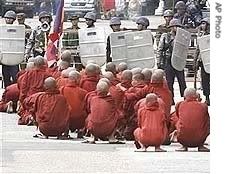
The Burmese military government's grip on the political situation is growing steadily tighter. The streets of Rangoon were reported quiet Sunday, while the government announced scores more arrests in its crackdown on pro-democracy demonstrations. The government's stranglehold on communications with the outside world is also continuing.
The Burmese military government said Sunday that 78 more people were taken for questioning in connection with mass protests over the last two weeks.
The number of police was meanwhile reported to have decreased, and barricades were taken down, near Rangoon's Shwedagon and the Sule Pagoda - two religious sites where protests had been staged and police fired on demonstrators.
The Internet played a key role in getting information and images to the outside world during the early days of the protests and the crackdown, but the government soon clamped down on Internet access.
An Internet café owner in Rangoon who declined to allow his name to be used told VOA the Internet is only available during the middle of the night, when there is a curfew in effect and it is illegal to be on line.
He says the city has been without Internet for nine or 10 days, though sometimes there is a very slow connection from 10 at night until four in the morning. He says he expects the Internet blackout to be lifted Monday, but nothing is certain.
The government meanwhile says more than 12 hundred people detained for their part in the protests in Rangoon have been released, about half of them Buddhist monks, after they pledged not to demonstrate again.
The military says 135 monks remain in custody, but diplomats and dissident groups say the number of detainees is probably closer to six thousand.
Outside the country, protests and an ongoing diplomatic debate at the United Nations over the Burmese government's actions are continuing.
On Saturday, thousands of demonstrators gathered in London, with smaller protests in cities around the world including Sydney, Stockholm, Paris, Washington D.C., and Bangkok.
A second day of protests here in Bangkok drew about 300 people to the Burmese embassy Sunday. Thailand is home to hundreds of thousands of Burmese exiles and migrant workers.
Britain, France and the U.S. have circulated a draft resolution at the U.N. Security Council calling on Burma's government to free political prisoners and open talks with dissident leaders.
The document would not be legally binding, but the Burmese government may take notice if the statement were approved by China, which is one of Burma's main trading partners and arms suppliers.
Up to now, China, along with Russia, has been opposed to any action against Burma by the U.N. Security Council.
Sunday, October 7, 2007
| [+/-] |
Crackdown Continues in Burma, Diplomatic Debate Rages Abroad |
Wednesday, October 3, 2007
| [+/-] |
It's the Oil and Gas, Stupid |
World leaders may be condemning the junta's crackdown, but foreign businesses don't want to lose their pieces of Burma's energy pie. Why the latest sanctions are unlikely to work.
At Newsweek, Melinda Liu writes:
Analysts describe it as the Burmese paradox: How can the rulers of a country so rich in energy, teak, minerals and gems be in such financial trouble? Even as it sits on top of 19 trillion cubic feet of natural gas and billions of barrels of crude oil reserves, the junta had to abruptly hike fuel prices so high in August that it triggered the popular uprising led by Buddhist monks.
Part of the explanation is simply bad governance. The Burmese regime is so arrogant—and inept—that it doesn’t expect citizens to rebel even when they watch their hard-won savings disappear overnight. That’s what happened in the summer of 1988, when the regime's surprise demonetization of the local currency, the kyat, meant a lot of money was suddenly not worth the paper it was printed on. (The kyat has a story all its own: on an astrologer’s advice, former Burmese strongman U Ne Win decided the currency should be denominated in multiples of nine, because 9 was a much more auspicious number than 10. As a result 45- and 90-kyat notes still circulate in Burma alongside multiples of 5 and 10. One gauge of the dire economic situation in Burma is the fact that the official exchange rate is 6 kyat to the U.S. greenback, while the unofficial rate is more like 1,350)
But there’s a more important reason for Burma’s predicament. Before the 1962 coup that installed a military regime in power, Burma had one of Southeast Asia’s highest standards of living. It boasted a well-educated intellectual class. It was one of the world biggest exporters of rice. But today, the country’s infrastructure is so decrepit that the regime cannot adequately exploit its own resources without outside help. Despite the country's lucrative oil and gas sectors, the domestic refining industry is a mess due to half a century of mismanagement, lack of investment and neglect. Local refineries aren’t suited to processing the high sulfur content in Burmese oil. As a result, the government has to import nearly all of its diesel, to the tune of nearly 20,000 barrels daily by 2004.
Combine that hunger with today’s high prices, and you can easily see how the need to import diesel could help prompt a price rise. This wasn’t the first time the regime imposed such a hike, either; two years ago fuel prices shot up ninefold. You don’t have to be a rocket scientist—actually Burma’s junta supremo Than Shwe is a former postal clerk—to know people might be mad about the abrupt Aug. 15 doubling of diesel prices and fivefold increase in the cost of compressed natural gas, a hike passed on to passengers using public transport. Or, indeed, that it’s bad PR to throw a lavish wedding ceremony for your daughter—as Than Shwe did—showing how the gem-encrusted elite parties on (while one in three Burmese children is malnourished, according to the World Food Program).
But the excesses don’t stop there. Paranoia has something to do with why the junta is cash-strapped. The nonsensical transfer in November 2005 of government offices to the new administrative capital of remote Naypyidaw, in a jungly wasteland 300 kilometers (about 190 miles) from Rangoon (apparently to boost government secrecy), is believed to have cost hundreds of millions of dollars. Then, to help compel disgruntled civil servants to go along with the move, the government raised their pay 500 percent. For its part, Burma’s 375,000-man Army—key to the junta’s survival—got a tenfold pay raise. And then there's the construction of another big-ticket item called “the Yadanabon Silicon Valley cyber-city.” This from a regime that’s trying to pull the plug on the Internet in a bid to prevent images of its repression from reaching the outside world.
Burma’s economic picture would be depressing enough without the involvement of Big Oil. One of the key reasons why sanctions against the regime are unlikely to work is because the junta's foreign partners hope to maintain business as usual. Foreign firms have been scrambling for a piece of Burma's oil and gas industry since the regime liberalized investment rules in 1988.
These are not obscure players or small-time plays. Burmese natural gas, worth $2.8 billion, generates one fifth of Thailand’s electricity. China wants to build pipelines and roads through Burma that would allow its oil imports to bypass vulnerable chokepoints in the Malacca Straits, which could be blocked by the U.S. Navy in the event of Sino-U.S. tensions.
State-run Chinese firms are also bidding for contracts in Burmese gas fields, as are South Korean and Indian competitors. India’s oil minister, Murli Deora, was present in Rangoon for energy cooperation talks with junta leaders when antigovernment protests broke out last month. Burma’s partners aren’t all Asian either. When earlier European Union and U.S. economic sanctions were levied against Burma, Total of France and Chevron remained involved in the Yadana gasfield. (At the time, existing investments were exempt; Chevron has a 28 percent stake because of its takeover of Unocal, Total’s original partner.)
Now we hear that the EU has just toughened its sanctions against Burma, expanding the visa bans for junta leaders and suspension of some imports such as timber and gems. But such measures—similar to those announced last week by the United States—will be toothless unless key oil and gas firms climb onboard. Today French Foreign Minister Bernard Kouchner hinted that Total—which extracts more than 17 million cubic meters of natural gas daily from its Burmese fields, according to its corporate Web site—“will not be exonerated” from post-crackdown sanctions. Total officials have argued that the firm has made no new capital expenditures in Burma since 1998 and that any “forced withdrawal” by Total would simply pave the way for rivals to take its place. Which is why China, Thailand, India and Russia have been muted in their condemnation of Burma’s recent bloodletting. They may hate the junta’s repression, but they love the thought of biting off a bigger piece of Burma’s energy pie.
Friday, September 28, 2007
| [+/-] |
Journalists Struggle as Burma Internet Access Cut |
PM broadcast [MP3; text transcript]:
MARK COLVIN: It's a truism about the internet that, like the human body, it reacts to damage by creating pathways around it.
But in the case of Burma, where the country's main internet pipeline has actually been cut today, that may take a while.
Hours after the Internet stoppage became obvious, a Burmese official is now claiming that "the Internet is not working because the underwater cable is damaged".
But it's not just the cable. By a strange coincidence, an official at a Thai telecom that provides satellite services to Burma says it appears that internet services inside the country are down as well.
Since the Burmese military government won't let journalists in to see what's happening for themselves, those, like our Correspondent Karen Percy in Bangkok, who are trying to gain information from afar, are finding it even harder.
Karen joins me now.
But, Karen, I gather that some information, even with the internet down, is starting to leak out?
KAREN PERCY: Yes, we're starting to get some stories come across the wires. New video has also appeared. CNN has just showed some video. It is from yesterday, but apparently we are … there has been some way that the various people who've been feeding out information have been able to get around these restrictions.
We're in fact hearing that shots have been fired in Rangoon. We cannot confirm this at this stage. There are reports of hundreds or thousands, depending on who you believe, of crowds in the city, but we do know that also, going on what has happened in the past couple of days, that the security forces will be on the lookout for anybody breaching the various bans that the Junta has put on on gatherings and the like.
We are also hearing, via some internet websites, that troops are on their way to the city, troops … divisions from central Burma are on their way to Rangoon.
Now, there is an extraordinary … some speculation going on. In fact, a couple of these divisions may well be preparing to retaliate against the troops who are already in Rangoon.
I do stress this is unconfirmed, it is speculation, but I will also say that a lot of the rumours and speculation that we have heard over this past week or so have turned out to be true, but I will still caution, I guess, what is going on there. We're also hearing of military aircraft activity.
So there's certainly a sense that the Junta, there's activity, military activity, and the protesters are active again today. So confrontation of some sort is inevitable.
MARK COLVIN: Military aircraft activity, is that coming, for instance, from the … from surveillance by, from outside? Is it coming from the Thai Air Force or anything like that?
KAREN PERCY: I'm not sure where the … it's popping up on one of the various websites that are monitored by activists on the outside. Where they're getting their information, I don't know. I guess that they're hearing from people on the inside that there is military activity. As to where it's coming from, I don't know. But if aircraft are up and about, then that would signal something major is going on.
MARK COLVIN: And what about what we've been able to glean about yesterday? We already have heard the Australian ambassador saying the death toll is probably well above what the military government is saying. What else can we find out about yesterday?
KAREN PERCY: Well, new pictures have appeared. CNN has just played some new pictures, apparently shot from a rooftop of some sort, looking down onto where the protesters were yesterday, and seeing I think it would be the Japanese photographer video journalist, you see him in the distance, a soldier very close to him, I think it's him being shot pretty much at point-blank range. There is another person who goes down in front of him, just a few seconds before.
The crowd is quite large, so certainly the information we're getting in terms of the fact that there is still a resolve by people seems to be there, but that also the military is certainly not just firing into the air. They seem to be firing with an intent to, if not kill, then maim.
There are some other …
MARK COLVIN: But, by the way, with the Japanese photographer, I think the Burmese military claimed that it was just a ricochet, but you say the video makes it pretty clear that it's nothing of the sort.
KAREN PERCY: Well, this particular video, if it matches up with the video that the Japanese have also got, then I think yes, it certainly shows he's very close. But even the still that I have seen on a Japanese website shows a soldier … shows the journalist lying on the floor and a soldier maybe two metres away from him, standing, looking at him. Nobody else is around.
So it would appear to me that yes there was a deliberate, and that's certainly been what the various reports on websites has been saying as well.
But again, you know, we need to be very careful here. It's hard to make judgement calls because there is so little information.
But we area also getting information from the Asian Human Rights Commission that is saying that it has heard of eight people being killed in a suburb of Rangoon yesterday, that there were …
So, and also we were talking earlier about reports of activity at a school at Rangoon, we think this morning, where a student might've been killed.
MARK COLVIN: Karen Percy, thank you very much. Karen Percy in Bangkok.
