Southeast water shortage a factor in huge cooling requirements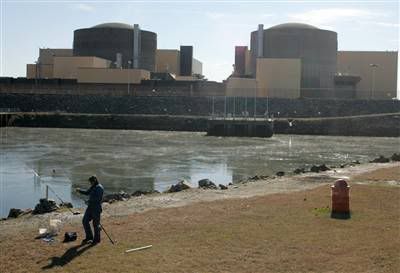
MSNBC reports:
Nuclear reactors across the Southeast could be forced to throttle back or temporarily shut down later this year because drought is drying up the rivers and lakes that supply power plants with the awesome amounts of cooling water they need to operate.
Utility officials say such shutdowns probably wouldn’t result in blackouts. But they could lead to shockingly higher electric bills for millions of Southerners, because the region’s utilities could be forced to buy expensive replacement power from other energy companies.
Already, there has been one brief, drought-related shutdown, at a reactor in Alabama over the summer.
“Water is the nuclear industry’s Achilles’ heel,” said Jim Warren, executive director of N.C. Waste Awareness and Reduction Network, an environmental group critical of nuclear power. “You need a lot of water to operate nuclear plants.” He added: “This is becoming a crisis.”
An Associated Press analysis of the nation’s 104 nuclear reactors found that 24 are in areas experiencing the most severe levels of drought. All but two are built on the shores of lakes and rivers and rely on submerged intake pipes to draw billions of gallons of water for use in cooling and condensing steam after it has turned the plants’ turbines.
Because of the yearlong dry spell gripping the region, the water levels on those lakes and rivers are getting close to the minimums set by the Nuclear Regulatory Commission. Over the next several months, the water could drop below the intake pipes altogether. Or the shallow water could become too hot under the sun to use as coolant.
“If water levels get to a certain point, we’ll have to power it down or go off line,” said Robert Yanity, a spokesman for South Carolina Electric & Gas Co., which operates the Summer nuclear plant outside Columbia, S.C.
Limits on intake pipes
Extending or lowering the intake pipes is not as simple at it sounds and wouldn’t necessarily solve the problem. The pipes are usually made of concrete, can be up to 18 feet in diameter and can extend up to a mile. Modifications to the pipes and pump systems, and their required backups, can cost millions and take several months. If the changes are extensive, they require an NRC review that itself can take months or longer.
Even if a quick extension were possible, the pipes can only go so low. It they are put too close to the bottom of a drought-shrunken lake or river, they can suck up sediment, fish and other debris that could clog the system.
An estimated 3 million customers of the four commercial utilities with reactors in the drought zone get their power from nuclear energy. Also, the quasi-governmental Tennessee Valley Authority, which sells electricity to 8.7 million people in seven states through a network of distributors, generates 30 percent of its power at nuclear plants.
While rain and some snow fell recently, water levels across the region are still well below normal. Most of the severely affected area would need more than a foot of rain in the next three months — an unusually large amount — to ease the drought and relieve pressure on the nuclear plants. And the long-term forecast calls for more dry weather.
Lakes nearing their minimums
At Progress Energy Inc., which operates four reactors in the drought zone, officials warned in November that the drought could force it to shut down its Harris reactor near Raleigh, according to documents obtained by the AP. The water in Harris Lake stands at 218.5 feet — just 3½ feet above the limit set in the plant’s license.
Lake Norman near Charlotte is down to 93.7 feet — less than a foot above the minimum set in the license for Duke Energy Corp.’s McGuire nuclear plant. The lake was at 98.2 feet just a year ago.
“We don’t know what’s going to happen in the future. We know we haven’t gotten enough rain, so we can’t rule anything out,” said Duke spokeswoman Rita Sipe. “But based on what we know now, we don’t believe we’ll have to shut down the plants.”
During Europe’s brutal 2006 heat wave, French, Spanish and German utilities were forced to shut down some of their nuclear plants and reduce power at others because of low water levels — some for as much as a week.
If a prolonged shutdown like that were to happen in the Southeast, utilities in the region might have to buy electricity on the wholesale market, and the high costs could be passed on to customers.
“Currently, nuclear power costs between $5 to $7 to produce a megawatt hour,” said Daniele Seitz, an energy analyst with New York-based Dahlman Rose & Co. “It would cost 10 times that amount that if you had to buy replacement power — especially during the summer.”
At a nuclear plant, water is also used to cool the reactor core and to create the steam that drives the electricity-generating turbines. But those are comparatively small amounts of water, circulating in what are known as closed systems — that is, the water is constantly reused. Water for those two purposes is not threatened by the drought.
Instead, the drought could choke off the billions of gallons of water that pass through the region’s reactors every day to cool used steam. Water sucked from lakes and rivers passes through pipes, which act as a condenser, turning the steam back into water. The outside water never comes into direct contact with the steam or any nuclear material.
At some plants — those with tall, Three Mile Island-style cooling towers — a lot of the water travels up the tower and is lost to evaporation. At other plants, almost all of the water is returned to the lake or river, though significantly hotter because of the heat absorbed from the steam.
Progress spokeswoman Julie Hahn said the Harris reactor, for example, sucks up 33 million gallons a day, with 17 million gallons lost to evaporation via its big cooling towers. Duke’s McGuire plant draws in more than 1 billion gallons a day, but most of it is pumped back to its source.
Nuclear plants are subject to restrictions on the temperature of the discharged coolant, because hot water can kill fish or plants or otherwise disrupt the environment. Those restrictions, coupled with the drought, led to the one-day shutdown Aug. 16 of a TVA reactor at Browns Ferry in Alabama.
The water was low on the Tennessee River and had become warmer than usual under the hot sun. By the time it had been pumped through the Browns Ferry plant, it had become hotter still — too hot to release back into the river, according to the TVA. So the utility shut down a reactor.
David Lochbaum, nuclear project safety director for the Union of Concerned Scientists, warned that nuclear plants are not designed to take the wear and tear of repeatedly stopping and restarting.
“Nuclear plants are best when they flatline — when they stay up and running or shut down for long periods to refuel,” Lochbaum said. “It wears out piping, valves, motors.”
Both the industry and NRC spokesman Scott Burnell said plants can shut down and restart without problems.
Wednesday, January 23, 2008
| [+/-] |
Drought Could Shut Down Nuclear Power Plants |
Thursday, January 10, 2008
| [+/-] |
Failure To Launch |
Inside the Bush administration's dream of resurrecting the nuclear weapons complex—and the old-school Republican congressman who stood in its way
In the January/February 2008 issue of Mother Jones, James Sterngold writes:
Representative Dave Hobson is a Republican in the old mold. Stocky, silver-haired, and congenial, the 71-year-old Ohio congressman is a fiscal hawk and a gun-rights supporter but has no truck with the religious right. He works hard in the legislative trenches tending to the arc of suburban and rural counties near Columbus that he's represented since 1991. Like his home territory, the legislative terrain Hobson occupies is solid if unexciting; he's the guy you might catch on C-SPAN picking through a military construction bill.
Two things color Hobson's views on policymaking: his success as a small businessman—he became wealthy from commercial real estate—and the four military bases in his home district. He is strong on defense, but in a nuts-and-bolts, look-after-the-troops way. He's proud of his efforts to privatize military housing, for instance, and his fight to get more armored Humvees to the troops in Iraq. (He's been there several times.) He also believes in tight budgets—a sign on his desk reads, "It's the national debt, stupid"—though he isn't dogmatic about it.
"Dave's a businessman who also happens to be a politician," says John Kasich, a powerful former Ohio congressman and Fox News commentator who is one of Hobson's closest friends. "Dave's not anti-pork, believe me, but the spending has to make sense." Hobson frequently won't sign off on a measure unless it has, in a phrase he often uses, "a business plan"—a clear set of achievable goals and a sensible way of reaching them.
Which is why this respected conservative has emerged, to his own surprise, as one of the toughest opponents of the Bush administration's extraordinarily ambitious attempts to expand the nation's nuclear weapons complex. The irony is that Hobson strongly believes the United States should have a state-of-the-art nuclear capability and a credible nuclear deterrent; he's even crafted a program that he believes would ensure this. Yet on nuclear policy, he says, President Bush has committed a cardinal legislative sin: putting forth grand ideas without a business plan or even a coherent notion of their impact on national security.
But that isn't what most disturbs Hobson. During conversations in his House office, decorated with military mementos—flags, a musket, an Army helmet, mounted swords and scabbards—the otherwise easygoing congressman becomes stern, even angry, as he recounts the White House's record of outright dissembling and abysmal planning. His complaints evoke the familiar criticisms of the president's handling of the war in Iraq. But, Hobson says, his experience was particularly troubling because it involved a debate about real weapons of mass destruction—perhaps the most sensitive security issue facing any president. Once a true believer, Hobson has come to a stark conclusion about the administration's approach to nuclear weapons: "They lied."
Shortly after he became chairman of the House Appropriations Subcommittee on Energy and Water Development in early 2003, Hobson came across a curious item in the proposed budget for the nation's nuclear weapons program. (As part of the Department of Energy, the program fell under the subcommittee's purview.) At the time, Hobson admits, he didn't know much about this dense, sobering subject. "Only senators were supposed to get involved in nuclear weapons issues," he explains. But he was ready to influence an issue larger than the opening of a new veterans clinic in his district. Ever confident in his ability to wield a sharp red pencil, he settled down with the $6 billion weapons budget.
The item that gave him pause was something called the Modern Pit Facility, a proposed factory for manufacturing a critical nuclear weapons component—grapefruit-sized, hollow plutonium spheres that are encased in high explosives to form the triggers of thermonuclear bombs. Even with 6,000 warheads deployed, more than 4,000 kept in reserve, and thousands of additional pits in storage, the Bush administration was insisting that a new pit production line was essential for upgrading the stockpile.
Hobson was worried that restarting pit production might push countries like Iran and North Korea to speed up their nuclear efforts, or even prod Russia and China to boost their warhead programs. More than that, though, the proposal's sheer scale and redundancy bothered him. For years, the nation's weapons labs had certified that the existing stockpile was in perfect working order, and weapons planners said they needed only small numbers of new pits for making specialized warheads.
Pit production had stopped in 1989 when the government's plant in Rocky Flats, Colorado, was shuttered due to major safety lapses and leaks of plutonium and other lethal materials. President Bush himself had declared that he wanted to shrink the nuclear stockpile to a minimum, and had recently negotiated with Russia to slash each country's deployed warheads by more than half—to 2,200 or fewer—by 2012. Yet the Modern Pit Facility would fabricate as many as 450 pits a year—roughly the same number being produced during the 1980s, in the era of mutually assured destruction.
Hobson voiced his concerns to Linton Brooks, the newly appointed head of the National Nuclear Security Administration (NNSA), an Energy Department unit that oversees the weapons complex.
"I said, 'First of all, I don't think you need 450 pits a year,'" Hobson recalls. "What kind of signal does that send to all these other countries? Second of all, I didn't think we had that kind of money."
Sensing that the nuclear priesthood was not going to take direction from a small-town congressman, Hobson was not prepared for a cakewalk. And yet, "without any consultations or questions, they just came back to us and said, 'Okay, we don't need that capacity. We'll cut it,'" says Hobson. "I thought, 'Gosh, this is an easy job.'"
Today, Brooks says that the administration was never actually set on fabricating 450 pits a year. "It was the high end of the range," he says.
For Hobson, though, this unexpected reversal was an epiphany. "These were nuclear weapons we were talking about, and they hadn't given it more thought than that?"
Few of the ideological blueprints from the foreign-policy hawks who swept into office with George W. Bush were as ambitious as those for reenergizing the idle nuclear weapons production complex. The United States still had its massive Cold War arsenal, but the bombs' role in defense planning was waning. Nuclear weapons were the ultimate dumb bombs, so indiscriminately destructive that many military planners regarded them as largely useless. During the Clinton years, some officials had even argued for their abolition, though the hawks prevailed and set up an expensive "stockpile stewardship" program to maintain the weapons and nourish the politically influential weapons labs.
In early 2001, the National Institute for Public Policy, a right-leaning think tank, issued a policy paper by a group of prominent neoconservatives who argued for a radical new strategy. The United States might be able to make do with a smaller nuclear force, they said, but it urgently needed new types of warheads for specialized missions such as destroying deeply buried bunkers.
But the real novelty of the proposal was its rationale: New warheads were required not to deal with specific threats such as the Soviet Union, but to prepare for unknown threats that might one day materialize. It was a "what if" strategy, a dramatic example of the neoconservative mantra that American military power needs to be essentially unfettered and boundless.
Three months after 9/11, the Bush administration issued a new Nuclear Posture Review, a sweeping policy statement that radically redefined nuclear strategy precisely along the lines urged by the National Institute for Public Policy. (The document was classified, but large portions were leaked.) This was not surprising, since six of the think-tank study's authors had assumed key positions in the new administration, including then-deputy national security adviser Stephen Hadley, DOD deputies Stephen Cambone and Keith Payne, and NNSA head Brooks.
The new policy fully embraced the "what if" doctrine. No expense would be spared in creating a "revitalized defense infrastructure." No longer would nuclear bombs be kept in reserve as history-altering weapons of last resort; the new nuclear ideologues were envisioning a strategy in which low-kiloton nuclear bombs could be used as actual war-fighting tools, a means—they claimed—of deterring the likes of Iraq, Iran, and North Korea.
A year and a half later, the Republican-controlled Congress repealed the part of the 1993 Spratt-Furse amendment that had prohibited research on weapons with a yield of less than five kilotons (roughly a third as powerful as the bomb dropped on Hiroshima). It appropriated hundreds of millions of dollars for refurbishing warheads and researching so-called bunker busters as well as new types of smaller warheads labeled "advanced concepts." There were even suggestions that the administration might lift the ban on underground testing put in place by the first President Bush in 1992, widely regarded as one of the most important nonproliferation measures of the past two decades.
The more Rep. Hobson learned about this ambitious nuclear vision, the more he saw the administration's efforts as an ill-advised prelude to a new arms race. Eventually, he approved the funding, but he inserted requirements that limited advanced concepts to the drawing board and insisted that the entire enterprise be subject to close congressional oversight. "We thought it was going to be just a research type of thing," he says.
The NNSA and the labs heard a different message. In December 2003 Brooks wrote to the heads of the Lawrence Livermore, Los Alamos, and Sandia nuclear labs, telling them they were now "free to explore a range of technical options...without any concern that some ideas could inadvertently violate a vague and arbitrary limitation." Hobson got a copy of the letter, and his heart sank. "I'd been had," he says.
Hobson was growing skeptical, but he had not lost his faith in the administration. It would take the bunker-buster debacle to change that.
The idea behind the Robust Nuclear Earth Penetrator (RNEP) was to use nuclear weapons to destroy subterranean bunkers where Kim Jong Il or Saddam Hussein might conceal command centers or caches of WMD. In theory, by detonating a low-kiloton bomb underground, it would be able to crush a reinforced target buried hundreds of feet beneath the surface, and its blast would be contained—making it more like a precision munition than a doomsday weapon.
The Bush administration decided that it needed bunker busters that were more accurate and could go deeper than existing "earth penetrators," specially modified warheads that can burrow no more than 20 feet into hard rock.
There was just one problem: Every independent assessment found that a new generation of bunker busters could not possibly perform as hoped. A March 2003 article in Arms Control Today by a group of respected nuclear weapons advisers concluded that no bomb could penetrate more than 50 feet without destroying the warhead itself, and that crushing a hardened bunker 1,000 feet underground would require an explosion of more than 100 kilotons—seven times the size of the Hiroshima bomb. Even a one-kiloton bomb, detonated at 20 to 50 feet down, "would eject more than 1 million cubic feet of radioactive debris from a crater about the size of ground zero at the World Trade Center." A report issued by the National Academy of Sciences concluded that instead of vaporizing any biological or chemical agents inside the bunker, the blast actually might disperse them.
"Technically you can't go deep enough to contain the blast," says Bruce Tarter, the former head of the Livermore lab and a member of the National Academy of Sciences panel. "It was not even close under any circumstance one can imagine. It didn't have technical or military credibility."
Such scientific concerns reinforced Hobson's skepticism of the new bombs. "The physics of it didn't work and they sent the wrong signal to the world," he says. "It gave people a lot of reasons to build their own weapons."
He also found it puzzling that while civilian Pentagon officials were clamoring for the new weapon, their uniformed colleagues seemed uninterested in it. Hobson visited the headquarters of the U.S. Strategic Command in Omaha, the nuclear-war nerve center, to see what its staff would say about the concept. "They never mentioned it, like it just didn't matter," he recalls. In October 2004, he convinced his subcommittee to kill funding for the bunker buster. The message to the White House, he thought, was clear.
A few weeks later, one of the subcommittee's senior staffers, Scott Burnison, stumbled upon a routine work authorization from the Sandia weapons lab showing that researchers there were spending thousands of dollars building a concrete wall for a crash test of the RNEP's hardened shell. Hobson was furious. He called Energy secretary Samuel Bodman and demanded that the test be stopped.
"They tried to go around me," he says, still visibly angry about it. "They lost their credibility." Brooks confirms the episode, but says the administration saw the test as harmless background research: "It never occurred to us that this would be an issue." Hobson, he insists, "overreacted."
By now, news of Hobson's failure to rubber-stamp the administration's agenda was getting attention at the top. Defense secretary Donald Rumsfeld summoned Hobson to see him, alone; the congressman politely replied that he would only come with key aides.
On March 15, 2005, Hobson and two subcommittee staffers sat down for a breakfast meeting at the Pentagon. Waiting for them were Rumsfeld and Bodman, as well as General Joseph Cartwright, the head of the Strategic Command, and a phalanx of senior defense officials. Rumsfeld, according to several of those who attended, was calm but insistent: The Pentagon needed the bunker buster, and it was going to get it—one way or another.
Recalls Hobson, in an account confirmed by others, "I said to him, 'Look, you're not going to be able to do this, and if you want to take this to a vote and embarrass the president of the United States, fine. I'll beat you. Because one thing I do know how to do is count votes.' Rumsfeld said, 'Bah, you might win this year but you won't win next year.' And I said, 'We'll see.'"
"Here's the thing you've got to know about Dave," explains Kasich, Hobson's former Ohio colleague. "I've never met anyone more interested in encouraging other people's success. But if you screw with him, that's a big mistake. And they misled him. They treated him like any other congressman. He isn't any other congressman."
Despite Rumsfeld's show of obstinacy, Hobson succeeded in killing the bunker buster, as well as the advanced concepts program. He was still irked, though. The president had gone to war in Iraq, in part, to shut down Saddam Hussein's purported nuclear weapons program, and one of the few things that Bush and John Kerry agreed on in the 2004 campaign was that nuclear proliferation and nuclear terrorism were the gravest threats facing the country. Yet the administration's weapons policies seemed likely to make proliferation worse while actually accomplishing very little in terms of revitalizing the American weapons complex.
Linton Brooks, a respected master of weapons minutiae, now acknowledges that he was sent out to sell the bunker buster with little planning and almost no official backing. "It seems hard to imagine we could be so dumb," he says, "but we thought of this as not particularly contentious." He says that he was ordered to follow a contradictory script that left him, the administration, and its nuclear weapons policy tied in knots.
Brooks still believes in the administration's overall goals, but he is sympathetic to Hobson's sense that its policy was adrift. "RNEP was a throwaway program," he says. By the time the bunker buster and advanced concepts were killed, Brooks concedes, "I don't know that we had a plan" for what would be done instead.
Hobson was convinced he should step into the vacuum and design the coherent nuclear policy the White House had failed to deliver. So he gathered the support of a few key members of Congress and slipped a single sentence into a conference report on the 2005 energy appropriations bill, taking the $9 million once reserved for advanced concepts to create something called the Reliable Replacement Warhead (RRW) program, which would improve "the reliability, longevity, and certifiability" of the existing nuclear stockpile. It was the most significant new nuclear weapons initiative since the end of the Cold War, snuck into law like an unassuming earmark.
As Hobson conceived it, the RRW program would provide both cost savings and a comprehensive arms-control policy. Since the end of the Cold War, billions of dollars had been spent on maintenance and piecemeal fixes for the nation's warheads. Hobson wanted the labs to come up with safer, more modern, and more durable weapons. In addition, he wanted to refurbish the production complex by consolidating and modernizing some of its far-flung facilities.
This was a minimalist policy, and it would result in significant arms reductions. Deploying more reliable weapons would reduce the need for the thousands of warheads that are currently kept as backups. Perhaps most important, the redesigned warheads would have no new capabilities such as bunker busting, making them less provocative to other countries. Hobson also insisted that there would be no underground testing. "I wanted to make sure that nobody could play around with these things and come up with new capabilities," he says. "You just knew they wanted to."
Sure enough, the weapons complex and the administration saw Hobson's RRW plan as an open-ended mandate for many new generations of weapons. In congressional testimony last spring, a senior official outlined 11 major aims for the program; the Congressional Research Service has counted 20. Yet as its nuclear wish list became ever more bloated, the administration never gave Hobson the details he demanded—precisely how many warheads it wanted to build, what types, or what they would cost.
To fill in some of the blanks, Hobson had insisted that the Energy Department set up a task force to examine the nation's nuclear weapons infrastructure. After months of research, the team, which was chaired by scientist and defense consultant David Overskei, released a detailed report that affirmed Hobson's vision of modernization, cost cutting, and consolidation. But here too the NNSA and the labs appeared to embrace the blueprint for downsizing, only to hijack it as a call for an expanded weapons complex.
Philip Coyle, a former senior weapons official at the Pentagon and Livermore, and now an adviser at the Center for Defense Information, says that, in hindsight, the nuclear complex was motivated by self-preservation. "I think they saw RRW as a path to a more sustainable future when they weren't sure if they had much of a future," he says. "They got carried away without thinking through the arms-control implications." The wasted opportunity for change still has Overskei feeling bitter. The administration, he says, "has no policy on nuclear weapons. That is the crux of the whole problem."
Today, the Bush administration's nuclear ambitions have unraveled. Following a string of security and safety lapses at the weapons labs, Brooks was fired last January. In April, an expert analysis by the American Association for the Advancement of Science destroyed nearly every claim the White House made for its version of the Reliable Replacement Warhead program, observing dryly that "it does not respond to a new military capability or mission need." The report said the old warheads and their plutonium pits may last longer than expected—contrary to one of the administration's arguments for why they urgently needed to be replaced. In May, the replacement warhead program budget was zeroed out by Hobson's subcommittee, now chaired by a Democrat, Pete Visclosky of Indiana.
Paradoxically, the Bush administration's nuclear misadventure has done something that even the collapse of the Soviet Union did not accomplish: opening nuclear disarmament for debate among foreign-policy conservatives. Recent reports from the Defense Threat Reduction Agency and the Sandia lab have concluded that a new nuclear program could encourage proliferation and harm American credibility on arms control. Earlier last year, George Shultz, William Perry, Henry Kissinger, and Sam Nunn—all former Cold War hawks—wrote an essay for the Wall Street Journal urging the United States to lead a new disarmament initiative. "Reassertion of the vision of a world free of nuclear weapons and practical measures toward achieving that goal would be, and would be perceived as, a bold initiative consistent with America's moral heritage," they wrote.
Its plans thwarted, the administration has resorted to bullying. In July, the secretaries of Energy, Defense, and State issued a statement urging quick funding of the RRW program, warning that any delays could force a resumption of underground testing. Hobson and Visclosky wrote an angry letter rejecting the threat as "irresponsible." (The Senate kept the program alive, but with reduced funding.)
For his part, Brooks seems mystified by how badly the administration has handled nuclear weapons policy. Talking at length at a diner near his home in Virginia, he recalls how, as the chief American arms control negotiator in 1991, he concluded the final draft of the Strategic Arms Reduction Treaty, a 700-page document nine years in the making that all but ended the arms race with the Soviet Union. "It was on the front page of the New York Times when we signed it in July," he says. "By Christmas the country I signed it with was gone and I never saw it coming." Watching Bush's nuclear weapons program run off course was just as startling, he says.
"I do think the White House was absent," Brooks says. "There's no organizational focus on nuclear issues today. I've been complaining about that for some time."
Hobson, who plans to retire in 2009, agrees that the real problem with Bush's nuclear policy—once it came to shaping reasonable, practical plans, as opposed to making grand promises—was simple neglect. From the dawn of the nuclear era more than six decades ago, every administration, whether in peaceful or violent times, has maintained a solemn focus on its policies for the only weapon that can end civilization. But not this one.
Hobson observes that even as he blocked the White House's rearmament efforts, he never faced consistent pressure from the administration or the Republican leadership to fall in line. "The president of the United States knows me well enough that if he was concerned about what I had been doing, he would have gotten me on the plane and gotten in my face," says Hobson. "He never did anything. Nobody called."
Saturday, November 17, 2007
| [+/-] |
U.S. Secretly Aids Pakistan in Guarding Nuclear Arms |
The NY Times reports:
Over the past six years, the Bush administration has spent almost $100 million so far on a highly classified program to help Gen. Pervez Musharraf, Pakistan’s president, secure his country’s nuclear weapons, according to current and former senior administration officials.
But with the future of that country’s leadership in doubt, debate is intensifying about whether Washington has done enough to help protect the warheads and laboratories, and whether Pakistan’s reluctance to reveal critical details about its arsenal has undercut the effectiveness of the continuing security effort.
The aid, buried in secret portions of the federal budget, paid for the training of Pakistani personnel in the United States and the construction of a nuclear security training center in Pakistan, a facility that American officials say is nowhere near completion, even though it was supposed to be in operation this year.
A raft of equipment — from helicopters to night-vision goggles to nuclear detection equipment — was given to Pakistan to help secure its nuclear material, its warheads, and the laboratories that were the site of the worst known case of nuclear proliferation in the atomic age.
While American officials say that they believe the arsenal is safe at the moment, and that they take at face value Pakistani assurances that security is vastly improved, in many cases the Pakistani government has been reluctant to show American officials how or where the gear is actually used.
That is because the Pakistanis do not want to reveal the locations of their weapons or the amount or type of new bomb-grade fuel the country is now producing.
The American program was created after the Sept. 11, 2001, attacks, when the Bush administration debated whether to share with Pakistan one of the crown jewels of American nuclear protection technology, known as “permissive action links,” or PALS, a system used to keep a weapon from detonating without proper codes and authorizations.
In the end, despite past federal aid to France and Russia on delicate points of nuclear security, the administration decided that it could not share the system with the Pakistanis because of legal restrictions.
In addition, the Pakistanis were suspicious that any American-made technology in their warheads could include a secret “kill switch,” enabling the Americans to turn off their weapons.
While many nuclear experts in the federal government favored offering the PALS system because they considered Pakistan’s arsenal among the world’s most vulnerable to terrorist groups, some administration officials feared that sharing the technology would teach Pakistan too much about American weaponry. The same concern kept the Clinton administration from sharing the technology with China in the early 1990s.
The New York Times has known details of the secret program for more than three years, based on interviews with a range of American officials and nuclear experts, some of whom were concerned that Pakistan’s arsenal remained vulnerable. The newspaper agreed to delay publication of the article after considering a request from the Bush administration, which argued that premature disclosure could hurt the effort to secure the weapons.
Since then, some elements of the program have been discussed in the Pakistani news media and in a presentation late last year by the leader of Pakistan’s nuclear safety effort, Lt. Gen. Khalid Kidwai, who acknowledged receiving “international” help as he sought to assure Washington that all of the holes in Pakistan’s nuclear security infrastructure had been sealed.
The Times told the administration last week that it was reopening its examination of the program in light of those disclosures and the current instability in Pakistan. Early this week, the White House withdrew its request that publication be withheld, though it was unwilling to discuss details of the program.
The secret program was designed by the Energy Department and the State Department, and it drew heavily from the effort over the past decade to secure nuclear weapons, stockpiles and materials in Russia and other former Soviet states. Much of the money for Pakistan was spent on physical security, like fencing and surveillance systems, and equipment for tracking nuclear material if it left secure areas.
But while Pakistan is formally considered a “major non-NATO ally,” the program has been hindered by a deep suspicion among Pakistan’s military that the secret goal of the United States was to gather intelligence about how to locate and, if necessary, disable Pakistan’s arsenal, which is the pride of the country.
“Everything has taken far longer than it should,” a former official involved in the program said in a recent interview, “and you are never sure what you really accomplished.”
In recent days, American officials have expressed confidence that Pakistan’s nuclear arsenal is well secured. “I don’t see any indication right now that security of those weapons is in jeopardy, but clearly we are very watchful, as we should be,” Adm. Mike Mullen, chairman of the Joint Chiefs of Staff, told a Pentagon news conference on Thursday.
Admiral Mullen’s carefully chosen words, a senior administration official said, were based on two separate intelligence assessments issued this month that had been summarized in briefings to Mr. Bush. Both concluded that Pakistan’s nuclear arsenal was safe under current conditions, and one also looked at laboratories and came to the same conclusion.
Still, the Pakistani government’s reluctance to release information has limited efforts to assess the situation. In particular, some American experts say they have less ability to look into the nuclear laboratories where highly enriched uranium is produced — including the laboratory named for Abdul Qadeer Khan, the man who sold Pakistan’s nuclear technology to Iran, North Korea and Libya.
So far, the amount the United States has spent on the classified nuclear security program, less than $100 million, amounts to slightly less than one percent of the roughly $10 billion in known American aid to Pakistan since the Sept. 11 attacks. Most of that money has gone for assistance in counterterrorism activities against the Taliban and Al Qaeda.
The debate over sharing nuclear security technology began just before then-Secretary of State Colin L. Powell was sent to Islamabad after the Sept. 11 attacks, as the United States was preparing to invade Afghanistan.
“There were a lot of people who feared that once we headed into Afghanistan, the Taliban would be looking for these weapons,” said a senior official who was involved. But a legal analysis found that aiding Pakistan’s nuclear weapons program — even if it was just with protective gear — would violate both international and American law.
General Musharraf, in his memoir, “In the Line of Fire,” published last year, did not discuss any equipment, training or technology offered then, but wrote: “We were put under immense pressure by the United States regarding our nuclear and missile arsenal. The Americans’ concerns were based on two grounds. First, at this time they were not very sure of my job security, and they dreaded the possibility that an extremist successor government might get its hands on our strategic nuclear arsenal. Second, they doubted our ability to safeguard our assets.”
General Musharraf was more specific in an interview two years ago for a Times documentary, “Nuclear Jihad: Can Terrorists Get the Bomb?” Asked about the equipment and training provided by Washington, he said, “Frankly, I really don’t know the details.” But he added: “This is an extremely sensitive matter in Pakistan. We don’t allow any foreign intrusion in our facilities. But, at the same time, we guarantee that the custodial arrangements that we brought about and implemented are already the best in the world.”
Now that concern about General Musharraf’s ability to remain in power has been rekindled, so has the debate inside and outside the Bush administration about how much the program accomplished, and what it left unaccomplished. A second phase of the program, which would provide more equipment, helicopters and safety devices, is already being discussed in the administration, but its dimensions have not been determined.
Harold M. Agnew, a former director of the Los Alamos weapons laboratory, which designed most of the United States’ nuclear arms, argued that recent federal reluctance to share warhead security technology was making the world more dangerous.
“Lawyers say it’s classified,” Dr. Agnew said in an interview. “That’s nonsense. We should share this technology. Anybody who joins the club should be helped to get this.”
“Whether it’s India or Pakistan or China or Iran,” he added, “the most important thing is that you want to make sure there is no unauthorized use. You want to make sure that the guys who have their hands on the weapons can’t use them without proper authorization.”
In the past, officials say, the United States has shared ideas — but not technologies — about how to make the safeguards that lie at the heart of American weapons security. The system hinges on what is essentially a switch in the firing circuit that requires the would-be user to enter a numeric code that starts a timer for the weapon’s arming and detonation.
Most switches disable themselves if the sequence of numbers entered turns out to be incorrect in a fixed number of tries, much like a bank ATM does. In some cases, the disabled link sets off a small explosion in the warhead to render it useless. Delicate design details involve how to bury the link deep inside a weapon to keep terrorists or enemies from disabling the safeguard.
The most famous case of nuclear idea sharing involves France. Starting in the early 1970s, the United States government began a series of highly secretive discussions with French scientists to help them improve the country’s warheads.
A potential impediment to such sharing was the 1968 Nuclear Nonproliferation Treaty, which bars cooperation between nations on weapons technology.
To get around such legal prohibitions, Washington came up with a system of “negative guidance,” sometimes called “20 questions,” as detailed in a 1989 article in Foreign Policy. The system let United States scientists listen to French descriptions of warhead approaches and give guidance about whether the French were on the right track.
Nuclear experts say sharing also took place after the cold war when the United States worried about the security of Russian nuclear arms and facilities. In that case, both countries declassified warhead information to expedite the transfer of safety and security information, according to federal nuclear scientists.
But in the case of China, which has possessed nuclear weapons since the 1960s and is a signatory to the Nuclear Nonproliferation Treaty, the Clinton administration decided that sharing PALS would be too risky. Experts inside the administration feared the technology would improve the Chinese warheads, and could give the Chinese insights into how American systems worked.
Officials said Washington debated sharing security techniques with Pakistan on at least two occasions — right after it detonated its first nuclear arms in 1998, and after the terrorist attack on the United States in 2001.
The debates pitted atomic scientists who favored technical sharing against federal officials at such places as the State Department who ruled that the transfers were illegal under the Nuclear Nonproliferation Treaty and under United States law.
In the 1998 case, the Clinton administration still hoped it could roll back Pakistan’s nuclear program, forcing it to give up the weapons it had developed. That hope, never seen as very realistic, has been entirely given up by the Bush administration.
The nuclear proliferation conducted by Mr. Khan, the Pakistani metallurgist who built a huge network to spread Pakistani technology, convinced the Pakistanis that they needed better protections.
“Among the places in the world that we have to make sure we have done the maximum we can do, Pakistan is at the top of the list,” said John E. McLaughlin, who served as deputy director of the Central Intelligence Agency at the time, and played a crucial role in the intelligence collection that led to Mr. Khan’s downfall.
“I am confident of two things,” he added. “That the Pakistanis are very serious about securing this material, but also that someone in Pakistan is very intent on getting their hands on it.”
Sunday, November 11, 2007
| [+/-] |
Experts say, "Danger of Nuclear-Armed Iran May Be Hyped" |
At McClatchy, Warren P. Strobel writes:
A hostile country led by anti-American ideologues appears close to developing its first nuclear weapon and, as a U.S. election approaches, the president and his advisers debate a pre-emptive military strike. Newspaper columnists demand action to stop the nuclear peril.
The country was China, the year was 1963 and the president was Lyndon Baines Johnson.
Now it is Iran that is said to may be bent on acquiring nuclear arms, and President Bush who has declared that "unacceptable." Some U.S. officials and outside commentators are again pushing for a pre-emptive attack.
But the White House and its partisans may be inflating the dangers of a nuclear-armed Iran, say experts on the Persian Gulf and nuclear deterrence. While there are dangers, they acknowledge, Iran appears to want a nuclear weapon for the same reason other countries do: to protect itself.
Bush, by contrast, has suggested that a nuclear-armed Iran could bring about World War III. The president and his top aides, along with hawkish commentators, have suggested that Iran might launch a first strike on Israel or the United States, or hand nuclear weapons to terrorist groups Tehran supports.
There is "only one terrible choice, which is either to bomb those (Iranian nuclear) facilities and retard their program or even cut it off altogether, or allow them to go nuclear," Norman Podhoretz, a foreign policy adviser to GOP presidential candidate Rudy Giuliani, said last month.
"Would I like Iran to have a nuclear bomb? No," said Robert Jervis, a Columbia University professor of international politics who has written widely on nuclear deterrence. But, "the fears (voiced) by the administration and a fair number of sensible people as well, just are exaggerated. The idea that this will really make a big difference, I think is foolish."
Even some commentators in Israel, whose leaders see themselves in Iran's crosshairs, present a more nuanced view of the potential threat than the White House does.
An Iranian nuclear bomb could present Israel "with the real potential for an existential threat," Ephraim Kam of the Institute for National Security Studies in Tel Aviv wrote in February.
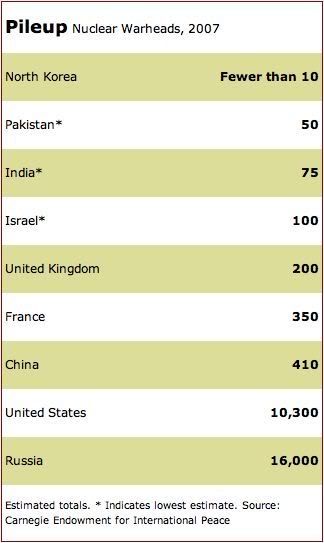
But Kam noted that Israel has its own unacknowledged nuclear deterrent — estimated at 100 to 200 warheads — larger than anything Iran could marshal for years to come.
Despite Iran's "messianic religious motivations," he wrote, "it is highly doubtful that Tehran would want to risk an Israeli nuclear response" by attempting a first strike.
Moreover, Iran, which says its nuclear research is aimed at generating electric power, is not thought to be close to having a nuclear weapon. In the worst-case scenario, it could have enough highly enriched uranium, a basic weapon ingredient in weapons, in two to three years.
The International Atomic Energy Agency is due to report next week on whether Iran has cleared up questions about its past nuclear work. The IAEA's judgment will influence whether the U.N. Security Council imposes new sanctions on Iran for failing to suspend uranium enrichment.
Bush administration officials insist that Iran is different from other countries that have sought and acquired nuclear weapons.
The world's known nuclear club is comprised of the United States, Russia, China, France, Britain, India, Pakistan, Israel and North Korea.
"Iran has been willing to share technology and arms with terrorists and inappropriate regimes, in the way these others haven't," said a senior administration official, speaking on condition of anonymity.
"The underlying facts of Iran and of nuclear weapons are different than these other cases," the official said. "I think they would behave differently."
In fact, U.S. ally Pakistan provided nuclear weapons technology to Iran and Libya, and North Korea has sold ballistic missiles in several Middle Eastern countries.
Iran's government is "a regime that is very aggressive in pursuit of its goals," added former undersecretary of state Robert Joseph, a conservative. "Having nuclear weapons would make it even more aggressive."
It is difficult to judge whether Iran would be deterred from using nuclear weapons because the West has limited understanding of the government in Tehran and the United States has mainly indirect communications, analysts say.
"We haven't talked to the Iranians well enough. We talked to the Soviets all the time," said former CIA analyst Judith Yaphe, now at the National Defense University. She added: "But I don't trust someone like (Iranian President Mahmoud) Ahmadenijad to understand where the red lines are."
Others, including Columbia's Jervis, say the U.S. government has not examined in depth how a nuclear armed Iran might behave for a simple reason: Bush's policy is that Iran will not be allowed to have the bomb.
U.S., Israeli and European concerns about a nuclear Iran generally fall into three categories:
The first is that it would hand over a nuclear weapon to terrorists, hoping to elude responsibility for an attack on Israel or America.
But Kam, the Israeli analyst, wrote that the chance of this "appears low." A more serious worry, he wrote, is that Iran could deter Israel from acting against Hezbollah, Iran's terrorist proxy that opposes Israel's existence.
Mohsen Sazegara, who helped found Iran's Islamic Revolutionary Guard Corps and is now a U.S.-based dissident, also predicted Iran would not engage in nuclear terrorism. "If I found out somebody was thinking of this, I'd have to say I don't know my country," he said.
The second concern is that a nuclear-armed Iran would prompt Arab powers such as Saudi Arabia and Egypt to seek their own bombs, sparking an arms race in the perpetually unstable Middle East.
"They're all talking about it now," Yaphe said. "That's a bad thing."
The third is that Iran, because of its radical religious government, will not be deterred from using nuclear weapons. Podhoretz said during a PBS debate that with Iran under the control of clerics and the "religious fanatic" Ahamadinejad "there's no assurance that self-preservation or the protection, preservation of the nation, will deter them."
But Jervis noted that in the early 1960s, Chinese leader Mao Tse-tung "was foaming at the mouth" with anti-Americanism.
President Johnson took no military steps to stop China from going nuclear, and it tested a weapon in 1964.
Iran's leaders suspect the United States wants to overthrow them. "Nuclear weapons mainly protect the homeland," Jervis said.
Saturday, October 20, 2007
| [+/-] |
Chain of Errors Blamed for Nuclear Arms Going Undetected |
An Air Force inquiry says weapons officers failed five times to check missiles before they were flown across the country to another base.
The LA Times reports:
Air Force weapons officers assigned to secure nuclear warheads failed on five occasions to examine a bundle of cruise missiles headed to a B-52 bomber in North Dakota, leading the plane's crew to unknowingly fly six nuclear-armed missiles across the country.
That August flight, the first known incident in which the military lost track of its nuclear weapons since the dawn of the atomic age, lasted nearly three hours, until the bomber landed at Barksdale Air Force Base in northern Louisiana.
But according to an Air Force investigation presented to Defense Secretary Robert M. Gates on Friday, the nuclear weapons sat on a plane on the runway at Minot Air Force Base in North Dakota for nearly 24 hours without ground crews noticing the warheads had been moved out of a secured shelter.
"This was an unacceptable mistake," said Air Force Secretary Michael W. Wynne at a Pentagon news conference. "We would really like to ensure it never happens again."
For decades, it has been military policy to never discuss the movement or deployment of the nuclear arsenal. But Wynne said the accident was so serious that he ordered an exception so the mistakes could be made public.
On Aug. 29, North Dakota crew members were supposed to load 12 unarmed cruise missiles in two bundles under the B-52's wings to be taken to Louisiana to be decommissioned. But in what the Air Force has ruled were five separate mistakes, six missiles contained nuclear warheads.
According to the investigation, the chain of errors began the day before the flight when Air Force officers failed to inspect five bundles of cruise missiles inside a secure nuclear weapons hangar at Minot. Some missiles in the hangar have nuclear warheads, some have dummy warheads, and others have neither, officials said.
An inspection would have revealed that one of the bundles contained six missiles with nuclear warheads, investigators said.
"They grabbed the wrong ones," said Maj. Gen. Richard Newton, the Air Force's deputy chief of staff in charge of operations.
After that, four other checks built into procedures for checking the weapons were overlooked, allowing the plane to take off Aug. 30 with crew members unaware that they were carrying enough destructive power to wipe out several cities.
Newton said that even though the nuclear missiles were hanging on the B-52's wings overnight without anyone knowing they were missing, the investigation found that the Minot's tarmac was secure enough that the military was never at risk of losing control of the warheads.
The cruise missiles were supposed to be transported to Barksdale without warheads as part of a treaty that requires the missiles to be mothballed. Newton said the warheads are normally removed in the Minot hangar before the missiles are assigned to a B-52 for transport.
The Air Force did not realize the warheads had been moved until airmen began taking them off the plane at Barksdale. The B-52 had been sitting on the runway there for more than nine hours, however, before they were offloaded.
Newton did not say what explanation the Minot airmen gave investigators for their repeated failure to check the warheads once they left the secured hangar, saying only that there was inattention and "an erosion of adherence to weapons-handling standards."
Air Force officials who were briefed on the findings said investigators found that personnel lacked neither the time nor the resources to perform the inspections, indicating that the weapons officers had become lackadaisical in their duties.
One official noted that until the Air Force was given the task of decommissioning the cruise missiles this year, it had not handled airborne nuclear weapons for more than a decade, implying that most of the airmen lacked experience with the procedures.
The Air Force has fired four colonels who oversaw aircraft and weapons operations at Minot and Barksdale, and some junior personnel have also been disciplined, Newton said. The case has been handed to a three-star general who will review the findings and determine whether anyone involved should face court-martial proceedings.
Despite the series of failures, Newton said, the investigation found that human error, rather than inadequate procedures, were at fault. Gates has ordered an outside panel headed by retired Gen. Larry D. Welch, a former Air Force chief of staff, to review the Pentagon's handling of nuclear weapons.
Friday, September 21, 2007
| [+/-] |
Netanyahu Confirms Secret Attack on Syria |
The Guardian reports:
Israel's opposition leader, Binyamin Netanyahu, has given the first confirmation from his country of a mysterious air strike on an unknown target deep in Syria earlier this month - fuelling frenzied speculation about exactly what happened.
The leader of the rightwing Likud party said he had given the prime minister, Ehud Olmert, his backing for the attack, which Damascus said took place on September 6. Before that, the Israeli government had enforced a news blackout on the story.
Asked during a TV interview, Mr Netanyahu said: "When a prime minister does something that is important and necessary to Israel's security ... I give my backing." He refused to give further details.
Syria protested to the UN about the "flagrant violation" of its airspace. Officials in Damascus have reported that their air defences forced Israeli F15 jets to flee, dropping "munitions" and fuel tanks in the desert near the Turkish border.
US and other officials have claimed that Israel hit Syrian targets that may have had links to North Korean nuclear arms - dismissed by Damascus as "a big lie".
Meanwhile, Mr Olmert last night confronted critics within his centrist Kadima party who fear he may concede too much to Palestinians, and urged them to seize an opportunity to make peace after 60 years of conflict. Mr Olmert said he would free more Palestinian prisoners as part of "measured gestures" toward President Mahmoud Abbas as they try to agree terms for a US-sponsored peace conference.
Thursday, September 20, 2007
| [+/-] |
Israel, U.S. Shared Data On Suspected Nuclear Site |
The Washington Post reports:
Israel's decision to attack Syria on Sept. 6, bombing a suspected nuclear site set up in apparent collaboration with North Korea, came after Israel shared intelligence with President Bush this summer indicating that North Korean nuclear personnel were in Syria, U.S. government sources said.
The Bush administration has not commented on the Israeli raid or the underlying intelligence. Although the administration was deeply troubled by Israel's assertion that North Korea was assisting the nuclear ambitions of a country closely linked with Iran, sources said, the White House opted against an immediate response because of concerns it would undermine long-running negotiations aimed at persuading North Korea to abandon its nuclear program.
Ultimately, however, the United States is believed to have provided Israel with some corroboration of the original intelligence before Israel proceeded with the raid, which hit the Syrian facility in the dead of night to minimize possible casualties, the sources said.
The target of Israel's attack was said to be in northern Syria, near the Turkish border. A Middle East expert who interviewed one of the pilots involved said they operated under such strict operational security that the airmen flying air cover for the attack aircraft did not know the details of the mission. The pilots who conducted the attack were briefed only after they were in the air, he said. Syrian authorities said there were no casualties.
U.S. sources would discuss the Israeli intelligence, which included satellite imagery, only on condition of anonymity, and many details about the North Korean-Syrian connection remain unknown. The quality of the Israeli intelligence, the extent of North Korean assistance and the seriousness of the Syrian effort are uncertain, raising the possibility that North Korea was merely unloading items it no longer needed. Syria has actively pursued chemical weapons in the past but not nuclear arms -- leaving some proliferation experts skeptical of the intelligence that prompted Israel's attack.
Syria and North Korea both denied this week that they were cooperating on a nuclear program. Bush refused to comment yesterday on the attack, but he issued a blunt warning to North Korea that "the exportation of information and/or materials" would affect negotiations under which North Korea would give up its nuclear programs in exchanges for energy aid and diplomatic recognition.
"To the extent that they are proliferating, we expect them to stop that proliferation, if they want the six-party talks to be successful," he said at a news conference, referring to negotiations that also include China, Japan, South Korea and Russia.
Unlike its destruction of an Iraqi nuclear reactor in 1981, Israel made no announcement of the recent raid and imposed strict censorship on reporting by the Israeli media. Syria made only muted protests, and Arab leaders have remained silent. As a result, a daring and apparently successful attack to eliminate a potential nuclear threat has been shrouded in mystery.
"There is no question it was a major raid. It was an extremely important target," said Bruce Riedel, a former intelligence officer at Brookings Institution's Saban Center for Middle East Policy. "It came at a time the Israelis were very concerned about war with Syria and wanted to dampen down the prospects of war. The decision was taken despite their concerns it could produce a war. That decision reflects how important this target was to Israeli military planners."
Israel has long known about Syria's interest in chemical and even biological weapons, but "if Syria decided to go beyond that, Israel would think that was a real red line," Riedel said.
Edward Djerejian, a former U.S. ambassador to Syria and founding director of Rice University's Baker Institute for Public Policy, said that when he was in Israel this summer he noticed "a great deal of concern in official Israeli circles about the situation in the north," in particular whether Syria's young ruler, Bashar al-Assad, "had the same sensitivity to red lines that his father had." Bashar succeeded his Hafez al-Assad as president of Syria in 2000.
The Israeli attack came just three days after a North Korean ship docked at the Syrian port of Tartus, carrying a cargo that was officially listed as cement.
The ship's role remains obscure. Israeli sources have suggested it carried nuclear equipment. Others have maintained that it contained only missile parts, and some have said the ship's arrival and the attack are merely coincidental. One source suggested that Israel's attack was prompted by a fear of media leaks on the intelligence.
The Bush administration's wariness when presented with the Israeli intelligence contrasts with its reaction in 2002, when U.S. officials believed they had caught North Korea building a clandestine nuclear program in violation of a nuclear-freeze deal arranged by the Clinton administration.
After the Bush administration's accusation, the Clinton deal collapsed and North Korea restarted a nuclear reactor, stockpiled plutonium and eventually conducted a nuclear test. Secretary of State Condoleezza Rice convinced Bush this year to accept a deal with North Korea to shut down the reactor, infuriating conservatives inside and outside the administration.
But for years, Bush has also warned North Korea against engaging in nuclear proliferation, specifically making that a red line that could not be crossed after North Korea tested a nuclear device last year. The Israeli intelligence therefore suggested North Korea was both undermining the agreement and crossing that line.
Conservative critics of the administration's recent diplomacy with North Korea have seized on reports of the Israeli intelligence as evidence that the White House is misguided if it thinks it can ever strike a lasting deal with Pyongyang. "However bad it might be for the six-party talks, U.S. security requires taking this sort of thing seriously," said John R. Bolton, the former U.S. ambassador to the United Nations who was a top arms control official in Bush's first term.
But advocates of engagement have accused critics of trying to sabotage the talks. China on Monday abruptly postponed a round of six-party talks scheduled to begin this week, but U.S. officials now say the talks should start again Thursday.
Some North Korean experts said they are puzzled why, if the reports are true, Pyongyang would jeopardize the hard-won deal with the United States and the other four countries. "It does not make any sense at all in the context of the last nine months," said Charles "Jack" Pritchard, a former U.S. negotiator with North Korea and now president of the Korea Economic Institute.
| [+/-] |
Shock Waves From Syria |
Did Israel bomb a secret nuclear facility equipped by North Korea?:
There's been no official confirmation of the targets or results of an Israeli air raid in northeastern Syria on Sept. 6. Yet, like a subterranean explosion, the event is sending shock waves through the Middle East and beyond. Syria has protested to the United Nations, though it hasn't been very clear about what it's protesting. On Tuesday, a front-page editorial in Damascus's main government-run newspaper criticized the United States for not condemning the attack. An Israeli newspaper, meanwhile, noted triumphantly that no nation other than North Korea had come to Syria's defense, rhetorically or otherwise.
What happened? Media accounts are beginning to converge on a report that Israel bombed a facility where it believed Syria was attempting to hatch its own nuclear weapons program with North Korea's assistance. The Post's Glenn Kessler reported that the strike came three days after a ship carrying material from North Korea docked at a Syrian port and delivered containers that Israel believes held nuclear materials. It's not clear whether U.S. intelligence agencies concur with Israel's conclusion, and independent experts have said that Syria lacks the resources for a credible nuclear weapons program.
TOOLBOX
Resize Text
Save/Share +
Print This
E-mail This
COMMENT
washingtonpost.com readers have posted 9 comments about this item.
View All Comments »
POST A COMMENT
Your washingtonpost.com User ID, maxthesabre, will be displayed with your comment.
Discussion Policy
It nevertheless is beginning to look as if Israel may have carried out the boldest act of nuclear preemption since its own 1981 raid against Iraq's Osirak nuclear complex. If so, its silence is shrewd. It has allowed Syria to avoid a military response and every other Arab state to pretend that nothing happened. So far, the most serious fallout may be China's abrupt and unexplained postponement of scheduled "six-party" talks on North Korea's nuclear program.
The non-news has boosted the previously rock-bottom poll numbers of Israeli Prime Minister Ehud Olmert. This week he jauntily announced that he was open to peace talks with Syria. Still, the lasting repercussions of the raid have yet to become clear. One question is how the government of Bashar al-Assad will respond to what may have been a devastating Israeli blow -- coupled with what can only be interpreted as silent approval by Syria's neighbors and most of the rest of the world. Will Mr. Assad be frightened out of the cocky aggressiveness that has caused him to sponsor or facilitate terrorism in Israel, Iraq and Lebanon? Or will he choose to escalate?
Another choice is faced by the Bush administration, which hopes to complete an accord with North Korea by the end of the year under which North Korea will disclose all of its nuclear programs and disable its facilities. Secretary of State Condoleezza Rice said this week that concerns about proliferation only added to the urgency of moving ahead on the deal. That's true -- but it doesn't mean U.S. negotiators can ignore the possibility that North Korea was shipping nuclear equipment to Syria even while promising to dismantle its own program. Pyongyang's dealings with Syria are a legitimate and necessary subject of inquiry when the six-party talks resume -- and they ought to be part of North Korea's promised disclosure.
Tuesday, September 18, 2007
| [+/-] |
Syria, N. Korea Deny Nuclear Cooperation |
The Associated Press reports:
Syria and North Korea denied Tuesday they are cooperating on a Syrian nuclear program, and they accused U.S. officials of spreading the allegations for political reasons -- either to back Israel or to block progress on a deal between Washington and Pyongyang.
A front-page editorial in the government newspaper Tishrin also criticized the United States for failing to condemn a Sept. 6 Israeli air incursion, which it called a violation of international law.
Details of the incursion remain unclear. Israel clamped a news blackout on the raid, while Syria said only that warplanes entered its airspace, came under fire from anti-aircraft defenses and dropped munitions and fuel tanks to lighten their loads while they fled.
U.S. officials have said Israeli warplanes struck a target. A military officer said Israel targeted weapons being shipped to Hezbollah militants in Lebanon, but another official's comments raised speculation the Israelis targeted a nuclear installation.
Andrew Semmel, acting U.S. deputy assistant secretary of state for nuclear nonproliferation policy, said Syria may have had contacts with "secret suppliers" to obtain nuclear equipment. He did not identify the suppliers, but said that North Koreans were in Syria and that he could not exclude involvement by the network run by the disgraced Pakistan nuclear scientist A.Q. Khan.
North Korea strongly denied it secretly helped Syria develop a nuclear program, maintaining the charge was fabricated by U.S. hard-liners to block progress in the North's relations with the United States.
A Syrian Cabinet minister ridiculed the speculation about any cooperation with North Korea.
"All this rubbish is not true. I don't know how their imagination has reached such creativity," Bouthaina Shaaban said.
"Regretfully, the international press is busy justifying an aggression on a sovereign state and the world should be busy condemning it instead of inventing reasons and aims of this aggression," he told Lebanon's Hezbollah TV station Al-Manar.
Syria's nuclear program has long been considered minimal, and the country is known to have only a small research reactor.
In Vienna, Austria, officials for the International Atomic Energy Agency declined comment. But a diplomat associated with the agency said the IAEA "didn't know anything about any nuclear facility in Syria, and if there is something there, we should know."
Syria was the subject of an IAEA investigation in 2004 on suspicions it could have been a customer of the nuclear black market run by the Khan network -- the same operation that supplied Iran and Libya for their clandestine atomic projects. The diplomat in Vienna, who insisted on anonymity, said the IAEA found no concrete evidence of such activity.
Israeli incursions into Syrian airspace are uncommon, unlike in neighboring Lebanon where Israeli warplanes have regularly made reconnaissance flights since last year's war with Hezbollah. Such flights were reported late Tuesday over southern Lebanon.
W. Patrick Lang, former head of Mideast intelligence at the U.S. Defense Intelligence Agency, said Israel's incursion over Syria may have been staged to convince the Syrians that its forces are still formidable despite the inconclusive war with Hezbollah. Syria may have tempered its response for fear of escalation, he added.
"The Syrians are really worried because of the hostility of the Bush administration," said Lang. "If things degenerate, they could end up on the receiving end of a strike from Israel, with the go-ahead from the U.S."
The editorial in Tishrin, which reflects Syrian government thinking in a country where the media is tightly controlled, said the U.S. accusations show Washington's pro-Israel bias and have no credibility.
It said Washington was "busy on behalf of Israel circulating claims" that the incursion involved "possible nuclear facilities supplied by (North) Korea."
"The strange thing is that the Americans are talking on behalf of Israel and are providing excuses and concocting new false spins such as talking about presumed Syrian nuclear activity and completely turning a blind eye about the Israeli nuclear danger," the Syrian editorial said.
Israel is widely believed to have nuclear weapons but has never acknowledged it.
The Syrian newspaper said the accusations "recall those false claims that the Americans and the British circulated about Iraq's nuclear programs."
Tishrin was referring to Saddam Hussein's alleged weapons of mass destruction program, one reasons cited by the U.S. for the invasion of Iraq in 2003. No such weapons were found.
Israeli President Shimon Peres, meanwhile, sought to calm tensions with Syria.
"The nervousness in relations between Syria and ourselves is over," Peres told foreign reporters in Jerusalem. "We are clearly ready to negotiate directly with Syria for peace."
Peres' comment followed similar remarks Monday by Prime Minister Ehud Olmert, who said he has "a lot of respect for the Syrian leader (President Bashar Assad) and for Syrian behavior."
Olmert said he is prepared for peace negotiations with Syria if the conditions are right. He made the offer of peace talks before, but it was the first time he had mentioned Syria since the reported airstrike. In 2000, Israel-Syria talks neared agreement but broke down over final border and peace arrangements.
Wednesday, July 11, 2007
| [+/-] |
Sting Reveals Security Gap At Nuclear Agency |
The Washington Post reports:
Undercover congressional investigators posing as West Virginia businessmen obtained a license with almost no scrutiny from the Nuclear Regulatory Commission that enabled them to buy enough radioactive material from U.S. suppliers to build a "dirty bomb," a new government report says.
The investigators obtained the license within 28 days from officials at the NRC, the federal agency that in addition to regulating nuclear power plants oversees radioactive materials used in health care and industry, the report by the Government Accountability Office says. NRC officials approved the request with a minimal background check that included no face-to-face interview or visit to the purported company to ensure it existed and complied with safety rules, the report says.
Using a post-office box at Mail Boxes Etc., a telephone and a fax machine, the undercover investigators from the GAO obtained the license "without ever leaving their desks," the report says.
After counterfeiting copies of the license, the GAO undercover agents ordered portable moisture density gauges, which contain radioactive americium-241 and cesium-137 and are commonly used at construction sites to analyze the properties of soil, water and pavement. The investigators ordered 45 gauges -- enough to build a bomb with enough radioactive material to qualify as a level-3 threat on the International Atomic Energy Agency's scale of 1 to 5, with 1 being the most hazardous.
The GAO investigators never took possession of the radioactive material, in part because they lacked the means to handle it safely. But the report notes that, armed with an arsenal of phony licenses, they could have secured contracts to buy much more than they did -- enabling them to make an even more lethal bomb.
"We altered the license so that it appeared our bogus company could purchase an unrestricted quantity" of radioactive material, the report says. A dirty bomb is designed to use conventional explosives to cause immediate injury to people nearby but also to cause a long-lasting threat by contaminating a wider area with radioactive material.
The GAO undertook the sting operation at the request of Sen. Norm Coleman (R-Minn.), the top minority member of the Senate permanent subcommittee on investigations, which since 2003 has been examining security gaps at the NRC and other federal agencies that could leave the country vulnerable to biological or nuclear attack. The report is to be the subject of hearings today before the subcommittee .
The GAO study is the latest of several government reports following the Sept. 11, 2001, terrorist attacks to warn of serious security gaps in NRC licensing procedures. A year ago, undercover GAO officials successfully bought enough radioactive material abroad to make two dirty bombs and smuggled them into the United States at two points, one on the Canadian border and one on the border with Mexico.
"It was as easy to get his material as a DVD at Netflix," Coleman said of the most recent investigation. "If al-Qaeda had set up a phony corporation in the U.S., they could have gathered enough material to make a dirty bomb. The problem is that the NRC is still operating on a pre-9/11 mentality. It boggles my mind that the NRC doesn't readily understand the threat we face."
NRC commissioner Edward McGaffigan Jr. said in an interview yesterday that the agency, while concerned about any security weakness, has had to allocate finite resources to what it thinks are the biggest potential threats to public safety. He said terrorists have looked for relatively simple ways to cause massive death and damage. Devices such as the moisture gauges, he said, pose a relatively low-level risk because they require a vast amount of work to fashion into a dangerous weapon.
"My sole concern, our sole concern, has been the safety of the American people," he said.
After the GAO presented the NRC with the results of its undercover operation, NRC officials on June 1 ordered an immediate, temporary halt in new licenses to handle radiation risks of 3 or lower. The agency lifted the ban two weeks later after modifying its procedures to require either a face-to-face meeting or site visit, McGaffigan said. The NRC already requires site visits before issuing licenses to handle material with risk levels of 1 and 2.
McGaffigan, who is to testify on behalf of the NRC at the hearing, acknowledged that one serious hurdle remains. "We have to fix the problem of people taking our licenses and counterfeiting them," he said.
In a report in 2006 and again this year, the NRC's inspector general criticized NRC officials for failing to detect and understand security flaws in its licensing process.
Coleman and other critics say the NRC essentially has ignored warnings for years and has done too little to remedy problems that would make it easier for someone to make a dirty bomb. Coleman called the NRC's efforts since June 1 "baby steps" that are insufficient and particularly outrageous because the agency has taken so long to act despite having been warned of serious flaws for more than four years.
When GAO investigators briefed Coleman on the results of the most recent operation, they said they focused the sting on West Virginia in part to show how close to the nation's capital a terrorist could build a bomb. Such proximity would reduce the chance of detection during transport to a target, the GAO briefers said, according to Senate staff members who heard the briefing.
In addition, by operating from West Virginia, the GAO undercover investigators were required to deal directly with the NRC. That's because West Virginia is one of more than a dozen states, including Virginia and the District of Columbia, that don't have their own system for issuing licenses for the handling of radioactive material and monitoring those who apply for them.
During the sting operation, an NRC official speaking to one of the phony businessmen on the phone said the agency needed to speak to the man's boss. The GAO agent put him on hold for a minute or two, then picked up the call without disguising his voice but pretending to be his boss, according to people familiar with the GAO investigation. The NRC reviewer accepted the calls at face value.
By contrast, the GAO investigators failed to obtain a license in Maryland, which is one of 34 states that under agreement with the NRC conduct their own licensing. Maryland officials told the disguised GAO employees that state inspectors would have to visit their company and perform other checks, which would take at least seven months. At that point, the phony businessmen withdrew their application, the report says.
Sunday, May 13, 2007
| [+/-] |
Thousands of Nuclear Arms Workers See Cancer Claims Denied or Delayed |
The Washington Post reports:
Walter McKenzie's assignment toward the end of the Cold War was to mop up after mishaps at a nuclear weapons factory. With a crew of other laborers from rural Georgia, he swabbed away leaks and spills inside the secret buildings, until one day his body became so contaminated with radiation that alarms at the factory went off as he passed.
"They couldn't scrub the radiation off my skin - even after four showers," McKenzie, 52, recalled of his most terrifying day at the Savannah River nuclear weapons plant near Aiken, S.C. "They took my clothes, my watch and even my ring, and sent me home in rubber slippers and a jumpsuit."
Later, when doctors discovered the first of 19 malignant tumors on his bladder, McKenzie followed the same torturous path as thousands of nuclear weapons workers with cancer: He filed a claim for federal compensation. It was denied.
Unable to access secret government files, or even some of his own personnel records, McKenzie could not sufficiently prove that he was exposed to something that may have made him sick. Nor can most of the 104,000 other workers, retirees and family members who have sought help from a federal program intended to atone for decades of hazardous working conditions at scores of nuclear weapons facilities around the country.
Since its inception in 2000, the compensation program has cut more than 20,000 checks and given long-delayed recognition to workers whose illnesses were hidden costs of the Cold War's military buildup.
Yet, of the 72,000 cases processed, more than 60 percent have been denied. Thousands of other applicants have been waiting for years for an answer. Overall, only 21 percent of applicants have received checks. Even as the nation continues to close and dismantle many nuclear weapons sites, a growing number of those who helped build the bombs are turning to lawyers and legislators to argue they are being treated unfairly.
Many complain that the compensation process is slow, frustrating, even insulting. "You get exposed to something that's so bad you have to leave your clothes behind," McKenzie said, "then they try to tell you it's not their fault that you got sick."
Some evidence suggests the government has tried to limit payouts for budget reasons. Internal memos obtained by congressional investigators show the Bush administration chafing over the program's rising costs and fighting to block measures that would increase workers' chances of compensation.
But Labor Department officials who oversee the program say it has been successful, pointing to the large sums distributed: about $2.6 billion in payments in five years, far more than some early estimates. Missing or unreliable records and the murkiness of cancer science, the officials say, make it difficult to satisfy all the claimants.
"In a compensation program, you get benefits out to people who are eligible and you inevitably have to deal with the fact that some people are not eligible," said Shelby Hallmark, director of Labor's Office of Workers' Compensation Programs. "As for the assumption that the program is somehow trying to block people from getting compensation, nothing could be further from the truth."
David Michaels, a former Energy Department official who helped launch the program in the late 1990s, said it is designed to "bend over backward" to award compensation to deserving workers. "Most of the people who should be compensated are being compensated," said Michaels, now associate chairman of George Washington University's department of environmental and occupational health.
Still, Labor's management of the program has drawn bipartisan, and often fierce, criticism from members of Congress.
Former congressman John N. Hostettler, an Indiana Republican who chaired a House subcommittee overseeing the program, said at a hearing last December that Labor Department memos reflect a "culture of disdain" toward workers and raise questions about whether the department exceeded its authority by using "legalistic interpretations" to limit eligible workers.
"To the bean counters, I would remind you that these aren't normal beans you are counting," Hostettler said. "These funds are a small acknowledgment of the sacrifice by workers whose lives were put at risk to make this country safe."
Clear Line on a Murky Issue
The compensation plan was unveiled in September 1999 by then-Energy Secretary Bill Richardson. "We're reversing the decades-old practice of opposing worker claims and moving forward to do the right thing," he said in 2000.
The shift was prompted in part by a drumbeat of reports about hazards at nuclear weapons plants, including articles in The Washington Post that showed how the government for years fought lawsuits from workers in Paducah, Ky., who were exposed to plutonium 100,000 times as radioactive as they were trained to handle.
Under the Energy Employees Occupational Illness Compensation Program, the government agreed to provide $150,000 and medical benefits to claimants who developed certain diseases and cancers. Another part of the program covers those exposed to toxic chemicals.
For each claim, government investigators review the evidence and decide whether a worker's illness was more likely than not caused by exposure to radiation or toxic chemicals at work. Under the act, the claim is denied if the probability is ruled to be less than 50 percent.
The complex task of coming up with such estimates through reconstructing the conditions inside secret plants as much as 60 years ago was assigned to the National Institute for Occupational Safety and Health, or NIOSH.
The estimates are based largely on personnel files and historical radiation measurements at the plants. But the records are often so incomplete and unreliable that it can be impossible to determine a worker's true exposure. For example, workers would sometimes remove the badges they were supposed to wear to monitor their cumulative doses of radiation.
"At every site, you hear stories about workers being told to put their badges in their lockers," said Mark Griffon, a radiation-safety expert who advises the government on worker exposure. "If workers wore their badges and ended up exceeding their quarterly radiation limit, they could be laid off or put in a different job."
Another obstacle is that records are becoming harder to track as plants are dismantled. Early this year, for example, more than 400 boxes of medical records that had been contaminated by radiation at an Ohio weapons facility turned up in a landfill in Los Alamos, N.M. The government is deciding whether to exhume them.
Long Wait in Colorado
The compensation program does provide a path for the government to help workers if records are lost or questionable. But critics say officials are reluctant to pursue it.
NIOSH and a White House-appointed panel on radiation exposure can recommend groups of workers from a particular site for a "special exposure cohort," making them automatically eligible for compensation if they suffer from leukemia, thyroid cancer or one of 20 other cancers.
So far, groups of workers from 18 sites have been added to the special exposure cohort, and petitions are pending for workers from a dozen other sites. The process can be difficult, as people who worked at the Rocky Flats nuclear weapons plant who applied for that status have learned.
On the rugged foothills outside Denver, there's little sign now of the sprawling plutonium facility that once employed as many as 7,000 people. The site was dismantled in a $7 billion, 10-year effort that ended in 2005 and is being turned into a wildlife refuge.
With the plant gone, many workers are struggling to re-create what happened in the 800-building complex that manufactured plutonium triggers for nuclear bombs. Thousands of fires were recorded in the plants' 40-year history, including one on Mother's Day 1969 that burned for several hours and released massive amounts of radioactive material.
Of the more than 5,100 Rocky Flats claims filed, about 1,400 have been approved. Many applicants who were denied blame missing or inadequate records and petitioned two years ago for special cohort status.
NIOSH officials recommended against the special status for Rocky Flats, reasoning that they could account for missing records by altering their models and overestimating exposures. Then, earlier this month, the radiation advisory board recommended the special cohort for a small number of workers - those employed from 1952 to 1958, when gaps in the recordkeeping apparently were the largest.
Advocates for the Rocky Flats workers point to multiple cases to illustrate the difficulty of meeting the government's standard for compensation without being part of the special cohort.
One worker, Donald Gabel, contracted a rare form of brain cancer at age 29, after nearly 10 years at the plant, and died in 1980. Months before his death, he testified that his job required him to climb several times a day to the top of a furnace, his head inches from a pipe expelling radioactive exhaust. Government contractors said they could not find his records and could not take new measurements because the pipe had been removed.
After Gabel died, his wife requested tests of plutonium levels in his brain, but she says government scientists told her they had lost most of the tissue and could not take an accurate sample.
Despite the problems, Gabel's widow, Kae Williams, won a rare victory in a traditional workers' compensation lawsuit, getting about $15,000 for her three children. But when she applied for additional benefits under the new program in 2001, the claim took four years to process and was ultimately denied. A government computer program found only a 41.73 percent chance that her husband's brain cancer was work-related.
"They make it sound like they are doing the right thing," Williams said. "For a glimpse, you think they are. And they are not."
Ill and Unaided
At South Carolina's Savannah River plant, workers may face longer odds than most. They lack the organization and lobbying advantages found at some larger sites where workers tended to be white and represented by strong unions.
"Black workers in these plants were put in high-exposure areas without proper protection or monitoring," said Robert W. Warren, a lawyer who represents dozens of Savannah River workers. "They worked in some of the most dangerous places, but there are no records today to show that."
When it opened in 1951, the Savannah River nuclear complex was one of the first employers in South Carolina's rural midlands to offer African Americans a shot at relatively good wages and benefits. But not all jobs at the plant were created equal.
The jobs offered to black workers in those days were often menial ones: cleaning spills, scraping paint, removing waste, sometimes in the most dangerous parts of the plant, said Wayne Knox, a radiation-safety expert who was a contractor at the Savannah River plant for nearly two decades. In the '50s and '60s, he said, workers often were kept in the dark about risks.
"Not just blacks, but also [white] people from poorer neighborhoods were put in a position where they had a lot of unnecessary exposures," said Knox, who now advises some families filing claims.
The sprawling, 300-square-mile site still contains one of the highest concentrations of radioactive waste of any weapons plant in the country, most of it in swimming-pool-size tanks. Special exposure cohort status has not been granted for the plant's workers; in a region that remains very poor, there are few advocates available to argue the workers' case in Washington.
McKenzie, the Savannah River laborer, was angered when government officials calculated the probability that his work caused his bladder cancer at only 28 percent. He became even angrier when he learned that the plant had been unable to locate many of his files - including records for the day he became so contaminated his clothes had to be destroyed. "There were whole months where the data is missing," he said.
McKenzie has asked a Labor Department appeals panel to reconsider the decision, while he struggles to pay hefty medical expenses that include regular visits to the urologist to see whether his cancer has returned. Having mostly given up hope for a government check, he now works a second job, cleaning up spills and leaks in private homes a few miles from the weapons plant.
"At first it looked like I had a good claim, but it didn't go anywhere," McKenzie said wearily. "A person doing it by himself has no wind."
Sunday, September 11, 2005
| [+/-] |
Pentagon Revises Nuclear Strike Plan |
Weapons could be used to preempt terror attack, document says
At the Washington Post, Walter Pincus reports:
The Pentagon has drafted a revised doctrine for the use of nuclear weapons that envisions commanders requesting presidential approval to use them to preempt an attack by a nation or a terrorist group using weapons of mass destruction. The draft also includes the option of using nuclear arms to destroy known enemy stockpiles of nuclear, biological or chemical weapons.
The document, written by the Pentagon's Joint Chiefs staff but not yet finally approved by Defense Secretary Donald H. Rumsfeld, would update rules and procedures governing use of nuclear weapons to reflect a preemption strategy first announced by the Bush White House in December 2002. The strategy was outlined in more detail at the time in classified national security directives.
At a White House briefing that year, a spokesman said the United States would "respond with overwhelming force" to the use of weapons of mass destruction against the United States, its forces or allies, and said "all options" would be available to the president.
The draft, dated March 15, would provide authoritative guidance for commanders to request presidential approval for using nuclear weapons, and represents the Pentagon's first attempt to revise procedures to reflect the Bush preemption doctrine. A previous version, completed in 1995 during the Clinton administration, contains no mention of using nuclear weapons preemptively or specifically against threats from weapons of mass destruction.
Titled "Doctrine for Joint Nuclear Operations" and written under the direction of Air Force Gen. Richard B. Myers, chairman of the Joint Chiefs of Staff, the draft document is unclassified and available on a Pentagon Web site. It is expected to be signed within a few weeks by Air Force Lt. Gen. Norton A. Schwartz, director of the Joint Staff, according to Navy Cmdr. Dawn Cutler, a public affairs officer in Myers's office. Meanwhile, the draft is going through final coordination with the military services, the combatant commanders, Pentagon legal authorities and Rumsfeld's office, Cutler said in a written statement.
Congressional reluctance
A "summary of changes" included in the draft identifies differences from the 1995 doctrine, and says the new document "revises the discussion of nuclear weapons use across the range of military operations."
The first example for potential nuclear weapon use listed in the draft is against an enemy that is using "or intending to use WMD" against U.S. or allied, multinational military forces or civilian populations.
Another scenario for a possible nuclear preemptive strike is in case of an "imminent attack from adversary biological weapons that only effects from nuclear weapons can safely destroy."
That and other provisions in the document appear to refer to nuclear initiatives proposed by the administration that Congress has thus far declined to fully support.
Last year, for example, Congress refused to fund research toward development of nuclear weapons that could destroy biological or chemical weapons materials without dispersing them into the atmosphere.
The draft document also envisions the use of atomic weapons for "attacks on adversary installations including WMD, deep, hardened bunkers containing chemical or biological weapons."
But Congress last year halted funding of a study to determine the viability of the Robust Nuclear Earth Penetrator warhead (RNEP) -- commonly called the bunker buster -- that the Pentagon has said is needed to attack hardened, deeply buried weapons sites.
The Joint Staff draft doctrine explains that despite the end of the Cold War, proliferation of weapons of mass destruction "raises the danger of nuclear weapons use." It says that there are "about thirty nations with WMD programs" along with "nonstate actors [terrorists] either independently or as sponsored by an adversarial state."
To meet that situation, the document says that "responsible security planning requires preparation for threats that are possible, though perhaps unlikely today."
Used to deterrence
To deter the use of weapons of mass destruction against the United States, the Pentagon paper says preparations must be made to use nuclear weapons and show determination to use them "if necessary to prevent or retaliate against WMD use."
The draft says that to deter a potential adversary from using such weapons, that adversary's leadership must "believe the United States has both the ability and will to pre-empt or retaliate promptly with responses that are credible and effective." The draft also notes that U.S. policy in the past has "repeatedly rejected calls for adoption of 'no first use' policy of nuclear weapons since this policy could undermine deterrence."
Rep. Ellen Tauscher (D-Calif.), a member of the House Armed Services Committee who has been a leading opponent of the bunker-buster program, said yesterday the draft was "apparently a follow-through on their nuclear posture review and they seem to bypass the idea that Congress had doubts about the program." She added that members "certainly don't want the administration to move forward with a [nuclear] preemption policy" without hearings, closed door if necessary.
A spokesman for Sen. John W. Warner (R-Va.), chairman of the Senate Armed Services Committee, said yesterday the panel has not yet received a copy of the draft.
Hans M. Kristensen, a consultant to the Natural Resources Defense Council, who discovered the document on the Pentagon Web site, said yesterday that it "emphasizes the need for a robust nuclear arsenal ready to strike on short notice including new missions."
Kristensen, who has specialized for more than a decade in nuclear weapons research, said a final version of the doctrine was due in August but has not yet appeared.
"This doctrine does not deliver on the Bush administration pledge of a reduced role for nuclear weapons," Kristensen said. "It provides justification for contentious concepts not proven and implies the need for RNEP."
One reason for the delay may be concern about raising publicly the possibility of preemptive use of nuclear weapons, or concern that it might interfere with attempts to persuade Congress to finance the bunker buster and other specialized nuclear weapons.
In April, Rumsfeld appeared before the Senate Armed Services panel and asked for the bunker buster study to be funded. He said the money was for research and not to begin production on any particular warhead. "The only thing we have is very large, very dirty, big nuclear weapons," Rumsfeld said. "It seems to me studying it [the RNEP] makes all the sense in the world."
