Scotsman.com reports:
A witness in the Lockerbie case has claimed he was offered $4 million (£2 million) by American investigators to lie to the trial judges.
Edwin Bollier, head of the Swiss company MEBO that was said to have manufactured the timer used to detonate the Pan Am bomb, claims he was offered the money by the FBI at its Washington HQ in exchange for making a statement that supported the main line of inquiry - that Libya was responsible for the bombing.
He has told Dr Hans Koechler, who was a UN observer during the trial of Abdelbaset Ali Mohmed al-Megrahi in the Netherlands, that he was offered a "new life" in the United States if he testified that the timer found in the plane wreckage had been supplied to Libya.
"I rejected this and said this could not possibly be the case," he said. He added that there was a "loud dispute" after he rejected the offer.
The claim follows news that the Maltese shopkeeper Tony Gauci, whose evidence led to Megrahi's conviction, was offered $2 million by the CIA.
Saturday, October 6, 2007
| [+/-] |
Lockerbie's Bomb Witness: "FBI Offered Me $4 Million" |
Friday, June 29, 2007
| [+/-] |
Pan Am 103 Revisited |
CBS News reports:
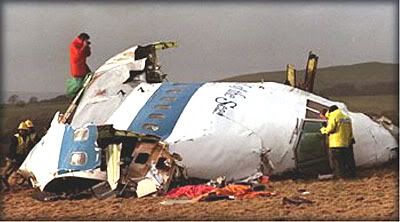
Three days before Christmas in 1988, the biggest mass murder in British history occurred. Pan Am Flight 103, Heathrow to JFK, had been in the air around 35 minutes when a bomb in the luggage hold exploded, sending the jumbo jet and its 259 passengers crashing into Lockerbie, Scotland. Another 11 were killed on the ground by the wreckage that rained down on them.
It took 13 years and a trial costing $160 million to put someone away for that crime. Former Libyan intelligence officer Abdel Basset Ali al Megrahi was found guilty and sentenced to life in a Scottish prison. Megrahi insists he's innocent. He tried to appeal, but that was turned down.
Now, however, he may get another day in court, after the independent Scottish Criminal Case Review Commission suggested strongly there may have been a miscarriage of justice and said there should be a new trial. Its 800 page report says there is new evidence and that evidence was withheld at the original trial. There were also serious questions raised about the credibility of the prosecution's forensic experts, conflicting forensic evidence, and witness inconsistencies.
Megrahi's lawyers contend Britain and the U.S. tampered with the evidence, disregarded witness statements and deliberately diverted the investigation away from the real culprits, Iran and Palestinian terrorists. They claim the bombing of the Pan Am flight was Iran's revenge for the shooting down of an Iranian passenger plane by the U.S. months earlier.
After Meghahi's conviction, you would have expected the families of those who'd been killed to be relieved, but many weren't. They believed the Libyan was framed.
Jim Swire, whose daughter Flora was a stewardess on the flight, says exactly that: "Framed." He sat in court and came out shaking his head. In Swire's view, "the trial ensured that a politically-desired result was obtained."
Swire asks why the West would want to blame Libya, which insisted its hands were clean. Swire answers his own question this way: The first Gulf War was about to happen, and the coalition didn't want Syrians and Iranians moving against it, "so they picked on Libya."
It was a convenient choice: Libya's Colonel Gaddafi was anti-West and had funded terror in other parts of the world, so why not? Libya was even forced to pay $270 million in compensation, as a condition for the lifting of U.N. sanctions. It did this begrudgingly, admitting no guilt.
If Megrahi gets a new trial, and that's not yet certain, he may still be found guilty, or he may not be. That's what a fair trial is supposed to decide. As still-grieving father Jim Swire says, "It's no good trying to have closure on false foundations. A house built on sand cannot stand."
After the commission's report, Megrahi said, "I wish, like the relatives, the whole truth about Pan Am 103 to be exposed."
There may be others in very high places that do not.
| [+/-] |
London Bomb Scare: A Chronology of Attacks |
CNN reports:
A chronology of bombings and attempted bomb attacks in the mainland UK since the 1970s:
June 29, 2007: Police defuse a bomb consisting of 200 liters of fuel, gas cylinders and nails found in an abandoned car in Haymarket, central London.
July 21, 2005: Two weeks after the deadly 7/7 bombings, four men are alleged to have attempted to carry out a second wave of attacks against London's transport network at three London underground stations and aboard a bus. But their alleged rucksack bombs fail to explode.
July 7, 2005: Four suicide bombers detonate themselves aboard three underground trains and a bus in a morning rush hour attack against London's transport network, killing 52 people and injuring around 700 more. Al Qaeda claims responsibility in a video statement. (Gallery)
August 2004: Anti-terrorist police disrupt a plot by Islamic militants to blow up targets including the Ministry of Sound nightclub and the Bluewater shopping center in southeast England using explosives packed into limousines and large vehicles. Seven men are convicted in May 2007 and sentenced to up to 26 years in prison.
March 2001: A car bomb explodes outside the BBC's London headquarters, wounding one man. Police blame the Real IRA, a republican splinter group opposed to the IRA's cease fire.
April 1999: Three people die when a nail bomb explodes in the Admiral Duncan pub in London's gay district -- the third in a spate of series of nail bomb attacks also targeting immigrant areas of the city that left dozens injured. A 23-year-old self-declared "Nazi", David Copeland, is sentenced to six life terms.
June 1996: A massive IRA bomb explodes in a shopping center in central Manchester, injuring more than 200 people.
February 1996: Two people die as IRA terrorists detonate a bomb in London's Docklands area, causing damage estimated at around $170m and ending the group's 17-month cease fire.
April 1993: An IRA truck bomb devastates part of London's financial district, killing one and wounding 44.
March 1993: Two boys aged three and 12 are killed and dozens are injured by two bombs left in litter bins in Warrington, northern England. The IRA admits planting the bombs.
April 1992: A huge IRA car bomb in London's financial district kills three people and wounds 91.
February 1991: IRA terrorists launch a mortar attack at Prime Minister John Major's Downing Street offices. No-one is injured.
September 1989: Eleven people die and 22 are wounded when an IRA bomb explodes at a Royal Marine music school in Deal, southern England.
December 1988: A Pan Am airliner explodes over the Scottish town of Lockerbie, killing 259 aboard and 11 people on the ground. Libyan agent Abdel Basset al-Megrahi, convicted of the attack in 2001, was this week granted the right to mount a fresh appeal. (Full story)
October 1984: Five people die in an IRA bomb attack on a hotel in Brighton, southern England, where Prime Minister Margaret Thatcher and her cabinet are staying for the Conservative Party's annual conference.
December 1983: An IRA bomb at London's Harrods department store kills six people.
July 1982: Two IRA bomb attacks on soldiers in London's parks kill 11 people and wound 50.
October-November 1974: A wave of IRA bombs in British pubs in Birmingham and Guildford kill 28 people and wound more than 200.
February 1974: A coach carrying soldiers and families in northern England is bombed by the IRA, killing 12 and wounding 14.
