The Jerusalem Post reports:
The White House on Tuesday flatly denied an Army Radio report that claimed US President George W. Bush intends to attack Iran before the end of his term. It said that while the military option had not been taken off the table, the Administration preferred to resolve concerns about Iran's push for a nuclear weapon "through peaceful diplomatic means."
Army Radio had quoted a top official in Jerusalem claiming that a senior member in the entourage of President Bush, who concluded a trip to Israel last week, had said in a closed meeting here that Bush and Vice President Dick Cheney were of the opinion that military action against Iran was called for.
The official reportedly went on to say that "the hesitancy of Defense Secretary Robert Gates and Secretary of State Condoleezza Rice" was preventing the administration from deciding to launch such an attack on the Islamic Republic for the time being.
The Army Radio report, which was quoted by The Jerusalem Post and resonated widely, stated that according to assessments in Israel, the recent turmoil in Lebanon, where Hizbullah has de facto established control of the country, was advancing an American attack.
Bush, the official reportedly said, considered Hizbullah's show of strength to constitute evidence of Iranian President Mahmoud Ahmadinejad's growing influence. In Bush's view, the official said, "the disease must be treated - not its symptoms."
However, the White House on Tuesday afternoon dismissed the story. In a statement, it said that "[the US] remain[s] opposed to Iran's ambitions to obtain a nuclear weapon. To that end, we are working to bring tough diplomatic and economic pressure on the Iranians to get them to change their behavior and to halt their uranium enrichment program.
It went on: "As the President has said, no president of the United States should ever take options off the table, but our preference and our actions for dealing with this matter remain through peaceful diplomatic means. Nothing has changed in that regard."
In an address to the Knesset during his visit here last week, Bush said that "the president of Iran dreams of returning the Middle East to the Middle Ages."
"America stands with you in firmly opposing Iran's nuclear weapons ambitions," Bush said. "Permitting the world's leading sponsor of terror to possess the world's deadliest weapon would be an unforgivable betrayal of future generations. For the sake of peace, the world must not allow Iran to have a nuclear weapon."
Tuesday, May 20, 2008
| [+/-] |
White House Denies Bush Intends to Attack Iran |
Wednesday, May 14, 2008
| [+/-] |
Bogus Claim, Al-Maliki Stall U.S. Plan on Iran Arms |
At IPS, Gareth Porter reports:
Early this month, the George W. Bush administration's plan to create a new crescendo of accusations against Iran for allegedly smuggling arms to Shiite militias in Iraq encountered not just one but two setbacks.
The government of Prime Minister Nouri al-Maliki refused to endorse U.S. charges of Iranian involvement in arms smuggling to the Mahdi Army, and a plan to show off a huge collection of Iranian arms captured in and around Karbala had to be called off after it was discovered that none of the arms were of Iranian origin.
The news media's failure to report that the arms captured from Shiite militiamen in Karbala did not include a single Iranian weapon shielded the U.S. military from a much bigger blow to its anti-Iran strategy.
The Bush administration and top Iraq commander Gen. David Petraeus had plotted a sequence of events that would build domestic U.S. political support for a possible strike against Iran over its "meddling" in Iraq and especially its alleged export of arms to Shiite militias.
The plan was keyed to a briefing document to be prepared by Petraeus on the alleged Iranian role in arming and training Shiite militias that would be surfaced publicly after the al-Maliki government had endorsed it and it used to accuse Iran publicly.
Chairman of the Joint Chiefs of Staff, Adm. Mike Mullen, told reporters on Apr. 25 that Petraeus was preparing a briefing to be given "in the next couple of weeks" that would provide detailed evidence of "just how far Iran is reaching into Iraq to foment instability". The centrepiece of the Petraeus document, completed in late April, was the claim that arms captured in Basra bore 2008 manufacture dates on them.
U.S. officials also planned to display Iranian weapons captured in both Basra and Karbala to reporters. That sequence of media events would fill the airwaves with spectacular news framing Iran as the culprit in Iraq for several days, aimed at breaking down Congressional and public resistance to the idea that Iranian bases supporting the meddling would have to be attacked.
But events in Iraq diverged from the plan. On May 4, after an Iraqi delegation had returned from meetings in Iran, al-Maliki's spokesman, Ali al-Dabbagh, said in a news conference that al-Maliki was forming his own Cabinet committee to investigate the U.S. claims. "We want to find tangible information and not information based on speculation," he said.
Another adviser to al-Maliki, Haider Abadi, told the Los Angeles Times' Alexandra Zavis that Iranian officials had given the delegation evidence disproving the charges. "For us to be impartial, we have to investigate," Abadi said.
Al-Dabbagh made it clear that the government considered the U.S. evidence of Iranian government arms smuggling insufficient. "The proof we have is weapons which are shown to have been made in Iran," al-Dabbagh said in a separate interview with Reuters. "We want to trace back how they reached [Iraq], who is using them, where are they getting it."
Senior U.S. military officials were clearly furious with al-Maliki for backtracking on the issue. "We were blindsided by this," one of them told Zavis.
Then the Bush administration's campaign on Iranian arms encountered another serious problem. The Iraqi commander in Karbala had announced on May 3 that he had captured a large quantity of Iranian arms in and around that city.
Earlier the U.S. military had said that it was up to the Iraqi government to display captured Iranian weapons, but now an Iraqi commander was eager to show off such weapons. Petraeus' staff alerted U.S. media to a major news event in which the captured Iranian arms in Karbala would be displayed and then destroyed.
But when U.S. munitions experts went to Karbala to see the alleged cache of Iranian weapons, they found nothing that they could credibly link to Iran.
The U.S. command had to inform reporters that the event had been cancelled, explaining that it had all been a "misunderstanding". In his press briefing May 7, Brig. Gen. Kevin Bergner gave some details of the captured weapons in Karbala but refrained from charging any Iranian role.
The cancellation of the planned display was a significant story, in light of the well-known intention of the U.S. command to convict Iran on the arms smuggling charge. Nevertheless, it went completely unreported in the world's news media.
A report on the Los Angeles Times' Blog "Babylon & Beyond" by Baghdad correspondent Tina Susman was the only small crack in the media blackout. The story was not carried in the Times itself, however.
The real significance of the captured weapons collected in Karbala was not the obvious U.S. political embarrassment over an Iraqi claim of captured Iranian arms that turned out to be false. It was the deeper implication of the arms that were captured.
Karbala is one of Iraq's eight largest cities, and it has long been the focus of major fighting between the Mahdi Army and its Shiite foes. Moqtada al-Sadr declared his ceasefire last August after a major battle there, and fighting had resumed there with the government operation in Basra in March. Thousands of Mahdi Army fighters have fought there over the past year.
The official list of weapons captured in Karbala includes nine mortars, four anti-aircraft missiles, 45, RPGs and 800 RPG missiles and 570 roadside explosive devices. The failure to find a single item of Iranian origin among these heavier weapons, despite the deeply entrenched Mahdi Army presence over many months, suggests that the dependence of the Mahdi Army on arms manufactured in Iran is actually quite insignificant.
The Karbala weapons cache also raises new questions about the official U.S. narrative about the Shiite militia's use of explosively formed penetrators (EFPs) as an Iranian phenomenon. Among the captured weapons mentioned by Gen. Jawdat were what he called "150 anti-tank bombs", as distinguished from ordinary roadside explosive devices.
An "anti-tank bomb" is a device that is capable of penetrating armour, which has been introduced to the U.S. public as the EFP. The U.S. claim that Iran was behind their growing use in Iraq was the centrepiece of the Bush administration's case for an Iranian "proxy war" against the U.S. in early 2007.
Soon after that, however, senior U.S. military officials conceded that EFPs were in fact being manufactured in Iraq itself, although they insisted that EFPs alleged exported by Iran were superior to the home-made version.
The large cache of EFPs in Karbala which are admitted to be non-Iranian in origin underlines the reality that the Mahdi Army procures its EFPs from a variety of sources.
But for the media blackout of the story, the large EFP discovery in Karbala would have further undermined the credibility of the U.S. military's line on Iran's export of the EFPs to Iraqi fighters.
Apparently understanding the potential political difficulties that the Karbala EFP find could present, Gen. Bergner omitted any reference to them in his otherwise accurate accounting of the Karbala weapons.
*Gareth Porter is an historian and national security policy analyst. The paperback edition of his latest book, "Perils of Dominance: Imbalance of Power and the Road to War in Vietnam", was published in 2006.
| [+/-] |
Letter To Bush About A Preemptive Strike on Iran |
Congressman John Conyers: "Join Me in Calling on President Bush to Respect Congress’ Exclusive Power to Declare War"
CASMII reports:
Dear Democratic Colleague:
As we mark five years of war in Iraq, I have become increasingly concerned that the President may possibly take unilateral, preemptive military action against Iran. During the last seven years, the Bush Administration has exercised unprecedented assertions of Executive Branch power and shown an unparalleled aversion to the checks and balances put in place by the Constitution’s framers. The letter that follows asks President Bush to seek congressional authorization before launching any possible military strike against Iran and affirms Senator Biden’s statement last year that impeachment proceedings should be considered if the President fails to do so.
I hope that you will join me in calling on the President to respect Congress’ exclusive power to declare war. To sign the letter below, please contact the Judiciary Committee staff at 225-3951.
Sincerely,
John Conyers, Jr.
Chairman
May 8, 2008
The Honorable George W. Bush
President of the United States
1600 Pennsylvania Avenue, N.W.
Washington, D.C. 20500
Dear Mr. President:
We are writing to register our strong opposition to possible unilateral, preemptive military action against other nations by the Executive Branch without Congressional authorization. As you know, Article I, Section 8 of the U.S. Constitution grants Congress the power “to declare war,” to lay and collect taxes to “provide for the common defense” and general welfare of the United States, to “raise and support armies,” to “provide and maintain a navy,” to “make rules for the regulation for the land and naval forces,” to “provide for calling forth the militia to execute the laws of the Union, suppress insurrections and repel invasions,” to “provide for organizing, arming, and disciplining, the militia,” and to “make all laws necessary and proper for carrying into execution ... all ... powers vested by this Constitution in the Government of the United States.” Congress is also given exclusive power over the purse. The Constitution says, “No money shall be drawn from the Treasury but in consequence of appropriations made by law.”
By contrast, the sole war powers granted to the Executive Branch through the President can be found in Article II, Section 2, which states, “The President shall be the Commander-in-Chief of the Army and Navy of the United States, and of the Militia of the several States, when called into actual Service of the United States.” Nothing in the history of the “Commander-in-Chief” clause suggests that the authors of the provision intended it to grant the Executive Branch the authority to engage U.S. forces in military action whenever and wherever it sees fit without any prior authorization from Congress. In our view, the founders of our country intended this power to allow the President to repel sudden attacks and immediate threats, not to unilaterally launch, without congressional approval, preemptive military actions against foreign countries. As former Republican Representative Mickey Edwards recently wrote, “[t]he decision to go to war ... is the single most difficult choice any public official can be called upon to make. That is precisely why the nation’s Founders, aware of the deadly wars of Europe, deliberately withheld from the executive branch the power to engage in war unless such action was expressly approved by the people themselves, through their representatives in Congress.”1
Members of Congress, including the signatories of this letter, have previously expressed concern about this issue. On April 25, 2006, sixty-two Members of Congress joined in a bipartisan letter that called on you to seek congressional approval before making any preemptive military strikes against Iran.2 Fifty-seven Members of Congress have co-sponsored H. Con. Res. 33, which expresses the sense of Congress that the President should not initiate military action against Iran without first obtaining authorization from Congress.3
Our concerns in this area have been heightened by more recent events. The resignation in mid-March of Admiral William J. “Fox” Fallon from the head of U.S. Central Command, which was reportedly linked to a magazine article that portrayed him as the only person who might stop your Administration from waging preemptive war against Iran,4 has renewed widespread concerns that your Administration is unilaterally planning for military action against that country. This is despite the fact that the December 2007 National Intelligence Estimate concluded that Iran had halted its nuclear weapons program in the fall of 2003, a stark reversal of previous Administration assessments.5
As we and others have continued to review troubling legal memoranda and other materials from your Administration asserting the power of the President to take unilateral action, moreover, our concerns have increased still further. For example, although federal law is clear that proceeding under the Foreign Intelligence Surveillance Act (FISA) “shall be the exclusive means by which electronic surveillance” can be conducted within the U.S. for foreign intelligence purposes, 18 U.S.C. 2511(2)(f), the Justice Department has asserted that the National Security Agency’s warrantless wiretapping in violation of FISA is “supported by the President’s well-recognized inherent constitutional authority as Commander in Chief and sole organ for the Nation in foreign affairs”.6 As one legal expert has explained, your Administration’s “preventive paradigm” has asserted “unchecked unilateral power” by the Executive Branch and violated “universal prohibitions on torture, disappearance, and the like.”7
Late last year, Senator Joseph Biden stated unequivocally that “the president has no authority to unilaterally attack Iran, and if he does, as Foreign Relations Committee chairman, I will move to impeach” the president. 8
We agree with Senator Biden, and it is our view that if you do not obtain the constitutionally required congressional authorization before launching preemptive military strikes against Iran or any other nation, impeachment proceedings should be pursued. Because of these concerns, we request the opportunity to meet with you as soon as possible to discuss these matters. As we have recently marked the fifth year since the invasion of Iraq, and the grim milestone of 4,000 U.S. deaths in Iraq, your Administration should not unilaterally involve this country in yet another military conflict that promises high costs to American blood and treasure.
Sincerely,
1. Mickey Edwards, Dick Cheney’s Error, Wash. Post, March 22, 2008, at A13.
2. Letter from Rep. Peter DeFazio, Rep. John Conyers, Jr., and 60 other Members of Congress, to President George W. Bush (Apr. 25, 2006) (on file with the Committee on the Judiciary).
3. H. Con. Res. 33, 110th Cong. (2008)
4. Thomas E. Ricks, Top U.S. Officer in Mideast Resigns, Wash. Post, March 12, 2008, at A1.
5. Dafna Linzer and Joby Warrick, U.S. Finds That Iran Halted Nuclear Arms Bid in 2003, Wash. Post, Dec. 4, 2007, at A1.
6. Department of Justice, Legal Authorities Supporting the Activities of the National Secuirty Agency Described by the President, Jan. 19, 2006 at 1.
7. David Cole, Less Safe, Less Free: Why America is Losing the War on Terror, 2007 at 2.
8. Adam Leach, Biden: Impeachment if Bush Bombs Iran, PORTSMOUTH HERALD, Nov. 29, 2007.
Wednesday, December 5, 2007
| [+/-] |
Former CIA Officials: Bush Iran Claims "Preposterous" |
Thomas B. Edsall and Max Follmer write:
Four former CIA officials who provided intelligence information to past presidents described as preposterous President Bush's claim that he was unaware until very recently that Iran had stopped its nuclear weapons program in 2003.
"It's unbelievable," said Melvin Goodman, who worked for the CIA from 1966 to 1990 and now is a senior fellow at the Center for International Policy.
Goodman's assessment of Bush's assertions were very similar to those of Larry C. Johnson, who worked at the CIA from 1985 to 1989 and from 1989 to 1993 served as Deputy Director in the U.S. State Department's Office of Counter Terrorism; Ray McGovern, a former CIA official who gave daily intelligence briefings to George H. W. Bush while he was vice president; and Bruce Riedel, who spent over two decades at both the CIA and National Security Council and is the former National Intelligence Officer for Near East and South Asian Affairs
At a December 4 (Tuesday) press conference, Bush asserted:I was made aware of the NIE last week. In August, I think it was Mike McConnell [Director of National Intelligence] came in and said, 'we have some new information.' He didn't tell me what the information was; he did tell me it was going to take a while to analyze.
Why would you take time to analyze new information? One, you want to make sure it's not disinformation. You want to make sure the piece of intelligence you have is real. And secondly, they want to make sure they understand the intelligence they gathered: If they think it's real, then what does it mean? And it wasn't until last week that I was briefed on the NIE that is now public.
McGovern was totally incredulous: "The notion that the head of National Intelligence whispered in Bush's ear 'I've got a surprise for you and it's really important, but I'm not going to tell you about it until we check it out' -- The whole thing is preposterous," he said in an interview with The Huffington Post.
Riedel agreed, saying "the president either chose to ignore what he heard or his director of national intelligence is not doing his job." Riedel said he doubted McConnell failed to "do his part of the bargain."
"To me it is almost mind boggling that the President is told by the DNI that we have new important information on Iran and he doesn't ask 'what is that information?'" said Riedel, who is now a Senior Fellow at the Saban Center For Middle East Policy at the Brookings Institution.
He said it wasn't the DNI's responsibility to tell the President to "stop hyperventilating about the Iranian threat."
"The President and his policy advisers - National Security Adviser Stephen Hadley in particular - have the responsibility of keeping their eye on the intelligence and to take into account new information as it comes along," Riedel told The Huffington Post.
Bush and Cheney have repeatedly warned of the dangers of Iran obtaining nuclear weapons, with no mention of the intelligence findings that Iran had stopped its program in 2003. On October 17, Bush was asked at a press conference, "But you definitively believe Iran wants to build a nuclear weapon?" He replied:
I think so long -- until they suspend and/or make it clear that they -- that their statements aren't real, yeah, I believe they want to have the capacity, the knowledge, in order to make a nuclear weapon. And I know it's in the world's interest to prevent them from doing so. I believe that the Iranian -- if Iran had a nuclear weapon, it would be a dangerous threat to world peace. But this -- we got a leader in Iran who has announced that he wants to destroy Israel. So I've told people that if you're interested in avoiding World War III, it seems like you ought to be interested in preventing them from have the knowledge necessary to make a nuclear weapon. I take the threat of Iran with a nuclear weapon very seriously.
White House Press Secretary Tony Fratto declined Wednesday to discuss what McConnell told Bush at their August meeting.Q ...Was there any indication from McConnell of the nature of the intelligence in the meeting in August?
MR. FRATTO: I can't give you more detail on what Director McConnell said to the President.
Larry Johnson pointed out that the National Intelligence Estimate is actually the result of an analysis of information from all intelligence agencies. The material on which the NIE report was based had been acquired well before the report itself was issued to the public.
When that information first became available to the CIA and other agencies, it would automatically have been included in the Presidential Daily Briefing (PDB) months before the NIE report, Johnson said. The President, Vice President, Defense Secretary and Secretary of State are all given daily accounts of the PDB, Johnson said. McGovern and Goodman agreed.
Monday, December 3, 2007
| [+/-] |
NSA Stephen Hadley Press Conference on Iran NIE |
Press Briefing by National Security Advisor Stephen Hadley:
MR. HADLEY: Good afternoon, I'm Steve Hadley, the President's National Security Advisor. I want to talk a little bit about the recent National Intelligence Estimate that was released to the executive branch and to the Congress today. There was an earlier briefing this afternoon by the Deputy Director of National Intelligence, Don Kerr, and also by the Director of Central Intelligence, Mike Hayden. And I wanted to give a little bit more context and set the findings of the NIE in a broader historical perspective.
The introduction is going to go on a little bit; there's a lot to tell. This is a complicated estimate. The unclassified key judgments that were released today are a little difficult to sort through and I want to try and lay this out for everybody, so I'll have an opening statement, probably 15-20 minutes, but there will be lots of time to answer questions at the end.
The Director of National Intelligence has today released the unclassified key judgments from the intelligence community's latest estimate of Iran's nuclear weapons efforts and its uranium enrichment program. The classified version of this National Intelligence Estimate was briefed to the President last Wednesday, November 28, and has been delivered to relevant congressional committees this morning.
On balance, the estimate is good news. On one hand, it confirms that we were right to be worried about Iran seeking to develop nuclear weapons. On the other hand, it tells us that we have made some progress in trying to ensure that that does not happen. But it also tells us that the risk of Iran acquiring a nuclear weapon remains a very serious problem.
The estimate offers grounds for hope that the problem can be solved diplomatically, without the use of force, as the administration has been trying to do. And it suggests we have the right strategy: intensified international pressure, along with a willingness to negotiate a solution that serves Iranian interests while ensuring the world that it will never have to face a nuclear-armed Iran. But the bottom line is that for that strategy to succeed, the international community has to turn up the pressure on Iran -- with diplomatic isolation, United Nations sanctions, and with other financial pressure. And Iran has to decide that it wants to negotiate a solution.
This is a complicated subject and the new Intelligence Estimate is a complicated document. Let me summarize the key judgments and then try and walk you through it and answer your questions. First, let me summarize the key judgments. The IC has high confidence -- high confidence -- that Iran had a covert nuclear weapons program that it has never acknowledged and continues to deny. The intelligence community has high confidence that Iran halted its covert nuclear weapons program in the fall of 2003. And they have moderate confidence that it had not restarted that program as of mid-2007.
They judge with high confidence that the halt in other nuclear-related decisions was directed primarily in response to increasing international scrutiny and pressure, resulting from exposure of Iran's previously undeclared nuclear work involving uranium enrichment. The intelligence community says they do not know whether Iran currently intends to develop nuclear weapons, but they assess with moderate to high confidence that Tehran at a minimum is keeping open the option to develop nuclear weapons. And the intelligence community assesses with moderate confidence that convincing the Iranian leadership to forgo the eventual development of nuclear weapons will be difficult.
Let me see if I can unpack this a bit and put it in context. First, remember how we got here. A little background: If a state is looking to become a nuclear-weaponed state, it needs three things. It needs weapons-grade nuclear material. It needs the technical know-how to fashion this nuclear material into a weapon. And it needs a means to deliver the weapon on a target, like a ballistic missile. The hardest step in today's world is acquiring weapons-grade nuclear material. Unless you steal it, there are two ways to get it: If you have a nuclear power reactor you can reprocess spent fuel coming out of that reactor, or you can create nuclear material by a process called uranium enrichment. This process produces fuel for nuclear power reactors, but it can also create weapons-grade nuclear material for a nuclear bomb.
In 1968, Iran signed the Nuclear Nonproliferation Treaty and pledged never to seek to acquire nuclear weapons. That's what Iran undertook to do. It signed what is called a safeguards agreement with the International Atomic Energy Agency, or the IAEA, under which it was to declare all its nuclear-related activities and open itself up to inspections by the IAEA.
In August 2002, an Iranian opposition group revealed the existence of a secret uranium enrichment plant in Iran at a place called Natans. The plant was secret. It had not been declared, as required, to the IAEA. Iran at that time had no operational nuclear power reactors, so why did it need a uranium enrichment plant? Iran was actively developing ballistic missiles. These facts raised a real concern that this was all part of an effort to develop nuclear weapons. So the IAEA, the International Atomic Energy Agency, backed by the international community, began a vigorous effort to convince Iran to suspend its enrichment activity, and thus reassure the world that it did not intend to develop nuclear weapons.
And the pressure seemed to work. In October 2003, Iran agreed to cooperate with the IAEA and suspend its uranium enrichment activities. Considerable further diplomacy involving both the IAEA and what's called the EU-3 -- representatives of Britain, France and Germany -- resulted in what's called the Paris Agreement of November 2004. In this agreement, Iran reaffirmed and extended the suspension of its enrichment activities. And the EU-3 agreed to negotiate long-term technology, economic and security arrangements for Iran.
Despite this progress, the intelligence community in May of 2005 assessed with high confidence that Iran currently was determined to develop nuclear weapons. The intelligence community maintained this assessment throughout this year, 2007. Indeed, Director of National Intelligence Negroponte told an open session of the House intelligence community on January 1, 2007, that, "our assessment is that Tehran is determined to develop nuclear weapons." DNI McConnell later told a Senate panel in open session on February 27 that, "We assess that Tehran seeks to develop nuclear weapons."
The irony is that one month after the intelligence community released this assessment, in June of 2005, Ahmadinejad wins a runoff election and becomes Iran's President. On August 1, 2005, just two months after taking power, Ahmadinejad informs the IAEA that he has decided to resume uranium enrichment, and does so beginning in January 2006.
For the next two years, through a whole series of IAEA Board of Governors resolutions urging Iranian compliance, through two U.N. Security Council sanctions resolutions, sweetened by negotiating offers by the EU-3 and the promise that the United States would join those negotiations, the international community tried unsuccessfully to get Iran to suspend its uranium enrichment activities, and those efforts to get the suspension continue today.
Also during this period, the President directs the intelligence community to enhance its capabilities to gather intelligence on Iran's nuclear programs.
Earlier this year, Congress called for a new National Intelligence Estimate on Iran. It is in part delayed in order to process -- the finalization of that NIE is delayed in part in order to process new intelligence, some of which has been received in the last few months.
The National Intelligence Estimate released today reveals that there was a covert nuclear weapons program. It also reveals that, unknown to us, that program was halted in the fall of 2003. So the covert nuclear weapons program was unknown to us, suspected, unknown; now confirmed. But what was also unknown was that the program was halted in the fall of 2003. That secret -- that covert nuclear weapons program was halted at the same time the Iranians publicly announced that they were suspending their public and declared uranium enrichment program.
So where does that leave us? One, we have good reason to continue to be concerned about Iran developing a nuclear weapon, even after this most recent National Intelligence Estimate. In the words of the NIE, "Iranian entities are continuing to develop a range of technical capabilities that could be applied to producing nuclear weapons if a decision is made to do so." For example, Iran's civilian uranium enrichment program is continuing. And as you know, once a country masters the technology to enrich uranium for use even in a civilian nuclear power program, it could readily use the same technology to produce weapons-grade uranium. As we have said, weapons-grade uranium is the long pole in the tent for a nuclear weapon.
And Iran continues to develop, test and deploy ballistic missiles -- a very attractive delivery system for a nuclear weapon. For example, the Iranian Defense Minister publicly acknowledged a medium-range ballistic missile called the Ashura, which could reach much of Eastern Europe.
Finally, we are very unsure of Iran's attentions [sic], even with respect to the covert nuclear weapons program that Iran has halted. Again, let me quote the National Intelligence Estimate: "We do not have sufficient intelligence to judge confidentially whether Tehran is willing to maintain the halt of its nuclear weapons program indefinitely while it weighs its options, or whether it will or already has set specific deadlines or criteria that will prompt it to restart the program."
Again from the NIE: "We assess with moderate confidence that convincing the Iranian leadership to forgo the eventual deployment of nuclear weapons will be difficult given the linkage many within the leadership probably see between nuclear weapons development and Iran's key national security and foreign policy objectives."
But the NIE gives us reason to believe that our current strategy stands the best chance of convincing Iran to give up its nuclear ambitions. Again, let me quote for a final time from the NIE: "Our assessment that Iran halted the program in 2003, primarily in response to international pressure, indicates Tehran's decisions are guided by a cost-benefit approach, rather than a rush to a weapon irrespective of political, economic and military costs. This in turn suggests that some combination of threats of intensified international scrutiny and pressures, along with opportunities for Iran to achieve its security, prestige and goals for regional influence in other ways might, if perceived by Iran's leaders as credible, prompt Tehran to extend the current halt to its nuclear weapons program. It is difficult to specify just what such a combination might be."
We have been pursuing this very strategy for over two years, since Iran resumed its nuclear enrichment. If we are to avoid the grim choice between accepting an Iran on the path to nuclear weapons or considering the use of force, we need to intensify our pressure on Iran, while making clear that if they do suspend enrichment, there is an opportunity for better relations with the international community.
And with that, I'll stop and I'd be pleased to answer your questions.
Q It is troubling that the United States was so wrong about what Iran was doing or what its intentions were?
MR. HADLEY: I don't think we were wrong about what it's doing or what its intentions were. Our concern was that they were pursuing a nuclear weapon. We saw the enrichment, which we couldn't really explain; we saw the ballistic missiles. And it led people to conclude: We are concerned that they were pursuing a nuclear weapons program and might have a covert program to actually weaponize highly-enriched uranium in order to be a nuclear weapon. And that's what the NIE has now discovered.
The President said some months ago, probably over a year ago, we need to have better intelligence on Iran's nuclear program; we have these suspicions, we have this concern, we need better intelligence to get greater certainty. The intelligence community increased their efforts, and lo and behold, in the last few months we get credible evidence that gives them a high confidence that they had a covert nuclear weapons program to weaponize weapons grade highly-enriched uranium into a weapon.
Q But in 2005 you thought that they had a nuclear weapons program, whereas you now think they abandoned it, or put it aside in 2003.
MR. HADLEY: We thought they had that program, we did indeed, in 2005.
Q So that's what I meant when I said, wrong.
MR. HADLEY: We have looked at it and we have determined that, indeed, they did have a program, and a covert program, which we had not been able to detect, but we also determined that they had suspended it in -- or halted it -- which is the term of art -- in fall of 2003 in response to international pressure. That's exactly right.
Q But, Steve, the question is, how did the government get it wrong? And isn't that troubling that it got so wrong over that two-year span?
MR. HADLEY: I don't think it is so wrong. I think it is right. If they had been saying in 2005 not to worry, Iran has no nuclear weapons ambitions, then we would have clearly got it wrong, because they did have such a program. I would say to you, they got it right, in terms of being concerned about Iran seeking a nuclear weapon. And we continue to be concerned about a nuclear weapon.
Remember, Iran is one of a handful of the hardest intelligence targets going. They are very good at this business of keeping secrets. And there's probably no secret that will be more closely kept by Iran than what it's doing on nuclear weapons. So I think the fact that we have got this additional information is an indication that we are succeeding in learning more about this program. And I think you have to recognize we're going to continue to dig, continue to learn more, and that's a good thing. That's --
Q Steve, let me follow on this point. If we now estimate with high confidence that it was shut down as of 2003, that it was halted, in October of this year, in 2007, the President is speaking about the Iranian threat, in terms of World War III. Why wouldn't you conclude that this President is hyping the threat?
MR. HADLEY: Because he was describing the threat as the intelligence community itself had been describing the threat both publicly and in their briefings to him. The President, as I think if you look at the testimony that was given by Don Kerr and Mike Hayden today, they basically said that the intelligence community finally came to the judgments that they came to on this issue Tuesday of last week. The President was briefed on Wednesday. So this is challenging information. The intelligence community had to decide what they thought about it. They were sufficiently uncertain about it that they delayed the publication of the NIE until they could come to the bottom of it, reach their conclusions, present it to the President, as they did on Wednesday, and then at that point, obviously, we wanted to get it out quickly.
Q They describe the Iranian threat today differently than the President would have even a month ago.
MR. HADLEY: Because our intelligence community has told us effective today that their assessment is somewhat different than it was before. That's correct.
Q How does this -- how does this not undercut the effort to get an international coalition? The urgency of doing that -- I would think all the international partners would say, wait a minute, they haven't had a program since 2003, so let's back off a little with the urgency.
MR. HADLEY: I think there is going to be a tendency or a lot of people to say, the problem is less bad than we thought, let's relax. And I think our view is that would be a mistake. Why? Because, as we said, in today's world the critical problem for making a nuclear weapon is getting the weapons-grade nuclear material. And for Iran, they are trying to get the capability to do that. Let me put it this way, their path to getting that capability is the enrichment program.
This is the program that they agreed to shut down in 2003, 2004, but restarted in 2005. It has been championed by Ahmadinejad. He is now making public announcements that they have 3,000 centrifuges and have mastered that technology. You don't need to take those assertions to the bank to be concerned that Iran is getting to the point where it will have mastered the ability to enrich uranium. And having mastered that ability to enrich uranium, they have the -- they will have the capacity to make weapons-grade nuclear uranium. That is the long pole in the tent, and that's what the international community has been trying, in a pretty united way, for the last three or four years to get the Iranians to suspend.
Q What do you know about the program that you say now you have confirmed the Iranians were conducting, that they suspended in 2003? What do you know about that program now? How long had that program been in place? How effective, how far along before they halted?
MR. HADLEY: Those are good questions. They are questions that I think Don Kerr and Mike Hayden should address. Some of this gets into portions of these materials that are still classified. Let me read you, though, I think as a starting point, a footnote that appears in the declassified key judgments that were put out today.
When you talk about a nuclear weapons program, what the intelligence community says they mean is Iran's nuclear weapon design -- that is to say, an effort to design a nuclear weapon. And weaponization work -- that is to say, taking weapons-grade uranium and adapting it so that it can be an operational nuclear weapon. And covert uranium conversion-related and uranium enrichment-related work. And that suggests that part of the program was a covert uranium enrichment facility.
And why would we worry about that? Because we would worry about it that in -- paired with an overt, declared uranium enrichment program, the information and know-how gleaned by that -- from that public uranium enrichment program could be passed at some time -- in the past or in the future -- to a covert uranium enrichment program, which could be used to develop and produce nuclear weapons grade material for a nuclear weapon.
Q There had to be more than an inkling before today that this information, this intelligence, that the Iranians had an ongoing nuclear weapons program was incorrect. So why wasn't -- why then would the President allow it or advise to go ahead with ratcheting up the rhetoric, instead of toning it down, when right now this obviously raises issues of credibility with the American public and with American allies about U.S. intelligence?
MR. HADLEY: Two things. One, when the President was told that we had some additional information, he was basically told: stand down; needs to be evaluated; we'll come to you and tell you what we think it means. So this was basically -- as we said, this is information that came in the last few months, and the intelligence community spent a lot time to get on top of it.
Secondly, I would disagree with you that the President has ratcheted up the rhetoric. We have said -- he has said, I have said, other administration officials have said many times, look, we want diplomacy to work. Because, as I said in my statement, we don't want to be in a situation where the only two choices this or a future President has is to accept Iran on a path to a nuclear weapon or to have to contemplate the use of nuclear force -- sorry, use of military force. Because that in the context of today's Middle East is a big move.
And so the President, in that statement -- as he said before and as he explained afterwards -- was trying to give a wake-up call to the international community that we needed to step up the diplomacy and step up the pressure to get Iran to suspend its declared uranium enrichment program. And that still is the case today, because that is the path to weapons-grade material which would give Iran the option in the future to produce a nuclear weapon.
Q The President -- you said the President was told to stand down on that --
MR. HADLEY: No, I said just the opposite. I said the President was told, we have some information, we have some new information not to stand down -- said, we have some new information; give us some time to analyze it, and we will come to you and tell you what we think it means.
Q Was he told that before or after --
MR. HADLEY: And that's what he was told, and they -- as was briefed by the intelligence community today, they came to their final judgments on Tuesday of last week, and they told the President of the United States on Wednesday.
Q But was he given that advice before or after the World War III comment?
MR. HADLEY: I'll have to -- I'll have to look.
Q Which was on October 20th.
MR. HADLEY: From my mind, it doesn't make any difference, because the World War III comment you characterize as stepping up the rhetoric. I would say it was making a point that the President and we have been making for two or three years, that the international community has to exert more pressure because Iran needs to suspend its enrichment program.
That was the position of our policy before the National Intelligence Estimate, and for the reasons I said. That continues to be our policy after this latest National Intelligence Estimate.
Q Steve, just to clarify.
MR. HADLEY: Sure.
Q Is it fair to say that the intelligence came in, in recent weeks, not recent months? Because this -- as was pointed out, the press briefing was late October when the President was asked definitively, do you believe Iran wants to build a nuclear bomb? And that's where you get, in the second part of that answer, the World War III comment.
MR. HADLEY: Correct.
Q So was it recent weeks that this intelligence came in?
MR. HADLEY: What the intelligence community has said is in the last few months. And again I would say, if they were working on this information before that quote in October, again, in terms of the point the President was making, he would have made that comment before we got -- the intelligence community got this information. He would have made that, I believe, that comment after. I just made it in this statement, which is, the international community has to understand that if we want to avoid a situation where we either have to accept Iran on the road to a nuclear weapon, with a path to a nuclear weapon, or the possibility of having to use force to stop it, with all the connotations of World War III, then we need to step up the diplomacy, step up the pressure to get Iran to stop their civilian -- so-called civilian uranium enrichment program. That was our policy before his October comment, that was the policy between October -- his October comment and today, and that's our policy going forward; no change.
Q Steve, you just said you would describe it quite different. Just a minute ago --
MR. HADLEY: I think that's right. And we would describe it --
Q Are you being consistent? I don't think you're being consistent.
MR. HADLEY: I am being consistent, because what we can say now is, that they actually had -- which we did not know at the time of 2005 -- they actually had a covert weapons program, which means we were right to be concerned; it was probably worse than we thought.
We would also say now, but that program, that covert nuclear weapon program has been suspended. And therefore it is important for our policy to continue to put diplomatic pressure on Iran so that the suspension -- the halting, excuse me -- the halting of their covert nuclear weapons program continues and that they suspend their uranium enrichment program. Because if you can do both of those things, maintain the halting of the nuclear weapons program and obtain the suspension of the uranium enrichment program, you've got some real assurance that Iran is not going to be on the path towards a nuclear weapon -- assuming they don't steal the weapon, they don't get weapons-grade nuclear material from some other source. And it still leaves the worrisome fact that they're working and developing ballistic missiles.
But it is a -- so I would describe our posture differently. I would describe our assessment -- the intelligence community would describe the assessment in a different way. But in terms of our policy, it continues to be one. And I would say it both underscores the urgency of the policy, and also gives us some confidence that it actually can work, but only if we pick up the pace.
Yes, ma'am.
Q Given the halting, as you described it, does this strengthen the position of Russia and China on sanctions, specifically?
MR. HADLEY: Well, we hope not, because as I said, the problem presented by the continuing uranium enrichment program continues, because that is the long pole for a country like Iran on the way towards having a path towards a nuclear weapon. That's something that Russia has said clearly they don't want Iran to do; that's something we think, less clearly, China has said the same thing.
So again, as the President says many times, we're asking people to do hard things. We're asking people to put pressure on Iran, and it has consequences for their diplomacy, it has consequences for their companies doing business with Iran. People don't like to do that. So I'm sure some people will try and use this as an excuse or a pretext for flagging on the effort.
Our argument is, actually, it should be just the reverse, because we need to keep the halting of the nuclear weapons program in place; we need to achieve the suspension of the enrichment program; and the only way -- what this NIE says is that the best path to do that is to continue what we've been doing, which is diplomatic isolation, U.N. sanctions and other financial pressure, plus the option for negotiations.
Q Second question. When did the Vice President get briefed on this? Because he was warning of serious consequences just last month, too.
MR. HADLEY: I've just got a note from him -- I did it once, I'll do it again. In terms of stand down, they did not tell the President to stand down and stop talking about Iran's nuclear program; they told him just the opposite: Mr. President, we have new information. Or let me put it this way, not just the opposite, let me be precise. He was not told to stop talking about Iran's nuclear weapons program. He was not told to change what he says about it. What he was told was, we have new information; it is interesting; it is going to take us some time to understand it, to assess it, to know what it means, and to know how credible it is, and we will come back to you when that process is done. And they did. And they came back to him Wednesday, and the results of their work is included in this estimate. Is that okay? (Laughter.)
I'm sorry, you asked a question and I didn't answer. Could you restate it, please?
Q When was the Vice President briefed on this? You mentioned when the President was, what about the Vice President?
MR. HADLEY: He, of course, can answer that for himself. I will say that the week before the Tuesday/Wednesday, there was a meeting that was held with the principals -- including the Vice President, myself and others -- to get a preliminary look at this information, to get some sense of it, and to give us an opportunity to test it and ask questions about it, and probe it a little bit, as part -- and we thought, one, so we would understand it, and two, as part of the process for the intelligence community, you know, coming to its conclusion about what this all meant. And those were the conclusions that they reached on Tuesday, and which were briefed to the President on Wednesday of last week.
Peter.
Q Steve, when was the first time the President was given the inkling of something? I'm not clear on this. Was this months ago, when the first information started to become available to intelligence agencies?
MR. HADLEY: You ought to go back to the intelligence community. We will get you an answer on that. There's two questions: one, when did they first get the information? -- you ought to ask that to them -- two, when was the President notified that there was new information available? We'll try and get you a precise answer. As I say, it was, in my recollection, is in the last few months. Whether that is October -- August, September, we'll try and get you an answer to that.
Q What about the -- I mean, in your view, for a lot of people will sound like echoes of Iraq, what we thought they -- we talked about what programs we thought they had -- in fact they suspended it or stopped it and so forth. I mean, how does this affect the credibility of everything you want to say about this or any other threat that might be out there in the world today?
MR. HADLEY: Well, I think all we can do is try and -- and I think all the intelligence community can do -- is try and get the best information they can, to try and be straight with the Congress and the President about how they assess that information, with what level of confidence, and to continue to get additional information. And when they get that additional information, if it changes their assessment, to come out and so inform people. You know, these are not puzzles that once you solve them, you have solved them for all times. These are challenges that are ongoing against very hard targets that lie, that try and prevent things from becoming public, and that try and mislead. And it is a very difficult intelligence channel.
So I think the answer is, in some sense, you know, welcome to the real world. And so the challenge for the intelligence community is to say, in all of this work -- and it's very challenging -- what they know, what they assess, what's the confidence of their assessment, and what they don't know. And that's what the intelligence community tries to do, and I think in some sense the unclassified key judgments -- if you read them with care -- show very clearly that that's what they're trying to do. And I will tell you, I'm sure we are going to -- I hope we are going to learn more, and that's probably going to change what we know and probably change our assessments, probably change our confidence level, because this is going to be something that this administration and future administrations are working with for a long time.
Q Just to turn your premise around a little bit, you said that you should keep the pressure up on the international -- with the international community. But doesn't the fact that Iran halted its program, even if it was covert, suggest that perhaps there is room for a negotiated settlement that would keep nuclear weapons out of the government --
MR. HADLEY: Yes, I said two things. I said we need to keep the pressure up, but also make clear there is a path for negotiation that will assess Iranian concerns. Our job is to keep up the pressure, but also to offer this negotiating path. But in the end of the day, the Iranians have to signal that they're willing to accept a negotiation path. And as you know, there have been now almost three years of off-and-on meetings -- two years probably -- off-and-on meetings between an Iranian negotiator -- for the longest time that was Larijani -- and with the EU-3, in terms of Javier Solana; that various offers have been put down for the EU-3 about how to address Iran's security, economic and diplomatic concerns; a path where Iran could reliably know that it could have a purely civil nuclear power program. There have been several offers of that sort.
So the combination that the intelligence community says is most likely to work is pressure, plus a negotiating option. That continues to be the case to this day. But at some point, Iran has to indicate a willingness to sit down and negotiate. And that's what we have not yet seen.
Thank you very much.
Monday, November 26, 2007
| [+/-] |
Baath Reconciliation Bill Draws Anger of Shiite Bloc |
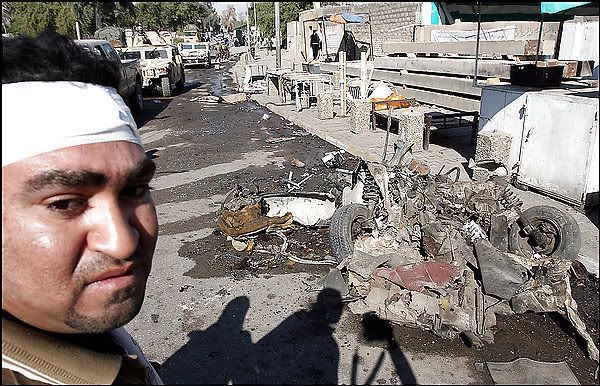 A wounded man stands at the scene of a suicide car bomb attack that killed 10 people in Baghdad. (By Hadi Mizban -- Associated Press)
The Washington Post reports:
A draft law that would ease restrictions on former members of Saddam Hussein's Baath Party, a measure seen by the Bush administration as crucial to national reconciliation, was presented in parliament on Sunday for the first time.
A powerful Shiite faction quickly objected to any moves to bring the Baathists back into government jobs, and a table-pounding argument erupted in the closed-door session, forcing postponement of the debate.
Meanwhile Sunday, a suicide attacker using a car bomb killed 10 people and wounded 29 near the Health Ministry building in central Baghdad, Iraqi police said. It was the latest assault to shatter a relative lull in Iraq's violence.
On Friday, a bomb hidden in a box containing birds detonated in the al-Ghazl animal market, killing 15 people and injuring 55, the deadliest attack in the capital in more than two months.
But violence on average is still down, and U.S. commanders and politicians are increasingly concerned that Iraq's government, riven by sect and competing visions, is not taking advantage of the lull to seek political reconciliation. In particular, the measure on Baathists is viewed as key to bridging the rift between Iraq's majority Shiites and minority Sunni Arabs.
In the wake of the 2003 U.S.-led invasion, thousands of members of the Sunni-dominated Baath Party were dismissed from military and government jobs, retaliation for years of persecuting Shiites. The proposed law would allow them to return to certain positions and collect pensions; thousands have already managed to do so unofficially.
Sunday's objections were raised by politicians loyal to Shiite cleric Moqtada al-Sadr, who withdrew his supporters from the Shiite-led government of Nouri al-Maliki earlier this year.
The argument was ostensibly triggered by claims that the draft law was improperly presented to the legislative body, without first going to its legal committee. But it was clear that the objections rose from deep-rooted sentiments dating to Iraq's turbulent past.
"We reject the return of Baathists to any executive position, not even a hospital manager," said Shiite lawmaker Liwa Smaysim, the head of Sadr's parliamentary bloc. "Our goal is to prosecute the Baath as a party and regime, not only as a regime."
"The Sadrists see the draft law as permissive with Baathists and it would bring them back their jobs. They think it's an amnesty for them," said Mahmoud Othman, an independent Kurdish lawmaker who attended the session.
"We are against the idea of revenge, we want a real reconciliation. The judiciary decides who committed crimes against Iraqis," he added. "Flexibility and forgiveness are needed to reach this goal."
Aside from the law on Baathists, reconciliation legislation to distribute oil revenue among Iraq's sects, reform the constitution and set a date for provincial elections also remain stalled.
Also Sunday, Iraq's most influential Shiite politician, Abdul Aziz al-Hakim, said the United States needed to back up its claims that Iran is fomenting violence inside Iraq, which Iran has denied. The U.S. military has accused an Iranian-backed Shiite cell in Friday's market bombing.
"These are only accusations raised by the multinational forces, and I think these accusations need more proof," Hakim, leader of the Supreme Islamic Iraqi Council, told reporters.
Wednesday, November 21, 2007
| [+/-] |
Israel Defying Sanctions Against Iran |
U.S. officials demanding halt to indirect Israel imports of Iranian pistachio nuts
The International Herald Tribune reports:
It's not just Iran's nuclear program that's causing problems for Israel and the U.S. — it's also Iran's pistachio nuts.
The reddish nuts are landing in Israeli shops after funneling through Turkey, violating Israeli law that bans all Iranian imports and angering American officials who are urging Israel to crack down as part of their attempt to keep Iran from acquiring nuclear weapons.
U.S. Undersecretary of Agriculture Mark Keenum said in a meeting with Israeli officials in Rome on Monday that the pistachio imports must stop, a U.S. official confirmed Wednesday. Both the U.S. and Israel have been pushing for new U.N. sanctions to persuade Iran to abandon its nuclear program. Iran insists its ambitions are peaceful.
"This causes great anger, especially since pistachios succeed in coming in through a third country," Israeli Agriculture Minister Shalom Simchon told Israeli Radio. "This has to do with the sanctions but also with the competition between American farmers and Iranian farmers, and we are trying to deal with this."
Simchon said a recent meeting with a senior U.S. agriculture official focused on using technology to detect the origin of pistachios. He said that would involve chemical testing to determine the climate and soil of where the nuts were grown.
In the mid 1990s U.S. officials pressured Israel to block the import of Iranian nuts coming through E.U. member states and winding up in Israel.
The United States has had few diplomatic and economic ties with Iran since a group of Iranian students besieged the American embassy in Tehran in 1979, holding diplomats hostage for 444 days.
Tensions since Iran started pursuing nuclear technology have only heightened, with the U.S. pushing the U.N. to enact new economic sanctions against the country until it gives up the program.
California is the second largest producer of pistachios in the world, according to the former California Pistachio Coalition. Iran is first.
"As a proud native of the golden state (California), I think Israelis should eat American pistachios, not Iranian ones," said Stewart Tuttle, spokesman for the U.S. Embassy in Tel Aviv.
Sunday, November 11, 2007
| [+/-] |
Experts say, "Danger of Nuclear-Armed Iran May Be Hyped" |
At McClatchy, Warren P. Strobel writes:
A hostile country led by anti-American ideologues appears close to developing its first nuclear weapon and, as a U.S. election approaches, the president and his advisers debate a pre-emptive military strike. Newspaper columnists demand action to stop the nuclear peril.
The country was China, the year was 1963 and the president was Lyndon Baines Johnson.
Now it is Iran that is said to may be bent on acquiring nuclear arms, and President Bush who has declared that "unacceptable." Some U.S. officials and outside commentators are again pushing for a pre-emptive attack.
But the White House and its partisans may be inflating the dangers of a nuclear-armed Iran, say experts on the Persian Gulf and nuclear deterrence. While there are dangers, they acknowledge, Iran appears to want a nuclear weapon for the same reason other countries do: to protect itself.
Bush, by contrast, has suggested that a nuclear-armed Iran could bring about World War III. The president and his top aides, along with hawkish commentators, have suggested that Iran might launch a first strike on Israel or the United States, or hand nuclear weapons to terrorist groups Tehran supports.
There is "only one terrible choice, which is either to bomb those (Iranian nuclear) facilities and retard their program or even cut it off altogether, or allow them to go nuclear," Norman Podhoretz, a foreign policy adviser to GOP presidential candidate Rudy Giuliani, said last month.
"Would I like Iran to have a nuclear bomb? No," said Robert Jervis, a Columbia University professor of international politics who has written widely on nuclear deterrence. But, "the fears (voiced) by the administration and a fair number of sensible people as well, just are exaggerated. The idea that this will really make a big difference, I think is foolish."
Even some commentators in Israel, whose leaders see themselves in Iran's crosshairs, present a more nuanced view of the potential threat than the White House does.
An Iranian nuclear bomb could present Israel "with the real potential for an existential threat," Ephraim Kam of the Institute for National Security Studies in Tel Aviv wrote in February.
But Kam noted that Israel has its own unacknowledged nuclear deterrent — estimated at 100 to 200 warheads — larger than anything Iran could marshal for years to come.
Despite Iran's "messianic religious motivations," he wrote, "it is highly doubtful that Tehran would want to risk an Israeli nuclear response" by attempting a first strike.
Moreover, Iran, which says its nuclear research is aimed at generating electric power, is not thought to be close to having a nuclear weapon. In the worst-case scenario, it could have enough highly enriched uranium, a basic weapon ingredient in weapons, in two to three years.
The International Atomic Energy Agency is due to report next week on whether Iran has cleared up questions about its past nuclear work. The IAEA's judgment will influence whether the U.N. Security Council imposes new sanctions on Iran for failing to suspend uranium enrichment.
Bush administration officials insist that Iran is different from other countries that have sought and acquired nuclear weapons.
The world's known nuclear club is comprised of the United States, Russia, China, France, Britain, India, Pakistan, Israel and North Korea.
"Iran has been willing to share technology and arms with terrorists and inappropriate regimes, in the way these others haven't," said a senior administration official, speaking on condition of anonymity.
"The underlying facts of Iran and of nuclear weapons are different than these other cases," the official said. "I think they would behave differently."
In fact, U.S. ally Pakistan provided nuclear weapons technology to Iran and Libya, and North Korea has sold ballistic missiles in several Middle Eastern countries.
Iran's government is "a regime that is very aggressive in pursuit of its goals," added former undersecretary of state Robert Joseph, a conservative. "Having nuclear weapons would make it even more aggressive."
It is difficult to judge whether Iran would be deterred from using nuclear weapons because the West has limited understanding of the government in Tehran and the United States has mainly indirect communications, analysts say.
"We haven't talked to the Iranians well enough. We talked to the Soviets all the time," said former CIA analyst Judith Yaphe, now at the National Defense University. She added: "But I don't trust someone like (Iranian President Mahmoud) Ahmadenijad to understand where the red lines are."
Others, including Columbia's Jervis, say the U.S. government has not examined in depth how a nuclear armed Iran might behave for a simple reason: Bush's policy is that Iran will not be allowed to have the bomb.
U.S., Israeli and European concerns about a nuclear Iran generally fall into three categories:
The first is that it would hand over a nuclear weapon to terrorists, hoping to elude responsibility for an attack on Israel or America.
But Kam, the Israeli analyst, wrote that the chance of this "appears low." A more serious worry, he wrote, is that Iran could deter Israel from acting against Hezbollah, Iran's terrorist proxy that opposes Israel's existence.
Mohsen Sazegara, who helped found Iran's Islamic Revolutionary Guard Corps and is now a U.S.-based dissident, also predicted Iran would not engage in nuclear terrorism. "If I found out somebody was thinking of this, I'd have to say I don't know my country," he said.
The second concern is that a nuclear-armed Iran would prompt Arab powers such as Saudi Arabia and Egypt to seek their own bombs, sparking an arms race in the perpetually unstable Middle East.
"They're all talking about it now," Yaphe said. "That's a bad thing."
The third is that Iran, because of its radical religious government, will not be deterred from using nuclear weapons. Podhoretz said during a PBS debate that with Iran under the control of clerics and the "religious fanatic" Ahamadinejad "there's no assurance that self-preservation or the protection, preservation of the nation, will deter them."
But Jervis noted that in the early 1960s, Chinese leader Mao Tse-tung "was foaming at the mouth" with anti-Americanism.
President Johnson took no military steps to stop China from going nuclear, and it tested a weapon in 1964.
Iran's leaders suspect the United States wants to overthrow them. "Nuclear weapons mainly protect the homeland," Jervis said.
Tuesday, October 30, 2007
| [+/-] |
Transcript of MSNBC Democratic Debate Moderated By Tim Russert & Brian Williams |
Democratic Candidates Sen. Christopher J. Dodd, D-Conn.; Sen. Hillary Rodham Clinton, D-N.Y.; Former Sen. John Edwards, D-N.C.; Gov. Bill Richardson, D-N.M.; Sen. Joseph R. Biden Jr., D-Del.; Rep. Dennis J. Kucinich, D-Ohio; Sen. Barack Obama, D-Ill. debate in Philadelphia, Pennsylvania
Transcript:
Brian Williams: Philadelphia, the cradle of American democracy, where the founding fathers gathered to declare our nation's independence and to ring out that news on the Liberty Bell, still proudly displayed here.
Philadelphia is also home to Drexel University, with a student body some 20,000 strong. Top majors here include business and engineering. But everybody rallies around the university mascot, Mario the Dragon.
Drexel was founded by financier and philanthropist Anthony J. Drexel back in 1891, the very same year the ornate main building was dedicated.
Tonight, in that building, Drexel continues Philadelphia's proud political tradition, playing host to the Democratic candidates for president, gathered here to debate as the race heats up and the early contests draw near.
Democracy in action, tonight in this City of Brotherly Love.
And from the Drexel campus in Philly, good evening. Brian Williams with Tim Russert.
We have thanked our hosts for this evening. We have thanked the candidates for being here. We should get started.
Senator Obama, we'll begin with you.
You gave an interview to the New York Times, over the weekend, pledging in it to be more aggressive, to be tougher in your campaign against your chief rival for the nomination, the leader among Democrats so far, Senator Clinton, who is here next to you tonight.
To that end, Senator, you said that Senator Clinton was trying to sound Republican, trying to vote Republican on national security issues.
And that was, quote, "bad for the country and ultimately bad for the Democrats." That is a strong charge, as you're aware. Specifically, what are the issues where you, Senator Obama, and Senator Clinton have differed, where you think she has sounded or voted like a Republican?
Barack Obama: Well, first of all, I think some of this stuff gets over- hyped. In fact, I think this has been the most hyped fight since Rocky fought Apollo Creed, although the amazing thing is, I'm Rocky in this situation.
(Laughter)
But, look, we have big challenges. We're at war. The country is struggling with issues like rising health care.
We've got major global challenges like climate change. And that's going to require big, meaningful change. And I'm running for president because I think that the way to bring about that change is to offer some sharp contrasts with the other party.
I think it means that we bring people together to get things done. I think it means that we push against the special interests that are holding us back. And most importantly, I think it requires us to be honest about the challenges that we face.
It does not mean, I think, changing positions whenever it's politically convenient. And Senator Clinton, in her campaign, I think has been for NAFTA previously. Now she's against it. She has taken one position on torture several months ago, and then most recently has taken a different position.
She voted for a war, to authorize sending troops into Iraq, and then later said this was a war for diplomacy.
I don't think that it -- now, that may be politically savvy, but I don't think that it offers the clear contrast that we need. I think what we need right now is honesty with the American people about where we would take the country. That's how I'm trying to run my campaign. That's how I will be as president.
Tim Russert: Senator Clinton, rebuttal?
Hillary Clinton: Well, I don't think the Republicans got the message that I'm voting and sounding like them.
If you watched their debate last week, I seemed to be the topic of great conversation and consternation. And that's for a reason -- because I have stood against George Bush and his failed policies.
They want to continue the war in Iraq; I want to end it. The Republicans are waving their sabers and talking about going after Iran. I want to prevent a rush to war.
On every issue from health care for children to an energy policy that puts us on the right track to deal with climate change and make us more secure, I have been standing against the Republicans, George Bush and Dick Cheney, and I will continue to do so. And I think Democrats know that.
Williams: Senator, thank you.
Tim Russert?
Russert: Senator Edwards, you issued a press release, your campaign, and the headline is "Edwards to
Clinton: American people deserve the truth, not more doubletalk on Iran."
What doubletalk are you suggesting that Senator Clinton has been engaging in on Iran?
John Edwards: First, good evening. It is wonderful to be here.
Let me talk a little bit about what I see as the choice the voters have. I think that from my perspective, President Bush over the last seven years has destroyed the trust relationship America and its president. In fact, I think he has destroyed the trust relationship between the president of the United States and the rest of the world.
I think it is crucial for Democratic voters and caucus-goers to determine who they can trust, who's honest, who is sincere, who has integrity.
And I think it's fair in that regard to look at what people have said. Senator Clinton says that she believes she can be the candidate for change, but she defends a broken system that's corrupt in Washington, D.C.
She says she will end the war, but she continues to say she'll keep combat troops in Iraq and continue combat missions in Iraq.
To me, that's not ending the war, that's a continuation of the war.
She says she'll stand up to George Bush on Iran. She just said it again. And, in fact, she voted to give George Bush the first step in moving militarily on Iran -- and he's taken it. Bush and Cheney have taken it. They have now declared the Iranian Revolutionary Guard a terrorist organization and a proliferator of weapons of mass destruction.
I think we have to stand up to this president.
And then, finally, she said in our last debate that she was against any changes on Social Security -- benefits, retirement aid, or raising the cap on the Social Security tax -- but apparently, it's been reported that she said privately something different than that.
And I think the American people, given this historic moment in our country's history, deserve a president of the United States that they know will tell them the truth, and won't say one thing one time and something different at a different time.
Russert: You stand behind the word "doubletalk"?
Edwards: I do.
Russert: Senator Clinton?
Clinton: Well, I think that anyone who has looked at my record of 35 years fighting for women and children and people who feel invisible and left out in this country knows my record. I fought for expanded education and health care in Arkansas. I helped to bring health care to six million children while in the White House.
And now in the Senate, I've been standing up against the Republicans and everything from preventing them from privatizing Social Security to standing up against President Bush's veto of children's health. You know, I have a long record of standing up and fighting. And I take on the special interests. I've been taking them on for many years.
And I think all you have to do is go back and read the media to know that.
But, on specific issues, I've come out with very specific plans. With respect to Social Security, I do have a plan. It's called, "start with fiscal responsibility." That's what we were doing in the 1990s, and we had Social Security on a much better path than it is today because of the irresponsible spending policies of George Bush and the Republican Congress.
If there are some of the long-term challenges that we need to address, let's do it in the context of having fiscal responsibility, and then let's put together a bipartisan commission and look at how we're going to deal with these long-term challenges. But I am not going to balance Social Security on the backs of seniors and hardworking middle-class Americans.
Let's start taking the tax cuts away from the wealthy, let's take away the no-bid contracts from Halliburton before we start imposing a trillion-dollar tax increase on the elderly and on middle- class workers. I don't think that's necessary, so I have a very specific plan. My friends may not agree with it, but I've been saying it and talking about it for many months.
Russert: We're going to get to Social Security in a little bit, but I want to stay on Iran, Senator Clinton.
As you know, you voted for the Kyl-Lieberman amendment, the only member of the stage here who did that.
Senator, Jim Webb of Virginia said it is for all practical purposes mandating the military option, that it is a clearly worded sense of Congress that could be interpreted as a declaration of war.
Why did you vote for that amendment which would -- calls upon the president to structure our military forces in Iraq with regard to the capability of Iran?
Clinton: Well, first of all, I am against a rush to war. I was the first person on this stage and one of the very first in the Congress to go to the floor of the Senate back in February and say George Bush had no authority to take any military action in Iran.
Secondly, I am not in favor of this rush for war, but I'm also not in favor of doing nothing.
Iran is seeking nuclear weapons. And the Iranian Revolutionary Guard is in the forefront of that, as they are in the sponsorship of terrorism.
So some may want a false choice between rushing to war, which is the way the Republicans sound -- it's not even a question of whether, it's a question of when and what weapons to use -- and doing nothing.
I prefer vigorous diplomacy. And I happen to think economic sanctions are part of vigorous diplomacy. We used them with respect to North Korea. We used them with respect to Libya.
And many of us who voted for that resolution said that this is not anything other than an expression of support for using economic sanctions with respect to diplomacy.
You know, several people who were adamantly opposed to the war in Iraq, like Senator Durbin, voted the same way I did, and said at the time that if he thought there was even the pretense that could be used from the language in that nonbinding resolution to give George Bush any support to go to war, he wouldn't have voted for it. Neither would I.
So we can argue about what is a nonbinding sense of the Senate, and I think that we are missing the point, which is we've got to do everything we can to prevent George Bush and the Republicans from doing something on their own to take offensive military action against Iran.
I am prepared to pass legislation with my colleagues who are here in the Congress to try to get some Republicans to join us, to make it abundantly clear that sanctions and diplomacy are the way to go. We reject and do not believe George Bush has any authority to do anything else.
Russert: Senator Dodd, you said that bill was a justification for war in Iran.
Chris Dodd: Well, Tim, I believe that this issue is going to come back to haunt us. We all learned, some of here painfully, back in 2002, that by voting for an authorization regarding Iraq, that despite the language of that resolution which called for diplomacy at the time, this administration used that resolution, obviously, to pursue a very aggressive action in Iraq.
I'm in a view here, what you didn't learn back in '02, you should've learned by now. And you don't just have to listen to this resolution. There's been a series of drumbeats by this administration, by Dick Cheney, by the president, by others, clearly pointing in a direction that would call for military action in Iran.
It is a dangerous view, in my view. And therefore, I thought it was incumbent upon us. It was interesting that people like Dick Lugar, the former Republican chairman of the Foreign Relations Committee, Chuck Hagel of Nebraska -- Republicans who also had serious reservations and voted against that resolution the other day on September 26th.
I'm very concerned that we're going to see those 76 votes come back, being waved in front of us here as a justification when the Bush administration decides to take military action in Iran.
So it was a moment -- it's a critical moment, when I think leadership is called for here. If you're going to seek the leadership of our country, this is the most serious time in a generation. You have an ascending China. You have an Iranian that's ambitious to acquire nuclear weapons. You have, obviously, a $4 trillion economy that's in trouble, a health care crisis in this country, energy and other issues that are going to confront the next president.
Good judgment and leadership at critical moments must be a part of this debate and discussion. That was a critical moment and the wrong decision was made, in my view.
Russert: Senator Biden, do you agree with Senator Webb: It was, de facto, a declaration of war?
Joe Biden: Well, I think it can be used as declaration. Look, we have a problem in the Senate -- and I'm not just directing this at Hillary; there were 75 other people who voted with her; we are in the minority -- that there are consequences for what we do.
And it's not even about going to war. Let's look at what happened from the moment that vote took place. Oil prices went up to $90 a barrel.
Who benefits from that? All this talk of war, all this talk of declaring people to be terrorists droves up the price of oil.
Secondly, we have emboldened Bush, at a minimum, his talk of world war III -- totally irresponsible talk. We've emboldened him, Tim, to be able to move, if he chooses to move.
They're terrorists. The fact that they're terrorists on one side of the border or the other, we just declare them terrorists. That gives him the color of right to move against them.
Thirdly, this has incredible consequences for Afghanistan and Pakistan. Nobody talks about this. The 75 of our colleagues don't understand. We have no driven, underground, every moderate in Pakistan and in Afghanistan.
This literally -- literally puts Karzai, as well as Musharraf in jeopardy. The notion is it plays into this whole urban legend that America's on a crusade against Islam.
This was bad -- if nothing else happens; not another single thing -- this was bad policy. The president had the ability to do everything that that amendment -- that resolution called for without us talking to it.
And all it has done is hurt us. Even if not another single action is taken, actions have consequences. Big nations can't bluff.
Williams: Senator Obama, let's get at this another way. "Red line" is the current expression of the moment where Iran is concerned in Washington. What would your red line be concerning when to, if to attack Iran? What would make it crystal-clear in your mind that the United States should attack Iran?
Obama: I don't think we should be talking about attacking Iran at this point for some of the reasons that Chris and Joe just talked about. Look, we have been seeing, during the Republican debates, the drum beat of war. The president has been talking about World War III.
That is a continuation of the kinds of foreign policy that rejects diplomacy and sees military action as the only tool available to us to influence the region.
And what we should be doing is reaching out aggressively to our allies, but also talking to our enemies and focusing on those areas where we do not accept their actions, whether it be terrorism or developing nuclear weapons, but also talking to Iran directly about the potential carrots that we can provide in terms of them being involved in the World Trade Organization, or beginning to look at the possibilities of diplomatic relations being normalized.
We have not made those serious attempts. This kind of resolution does not send the right signal to the region. It doesn't send the right signal to our allies or our enemies.
And, as a consequence, I think over the long term, it weakens our capacity to influence Iran.
Now, there may come a point where those measures have been exhausted and Iran is on the verge of obtaining a nuclear weapon, where we have to consider other options. But we shouldn't talk about those options now, when we haven't even tried what would be a much more effective approach.
Williams: Same question to Senator Clinton. What would be your red line?
Clinton: Well, first of all, we have to try diplomacy, and I see economic sanctions as part of diplomacy. We have used it with other very difficult situations -- like Libya, like North Korea. I think that what we're trying to do here is put pressure on the Bush administration. Joe is absolutely right. George Bush can do all of this without anybody. You know, that is the great tragedy and that's why we've got to rein him in, and that's why we need Republican support in the Congress to help us do so.
I invite all of our colleagues to pass something immediately that makes it very clear: He has no authority and we will not permit him to go take offensive action against Iran. But what we're trying to do is push forward on vigorous diplomacy. That has been lacking. I believe we should be engaged in diplomacy right now with the Iranians.
Everything should be on the table, not just their nuclear program. I've been advocating this for several years. I believe it strongly.
But I also think when you go to the table to negotiate with an adversarial regime, you need both carrots and sticks. The Revolutionary Guard is deeply involved in the commercial activities of Iran. Having those economic sanctions hanging over their heads gives our negotiators one of the set of sticks that we need to try to make progress in dealing with a very complicated situation.
Everybody agrees up here that President Bush has made a total mess out of the situation with Iran. What we're trying to do is to sort our way through to try to put diplomacy, with some carrots and some sticks, into the mix and get the president to begin to do that.
Williams: Respectfully, Senator, same question though: Do you have a threshold, a red line beyond which...
Clinton: I want to start diplomacy. I -- you know, I am not going to speculate about when or if they get nuclear weapons.
We're trying to prevent them from getting so. We're not, in my view, rushing to war. We should not be doing that, but we shouldn't be doing nothing, and that means we should not let them acquire nuclear weapons. And the best way to prevent that is a full court press on the diplomatic front.
Williams: I've noted all of our candidates want in on this.
Senator Edwards, you next.
Edwards: Thank you very much.
Well, I just listened to what Senator Clinton said and she said she wanted to maximize pressure on the Bush administration. So the way to do that is to vote yes on a resolution that looks like it was written, literally, by the neo-cons.
I mean, has anyone read this thing? I mean, it literally gave Bush and Cheney exactly what they wanted. It didn't just give them what they wanted. They acted on it.
A few weeks later, they declared the Iranian Revolutionary Guard a terrorist organization, and -- this is going to sound very familiar -- remember from Iraq? The prelude to Iraq? -- proliferators of weapons of mass destruction.
The way you put pressure on this administration is you stand up to them; you say no.
A lot of us on this stage have learned our lessons the hard way, that you give this president an inch and he will take a mile. And this is about such an important issue, and we have to stand up to this president. We need to make it absolutely clear that we have no intention of letting Bush, Cheney or this administration invade Iran because they have been rattling the saber over and over and over.
And what this resolution did, written literally in the language of the neo-cons, is it enables this president to do exactly what he wants to do. He continues to march forward. He continues to say this is a terrorist organization. He continues to say these are proliferators of weapons of mass destruction.
How in the world is that -- Democrats -- we're not talking about Republicans now, Chris and Joe -- Democrats standing up to this president and saying, "No, we are not going to allow this, we are not going to allow this march to war in Iran"?
Russert: Governor Richardson, would you negotiate with Iran without any conditions?
Bill Richardson: Yes, I would. And I'm the only one on this stage that has actually negotiated with a foreign country...
(Unknown): That's not true.
Richardson: And I want to just say to you that, in my judgment, we have to use diplomacy. And there is a redline. We cannot permit Iran to use nuclear weapons. And I do believe what you do is Ahmadinejad -- it's very difficult to deal with him. But there are moderate elements in Iraq. There are moderate clerics. There's students. There's a business community.
And I believe that we can achieve a compromise on the nuclear issue. In exchange for them having a nuclear fuel cycle, nuclear power, they don't develop nuclear weapons -- carrot and sticks, diplomatic initiatives, economic incentives.
The problem is we saber-rattle. And this resolution in the Senate saber-rattles. I was U.N. ambassador. I know this region. And I do believe that it's critically important that we talk to North Korea, that we talk to Syria, that we talk to Iran.
It's going to take skilled diplomacy. What we have in this administration is a policy of preemption, of saber-rattling, of leaking out potential targets in Iran. That's not going to get diplomacy started.
I believe its critical that if we're going to resolve the situation in the Middle East, if we're going to get Iraq to stop Iran's helping terrorists, we have to engage them vigorously, potentially also with sanctions. We need to get European allies who refuse generally to help us with sanctions, as well as Russia. What you saw recently is Russia and Iran embracing each other. That is not healthy.
Russert: Congressman Kucinich, your opinion of this resolution?
Dennis Kucinich: Well, first of all, we need to adamantly reject any kind of a move toward war with Iran.
There's no basis for it whatsoever. But we have to realize, Tim, that we have a number of enablers who happen to be Democrats who have said over the last year, with respect to Iran, all options are on the table. And when you say all options are on the table, you are licensing President Bush.
And I'm the only one up here on the stage who not only voted against the war in Iraq, voted against funding the war, but also led the effort against Bush's drive toward war.
The problem is: These policies of preemption license a war. Preemption, by virtue of international law, is illegal. Our president has already violated international law.
The war in Iraq is illegal. Even planning for the war against Iran is illegal. Tim, we're here in Philadelphia, the birthplace of democracy. I want to know when this democratic Congress is going to stand up for the Constitution and hold the president accountable with Article II, Section 4, an impeachment act.
I think that our democracy is in peril, and unless the Democrats and the Congress stand up for the Constitution, we are going to lose our country. We need to challenge him on this war, but we need to challenge him at his core, and the core is, there needs to be a separation of powers, a balance of powers.
Things are out of balance. It is time for us to stand up for the Constitution of the United States.
(Applause)
Russert: I want to ask each of you the same question.
Senator Clinton, would you pledge to the American people that Iran will not develop a nuclear bomb while you are president?
Clinton: I intend to do everything I can to prevent Iran from developing a nuclear bomb.
Russert: But you won't pledge?
Clinton: I am pledging I will do everything I can to prevent Iran from developing a nuclear bomb.
Russert: But, they may.
Clinton: Well, you know, Tim, you asked me if I would pledge, and I have pledged that I will do everything I can to prevent Iran from developing a nuclear bomb.
(Laughter)
Russert: Senator Edwards?
Edwards: What I will do is take all the responsible steps that can be taken to keep Iran from developing a nuclear weapon.
Obama: I think all of us are committed to Iran not having nuclear weapons, and so we could potentially short circuit this.
(Laughter)
But I think there is a larger point at stake, Tim, and that is, we have been governed by fear for the last six years. And this president has used the fear of terrorism to launch a war that should have never been authorized. We are seeing the same pattern now. We are seeing the Republican nominees do the same thing.
And it is very important for us to draw a clear line and say, "We are not going to be governed by fear. We will take threats seriously. We will take action to make sure that the United States is secure."
As president of the United States, I will do everything in my power to keep us safe.
Obama: But what we cannot continue to do is operate as if we are the weakest nation in the world instead of the strongest one, because that's not who we are and that's not what America has been about, historically. And it is starting to warp our domestic policies, as well.
We haven't even talked about civil liberties and the impact of that politics of fear -- what that has done to us, in terms of undermining basic civil liberties in this country, what it has done in terms of our reputation around the world.
Russert: Senator Biden, would you pledge to the American people that Iran would not build a nuclear bomb on your watch?
Biden: I would pledge to keep us safe. If you told me, Tim -- and this is not -- this is complicated stuff; we talk about this in isolation. The fact of the matter is, the Iranians may get 2.6 kilograms of highly-enriched uranium.
But the Pakistanis have hundreds -- thousands of kilograms of highly-enriched uranium. If by attacking Iran to stop them from getting 2.6 kilograms of highly-enriched uranium, the government in Pakistan falls, who has missiles already deployed with nuclear weapons on them that can already reach Israel, already reach India, then that's a bad bargain.
Biden: Presidents make wise decisions informed not by a vacuum in which they operate, by the situation they find themselves in the world.
I will do all in my power to stop Iran from getting a nuclear weapon, but I will never take my eye off the ball. What is the greatest threat to the United States of America: 2.6 kilograms of highly enriched uranium in Tehran or an out-of-control Pakistan? It's not close.
Williams: Senator Dodd?
Dodd: Well, listen, there's a deeper question here, because not only the pledge you make, but this audience and others here make a determination which of us here have the experience, the background here to manage the situation. It's a critical question.
As I at the outset of my -- the first question you gave me here, this is the most critical time in a generation in this country. The problem's not only the Middle East. What's going on in the Far East, as well as in Latin America and elsewhere.
And which of us here brings the background, the experience, the ability to make a difference on these issues, including the question of Iran.
I agree with Joe. I think the more immediate problem is Pakistan, the one that needs to be addressed. But certainly, bringing that experience together so that you're able to marshal the resources, put together the kind of team, and demonstrate as a result of what you've been able to accomplish over the years that you can actually handle this situation.
Results matter. Experience matters. Having the demonstrated ability to deal with these issues is critical.
So, certainly, I would make a pledge obviously to do everything we can to avoid this problem. But I would suggest to you, Tim, that the more immediate issue is the one exactly that Joe has identified here. Pakistan does pose a more serious issue for this country, and one that needs to be addressed.
That is what I did in Latin America when I negotiated the settlements in El Salvador and Nicaragua, going back 20 years ago, deeply involved in the process, working day after day with various elements to bring about the kind of results that today has reduced the threats of violence in that part of the world.
That's what's needed here, a leader that has the experience and the background to grapple with these issues.
Williams: Governor Richardson?
Richardson: Well, I would make the pledge. It would be through diplomacy. And what we're also talking about is not just Pakistan. We're talking about enriched uranium, a loose nuclear weapon, nuclear materials, fissionable material throughout the world.
Even more of a threat than nuclear weapons is a loose nuclear weapons crossing the border. So what we need is an international agreement. But the key has to be diplomacy.
And I have -- in the fourth row, there's a man named Bill Barloon, who I rescued from an Iraqi prison in Abu Ghraib. And it's going to take leadership. It's going to take diplomacy. It's going to take negotiation.
I went head to head with Saddam Hussein and I brought two Americans out. Bill Barloon is one. And the greatest words I heard after I got him out was, "Thank you." And then I said, "I'm taking you home."
That's diplomacy. That means talking to the Irans, to the Syrias, to the -- North Korea. I've done it, all my life, as diplomat, as a U.N. ambassador, as a special envoy, as a hostage negotiator.
I've got the most international experience here, with all due respect. There's a lot of good international experience here. But I've gone head-to-head in North Korea, and we got back -- we got back six remains of our soldiers six months ago. We got the North Koreans to stop their nuclear reactor.
And so, I believe it's important that we have a leader, not just who can bring people together, but could resolve some of the thorniest problems we have.
Williams: Congressman Kucinich, same question.
Kucinich: With all due respect to our friends from the media here, the media itself has to be careful how you frame these questions. We don't want to be put in a position where we are taking this country to the threshold of war. The media did play a role in taking us into war in Iraq. And I'm urging members of the media -- urge restraint upon you and our president, whose rhetoric is out of control.
I would go to Iran and I would urge Iran not just to not have nuclear weapons. I would urge then to give up nuclear power because nuclear power is the most expensive type of power there is. It is not a sustainable type of power because of the costs of it. It is unsafe. I would urge Iran to give up nuclear power.
But I would also do something further. It is time that the United States government enforced and participated in fully the Non- Proliferation Treaty, which calls for the abolition of all nuclear weapons.
We must lead the way, and we must have a president who understands the danger of these nuclear weapons and have America lead the way among all nations towards nuclear abolition.
When we do that, we will have the credibility to go to an Iran and any other nation that may have desires for nuclear power to say, "Look, we want to take it in another direction."
We are not going to stand by and watch our country lost because we are ratcheting up the rhetoric toward war against Iran.
We have to stop this, Tim. We have to stop ratcheting up the rhetoric for war. We really need to stop it.
Russert: Senator Clinton, elsewhere in the region, let's talk about Iraq. One of your military advisers, retired Lieutenant General Claudia Kennedy, while campaigning for you in New Hampshire, was recently quoted saying, quote, "I don't oppose the war. I have never heard Senator Clinton say 'I oppose the war.'"
Senator Clinton, do you oppose the war in Iraq?
Clinton: Absolutely. But I do not -- and I don't think any of us do -- oppose the brave young men and women who have fought this war with such distinction and heroism.
You know, I have said, repeatedly, that I will begin to bring our troops home as soon as I am president, because it is abundantly clear that President Bush does not intend to end the war while he is still president.
In order to do that, we're doing to have to get the Joint Chiefs and my secretary of defense and advisers together to start the planning to move as quickly as possible, because I don't believe that the planning has been sufficiently undertaken in the Pentagon under this administration.
But we've got to do more. We have to try to get the Iraqi government to understand its obligations, because there is no military solutions. And they have, thus far, failed to do so.
And, finally, we need to engage in diplomacy, with respect to Iraq. You know, we have a big diplomatic apparatus. This president doesn't use it. He relies on a very small group of people. I think that's a terrible mistake.
In addition to the foreign service officers, I would bring in a lot of other distinguished Americans who have experience -- people, you know, like my colleagues, Bill and Joe and Chris. We need a lot of Americans trying to fan out across the world following President Bush, because he's going to leave so many problems.
His policies have alienated our friends and emboldened our enemies. And Iraq and Iran are tinder boxes -- the Middle East, Pakistan.
I agree with Joe -- the Afghanistan situation.
Everywhere you look in the world we've got work to do, and I think we've got to do more than just send our young men and women out. That is not an appropriate use of their power.
Williams: Senator Obama, was Senator Clinton's answer to the opposition of the Iraq war question consistent, in your view?
Obama: I don't think it's consistent with the Iran resolution, for example, which specifically stated that we should structure our forces in Iraq with an eye toward blunting Iranian influence. It is yet another rationale for what we're doing in Iraq, and I think that's a mistake.
Now, I agree that we've got to focus on diplomacy. The president has to lead that diplomacy, which is why I've said I would convene a meeting of Muslim leaders upon taking office because I think we have to send a strong signal that we are willing to listen and not just talk, and certainly not just dictate or engage in military action.
But the real key for the next president is someone who has the credibility of not having been one of the co-authors of this engagement in Iraq.
I think I am in a strong position to be able to say I thought this was a bad idea in the first place. We now have to fix it. We have to be as careful getting out as we were careless getting in. But we nevertheless have to take steps that are not only engaging Iraqis -- the Shia, the Sunni and the Kurds -- but also engaging Iran, Syria and other powers in the region.
Williams: Senator Edwards, same question.
Edwards: Well, here's what I want. I want to make certain that voters in Iowa and New Hampshire and all across America, Democrats and Independents, understand that you have choices in this election, very clear choices.
If you believe that combat missions should be continued in Iraq over the long term, if you believe that combat troops should remain stationed in Iraq, and if you believe there should be no actual timetable for withdrawal, then Senator Clinton is your candidate.
Edwards: I don't. I think that we need to end combat missions; we need to get combat troops out of Iraq. As president of the United States, I will do that. I think it's a requirement of leadership, as president. And I will do it in my first year in office: combat missions ended, combat troops out of Iraq, period.
So there's a very clear choice here between the candidates.
And the second thing that I want to make certain that voters are aware of, when we talk -- we've had a long discussion about Iran. And Barack just made the connection to Iran, and there is a very clear connection.
Because we need to learn from the past. And what we've learned from the past is you cannot trust this president. And what I worry about is, if Bush invades Iran six months from now, I mean, are we going to hear: "If only I had known then what I know now?"
Well, we know enough now to know we have to stand up to this president.
And the second point I would make is, I was surprised by Senator Clinton's vote. I'll be honest about that. And then I saw an explanation of it in The New York Times for her vote which basically said she was moving from primary mode to general election mode.
I think that our responsibility as presidential candidates is to be in "tell the truth" mode all the time. We should not be saying something different in the primary than we say in the general election. I think that's what Americans have been hearing from George Bush, and I think they're looking for something different and voters have a choice in this election.
Williams: Senator Clinton, 30-second rebuttal.
Clinton: Well, I need to rebut this. I don't know where to start. Number one, when we talk about combat missions in Iraq, my understanding is that we had the same agreement -- most of us on this stage -- that we would bring out combat troops but we would pursue a mission against Al Qaida in Iraq if they remained a threat.
Now, I don't know how you pursue Al Qaida without engaging them in combat. So I think we're having a semantic difference here. I think we should get as many of the combat troops out as quickly as possible.
If we leave any troops in, like special operations, to go after Al Qaida in Iraq, I assume that we don't want them just sitting around and watching them. We want them to engage them. That is a very limited mission. That is what I have said consistently.
And you know, when it comes to where I stand, I have been explaining that to the American people. I stand for ending the war in Iraq, bringing our troops home.
But I also know it's going to be complicated, and it's going to take time. And I intend to do it in a responsible manner that is as safe for our troops as possible.
We're going to have troops remaining there, guarding our embassy. We may have a continuing training mission, and we may have a mission against Al Qaida in Iraq. So that's a very big difference than having the 160,000 troops that George Bush has there today.
Williams: Senator, thank you.
And a brief housekeeping note here. We have built two or three rather short breaks into tonight's program, this two-hour debate. And we're going to choose to take the first of them right now, mostly so everyone can take a breath on this hot stage on this otherwise cool night in Philadelphia.
We will continue with our debate from the campus of Drexel University in Philadelphia right after this.
(Applause)
(Commercial break)
Williams: We are back, from the campus of Drexel University in Philadelphia, Pennsylvania, resuming what will be tonight a two-hour debate.
And we're going to start with another subject at the top of this segment.
Senator Clinton, it will go to you. It speaks to electability.
Earlier this month, Republican presidential frontrunner, Rudolph Giuliani, said this about you, quote, "I don't know Hillary's experience. She's never run a city. She's never run a state. She's never run a business. She's never met a payroll. She's never been responsible for the safety and security of millions of people, much less, even hundreds of people.
"So I'm trying to figure out where the experience is here," end of quote.
Senator, how do you respond to the former mayor of New York?
Clinton: Well, I think the kind of experience that the Republican nominees are exhibiting is the kind of experience we don't need. And I think my experience of 35 years -- as an advocate for children and families, as a citizen-activist, as someone who helped to bring educational reform and health care reform to Arkansas, bringing the Children's Health Insurance Program to fruition during the years in the White House, my time in the Senate -- I think my experience on both ends of Pennsylvania Avenue.
But it's really about what's at stake in this election and who can deliver the change that we all know this country desperately needs.
In a perverse way, I think that the Republicans and their constant obsession with me demonstrate clearly that they obviously think that I am communicating effectively about what I will do as president. I am trying to do that because it matters greatly. We've got to turn the page on George Bush and Dick Cheney. In fact, we have to throw the whole book away.
This has been a disastrous period in American history, and we hope it will be an aberration. Then we need to get back to doing what will work again here at home and around the world. I have set forth big goals to restore America's leadership, to once again rebuild a strong and prosperous middle class, to reform our government, and to reclaim the future for our children.
That means ending the war in Iraq, having an energy policy that works and creates jobs, having health care for everyone, having an education system from pre-kindergarten to college affordability and so much more.
Russert: Senator Clinton, I'd like to follow up, because in terms of your experience as first lady, in order to give the American people an opportunity to make a judgment about your experience, would you allow the National Archives to release the documents about your communications with the president, the advice you gave?
Because, as you well know, President Clinton has asked the National Archives not to do anything until 2012.
Clinton: Well, actually, Tim, the Archives is moving as rapidly as the Archives moves. There's about 20 million pieces of paper there. And they are move, and they are releasing as they do their process. And I am fully in favor of that.
Now, all of the records, as far as I know, about what we did with health care, those are already available. Others are becoming available. And I think that, you know, the Archives will continue to move as rapidly as its circumstances and processes demand.
Russert: But there was a letter written by President Clinton specifically asking that any communication between you and the president not be made available to the public until 2012. Would you lift that ban?
Clinton: Well, that's not my decision to make, and I don't believe that any president or first lady ever has. But, certainly, we're move as quickly as our circumstances and the processes of the National Archives permits.
Russert: Senator Obama, your hand is up?
Obama: Well, look, I'm glad that Hillary took the phrase "turn the page." It's a good one, but this is an example of not turning the page. We have just gone through one of the most secretive administrations in our history.
And not releasing, I think, these records at the same time, Hillary, that you're making the claim that this is the basis for your experience, I think, is a problem.
Part of what we have to do is invite the American people back to participate in their government again. Part of what we need to do is rebuild trust in our government again.
And that means being open and transparent and accountable to the American people. And that's one of the hallmarks of my previous work in the state legislature, in the United States Senate, making sure that Americans know where our money is going, what earmarks are out there, what kinds of pork barrel spending is being done, who's bungling money for who.
And that, I think, is part of the job of the next president, is making Americans believe that our government is working for them; because right now, they don't feel like it's working for them. They feel like it's working for special interests and it's working for corporations.
One last point I want to make -- part of the reason that Republicans, I think, are obsessed with you, Hillary, is because that's a fight they're very comfortable having. It is the fight that we've been through since the '90s.
And part of the job of the next president is to break the gridlock and to get Democrats and independents and Republicans to start working together to solve these big problems like health care or climate change or energy.
And what we don't need is another eight years of bickering. And that's precisely why I'm running for president, because one of the things I've been able to do, throughout my political career, is to bring people together to get things done.
Russert: Senator Edwards had his hand up. Then I want to give Senator Clinton a chance to respond.
Edwards: Thank you very much.
I mean, another perspective on why the Republicans keep talking about Senator Clinton is, Senator, they may actually want to run against you, and that's the reason they keep bringing you up.
What I would say is, Senator Clinton just said that she believes we desperately need change in this country. And I agree with that. I actually think we have a system that's broken; it's rigged; it's corrupt. And it does not work for the American people.
And it's time we start telling the truth about that -- too much influence from entrenched interests, insurance companies, drug companies, oil companies, too much influence from Washington lobbyists.
And so the question, I think, that voters have to ask themselves is: Do you believe that the candidate who's raised the most money from Washington lobbyists, Democrat or Republican, the candidate who's raised the most money from the health industry, drug companies, health insurance companies, the candidate who's raised the most money from the defense industry, Republican or Democrat -- and the answer to all of those questions is: That's Senator Clinton.
Will she be the person who brings about the change in this country? You know, I believe in Santa Claus. I believe in the tooth fairy. But I don't think that's going to happen. I really don't.
And I think that if people want the status quo, Senator Clinton's your candidate. That's what I believe. If they want real change, then they need somebody who tells the truth about a system that doesn't work, who believes that this may actually be the first generation we're all worried about. This being the first generation that doesn't leave the world and America better for our children, unlike 20 generations that came before us.
This is not an abstract thing.
This is not about lobbyists. As a matter of fact, it's not about any of us. The truth is, when this election is over, I'm going to be fine. Senator Clinton is going to be fine. Senator Obama's going to be fine.
The question is: Will America be fine? And will we ensure -- and I think this is the great moral test of our generation -- will we ensure that our children have a better life than we have had? That's the responsibility we have.
Russert: Senator Clinton, please.
Clinton: Well, I think we were making progress in the 1990s and I am very proud of the progress were making until, unfortunately, the Supreme Court handed the presidency to George Bush, and we have been living with the consequences ever since.
I think it is time for us to step up and say we are going to change the way Washington works. I've laid out very specific plans about how to do that. I'm going to take $10 billion away from a lot of these industries, starting with money from the HMOs that are getting too much out of Medicare, starting with the no-bid contracts for Halliburton; starting with the defense industry that needs to be pared down and reined in.
I've been very clear about that. And I intend to implement that.
You know, change is just a word if you don't have the strength and experience to actually make it happen.
Williams: Senator Obama, to you, let's apply what we'll call the Giuliani question about having run a city, a state, a payroll. What, specifically, is your relevant experience for being president?
Obama: The experience I have in politics is primarily legislative. But here's the experience that I think the next president needs. I think the next president has to be able to get people to work together to get things done, even when they disagree.
And I've done that. You know, when I was in Illinois, we brought police officers and civil rights advocates together to reform a death penalty system that had sent 13 innocent men to death row.
And we ended up passing it unanimously, even though originally people had said it couldn't be done.
You know, Dennis earlier was talking about the need to work on nonproliferation issues. I've worked with Dick Lugar, Republican spokesperson for the Senate Foreign Relations Committee, to focus on the next generation of nonproliferation efforts.
Now, that, I think, is critical experience.
I also think it is critical for the next president to be experienced to stand up to special interests. I'm glad Hillary is talking about it, but I'm the only person on this stage who has worked actively just last year passing, along with Russ Feingold, some of the toughest ethics reform since Watergate, making sure that lobbyists could not provide gifts and meals to congressmen, making sure that the bundling of moneys by lobbyists was disclosed.
And finally, I think we've got to have a president who has the experience of standing up, even when it's not easy, which is what I did in 2002 when i stood up against this war in Iraq 10 days before the authorization.
That is the kind of judgment that I'm displaying during this campaign when I go to Detroit and I say to the automakers that they need to raise fuel efficiency standards; not in front of some environmental group.
That kind of consistency and principled leadership, I think, is what is going to move us in the next direction. That's what I'll provide as president.
Williams: Governor Richardson, though, there was broad disagreement on this panel about you having the only negotiation experience.
You did raise your qualifications earlier. Is your contention that, say, the top three frontrunners in this race are less qualified than you are to be president?
Richardson: No, and I'm positive. You know what I'm hearing here? I'm hearing this holier than thou attitude towards Senator Clinton that -- it's bothering me because it's pretty close to personal attacks that we don't need. Do we trust her? Do we -- did she take money from special interests?
We need to be positive in this campaign. Yes, we need to point out our differences. And I have big differences with her over the war -- I would get all our troops out -- over No Child Left Behind -- I'd get rid of it. I also have differences over Iran. I think that was the wrong vote for her to cast because I think it was saber-rattling.
But I think it's important that we save the ammunition for the Republicans. If we continue, I believe, harping on the past and not focusing on the future -- look, the reality on the electability issue is, the last senator that was elected president was 40 years ago.
Look, the reality on the electability issue is, the last senator that was elected president was 40 years ago. His name was John F. Kennedy.
We elect governors as president. Seven out of the last eight have been either governors or ex-governors.
And my view is that I know how to bring people together. More than all the issues that we're talking about it's who can govern, who can manage.
I'm the only CEO in this race. I've balanced budgets. I've provided health care to kids under 12. I've improved education. I've got foreign policy experience. I've negotiated with foreign countries as a diplomat, as a hostage negotiator.
Yes, I do think it is substantially more than my colleagues, although they have a strong record.
But the important thing is that we need to stay positive. We need to have disagreement on the issues, not on whether you can trust -- I trust Senator Clinton, but I don't agree with her on a majority of issues.
Williams: Senator Dodd, you gave an interview to our local NBC station here today, alluding to problems with Senator Clinton's national electability. What is the point you want to make on that score?
Dodd: Well, first, I think electability's a very critical issue. Look, at the end of this process here, we need to have a Democrat in the White House come January 20, 2009. That is essential in my view to get this country back on its feet again, to restore our moral authority in the world. It is a critical question.
Whether it's fair or not fair, the fact of the matter is that my colleague from New York, Senator Clinton, there are 50 percent of the American public that say they're not going to vote for her. I'm not saying anything that people don't know already. I don't necessarily like it, but those are the facts.
We as a party certainly have to take that into consideration. But let me add, since the matter's been brought up here as well, this situational ethics situation does bother me in a sense, what Bill Richardson has alluded to. My friend John Edwards here, certainly taking money from the trial bar, special interest group, here to be condemning one candidate for taking money from one group as opposed to another.
I happen to believe we ought to have public financing for our campaigns. I've supported that for 25 years. I managed the McCain-Feingold legislation on the floor of the United States Senate several years ago. I won't take a back seat to anybody on trying to reform our political process.
But let's remember what's at stake here. We need to elect a Democrat, a Democrat that's electable and a Democrat that can bring the country together.
For 26 years, I have, in every major landmark piece of legislation, had a Republican as my co-sponsor, because no one party is going to straighten all of this out.
When I started the children's caucus in 1981, I did it with Arlen Specter of this state. When I wrote the Family and Medical Leave bill, I did it with Kit Bond and Dan Coates.
When I wrote the first child care legislation since World War II, I did it with Orrin Hatch, not because I agreed with him on any other issue, but because I knew, in order to move our country forward, we had to have leadership in this country that understood the value of reaching out and finding common ground with people.
So electability and the ability the govern and to do so immediately are important. But don't discount the importance of electability.
It's a very important hurdle...
Williams: Senator Edwards, do you want to take 30 seconds and respond on situational ethics?
Edwards: I do. First of all, let me be absolutely clear about this. I think I said it a few minutes ago. Nobody on this stage is pure, and that absolutely includes me. I am not perfect, nor do I claim to be.
It is true that I, like Senator Obama, have taken no money from Washington lobbyists in this campaign and no money from special interest PACs. But I am not interested in patting myself on the back, or actually talking about anybody personally on this stage.
I completely disagree with what Bill said. This is not about the past. This is about the future. This is about whether we believe this system works. I mean, we are here in Philadelphia where the founding fathers decided that the power, the sovereign power in this government should not reside with the rich and the powerful. It ought to reside with the people.
And everybody in America can see what is happening now. We don't have universal health care because of drug companies, insurance companies and their lobbyists.
The reason we haven't tackled global warming is because of oil companies, power companies and their lobbyists.
And the question is, what are we going to do for our children? I mean, I'll say this to every voter who's watching this debate: Are you -- listen, we've all stood by and watched this happen. That includes me. I'm guilty. Guilty as charged.
But the question is, are you willing to look your children in the eye tonight and say, "I'm going to turn this mess over to you"? Because if you turn your back on the incompetence and the corruption that exists in Washington today, that's exactly what you're saying. You're saying, "I'm going to let my children and my grandchildren take care of that. I'm not willing to do that."
Williams: Congressman Kucinich. You're smiling. Why?
Kucinich: Well, I'm glad to hear people take a stand for integrity. When people get money from New York hedge funds and then they attack another person for getting money from Washington interest groups, you know what? They're both right. So I'm not going to get in the middle of that one.
Now, I want to go beyond that.
The American people have a right to know what's different here among all these candidates. We haven't really established that, I don't think. And I'm the only one up here who stands for a not for profit health care system, which means that the insurance industry has enormous influence in this race.
Why shouldn't Democrats stand for universal, single-payer, not for profit with 46 million Americans uninsured and 50 million Americans under-insured?
Tim, I want to tell you something. There's got to be people watching this at home saying, "Hey, you haven't talked about me losing my job because of NAFTA." Well, I'll cancel NAFTA and the WTO and have trade that's based on workers' rights -- human rights and environmental quality principles.
Somebody's got to be saying, "Wait a minute. Who's talking about whether I'm going to have health care?" I've introduced the bill, H.R. 676.
You have somebody worried about losing their home. We need to cancel Bush's tax cuts and flip them so we give the benefit to the 80 percent, while currently it's going to the top one percent, so people will have more money so they can save their homes.
I mean, we have to talk about people's practical aspirations here. And, if we don't do that tonight, this debate is a total flop.
Williams: Senator Biden, you said recently, "While Mrs. Clinton was meeting socially with the prime minister of a country, I was sitting down and negotiating with them. I know my experience is considerably deeper and more relevant."
Do you stand by that quote, and is your inference that she is less qualified than you to be president?
Biden: I'm not running against Hillary Clinton. I'm running to lead the free world. I'm running to lead this country. And the irony is, Rudy Giuliani, probably the most underqualified man since George Bush to seek the presidency...
(Laughter)
... is here talking about any of the people here.
(Applause)
Rudy Giuliani -- I mean, think about it. Rudy Giuliani -- there's only three things he mentions in a sentence: a noun and a verb and 9/11. I mean, there's nothing else.
(Laughter)
There's nothing else, and I mean this sincerely. He is genuinely not qualified to be president. Here's a man who brags about how he made the city safe. It was the Biden crime bill that became the Clinton crime bill that allowed him to do that.
They wipe it out. He remains silent.
The 9/11 Commission comes along and says the way to keep your city safe is to do the following things. He's been silent. He's done nothing.
And now he's talking about he's going to go in and he will demonstrate to Iran, he's going to in fact lay down the law.
This man is truly not qualified to be president. I'm looking forward to running against Rudy Giuliani.
(Laughter)
And with regard to my experience, hey, Bill, 1979, I was -- I led a delegation of 19 senators negotiating the START agreement with Brezhnev. I was deeply involved in Bosnia, as the first lady and now Senator Clinton will tell you. I've been negotiating while you were still in Congress, man.
And so the point is -- and I introduced the first public financing bill. If you all had been around long enough you -- maybe I've been around too long. They forget all the wonderful things I've done here.
But, anyway...
(Laughter)
All kidding aside, I'm running not against Hillary Clinton or anybody on this stage.
I'm running to be the leader of this country to put it back on track and to regain control in the world which is lost.
Williams: On that note, Tim Russert's going to take us into a segment on Social Security.
Russert: Senator Clinton, I want to clear something up which goes to the issue of credibility. You were asked at the AARP debate whether or not you would consider taxing, lifting the cap from $97,500, taxing that, raising more money for Social Security. You said, quote, "It's a no." I asked you the same question in New Hampshire, and you said "no."
Then you went to Iowa and you went up to Tod Bowman, a teacher, and had a conversation with him saying, "I would consider lifting the cap perhaps above $200,000." You were overheard by an Associated Press reporter saying that.
Why do you have one public position and one private position?
Clinton: Well, Tim, I don't. I have said consistently that my plan for Social Security is fiscal responsibility first, then to deal with any long-term challenges which I agree are ones that we are going to have to address.
We would have a bipartisan commission. In the context of that, I think all of these would be considered. But, personally, I do not want to balance Social Security on the backs of our seniors and middle-class families. That's why I put fiscal responsibility first, because we have to change the Bush tax cuts, which I am committed to doing.
We have to move back toward a more fair and progressive tax system, and begin once again to move toward a balanced budget with a surplus. You know, part of the idea in the '90s was not just so Bill would have a check mark next to his name in history, but so that we would have the resources to deal with a lot of these entitlement problems.
George Bush understood that. The Republicans understood that. They wanted to decimate that balanced budget and a surplus because they knew that that would give them a free hand to try to privatize Social Security.
I am not going to be repeating Republican talking points. So when somebody asks me, would something like this be considered, well, anything could be considered when we get to a bipartisan commission. But personally, I am not going to be advocating any specific fix until I am seriously approaching fiscal responsibility.
Russert: But you did raise it as a possibility with Tod Bowman?
Clinton: Well, but everybody knows what the possibilities are, Tim. Everybody knows that. But I do not advocate it. I do not support it. I have laid out what I do believe, and I am going to continue to emphasize that.
I think, for us to act like Social Security is in crisis is a Republican trap. We're playing on the Republican field. And I don't intend to do that.
Russert: You call it a Republican talking point. Georgetown University, February 9, 1998: "We are in a -- heading to a looming fiscal crisis in Social Security. If nothing is done, it will require a huge tax increase in the payroll tax or a 25 percent in Social Security benefits," Bill Clinton, 1998.
That's recent history. Only two years to go in his term. Is that a Republican talking point?
Clinton: No, but what he did was to move us toward a balanced budget and a surplus. And, if you go back and you look at the numbers, they really took off starting in '98, '99, 2000, 2001.
And that would have given a president who actually believed in Social Security -- which George Bush does not -- the resources and the options to make decisions, but not the kind of draconian decisions, and certainly not the move toward privatization, which is what the Republicans have been advocating for as long as I can remember.
Russert: Senator Obama, you said in May, that, quote, "Everything is on the table when it comes to Social Security." You now have an ad up in Iowa which says that any benefit cuts are off and raising the retirement age are off.
Why have you changed your mind?
Obama: Well, what I say is that that is not my plan.
Now, I just want to go back to what Senator Clinton said, because I think it's important for us not to engage in business as usual on Social Security and talk straight.
Everybody on this stage is against privatization and we all fought against it -- everybody. I absolutely agree that Social Security is not in crisis; it is a fundamentally sound system, but it does have a problem, long-term.
Even if we deal with the issue of fiscal responsibility, the trust fund is no longer being rated -- that's something that all of us are in favor of.
We've got 78 million baby boomers who are going to be retiring over the next couple of decades. That means more retirees, fewer workers to support those retirees.
It is common sense that we are going to have to do something about it. That is not a Republican talking point. And if we don't deal with it now, it will get harder to deal with later.
So what I've said, and I know some others on this stage have said, is that among the options that are available, the best one is to lift the cap on the payroll tax, potentially exempting folks in the middle -- middle-class folks -- but making sure that the wealthy are paying more of their fair share -- a little bit more.
Now, it is important, if we are going to lead this country, to be clear to the American people about what our intentions are. And this is part of the politics that we have been playing, which is to try to muddle through, give convoluted answers. Ultimately, we then don't have a mandate and we can't bring about change, in part because we're afraid to give Republicans talking points.
I'm not fearful, just as Joe isn't, to have a debate about this with Rudy Giuliani because we've got the facts on our side. But we've got to be clear about those facts and not pretend that those facts don't exist.
Russert: But when asked by The New York Times whether Senator Clinton has been truthful, you said no.
Obama: What I said is that she has not been truthful and clear about this point that I just made, which is we can talk about fiscal responsibility and all of us agree with that. All of us oppose privatization.
But even after we deal with those issues, we are still going to have an actuarial gap that has to be dealt with. It is not going to vanish and if we have a moral responsibility to the next generation to make sure that Social Security is there, the most successful program to lift seniors out of poverty that we've ever devised, then we need to start acting now and having a serious conversation about it.
Clinton: Tim, I don't see any difference here. You know, my view is we go towards fiscal responsibility, which is hard. It's not going to be easy inheriting what we're going to inherit from Bush and the Republicans.
And there are some long-term challenges. I have no disagreement with that.
But I think the best way to handle them is within the context of a bipartisan commission. That's what worked in 1983 when Social Security was on the ropes. Our colleagues in the Senate had a hearing today talking about how they could move toward a bipartisan commission.
And, once there's a bipartisan commission, then we can see what we need to do. But I don't want these decisions to be made in a vacuum. I want it to be made in the face of moving back toward fiscal responsibility, because that will influence which choices are actually better.
And I certainly don't want to impose a trillion-dollar tax increase on middle-class families, or any kind of additional burdens on our seniors.
Williams: Senator Obama, we're going to transfer into a new area here. A question specifically for you because you're in a rather unique position. It's about religion and misinformation. Governor Romney misspoke twice on the same day, confusing your name with that of Osama bin Laden.
Your party is fond of talking about a potential swiftboating. Are you fearful of what happened to John McCain, for example, in South Carolina a few years back; confusion on the basis of things like names and religion?
Obama: No, because I have confidence in the American people.
And I don't pay much attention to what Mitt Romney has to say -- at least what he says this week. It may be different next week.
But there is no doubt that my background is not typical of a presidential candidate. I think everybody understands that. But that's part of what is so powerful about America, is that it gives all of us the opportunity -- a woman, a Latino, myself -- the opportunity to run.
And, listen, when I was running for the United States Senate everybody said nobody's going to vote for a black guy named Barack Obama; they can't even pronounce it. And we ended up winning by 20 points in the primary and 30 points in the general election.
The way to respond to swiftboating is to respond forcefully, rapidly and truthfully. And I have absolute confidence in the American people's capacity to absorb the truth, as long as we are forceful in that presentation.
And we are seeing it. As we travel all across the country, we have received enormous support, in states where, frankly, there aren't a lot of African-Americans, and there aren't a lot of Obamas.
(Laughter)
Williams: Let's take this opportunity to fit in what will be the second of three breaks tonight.
We'll be back with more from the campus of Drexel University in Philadelphia right after this.
(Commercial break)
Williams: We are back from the campus of Drexel University here in Philadelphia. Our debate continues now. We're going to introduce some rule changes as we go, and for this next question, alone in this segment, we're going to enforce a -- or try to -- a 30-second limit on responses. We're going to begin with Senator Dodd and go right down the panel.
Most experts believe we're looking at $100 a barrel oil prices, perhaps very soon. Most experts further believe there are some folks in America who may be paying 50 percent more for things like heating oil this winter, let's say, where winters are difficult, in two states that come to mind: Iowa and New Hampshire, say nothing of your home state of Connecticut.
As a member of the U.S. Senate, are these people doomed to paying more, to suffering through these energy costs this winter, Senator? Aside from blue ribbon panels, what can be done right now about what afflicts the United States on this issue of energy?
Dodd: I would suggest to you what Senator Byron Dorgan and I offered twice in the last couple of years, and that was to say that any increase in price over $40 a barrel either be reinvested in alternative energies or new exploration here, or provide a direct rebate to consumers across the country to reduce the cost that you have exactly described here with these increases in the price of a barrel of oil.
That would provide some immediate relief, with low-income energy assistance and other programs, which I and others have championed over the years to provide assistance to those who are going to be in desperate conditions with health as well. But that's the short-term answer to this problem.
The longer-term answer is obviously to stop what we do every single day and that is borrow $1 billion every single day to buy foreign oil offshore here.
We ought to moving more directly, obviously, to energy independence here. I'd invite people to chrisdodd.com to get a long, detailed explanation of exactly how to do that.
Williams: We're going to try to enforce this time limit.
Senator Biden?
Biden: A big piece of that cost is risk. People are betting on things getting worse. That old joke, you know: When you're in a hole, you should stop digging.
Why do we continue to cause the price of oil to rise by continuing to rattle the saber with Iran? Why do we continue to cause the price of oil to rise by a foreign policy that is absolutely moribund of any center?
And what we have to do immediately to take care of those people in Iowa and New Hampshire: provide for emergency fuel assistance.
Williams: Senator Edwards?
Edwards: Well, what we can do in the short term -- and I will do as president -- is ensure that my Justice Department investigates what these oil companies who are vertically integrated, you know, from refinery to pump, are doing.
But I think there's something else that -- we've talked a lot about being straight with people tonight. I think it's really important that every four years the presidential candidates roll through Iowa and New Hampshire, promise this, promise that, promise this.
Here's the truth: We need to ask Americans to be patriotic about something other than war.
And I want to be the president who says to America, we're in this together. We're going to have to be willing to sacrifice. If we love this country enough, we're going to have to conserve, in our homes, in our workplaces, and alter our behavior to make America what it's capable of being.
Williams: Senator Clinton?
Clinton: Well, I agree with everything that my colleagues have just said. I think it's important that we do have enough money in LIHEAP. It's a battle we fight every year against the Republicans. That's the program to help consumers pay their bills. We should have a crash program on weatherization, which will help to drive those bills down.
We need to do more to investigate, as John says, and we might even have to look at the strategic petroleum reserve, which the Bush administration has been filling up beyond any expectation of need for the short term, at least. But we also have to have a serious move toward energy efficiency and conservation. And that is where we need to get people to be more conscious to do it for themselves.
Williams: Senator Obama?
Obama: As Joe pointed out, out of the $90 that it's costing right now for a barrel, about 30 percent of that is just risk.
It's not dictated by supply and demand. If we can lower the rhetoric, with respect to military action in the Middle East, that will have an immediate impact.
All the other suggestions that have been made are sound. But one of the things that we have to do, with respect to conservation is increase fuel efficiency standards on cars.
And we have to make that commitment not just by going to environmentalist groups and saying we're going to do it but doing what I did, which is go to Detroit, talking to the auto makers. Joe and I have been working on legislation that would provide them the incentives to start making those shifts.
Williams: Congressman Kucinich?
Kucinich: Everyone knows that the war against Iraq was about oil. This administration was trying to gain control of Iraq's oil, with the help of Congress. It's time we had a president who stood for the Constitution and international law.
And that's exactly what I'll do.
Everyone knows that the saber-rattling against Iran is driving up the price of oil. We have to stop the war in Iraq, bring our troops home, end the occupation, have an international security and peacekeeping force that moves in as our troops leave.
We have to stop planning for war against Iran. We have to insist that we enforce the Constitution of the United States, which this president continues to violate, and, again, I state that the president and the vice president should be subject to impeachment.
Then we can start to get control of our energy policies by rejecting this doctrine of preemption, which is not worthy of this nation.
Williams: Thank you. Thank you, Congressman.
Governor Richardson?
Richardson: You need an energy revolution in this country -- an Apollo program that does the following: one, reduces consumption of fossil fuels by 50 percent by 2020. Fuel efficiency -- I'm going to be specific -- 50 miles per gallon. A renewable portfolio standard -- in other words, all electricity in America -- 30 percent renewable sources.
Reduce greenhouse gas emissions by 80 percent by 2040; by 30 percent by 2020. A cap-and-trade system.
Energy efficiency, too. You got to ask the American people to sacrifice a little bit. What does that mean? That means when we use appliances, mass transit, air conditioning, that we all bound together to reduce this dependence on foreign oil that affects our national security, when 65 percent of your oil is imported.
When the planet -- when the planet is polluted by fossil fuels and manmade pollution, it is American leadership, and it's presidential leadership, and it has to be an energy revolution, not these little energy bills that the Congress keeps passing that are meaningless.
Williams: Thank you, Governor.
A question for Senator Dodd.
A question to you alone, Senator, about this intersection of environment and sacrifice. So many people have been saddened by the pictures these past few days from Southern California. There are reports that major cities in the state of Georgia are threatened will running out of drinking water in a matter of days.
Are you truly prepared to lead, on a national scale, the kind of sacrifice it would require where it intersects with the environment?
Dodd: Well, I think you've got to. I find it somewhat startling here that Ronald Reagan's former secretary of state and George Bush's first economic -- chief economic adviser are, frankly, more courageous and bold on energy policy than my fellow competitors here for this job, the presidency.
I've called for a corporate carbon tax. All of us share the same goals here of achieving energy independence, reducing our dependency on fossil fuels and the carbons they emit. But you're not going to achieve that unless you deal with price, quite frankly, here.
And there's a direct correlation between continuing a policy that produces the CO2 emissions and the health hazards to our country and the climate change problems here. You've got to deal with price because, frankly, consumers are not going to be in a position where they can afford the more expensive fuels, the alternative fuels and technologies.
Dodd: So the corporate carbon tax, taxing carbon, is a critical element if you are going to achieve this kind of energy change we need in our country. That directly bears on the kinds of problems we're seeing. There is no doubt in my mind that there is a correlation between what you've just described, Brian, and energy policy here; not to mention the national security and economic security risks as a result of our continuing dependence on fossil fuels, particularly oil out of the Middle East.
So those are things that I advocate that no one else does on the stage here this evening. Al Gore has called it the most bold and honest plans. It has been called the blue ribbon, or the gold standard, rather, of any of the energy policies that have been suggested by presidential candidates.
This is a major issue. It requires hardship. A corporate carbon tax is not without a cost to it. I understand that. But the status quo of continuing borrowing $1 billion every day to buy foreign oil, continuing the risk to our country, I think is unacceptable.
That's why I'm advocating it.
Williams: Senator Edwards, should there be a bottomless well of federal dollars for people who knowingly live in areas of this country that are disaster-prone to rebuild their homes if lost in a disaster?
Edwards: Well, I think that when families are devastated -- and we've lived with this in North Carolina because we've been regularly hit by hurricanes, and I've spent an awful lot of time in New Orleans. When families are hit by natural disasters, I think it is for the national community to be there for them.
I think that's our joint responsibility as a national community to be there for them. And my view about what's happening, particularly in New Orleans, is it's absolutely heartbreaking to see what's happened there. Because this is a perfect example of a government that's a mess and the American people who are absolutely extraordinary.
I mean, you look at how America has responded to this tragedy. They have been volunteering, contributing. I took 700 college kids down to New Orleans who gave up their spring break to go down there and work to help rehabilitate houses.
I was so inspired and proud of those young kids.
But the government has been a complete disaster. And contracts have been let to these multi-national corporations, instead of allowing the people of New Orleans to rebuild their own city.
My view is: We didn't need a surge in Baghdad -- we needed a surge in New Orleans. We need to be there for our people who are struggling.
And I do think we can be smart about planning. I think actually, in the case of New Orleans, there was an extraordinary opportunity to rebuild a city that was more economically integrated, more racially integrated.
Those pictures that we saw coming out of the Ninth Ward of New Orleans, I think, broke a lot of people's hearts. And I think it actually was a wake-up call to a lot of Americans who didn't realize that kind of problem existed any longer.
Williams: But does smarter mean any limits?
Let's just take 20 seconds more here -- from Malibu to the Outer Banks down to Florida -- should there be unlimited federal authority...
Edwards: Of course we have to be smart. We have to be environmentally sensitive. There's actually on the coast of North Carolina, we've done a great deal to do that, to preserve wetlands, for example, which are crucial barrier to help protect our coasts.
But, yes, smart, but when a natural disaster comes, our country needs to be there for our people.
Williams: To Tim Russert.
Russert: I'd like to talk about taxes.
Senator Clinton, I'd like to start with you. Because the chairman of the House Ways and Means Committee, Charlie Rangel, is a strong supporter of your campaign.
He wants to repeal the Alternative Minimum Tax. But he also wants to have a 4 percent surtax on a single $150,000 income or $200,000 married couple.
You went to Harlem with your husband, with Charlie Rangel. And the former president said, quote, "Charlie Rangel wants me to pay more taxes so you can pay less and I think that's a good idea."
Is that also your view?
Clinton: Well, I am a great admirer of Chairman Rangel. And what he's trying to do is deal with a very serious problem. You know, the Alternative Minimum Tax was never intended to hit people are in middle income, upper middle income. It was meant for people who are rich and evading taxes.
Now I don't know all the details of what Charlie is recommending, but I certainly agree with the goal. We've got to do something with the Alternative Minimum Tax.
There are a lot of ways of getting there. I want it to be fair and progressive. It starts in the House, it starts in the Ways and Means Committee, which he chairs. But I think my husband was expressing an opinion that a lot of people who have been very fortunate and blessed over the last six and a half years feel.
You know, we've not been asked to sacrifice anything. You know, young men and women wearing the uniform of our country are dying and being maimed. We have the average American family losing a thousand dollars in income, and George Bush and his cronies can't figure out how they can give even more tax cuts to the wealthiest of Americans.
Now, I never thought Bill and I would be in that category, to be honest with you. So it's kind of a new experience. But it's not one that make us very comfortable, because we should be investing in new energy, we should be investing in college affordability, universal pre-K, the kind of health care plan that I've outlined.
That's what we intend to do. But we're going to have to deal with the AMT, something that the Republicans have refused to do because, very frankly, it hits people who are below their concern. They're concerned about the real top wage earners. This hits people that are, you know, the police chief. This hits people that are, you know, two income families that are doing well.
So we're going to have to do something about it. I think Charlie's being very courageous in moving forward. I don't agree with all the details, but he's on the right track to say we've got to do something about the AMT.
Russert: So in principle, you would be in favor of looking at a 4 percent surtax?
Clinton: No, I didn't say that, Tim. I said that I'm in favor of doing something about the AMT. How we do it and how we put the package together everybody knows is extremely complicated.
It's not going to happen while George Bush is president. Everybody knows that. I want to get to a fair and progressive tax system. The AMT has to be part of what we try to change when I'm president.
And there are a lot of moving pieces here. You know, there are kinds of issues we're going to deal with as the tax cuts expire.
I want to freeze the estate tax at the 2009 level of $7 million for a couple.
There's a lot of moving parts. So I'm not going to get committed to a specific approach, but I applaud Chairman Rangel for beginning the conversation.
Russert: But you will not campaign on the Rangel plan?
Clinton: No, no. That's Charlie Rangel's plan. And, as I say, I support and admire his willingness to take this on.
Russert: Senator Obama, would you campaign on the Rangel plan?
Obama: No, because I don't know all the details of it and I may not agree with some aspects of it.
But let's broaden the conversation here. We're all traveling all across the country -- Iowa, New Hampshire. Everywhere you go, you'll meet a single mother who is raising her kids, working at the same time, trying to go to college. And every one of her costs, from health care to college tuition, has gone up. Home heating oil is going up. She can't even imagine the idea of saving.
Now, in the meantime, we've got a 10,000-page tax code that is rife with corporate loopholes.
There's a building in the Cayman Islands that supposedly houses 12,000 U.S. corporations, which means it is either the largest building in the world or the biggest tax ripoff in the world, and I think we know which one it is.
So there has to be a restoration of balance in our tax code to help that single mom, to help a two-parent working family that is struggling to make ends meet.
So I put forward a very specific plan. I've said we are going to offset some of the payroll taxes that people are experiencing so that families who are making less than $50,000 a year get a larger break. I want to make sure that seniors who are making less than $50,000, that they get some relief in terms of the taxes on their Social Security.
Those kinds of progressive tax steps, while closing loopholes and rolling back the Bush tax cuts to the top 1 percent, simply restores some fairness and a sense that we're all in this together, as opposed to each of us being in it on our own.
Russert: Congressman Kucinich, I want to move to the issue of hedge funds -- hedge funds. Managers of hedge funds. There's a listing in the paper the other day of 100 top managers of hedge funds. At the top, $1.5 billion. Number 100 makes $50 million. They pay a tax rate of 16 percent, rather than ordinary income of 31, 32 percent.
The Democrats took control of Congress in November of '06. The leader of the Democrats in the Senate, Harry Reid, said, we're not going to change it this year. Your reaction.
Kucinich: It's one of the reasons why the American people are so distressed with the current condition of the Democratic Party. They won't stand up to Wall Street, where there's over a trillion dollars of unregulated capital with hedge funds.
They won't end the war, as our party promised to do in the 2006 election. They won't stand up to the insurance companies, the for- profit insurance companies, by joining me in a not-for-profit system.
So people are asking them, "What's the difference between Democrats and Republicans?" Tim, my candidacy is a candidacy which will protect the interests of Main Street.
No privatization of Social Security, make the hedge funds accountable, protect the small investors who are at risk with these public offerings of these hedge funds.
My Domestic Policy Subcommittee has been looking at this. I was one of the first ones on Capitol Hill to look at it.
Right now, it's all about a redistribution of the wealth upwards, Tim. You know, the tax system is about redistributing the wealth upwards. The health care system redistributes the wealth upwards. Our energy policies redistribute the wealth upwards.
We have to have a president who is independent enough to be able to stand up to these interest groups and push the Democratic Congress to defend the American people by standing for the end of the war in Iraq, by standing for a universal, not-for-profit health care system, by standing for control of these oil companies, which are out of control, and, finally, by standing for the Constitution.
I will say it one more time. It's time for the Democratic Party to take a position on impeachment, and for the House of Representatives to move the bill that I've introduced.
Russert: Senator Edwards, you worked for a hedge fund. By every estimate, we could save $25 billion over 10 years, new revenue that could be used for a whole variety of programs. Why won't the Democratic Party act on this issue?
Edwards: They should. I mean, this is an example of the extraordinary corruption that still exists in the system and in the government.
What happened was, the Congress started to move to act. The lobbyists for the hedge funds descended and managed to kill it. It's just that simple.
This is one, unfortunately of a whole series of things, that indicate that our government doesn't work the way it should, and that corruption has crept into it. I wish it was the only thing. It's not the only thing.
I mean, we have young men and women serving this country patriotically and heroically in Iraq, and we've got a bunch of paid mercenaries moving around over there, working for Blackwater and others, who gave hundreds of thousands of dollars to Bush and the Republican Party.
We've got politically connected people at home making millions of dollars while our men and women serve and put their lives on the line in Iraq.
We decided to try to keep the country safer by inspecting containers that come into this country. And who lobbied against it? The biggest company in America: Wal-Mart. We've had trade deals that have cost us millions of jobs, and what did America get in return? We got millions of dangerous Chinese toys.
These things are all evidence of a system that doesn't work. Now, we can turn our backs on it and pretend it's not true and, as I said earlier, leave this mess to our children and our grandchildren. Or we can do what the founding fathers said we should do.
And what has happened over and over in American history when this happened? There is nothing the American people can't do. We -- there's nothing wrong with the American people. They are strong, heroic, passionate. But their voice needs to be heard. The government belongs to them. It doesn't belong to this crowd of powerful, monied interests in Washington, D.C.
And we have to be willing to say the truth about it and to change this system so that our children actually can have a better life than we've had.
Williams: Senator, thank you. We're going to introduce the concept of a lightning round here. Take one question, go down the line; 30 seconds each, a time we're going to enforce.
And, Governor Richardson, we're going to start with you. This is about something called trends in international mathematics and science study. It's called "TIMS." A number of overseas nations took part in it.
It found that, overseas, students spend an average of 193 days, annually, in school.
The deficit, compared to the U.S., where it's 180 days, over 12 years, that adds up to a one-year gap between education in the U.S. and overseas.
Do you believe ewe in this country need to extend the school day and/or extend the school year, and will you commit to it?
Richardson: Yes, I'd commit to it. And I'm glad, finally, education is coming up in a major debate.
This is what I would do. We are 29th in the world in science and math compared to the E.U., to countries in China and India. They graduate four or five times more engineers. There is a competitiveness gap here.
This is what I would do.
One, I'd have 100,000 new science and math teachers. But we have to pay our teachers what they deserve, a minimum wage of what I believe is $40,000 per year. I'd get rid of No Child Left Behind. I would have science and math academies, but in the high school curriculum it is critically important that we have more civics, more language, and art in the schools to provoke creativity in science and math proficiency.
Williams: A third-second limit on these, Congressman.
Kucinich: There's a statue above the House of Representatives of a woman whose arm is outstretched and she is protecting a child sitting next to a pile of books. The title of this statue is "Peace Protecting Genius." We need to have a country that stands for peace, that gets us out of the wars. We see the connection between global warring and global warming.
If we cut the Pentagon budget 15 percent, $75 billion will go into a universal pre-kindergarten program so our children ages 3, 4 and 5 will have access to full-time day care and more money would go into elementary and secondary education.
In addition to that, our college-age students need to know that with a Kucinich administration they're guaranteed a two- or four-year college, tuition free, and it'll be paid for by the government investing in our young people. That's the kind of approach I'll take to education.
Williams: Thank you, Congressman.
Senator?
Obama: I do think that we have to have more instruction in the classroom. We're going to have to pay for that, and the federal government has to help strapped local districts in order to make that happen.
We also have to, if we want to development math and science curriculums, we've got to make math and science jobs attractive, which means increasing research grants.
And this is something that is important not just for our competitiveness, but also for our long-term national security. And when George Bush requests $196 billion for next year's wars in Iraq and Afghanistan and is seeing a flatlining of investment in science research, that makes it more difficult for us to encourage our children to go into sciences.
Williams: Senator Obama, thank you.
Senator Clinton?
Clinton: Well, very quickly, I would start at the very beginning. We need to do more to help our families prepare their children. A family is a child's first school. The parents are a child's first teacher. This is something that I've worked on for many years.
We need to really support it through nurse visitation or social work or child care. We need to do more with the pre-kindergarten program that I have proposed. In addition, though, this has to fit into an overall innovation agenda, which I have also set forth.
Because we can't just say, go to school longer. We need to do what happened when I was in school and Sputnik went up, and our teacher said, your president wants you to study math and science.
That's what I want kids today to feel, that it's part of making sure we maintain our quality of life and our standard of living.
Williams: Senator Edwards?
Edwards: I think we still have two public school systems in many ways in America. We have one for affluent communities, and one for everybody else.
I think the things that we need to do, specifically -- we should have universal pre-K for all 4-year-olds. We ought to deal with nutritional and health care needs of younger children -- young than four years of age, starting at about age two.
We should have a national teaching university so that we attract our most talented young people, send them out across America to teach in the toughest places to teach. We should give incentive pay to teachers who are willing to teach in the most difficult places.
We should have second-chance schools for kids who are dropping out and college for any kids who's willing to work when they're in college.
Williams: Senator, thank you.
Senator Biden?
Biden: Yes, I proposed it in 1987. We should go to school longer. We either have to assume that our kids are (inaudible) brighter every other child in the world, or that somehow we have to go to school longer.
Secondly, we should have a minimum 16 years of education.
Thirdly, we should be focusing on the socioeconomic disadvantaged, mostly minorities in inner cities. That's something we've ignored. We pay no attention to it. We pretend they're the same circumstances as every other kid in America. They start off with half. Half of the education gap exists before they set foot in the first classroom. That should be the focus.
Williams: Senator Dodd?
Dodd: Well, Brian, this is a -- I've often said the single most important issue. And I've been asked the question over the years, "What's the single most important issue?" I always say education because it is the answer to every other problem we confront as a people here.
We've got to begin -- I'm proud to have been named "Senator of the Decade" by the Head Start Association. All the ideas that are being advocating in early childhood education are critical.
The federal government needs to be a better partner in all of this, not take away control locally. But a child's quality of education shouldn't depend on the accident of birth, and that's what happens too often in our country. The children of Philadelphia or in Connecticut or wherever else are going to be competing with children in Johannesburg, in Sydney, in Moscow, in Beijing.
We need to make the kind of investments jointly with our local communities. Higher education community colleges need to be more tuition-free -- I have an idea on how to do that -- so that we provide that continuum from the earliest stages through higher education to meet the challenges of the 21st century.
Williams: I have to keep you to time, Senator.
Thank you.
We're going to continue this notion of a lightning round after a quick break.
We're going to start our next segment with a question handed to me by a student here at Drexel today.
So, again, our last break now, and a short one. We will continue from Philadelphia right after this.
(Commercial break)
Williams: We are back at Drexel University in Philadelphia.
Something we'd like to institute as the lightning round -- we've put a clock -- a noise perhaps not loud or severe enough on the screen as we tried this out in the previous segment.
(Laughter)
We're going to try to get tougher and heavier concerning our enforcement.
I promised to begin with a question handed me by a Drexel student today.
It dovetails -- Senator Dodd, we will start with you -- it dovetails with what physicians have asked me to ask in this room to this group here tonight.
With so many young people choosing not to go into medicine, so many veteran physicians choosing to get out or losing heart because their ability to earn an income is going down. How do you expect this nation to attract, to continue to attract quality people to medicine, senator?
Dodd: Well, a couple of things very quickly again in 30 seconds here. But first, obviously providing some benefits to people who choose to go into that educational field and profession so we can attract them to work in areas that they are needed, and that certainly needs to be done.
I believe there's an answer to the medical malpractice issue, not the ones that Republicans have been proposing, but that's one of the issues that people are concerned about.
And part of a larger health care plan ought to be a part of that as we consider universality and other elements here to make sure that this profession becomes one, where the cost of insurance, the cost of other items here are not going to be so excessive that you'd be discouraged from going in that direction.
Williams: Senator, thank you.
Senator Biden?
Biden: You got to help them pay off their education. They start off in the hole. They graduate and have these gigantic bills, 40,000 bucks a year. They graduate hundreds of thousands of dollars in debt.
You got to give them ability to write that off if they engage in public service, move into areas where they need doctors, number one.
Now, number two, you got to get the insurance company out of looking over their shoulders and everything. They know the decisions to make. They know what they should be doing. And they should be rewarded for their decisions.
The light's on, and I want you to know I stay inside my time.
Williams: Very good. It's our new tough guy policy.
(Laughter)
Senator, thank you.
Senator Edwards?
Edwards: What we need is a universal health care system that gets doctors out of the business of having to deal with insurance companies on a daily basis, to protect them from that.
But I want to talk about another piece of this, which is we have a nursing crisis in America, a serious nursing crisis. So what we need to do is expand our nursing schools, give scholarships to young people who are willing, when they go to nursing school, to commit to come out and go to the places that are underserved.
We need to get rid of things like mandatory overtime. We need to have safer staff-to-patient ratios so that we can deal with this crisis, for the men and women who actually provide a huge amount of the health care in this country.
Williams: Senator, thank you.
Senator Clinton?
Clinton: Well, again, I agree with everything that has been said. In my proposal, for the American Health Choices plan, we basically give the insurance companies an ultimatum. They have to get into the business of actually providing insurance, instead of trying to avoid covering people.
They cannot deny people coverage. They cannot have a pre- existing condition which is not covered.
That is one of the biggest problems that doctors face. They face this constant barrage of harassment and bureaucratization from the private insurance world.
We also need to clean up Medicare and Medicaid. They're not as friendly as they need to be, either.
Williams: Senator, thank you.
Senator Obama?
Obama: We need to deal with the insurance companies. On Medicare and Medicaid, the reimbursement system is not working the way it should. And by the way, instituting a universal health-care system that emphasizes prevention will free up dollars that potentially then can go to reimbursing doctors a little bit more.
But we've got to deal with the cost of medical education. We have to deal with college costs generally, and that's why I put forward proposals to get banks and middle men out of the process and expand national service to encourage young people to go into these helping professions where we need a lot more work.
Williams: Senator, thank you.
Congressman?
Kucinich: I'm the co-author of the bill, H.R. 676, that establishes Medicare for all. As long as you have the private insurance companies in involved in providing health services, people aren't going to get care. Doctors know that the insurance companies want to substitute their judgment for their practice. Everyone knows that the insurance companies make money not providing health care.
I'm standing for Medicare for all. There is no one else on this stage who is ready to take on the insurance companies directly by saying we should join every other industrialized nation in the world by caring for our people by having a not-for-profit health care system.
Just because you say it's universal doesn't mean it's not-for- profit. Even the insurance companies want a universal health care system.
Williams: Thank you, Congressman.
Governor Richardson?
Richardson: Well, I have a specific proposal -- here it is: In exchange for two years of tuition paid by the government or loans, you give one year of national service to the country. This will attract more doctors and will enable students to afford a college education when it's taking them seven years to pay for this.
Get rid of the student loan and bank agencies that are ripping off the system. Re-establish, on a general basis, the doctor-patient relationship. Deal with Medicare reimbursement. Deal with ways that we also not forget health professionals, and that's nurses, that's -- others that...
Williams: Governor?
Richardson: ... in our health care system are not given the same opportunity.
Williams: Governor, thank you.
Senator Obama, a question to you. More than one columnist covering the field of transportation has compared our current commercial aviation business to Aeroflot in the old Soviet Union. One writer said, "Hold on, that's insulting to Aeroflot. They have raised their service."
The question to you is, how did this country get into a state where point-to-point air travel is no longer truly dependable, but more important, what would you be truly willing to do as president to fix it?
Obama: Well, this is a problem that's been building for a long time. The airlines got into trouble after deregulation, and it has continued and compounded. And they have now tried to make more money. And they're seeing better solvency, but they've done it on the backs of consumers. And anybody who's flying commercial knows that service has gone down and deteriorated further and further and further.
So, as president of the United States, we have to look at making sure that there's enough airport capacity. We've got to place, potentially, restrictions on some flights and encourage airlines to deal with the problems of remote areas that are having difficulty in terms of making connections.
But this is going to require the kind of leadership that we have not seen from this president, not just on transportation in the airlines industry, but in transportation generally.
We haven't seen that kind of commitment on Amtrak...
Williams: Time.
Obama: I'm sorry. I didn't realize this was a lightning round.
Williams: Yes. Yes, sorry. The rules are...
Obama: But, generally speaking, this president has failed on this issue. We've got to keep on -- we have to make much bigger progress than we've done.
Williams: We should probably repeat. The lightning round continues with my colleague, Tim Russert.
Russert: Thank you, Brian.
Senator Clinton, Governor of New York Eliot Spitzer has proposed giving driver's licenses to illegal immigrants. He told the Nashua, New Hampshire, Editorial Board it makes a lot of sense.
Why does it make a lot of sense to give an illegal immigrant a driver's license?
Clinton: Well, what Governor Spitzer is trying to do is fill the vacuum left by the failure of this administration to bring about comprehensive immigration reform. We know in New York we have several million at any one time who are in New York illegally. They are undocumented workers. They are driving on our roads. The possibility of them having an accident that harms themselves or others is just a matter of the odds. It's probability.
So what Governor Spitzer is trying to do is to fill the vacuum. I believe we need to get back to comprehensive immigration reform because no state, no matter how well intentioned, can fill this gap. There needs to be federal action on immigration reform.
Russert: Does anyone here believe an illegal immigrant should not have a driver's license?
(Unknown): Believe what?
Russert: An illegal immigrant should not have a driver's license.
Dodd: This is a privilege. And, look, I'm as forthright and progressive on immigration policy as anyone here. But we're dealing with a serious problem here, we need to have people come forward. The idea that we're going to extend this privilege here of a driver's license I think is troublesome, and I think the American people are reacting to it.
We need to deal with security on our borders. We need to deal with the attraction that draws people here. We need to deal fairly with those who are here.
But this is a privilege. Talk about health care, I have a different opinion. That affects the public health of all of us.
But a license is a privilege, and that ought not to be extended, in my view.
Clinton: Well, I just want to add, I did not say that it should be done, but I certainly recognize why Governor Spitzer is trying to do...
(Unknown): Wait a minute...
Clinton: And we have failed. We have failed.
Dodd: No, no, no. You said -- you said yes...
Clinton: No.
Dodd: ... you thought it made sense to do it.
Clinton: No, I didn't, Chris. But the point is, what are we going to do with all these illegal immigrants who are driving...
Dodd: That's a legitimate issue. But driver's license goes too far, in my view.
Clinton: Well, you may say that, but what is the identification?
If somebody runs into you today who is an undocumented worker...
Dodd: There's ways of dealing with that.
Clinton: Well...
Dodd: This is a privilege, not a right.
Clinton: Well, what Governor Spitzer has agreed to do is to have three different licenses, one that provides identification for actually going onto airplanes and other kinds of security issues, another which is another ordinary driver's license, and then a special card that identifies the people who would be on the road, so...
Dodd: That's a bureaucratic nightmare.
Clinton: ... it's not the full privilege.
Russert: Senator Clinton, I just want to make sure of what I heard. Do you, the New York senator, Hillary Clinton, support the New York governor's plan to give illegal immigrants a driver's license?
You told the New Hampshire paper that it made a lot of sense. Do you support his plan?
Clinton: You know, Tim, this is where everybody plays "gotcha." It makes a lot of sense. What is the governor supposed to do? He is dealing with a serious problems. We have failed. And George Bush has failed. Do I think this is the best thing for any governor to do? No. But do I understand the sense of real desperation, trying to get a handle on this? Remember, in New York, we want to know who's in New York. We want people to come out of the shadows.
He's making an honest effort to do it. We should have passed immigration reform.
Williams: New subject, Senator Edwards.
You have young children. As you know, the Internet can be a bit of a cultural wild west.
Assuming a lot of homes don't have parental support, would you be in favor of any government guidelines on Internet content?
Edwards: For children? To try to protect children -- using technology to protect children, I would.
I want to add something that Chris Dodd just said a minute ago, because I don't want it to go unnoticed. Unless I missed something, Senator Clinton said two different things in the course of about two minutes just a few minutes ago.
And I think this is a real issue for the country. I mean, America is looking for a president who will say the same thing, who will be consistent, who will be straight with them. Because what we've had for seven years is double-talk from Bush and from Cheney, and I think America deserves us to be straight.
Williams: Senator Obama, why are you nodding your head?
Obama: Well, I was confused on Senator Clinton's answer. I can't tell whether she was for it or against it. And I do think that is important. One of the things that we have to do in this country is to be honest about the challenges that we face.
Immigration is a difficult issue. But part of leadership is not just looking backwards and seeing what's popular or trying to gauge popular sentiment. It's about setting a direction for the country. And that's what I intend to do as president.
Russert: Are you for it or against it?
Obama: I think that it is the right idea, and I disagree with Chris because there is a public safety concern. We can make sure that drivers who are illegal come out of the shadows, that they can be tracked, that they are properly trained, and that will make our roads safer.
That doesn't negate the need for us to reform illegal immigration.
(Crosstalk)
Russert: Congressman Kucinich, I want to move to a different area, because this is a serious question. The godmother of your daughter, Shirley MacLaine, writes in her new book that you sighted a UFO over her home in Washington state...
(Laughter)
... that you found the encounter extremely moving, that it was a "triangular craft, silent and hovering," that you "felt a connection to your heart and heard directions in your mind."
Now, did you see a UFO?
Kucinich: I did. And the rest of the account -- I didn't -- it was an unidentified flying object, OK? It's, like, it's unidentified. I saw something. Now, to answer your question, I'm moving my -- it's -- and I'm also going to move my campaign office to Roswell, New Mexico, and other one in Exeter, New Hampshire, OK?
And also, you have to keep in mind that more -- that Jimmy Carter saw a UFO and also that more people in this country have seen UFOs than I think approve of George Bush's presidency.
Russert: Actually...
(Laughter)
Kucinich: And so, wait, we're just getting started here.
(Laughter)
Russert: No, no. Let me -- well, 14 percent of Americans say they have seen UFOs. I'm going to move...
Kucinich: What was the percentage?
Russert: Fourteen percent.
Kucinich: What as that percentage?
Russert: Fourteen.
Kucinich: Thank you.
Russert: I want to see...
(Laughter)
I'm going to ask Senator Obama a question, in the same line. The three astronauts of Apollo 11 who went to the moon back in 1969, all said that they believe there is life beyond Earth. Do you agree?
Obama: You know, I don't know. And I don't presume to know.
What I know is there is life here on Earth.
(Laughter)
And -- and that we're not attending to life here on Earth.
(Applause)
We're not taking care of kids who are alive and unfortunately are not getting health care. We're not taking care of senior citizens who are alive and are seeing their heating prices go up.
So, as president, those are the people I will be attending to first.
(Laughter)
There may be some other folks on their way.
(Applause)
Williams: Let's talk about life on earth. Senator Clinton, Lance Armstrong called here today with a question. He made the point, as he often has, 3,000 people, roughly, killed on 9/11; roughly $1 trillion spent in the years since. About that many people die of cancer every two days.
He wanted us to ask any of you: Are you willing to be the president, or are you willing to pledge to be the president that knocks cancer down from its status as number one killer of Americans under the age of 85.
Clinton: I'm going to do everything I can to do that. I went to Lance Armstrong's cancer symposium in Iowa. It was a very moving experience, not only people like us speaking, but a lot of cancer survivors, a lot of researchers.
It's just outrageous that under President Bush, the National Institutes of Health have been basically decreased in funding. We are on the brink of so many medical breakthroughs, and I will once again fund that research, get those applications processed, get those young researchers in those labs, to know that we're going to tackle cancer and try to do everything we can to drive its death rate down.
Williams: Senator, thank you.
Tim Russert?
Russert: Senator Dodd, you went on the Bill Maher show last month and said that you were for decriminalizing marijuana.
Is there anyone here who disagrees with Senator Dodd in decriminalizing marijuana?
Senator Biden, Senator...
(Laughter)
Senator Edwards, why?
Edwards: Because I think it sends the wrong signal to young people. And I think the president of the United States has a responsibility to ensure that we're sending the right signals to young people.
Dodd: Can I respond just why I think it ought to be?
We're locking up too many people in our system here today. We've got mandatory minimum sentences, they are filling our jails with people that don't belong there.
My idea is to decriminalize this, reduce that problem here. We've gone from 800,000 to 2 million people, in our penal institutions in this country. We've got to get a lot smarter about this issue than we are. And as president, I'd try and achieve that.
Williams: Senator Biden, I have to introduce a new subject here. Christmas shopping season, holiday shopping, almost upon us, as there is a chill in the air.
Would you advise Americans against buying imported toys from China, in light of the recent health and safety problems?
Biden: If I were president, I'd shut down any imports from China, period, in terms of their toys -- flat shut it down, number one.
(Applause)
Number two, imagine if this was Morocco selling us these toys, we would have shut it down a year ago. They have mortgage on our house because Bush mortgaged us to a $1 trillion to them. He is responsible for this. This is outrageous.
And by the way, where is Rudy where we need him, here?
(Laughter)
He could have helped you on this, you know what I mean -- on the UFOs.
(Laughter)
I don't know.
Williams: This is what happens late at night in a hot room.
Senator Obama, we started with you. Let's take a stab at this one. Tomorrow, of course, is Halloween. You will go as what?
(Laughter)
Obama: Well, we haven't decided on the costume yet. I know my nine-year-old is going as a mad professor. And my six-year-old's going as a witch. I will be accompanying them. I am thinking about wearing a Mitt Romney mask, which I think will really...
(Laughter)
But it has two sides to it. It goes in both directions at once.
Williams: Let's perhaps try to end on that note, along...
(Laughter)
... along with this. If you didn't hear your question asked or answered here tonight we are guessing there will be ample opportunity. We, among others, will be back at this pursuit with now 65 days to go until the Iowa caucuses.
I want to thank my partner, first and foremost, Tim Russert in the questioning here tonight. We, of course, want to thank our hosts at Drexel University, the great city of Philadelphia, and the candidates in the race for the Democratic nomination for being with us here tonight.
On behalf of all of us at NBC News, especially our road crew here who makes these all possible, good night from Philadelphia. Thank you for being with us.
(Applause)
