The WSJ reports:
The Pentagon is preparing to build its first base for U.S. forces near the Iraqi-Iranian border, in a major new effort to curb the flow of advanced Iranian weaponry to Shiite militants across Iraq.
The push also includes construction of fortified checkpoints on the major highways leading from the Iranian border to Baghdad and the installation of X-ray machines and explosives-detecting sensors at the only formal border crossing between Iran and Iraq.
The measures come as the U.S. high command in Iraq has begun to recalibrate the overall American mission in the country to focus less on the Sunni Muslim radicals who were long the primary U.S. targets of pacifying the country and more on the Shiite Muslim militias suspected of maintaining close ties to Iran.
When Gen. David Petraeus gives Congress his long-awaited Iraq progress report today, aides say the top U.S. commander in Iraq will argue that the "surge" of additional American combat troops into Iraq has helped deal a serious blow to al Qaeda in Iraq and other Sunni extremist groups.
He will also note a sharp turnaround in once-restive regions such as Anbar province, where the U.S. has teamed up with Sunni tribal sheikhs to combat al Qaeda in Iraq, and in Sunni areas of Baghdad, where Sunni residents have turned to the U.S. for help in securing their neighborhoods from Shiite militants such as Muqtada al Sadr's Mahdi Army.
"The Sunnis realize they have lost the battle for Baghdad," said one military planner. "The problem we face is that the Shiites don't realize they have won."
Indeed, Gen. Petraeus is expected to warn that Iran is expanding its attempts to destabilize Iraq by providing Shiite extremists with lethal weaponry such as advanced roadside bombs capable of breaching even the strongest U.S. armor. U.S. commanders say that Iranian-made weaponry is used in an increasing percentage of attacks on U.S. forces, and that Shiite extremists are now responsible for as many anti-American attacks as Sunni radicals.
Iran denies supplying weapons to Iraqi militants, but the accusation is at the center of escalating tensions between Washington and Tehran that have sparked talk of a possible American military strike on Iran.
"We've got a major problem with Iranian munitions streaming into Iraq," said Maj. Gen. Rick Lynch, the commander of the Army's 3rd Infantry Division. "This Iranian interference is troubling and we have to stop it."
He said 48 advanced roadside bombs - a type the U.S. says are made in the region only in Iran - have been used against his forces in central and southern Iraq, killing nine American soldiers. Gen. Lynch also said the U.S. stopped a planned attack on an American base that would have made use of 46 Iranian-made rockets.
U.S. officials acknowledge the difficulty of stemming the flow of weapons across a border that is unfenced and thinly patrolled in many parts. But they hope that forcing smugglers off the main roads will make it easier to spot the militants through aerial surveillance.
Gen. Lynch says the new effort to curb the flow of Iranian weaponry will have several components: stationing U.S. soldiers at a new base to be built close to the border; building six fortified checkpoints to be manned by troops from the former Soviet republic of Georgia on the highways and major roads leading from the Iranian border to Baghdad; and installing better detection equipment at the Zurbatiya border crossing to make it harder for militants to hide weapons in the hundreds of trucks that pass into Iraq from Iran every day.
The new U.S. base, to be located about four miles from the Iranian border, is meant to be a central component of the expansive American effort to hinder the weapons smuggling. U.S. officers say they plan to use the new base for at least two years, though they say it is unclear whether the outpost will be among the small number of facilities that would remain in Iraq after any future large-scale U.S. withdrawal from the country.
Maj. Toby Logsdon, the U.S. officer overseeing the project, says that the new base will have living quarters for at least 200 soldiers. He hopes U.S. forces will begin living at the new outpost in November.
"Iran will know this is here - they will have to rethink how they do things, and the smugglers will have to rethink how they do things," he says, gesturing to the sandy field where the new base will be built.
The challenge of preventing Shiite militants from smuggling weaponry and explosives across the largely porous Iraqi-Iranian border was apparent on a recent visit to Wasit, a sparsely populated Iraqi province that abuts the long border between the two countries. There is no fence or wall separating Iran and Iraq, and the border itself is unmarked.
The only Iraqi government presence is a string of primitive border forts, which lack power and running water. The Iraqi officers who command the forts say chronic fuel shortages mean that they and their men don't have enough gas to drive along the border looking for infiltrators from Iran.
Compounding the challenge, the province is populated by Shiite tribes that have profited for decades by smuggling items to and from Iran. U.S. commanders say the tribes are adept at using the deep gorges and wadis that crisscross the desert to pass into and out of Iran undetected.
"The tribes used to use these same routes to bring in weapons for the Shiite groups fighting Saddam in the 1980s and 1990s," says Col. Mark Mueller, who commands a military advisory team working with Iraq's poorly funded border guards. "They've been doing this a long, long time."
Nevertheless, U.S. commanders believe the new checkpoints will boost their interdiction efforts by forcing militants to avoid using the major highways where the checkpoints are situated and instead travel on small dirt roads or across the open desert, where the smugglers' vehicles stand a better chance of being spotted by American satellites, drones and surveillance airplanes. "You want to separate the sheep from the wolves, and push the wolves to alternate routes that are easier to interdict," Col. Mueller says.
Monday, September 10, 2007
| [+/-] |
U.S. To Target Iranian Arms Entering Iraq |
Wednesday, March 30, 2005
| [+/-] |
U.S. Scatters Bases To Control Eurasia |
Asia Times Online reports:
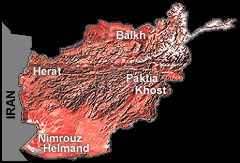
The United States is beefing up its military presence in Afghanistan, at the same time encircling Iran. Washington will set up nine new bases in Afghanistan in the provinces of Helmand, Herat, Nimrouz, Balkh, Khost and Paktia.
Reports also make it clear that the decision to set up new US military bases was made during Secretary of Defense Donald Rumsfeld's visit to Kabul last December. Subsequently, Afghan President Hamid Karzai accepted the Pentagon diktat. Not that Karzai had a choice: US intelligence is of the view that he will not be able to hold on to his throne beyond June unless the US Army can speed up training of a large number of Afghan army recruits and protect Kabul. Even today, the inner core of Karzai's security is run by the US State Department with personnel provided by private US contractors.
Admittedly, Afghanistan is far from stable, even after four years of US presence. Still, the establishment of a rash of bases would seem to be overkill. Indeed, according to observers, the base expansion could be part of a US global military plan calling for small but flexible bases that make it easy to ferry supplies and can be used in due time as a springboard to assert a presence far beyond Afghanistan.
Afghanistan under control?
On February 23, according to the official Bakhter News Agency, 196 American military instructors arrived in Kabul. These instructors are scheduled to be in Afghanistan until the end of 2006. According to General H Head, commander of the US Phoenix Joint Working Force, the objective of the team is to expedite the educational and training programs of Afghan army personnel. The plan to protect Karzai and the new-found "democracy" in Afghanistan rests on the creation of a well-trained 70,000-man Afghan National Army (ANA) by the end of 2006. As of now, 20,000 ANA personnel help out 17,000-plus US troops and some 5,000-plus North Atlantic Treaty Organization (NATO) troops currently based in Afghanistan.
In addition, on February 28, in a move to bring a large number of militiamen into the ANA quickly, Karzai appointed General Abdur Rashid Dostum, a regional Uzbek-Afghan warlord of disrepute, as his personal military chief of staff. The list of what is wrong with Dostum is too long for this article, but he is important to Karzai and the Pentagon.
Dostum has at least 30,000 militiamen, members of his Jumbush-e-Milli, under him. A quick change of their uniforms would increase the ANA by 30,000 at a minimal cost. Moreover, Dostum's men do not need military training (what they do need is some understanding of and respect for law and order). Another important factor that comes into play with this union is the Pentagon-Karzai plan to counter the other major north Afghan ethnic grouping, the Tajik-Afghans.
Since the presidential election took place in Afghanistan last October, Washington has conveyed repeatedly that the poison fangs of al-Qaeda have been uprooted and the Taliban is split. There was also reliable news suggesting that a section of Taliban leaders have accepted the leadership of two fellow Pashtuns, Karzai and US Ambassador Zalmay Khalilzad, and are making their way into the Kabul government.
With al-Qaeda defanged and the Taliban split, one would tend to believe that the Afghan situation is well under control. But then, how does one explain that a bomb went off in the southern city of Kandahar, killing five people on March 17, the very day US Secretary of State Condoleezza Rice landed in Kabul on her first visit to Afghanistan? And why has Karzai pushed back the dates for Afghanistan's historical parliamentary elections, originally planned for 2004, and then to May 2005, now to September 2005?
One thing that is certainly not under control, and is surely the source of many threats to the region, is opium production. During the US occupation, opium production grew at a much faster rate than Washington's, and Karzai's, enemies weakened. In 2003, US-occupied Afghanistan produced 4,200 tons of opium. In 2004, US-occupied and semi-democratic Afghanistan produced a record 4,950 tons, breaking the all-time high of 4,600 tons produced under the Taliban in the year 2000.
Though the problem is known to the world, the Pentagon refuses to deal with it. It is not the military's job to eradicate poppy fields, says the Pentagon. Indeed, it would antagonize the warlords who remain the mainstays of the Pentagon in Afghanistan, say observers.
Back on the base
When all is said and done, one cannot but wonder why the new military bases are being set up. Given that al-Qaeda is only a shadow of the past, the Taliban leaders are queuing up to join the Kabul government, and the US military is not interested in tackling the opium explosion, why are the bases needed?
A ray of light was shed on this question during the recent trip to Afghanistan by five US senators, led by John McCain. On February 22, McCain, accompanied by Senators Hillary Clinton, Susan Collins, Lindsey Graham and Russ Feingold, held talks with Karzai.
After the talks, McCain, the No 2 Republican on the Senate Armed Services Committee, said he was committed to a "strategic partnership that we believe must endure for many, many years". McCain told reporters in Kabul that America's strategic partnership with Afghanistan should include "permanent bases" for US military forces. A spokesman for the Afghan president told news reporters that establishing permanent US bases required approval from the yet-to-be-created Afghan parliament.
Later, perhaps realizing that the image that Washington would like to project of Afghanistan is that of a sovereign nation, McCain's office amended his comments with a clarification: "The US will need to remain in Afghanistan to help the country rid itself of the last vestiges of Taliban and al-Qaeda." His office also indicated that what McCain meant was that the US needs to make a long-term commitment, not necessarily "permanent" bases.
On March 16, General Richard Myers, chairman of the US Joint Chiefs of Staff, said no decision had been reached on whether to seek permanent bases on Afghan soil. "But clearly we've developed good relationships and good partnerships in this part of the world, not only in Afghanistan," he added, also mentioning existing US bases in Uzbekistan and Kyrgyzstan.
A military pattern
But this is mere word play. Media reports coming out of the South Asian subcontinent point to a US intent that goes beyond bringing Afghanistan under control, to playing a determining role in the vast Eurasian region. In fact, one can argue that the landing of US troops in Afghanistan in the winter of 2001 was a deliberate policy to set up forward bases at the crossroads of three major areas: the Middle East, Central Asia and South Asia. Not only is the area energy-rich, but it is also the meeting point of three growing powers - China, India and Russia.
On February 23, the day after McCain called for "permanent bases" in Afghanistan, a senior political analyst and chief editor of the Kabul Journal, Mohammad Hassan Wulasmal, said, "The US wants to dominate Iran, Uzbekistan and China by using Afghanistan as a military base."
Other recent developments cohere with a US Air Force strategy to expand its operational scope across Afghanistan and the Caspian Sea region - with its vital oil reserves and natural resources: Central Asia, all of Iran, the Persian Gulf, the Strait of Hormuz and the northern Arabian Sea up to Yemen's Socotra Islands. This may also provide the US a commanding position in relation to Pakistan, India and the western fringes of China.
The base set up at Manas outside Bishkek, the capital of Kyrgyzstan - where, according to Central Asian reports, about 3,000 US troops are based - looks to be part of the same military pattern. It embodies a major commitment to maintain not just air operations over Afghanistan for the foreseeable future, but also a robust military presence in the region well after the war.
Prior to setting up the Manas Air Base, the US paid off the Uzbek government handsomely to set up an air base in Qarshi Hanabad. Qarshi Hanabad holds about 1,500 US soldiers, and agreements have been made for the use of Tajik and Kazakh airfields for military operations. Even neutral Turkmenistan has granted permission for military overflights. Ostensibly, the leaders of these Central Asian nations are providing military facilities to the US to help them eradicate the Islamic and other sorts of terrorists that threaten their nations.
These developments, particularly setting up bases in Manas and Qarshi Hanabad, are not an attempt by the US to find an exit strategy for Afghanistan, but the opposite: establishing a military presence.
Encircling Iran
On February 28, Asia Times Online pointed out that construction work had begun on a new NATO base in Herat, western Afghanistan (US digs in deeper in Afghanistan ). Another Asia Times Online article said US officials had confirmed that they would like more military bases in the country, in addition to the use of bases in Pakistan (see The remaking of al-Qaeda , February 25).
Last December, US Army spokesman Major Mark McCann said the United States was building four military bases in Afghanistan that would only be used by the Afghan National Army. On that occasion, McCann stated, "We are building a base in Herat. It is true." McCann added that Herat was one of four bases being built; the others were in the southern province of Kandahar, the southeastern city of Gardez in Paktia province, and Mazar-i-Sharif, the northern city controlling the main route to central Afghanistan.
The US already has three operational bases inside Afghanistan; the main logistical center for the US-led coalition in Afghanistan is Bagram Air Field north of Kabul - known by US military forces as "BAF". Observers point out that Bagram is not a full-fledged air base.
Other key US-run logistical centers in Afghanistan include Kandahar Air Field, or "KAF", in southern Afghanistan and Shindand Air Field in the western province of Herat. Shindand is about 100 kilometers from the border with Iran, a location that makes it controversial. Moreover, according to the US-based think-tank Global Security, Shindand is the largest air base in Afghanistan.
The US is spending US$83 million to upgrade its bases at Bagram and Kandahar. Both are being equipped with new runways. US Brigadier General Jim Hunt, the commander of US air operations in Afghanistan, said at a news conference in Kabul Monday, "We are continuously improving runways, taxiways, navigation aids, airfield lighting, billeting and other facilities to support our demanding mission."
The proximity of Shindand to Iran could give Tehran cause for concern, says Paul Beaver, an independent defense analyst based in London. Beaver points out that with US ships in the Persian Gulf and Shindand sitting next to Iran, Tehran has a reason to claim that Washington is in the process of encircling Iran. But the US plays down the potential of Shindand, saying it will not remain with the US for long. Still, it has not been lost on Iranian strategists that the base in the province of Herat is a link in a formidable chain of new facilities the US is in the process of drawing around their country.
Shindand is not Tehran's only worry. In Pakistan, the Pervez Musharraf government has allowed the commercial airport at Jacobabad, about 420km north of Karachi and 420km southeast of Kandahar, as one of three Pakistani bases used by US and allied forces to support their campaign in Afghanistan. The other bases are at Dalbandin and Pasni. Under the terms of an agreement with Pakistan, the allied forces can use these bases for search and rescue missions, but are not permitted to use them to stage attacks on Taliban targets. Both Jacobabad and Pasni bases have been sealed off and a five-kilometer cordon set up around the bases by Pakistani security forces.
Reports of increased US operations in Pakistan go back to March 2004, when two air bases - Dalbandin and Shahbaz - in Pakistan were the focus for extensive movements to provide logistical support for Special Forces and intelligence operations. Shahbaz Air Base near Jacobabad appeared to be the key to the United States' 2004 spring offensive. At Jacobabad, C-17 transports were reportedly involved in the daily deliveries of supplies. A report in the Pakistani newspaper the Daily Times on March 10, 2004, claimed that the air base was under US control, with an inner ring of facilities off limits to Pakistan's military.