The NY Times reports:
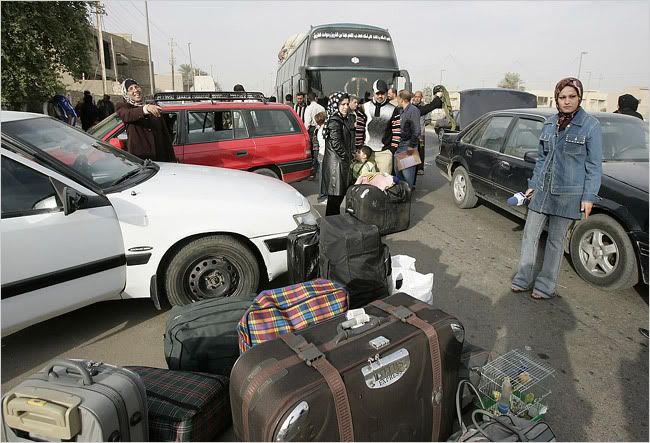
At a row of travel agencies near the highway to Syria, the tide of migration has reversed: the buses and GMC Suburban vans filled with people heading to Damascus run infrequently, while those coming from the border appear every day.
By all accounts, Iraqi families who fled their homes in the past two years are returning to Baghdad.
The description of the scope of the return, however, appears to have been massaged by politics. Returnees have essentially become a currency of progress.
Under intense pressure to show results after months of political stalemate, the government has continued to publicize figures that exaggerate the movement back to Iraq and Iraqis’ confidence that the current lull in violence can be sustained.
On Nov. 7, Brig. Gen. Qassim al-Moussawi, the Iraqi spokesman for the American-Iraqi effort to pacify Baghdad, said that 46,030 people returned to Iraq from abroad in October because of the “improving security situation.”
Last week, Iraq’s minister of displacement and migration, Abdul-Samad Rahman Sultan, announced that 1,600 Iraqis were returning every day, which works out to a similar, or perhaps slightly larger, monthly total.
But in interviews, officials from the ministry acknowledged that the count covered all Iraqis crossing the border, not just returnees. “We didn’t ask them if they were displaced and neither did the Interior Ministry,” said Sattar Nowruz, a spokesman for the Ministry of Displacement and Migration.
As a result, the tally included Iraqi employees of The New York Times who had visited relatives in Syria but were not among the roughly two million Iraqis who have fled the country.
The figures apparently also included three people suspected of being insurgents arrested Saturday near Baquba in Diyala Province. The police described them as local residents who had fled temporarily to Syria, then returned.
Some Iraqi lawmakers said that overly broad figures were being used intentionally.
“They are using this number because they want to show that Maliki is succeeding,” said Salim Abdullah, a lawmaker and member of the largest Sunni bloc, known as the Accordance Front, referring to Prime Minister Nuri Kamal al-Maliki. “But this does not make the number correct. I think dozens of Iraqis return home daily, but not 1,600.”
A half-dozen owners of Iraqi travel agencies and drivers who regularly travel to Syria agreed that the numbers misrepresented reality.
They said that the flow of returnees peaked last month, with more than 50 families arriving daily from Syria at Baghdad’s main drop-off point. Since Nov. 1, they said, the numbers have declined, and on Sunday morning, during a period when several buses used to appear, only one came.
The travel agents said that they believed that Iraqis would continue to return to Baghdad from Syria and Jordan but that the initial rush appeared to be over.
A United Nations survey released last week, of 110 Iraqi families leaving Syria, also seemed to dispute the contentions of officials in Iraq that people are returning primarily because they feel safer.
The survey found that 46 percent were leaving because they could not afford to stay; 25 percent said they fell victim to a stricter Syrian visa policy; and only 14 percent said they were returning because they had heard about improved security.
Underscoring a widely held sense of hesitation, many of those who come back to Iraq do not return to their homes. Clambering off the bus on Sunday, a woman who gave her name as Um Dima, mother of Dima, said that friends were still warning her not to go back to her house in Dora, a violent neighborhood in south Baghdad. So for now, she said, she will move in with her parents in southern Iraq.
Raad al-Kihani, a prominent Shiite tribal leader in Baghdad and supporter of the prime minister, said that most people returning were still restricted by the fear of sectarian violence. “There are no Shiite families moving back to Sunni neighborhoods and no Sunnis moving back to Shiite neighborhoods,” he said.
The Iraqi government is using incentives and aggressive public relations to try to bring more people home. Iraqi officials plan to pay for buses to transport Iraqis from Syria. Prominent government figures recently visited Saab al-Bor, a largely abandoned town near Baghdad, to emphasize that families should feel safe enough to return.
The Displacement Ministry offers 1 million Iraqi dinar, about $800, to internally displaced families who can prove they have returned home with a letter from the police and their neighborhood council. But the movement has been limited. As of Thursday, 4,358 internally displaced families, about 25,000 people, had returned to their homes in Baghdad, the ministry’s registry of payments to returnees said.
Furthermore, people are still leaving their homes — 28,017 were internally displaced in October, according to the latest United Nations figures. In all, the United Nations estimates that 2.4 million Iraqis are still internally displaced, with many occupying someone else’s home.
Greater numbers will not return to their neighborhoods, some Iraqi lawmakers and independent migration specialists say, until a clear legal framework has been established to help them get their houses back without evicting other displaced families.
“The actions are slow and so many things needs to be done, said Ayaed al-Sammaraie, a member of Parliament and a leader of its largest Sunni Arab bloc. “The main thing people would like is to return to their spots, and it seems there isn’t a plan for that.”
Monday, November 26, 2007
| [+/-] |
Numbers of Iraqi Refugees Returning Home Exaggerated |
Sunday, July 15, 2007
| [+/-] |
A New Escape From Iraq - If You're A Westerner |
McClatchy reports:
A new no-frills airline that begins weekly flights between Baghdad and Amman, Jordan, in August will only accept certain passengers _ U.S. and Western citizens.
Iraqis, Indians, Pakistanis and other non-Westerners need not apply.
Expat Airways, looking to capitalize on the thousands of contract workers in Iraq, is believed to be the world’s only commercial airline to blacklist such a large swath of nationalities.
Company officials say they believe the carrier’s 8 a.m. flights out of Baghdad beginning Aug. 7 will help speed U.S. and Western contractors through Baghdad International Airport where daylong delays, overbooking and no-show planes are common.
Royal Jordanian Airlines and Iraqi Airways are the only two scheduled commercial carriers flying between Baghdad to Amman, a gateway to Europe and the United States.
More than 180,000 contract workers are on the U.S. tax-funded payroll in Iraq, ferrying supplies, controlling checkpoints and other duties. Some 21,000 of them are Americans. About 118,000 are Iraqis. The rest are from Pakistan, Peru and other foreign countries. U.S. combat forces number about 150,000.
Pro Group, with offices in Amman and the United Kingdom, is launching Expat Airways in conjunction with the Jordanian Air Force. The Baghdad flights will use Jordan’s Marka Airport.
Ashraf Mraish, managing director for Pro Group, based in Amman, said Jordan’s tight visa restrictions drove the decision to exclude non-Westerners. Refugees have overwhelmed Jordan, which has imposed strict entry requirements for Iraqis.
“It would cost us much more to accommodate non-Westerners,” Mraish said this week. “We hope this flight is a solution to make (contractors’) lives easier.”
Despite fares of $450 each way, the 500-mile jaunt aboard a 42-seat Russian Antonov turboprop is strictly no frills. Passengers have to load and unload their own luggage. There is no beverage or meal service. Passengers cannot bring their own booze aboard “for obvious reasons,” according to a recent e-mail Expat Airways sent contractor firms.
“Seats cannot be reserved,” the e-mail stated, “so it will be on a first-come first-served basis and (seats) will not be numbered.”
Expat planes won’t even have a logo painted on them.
In interviews, many contractors recalled cramped, sweltering rides out of Baghdad on U.S. military C-130 transports, or nights of uncertainty spent on cots or the airport floor.
“You never know if the plane’s going to get out or not,” said American contractor Daniel Thorsen. “And if you get dropped off at Baghdad International and your personal security detail leaves you, you’re in trouble.”
Friday, May 4, 2007
| [+/-] |
Iraq Reimposes Saddam's Freeze On Doctors |
Policy begun under Saddam again being used to keep doctors from fleeing
The Washington Post reports:
Iraq is hemorrhaging doctors as violence racks the nation. To stem the flow, the Iraqi government has recently taken a cue from Saddam Hussein: Medical schools are once again forbidden to issue diplomas and transcripts to new graduates.
Hussein built a fine medical system in part by withholding doctors' passports and diplomas. Although physicians can work in Iraq with a letter from a medical school verifying their graduation, they say they need certificates and transcripts to work abroad.
It is a common refrain among war-weary Iraqis that things were better before the U.S.-led invasion in 2003. Electricity in Baghdad was more reliable; sectarian hostility was rare; Iraq was safe -- except for the many victims of Hussein's tyranny. But rarely has the government embraced a policy that so harshly evokes the era of dictatorship. To some students and doctors, the diploma decision, like Iraq's crumbling medical system, provides clear proof of the government's helplessness and the nation's decline.
"I don't think anybody would think now to go back like it was in Saddam's time. It would be a scandal," said an incredulous Akif al-Alousi, a leader of the Iraqi Medical Association, upon hearing about the measure from a reporter. After verifying it, Alousi said that the association would challenge the rule, which he called a violation of "basic rights."
Students rail against policy
Noor Jassem, 24, a fifth-year medical student at Mustansiriyah Medical College in Baghdad, agreed.
"They have no right to impose such a restriction," Jassem said. "If the government cannot provide security for the doctors, then why should it stand in their way to leave?"
Baghdad University medical students said a sign announcing the freeze on medical degrees was posted in late March at the office where they pick up their diplomas. The order was issued by the Ministry of Higher Education and cited a February letter from the office of Prime Minister Nouri al-Maliki.
Spokesmen for the ministry and the prime minister distanced themselves from the announcement.
"There is no legal grounds for stopping such a thing," said Higher Education spokesman Basil al-Khatib, who declined to produce a copy of the letter from Maliki's office.
Government spokesman Ali al-Dabbagh said the Hussein-era rule had never been changed. As they did in the past, he said, medical graduates can still get certificates upon completing service in public hospitals for six years -- one year of service for each year of their "free education."
Medical students and professors disputed those assertions, saying that since the fall of Hussein all new graduates have been given diplomas.
Khatib said the Health Ministry had come up with the proposal, noting that the agency that runs the nation's hospitals would be its principal beneficiary. Health Ministry spokesman Qasim Yahya denied the assertion.
‘In the interest of the Iraqi people’
Not that his ministry is complaining. "We welcome the decision, even though we know this is against the basic rights of individuals," Yahya said. "But it is in the interest of the Iraqi people."
Iraq's once top-notch medical system has been devastated by 1990s economic sanctions and present-day warfare. Hospitals often run out of such essentials as gauze, antibiotics and even blood, doctors say. Much of their equipment is outdated or broken.
Worst of all, they are running out of doctors, who like many of Iraq's intellectuals have been the frequent targets of kidnappings and assassinations.
Thousands have already fled
The Iraqi Medical Association, with which all physicians must register to practice, estimates that at least one-third of the country's 40,000 or so doctors have fled to Jordan, Syria and other countries. Waleed Khalid, the association's vice president, said the organization issues 30 to 50 "certificates of good standing" to Iraqi physicians every day -- forms that any doctor must have to work abroad, he said.
Medical schools have also suffered. At Baghdad University's Kindi Teaching Hospital -- where 90 percent of surgeries are trauma cases, mostly involving bomb and shooting victims -- half the teaching positions are vacant, said Hameed Hussein al-Araji, head of the surgery department. General surgery instructors must fill in for specialists, such as the cardiothoracic surgery professor who was assassinated last year, he said.
Only about 25 percent of students are able to attend classes daily, Araji said. The rest, kept away by explosions and gunfire and roadblocks, use lecture notes to study at home and show up only for exams.
Perks extra include security
Even against that bleak backdrop, medical school enrollment remains high, officials said. The problem is that many graduates do not stay. Before the diploma freeze, the Ministry of Health estimates, about 50 percent of medical students were leaving the country upon graduation.
The Health Ministry has offered several perks to slow the exodus, said Yahya, the spokesman. Medical school graduates can choose where to complete their internships. Physicians are offered space for private clinics inside hospitals, with free equipment and cheap rent. Some hospitals provide on-campus lodging for doctors and their families, complete with security guards "to reduce the cases of assassinations," he said.
"But many of the doctors say: 'It's not a question of having consultative clinics or housing. We want to live a normal life, where we can take our families out,' " Yahya said.
Precisely, medical students say.
"The government should provide good conditions so that we could stay," said Nada Fadhil, 23, a student at Mustansiriyah who wants to be a radiologist.
Fadhil, who has dreamed of being a doctor since she was a child, said she feels sorry that Iraq is losing its physicians. Then again, she said, fear of leaving her house kept her away from classes for all but 10 days of the first three months of this year.
Escaping with a ‘national treasure’
So even though she has no plans to leave Iraq after graduating, Fadhil admits she would not hesitate to flee if she felt threatened -- with or without her diploma. She would simply postpone her residency.
One senior medical school official in Baghdad has no sympathy with such arguments. In an interview in his central Baghdad office, he railed against what he views as "exploitation" by graduates, accusing them of stealing away with a "national treasure" -- a free medical education. The students have a duty to stay, he said.
"Let's put it right: What was happening in Saddam's time was better than what is happening now," said the official, who said he did not want his name published out of fear for his life. "There was order. There was discipline. This we are losing."
Although the medical association says it will dispute the diploma decision, doctors and students said they plan no public protest, fearing it could get them killed.
Besides, some said, Iraq's disorder could yield benefits -- corruption is rampant, so rules can be broken. Fadhil said there were rumors on campus that graduates could get their degrees from the Ministry of Higher Education by paying a bribe of about $5,700. Araji, the surgery professor, said he has heard it costs a mere $200.
"Look, in countries like Iraq, living in a chaos, everyone believes that everything is possible with money," said Araji, who graduated in the Hussein era and said he never did get his degree. "They pay, and they can get their certificate. Like a passport."
