The Washington Post reports:
In August 1980, with no hope left of winning the nomination, Sen. Edward M. Kennedy conceded defeat to incumbent Jimmy Carter in the Democratic presidential race.
"For me, a few hours ago, this campaign came to an end," Kennedy said at the Democratic National Convention in New York. "For all those whose cares have been our concern, the work goes on, the cause endures, the hope still lives, and the dream shall never die."
And with that, at age 48, Kennedy returned to the Senate, where he committed himself to a career as a legislator, crafting landmark bills on health care, education and immigration. Many Democrats are now pointing to the Kennedy model as a path for Sen. Hillary Rodham Clinton to reshape her own political career, assuming she is unable to wrest the nomination from Sen. Barack Obama.
"I loved the Senate before I ran for the president," Kennedy explained in an interview before his recent cancer diagnosis. Losing to Carter, he said, made him appreciate the opportunities in Congress all the more. "I think I became a better senator, with greater focus and attention," Kennedy said. But he added: "It all depends on the attitude, what's in the mind of the person."
Clinton, Kennedy continued, must decide where her heart lies. "She's got great capacity -- she was a good senator before, and she can be a great senator in the future," he said. The question, he said, is "what she does with this experience."
When Kennedy returned to Capitol Hill before the 1980 election, the Massachusetts Democrat was in a similar fix. Like Clinton, he was the heir to a powerful political legacy. But the climate was volatile, and voters were in the mood for change. Kennedy was rejected by many of his Senate colleagues, despite Carter's sagging popularity, and he won just 10 primary states. But like Clinton, he hung on until the bitter end.
Yet Kennedy was an 18-year Senate veteran who had already risen to chairman of the Judiciary Committee and a health subcommittee. Clinton faces few options for quick advancement should she give up her presidential bid, prompting some to speculate that she may look elsewhere for a prominent political post, possibly the governorship of New York.
The climate on Capitol Hill has changed considerably in the 18 months since Clinton began her presidential campaign. The Senate leadership path that she had once viewed as a viable alternative is now all but blocked. Senate Majority Leader Harry M. Reid (Nev.) has gained clout in his role, and he will grow even more powerful if Democrats succeed in expanding their narrow majority in November by up to half a dozen seats.
Reid's deputies, Majority Whip Richard J. Durbin (Ill.) and Democratic Caucus Vice Chairman Charles E. Schumer (N.Y.), also have enhanced their status in recent months and are quietly laying the groundwork to succeed Reid whenever he decides to step down.
"Within the caucus, there's strong support for Senator Reid, and those who speculate otherwise don't understand the Senate," said Durbin, who was the first senator to endorse Obama. When Clinton returns to her old job, assuming she does not win the nomination, Durbin added, "she will be an important part of the future. But I can't tell you that anyone has approached me, or anyone in the caucus, with any specific suggestions about what she would do."
When Clinton announced her bid in January 2007, she was the prohibitive favorite, and most of her Senate colleagues appeared ready to rally to her side. But as her primary battle with Obama draws to an end, with the senator from Illinois almost certain to emerge the victor, Clinton has discovered that the reservoir of Senate goodwill was not so deep after all.
Clinton collected 13 endorsements from her Senate colleagues, compared with 15 for Obama, and she has not added a name to her list since early February, even though she has won significant contests since then.
"I'm sure she'll remember, for the rest of her life, who was with her and who wasn't," said Sen. Christopher J. Dodd (D-Conn.), who ran unsuccessfully this year and then endorsed Obama.
Speaking on the condition of anonymity, many Democratic senators said they expect Clinton to work doggedly for Obama this summer and fall, and they agreed that if she does, whatever hard feelings that linger from the primary race will vanish.
But a bigger question is whether, like Kennedy, she will shelve her presidential ambitions, especially if Sen. John McCain (R-Ariz.) wins in November. The 2012 election would coincide with the end of Clinton's second Senate term, effectively turning her into a lame duck. A run for New York governor would hasten Clinton's departure by two years.
But if Obama wins in November, her next likely opportunity for the presidency would be in 2016, when she would be 69. If Clinton makes it clear her future is in the Senate, she could find several paths open to her, aides and colleagues said.
One would be to champion a major piece of legislation, such as the health-care bill Obama has promised early in his first term.
A member of three prominent committees, Clinton remains a junior member on all three panels and does not stand to become a committee chairman for at least another decade.
But another option would be to assume the chairmanship of the Democratic Senatorial Campaign Committee, a demanding but high-profile post that is an appointment by Reid. Sen. Robert Menendez (N.J.) is a potential successor to Schumer, who has led the committee for four years, but Democratic sources said Clinton could get the job if she wanted it.
Sen. Patrick J. Leahy (Vt.) pointed to the late Hubert H. Humphrey (D-Minn.) as one example of life in the Senate after a losing White House bid. A senator in the 1950s and '60s, Humphrey became vice president in 1965 and then narrowly lost to Richard M. Nixon in the 1968 presidential election. He won another Senate term in 1970 and returned as the most junior member. "He realized he could command an audience anywhere in the world. He threw himself into the issues. He had the time of his life," Leahy said.
On the other hand, Sen. Joseph R. Biden Jr. (Del.) returned to the Senate after his failed 1988 presidential bid and became a formidable voice on both the Judiciary and Foreign Relations committees.
With or without a prominent post, Clinton will possess unrivaled clout, her colleagues said. "She is the single most powerful woman in America, and that will be solidified by this race, not diminished by it," said Biden, who has not endorsed a candidate after dropping his own bid earlier this year.
As the former first lady, Clinton arrived in the Senate in January 2001 already a political celebrity, and her status was acknowledged with an appointed leadership position as head of the Steering Committee, with the task of interacting with outside liberal groups.
But colleagues said Clinton showed no interest in using her perch to work toward more powerful posts inside the Senate. Rather, she spent much of her time traveling the country to help Democrats in presidential battleground states, and raising money through her leadership political action committee, HillPAC. She also committed herself to advancing New York state interests, numerous colleagues and senior aides said.
Regardless of which route she now chooses, colleagues who have run failed campaigns said she must first readjust to life in the Senate.
"When you're out on the campaign, you've got to make decisions every hour, every minute," said Sen. Tom Harkin (D-Iowa). "Then you come back to the Senate and it's like a cocoon."
Tuesday, May 27, 2008
| [+/-] |
No Clear Map For Clinton's Political Future |
Monday, October 1, 2007
| [+/-] |
Senate to Approve More War Funding |
The Associated Press reports:
Powerless in their effort to bring troops home from Iraq, Senate Democrats were on track Monday to help pass a defense policy bill that would authorize another $150 billion for the wars in Iraq and Afghanistan.
The vote comes as the House planned to approve on Tuesday separate legislation requiring that President Bush give Congress a plan for eventual troop withdrawals.
The developments underscored the difficulty facing Democrats in the Iraq debate: They lack the votes to pass legislation ordering troops home and are divided on whether to cut money for combat, despite a mandate by supporters to end the war.
Hoping the political landscape changes in coming months, Democratic leaders say they will renew their fight when Congress considers the money Bush wants in war funding.
While the policy bill the Senate was set to approve Monday authorizes the money to be spent, it does not guarantee it; Bush will have to wait until Congress passes a separate appropriations bill before war funds are transferred to military coffers.
"I think that's where you're going to see the next dogfight," said Senate Majority Leader Harry Reid, D-Nev., of the upcoming war spending bill.
Democrats say their options include directing that the money be spent on bringing troops home instead of combat; setting a date when money for the war is cut off, and identifying a goal to end the war to try to pressure Bush to bring troops home.
Similar attempts have been made but fallen short of the 60 votes needed to overcome procedural hurdles in the Senate.
"Many of us have reached a breaking point on this," said Senate Majority Whip Dick Durbin, D-Ill. "I've done this for too many years. I've waited for the president to start bringing this war to an end. I'm not going to sign up for this any longer."
In the House, Democrats are pushing for a bill that would require the administration to report to Congress in 60 days and every 90 days thereafter on the status of its redeployment plans in Iraq.
The bill, sponsored by Democrats John Tanner of Tennessee and Neil Abercrombie of Hawaii, was initially cast aside as too mild by Democratic leaders focused on tougher proposals ordering troops home this fall.
But after Democrats were unable to peel off Republican support, the Iraq debate stalled and some four dozen rank-and-file Democrats demanded a vote on the Abercrombie-Tanner bill.
"This will be the first time since the war in Iraq began that we are working together as a Congress instead of one party or another to be a constructive voice in the civilian management of operations in Iraq," Tanner said in a statement e-mailed to the Associated Press.
In February, Bush requested more than $140 billion for the war, and is expected to ask for another $42 billion to cover costs in the 2008 budget year, which began Monday. The Senate's defense policy bill authorizes Bush's initial request, plus an additional $23 billion for the purchase of bomb-resistent vehicles.
In addition to war money, the Senate's defense policy bill authorizes more than a half trillion dollars in annual military programs, including such big-ticket items as $10.1 billion for missile defense.
Republicans predict the bill is on track to be vetoed by President Bush because it includes hate-crimes legislation by Sen. Edward Kennedy, D-Mass. The White House said it sees Kennedy's proposal, which would let federal law enforcement help states prosecute attacks on gays, as unnecessary.
The House passed its version of the defense authorization bill in May by a 397-27 vote. That $646 billion measure would trim hundreds of millions of dollars from some weapons modernization programs and use the money instead to aid troops in combat.
The House bill has drawn a veto threat from the White House because of provisions insisting the military rely heavily on American-made products and proposed changes to the Pentagon's personnel policies.
Thursday, September 20, 2007
| [+/-] |
Senate Approves Resolution Denouncing MoveOn.org Ad |
The NY Times reports:
The Senate approved a resolution on Thursday denouncing the liberal antiwar group MoveOn.org over an advertisement that questioned the credibility of Gen. David H. Petraeus, the American commander in Iraq.
MoveOn.org, with 3.2 million members, has become a powerful force in Democratic politics and the advertisement it paid for, which appeared in The New York Times, has come under sharp attack from Congressional Republicans and others as unpatriotic and impugning the integrity of General Petraeus.
Senator Hillary Rodham Clinton of New York and Senator Christopher J. Dodd of Connecticut, both Democratic candidates for president, voted against the resolution, which passed 72 to 25.
But curiously absent from the vote was Senator Barack Obama of Illinois, also a Democratic candidate for president, who had canceled a campaign appearance in South Carolina so he could be in Washington for votes.
Mr. Obama issued a statement calling the resolution, put forward by Senator John Cornyn, Republican of Texas, “a stunt.” Mr. Obama said, “By not casting a vote, I registered my protest against these empty politics.”
Mr. Obama had voted minutes earlier in favor of an extremely similar resolution proposed by Senator Barbara Boxer, Democrat of California.
Ms. Boxer’s proposal, which failed, called for the Senate to “strongly condemn all attacks on the honor, integrity and patriotism” of anyone in the United States armed forces. It did not mention the MoveOn.org ad. Mr. Dodd and Mrs. Clinton also voted in favor of Ms. Boxer’s proposal.
Senator Joseph R. Biden Jr. of Delaware, who is also seeking the Democratic nomination, was in Iowa and did not vote.
At a White House news conference, President Bush called the advertisement disgusting and said it was an attack not only on General Petraeus but also on the entire American military.
“And I was disappointed that not more leaders in the Democrat Party spoke out strongly against that kind of ad,” Mr. Bush said. “And that leads me to come to this conclusion: that most Democrats are afraid of irritating a left-wing group like MoveOn.org — or more afraid of irritating them than they are of irritating the United States military.”
Representative Thomas M. Davis III, Republican of Virginia, has urged the House to hold hearings on the MoveOn.org ad and to investigate whether The Times gave the group an improper discount. A New York Times Company spokeswoman has said that the group paid a standard “standby” rate.
MoveOn.org lashed out at Mr. Bush’s comments and pledged to double its spending on ads criticizing Republican lawmakers for blocking efforts by Democrats to change the war strategy. Eli Pariser, executive director of MoveOn.org Political Action, said, “What’s disgusting is that the president has more interest in political attacks than developing an exit strategy to get our troops out of Iraq and end this awful war.”
Friday, August 3, 2007
| [+/-] |
Senate Roll Call: Terrorism Surveillance |
The 60-28 roll call by which the Senate voted to temporarily give President Bush expanded authority to eavesdrop on foreign terrorists without court warrants.
On this vote, a "yes" vote was a vote to give Bush that authority and a "no" vote was a vote to deny him that authority.
Voting "yes" were 16 Democrats, 43 Republicans and 1 independent.
Voting "no" were 27 Democrats, 0 Republicans and 1 independent.
Alabama
Sessions (R) Yes; Shelby (R) Yes.
Alaska
Murkowski (R) Yes; Stevens (R) Yes.
Arizona
Kyl (R) Yes; McCain (R) Not Voting.
Arkansas
Lincoln (D) Yes; Pryor (D) Yes.
California
Boxer (D) Not Voting; Feinstein (D) Yes.
Colorado
Allard (R) Yes; Salazar (D) Yes.
Connecticut
Dodd (D) No; Lieberman (I) Yes.
Delaware
Biden (D) No; Carper (D) Yes.
Florida
Martinez (R) Yes; Nelson (D) Yes.
Georgia
Chambliss (R) Yes; Isakson (R) Yes.
Hawaii
Akaka (D) No; Inouye (D) Yes.
Idaho
Craig (R) Yes; Crapo (R) Yes.
Illinois
Durbin (D) No; Obama (D) No.
Indiana
Bayh (D) Yes; Lugar (R) Not Voting.
Iowa
Grassley (R) Yes; Harkin (D) Not Voting.
Kansas
Brownback (R) Yes; Roberts (R) Yes.
Kentucky
Bunning (R) Not Voting; McConnell (R) Yes.
Louisiana
Landrieu (D) Yes; Vitter (R) Yes.
Maine
Collins (R) Yes; Snowe (R) Yes.
Maryland
Cardin (D) No; Mikulski (D) Yes.
Massachusetts
Kennedy (D) No; Kerry (D) Not Voting.
Michigan
Levin (D) No; Stabenow (D) No.
Minnesota
Coleman (R) Yes; Klobuchar (D) Yes.
Mississippi
Cochran (R) Yes; Lott (R) Not Voting.
Missouri
Bond (R) Yes; McCaskill (D) Yes.
Montana
Baucus (D) No; Tester (D) No.
Nebraska
Hagel (R) Yes; Nelson (D) Yes.
Nevada
Ensign (R) Yes; Reid (D) No.
New Hampshire
Gregg (R) Not Voting; Sununu (R) Yes.
New Jersey
Lautenberg (D) No; Menendez (D) No.
New Mexico
Bingaman (D) No; Domenici (R) Yes.
New York
Clinton (D) No; Schumer (D) No.
North Carolina
Burr (R) Yes; Dole (R) Yes.
North Dakota
Conrad (D) Yes; Dorgan (D) Not Voting.
Ohio
Brown (D) No; Voinovich (R) Yes.
Oklahoma
Coburn (R) Yes; Inhofe (R) Yes.
Oregon
Smith (R) Yes; Wyden (D) No.
Pennsylvania
Casey (D) Yes; Specter (R) Yes.
Rhode Island
Reed (D) No; Whitehouse (D) No.
South Carolina
DeMint (R) Yes; Graham (R) Yes.
South Dakota
Johnson (D) Not Voting; Thune (R) Yes.
Tennessee
Alexander (R) Not Voting; Corker (R) Yes.
Texas
Cornyn (R) Yes; Hutchison (R) Yes.
Utah
Bennett (R) Yes; Hatch (R) Yes.
Vermont
Leahy (D) No; Sanders (I) No.
Virginia
Warner (R) Yes; Webb (D) Yes.
Washington
Cantwell (D) No; Murray (D) Not Voting.
West Virginia
Byrd (D) No; Rockefeller (D) No.
Wisconsin
Feingold (D) No; Kohl (D) No.
Wyoming
Barrasso (R) Yes; Enzi (R) Yes.
Friday, July 20, 2007
| [+/-] |
Senate Tied In Knots By Filibusters |
McClatchy reports:
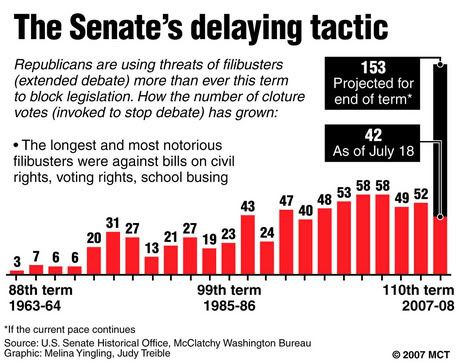
This year Senate Republicans are threatening filibusters to block more legislation than ever before, a pattern that's rooted in — and could increase — the pettiness and dysfunction in Congress.
The trend has been evolving for 30 years. The reasons behind it are too complex to pin on one party. But it has been especially pronounced since the Democrats' razor-thin win in last year's election, giving them effectively a 51-49 Senate majority, and the Republicans' exile to the minority.
Seven months into the current two-year term, the Senate has held 42 "cloture" votes aimed at shutting off extended debate — filibusters, or sometimes only the threat of one — and moving to up-or-down votes on contested legislation. Under Senate rules that protect a minority's right to debate, these votes require a 60-vote supermajority in the 100-member Senate.
Democrats have trouble mustering 60 votes; they've fallen short 22 times so far this year. That's largely why they haven't been able to deliver on their campaign promises.
By sinking a cloture vote this week, Republicans successfully blocked a Democratic bid to withdraw combat troops from Iraq by April, even though a 52-49 Senate majority voted to end debate.
This year Republicans also have blocked votes on immigration legislation, a no-confidence resolution for Attorney General Alberto Gonzales and major legislation dealing with energy, labor rights and prescription drugs.
Nearly 1 in 6 roll-call votes in the Senate this year have been cloture votes. If this pace of blocking legislation continues, this 110th Congress will be on track to roughly triple the previous record number of cloture votes — 58 each in the two Congresses from 1999-2002, according to the Senate Historical Office.
Senate Majority Leader Harry Reid, D-Nev., forced an all-night session on the Iraq war this week to draw attention to what Democrats called Republican obstruction.
"The minority party has decided we have to get to 60 votes on almost everything we vote on of substance," said Sen. Claire McCaskill, D-Mo. "That's not the way this place is supposed to work."
Even Sen. Trent Lott, R-Miss., who's served in Congress since 1973, complained that "the Senate is spiraling into the ground to a degree that I have never seen before, and I've been here a long time. All modicum of courtesy is going out the window."
But many Republicans say the Senate's very design as a more deliberative body than the House of Representatives is meant to encourage supermajority deal-making. If Democrats worked harder to seek bipartisan deals, Republicans say, there wouldn't be so many cloture votes.
"You can't say that all we're going to do around here in the United States Senate is have us govern by 51 votes — otherwise we might as well be unicameral, because then we would have the Senate and the House exactly the same," said Sen. John McCain, R-Ariz.
To which Reid responds: "The problem we have is that we don't have many moderate Republicans. I don't know what we can do to create less cloture votes other than not file them, just walk away and say, 'We're not going to do anything.' That's the only alternative we have."
Some Republicans say that Reid forces cloture votes just so he complain that they're obstructing him.
Sen. Arlen Specter, R-Pa., called the all-nighter on Iraq "meaningless, insulting" and "an indignity." "There is no doubt that there are not 67 votes present to override a veto. There is little doubt that there are not 60 votes present to bring the issue to a vote."
Republicans also say that Democrats are forgetting how routinely they threatened filibusters only a few years ago when they were the minority, especially to block many of President Bush's judicial nominees. Back then, Republicans were so mad that they considered trying to change Senate rules to eliminate filibusters — but didn't.
"The suggestion that it's somehow unusual in the Senate to have controversial matters decided by 60 votes is absurd on its face," said Senate Minority Leader Mitch McConnell, R-Ky.
Although this year's Congress is taking it to a new level, the frequency of cloture votes has been climbing for decades — the result of more polarized politics in Congress and also evolving Senate rules and practices.
Associate Senate Historian Don Ritchie said that since the nation's start, dissident senators have prolonged debate to try to kill or modify legislation. The word "filibuster" — a translation of the Dutch word for "free-booter" or pirate — appears in the record of an 1840s Senate dispute about a patronage job.
From Reconstruction to 1964, the filibuster was largely a tool used by segregationists to fight civil rights legislation. Even so, filibusters were employed only rarely; there were only three during the 88th Congress, which passed the landmark Civil Rights Act of 1964 after two months of filibustering.
Filibusters were infrequent partly because the Senate custom of civility prompted consideration of minority views — and partly because they were so hard to overcome that compromises were struck. In 1917 cloture rules for ending filibusters were put in place, but required a two-thirds vote — so high it was rarely tested.
Post-Watergate, in 1975, the bar was lowered to three-fifths, or 60 votes, and leaders began to try it more often.
By the early 1990s, tensions between then-Majority Leader George Mitchell of Maine and Minority Leader Bob Dole of Kansas upped the ante, and the filibuster-cloture spiral has soared ever since as more partisan politics prevailed. The use of filibusters became "basically a tool of the minority party," Ritchie said.
The current Senate has two other complications: the 51-49 Democratic majority, which includes a pro-war independent and an absent Democrat recuperating from brain surgery, makes it harder to find 60 votes. And the presidency and Congress are controlled by opposing parties, which increases confrontation.
The Senate "has always been a cumbersome and frustrating and slow body because that's what the Constitution wanted," Ritchie said. The new majority's decisions are: "How often are you willing to lose on these issues? Would you rather campaign on the other side being obstructionists? What's a tolerable compromise? They're still working these things out."
Republican Senate leader McConnell said Friday in a news conference that when he became minority leader, "it was not my goal to see us do nothing. I mean, you can always use the next election as a rationale for not doing anything. But as you all know, we've had a regularly scheduled election every two years since 1788, so there's always an election right around the corner."
"A divided government has frequently done important things: Social Security in the Reagan period, when (Democrat) Tip O'Neill was speaker; welfare reform when Bill Clinton was in the White House when there was a Republican Congress. There's no particular reason why divided government can't do important things. We haven't yet, but it's not too late.
"And I think clearly the way to accomplish things is in the political middle, and I would challenge our friends on the other side of the aisle to step up and take a chance on something big and important for our country."
Of course, Democrats say similar things — but then neither side often compromises.
Wednesday, July 11, 2007
| [+/-] |
Senate in Standoff Over Iraq Amendments to Defense Bill |
The Congressional Quarterly reports:
The Senate refused Wednesday to limit debate on the first amendment to the fiscal 2008 defense authorization bill, digging in along largely partisan lines over whether to tell President Bush how to wage the war in Iraq.
By 56-41, senators refused to invoke cloture on an amendment by Jim Webb, D-Va., that sought to require specific minimum intervals between deployments of U.S. troops. The final tally was four short of the 60 votes needed.
The Senate refused Wednesday to limit debate on the first amendment to the fiscal 2008 defense authorization bill, digging in along largely partisan lines over whether to tell President Bush how to wage the war in Iraq.
By 56-41, senators refused to invoke cloture on an amendment by Jim Webb, D-Va., that sought to require specific minimum intervals between deployments of U.S. troops. The final tally was four short of the 60 votes needed.
Seven Republicans voted to limit debate — Norm Coleman, Minn., Susan Collins, Maine; Chuck Hagel, Neb.; Gordon H. Smith, Ore.; Olympia J. Snowe, Maine; John E. Sununu, N.H., and John W. Warner, Va. So did all 48 Democrats present and one independent, Bernard Sanders of Vermont. Independent Joseph I. Lieberman of Connecticut voted “no.”
The White House on Tuesday threatened to veto the defense bill (HR 1585) if the Webb amendment was adopted, or any other amendment that would set timetables for a withdrawal or dictate missions for the U.S. forces deployed in Iraq.
Minority Leader Mitch McConnell, R-Ky., said it was pointless to adopt amendments to the defense bill that will provoke a Bush veto.
But Majority Leader Harry Reid, D-Nev., said exhausted troops and a public fed up with the war “deserve more than expressions of disapproval. Our votes, not our voices, will prove whether our resolve is firm and whether we are prepared to lead.”
Friday, June 22, 2007
| [+/-] |
Wyoming's Democratic Governor Names Successor To The Late Republican Senator Craig Thomas' Seat |
From the NYT, Michael Falcone blogs:
A Republican state legislator, John Barrasso, is the new United States Senator from Wyoming. The state’s governor, Dave Freudenthal, appointed him to the post today, filling a vacancy created by the death of Senator Craig Thomas earlier this month.
Mr. Barrasso, who is in his second term as a Wyoming state senator, was chosen from a long list of candidates who applied for the post. That list got whittled down to just three this week by the Wyoming Republican Party Central Committee, which submitted the names to the governor.
The other finalists for the interim Senate seat were Cheyenne lawyer Tom Sansonetti, who also served as chief of staff to Mr. Thomas, and former state Treasurer Cynthia Lummis. In a statement, Mr. Freudenthal declined to elaborate further about his choice.
“There are many factors that went into this decision, and it was the sum of these factors that led me to this choice,” he said. “While I don’t intend to indulge the speculation on why I made this decision, I will say that I hope I made the right choice.”
Mr. Barrasso’s appointment takes effect immediately. Although Mr. Thomas’s term was set to end in 2012, Mr. Barrasso will face a special election in 2008 to keep the interim Senate seat. He has indicated that he intends to run.
In his application for the position Mr. Barrasso promised to “continue Craig Thomas’s legacy of fighting for Wyoming,” and laid out a set of conservative viewpoints that gives clues about the kind of Senator he would be.
“I believe in limited government, lower taxes, less spending, traditional family values, local control and strong national defense. In the State Senate, in addition to receiving an “A” rating from the NRA, I have voted for prayer in schools, against gay marriage and have sponsored legislation to protect the sanctity of life.”
Mr. Barrasso is an orthopedic surgeon with a private practice in Casper, Wyo.

Monday, June 18, 2007
| [+/-] |
Democrats Press Plan To Channel Billions in Oil Subsidies to Renewable Fuels |
The NYTimes reports:
Senate Democrats are seeking a major reversal of energy tax policies that would take billions of dollars in tax breaks and other benefits from the oil industry to underwrite renewable fuels.
The tax increases would reverse incentives passed as recently as three years ago to increase domestic exploration and production of oil and gas. The change reflects a shift from the Republican focus on expanding oil production to the Democratic concern about reducing global warming.
On Tuesday, the Senate Finance Committee will take up a bill that would raise about $14 billion from oil companies over 10 years and would give about the same amount of money on new incentives for solar power, wind power, cellulosic ethanol and numerous other renewable energy sources. The bill is one of the signature issues this year for Democrats, along with immigration and the war in Iraq, and one in which they hope to clearly distinguish themselves from the Republicans.
But Senate Democrats are expected to go beyond the $14 billion in tax changes in the draft bill. Democratic officials said the committee is all but certain to adopt a proposal by Senator Jeff Bingaman of New Mexico that would raise $10 billion from companies that drill for oil and gas in federal waters but do not currently pay royalties to the government.
“We are cutting back subsidies for the oil and gas industry and using that money to finance the development of new and cleaner sources of energy,” said Mr. Bingaman, who plans to attach the entire tax package to the energy bill on the Senate floor next week.
It is unclear how much President Bush or Republicans in Congress will fight the proposed tax shift. The ranking Republican on the Senate Finance Committee, Senator Charles Grassley of Iowa, has already endorsed the $14 billion package.
But the plan could easily founder because of opposition to any one of many hotly disputed provisions in the broader energy bill. Just last week, a threatened filibuster by Republicans forced Democrats to postpone a floor vote on requiring electric utilities to produce 15 percent of their power from renewable fuels. The White House, meanwhile, has threatened to veto the bill if lawmakers do not drop a provision intended to prosecute what Democrats call “unconscionably excessive” gasoline prices.
Senator Charles E. Schumer of New York has proposed that oil companies be prohibited from using an accounting method called “last in, first out” for inventories that saves them as much as $5 billion in taxes a year.
Because Senate Democrats want to offset the cost of any new tax breaks with tax increases elsewhere, many lawmakers are pushing for even more tax raises from oil companies.
Oil executives are protesting loudly, saying that the proposed changes would take money away from exploring and drilling in the United States and increase the nation’s dependence on imported foreign oil.
“They talk about our companies as if they’re owned by space aliens,” said John Felmy, chief economist at the American Petroleum Institute, a trade association. “They talk about energy security, but these provisions could have the opposite effect in terms of reducing our production here and increasing our imports.”
The oil industry has ample reason to worry. With consumers seething about gasoline prices increasing to more than $3 a gallon and oil profits reaching record highs, oil companies would be short of friends in Congress regardless of the party in power.
Beyond the immediate jockeying, however, lies a bigger question: Is Congress putting taxpayers at risk by funneling billions of dollars in subsidies into alternative fuels that are still a long way from being profitable?
Indeed, industry experts said the Senate bill greatly understated the true cost of incentives for renewable fuels. Most of the incentives are set to expire at the end of 2009 or 2010, but Democrats in both the House and Senate have called for an increase in the production of such fuels by 2022. As a practical matter, the vast majority of “temporary” tax breaks are routinely extended once they are passed for the first time.
In addition to higher taxes for oil companies, House and Senate Democrats are hitting at the oil industry in other ways. The Senate bill would give the federal government more power to prosecute companies that engage in “price gouging” on gasoline prices, which is broadly defined in the bill as charging “unconscionably excessive” prices that reflect “unfair leverage.” A similar measure is moving through the House.
Separately, the House Natural Resources Committee passed a bill last week that would, among other things, crack down on companies that cheat on royalties they pay for oil and gas pumped on publicly owned land.
In effect, the various bills would transfer billions of dollars from oil companies to producers of renewable fuels.
The Senate bill would offer $5.6 billion in tax credits over the next three years for companies that produce electricity from renewable fuels like wind and geothermal power. It would offer tax-free bonds for new power plants with renewable or clean energy. It would offer tax credits totaling about a dollar a gallon to producers of cellulosic ethanol, and even bigger tax credits for “biodiesel” fuel. It would extend and expand tax breaks for plug-in electric cars and other vehicles that use alternative energy sources, and it would provide tax breaks for gas stations that offer renewable fuels.
In a nod to the politically powerful coal industry, the bill would also provide $1.5 billion in tax-free “clean coal bonds” for advanced coal-fired electricity plants and $332 million in tax credits for plants that make diesel fuel from coal.
Democrats in the House are moving with similar legislation. The House passed a bill earlier this year that would raise about $14 billion over 10 years from oil companies, and the House Ways and Means Committee is expected to mark up a new tax bill that would offer rich incentives for alternative fuels and increased efficiency.
The Democratic bill contrasts sharply with the energy bill that the Republican-led Congress passed in 2005. The Senate bill offers less than $1 billion in incentives for coal, no tax breaks for nuclear power and tax hikes for oil. But two years ago, Congress approved $11 billion in additional tax breaks, of which $7 billion went to oil, coal and nuclear power.
“It is a dramatic change in policy, targeted at the big oil companies,” said Senator Ron Wyden, Democrat of Oregon. “It will show the country the kind of things we can do by taking away subsidies for fossil fuels and putting the money into new sources of energy.”
Privately, some Democrats say it is payback time: the oil industry’s political contributions have overwhelmingly gone to Republican lawmakers and President Bush, and many Democrats say they have little sympathy for the industry now.
It is unclear whether Republicans or Mr. Bush plan to protect the industry.
In stinging criticism earlier this month, the White House Office of Management and Budget said the proposed price-gouging measure amounted to price regulation that would jeopardize investment in oil production and ultimately hurt consumers.
In 2005, Mr. Bush threatened to veto a one-year measure that blocked oil companies from using the “last in, first out” accounting method for inventories. The Bush administration, echoing charges by the oil industry, said the measure amounted to a one-year windfall profits tax that would frighten investors by raising the prospect of further tax raises whenever oil prices jumped sharply.
Mr. Schumer’s proposal is similar to the 2005 proposal, except that his measure would be permanent.
The oil industry still has persuasive clout in Washington. Exxon, Shell and trade groups like the American Petroleum Institute have hired former Democratic lawmakers and Democratic lobbyists to help press their case.
They have carefully positioned themselves, picking their fights on selected issues that attract fairly little popular interest but affect potentially large amounts of money.
The effort is mostly defensive — fending off tax increases — but also has offensive elements. Royal Dutch Shell and other big companies hope to be big players in coal-based liquid fuels. And the industry in general is still pushing for Congress to open up more areas on the outer continental shelf for deepwater drilling.
But industry executives hold out little hope for emerging unscathed.
Friday, June 15, 2007
| [+/-] |
Senate Strikes Deal To Revive Immigration Bill |
The LAT reports:
Senate leaders reached a deal Thursday night to revive stalled immigration legislation after days of intense talks and a rare presidential salvage mission to the Capitol.
Majority Leader Harry Reid (D-Nev.) and Minority Leader Mitch McConnell (R-Ky.) issued a brief joint statement, saying they had met with key lawmakers and the bill would return to the Senate floor.
The Senate could resume debate next week, as soon as it finishes an energy bill, and would aim to complete it before the end of the month.
The bill kicked up fierce objections among conservatives across the country who derided it as amnesty for illegal immigrants, emboldening Senate opponents who thwarted attempts to debate the bill.
Senate leaders agreed Thursday to a list of amendments to be considered, clearing the way for debate to resume. The decision followed President Bush's announcement that he supports a move to immediately set aside more than $4 billion to beef up enforcement of immigration laws.
The two actions significantly improve the chances that the Senate will pass the comprehensive bill, which would provide a path to citizenship for many of the nation's estimated 12 million illegal immigrants. "We believe that there are enough votes," White House spokesman Tony Snow said Thursday.
A senior Democratic aide said that Senate leaders agreed to specific amendments, with 11 for each side, but did not describe them.
One will certainly be the amendment drafted by Sen. Lindsey Graham (R-S.C.) to guarantee that the federal government spends billions of dollars to improve border security and crack down on businesses that hire illegal workers. The measure is intended as an answer to conservatives who doubt the administration's commitment to enforcement.
The president made his announcement two days after he urged Senate Republicans at their weekly policy lunch to pass the bill, his first such visit to the Capitol in nearly six years.
"I understand Americans are skeptical about immigration reform," Bush said in a speech to a construction trade association, recalling the last time large-scale immigration legislation was passed in 1986. "There's a lot of people saying, 'Well, there's just no possible way that they can achieve important objectives. After all, they tried in '86 and they failed.' "
The president insisted his administration was already doing a better job of catching illegal border-crossers, but said he would support the Graham amendment as a way to ensure that there was adequate funding to improve even more. "We're going to show the American people that the promises in this bill will be kept," Bush said.
Under the proposal, the U.S. Treasury would immediately set aside $4.4 billion to step up border security and workplace enforcement. The funds would be repaid from the fines collected over two years from illegal immigrants who go through the legalization process.
"The moment the presidential signing pen meets the paper these funds will be available," Graham said in a statement.
"The funds will be ready to use in our efforts to construct miles of new fencing, miles of new vehicle barriers, utilize new cutting-edge technology at the border, build surveillance towers, institute an [employer verification system] to ensure workers are legal, and other enforcement measures."
The president's announcement appeared to sideline a move to put together a separate funding measure for the same purpose. Conservative opponents of the bill had asked for an emergency budget bill — similar to those used to pay for the wars in Iraq and Afghanistan — to show the administration's resolve.
Sen. John Cornyn (R-Texas), a key opponent of the legislation, described Bush's support as a "welcome development," noting that he had proposed a similar plan as part of a defense spending bill last year.
"I do think it's the right position, but it may be too late to revive this bill," Cornyn said in a conference call with reporters. "Whether this is enough to satisfy members of the Senate, we'll have to see."
Snow suggested that the president and other backers of the bill wanted the funding to be a part of the immigration package, not a separate measure.
"All the pieces have to work together," he said. "If you disaggregate, things fall apart."
Reid pulled the bill from the floor last week in a dispute with Republicans over how many amendments he would permit to be debated and voted on. Opponents had offered more than 300 amendments, a common tactic designed to indefinitely prolong debate on a bill.
A bipartisan group of a dozen senators met for months with two Cabinet secretaries to craft the complex bill, defying deep opposition from within their own parties. Those same senators had met almost daily since the bill's collapse to rescue it, saying the immigration crisis is too dire to abandon the bill.
Most observers believe the approach of the 2008 election means it could be years before the right climate exists again to tackle the emotional issue.
Calling immigration "one of the most pressing national security issues facing our nation," Sen. Ken Salazar (D-Colo.) said Thursday in a statement: "Failure is not an option. And those who are using this opportunity to divide us instead of bringing real solutions to the table will be to blame if comprehensive immigration reform is not accomplished."
Sen. Jeff Sessions (R-Ala.), one of the main opponents, dismissed the move to set aside billions of dollars for enforcement, saying: "It will do little to change the fundamental flaws of this legislation."
"I can't fathom why they seem so obsessed to ram through this flawed bill that the American people overwhelming reject," he said in a statement.
The administration has insisted that an immigration overhaul be comprehensive and include programs that would address the country's immigration problems.
Those elements include enhanced enforcement, a system to verify that employees are legal, a guest worker program, provisional legalization for illegal workers already in the country and a path to citizenship for those immigrants who wish to pursue it.
It would also restructure future immigration criteria to give more weight to language and job skills and less weight to family ties.
Illegal immigrants who want to become citizens would have to pay back taxes, learn English and meet other requirements. The process would be expected to take eight years or more.
The legislation would require improvements in border security and work-site enforcement to be in place before the legalization process could begin.
"By moving forward with this bill in the Senate, we will make our border more secure," Bush said. "In other words, if you're worried about border security, you ought to be supporting this bill."
Thursday, June 7, 2007
| [+/-] |
Wyoming U.S. Attorney Announces Resignation In Anticipation Of Senate Appointment? |
The Billings Gazette reports:
Wyoming U.S. Attorney Matthew Mead, mentioned as a potential nominee for Wyoming's open U.S. Senate seat, announced Thursday that he would resign at midnight.
Mead said in a prepared statement that he submitted his resignation Wednesday. He offered no explanation and could not immediately be reached for comment.
Mead was appointed by President Bush in October 2001. He succeeded Dave Freudenthal, a Democrat appointed by President Clinton. Freudenthal is now governor of Wyoming.
Speculation has circulated since Monday's death of Sen. Craig Thomas, R-Wyo., that Mead might be interested in taking that job. Mead did not confirm the speculation, however.
"Sorry, I am going to dodge that one," he told the Jackson Hole News & Guide.
Last month, Mead confirmed that he was on the "third tier" of a list of U.S. attorneys drawn up by Justice Department officials who have since resigned. Eight U.S. attorneys were fired last year, but Mead pointed out that no one on the third tier resigned or was fired.
He wrote on the Casper Star-Tribune opinion page that he has never been told why he was on the list or what the third tier of the list meant.
"Perhaps my value system differed from those of the departed list makers. They are no longer with the Department; I am," he wrote. "Hopefully, with the list makers' recent departures, our ship will now track true and list no more."
But it was not clear, either, whether the list played a role in Mead's resignation.
Mead is a Jackson native and said in the release that he was returning to his family ranching operation.
"I have deeply valued pursuing the mission of the U.S. Department of Justice and working closely with our federal, state and local law enforcement partners and the Northern Arapaho and Eastern Shoshone tribal members," the release said.
"I am very pleased with the level of law enforcement cooperation in Wyoming that has developed over the last five and a half years. I leave office with the highest regard for Wyoming law enforcement and the good people at the U.S. Attorney's Office and the work that they all do."
Thursday, May 17, 2007
| [+/-] |
Senate Passes Interim Iraq War Funding Bill |
Reuters reports:
The U.S. Senate on Thursday passed an interim Iraq war funding bill that promised support but gave no specific dollar figure, enabling congressional negotiators to begin work on a compromise they hope to send to President George W. Bush next week.
By voice vote, the Senate approved vague language expressing the need to support U.S. troops. The measure reflected the Senate's inability to bridge differences between Democrats and Republicans on war funding legislation that Bush would sign.
On May 10, the House of Representatives passed a bill Bush has promised to veto because it only guarantees $42.8 billion, enough new money for the war in Iraq for the next two or three months. Anti-war Democrats pushed the measure through the House with a provision that holds back an additional $52.8 billion, pending progress reports from Bush.
With Thursday's Senate vote, the two chambers can now formally begin negotiating a compromise bill in the hope of passing it next week, before a Memorial Day holiday recess.
"Democrats' commitment to bringing this war to a responsible end has never been stronger," said Senate Majority Leader Harry Reid, a Nevada Democrat.
Republicans have signaled their support for the war might erode by September or October unless there is progress toward ending sectarian violence and U.S. casualties. But so far they have stuck with Bush and accused Democrats of backing "surrender dates" for the war.
Bush vetoed a war-spending bill on May 1 that would have given about $100 billion to the Pentagon to continue fighting wars in Iraq and Afghanistan through September 30. But Democrats attached troop withdrawal deadlines that Bush would not accept.
White House aides also have been meeting with Senate leaders in an attempt to end the deadlock.
One possible compromise could involve providing $100 billion in new war money and adding "benchmarks" to measure progress in Iraq.
It was still unclear whether Democrats will be able to force consequences, like curtailing reconstruction aid, if Iraq's government fails to improve its country's political stability and military readiness.
While closed-door negotiations continued, Democrats kept up the pressure on Bush. Senate Appropriations Committee Chairman Robert Byrd of West Virginia, a vocal opponent of the war, said Bush "appears to see no value in anything except continuing his quixotic mission impossible." He added that the 4-year-old war was "turning the sands of Iraq blood-red."
Monday, May 14, 2007
| [+/-] |
Senate To Vote On Ending War Funding |
The AP reports:
The Senate is expected to vote as early as this week on whether to cut off money for the Iraq war next year, as well as on a softer measure calling for troops to leave this fall.
Senate Majority Leader Harry Reid, D-Nev., said Monday the two measures would be offered as amendments to a water projects funding bill being debated this week. While the Senate had planned to debate Iraq this week, it had previously been unclear what specifics members would consider.
The first amendment, backed by Reid and Sen. Russ Feingold, would require that combat operations end by March 31, 2008, by cutting off money after that date.
The second measure would provide more than $120 billion to fund the wars in Iraq and Afghanistan, as well as various domestic projects. It would call for troops to begin leaving Iraq by Oct. 1, but allow the president to waive that requirement.
Passage of the $120 billion in war spending would allow the Senate to begin negotiating with the House and send President Bush a bill by the end of the month.
The House last week approved, 221-205, legislation that would fund the war in two-month installments, giving Congress a chance to cut off money for the war after July. The House measure was considered unlikely to survive in the Senate, where Democrats wanted to fund the war through September.
"On our side of the aisle, Democrats believe they should do something very very close to what was done in the bill that was sent to the president to be vetoed," said Reid.
Thursday, May 10, 2007
| [+/-] |
Senators Who Weakened Drug Bill Got Millions From Industry |
Senators who raised millions of dollars in campaign donations from pharmaceutical interests secured industry-friendly changes to a landmark drug-safety bill, according to public records and interviews.
HOW SENATORS VOTED
The Senate voted 49-40 this week to require U.S. officials to certify the safety and effectiveness of prescription medicines imported from foreign countries. The vote effectively killed an effort to allow the importation of cheaper prescription drugs from abroad. A "yes" vote, supported by drugmakers, was a vote to adopt the certification requirement and a "no" vote was a vote to defeat it.
Here are the top recipients of contributions from pharmaceutical executives and political action committees from 2001 through March, and how they voted:Senator 2001-07 contributions Vote
Richard Burr, R-N.C. $520,694 Yes
John Kerry, D-Mass. $304,888 Yes
Joe Lieberman, I-Conn. $281,040 Yes
Arlen Specter, R-Pa. $259,699 Yes
Orrin Hatch, R-Utah $241,850 Yes
Chuck Grassley, R-Iowa $216,599 No
Max Baucus, D-Mont. $199,000 Yes
Chris Dodd, D-Conn. $192,025 Did not vote
Tom Carper, D-Del. $183,794 Yes
Mike Enzi, R-Wyo. $174,338 Yes
Source: USA TODAY analysis of campaign-finance data
The bill, which passed 93-1, grants the Food and Drug Administration broad new authority to monitor the safety of drugs after they are approved. It addressed some shortcomings that allowed the painkiller Vioxx to stay on the market for years after initial signs that it could cause heart attacks.
However, the powers granted to the FDA in the bill's original version were pared back during private meetings. And efforts to curb conflicts of interest among FDA advisers and allow consumers to buy cheaper drugs from other countries were defeated in close votes.
• A measure that blocked an effort to allow drug importation passed, 49-40. The 49 senators who voted against drug importation received about $5 million from industry executives and political action committees since 2001 — nearly three quarters of the industry donations to current members of the Senate, according to a USA TODAY analysis of data compiled by two non-partisan groups, Center for Responsive Politics and PoliticalMoneyLine.
• Sen. Pat Roberts, R-Kan., said he demanded removal of language that would have allowed the FDA to ban advertising of high-risk drugs for two years because it would restrict free speech. Roberts has raised $18,000 from drug interests so far this year, records show, and $66,000 since 2001. His spokeswoman, Sarah Little, said he "takes great pains to keep fundraising and official actions separate."
• Sen. Judd Gregg, R-N.H., claimed authorship of a change that reduced the FDA's power to require post-market safety studies. He said he wanted to target drugs only if there was evidence of harm. Gregg has raised $168,500 from drug executives and PACs since 2001 and sided with them in four key votes.
• The bill's chief sponsors — Sens. Edward Kennedy, D-Mass., and Mike Enzi, R-Wyo., — agreed after consultations with industry officials and others to modify a proposal that all clinical drug studies be made public, said Craig Orfield, Enzi's spokesman. Under the change, only those studies submitted to the FDA would be available.
Enzi took in $174,000 from drug interests since 2001; Kennedy, $78,000. Their spokesmen said the money did not influence them.
Senators also voted down an amendment that would have made it harder for scientists who have accepted money from a drug company to advise the FDA on drug approval applications from that firm.
"It's not that money buys votes," said Sen. Bernie Sanders, I-Vt., the lone vote against the bill. "But you have a culture in which big money has significant influence. Big money gains you access, access gives you the time to influence people."
Orfield, Enzi's spokesman, said compromise is necessary in the Senate, where 60 votes are needed to overcome any single senator's objection. "Our objective is to get something that can pass," he said.
The pharmaceutical companies spend more money on lobbying than any other single industry — $855 million from 1998 to 2006, according to the non-partisan Center for Public Integrity.
"I don't think there is any lobbying group in town that has the clout of the drug industry," said Ron Pollack, director of Families USA, a left-leaning consumer advocacy group.
The biggest drug trade group, Pharmaceutical Research and Manufacturers of America, praised the bill after it passed. The group's spokesman, Ken Johnson, said its critics "never point out that a great deal of this money is spent trying to defeat bills … that are designed to cripple this industry."
The bill, which now goes to the House, was based in part on the recommendations of a report by the Institute of Medicine, a division of the National Academy of Sciences. The Institute was asked by the FDA to examine drug safety in the wake of the scandal over Vioxx, which Merck withdrew from the market in 2004 amid evidence that the drug put users at increased risk for heart attack and stroke.
The report offered two dozen recommendations for improvement. Chief among those was that Congress should grant FDA the power to require a system of post-market surveillance, which the Senate bill would do. But two other key recommendations were not followed in the measure: That FDA should have the power to ban consumer advertising for the first two years of a drug's market life; and that FDA scientists who investigate post-market side effects should work in an office separate from those that approve drugs initially.
The bill "does not sufficiently address the underlying problems," said Sen. Chuck Grassley, R-Iowa, who in recent years held hearings featuring FDA whistle-blowers who said their concerns about drug safety were ignored.
[Full list of votes here.]
