The Washington Post reports:
Over the past seven years, an imposing building on the outskirts of this city has served as a secret holding cell for the CIA.
The building is the headquarters of the General Intelligence Department, Jordan's powerful spy and security agency. Since 2000, at the CIA's behest, at least 12 non-Jordanian terrorism suspects have been detained and interrogated here, according to documents and former prisoners, human rights advocates, defense lawyers and former U.S. officials.
In most of the cases, the spy center served as a covert way station for CIA prisoners captured in other countries. It was a place where they could be hidden after being arrested and kept for a few days or several months before being moved on to Guantanamo Bay, Cuba, or CIA prisons elsewhere in the world.
Others were arrested while transiting through Jordan, including two detained during stopovers at Amman's international airport. Another prisoner, a microbiology student captured in Pakistan in the weeks after the attacks of Sept. 11, 2001, has not been seen since he was flown to Amman on a CIA plane six years ago.
The most recent case to come to light involved a Palestinian detainee, Marwan al-Jabour, who was transferred to Jordan last year from a CIA-run secret prison, then released several weeks later in the Gaza Strip.
The General Intelligence Department, or GID, is perhaps the CIA's most trusted partner in the Arab world. The Jordanian agency has received money, training and equipment from the CIA for decades and even has a public English-language Web site. The relationship has deepened in recent years, with U.S. officials praising their Jordanian counterparts for the depth of their knowledge regarding al-Qaeda and other radical Islamic networks.
In the aftermath of Sept. 11, however, the GID was attractive for another reason, according to former U.S. counterterrorism officials and Jordanian human rights advocates. Its interrogators had a reputation for persuading tight-lipped suspects to talk, even if that meant using abusive tactics that could violate U.S. or international law.
"I was kidnapped, not knowing anything of my fate, with continuous torture and interrogation for the whole of two years," Al-Haj Abdu Ali Sharqawi, a Guantanamo prisoner from Yemen, recounted in a written account of his experiences in Jordanian custody. "When I told them the truth, I was tortured and beaten."
Sharqawi was captured in Karachi, Pakistan, in February 2002 in a joint Pakistani-U.S. operation. Although the Guantanamo Bay prison had just opened, the CIA flew him instead to Amman, where he was imprisoned for 19 months, according to his account and flight records. He was later taken to another CIA-run secret prison, his statement says, before he was finally moved to Guantanamo in February 2004.
Sharqawi said he was threatened with sexual abuse and electrocution while in Jordan. He also said he was hidden from officials of the International Committee for the Red Cross during their visits to inspect Jordanian prisons.
"I was told that if I wanted to leave with permanent disability both mental and physical, that that could be arranged," Sharqawi said in his April 2006 statement, which was released by a London-based attorney, Clive Stafford Smith, who represents Guantanamo inmates. "They said they had all the facilities of Jordan to achieve that. I was told that I had to talk, I had to tell them everything."
Bush administration officials have said they do not hand over terrorism suspects to countries that are likely to abuse them. For several years, however, the State Department has cited widespread allegations of torture by Jordan's security agencies in its annual report cards on human rights.
Independent monitors have become increasingly critical of Jordan's record. Since 2006, the United Nations, Amnesty International and Human Rights Watch have issued reports on abuses in Jordan, often singling out the General Intelligence Department.
Former prisoners have reported that their captors were expert in two practices in particular: falaqa, or beating suspects on the soles of their feet with a truncheon and then, often, forcing them to walk barefoot and bloodied across a salt-covered floor; and farruj, or the "grilled chicken," in which prisoners are handcuffed behind their legs, hung upside down by a rod placed behind their knees, and beaten.
In a report released in January 2007, Manfred Nowak, the U.N. special investigator for torture, found that "the practice of torture is routine" at GID headquarters and concluded "that there is total impunity for torture and ill-treatment in the country."
Officials with the GID did not respond to a letter seeking an interview for this article. The Jordanian Foreign Ministry also did not respond to interview requests.
The CIA declined to comment on its relationship with the GID but defended in general the covert transfer of terrorism suspects to other countries, a practice known as rendition.
"The United States does not transfer individuals to any country if it believes they will be tortured there," said Paul Gimigliano, a CIA spokesman. "Setting aside the myths, rendition is, in fact, a lawful, effective tool that has been used over the years on a very limited scale, and is designed to take terrorists off the street."
'In Jordan, Nobody Asks'
Immediately after Sept. 11, the CIA had nowhere to hold terrorism suspects it had captured abroad. The military prison at Guantanamo did not open until January 2002. And it took the CIA until the spring of 2002 to get its own network of secret overseas prisons up and running.
Short on options, the CIA sought help from its counterparts in Jordan. Soon, CIA airplanes began carrying prisoners to Amman.
Jamil Qasim Saeed Mohammed, a Yemeni microbiology student, was captured in a U.S.-Pakistani operation in Karachi a few weeks after 9/11 on suspicion of helping to finance al-Qaeda operations. Witnesses reported seeing masked men take him aboard a Gulfstream V jet at the Karachi airport Oct. 24, 2001.
Records show that the plane was chartered by a CIA front company and that it flew directly to Amman. Mohammed has not been seen since. Amnesty International said it has asked the Jordanian government for information on his whereabouts but has not received an answer.
About the same time, Jamal Alawi Mari, another Yemeni citizen, was apprehended at his home in Karachi by Pakistani and U.S. agents. Records show that U.S. officials suspected him of working for Islamic charities that allegedly supported al-Qaeda.
Soon after, Mari was also flown by the CIA to Amman. "They never told me where I was going," he testified later before a U.S. military tribunal. "I found out later I was in Jordan."
Mari said he was imprisoned for four months in Jordan, out of sight of visiting Red Cross officials. In early 2002, he was taken to Guantanamo and remains imprisoned there.
Defense lawyers and human rights advocates in Amman said it wasn't a surprise that the CIA turned to Jordan's security agency for assistance.
"In America, people will ask about any breach of the law," said Younis Arab, a lawyer who has represented a CIA prisoner brought to Jordan. "Here in Jordan, nobody asks. So the Americans get the Jordanians to do the dirty work."
Other Jordanian lawyers cited unconfirmed reports that the CIA had transferred high-ranking al-Qaeda leaders to Jordan for interrogation. Although hard evidence is elusive, some former inmates have reported being detained in the same wing as Ramzi Binalshibh, a key planner in the Hamburg cell that carried out the Sept. 11 hijackings, said Abdulkareem al-Shureidah, an Amman lawyer.
"He was detained in Jordanian jails, definitely," Shureidah said of Binalshibh, who was kept in CIA custody in undisclosed locations from the time of his capture in Karachi in September 2002 until September 2006, when he was transferred to Guantanamo. "The U.S. brought all kinds of persons here from around the world."
Samieh Khreis, an Amman lawyer who has represented former Guantanamo inmates from Jordan, said testimony by former prisoners and others in Jordan reinforced a long-held suspicion that the CIA ran a satellite operation inside headquarters of the General Intelligence Department.
"Of course they had a jail here, a secret jail -- of course, no question," he said. "If they were to put me in that GID building over there, in my mind, it might as well be an American jail."
Khreis said the Jordanian spy service has a well-deserved reputation for using dubious tactics to force confessions. But he said the CIA sent prisoners to Amman primarily to take advantage of the GID's knowledge of Islamic radical groups.
"Torture is not the main reason," he said.
A Flat Denial
On June 26, 2006, just after 6 p.m., Nowak, the U.N. investigator, paid a surprise visit to GID headquarters in Amman.
The Jordanian government had previously agreed to give Nowak carte blanche to inspect any prison in the country, with no preconditions and unfettered access to inmates. As a new member of the U.N. Human Rights Council, Jordan was eager to win Nowak's seal of approval. GID officials permitted Nowak to tour its prison wing. But they refused to allow him to speak with prisoners in private. When Nowak asked about allegations that the CIA had used the building as a proxy jail, department officials said the reports were untrue.
"The response was just very flat, a simple denial, 'We don't know anything about that,' " Nowak recalled in an interview.
In interviews with former GID prisoners, Nowak said, he heard repeated, credible reports of inmates being subjected to electric shocks, sleep deprivation and various forms of beatings, including farruj and falaqa.
He said several inmates reported that their chief tormentor was Col. Ali Birjak, head of the GID's counterterrorism unit and one of the officials who had denied cooperating with the CIA. Based on those interviews, Nowak recommended in his report that Birjak be investigated by Jordanian authorities on torture charges.
In a written response to Nowak's findings on Oct. 10, 2006, the Jordanian government called the torture allegations "untrue" and noted that they were lodged by people with criminal records.
"It is common for prisoners to make false allegations about torture in a pathetic attempt to evade punishment and to influence the court," the government wrote.
In interviews with The Washington Post, however, former prisoners of the GID gave similar accounts of physical abuse.
Masaad Omer Behari, a Sudanese citizen, spent 86 days in the department's custody in early 2003 after he was arrested during a stopover at Amman's international airport.
Behari said his interrogators wanted to know about his activities in Vienna, where he had lived for more than a decade. He had been asked many of the same questions previously by the FBI and Austrian security officials about an alleged plot to bomb the U.S. Embassy in Vienna in 1998, he said, though he had denied any role and was never charged.
While he was in custody in Amman, Behari said, guards meted out a combination of falaqa and farruj. They struck the soles of his feet with batons while he was handcuffed and hanging upside down, then doused him with cold water and forced him to walk over a salt-strewn floor.
"I thought they were going to kill me," he said. "I said my prayers, thinking I was going to die."
Saturday, December 1, 2007
| [+/-] |
Jordan's Spy Agency: Holding Cell for the CIA |
Sunday, July 15, 2007
| [+/-] |
Barn Owls Unite Israelis & Jordanians |
 Shaul Aviel, center, an Israeli from Kibbutz Sde Eliyahu, Jordanian veterinary surgeon Dr.Safwan Fawzi Al Hussein, right, and Jordanian agricultural engineer Baker Hasan Barakat examine a barn owl in this recent undated picture taken south of the Sea of Galilee. In the midst of seemingly endless Mideast violence, Israelis and Jordanians are sharing ideas for protecting nature, using owls instead of harmful pesticides to keep the rats out of the crops. (AP Photo)
The LATimes reports:
For years, Ibrahim Alayyan watched in frustration as rats ravaged the date crop at his lush family farm.
Having no luck with pesticides, the retired Jordanian heart surgeon was only too eager to try a pest control agent widely used in fields just across the Jordan River in Israel -- owls.
"There used to be so many rats," Alayyan said. "But after we put in the owls, thank God, this is the first time we have had a full date harvest."
To the world, the symbol of peace may be a dove, but to farmers on either side of the Jordan, it's Tyto alba, the common barn owl.
Alayyan is one of dozens of Jordanians working in cooperation with Israeli colleagues, targeting rodents with a natural predator instead of with chemicals.
The effort still faces suspicions and superstitions, but organizers hope the message of their partial success will spread to Lebanon, Syria and other Middle Eastern countries, and demonstrate the fruits of the 1994 peace treaty that ended a 46-year state of war between Israel and Jordan.
Political benefits aside, the project is driven foremost by environmental concerns.
In the late 1970s, chemicals killed hundreds of birds in northern Israel, said Yossi Leshem, an Israeli ornithologist and director of the International Center for the Study of Bird Migration.
So Leshem persuaded Sde Eliyahu, a kibbutz south of the Sea of Galilee, to try owls, which can eat up to 10 rodents a day. All the farmers needed was to build boxes where the birds could mate and raise their young.
"I put up 14 barn owl boxes, and everybody laughed at me," said Shauli Aviel, who oversees the effort at the collective farm.
A few years later, Sde Eliyahu's rat problem had vanished, he said. More than 60 nesting boxes now sit on the grounds of the kibbutz, and the technique has caught on with other farmers along the Jordan.
Yet as the owl population grew, the birds increasingly began flying -- and looking to nest -- across the nearby border with Jordan, where pesticide use remains rampant. Chemicals seeped into the water table, and owls were poisoned by eating contaminated rodents.
Then came the peace treaty, Israelis and Jordanians got used to being good neighbors, and in late 2002 Aviel and fellow Israeli farmers planned a regional conference on barn owls to explain their advantages to colleagues across the Jordan River.
The response was discouraging. Many Arabs consider owls the same way others view black cats -- as bad luck. Word came back to the Israelis that no Jordanians would attend.
So the organizers changed the title of the conference to focus on organic farming, and two dozen Jordanians turned up. Midway through the gathering they were given a demonstration on owls, and soon Jordanian farmers were asking how they could attract owls to their fields, Aviel said.
With funding from the Jewish Community Federation of Cleveland, Ohio, the kibbutz gave the Jordanians advice and building materials. More than three dozen nesting boxes have since been put up in Jordan, organizers said.
Among the most eager participants was Alayyan, a former chief of cardiovascular surgery at a Jordanian hospital. He agreed to build a nesting box at his family's farm in the village of Sheik Hussein, six miles from Aviel's kibbutz.
"For me, it was a real pleasure to find a man like that on the other side of the border," said Aviel, as he and Alayyan surveyed a group of newborn owl nestlings. Unable to communicate in their own languages, the two men spoke to each other in English, but when it came to nature and conservation, "He spoke in my language," Aviel said.
The project also has gotten support from political and former military leaders in both countries, including Mansour Abu Rashed, the former head of Jordanian intelligence.
Rashed, who heads the Amman Center for Peace and Development, said organizers are "under no illusions" the owl project will ease Mideast tensions; the goal is simply "to bring people together, to let them talk and build confidence."
But obstacles remain. After the U.S.-led invasion of Iraq in March 2003, Israeli farmers delayed the initial delivery of building materials to Jordan for the owl boxes because of the tense atmosphere. Arabic posters promoting the benefits of barn owls make no mention of Israel.
Some Israeli organizers have expressed frustration at the pace of progress in Jordan. And last month, some nesting boxes on Jordanian farms were stolen or vandalized. Although it was unclear whether the vandalism was driven by owl-phobia or by Israel's involvement, it upset Leshem, the Israeli ornithologist.
"We are wasting our money and time, coming and putting boxes -- and then, suddenly, they are destroyed," he said after a recent meeting with the Jordanians.
"It's a new project in our area," explained Abu Rashed, the retired general. "Nobody knows what's inside" the boxes.
Organizers also say the project has gained little traction among Palestinians, because of security restrictions that make it hard for them and Israelis to travel to each other's territory for meetings.
Still, even when tensions run high, the environment is one of the few areas where Israelis and Arabs cooperate. The owl conference went ahead at a time when the Palestinian uprising against Israel was at its peak, and during that uprising, Israeli and Palestinian officials maintained contacts on issues such as water quality and waste removal.
The Arava Institute for Environmental Studies in southern Israel trains Jewish and Arab students, including Jordanians and Palestinians, in solving ecological problems.
Friends of the Earth-Middle East, an organization of Israeli, Jordanian and Palestinian environmentalists, leads joint efforts to clean up the Jordan River and promote eco-tourism packages on both sides of the border.
"We're doing something our governments are not able to do," says Mira Edelstein, an organization spokeswoman. "If people know how to highlight the environmental benefits that can come out of this type of cooperation, then it's not political anymore."
| [+/-] |
A New Escape From Iraq - If You're A Westerner |
McClatchy reports:
A new no-frills airline that begins weekly flights between Baghdad and Amman, Jordan, in August will only accept certain passengers _ U.S. and Western citizens.
Iraqis, Indians, Pakistanis and other non-Westerners need not apply.
Expat Airways, looking to capitalize on the thousands of contract workers in Iraq, is believed to be the world’s only commercial airline to blacklist such a large swath of nationalities.
Company officials say they believe the carrier’s 8 a.m. flights out of Baghdad beginning Aug. 7 will help speed U.S. and Western contractors through Baghdad International Airport where daylong delays, overbooking and no-show planes are common.
Royal Jordanian Airlines and Iraqi Airways are the only two scheduled commercial carriers flying between Baghdad to Amman, a gateway to Europe and the United States.
More than 180,000 contract workers are on the U.S. tax-funded payroll in Iraq, ferrying supplies, controlling checkpoints and other duties. Some 21,000 of them are Americans. About 118,000 are Iraqis. The rest are from Pakistan, Peru and other foreign countries. U.S. combat forces number about 150,000.
Pro Group, with offices in Amman and the United Kingdom, is launching Expat Airways in conjunction with the Jordanian Air Force. The Baghdad flights will use Jordan’s Marka Airport.
Ashraf Mraish, managing director for Pro Group, based in Amman, said Jordan’s tight visa restrictions drove the decision to exclude non-Westerners. Refugees have overwhelmed Jordan, which has imposed strict entry requirements for Iraqis.
“It would cost us much more to accommodate non-Westerners,” Mraish said this week. “We hope this flight is a solution to make (contractors’) lives easier.”
Despite fares of $450 each way, the 500-mile jaunt aboard a 42-seat Russian Antonov turboprop is strictly no frills. Passengers have to load and unload their own luggage. There is no beverage or meal service. Passengers cannot bring their own booze aboard “for obvious reasons,” according to a recent e-mail Expat Airways sent contractor firms.
“Seats cannot be reserved,” the e-mail stated, “so it will be on a first-come first-served basis and (seats) will not be numbered.”
Expat planes won’t even have a logo painted on them.
In interviews, many contractors recalled cramped, sweltering rides out of Baghdad on U.S. military C-130 transports, or nights of uncertainty spent on cots or the airport floor.
“You never know if the plane’s going to get out or not,” said American contractor Daniel Thorsen. “And if you get dropped off at Baghdad International and your personal security detail leaves you, you’re in trouble.”
Tuesday, January 9, 2007
| [+/-] |
Iraqis Escaping Abroad |
The United Nations estimates two million Iraqis have fled to neighbouring countries to escape sectarian violence. It's estimated that 50,000 Iraqis flee the country every month. Many of them choose Syria and Jordan, where they often face extreme hardship. Their refugee status gives them no automatic benefits.
With help from the charity, Refugees International, the BBC spoke to four Iraqis about fleeing religious and professional persecution in their country:
FATIMA, DAMASCUS
Fatima is a single woman working as a hairdresser in Damascus.
She fled Baghdad three years ago after armed militants attacked the salon where she worked.
They disapproved of women having their hair cut in a public place.
They had also threatened to attack the building where she lived with several other women. The militiamen disapprove of women living alone.
"It's impossible to live as a single woman in Iraq; you are treated very badly and it's dangerous," says Fatima, a Shia Muslim.
She sold her jewellery to raise cash, and together with three other women, headed for Damascus.
"In Syria it's OK. Nobody interferes with my life if I just do my job and go home."
Fatima styles hair for women in their own homes; most of her customers are Iraqi. But she says her earnings barely cover the rent.
Every six months she has to leave Syria to renew her tourist visa. She hires a taxi to take her to the border.
"One taxi driver wanted to charge me 25,000 Syrian Lira (about US $480) for the journey. I said that was too much.
"He said that I must be making lots of money, that as an Iraqi woman in Syria, I must be working in a nightclub."
Some Iraqi women in Damascus have turned to prostitution to make ends meet.
"People judge me because of what they see in clubs in Syria, they assume every Iraqi woman is doing the same thing."
Fatima has no family to help her out so she feels isolated - especially in a society which is sceptical of single women.
"I want to be independent. I don't want to be judged badly; I don't want to be humiliated by anything.
"I just want to feel settled and to know I can survive."
KHALIL AND DALAL, DAMASCUS
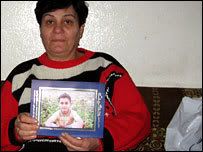 Dalal holds a photo of a nephew who was killed in Iraq
Only Dalal agreed to be photographed. Khalil, a painter, was afraid the people who attacked him would find out he is now in Syria.
In 2004 he began to receive anonymous threats from someone who objected to his painting of a woman, calling it blasphemous.
He was also threatened because he had been asked to paint portraits for American troops in Baghdad.
Three weeks after the first threat, his gallery was burned to the ground. Shortly afterwards, someone threw a firebomb into the couple's living room in the middle of the night, while they slept upstairs.
It took them two months to raise the money to leave.
The couple have three grown up children. Their youngest son lives with them and their daughter lives in Canada.
Their oldest son, Ziad, lives in Sweden. He was visiting his parents for the first time in five years and explained, from Damascus, their situation:
"They can't work and they don't have much money. They have a little from what they brought over from Iraq, but there's not much left because they have to pay for their food and rent out of it."
The couple know a few Iraqi families in Damascus and Ziad says his 19-year-old brother plays football in the street with some Iraqi friends.
But, he says his mother misses having her wider family around her and "feels lonely inside".
The couple appear to have taken on the informal role of community activists in Damascus. Khalil teaches art at the local church and Dalal helps orient new arrivals from Iraq to life in Syria.
Ziad says his parents cannot return to Iraq and are trying to move either to Canada, or Sweden, to join one of their other children.
AHMED and MAYYADA ABDEL SALAM, AMMAN
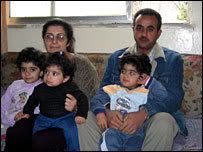
Ahmed is a doctor and his wife Mayyada is a pharmacist. They belong to the Sabian faith, a monotheistic non-Muslim minority in Iraq.
They left Baghdad in 2005 after Mayyada's pharmacy was attacked when she refused to wear a headscarf.
Ahmed explains: "One of the radical Muslims came into the pharmacy and asked Mayyada why she was unveiled. She explained she was not Muslim and that there was no hijab in her religion.
"He told her she was an infidel and that she should leave Iraq."
A few days later the radicals targeted the pharmacy in a drive-by shooting. Ahmed says they had a lucky escape.
"I, my wife and children were in the pharmacy when the attack happened. They shot several rounds, smashing the shop window and the shelves of drugs.
"We were terrified. My wife was injured in the leg, but only superficially."
The family didn't return to the pharmacy, but stayed at home preparing to leave Iraq.
They arrived in Jordan less than two months later. Ahmed says they chose Jordan because it was close and at the time it was easy to get to.
But life is difficult in Amman.
"We arrived as refugees; we have no rights. We can't work and we can't send the children to school. We have three daughters, aged six, three and one. We are considered illegal residents in Amman, although we are refugees."
They arrived with their life savings which Ahmed reckons will last another four or five months. After that, they will have to ask for help from relatives abroad.
Ahmed's parents are living in their family home in Baghdad.
"We speak to them on the phone, we are very anxious about them because it is so dangerous."
They family is renting a two-bedroom apartment in Amman and educating their six-year-old at home.
They are in touch with other Iraqis in the city and they also know a few Jordanians.
"We do have some contact with them, but it's usually superficial. There's no time for anything deeper and we are not in the right frame of mind to reach out to others.
"We keep it superficial because we are depressed and we don't know what the future holds."
Ahmed and his wife want to move to Australia. They have already had one application rejected, but they are putting in another.
"We want to start a new life for our children. They are more important than us."
SAAD MOHAMED AND FAMILY, AMMAN
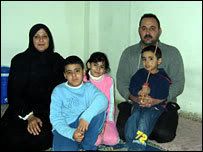
Saad brought his family to Jordan in June 2006, after narrowly escaping two direct attempts on his life.
Under Saddam's regime Saad, a Sunni, was a soldier in the army and his ID card identifies him as a veteran of the Iran-Iraq war. He is therefore considered a "Saddamist".
"I received letters at my house, telling me to leave within 24 hours or be killed.
"One time, I was driving the car - with our three young children - and somebody started shooting at us. I managed to drive away quickly and we escaped. That was in Baghdad."
The family fled with no possessions. They had money sent from home after they arrived in Amman - but it was stolen within 24 hours.
Saad believes someone followed them from Iraq and stole the money as soon as it was safe to do so.
He has no work permit and was unemployed for the first five months in Jordan.
"About three weeks ago someone gave me a job. I'm working as a porter, guarding a building. The pay barely covers the rent, food and water. It's hardly enough to live on."
After Saddam's regime was toppled, Saad used to work in a shop, selling electric cables and lighting equipment.
He has no friends or family in Jordan. He says he chose Amman because it was the only place he could escape to.
"Our children are aged seven, six and four. They need to go to school, but I can't afford to send them."
Saad is applying for asylum in Europe. He says he has contacted the Spanish embassy, but he hasn't heard from them yet.
One of his children was born with a disability and has already had several operations. Saad has applied to children's organisations to see if his son can be offered a place in school.
He says he has no idea what happened to his house in Baghdad.
"All I know is that the Mehdi Army have now got hold of many houses in the area where I used to live."
Would he ever think of going back?
"I don't even think about it. It's highly unlikely. I have a psychological block about it.
"Five of my cousins were killed in front of my eyes immediately before I left."
Saad says he conjures up the memory of Iraq to try to get his children to behave: "If they're playing up, I threaten them with moving back to Iraq."
