The NYT reports:
William Kristol, one of the nation’s leading conservative writers and a vigorous supporter of the Iraq war, will become an Op-Ed page columnist for The New York Times, the newspaper announced Saturday.
Mr. Kristol will write a weekly column for The Times beginning Jan. 7, the newspaper said. He is editor and co-founder of The Weekly Standard, an influential conservative political magazine, and appears regularly on Fox News Sunday and the Fox News Channel. He was a columnist for Time magazine until that relationship was severed this month.
Mr. Kristol, 55, has been a fierce critic of The Times. In 2006, he said that the government should consider prosecuting The Times for disclosing a secret government program to track international banking transactions.
In a 2003 column on the turmoil within The Times that led to the downfall of the top two editors, he wrote that it was not “a first-rate newspaper of record,” adding, “The Times is irredeemable.”
In the mid-1990s, Mr. Kristol led the Project for the Republican Future, an influential policy study group. Before that, he was chief of staff to Vice President Dan Quayle.
A native of New York City, he holds a bachelor’s degree and a doctorate from Harvard.
His father is Irving Kristol, one of the founding intellectual forces behind modern conservatism.
Sunday, December 30, 2007
| [+/-] |
The New York Times Adds An Op-Ed Columnist |
Saturday, December 29, 2007
| [+/-] |
New York Times Explains Hiring New 'Op-Ed' Wag |
Editors and Publishers report:
A day after the Huffington Post first reported it, The New York Times has announced that it has indeed hired conservative pundit, and Fox News analyst, Bill Kristol, as a new regular op-ed columnist.
Liberal bloggers had been up in arms over the move. Kristol said, in an interview with Politico.com, it gave him some pleasure to see their "heads explode." Kristol was perhaps the most influential pundit of all in promoting the U.S. invasion of Iraq and has strongly defended the move ever since.
Times' editorial page editor Andy Rosenthal defended the move. Rosenthal told Politico.com shortly after the official announcement Saturday that he fails to understand “this weird fear of opposing views....We have views on our op-ed page that are as hawkish or more so than Bill....
“The idea that The New York Times is giving voice to a guy who is a serious, respected conservative intellectual — and somehow that’s a bad thing,” Rosenthal added. “How intolerant is that?”
Unlike The Times’ other regulars, Kristol will write only once a week, with his first column set for Jan. 7, and he has just a one-year contract. The paper noted in its own announcement: "In a 2003 column on the turmoil within The Times that led to the downfall of the top two editors, he wrote that it was not 'a first-rate newspaper of record,' adding, 'The Times is irredeemable.'”
Kristol, on Fox News in 2006, suggested that the paper should face charges after its big banking records scoop: "I think it is an open question whether the Times itself should be prosecuted for this totally gratuitous revealing of an ongoing secret classified program that is part of the war on terror.”
In 2003, on NPR's "Fresh Air" show, he said, "There's been a certain amount of pop sociology in America ... that the Shia can't get along with the Sunni....Iraq's always been very secular."
In the July 14, 2006 issue of The Weekly Standard, which he edits, Kristol called for a "military strike against Iranian nuclear facilities. Why wait? Does anyone think a nuclear Iran can be contained? That the current regime will negotiate in good faith? It would be easier to act sooner rather than later. Yes, there would be repercussions--and they would be healthy ones, showing a strong America that has rejected further appeasement."
Kristol, in the current issue of The Weekly Standard, argues that Gen. David Petraeus should have been picked as Time's person of the year, but "Our liberal elites are so invested in a narrative of defeat and disaster in Iraq that to acknowledge the prospect of victory would be too head-wrenching and heart-rending." In the Dec. 17 issue he argued, "Resisting the temptation to throw away success in Iraq by drawing down too fast or too deep is the greatest service this president can render his successor."
Monday, November 19, 2007
| [+/-] |
Newsweek & Most Media Embraces Karl Rove, After TIME Takes a Pass |
At Radar Online, Charles Kaiser writes:
When Newsweek made Karl Rove one of its columnists last week (along with Markos (Daily Kos) Moulitsas for balance), there was one big question: Could the number of new readers attracted by this fancy new hire possibly exceed the hordes of freshly canceled subscriptions?
The early betting was heavily against any circulation increase. And the odds didn't get better with Rove's first column. His biggest scoop was about the "full-length vanity mirror" found in the West Wing office he inherited from Hillary—and the fact that she had denied putting the mirror there (twice). This, you see, is Rove's idea of "a small but telling story: She is tough, persistent, and forgets nothing." Rove's hiring (which the New York Times didn't even bother to report) makes him the latest in a long and distinguished line of politicos turned pundits who owe their big journalism careers almost entirely to the flowery rhetoric of Spiro T. Agnew.
For latecomers to this never-ending melodrama, Agnew was Richard Nixon's first vice president—the one whose main qualification for the job was this: "No assassin in his right mind would kill me,'' Nixon explained. ''They know if they did that they would wind up with Agnew!" Once Agnew started his blistering attacks on the commie-pinko-liberal press, he became a celebrity in his own right. He called reporters "an effete corps of impudent snobs" and television commentators ''a tiny fraternity of privileged men elected by no one and enjoying a monopoly sanctioned and licensed by the government.''
Since almost all of these haikus were written by conservative White House speechwriters Bill Safire and Pat Buchanan, it was only fitting that they would be among the first to benefit from them.
After a brief push back from shocked newspaper big shots, opposition to Agnew's slanted-media thesis crumbled. In 1973, Nixon alum Bill Safire landed on the op-ed page of the New York Times. (Agnew was actually forced to resign later that same year, after being caught up in a kickback scandal that dated from his tenure as governor of Maryland, but conservatives have continued their nonstop anti-press campaign ever since.) Around the same time, George Will began appearing more regularly in the Washington Post (while still moonlighting as a speechwriter for Jesse Helms). And then came the ubiquitous Pat Buchanan.
The success of Safire, Will, and Buchanan is a good barometer of just how far right you can go in Washington and still remain an honored member of the old boys' club. In his new book about the 1960s, Tom Brokaw explains that Buchanan's "good humor" has made him "enduringly popular even with liberal observers."
That's the genius of Washington—just because you've written that Adolf Hitler was "an individual of great courage" (Google "anti-Semitism of Pat Buchanan" and you get 231,000 hits), dismissed the idea that "white rule of a black majority is inherently wrong" in South Africa, or shown your lavender-friendly side by pointing out that "homosexuality involves sexual acts most men consider not only immoral, but filthy," none of that will prevent you from continuing as a regular on Meet the Press. (And you're surprised that Tim Russert was never offended by Imus?)
For its part, Time magazine said nothing publicly about Rove's arrival at Newsweek, but a well-placed source told me that Bob Barnett (every Washington literati's favorite lawyer, including Bill Clinton) had traveled to the Time-Life building on Sixth Avenue to offer Rove's services before Newsweek snared them. Time's editors apparently felt the cost/benefit analysis wouldn't be in their favor if they embraced the man who has done more than anyone to keep the spirit of Joe McCarthy alive and well in American politics. (Read Joshua Green's definitive profile from the Atlantic in 2004.) "Time thought this wouldn't be like hiring George Stephanopoulos," my source explained. "They think Karl is essentially like an unindicted coconspirator in a whole string of felonies."
Besides the obvious shock value, there was another reason Rove's arrival in the fourth estate was inevitable. In public, Rove is one of dozens of conservatives who assiduously bash the press. Last summer, channeling Agnew, Rove told Rush Limbaugh that "the people I see criticizing [Bush] are sort of elite effete snobs." But at the same time, Rove was constantly massaging big-time Washington journalists over long lunches at the Hay Adams Hotel.
The result of this continuous media handling was a mostly kid-glove treatment of Rove by great Washington political reporters like Anne Kornblut. The day after Rove dodged an indictment by the special prosecutor, this is how Kornblut appraised him in the New York Times: "a cheerful, sharp-witted operative fond of sparring with reporters off the record." It's that kind of hard-hitting approach that got Kornblut stolen away by the Washington Post—but also makes it possible for Jon Stewart to provide an essential reality check on our nation's capital. At the moment, the Daily Show is condemned to reruns for the length of the writers' strike, but last week there was a magnificent moment of serendipity. The same day Newsweek announced its new hire, the show rebroadcast a feature on Rove from the week after he left the White House.
"Washington was very shaken last week," Stewart intoned, "with news that Karl Rove, whose bountiful advisory teats had fed so many Beltway insiders for lo these six and a half years, was capping the spigot and moving on." Then Chris Wallace was shown offering up a list of "Karl Rove's greatest hits." Cut to Stewart:
"I just bought those: John McCain's black baby; Max Cleland, the one-limb pussy; The Queers are coming!; and, of course, Schiavo-a-go-go. No need to call now—your phones have already been tapped.
Thursday, October 18, 2007
| [+/-] |
Mainstream Media Unites Behind Mukasey for Attorney General |
The Christian Science Monitor reports:
Michael Mukasey, President George Bush's choice to replace Alberto Gonzalez, whose office was criticized for its support of what the CIA has called "enhanced interrogation" techniques and opponents called torture, appeared to repudiate the use of such measures at the start of his confirmation hearings at which he also promised independence from the White House.
The apparent relaxing of US standards governing the treatment of prisoners since Sept. 11 has damaged America's standing around the world, and the issue is being closely watched abroad.
While Democrats in Congress expressed disappointment at some of Mr. Mukasey's answers, The New York Times reports that he did a good enough job to virtually guarantee his confirmation.Democratic senators welcomed Mr. Mukasey's promise that he would impose new rules to limit contacts between political figures and the Justice Department. He also said ... the department's hiring [should] be done "on the basis of competence and ability and dedication and not based on whether somebody's got an 'R' or a 'D' next to their names."
Those remarks were clearly meant to distance Mr. Mukasey from the political scandals that engulfed the department during the tenure of Mr. Gonzales, who dismissed several United States attorneys around the country last year for what appeared to be political reasons.
Mr. Mukasey also pleased the Democrats who control the Judiciary Committee by saying that he considered torture of terrorist suspects to be illegal under American and international law and that the president did not have the authority to order it under any circumstances.
The Chicago Tribune says Mukasey "explicitly disavowed" the relaxation of standards regarding interrogation and detainees under Mr. Gonzalez.He also quickly distanced himself from Gonzales by explicitly disavowing two Justice Department memos that authorized use of abusive tactics to interrogate suspected terrorists. Mukasey said that policy "was worse than a sin. It was a mistake."
Though Mukasey did not ever say so, some commentators believe he is signaling a new direction for the government.
Mukasey noted that the United States is bound by its own laws and treaty obligations to prohibit torture, but he went further, saying, "We don't torture, not simply because it's against this or that law or this or that treaty. Soldiers of this country liberated concentration camps and photographed what they saw there as a record of the barbarism they opposed."
Andrew Sullivan, a conservative columnist and blogger for the Atlantic Monthly, who has strongly opposed abusive interrogation methods, is hopeful about Mukasey, comparing his comments, particularly his remark that the US didn't record what went on in concentration camps so we could "duplicate what we opposed," to the position on the issue by Democratic Sen. Dick Durbin."Duplicate what we opposed"? Nazi concentration camps? Does that remind you of anyone?
Other bloggers also believe Mukasey is committed to limiting executive power. Spencer Ackerman in a post at the Talking Points Memo blog, praised Mukasey's testimony.
"In a Senate floor speech Tuesday, [Senator Dick] Durbin cited an FBI report describing Guantanamo Bay prisoners chained to the floor in the fetal position without food or water and sometimes in extreme temperatures.
"If I read this to you and did not tell you that it was an FBI agent describing what Americans had done to prisoners in their control," he said, "you would most certainly believe this must have been done by Nazis, Soviets in their gulags, or some mad regime."
Is it not clear that Mukasey's and Durbin's point is exactly the same?Most significantly, Mukasey said that he is unaware of any inherent commander in chief authority to override legal restrictions on torture – a huge repudiation of Dick Cheney, David Addington and John Yoo's perspective on broad constitutional powers possessed by the president in wartime – or to immunize practitioners of torture from prosecution. That answer is sure to create anxiety inside the CIA, where many interrogators fear that they will be brought up on charges for carrying out interrogation methods earlier approved by the administration.
The right-leaning New York Sun agrees with the assessment that Mukasey is a shoo-in for confirmation,but that once in office he could leave the Bush administration's legal strategy for the war on terror "badly bruised."The risks the pick carries for the Bush administration were also on display. In addition to denouncing in blunt terms the so-called torture memo, which was later revoked, Judge Mukasey heartily endorsed the withering critique a former Justice Department official, Jack Goldsmith, has made of the administration's attempts to assert executive power without involving Congress.
To be sure, senators still have questions about how far Mukasey would go in restraining the White House, particularly when it comes to assertions of "executive privilege," the Associated Press reports.
Asked by Senator Schumer about Mr. Goldsmith's recently published book, "The Terror Presidency," Judge Mukasey replied, "I thought it was superb. ... I couldn't put it down. In a way, I was sorry when I finished."
The judge went on to make clear that he endorses Mr. Goldsmith's central thesis that the Bush administration's embrace of what Mr. Schumer called "unilateralism" was a mistake. "I would certainly suggest that we go to Congress whenever we can. It always strengthens the hand of the president to do that," Judge Mukasey said.Chairman Patrick Leahy, D-Vt., said he would query the former federal judge on his views of the administration's position on executive privilege. The issue arose when presidential counsel Fred Fielding declared certain White House documents and information off-limits under the privilege.
Mukasey on Wednesday gave a hint of his posture on the issue. While he sees valid reasons for declaring executive privilege, his reaction to some of the White House's rationale was, "Huh?"
Ranking Republican Arlen Specter, R-Pa., said he also would have questions about whether Mukasey believes the Justice Department can live with a legal shield for reporters against being forced to reveal sources in federal court. Again, Mukasey gave a glimpse of his opinion a day earlier, saying he had significant concerns about the legislation pending in the Senate. But he did not endorse or reject the proposal.

Thursday, September 27, 2007
| [+/-] |
Spies Prep Reporters on Protecting Secrets |
The New York Sun reports:
Frustrated by press leaks about its most sensitive electronic surveillance work, the secretive National Security Agency convened an unprecedented series of off-the-record "seminars" in recent years to teach reporters about the damage caused by such leaks and to discourage reporting that could interfere with the agency's mission to spy on America's enemies.
The half-day classes featured high-ranking NSA officials highlighting objectionable passages in published stories and offering "an innocuous rewrite" that officials said maintained the "overall thrust" of the articles but omitted details that could disclose the agency's techniques, according to course outlines obtained by The New York Sun.
Dubbed "SIGINT 101," using the NSA's shorthand for signals intelligence, the seminar was presented "a handful of times" between approximately 2002 and 2004, an agency spokeswoman, Marci Green, confirmed yesterday. Officials were pleased with the program, she said.
"They believe they were very successful in being able to talk to journalists regarding our mission and the sensitivities of our mission in an unclassified way," Ms. Green said.
The syllabi make clear that the sessions, which took place at NSA headquarters in Fort Meade, Md., were conceived of not merely as familiarization tours, but as part of a campaign to limit the damage caused by leaks of sensitive intelligence.
"Course Objective: to convey the fragility of SIGINT and to increase editors' and reporters' understanding that there are other ways to express similar thoughts in an article without compromising the story and without compromising SIGINT," the syllabi said.
The NSA's seminars, delivered over tea and pastries, and accompanied by a clip from "Top Gun," seemed designed to elicit a chummy atmosphere and to highlight commonalities between reporters and the agency's electronic sleuths. "Reporters go to great lengths to protect their sources, as do we," one talking point for the classes said. "We need your help."
Journalists were also treated to technical demonstrations and encouraged to feel that they had gotten a rare behind-the-scenes view of the agency. "Stress that this is the first-ever such course in NSA's history," another talking point said. During one sensitive discussion, journalists were to be told they could not take any notes.
Among the news stories singled out for redrafting by the NSA were an Associated Press rewrite of a 1999 USA Today article by Jack Kelley reporting that officials used a "reconnaissance satellite" to intercept Osama bin Laden's telephone calls and head off six attacks on American embassies, a 1998 Knight Ridder dispatch by Neely Tucker reporting that an "exhaustive review of electronic intercepts of the traffic on bin Laden's communications network" picked up evidence of his involvement in the bombing of American embassies in Kenya and Tanzania, and a 1998 New York Times story by Steven Lee Myers reporting that a Pentagon warning about a possible attack on American interests in the Persian Gulf was prompted by "eavesdropping on conversations between Mr. bin Laden" and his cohorts.
The exact substitutions of language that the NSA proposed were deleted from the syllabi released to the Sun under the Freedom of Information Act. The agency did leave in the caveat that it was "neither confirming nor denying the accuracy" of the reports it used as examples.
Mr. Tucker, the author of the Knight Ridder story, said in an interview yesterday that he was never invited to the course and never knew the NSA had a problem with the report. "Nobody ever said a word," he said. Mr. Tucker, who now writes for the Washington Post, noted that he was in Africa at the time and that the passage probably originated with another reporter in Washington.
Told of his involvement in the NSA seminar, he said, "Always glad to help NSA any way I can."
Mr. Myers did not respond to a phone message yesterday seeking comment. Mr. Kelley, who quit USA Today in 2004 amid a probe into fabricated stories, could not be reached.
Ms. Green said the program stopped in late 2004 due to staffing changes at the NSA's public affairs operation.
In 2005, following the publication of a New York Times story on a secret program for warrantless wiretapping of some phone calls placed or received in America, the Bush administration's attitude toward leaks became far more confrontational. Director of Central Intelligence Porter Goss crusaded against leaks at the CIA and later told a Senate committee that he hoped reporters would be called before grand juries to identify their sources. Attorney General Gonzales also discussed the "possibility" of prosecuting journalists who wrote stories based on leaked intelligence.
The syllabi, which are marked as drafts, list presenters including the director of the NSA at the time, General Michael Hayden, the agency's general counsel, Robert Deitz, and the head of the signals intelligence division, Maureen Baginski.
Ms. Baginski, who left NSA in 2003 and is now in the private sector, said yesterday that she had no recollection of making such a presentation. Told of the rewriting element of the class, she chuckled and said, "It's an interesting approach."
The Sun obtained the syllabi in response to a Freedom of Information Act request regarding an investigation into leaks about NSA intercepts that may have presaged the terrorist attacks of September 11, 2001. The released course materials contain no obvious reference to those leaks, but they may have been mentioned in portions of the syllabus the NSA deleted from the released copy.
Friday, September 14, 2007
| [+/-] |
Is Serious Trouble Brewing Between Syria and Israel? |
Speculation Centers on Fears of Missiles and Nuclear Weapons
Peace Talks Seem Impossible as Tensions Grow Between Syrians and Israelis. ABC News reports:
Eight days ago, the Syrian government announced that Israeli military jets had been spotted flying through Syrian airspace. The Syrians said the jets had been fired upon and had fled. The Israelis said nothing at all.
Ever since, the region and its media have been engaged in a frenzy of speculation as to what really happened. As soon as news of the reported incident broke, the Israeli government imposed a complete media blackout.
That blackout has muzzled Israeli journalists who have been frustrated by the silence of their usually talkative defense sources. In one bulletin an Israeli radio announcer sarcastically told his audience to log onto the Web site of a government-sponsored Syrian newspaper to find out what really happened.
In the strange atmosphere that has followed last week's incident, the region's bloggers have been working overtime to fill the void. What seems clear is that something important did happen, and far from the Israeli mission being limited to probing, or reconnaissance, the consensus view is that the Israelis flew a mission that had a real target.
This speculation has been supported by a number of anonymous defense sources in the United States. One such source is quoted in The New York Times saying, "The strike I can confirm, the target, I can't."
Judging by the extraordinary secrecy attached to the target, it was highly sensitive. Another unnamed U.S. source said the Israeli strike "left a big hole in the desert." Meanwhile the Syrians are sticking to their story that the Israelis turned and ran once they were detected. Syrian U.N. ambassador Bashar al Ja'afari told reporters: "There was no target. They dropped their munitions. They were running away."
Here are the leading theories about the target, in no particular order of credibility or importance:
The Israelis, presumably with U.S. knowledge and backing, targeted a transfer of weapons destined for the Lebanese group Hezbollah. This trafficking of weapons has long been an issue for the Israelis, and now is in direct contravention of U.N. Security Council Resolution 1701, which was drawn up at the end of last year's conflict between Israel and Hezbollah. Israeli intelligence has been warning that Hezbollah is trying to rearm and the usual suspects are Syria and Iran.
The rest of this article is not available at the ABC website.
Friday, June 8, 2007
| [+/-] |
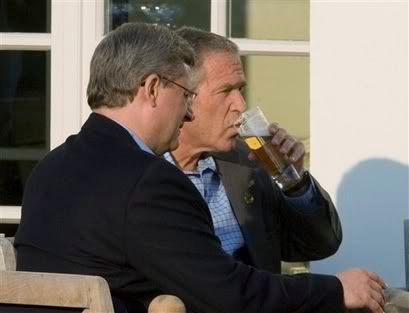
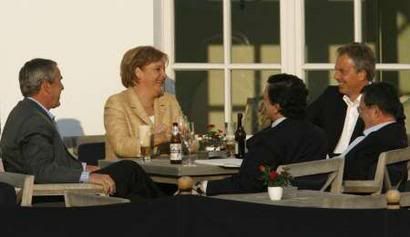
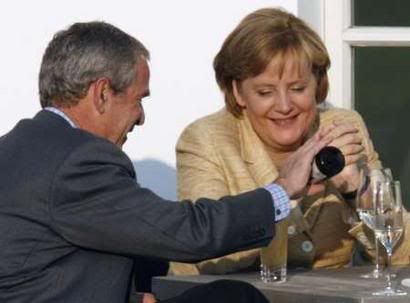
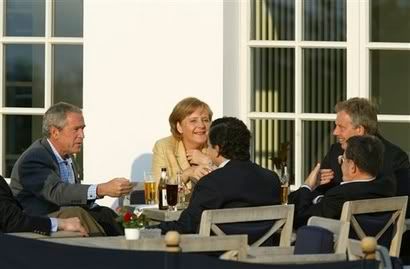
Bush Ill At G8 Summit |
The Associated Press reports:
President Bush signaled Friday the United States will press ahead with a missile defense shield in Eastern Europe despite Russia's heated objections. Poland's president expressed support for installing interceptor rockets in his country.
An upset stomach crimped Bush's schedule on a busy day that took him from Germany to Poland and finally to Italy. The president stayed in bed and skipped morning sessions at the summit of world leaders in Heiligendamm, Germany, and he appeared subdued later after talks in Poland with President Lech Kaczynski.
"Still not 100 percent but better all the time," White House deputy press secretary Dana Perino said of her boss.
On Saturday, Bush will meet for the first time with Pope Benedict XVI. Large anti-Bush demonstrations are planned in Rome, and Premier Romano Prodi had to ask his Cabinet members to refrain from taking part.
The administration made clear it was not abandoning plans for a missile-defense program in Poland and the Czech Republic despite a surprise counterproposal Thursday by Russian President Vladimir Putin to instead use a Soviet-era radar tracking station in Azerbaijan.
Putin had more suggestions on Friday for locations for missile interceptors: "They could be placed in the south, in U.S. NATO allies such as Turkey, or even Iraq," Putin said. "They could also be placed on sea platforms."
Secretary of State Condoleezza Rice, in an Associated Press interview in New York, said Friday, "One does not choose sites for missile defense out of the blue. It's geometry and geography as to how you intercept a missile."
"This is an idea that has not yet been vetted," she said of Putin's offer. "We have to see whether Azerbaijan makes any sense in the context of missile defense."
The U.S. system calls for a radar screen in the Czech Republic to watch for missile threats, and 10 interceptor rockets in Poland to shoot down any missiles. Both Bush and Kaczynski said the system would not threaten Russia. The Kremlin argues that the system would undermine its nuclear deterrent.
"The system we have proposed is not directed at Russia," Bush said after talks with Kaczynski at the presidential retreat at Jurata, a resort on the Baltic Sea. "Indeed, we would welcome Russian cooperation on missile defense."
Bush said a working group including the United States and Russia would "discuss different opportunities and different options, all aimed at providing protection for people from rogue regimes who might be in a position to either blackmail and/or attack those of us who live in free societies."
Kaczynski voiced strong support for putting the interceptors on Polish soil. "As far as the missile defense system is concerned, the two parties fully agree," Kaczynski said.
"The Russian federation can feel totally safe," said Kaczynski. He said Moscow must recognize that the world has changed since the fall of the Soviet Union nearly two decades ago.
Bush thanked the Polish president for sending troops to both Iraq and Afghanistan. Poland has nearly 900 troops in Iraq, and Bush noted that the country had recently agreed to keep them there at least through the end of the year.
The three-day summit in Heiligendamm ended with agreement to commit more than $60 billion to fight disease in Africa. Half of the money already had been pledged by Bush, and other countries would have to fill in the rest. Anti-poverty activists have complained that promises to boost annual aid to poor countries have not been met.
The leaders also warned Iran to drop its disputed nuclear program, signaling support for U.N. Security Council moves to discuss a third set of sanctions against Tehran. But, in a setback, they failed to reach a deal about the independence-seeking Serbian province of Kosovo.
White House counselor Dan Bartlett said Bush likely fell ill with "some sort of bug, probably more viral in nature" and that it appeared unrelated to anything he ate.
Bartlett joked that Bush's decision to avoid the other leaders for a while was a "precautionary step" to avoid following in the footsteps of his father, former President George H. W. Bush.
At a state dinner in Tokyo in January 1992, the elder Bush fainted and vomited into the lap of Prime Minister Kiichi Miyazawa.