The Hill reports:
In a move that could give cover to Republicans in an increasingly tough election year, one of the Bush administration’s most steadfast supporters in the Senate is indicating that he may introduce legislation later this year that could alter the administration’s Iraq policy.
Sen. Lindsey Graham (R-S.C.), who staunchly supported Bush’s Iraq troop surge strategy, said he is not seeking to influence military strategy but rather the way the United States spends money to influence the political process in Iraq.
Graham’s effort is still in the conceptual stages, but it could give an opportunity for Republicans — banking on the success of the surge — to carve out a distinct Iraq plan that differs from the Bush administration without giving in to the Democrats’ withdrawal push.
Graham said he is disappointed with the political reconciliation efforts in Iraq and is considering influencing alternatives to Prime Minister Nouri al-Maliki’s government if the country does not make strides toward that goal.
“If his government has not delivered meaningful political reconciliation by the end of the year, given the success of the surge and better security, I will consider [Maliki’s] government a failure,” Graham told The Hill. “And then we look for other horses to support.
“It would be foolhardy to continue to throw money at a group of people who have had an opportunity to produce and have not,” he said. He added that he is “not going to sit on the side” if the Shiite, Sunni and Kurdish factions fail to implement reconciliation measures that could bring the country together.
Graham, who is up for reelection in 2008 and will likely face a primary challenge from the right, has been in discussions with the White House about his possible move, said a source familiar with Graham’s plan. “They are familiar with his line of thinking,” said the source. “The White House has its own problems with the Maliki government.”
Although Iraqis have made some strides at the local and community level, reconciliation within the national government remains stalled. A recent U.S. effort to incorporate 70,000 local fighters into the Iraqi police and army to solidify security gains is facing resistance from the Shiite-dominated central government, which fears that the Sunni-majority fighters could eventually mount an armed opposition.
“There are people within Iraq who are doing reconciliation and you might look at local support, sending your money into areas where people are trying,” Graham said. “There are lots of options.”
Graham cautioned that he is waiting until the end of the year to see whether the Maliki government is making any strides. With better security as a result of the surge’s success, said Graham, “it is the time to act.”
“You could not have had democracy with the level of violence we had before,” Graham said. “I am optimistic that all the groups will act, but if they don’t, then it will be clear to me that we would have to look for other alternatives.”
Graham has stated in the past few months that Iraqis should hold provincial elections, share economic resources, grant amnesty for some anti-government factions, and revisit the de-Baathification policies following the ouster of Saddam Hussein.
Earlier this year, Graham warned that Republicans could pay a political cost in opposing the Democrats’ troop withdrawal strategy. If Graham introduces legislation, it could stem the fear that Republicans could desert Bush on Iraq in droves next year when the presidential election picks up.
Graham’s impetus to act does not surprise some observers.
“If I were a Republican close to Bush, Maliki would infuriate me,” said Marc Lynch, a Middle East expert and associate professor at George Washington University. “That may be where Graham is coming from, [as a strong supporter of the surge].
“The problem is that we have very little leverage over Maliki because everybody knows that the troop commitment is going to go down, and that Bush will not go towards a real withdrawal,” said Lynch, who also writes the Abu Aardvark blog.
Lynch said he believes the “real purpose” of Graham’s possible legislation is to give Republicans some cover to say that they “are doing something without changing the core of Bush’s Iraq strategy.”
But Stephen Biddle, a senior defense policy fellow at the Council on Foreign Relations who has just returned from a trip to Iraq, said that Graham’s plan would have been better suited to the spring rather than now, as circumstances are changing rapidly.
“At the moment … we are getting reconciliation from the bottom up without coercive leverage on Maliki,” said Biddle. “The rapid spread of [the] bottom-up [local reconciliation] approach combined with some apparent Iraqi recalculations on how long the U.S. is staying in Iraq has set up a situation in which the Iraqi government is increasingly interested in experimenting with reconciliation to see if it will work.”
If the U.S. withdraws support for Maliki, Biddle said, any “experimentation with reconciliation we have now may be set back by at least six months.”
Meanwhile, some of Graham’s GOP colleagues on the Armed Services Committee said that any effort to stabilize the Iraqi government will have strong backing in the Senate.
“From the standpoint of a pure military side, good things are happening,” said Sen. Saxby Chambliss (R-Ga.). “From the standpoint of stabilizing the government, that is not happening, so whatever we can do as a Congress to move more in that direction, I think there will be a lot of support for that.”
Graham’s consideration to take up legislation comes as the Democrats are trying to force another vote on a troop withdrawal goal as part of a $50 billion bridge fund to finance war operations. Democrats face an uphill battle in the Senate, where Republicans are touting the reduction in sectarian violence as a result of the surge.
Thursday, November 15, 2007
| [+/-] |
Lindsey Graham May Seek To Pull Plug On Maliki |
Wednesday, November 7, 2007
| [+/-] |
Murder Charges Dropped in Iraqi's Death |
UPI reports:
The U.S. Army does not have enough evidence for murder charges against a U.S. soldier accused of killing a wounded Iraqi near Kirkuk, a military official ruled.
Lt. Col. Raul Gonzalez has recommended aggravated assault instead of murder charges be lodged against Spc. Christopher P. Shore, the Atlanta Journal-Constitution reported Wednesday.
During a hearing in Hawaii, Shore said his commanding officer, Sgt. 1st Class Trey A. Corrales, ordered him to "finish" a detainee who was on the ground bleeding, the newspaper said. The man died two days later.
Gonzalez, the presiding officer investigating the case, said evidence indicated Corrales -- not Shore -- shot and hit the victim multiple times with an M-4 rifle and displayed intent to kill.
Furthermore, Gonzalez said Corrales created an "unhealthy environment" for his platoon via his "abusive" and "unlawful" behavior, the newspaper said.
Shore, home in Winder, Ga., on leave, told the Journal-Constitution he was relieved by the decision.
"I think the man did the right thing," he said.
Saturday, September 29, 2007
| [+/-] |
Sniper Acquitted of Murder, Convicted of Planting Evidence in Iraq |
Killings of Iraqis led to court case.
The Boston Globe reports:
A military panel acquitted US Army Specialist Jorge G. Sandoval of two counts of murder yesterday, apparently swayed by testimony from fellow Army snipers that two Iraqi men were killed on orders from a higher-ranking soldier.
Sandoval was convicted of a less serious charge of planting detonation wire on one of the bodies to make it look like the victim was an insurgent. As a result, he still could face five years in prison. The seven-member jury deliberated less than two hours in clearing him of all but one charge.
Sandoval, 22, of Laredo, Texas, had faced five charges in the deaths of the two unidentified Iraqi men.
In dramatic testimony during the two-day court-martial, Sandoval's colleagues testified they were following orders when they shot the men during two separate events, on April 27 and May 11. The shootings took place near Iskandariyah, a volatile Sunni-dominated area 30 miles south of Baghdad.
Specialist Alexander Flores, of Hayward, Calif., who was in the same squad as Sandoval on the day of the April killing, testified their platoon leader said the suspect was "our guy" and ordered them to move in, which they interpreted as "take the target out."
The suspect, who wore dark clothing and used a sickle to cut grass in a field, matched the general description Iraqi soldiers had given the Americans of one of two insurgents they had faced earlier in the day, according to testimony.
After the killing, Flores said Staff Sergeant Michael Hensley told him to place the detonation wire on the body and in the man's pocket, which he said he did.
But prosecutors cited an interview with Sandoval immediately after his arrest in which he said he planted the wire.
Outside court, Flores stood by his testimony.
"He was just doing his job, as he was told. It's not his fault," said Flores, who, along with the rest of Sandoval's sniper platoon, greeted him with hugs and well wishes.
In the May shooting, Sergeant Evan Vela said Hensley told him to shoot a man who had stumbled upon their snipers' hideout, although he was not armed and had his hands in the air when he approached the soldiers.
"He [Hensley] asked me if I was ready. I had the pistol out. I heard the word shoot. I don't remember pulling the trigger. It took me a second to realize that the shot came from the pistol in my hand," Vela testified, crying.
Sandoval, who was charged with murder because prosecutors said he did nothing to stop the killing, also was acquitted yesterday of charges he planted the weapon on the second man's body.
Vela of Rigby, Idaho, and Hensley of Candler, N.C., are both charged in the case and will be tried separately.
All three soldiers are part of the 25th Infantry Division at Fort Richardson, Alaska.
Friday, September 28, 2007
| [+/-] |
More Iraqi Civilians Killed in U.S. Raid in Baghdad |
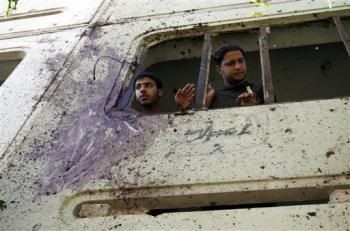 Two Iraqi men look out from a damaged window, from where the body of a civilian was recovered, at an apartment building after a U.S airstrike in the Sihha district in Dora southern Baghdad, Iraq, early Friday, Sept. 28, 2007. Iraqi police and witnesses said U.S. troops backed by helicopter gunships raided an apartment building in a primarily Sunni neighborhood in southern Baghdad on killing at list 10 civilians and wounding 12. The U.S. military said it was checking into the report. (AP Photo/Loay Hameed)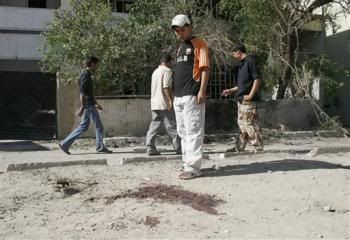
 Iraqi women react during a funeral after a U.S airstrike in the Sihha district in Dora southern Baghdad, Iraq, early Friday, Sept. 28, 2007. Iraqi police and witnesses said U.S. troops backed by helicopter gunships raided an apartment building in a primarily Sunni neighborhood in southern Baghdad on killing at list 10 civilians and wounding 12. The U.S. military said it was checking into the report. (AP Photo/Loay Hameed )
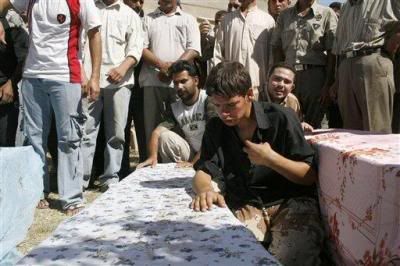 Iraqi men stand in front of three coffins during a funeral of victims after a U.S. air strike in the Sihha district in Dora southern Baghdad, Iraq, early Friday, Sept. 28, 2007. Iraqi police and witnesses said U.S. troops backed by helicopter gun ships raided an apartment building in a primarily Sunni neighborhood in southern Baghdad on killing at list 10 civilians and wounding 12. The U.S. military said it was checking into the report. (AP Photo/Loay Hameed )
The International Herald Tribune reports:
Iraqi police and witnesses said U.S. troops backed by helicopter gunships raided an apartment building in a primarily Sunni neighborhood in southern Baghdad on Friday, killing 10 civilians and wounding 12. The U.S. military said it was checking into the report.
An unknown number of people also were detained after the 2 a.m. incident in the Sihha district in Dora where clashes took place between U.S. helicopters and gunmen, said a police officer who spoke on condition of anonymity because he was not authorized to release the information.
Shaheed Abdul-Al, a 42-year-old metal worker who lives in the area, said his family was awakened by the sound of helicopters, heavy gunfire and bombing.
"We saw a big spark of light with bombing sounds come from the direction of the (targeted) building," he said. "We were horrified and still awake at sunrise."
Ahmed Salim, a 16-year-old student who lives near the targeted complex, said he saw U.S. military vehicles through his window.
"When the Americans left, I and others rushed to the site where people began to rescue victims," he said. "I saw some injured ones and dead bodies."
In violence north of Baghdad, at least six people were killed when four gunmen with long beards wearing military uniforms barged into a busy cafe late Thursday as people were playing a popular game to celebrate the end of the dawn-to-dusk fast during the Islamic holy month of Ramadan.
The men arrived in a Russian-made military vehicle used by the Saddam Hussein-era army and opened fire, shouting, "God is great," according to a provincial police officer who asked that his name not be used for fear of reprisals.
The six killed included three off-duty police officers and eight other people were wounded, the officer said.
The attack occurred in Sadiyah, a town some 95 kilometers (60 miles) north of Baghdad in the volatile Diyala province.
Thursday, September 27, 2007
| [+/-] |
Sniper Describes Killing Captive |
Testimony in Court-Martial Describes a Sniper Squad Pressed to Raise Body Count
The New York Times reports:
An Army sniper is taught to kill people “calmly and deliberately,” even when they pose no immediate danger to him. “A sniper,” Army Field Manual 23-10 goes on to state, “must not be susceptible to emotions such as anxiety or remorse.”
But in a crowded military courtroom seemingly stunned into silence on Thursday, Sgt. Evan Vela all but broke down as he described firing two bullets into an unarmed Iraqi man his unit arrested last May.
In anguished, eloquent sentences, Sergeant Vela, a member of an elite sniper scout platoon with the First Battalion, 501st Infantry Regiment, quietly described how his squad leader, Staff Sgt. Michael A. Hensley, cut off the man’s handcuffs, wrestled him to his feet and ordered Sergeant Vela, standing a few feet away, to fire the 9-millimeter service pistol into the detainee’s head.
“I heard the word ‘Shoot,’” Sergeant Vela recalled. “I don’t remember pulling the trigger,” he said. “I just came through and the guy was dead, and it just took me a second to realize the shot had come from the pistol.”
Then, Sergeant Vela said, as the man, a suspected insurgent, convulsed on the ground, Sergeant Hensley kicked him in the throat and told Sergeant Vela to shoot him again. Sergeant Vela, who is not on trial but faces murder charges in connection with the killing, said he fired a second time.
His testimony on Thursday, in the court-martial of Specialist Jorge G. Sandoval Jr., another sniper who is accused of murder, provided a glimpse into the dark moments of a platoon exhausted, emotionally and physically, by days-long missions in the region south of Baghdad that soldiers call the “triangle of death.” In their testimony, Sergeant Vela and other soldiers described how their teams were pushed beyond limits by battalion commanders eager to raise their kill ratio against a ruthless enemy.
During a separate hearing here in July, Sgt. Anthony G. Murphy said he and other First Battalion snipers felt “an underlying tone” of disappointment from field commanders seeking higher enemy body counts.
“It just kind of felt like, ‘What are you guys doing wrong out there?’” he said at the time.
That attitude among superiors changed earlier this year after Sergeant Hensley, an expert marksman, became a team leader, according to soldiers’ testimony. Though sometimes unorthodox, soldiers said, Sergeant Hensley and other snipers around him began racking up many more kills, pleasing the commanders.
Soldiers also testified that battalion commanders authorized a classified new technique that used fake explosives and detonation wires as “bait” to lure and kill suspected insurgents around Iskandariya, a hostile Sunni Arab region south of Baghdad.
As their superiors sought less restrictive rules of engagement — to legalize the combat killing of anyone who made a soldier “feel threatened,” for example, instead of showing hostile intent or actions — the baiting program, as it was known, succeeded in killing more Iraqis suspected of being terrorists, soldiers testified.
But testimony in proceedings for Sergeant Hensley and, on Thursday, for Specialist Sandoval, both of whom face murder charges in connection with separate killings of Iraqi men last spring, suggest that as the integrity of the battalion’s secret baiting program began to crack, so did Sergeant Hensley.
Only a select group of snipers in the battalion were told of the program, but many more were ordered, without explanation, to carry the baiting items on missions, creating rumors that the items were intended to be planted on victims of unjustified killings, soldiers testified.
Sergeant Hensley, according to several snipers, added to such suspicions when he told a junior member of his team to plant a roll of copper wire — clear contraband — on a suspected insurgent that Specialist Sandoval killed on April 27 after being authorized to shoot by his platoon commander.
On a separate mission two weeks earlier, Sergeant Hensley had killed another Iraqi man he said appeared to be “laying wire” near an irrigation ditch, as the man’s wife and children worked and played nearby.
Then on May 11, Sergeant Vela killed the unarmed man. Afterward, as he testified Thursday, Sergeant Hensley pulled an AK-47, a weapon favored by insurgents, out of his pack and placed it on the body, telling his team that the gun would “say” what happened.
Specialist Sandoval’s court-martial on murder charges began here on Wednesday, and is scheduled to conclude Friday. Sergeant Hensley’s court-martial on murder charges is scheduled to begin here Oct. 22.
An evidentiary hearing for Sergeant Vela, who took the stand on Thursday in the Sandoval court-martial after being granted immunity from incriminating himself in that case, is expected later this year.
Sergeant Murphy has been investigated for a killing of another Iraqi man on April 7. Prosecutors have warned two more battalion members that they are also suspected of committing possible crimes as accomplices in the murder cases.
Struggling to explain why a highly trained Army sniper unit, renowned for its lethal economy of patience and discipline, would bog down under a cloud of murder investigations, some soldiers in interviews faulted commanders for pushing units to keep their kill counts high.
Others pointed toward the outsized influence on the unit by Sergeant Hensley, who, according to other soldiers’ testimony, was dealing with two recent deaths: that of a close friend, killed in a roadside bomb, and also the suicide of his girlfriend back home.
“Staff Sgt. Hensley just continued to drive on,” said Specialist Joshua Lee Michaud, in testimony at the July hearing about the sergeant’s toughness. “Both of them didn’t even faze him.”
A trainer of snipers, Sgt. First Class Terrol Peterson, testified Thursday that the very emotions a sniper must control to do his job properly — anxiety and remorse — sometimes emerge in unexpected and painful ways. “When a sniper breaks, he breaks bad,” Sergeant Peterson said.
Tuesday, September 25, 2007
| [+/-] |
U.S. Snipers Accused of 'Baiting' Iraqis |
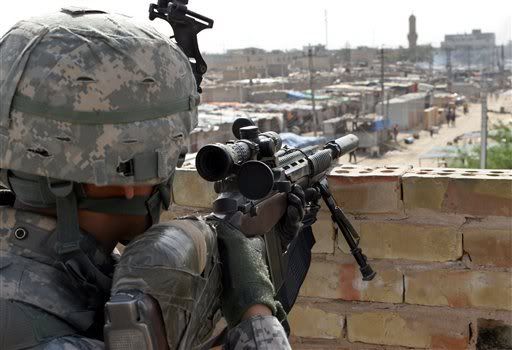 A U.S. soldier holds his sniper position on a rooftop in a Shiite enclave of Sadr City in Baghdad, Iraq, in this April file photo. Army snipers hunting insurgents in Iraq were under orders to "bait" their targets with suspicious materials, such as detonation cords, and then kill whoever picked up the items, according to the defense attorney for a soldier accused of planting evidence on an Iraqi he killed. (AP photo)
The New York Times reports:
Under a program developed by a Defense Department warfare unit, Army snipers have begun using a new method to kill Iraqis suspected of being insurgents, using fake weapons and bomb-making material as bait and then killing anyone who picks them up, according to testimony presented in a military court.
The existence of the classified “baiting program,” as it has come to be known, was disclosed as part of defense lawyers’ efforts to respond to murder charges the Army pressed this summer against three members of a Ranger sniper team. Each soldier is accused of killing an unarmed Iraqi in three separate shootings between April and June near Iskandariya, and with planting “drop weapons” like detonation wires or other incriminating evidence on the bodies of the victims.
In sworn statements, soldiers testifying for the defense have said the sniper team was employing a “baiting program” developed at the Pentagon by the Asymmetrical Warfare Group, which met with Ranger sniper teams in Iraq in January and gave equipment to them.
The Washington Post described the baiting program on Monday.
An Army spokesman, Paul Boyce, said Monday that the Army did not publicly discuss specific methods for “targeting enemy combatants,” and that no classified program authorized the use of “drop weapons” to make a killing appear justified. Army officers involved in evidentiary hearings in Baghdad in July did not dispute the existence or use of a baiting program.
The court-martial of one accused soldier, Specialist Jorge G. Sandoval Jr., is scheduled to begin in Baghdad on Wednesday. The two other soldiers facing premeditated murder charges are Staff Sgt. Michael A. Hensley, the sniper team squad leader, and Sgt. Evan Vela. All three are part of the headquarters of the First Battalion, 501st Infantry Regiment, Fourth Brigade (Airborne), 25th Infantry Division, based at Fort Richardson, Alaska.
None of the soldiers deny that they killed the three Iraqis they are charged with murdering. Through their lawyers and in court documents, the soldiers say the killings were legal and authorized by their superiors. But defense lawyers raised the issue of the baiting program in response to prosecutors’ allegations that the soldiers had planted items, like wire for making bombs, on the bodies of the victims.
A transcript of the hearing was provided by a family member of an accused soldier.
Snipers are among the most specialized of soldiers, using camouflage clothing and makeup to infiltrate enemy locations, and high-powered rifles and scopes to stalk and kill enemy fighters. The three snipers accused of murder had for months ventured into some of the most dangerous areas of Iraq, said lawyers for Sergeant Vela.
“Snipers are special people who are trained to shoot in a detached fashion, not to see their targets as human beings,” said James D. Culp, one of Sergeant Vela’s lawyers. “Snipers have split seconds to take shots, and he had a split second to decide whether to shoot.”
After visiting the sniper unit in Iraq, members of the Asymmetrical Warfare Group gave soldiers ammunition boxes containing so-called “drop items” like bullets, plastic explosives and bomb detonation cords to use to pinpoint Iraqis involved in insurgent activity, according to Capt. Matthew P. Didier, a sniper platoon leader who gave sworn testimony in the accused soldiers’ court hearings.
Captain Didier, in a sworn statement about the program that was obtained by The New York Times, described baiting as “putting an object out there that we know they will use, with the intention of destroying the enemy.”
After placing the bait, snipers observed the area around it, Captain Didier said in his statement. “If someone found the item, picked it up and attempted to leave with the item,” he said, “we would engage the individual, as I saw this as a sign that they would use the item against U.S. forces.” (Engage is a military euphemism for firing on or killing an enemy.)
The Asymmetrical Warfare Group, based at Fort Meade, Md., grew out of a task force created after the American invasion of Iraq in 2003 to develop methods to defeat roadside bombs. Not all of the group’s tactics were meant for sniper units, and most of them have not been publicly disclosed.
For instance, the group last year advised “kill teams” from the Third Brigade, Second Infantry Division, to dig holes resembling those used by insurgents to hide roadside bombs, and to shoot Iraqis who tried to place things in the holes, said a soldier who was briefed on the program and who spoke on condition of anonymity to avoid retribution.
The kill teams used the tactic not to kill people, but to wound them with gunshots and then capture and interrogate them, the soldier said. “It’s pretty common, and it’s pretty effective,” the soldier said in an interview. The soldier lamented the disclosure of the baiting and other anti-insurgent combat tactics because “it’s probably saving a lot of soldiers’ lives.”
James Ross, the legal and policy director for Human Rights Watch, said using fake weapons and ammunition as bait to attract and kill insurgents creates blurry ethical boundaries for soldiers fighting in Iraq, and great risk to civilians who are not legal targets in war. International law recognizes that killing “any individual who is directly or indirectly taking part in hostilities” can be justified, Mr. Ross said, but it is not precise about how such distinctions should be applied.
Mr. Ross said the dispersal of ammunition and explosives by American forces as part of an effort to attract insurgents would present obvious human rights problems.
“It seems to me that there are all sorts of reasons that civilians would want to pick up ammunition that is sitting on the ground,” he said.
Specialist Sandoval is the first of the three suspects to be tried in a court-martial. He and Sergeant Hensley were accused of leaving a spool of wire that could be used to detonate roadside bombs in a pocket of the man whom Specialist Sandoval shot in April, on Sergeant Hensley’s command.
Friday, August 3, 2007
| [+/-] |
At U.S. Base, Iraqis Must Use Separate Latrine |
FORWARD OPERATING BASE WARHORSE, Iraq — The sign taped to the men's latrine is just five lines:
"US MILITARY CONTRACTORS CIVILIANS ONLY!!!!!"
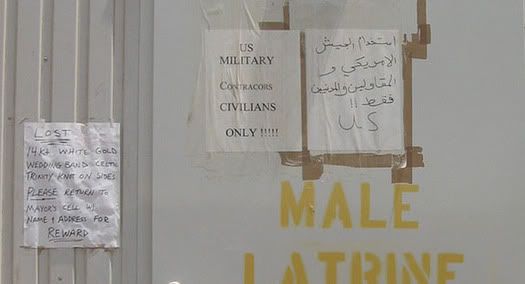 It needed only one: "NO IRAQIS."
McClatchy reports:
Here at this searing, dusty U.S. military base about four miles west of Baqouba, Iraqis — including interpreters who walk the same foot patrols and sleep in the same tents as U.S. troops — must use segregated bathrooms.
Another sign, in a dining hall, warns Iraqis and "third-country nationals" that they have just one hour for breakfast, lunch or dinner. American troops get three hours. Iraqis say they sometimes wait as long as 45 minutes in hot lines to get inside the chow hall, leaving just 15 minutes to get their food and eat it.
It's been nearly 60 years since President Harry Truman ended racial segregation in the U.S. military. But at Forward Operating Base Warhorse it's alive and well, perhaps the only U.S. military facility with such rules, Iraqi interpreters here say.
It's unclear precisely who ordered the rules. "The rule separating local national latrines from soldiers was enacted about two to three rotations ago," Maj. Raul Marquez, a spokesman for the 3rd Brigade Combat Team of the 1st Cavalry Division, from Fort Hood, Texas, wrote in an e-mail. That was before his brigade or the 3rd Stryker Combat Brigade of the 2nd Infantry Division, from Fort Lewis, Wash., the other major combat force here, was based at Warhorse.
There's also disagreement on the reason.
Marquez cited security. "We are at war, and operational security (OPSEC) and force protection are critical in this environment," Marquez wrote. "We screen all our local nationals working and living in the FOB, however, you can never know what's in their mind."
Other soldiers traced the regulations to what they called cultural differences between the Iraqis and the Americans.
"We've had issues with locals," said Staff Sgt. Oscar Garcia, who mans Warhorse's administrative hub. "It's not because we're segregating."
Garcia said some Iraqis squatted on the rims of unfamiliar American-style toilets or had used showers as toilets, forcing private contractors who maintain the facilities to clean up after them.
Another soldier at the administrative hub who declined to give his name or rank cited conflicts over hygiene habits. "We can't accept people washing their feet where I brush my teeth," he said.
"It's to keep problems from happening," said Army Capt. Janet Herrick, a public affairs officer. "It's a preventive measure . . . so no one gets belittled."
But the Iraqis who're paid $80,000 to $120,000 a year for their interpreting services are offended.
"It sucks," Ahmed Mohammed, 30, said of the latrine policy. He called the signs — in English and Arabic — "racist."
He's worked as an interpreter for the U.S. military since 2004. He's college educated and well versed in the ways of Western plumbing. He said Warhorse was the only American base where he'd encountered U.S.-only signs on latrines and country-of-origin restrictions on dining hours.
"I live in the same tent with 80 Americans," he said.
Mohammed works for L-3 Titan Group, a unit of New York-based L-3 Communications. He declined to have his picture taken for publication. He fears for his life. He said his brother was killed last year in Baghdad for working for an American company.
Mohammed has sold his house and has squirreled away enough money to buy visas for his family of four. He said he intended to quit soon and emigrate to Germany. The latrine policy is part of the reason, he said.
L-3 officials didn't respond to a request for comment.
"On one hand we're asking Iraqis to help us," often at great risk, said Laila al Qatami, spokeswoman for the American-Arab Anti-Discrimination Committee in Washington. "But at the same time we're saying, 'We want to keep you at a distance.' It's a mixed message we're sending.
"I don't understand having separate bathrooms. It seems to go against everything that the United States stands for."
Tuesday, July 3, 2007
| [+/-] |
3rd American Soldier Charged in Murder of an Iraqi Civilian |
The New York Times reports:
A third American soldier has been charged with murdering an Iraqi civilian and planting a weapon in a shooting that the soldiers tried to cover up, the United States military said Monday.
The soldier, Sgt. Evan Vela, of Phoenix, Idaho, served in the headquarters unit of the First Battalion, 501st Infantry, of the 25th Infantry Division, based at Fort Richardson, Alaska. That is the same unit as Staff Sgt. Michael A. Hensley and Specialist Jorge G. Sandoval Jr., who were charged last week with killing three Iraqis and placing weapons near their bodies to make it seem as though they were combatants.
Sergeant Vela is charged with one count of premeditated murder, and also of placing a weapon with the body, obstruction of justice and making a false statement, according to a statement by the military.
The killings happened near Iskandariya, south of Baghdad, between April and June, the military said in a statement. All three soldiers have been detained and are awaiting trial.
The military said two soldiers and one marine were killed in western Anbar Province on Sunday, in addition to two soldiers whose deaths were reported earlier. Those follow 101 American military deaths in June, according to figures from the Iraq Coalition Casualty Count, making the 331 fatalities from April through June the deadliest quarter yet for United States forces.
In Diyala Province, the scene of heavy recent fighting between Sunni militants and American forces, an Iraqi police official in Muqdadiya said the civilian death toll from terrorist attacks in the Sherween area on Sunday night had reached 16, with 30 wounded. However, Maj. Gen. Abdul Karim al-Rubaie, the Iraqi commander of operations in Diyala, said coalition and Iraqi forces had made significant advances during the recent large-scale operation to clear Al Qaeda from Baquba.
“The terrorists even targeted schools, as they wanted to halt the progress of science in these areas,” he said Monday. “Life has gradually started to go back to normality in these areas, and residents were happy with the military operations.”
In Baghdad, Brig. Gen. Qassim Atta, an Iraqi military spokesman, said the security crackdown there had led to a reduction in attacks on civilians but an increase in attacks on American-led forces. However, hours later a car bomb in Binouk, a district in northern Baghdad, killed four people and wounded 25, an Interior Ministry official said last night.
Farther south, American F-16s bombed buildings in Diwaniya after insurgents launched 75 rockets and mortar shells at a coalition base. Iraqi officials said the jets killed 10 civilians, including women and children, wounded 30 others and destroyed several houses.
A statement from the United States military said the jets “targeted and bombed the insurgent launch sites.” Accusing insurgents of using civilians as human shields, it said coalition forces were “reviewing the incident to ensure that appropriate and proportionate force was used.”
The strike led to a protest march by residents, some of whom opened fire on a government building, leading to an exchange in which a 17-year-old demonstrator and two security guards were killed.
Sunday, July 1, 2007
| [+/-] |
2 U.S. Soldiers Charged With Murder of 3 Iraqis |
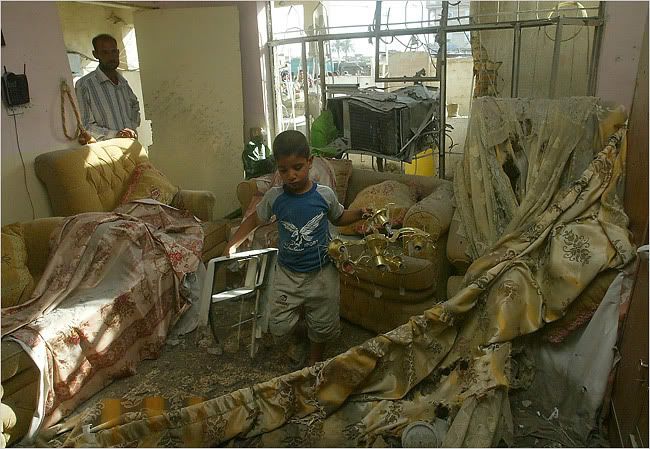 Officials of American-led forces said soldiers killed 26 militants in a raid in Sadr City Saturday, but some residents said civilians were killed. [Kareen Raheem, Reuters]
The New York Times reports:
Two American soldiers have been charged with premeditated murder and planting weapons on dead Iraqis, the United States military said Saturday.
Officials of American-led forces said soldiers killed 26 militants in a raid in Sadr City Saturday, but some residents said civilians were killed.
The soldiers, Staff Sgt. Michael A. Hensley and Specialist Jorge G. Sandoval Jr., were detained after fellow soldiers reported they had been involved in the deaths of three Iraqis near Iskandariya, a stronghold of the Sunni Arab insurgency south of Baghdad, in separate events between April and June this year.
Also on Saturday, the United States military mounted an early morning raid into the Shiite district of Sadr City in Baghdad. Officials with the American-led forces said soldiers had killed 26 militants, but some residents and Mahdi Army militia commanders accused them of killing civilians.
In the murder case, American military officials said Sergeant Hensley, 27, from Candler, N.C., faces three charges of premeditated murder, obstruction of justice and wrongfully placing weapons with the remains of deceased Iraqis. Specialist Sandoval, 20, faces one charge of premeditated murder and one of wrongfully placing a weapon on one of the three Iraqis killed.
Both were serving with the First Battalion, 501st Infantry, of the 25th Infantry Division, which has its headquarters at Fort Richardson, Alaska. Specialist Sandoval was picked up while at home on a two-week leave in Laredo, Tex., the military said. Charges were filed Thursday, and both men are in confinement in Kuwait.
The military said in a statement that an investigation was under way.
The area, part of the so-called Sunni Triangle, is no stranger to controversy.
Two American soldiers have admitted to raping a 14-year-old and killing her and her family in Mahmudiya, a town near Iskandariya, in March 2006, and others also face trial in the killings. Tension has been high since May 12, when an insurgent ambush on a patrol near Mahmudiya killed four American soldiers and one Iraqi, and led to the abduction of three Americans. One soldier’s body was later found but the other two soldiers are still missing.
In Baghdad, Lt. Col. Christopher Garver, an American military spokesman, said the raid in Sadr City on Saturday was against a militant cell that was smuggling weapons, explosively formed penetrators, a particularly lethal type of bomb, and money from Iran to aid Iraqi militias.
He said soldiers killed about 26 fighters and detained 17 suspects, but came under attack from small arms, rocket-propelled grenades and roadside bombs as they withdrew from the area. The Americans returned fire against militants shooting from behind buildings and cars.
“Everyone who got shot was shooting at U.S. troops at the time,” Colonel Garver said. “It was an intense firefight.”
But Iraqi officials said that the death toll was much lower, around eight, and some said that civilians were killed, including a man, his wife and their daughter, who had left their home to check on the disturbance.
Sadr City residents said the American operation was directed at more than one part of the district. Abu Jamal, 50, said he heard troops outside his house in the Sabee Qusoor area early in the morning.
“We were sitting on the roof, all of a sudden the helicopters started throwing flares,” he said. “We were afraid, so we left and went downstairs. The whole family went into one room because we started hearing the sound of firing from the helicopters. We couldn’t hear any firing from machine guns, only the aircraft firing. It was a horrible night.”
In Najaf, a spokesman for the anti-American cleric Moktada al-Sadr, the nominal leader of the Mahdi Army, condemned the raid Saturday and insisted that the militia was not involved in the fight.
“We reject these repeated assaults against civilians. The allegation that Mahdi Army members were the only ones targeted is baseless and wrong,” said the spokesman, Sheik Salah al-Obaidi. “The bombing hurt only innocent civilians.”
The battle prompted an immediate statement from the office of Prime Minister Nuri Kamal al-Maliki, saying that he would demand clarification from the military.
On the political front, Mr. Maliki appealed for Iraq’s largest Sunni bloc, the Iraqi Consensus Front, to end its boycott of his Shiite-dominated government. The boycott began last week as a protest of an arrest warrant issued against one of its members, Culture Minister Asad al-Hashimi, in a murder investigation.
Mr. Maliki said boycotts would only “complicate” matters, and urged them to embrace dialogue as “the only way to solve all the problems now and in the future.”
In Diyala Province, a suicide bomber killed three police recruits and wounded 34 lined up outside a police station in Muqdadiya.
Meanwhile, the American military said it killed Abu Abdel Rahman al-Masri, a senior figure in Al Qaeda in Mesopotamia, in a raid east of Falluja on Friday. Colonel Garver said that Mr. Masri, an Egyptian, had worked closely with Abu Ayyub al-Masri, the military leader of the group, and that his body had been identified by known associates.
American commanders also said that on Friday night a tip from an Iraqi led them to a grave containing dozens of bodies near Ferris, 20 miles south of Falluja. The military said in a statement: “Coalition forces uncovered 35 to 40 bodies at the site. The remains were bound and had gunshot wounds. This incident is currently under investigation.” It is unclear when or how the victims were killed.
Separately, an American command sergeant major, the most senior enlisted member serving in a major command, was sentenced to four months in detention after being convicted of possessing alcohol and pornography, engaging in an inappropriate relationship with a female soldier in his unit, and maltreating a soldier.
The command sergeant major, Edward Ramsdell, of the 411th Engineer Brigade, was working in Diyala Province at the time, and he was given a court-martial in October. Prosecutors said he had possessed a “large quantity” of alcohol and pornography in his quarters, tried to conceal the evidence when discovered and then tried to escape from investigating officers.
Friday, May 25, 2007
| [+/-] |
Did the U.S. Lie About Using Cluster Bombs in Iraq? |
At a time when many nations are moving toward banning the use of cluster munitions, which pose a more serious threat to civilians than any other type of weaponry, the U.S. opposes new limits of any kind.
Nick Turse writes:
Did the U.S. military use cluster bombs in Iraq in 2006 and then lie about it? Does the U.S. military keep the numbers of rockets and cannon rounds fired from its planes and helicopters secret because more Iraqi civilians have died due to their use than any other type of weaponry?
These are just two of the many unanswered questions related to the largely uncovered air war the U.S. military has been waging in Iraq.
What we do know is this: Since the major combat phase of the war ended in April 2003, the U.S. military has dropped at least 59,787 pounds of air-delivered cluster bombs in Iraq -- the very type of weapon that Marc Garlasco, the senior military analyst at Human Rights Watch (HRW) calls, "the single greatest risk civilians face with regard to a current weapon that is in use." We also know that, according to expert opinion, rockets and cannon fire from U.S. aircraft may account for most U.S. and coalition-attributed Iraqi civilian deaths and that the Pentagon has restocked hundreds of millions of dollars worth of these weapons in recent years.
Unfortunately, thanks to an utter lack of coverage by the mainstream media, what we don't know about the air war in Iraq so far outweighs what we do know that anything but the most minimal picture of the nature of destruction from the air in that country simply can't be painted. Instead, think of the story of U.S. air power in Iraq as a series of tiny splashes of lurid color on a largely blank canvas.
Cluster Bombs
Even among the least covered aspects of the air war in Iraq, the question of cluster-bomb (CBU) use remains especially shadowy. This is hardly surprising. After all, at a time when many nations are moving toward banning the use of cluster munitions -- at a February 2007 conference in Oslo, Norway, 46 of 48 governments represented supported a declaration for a new international treaty and ban on the weapons by 2008 -- the U.S. stands with China, Israel, Pakistan, and Russia in opposing new limits of any kind.
Little wonder. The U.S. military has a staggering arsenal of these weapons. According to a recent Human Rights Watch report, the Army holds 88% of the Pentagon's CBU inventory -- at least 638.3 million of the cluster bomblets that are stored inside each cluster munition; the Air Force and Navy, according to Department of Defense figures, have 22.2 million and 14.7 million of the bomblets, respectively. And even these numbers are considered undercounts by experts.
A cluster bomb bursts above the ground, releasing hundreds of smaller, deadly submunitions or "bomblets" that increase the weapon's kill radius causing, as Garlasco puts it, "indiscriminate effects." It's a weapon, he notes, that "cannot distinguish between a civilian and a soldier when employed because of its wide coverage area. If you're dropping the weapon and you blow your target up you're also hitting everything within a football field. So to use it in proximity to civilians is inviting a violation of the laws of armed conflict."
Worse yet, U.S. cluster munitions have a high failure rate. A sizeable number of dud bomblets fall to the ground and become de facto landmines which, Garlasco points out, are "already banned by most nations on this planet." Garlasco adds: "I don't see how any use of the current U.S. cluster bomb arsenal in proximity to civilian objects can be defended in any way as being legal or legitimate."
In an email message earlier this year, a U.S. Central Command Air Forces (CENTAF) spokesman told this reporter that "there were no instances" of CBU usage in Iraq in 2006. But military documents suggest this might not be the case.
Last year, Titus Peachey of the Mennonite Central Committee -- an organization that has studied the use of cluster munitions for more than 30 years -- filed a Freedom of Information Act request concerning the U.S. military's use of cluster bombs in Iraq since "major combat operations" officially ended in that country. In their response, the Air Force confirmed that 63 CBU-87 cluster bombs were dropped in Iraq between May 1, 2003 and August 1, 2006. A CENTAF spokesman contacted for confirmation that none of these were dropped on or after January 1, 2006, offered no response. His superior officer, Lt. Col. Johnn Kennedy, the Deputy Director of CENTAF Public Affairs, similarly ignored this reporter's requests for clarification.
These 12,726 BLU-97 bomblets -- each CBU-87 contains 202 BLU-97s or "Combined Effects Bombs" (CEBs) which have anti-personnel, anti-tank, and incendiary capabilities or "kill mechanisms" -- dropped since May 2003 are, according to statistics provided by Human Rights Watch, in addition to almost two million cluster submunitions used by coalition forces in Iraq in March and April 2003.
Asked about CBU usage by the Air Force in Iraq in 2006, Ali al-Fadhily, an independent Iraqi journalist, commented: "The use of cluster bombs is a sure thing, but it was very difficult to prove because there were no international experts to document it." In the past, however, international experts have actually had a chance to examine some locations where a fraction of the bomblets that coalition forces used have landed.
On a 2004 research trip to Iraq, for instance, Titus Peachey visited numerous sites which had experienced such strikes. At a farm in northern Iraq, he was shown not only impact craters from exploded bomblets on a farmer's property but also unexploded bomblets, by a team from the Mines Advisory Group, a humanitarian organization devoted to landmine and bomb clearance. While "the de-miners expressed frustration that the farmer had planted his field before it had been cleared," Peachey explained that this was a common, if dangerous, practice in such situations. The U.S. used similar ordnance in Laos during the Vietnam War, he pointed out, noting:
"The villagers of Laos waited more than 20 years for clearance work to get started in their fields and villages. During that time they had no choice but to till soil that was filled with bombs. Otherwise they could not eat. In Iraq, the several visits that we made confirmed this very same dynamic. People could not afford to wait until clearance teams made their farms safe for cultivation. They had to take great risks in order to survive."
Evidence of these risks can be found in U.S. military documents. Case in point: a June 2005 internal memorandum from the U.S. Army's 42d Infantry Division which describes how a 15-year old Iraqi boy, working as a shepherd, "was leading the sheep through north Tikrit, near an ammo storage site, when he picked up a UXO [unexploded ordnance] from a cluster bomb. The UXO detonated and he was killed." Asked to pay $3,000 in compensation for the boy's life, the Army granted that his death was "a horrible loss for the claimant," his mother, but concluded that there was "insufficient evidence to indicate that US. Forces caused the death."
Iraqi documents also chronicle the effects of air-delivered cluster munitions. Take a September 2006 report by the Conservation Center of Environment & Reserves, an Iraqi non-governmental organization (NGO), examining alleged violations of the laws of war by U.S. forces during the April 2004 siege of Fallujah. According to its partial list of civilian deaths, at least 53 people were killed by air-launched cluster bombs in the city that April. An analysis of data collected by another Iraqi NGO, the Iraqi Health and Social Care Organization, showed that, between March and June 2006, of 193 war-injured casualties analyzed, 148 (77%) were the result of cluster munitions of unspecified type.
Air War, Iraq: 2006
While cluster bombs remain a point of contention, Air Force officials do acknowledge that U.S. military and coalition aircraft dropped at least 111,000 pounds of other types of bombs on targets in Iraq in 2006. This figure -- 177 bombs in all -- does not include guided missiles or unguided rockets fired, or cannon rounds expended; nor, according to a CENTAF spokesman, does it take into account the munitions used by some Marine Corps and other coalition fixed-wing aircraft or any Army or Marine Corps helicopter gunships; nor does it include munitions used by the armed helicopters of the many private security contractors flying their own missions in Iraq.
In statistics provided to me, CENTAF reported a total of 10,519 "close air support missions" in Iraq in 2006, during which its aircraft dropped those 177 bombs and fired 52 "Hellfire/Maverick missiles." The Guided Bomb Unit-12, a laser-guided bomb with a 500-pound general purpose warhead -- 95 of which were reportedly dropped in 2006 -- was the most frequently used bomb in Iraq last year, according to CENTAF. In addition, 67 satellite-guided, 500-pound GBU-38s and 15 2,000-pound GBU-31/32 munitions were also dropped on Iraqi targets in 2006, according to official U.S. figures. There is no independent way, however, to confirm the accuracy of this official count.
Rockets
Rockets, like the 2.75-inch Hydra-70 rocket which can be outfitted with various warheads and fired from either fixed-wing aircraft or most military helicopters, are conspicuously absent from the totals -- so as not to "skew the tally and present an inaccurate picture of the air campaign," said a CENTAF spokesman mysteriously. If released, these figures might, however, prove impressive indeed. According to a 2005 press release issued by Sen. Patrick Leahy (D-VT), who helped secure a five-year, $900 million Hydra contract from the Army for General Dynamics, "the widely used Hydra-70 rocket... has seen extensive use in Afghanistan and Iraq... [and] has become the world's most widely used helicopter-launched weapon system." By this April, $502 million in orders for the Hydra-70 had been placed by the Army since the contract was awarded.
Cannon Rounds
The number of cannon rounds -- essentially large caliber "bullets"-- fired by CENTAF aircraft is also a closely guarded secret. The official reason given is that "special forces often use aircraft such as the AC-130" gunships, which fire cannon rounds, and "their missions and operations are classified, so therefore these figures are not released." However, an idea of the number of cannon rounds expended by CENTAF aircraft can be gleaned from a description of a single operation on January 28, 2007 when U.S. F-16s and A-10 Thunderbolts not only "dropped more than 3.5 tons of precision munitions," but also fired "1,200 rounds of 20mm and 1,100 rounds of 30mm cannon fire" in a five square mile area near the southern city of Najaf.
A sense of usage levels can also be gathered from a consideration of contracts awarded in recent years. Take the 20mm PGU-28 ammunition used by helicopters like the AH-1 Cobra and fixed-wing aircraft like the F-16. In 2001, the Department of Defense noted that it held approximately eight million PGU-28/B rounds in its inventory. In May 2003, the Army took steps to increase that arsenal by modifying an existing contract with General Dynamics to add 980,064 rounds of 20mm ammunition to 1.3 million rounds already delivered since December 2001.
In February 2004, General Dynamics was awarded an almost $11 million add-on to an already existing contract for an extra 427,000 cannon rounds for the AH-1 Cobra helicopter. In September 2006, General Dynamics was awarded a similar nearly $14 million add-on for yet more 20mm ammunition; and, in April 2007, $22 million for more of the same. That same month, the U.S. Army Sustainment Command issued a "sources sought notice," looking for more arms manufacturers willing to produce six million or more rounds of such ordnance with promises of an "estimated 400% option over 5 years."
Yet, repeated inquiries about cannon rounds fired in Iraq prompted a CENTAF spokesman to emphatically state in an email: "WE DO NOT REPORT CANNON ROUNDS." Lt. Col. Johnn Kennedy followed up, noting, "Glad to see you appreciate the tremendous efforts [my subordinate] has already expended on you. Trust me, it's probably much more significant than the relentless pursuit of the number of cannon rounds."
But the number of cannon rounds and rockets fired by U.S. aircraft is hardly an insignificant matter. According to Les Roberts, co-author of two surveys of mortality in Iraq published in the British medical journal, The Lancet, "Rocket and cannon fire could account for most coalition-attributed civilian deaths." He adds, "I find it disturbing that they will not release this [figure], but even more disturbing that they have not released such information to Congressmen who have requested it."
In 2004, Roberts himself witnessed the destruction caused by cannon fire in Baghdad's vast Shiite slum, Sadr City. He recalls again and again passing through 100-200 meter-wide areas of neighborhoods that had been raked by cannon rounds. "It wasn't one house that was beat up," he recalled. "It would be five, six, seven buildings in a row." Unlike bomb- and artillery-ravaged Ramadi and Fallujah, Roberts noted:
"There weren't whole buildings knocked down. There were just big swaths of many, many houses where every window was broken, where there were thousands of pockmarks from cannon fire; not little dents, but huge chunks the size of your fist out of the walls, and lamp-posts bent over because they lost their integrity from being hit so many times."
This portrait of devastation is echoed in the words of journalist Ali al-Fadhily, who told me that he had witnessed helicopter gunships in action, noting: "The destruction they caused was always immense and casualties so many. They simply destroy the target with every living soul inside. The smell of death comes with those machines."
While the destructive capacity of helicopter gunships has been well-documented and we have indications of the levels of ammunition available to the military, the actual scale of use is hard to pin down. Flight hours are, however, another indication. According to James Glantz of the New York Times, Army helicopters logged 240,000 flight hours in Iraq in 2005, 334,000 in 2006, and projections for 2007 suggest that the figure will reach 400,000. (And these numbers don't even include Marine Corps squadrons, heliborne missions by private security contractors, or those of the nascent Iraqi Air Force.)
Top Secret Information
While military press information officers continue to stonewall on the number of cannon rounds fired by helicopters ("We cannot comment on your inquiry due to operational security"), earlier this year Col. Robert A. Fitzgerald, the Marine Corps' head of aviation plans and policy, was quoted in National Defense Magazine on the subject. He claimed that, in 2006, "Marine rotary-wing aircraft flew more than 60,000 combat flight hours, and fixed-wing platforms completed 31,000. They dropped 80 tons of bombs and fired 80 missiles, 3,532 rockets and more than 2 million rounds of smaller ammunition." (When asked if Col. Fitzgerald's admission endangered "operational security," a military spokesman responded, "I cannot comment on the policies or release authority of a Marine colonel.")
While Col. Fitzgerald's statistics presumably also include operations in Afghanistan (where we know U.S. air power has been called upon ever more heavily), they do remind us that the minimalist figures regularly given out by CENTAF hardly offer an accurate picture of the air war in Iraq. When combined with the military's evasive non-answers, they are also a reminder of what a dearth of information is actually available on even seemingly innocuous matters relating to the air war in Iraq.
For example, from January through April, I posed questions to a Coalition Press Information Center media contact -- one "SSG Wiley." After being rebuffed on the topic of munitions expenditure, I asked, in January, about the total number of "rotary-wing sorties" flown in 2006. The aptly-named Wiley responded that s/he "sent it out to the relevant directorates and [was] awaiting a response.... I will contact you as soon as I get something." That turned out, despite follow-up, to be never. Following a March 30th query regarding "the relevant directorates," s/he entreated me, by email, to drop my request for information. Facing the reportorial void, I asked if Wiley would at least provide his/her full name and title for attribution in this article. S/he has yet to respond.
The New Iraqi Air Force
Another little-talked about aspect of the air war is the modest emergence of a new Iraqi Air Force (IAF). Until the first Gulf War, the Iraqi military had a large air contingent, including hundreds of modern Russian and French combat aircraft. Today, apparently owing to U.S. reluctance to put powerful modern weaponry of any sort in Iraqi hands, the reconstituted IAF is a distinctly less impressive force. Instead of advanced fighters and bombers, they fly SAMA CH-2000 two-seat, single-engine prop airplanes, SB7L-360 Seeker reconnaissance aircraft, a handful of C-130 Hercules turbo-prop cargo planes, and Bell 206 Ranger, UH-1HP "Huey" and Russian Mi-17 helicopters based out of military installations in Baghdad, Basra, Kirkuk, and Taji.
Recently returning from a fact-finding mission in Iraq, undertaken in his capacity as an adjunct professor at the United States Military Academy at West Point, retired U.S. Army Gen. Barry McCaffrey called for sending more aircraft, including 150 helicopters, to the Iraqi security forces. In fact, the IAF recently did take delivery of newly refurbished helicopters at Taji Air Base, is scheduled to receive new aircraft at Kirkuk, and has contracted to add 28 new Mi-17 helicopters in the near future.
The IAF may even be conducting full-scale air strikes of its own sometime soon. As of April 1, 2007, five Iraqi Bell 206 Ranger pilots from its 12th Squadron had already logged more than 188 combat hours. In a recent Air Force Times article, Capt. Shane Werley, the chief American advisor to the IAF's 2d Squadron, asserted that pilots he was working with would, at an unspecified date, "be taking missions from the [Army's] 1st Cavalry [Division at Taji].... The bottom line is we're getting these guys back in the fight."
The Scale of the Carnage
Just a few dogged reporters assigned to the air-power beat might, at least, have offered some sense of the human fall-out of this largely one-sided air war. Since this has not been the case, we must rely on the best available evidence. One valuable source is the national cross-sectional cluster sample survey of mortality in Iraq since the 2003 invasion, published last year in The Lancet which used well-established survey methods that have been proven accurate in conflict zones from Kosovo to the Congo. (Interviewers actually inspected death certificates in an overwhelming majority of the Iraqi households surveyed.)
Carried out by epidemiologists at Johns Hopkins University's Bloomberg School of Public Health and Iraqi physicians organized through Mustansiriya University in Baghdad, it estimated 655,000 "excess Iraqi deaths as a consequence of the war." The study also found that, from March 2003 through June 2006, 13% of violent deaths in Iraq were caused by coalition air strikes. If the 655,000 figure, including over 601,000 violent deaths, is accurate, this would equal approximately 78,133 Iraqis killed by bombs, missiles, rockets, or cannon rounds up to last June.
There are also indications that the air war has taken an especially grievous toll on Iraqi children. Figures provided by The Lancet study's authors suggest that 50% of all violent deaths of Iraqi children under 15 years of age in that same period were due to coalition air strikes. These findings are echoed by Conservation Center of Environment & Reserves' statistics, indicating that no fewer of 25 of the 59 Iraqis on their partial list of those killed by air strikes during the April 2004 siege of Fallujah were children.
The Iraq Body Count Project (IBC), a group of researchers based in the United Kingdom who maintain a public database of Iraqi civilian deaths resulting from the war, carefully restricts itself to media-documented reports of civilian fatalities. While its figures are consequently much lower than The Lancet's -- currently, its tally range stands at: 64,133-70,243 -- an analysis of its media-limited data offers a glimpse of the human costs of the air war.
Statistics provided by the Iraq Body Count Project show that from 2003-2006, coalition air strikes, according to media sources alone (which, as we know, have covered the air war poorly), killed 3,615-4,083 people and left another 11,956-12,962 wounded. Last year, media reports listed between 169-200 Iraqis killed and 111-112 injured in 28 separate coalition air strikes, according to the IBC project. These numbers also appear to be on the rise. John Sloboda, the project's spokesperson and co-founder notes by email that, during 2006, the "vast majority" of lethal air strikes took place during the latter half of the year.
Asked about the assertion that the second half of 2006 was deadlier for Iraqis, due to U.S. air strikes, and the possible reasons for this, Lt. Col. Kennedy waxed eloquent: "War, by its very nature, has ebbs and flows, and we constantly review the application of airpower to best support the forces on the ground in theater. We view this as simply part of our contract to the warfighters. As we do not discuss operational aspects of missions, I'll decline further comment." But recently, Air Force Chief of Staff T. Michael Moseley did admit that he had "anecdotal evidence" suggesting "airpower is the most lethal of the components in wrapping up bad guys." He continued, "As far as numbers of people killed, as far as wrapping up bad guys and as far as delivering a kinetic effect, the air component -- which also includes Marine and Navy air, by the way -- is the most lethal of the components."
According to IBC's figures, during the first three months of 2007, U.S. air attacks had already killed more than half as many civilians as had died in all air strikes last year -- some 95-107 deaths; and publicly available CENTAF statistics indeed do show a surge in close air-support missions in 2007. For example, between March 24 and March 30, 2006, CENTAF reported 366 close air support missions. In 2007, the number for the same dates skyrocketed to 437 -- an almost 20% jump.
The Secret of Why the Air War Is So Secret
Unfortunately, media reports on the air war are so sparse, with reporting confined largely to reprinting U.S. military handouts and announcements of air strikes, that much of the air war in Iraq remains unknown -- although the very fact of an occupying power regularly conducting air strikes in and near population centers should have raised a question or two. Echoing Ali al-Fadhily's comments about the dearth of international observers in Iraq, Garlasco of Human Rights Watch notes, "Because of the lack of security we've had no one on the ground for three years now, and so we have no way of knowing what's going on there." He adds, "It's a huge hole in all the human rights organizations' reporting."
But human rights organizations and other NGOs are just part of the story. Since the Bush administration's invasion, the American air war has been given remarkably short shrift in the media. Back in December 2004, Tom Engelhardt, writing at Tomdispatch, called attention to this glaring absence. Seymour Hersh's seminal piece on air power, "Up in the Air," published in the New Yorker in late 2005, briefly ushered in some mainstream attention to the subject. And articles by Dahr Jamail, an independent journalist who covered the American occupation of Iraq, before and after the Hersh piece, are among the smattering of pieces that have offered glimpses of the air campaign and its impact. To date, however, the mainstream media has not, to use the words of Lt. Col. Kennedy, engaged in a "relentless pursuit of the number of cannon rounds" fired -- or any other aspect of the air war or its consequences for Iraqis.
Les Roberts especially laments just "how profoundly the press has failed us" when it comes to coverage of the war. "In the first couple of years of the war," he says, "our survey data suggest that there were more deaths from bombs dropped by our planes than there were deaths from roadside explosives and car bombs [detonated by insurgents]." The only group on the ground systematically collecting violent death data at the time, the NGO Coordinating Committee for Iraq, he notes, found the same thing. "If you had been reading the U.S. papers and watching the U.S. television news at the time," Roberts adds, "you would have gotten the impression that anti-coalition bombs were more numerous. That was not just wrong, it probably was wrong by a factor of ten!"
With the military unwilling to tell the truth -- or say anything at all, in most cases -- and unable to provide the stability necessary for NGOs to operate, it falls to the mainstream media, even at this late stage of the conflict, to begin ferreting out substantive information on the air war. It seems, however, that until reporters begin bypassing official U.S. military pronouncements and locating Iraqi sources, we will remain largely in the dark with little knowledge of what can only be described as the secret U.S. air war in Iraq.
Tuesday, May 8, 2007
| [+/-] |
A Sheik and His Uninvited ‘Guests’ Mirror Uneasy Iraq-U.S. Ties |

The NYT reports:
Nearly every day, the sheik stops by the villa that was once his home, but is now an American garrison. Sometimes he comes with tips about the insurgency, or with news of political developments in this rural village near the Euphrates River.
But mostly he comes to ask for his house back.
“To take my home in this way is not right,” the sheik, Hamed Moussa Khalaf al-Duleimi, said one afternoon in April, putting a wrinkled, bronzed hand on the knee of the 31-year-old American commander, Capt. Chris Calihan.
Sheik Duleimi, 74, has not lived here since January, when marines on a counterinsurgency mission burst in late one night, announced that they were turning his house into a military base and evicted him. He sent his family to a rented apartment in Falluja while he moved into a son’s home just across the road.
Most Iraqis, particularly here in the Sunni-dominated Anbar Province, regard the Americans as occupiers who came uninvited to Iraq and who, in their rush to remove Saddam Hussein, may have damaged the country beyond repair.
But the prevailing view is also a deeply conflicted one, because most people here now want the Americans to stay, at least until some semblance of stability is restored.
“It’s not just my house,” Sheik Duleimi continued. “They have taken Iraq. They have taken everything.”
On a recent afternoon, the sheik, as usual, showed up at the garrison gate unannounced and was escorted in by a soldier.
He swept past Bradley fighting vehicles and Humvees, his long dark robe and spotless white headdress billowing around him, and through the battered marble portico, now a bunker of sandbags. Captain Calihan, who commands Company B, First Battalion, 26th Infantry Regiment, First Infantry Division, was waiting for him in the grand foyer.
For security reasons, that is as far as the sheik has been allowed to go. In the shadowy world of tribal politics here in Anbar, it is almost impossible for the Americans to know who is friend and who is foe.
“May God bless you with goodness,” the sheik said, using a traditional Arabic greeting, as he settled into an armchair that had once been his.
Despite the sheik’s antipathy toward the American enterprise in Iraq, his visits with the captain are cordial and have become something of a self-affirming ritual for both men. The regular contact helps the captain maintain at least the tacit cooperation of the community’s leaders in the fight against the hard-core Sunni resistance.
The sheik, meanwhile, can remind the American whose house this really is.
The interaction captures the uneasiness of the alliance forged all over Iraq between the American military and the Iraqi leadership, a mix of cooperation and barely concealed antagonism.
On this particular visit, the sheik brought a cousin to meet the captain. The cousin hoped to recover several weapons the marines had confiscated during their operation in January. But the cousin had no record of the serial numbers.
“The guns were old, from our fathers’ generation,” Sheik Duleimi said, worrying a strand of amber-colored beads between his fingers.
But without the serial numbers, Captain Calihan said, he could do nothing. The sheik’s cousin thanked the captain, and, escorted by a soldier, left the two men to talk.
The sheik asked if he could take a quick walk around the house and videotape it “for myself.” Captain Calihan laughed. He had heard a version of this request many times. “I can’t let you tape the house for security reasons,” he said.
Both men were smiling: They know how the conversation goes.
The sheik said he was not receiving enough compensation for his house — the military was giving him about $2,000 a year in rent. He asked about the claim he had filed for $40,000 worth of lost furniture; the captain said it was still under review.
As they spoke, the sheik’s eyes flicked around the room, tracking the movement of the soldiers and taking in the alterations and damage: the thick electrical cables run through holes in the walls, scuff marks on the plaster, captured weapons — including a rusty surface-to-air missile launcher — hung like trophies. All the windows had been punched out, filled with sandbags and covered with plywood.
Most of the 11 rooms, including the kitchen, had been converted to barracks with bunk beds and cots. A company of Iraqi Army soldiers, most of them Shiites, had moved into one wing. The garden of fruit trees and flowers was now a muddy parking lot for armored vehicles.
“I have patience in life,” the sheik said, his voice worn from years of smoking. “It’s not easy, but I have patience. From Baghdad to Qaim, there is not a house like my house. Nobody spent money like I did.”
“It’s a beautiful house,” the captain replied evenly. “You’re kind for letting us stay here.” This, too, was a familiar refrain — and a fiction they both perpetuated. It allowed the sheik to retain some dignity.
Called away on other business, the captain left the sheik under guard to ensure that he did not wander off.
The sheik said he began building the house in 1991 and was nearly done when the Americans invaded Iraq in 2003. Then the Americans, he said, helped usher in a Shiite-dominated Iraqi government, which he blamed for inflaming sectarian tension throughout Iraq and attracting foreign jihadists to Anbar.
The Americans “destroyed everything in Iraq,” he said.
But he opposes an immediate withdrawal of American forces. First, he said, he wanted to see the advent of a new government with no sectarian prejudices. “Someday, the Americans will leave,” he said. “But they have to fix the situation.”
The sheik glanced at the sleepy young soldier guarding him. He was slumped in a chair, nibbling on a Pop-Tart. “If the American soldiers are done with their mission, I want them to leave the house,” the sheik continued, an edge to his voice. “The American forces destroyed this house. My house is raped.”
It appeared that the captain would be delayed indefinitely, so Sheik Duleimi decided to leave. On his way out, he ducked into a big room where he had once received guests. It had a cantilevered ceiling, recessed lighting, a chandelier. It was now occupied by two dozen Iraqi soldiers. As he entered, several soldiers stood up in respect.
“In the past, there were many guests who came here to visit me,” the sheik said wistfully, looking past the soldiers. “If there were any problems with members of the tribe, we solved it here.”
As he turned to leave, he paused. “Take care of my house,” he murmured to the soldiers, then shuffled out of the room, his sandals scraping against the tiles he had laid.
