Elected to end the war, Democrats have surrendered to Bush on Iraq and betrayed the peace movement for their own political ends
At the Rolling Stone, Matt Taibbi writes:
Quietly, while Hillary Clinton and Barack Obama have been inspiring Democrats everywhere with their rolling bitchfest, congressional superduo Harry Reid and Nancy Pelosi have completed one of the most awesome political collapses since Neville Chamberlain. At long last, the Democratic leaders of Congress have publicly surrendered on the Iraq War, just one year after being swept into power with a firm mandate to end it.
Solidifying his reputation as one of the biggest pussies in U.S. political history, Reid explained his decision to refocus his party's energies on topics other than ending the war by saying he just couldn't fit Iraq into his busy schedule. "We have the presidential election," Reid said recently. "Our time is really squeezed."
There was much public shedding of tears among the Democratic leadership, as Reid, Pelosi and other congressional heavyweights expressed deep sadness that their valiant charge up the hill of change had been thwarted by circumstances beyond their control — that, as much as they would love to continue trying to end the catastrophic Iraq deal, they would now have to wait until, oh, 2009 to try again. "We'll have a new president," said Pelosi. "And I do think at that time we'll take a fresh look at it."
Pelosi seemed especially broken up about having to surrender on Iraq, sounding like an NFL coach in a postgame presser, trying with a straight face to explain why he punted on first-and-goal. "We just didn't have any plays we liked down there," said the coach of the 0-15 Dems. "Sometimes you just have to play the field-position game...."
In reality, though, Pelosi and the Democrats were actually engaged in some serious point-shaving. Working behind the scenes, the Democrats have systematically taken over the anti-war movement, packing the nation's leading group with party consultants more interested in attacking the GOP than ending the war. "Our focus is on the Republicans," one Democratic apparatchik in charge of the anti-war coalition declared. "How can we juice up attacks on them?"
The story of how the Democrats finally betrayed the voters who handed them both houses of Congress a year ago is a depressing preview of what's to come if they win the White House. And if we don't pay attention to this sorry tale now, while there's still time to change our minds about whom to nominate, we might be stuck with this same bunch of spineless creeps for four more years. With no one but ourselves to blame.
The controversy over the Democratic "strategy" to end the war basically comes down to whom you believe. According to the Reid-Pelosi version of history, the Democrats tried hard to force President Bush's hand by repeatedly attempting to tie funding for the war to a scheduled withdrawal. Last spring they tried to get him to eat a timeline and failed to get the votes to override a presidential veto. Then they retreated and gave Bush his money, with the aim of trying again after the summer to convince a sufficient number of Republicans to cross the aisle in support of a timeline.
But in September, Gen. David Petraeus reported that Bush's "surge" in Iraq was working, giving Republicans who might otherwise have flipped sufficient cover to continue supporting the war. The Democrats had no choice, the legend goes, but to wait until 2009, in the hopes that things would be different under a Democratic president.
Democrats insist that the reason they can't cut off the money for the war, despite their majority in both houses, is purely political. "George Bush would be on TV every five minutes saying that the Democrats betrayed the troops," says Sen. Bernie Sanders of Vermont. Then he glumly adds another reason. "Also, it just wasn't going to happen."
Why it "just wasn't going to happen" is the controversy. In and around the halls of Congress, the notion that the Democrats made a sincere effort to end the war meets with, at best, derisive laughter. Though few congressional aides would think of saying so on the record, in private many dismiss their party's lame anti-war effort as an absurd dog-and-pony show, a calculated attempt to score political points without ever being serious about bringing the troops home.
"Yeah, the amount of expletives that flew in our office alone was unbelievable," says an aide to one staunchly anti-war House member. "It was all about the public show. Reid and Pelosi would say they were taking this tough stand against Bush, but if you actually looked at what they were sending to a vote, it was like Swiss cheese. Full of holes."
In the House, some seventy Democrats joined the Out of Iraq caucus and repeatedly butted heads with Reid and Pelosi, arguing passionately for tougher measures to end the war. The fight left some caucus members bitter about the party's failure. Rep. Barbara Lee of California was one of the first to submit an amendment to cut off funding unless it was tied to an immediate withdrawal. "I couldn't even get it through the Rules Committee in the spring," Lee says.
Rep. Lynn Woolsey, a fellow caucus member, says Democrats should have refused from the beginning to approve any funding that wasn't tied to a withdrawal. "If we'd been bold the minute we got control of the House — and that's why we got the majority, because the people of this country wanted us out of Iraq — if we'd been bold, even if we lost the votes, we would have gained our voice."
An honest attempt to end the war, say Democrats like Woolsey and Lee, would have involved forcing Bush to execute his veto and allowing the Republicans to filibuster all they wanted. Force a showdown, in other words, and use any means necessary to get the bloodshed ended.
"Can you imagine Tom DeLay and Denny Hastert taking no for an answer the way Reid and Pelosi did on Iraq?" asks the House aide in the expletive-filled office. "They'd find a way to get the votes. They'd get it done somehow."
But any suggestion that the Democrats had an obligation to fight this good fight infuriates the bund of hedging careerists in charge of the party. In fact, nothing sums up the current Democratic leadership better than its vitriolic criticisms of those recalcitrant party members who insist on interpreting their 2006 mandate as a command to actually end the war. Rep. David Obey, chair of the House Appropriations Committee and a key Pelosi-Reid ally, lambasted anti-war Democrats who "didn't want to get specks on those white robes of theirs." Obey even berated a soldier's mother who begged him to cut off funds for the war, accusing her and her friends of "smoking something illegal."
Rather than use the vast power they had to end the war, Democrats devoted their energy to making sure that "anti-war activism" became synonymous with "electing Democrats." Capitalizing on America's desire to end the war, they hijacked the anti-war movement itself, filling the ranks of peace groups with loyal party hacks. Anti-war organizations essentially became a political tool for the Democrats — one operated from inside the Beltway and devoted primarily to targeting Republicans.
This supposedly grass-roots "anti-war coalition" met regularly on K Street, the very capital of top-down Beltway politics. At the forefront of the groups are Thomas Matzzie and Brad Woodhouse of Americans Against the Escalation in Iraq, the leader of the anti-war lobby. Along with other K Street crusaders, the two have received iconic treatment from The Washington Post and The New York Times, both of which depicted the anti-war warriors as young idealist-progressives in shirtsleeves, riding a mirthful spirit into political combat — changing the world is fun!
But what exactly are these young idealists campaigning for? At its most recent meeting, the group eerily echoed the Reid-Pelosi "squeezed for time" mantra: Retreat from any attempt to end the war and focus on electing Democrats. "There was a lot of agreement that we can draw distinctions between anti-war Democrats and pro-war Republicans," a spokeswoman for Americans Against the Escalation in Iraq announced.
What the Post and the Times failed to note is that much of the anti-war group's leadership hails from a consulting firm called Hildebrand Tewes — whose partners, Steve Hildebrand and Paul Tewes, served as staffers for the Democratic Senatorial Campaign Committee (DSCC). In addition, these anti-war leaders continue to consult for many of the same U.S. senators whom they need to pressure in order to end the war. This is the kind of conflict of interest that would normally be an embarrassment in the activist community.
Worst of all is the case of Woodhouse, who came to Hildebrand Tewes after years of working as the chief mouthpiece for the DSCC, where he campaigned actively to re-elect Democratic senators who supported the Iraq War in the first place. Anyone bothering to look — and clearly the Post and the Times did not before penning their ardent bios of Woodhouse — would have found the youthful idealist bragging to newspapers before the Iraq invasion about the pro-war credentials of North Carolina candidate Erskine Bowles. "No one has been stronger in this race in supporting President Bush in the War on Terror and his efforts to effect a regime change in Iraq," boasted the future "anti-war" activist Woodhouse.
With guys like this in charge of the anti-war movement, much of what has passed for peace activism in the past year was little more than a thinly veiled scheme to use popular discontent over the war to unseat vulnerable Republicans up for re-election in 2008. David Sirota, a former congressional staffer whose new book, The Uprising, excoriates the Democrats for their failure to end the war, expresses disgust at the strategy of targeting only Republicans. "The whole idea is based on this insane fiction that there is no such thing as a pro-war Democrat," he says. "Their strategy allows Democrats to take credit for being against the war without doing anything to stop it. It's crazy."
Justin Raimondo, the uncompromising editorial director of Antiwar.com, regrets contributing twenty dollars to Americans Against the Escalation in Iraq. "Not only did they use it to target Republicans," he says, "they went after the ones who were on the fence about Iraq." The most notorious case involved Lincoln Chafee, a moderate from Rhode Island who lost his Senate seat in 2006. Since then, Chafee has taken shots at Democrats like Reid, Hillary Clinton and Chuck Schumer, all of whom campaigned against him despite having voted for the war themselves.
"Look, I understand partisan politics," says Chafee, who now concedes that voters were correct to punish him for his war vote. "I just find it amusing that those who helped get us into this mess now say we need to change the Senate — because we're in a mess."
The really tragic thing about the Democratic surrender on Iraq is that it's now all but guaranteed that the war will be off the table during the presidential campaign. Once again — it happened in 2002, 2004 and 2006 — the Democrats have essentially decided to rely on the voters to give them credit for being anti-war, despite the fact that, for all the noise they've made to the contrary, in the end they've done nothing but vote for war and cough up every dime they've been asked to give, every step of the way.
Even beyond the war, the Democrats have repeatedly gone limp-dick every time the Bush administration so much as raises its voice. Most recently, twelve Democrats crossed the aisle to grant immunity to phone companies who participated in Bush's notorious wiretapping program. Before that, Democrats caved in and confirmed Mike Mukasey as attorney general after he kept his middle finger extended and refused to condemn waterboarding as torture. Democrats fattened by Wall Street also got cold feet about upsetting the country's gazillionaires, refusing to close a tax loophole that rewarded hedge-fund managers with a tax rate less than half that paid by ordinary citizens.
But the war is where they showed their real mettle. Before the 2006 elections, Democrats told us we could expect more specifics on their war plans after Election Day. Nearly two years have passed since then, and now they are once again telling us to wait until after an election to see real action to stop the war. In the meantime, of course, we're to remember that they're the good guys, the Republicans are the real enemy, and, well, go Hillary! Semper fi! Yay, team!
How much of this bullshit are we going to take? How long are we supposed to give the Reids and Pelosis and Hillarys of the world credit for wanting, deep down in their moldy hearts, to do the right thing?
Look, fuck your hearts, OK? Just get it done. Because if you don't, sooner or later this con is going to run dry. It may not be in '08, but it'll be soon. Even Americans can't be fooled forever.
Monday, February 11, 2008
| [+/-] |
The Chicken Doves |
Sunday, January 27, 2008
| [+/-] |
Why Congress Didn't Bring The Troops Home |
The Democratic majority squandered chances to work with Republicans unhappy with Bush and tried to bully their rivals.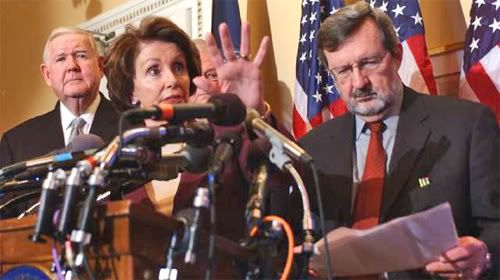
(Dennis Cook / Associated Press)
The Los Angeles Times reports:
To a crescendo of clicking cameras, House Speaker Nancy Pelosi stepped before a row of shimmering U.S. flags last March to make an announcement Americans had been waiting four months to hear.
November's elections had swept Democrats into power on a wave of frustration with the Iraq war. Now, flanked by three committee chairmen in her ceremonial Capitol office, the San Francisco congresswoman prepared to unveil the party's plan to bring the troops home.
"The American people called for a new direction," the speaker said, trying to give voice to the historic moment. "That's what this bill does."
There was just one problem. Pelosi had no answer for a simple question: Would the plan get any GOP support?
"I'm the last person to ask about Republican votes," she said curtly.
The speaker's dismissive comment drew little attention that morning. But it was telling. Today, the legislative drive against the war -- the most intense on Capitol Hill since the Vietnam era -- is all but over. As Wisconsin Sen. Russ Feingold, a leading antiwar Democrat, bluntly put it: "We have made no progress."
What happened?
The answer lies partly in the slim Democratic majority and a determined Republican president.
But it was the new Democratic majority's inability to work across the aisle that ultimately ensured failure.
Like the Republicans they had replaced, senior Democrats chose confrontation over cooperation.
They squandered opportunities to work with Republicans unhappy with the president.
And, under pressure from their antiwar base, they tried to bully their rivals.
"Even now, I fail to understand how we think we can stop the war unless we bring in Republicans," said Hawaii Rep. Neil Abercrombie, one of the liberal Democrats who challenged his party's strategy.
Unintended outcome
Democrats -- and even many Republicans -- had expected a far different result.
When GOP senators sat down for a tense luncheon in the Capitol's wood-paneled Mansfield Room last January, their party was in turmoil.
President Bush's decision to send additional troops to Iraq, combined with the party's election losses, infuriated many lawmakers. As Vice President Dick Cheney sat silently, a heated debate erupted.
Virginia Sen. John W. Warner, a white-haired veteran of two wars, rose to express deep concern that the U.S. military was caught in a civil war in Iraq. On the other side, Arizona's John McCain and South Carolina's Lindsey Graham passionately warned that retreat would spell disaster.
"It was a very difficult time," recalled Graham, who struggled that afternoon to prevent a full-scale revolt. "Republicans wanted to drop Iraq like a hot potato."
Senate Democrats were trying to capitalize on the dissent with a resolution that would simply express opposition to the troop buildup.
Senate Majority Leader Harry Reid, a conservative Democrat from Nevada who had worked often with Republicans, turned to Warner.
His decision to effectively cede control of the war debate to a lawmaker from the president's party was the calculation of a veteran tactician. Democrats had taken control of the Senate by the narrowest of margins, 51-49. (The chamber's two independents typically side with the Democrats.) If they wanted to force the president to do anything, they would need as many as a dozen Republicans to overcome a filibuster.
But Reid, a former boxer, was also a fierce partisan who had excelled as a leader by keeping Democrats together. That impulse would be decisive.
As Warner walked the hallways of the Senate trying to find GOP votes and proposed weakening the resolution, the staunchest antiwar members of Reid's caucus grew increasingly restive.
Within days, Feingold said he would oppose the resolution. So too did Connecticut's Christopher J. Dodd, another liberal Democrat. Reid, who was skeptical that Warner could deliver enough Republicans, cut off debate. GOP senators killed the measure on a procedural vote.
After just four weeks, the drive to build consensus was effectively over.
"It changed the political complexion of the debate and the environment," said Maine Sen. Olympia J. Snowe, a moderate Republican who had worked on the resolution.
The quick demise of the anti-surge resolution prompted Democrats to focus inward. The party, which had done little to develop a consensus antiwar strategy, was in turmoil.
Grass-roots groups that had helped elect Democrats were clamoring for legislation to restrict war funding and compel a swift withdrawal. So, too, was the nearly 80-strong House Out of Iraq caucus, one of whose leaders, Rep. Maxine Waters (D-Los Angeles), would get in a shouting match with Pelosi at a packed Democratic caucus meeting.
Other Democrats were reluctant to try to end the war by limiting money. "We didn't want to send a message that we weren't going to fund the troops," said Michigan Sen. Carl Levin, the Senate Armed Services Committee chairman.
Pelosi turned to House Appropriations Chairman David R. Obey to write a bill that would bring Democrats together.
Obey, an old-school liberal from rural northern Wisconsin, was a fierce critic of the war. But the 38-year veteran was also someone who could cut deals with Republicans. Obey scorned doctrinaire antiwar Democrats who "didn't want to get any specks on those white robes of theirs." In one confrontation with a soldier's mother who asked Obey to stop paying for the war, the lawmaker exploded in a rant against "idiot liberals."
Republican leaders -- still struggling to keep their caucus from splintering -- worried that Obey would reach out to GOP moderates. "If they had put their hands out . . . there were probably 50 or 60 of my members who could have been there," House Minority Leader John A. Boehner of Ohio said recently. "It could have been a very different outcome."
That was not the task Pelosi handed Obey.
The new speaker, who like Reid had united her party against hard-nosed GOP majorities, had never chaired a committee or drafted major legislation that required bipartisan compromise. She had a frosty relationship with Republican lawmakers. Now, she made it clear to Obey that she wanted a withdrawal timeline.
Drafts upon drafts
Obey and his staff hunkered down in his office for weeks, poring over scores of Democratic proposals. With Obey dictating language over his senior aide's shoulder, they produced draft after draft. Most of them went into a shredder.
Then, over the first weekend in March, they reached for a little-noticed bill filed just days earlier by Rep. Howard Berman (D-Valley Village) that linked pullout dates to the performance of the Iraqi government.
The war-funding bill that Pelosi announced at the March news conference would require the administration to begin withdrawing troops no later than March 2008, and to complete the pullout by August.
Democrats would triumphantly pass the most sweeping antiwar legislation since the Vietnam War. But it had attracted just two Republican votes in the Senate and two in the House, not nearly enough to override a presidential veto.
The Democratic response was to threaten to bury their Republican foes at the polls.
New York Sen. Charles E. Schumer, the combative head of the Democratic Senatorial Campaign Committee, gleefully touted plummeting GOP poll numbers. "They're going to have to break because they're going to have to look . . . extinction in the eye."
Democratic leaders now openly ridiculed compromise proposals from Republicans.
When Indiana Sen. Richard G. Lugar, a soft-spoken Republican and former Foreign Relations chairman, in late June made an earnest call for withdrawing troops, he got a visit from Bush's national security advisor within 48 hours. Democratic leaders ignored him and shut down debate on his proposal to require the Bush administration to submit a withdrawal plan.
Senior Democrats insisted the measure was too weak and would give Republicans political cover.
On the other side of the Capitol, Democrats were attacking their own. Hawaii's Abercrombie, a former Vietnam War protester, was shouted down at a meeting with fellow antiwar Democrats to discuss a similar bill he drafted.
"This was taken as a sign that suddenly I wasn't on the road to Damascus anymore. I had fallen from the true path," Abercrombie said. Pelosi, under pressure from the Out of Iraq caucus, prevented his bill from ever coming up for a vote.
A whiff of revenge
Many Democrats wrongly believed Republicans would break over the August recess when a well-funded antiwar campaign would target many in their districts. This heavy-handed approach had been a hallmark of the way Republicans had run Capitol Hill. Now, GOP lawmakers recoiled at the withdrawal timeline and the smash-mouth tactics.
No Democratic withdrawal measure ever won more than four GOP votes in the House or Senate.
By September, when Army Gen. David H. Petraeus gave Congress an upbeat report about diminishing violence, the Democratic legislative campaign against the war was effectively dead.
Today, Pelosi professes surprise that so few GOP lawmakers joined the Democratic antiwar effort. "I didn't foresee that," she said.
But neither she nor Reid express any regrets.
"We tried everything except yoga," Reid said recently, sitting by a fire in his office on the other side of the Capitol. "Republicans weren't looking for middle ground. . . . We felt we were on track with what the American people wanted."
But, the Congress that began 2007 with a relatively high 35% approval rating now rates just 22%, according to Gallup surveys.
"One of the many messages sent by voters in 2006 was that they were unhappy with the war in Iraq," said Maine Sen. Susan Collins, a moderate Republican. "Another message that was sent and not heard was that they were tired of partisan gridlock."
noam.levey@latimes.com
Thursday, January 24, 2008
| [+/-] |
Tentative Deal Reached on Stimulus Plan |
The New York Times reports:
House leaders and the White House on Thursday announced a tentative agreement on an economic stimulus package of roughly $150 billion that would pay stipends of $300 to $1,200 per family, and more for families with children, plus provide tax incentives for businesses to encourage spending.
The accord was announced by Speaker Nancy Pelosi of California, the Republican leader, Representative John A. Boehner of Ohio, and Treasury Secretary Henry M. Paulson Jr. at a Capitol news conference and hailed minutes afterward by President Bush as the fruit of “patience, determination and good will” in both parties.
The president and the speaker both described the accord as embracing the basic precepts of their respective parties. Mr. Bush called it “a powerful and effective way to help taxpayers and businesses” by letting people keep and spend more of their own money.
Ms. Pelosi said the package is aimed at the middle class “and to those who aspire to be in the middle class.” She described it as “timely, targeted and temporary — that was our standard.”
In addition to the tax rebates, or stipends, Ms. Pelosi said the package would offer some quick relief for those homeowners in danger of losing their houses.
Mr. Boehner called the package “simple, clean and neat.” Like Ms. Pelosi, he said none of the parties to the talks got everything they wanted. But in the end, he said, “This agreement is a big win for the American people.”
President Bush said the agreement was also a victory for the kind of bipartisanship that some politicians and analysts say is in short supply in Washington of late. And as he has many times, the president said the American economy is “structurally sound” despite rising energy prices and problems in the housing industry.
Democrats released a summary estimating that the rebates would go to 117 million families. About two-thirds of the total package would go toward the rebates, with the remaining one-third going toward business tax breaks, like write-offs for equipment purchases.
Both leaders pledged quick action in the House, and both pointedly urged similar alacrity by the Senate, whose members operate “with their very senatorial rules,” as Ms. Pelosi put it.
“Speed is of the essence,” Mr. Paulson said.
President Bush underscored that message, as he offered warm praise for the negotiators in both parties. He also took the opportunity to urge once again the extension of tax cuts that were approved by the Republican-controlled Congress early in the decade and are to expire within a few years.
Senator Harry Reid of Nevada, the Democratic majority leader, said minutes after the announcement that he was pleased an agreement had been reached, and that he wanted a package ready for Mr. Bush by the time Congress recesses around President’s Day. But he said senators would “work to improve the House package” through the addition of unemployment benefits and other items.
Late in the negotiations that preceded Thursday’s breakthrough, Ms. Pelosi agreed not to include two proposals that had broad support among Congressional Democrats: an extension of unemployment benefits and a temporary increase in food stamps.
In exchange for those concessions, the Bush administration and House Republicans agreed that the stipend of at least $300 would be paid to all workers who earned at least $3,000 last year, even those who did not earn enough to pay taxes.
As it was presented on Thursday afternoon, the package calls for workers who paid income taxes to receive $300 to $600, and couples to receive up to $1,200 — plus $300 more for each child. The stipend, which some lawmakers were calling a “tax rebate,” would be subject to income limits so that the wealthiest taxpayers would not receive it. Payments would go to individuals earning up to $75,000 and couples earning up to $150,000. He said roughly two-thirds of the overall package would be aimed at individual taxpayers and one-third at businesses.
Senators Reid and Mitch McConnell of Kentucky, the Republican minority leader, have yet to give their approval to the accord. But, while there may be some wrinkles to iron out between the House and Senate, there was nothing to suggest any disagreement so severe as to be a potential deal breaker.
Republicans immediately cheered the deal as “tilted toward taxpayers” and avoiding “extraneous spending” on unemployment benefits, food stamps, or infrastructure projects, which some Democrats had said should be included in a stimulus package.
But it was unclear how the package, without extended unemployment benefits or increased food stamps, would be received by Democrats in the Senate, including Senator Edward M. Kennedy of Massachusetts and Senator Charles E. Schumer of New York, who have said that those proposals offered the best prospects for quickly injecting added spending into the economy.
Senator Max Baucus, the Montana Democrat who is chairman of the Finance Committee, reiterated his interest in extending unemployment benefits at a hearing on Thursday morning, where he said his committee would mark up a fiscal stimulus bill next week.
“There are reports that a deal may be close on the House side,” Mr. Baucus said. “The Senate will want to speak, as well.”
That announcement of potential action by the Finance Committee could jar Democratic leaders who have been striving for a carefully coordinated effort on the economy. Earlier this week, Mr. Reid announced that the House would take the lead in developing the stimulus package and would conduct the immediate negotiations with the White House and Congressional Republicans.
Noting that tax rebates were one potentially cost-effective method to spur new spending, Mr. Baucus said: “Another example would be expanding unemployment insurance benefits. In recent recessions, Congress has extended the number of weeks that unemployed workers could receive benefits. We could do that again. We could provide a further extension for recipients in high unemployment states. And we could also temporarily increase the dollar amount of benefits to help unemployed workers to pay their bills.”
“Unfortunately, under current law, fewer than 4 in 10 unemployed workers receive unemployment insurance benefits,” Mr. Baucus continued. “To address this problem, we could extend eligibility. For example, we could extend benefits to part-time workers.”
Mr. Schumer, at the same hearing, also lamented Ms. Pelosi’s concession on unemployment benefits, but said he hoped that cooperation on a quick stimulus plan would continue. “While I may not agree with every element of the package — such as the decision to leave out extended unemployment benefits, which economists say would give us the greatest bang for the buck — there are some very positive developments around the tax rebate for families,” he said. “I encourage everyone to keep working in a bipartisan way.”
Ms. Pelosi met three times on Wednesday with Treasury Secretary Paulson and Mr. Boehner, who have served as chief architects of the plan in a rare show of bipartisanship.
On her way into a meeting Wednesday evening, Ms. Pelosi signaled that a deal might be close when she said there had been “tremendous” progress during the day.
Democratic leaders said that to speed the economic rescue package they would mostly bypass the usual committee process. Lawmakers said that they hoped the plan could be approved by mid-February and that it would be sufficient to soften an economic downturn and forestall a recession.
“One of the principal tenets of the administration and of ourselves is we have got to do this fast,” Representative Steny H. Hoyer of Maryland, the majority leader, said Wednesday. “To go through the regular process and have hearings and have mark-ups and subcommittee mark-ups, obviously we would be to some degree twiddling our thumbs while the economy burns.”
The progress toward a stimulus plan came as the Congressional Budget Office revised its economic projections to give a gloomier assessment of the economy, including a widening budget deficit and the first decline in corporate tax revenue since 2003.
The grimmer outlook prompted Senator Kent Conrad of North Dakota, chairman of the Budget Committee, to declare that a short-term stimulus package was insufficient.
“In addition to developing a bipartisan stimulus package,” Mr. Conrad said, “we also must work together to tackle the long-term fiscal challenges we face with the coming retirement of the baby boom generation. The American people rightly expect that we will come together to address these two significant challenges.”
House conservatives raised alarms about the emerging economic legislation, saying they feared it would focus too much on tax rebates and not enough on tax incentives to encourage businesses to create jobs.
They said any package should include provisions that would reduce the corporate tax rate, adjust capital gains for inflation and lower the capital gains rate for corporations.
“Giving temporary tax rebate checks to families, as important as that is, is not the same as economic growth,” said Representative Jeb Hensarling of Texas, chairman of the Republican Study Committee. “If you’re going to have an economic stimulus package, it ought to contain some economic stimulus.”
Thursday, December 13, 2007
| [+/-] |
Democrats Bow To Bush's Demand in House Spending Bill |
Billions Trimmed From New Requests
The Washington Post reports:
House Democratic leaders yesterday agreed to meet President Bush's bottom-line spending limit on a sprawling, half-trillion-dollar domestic spending bill, dropping their demands for as much as $22 billion in additional spending but vowing to shift funds from the president's priorities to theirs.
The final legislation, still under negotiation, will be shorn of funding for the war in Iraq when it reaches the House floor, possibly on Friday. But Democratic leadership aides concede that the Senate will probably add those funds. A proposal to strip the bill of spending provisions for lawmakers' home districts was shelved after a bipartisan revolt, but Democrats say the number and size of those earmarks will be scaled back.
When defense spending is added to the total, discretionary spending for fiscal 2008 would reach a tentative total of $936.5 billion, $3.7 billion more than the president's request, said House Appropriations Committee staff members. All of the additional money would be spent on veterans affairs.
The agreement signaled that congressional Democrats are ready to give in to many of the White House's demands as they try to finish the session before they break for Christmas -- a political victory for the president, who has refused to compromise on the spending measures.
The House last night also approved a new version of legislation that would stave off the spread of the alternative minimum tax, a parallel tax system originally targeted at the very rich, to millions of middle-class families. The House version would not add to the federal budget deficit.
The progress yesterday on Capitol Hill did not mean that lawmakers will be rushing to the exits in the next few days. The AMT bill, which was approved 226 to 193, pays for the $50 billion tax fix largely by preventing hedge fund managers from deferring compensation by shifting their pay to offshore tax shelters. The White House issued a fresh veto threat, reiterating Bush's opposition to any tax increases to pay for an AMT fix.
The threat virtually ensured that the Senate will not muster the 60 votes needed to break a threatened Republican filibuster. It moved Congress further toward shattering a Democratic pledge not to pass tax cuts that are not fully offset by tax increases or spending reductions.
Senate Democratic leaders, backed by key Republicans, finalized a new version of a comprehensive energy bill. It would raise automotive fuel-efficiency standards and preserve a package of conservation and renewable-energy tax incentives, to be funded largely by revoking tax breaks given to the largest oil companies in recent years.
The Senate is to vote today on the revised energy bill, and senators from both parties said proponents are close to reaching the 60-vote threshold. Majority Leader Harry M. Reid (D-Nev.) summoned from the campaign trail the five senators seeking the presidential nomination for this morning's vote.
The new version of the bill meets a key White House demand by stripping out a requirement that utilities move toward generating 15 percent of their electricity from renewable energy sources. It also pares back tax increases on oil companies by exempting independent energy companies from a provision that would end a manufacturer's tax credit awarded in 2005.
But the White House is also threatening to veto that legislation. "It seems that Senator Reid wants to keep the tax title in there, which the president has been very clear that he won't sign," White House spokesman Dana Perino said.
Bush may also veto the spending package, even though Democrats shaved $22 billion from federal domestic programs to meet his demands, said Rep. Jerry Lewis (Calif.), the ranking Republican on the House Appropriations Committee. He added, "And I think we'll have enough Republicans to sustain a veto."
White House spokesman Tony Fratto emphasized last night, "The White House is not part of any deal, full stop."
The veto threats in the face of Democratic compromises left party lawmakers in disbelief. Because of Bush's intransigence, Sen. Patty Murray (D-Wash.) said that "we're going to have some horrific decisions to make over the next week."
Democratic leaders tried to put the best face on their surrender on domestic spending levels, promising that the final bill will reflect their priorities, if not their preferred funding -- "the president's number, our priorities," said House Speaker Nancy Pelosi (D-Calif.). She noted that the bill would increase funding for children's health programs, nutrition and medical research at the National Institutes of Health.
Democrats will also increase spending on heating assistance for the poor, health care for veterans, local law enforcement and border security, Democratic leadership aides said last night.
To meet those goals, staff members on the House Appropriations Committee will probably target the president's "Millennium Challenge" international aid program, his abstinence-education efforts and the scandal-plagued "Reading First" education effort.
Senate Republicans will seek to add as much as $70 billion in war funding to the bill, without strings on the withdrawal of U.S. troops from Iraq attached. Pelosi indicated she would vote against the final bill if such funds are included but made clear that Democrats are ready to make the concessions needed to avoid a veto.
"This is a negotiation about a bill that will be signed by the president," she said.
The retooled version of the energy bill still includes higher standards for motor vehicle and appliance efficiency, as well as a requirement for vastly expanded use of ethanol and other biofuels. The tax package would offset expanded energy conservation incentives by trimming tax breaks and depreciation allowances for the biggest oil firms.
The House AMT bill would prevent 21 million middle-income American households from being hit with a tax increase that could average $2,000 per family from a levy designed in 1969 to target only the super-rich. The proposal would also increase the number of low-income families that could benefit from a refundable tax credit for children.
The plan's outlook in the Senate is not good. The ranking Republican on the House Ways and Means Committee, Rep. Jim McCrery (La.), called it "dead on arrival."
"What we are watching is a Kabuki dance," he said. "The Senate made it clear, with a bipartisan 88 to 5 vote last Thursday, that it will pass an AMT patch without unnecessary tax increases." Bush also opposes the House measure.
Sunday, December 9, 2007
| [+/-] |
Hill Briefed on Waterboarding in 2002 |
In Meetings, Spy Panels' Chiefs Did Not Protest, Officials Say
The Washington Post reports:
In September 2002, four members of Congress met in secret for a first look at a unique CIA program designed to wring vital information from reticent terrorism suspects in U.S. custody. For more than an hour, the bipartisan group, which included current House Speaker Nancy Pelosi (D-Calif.), was given a virtual tour of the CIA's overseas detention sites and the harsh techniques interrogators had devised to try to make their prisoners talk.
Among the techniques described, said two officials present, was waterboarding, a practice that years later would be condemned as torture by Democrats and some Republicans on Capitol Hill. But on that day, no objections were raised. Instead, at least two lawmakers in the room asked the CIA to push harder, two U.S. officials said.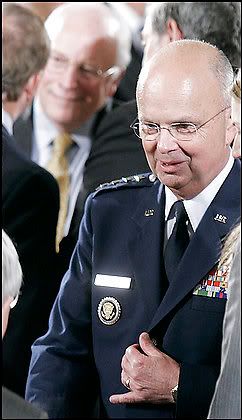
"The briefer was specifically asked if the methods were tough enough," said a U.S. official who witnessed the exchange.
Congressional leaders from both parties would later seize on waterboarding as a symbol of the worst excesses of the Bush administration's counterterrorism effort. The CIA last week admitted that videotape of an interrogation of one of the waterboarded detainees was destroyed in 2005 against the advice of Justice Department and White House officials, provoking allegations that its actions were illegal and the destruction was a coverup.
Yet long before "waterboarding" entered the public discourse, the CIA gave key legislative overseers about 30 private briefings, some of which included descriptions of that technique and other harsh interrogation methods, according to interviews with multiple U.S. officials with firsthand knowledge.
With one known exception, no formal objections were raised by the lawmakers briefed about the harsh methods during the two years in which waterboarding was employed, from 2002 to 2003, said Democrats and Republicans with direct knowledge of the matter. The lawmakers who held oversight roles during the period included Pelosi and Rep. Jane Harman (D-Calif.) and Sens. Bob Graham (D-Fla.) and John D. Rockefeller IV (D-W.Va.), as well as Rep. Porter J. Goss (R-Fla.) and Sen. Pat Roberts (R-Kan).
Individual lawmakers' recollections of the early briefings varied dramatically, but officials present during the meetings described the reaction as mostly quiet acquiescence, if not outright support. "Among those being briefed, there was a pretty full understanding of what the CIA was doing," said Goss, who chaired the House intelligence committee from 1997 to 2004 and then served as CIA director from 2004 to 2006. "And the reaction in the room was not just approval, but encouragement."
Congressional officials say the groups' ability to challenge the practices was hampered by strict rules of secrecy that prohibited them from being able to take notes or consult legal experts or members of their own staffs. And while various officials have described the briefings as detailed and graphic, it is unclear precisely what members were told about waterboarding and how it is conducted. Several officials familiar with the briefings also recalled that the meetings were marked by an atmosphere of deep concern about the possibility of an imminent terrorist attack.
"In fairness, the environment was different then because we were closer to Sept. 11 and people were still in a panic," said one U.S. official present during the early briefings. "But there was no objecting, no hand-wringing. The attitude was, 'We don't care what you do to those guys as long as you get the information you need to protect the American people.'"
Only after information about the practice began to leak in news accounts in 2005 -- by which time the CIA had already abandoned waterboarding -- did doubts about its legality among individual lawmakers evolve into more widespread dissent. The opposition reached a boiling point this past October, when Democratic lawmakers condemned the practice during Michael B. Mukasey's confirmation hearings for attorney general.
GOP lawmakers and Bush administration officials have previously said members of Congress were well informed and were supportive of the CIA's use of harsh interrogation techniques. But the details of who in Congress knew what, and when, about waterboarding -- a form of simulated drowning that is the most extreme and widely condemned interrogation technique -- have not previously been disclosed.
U.S. law requires the CIA to inform Congress of covert activities and allows the briefings to be limited in certain highly sensitive cases to a "Gang of Eight," including the four top congressional leaders of both parties as well as the four senior intelligence committee members. In this case, most briefings about detainee programs were limited to the "Gang of Four," the top Republican and Democrat on the two committees. A few staff members were permitted to attend some of the briefings.
That decision reflected the White House's decision that the "enhanced interrogation" program would be treated as one of the nation's top secrets for fear of warning al-Qaeda members about what they might expect, said U.S. officials familiar with the decision. Critics have since said the administration's motivation was at least partly to hide from view an embarrassing practice that the CIA considered vital but outsiders would almost certainly condemn as abhorrent.
Information about the use of waterboarding nonetheless began to seep out after a furious internal debate among military lawyers and policymakers over its legality and morality. Once it became public, other members of Congress -- beyond the four that interacted regularly with the CIA on its most sensitive activities -- insisted on being briefed on it, and the circle of those in the know widened.
In September 2006, the CIA for the first time briefed all members of the House and Senate intelligence committees, producing some heated exchanges with CIA officials, including Director Michael V. Hayden. The CIA director said during a television interview two months ago that he had informed congressional overseers of "all aspects of the detention and interrogation program." He said the "rich dialogue" with Congress led him to propose a new interrogation program that President Bush formally announced over the summer
"I can't describe that program to you," Hayden said. "But I would suggest to you that it would be wrong to assume that the program of the past is necessarily the program moving forward into the future."
Waterboarding as an interrogation technique has its roots in some of history's worst totalitarian nations, from Nazi Germany and the Spanish Inquisition to North Korea and Iraq. In the United States, the technique was first used five decades ago as a training tool to give U.S. troops a realistic sense of what they could expect if captured by the Soviet Union or the armies of Southeast Asia. The U.S. military has officially regarded the tactic as torture since the Spanish-American War.
In general, the technique involves strapping a prisoner to a board or other flat surface, and then raising his feet above the level of his head. A cloth is then placed over the subject's mouth and nose, and water is poured over his face to make the prisoner believe he is drowning.
U.S. officials knowledgeable about the CIA's use of the technique say it was used on three individuals -- Khalid Sheikh Mohammed, the alleged mastermind of the Sept. 11, 2001, terrorist attacks; Zayn Abidin Muhammed Hussein Abu Zubaida, a senior al-Qaeda member and Osama bin Laden associate captured in Pakistan in March 2002; and a third detainee who has not been publicly identified.
Abu Zubaida, the first of the "high-value" detainees in CIA custody, was subjected to harsh interrogation methods beginning in spring 2002 after he refused to cooperate with questioners, the officials said. CIA briefers gave the four intelligence committee members limited information about Abu Zubaida's detention in spring 2002, but offered a more detailed account of its interrogation practices in September of that year, said officials with direct knowledge of the briefings.
The CIA provided another briefing the following month, and then about 28 additional briefings over five years, said three U.S. officials with firsthand knowledge of the meetings. During these sessions, the agency provided information about the techniques it was using as well as the information it collected.
Lawmakers have varied recollections about the topics covered in the briefings.
Graham said he has no memory of ever being told about waterboarding or other harsh tactics. Graham left the Senate intelligence committee in January 2003, and was replaced by Rockefeller. "Personally, I was unaware of it, so I couldn't object," Graham said in an interview. He said he now believes the techniques constituted torture and were illegal.
Pelosi declined to comment directly on her reaction to the classified briefings. But a congressional source familiar with Pelosi's position on the matter said the California lawmaker did recall discussions about enhanced interrogation. The source said Pelosi recalls that techniques described by the CIA were still in the planning stage -- they had been designed and cleared with agency lawyers but not yet put in practice -- and acknowledged that Pelosi did not raise objections at the time.
Harman, who replaced Pelosi as the committee's top Democrat in January 2003, disclosed Friday that she filed a classified letter to the CIA in February of that year as an official protest about the interrogation program. Harman said she had been prevented from publicly discussing the letter or the CIA's program because of strict rules of secrecy.
"When you serve on intelligence committee you sign a second oath -- one of secrecy," she said. "I was briefed, but the information was closely held to just the Gang of Four. I was not free to disclose anything."
Roberts declined to comment on his participation in the briefings. Rockefeller also declined to talk about the briefings, but the West Virginia Democrat's public statements show him leading the push in 2005 for expanded congressional oversight and an investigation of CIA interrogation practices. "I proposed without success, both in committee and on the Senate floor, that the committee undertake an investigation of the CIA's detention and interrogation activities," Rockefeller said in a statement Friday.
Sen. John McCain (R-Ariz.), a former Vietnam War prisoner who is seeking the GOP presidential nomination, took an early interest in the program even though he was not a member of the intelligence committee, and spoke out against waterboarding in private conversations with White House officials in late 2005 before denouncing it publicly.
In May 2007, four months after Democrats regained control of Congress and well after the CIA had forsworn further waterboarding, four senators submitted written objections to the CIA's use of that tactic and other, still unspecified "enhanced" techniques in two classified letters to Hayden last spring, shortly after receiving a classified hearing on the topic. One letter was sent on May 1 by Sen. Russell Feingold (D-Wis.). A similar letter was sent May 10 by a bipartisan group of three senators: Dianne Feinstein (D-Calif.), Chuck Hagel (R-Neb.) and Ron Wyden (D-Ore.).
In a rare public statement last month that broached the subject of his classified objections, Feingold complained about administration claims of congressional support, saying that it was "not the case" that lawmakers briefed on the CIA's program "have approved it or consented to it."
Wednesday, November 7, 2007
| [+/-] |
Impeachment Fuse is Briefly Lighted |
A resolution against Cheney gets parked in committee. Republicans sought an immediate vote in order to spark a House floor fight.
The LA Times reports:
House Democrats on Tuesday beat back a Republican attempt to force them to vote on a divisive resolution to impeach Vice President Dick Cheney for "fabricating a threat of Iraqi weapons of mass destruction" to justify the war in Iraq.
The 218-194 party-line vote waylaying the measure by sending it to the judiciary committee capped a remarkable afternoon in which Republicans tried to outfox Democrats, switching their votes in a strategy that could have triggered an immediate vote.
"We're going to help them out," explained Rep. Pete Sessions (R-Texas). "We're going to give them their day in court."
House Speaker Nancy Pelosi (D-San Francisco) and her lieutenants maneuvered to avoid a bruising floor fight. Such a clash would have forced Democrats to choose between their liberal base, which might cheer a Cheney impeachment, and a broader electorate, which might view the resolution as a partisan game in a time of war.
With the vote technically slated to last 15 minutes, she held voting open for more than an hour and finally forced the measure to an uncertain future in the committee.
That referral effectively shelved the issue for now, but not before the resolution's sponsor, Rep. Dennis J. Kucinich, a far-left Ohio Democrat running for president, had a chance to read into the record three articles of impeachment against the vice president.
"Impeachment is not on our agenda," said House Majority Leader Steny Hoyer (D-Md.). "We have some major priorities. We need to focus on those."
House Judiciary Committee Chairman John Conyers Jr. (D-Mich.) agreed that it was not in Pelosi's interest to advance the articles of impeachment. "If she were to let this thing out of the box, considering the number of legislative issues we have pending . . . it could create a split that could affect our productivity for the rest of the Congress," Conyers told Fox News.
The resolution said that Cheney, "in violation of his constitutional oath to faithfully execute the office of vice president," had "purposely manipulated the intelligence process to deceive the citizens and Congress of the United States by fabricating a threat of Iraqi weapons of mass destruction to justify the use of the U.S. Armed Forces against the nation of Iraq in a manner damaging to our national security interests."
The 11-page resolution also charged that Cheney purposely deceived the nation about an alleged relationship between Iraq and Al Qaeda and has also "openly threatened aggression against the Republic of Iran absent any real threat to the United States."
If the judiciary committee were to vote out any of the impeachment articles, the issue would then go to the House floor. If the House were to vote to impeach Cheney, the Senate could try him and, with a two-thirds vote, remove him from office. "This vote sends a message that the administration's conduct in office is no longer unchallenged," Kucinich said afterward. Predicting that the judiciary committee will be forced by public opinion to hold hearings, he added, "Hopefully, it will have a restraining effect on this administration to stop this madness."
Four Democrats joined Kucinich to vote against sending the impeachment resolution to committee.
They included Reps. Bob Filner of Chula Vista and Maxine Waters of Los Angeles.
At day's end, Republicans and Democrats were accusing each other of petty political ploys at the expense of important business.
At the White House, Press Secretary Dana Perino noted that Congress "has not sent a single appropriations bill to the president's desk this year . . . yet they find time to spend an entire work period on futile votes to impeach the vice president. It is this behavior that leaves the American people shaking their head in wonder at this Congress."
Cheney spokeswoman Megan M. Mitchell added, "It is one thing for Congressman Kucinich to use this political ploy in his presidential campaign. It is another thing to do so on the floor of the U.S. House of Representatives."
Hoyer issued a statement chiding Republicans for turning the potential impeachment of a vice president into "a petty political game."
Insisting that House leaders have their eye on the ball, he added, "Speaker Pelosi and I have made it clear that this Congress is not going to proceed with impeachment, and is going to focus on critical issues facing our nation, such as healthcare for children and the war in Iraq."
Sunday, October 14, 2007
| [+/-] |
House Falling Short on SCHIP Override |
The Washington Post reports:
House Speaker Nancy Pelosi (D-Calif.) reversed her stance from a week earlier, appearing resigned Sunday that Democrats would not convince enough Republicans to pass an expansion of a children's health insurance program over President Bush's veto.
"Isn't that sad for America's children?" she asked on ABC's "This Week." Her second appearance on a Sunday talk show in as many weeks came days before the House is expected to vote again on the State Children's Health Insurance Program.
Last week, Pelosi was far more optimistic about the chances of overriding Bush's veto, saying on "Fox News Sunday" that the Democrats needed "about 14 Republican votes" to reach the required two-thirds majority.
This week, it was Pelosi's Republican counterpart, House Minority Leader John Boehner (Ohio), who was facing questions on Fox, and he said he was confident that "we will have the votes to sustain the president's veto."
The White House has signaled it wants to find a compromise with Democrats over the program, but any agreement seemed distant today.
Pelosi said she has never heard from Bush about the program and she reiterated a point she made last week, that she is unwilling to support legislation that would cover fewer children than the current bill's 10 million.
The Senate already has a sufficient majority to override the veto, and Senate Minority Leader Mitch McConnell (R-Ky.) predicted on ABC that the White House and congressional Democrats would strike a deal.
"Neither side is going to leave these kids uninsured. It's become kind of a political football, which is really unfortunate. But the coverage is going to be provided in some way," McConnell said.
Wednesday, October 10, 2007
| [+/-] |
Smile, Though Your Head Is Aching |
The Washington Post reports:
House Speaker Nancy Pelosi was in a determinedly good mood when she sat down to lunch with reporters yesterday. She entered the room beaming and, over the course of an hour, smiled no fewer than 31 times and got off at least 23 laughs.
But her spirits soured instantly when somebody asked about the anger of the Democratic "base" over her failure to end the war in Iraq.
"Look," she said, the chicken breast on her plate untouched. "I had, for five months, people sitting outside my home, going into my garden in San Francisco, angering neighbors, hanging their clothes from trees, building all kinds of things -- Buddhas? I don't know what they were -- couches, sofas, chairs, permanent living facilities on my front sidewalk."
Unsmilingly, she continued: "If they were poor and they were sleeping on my sidewalk, they would be arrested for loitering, but because they have 'Impeach Bush' across their chest, it's the First Amendment."
Though opposed to the war herself, Pelosi has for months been a target of an antiwar movement that believes she hasn't done enough. Cindy Sheehan has announced a symbolic challenge to Pelosi in California's 8th Congressional District. And the speaker is seething.
"We have to make responsible decisions in the Congress that are not driven by the dissatisfaction of anybody who wants the war to end tomorrow," Pelosi told the gathering at the Sofitel, arranged by the Christian Science Monitor. Though crediting activists for their "passion," Pelosi called it "a waste of time" for them to target Democrats. "They are advocates," she said. "We are leaders."
It was a rather fierce response to the party's liberal base, which frightens many a congressional Democrat. But it wasn't out of character for the new speaker. Pelosi's fixed and constant smile makes her appear as if she is cutting an ad for a whitening toothpaste. But when you listen to the words that come from her grinning maw, the smile seems more akin to that of a barracuda.
One reporter asked about Democratic lawmakers who proposed a tax increase for the war. "They were not making legislation; they were making a point," Pelosi judged.
Another asked about a Republican congressman's complaints that the word "God" was removed from certificates accompanying congressional flags. "I don't know what his point is," Pelosi volleyed.
Complaints that she didn't go far enough on climate-change legislation? "We did not say we were going to do any more than we did."
The Senate's stalemate on the war? "We in the House will not be confining our legislation initiatives to what is legislatively possible in the Senate."
Pelosi admitted no mistakes and claimed no regrets as she reflected on her first session in the speaker's chair. "I'm very proud of the work of this Congress," she declared. Evidently so: She repeated how "proud" she was nine times. Passing the recommendations of the 9/11 commission made her "very proud," while energy legislation made her "very, very proud," and new ethics rules made her "especially proud."
"What do you see as your greatest mistake?" asked one reporter.
Pelosi smiled. "Why don't you tell me?" she proposed. She smiled again, then laughed. " 'Cause I think we're doing just great." She laughed again.
Even those approval ratings for Congress, in the teens and 20s, didn't evoke regrets. "I don't like the numbers for Congress," she admitted, but "I'm very pleased with the Democratic numbers." She then took an unusual detour into polling minutiae. "Today the Rasmussen numbers were the third time that we were double-digit ahead in the generic," she reported, "and the third month in a row we were in the high 40s."
Holders of high office typically avoid discussions like that because it makes them look, well, political. But Pelosi did not hesitate to plunge into the political, explaining that "it was so important for us to bring the president's numbers down two years ago on Social Security" because it discouraged Republican candidates from running for Congress.
Pelosi may have realized that her words sounded too calculating, for at one point she begged the reporters' indulgence for her to "be allowed a partisan moment." She smiled at her joke, then chuckled.
The ready grin seemed at odds with other body language that suggested Pelosi was not having an enjoyable lunch. She ignored her salad and roll, then waved off the chicken and vegetables and left her dessert untouched. "The tea is fine," she told the waiter, taking her first sip more than halfway through the lunch.
But the smile had its uses. She smiled warmly while telling a reporter in the room that his story was completely wrong. She laughed heartily when somebody mentioned the awkward interview in which Whoopi Goldberg expressed a lust for Pelosi's husband. She grinned when mentioning the fight over children's health care. And she laughed while discussing how she has "striven" to work with Bush on Iraq. "Is that a word? 'Striven'? " she asked.
It seemed that only the antiwar advocates had the power to wipe the smile off Pelosi's face. Speaking about ethics legislation, she boasted that "we have drained the swamp" in Congress and pleased government watchdog groups. "At last," she added, "some advocates from the outside who are satisfied."
| [+/-] |
There Goes The Neighborhood |
Roll Call reports:
One might think it would be great to have Speaker Nancy Pelosi (D-Calif.) as a neighbor (imagine the block parties!). But the Speaker apparently is not making herself popular in her high-dollar 'hood, telling reporters on Tuesday that protesters have taken up residence outside her house and are driving the natives wild.
"I've had four or five months of people sitting outside my home, going into my garden in San Francisco and angering my neighbors," Pelosi said at a gathering sponsored by the Christian Science Monitor.
Pelosi added that the squatters have engaged in decidedly non-neighborly behavior like hanging their clothes from the trees; moving in sofas, chairs and other "permanent living facilities"; and, oddly, building a large Buddha on the sidewalk in front of her home. "You can just imagine my neighbors' reactions to all of this," she said. "And if they were poor, and they were sleeping on my sidewalk, they'd be arrested for loitering, but because they have 'impeach Bush' across their chest, it's the First Amendment."
Thursday, September 27, 2007
| [+/-] |
Corn Farms Prosper, But Subsidies Still Flow |
The Washington Post reports:
Corn farmer Jim Handsaker has found a slew of ways to ride the heartland boom in biofuels that is reshaping the economy of rural Iowa.
He sold some of his 2006 crop this year for more than $4 a bushel, the highest price in a decade. His stake in two nearby ethanol plants brought in several thousand dollars more in dividends. Meanwhile, soaring farmland prices have pushed the value of the 400 acres he owns to around $2 million.
Even so, come October he will get a subsidy check from the government, part of a $1.6 billion installment that the U.S. Department of Agriculture will send to corn farmers.
Those annual automatic payments to Handsaker and thousands of other prospering corn growers have long been controversial. But coming at a time when taxpayers are already subsidizing the ethanol industry to the tune of $3 billion a year, the double-barreled support system for those who grow corn and those who turn it into fuel has begun to draw fire in Congress.
"Federal farm subsidies are already narrowly focused on certain crops and are excessive," said Sen. Richard G. Lugar (R-Ind.), a farmer and former chairman of the Senate agriculture committee. "They become ridiculous given the exploding possibilities to grow crops for biofuels production."
So far, Congress has shown little inclination to adjust the subsidies to account for the new energy-driven rural economy.
A House-passed farm bill would give corn growers $10.5 billion over the next five years, even if prices stay high. These "direct payments," a kind of annual allowance, are set by formula and go out automatically, regardless of prices, profits, yields or weather.
At the same time, a Senate-approved energy bill would double the federal requirement for the use of ethanol from corn -- a move that should further buttress corn prices.
Handsaker, a Republican who keeps a framed picture of President and Mrs. Bush in his office, argues that such farm subsidies help keep agricultural land in the hands of family farmers and away from corporate monopolies.
Handsaker is not banking on the ethanol boom lasting. "We've all been down the road of price plateaus," he said.
But he acknowledges that justifying the payments is not easy in the midst of an energy renaissance in the heartland. Country roads are dotted with signs advertising "ethanol corn" -- genetically engineered seeds with the high starch content ideal for making 200-proof, high-octane ethanol.
Just weeks before the October harvest, Hardin County, Handsaker's home in central Iowa, was a sea of corn rolling southwest from Iowa Falls. Handsaker once grew a mix of corn and soybeans on the farmland he and his brothers own or rent. "Now we're 100 percent corn," he said.
On a once quiet highway west of Iowa Falls, a constant stream of tractor-trailers pound the road, hauling corn to the Hawkeye Renewables ethanol refinery and soybeans to Cargill Inc.'s biodiesel plant.
To celebrate a banner year, Hawkeye founder and chief executive Bruce Rastetter pulled out the stops for his annual midsummer bash. Several hundred politicians, businessmen and farmers mingled at his richly landscaped hilltop estate, and Sen. Charles E. Grassley (R-Iowa) made his entrance in a wagon pulled by Rastetter's team of Percheron draft horses.
"It's a great country," said Rastetter, a Hardin County native who started with a few acres of farmland and a small feed business 20 years ago. He recently pledged $1.75 million to Iowa State University. In addition to his Iowa Falls plant, he operates a second one in a nearby county and has two more under construction.
The boom has helped push shares in Iowa ethanol plants to double or triple the initial price. Bill Couser, a corn grower and cattleman who was a driving force behind a new ethanol plant in neighboring Story County, says a grateful local school bus driver who bought shares "waves and honks every time she drives by."
"That's the secret of this ethanol industry," Couser said. "It's keeping the dollars at home."
In July, Pine Lake Corn Processors, the second Hardin County plant after Hawkeye's, announced profits for the previous eight months of $3,800 a share, more than the $3,250 cost of the initial investment. "It's worked out better than my wildest dreams," said Pine Lake President Larry Meints, a corn grower who pushed for the new plant after becoming fed up with hauling grain to distant elevators.
The new market means corn-rich Hardin County has to import the crop even though it grows 35 million bushels a year. The county can't supply its two ethanol refineries and its thriving pork, beef and poultry industries.
"Things are good here," said Howard B. Wenger, president of Iowa Falls State Bank, who reviews the balance sheets of hundreds of farmers.
He estimates that most farmers earned between $100 and $400 an acre on their 2006 crop after expenses, depending on whether they owned or rented their land. That translates into profits of $100,000 to $400,000 on a 1,000-acre farm. The USDA predicts that net farm income will be $87.1 billion this year, up nearly 50 percent over 2006.
Iowa farmland values are up 18 percent in the past 12 months, according to Federal Reserve Board surveys, making millionaires on paper out of any farmers owning 200 acres free and clear.
The rural prosperity is due in large measure to billions of dollars in federal subsidies and incentives for corn-based energy. These include a 51-cent tax credit that gasoline manufacturers get on every gallon of ethanol they mix with their blends, and more than $500 million in federal cash to ethanol refiners between 2001 and 2006.
In 2005, Congress required the use of at least 7.5 billion gallons of ethanol a year by 2012. Then in 2006 came new demand for ethanol as a pollution-curbing additive, along with a jump in gasoline prices that made the corn-based fuel competitive.
"We're harvesting the sun out here," said Handsaker, a genial man who typifies the new breed of businessman-farmer. "We're creating something with sun and chemicals and water and making a renewable product instead of unloading an oil tanker."
When he started in 1971, he recalled, farmers sold their crops to the local livestock industry or sent them "down the river" to volatile export markets.
Prices soared when the Soviet harvest failed or Argentina's corn crop fell short. In between, government payments bridged the gap between solvency and bankruptcy. From 2001 through 2005, Handsaker and his two brothers collected more than $500,000, according to USDA records.
Now four ethanol plants have sprouted within easy trucking distance of their farms and will get about half the 450,000 bushels they produce.
Still, the three brothers stand to collect about $45,000 in direct payments this year, based solely on their previous crop acreage and yields, according to USDA records. Congress created the payments in 1996 as part of a plan to temporarily buttress farm incomes while other traditional subsidies were eliminated. They were supposed to be phased out. Instead, the 2002 farm bill continued them.
"It's a bonus program, not a safety net," said Sen. Richard J. Durbin (D-Ill.). "Farmers I talk to know it's not politically sustainable to ask taxpayers to make payments to them in highly profitable years."
Durbin plans to offer a farm bill amendment that would gradually replace the automatic payments with a program to compensate growers when statewide farm revenues fall below the norm. The National Corn Growers Association embraces a similar plan. This week, the Senate agriculture committee's chairman, Tom Harkin (D-Iowa), circulated a proposal to cut direct payments by $4.5 billion over five years.
The American Farm Bureau Federation, the country's largest farm organization, opposes any changes, but the National Farmers Union, the nation's second-largest, supports an overhaul of direct payments. "It's the most costly and inefficient method for providing a safety net," said the union's president, Tom Buis.
Lugar, the senator from Indiana, favors scrapping the current farm program and using crop insurance and tax-exempt savings accounts to tide farmers over in bad years.
"A farmer's best friend in Iowa is the energy bill," said Bruce Babcock, a professor of economics at Iowa State. "What do you need the direct payments for? It's money for nothing."
Rastetter, along with most others in the ethanol industry, argues that increasing requirements for ethanol use would do more for corn growers than farm programs would. If the government expands its support for ethanol, he said, "then the market price of corn will support farmers and provide the safety net."
But relying on energy policy instead of the traditional farm program worries many in rural Iowa who remember previous bubbles.
The bank still holds a mortgage on his land, Handsaker notes.
Ethanol prices have been tumbling recently as supply catches up with demand. Some ethanol companies, including Rastetter's, have put plans for new refineries on hold pending action by Congress to expand required use.
But such action faces stiff opposition from the livestock industry, which contends that the added demand for corn could mean higher feed and food costs. Environmental groups say it could jeopardize water supplies and sensitive lands in exchange for only minimal savings in the use of fossil fuels, given the amounts of gasoline and chemical fertilizer needed to raise corn.
Meanwhile, the prices of fertilizer, seed and land have been rising rapidly as landlords and corporations move to capture their share of higher grain prices. "As far as the bioeconomy, I don't think any of us thinks it's the golden egg," said April Hemmes, who owns 1,000 acres of prime farmland near Iowa City.
Thursday, August 2, 2007
| [+/-] |
Despite Democratic Promises of Reform, Big Ag Wins Again |
In the San Jose Mercury News, Daniel Weintraub writes:
House Speaker Nancy Pelosi could have listened to Berkeley chef Alice Waters, or to the University of California-Berkeley's Michael Pollan, author of "The Omnivore's Dilemma." Instead, she went with the Farmers Rice Co-op, King Ranch and Buttonwillow Land and Cattle Co.
Waters and Pollan were among those urging Pelosi and the House of Representatives she leads to overhaul the nation's farm policy, shifting billions of dollars from subsidies for corporate agribusiness to a means-tested safety net for real family farmers, plus policies to promote healthier foods and sound stewardship of the land.
But Pelosi last week turned back their pleas and sided with big agriculture - and her political instincts. She is supporting a farm bill that would preserve the worst parts of U.S. policy and, perhaps, help farm-state Democratic incumbents maintain their tenuous hold on districts they captured in the 2006 elections.
Pelosi says that the bill she supports includes the "first steps" toward reform. But at best those steps are tiny. And since the United States sets farm policy only once every five years, this was a rare opportunity for Democrats to show that their newly ascendant leadership in Congress will fight for real change. They've failed that test.
U.S. farm policy is a remnant from the Great Depression, when more than a quarter of Americans made their living from the land and were vulnerable to changes in the weather and market conditions.
Today, farming is a big business increasingly dominated by large corporations. But the subsidies originally adopted for the family farmer continue and have been warped to favor the largest companies at the expense of the little guy.
According to Environmental Defense, 10 percent of farming operations now collect more than 60 percent of direct subsidies paid under the farm bill. And according to OxFam America, a non-profit organization working to end world hunger, 92 percent of the subsidies go to the growers of just five commodities: corn, wheat, cotton, soybeans and rice.
California ranked 10th in the nation in payments received from 1995-2005, but 91 percent of California farmers and ranchers do not get any payments at all, according to the Environmental Working Group, which tracks the subsidies and publishes a database of the recipients. The Rice Co-op was the biggest California recipient last year, with payments of more than $5 million spread among its members. Texas-based King Ranch, with operations in California, and the Buttonwillow Land and Cattle Co. were not far behind.
The subsidies encourage farmers to grow big-volume crops, flooding world markets at the expense of small farmers in other countries and drawing complaints against U.S. policy at the World Trade Organization. The current subsidies also lower the cost of raw materials for the processed food companies that rely on corn syrup and soy, while doing almost nothing for the growers of fresh fruits and vegetables and the consumers who want to buy them.
While it would be better to phase out all subsidies, that isn't feasible in today's political climate. The next best thing might be the idea pushed by the movement Waters and Pollan helped lead. Their coalition is pushing for a third way - not ending the subsidies but overhauling them to put them in the service of a different set of policy goals.
Those goals were reflected in an amendment offered by Wisconsin Democrat Ron Kind and Arizona Republican Jeff Flake. Their proposal would have replaced price guarantees and direct payments with a safety net to protect farmers from declines in prices and crop yields. It would have denied subsidies to farms making more than $500,000 a year (or $250,000 per person), and it would have shifted some of that money into programs to preserve fragile land and promote specialty crops, organic foods and farmers' markets.
But with the House Agriculture committee dominated by farm-state Democrats, including nine freshmen looking to strengthen their holds on their seats, it would have taken strong leadership from Pelosi to steer the debate toward reform. Kind's proposal failed, and the bill that resulted protects the status quo. While it purports to limit payments to $1 million per person or $2 million per farm, critics say that it opens new loopholes that will actually let some operations collect more than ever.
The irony is that the reform proposal would have distributed more money than current policy to the vast majority of congressional districts. That's because the farmers in just 20 districts now collect more than half the subsidies. According to Environmental Defense, 36 of 55 freshmen would have seen their farmers do better under the Kind amendment, with only seven doing worse. For the others it would have been a wash.
But in each district, large and powerful farm operations would have suffered at the expense of smaller, less influential growers. Thus the vote in favor of Big Ag.
Fortunately, the House won't have the last word on this matter. The Senate has yet to act, and House Democrats might have overreached when they included a last-minute tax increase to help pay for programs they added to their bill to buy off the opposition. This is one food fight that is likely to continue all summer.
Sunday, July 22, 2007
| [+/-] |
Pelosi Promises Congressional Contempt of Harriet Miers |
Speaker reiterates impeachment is not on her agenda.
SFGate.com reports:
Congress this week will take the next step to force the Bush administration to hand over information about the dismissal of U.S. attorneys and the politicization of the Justice Department, House Speaker Nancy Pelosi said Saturday.
The House Judiciary Committee will bring contempt of Congress charges against the administration this week, said the San Francisco Democrat. She did not specify who the subject of the action would be, but Pelosi spokesman, Brendan Daly, said later it would be former White House counsel Harriet Miers, who defied a House Judiciary Committee subpoena to appear.
"They have disregarded the call of Congress for information about their politicizing the Department of Justice. We can document that. Those are actual facts and we will bring the contempt of Congress forth," said Pelosi, who spoke with reporters at a San Francisco workshop for people who want to become U.S. citizens.
She also addressed criticism of the farm bill and reiterated her opposition to impeaching President Bush.
Lawmakers have increasingly put pressure on the administration to share documents and records -- and for officials to testify, under oath, in front of Congress -- about why nine U.S. attorneys, including Kevin Ryan in San Francisco, were dismissed from their jobs in December 2006.
Congress has for months been seeking information about which administration officials were involved in the dismissals of the attorneys. The White House, however, has claimed "executive privilege" for many of those requests, meaning the executive branch is free from oversight of the legislative and judiciary branches of the government in those instances. A House judiciary subcommittee has voted to reject such reasoning.
Contempt of Congress is defined by federal law as action that obstructs the work of Congress, including investigations. If both the White House and Congress stick to these positions, the matter could become a constitutional question for the courts to decide.
White House spokesman Rob Saliterman said such an action by the House Judiciary Committee shows an interest in "partisan attacks" above real finding of facts.
"It's unfortunate congressional Democrats are continuing on the course of confrontation," Saliterman said.
Pelosi also reiterated Saturday that she would not engage in what would perhaps be the biggest confrontation possible with the White House -- seeking the impeachment of Bush over the Iraq war.
The speaker said she had "no hesitation" criticizing the president about his handling of the war, but said there were more important priorities for lawmakers -- such as health care and creating jobs -- than the divisive pursuit of impeachment.
"Look, it's hard enough for us to end the war. I don't know how we would be successful in impeaching the president," Pelosi said.
She did note that calls for the president's removal are not coming just from San Francisco.
"I'm not unsympathetic to the concern people have -- I hear it all over the country. People here have said to me, 'Well, people on the left want the president to be impeached.' I hear it across the board across the country. It's not just the left," Pelosi said.
The speaker also addressed criticism that the version of the farm bill moving through the House does not go far enough with reforms. The bill, which Pelosi supports, is expected to be up for a vote by the House this week.
Bay Area food and environmental activists had formed a new coalition to compete with the traditional farm lobby on the bill. They wanted the bill to put more of a focus on diversity of crops, local farming and increasing fresh fruits and vegetables in school lunches and the food stamp program.
Activists also wanted lawmakers to move money from subsidizing crops to environmental and nutrition programs.
Pelosi said she is "very proud" of the bill and that reforms were made in it that will shift the country's agricultural policies.
"It is a careful balance that I think says you're never going to see a farm bill that looks like past farm bills again," Pelosi said. "This one takes us into the future."
Monday, July 9, 2007
| [+/-] |
Cindy Sheehan Planning To Run Against Pelosi |
The AP reports:
Cindy Sheehan, the soldier's mother who galvanized the anti-war movement, said Sunday that she plans to run against House Speaker Nancy Pelosi unless Pelosi introduces articles of impeachment against President Bush in the next two weeks.
Sheehan said she will run against the San Francisco Democrat in 2008 as an independent if Pelosi does not seek by July 23 to impeach Bush. That's when Sheehan and her supporters are to arrive in Washington after a 13-day caravan and walking tour starting next week from the group's war protest site near Bush's Crawford ranch.
"Democrats and Americans feel betrayed by the Democratic leadership," Sheehan told The Associated Press. "We hired them to bring an end to the war."
Pelosi spokesman Brendan Daly said the congresswoman has said repeatedly that her focus is on ending the war in Iraq.
"She believes that the best way to support our troops in Iraq is to bring them home safely and soon," Daly said in an e-mail to The Associated Press. "July will be a month of action in Congress to end the war, including a vote to redeploy our troops by next spring."
The White House declined to comment on Sheehan's plans.
Sheehan plans her official candidacy announcement Tuesday.
Sunday wrapped up what is expected to be her final weekend at the Crawford lot that she sold to California radio talk show host Bree Walker, who plans to keep it open to protesters.
Sheehan first came to Crawford in August 2005 during a Bush vacation, demanding to talk to him about the war that killed her son Casey in 2004.
Sheehan, who will turn 50 on Tuesday, said she believes Bush should be impeached because he misled the public about the reasons for going to war, violated the Geneva Convention by torturing detainees, and crossed the line by commuting the prison sentence of former vice presidential aide Lewis "Scooter" Libby.
She said other grounds for impeachment are the domestic spying program and the "inadequate and tragic" response to Hurricane Katrina.
| [+/-] |
Cindy Sheehan Planning To Run Against Pelosi |
The AP reports:
Cindy Sheehan, the soldier's mother who galvanized the anti-war movement, said Sunday that she plans to run against House Speaker Nancy Pelosi unless Pelosi introduces articles of impeachment against President Bush in the next two weeks.
Sheehan said she will run against the San Francisco Democrat in 2008 as an independent if Pelosi does not seek by July 23 to impeach Bush. That's when Sheehan and her supporters are to arrive in Washington after a 13-day caravan and walking tour starting next week from the group's war protest site near Bush's Crawford ranch.
"Democrats and Americans feel betrayed by the Democratic leadership," Sheehan told The Associated Press. "We hired them to bring an end to the war."
Pelosi spokesman Brendan Daly said the congresswoman has said repeatedly that her focus is on ending the war in Iraq.
"She believes that the best way to support our troops in Iraq is to bring them home safely and soon," Daly said in an e-mail to The Associated Press. "July will be a month of action in Congress to end the war, including a vote to redeploy our troops by next spring."
The White House declined to comment on Sheehan's plans.
Sheehan plans her official candidacy announcement Tuesday.
Sunday wrapped up what is expected to be her final weekend at the Crawford lot that she sold to California radio talk show host Bree Walker, who plans to keep it open to protesters.
Sheehan first came to Crawford in August 2005 during a Bush vacation, demanding to talk to him about the war that killed her son Casey in 2004.
Sheehan, who will turn 50 on Tuesday, said she believes Bush should be impeached because he misled the public about the reasons for going to war, violated the Geneva Convention by torturing detainees, and crossed the line by commuting the prison sentence of former vice presidential aide Lewis "Scooter" Libby.
She said other grounds for impeachment are the domestic spying program and the "inadequate and tragic" response to Hurricane Katrina.
Wednesday, June 20, 2007
| [+/-] |
Gingrich's Lesson For Pelosi |
The speaker should value loyalty, not longevity, for House leadership posts to keep Democrats in line.
In the LA Times, Ron Brownstein writes:
House Democrats avoided a full-scale meltdown over their top domestic priority Monday when Speaker Nancy Pelosi forced Michigan Rep. John D. Dingell to shelve most of an energy bill that amounted to a slag heap of special-interest favors for the auto, coal and utility industries.
But the compromise only delays an inevitable confrontation between Dingell, the chairman of the powerful Energy and Commerce Committee, and the majority of House Democrats over energy independence and global warming. And it shouldn't stop Democrats from asking why a legislator so far from the party's mainstream on energy and the environment controls a chokepoint over its policies on those issues.
Dingell, who was first elected in 1955, is a canny legislator, dogged investigator and reliable Democratic vote on most issues. But his brazen challenge on energy — driven by his lifelong determination to defend his state's auto industry — harkened back to the breakdown in party cohesion that increasingly undermined House Democrats in the last years before they lost the majority in 1994. With party leaders unable to enforce discipline, committee chairmen frequently set their own course, and backbench members routinely opposed party priorities. The problem reached epidemic proportions during President Clinton's first two years, when alternating defections from liberals and conservatives produced an image of chaos that ultimately hurt all House Democrats.
One of the best weapons Democratic leaders had to discourage such dissension was the reform that liberals imposed in 1975 to elect House committee chairs, rather than automatically awarding the posts to the longest-serving members. Using the new rules, House Democrats quickly overthrew a few out-of-step chairs, but they gradually drifted back to reliance on seniority. That allowed even chairmen who defied the party on key issues — as Dingell did by fighting clean-air legislation during the 1980s — to maintain their positions.
When Republicans took control in 1995, then-Speaker Newt Gingrich dusted off and improved the old liberal playbook. First, Gingrich reached around the most senior member on three committees (Appropriations, Judiciary and Energy and Commerce) to pick chairs who would follow his direction. Then he imposed six-year term limits on all committee chairs.
Gingrich's changes replaced a culture of seniority with a culture of competition that awarded chairmanships to legislators who most reliably supported the leadership. Republicans carried the system to excess by systematically denying chairmanships to moderates and punishing almost any independent thinking. But overall, Gingrich's approach helped Republicans consistently move their agenda through the House despite persistently narrow majorities.
When Democrats regained control after the 2006 elections, they insisted they had learned from Republican techniques. But they blinked at the toughest step. Pelosi, ruffling senior Democrats, maintained Gingrich's term limits for chairmen. But she reverted to a seniority system in naming the chairman of every permanent House committee.
Pelosi's allies say that decision was justified because the chairmen-in-waiting had worked so hard to help recapture the majority. But Dingell's insurrection on the energy bill shows the risks in that course.
With Congress' approval rating plummeting amid stalemate over Iraq, many Democrats believe that legislation to improve fuel economy and to promote renewable energy offers their best chance this year for an important legislative achievement. Instead, Dingell produced an energy bill engineered so precisely to the specifications of the U.S. auto companies that it should have come with tail fins.
The compromise announced Monday would force Dingell to drop his most egregious proposals, which aimed to preempt efforts underway in California and the federal government to regulate greenhouse gas emissions from cars. But in return, the bill would abandon proposals to require tougher fuel economy for cars and trucks.
Overall, the deal is a victory for Pelosi, but it won't be the last word on either issue. Dingell says he plans to revive his preemption proposals if the House considers global warming legislation this fall. And he looms as an enduring obstacle if other Democrats later try to add tougher fuel efficiency requirements, either on the House floor or when the House bill is melded in a conference committee with the energy legislation the Senate is debating.
Dingell sincerely believes that in fighting tougher fuel economy and pollution standards, he is protecting his autoworker constituents. He's wrong. Detroit would be more competitive today if Washington had required years ago that it produce more fuel-efficient cars. But at nearly 81, Dingell's not going to experience a green conversion. Which is why Pelosi will have no one to blame but herself if she fails to learn from this confrontation with the most venerable of the House's "old bulls."
If Pelosi wants to run with the bulls — and not get trampled by them — she needs to take a lesson from Gingrich and send a clear message that loyalty, not longevity, will determine who holds the gavels in her House.
Tuesday, May 1, 2007
| [+/-] |
Transcript of Hardball with Chris Matthews, May 1, 2007, 7 PM |
Guests Paul Eaton, Steve McMahon join host Chris Matthews
Transcript:
CHRIS MATTHEWS, HOST: Roger and I are back.
The president is going to be speaking. He‘s going to be speaking from what is called the Cross Hall in the U.S.—in the White House, actually. It‘s a long hallway you see oftentimes in the backdrop of a presidential press conference, when you look at it from the point of the view of the East Room, looking down towards the state dining room. That‘s the hallway that connects the main part of the White House.
I‘m not sure why that spot has been chosen. I imagine he will have his back to the doorway that opens in to the very historic East Room.
Roger, what do you think of this setting? The president really is setting up a very historic occasion to explain his veto late this afternoon of the war spending bill.
ROGER SIMON, CHIEF POLITICAL COLUMNIST, THEPOLITICO.COM: He wants this to be momentous. He wants this to be a defining moment of his presidency and a defining moment for the Republican party.
He is saying he is standing up to a party of defeat. He is standing up to Democrats, who, as John McCain said, you know, are celebrating defeat, who want to wave the white flag. And this is where he draws his line in the sand, between the Republican Party, who supports this war, and the Democratic Party, who is against this war.
MATTHEWS: That was a strong political position several months ago. But the latest NBC/”Wall Street Journal” poll shows that the public, by 2-1, is more nervous about the president being stubborn than they are about the Congress overreaching.
SIMON: I think it‘s a real concern. I think his veto will be upheld this time. But this is a clash, an issue the Democrats are going to revisit time and time again.
And barring some momentous change on the ground in Iraq, a great disaster on the one hand, a great victory on the other, it‘s hard to believe—it‘s hard to see how the president‘s position doesn‘t erode over time, and how, eventually, he doesn‘t give ground to Democrats and to Republicans.
As November of next year draws closer, Republicans are going to get very, very nervous about this war...
(CROSSTALK)
SIMON: ... and more and more of them are going to slide over.
(CROSSTALK)
MATTHEWS: The position of the American Indian, the Native American, in fighting the settlers eroded over time, of course, but they won the Battle of the Little Bighorn. And they beat Custer.
Could it be that we‘re looking at a rerun of the old Newt Gingrich mistake? Which is, yes, the country wanted less government; they supported the conservatives when they came in ‘74 -- or ‘94 and ‘95, when they won that big Gingrich revolution, the Contract with America, until it reached the point where the Republicans in Congress challenged the executive authority of the president with the government shutdown.
And, all of a sudden, the country shifted and said, wait a minute. Whatever problems we have with Bill Clinton, he is the only president we have got. Could that happen here, where the issue shifts from, should there be a deadline for the war, which the public supports now, to, are we funding the troops or not?
SIMON: Well, it‘s possible. I think part of the Bill Clinton victory was that he was a far more likable candidate and better salesman than Newt Gingrich was in selling his positions.
But you‘re right. He spoke with one clear voice, and the Republicans had scattered voices. On this issue, the hope of George Bush and the Republican Party is to sell two things. One, we are protecting the troops by providing these funds, and the Democrats are turning their back on the troop.
And, two, by fighting this war, by fighting terror in Iraq, we keep the terrorists from coming home and killing Americans in their beds as they sleep or as they go to work.
(CROSSTALK)
MATTHEWS: And this is the horrible conundrum we face, because, when you talk to people who support the war heartily with the president, all the way with him, like Ken Blackwell a few moments ago, the former secretary of state from Ohio, they admit—well, it‘s not a matter of admitting.
They point out, as everybody does, that a lot of the people we‘re killing are coming in from out of Iraq, from other countries. They‘re suicide terrorists being recruited out of that sea of hostility against us over in that part of the world.
And how do you stop that recruitment? It‘s almost like, you know, the
the NFL draft. They just keep recruiting these people to commit suicide. And it‘s very hard to stop a person by killing them if being killed is what they are seeking to get done. It‘s a real conundrum, isn‘t it, to win a war against people who are running at you to get—to blow themselves up?
SIMON: It‘s extremely difficult when these insurgencies are based in
on religious grounds.
Classically, you end insurgencies not by defeating them militarily, but by making them part of the process. Take a look at Ireland.
MATTHEWS: Yes.
SIMON: You power-share. You make them part of the mainstream. When the mainstream turns against the insurgents, the insurgents can‘t exist anymore. They are not enough insurgents...
(CROSSTALK)
MATTHEWS: Well, unfortunately, that is not happening, because, just today, we are looking at the possible resignation from the Maliki government...
(CROSSTALK)
MATTHEWS: ... of a good number of Sunnis. And they‘re the only people that can represent their people, that minority of 20 percent who are waging this war against the majority Shia.
Most Americans don‘t want to deal with this—these issues of these sectarian groups over there. But we have got to deal with the fact this is the war we‘re fighting.
Let‘s bring in Pat Buchanan and Steve McMahon.
Pat, I want to ask you to try to analyze this—it‘s a horrible word for it, but game that is going on. It is heavy stakes, 100 Americans killed this month. More will be killed in the future as this war goes on. But this political back-and-forth—the president vetoes the bill this time. Two weeks from now, they get another bill back at the president, perhaps, and then the president has to veto it again.
At what point does he say, wait a minute, you are cutting off funds for the troops?
PAT BUCHANAN, NBC POLITICAL ANALYST: I think he‘s going to say tonight that this bill is basically a formula for an American defeat in Iraq by an immediate withdrawal, or withdrawal beginning in October, that this cuts off the troops, that it gives the enemy a message.
Look, I think the president of the United States is deadly sincere. I agree with Roger. This is historic. The president is saying, you stand with us or you stand with them, and they are the party of defeat here, all those who voted for this. I want no deadlines.
And I think, in the short term, Chris, the president of the United States will, as you suggest, win this battle. I think the Democratic Congress will split inside its caucuses. They will give him the money. There will be some deadlines. But I doubt that they will binding, in the sense, if something really terrible happens, if they‘re not met—I think he wins in the short term. I believe this, though.
(CROSSTALK)
MATTHEWS: No. Let me—no, don‘t agree with me too quickly.
I think the Democrats win tonight. I believe, when it gets down to the short hairs, when it gets down to the question, are we actually cutting off vital funding of our soldiers in the field, their reinforcements, their fighting ability, when is that going to happen?
Let me bring in Steve McMahon here.
Steve, it seems to me the president has mentioned the date May 15 a couple weeks ago. When that happens, when he says, at this point forward, not enough training, not enough equipment is going to the troops, what do the Democrats say then about getting a bill to him that is clean?
STEVE MCMAHON, DEMOCRATIC STRATEGIST: Well, I think the Democrats are going to get funding—going to get a bill that is going to provide funding for the troops, but they are going to do it incrementally.
And this is going to—this is going to all come home to roost on the president when the Republicans cave in on him. And you now have Congressman Blunt and Congressman Boehner talking about specific benchmarks that the Iraqi government will have to meet. And the conditions that they‘re placing on the benchmarks if they‘re not met are things like where the troops can be positioned inside the country.
So, this is a situation that is coming to a head partly because the Democrats won Congress and are forcing it, but also partly because the Republicans in Congress are reading the same polls, Chris, that you and I are.
They know. Anybody who has to stand for election in November of ‘08 knows that this is going to be the issue against which they are measured. And, if they don‘t heed the call of the American people to find a way out of this conflict, everybody on that ballot is going to be in trouble.
(CROSSTALK)
MATTHEWS: I agree with that.
(CROSSTALK)
MATTHEWS: I think being a Republican now, in this war fever right now, it‘s almost impossible to get victory east of the Mississippi. And that measure, Pat, that may be moving further west as this war goes on...
(CROSSTALK)
MATTHEWS: ... where it becomes almost impossible to win.
BUCHANAN: Chris...
MATTHEWS: Yes, sir.
BUCHANAN: ... you look at the debaters Thursday night, when you are talking to them. Almost all will support the president, because I will tell you what is going on here.
This is even larger. This is Bush‘s war. It‘s Cheney‘s war. It‘s Rumsfeld‘s war. It‘s the neocons‘ war. What is being set up now is that these guys who voted us into the war in the Congress turned around and took a walk and cut off the troops when we were late in the battle. That‘s right. And he‘s setting it up for the Democrats‘ defeat: They lost the war.
MATTHEWS: Right.
BUCHANAN: That is what is being set up here. And that is why the president—his cards—he‘s only got so many cards. And they‘re not that high. And, in the long run, the country, I think, is turning against the war. But that is what he is setting up for the future debate on who lost Iraq.
(CROSSTALK)
MATTHEWS: Are you saying that he is willing to throw the game?
BUCHANAN: Oh, no, I think he wants to win it. But he does believe, if this goes through, we are going to lose it. And he‘s going to say so.
(CROSSTALK)
MATTHEWS: Steve, do you think that is true? Does anybody—let me go—let‘s bring in General Paul Eaton just for a second.
Major General, you have written a letter to the president, questioning his claim that he is speaking for the troops.
MAJOR GENERAL PAUL EATON (RET.), U.S. ARMY: I have, Chris.
MATTHEWS: Well, make your case, General.
EATON: This—this bill, and, when you attach a timeline to it, the audience is not the American people. The audience is not the—our enemy. The audience is really the al-Maliki government.
And, throughout my career and throughout most soldiers‘ career, there is a timeline discipline. You attach a timeline to discipline the process. And, right now, we have got an open-ended situation. The Iraqis are playing us along, the Iraqi government. And they are not pursuing the benchmarks that they agreed to and the timelines that they agreed to.
We‘re talking about the reinstatement of the...
(CROSSTALK)
MATTHEWS: OK.
General—hold on, General.
We have the president coming right now to the lectern.
Here is, the president of the United States.
GEORGE W. BUSH, PRESIDENT OF THE UNITED STATES: ... the Congress to pass an emergency war spending bill that would provide our brave young men and women in uniform with the funds and flexibility they need.
Instead, members of the House and the Senate passed a bill that substitutes the opinions of politicians for the judgment of our military commanders. So a few minutes ago, I vetoed the bill.
Tonight, I will explain the reasons for this veto and my desire to work with Congress to resolve this matter as quickly as possible.
We can begin tomorrow with a bipartisan meeting with the congressional leaders here at the White House.
Here‘s why the bill Congress passed is unacceptable. First, the bill
the bill would mandate a rigid and artificial deadline for American troops to begin withdrawing from Iraq. That withdrawal could start as early as July 1, and it would have to start no later than October 1, regardless of the situation on the ground.
It makes no sense to tell the enemy when you plan to start withdrawing. All the terrorists would have to do is mark their calendars and gather their strength and begin plotting how to overthrow the government and take control of the country of Iraq.
I believe setting a deadline for withdrawal would demoralize the Iraqi people, would encourage killers across the broader Middle East, and send a signal that America will not keep its commitments. Setting a deadline for withdrawal is setting a date for failure. And that would be irresponsible.
Second, the bill would impose impossible conditions on our commanders in combat. After forcing most of our troops to withdraw, the bill would dictate the terms on which the remaining commanders and troops could engage the enemy. That means America‘s commanders in the middle of a combat zone would have to take fighting directions from politicians 6,000 miles away in Washington, D.C. This is a prescription for chaos and confusion. And we must not impose it on our troops.
Third, the bill is loaded with billions of dollars in non-emergency spending that has nothing to do with fighting the war on terror. Congress should debate these spending measures on their own merits, and not as a part of an emergency funding bill for our troops.
The Democratic leaders know that many in Congress disagree with their approach and that there are not enough votes to override the veto. I recognize that many Democrats saw this bill as an opportunity to make a political statement about their opposition to the war. They have sent their message, and now it is time to put politics behind us and support our troops with the funds they need.
Our troops are carrying out a new strategy with a new commander, General David Petraeus. The goal of this new strategy is to help the Iraqis secure their capital, so they can make progress toward reconciliation and build a free nation that respects the rights of its people, upholds the rule of law, and fights extremists and radicals and killers alongside the United States in this war on terror.
In January, General Petraeus was confirmed by a unanimous vote in the United States Senate. In February, we began sending the first of the reinforcements he requested. Not all these reinforcements have arrived in Baghdad. And, as General Petraeus has said, it will be the end of the summer before we can assess the impact of this operation.
Congress ought to give General Petraeus‘ plan a chance to work. In the month since our military has been implementing this plan, we have begun to see some important results. For example, Iraqi and coalition forces have closed down an al Qaeda car bomb network. They have captured a Shia militia leader implicated in the kidnapping and killing of American soldiers. They have broken up a death squad that had terrorized hundreds of residents in a Baghdad neighborhood.
Last week, General Petraeus was in Washington to brief me. And he briefed members of Congress on how the operation is unfolding. He noted that one of the most important indicators of progress is the level of sectarian violence in Baghdad. And he reported that, since January, the number of sectarian murders has dropped substantially.
Even as sectarian attacks have declined, we continue to see spectacular suicide attacks that have caused great suffering. These attacks are largely the work of al Qaeda, the enemy that everyone agrees we should be fighting.
The objective of these al Qaeda attacks is to subvert our efforts by reigniting the sectarian violence in Baghdad and breaking support for the war here at home. In Washington last week, General Petraeus explained it this way: Iraq is, in fact, the central front of all al Qaeda‘s global campaign.
Al Qaeda—al Qaeda‘s role makes the conflict in Iraq far more complex than a simple fight between Iraqis. It‘s true that not everyone taking innocent life in Iraq wants to attack America here at home. But many do. Many also belong to the same terrorist network that attacked us on September the 11th, 2001, and wants to attack us here at home again.
We saw the death and destruction al Qaeda inflicted on our people when they were permitted a safe haven in Afghanistan. For the security of the American people, we must not allow al Qaeda to establish a new safe haven in Iraq.
We need to give our troops all the equipment and the training and protection they need to prevail. That means that Congress needs to pass an emergency war-spending bill quickly.
I have invited leaders of both parties to come to the White House tomorrow and to discuss how we can get these vital funds to our troops. I‘m confident that, with goodwill on both sides, we can agree on a bill that gets our troops the money and flexibility they need, as soon as possible.
The need to act is urgent. Without a war-funding bill, the military has to take money from some other account or training program, so the troops in combat have what they need. Without a war-funding bill, the armed forces will have to consider cutting back on buying new equipment or repairing existing equipment.
Without a war-funding bill, we add to the uncertainty felt by our military families. Our troops and their families deserve better, and their elected leaders can do better.
Here in Washington, we have our differences on the way forward in Iraq, and we will debate them openly. Yet, whatever our differences, surely we can agree that our troops are worthy of this funding, and that we have a responsibility to get it to them without further delay.
Thank you for listening.
May God bless our troops.
MATTHEWS: That was the president of the United States laying it on the line there. He has vetoed the bill, which would have required a timetable for the removal of U.S. forces over six months from Iraq.
Let me bring in General Paul Eaton again. We‘re going to also have Pat Buchanan joining us, Roger Simon, and Steve McMahon.
But, first of all, General Eaton, once again, the president said it‘s a battle between the Democrats on Capitol Hill, the congressional leadership, that wants to substitute, as he put it, the opinions of politicians for the judgments of our military leaders.
What is he saying there that make sense to do? Or how do you disagree with him?
EATON: Chris, I come at it from a perspective, this bill puts discipline in a process that has demanded discipline for the last three-and-a-half years.
The—the real intent is to get after the al-Maliki government and to get them to start the settling of the benchmarks that they agreed to, the reinstatement of Baath leadership, as—as we vet them and bring them in, the distribution of mineral resources, to do those things that they have agreed to, to begin a legitimate government, to reestablish a legitimate government in Iraq that the Iraqi security forces can look to for legitimacy.
Right now, that is absent. And what we are seeing right now, the—the withdrawal—the—he has stood down some very successful Sunni generals and a couple of Shia generals who are having marked success working in the arena of—with—of drawing down the sectarian violence.
And you are going to have a continued defection of Sunni leaders from his parliament with—without a sense of inclusion and bringing the Sunnis in there in a vital context.
MATTHEWS: Yes, especially if they keep arresting them, these generals.
Let me bring in Pat Buchanan here.
Pat, one of the problems over there is that this political goal we have of a unified government doesn‘t seem to be working. You see people—the Maliki—rather, the Muqtada al-Sadr crowd, where they withdrew from the government. They‘re still in parliament, I believe. You—you see now the threatened removal of several Sunni members of the government.
You wonder. And then you see they are arresting Sunni military people who are acting against the Shia militia. It doesn‘t look like any steps are being taken to build this unity that we are having our guys killed for.
BUCHANAN: Yes, that‘s exactly right, Chris.
And there‘s a real sense of frustration on the part of everybody with the Maliki government and its seeming inability to be broad-minded and bring in the Sunnis and share the oil revenues.
(CROSSTALK)
BUCHANAN: But the key question here is what the president did just now. He called this a date for failure. That‘s what this bill set.
MATTHEWS: Yes.
BUCHANAN: He almost went to say it was a date for defeat. So, he is framing this argument. And this bill is dead. I do believe the next bill is coming down. The Democratic Party, or a significant slice of it, will vote to give the president of the United States the $100 dollars. I think it would be a mistake for them to parcel it out every two months.
MATTHEWS: Yes.
BUCHANAN: And I think there will be some benchmarks, but they will not be linked to any withdrawal. And this is going to be an immediate victory for the president. And it‘s going to divide the Democratic Party.
MATTHEWS: OK, let me ask Steve McMahon.
Steve, are you—are you sensing any defections? As these two trucks get close to bashing into each other, do you sense any defections on the Democrat side, where they are saying: “Wait a minute, we have made our case. Let‘s stop it here. We don‘t have to keep going back to the president. We made our case. He vetoed the bill. Everybody knows where the Democrats stand. They know where the president stands, but we only have one commander in chief”?
Why do they keep going back into the pit against the president at this point?
(CROSSTALK)
MATTHEWS: I guess I don‘t know the answer to that. Why do they want to do it again? They made their point. He‘s going to veto. Nobody thinks the Democrats have enough votes to override. Leave it at that. Let him feed the troops.
MCMAHON: Because that is what the American people elected the Democrats to do, to hold this president accountable and to change direction in Iraq.
You know, it‘s ironic Chris. As we sit here today, it‘s the fourth anniversary of the president landing on the aircraft carrier, announcing mission accomplished. And now he is saying, we need more time. We need a blank check. We don‘t want any benchmarks. We want don‘t any timetables.
And, frankly, I just think the American people are tired of it. And you talked about defections. And I think the interesting defections are not going to be on the Democratic side. I have mentioned this before. They‘re going to be the Republican side.
It‘s people like Boehner and Blunt, and Inglis from South Carolina, the people who are openly talking about benchmarks, the very benchmarks the president doesn‘t want.
But—but he‘s going to have benchmarks. The only question is, what is the nature of the benchmarks? What is the nature of the accountability? This Congress is tired of the blank check. And the American people are forcing, frankly, not just the Democrats, but the Republicans, to take some action to find a new way in Iraq.
And the Republicans are getting the message, just as the Democrats have.
MATTHEWS: We have got NBC‘s Chip Reid joining us from Congress.
Chip, it‘s amazing to watch the president. They set up the shot tonight so that the—the Jefferson Memorial could appear in the back of the president as he was speaking from the Cross Hall at the White House.
And, yet, I have to ask myself, wasn‘t Jefferson the one who believed that Congress should have the major authority in making war or making peace?
CHIP REID, NBC CORRESPONDENT: Well, that‘s certainly true, Chris.
And let me add something to what you were talking about just now, the question, why are the Democrats pushing this so hard? Why not just leave it there?
MATTHEWS: Yes.
C. REID: They believe you have to just push it for every inch that you can get all the way, partly because they believe—take, for example, a lot of people said they were not going to be able to pass timelines in the first place, because they knew it would be filibustered or they knew it would be vetoed. So, why bother?
Well, they believe that, by passing it, even though they know it can‘t become law, by having this unified Democratic position, they have really made clear to the nation that they are making progress.
And the reason—I think one reason they are going ahead with the veto vote—override vote, even though they know it is going to fail, in the House tomorrow is because Democrats, especially on the House side, have been just—been getting hammered by the left wing of their party, saying, you have got to do more. You have got to bring the troops home. So, they have got to show them they are doing everything that they possibly can.
MATTHEWS: What happens when the point comes where the president goes on television, and says, it‘s May 15, or whatever date; we will now be unable to provide the full training and resources our troops get normally because of what Congress is doing to me?
What happens, then, to that Democrat solidarity?
C. REID: Boy.
Well, I think you‘re going to still going to—I think you‘re going to still going to have—they are going to find a way. They are going to find a way to keep—we saw this time—I mean, Democratic solidarity a number of weeks ago looked impossible.
They got it, because the alternative is to give the president a victory. And, so, the Democrats have managed to find ways to—to get some solidarity.
Now, I should say, on this benchmarks issue, Democrat have been telling us up here that they do understand this is going to split the Democrats, because a lot of Democrats, this next time around, are not going to vote for this thing. Even Democrats concede that, because they are not going to vote for something that doesn‘t have some form of timeline in it. They say it just gives too much.
MATTHEWS: Oh.
C. REID: So, Democrats realize they have to get Republicans votes here. They‘re going to have to get people from both sides.
MATTHEWS: So, in other words, the Democrats—the Democrats have to thread the needle here.
C. REID: Absolutely.
MATTHEWS: They have to have a bill that somewhat—puts up benchmarks for the president to achieve with regard to the Maliki government. But, if they give it too easy, then they lose their—their real anti-war base.
C. REID: That‘s right. Exactly.
And they are going to lose some of that base on this one, some Democrats have predicted to us, Democrats in a position to know. And they have got make up for that by getting Blunt and people like that on—and Inglis and people like that, people who are willing to do something on benchmarks that may even have a little bit of teeth.
MATTHEWS: Do you think Nancy Pelosi can fine-tune this?
C. REID: Fine-tune, fine-tune...
MATTHEWS: Fine-tune a bill that requires some action by the president, but also keeps aboard enough Democrats and wins enough Republican support to get the 218 in the House she needs.
C. REID: It‘s possible, but she can‘t do it with a magic wand herself. It‘s got to something that people like Blunt and some other Republicans are willing to do, that they want to—they realize moderate Republicans are in a real fix here. And they have got to give them something to vote for that isn‘t just red meat from the Republican side, some kind of benchmarks.
I mean, everybody, from the president all the way to the left side, everybody has supported, in concept, the idea of benchmarks for a long time now.
MATTHEWS: Right.
C. REID: So, a lot of Republicans, moderates in particular, are saying, well, then, let‘s do some serious benchmarks. Let‘s not just have talk.
And people like Blunt understand, you have got to give those moderate Republicans something to vote for here.
MATTHEWS: Well, we‘re watching history in the making, as Pat Buchanan said, Chip.
Let‘s go back to Pat on this point now, where we‘re—obviously, what we say on television, we are stretching a bit here, waiting to hear the two top leaders. Harry Reid of the Senate, the Democratic majority leader, and the speaker of the House, Nancy Pelosi, are about to come on and tell us exactly what their next move is.
It‘s going to—here they come. It‘s going to be, apparently, another attempt—or an attempt to override, followed by perhaps another bill with some new strings attached.
Pat, again, I recall that Thomas Jefferson played a role in creating the Congress as the first branch of government with regard to war-making powers. Is this a challenge to that? Is the end of that, or what?
(CROSSTALK)
BUCHANAN: Well, Jefferson was in Paris when they wrote the Constitution. And he himself violated the Constitution when he grabbed the Louisiana Purchase he had no right to do. And, of course, he overthrew the Alien and Sedition Acts on is own volition. He was a very strong president when he got in here.
The Democratic problem, Chris, is threading the needle between taking a principled stand with the country and setting benchmarks or guidelines to get out, and appearing to obstruct the American forces in battle in Iraq. If they are perceived as the latter, with two months of spending and so much here, and the troops have got to do this, they are setting themselves up to be held accountable for what is going to happen at the end game, which does not look good right now.
MATTHEWS: Well, I wonder, Steve, whether you can put an ankle bracelet on the president. I mean, how much can you hobble the president as commander in chief and not look like you‘re—you‘re hurting his ability to win the war he is trying to win?
MCMAHON: Well, there is a legitimate question, Chris, about whether or not the conditions on the ground are going to significantly improve, regardless of how much time the president has.
Remember, four years ago, mission accomplished, and, today, he is asking for more time. The American people have said clearly that they expect some accountability, some standards, some benchmarks, benchmarks that the president himself said the Maliki government was willing to meet. And now the president doesn‘t want to ask the government to meet it.
I just think that the American people have spoken. The Congress is tired of being ignored. The voters are tired of being ignored. They want to apply some pressure. And the Democrats and moderate Republicans now are going to start to apply pressure every way they can.
It‘s not an effort to necessarily hamstring the president. It‘s an effort to change direction in Iraq, to let the president recognize that there is a co-equal branch of government involved here, and that the voters have spoken, and they are looking something different. And, as long as...
(CROSSTALK)
MCMAHON: ... as long as...
(CROSSTALK)
MCMAHON: ... elections, there‘s going to be pressure.
MATTHEWS: Let me read you a poll fact that we just got from the NBC/”Wall Street Journal” poll.
This is what public opinion is right now, and reflected—it‘s being reflected in what we‘re watching here politically between this back-and-forth between the Republican president, George Bush, and, of course, the Democratic leadership in Congress.
What concerns you more, the poll question was, that Congress will go too far in pressing the president to reduce troop levels in Iraq, or that President Bush will not make enough changes in his Iraq policy?
Well, guess what the results are? Congress will go too far, 31 percent. Something less than a third of the people are worried Congress will go too far in hobbling the president here. President Bush will not make enough changes, 61 percent.
Pat, that is shifting toward the Democratic or anti-war position.
BUCHANAN: A snapshot will say that is exactly correct. I don‘t dispute the poll.
But what the Democrats know is that this is early May of 2007. And, if American withdrawal, let‘s say, had completely happened by next April, my prediction would be, by June and July, the Iraqis who supported us there will be suffering the fate of the Cambodians and the Vietnamese and the Harkis in Algeria.
And, at that point, a snapshot might say, especially if the president of the United States is saying, these guys lost this war, would be dramatically different. The Democrats know this. That‘s why they‘re deeply apprehensive, even though they‘re sitting there with what looks like...
(CROSSTALK)
MATTHEWS: That argument did not help Jerry Ford in 1976, Pat.
Here is Nancy Pelosi, the speaker of the House. And there‘s Harry Reid, the majority leader, the Democratic leader of the Senate, coming in, with Chuck Schumer and Dick Durbin and some others, and Jim Clyburn.
(JOINED IN PROGRESS)
SEN. HARRY REID (D-NV), MAJORITY LEADER: ... mired in the middle of an open-ended civil war. But we‘re not. And neither are most Americans.
A bipartisan majority of Congress sent the president a bill to fully fund our troops and change the mission in Iraq. The president refused to sign this bill. That‘s his right, but now he has an obligation to explain his plan to responsibly end this war.
In the coming days, we will continue to reach out to the president, and we hope congressional Republicans who remained silent—congressional Republicans through this whole debate—will work with us as well.
But, if the president thinks, by vetoing this bill, he will stop us from working to change the direction of the war in Iraq, he is mistaken.
REP. NANCY PELOSI (D-CA), SPEAKER OF THE HOUSE: Thank you, Mr. Leader.
Earlier today, the leader and I sent to the president a bill that made a strong commitment to support our men and women in uniform and a strong commitment to honor our promises to our veterans. This is a bill that was worthy of the sacrifice of our men and women in uniform.
It was a bill that honored and respected the wishes of the American people to have benchmarks, to have guidelines, to have standards for what is happening in Iraq, again, out of respect for the wishes of the American people.
We had hoped that the president would have treated it with the respect that a bipartisan—bipartisan legislation, supported overwhelmingly by the American people, deserved.
Instead, the president vetoed the bill outright, and, frankly, misrepresented what this legislation does. This bill supports the troops. In fact, it gives the president more than he asked for, for our troops.
And well they deserve it. They have done their duties excellently. They have done everything that has been asked of them, all of this without, in some cases, the training, the equipment, and a plan for success for them.
The president wants a blank check. The Congress is not going to give it to him. The president said in his comments that he did not believe in timelines, and he spoke out very forcefully against them.
Yet, in 1999, on June 5, then-Governor Bush said, about President Clinton, “I think it‘s important for the president to lay out a timetable as to how long they will be involved and when they would be withdrawn.”
Despite his past statements, President Bush refuses to apply the same standards to his own activities.
Standards, that‘s the issue. If the president thinks that what is happening on the ground in Iraq now is progress, as he said in his comments tonight, then, it is clear to see why we have a disagreement on policy with him.
I agree with Leader Reid. We look forward to working with the president to find common ground. But there is great distance between us right now.
Thank you.
QUESTION: Senator Reid, would you be willing to consider...
MATTHEWS: OK. Well, they are not taking questions. That‘s Harry Reid, had a statement. And then he was followed by the speaker of the House.
Pat Buchanan, your thoughts on the way they handled it, the Democratic leadership?
BUCHANAN: That did not sound like to me Alamo defiance, Chris.
I mean, I thought Harry Reid...
(LAUGHTER)
BUCHANAN: ... was very abbreviated, and, frankly, fairly weak. And she into a long, elaborate explanation: We‘re going to work together. We‘re not going to give him a blank check.
I didn‘t get any sense here that they have a clear-cut strategy or that they have made a hard decision—“We‘re going to defy this president, no matter what it takes, to make sure we get deadlines in there”—at all.
I think the president—if you looked at simply the body language and the tone of the two sides tonight, this looks to me like the president feels that he is the one that has got the winning hand in this short-term battle.
MATTHEWS: Well, let me to go Steve.
I think the Democrats have the winning hand, but I think it may well turn about in the near future, once the funding runs out.
I go back to my question, Steve. Once the president can come to the country and say, I need funding for my troops, give me a clean bill, or else they will be short, I don‘t see how the Democrats can say to him, no, we are not going to give you what you need to feed the troops.
I don‘t see how you win that. We have been through this so many times. It is like a game of chicken, where the two trucks are coming at each other. And the Democrats look great, until they hit the other truck. And then, I think...
(LAUGHTER)
MATTHEWS: ... one side gets blamed. And that is the guys who started this fight.
MCMAHON: Well, Chris, I think...
(CROSSTALK)
MATTHEWS: I guess I‘m not going to convince you.
MCMAHON: Well, no, but...
(CROSSTALK)
MATTHEWS: ... because it‘s not your job to agree with me.
MCMAHON: I think...
MATTHEWS: But I just that the timing—it‘s like a guy sits down at the blackjack table in Vegas, and he‘s winning three or four hands in a row. Get out of there. You won. Leave.
(CROSSTALK)
MCMAHON: But, Chris, hold on a second...
MATTHEWS: Go ahead.
MCMAHON: ... because there is another—there is another path. And, if the president wants his funding, he can sign the bill. The Democrats sent him a bill that gave him the money that he asked for.
MATTHEWS: No, he can‘t, because that ties his hands.
MCMAHON: No, no, no. Because he is being stubborn and obstinate—that‘s why. And it‘s exactly what the American people have figured out.
There‘s a lot of ways for the Congress to apply pressure. One way to announce a hard deadline for the troops to be removed from Iraq. Another way is for the Congress to impose some accountability on the Maliki government, benchmarks that the Maliki agreed to, and start to apply the pressure to the—to moderate Republicans in the middle, who are worried about their reelection prospects.
MATTHEWS: OK.
MCMAHON: And those people are going to come...
(CROSSTALK)
MATTHEWS: That is different than what they are doing.
Steve, you‘re prospecting here on what—what the Democrats might do.
What they are doing now is saying, the president doesn‘t get his funding unless he agrees to sort of a six-month timetable for removing our troops from Iraq. That‘s what they have done.
Now, you‘re speculating that, somewhere down the road, they‘re going to be smart to say, OK, you can have the funding for our troops, Mr. President, if you simply tell the Maliki government, you don‘t get any money for ship-building—I‘m sorry—for building projects over there, no more sewer construction, no electric grids anymore, none of the money, unless you agree to do certain things in terms of building a unity government, right? That is what you are saying?
MCMAHON: Yes.
I‘m saying that this the first step in applying pressure to change direction in Iraq. It‘s just the first step. There will be more. There will be more pressure. And there will be more Republicans who are applying it. It‘s not just going to be the Democrats alone. The American people want a new course. The Republicans know it. The Democrats know of it. Everybody knows it but George Bush. And this Congress is going to make sure that, at—in one way or another, he figures it out.
BUCHANAN: But, Chris, exactly when you get the benchmarks—and let‘s say they withhold $5 billion in foreign aid if the benchmarks are not met.
MATTHEWS: Right.
BUCHANAN: One hundred billion dollars is voted by the Congress to continue the war, and every hard-core liberal in the Democratic Party—and it‘s an anti-war party—they say, the Congress we elected to defund the war has refunded the war, to a tune of $100 billion, given the president what we wanted. And what we got are a couple of benchmarks and maybe a reduction in foreign aid, and the war goes on.
MATTHEWS: Yes.
BUCHANAN: So, the division moves into the Democratic Party.
MATTHEWS: So, you say the Democrats are trapped?
BUCHANAN: Yes.
MCMAHON: Well, Pat is a Republican. Of course he‘s going to say that.
(CROSSTALK)
BUCHANAN: I was against the war.
MCMAHON: I would say the Republicans are trapped.
And the American people did not vote the Democrats into Congress to defund the war. The American people voted the Democrats into Congress to find a new direction and to find a way out of the war. That‘s what the Democratic Congress is going to do.
MATTHEWS: OK.
MCMAHON: And I suspect it‘s going to do it with a lot of Republican support.
MATTHEWS: Let‘s go to Chip Reid.
Chip, are you still with us? Chip Reid?
Not still with us.
Roger—oh, there is Chip.
Chip, what do you hear, in terms of hard reporting, as for the Democrats‘ next move, after the—they fail to override, fail to get the two-thirds in both houses?
OK. We are not going to hear from him.
Roger Simon, do you have any reporting on that? What will the Democrats do once they fail to override tomorrow?
SIMON: I think this is going to be short-term defeat for the Democrats. The president will get his funding. But, in the end, it‘s probably a long-term victory for the Democrats.
I have to disagree with Pat when he says—I think he said that the issue is going to get to, in the end, who lost Iraq? I don‘t think that is the issue for the American people. The issue is going to be that, when this war ends—and we all know it‘s going to come to end—mothers and fathers and husbands and wives and children are going to be very happy that those troops are home.
And that is going to be the dominant force in American politics, getting the troops home, and being happy once they are here. And, if the Maliki government fails to want a secular, democratic government more than we do—right now, we want this more than the Iraqi people want it. If they fail at it, it‘s going to be their failure. This has got to be a Iraqi success or an Iraqi failure, not an American-imposed one.
(CROSSTALK)
MATTHEWS: General Eaton—General Eaton—let‘s go to General Eaton, a man who is a military expert.
General, the troops in the field, men and women, are they rooting for the president in this battle when they read the paper, when they read “Stars and Stripes” or they check with Armed Services Radio? Are they checking in on this dispute back here, or are they just fighting the war?
EATON: Chris, they are just fighting the war. They—the effort at squad level is very focused on getting the mission done.
But I will tell you that Secretary of Defense Gates has extended tour lengths from 12 to 15 months. We have not yet increased the recruiting goals for United States Army Recruiting Command to grow the force to meet the foreign policy demands of this country.
We have a timeline on the table. It‘s January 2009. It is coming. And what the American people did last November was vote to accelerate that timeline. That is what we need to do, in order to discipline this war and put spine in the foreign policy in the State Department to get after a diplomatic solution, to get this al-Maliki government to produce.
MATTHEWS: Do the—does the Maliki government in Iraq that we up put there and are helping to stay up, do they have a calendar? Do they know that this president leaves office in January 2009, and he is their last committed friend?
EATON: The country of Iraq is a country that has had 1,000 years of eternal Muslim domination and 30 years of Saddam brutality.
They don‘t think like we do. And they have got to be absolutely disciplined. This bill helps do that. They have got to put markers on the ground to meet in order to—to survive as a nation in its concept.
MATTHEWS: Well, what makes you think that they want to do what we want them to do, that Maliki wants to put together a government which shares the oil revenues among the three groups, that gives the Sunnis, who were running the show for all those 30 years, a piece of the power, that tells the Shia they can‘t have a mullah-led government, that it‘s going to be something of a secular state in the middle of Arabia? All those conditions are American goals. Who says they are Iraqi goals?
EATON: Chris, you have defined the problem.
The whole issue is the performance of the al-Maliki government that is
not deemed legitimate by the Kurds in the north or the Sunnis in the
center. And, until you get a legitimate government operating—and that
legitimate government could be something on the line of Peter Galbraith‘s
book “The end of Iraq,” or it could be Senator Biden‘s plan of a
tripartition—this—victory, as defined by President Bush, is not out -
it is not possible with this current government.
MATTHEWS: OK. Let me—thank you very much, General Paul Eaton.
And let‘s bring in—Major General.
Let me bring in right now Pat Buchanan, and then Steve McMahon, in order.
Quickly, your assessment of where this heads in the future?
Pat first.
BUCHANAN: In the future, I think, Chris, we are headed down the road.
We are coming out of Iraq. We‘re at the beginning of the end of America‘s involvement in Iraq. But that is not the end of the war in Iraq.
I believe the war is going to turn into a disaster. I think it could spread down the peninsula. And it‘s at that point that I disagree with Roger. I agree with him. The American people want their guys home. They have had enough of this. That‘s going to get stronger and stronger.
But, at the end of this, if there is the gathering disaster in the—in Saudi Arabia, in Jordan, and the Sunni-Shia war in Iran, and all the rest of it, people are then going to say, who was responsible for the disaster?
MATTHEWS: OK.
Your assessment, Steve.
MCMAHON: I think Pat is right. People are going to say, who was responsible for the disaster? This is George Bush‘s war. This is George Bush‘s puppet government in Iraq. And it‘s George Bush...
MATTHEWS: OK.
MCMAHON: ... who is responsible for the disaster. And the American people have already reached that judgment.
MATTHEWS: OK.
The only problem is, the Democratic candidate Hillary Clinton may have had her fingerprints on this.
We are going to be right back.
In fact, we are going right now to Tucker. And we‘re going to catch him in progress.
