Wednesday, July 11, 2007
| [+/-] |
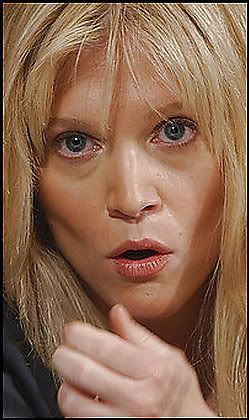
Sara Taylor's Road To and From The White House |
The Washington Post reports:
On a snowy evening in December 1998, Sara M. Taylor, the daughter of a former pipe fitter at a John Deere plant in Iowa, came to a meeting at the Capital Hilton. Washington had grown dark and quiet, and the hotel restaurant was empty, save two people: Omaha financial guru Warren Buffett, and the man she was there to meet -- Karl Rove. Rove had just helped reelect George W. Bush as governor of Texas, and now Rove and Bush had begun the slow process of building a presidential run.
Over the course of an hour Rove quizzed her on the politics of her home state. Her dad, before she was born, had done a stint in the Iowa legislature, and two years earlier she'd taken a year off from her studies at Drake University to work on the presidential campaign of Texas senator Phil Gramm. They spoke about the coalitions needed to win -- social conservatives and the agriculture constituency -- and about the need to meet people personally. Suddenly, Bush himself walked in, plopped down beside her and Rove and drilled her about what he needed to know to win Iowa. In a matter of months, Taylor moved back to Iowa, helping to set up Bush's 2000 win. She was 24.
That was the beginning of Taylor's relationship with the two men. The end is proving more difficult to resolve.
After eight years working with Bush and Rove through two presidential campaigns and two turbulent administrations, Taylor, now 32, finds herself unable to exit gracefully. After leaving her post as White House political director in May out of what she says was a search for normalcy, she now finds herself part of the unending congressional probe into the dismissal of nine U.S. attorneys.
Yesterday, after the White House invoked executive privilege regarding any meetings, conversations and deliberations she had in the matter, Taylor became the latest high-level political appointee to testify before the Senate Judiciary Committee. These constraints led to a torturous session, and both sides expressed frustration over what she could and couldn't say. Under questioning yesterday, she refused to answer several questions and testified that she never spoke or met with President Bush about plans to fire the U.S. attorneys last year.
Said friend and former White House communications director Nicolle Wallace: "I just feel like it's incredibly unfair that she's being caught in what's really a struggle between Congress and the White House."
Taylor's been in tough fights before. Following her service for Bush in Iowa, she moved on to South Carolina, Washington state and Michigan. After the cliffhanger election, she was dispatched to Florida to help with recount efforts. Often pulling volunteers from Texas off the floor for not paying attention to their tasks, she eventually developed a pinpoint tracking system that literally traced each recounted ballot.
"It's methodical," Taylor said one evening last week over dinner on Capitol Hill. "You create a system to check every ballot and then you have a spreadsheet in place to tell you where you are. We always knew if we lost one vote or picked one up."
Described by her former colleagues as a tireless worker, Taylor's stature only grew after Bush took control of the White House in 2001. First charged with overseeing the Midwest in the political office led by Ken Mehlman, she joined the 2004 reelection campaign as a top strategist. Taylor was involved in everything from media planning and travel schedules to polling and research.
Asked about her rapid rise, Taylor, who was a finance major in college, said, "I would argue a lot of it had to do with my analytical ability. I think a lot of political operatives have good people skills and great social skills and work really hard, but everyone's not really good at math."
"I was the media director and her title was deputy strategist," said Mark McKinnon. "But functionally she basically did 80 percent of the work for me and [chief campaign strategist] Matthew Dowd. She knows polling, she knows media, she knows the field. For someone her age she has more knowledge than someone with a lifetime of campaigning."
Taylor's reward? A spot as the White House political director after the departure of Matthew Schlapp. From a mid-level staffer, Taylor came back to the White House to advise the senior staff and the president on domestic political issues and played an important role in anything involved with Bush's domestic agenda. Her new role meant constant contact with Rove, whose relationship with Taylor evolved from first "a teacher and leader to almost more of a partner," said Wallace.
"He makes you a better person because he's so methodical and is so smart and never misses anything and is demanding in a good way," Taylor said of her former boss. "He just doesn't have time for error. You can't put a value on the training process."
Another lesson learned?
"Even when you think an e-mail is private, it never is," she said, in reference to a disparaging e-mail involving the firing of Bud Cummins, the U.S. attorney in Little Rock.
By last December, after the Democrats won control of both the House and the Senate, Taylor had had enough. By her own account, she could never separate her personal and professional lives and found herself exhausted, ready to start a new life away from the White House. In May, she left.
A clean break it wasn't. After taking time off for the first time in years, she traveled to Europe and returned home to a subpoena.
She wasn't terribly surprised. Last year Taylor signed up for professional liability insurance after noting comments made by some Democrats on the 2006 campaign trail about wanting to investigate the White House.
But now she's on several hooks. This week she found out the insurance will not cover her legal costs. Moreover, she's restrained from fully telling her side of things, from moving on.
"It's a very difficult position to be in," she said. "The president has exerted executive privilege and I have great respect for the president. The problem for you as an individual is that this comes at a huge personal cost financially.
"But this is a bigger issue than me. I understand the president is doing what he believes is right."
Monday, July 9, 2007
| [+/-] |
Bush Invokes Executive Privilege, Refuses To Allow Miers & Taylor To Testify |
The International Herald Tribune reports:
President George W. Bush, invoking executive privilege for the second time in his clash with lawmakers over the firing of federal prosecutors, said Monday that he would refuse to comply with congressional subpoenas for testimony from two top former aides.
In a letter to the chairmen of the House and Senate Judiciary Committees, Bush's counsel, Fred Fielding, declared that the legislative and executive branches of government were at an impasse. Fielding wrote that Bush was directing the two aides - Sara Taylor, former White House political director, and Harriet Miers, former White House counsel - not to testify.
"The assertion of executive privilege here is intended to protect a fundamental interest of the presidency: the necessity that a president receive candid advice from his advisers and that those advisers be able to communicate freely and openly with the president," Fielding wrote.
He added that in the case of the firing of federal prosecutors, "the institutional interest of the executive branch is very strong."
The move was not unexpected.
Bush said last month that he had no intention of letting Miers or Taylor testify.
Bush offered at that time to allow the two women, as well as other top aides - including Karl Rove, his chief political strategist - to be interviewed by lawmakers if the interviews were not under oath and were not transcribed. Though Democratic leaders in Congress rejected that offer as insufficient, Bush renewed it Monday.
The latest refusal to comply with the subpoenas raises tensions in an already tense legislative-executive clash and heightens the likelihood that the two sides will wind up in court. Congressional Democrats are trying to determine who sought the firings of nine federal prosecutors, and why. They want to know whether White House officials, including Rove, interfered with hiring and firing decisions at the Justice Department for political reasons, or perhaps to thwart certain investigations.
Bush said in June that he would not comply with subpoenas for documents in the case. At that time, the committee chairmen - Representative John Conyers and Senator Patrick Leahy - wrote to Fielding to complain that Bush was not acting in good faith.
In his letter, Fielding complained about the tone and language the Democrats used, telling them he wanted to convey "a note of concern over your letter's apparent direction in dealing with a situation of this gravity."
Leahy was dismissive of Fielding's letter, saying in a statement: "This is more stonewalling from a White House that believes it can unilaterally control the other co-equal branches of government. What is the White House trying to hide by refusing to turn over evidence it was willing to provide months ago, as long as that information was shared in secret with no opportunity for Congress to pursue the matter further?"
Wednesday, June 13, 2007
| [+/-] |
Arlen Specter to White House: "Let's Make a Deal" |
From TPMmuckraker:
Here's Senate Judiciary Committee ranking member Arlen Specter (R-PA) on the floor of the Senate today making an offer to the White House for a compromise:
The standing offer from the White House is that congressional investigators interview White House aides about the U.S. attorney firings behind closed doors, with no oath or no transcript. Democrats have rejected that, and today the chairmen of the House and Senate judiciary committees issued subpoenas for former White House counsel Harriet Miers and Karl Rove's former top aide Sara Taylor.
Specter said that he'd spoken to the current White House counsel Fred Fielding today about the subpoenas for Taylor and Miers. Specter went on to muse about a possible compromise. He'd prefer that there be a public hearing and that the hearing be under oath, but said that's not necessary, given that it's a crime to lie to investigators, even if it's not under oath. But Specter said there needs to be a transcript -- otherwise it would be much more difficult to hold an aide to account for lying.
So if the White House offers to hand over Taylor and Miers for private interviews with a transcript (but no oath), Specter would agree. And given that a court battle between Congress and the White House is likely to drag on for months upon months, you can bet that Democrats would give such a deal serious consideration.
But before any of that happens, the White House has to give ground -- something they haven't done since Congress started knocking on the door in March. Will the subpoenas change that?
