Run away the ray-gun is coming : The US army's new secret weapon
At the Daily Mail, Michael Hanlon writes:
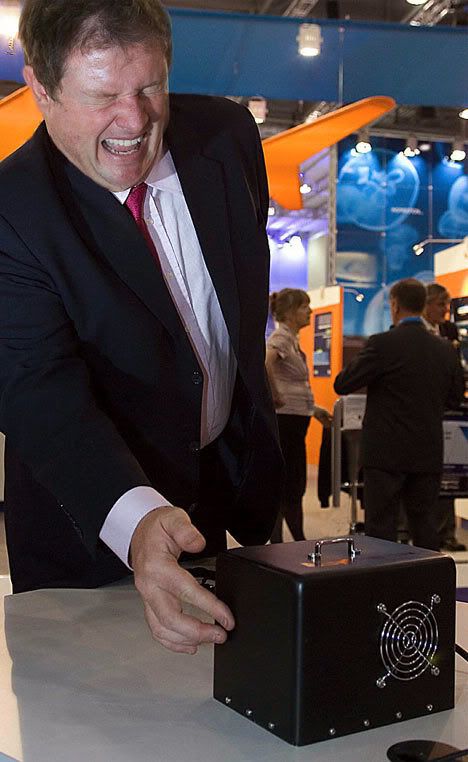
"Where do I put my finger? There ... OK? Nothing's happening ... is it on?"
"Yes, it's on. Move your finger a bit closer."
"Er ... ow! OW!" Not good. I try again. "OWWW!" I pull my hand away sharpish. My finger is throbbing, but seems undamaged.
I was told people can take it for a second, maximum. No way, not for a wimp like me.
I try it again. It is a bit like touching a red-hot wire, but there is no heat, only the sensation of heat. There is no burn mark or blister.
Its makers claim this infernal machine is the modern face of warfare. It has a nice, friendly sounding name, Silent Guardian.
I am told not to call it a ray-gun, though that is precisely what it is (the term "pain gun" is maybe better, but I suppose they would like that even less).
And, to be fair, the machine is not designed to vaporise, shred, atomise, dismember or otherwise cause permanent harm.
But it is a horrible device nonetheless, and you are forced to wonder what the world has come to when human ingenuity is pressed into service to make a thing like this.
Silent Guardian is making waves in defence circles. Built by the U.S. firm Raytheon, it is part of its "Directed Energy Solutions" programme.
What it amounts to is a way of making people run away, very fast, without killing or even permanently harming them.
That is what the company says, anyway. The reality may turn out to be more horrific.
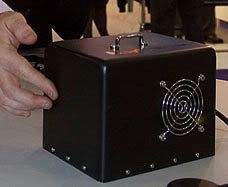
I tested a table-top demonstration model, but here's how it works in the field.
A square transmitter as big as a plasma TV screen is mounted on the back of a Jeep.
When turned on, it emits an invisible, focused beam of radiation - similar to the microwaves in a domestic cooker - that are tuned to a precise frequency to stimulate human nerve endings.
It can throw a wave of agony nearly half a mile.
Because the beam penetrates skin only to a depth of 1/64th of an inch, it cannot, says Raytheon, cause visible, permanent injury.
But anyone in the beam's path will feel, over their entire body, the agonising sensation I've just felt on my fingertip. The prospect doesn't bear thinking about.
"I have been in front of the full-sized system and, believe me, you just run. You don't have time to think about it - you just run," says George Svitak, a Raytheon executive.
Silent Guardian is supposed to be the 21st century equivalent of tear gas or water cannon - a way of getting crowds to disperse quickly and with minimum harm. Its potential is obvious.
"In Iraq, there was a situation when combatants had taken media as human shields. The battalion commander told me there was no way of separating combatants from non-combatants without lethal force," Mr Svitak tells me.
He says this weapon would have made it possible because everyone, friend or foe, would have run from it.
In tests, even the most hardened Marines flee after a few seconds of exposure. It just isn't possible to tough it out.
This machine has the ability to inflict limitless, unbearable pain.
What makes it OK, says Raytheon, is that the pain stops as soon as you are out of the beam or the machine is turned off.
But my right finger was tingling hours later - was that psychosomatic?
So what is the problem? All right, it hurts, but then so do tear gas and water cannon and they have been used by the world's police and military for decades.
Am I being squeamish?
One thing is certain: not just the Silent Guardian, but weapons such as the Taser, the electric stun-gun, are being rolled out by Britain's police forces as the new way of controlling people by using pain.
And, as the Raytheon chaps all insist, you always have the option to get out of the way (just as you have the option to comply with the police officer's demands and not get Tasered).
But there is a problem: mission creep. This is the Americanism which describes what happens when, over time, powers or techniques are used to ends not stated or even imagined when they were devised.
With the Taser, the rules in place in Britain say it must be used only as an alternative to the gun. But what happens in ten or 20 years if a new government chooses to amend these rules?
It is so easy to see the Taser being used routinely to control dissent and pacify - as, indeed, already happens in the U.S.
And the Silent Guardian? Raytheon's Mac Jeffery says it is being looked at only by the "North American military and its allies" and is not being sold to countries with questionable human rights records.
An MoD spokesman said Britain is not planning to buy this weapon.
In fact, it is easy to see the raygun being used not as an alternative to lethal force (when I can see that it is quite justified), but as an extra weapon in the battle against dissent.
Because it is, in essence, a simple machine, it is easy to see similar devices being pressed into service in places with extremely dubious reputations.
There are more questions: in tests, volunteers have been asked to remove spectacles and contact lenses before being microwaved. Does this imply these rays are not as harmless as Raytheon insists?
What happens when someone with a weak heart is zapped?
And, perhaps most worryingly, what if deployment of Silent Guardian causes mass panic, leaving some people unable to flee in the melee? Will they just be stuck there roasting?
Raytheon insists the system is set up to limit exposure, but presumably these safeguards can be over-ridden.
Silent Guardian and the Taser are just the first in a new wave of "non-lethal" weaponry being developed, mostly in the U.S.
These include not only microwave ray-guns, but the terrifying Pulsed Energy Projectile weapon. This uses a powerful laser which, when it hits someone up to 11/2 miles away, produces a "plasma" - a bubble of superhot gas - on the skin.
A report in New Scientist claimed the focus of research was to heighten the pain caused by this semi-classified weapon.
And a document released under the U.S. Freedom of Information Act talks of "optimal pulse parameters to evoke peak nociceptor activation" - i.e. cause the maximum agony possible, leaving no permanent damage.
Perhaps the most alarming prospect is that such machines would make efficient torture instruments.
They are quick, clean, cheap, easy to use and, most importantly, leave no marks. What would happen if they fell into the hands of unscrupulous nations where torture is not unknown?
The agony the Raytheon gun inflicts is probably equal to anything in a torture chamber - these waves are tuned to a frequency exactly designed to stimulate the pain nerves.
I couldn't hold my finger next to the device for more than a fraction of a second. I could make the pain stop, but what if my finger had been strapped to the machine?
Dr John Wood, a biologist at UCL and an expert in the way the brain perceives pain, is horrified by the new pain weapons.
"They are so obviously useful as torture instruments," he says.
"It is ethically dubious to say they are useful for crowd control when they will obviously be used by unscrupulous people for torture."
We use the word "medieval" as shorthand for brutality. The truth is that new technology makes racks look benign.
Tuesday, September 18, 2007
| [+/-] |
The Future of U.S. Weaponry |
Thursday, August 23, 2007
| [+/-] |
British Army Deploys New Weapon Based on Mass-Killing Technology |
Parliament not told, minister says
Raw Story reports:
A new 'super-weapon' being supplied to British soldiers in Afghanistan employs technology based on the "thermobaric" principle which uses heat and pressure to kill people targeted across a wide air by sucking the air out of lungs and rupturing internal organs.
The so-called "enhanced blast" weapon uses similar technology used in the US "bunker busting" bombs and the devastating bombs dropped by the Russians to destroy the Chechen capital, Grozny.
Such weapons are brutally effective because they first disperse a gas or chemical agent which is lit at a second stage, allowing the blast to fill the spaces of a building or the crevices of a cave. When the US military deployed a version of these weapons in 2005, DefenseTech wrote an article titled, "Marines Quiet About Brutal New Weapon."
According to the US Defense Intelligence Agency, which released a study on thermobaric weapons in 1993, "The [blast] kill mechanism against living targets is unique--and unpleasant.... What kills is the pressure wave, and more importantly, the subsequent rarefaction [vacuum], which ruptures the lungs.… If the fuel deflagrates but does not detonate, victims will be severely burned and will probably also inhale the burning fuel. Since the most common FAE fuels, ethylene oxide and propylene oxide, are highly toxic, undetonated FAE should prove as lethal to personnel caught within the cloud as most chemical agents."
A second DIA study said, "shock and pressure waves cause minimal damage to brain tissue... it is possible that victims of FAEs are not rendered unconscious by the blast, but instead suffer for several seconds or minutes while they suffocate."
"The effect of an FAE explosion within confined spaces is immense," said a CIA study of the weapons. "Those near the ignition point are obliterated. Those at the fringe are likely to suffer many internal, and thus invisible injuries, including burst eardrums and crushed inner ear organs, severe concussions, ruptured lungs and internal organs, and possibly blindness."
British defense officials told the UK Guardian that British bombs were "different."
"They are optimized to create blast [rather than heat]", one said, speaking on the standard condition of anonymity in Britain. The official added that it would be misleading to call them "thermobaric."
Officials told the Guardian the new weapon was classified as a soldier launched "light anti-structure munition" and that the bombs would be more effective because "even when they hit the damage is limited to a confined area."
"The continuing issue of civilian casualties in Afghanistan has enormous importance in the battle for hearts and minds," said Liberal Democrat leader Sir Menzies Campbell in the article. "If these weapons contribute to the deaths of civilians then a primary purpose of the British deployment is going to be made yet more difficult."
According to Campbell, the deployment of the weapons was not announced to Parliament.
Wednesday, March 7, 2007
| [+/-] |
Defense Contractors Developing Weapons That Only Make You Feel Sick |
Navy SBIR program awards Invocon $99,609.00 :
Contract #
M67854-04-C-1013
Topic
N03-163
Solicitation
03.2
SYSCOM: MARCOR
Award Amount: $99,609.00
Phase: I
Program: Navy SBIR
Start/End Date: 11/21/2003 - 05/21/2004
FY Reported: 2004
Title: EPIC (Electromagnetic Personnel Interdiction Control)
Abstract:
The Marine Corps has a requirement for a non-destructive stun weapon that would render a hostile war fighter ineffective for a period of time. There is significant political and military interest in such a capability. In addition, the ability to remotely incapacitate a human being without permanent damage would be a landmark event in the field of civil law enforcement. The desirability of waging bloodless war to counter threats to national security is virtually limitless since both military and civil authority could determine a priori when and if loss of human life is necessary. IVC proposes to investigate the use of beamed RF energy to excite and interrupt the normal process of human hearing and equilibrium. The focus will be in two areas. (1) Interruption of the mechanical transduction process by which sound and position (relative to gravity) are converted to messages that are processed by the brain. (2) Interruption of the chemical engine which sustains the proper operation of the nerve cells that respond to the mechanical transduction mechanisms referenced in item (1). Interruption of either or both of these processes has been clinically shown to produce complete disorientation and confusion. Second order effects would be extreme motion sickness.
Benefit:
This RFP asks for a weapon that can “temporarily incapacitate” a human threat as a point or area target. In short, a Star Trek hand-held Phaser Weapon set on “Stun”. It would be the ultimate in individual weaponry providing an individual war fighter with the ability to reduce an opponent to helplessness while doing no permanent damage. The requirement also states the need for the weapon to operate through walls and other protective mediums that now provide cover for combatants in urban warfare situations. This capability would increase the effectiveness of a war-fighter in urban combat for two reasons: (1) the enemy could be engaged and neutralized through a wall; and (2) the damage of friendly fire mistakes would be minimized since on permanent damage would be done by the stun weapons. The civilian applications of such a weapon would be a landmark event in law enforcement. The civil authority could always protect themselves from lethal threats while still delivering targets to the justice system unharmed. Further, the critical decision now placed on law enforcement as to whether or not lethal responses are necessary could be virtually eliminated since use of the “stun” weapon could neutralize a perceived threat without permanent damage.
Keywords: EM fields, cell chemistry, Inner Ear, Radiation, Modulation, Radio Frequency
Thursday, June 15, 2006
| [+/-] |
Hill Ties Reap Rewards For Top Defense Firms |
The Hill reports:
Letitia White, former defense appropriations staff member for Rep. Jerry Lewis (R-Calif.), is known on the Hill and in industry circles as the golden girl of earmarks.
It is those earmarks and the hefty price paid for them — in campaign contributions and lobbying fees — that have spurred federal investigators to look into the connection between White, now a partner at the firm of Copeland Lowery Jacquez Denton & White; Jeff Shockey, a former lobbyist at the firm and one of Lewis’s top committee staff members; and Lewis, the chairman of the House Appropriations Committee.
Former Rep. Bill Lowery (R-Calif.), Lewis’s longtime friend, is also a founding partner of Copeland Lowery.
The probe, which grew out of the investigation into former Rep. Randy “Duke” Cunningham (R-Calif.) that led to his resignation from Congress and his imprisonment, has prompted increased scrutiny of the defense-contracting business.
But the defense-contracting lobbying business has been a lucrative part of the K Street community for years, lawfully helping sell defense industry products to Capitol Hill and the Pentagon.
While Copeland Lowery targeted all appropriations bills, not just defense, there are several lobby shops that specialize almost solely in defense. They provide what Washington insiders argue is a necessary service.
Here is a look at the top defense-contracting lobbying firms and their connections to Congress and the Pentagon:
THE PMA GROUP
In 2006 alone, the PMA Group accounted for at least 60 earmarks in the conference report of the defense spending bill, according to data compiled by Taxpayers for Common Sense, a watchdog organization tracking earmarks in bills. That amounted to roughly $95.1 million, according to an analysis of that data.
Determining exactly how many earmarks a certain firm has secured is difficult because that information is not publicly available and defense companies often hire several lobbying firms to represent them.
Paul Magliocchetti, a nine-year veteran of the House Defense Appropriations Subcommittee, is the founder of the PMA Group. Out of its team of 35 lobbyists, at least 30 have worked on Capitol Hill, in the Pentagon or both.
One member of the team, Richard Kaelin, was the chief of staff to longtime House Appropriations Committee member Rep. Pete Visclosky (D-Ind.).
Kaelin also served as the lawmaker’s appropriations director, focusing on national security, energy and water development. That position “allowed him to develop keen negotiating skills essential to protecting multimillion-dollar projects and programs of national significance,” according to his company bio.
Another, Melissa Koloszar, was chief of staff to Rep. Jim Moran (D-Va.), also a member of the Defense Appropriations Subcommittee. For five years Koloszar also served as Moran’s legislative director. As an associate staff member on the Appropriations Committee, she was the primary contact to the defense subcommittee.
And if Moran ever becomes a chairman of a spending panel, PMA could be in luck. The lawmaker said Tuesday that if he were a chairman of a spending panel he would “earmark the [expletive] out of it.”
PMA’s Dan Cunningham has a close relationship with subcommittee ranking member Rep. John Murtha (D-Pa.), according to K Street sources.
Cunningham also served as the director and deputy director for the Army’s congressional liaison team. He directed the legislative strategy for presenting the Army’s budget for military pay, operations and maintenance, military construction, acquisition, and research and development, according to his bio.
PMA is also a heavyweight when it comes to political contributions.
For the 2006 cycle alone, PMA’s PAC doled out more than $250,000 to federal candidates. Since 2000, the PAC contributed close to $1 million to members of the House and the Senate, focusing on GOP and Democratic members of the authorization and appropriations committees.
With its 139 clients, the firm ranked as No. 10, with revenue of $7.8 million in 2005, on a list of the most profitable lobbying firms compiled by PoliticalMoneyLine.
ADI
American Defense International (ADI), with 105 clients, mostly defense and technology, was able to secure at least 32 earmarks for its clients in the 2006 defense spending bill, according to data compiled by Taxpayers for Common Sense.
ADI also has attracted an all-star cast. The chairman, Van Hipp Jr., headed the South Carolina Republican Party in 1988. He was deputy assistant secretary of the Army for reserve forces and mobilization and was appointed by then-Secretary of Defense Dick Cheney as the principal deputy general counsel of the Navy.
John Barth, meanwhile, was chosen to serve as the secretary of the Navy’s personal liaison to the House and Senate Appropriations committees for all Marine Corps matters.
Michael Khatchadurian served on the House Armed Services Committee, was military legislative assistant for Reps. Jim Ryun (R-Kan.) and Ander Crenshaw (R-Fla.), who was then a member of the House Armed Services Committee and is now a member of the Appropriations Committee. After leaving Congress, he worked in the public-affairs office of the Joint Chiefs of Staff.
Former House Armed Services Committee Chairman Ron Dellums (D-Calif.) serves as ADI’s senior national-security adviser.
ADI’s president, Michael Herson, also has experience at the Pentagon. During Cheney’s tenure there, Herson was the special assistant to the assistant secretary of defense for force management and personnel. After that, Herson joined the Alexis de Tocqueville Institution as a visiting fellow for national-security affairs.
“It is important to be a good practitioner with what you do,” Herson said. “You have to have a story to tell, have all the forms filled out and all the material that the staff needs. It is more about relationships, and you can establish those by being well-prepared and having a good story to tell.”
Several media reports have noted that Herson is married to a legislative assistant to Sen. Arlen Specter (R-Pa.). She works part time for Specter and does not handle appropriations matters.
It has also been reported that ADI does not take clients into Specter’s office.
ADI’s total earmarks for the 2006 Pentagon budget amount to at least $81 million.
ADI employees also donate mightily to the political process. For the 2002, 2004 and 2006 cycles, they contributed a total of $284,000.
ADI was ranks No. 29 with revenue of $3.9 million in PoliticalMoneyLine’s list of top lobbying firms.
COPELAND LOWERY AND OTHERS
Meanwhile, Letitia White’s firm, Copeland Lowery, with its 105 clients, ranks No. 32 with revenue of $3.7 million.
While PMA, ADI and Copeland Lowery have a large number of defense clients, other smaller, well-connected and successful shops that focus almost exclusively on defense issues are also major players.
One of them is Robison International, which is run by retired Maj. Gen. Randall West. Robison International is a steady contributor to Rep. Alan Mollohan (D-W.Va.)
Ervin Technical Associates is yet another powerful force in the defense lobbying world. Founding partner Jim Ervin’s experience includes program management and international sales with the Air Force. He also served as a congressional liaison.
