At AlterNet.org, Tara Lohan writes:
From Chile to the Philippines to South Africa to her home country of Canada, Maude Barlow is one of a few people who truly understands the scope of the world's water woes. Her newest book, Blue Covenant: The Global Water Crisis and the Coming Battle for the Right to Water, details her discoveries around the globe about our diminishing water resources, the increasing privatization trend and the grassroots groups that are fighting back against corporate theft, government mismanagement and a changing climate.
If you want to know where the water is running low (including 36 U.S. states), why we haven't been able to protect it and what we can do to ensure everyone has the right to water, Barlow's book is an essential read. It is part science, part policy and part impassioned call. And the information in Blue Covenant couldn't come from a more reliable source. Barlow is the national chairperson of the Council of Canadians and co-founder of the Blue Planet Project, which is instrumental in the international community in working for the right to water for all people. She also authored Blue Gold: The Fight to Stop Corporate Theft of the World's Water with Tony Clarke. And she's the recipient of the Right Livelihood Award (known as the "Alternative Nobel") for her global water justice work.
She took a moment to talk to AlterNet in between the Canadian and U.S. legs of a book tour for Blue Covenant:Tara Lohan: This year in the U.S. there has been a whole lot press about the drought in Atlanta and the Southeast, and I think for a lot of people in the U.S. it is the first they are hearing about drought, but the crisis here in North America is really pretty extreme isn't it?
Maude Barlow: It really is, and it kind of surprises me when I hear people, for instance in Atlanta say, "We didn't know it was coming." I don't know how that could be possible, and I do have to say that I blame our political leaders. I don't understand how they could not have been reading what I've been reading and what anyone who is watching this has been reading.
I remember attending a conference in Boise, Idaho, three years ago and hearing a lot of scientists get up and say, "Read my lips, this isn't a drought, this is permanent drying out." We are overpumping the Ogallala, Lake Powell and Lake Meade. The back up systems are now being depleted. This is by no means a drought ...
The thing that I'm trying to establish with the first chapter, which is called "Where Has All the Water Gone," is that what we learned in grade five about the hydrologic cycle being a closed, fixed cycle that could never be interrupted and could never go anywhere, is not true. They weren't lying to us, but they weren't aware of the human capacity to destroy it, and the reality is that we've interrupted the hydrologic cycle in many parts of the world and the American Southwest is one of them.
TL: How is this happening?
MB: By farming in deserts and taking up water from aquifers or watersheds. Or by urbanizing -- massive urbanization causes the hydrologic cycle to not function correctly because rain needs to fall back on green stuff -- vegetation and grass -- so that the process can repeat itself. Or we are sending huge amounts of water from large watersheds to megacities and some of them are 10 to 20 million people, and if those cities are on the ocean, some of that water gets dumped into the ocean. It is not returned to the cycle.
We are massively polluting surface water, so that the water may be there, but we can't use it. And we are also mining groundwater faster than it can be replenished by nature, which means we are not allowing the cycle to renew itself. The Ogallala aquifer is one example of massive overpumping. There are bore wells in the Lake Michigan shore that go as deep into the ground as Chicago skyscrapers go into the ground and they are sucking groundwater that should be feeding the lake so hard that they are pulling up lake water now, and they are reversing the flow of water in Lake Michigan for the first time.
We are interrupting the natural cycle. And another thing we are doing is something called virtual water trade. That is where you send water out of the watershed in the form of products or agriculture. You've used the water to produce something and then you export it, and about 20 percent of water used in the world is exported out of watershed in this way, because so much of our economy is about export. In the U.S. you are sending about one-third of your water out of watersheds -- it is not sustainable.
This is not a cyclical drought. We are actually creating hot stains, as I and some scientists call them, around the world. These are parts of the world that are running out of water and will be, or are, in crisis. Which means that millions more people will be without water. I argue that this is one of the causes of global warming. We usually hear water being a result of climate change, and it is, particularly with the melting of the glaciers. But our abuse, mismanagement and treatment of water is actually one of the causes, and we have not placed that analysis at the center of our thinking about climate change and environmental destruction, and until we do, we are only addressing half the question.
I do blame in a very big way, the political leadership in most of our countries for having failed to heed the call of scientists and ecologists and water managers who've been telling us for years now there is a crisis coming -- there are 36 states in the U.S. in some form of water stress, from serious to severe. Thirty-six states! Most Americans don't know this -- why is this not part of people's everyday concerns? That is what I'm hoping this book will help do.
TL: Do you think governments, like the U.S. or Canada, have any kind of a contingency plan?
MB: No. There are people in the U.S. who believe Canada is the contingency plant. Or Northeast water or Alaska water. So, moving water is one of the contingency plans, likely by pipeline. You could also ship it by tanker. Other than that, no. And not only are there no backup plans, but there is not even an understanding that you've got to stop increasing the demand on water. In the U.S., people are moving into the very area of the country that has no water -- a huge migration is taking place to to the American Southwest where they're building more golf courses.
I just read about a new water theme park in Arizona that will have waves so big you can have serious surfers, like real surfing in the desert. There is just this lack of understanding about how nature works, how the hydrologic cycle needs to be protected and how watersheds need to be protected, and when you start playing god by moving this stuff around like this we are just creating this massive crisis. There is not enough water for the demands being made on it in the American Southwest.
TL: You said 36 states in the U.S. are water stressed -- what does that actually mean for the people who live there?
MB: Well, in a dire case, literally running out of water. In many other cases, the predictions are that the demand will increase seriously and they've got to start planning. I quote in the book that the demand in Florida is growing so much and overpumping is happening so much that there are actually sink holes opening up and swallowing homes and streets and sometimes whole shopping centers. It is called subsidence. Mexico City is sinking in on itself because all the water under the city has been taken out and now they are going farther afield pumping water.
It can go from that kind of crisis, or as in some communities in the Midwest, you face having no water to the Chicago area, where the demand is going to grow hugely, and therefore the demand will be on the Great Lakes, which are already in trouble. There are four trillion liters taken out of the Great Lakes every single day and believe me, nature is not putting a trillion gallons back in. It is not rocket science that we are not allowing nature to refill and replenish. And now there are new demands on the Great Lakes because communities and industries off the basin are now demanding access to it.
TL: You mentioned global warming earlier, and I just want to come back to that for a moment. Are we approaching climate change in the wrong way by not recognizing its connection to water?
MB: Yes.
TL: So what should we be doing?
MB: Well, we have to put it into the equation. I've found that some politicians are actually using global warming as an excuse not to do anything, and I'll give you an example. It is the polar opposite of the Bush administration, which is that global warming doesn't exist. In Australia, which thankfully has gone through a government change, they are disengaging the water from the countryside and letting farmers sell it through brokers, they are disrupting streams and aquifers. They are draining the wetlands. They are privatizing. They are doing all sorts of things wrong, including overusing and polluting it, and so on. And what did the prime minister say? "It's got nothing to do with anything we're doing; it's global warming, and it blew here from away -- we didn't even create it."
I think global warming is becoming a little bit of a catch all for some governments to do nothing or to put off a solution to other things until they find a solution to global warming, and there is no excuse. Right now we have got to stop the abuse of water. The single most important thing that we can do for global warming, aside from stopping the overpumping of greenhouse gas emissions, but the twin to that is to retain water in watersheds. Because the hydrologic cycle is what cools the temperature.
Global warming can be averted through a great extent if we could maintain watersheds and maintain the cycle in its purest form. That means keeping green spaces, building green rings around urban centers -- everything from parks and gardens -- stop polluting, stop overmining groundwater and retain water in watersheds, which means we have to live more sustainably, we have to grow our food differently, we have to stop believing in unlimited growth and more stuff and more competition, and all of that.
I find that global warming is such a crisis that we won't do anything on any other front because all our attention is going there. I think we are terribly missing the boat on this, and I'm very interested in getting a debate going on this in the climate-change community so that when people are talking about the causes of climate change, our drying up of the earth from below will be considered as serious a cause as the trapping of heat from greenhouse gas emissions. It is not only part of the analysis we are missing, but part of the solution.
TL: That is interesting. I haven't heard a lot of people talking about it from that angle.
MB: Nobody.
I'm working with a group of scientists in Slovakia and a few other places, voices in the wilderness, but when you start putting it together, honestly, it makes such sense. I mean if you start to look at the growth of deserts -- in the last 30 years we've doubled the growth of deserts in the world, and it will double again in 20 years. Well, if you are creating deserts and you've got heat rising from the earth with urban heat islands, the inability for the hydrologic cycle to be maintained because of urbanization, it makes a lot of sense. Of course that is all exacerbated by melting glaciers and the lowering of the ice packs, which protects from evaporation. It is kind of a deadly combination. I spoke at a conference about this recently in London, England, and was received by people from the climate change world, really, really well, and I thought "This is a good sign."
TL: You spent a lot of time in this book, and also in Blue Gold, talking about privatization. Can you talk a little about why we should be concerned about it?
MB: Well, as water dwindles in the world and available fresh water is becoming more scarce, the demand is growing, water is becoming a commodity, it is becoming valuable to those who want to put a price on it, which is why I called the first book Blue Gold. And this blue gold is attracting private sector interest in many, many ways, and there is a private sector interest coming together to control every level of water, from when we take it out of the ground, bottle it, to how we deliver it, to wastewater treatment, and now the biggest and newest is water reuse and recycling. That sounds benign at first, but when you really start to look at it, really it is about big, big corporations like GE, Dow Chemical, Proctor & Gamble getting into the ownership, control, and recycling of dirty water, which because there are billions of dollars at stake, in my opinion, becomes a disincentive to protect source water. And you can start to understand why governments, in collusion with these companies, are starting to spend millions of dollars on cleanup technology but will not enforce rules to stop pollution in the first place.
And then we have desalination. There are 30 desal plants planned for California alone. They are now talking about nuclear-powered desalination. They are talking about building those plants as we speak. The people in the anti-nuclear movement had better dust off and come back because it is all coming back with desalination. And then there is nanotechnology, which they want to be totally deregulated. I've got a great quote in the book where this guy says, "We are going to do to water what we did to telecommunications in the 1990s," which is total deregulation. They want governments out of the business of water.
I have a whole section in the book on how water has become such a hot commodity. When I wrote Blue Gold there was no water being exchanged on the Stock Exchange, now there are over a dozen indexes just for trading water. It has become a multi-multibillion-dollar industry just overnight. A lot of it is this water reuse -- it is the fast-growing section of the water industry. I argue that there is a race going on over who's going to control water, whether it will be seen as a public commons, a public trust, and part of our collective heritage that also belongs to the earth -- or whether it will be controlled by private corporations, and I don't know who will win.
TL: But it is not all bad news.
MB: No, we are making good inroads in the bottled water area -- a lot of universities, high schools, are having drives to reject bottled water. We're getting restaurants now taking the challenge up to not serve bottled water, and we're getting people to take a pledge not to drink bottled water.
There has been a huge fight back from the big utility companies, particularly in the global south, to the extent that Suez has basically announced it is going to leave Latin America because people are so furious with them, which has been the result of fabulous grass-roots activism. So, it is not that this is a done deal, but most of the our governments are supportive of these private-sector incursions.
It is all about technology and not about lifestyle and alternative ways and decreasing growth and stuff -- they are saying we are not going to challenge the model, it is unlimited growth, continued competition, continued economical globalization, continued privatization, continued deregulation -- we'll just continue to find ways to clean up the mess as we go along.
TL: Water is not just an environmental issue, but a national security issue, you discovered with this book.
MB: Yes, water has become an issue of national security in the U.S. Six years ago I couldn't find any inkling at the national level -- the Pentagon or White House -- of a coming water crisis, either globally or in the U.S. But in the last, two to three years, this has been hugely changed. There is now a consortium advising the Bush administration and the Pentagon -- it is called Global Water Futures. It is made up of this think tank called the Center for International Studies and Sandia Laboratories. Then I dug deeper and found it is being contracted out to be run by Lockheed Martin. And this consortium involves Coke and Proctor & Gamble and others. So you finally have the U.S. government saying, "Holy crap, we're in trouble here, you can't be a super power if you don't have energy and water." Now they've got this advisory body that not only has this think tank and the corporate side too, and the high technology side, and the military side. It becomes very clear what you are dealing with.
TL: Can you talk more about the grass-roots resistance to all of this?
MB: The thing that is so stunning, especially in the global south, is that when you are dealing with water, you are dealing with life and death. For a lot of people it is like, "Well, we didn't know what to do when they privatized our education or shut down our public hospitals -- but water is different." They are willing to go the wall for it -- as one person said to me, "You may as well kill me with a bullet as dirty water." People just take a stand and are determined they are not going to compromise.
We took the time as a movement ... whenever anybody always asks me how to build a campaign, I always include these steps. We took the time to find language that we all jointly agreed on -- that water is not a commodity, that it belongs to the earth and all species, it is a public trust and human right, and so on. We've taken the time to work this out so that if you ask any of us around the world, you are going to hear the same kind of language. There is a trust that we have built in this shared philosophy and shared vision.
TL: How is it that you've managed to create such as worldwide message and come together?
MB: Part of the origin was when I wrote a report for the International Forum on Globalization back in 1999. It was called Blue Gold: The Global Water Crisis and the Commodification of the World's Water Supply. It took off, and a bunch of people from around the world started reading it. We got it translated into many, many languages, and I started hearing from people saying, "I thought this was personal and we were fighting this particular company in our community, and we didn't know that this was a global fight."
So, to my knowledge, that was the first analysis, and that morphed into the book. I started traveling and meeting people and Food & Water Watch got set up in the U.S. And then there was meeting people in Europe who were fighting big water companies, coming together at the big World Water Forum and bringing folks together from the global south to challenge what we call the "lords of water." And, of course, technology has been incredible. You don't have to have a computer in every house -- you just have to have somebody on the other end who has the capacity to receive this information.
TL: What else do we need to be doing?
MB: We need laws. Martin Luther King Jr. said, "Legislation won't change the heart, but it will restrain the heartless." We need legislation at every level of our government. It is all well for grass-roots people to do all their wonderful work -- but they shouldn't have to do all the work. We need laws at every level, from municipal up to state to national to international, that protect water ecologically on one hand and protect the notion of a human right and right of the earth, and not a commodity, and that is so fundamental.
That is why I call the book "blue covenant" -- we need a covenant of three parts -- from humans to the earth to stop destroying the lifeblood of the earth, from the rich to the poor (global north to the south) for water justice, not charity -- justice. Water should be a fundamental right for all generations, and no one should be allowed to sell it for profit. We want this right up to the United Nations. It is a struggle at every level. But we just keep going. The fight back around the world is claiming space, but we have to have the weight of law behind us. We have to make, as a society, decisions about what matters. And if we believe that people shouldn't die because they can't afford water, then we have to bring things to bear to make that happen -- we have to change things. If the World Bank has money to give to Suez or Veolia, they've got the money to give to a public agency.
TL: So are you hopeful we can move change in the right direction?
MB: I'm always hopeful -- it is part of my job. I consider hope to be a moral imperative, and I also don't think you have any right to go around alarming people with these facts unless you are also prepared to talk about what needs to be done, and success stories, and be hopeful. I am very very hopeful that we can collectively do this.
If I'm worried -- it is about the exponential abuse of water -- can we catch this and stop it fast enough?
List of stops and dates for Barlow's book tour.
Thursday, February 14, 2008
| [+/-] |
The Growing Battle for the Right to Water |
Wednesday, February 13, 2008
| [+/-] |
Unique Mating Photo of Wild Gorillas Face to Face |
 Western gorillas mating 'face-to-face' in Mbeli Bai in the Republic of Congo.
(Credit: Copyright Thomas Breuer – WCS/MPI-EVA)
Scientists from the Wildlife Conservation Society and Max Planck Institute for Evolutionary Anthropology have released the first known photographs of gorillas performing face-to-face copulation in the wild. This is the first time that western gorillas have been observed and photographed mating in such a manner.
The photographs were part of a study conducted in a forest clearing in Nouabalé-Ndoki National Park in the Republic of Congo that appeared in a recent issue of The Gorilla Gazette.
"Understanding the behavior of our cousins the great apes sheds light on the evolution of behavioral traits in our own species and our ancestors," said Thomas Breuer, a researcher at the Max Planck Institute for Evolutionary Anthropology and WCS and lead author of the study. "It is also interesting that this same adult female has been noted for innovative behaviors before."
The western lowland gorilla is listed as Critically Endangered as a result of hunting by humans, habitat destruction, and health threats such as the Ebola virus.
The female gorilla in the photograph, nicknamed "Leah" by researchers, made history in 2005 when she was observed using tools -- another never-before-seen behavior for her kind in the wild. Breuer and others witnessed Leah using a stick to test the depth of a pool of water before wading into it in Mbeli Bai, where researchers have been monitoring the gorilla population since 1995.
Researchers say that few primates mate in a face-to-face position, known technically as ventro-ventral copulation; most primate species copulate in what's known as the dorso-ventral position, with both animals facing in the same direction. Besides humans, only bonobos have been known to frequently employ ventro-ventral mating positions. On a few occasions, mountain gorillas have been observed in ventro-ventral positions, but never photographed. Western gorillas in captivity have been known to mate face-to-face, but not in the wild, which makes this observation a noteworthy first.
"Our current knowledge of wild western gorillas is very limited, and this report provides information on various aspects of their sexual behavior," added Breuer, whose study is funded by the Brevard Zoo, Columbus Zoo and Aquarium, Cincinnati Zoo and Botanical Garden, Max Planck Society, Sea World & Busch Gardens Conservation Fund, Toronto Zoo, Wildlife Conservation Society and Woodland Park Zoo. "We can't say how common this manner of mating is, but it has never been observed with western gorillas in the forest. It is fascinating to see similarities between gorilla and human sexual behavior demonstrated by our observation."
Scientists estimate that western gorillas have declined 60 percent in recent years due to habitat loss, illegal hunting, and Ebola hemorrhagic fever. The Wildlife Conservation Society, which is the only organization working to protect all four gorilla sub-species (also including the Cross River Gorilla, the mountain gorilla, and the Grauer's gorilla), has been studying gorillas and other wildlife in the Republic of Congo since the 1980s. In 1993, the Congolese Government, working in tandem with technical assistance from WCS, established Nouabalé-Ndoki National Park.
Thursday, January 3, 2008
| [+/-] |
Forests Soak Up Less and Less CO2 |
Canada's trees getting worse at filtering gases, researchers say
The Ottawa Citizen reports:
Last year brought glum news that Canada's forests were only a so-so defence against global warming. Now, we find out our forests are getting worse at soaking up greenhouse gases.
A study by Canadian, Chinese and European researchers shows that, as the climate gets warmer, northern forests aren't soaking up extra carbon dioxide from the air after all.
Forests may, in fact, become worse at storing carbon if climate trends continue.
Canada has always argued that our forests strongly "offset" some of the fossil fuels we burn. Our official position is that Kyoto-style climate plans should give Canada credit for the good work our forests do.
However, a series of studies in the past two years and continuing today in the journal Nature call that into question.
Forests soak up less pollution that we'd hoped. Even as Canada realized it had over-hyped the air-cleaning work done by forests, though, one apparent piece of good news emerged.
Scientists noticed that the global warming trend was waking up trees earlier each spring. As well, the trees were staying green longer into the autumn.
This longer growing season, they reasoned, meant trees should work longer at building new branches and leaves, the process that soaks up carbon from the air. So, shouldn't that get rid of more carbon dioxide?
No, says today's study by the Global Carbon Project, a multinational science network that includes Canada. The study focuses on years of data-gathering -- largely from Canadian forests -- that record precisely how much carbon dioxide is in the air of a forest day by day.
In the past 20 years, two things have happened. The autumn in many forests of Canada, Europe and China has warmed by 1.1 degrees. The autumn forests are also releasing carbon dioxide back into the air faster than they soak it up.
This trend is so strong, University of Colorado atmospheric scientist John Miller writes in Nature, that it "seems to largely cancel" gains made through the earlier arrival of spring and its extra forest growth.
Shilong Piao and colleagues at the Laboratory of Sciences on Climate and the Environment in France's national science agency said although plants' respiration (emitting carbon dioxide) and photosynthesis (storing carbon dioxide) are both stepped up, the respiration outstrips the photosynthesis to cause a net loss of carbon from plants into the air.
"If warming in autumn occurs at a faster rate than in spring, the ability of northern ecosystems to sequester carbon will diminish in the future," Mr. Piao says in a written announcement of his results.
Saturday, December 29, 2007
| [+/-] |
Global Warming to Alter California Landscape |
The AP reports:
California is defined by its scenery, from the mountains that enchanted John Muir to the wine country and beaches that define its culture around the world.
But as scientists try to forecast how global warming might affect the nation's most geographically diverse state, they envision a landscape that could look quite different by the end of this century, if not sooner.
Where celebrities, surfers and wannabes mingle on Malibu's world-famous beaches, there may be only sea walls defending fading mansions from the encroaching Pacific. In Northern California, tourists could have to drive farther north or to the cool edge of the Pacific to find what is left of the region's signature wine country.
Abandoned ski lifts might dangle above snowless trails more suitable for mountain biking even during much of the winter. In the deserts, Joshua trees that once extended their tangled, shaggy arms into the sky by the thousands may have all but disappeared.
"We need to be attentive to the fact that changes are going to occur, whether it's sea level rising or increased temperatures, droughts and potentially increased fires," said Lisa Sloan, a scientist who directs the Climate Change and Impacts Laboratory at the University of California, Santa Cruz. "These things are going to be happening."
Among the earliest and most noticeable casualties is expected to be California's ski season.
Snow is expected to fall for a shorter period and melt more quickly. That could shorten the ski season by a month even in wetter areas and perhaps end it in others.
Whether from short-term drought or long-term changes, the ski season already has begun to shrivel in Southern California, ringed by mountain ranges that cradle several winter resorts.
"There's always plenty of snow, but you may just have to go out of state for it," said Rinda Wohlwend, 62, who belongs to two ski clubs in Southern California. "I'm a very avid tennis player, so I'd probably play more tennis."
---
Because California has myriad microclimates, covering an area a third larger than Italy, predicting what will happen by the end of the century is a challenge.
But through a series of interviews with scientists who are studying the phenomenon, a general description of the state's future emerges.
By the end of the century, temperatures are predicted to increase by 3 to 10 degrees Fahrenheit statewide. That could translate into even less rainfall across the southern half of the state, already under pressure from the increased frequency of wildfires and relentless population growth.
Small mammals, reptiles and colonies of wildflowers in the deserts east of Los Angeles are accustomed to periodic three-year dry spells. But they might not be able to withstand the 10-year drought cycles that could become commonplace as the planet warms.
Scientists already are considering relocating Joshua tree seedlings to areas where the plants, a hallmark of the high desert and namesake of a national park, might survive climate change.
"They could be wiped out of California depending on how quickly the change happens," said Cameron Barrows, who studies the effects of climate change for the Center for Conservation Biology in Riverside.
Farther north, where wet, cold winters are crucial for the water supply of the entire state, warmer temperatures will lead to more rain than snow in the Sierra Nevada and faster melting in the spring.
Because 35 percent of the state's water supply is stored annually in the Sierra snowpack, changes to that hydrologic system will lead to far-reaching consequences for California and its ever-growing population.
Some transformations already are apparent, from the Sierra high country to the great valleys that have made California the nation's top agricultural state.
The snow line is receding, as it is in many other alpine regions around the world. Throughout the 400-mile-long Sierra, trees are under stress, leading scientists to speculate that the mix of flora could change significantly as the climate warms. The death rate of fir and pine trees has accelerated over the past two decades.
In the central and southern Sierra, the giant sequoias that are among the biggest living things on Earth might be imperiled.
"I suspect as things get warmer, we'll start seeing sequoias just die on their feet where their foliage turns brown," said Nate Stephenson, a U.S. Geological Survey ecologist who is studying the effects of climate change in the Sierra Nevada. "Even if they don't die of drought stress, just think of the wildfires. If you dry out that vegetation, they're going to be so much more flammable."
Changes in the mountain snowpack could lead to expensive water disputes between cities and farmers. Without consistent water from rivers draining the melting snow, farmers in the Central and Salinas valleys could lose as much as a quarter of their water supply.
Any drastic changes to the state's $30 billion agriculture industry would have national implications, since California's fertile valleys provide half the country's fresh fruits, nuts and vegetables, according to the Union of Concerned Scientists' study.
"Obviously, it's going to mean that choices are going to be made about who's going to get the water," said Brian Nowicki, a biologist with the Center for Biological Diversity in Tucson, Ariz.
Among the biggest unknowns is what will happen along California's coast as the world's ice sheets and glaciers melt. One scenario suggests the sea level could rise by more than 20 feet.
Will the rising sea swamp the ports of Long Beach and Los Angeles, the nation's busiest harbor complex, turning them into a series of saltwater lakes? Will funky Ocean Beach, an island of liberalism in conservative San Diego County, become, literally, its own island?
Among the more sobering projections is what is in store for marine life.
The upwelling season, the time when nutrient-rich water is brought from the ocean's depths to the surface, nourishes one of the world's richest marine environments.
That period, from late spring until early fall, is expected to become weaker earlier in the season and more intense later. Upwelling along the Southern California coast will become weaker overall.
As a result, sea lions, blue whales and other marine mammals that follow these systems up and down the coast are expected to decline.
The changing sea will present trouble for much of the state's land-dwelling population, too. A sea level rise of 3 to 6 feet would inundate the airports in San Francisco and Oakland. Many of the state's beaches would shrink.
"If you raise sea level by a foot, you push a cliff back 100 feet," said Jeff Severinghaus, professor of geosciences at the Scripps Institution of Oceanography in San Diego. "There will be a lot of houses that will fall into the ocean."
Friday, December 14, 2007
| [+/-] |
Climate Change Blamed As Thousands Of Walruses Die In Stampedes |
 This photo provided by Pacific Institute of Fisheries and Oceanography shows a dead walrus, foreground, after a stampede on Cape Vankarem, Russia in March, 2007.
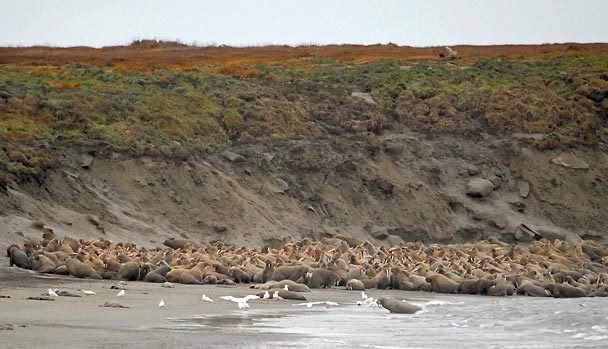 Climate change blamed as thousands of walruses die in stampedes
Thousands of Pacific walruses above the Arctic Circle died in stampedes earlier this year after the disappearance of sea ice caused them to crowd onto the shoreline in extraordinary numbers.
The Seattle Times reports:
In what some scientists see as another alarming consequence of global warming, thousands of Pacific walruses above the Arctic Circle were killed in stampedes earlier this year after the disappearance of sea ice caused them to crowd onto the shoreline in extraordinary numbers.
The deaths took place during the late summer and fall on the Russian side of the Bering Strait, which separates Alaska from Russia.
"It was a pretty sobering year — tough on walruses," said Joel Garlach-Miller, a walrus expert for the U.S. Fish and Wildlife Service.
Unlike seals, walruses cannot swim indefinitely. The giant, tusked mammals typically clamber onto the sea ice to rest, or haul themselves onto land for just a few weeks at a time.
But ice disappeared in the Chukchi Sea this year because of warm summer weather, ocean currents and persistent eastern winds, Garlach-Miller said.
As a result, walruses came ashore earlier and stayed longer, congregating in extremely high numbers, with herds as big as 40,000 at Point Shmidt, a spot that had not been used by walruses as a "haulout" for a century, scientists said.
Walruses are vulnerable to stampedes when they gather in such large numbers. The appearance of a polar bear, a hunter or a low-flying airplane can send them rushing to the water.
Sure enough, scientists received reports of hundreds and hundreds of walruses dead of internal injuries suffered in stampedes. Many of the youngest and weakest animals, mostly calves born in the spring, were crushed.
Biologist Anatoly Kochnev of Russia's Pacific Institute of Fisheries and Oceanography estimated 3,000 to 4,000 walruses out of population of perhaps 200,000 died, or two or three times the usual number on shoreline haulouts.
He said the animals only started appearing on shore for extended periods in the late 1990s, after the sea ice receded.
"The reason is the global warming," Kochnev said.
The reports match predictions of what might happen to walruses if the ice receded, said wildlife biologist Tony Fischbach of the U.S. Geological Survey.
"We were surprised that this was happening so soon, and we were surprised at the magnitude of the report," he said.
Scientists said the death of so many walruses — particularly calves — is alarming in itself. But if the trend continues, and walruses no longer have summer sea ice from which to dive for clams and snails, they could strip coastal areas of food, and that could reduce their numbers even further.
No large-scale walrus die-offs were seen in Alaska during the same period, apparently because the animals congregated in smaller groups on the American side of the Bering Strait, with the biggest known herd at about 2,500.
Thursday, December 6, 2007
| [+/-] |
More Than Half of Amazon Will Be Lost By 2030, Report Warns |
The Guardian reports:
Climate change could speed up the large-scale destruction of the Amazon rainforest and bring the "point of no return" much closer than previously thought, conservationists warned today.
Almost 60% of the region's forests could be wiped out or severely damaged by 2030, as a result of climate change and deforestation, according to a report published today by WWF.
The damage could release somewhere between 55.5bn-96.9bn tons of carbon dioxide into the atmosphere from the Amazon's forests and speed up global warming, according to the report, Amazon's Vicious Cycles: Drought and Fire.
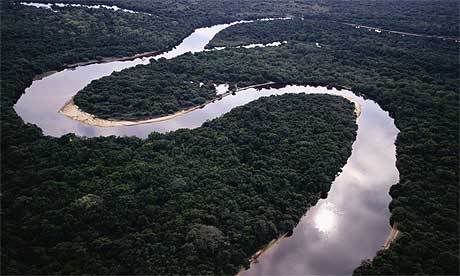
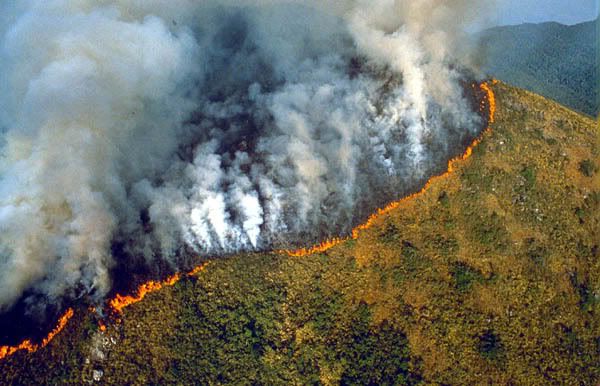 June 1989, Brazil: The forest burns. The Amazon is the largest rainforest in the world and is home to 15% of the world’s known land-based plant species, and nearly 10% of the world’s mammals. It has as many as 300 species of tree in a single hectare. Photograph: Sipa Press/Rex Features
Trends in agriculture and livestock expansion, fire, drought and logging could severely damage 55% of the Amazon rainforest by 2030, the report says. And, in turn, climate change could speed up the process of destruction by reducing rainfall by as much as 10% by 2030, damaging an extra 4% of the forests during that time.
By the end of the century, global warming is likely to reduce rainfall by 20% in eastern Amazonia, pushing up temperatures by more than 2C and causing forest fires, the report said.
 September 1988, Rondonia State, Brazil: Newly cleared land. Soya farming is one of the primary drivers of deforestation in the Amazon.
Photograph: Stephen Ferry/Liaison/Getty Images
Destroying almost 60% of tropical rainforest by 2030 would do away with one of the key stabilisers of the global climate system, it warned.
Such damage could have a knock-on effect on rainfall in places such as central America and India, and would also destroy livelihoods for indigenous people and some 80% of habitats for animal species in the region.
The "point of no return", in which extensive degradation of the rainforest occurs and conservation prospects are greatly reduced, is just 15-25 years away - much sooner than some models suggest, the report warns.
Releasing the report at the UN conference in Bali, which aims to begin negotiations on a new international climate change deal, the WWF called for a strategy to reduce emissions from forests and stop deforestation.
Beatrix Richards, the head of forests at WWF-UK, said: "The Amazon is on a knife-edge due to the dual threats of deforestation and climate change.
"Developed countries have a key role to play in throwing a lifeline to forest around the world. At the international negotiations currently underway in Bali governments must agree a process which results in ambitious global emission reduction targets beyond the current phase of Kyoto which ends in 2012.
"Crucially this must include a strategy to reduce emissions from forests and help break the cycle of deforestation."
The report's author, Dan Nepstead, senior scientist at the Woods Hole research centre in Massachusetts, said: "The importance of the Amazon forest for the globe's climate cannot be underplayed.
"It's not only essential for cooling the world's temperature but such a large source of freshwater that it may be enough to influence some of the great ocean currents, and on top of that it's a massive store of carbon."
Tuesday, December 4, 2007
| [+/-] |
World is Facing Food Shortages |
The AAP reports:
The world is eating more than it produces and food prices may climb for years because of the expansion of farming for fuel and climate change, new reports say.
Biofuel expansions alone could push maize prices up over two-thirds by 2020 and increase oilseed costs by nearly half, with subsidies for the industry effectively constituting a tax on the poor, the International Food Policy Research Institute said.
Global cereal stocks, a key buffer used to fight famines around the world, have sunk to their lowest level since the 1980s because of reduced plantings and poor weather, said the institute's director general, Joachim von Braun.
"The world eats more than it produces currently, and over the last five or six years that is reflected in the decline in stocks and storage levels. That cannot go on, and exhaustion of stocks will be reached soon," he told a conference in Beijing.
Countries such as Mexico have already experienced food riots over soaring prices, von Braun added in a report released at the same meeting, held by the Consultative Group on International Agricultural Research.
"The days of falling food prices may be over," said von Braun, lead author of the World Food Situation report.
"Surging demand for food, feed and fuel have recently led to drastic price increases ... climate change will also have a negative impact on food production," he added.
Growing financial investor interest in commodity markets as prices climb is fuelling price volatility, and world cereal and energy prices are increasingly closely linked.
With oil prices hovering around $US90 a barrel, this is bad news for the poor, who have already suffered "quite dramatic" impacts from a tripling in wheat prices and near-doubling in rice prices since 2000, the report said.
More investment in agricultural technology, a stronger social welfare net with particular support for children, an end to trade barriers and improved infrastructure and finance opportunities in less developed countries, could all help improve food security.
Although increased trade, a key demand of many developing world nations in global talks, would bring economic gains, in many cases it would not significantly reduce poverty, the report added.
Global warming could cut worldwide income from agriculture by 16 per cent by 2020, despite the potential for increased yields in some colder areas and the fertilising impact on plants of having higher carbon dioxide concentrations in the atmosphere.
"With the increased risk of droughts and floods due to rising temperatures, crop-yield losses are imminent," the report said.
It warned that Africa would be hit particularly hard by changes in weather patterns, in which scientists say man-made gases pumped into the atmosphere are an important factor.
"When taking into account the effects of climate change, the number of undernourished people in Sub-Saharan Africa may triple between 1990 and 2080," the report said.
Biofuels also threaten nutrition for the poor. Under current investment plans, and assuming expansion in nations with high potential but without detailed plans, maize prices would rise a quarter by the end of the next decade.
Under a more dramatic expansion, prices could climb up to 72 per cent for maize and 44 per cent for oilseeds, the report said.
Even when next-generation biofuels that use feedstocks such as wood and straw become commercially viable, competition for resources from water to investment capital may continue.
Global food demand is shifting towards higher-value vegetables, diary, fruits and meat as a result of rapid economic growth in developing countries including China and India.
But it can be difficult for smaller farmers to take advantage of the trend because of large retailers' growing grip on the market and their high safety, quality and other requirements.
Monday, December 3, 2007
| [+/-] |
Nevada Learns to Cash In on Sales of Federal Land |
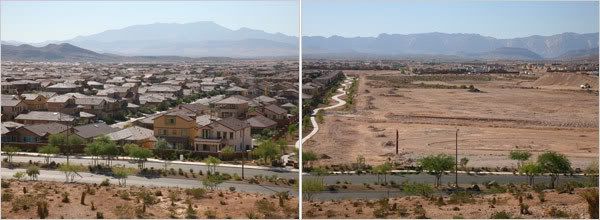 The Mountain’s Edge development sits on land once owned by the federal government in the Las Vegas Valley.
The New York Times reports:
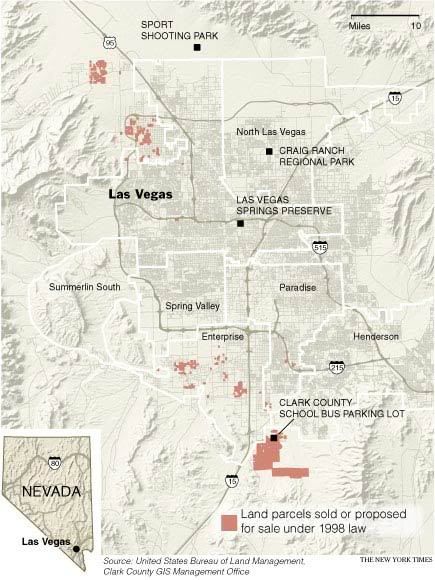
When it opens in 2009, the Clark County Shooting Park will be something to behold, through a scope or otherwise: hundreds of acres devoted to all things gun and bow, complete with a rifle range, a skeet center and an R.V. “host area.”
Las Vegas and other local governments in Nevada quickly caught on that the sales of lands on their outskirts could be used to improve life in the heart of their cities. Local officials find that arrangement fair, but not everyone does.
The coming Craig Ranch Regional Park, due in 2010, should be impressive too, with plans calling for an amphitheater, an aquatics center and sand volleyball courts, all wound around native gardens and wetlands.
Much of the financing for the projects has not come from familiar sources, like local taxes, bond issues or private donations. Instead, they are being paid for through the sales of public lands owned by the federal government.
Tens of thousands of acres of federal lands in the Las Vegas area have been sold under an unusual law pushed through Congress nearly a decade ago by the Nevada delegation. The sales have grossed nearly $3 billion and counting.
Because of a stipulation created by the Nevada legislators, the money has not been deposited into the general federal Treasury, but rather put in a special Treasury account to be spent almost exclusively in Nevada on a something-for-everyone collection of projects.
The money has bought environmentally sensitive land and paid for conservation projects, a central purpose of the law and its amendments, as well as improvements in national recreation and refuge areas. But it has also been allocated to such nuts-and-bolts governmental services as education and water projects, and a variety of local perks, including boat ramps, nature trails and community parks complete with tennis courts, dog runs and barbecue pits.
Supporters say the law, which authorized competitive auctions, has been a godsend for a region dealing with rampant population growth, limited room to grow, scarce water and facilities overwhelmed by their own popularity. But critics see it as having created a limitless federal bank account that has encouraged and subsidized unbridled growth at the expense of taxpayers from the 49 other states, all while Nevada continues to draw new residents as a low-tax state disinclined to pay for such projects itself.
Even some ardent fans of the law say the infusion of cash has led to overreaching on the part of some municipalities in Clark County, the mother ship for three growing cities: Las Vegas, North Las Vegas and Henderson.
“We’ve gotten a bit greedy,” said Michael L. Montandon, the mayor of North Las Vegas, which has had $176 million worth of projects approved, including $85.3 million for Craig Ranch. “When your neighboring cities are asking for five times what you are, it tends to make your staff run around looking for projects.”
To gauge the law’s impact since its passage in 1998, The New York Times analyzed data from the United States Bureau of Land Management, the landlord for the federally owned lands. The analysis covered the more than 29,000 acres sold under the law as of Nov. 1, as well as the $2.3 billion in expenditures allocated to projects as of Aug. 31 by the Department of the Interior, which oversees distribution of the money.
The examination found the following:
More than $1 billion in proceeds from the federal land sales have been allocated for parks, trails and nature areas that often amount to public amenities — many of which elected officials say they would not have been able to pay for otherwise. The projects have enhanced property values, and benefited big-name developers, including Focus Property Group, the American Nevada Company, the Del Webb Corporation and the Olympia Development Group, all of which have bought large parcels of arid public lands and turned them into elaborate housing tracts.
Nevada’s schools, which have long sought more money from state lawmakers who resisted raising taxes as enrollment mushroomed, have received $150 million from the sale of the federal lands. The interest on that money has paid for expenses including teachers’ salaries, utility bills and textbooks, which in other states would usually be underwritten by local property taxes.
 Las Vegas and other local governments in Nevada quickly caught on that the sales of lands on their outskirts could be used to improve life in the heart of their cities. Local officials find that arrangement fair, but not everyone does.
The 1998 law uses the same legal framework as a 1920s land act under which the Clark County School District has bought some 685 acres through noncompetitive direct sales for an average of $10 an acre since 2004 to provide land for public schools.
The Southern Nevada Water Authority, the agency that has long provided cheap water to the valley’s two million residents, has received $285 million from the federal land sales, which it has used on a variety of water treatment, testing and transport projects, including facilities at drought-plagued Lake Mead. Plans for revenue from future land sales, water officials say, could include work on a pipeline to import water from 250 miles away.
The acquisition and protection of environmentally sensitive land in private hands was a central element of the law’s purpose, but allocations for those purchases have accounted for only about 15 percent ($346.1 million) of the $2.3 billion in approved spending. Moreover, there has been a net loss of protected land: thus far, some 34,468 acres of public land have been sold or exchanged, while a little more than 20,000 acres of environmentally sensitive land have been bought, though federal officials say other big deals are pending.
Spending on conservation projects, a focus of an amendment to the law in 2002, has also lagged behind other construction-heavy categories. Some $180 million has been allocated for continuing projects like programs to fight litter and dumping, studies of off-road vehicle and water strategies, and wild horse and burro management.
Still, some expenditures designated as conservation have been so broadly defined that they resemble traditional pork. Among them are a mobile fire education trailer ($132,000), an interagency Web site ($269,000), and several plans devoted to safety programs for the region’s abandoned mines ($3 million).
Millions of dollars from the sale of federal lands has been set aside to meet federal requirements — typically the responsibility of local governments — to offset environmental damage from the city’s sprawling growth. Under the act, $53 million has been allocated to help communities in Clark County and the Nevada Department of Transportation to conform with requirements of the Endangered Species Act when development encroaches on native habitats.
Critics argue that the sales help pay for the infrastructure that then supports more expansion.
“Fundamentally, we’re talking about selling public lands which belong to all Americans and giving the proceeds back to local counties for what would ostensibly be conservation projects,” said Myke Bybee, public lands representative for the Sierra Club in Washington. “But those projects,” Mr. Bybee said, are not always “in keeping with conservation.”
That said, in Nevada the law is widely seen by Republicans and Democrats alike as paying off for most everyone at the table, a rarity in a gambling town. Among the winners are developers — who now have access to lands long deemed off-limits — and municipalities, which have added dozens of new recreational amenities, thousands of new residents to tax rolls, and improved the quality of life, all without raising taxes.
“This bill has been across the board incredible for the entire state, for quality of life, for economic development, for managing growth,” said Senator John Ensign, a Republican, who was the bill’s author while serving in the House of Representatives. “And for doing things to make Nevada a better place.”
The law’s original boundary for eligible federal land sales was expanded by Congress in 2002, and some groups, including the Las Vegas Chamber of Commerce, are lobbying to expand it even farther. The allowable area has grown by about 40 percent, or 22,000 acres more than the original 52,000 approved by Congress.
Spreading the Wealth
More and more local officials now want a piece of the land pie. In recent years, Congress has authorized the sale of up to 135,000 acres of public land in White Pine and Lincoln Counties in eastern Nevada. Another later law was enacted in 2000 that requires 80 percent of proceeds from federal land sales be spent in the states where the land is located. And there are similar proposals in other Western states, including land hand-overs to localities in central Idaho and land sales in Washington County, Utah, another fast-growing desert area.
Moreover, local authorities are getting ever bolder in using the proceeds from the federal land sales for expenses not traditionally covered by money from federal taxpayers. More recent bills, authorizing the sales in eastern Nevada, funnel 10 percent of federal proceeds back into law enforcement, fire protection and transportation, traditionally the bailiwick of local governments.
Efforts to redirect at least some of the proceeds from the sales of federal lands into the general federal Treasury have repeatedly been beaten back by the politically connected Nevada delegation, which is now headed by the Senate majority leader, Harry Reid, a Democrat. In recent years, the Bush administration twice failed in efforts to take back some of the payout for the Treasury.
In many ways the law, formally known as the Southern Nevada Public Land Management Act of 1998, has created a new model for managing much of the federally owned land in the West, which encompasses more than 80 percent of the state of Nevada and huge chunks of Utah, Idaho, Wyoming, Arizona, California and Oregon. That model provides a faster way of moving public lands into private hands, and encouraging growth into inhospitable places, in this case, the Mojave Desert.
That local and federal governments work together on such deals is remarkable considering the historic tension between federally owned public lands and the all-American desire for private property. The centuries-old debate has resonated from the high-mindedness of Manifest Destiny’s westward push in the early 1800s to the frenzied scramble of Civil-War-era homesteaders to the defiance of the Sagebrush Rebellion of the 1970s and ’80s, in which ranchers and local officials in the West wanted federal lands transferred to local governments or sold to private owners.
In each case, the central question has been what exactly do America’s national lands represent: Are they expendable, tradeable, and now, salable resources meant to be made private for the sake of progress and individual gain? Or are they public treasures to be protected at all costs, even when they are essentially arid wastelands?
In the Las Vegas area, the answer has increasingly been to sell. The first of a wave of omnibus lands bills passed by a Republican-led Congress, the Nevada law of 1998 was viewed as a pragmatic compromise by environmental groups eager to guarantee the purchase and exchange of fragile habitat.
Subsequent laws affecting other parts of Nevada — which brought environmental groups, land owners and others into negotiations — have coupled land sales with the designation of hundreds of thousands of acres as wilderness. Those wilderness designations, which ban development, were trumpeted by local lawmakers and welcomed even by those who worried about land sales.
“We had a decision to make: Do we pursue this opportunity to protect these special places or do we not?” said Jeremy Garncarz, the associate director of wilderness support at the Wilderness Society. “And we made the decision to pursue the opportunity to protect these places.”
But as the 1998 law has played out, some of its early supporters among environmentalists have also soured on it. The Office of Management and Budget, an arm of the White House, assessed the program in 2004 and said that while it had been “fairly well run,” its revenues were “increasingly being dedicated to low-priority activities.”
Original Intent
“The original concept was to allow private, environmentally sensitive land to be bought more readily,” Jeff Van Ee, a longtime Nevada environmentalist who helped lawmakers draw up the law. “But over the years, what we’ve seen is the money going all over the place, and too much money going to projects that should be funded through more conventional means.”
Sales at auction have accounted for the vast majority of the law’s proceeds, with more than $2.7 billion in sales from 13,000 acres, much of it situated on the edge of cities and primed for development. In a federal-local dance officially known as joint selection, municipalities nominate land for sale once they have determined their infrastructure can support them, said Steve Tryon, assistant field manager for the Las Vegas office of the Bureau of Land Management.
“The cities of Las Vegas and North Las Vegas and Henderson are kind of driving the show,” he said of the selection process, also mentioning that Clark County was very active.
Mr. Tryon said the 1998 law had increased the use of sales provisions in the Federal Land Policy and Management Act of 1976, resulting in more than 14,000 acres sold via direct sale to developers, localities and individuals who owned property adjacent to federal lands. Those sales grossed only a small fraction of the auction sales, bringing in only $114 million.
Nevada lawmakers say it is unfair to view expenditures under the law as a raid on the federal Treasury since the federal government is the largest landowner in Nevada and should be expected to contribute to the state’s economic well-being, just as big private land owners do in other states.
Senator Reid also said that the improvements, including the money spent on parks, trails and natural areas, were on facilities that the general public could use. “All the money is used on public land,” he said. “It doesn’t go onto the Las Vegas Strip.”
Before the 1998 public lands law, the government often converted land to private hands through land exchanges. The deals were regularly criticized by lawmakers and taxpayers, who thought the government gave too much, and wilderness lovers, who thought they got too little.
Land sales, through acts like the 1980 Santini-Burton Act (which sold small tracts of Las Vegas-area land to finance land purchases in the Tahoe basin), were also laborious and the take often meager. A report in September 2001 by the General Accounting Office found that the Bureau of Land Management had sold 79,000 acres between 1991 and 2000 and received just $3 million.
Under the 1998 act, the sales have grossed nearly 1,000 times that figure in the same amount of time — with less than half as much land. One reason is timing: the auctions began just as the Las Vegas real estate market heated up.
The proceeds took the law’s architects by surprise. The Congressional Budget Office estimated in 1998 that the sales would gross some $350 million over seven years. But developers spent more than twice that on a single day in November 2005, when 2,887 acres brought a record $783 million in bids. The majority of auction offerings have been parcels of 10 acres or less. But by 2002, a few large swaths of public lands, more than 100 acres each, were starting to attract bids. At auctions in 2004 and 2005, three bidders bought a combined 10 square miles of land for $1.7 billion for master-planned communities. These developments, often with tens of thousands of units, effectively convert desert into suburbia, complete with parks, artificial lakes, and preternaturally green golf courses.
One of those master builders is John Ritter, chief executive of Focus Property Group, who called the act “a tremendous success,” adding that the fact that sale proceeds would be spent near the communities his company built was an added bonus.
“It’s a well-thought-out way to release land,” said Mr. Ritter, whose company paid $557 million for 1,940 acres at an auction in 2004.
Boat Ramps and Toilets
As quick as money flowed in to the special account, it flowed out. All spending requires authorization by the secretary of the interior from money held in an interest-bearing account, with recommendations from a four-member committee representing four major agencies that receive money from the act, the National Park Service, the United States Forest Service, the Fish and Wildlife Service and the Bureau of Land Management.
Purchases receiving a green light have included a handsome array of land considered environmentally sensitive, which can be recommended by any interested group in the state, including nonprofit organizations and private landholders.
Among the highlights are the planned purchase of Incline Lake near Lake Tahoe, an $83 million project headed by the United States Forest Service, which plans to open it to the public.
But other approved projects read like a Christmas list drafted in Carson City, the state capital: $50.3 million for erosion control and fire prevention programs at Lake Tahoe; $28.8 million in improvements to the picturesque and increasingly popular Red Rock Canyon conservation area; $49.4 million for trails and other amenities at the Springs Preserve, a new environmentally friendly tourist attraction in downtown Las Vegas; and $495,900 for 30 “premier” toilets, complete with “flush technology and solar lighting” at nearby Lake Mead.
This summer, ground was also broken on a tract of low-cost housing in southern Las Vegas, land sold to nonprofit developers at 5 percent of its appraised value.
More than $400 million has also been allocated for building projects on federal lands for the four agencies represented on the executive committee. The law has also been amended six times, and 10 federal agencies, including the Highway Administration and the Army Corps of Engineers, now receive money through it.
Many projects have been focused on Lake Mead, on water pipes, boat ramps and restrooms, as well as pleasantries like picnic tables and campgrounds. But the land sales have also helped federal agencies subsidize basic infrastructure needs, including phone lines, housing, equipment shelters, road construction, fire stations, parking lots, fencing and power supply.
A report last year by the Office of Management and Budget also raised questions about some of the spending, saying too much money went to “purely local projects, which do not reflect the highest priorities of the nation.”
Easing the Burden
Sure enough, the biggest category of approved spending by far has been the urban and suburban projects nominated by local governments, which quickly caught on that the sales of lands on their outskirts could be used to improve life in the heart of their cities. Local officials say that is only fair, arguing that the opening of the lands — and subsequent population growth — increases the stress on local governments to provide services and infrastructure.
The public expenditure, said Erik Pappa, a spokesman for Clark County, in an e-mail message, “relieves some of that burden by providing funding for amenities to improve our quality of life.”
Amendments to the original law have also opened up more categories of spending, including up to $300 million to be set aside for restoration programs in the Lake Tahoe basin, and new counties and groups eligible for money, including fire-safe councils and the Washoe Indian tribe. Some money has also started to be allocated for projects in California, as part of fire prevention programs in the Lake Tahoe region, which includes both states.
In 2006, $476 million was allocated to parks, trails and natural areas throughout the state, a category that has included such cherries as a $1.4 million softball complex in Caliente, a $10 million Las Vegas park with boccie and shuffleboard courts and a $1.5 million planning grant for picnic grounds in Alamo.
P. Lynn Scarlett, the deputy secretary of the interior, defended her agency’s performance, saying the Bureau of Land Management “has very vigorously and carefully selected projects” for the various categories approved by Congress. Ms. Scarlett also said that the disparity between land sold and land bought would most likely equalize as pending purchases of tens of thousands of acres of environmentally sensitive land went through.
For now, with the real estate market here and nationally in a tailspin, the flow of new financing has slowed. Likewise, sales at auctions so far this year have brought in only $20 million.
At the most recent auction, on Nov. 1, the average price per acre topped $500,000, though only one parcel — of 31 offered — sold. In the early days, an acre typically fetched less than $100,000.
Both developers and local politicians have blamed the auction system for inflating land values in the Las Vegas Valley, and some groups have started to push for the boundary to be expanded even farther to lower those costs.
Steve Hill, a major concrete supplier and the chairman of the governmental affairs committee of the Las Vegas Chamber of Commerce, said the lack of available land was making it hard for housing projects to make financial sense, a situation made worse by the mortgage crisis. As such the law was unintentionally encouraging the growth of far-flung suburbs throughout Southern Nevada, Mr. Hill said. Because Las Vegas is encircled by federal lands, these suburbs are forced miles away.
“There are those that feel that land constraint is part social engineering, but the idea that we’re going to squeeze people outside the disposal boundary and push them 50 miles away has social and environmental consequences as well,” he said. “It would be like saying, you can live on the island of Manhattan or you have to live 50 miles away.”
Defenders of the growth of Las Vegas, which is expected to devour its available land by 2017, say the city is in fact very dense, not sprawling. They often refer to the “Manhattanization” of the city, with more and more vertical developments planned, making even more urgent the demand for public parks and other amenities.
“I believe in 100 years they’ll be studying this as a great piece of public policy,” Mr. Montandon, the North Las Vegas mayor, said of the 1998 law. “I think it will go right up beside Robert Moses building New York.”
Meanwhile, plans for similar land sales are moving forward elsewhere in the West. A bill to sell land in fast-growing Washington County in southwestern Utah stalled in Congress last year. But its author, Senator Robert F. Bennett of Utah, said he would introduce another version this year.
Both of Nevada’s senators, Mr. Ensign and Mr. Reid, are circumspect about the spoils or the concept being expanded elsewhere.
“Nevada is doing just fine,” said Mr. Reid, who posed at the ground-breaking for the $64 million shooting range in October 2006. “But I’m not going to be trying to be a missionary for people doing this in other states.”
Public Lands: Treasure or Commodity?
The federal government has sold nearly $3 billion of federal land in the Las Vegas area under a law pushed through Congress nearly a decade ago by Nevada legislators. Some of the projects funded by the proceeds.
Sunday, December 2, 2007
| [+/-] |
Business Lobby Presses Agenda Before '08 Vote |
The NY Times reports:
Business lobbyists, nervously anticipating Democratic gains in next year’s elections, are racing to secure final approval for a wide range of health, safety, labor and economic rules, in the belief that they can get better deals from the Bush administration than from its successor.
Ivan H. Adler, an executive recruiter, says Democratic lobbyists are in demand.
Hoping to lock in policies backed by a pro-business administration, poultry farmers are seeking an exemption for the smelly fumes produced by tons of chicken manure. Businesses are lobbying the Bush administration to roll back rules that let employees take time off for family needs and medical problems. And electric power companies are pushing the government to relax pollution-control requirements.
“There’s a growing sense, a growing probability, that the next administration could be Democratic,” said Craig L. Fuller, executive vice president of Apco Worldwide, a lobbying and public relations firm, who was a White House official in the Reagan administration. “Corporate executives, trade associations and lobbying firms have begun to recalibrate their strategies.”
The Federal Register typically grows fat with regulations churned out in the final weeks of any administration. But the push for such rules has become unusually intense because of the possibility that Democrats in 2009 may consolidate control of the White House, the Senate and the House of Representatives for the first time in 14 years.
Even as they try to shape pending regulations, business lobbies are also looking beyond President Bush. Corporations and trade associations are recruiting Democratic lobbyists. And lobbyists, expecting battles over taxes and health care in 2009, are pouring money into the campaigns of Democratic candidates for Congress and the White House.
Randel K. Johnson, a vice president of the United States Chamber of Commerce, said, “I am beefing up my staff, putting more money aside for economic analysis of regulations that I foresee coming out of a possible new Democratic administration.”
At the Transportation Department, trucking companies are trying to get final approval for a rule increasing the maximum number of hours commercial truck drivers can work. And automakers are trying to persuade officials to set new standards for the strength of car roofs — standards far less stringent than what consumer advocates say is needed to protect riders in a rollover.
Business groups generally argue that federal regulations are onerous and needlessly add costs that are passed on to consumers, while their opponents accuse them of trying to whittle down regulations that are vital to safety and quality of life. Documents on file at several agencies show that business groups have stepped up lobbying in recent months, as they try to help the Bush administration finish work on rules that have been hotly debated and, in some cases, litigated for years.
At the Interior Department, coal companies are lobbying for a regulation that would allow them to dump rock and dirt from mountaintop mining operations into nearby streams and valleys. It would be prohibitively expensive to haul away the material, they say, and there are no waste sites in the area. Luke Popovich, a vice president of the National Mining Association, said that a Democratic president was more likely to side with “the greens.”
A coalition of environmental groups has condemned the proposed rule, saying it would accelerate “the destruction of mountains, forests and streams throughout Appalachia.”
A priority for many employers in 2008 is to secure changes in the rules for family and medical leave. Under a 1993 law, people who work for a company with 50 or more employees are generally entitled to 12 weeks of unpaid leave to care for newborn children or sick relatives or to tend to medical problems of their own. The Labor Department has signaled its interest in changes by soliciting public comments.
The National Association of Manufacturers said the law had been widely abused and had caused “a staggering loss of work hours” as employees took unscheduled, intermittent time off for health conditions that could not be verified. The use of such leave time tends to rise sharply before holiday weekends, on the day after Super Bowl Sunday and on the first day of the local hunting season, employers said.
Debra L. Ness, president of the National Partnership for Women and Families, an advocacy group, said she was “very concerned that the Bush administration will issue new rules that cut back on family and medical leave for those who need it.”
That could be done, for example, by narrowing the definition of a “serious health condition” or by establishing stricter requirements for taking intermittent leave for chronic conditions that flare up unexpectedly.
The Chamber of Commerce is seeking such changes. “We want to get this done before the election,” Mr. Johnson said. “The next White House may be less hospitable to our position.”
Indeed, most of the Democratic candidates for president have offered proposals to expand the 1993 law, to provide paid leave and to cover millions of additional workers. Senator Christopher J. Dodd of Connecticut was a principal author of the law. Senator Hillary Rodham Clinton of New York says it has been “enormously successful.” And Senator Barack Obama of Illinois says that more generous family leave is an essential part of his plan to “reclaim the American dream.”
Susan E. Dudley, administrator of the White House Office of Information and Regulatory Affairs, said, “Research suggests that regulatory activity increases in the final year of an administration, regardless of party.”
Whoever becomes the next president, Democrat or Republican, will find that it is not so easy to make immediate and sweeping changes. The Supreme Court has held that a new president cannot arbitrarily revoke final regulations that already have the force of law. To undo such rules, a new administration must provide a compelling justification and go through a formal rule-making process, which can take months or years.
Within hours of taking office in 2001, Mr. Bush slammed the brakes on scores of regulations issued just before he took office, so his administration could review them. A study in the Wake Forest Law Review found that one-fifth of those “midnight regulations” were amended or repealed by the Bush administration, while four-fifths survived.
Some of the biggest battles now involve rules affecting the quality of air, water and soil.
The National Chicken Council and the U.S. Poultry and Egg Association have petitioned for an exemption from laws and rules that require them to report emissions of ammonia exceeding 100 pounds a day. They argue that “emissions from poultry houses pose little or no risk to public health” because the ammonia disperses quickly in the air.
Perdue Farms, one of the nation’s largest poultry producers, said that it was “essentially impossible to provide an accurate estimate of any ammonia releases,” and that a reporting requirement would place “an undue and useless burden” on farmers.
But environmental groups told the Bush administration that “ammonia emissions from poultry operations pose great risk to public health.” And, they noted, a federal judge in Kentucky has found that farmers discharge ammonia from their barns, into the environment, so it will not sicken or kill the chickens.
On another issue, the Environmental Protection Agency is drafting final rules that would allow utility companies to modify coal-fired power plants and increase their emissions without installing new pollution-control equipment.
The Edison Electric Institute, the lobby for power companies, said the companies needed regulatory relief to meet the growing demand for “safe, reliable and affordable electricity.”
But John D. Walke, director of the clean air program at the Natural Resources Defense Council, said the rules would be “the Bush administration’s parting gift to the utility industry.”
If Democrats gain seats in Congress or win the White House, that could pose problems for all-Republican lobbying firms like Barbour, Griffith & Rogers, whose founders include Gov. Haley Barbour of Mississippi, a former chairman of the Republican National Committee.
Loren Monroe, chief operating officer of the Barbour firm, said: “If the right person came along, we might hire a Democrat. And it’s quite possible we could team up in an alliance with a Democratic firm.”
Two executive recruiters, Ivan H. Adler of the McCormick Group and Nels B. Olson of Korn/Ferry International, said they had seen a growing demand for Democratic lobbyists. “It’s a bull market for Democrats, especially those who have worked for the Congressional leadership” or a powerful committee, Mr. Adler said.
Few industries have more cause for concern than drug companies, which have been a favorite target of Democrats. Republicans run the Washington offices of most major drug companies, and a former Republican House member, Billy Tauzin, is president of their trade association, the Pharmaceutical Research and Manufacturers of America.
The association has hired three Democrats this year, so its lobbying team is split evenly between Republicans and Democrats.
Loren B. Thompson, a military analyst at the Lexington Institute, a policy research organization, said: “Defense contractors have not only begun to prepare for the next administration. They have begun to shape it. They’ve met with Hillary Clinton and other candidates.”
Friday, November 9, 2007
| [+/-] |
Oil Oozes in San Francisco Bay After Ship Hits Golden Gate Bridge |
About 58,000 gallons of heavy fuel spilled, threatening wildlife and closing beaches.
 Alcatraz is surrounded by oil slicks that leaked from a cargo ship after it bumped the San Francisco -Oakland Bay Bridge
The LA Times reports:
Crews were racing Thursday to mop up 58,000 gallons of fuel that spilled after a cargo ship bumped into the San Francisco-Oakland Bay Bridge.
Spread by the tides, the fuel slick from Wednesday's accident shut down several beaches and threatened shorebirds, seals and other marine mammals that make a home in the bay.
By Thursday afternoon, 26 oil-covered birds had been rescued by wildlife crews, while six birds were found dead. Hundreds more had been caught in the spreading slick, said Steve Edinger, assistant chief for the California Department of Fish and Game.
The slick had also spread outside the bay, as far as Tennessee Point in Marin County, 10 miles north of the Golden Gate.
"This is a significant event," Edinger said. "This is one we're very concerned about."
He said the last major oil spill in the bay occurred in 1996, when 10,000 gallons oozed out of a ship in a repair facility.
Melissa Hauck of the U.S. Coast Guard said eight oil-skimming boats were working to clean up the slick. By late afternoon, 9,500 gallons had been collected, as well as 3 cubic yards of oil in gel or solid form. The spill was of bunker fuel, a viscous fuel used on ships that is heavy and can be difficult to clean up.
Authorities also laid 11,000 feet of log booms around the 810-foot container ship Cosco Busan, which was towed to an anchorage off Candlestick Point in San Francisco after it nudged the Bay Bridge in morning fog. No more fuel was leaking from the vessel, Hauck said.
The ship struck a steel and concrete buttress that protects one of the suspension bridge's massive support towers about 8:30 a.m. Wednesday, gouging the hull on the front port side above the water line. Authorities said the bridge piling was not damaged and that the protective shield would be repaired.
Coast Guard officials said the Cosco Busan was being guided out of the bay by a pilot familiar with the waters when the accident occurred.
The spill in the bay is relatively small. The 1989 Exxon Valdez disaster dumped 11 million gallons of crude oil off Prince William Sound. A spill in 2001 off the Galapagos Islands spread more than 160,000 gallons through the ecologically fragile archipelago.
Still, public officials voiced criticism that the Coast Guard initially underestimated it.
Hours after the accident, Coast Guard officials described the fuel leak as a relatively insignificant 140 gallons. But by Thursday morning, the estimate had skyrocketed to nearly 60,000 gallons.
Sen. Barbara Boxer (D-Calif.) released a letter she wrote Thursday to the head of the Coast Guard, expressing dismay over the delay in accurately assessing the risk as well as questioning the investigation into the cause.
"Many questions remain as to why it took an entire day to determine the gravity of this spill, and whether the Coast Guard took appropriate measures to conduct drug and alcohol tests on the ship's pilot and navigators in a timely fashion," Boxer wrote to Adm. Thad W. Allen.
Coast Guard officials said the investigation was ongoing.
The fuel slick soiled at least nine beaches and parks: Muir Beach, Kirby Cove, Rodeo Beach, Black Sand Beach, Baker Beach, Crissy Field, China Beach, Angel Island and Fort Point.
Thirteen state and federal agencies set up a command center at Fort Mason in San Francisco and were meeting to discuss the mop-up.
Oil slicks create problems for shorebirds by coating their feathers, robbing them of their natural ability to stay warm in the chilly bay water.
"It's sort of like a rip in a wetsuit," Edinger said. "They get cold, they beach themselves and they start preening their feathers. They can ingest oil, and that shuts down their digestive system. They lose energy and the ability to take on water and moisture."
Birds that escape the slick can fall prey to a different peril: They can't find food, become debilitated and may die.
Edinger said most birds being treated were surf scoters, but there were reports of gulls and other shorebirds being affected. He said the next two or three days could see the numbers of imperiled birds jump significantly.
Experts from the Oiled Wildlife Care Network, a UC Davis program, have been called in by Fish and Game.
Sunday, November 4, 2007
| [+/-] |
Atlanta Water Use is Called 'Shortsighted' |
The rapidly growing metropolis' 'cavalier' attitude toward conservation is the real problem, critics say.
The LA Times reports:
When Rick McKee, the editorial cartoonist of the Augusta Chronicle newspaper, set out to capture the historic and severe drought that is afflicting the Southeast, he did not draw parched rivers or shriveled crops or brown lawns: He drew an oafish, bloated hulk of a boy holding up a straw to slurp up water from a smaller boy's water fountain.
Above the larger boy, a sign reads "Atlanta," above the other, "Everybody else."
It is, in many ways, a cartoon that sums up feelings across the Southeast now that Lake Lanier, the reservoir that supplies drinking water to most of metropolitan Atlanta's 5 million residents, is draining to historic lows. With government officials issuing stark projections that Atlanta could run out of water within three months, Georgia politicians have pleaded with the U.S. Army Corps of Engineers to decrease the amount of water being released. The flow has been required to save two species of mussels 200 miles downriver.
Yet while Georgia's leaders try to cast the water shortage as a battle between 5 million people and a few mussels -- with the message that greater priority should be given to Atlanta residents -- there is a growing sense that the metropolis itself is the problem: Critics say Atlanta's rapid population growth, coupled with blithe disregard for water conservation, is straining the region's ecosystem.
A break came Thursday in Georgia's 17-year water war with Florida and Alabama: The GOP governors of the three states agreed to reduce by 16% the amount of water released downriverfrom Lake Lanier, which would slow the drain on Atlanta's main water source.
But experts say the Southeast's struggles over water resources are far from over.
"What was not on the table, and what has got to be on the table, is Atlanta's unrestricted growth and cavalier attitude to water use," said Sally Bethea, executive director of Upper Chattahoochee Riverkeeper, a watchdog group.
Such concerns are not coming just from environmental lobbyists, who have long argued that Atlanta must do more to conserve water.
Florida Gov. Charlie Crist, in opposing a request by Georgia Gov. Sonny Perdue to President Bush to permit a reduced downstream flow, wrote in his own letter to Bush that Florida's $134-million commercial seafood industry depended on the water. Crist added that his state had acted responsibly in enacting water legislation. Alabama Gov. Bob Riley argues that downstream communities and a nuclear power plant in his state require water too.
Even within Georgia, the drought has brought to the fore long-simmering resentment against the booming capital of the New South. About 140 miles east in Augusta, which sits on the Savannah River, there is concern that Atlanta could slake its thirst on Augusta's water supplies. Last month, Atlanta Mayor Shirley Franklin suggested that Atlanta explore piping in water from the Savannah or Tennessee rivers.
"Atlanta is a greedy, poorly designed behemoth of a city incapable of hearing the word 'no' and dealing with it," said a recent editorial in the Valdosta (Ga.) Daily Times.
The editorial said Atlanta's "politicians can't bring themselves to tell their greedy constituents complaining about the low flows in their toilets this week that perhaps if they didn't have six bathrooms, it might ease the situation a bit."
Atlanta is not the only city grappling with water shortages. In 2003, a Government Accountability Office report on the nation's freshwater supply found that 36 states anticipated water shortages in the next decade.
Two months ago, a federal judge in California ordered protective measures for the tiny endangered smelt fish in the Sacramento-San Joaquin River Delta, a mandate that water officials said could cut by a third the flow of water to Southern California from the north.
Yet while cities such as Los Angeles, Las Vegas and Denver have ushered in water conservation measures -- including offering incentives, installing high-efficiency toilets and low-flow shower heads, and increasing monthly water bills for big water users -- experts say Atlanta, one of the fastest-growing metropolitan regions in the country, has been particularly shortsighted.
Atlanta was founded far from any major river or lake. The metro area had a population of 2.9 million in 1990 and 4.1 million in 2000, and its daily draw on the water reserve was 320 million gallons in 1990 and 420 million in 2000.
With 2 million more residents projected by 2030, water use is expected to rise to more than 700 million gallons a day.
For its drinking water, Atlanta relies almost entirely on Lake Lanier, a 38,000-acre reservoir in northern Georgia built in the 1950s.
"If your population is growing, you cannot expect to do the same old things you did a decade ago," said Chris Brown, executive director of the California Urban Water Conservation Council. "You have to change the way you behave."
This has not happened in Atlanta, conservationists say. In 2003, the area's 16-county Metropolitan North Georgia Water Planning District adopted a water conservation plan. Yet most counties have not implemented the recommendations, such as reducing leaks and raising billing rates for those who use more water.
Last year, a bill failed in the state House of Representatives that would have required older homes to be retrofitted with low-flow fixtures before they were resold.
Some environmentalists are questioning whether Atlanta can handle 2 million more people.
"Conservation may not be the answer in and of itself," said Elizabeth Nicholas, general counsel for Upper Chattahoochee Riverkeeper. "There just isn't enough fresh water here to support major growth. We need to be smarter about how and where we're growing."
Conservationists' suggestion that the state should prohibit building if no water is available rankles developers and the business community.
"People are coming to this state whether environmentalists like it or not," said Ed Phillips, executive vice president of the Home Builders Assn. of Georgia. "What are we going to do? Put up a fence?"
Many of Georgia's political leaders say the solution to the drought is not to stop developing but to manage water more efficiently, building more reservoirs to enhance water storage.
"We have not consumed our way into drought," said Carol Couch, director of the Environmental Protection Division of the Georgia Department of Natural Resources. She said there must be planning to accommodate growth, including building more reservoirs and encouraging residents to conserve and reuse water.
Conservationists have traditionally opposed additional reservoirs, arguing they would lead to much water loss through evaporation and would severely affect the environment.
Last month, Georgia Republicans Lt. Gov. Casey Cagle and House Speaker Glenn Richardson proposed legislation that would commit millions of dollars in the 2008 session to build reservoirs and enlarge existing ones.
For now, as water levels at Lake Lanier drop about a foot a week, Atlantans have been urged to shorten showers and to report neighbors who violate the ban on outdoor watering. Businesses have been asked to cut water use by 10%.
Last week's tri-state compromise is awaiting approval by the U.S. Fish and Wildlife Service. The agency is expected to issue its opinion by the middle of this month after assessing how the reduced flows could affect the endangered fat threeridge and threatened purple bankclimber mussels in Florida's Apalachicola River. The U.S. Army Corps of Engineers would execute any change.
| [+/-] |
Pollution From China's Coal-Fired Plants Take Only 5 To 10 Days To Reach U.S. |
World's growing dependence on coal leaving a trail of environmental devastation
 Chinese coal workers load coal unto trucks in Baotou, nestled in the sand-sculpted ravines of Inner Mongolia, China, Tuesday, May 8, 2007. (AP Photo/Elizabeth Dalziel)
The Associated Press reports:
It takes five to 10 days for the pollution from China's coal-fired plants to make its way to the United States, like a slow-moving storm.
It shows up as mercury in the bass and trout caught in the Willamette River in the western U.S. state of Oregon. It increases cloud cover and raises ozone levels. And along the way, it contributes to acid rain in Japan and South Korea and health problems everywhere from Taiyuan to the United States.
This is the dark side of the world's growing use of coal.
Cheap and abundant, coal has become the fuel of choice in much of the world, powering economic booms in China and India that have lifted millions of people out of poverty. Worldwide demand is projected to rise by about 60 percent through 2030 to 6.9 billion tons a year, most of it going to electrical power plants.
But the growth of coal-burning is also contributing to global warming, and is linked to environmental and health issues ranging from acid rain to asthma. Air pollution kills more than 2 million people prematurely, according to the World Health Organization.
"Hands down, coal is by far the dirtiest pollutant," said Dan Jaffe, an atmospheric scientist at the University of Washington who has detected pollutants from Asia at monitoring sites on Mount Bachelor in Oregon and Cheeka Peak in Washington state. "It is a pretty bad fuel on all scores."
To understand the conflict over coal, look at Taiyuan and the surrounding Shanxi Province, the country's top coal-producing region — and one of its most polluted.
Almost overnight, coal has turned poor farmers in this city of 3 million people into Mercedes-driving millionaires, known derisively as "baofahu" or the quick rich. Flashy hotels display chunks of coal in the lobby, and sprawling malls advertise designer goods from Versace and Karl Lagerfeld. Real estate prices have doubled, residents say, and construction cranes fill the skyline.
A museum in Taiyuan celebrates all things coal. Amid photos of smiling miners, coal is presented as the foundation of the country's economic development, credited with making possible everything from the railroad to skin care products.
"Today, coal has penetrated into every aspect of people's lives," the museum says in one of many cheery pronouncements. "We can't live comfortably without coal."
Yet the cornstalks lining a highway outside the city 410 kilometers (255 miles) southwest of Beijing are covered in soot. The same soot settles on vegetables sold at the roadside, and the thick, acrid smoke blots out the morning sun. At its worst, the haze forces highway closures and flight delays.
With pressure to clean up major cities such as Shanghai and Beijing, particularly in the run-up to next year's Beijing Olympics, the central government is turning increasingly to provinces such as Shanxi to meet the country's power demands.
"They look at polluted places like Taiyuan and say it's so polluted there so it doesn't matter if they have another five power plants," said Ramanan Laxminarayan, a senior fellow at Resources For the Future, an American think tank that found links between air pollution and rising hospital admissions in Taiyuan.
"I visited these power plants and there is no concept of pollution control," he said. "They sort of had a laugh and asked, 'Why would you expect us to install pollution control equipment?'"
China is home to 20 of the world's 30 most polluted cities, according to a World Bank report.
Health costs related to air pollution total US$68 billion (€47 billion) a year, nearly 4 percent of the country's economic output, the report said. And acid rain has contaminated a third of the country, Sheng Huaren, a senior Chinese parliamentary official, said last year. It is said to destroy some US$4 billion (€2.8 billion) worth of crops every year.
"What we are facing in China is enormous economic growth, and ... China is paying a price for it," said Henk Bekedam, the country representative for the World Health Organization. "Their growth is not sustainable from an environmental perspective. The good news is that they realize it. The bad news is they're dependent on coal as an energy source."
But the costs go far beyond China. The soot from power plants boosts global warming because coal emits almost twice as much carbon dioxide as natural gas. And researchers from Texas A&M University found that air pollution from China and India has increased in cloud cover and major Pacific Ocean storms by 20 percent to 50 percent over the past 20 years.
"We know dust from factories in China, India, Mexico and Africa does not simply disappear; the wind brings it here," said the U.S. Chamber of Commerce's Bill Kovacs.
Kovacs said overseas dust is adding to the number of counties that do not qualify for federal transportation funds because they are out of compliance with ozone standards. More than 100 counties do not meet the limit of 84 parts per billion. China alone contributes 3 to 5 parts per billion, estimates Daniel J. Jacob, professor of atmospheric chemistry and environmental engineering at Harvard University.
Mercury, a byproduct of some coal-mining, is another major concern. The potent toxin falls into waterways and shows up in fish. Asia's contribution to U.S. mercury levels has shot up over the past 20 years. Jacob estimated half of the mercury in the United States comes from overseas, especially China.
"It's a global problem and right now China is a source on the rise," he said. "If we want to bring down mercury levels in fish, then we have to go after emissions in East Asia."
A fifth of the mercury in the Willamette River came from China and other foreign sources, said Bruce K. Hope of the Oregon Department of Environmental Quality. Pregnant or nursing women who eat the fish put their babies at risk of neurological damage.
"It's frustrating to realize that part of your problem is someone else's behavior and you can't really go to them and say, 'Can you do something different?'" Hope said.
China has closed some polluting factories and says it will retire 50 gigawatts of inefficient power plants, or 8 percent of the total power grid, by 2010, according to the Pew Center for Global Climate Change. The government has also mandated that solar, wind, hydroelectric and other forms of renewable energy provide 10 percent of the nation's power by 2010, and ordered key industries to reduce energy consumption by 20 percent.
President Hu Jintao, in a speech to a key party congress last month, promised a cleanup. But China has fallen short of its national targets for using energy more efficiently, and coal remains a major energy source.
"Everyone knows coal is dirty, but there is no way that China can get rid of coal," the World Bank's Zhao Jianping said in Beijing. "It must rely on it for years to come, until humans can find a new magic solution."
Robert N. Schock, the director of studies for the World Energy Council, agreed that coal, cheap and abundant, will remain a crucial source of energy for many years and be crucial to improving living standards in developing countries.
"Twenty-five percent of the world's electric power is now generated by coal, and those plants are not likely to disappear overnight," Schock said.
In Shanxi province, authorities have pledged to close 900 coal mines and dozens of makeshift factories that process coal for the steel industry, according to the official Xinhua News Agency. The Asian Development Bank is providing more than US$200 million (€139 million) in loans to improve air quality in the province, through programs to shift to cleaner-burning natural gas for household heating and a demonstration project to capture methane, a greenhouse gas released in coal mining.
Taiyuan, dubbed the world's most polluted city in the 1990s, is no longer thought to be the worst, thanks to various efforts including phasing out coal-burning boilers. But the level of pollutants in the air remains five to 10 times higher than levels in New York or London. Residents say they see blue skies fewer than 120 days a year.
Australians Paul and Helen Douglas, who work for Evergreen in Taiyuan, an American social service agency, said their 21-month-old daughter Rose has been found in tests to have elevated lead levels. She has developed a chronic cough, Paul Douglas said, and the family will likely return to Australia before their contract ends if their daughter's toxin levels rise further.
"People say we are irresponsible and that we are making decisions that are injuring our children," he said of coming under fire from relatives and church members for staying in Taiyuan.
Taiyuan residents, though, shrug wearily when the talk turns to pollution, fearful that speaking out could get them in trouble. But when pressed, the complaints tumble forth and expose a community held hostage by the soot.
Residents seal their windows to keep out the dirty air. Parents are warned not to let their toddlers play outside, for fear of being covered in coal dust. Fruits and vegetables must be washed in detergent.
"I'm worried about my children," said a woman who lives in the shadow of a power plant and fertilizer factory. She would only give her surname, Zhang. "We worry about everything. If you get sick seriously, you will die."
Many complain of chronic sore throats, bronchitis, lung cancer and pulmonary fibrosis. One study, by researchers at Norway's Center for International Climate and Environmental Research, found Taiyuan's pollution increased death rates by 15 percent and chronic respiratory ailments by 40 to 50 percent.
"I feel terrible and I'm coughing all the time," said William Li, a retired engineer from Taiyuan. His father died of lung cancer and his son has tracheitis, an upper respiratory condition. "The coal, it produces electric power that we send to other provinces. But we are left with the pollution."
