ABC News reports:
If you cringe when your read your monthly Internet or phone bill, take heart: Uncle Sam probably does too.
According to an internal Comcast cable company document, the giant cable-Internet-phone provider charges the government $1,000 nearly every time the FBI or other intelligence or law enforcement agency wants to surveil a person's e-mail or digital phone account.
Comcast provides cable-based communications service to millions of Americans. A company spokeswoman told ABC News "our first priority is our customers' privacy, but we want to balance that with the legitimate needs of law enforcement."
On top of its "start-up" fee, Comcast charges state and federal authorities $750 a month to maintain electronic surveillance, according to the document, which was obtained by the nonprofit Secrecy News Web site.
The fees are charged for nearly all law enforcement or intelligence surveillance requests. In cases involving child exploitation, Comcast waives the fees, the document states.
In addition to those surveillance services, Comcast can also provide state and federal authorities with customer billing information for a fee, according to the 35-page document, entitled "Law Enforcement Handbook." The company strives to respond "within eight to ten days" to government requests, the handbook states.
Depending on the type of information an agency wants, it can submit a letter of request, a criminal warrant, obtain a court order, submit a secret intelligence warrant or use a controversial "National Security Letter," according to the handbook.
The document sheds light on the quiet cooperation some communications companies give government authorities, at a time when aspects of that relationship are coming under fire.
Communications companies are required by law to provide law enforcement access to customer information and records that are needed for criminal investigations, as well as for certain intelligence operations.
The Democrat-led Congress, however, is turning up the heat on the Bush administration and major telecommunications carriers for a domestic spying operation involving phone and Internet customers that many people, including former Justice Department officials, believe operated outside the law.
Little is known about the effort, which the White House has since named the "Terrorist Surveillance Program," other than that it apparently involved the super-secret National Security Agency (NSA) and carriers like AT&T and Verizon, which provided the government with customers' phone records.
Congressional leaders have said the Bush administration has steadfastly refused to provide details on the program, although the White House has said it had "fully briefed" them.
In letters to Congress released yesterday, carriers AT&T, Verizon and Qwest declined to discuss the program. Qwest has previously stated it declined to participate in the program, despite overtures from the administration.
There have been no reports that Comcast, which provides digital phone service to 3.5 million people, has been involved in the TSP.
The Comcast handbook, dated September 2007 and stamped "Comcast Confidential," does not say how many requests for surveillance assistance Comcast has received.
Sunday, October 21, 2007
| [+/-] |
What Does Uncle Sam Pay to Read Your E-Mail? |
Friday, October 12, 2007
| [+/-] |
Transcript of 'Democracy Now!' for October 12, 2007 |
Charlie Savage, winner of the 2007 Pulitzer Prize for National Reporting, covers national legal affairs for the Boston Globe with a focus on 9/11 issues. He has written extensively about President Bush’s signing statements and other White House efforts to expand executive branch secrecy and unchecked power. Warrantless wiretapping is one part of this story. Savage has just published a book charting the means the Bush administration devised to circumvent laws and expand Presidential authority. It’s called “Takeover: The Return of the Imperial Presidency and the Subversion of American Democracy.”
The House Judiciary and Intelligence Committees approved a bill Wednesday granting federal judges greater oversight over the Bush administration’s warrantless surveillance program. Rejecting President Bush’s request, the bill does not provide retroactive legal immunity to phone and internet companies that shared information with intelligence officials. President Bush criticized the bill Tuesday and outlined his demands to renew the government’s broad eavesdropping authority.
Wednesday’s bill updates the Protect America Act that was pushed through Congress in August of this year and is set to expire in February of 2008. Although the bill restores some of the checks and balances removed by the Protect America Act it also increases other spying powers. It continues the policy of warrantless eavesdropping of overseas communications and increases the period of warrantless emergency surveillance of US residents. Also the so-called “basket” or “blanket” warrants issued by the secret Federal Intelligence Surveillance Court would only need to be reviewed once a year. The American Civil Liberties Union criticized this provision as “not anywhere close to the rigorous privacy safeguards Americans deserve.”
Transcript:
JUAN GONZALEZ: The House Judiciary and Intelligence Committees approved a bill Wednesday granting federal judges greater oversight over the Bush administration’s warrantless surveillance program. Rejecting President Bush’s request, the bill does not provide retroactive legal immunity to phone and internet companies that shared information with intelligence officials. President Bush criticized the bill Tuesday and outlined his demands to renew the government’s broad eavesdropping authority.PRESIDENT GEORGE W. BUSH: The final bill must meet certain criteria. It must give our intelligence professionals the tools and flexibility they need to protect our country. It must keep the intelligence gap firmly closed and ensure that protections intended for the American people are not extended to terrorists overseas who are plotting to harm us. And it must grant liability protection to companies who are facing multi-billion-dollar lawsuits only because they are believed to have assisted in the efforts to defend our nation following the 9/11 attacks.
JUAN GONZALEZ: Wednesday’s bill updates the Protect America Act that was pushed through Congress in August of this year and is set to expire in February of 2008. Although the bill restores some of the checks and balances removed by the Protect America Act, it also increases other spying powers. It continues the policy of warrantless eavesdropping of overseas communications and increases the period of warrantless emergency surveillance of US residents. Also, the so-called “basket” or “blanket” warrants issued by the secret Federal Intelligence Surveillance Court would only need to be reviewed once a year. The American Civil Liberties Union criticized this provision as “not anywhere close to the rigorous privacy safeguards Americans deserve.”
Terrorists in faraway lands are plotting and planning new ways to kill Americans. The security of our country and the safety of our citizens depend on learning about their plans. The Protect America Act is a vital tool in stopping the terrorists, and it would be a grave mistake for Congress to weaken this tool.
AMY GOODMAN: Charlie Savage is a Pulitzer Prize-winning reporter from the Boston Globe, has written extensively about President Bush’s signing statements and other White House efforts to expand executive branch secrecy and unchecked power. Warrantless wiretapping is one part of this story. Charlie Savage has just published a book charting the means the Bush administration devised to circumvent laws and expand presidential authority. It’s called Takeover: The Return of the Imperial Presidency and the Subversion of American Democracy. Joining us now in our firehouse studio, Charlie Savage. Welcome.
CHARLIE SAVAGE: Thanks for having me on.
AMY GOODMAN: Charlie, you begin in a very dramatic way on September 11, 2001. Tell us about what Dick Cheney was doing.
CHARLIE SAVAGE: That’s right. Well, I began with this sort of unusual moment in the midst of the 9/11 attacks, in which the military believed that at least one more plane is still in the air and hijacked, and they asked Dick Cheney in the bunker beneath the White House whether they should shoot this plane down. And Cheney gives them authority to shoot down United 93, as it were. Now, it turns out that that was a moot point, because United 93 had already crashed amid the passenger uprising. They were looking at an image of where it would be if it were still in the air.
But this shoot-down order became the subject of an intense dispute with the 9/11 Commission, because Cheney later told the commission, and Bush agreed with him, that Bush had given Cheney prior authority as the commander-in-chief, who actually commands the military to take such an extraordinary step. But the 9/11 Commission looked at all the notes of the people aboard Air Force One and in the bunker, and they looked at all the switchboard logs from the bunker and the military of communications going in and out, and they found no evidence, no documentary evidence that that call existed.
And so, I use that moment to open this book, Takeover, because it’s a very vivid illustration of, first of all, the climate, you know, the atmosphere of 9/11, which really helped this push to concentrate more power in the White House, but also Cheney taking command inside the administration, especially in the national security context, Bush acquiescing to Cheney’s point of view, and then their effort -- their administration's effort to control the flow of information about kind of what’s happening behind the closed doors at the executive branch.
AMY GOODMAN: And when they had the 9/11 Commission hearing meeting, the insistence by Cheney and Bush that it not be sworn testimony, that Cheney be sitting physically directly next to President Bush, and that there be no recording of their statements made about this conversation, about whether Bush had given the actual command or whether it was Cheney.
CHARLIE SAVAGE: That’s right. You know, and, of course, it is a moot point. The planes were down. It doesn’t really matter that much, but it’s a vivid way of illustrating Cheney's role in the administration, and therefore getting into the topic of what Cheney used that influence to do. And one of the most important things and one of the most successfully implemented policies of this administration, one that they never talk about and that I think has received scant attention, just depending on how sweeping it is and how successfully they pulled it off, was that he had wanted, when they arrived in office long before 9/11, to use that time in office to reshape American democracy by concentrating more power in the White House, by expanding presidential power, by throwing off checks and balances.
This was an agenda that he had with him, dating back thirty years to his time in the White House as chief of staff to Gerald Ford in that period after Watergate and Vietnam, when Congress was re-imposing some checks and balances on the imperial presidency that had grown up during the early Cold War. And Cheney would spend the next thirty years trying to throw that off. Finally, as vice president, the most experienced vice president in history dealing with one of the least experienced presidents in history, he was in a position to shape this administration’s practices and tactics as it went forward, now pushing into eight years, in order to take actions and set precedents across a huge range of issues and ways that were going to leave the presidency much stronger than it was when they arrived.
JUAN GONZALEZ: And specifically the use of the signing statements, which, of course, was the subject of much of your reporting -- how did the signing statements fit into this overall policy?
CHARLIE SAVAGE: The signing statements are one tactic among many, but it’s an illustration of how much more aggressive this administration has been than any that came before and how it’s kind of thrown off sort of unofficial constraints, practices of restraint. A signing statement is an official legal document the President issues on the day he signs a bill into law. It consists of instructions to his subordinates in the executive branch about how they are to implement the new laws created by a bill. And it becomes controversial when the President says, “You will interpret Section 103 as being unconstitutional, because I alone have said it’s unconstitutional, and you do what I tell you. And if it’s unconstitutional, that means you don’t need to enforce it.” And where that becomes very controversial is when Section 103 is a check or a balance on the President’s own power, because then not enforcing that law means not having to obey that law.
Now, previous presidents have occasionally used signing statements like this, but President Bush has challenged more laws than all previous presidents in American history combined, using signing statements, a dramatic escalation of this tactic, in what the American Bar Association has said is evolving into kind of a backdoor override-proof line-item veto power, which can really prevent Congress from ever again imposing any new checks on presidential power. It’s just but -- it’s an extraordinary thing, an extraordinary development in our constitutional law, and yet it’s just one of many, many different tactics the administration has used to concentrate more unchecked power in the White House.
AMY GOODMAN: Talk about wiretapping, the controversy now, the frustration that people have with the Democrats, supposedly the opposition party, going along with the Republicans.
CHARLIE SAVAGE: Well, the background is that after 9/11, as we all know now, Bush gave the military the authority to wiretap phone calls without warrants, in defiance of a 1978 law that required warrants for that situation. And he used a very aggressive legal theory about the President's powers as commander-in-chief to bypass laws at his own discretion. Because that program was only legal if that theory were true, that meant that the fact that they did this set a precedent that says that theory is true, and future presidents will be able to cite that precedent when they want to evade any other law that restricts their own authority.
So now, going forward, one of the ways this agenda has been able to be so successfully implemented was that there was no resistance from Congress. At the very moment there was this stronger push coming out of the Vice President's office to expand the presidential power as an end to itself in any way possible, because of one-party rule for six years and because of the atmosphere of crisis after 9/11, there was no push back. And that’s how the ball was moved so far down the field.
And one of the things that’s been very interesting about the last year is now we have split control of government again, and so the question was, how is that going to change things? And what we’ve seen from the Protect America Act in August and the dynamic going forward is that even with split control of government, the dynamic is still there. Congress is just as it was for the first twenty or thirty years of the Cold War, when the original imperial presidency was growing under presidents of both parties, by the way. Congress is again unwilling to push back against the White House's assertion that it needs ever more authority, and checks and balances will result in bloodshed. And so, I think, going forward, that you can see that this dynamic is going to be with us. And, of course, two years from now, we may have one-party control of government again, the other party, but that will just sort of hurl us further down this path, I think.
JUAN GONZALEZ: And this issue of the President seeking to protect those in the corporate world who go along with his policies -- well, first of all, obviously, there was the retroactive immunity to the airline companies after 9/11 for their failure to act to provide a kind of security on their planes, giving them immunity from any possible lawsuits, and now this effort by the administration to try to provide retroactive immunity to the telecom companies that went along with his surveillance program.
CHARLIE SAVAGE: Well, and what this is, is because Congress has demonstrated that it’s really not going to do anything about the basic fact that the President asserted he could bypass a law and then he acted on that assertion, and, you know, that established he can do that, or whoever else is president at any given moment from now on can do that, that the one sort of last place where critics of this sort of extraordinary development could still have some traction was the lawsuit against the companies, which had also evidently broken privacy laws by going along with this. So, by seeking retroactive immunity, it’s sort of the last place closing off the possibility of accountability.
And accountability for how people use their power is one of the great ways in which the administration has successfully expanded their own powers, as well. For example, by dramatically expanding secrecy surrounding the executive branch in all kinds of ways, going after open government laws, expanding executive privilege, expanding the use of the state secret privilege to get rid of lawsuits in courts, and on and on and on, what they’ve done is they’ve made the executive branch much more of a black box so that outsiders, whether Congress, the courts or just voters, don’t know what officials are doing with these powers at the very moment that the powers are being dramatically increased, and that means that the officials who have that power, whoever they are at any given moment, are much freer to do whatever they want with them.
AMY GOODMAN: Charlie Savage, how is the Bush administration remaking the Civil Rights Division in the Justice Department?
CHARLIE SAVAGE: This is another example of the myriad ways in which they're concentrating more power in the White House, in this case centralizing greater control over the permanent government, the bureaucracy. There’s eight or nine case studies in my book that explain different tactics for this, which have been very successfully implemented. One of them is in the Civil Rights Division of the Justice Department, which is an agency set up by statute with a mission by statute of enforcing the nation's civil rights laws, primarily to protect minorities against discrimination.
Conservative presidents have long tussled with his agency, because they have different ideas about, you know, how much affirmative action should be part of these kinds of things. But no president, until this administration, has messed with longstanding traditional procedures for hiring career lawyers in the Civil Rights Division. And even under Reagan, even under Nixon, they never went this far.
But what this administration did, starting in 2002, is they changed the procedures, whereby -- if there was a vacancy in the career ranks, previously career veterans would decide who should fill that position, and that meant that they were still hiring people who had a demonstrated commitment to enforcing civil rights laws. In 2002, in an unprecedented step, the administration changed that and centralized control among political appointees for hiring replacement career lawyers and stopped hiring people with a demonstrated commitment to enforcing civil rights and started hiring people who are members of the Federalist Society and who had no experience on civil rights law, or if they did have experience, their experience was fighting against the traditional enforcement of civil rights, defending companies against discrimination lawsuits, and so forth.
And so, they’ve been remaking that division as a way of sort of behind the scenes seizing and imposing greater political control over it. Lawsuits alleging systematic discrimination against minorities have fallen -- against African Americans, that is -- and the agency is redirecting its resources now towards reverse-discrimination against whites, discrimination against Christians, these sorts of things that are more in line with the President’s agenda, just one more example of centralizing greater control in the White House.
AMY GOODMAN: We have ten seconds. Do you think the takeover is complete?
CHARLIE SAVAGE: I think this has been the single most successfully implemented policy of this administration, and I think that presidential power acts like a one-way ratchet. It’s easier to increase than it is to roll back again. And I don’t see, because of the continuing dynamic of the war on terror, this being reversed.
AMY GOODMAN: Charlie Savage is the Pulitzer Prize-winning journalist, won in 2007 for his reporting on this issue. Takeover: The Return of the Imperial Presidency and the Subversion of American Democracy is the name of his new book.
Saturday, September 22, 2007
| [+/-] |
Collecting Details on Travelers Documented |
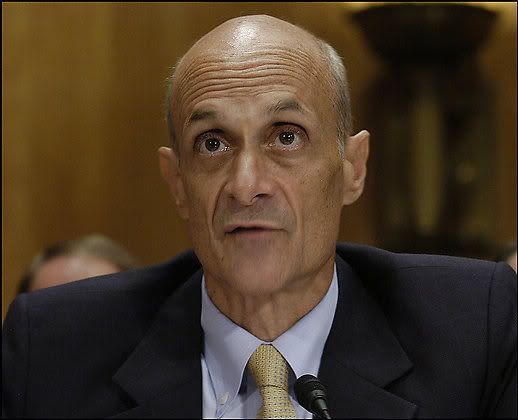
The Washington Post:
The U.S. government is collecting electronic records on the travel habits of millions of Americans who fly, drive or take cruises abroad, retaining data on the persons with whom they travel or plan to stay, the personal items they carry during their journeys, and even the books that travelers have carried, according to documents obtained by a group of civil liberties advocates and statements by government officials.
The personal travel records are meant to be stored for as long as 15 years, as part of the Department of Homeland Security's effort to assess the security threat posed by all travelers entering the country. Officials say the records, which are analyzed by the department's Automated Targeting System, help border officials distinguish potential terrorists from innocent people entering the country.
But new details about the information being retained suggest that the government is monitoring the personal habits of travelers more closely than it has previously acknowledged. The details were learned when a group of activists requested copies of official records on their own travel. Those records included a description of a book on marijuana that one of them carried and small flashlights bearing the symbol of a marijuana leaf.
The Automated Targeting System has been used to screen passengers since the mid-1990s, but the collection of data for it has been greatly expanded and automated since 2002, according to former DHS officials.
Officials yesterday defended the retention of highly personal data on travelers not involved in or linked to any violations of the law. But civil liberties advocates have alleged that the type of information preserved by the department raises alarms about the government's ability to intrude into the lives of ordinary people. The millions of travelers whose records are kept by the government are generally unaware of what their records say, and the government has not created an effective mechanism for reviewing the data and correcting any errors, activists said.
The activists alleged that the data collection effort, as carried out now, violates the Privacy Act, which bars the gathering of data related to Americans' exercise of their First Amendment rights, such as their choice of reading material or persons with whom to associate. They also expressed concern that such personal data could one day be used to impede their right to travel.
"The federal government is trying to build a surveillance society," said John Gilmore, a civil liberties activist in San Francisco whose records were requested by the Identity Project, an ad-hoc group of privacy advocates in California and Alaska. The government, he said, "may be doing it with the best or worst of intentions. . . . But the job of building a surveillance database and populating it with information about us is happening largely without our awareness and without our consent."
Gilmore's file, which he provided to The Washington Post, included a note from a Customs and Border Patrol officer that he carried the marijuana-related book "Drugs and Your Rights." "My first reaction was I kind of expected it," Gilmore said. "My second reaction was, that's illegal."
DHS officials said this week that the government is not interested in passengers' reading habits, that the program is transparent, and that it affords redress for travelers who are inappropriately stymied. "I flatly reject the premise that the department is interested in what travelers are reading," DHS spokesman Russ Knocke said. "We are completely uninterested in the latest Tom Clancy novel that the traveler may be reading."
But, Knocke said, "if there is some indication based upon the behavior or an item in the traveler's possession that leads the inspection officer to conclude there could be a possible violation of the law, it is the front-line officer's duty to further scrutinize the traveler." Once that happens, Knocke said, "it is not uncommon for the officer to document interactions with a traveler that merited additional scrutiny."
He said that he is not familiar with the file that mentions Gilmore's book about drug rights, but that generally "front-line officers have a duty to enforce all laws within our authority, for example, the counter-narcotics mission." Officers making a decision to admit someone at a port of entry have a duty to apply extra scrutiny if there is some indication of a violation of the law, he said.
The retention of information about Gilmore's book was first disclosed this week in Wired News. Details of how the ATS works were disclosed in a Federal Register notice last November. Although the screening has been in effect for more than a decade, data for the system in recent years have been collected by the government from more border points, and also provided by airlines -- under U.S. government mandates -- through direct electronic links that did not previously exist.
The DHS database generally includes "passenger name record" (PNR) information, as well as notes taken during secondary screenings of travelers. PNR data -- often provided to airlines and other companies when reservations are made -- routinely include names, addresses and credit-card information, as well as telephone and e-mail contact details, itineraries, hotel and rental car reservations, and even the type of bed requested in a hotel.
The records the Identity Project obtained confirmed that the government is receiving data directly from commercial reservation systems, such as Galileo and Sabre, but also showed that the data, in some cases, are more detailed than the information to which the airlines have access.
Ann Harrison, the communications director for a technology firm in Silicon Valley who was among those who obtained their personal files and provided them to The Post, said she was taken aback to see that her dossier contained data on her race and on a European flight that did not begin or end in the United States or connect to a U.S.-bound flight.
"It was surprising that they were gathering so much information without my knowledge on my travel activities, and it was distressing to me that this information was being gathered in violation of the law," she said.
James P. Harrison, director of the Identity Project and Ann Harrison's brother, obtained government records that contained another sister's phone number in Tokyo as an emergency contact. "So my sister's phone number ends up being in a government database," he said. "This is a lot more than just saying who you are, your date of birth."
Edward Hasbrouck, a civil liberties activist who was a travel agent for more than 15 years, said that his file contained coding that reflected his plan to fly with another individual. In fact, Hasbrouck wound up not flying with that person, but the record, which can be linked to the other passenger's name, remained in the system. "The Automated Targeting System," Hasbrouck alleged, "is the largest system of government dossiers of individual Americans' personal activities that the government has ever created."
He said that travel records are among the most potentially invasive of records because they can suggest links: They show who a traveler sat next to, where they stayed, when they left. "It's that lifetime log of everywhere you go that can be correlated with other people's movements that's most dangerous," he said. "If you sat next to someone once, that's a coincidence. If you sat next to them twice, that's a relationship."
Stewart Verdery, former first assistant secretary for policy and planning at DHS, said the data collected for ATS should be considered "an investigative tool, just the way we do with law enforcement, who take records of things for future purposes when they need to figure out where people came from, what they were carrying and who they are associated with. That type of information is extremely valuable when you're trying to thread together a plot or you're trying to clean up after an attack."
Homeland Security Secretary Michael Chertoff in August 2006 said that "if we learned anything from Sept. 11, 2001, it is that we need to be better at connecting the dots of terrorist-related information. After Sept. 11, we used credit-card and telephone records to identify those linked with the hijackers. But wouldn't it be better to identify such connections before a hijacker boards a plane?" Chertoff said that comparing PNR data with intelligence on terrorists lets the government "identify unknown threats for additional screening" and helps avoid "inconvenient screening of low-risk travelers."
Knocke, the DHS spokesman, added that the program is not used to determine "guilt by association." He said the DHS has created a program called DHS Trip to provide redress for travelers who faced screening problems at ports of entry.
But DHS Trip does not allow a traveler to challenge an agency decision in court, said David Sobel, senior counsel with the Electronic Frontier Foundation, which has sued the DHS over information concerning the policy underlying the ATS. Because the system is exempted from certain Privacy Act requirements, including the right to "contest the content of the record," a traveler has no ability to correct erroneous information, Sobel said.
Zakariya Reed, a Toledo firefighter, said in an interview that he has been detained at least seven times at the Michigan border since fall 2006. Twice, he said, he was questioned by border officials about "politically charged" opinion pieces he had published in his local newspaper. The essays were critical of U.S. policy in the Middle East, he said. Once, during a secondary interview, he said, "they had them printed out on the table in front of me."
Thursday, September 20, 2007
| [+/-] |
U.S. Airport Screeners Are Watching What You Read |
Wired reports:
International travelers concerned about being labeled a terrorist or drug runner by secret Homeland Security algorithms may want to be careful what books they read on the plane. Newly revealed records show the government is storing such information for years.
Privacy advocates obtained database records showing that the government routinely records the race of people pulled aside for extra screening as they enter the country, along with cursory answers given to U.S. border inspectors about their purpose in traveling. In one case, the records note Electronic Frontier Foundation co-founder John Gilmore's choice of reading material, and worry over the number of small flashlights he'd packed for the trip.
The breadth of the information obtained by the Gilmore-funded Identity Project (using a Privacy Act request) shows the government's screening program at the border is actually a "surveillance dragnet," according to the group's spokesman Bill Scannell.
"There is so much sensitive information in the documents that it is clear that Homeland Security is not playing straight with the American people," Scannell said.
The documents show a tiny slice of the massive airline-record collection stored by the government, as well as the screening records mined for the controversial Department of Homeland Security passenger-rating system that assigns terrorist scores to travelers entering and leaving the country, including U.S. citizens.
The so-called Automated Targeting System scrutinizes every airline passenger entering or leaving the country using classified rules that tell agents which passengers to give extra screening to and which to deny entry or exit from the country.
The system relies on data ranging from the government's 700,000-name terrorism watchlist to data included in airline-travel database entries, known as Passenger Name Records, which airlines are required to submit to the government.
According to government descriptions, ATS mines data from intelligence, law enforcement and regulatory databases, looking for linkages in order to identify "high-risk" targets who may not already be on terrorist watchlists.
ATS was started in the late 1990s, but was little known until the government issued a notice about the system last fall. The government has subsequently modified the proposed rules for the system, shortening the length of time data is collected and allowing individuals to request some information used by the scoring system.
The government stores the PNRs for years and typically includes destinations, phone and e-mail contact information, meal requests, special health requests, payment information and frequent-flier numbers.
The Identity Project filed Privacy Act requests for five individuals to see the data stored on them by the government.
The requests revealed that the PNRs also included information on one requester's race, the phone numbers of overseas family members given to the airlines as emergency contact information, and a record of a purely European flight that had been booked overseas separately from an international itinerary, according to snippets of the documents shown to Wired News.
The request also revealed the screening system includes inspection notes from earlier border inspections.
One report about Gilmore notes: "PAX (passenger) has many small flashlights with pot leaves on them. He had a book entitled 'Drugs and Your Rights.'" Gilmore is an advocate for marijuana legalization.
Another inspection entry noted that Gilmore had "attended computer conference in Berlin and then traveled around Europe and Asia to visit friends. 100% baggage exam negative.... PAX is self employed 'Entrepreneur' in computer software business."
"They are noting people's race and they are writing down what people read," Scannell said.
It doesn't matter that Gilmore was reading a book about drugs, rather than Catcher in the Rye, according to Scannell. "A book is a book," Scannell said. "This is just plain wrong."
The documents have also turned Scannell against the Department of Homeland Security's proposal for screening airline passengers inside the United States.
That project, known as Secure Flight, will take watchlist screening out of the hands of airlines, by having the airlines send PNR data to the government ahead of each flight. While earlier versions included plans to rate passenger's threat level using data purchased from private companies, DHS now proposes only to compare data in the PNR against names on the watchlist, which largely disarmed civil libertarians' opposition to the program.
That's changed for Scannell now, who sees Secure Flight as just another version of ATS.
"They want people to get permission to travel," Scannell said. "They already instituted it for leaving and entering the country and now they want to do it to visit your Aunt Patty in Cleveland."
The Department of Homeland Security did not respond to a request for comment.
Monday, September 17, 2007
| [+/-] |
Corporations Setting Up On-Site Clinics For Employees |
The Washington Times reports:
Corporations struggling to stem the rising tide of health care costs are providing on-site medical services that used to be found only in doctors' offices and hospitals.
The National Business Group on Health recently released a survey on the prevalence of on-site clinics among U.S. employers with more than 1,000 employees. Of those surveyed, 23 percent reported offering on-site medical services in 2007, while 29 percent plan to offer a program next year.
"These clinics are also an opportunity to provide services in a more cost-effective way," said Helen Darling, president of the Washington lobbying group. "They will have limited services, and the patient won't get a lot of extra costly services, which the employer would have had to pay for."
A recent Kaiser Family Foundation survey found that the premiums businesses pay for their workers' health care have increased 78 percent since 2001. But creating a medical facility is not exactly a cheap solution to the problem, so the trend is predominantly found among large employers.
Automakers and other manufacturers have been incorporating on-site health care into their business plans for years. Mishaps are a fact of life in manufacturing, where nurses are needed to treat occupational injuries.
But over the past several years, white-collar employers, including technology and pharmaceutical companies, are discovering that it is cost-effective to offer a clinic with a family physician who provides care to employees and their families.
World Health Management of Cleveland has offered on-site health care services to employers for more than 20 years. Jim Hummer, founder of the company, said he witnessed an evolution in employers' thinking on health care during that time.
"All of a sudden, it's in vogue to get involved in workers' health care issues," he said. "Health care costs have gone out of sight, so the employers are realizing they must change. For the first time, there is an alignment of interest between the workers and employers on preventing illnesses."
Thursday, September 13, 2007
| [+/-] |
The Power of the Postcode |
The Telegraph reports:
There's no lottery about postcodes. It is a precise ... and revealing ... science, writes Jasper Gerard
It's in the DNA of the British to keep up appearances. Even the Queen patches her carpets.
Telltale code: your postcode can reflect your lifestyle
Meanwhile, the middle class kits itself out from Boden clearance sales and supplements the weekly shop in Waitrose with a crafty whizz round Lidl.
But postcodes, we now learn, strip away our pretence and lay bare just how smart we really are. An Englishman no longer gives away his life story by opening his mouth, but by opening an envelope marked with that telltale code.
How long you are put on hold is now determined by it. Whenever some call centre operative from Bangalore asks for your postcode, he will have "frighteningly accurate" information about your salary, credit rating, property value, hobbies, relationships, holidays, political affiliations, even what TV shows you watch, your interest in current affairs, what newspaper you read, which websites you check.
CCTV cameras may document where you are through the day, but now companies can instantly summon an image of how you live - thanks to your postcode.
And this will not be some generalised punt, such as that if you live in Gloucestershire you are probably gin and Jag, into wife-swapping and with a weakness for flashing the cash. It will be detailed, about you and your most immediate neighbours.
Your friends think you are swanky to strut around in Manolos, but you know they are hand-me-downs from your sister who found they gave her blisters. And guess what? Your new friend from Bangalore knows that, too - my dear, he can tell instantly that anyone down your street could barely afford Russell & Bromley.
Contrary to popular myth, there is no lottery about postcodes: the richer you are, the smarter your area and the more attractive you are to companies desperate to flog you stuff. So far from being a lottery, it is an increasingly precise science.
Professor Roger Burrows, who this week presented a paper on postcode profiling at the British Association Festival of Science in York, says: "In some call centres, a message will flash up 'wealthy customer, handle with care'." And the intelligence is freely available: "Everyone can access information about others in the country based on their postcode."
Employers and dates already scour Facebook for background, but you can edit that information. There is no such protection from other websites that publish what you - poor, naïve soul - might consider "private". I've just had a gander, and I'm reeling from the avalanche of detail cascading down after a few clicks.
Check out www.upmystreet.com: peeping toms will be in paradise. Everything you ever wanted to know about your neighbours and much more is there. Are they, it asks, "Sun readers or Guardianistas?" It's like curtain-twitching, just more scientific.
My Kentish village (TN8) is described in detail. I am, apparently a "type 3" - that is, a commuter who lives in a desirable shire village whose income is "very high" (open to debate, I fear). But I am also told my postcode's average wage, how much nearby houses have sold for - and even that three folk nearby claim the Jobseeker's Allowance. Those of us with jobs are, I learn, "highly astute" (don't laugh) senior managers and work-from-homers who shop online and are into fine art, opera, the National Trust and The Daily Telegraph. I learn that my neighbours are charitable, Christian, married (some for the second time), and are also getting on a bit. It doesn't tell me if they are swingers, but I suspect plenty of other websites will.
And then there is www.checkmyfile.com, which tempts me to snoop around the postcodes of famous people. The average price of a semi in David Cameron's West Kensington (W10), I discover, is a perky £2,943,752, and his neighbours mostly cycle to work - though it fails to tell me if their chauffeurs also drive behind. Charlotte Church's neighbours in Cardiff, by contrast, read mid-market tabloids, earn between £10,000 and £15,000, and really do shovel muck for a living - which might explain why the language of the "voice of an angel" borders on the agricultural.
Who you happen to live next door to really matters, and not merely because their Leylandii block your light: if one of them has a dodgy credit rating, this will limit your access to loans as financial-service companies calculate risk by the proportion of local households that have defaulted.
Barclaycard has stopped direct delivery to certain postcodes. A mail-order firm has cut fraud losses by 80 per cent through extra checks on orders from just 17 per cent of postcodes. It makes financial sense, but stigmatises people merely according to geography. Very precise geography, it must be said: companies will classify houses differently just yards apart.
Prof Burrows found a street in London's East End that contained five different categories, gradually changing from a smart, gentrified enclave right down to a grimy bit that wouldn't recognise Cath Kidston if it smacked it in its rather common chops.
Postcodes now do far more than help Postman Pat. They dramatically affect property values, with residents of a Birmingham development threatening to sue the builder after finding themselves in the "wrong" postcode; developers in London's Raynes Park (SW20) lobbied furiously to have the area rechristened "West Wimbledon" (SW19).
Just as the capital's telephone designations - 0207 for inner London, 0208 for outer - caused consternation among the many outed as "suburban", so the British have long been snobbish about the code at the end of their address. W1 (Mayfair) was always smart, while W2 meant, oh dear, you lived "north of the park" and, worse, now next door to the Blairs.
Windsor, rather than dropping bombs on Slough, simply requested the town be dropped from the Windsor postcode. An Old Etonian of my acquaintance was perturbed when he discovered the great country pile he had just bought carried the prefix "MK", for Milton Keynes - how non-U. A postcode has long damned not just an area but a way of life: if a Labour luvvy from Hampstead said something silly, he was ridiculed for being "so NW3".
But what has changed is the sheer detail that can be gleaned and how this will be used, determining your chances of gaining that platinum card or the right deal for that holiday to the Maldives.
Postcode data is not all bad: government resources, notably money for health, can be better targeted to where they are most needed, though inevitably this encourages Labour's habit of robbing the suburbs to give to the poorer inner cities. There's nothing you can do about it.
And nor is there any place to hide: ring a call centre - even from your mobile - and the person who answers will immediately ask for your postcode. You can refuse, of course; but then the company may refuse to do business.
Should you be suffering from "postcode cringe", though, stuck in an unfashionable area, don't book the removal van yet. Even the smartest postcodes - such as the Telegraph's SW1 - can be "contaminated" by, say, the number of bedsits around Victoria Station. Horton in Surrey and Grange Park in Northampton are in the highest household incomes bracket, areas not normally associated with Burlington Berties.
And items such as pet insurance might be discounted in unfashionable postcodes as vets will be cheaper. Oh, and live in a crummy area and you could receive a higher pension - because your area's so ghastly you will die quicker.
It's still so terribly complicated, being British. Shaw would recognise all of this. John Major announced "the classless society", but far from abolishing class, we have invented hundreds of new classes. We can go ex-directory; if only we could go ex-postcode.
KT19: LIFE IS SWEET
If you live in Epsom, you're more likely to live in a semi-detached house, have a managerial job, and invest in ISAs. Your household income will be around £59,000pa - the country's highest average. You shop for food at Waitrose, Sainsbury's and M&S, and for clothes in Next or French Connection. You go to the gym, play golf and enjoy skiing breaks. As well eating out, you'll appreciate wine and the odd cigar.
L5: SHAPE UP
If you live in Everton, chances are you're a single pensioner living in a high-rise block of flats. With an average household income of around £16,000pa, you're unlikely to have much to save. Unemployment is twice the national average and you don't own a car. Your inactive lifestyle is fuelled by a poor diet and nights in the pub, which contributes to the likelihood of long-term illness.
Thursday, August 9, 2007
| [+/-] |
America Under Surveillance |
Salon News reports:
In the pre-dawn hours of Sept. 1, 2005, a U-2 surveillance aircraft known as the Dragon Lady lifted off the runway at Beale Air Force Base in California, the home of the U.S. Air Force 9th Reconnaissance Wing and one of the most important outposts in the U.S. intelligence world. Originally built in secret by Lockheed Corp. for the Central Intelligence Agency, the U-2 has provided some of the most sensitive intelligence available to the U.S. government, including thousands of photographs of Soviet and Chinese military bases, North Korean nuclear sites, and war zones from Afghanistan to Iraq.
But the aircraft that took off that September morning wasn't headed overseas to spy on America's enemies. Instead, for the next six hours it flew directly over the U.S. Gulf Coast, capturing hundreds of high-resolution images as Hurricane Katrina, one of the largest storms of the past century, slammed into New Orleans and the surrounding region.
The U-2 photos were matched against satellite imagery captured during and after the disaster by the National Geospatial-Intelligence Agency. Relatively unknown to the public, the NGA was first organized in 1996 from the imagery and mapping divisions of the CIA, the Department of Defense and the National Reconnaissance Office, the agency that builds and maintains the nation's fleet of spy satellites. In 2003, the NGA was formally inaugurated as a combat support agency of the Pentagon. It is responsible for supplying overhead imagery and mapping tools to the military, the CIA and other intelligence agencies -- including the National Security Agency, whose wide-reaching, extrajudicial spying inside the United States under the Bush administration has been a heated political issue since first coming to light in the media nearly two years ago.
The NGA's role in Hurricane Katrina has received little attention outside of a few military and space industry publications. But the agency's close working relationship with the NSA -- whose powers to spy domestically were just expanded with new legislation from Congress -- raises the distinct possibility that the U.S. government could be doing far more than secretly listening in on phone calls as it targets and tracks individuals inside the United States. With the additional capabilities of the NGA and the use of other cutting-edge technologies, the government could also conceivably be following the movements of those individuals minute by minute, watching a person depart from a mosque in, say, Lodi, Calif., or drive a car from Chicago to Detroit.
Prior to Katrina, the NGA had been used sporadically during domestic crises. Its first baptism of fire came after the 9/11 terrorist attacks, when the agency collected imagery to help in the recovery efforts at the World Trade Center and the Pentagon. But the storm of 2005 triggered NGA activity on a scale never before seen inside the borders of the United States. "Hurricane Katrina changed everything with what we do with disasters," John Goolgasian, the director of the NGA's Office of Americas, told Salon. In New York after 9/11, the NGA had only a handful of people on the ground, but "with Katrina, we put a lot of people down in the theater," he said, using a term usually reserved for overseas military battlegrounds. The agency now deploys its staff on a regular basis to hurricane zones and also provides assistance to law enforcement agencies during events such as the Super Bowl, the baseball All-Star Game and political conventions.
On one level, the engagement of the NGA and the U-2 flights over the Gulf Coast during Katrina were commendable efforts to use America's vast surveillance powers for the safety and support of its citizens. But at the same time, the incident apparently marked the first time in history that U.S. intelligence agencies created to spy on foreign countries were deployed to collect extensive information on the U.S. "homeland." Their role during Katrina is just one aspect of an enormous domestic surveillance infrastructure put in place by the Bush administration ever since the Sept. 11 terrorist attacks sparked a radical restructuring and expansion of America's intelligence system. Although the full scope of domestic surveillance under Bush remains elusive, we now know from press accounts, lawsuits, and Attorney General Alberto Gonzales and other top Bush officials' descriptions and denials that the NSA has been involved in multiple domestic surveillance programs -- in apparent violation of federal law -- including spying on Americans' telecommunications and Internet traffic, as well as data mining.
In December 2004, the NSA and the NGA announced the signing of an agreement to share resources and staff and to link their "sources, data holdings, information infrastructure, and exploitation techniques." The document spelling out the agreement itself is classified. But in a press release the NGA explained that the pact allows "horizontal integration" between the two agencies, defined as "working together from start to finish, using NGA's 'eyes' and NSA 'ears.'"
The collaboration makes it possible for the agencies to create hybrid intelligence tools that enhance the ability of U.S. forces in combat. By combining intercepts of cellphone calls with overhead imagery gathered by unmanned aerial vehicles (UAVs), for example, intelligence analysts can track suspected terrorists or insurgents in Iraq in real time. Last November, NGA director Robert B. Murrett disclosed that it was through such technology that the U.S. military was able to locate and bomb the safe house where Abu Musab al-Zarqawi, the leader of al-Qaida in Iraq, was staying in June 2006. "Eventually, it all comes down to physical location," he told reporters. When NSA and NGA data are combined, he added, "the multiplier effect is dramatic."
Nine months prior, during Hurricane Katrina, the NGA's sophisticated surveillance tools, which can create three-dimensional maps, helped first responders identify hospitals, schools and areas where hazardous materials were stored in the Gulf Coast region. And in an unprecedented move, the NGA distributed thousands of unclassified images of stricken areas, via the Internet, to the public. "People could actually see their houses," said retired Air Force Gen. James R. Clapper, the NGA director at the time of Katrina. In an interview with Salon before his appointment in April as undersecretary of defense for intelligence, Clapper said that the NGA's work during the hurricane was "the most graphic example in my 40 years of intelligence of coming to the direct aid of people in extreme circumstances."
The purpose and utility of such intelligence tools in a disaster area, or in a war zone, are clear. But given the Bush administration's highly secretive, aggressive policies in the war on terror, what's to stop the NGA and the NSA from collaborating on other types of real-time surveillance at home?
This past Saturday, Congress approved legislation expanding the ability of the National Security Agency to eavesdrop, without warrants, on telephone calls, e-mail and faxes passing through telecommunications hubs in the United States when the government suspects terrorists may be involved. The legislation, which expands the 1978 Foreign Intelligence Surveillance Act, or FISA, was negotiated between the White House and lawmakers in response to a federal court ruling this summer determining that the NSA's past eavesdropping had violated the law. Mike McConnell, the retired Navy admiral who was appointed last January as the nation's second director of national intelligence, told Congress that the ruling drastically reduced the ability of the NSA to track terrorists, while Bush warned that, because of the ruling, the government was "missing a significant amount of foreign intelligence that we should be collecting to protect our country."
The fear of Democratic leaders that their party might be further accused of being soft on terrorism apparently prompted them to vote for the new FISA legislation -- handing new unilateral surveillance powers to the executive branch while significantly diminishing judicial oversight. Civil liberties groups and lawmakers opposed to the legislation believe the changes will make it easier for the government to spy on U.S. citizens, because the more loosely defined FISA statute now allows warrantless surveillance of people communicating with others who are "reasonably believed to be outside the United States." During the House debate last Saturday night, Rep. Zoe Lofgren, D-Calif., described the bill as an enormous loophole that will grant the attorney general the ability to "wiretap anybody, any place, any time without court review, without any checks and balances."
President Bush signed the measure into law on Sunday.
The NGA, which has a staff of 14,000 and an estimated budget of about $2.5 billion (the actual amount is classified), buys most of its imagery from commercial satellite vendors, but it also relies on highly classified overhead photography captured by the National Reconnaissance Office's fleet of military satellites. According to David H. Burpee, the NGA's director of public affairs, the agency operates under strict oversight rules that ban it from collecting imagery over the United States without a formal request from a "lead" domestic agency coordinating efforts during a disaster. In the case of Katrina, the NGA's assistance was requested by the Federal Emergency Management Administration. In a statement to Salon, Burpee said that the NGA collects intelligence "in accordance with Constitutional law, federal law, and executive policies such as Executive Order 12333." (That order, signed in 1981 by President Reagan, includes a mandate for federal agencies to cooperate with the CIA and other intelligence agencies.) Any questions involving domestic operations would have to be directed to the lead agency requesting NGA support, Burpee added.
It is unclear how the latest changes to FISA might affect other intelligence agencies besides the NSA. But the zeal with which McConnell and Bush pursued the new legislation unbridling the NSA -- which could presumably tap the NGA for assistance with operations at home, just as it does in the war zones -- raises stark questions about the administration's intentions with domestic intelligence.
A close look at the NSA programs suggests that the Bush administration is casting the widest net possible. To date, President Bush and administration officials have acknowledged only a narrow aspect of domestic spying -- referred to as the Terrorist Surveillance Program -- which they admitted, in the wake of media reports, included the warrantless wiretapping of phone calls. But in May 2006, USA Today reported on a program that involved the NSA's gaining access to huge customer databases maintained by AT&T and other telecommunications providers. In another alleged program, discovered by AT&T technician Mark Klein and disclosed in a lawsuit against the telecom provider filed by the Electronic Frontier Foundation, the NSA attached what amounts to an electronic hose to AT&T Internet data lines in San Francisco and other cities and diverted global Internet traffic and phone calls to a special room, where calls and messages were analyzed with powerful computers to find clues to terrorist cells. A Salon report in June 2006 uncovered what appeared to be a nexus for such activity in a secret room at an AT&T facility in St. Louis.
Then, last month, the New York Times disclosed that a dispute in 2003 between the White House and the Justice Department over NSA operations involved a potential fourth program using "computer searches through massive electronic databases" that contained the records of tens of thousands of domestic phone calls and e-mails. McConnell acknowledged multiple programs, albeit without specifics, in a July 31 letter to Arlen Specter, the ranking Republican on the Senate Judiciary Committee. "A number of these intelligence activities were authorized in one order" by Bush shortly after 9/11, McConnell wrote. With regard to the administration's Terrorist Surveillance Program, he added: "This is the only aspect of the NSA activities that can be discussed publicly, because it is the only aspect of those various activities whose existence has been officially acknowledged." Many FISA experts, such as James Dempsey of the Center for Democracy and Technology, have concluded that the NSA was running at least three domestic surveillance programs, including data mining. "I think the TSP was an after-the-fact name given to an activity, or a set of activities, or a whole subset of activities" by the NSA, Dempsey said.
After 9/11, the paradigm for domestic law enforcement shifted radically, by making it the duty of the government to use its intelligence resources to help law enforcement agencies preempt attacks before they happened, beyond the traditional practice of gathering evidence to prove that a crime had already occurred. The idea that the U.S. homeland was now a battleground (or a "theater") first took hold in 2002, when the Pentagon established the U.S. Northern Command in Colorado to provide command and control of military efforts within U.S. borders. Northcom was given two primary responsibilities: providing military security during national emergencies, including terrorist attacks and natural disasters; and protecting important U.S. military bases in the 50 states. As part of the Pentagon's domestic security mission, former Secretary of Defense Donald Rumsfeld created the Counter-Intelligence Field Activity (CIFA) in 2002. But CIFA soon became a weapon against anyone suspected of harboring ill-will against the Bush administration and its policies. CIFA was caught spying on antiwar groups, Quakers and other organizations. Even though Clapper and his boss, Secretary of Defense Bob Gates, have expressed concerns about CIFA's reach, the agency remains an integral part of the Pentagon's counterterrorism efforts.
The link between Pentagon-driven intelligence operations and the homeland was underscored during the Katrina crisis by the NGA's deployment to New Orleans of a special vehicle called a Mobile Integrated Geospatial-Intelligence System, or MIGS, which is loaded with equipment that allows NGA analysts to download intelligence from U-2s and U.S. military satellites. The vehicles were first deployed by the NGA in Iraq and Afghanistan, and later to the Gulf Coast. "They're pretty much the NGA in a Humvee -- very military," said Goolgasian, the NGA official. "But it kind of sticks out like a sore thumb if you're driving into an urban area" in the United States. As a result, the NGA has painted its domestic vehicles blue and renamed them Domestic MIGS, or DMIGS.
Military, intelligence agency and police work is also coming together in numerous "fusion centers" around the country in a joint program run by the Department of Justice and Department of Homeland Security that has received little public attention. At present, there are 43 current and planned fusion centers in the United States where information from intelligence agencies, the FBI, local police, private sector databases and anonymous tipsters is combined and analyzed by counterterrorism analysts. DHS hopes to create a wide network of such centers that would be tied into the agency's day-to-day activities, according to the Electronic Privacy Information Center. The project, according to EPIC, "inculcates DHS with enormous domestic surveillance powers and evokes comparisons with the publicly condemned domestic surveillance program of COINTELPRO," the 1960s program by the FBI aimed at destroying groups on the American political left.
It doesn't take much imagination to see how powerful technologies, when combined with secretive, growing interagency collaboration, could be misused in a domestic context. In recent years many U.S. cities have deployed sophisticated video cameras throughout their downtown areas that track activity 24 hours a day. And U.S. intelligence and law enforcement agencies now have at their disposal facial recognition software that can identify one person among thousands in a large crowd. Combine that with the awesome eavesdropping power of the NSA and the ability of the NGA to capture live imagery from satellites and UAVs, and the result could be an ability to track any individual, in real time, as he or she moves around.
John Pike, the director of GlobalSecurity.org, said the NGA is unlikely to be called upon for surveillance of an individual inside the United States. "NGA imagery is not what you would use to track people," he said. But as the intelligence infrastructure, including the kinds of local camera-surveillance systems that proved so useful in identifying the perpetrators of the London subway bombings, expands in the United States, it raises the specter of a nationwide surveillance web. "These networks are going to get denser and going to cover more area over time," Pike said. "At some point in time somebody's going to drop in an automated face-print recognizer, and then they're off to the races. Anybody who is currently wanted by the authorities, well, there's just going to be parts of the country where such a person could not enter."
The expanding role of U.S. intelligence agencies on the home front raises serious issues, according to Army Lt. Gen. Russel L. Honoré, the commanding general on the scene in the Gulf Coast during Hurricane Katrina. Last fall, during a national conference on geospatial intelligence, he said, "Most of our capability [in the military] is kept on the classified side because that's the best way to fight the enemy." But the situation in the Gulf Coast, as the lines blurred, was complicated by conflicting policy directives. There were some people in government saying, "You're not going to use the intel stuff on us," Honoré recalled, while others were saying just the opposite: "Why aren't you using that intel stuff to tell us what's going on down there?" And then, there were people sitting back, saying, "They can't do that inside the United States," he said, adding, "This is one of the things government has to work out."
In light of the mounting revelations about the Bush administration's domestic spying, civil libertarians no doubt strongly agree.
Monday, July 9, 2007
| [+/-] |
New York Plans Surveillance Veil For Downtown |
The NYTimes reports:
By the end of this year, police officials say, more than 100 cameras will have begun monitoring cars moving through Lower Manhattan, the beginning phase of a London-style surveillance system that would be the first in the United States.
The Lower Manhattan Security Initiative, as the plan is called, will resemble London’s so-called Ring of Steel, an extensive web of cameras and roadblocks designed to detect, track and deter terrorists. British officials said images captured by the cameras helped track suspects after the London subway bombings in 2005 and the car bomb plots last month.
If the program is fully financed, it will include not only license plate readers but also 3,000 public and private security cameras below Canal Street, as well as a center staffed by the police and private security officers, and movable roadblocks.
“This area is very critical to the economic lifeblood of this nation,” New York City’s police commissioner, Raymond W. Kelly, said in an interview last week. “We want to make it less vulnerable.”
But critics question the plan’s efficacy and cost, as well as the implications of having such heavy surveillance over such a broad swath of the city.
For a while, it appeared that New York could not even afford such a system. Last summer, Mr. Kelly said that the program was in peril after the city’s share of Homeland Security urban grant money was cut by nearly 40 percent.
But Mr. Kelly said last week that the department had since obtained $25 million toward the estimated $90 million cost of the plan. Fifteen million dollars came from Homeland Security grants, he said, while another $10 million came from the city, more than enough to install 116 license plate readers in fixed and mobile locations, including cars and helicopters, in the coming months.
The readers have been ordered, and Mr. Kelly said he hoped the rest of the money would come from additional federal grants.
The license plate readers would check the plates’ numbers and send out alerts if suspect vehicles were detected. The city is already seeking state approval to charge drivers a fee to enter Manhattan below 86th Street, which would require the use of license plate readers. If the plan is approved, the police will most likely collect information from those readers too, Mr. Kelly said.
But the downtown security plan involves much more than keeping track of license plates. Three thousand surveillance cameras would be installed below Canal Street by the end of 2008, about two-thirds of them owned by downtown companies. Some of those are already in place. Pivoting gates would be installed at critical intersections; they would swing out to block traffic or a suspect car at the push of a button.
Unlike the 250 or so cameras the police have already placed in high-crime areas throughout the city, which capture moving images that have to be downloaded, the security initiative cameras would transmit live information instantly.
The operation will cost an estimated $8 million to run the first year, Mr. Kelly said. Its headquarters will be in Lower Manhattan, he said, though the police were still negotiating where exactly it will be. The police and corporate security agents will work together in the center, said Paul J. Browne, the chief spokesman for the police. The plan does not need City Council approval, he said.
The Police Department is still considering whether to use face-recognition technology, an inexact science that matches images against those in an electronic database, or biohazard detectors in its Lower Manhattan network, Mr. Browne said.
The entire operation is forecast to be in place and running by 2010, in time for the projected completion of several new buildings in the financial district, including the new Goldman Sachs world headquarters.
Civil liberties advocates said they were worried about misuse of technology that tracks the movement of thousands of cars and people,
Would this mean that every Wall Street broker, every tourist munching a hot dog near the United States Court House and every sightseer at ground zero would constantly be under surveillance?
“This program marks a whole new level of police monitoring of New Yorkers and is being done without any public input, outside oversight, or privacy protections for the hundreds of thousands of people who will end up in N.Y.P.D. computers," Christopher Dunn, a lawyer with the New York Civil Liberties Union, wrote in an e-mail message.
He said he worried about what would happen to the images once they were archived, how they would be used by the police and who else would have access to them.
Already, according to a report last year by the civil liberties group, there are nearly 4,200 public and private surveillance cameras below 14th Street, a fivefold increase since 1998, with virtually no oversight over what becomes of the recordings.
Mr. Browne said that the Police Department would have control over how the material is used. He said that the cameras would be recording in “areas where there’s no expectation of privacy” and that law-abiding citizens had nothing to fear.
“It would be used to intercept a threat coming our way, but not to collect data indiscriminately on individuals,” he said.
Mr. Browne said software tracking the cameras’ images would be designed to pick up suspicious behavior. If, for example, a bag is left unattended for a certain length of time, or a suspicious car is detected repeatedly circling the same block, the system will send out an alert, he said.
Still, there are questions about whether such surveillance devices indeed serve their purpose.
There is little evidence to suggest that security cameras deter crime or terrorists, said James J. Carafano, a senior fellow for homeland security at the Heritage Foundation, a conservative research group in Washington.
For all its comprehensiveness, London’s Ring of Steel, which was built in the early 1990s to deter Irish Republican Army attacks, did not prevent the July 7, 2005, subway bombings or the attempted car bombings in London last month. But the British authorities said the cameras did prove useful in retracing the paths of the suspects’ cars last month, leading to several arrests.
While having 3,000 cameras whirring at the same time means loads of information will be captured, it also means there will be a lot of useless data to sift through.
“The more hay you have, the harder it is to find the needle,” said Mr. Carafano.
Thursday, April 26, 2007
| [+/-] |
Pentagon Urged To Close Secret Database |
Where are the Democrats?:
The Pentagon's new intelligence undersecretary is recommending the Defense Department shut down a controversial classified database that has been criticized for improperly collecting information on anti-war groups and citizens.
James R. Clapper Jr., who stepped into the job two weeks ago, "does not believe they merit continuing the program as currently constituted, particularly in light of its image in the Congress and the media," said Pentagon spokesman Maj. Patrick Ryder.
Clapper forwarded his recommendation to Defense Secretary Robert Gates last week, but no final decision has been made. Gates has been traveling in the Middle East and eastern Europe for most of the last two weeks.
Ryder said the Defense Department needs a way to assess potential threats, "but we must lay to rest the distrust and concern about the Department's commitment to civil rights that have been sustained by the problems found in the TALON reporting system."
The database has been under critical review since it was publicly disclosed in December 2005.
Anti-war groups and other organizations, including a Quaker group — the American Friends Service Committee — protested after it was revealed that the military had monitored anti-war activities, organizations and individuals who attended peace rallies.
Pentagon officials last year said the program was productive and had detected international terrorist interests in specific military bases. But they also acknowledged that some workers may not have been using the system properly.
Known as TALON — or the Threat and Local Observation Notice — the system was developed by the Air Force in the aftermath of the Sept. 11, 2001, terrorist attacks as a way to collect information about possible terrorist threats.
The TALON reports — collected by an array of Defense Department agencies including law enforcement, intelligence, counterintelligence and security — are compiled in a large database and analyzed by an obscure Pentagon agency, the Counterintelligence Field Activity. CIFA is a three-year-old outfit whose size and budget are secret.
Last year, a Pentagon review found that as many as 260 reports in the database were improperly collected or kept there. At the time, the Pentagon said there were about 13,000 entries in the database, and that less than 2 percent either were wrongly added or were not purged later when they were determined not to involve real threats.
Friday, April 20, 2007
| [+/-] |
Colleges Face Surge of Troubled Students |
The Seattle Post Intelligencer reports:
Across America, college counseling centers are strained by rising numbers of mentally ill students and surging demand for mental health services - a challenging trend as campus officials try to identify potential threats like the unstable Virginia Tech gunman.
And even when serious emotional problems are detected, university officials often feel constrained in how they respond due to an array of laws and policies protecting students' rights and privacy.
"The number of people coming to colleges who've had psychiatric treatment has increased tremendously," said Dr. Gerald Kay, a psychiatry professor at Wright State University and chair of the American Psychiatric Association committee on college mental health.
"Now they're able to come to college - that would not have been the case earlier," Kay said. "You've got a very large number of people who may have some vulnerabilities. It has stressed the availability of resources."
Reasons for the surge include the Americans with Disabilities Act, which gives mentally ill students the right to be at college, and increasingly sophisticated medications which enable them to function better than in the past.
Recent surveys and studies underscore the scope of the increase.
A survey last year by the American College Health Association found that 8.5 percent of students had seriously considered suicide, and 15 percent were diagnosed for depression, up from 10 percent in 2000. The Anxiety Disorders Association of America found that 13 percent of students at major universities and 25 percent at liberal arts colleges are using campus mental health services.
Dr. Chris Flynn, director of Virginia Tech's counseling center, has declined to discuss details of gunman Cho Seung-Hui's case, but said the center's staff - which includes a psychiatrist and 11 psychologists - treats about 2,000 students per school year.
In December 2005, a magistrate ordered Cho to undergo an evaluation at a private psychiatric hospital after two women complained about annoying calls from him, and an acquaintance reported he might be suicidal. An initial evaluation found probable cause that Cho was a danger to himself or others as a result of mental illness, but court papers indicate he was free to leave the hospital within days - a step allowed only if hospital officials judged him no longer a danger.
"We have to provide services to students with mental illness - it's not grounds to exclude them from our property," Flynn said. "We cannot discriminate against the mentally ill, nor do we want to."
He said the type of complaints lodged against Cho by the two women are a common and challenging phenomenon on campuses nationwide.
"It is very difficult to predict when what someone perceives as stalking is stalking, and then how it might translate into violence later," Flynn said. "Clearly, if anyone had any warning about a violent incident, people would have stepped in and acted."
Psychologist Sherry Benton, assistant director of counseling services at Kansas State University, has conducted research concluding that students' mental health problems are more complex and severe than 20 years ago.
"We're well aware that problems are getting worse, but what hasn't happened is increasing funding for mental health services," she said. "Most centers are now overwhelmed. Business has gone up and up, but budgets have remained the same or been cut, and that's a huge problem."
One factor, Benton said, is that mental health services are usually not among the categories assessed during colleges' periodic accreditation reviews. If schools needed good services to remain accredited, they might invest more, she said.
Benton views the rising demand for campus mental health services as a good news-bad news development.
"We do get a lot more students into college who have mental illness but are no problem whatsoever," she said. "They do need support and use medication; they go on to lead full, productive lives."
On the downside, she and her colleagues see stress levels among students far higher than a generation ago due to increased workloads and financial strains, often coupled with lack of healthy lifestyles.
Complicating the overall picture is a web of laws and policies that limit the options for worried staff members. Troubled students generally can't be forced to obtain treatment, and privacy laws may limit sharing information about them, even to the extent that some parents have sued schools - including the Massachusetts Institute of Technology and the Oregon Institute of Technology - for not advising them of their children's serious disorders.
Nonetheless, officials on many campuses have set up committees to pool information about students with emotional or behavioral problems so patterns can be detected in what might otherwise be seen as isolated incidents. The trick, officials say, is to find the proper balance between respecting a student's rights and protecting the university.
"That's the tightrope administrators have to walk," said Wright State's Gerald Kay.
"The issue in most instances is how do you bring these people into some sort of treatment."
Benton said any student who issues threats should be dealt with forcefully, regardless of privacy guidelines.
"Safety trumps confidentiality every time," she said. "If someone is a danger to themselves or others, then confidentiality is out the window and you notify who you need to notify to ensure the safety of them and those around them."
Peter Lake, a law professor at Stetson University, contends that officials on many campuses have been too deferential to privacy concerns, at the risk of safety at their schools.
"There's a false consciousness of privacy in higher education - as an institution, we don't like to share information," he said.
"Now, you're going to be seeing a greater emphasis on a management team or a safety czar - someone whose job it is to look at students' overall profiles," Lake said. "It's not only a good idea - it's an idea we can't live without."
Friday, November 3, 2006
| [+/-] |
U.S. Plans to Screen All Who Enter, Leave Country |
Personal Data Will Be Cross-Checked With Terrorism Watch Lists; Risk Profiles to Be Stored for Years
The Washington Post reports:
The federal government disclosed details yesterday of a border-security program to screen all people who enter and leave the United States, create a terrorism risk profile of each individual and retain that information for up to 40 years.
The details, released in a notice published yesterday in the Federal Register, open a new window on the government's broad and often controversial data-collection effort directed at American and foreign travelers, which was implemented after the Sept. 11, 2001, attacks.
While long known to scrutinize air travelers, the Department of Homeland Security is seeking to apply new technology to perform similar checks on people who enter or leave the country "by automobile or on foot," the notice said.
The department intends to use a program called the Automated Targeting System, originally designed to screen shipping cargo, to store and analyze the data.
"We have been doing risk assessments of cargo and passengers coming into and out of the U.S.," DHS spokesman Jarrod Agen said. "We have the authority and the ability to do it for passengers coming by land and sea."
In practice, he said, the government has not conducted risk assessments on travelers at land crossings for logistical reasons.
"We gather, collect information that is needed to protect the borders," Agen said. "We store the information we see as pertinent to keeping Americans safe."
Civil libertarians expressed concern that risk profiling on such a scale would be intrusive and would not adequately protect citizens' privacy rights, issues similar to those that have surrounded systems profiling air passengers.
"They are assigning a suspicion level to millions of law-abiding citizens," said David Sobel, senior counsel of the Electronic Frontier Foundation. "This is about as Kafkaesque as you can get."
DHS officials said that by publishing the notice, they are simply providing "expanded notice and transparency" about an existing program disclosed in October 2001, the Treasury Enforcement Communications System.
But others said Congress has been unaware of the potential of the Automated Targeting System to assess non-aviation travelers.
"ATS started as a tool to prevent the entry of drugs with cargo into the U.S.," said one aide, who spoke on the condition of anonymity because of the sensitivity of the subject. "We are not aware of Congress specifically legislating to make this expansion possible."
The Senate Homeland Security and Governmental Affairs Committee, chaired by Sen. Susan Collins (R-Maine), yesterday asked Homeland Security to brief staff members on the program, Collins's spokeswoman, Jen Burita, said.
The notice comes as the department is tightening its ability to identify people at the borders. At the end of the year, for example, Homeland Security is expanding its Visitor and Immigrant Status Indicator Technology program, under which 32 million noncitizens entering the country annually are fingerprinted and photographed at 115 airports, 15 seaports and 154 land ports.
Stephen E. Flynn, senior fellow for national security studies at the Council on Foreign Relations, expressed doubts about the department's ability to conduct risk assessments of individuals on a wide scale.
He said customs investigators are so focused on finding drugs and weapons of mass destruction that it would be difficult to screen all individual border crossers, other than cargo-truck drivers and shipping crews.
"There is an ability in theory for government to cast a wider net," he said. "The reality of it is customs is barely able to manage the data they have."
The data-mining program stemmed from an effort in the early 1990s by customs officials to begin assessing the risk of cargo originating in certain countries and from certain shippers. Risk assessment turned more heavily to automated, computer-driven systems after the 2001 attacks.
The risk assessment is created by analysts at the National Targeting Center, a high-tech facility opened in November 2001 and now run by Customs and Border Protection.
In a round-the-clock operation, targeters match names against terrorist watch lists and a host of other data to determine whether a person's background or behavior indicates a terrorist threat, a risk to border security or the potential for illegal activity. They also assess cargo.
Each traveler assessed by the center is assigned a numeric score: The higher the score, the higher the risk. A certain number of points send the traveler back for a full interview.
The Automated Targeting System relies on government databases that include law enforcement data, shipping manifests, travel itineraries and airline passenger data, such as names, addresses, credit card details and phone numbers.
The parent program, Treasury Enforcement Communications System, houses "every possible type of information from a variety of federal, state and local sources," according to a 2001 Federal Register notice.
It includes arrest records, physical descriptions and "wanted" notices. The 5.3 billion-record database was accessed 766 million times a day to process 475 million travelers, according to a 2003 Transportation Research Board study.
In yesterday's Federal Register notice, Homeland Security said it will keep people's risk profiles for up to 40 years "to cover the potentially active lifespan of individuals associated with terrorism or other criminal activities," and because "the risk assessment for individuals who are deemed low risk will be relevant if their risk profile changes in the future, for example, if terrorist associations are identified."
DHS will keep a "pointer or reference" to the underlying records that resulted in the profile.
The DHS notice specified that the Automated Targeting System does not call for any new means of collecting information but rather for the use of existing systems. The notice did not spell out what will determine whether someone is high risk.
But documents and former officials say the system relies on hundreds of "rules" to factor a score for each individual, vehicle or piece of cargo.
According to yesterday's notice, the program is exempt from certain requirements of the Privacy Act of 1974 that allow, for instance, people to access records to determine "if the system contains a record pertaining to a particular individual" and "for the purpose of contesting the content of the record."
Wednesday, October 18, 2006
| [+/-] |
FBI Director Wants ISPs To Track Users |
USA Today reports:
FBI Director Robert Mueller on Tuesday called on Internet service providers to record their customers' online activities, a move that anticipates a fierce debate over privacy and law enforcement in Washington next year.
"Terrorists coordinate their plans cloaked in the anonymity of the Internet, as do violent sexual predators prowling chat rooms," Mueller said in a speech at the International Association of Chiefs of Police conference in Boston.
"All too often, we find that before we can catch these offenders, Internet service providers have unwittingly deleted the very records that would help us identify these offenders and protect future victims," Mueller said. "We must find a balance between the legitimate need for privacy and law enforcement's clear need for access."
The speech to the law enforcement group, which approved a resolution on the topic earlier in the day, echoes other calls from Bush administration officials to force private firms to record information about customers. Attorney General Alberto Gonzales, for instance, told Congress last month that "this is a national problem that requires federal legislation."
Justice Department officials admit privately that data retention legislation is controversial enough that there wasn't time to ease it through the U.S. Congress before politicians left to campaign for re-election. Instead, the idea is expected to surface in early 2007, and one Democratic politician has already promised legislation.
Law enforcement groups claim that by the time they contact Internet service providers, customers' records may be deleted in the routine course of business. Industry representatives, however, say that if police respond to tips promptly instead of dawdling, it would be difficult to imagine any investigation that would be imperiled.
It's not clear exactly what a data retention law would require. One proposal would go beyond Internet providers and require registrars, the companies that sell domain names, to maintain records too. And during private meetings with industry officials, FBI and Justice Department representatives have cited the desirability of also forcing search engines to keep logs — a proposal that could gain additional law enforcement support after AOL showed how useful such records could be in investigations.
A representative of the International Association of Chiefs of Police said he was not able to provide a copy of the resolution.
Preservation vs. retention
At the moment, Internet service providers typically discard any log file that's no longer required for business reasons such as network monitoring, fraud prevention or billing disputes. Companies do, however, alter that general rule when contacted by police performing an investigation—a practice called data preservation.
A 1996 federal law called the Electronic Communication Transactional Records Act regulates data preservation. It requires Internet providers to retain any "record" in their possession for 90 days "upon the request of a governmental entity."
Because Internet addresses remain a relatively scarce commodity, ISPs tend to allocate them to customers from a pool based on if a computer is in use at the time. (Two standard techniques used are the Dynamic Host Configuration Protocol and Point-to-Point Protocol over Ethernet.)
In addition, Internet providers are required by another federal law to report child pornography sightings to the National Center for Missing and Exploited Children, which is in turn charged with forwarding that report to the appropriate police agency.
When adopting its data retention rules, the European Parliament approved U.K.-backed requirements saying that communications providers in its 25 member countries-several of which had enacted their own data retention laws already—must retain customer data for a minimum of six months and a maximum of two years.
The Europe-wide requirement applies to a wide variety of "traffic" and "location" data, including: the identities of the customers' correspondents; the date, time and duration of phone calls, VoIP (voice over Internet Protocol) calls or e-mail messages; and the location of the device used for the communications. But the "content" of the communications is not supposed to be retained. The rules are expected to take effect in 2008.
Wednesday, December 7, 2005
| [+/-] |
Secret ID Law to Get Hearing |
Wired reports:
Although John Gilmore lives just five blocks from San Francisco's Department of Motor Vehicles, his driver's license is expired. On purpose.
The outspoken, techno-hippie, wealthy civil libertarian doesn't want to give his Social Security number to the DMV.
Neither will he show his driver's license at airports, or submit to routine security searches. This refusal to obey the rules led him to file suit against the Bush administration (Gilmore v. Gonzales) after being rebuffed at two different airports on July 4, 2002, when he tried to fly without showing identification. One airline offered to let Gilmore fly without showing ID, but only if he underwent more intensive security screening, which he declined.
On Thursday, Gilmore and his lawyers will get 20 minutes in front of the 9th U.S. Circuit Court of Appeals to make their argument against identification requirements and government secrecy, in a case that time and shifting public opinion has transformed from a quirky millionaire's indignant protest into a closely watched test of the limitations of executive branch power.
"The nexus of the case has always been the right to travel," Gilmore said. "Can the government prevent Americans from moving around in their own country by slapping any silly rules on them -- you have to show ID, you have to submit to searches, you have to wear a yarmulke?"
Gilmore has sunk thousands of dollars into fighting identification requirements, but he also personally committed to not traveling in the United States if he has to show identification.
So Gilmore has not taken a train, an intercity bus or a domestic flight since July 4, 2002. He still flies internationally.
Gilmore describes himself as being under "regional arrest," and said he would love to drive and fly again.
"I'm a millionaire," Gilmore said. "I can do whatever the fuck I want, right? Why should I run around without an ID? Because no one else was paying attention to that and letting our liberties slip down the drain. I figured it was worth some amount of money and some amount of personal sacrifice to keep a free society."
Gilmore has long been a prominent figure in the privacy and civil liberties communities -- he co-founded the Electronic Frontier Foundation. But many civil liberties advocates begged Gilmore not to file suit in 2002 because they were certain he would lose and set bad case law, according to Gilmore's lawyer, Jim Harrison.
Things might be different in late 2005.
"The same people that were telling John that you really should not do this while the country is inflamed are the same ones that filed friend-of-the-court briefs to the 9th Circuit," Harrison said.
Gilmore also thinks the mood of the country has changed. "It is now considered patriotic to criticize the president," Gilmore said.
While civil liberties groups now publicly back Gilmore's challenge to government secrecy, many privacy advocates still privately grumble that Gilmore's case is not the best vehicle for challenging identification requirements.
On Thursday, Gilmore will argue that the government's secret identification rules -- no federal law compels travelers to show ID -- and no-fly list infringe on his First Amendment rights, but don't make the country safer.
In addition, government lawyers long denied the existence of the rule -- which predates the Sept. 11 terrorist attacks -- even though there are signs in airports cautioning passengers that they are required to show identification.
The government recently switched tactics, acknowledging the rule exists but arguing that the identification requirement is a law-enforcement technique.
So far, the government has refused to show Gilmore the order compelling airlines to ask for identification, saying that the rule is "sensitive security information," a security designation that was greatly expanded by Congress in 2002, allowing the Transportation Security Administration wide latitude to withhold information from the public.
Gilmore argues that secrecy and the power of the "sensitive security information," or SSI, designation is to blame for the repeated privacy scandals at the TSA.
"TSA and DHS in general have set themselves up to be insulated from criticism, to have their inner workings be invisible, because they can pull this magic SSI shield over anything they do," Gilmore said. "And what you see are the natural consequences of that kind of secrecy, which is that incompetence is never detected and corrected."
