The NYTimes reports:
Europeans may claim a leadership role in fighting global warming, but they get black marks from environmentalists — and even from Washington — for failing to control their fishing fleets in the Mediterranean and other coastal waters.
In particular, United States officials want the European Union to do more to stop the overfishing of Atlantic bluefin tuna, a highly migratory, warm-blooded species that can grow to nearly a ton. A single fish can fetch tens of thousands of dollars as demand grows for dishes like sushi.
Europeans must “get control of their fleets, and if they reach their quotas they’ve got to shut down the fisheries,” said William Hogarth, the director of the fisheries service of the National Oceanic and Atmospheric Administration.
“We don’t have that from Europe yet,” he said. “We don’t even have the basics.”
Bluefin tuna spawn both in the Gulf of Mexico and in the Mediterranean. The fish do not interbreed, but they mix extensively in the North Atlantic. So European catches may consist of significant numbers of bluefin tuna originating in waters around the United States.
How much mixing of fish takes place is still a disputed matter. But Mr. Hogarth said the mixing was an important factor in the decline of fish stocks around the United States.
“It’s a great injustice,” he said of European overfishing. “Unless you can get control of the eastern stock then the western stock can’t recover due to the mixing.”
The United States also has a poor record on fish stocks; it has allowed cod to become overfished and perhaps irreparably depleted.
Tuna experts like Carl Safina, the president of the Blue Ocean Institute, a nonprofit conservation group based in New York, places much of the blame for the collapse in west Atlantic bluefin tuna stocks on the United States, which, he said, continues to allow fishing in spawning areas in the Gulf of Mexico.
“The U.S. is delighting in shifting the blame to Europe,” he said.
He said that there were areas around Scandinavia and in waters off Brazil where bluefin tuna were already commercially extinct, and that the west Atlantic, where American fleets work the seas, was headed that way, too.
Yet he and other conservationists reserve their harshest criticism for the Europeans.
As part of a so-called recovery plan approved this month, European Union governments decided to put expert observers on 20 percent of each country’s vessels over 15 meters, or about 49 feet, to check catches and spot vessels using illegal fishing practices. European Union governments also pledged to ban the use of aircraft to locate shoals of tuna.
But conservationists sharply criticized that plan, largely because the bluefin tuna quota shared between Cyprus, France, Greece, Italy, Malta, Portugal and Spain was set at about 17,000 tons. That is the maximum amount recommended by the International Commission for the Conservation of Atlantic Tunas, an international organization with more than 40 member countries. But it is roughly twice the limit stipulated by the commission’s own scientific advisers.
“This is not a recovery plan,” said Sergi Tudela, who is in charge of the fisheries program for the World Wide Fund for Nature in the Mediterranean. “It is a collapse plan.”
Ireland and Britain also criticized the European Union plan because it failed to penalize fleets in countries like France and Italy that already had overfished, and because drift-net fishing, banned since 2002, was still going on in some European Union fleets.
Conservationists like Mr. Safina are calling for an Atlantic-wide, five-year moratorium on bluefin tuna fishing and the closing of spawning areas in the Gulf of Mexico to fishing techniques that could kill bluefin.
Mr. Hogarth, the United States fisheries official, said that American fleets hauled only a small fraction of their quota last year because of low stocks, and that any measures taken by Europe looked as though they would be too little, too late for global stocks of bluefin tuna.
“We’re catching only about 12 to 14 percent of our quota,” Mr. Hogarth said. “There are just no fish here.”
Showing posts with label fish. Show all posts
Showing posts with label fish. Show all posts
Monday, June 25, 2007
| [+/-] |
U.S. Accuses Europe of Overfishing Tuna in Atlantic |
Sunday, June 24, 2007
| [+/-] |
When The World's Stocks of Tuna Gets Low, What Do You Make Into Sushi? |
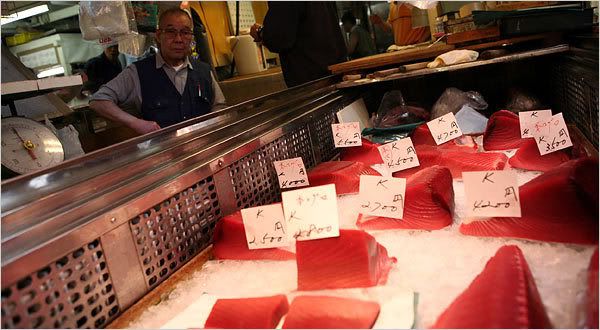 Chunks of raw tuna at Tsukiji, the famed fish market in Tokyo. The growing demand for sushi in countries like Russia and China and depleting tuna stocks are raising prices, and causing chefs to try other ingredients.
[photo by Ko Sasaki]
The NYTimes reports:
Sushi made with deer meat, anyone? How about a slice of raw horse on that rice?
These are some of the most extreme alternatives being considered by Japanese chefs as shortages of tuna threaten to remove it from Japan’s sushi menus — something as unthinkable here as baseball without hot dogs or Texas without barbecue.
In this seafood-crazed country, tuna is king. From maguro to otoro, the Japanese seem to have almost as many words for tuna and its edible parts as the French have names for cheese. So when global fishing bodies recently began lowering the limits on catches in the world’s rapidly depleting tuna fisheries, Japan fell into a national panic.
Nightly news programs ran in-depth reports of how higher prices were driving top-grade tuna off supermarket shelves and the revolving conveyer belts at sushi chain stores. At nicer restaurants, sushi chefs began experimenting with substitutes, from cheaper varieties of fish to terrestrial alternatives and even, heaven forbid, American sushi variations like avocado rolls.
“It’s like America running out of steak,” said Tadashi Yamagata, vice chairman of Japan’s national union of sushi chefs. “Sushi without tuna just would not be sushi.”
The problem is the growing appetite for sushi and sashimi outside Japan, not only in the United States but also in countries with new wealth, like Russia, South Korea and China. And the problem will not go away. Fishing experts say that the shortages and rising prices will only become more severe as the population of bluefin tuna — the big, slow-maturing type most favored in sushi — fails to keep up with worldwide demand.
Last year, dozens of nations responded by agreeing to reduce annual tuna catches in the eastern Atlantic and Mediterranean oceans by 20 percent in an effort to stabilize populations. But the decision only seemed to crystallize growing fears in Japan about tuna shortages, helping to push up prices of the three species of bluefin — northern, Pacific and southern — that are considered the best tuna to eat raw.
Since the start of last year, the average price of imported frozen northern and Pacific bluefin has risen more than a third, to $13 a pound, according to Japan’s Fisheries Agency.
Wholesalers say that competition from foreign fishing fleets and buyers has made the top-quality tuna increasingly hard to come by here. Tadashi Oono, who sells big red slabs of tuna from a stall in the sprawling Tsukiji fish market of Tokyo, said that three years ago, he routinely sold two or three top-grade bluefin every day. This year, he said, he sometimes finds only two or three tuna of that quality to sell in a month.
Some culinary enthusiasts say the anguish over tuna shortages may also reflect deeper anxieties in Japan about its recent economic decline, especially when compared with neighboring China.
After World War II, tuna became a symbol of the economic might that allowed Japan to dominate the buying of tuna on world markets from Boston to Cape Town. Japan now consumes about 60,000 tons a year of the three bluefin species, or more than three-quarters of the world’s annual catch, according to the Fisheries Agency.
But as more top-grade tuna ends up in other countries, there are concerns that Japan could one day lose its status as global tuna superpower.
“Fish that would have gone to Tokyo are now ending up in New York or Shanghai,” said Sasha Issenberg, the author of “The Sushi Economy” (Gotham, 2007). “This has been devastating to Japan’s national esteem.”
The tuna shortage is also having a more concrete effect on menus at Japanese sushi bars. Fukuzushi, a midpriced restaurant in a residential neighborhood in Tokyo, is having a tougher time finding high-quality fish at reasonable prices.
The restaurant’s owner, Shigekazu Ozoe, 56, said the current situation reminded him of the last time he had no tuna to sell — in 1973, during a scare over mercury poisoning in oceans when customers refused to buy it. At that time, he tried to find other red-colored substitutes like smoked deer meat and raw horse, a local delicacy in some parts of Japan.
“We tasted it, and horse sushi was pretty good,” he recalled. “It was soft, easy to bite off, had no smell.”
If worse comes to worst, he said, he could always try horse and deer again. The only drawback he remembered was customers objecting to red meat in the glass display case on the counter of his sushi bar.
“One customer pointed and said: ‘You have something four-legged in your fish case? That’s eerie!’ ”
So far, top sushi restaurants have avoided the shortages by paying top yen for premium bluefin caught off domestic ports like Ouma in northern Japan.
“The prices of top-name tuna like Ouma are already as high as they can go,” said Yosuke Imada, owner of Kyubey in the upscale Ginza district of Tokyo. “What will happen is that the prices of lower grades of tuna will rise to catch up.”
That prospect worries Mr. Yamagata of the union of sushi chefs.
Mr. Yamagata, 59, has been experimenting with more creative tuna alternatives at Miyakozushi, a restaurant catering to the business lunch crowd that has been in his family for four generations. He said his most successful substitutes were ideas he “reverse imported” from the United States, like smoked duck with mayonnaise and crushed daikon with sea urchin. He said he now made annual visits to sushi restaurants in New York and Washington for inspiration.
“We can learn from American sushi chefs,” Mr. Yamagata said. “Sushi has to evolve to keep up with the times.”
Thursday, June 14, 2007
| [+/-] |
He Is Dead |
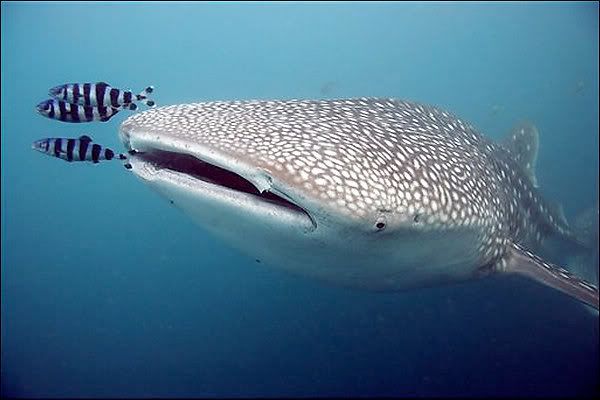 In this undated photo released by the Georgia Aquarium in Atlanta, Norton, one of the original whale sharks on exhibit at the aquarium is shown. Officials at the aquarium reported that Norton died early Wednesday, June 13, 2007, and is the second whale shark to die at the facility in five months. (AP Photo/Courtesy of Georgia Aquarium)
The Washington Post reports:
For the second time in less than six months, a whale shark at the Georgia Aquarium, the only facility outside Asia to display the rare fish, has died.
The whale shark, known as Norton, had stopped eating in recent months and was swimming erratically, according to a statement from the aquarium. Veterinary and husbandry staff members conducted tests that confirmed Norton's declining health.
On Tuesday, he was placed on 24-hour watch. Early Wednesday, Norton stopped swimming and settled to the bottom of his 6 million-gallon tank. Divers brought him up on a stretcher for additional tests and treatment, and "after every option had been exhausted to improve Norton's health, the team made the decision to humanely euthanize him," aquarium officials said in the statement.
In January, the aquarium lost another whale shark, the world's largest fish and one of the facility's most popular attractions. Ralph, which arrived with Norton in June 2005 from Taiwan, died of an inflammation to a membrane in his abdomen. Two female whale sharks, Alice and Trixie, came to the facility in June 2006.
Before the females arrived, the aquarium team had noticed both male whale sharks lost their appetites around the same time and theorized it was because of a chemical used in the exhibit to treat parasites, said Ray Davis, senior vice president of zoological operations at the aquarium.
As a precaution, the aquarium stopped using the treatment, he said. But officials are still investigating whether the chemical played a role in the animals' deaths.
"We have some of the pieces but not all of them," Davis said, adding that necropsy results often take months and can be inconclusive. "We want to make sure we move the team from the bereavement phase to the scientific and necropsy phase."
As with Ralph, a necropsy will be performed on Norton and then he will be cremated, according to a letter written to the aquarium's ticket holders by Jeffery S. Swanagan, its president and executive director.
On June 4, the aquarium welcomed two whale sharks from Taiwan, Yushan and Taroko. After reviewing Ralph's death and Norton's health, aquarium officials determined that it would not be a risk to add the pair, Davis said.
The whale shark grows up to 66 feet long and lives in tropical and subtropical waters. It is considered harmless to humans, feeding on plankton and small fish with its approximately 3,000 small teeth.
Subscribe to:
Posts (Atom)
