The Washington Times reports:
President Bush is benefiting from a Karl Rove-free White House and the lower-profile approach of his successor, who high-ranking Republican Party activists and operatives say helped the administration to key victories at the end of last year.
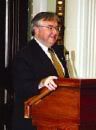
Mr. Bush named Barry Jackson in September to replace Mr. Rove, the "architect" of Mr. Bush's electoral successes, and his understated style is credited with rallying Capitol Hill Republicans to wins on Iraq, spending and national health insurance.
While friends and colleagues of Mr. Rove use words like "flamboyant," "gregarious" and "flashy" to describe him, they portray his former deputy, Mr. Jackson, as "a man of few words" who is the right fit for a president now reliant on Republican legislators sticking with him.
"It's no accident that the president has had the four best months of his presidency ever in dealing with the Congress," said Terry Holt, a Republican consultant who worked with Mr. Jackson in Congress.
Mr. Rove himself has paid tribute to Mr. Jackson's consensus-building skills, which he cultivated as chief of staff to House Minority Leader John A. Boehner, when the Ohio Republican was the third-ranking member of his party.
"He can draw people together and make everybody who's part of something better able to get the job done," said Mr. Rove, who is writing a regular column for Newsweek magazine and working on a book.
While Mr. Jackson's behind-the-scenes sway has been right on time for the president, Mr. Rove's in-your-face style and larger-than-life reputation often fit with Mr. Bush's approach to governing in his first term and early in his second term.
The president's scorn for "small ball" governing is well-known, as is his penchant for pursuing big ideas and big reforms.
Mr. Bush dubbed Mr. Rove "the architect" after he guided the incumbent to victory in 2004. In the White House, Mr. Rove and fellow Texan Dan Bartlett had significant influence over policy, politics and communications.
But entering 2007, the White House knew that for any of the president's initiatives — particularly the war in Iraq — to succeed, he would have to maintain the support of Republicans in Congress.
"Bush is in a time in his presidency where his success is in part related to his ability to persuade other people to work together," said Ken Mehlman, former chairman of the Republican National Committee and a veteran of both Bush campaigns.
Enter Mr. Jackson, and counselor to the president Ed Gillespie, another former Hill staffer. The two have helped frustrate Democrats' attempts to splinter the Republican Party on the war, spending and children's health insurance, said Paula Nowakowski, Mr. Boehner's chief of staff, who has known and worked with Mr. Jackson since the early 1990s, and others.
"I think President Bush had a very good year and had a strong close to the year, with those guys in there," said Charlie Black, a longtime Republican strategist who has advised Presidents Reagan and George H.W. Bush, as well as the current president.
"You've got a Democratic Congress and an unpopular war, and they still won a lot of battles," Mr. Black said.
House Speaker Nancy Pelosi, at her year-end press conference, expressed surprise and frustration at the Republican Party's discipline. The California Democrat said that foiled her party's promises to end the war in Iraq this year.
"We see a difference on the Hill in discipline, in message, in all of those things. I know that's Barry's hand, as well as Eddie's," said Ms. Nowakowski. "Look at the fall. Who in God's name would have thought we would have been as successful on so many issues as we were this fall?"
Mr. Gillespie yesterday told reporters that the administration has figured out how "to get results for the American people" when dealing with a Congress controlled by the other party.
"It's not always pretty, but it does get results that I think are beneficial," he said.
Not all of Mr. Jackson's efforts to infuse White House policy with Republican congressional support succeeded last year. While still working as Mr. Rove's deputy, Mr. Jackson was unable to push the president's immigration-reform plan through Congress, which was torpedoed by intense opposition from Republicans in the House and Senate.
Mr. Jackson, who came to work for Mr. Bush in 2000, did not receive all of Mr. Rove's powers in the White House.
Mr. Rove's title was deputy chief of staff and senior adviser to the president, while Mr. Jackson is now the assistant to the president for strategic initiatives and external affairs, and oversees four divisions within the White House — political affairs, intergovernmental relations, public liaison and strategic initiatives.
Mr. Jackson, who is single, declined to be interviewed for this article. He was born in Washington, D.C, but grew up in Ohio.
In 1983, he graduated from the University of Iowa with a degree in journalism, and eventually helped run a family rental business in Mason, Ohio, before going to work for Mr. Boehner's first congressional campaign in 1990.
Longtime friends and colleagues sang Mr. Jackson's praises, saying they were delighted he has been promoted to his current position.
"He's one of those rare people in Washington who has managed to achieve enormous respect without an ounce of self-promotion," Mr. Holt said.
Wednesday, January 2, 2008
| [+/-] |
Rove's Successor Keeps Low Profile |
Saturday, December 29, 2007
| [+/-] |
Campaigns Turn To Pakistan |
Candidates stress fighting terrorism
McClatchy reports:
The presidential campaign erupted Friday into a full-blown debate over how best to stabilize Pakistan as candidates vied in the few days before Thursday's Iowa caucuses to show who was best prepared to lead the fight against terrorism.
In the wake of Thursday's assassination of Pakistani opposition leader Benazir Bhutto, Republican and Democratic presidential candidates spent much of Friday laying out specific policies they'd follow now -- or, for Democratic Illinois Sen. Barack Obama and two former Republican governors, Mike Huckabee of Arkansas and Mitt Romney of Massachusetts, trying to convince voters that they're qualified to play in that league.
The rivals with thicker foreign-policy resumes offered detailed blueprints of how they would deal with Pakistan. New Mexico Gov. Bill Richardson, a former United Nations ambassador, struck first, telling a Des Moines audience that the United States should give Pakistan "not one penny more until [President Pervez] Musharraf is gone and the rule of law is restored."
Most Democratic candidates wouldn't go that far; New York Sen. Hillary Rodham Clinton offered a multi-part plan to restore stability but stopped short of calling for Musharraf's ouster.
"I don't think the Pakistani government at this time under President Musharraf has any credibility at all," Clinton said as she visited Story City. "They have disbanded an independent judiciary. They have oppressed a free press."
She called for a "full, independent, international investigation."
Senate Foreign Relations Committee Chairman Joseph Biden, D-Del., urged putting new pressure on Musharraf to hold "fair elections as soon as possible," while Sen. Christopher Dodd, D-Conn., a senior Foreign Relations member, urged that Pakistan's elections be postponed.
The fight was not just over ideas -- it was over foreign policy pedigree, too.
Dodd took aim at Clinton, questioning her experience.
"It isn't enough to be sitting on the sidelines, watching your husband deal with these problems over the years," Dodd said. And he termed Richardson's call for Musharraf to resign "a dangerous idea."
GOP backs Musharraf
The Republican debate had a different tone. Most candidates were more willing to tolerate, and in some cases even praise, Musharraf, while they painted Democrats as unsteady and weak.
"I don't think it would be a good idea to call for him [Musharraf] to step down now," former Tennessee Sen. Fred Thompson told CNN on Friday. "I hope that we as candidates out here don't start lobbing these ideas that get plenty of attention but are not very sound. This is a serious matter. It's going to be with us for some time, and we need to be deliberate in our approach to it because we have several interests involved."
Arizona Sen. John McCain said, "You're going to hear a lot of criticism about Musharraf, that he hasn't done everything we wanted him to do, but he did agree to step down as head of the military, and he did get the elections."
Romney stressed his experience as a business executive -- saying he could put together "a great team" to help manage crises -- while Huckabee linked the assassination to illegal immigration, saying it highlighted the importance of securing the nation's borders by building a fence along the Mexican border.
Wednesday, December 19, 2007
| [+/-] |
Book Links Jamming to GOP 'High Ups' |
Operative imprisoned in case tells his story.
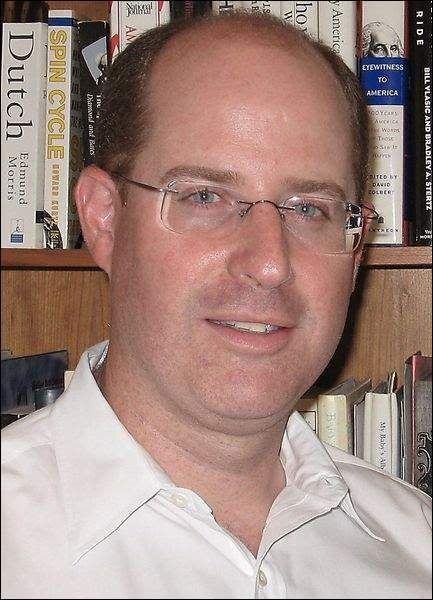 Republican consultant Allen Raymond
The Concord Monitor reports:
The conspiracy to jam New Hampshire Democratic Party phone lines on Election Day 2002 must have gone to the top of the Republican Party, one of the operatives imprisoned in the scheme writes in a forthcoming book.
Republican consultant Allen Raymond writes that he became involved only because he'd been called by James Tobin, then the New England political director for the Republican National Committee.
"The Bush White House had complete control of the RNC, and there was no way someone like Tobin was going to try what he was proposing without first getting it vetted by his high-ups," Raymond wrote in How To Rig an Election, a book set for publication next month. "That's if Tobin, rather than one of his bosses, had even thought of the ploy himself - which seemed unlikely."
Raymond, who once had the same RNC job as Tobin for the mid-Atlantic region, said that before Tobin's call, his telemarketing outfit, GOP Marketplace, had been shut out of RNC jobs. Allen figured he'd lost favor because he publicly aired his disdain for Bush and feuded with a Bush vendor. "I figured this was the Dare - the Bushies' way of making me prove my stripes to get back into the club," he wrote.
In an interview, Raymond said the book had two aims: To entertain - he said he aimed for a cross between Ball Four and Wise Guys (the book Goodfellas was based on) - and to follow the adage "sunlight's the best disinfectant."
"Anybody who reads this book and is mad at me has no sense of humor," he said.
The Monitor obtained an advance copy yesterday. The book is set for release Jan. 8, the day of New Hampshire's presidential primary.
Former gossip columnist Ian Spiegelman, who used to write the New York Post's Page Six, co-wrote the book, which is full of vulgar, colorful language. Raymond said he was connected with Spiegelman through his agent.
"The gossip world at the level he was working is highly charged, highly political," Raymond said. "So I knew that he'd understand what I was talking about."
President Bush is described as a "Connecticut-raised cowboy who'd been blind drunk until he was forty." Steve Forbes, whose presidential campaign Raymond worked for in 2000, "looked like he'd been put together on an operating table" and "had a stammering speech pattern that made you think he was on the verge of a seizure."
Raymond, 40, also knocks the Republican Party that employed him for nearly a decade. "Ever hear the one about the president who picked a land war in the Middle East?" he writes. "Or the one about the vice president who took a scattergun to an old man's face? And then got the old man to apologize for getting shot? That's the type I was dealing with."
Tobin, meanwhile, is painted as a moderate New Englander who'd gone to work for Bush's campaign and "reinvented himself as a full-fledged, Bible-thumping, fear-mongering acolyte for the Holy Connecticut Cowboy."
The U.S. attorneys who handled Tobin's trial also don't escape derision. Prosecutors Nick Marsh and Andrew Levchuk are described as the "pair from Keystone" who "knew exactly nothing" when they took over the case.
The phone-jamming scheme involved repeated hang-up calls made to jam six phone lines - five at the Democratic Party's get-out-the-vote operation and one for a firefighters union offering rides to the polls. Raymond writes that the plan was to tie up the lines all day, but it was aborted after 90 minutes on orders from then-state Republican Party Chairman John Dowd, who insisted it was illegal.
The calls were made on the day of the down-to-the-wire Senate race between Jeanne Shaheen and John Sununu, whose names are almost afterthoughts in the book, mentioned only after pages of discussing the scheme. Sununu won the election by 19,571 votes; the two may face a rematch next year.
Raymond, who served three months in federal prison, and two other men pleaded guilty to criminal conspiracy charges for their roles in the scheme. Chuck McGee, executive director of the New Hampshire Republican Party at the time, came up with the idea. Idaho telemarketer Shaun Hansen owned the company that made the calls.
As the phone-jamming blew up in the press and the FBI investigated, Allen wrote, the RNC opted for "the old-school cover-up" route.
Tobin pleaded not guilty, went to trial and was convicted of telephone harassment in 2005. This spring, an appeals court overturned the ruling and sent the case back to U.S. District Court in Concord for further arguments. Tobin is slated for a new trial in February, though Judge Steven McAuliffe is considering a motion to acquit him.
To Raymond, Tobin was the scheme's "linchpin," and he wrote that he "couldn't believe it" when he read in the newspaper that Tobin pleaded not guilty.
"Now, Tobin was not mentally defective; he could not have believed his own lies," Raymond wrote. To Raymond, he said, the key question is: "Who is he protecting?"
Raymond repeatedly notes that the RNC has paid millions for Tobin's legal defense. "My old pals at the Republican National Committee were spending almost $3 million on my coconspirator's legal defense because he was still a loyal member of the GOP family, while at the same time labeling me a liar, a rogue and a thief to any news outlet that would listen," he wrote.
The smaller details of being a man under indictment are also detailed in the book.
Raymond went to great pains to convince lawyers at the Department of Justice that he wasn't what they were expecting - "a slimy D.C. scoundrel in a Gucci suit, French cuffs, tassel shoes and a fat watch." When he was under investigation, he owned three watches worth a total of $6,000 - so he went to CVS and bought a Timex. He also pulled out the first suit he'd owned, "a power tie from 1990" and loafers with a whole.
"When I put the whole ensemble together, (my wife) Elizabeth just clucked her tongue and gave me the thumbs-up," he wrote. "And then I jumped into my Audi and went to my meeting."
In addition to phone jamming, Raymond elaborates on other political dirty tricks, such as using racial tensions to target phone calls in a New Jersey congressional race that sounded as if they were coming in support of his opponent. He deployed the "angry black man" voice on Eastern European Democrats and used actors with "thick Spanish accents" to tape calls aimed at union households.
These days, Raymond said, he's promoting his book, coaching little league and working at a few business ventures on the side. He lives in the Washington, D.C., area with his wife and two elementary-school-age sons.
He's done with working in politics. As a felon, he said, he's not allowed to vote. But if he could, he'd call himself undeclared, no longer a Republican.
"I love politics, but I'm done. I'll never make a living in politics again," Raymond said in the interview. "After what I went through, one, who would hire me? And two, why would I ever want to work for anybody who would hire me?"
| [+/-] |
Official: Justice Department Slowed Probe Into Phone Jamming |
McClatchey reports:
The Justice Department delayed prosecuting a key Republican official for jamming the phones of New Hampshire Democrats until after the 2004 election, protecting top GOP officials from the scandal until the voting was over.
An official with detailed knowledge of the investigation into the 2002 Election-Day scheme said the inquiry sputtered for months after a prosecutor sought approval to indict James Tobin, the northeast regional coordinator for the Republican National Committee.
The phone-jamming operation was aimed at preventing New Hampshire Democrats from rounding up voters in the close U.S. Senate race between Republican Rep. John Sununu and Democratic Gov. Jeanne Shaheen. Sununu's 19,000-vote victory helped the GOP regain control of the Senate.
While there were guilty pleas in the New Hampshire investigation prior to the 2004 presidential election, involvement of the national GOP wasn't confirmed. A Manchester, N.H., policeman quickly traced the jamming to Republican political operatives in 2003 and forwarded the evidence to the Justice Department for what ordinarily would be a straightforward case.
However, the official, who requested anonymity because of the sensitivity of the matter, told McClatchy that senior Justice Department officials slowed the inquiry. The official didn't know whether top department officials ordered the delays or what motivated those decisions.
The official said that Terry O'Donnell, a former Pentagon general counsel who was representing Tobin, was in contact with senior department officials before Tobin was indicted.
In October, the House Judiciary Committee opened an investigation to determine whether partisan politics undermined the federal probe.
The official said that department officials rejected prosecutor Todd Hinnen's push to bring criminal charges against the New Hampshire Republican Party.
Weeks before the 2004 election, Hinnen's supervisors directed him to ask a judge to halt action temporarily in a Democratic Party civil suit against the GOP so that it wouldn't hurt the investigation, although Hinnen had expressed no concerns that it would, the official said.
Paul Twomey, a lawyer for the state Democratic Party, said the delay spared Republicans embarrassment at the peak of the campaign because a pending deposition would have revealed that several state GOP officials knew about the scheme, which was hatched by their executive director, Charles McGee. The delay also stalled the case beyond its statute of limitations, depriving Democrats of full discovery, he said.
Citing longstanding policy, spokesman Peter Carr said the Justice Department wouldn't comment on its investigation.
Four men have been convicted in the scandal, including McGee and Republican consultant Allen Raymond, who arranged to jam the phones. Their cooperation led to Tobin's indictment.
In mid-October 2004, Tobin resigned as the Bush-Cheney campaign's regional director after a news report disclosed allegations of his involvement. Bush narrowly lost New Hampshire, the only state he won in 2000 that went for Democrat John Kerry.
Hinnen, now an aide to Democratic presidential candidate and Delaware Sen. Joseph Biden, said he couldn't comment on the investigation.
Tobin was convicted in December 2005 of charges related to the scheme, but won a new trial on appeal. His lawyers didn't respond to e-mailed questions.
National Republican committees have paid more than $6 million to Washington law firms to defend Tobin and fight the civil suit, raising suspicions that there's more to the scandal.
Rep. Paul Hodes, a New Hampshire Democrat who requested the House inquiry, said he considers the delay in indicting Tobin to be ``a miscarriage of justice.''
At the outset, the federal investigation hit a snag when Thomas Colantuono, the U.S. attorney for New Hampshire, withdrew from the case in early 2003 because his wife was a Bush-Cheney campaign worker. Justice Department officials then assigned the case to Hinnen, a prosecutor in the Computer Crimes Section.
HOW THE INVESTIGATION BEGAN
The official with detailed knowledge of the case gave this account of how the case unfolded:
In early 2004, Hinnen got approval from John Malcolm, the deputy chief of the Justice Department's Criminal Division, in early 2004 to investigate Tobin. Malcolm left the department soon afterward.
Hinnen then sought approval from Malcolm's successor, Laura Parsky, to prosecute Tobin but wasn't told until late summer to write a formal, detailed prosecution memo, which he did in early September.
On Oct. 1, 2004, Hinnen got the green light to prepare an indictment, but was directed to first give Tobin lawyer O'Donnell a chance to make his client's case. O'Donnell requested delays and then told Hinnen, Parsky and other senior officials that an unidentified lawyer had advised Tobin that the jamming was legal.
Hinnen argued to his superiors that it was irresponsible for the department to allow Tobin to serve as a Bush campaign official when it had evidence that he'd hindered people from voting.
In late October 2004, Justice Department officials told Hinnen it was too close to the election to bring such a politically sensitive indictment, putting it off until late November.
In early 2005, Hinnen submitted a lengthy memo arguing for a criminal indictment treating the New Hampshire Republican State Committee as a corporate entity. Hinnen noted that the party lacked an ethics policy at the time of the phone jamming and that its officials had refused to share with prosecutors the results of an internal investigation of the scheme.
Craig Donsanto, the chief of the department's Election Crimes Branch, objected to an indictment, arguing that the state GOP's ``shareholders'' are the voters.
Ultimately, John Keeney, a career deputy assistant attorney general, directed Hinnen to drop the idea.
Keeney, Donsanto and Parsky, now a San Diego County judge, didn't respond to phone calls.
In August, 2005, Hinnen was detailed for 18 months to a National Security Council job in the White House, leaving other prosecutors to handle Tobin's trial.
Tuesday, December 18, 2007
| [+/-] |
GOP Trickster Says He Was A Scapegoat |
Phone jammer claims higher-ups in the party took part in the scheme in New Hampshire
The Houston Chronicle reports:
A former GOP political operative who ran an illegal Election Day scheme to jam the phone lines of New Hampshire Democrats during the state's tight 2002 U.S. Senate election said in a new book and an interview that he believes the scandal reaches higher into the Republican Party.
Allen Raymond of Bethesda, Md., whose book Simon & Schuster will publish next month, also accused the GOP of trying to hang the blame for a scandal on him as part of an "old-school cover-up."
Raymond's book, How to Rig an Election: Confessions of a Republican Operative, offers a raw glimpse of the phone scandal as it unraveled and of a ruthless world in which political operatives seek to win at all costs.
McClatchy obtained an advance copy of the book.
The 2002 New Hampshire Senate race, in which GOP Rep. John Sununu edged Democratic Gov. Jeanne Shaheen by 19,000 votes, was among several targeted by Republicans seeking to win control of the U.S. Senate.
Raymond said those who have tried to make him the fall guy for the New Hampshire scheme failed to recognize that e-mails, phone records and other evidence documented the complicity of a top state GOP official and the Republican National Committee's northeast regional director.
Both men were later convicted of charges related to the phone harassment, along with Raymond and an Idaho phone bank operator. Defense lawyers have since won a retrial for James Tobin, the former regional director for both the RNC and the National Republican Senatorial Committee.
A lawyer for Tobin didn't respond to phone messages.
GOP committees have paid Washington law firms more than $6 million to defend Tobin and to fight a Democratic civil suit against the party. Raymond, himself a former RNC official, said he believes that the scandal reaches higher.
"Any tactic that didn't pass the smell test would never see the light of day without, at the very least, the approval of an RNC attorney," he wrote.
Paul Twomey, a lawyer for the New Hampshire Democratic Party, said that phone records obtained in the civil suit showed that Tobin made 22 calls to the White House political office in the 24 hours before and after the jamming.
Twomey said Tobin refused to testify about the calls, invoking his Fifth Amendment rights against self-incrimination.
Asked about Raymond's book, RNC spokesman Danny Diaz said that "it would be hard to find two less credible individuals" than Raymond and co-author Ian Spiegelman, who lost his job as a New York Post gossip columnist for sending a threatening e-mail accusing a source of trying to plant a fake story.
Raymond, who served three months in jail last year, said he earned a graduate degree in political management solely to make money off politics, and it made no difference to him whether he was a Republican or a Democrat.
Sunday, December 2, 2007
| [+/-] |
Business Lobby Presses Agenda Before '08 Vote |
The NY Times reports:
Business lobbyists, nervously anticipating Democratic gains in next year’s elections, are racing to secure final approval for a wide range of health, safety, labor and economic rules, in the belief that they can get better deals from the Bush administration than from its successor.
Ivan H. Adler, an executive recruiter, says Democratic lobbyists are in demand.
Hoping to lock in policies backed by a pro-business administration, poultry farmers are seeking an exemption for the smelly fumes produced by tons of chicken manure. Businesses are lobbying the Bush administration to roll back rules that let employees take time off for family needs and medical problems. And electric power companies are pushing the government to relax pollution-control requirements.
“There’s a growing sense, a growing probability, that the next administration could be Democratic,” said Craig L. Fuller, executive vice president of Apco Worldwide, a lobbying and public relations firm, who was a White House official in the Reagan administration. “Corporate executives, trade associations and lobbying firms have begun to recalibrate their strategies.”
The Federal Register typically grows fat with regulations churned out in the final weeks of any administration. But the push for such rules has become unusually intense because of the possibility that Democrats in 2009 may consolidate control of the White House, the Senate and the House of Representatives for the first time in 14 years.
Even as they try to shape pending regulations, business lobbies are also looking beyond President Bush. Corporations and trade associations are recruiting Democratic lobbyists. And lobbyists, expecting battles over taxes and health care in 2009, are pouring money into the campaigns of Democratic candidates for Congress and the White House.
Randel K. Johnson, a vice president of the United States Chamber of Commerce, said, “I am beefing up my staff, putting more money aside for economic analysis of regulations that I foresee coming out of a possible new Democratic administration.”
At the Transportation Department, trucking companies are trying to get final approval for a rule increasing the maximum number of hours commercial truck drivers can work. And automakers are trying to persuade officials to set new standards for the strength of car roofs — standards far less stringent than what consumer advocates say is needed to protect riders in a rollover.
Business groups generally argue that federal regulations are onerous and needlessly add costs that are passed on to consumers, while their opponents accuse them of trying to whittle down regulations that are vital to safety and quality of life. Documents on file at several agencies show that business groups have stepped up lobbying in recent months, as they try to help the Bush administration finish work on rules that have been hotly debated and, in some cases, litigated for years.
At the Interior Department, coal companies are lobbying for a regulation that would allow them to dump rock and dirt from mountaintop mining operations into nearby streams and valleys. It would be prohibitively expensive to haul away the material, they say, and there are no waste sites in the area. Luke Popovich, a vice president of the National Mining Association, said that a Democratic president was more likely to side with “the greens.”
A coalition of environmental groups has condemned the proposed rule, saying it would accelerate “the destruction of mountains, forests and streams throughout Appalachia.”
A priority for many employers in 2008 is to secure changes in the rules for family and medical leave. Under a 1993 law, people who work for a company with 50 or more employees are generally entitled to 12 weeks of unpaid leave to care for newborn children or sick relatives or to tend to medical problems of their own. The Labor Department has signaled its interest in changes by soliciting public comments.
The National Association of Manufacturers said the law had been widely abused and had caused “a staggering loss of work hours” as employees took unscheduled, intermittent time off for health conditions that could not be verified. The use of such leave time tends to rise sharply before holiday weekends, on the day after Super Bowl Sunday and on the first day of the local hunting season, employers said.
Debra L. Ness, president of the National Partnership for Women and Families, an advocacy group, said she was “very concerned that the Bush administration will issue new rules that cut back on family and medical leave for those who need it.”
That could be done, for example, by narrowing the definition of a “serious health condition” or by establishing stricter requirements for taking intermittent leave for chronic conditions that flare up unexpectedly.
The Chamber of Commerce is seeking such changes. “We want to get this done before the election,” Mr. Johnson said. “The next White House may be less hospitable to our position.”
Indeed, most of the Democratic candidates for president have offered proposals to expand the 1993 law, to provide paid leave and to cover millions of additional workers. Senator Christopher J. Dodd of Connecticut was a principal author of the law. Senator Hillary Rodham Clinton of New York says it has been “enormously successful.” And Senator Barack Obama of Illinois says that more generous family leave is an essential part of his plan to “reclaim the American dream.”
Susan E. Dudley, administrator of the White House Office of Information and Regulatory Affairs, said, “Research suggests that regulatory activity increases in the final year of an administration, regardless of party.”
Whoever becomes the next president, Democrat or Republican, will find that it is not so easy to make immediate and sweeping changes. The Supreme Court has held that a new president cannot arbitrarily revoke final regulations that already have the force of law. To undo such rules, a new administration must provide a compelling justification and go through a formal rule-making process, which can take months or years.
Within hours of taking office in 2001, Mr. Bush slammed the brakes on scores of regulations issued just before he took office, so his administration could review them. A study in the Wake Forest Law Review found that one-fifth of those “midnight regulations” were amended or repealed by the Bush administration, while four-fifths survived.
Some of the biggest battles now involve rules affecting the quality of air, water and soil.
The National Chicken Council and the U.S. Poultry and Egg Association have petitioned for an exemption from laws and rules that require them to report emissions of ammonia exceeding 100 pounds a day. They argue that “emissions from poultry houses pose little or no risk to public health” because the ammonia disperses quickly in the air.
Perdue Farms, one of the nation’s largest poultry producers, said that it was “essentially impossible to provide an accurate estimate of any ammonia releases,” and that a reporting requirement would place “an undue and useless burden” on farmers.
But environmental groups told the Bush administration that “ammonia emissions from poultry operations pose great risk to public health.” And, they noted, a federal judge in Kentucky has found that farmers discharge ammonia from their barns, into the environment, so it will not sicken or kill the chickens.
On another issue, the Environmental Protection Agency is drafting final rules that would allow utility companies to modify coal-fired power plants and increase their emissions without installing new pollution-control equipment.
The Edison Electric Institute, the lobby for power companies, said the companies needed regulatory relief to meet the growing demand for “safe, reliable and affordable electricity.”
But John D. Walke, director of the clean air program at the Natural Resources Defense Council, said the rules would be “the Bush administration’s parting gift to the utility industry.”
If Democrats gain seats in Congress or win the White House, that could pose problems for all-Republican lobbying firms like Barbour, Griffith & Rogers, whose founders include Gov. Haley Barbour of Mississippi, a former chairman of the Republican National Committee.
Loren Monroe, chief operating officer of the Barbour firm, said: “If the right person came along, we might hire a Democrat. And it’s quite possible we could team up in an alliance with a Democratic firm.”
Two executive recruiters, Ivan H. Adler of the McCormick Group and Nels B. Olson of Korn/Ferry International, said they had seen a growing demand for Democratic lobbyists. “It’s a bull market for Democrats, especially those who have worked for the Congressional leadership” or a powerful committee, Mr. Adler said.
Few industries have more cause for concern than drug companies, which have been a favorite target of Democrats. Republicans run the Washington offices of most major drug companies, and a former Republican House member, Billy Tauzin, is president of their trade association, the Pharmaceutical Research and Manufacturers of America.
The association has hired three Democrats this year, so its lobbying team is split evenly between Republicans and Democrats.
Loren B. Thompson, a military analyst at the Lexington Institute, a policy research organization, said: “Defense contractors have not only begun to prepare for the next administration. They have begun to shape it. They’ve met with Hillary Clinton and other candidates.”
Saturday, November 24, 2007
| [+/-] |
Karl Rove: "How to Beat Hillary" |
"Republicans who think she'll be easy to defeat are wrong. What they should do."
In Newsweek, Karl Rove writes:
I've seen up close the two Clintons America knows. He's a big smile, hand locked on your arm and lots of charms. "Hey, come down and speak at my library. I'd like to talk some politics with you."
And her? She tends to be, well, hard and brittle. I inherited her West Wing office. Shortly after the 2001 Inauguration, I made a little talk saying I appreciated having the office because it had the only full-length vanity mirror in the West Wing, which gave me a chance to improve my rumpled appearance. The senator from New York confronted me shortly after and pointedly said she hadn't put the mirror there. I hadn't said she did, just that the mirror was there. So a few weeks later, in another talk, I repeated the story about the mirror. And shortly thereafter, the junior senator saw me and, again, without a hint of humor or light in her voice, icily said she'd heard I'd repeated the story of the mirror and she … did … not … put … that mirror in the office.
It is a small but telling story: she is tough, persistent and forgets nothing. Those are some of the reasons she is so formidable as a contender, and why Republicans who think she would be easy to beat are wrong. The Republican presidential nomination is the most fluid and unpredictable contest in decades, but the Democratic nominee is likely to be Hillary. Not without a fight, not without losing early contests (probably Iowa, for starters) and not without bruises and bumps.
And so the question to John McCain from a woman at a town hall in South Carolina last Monday was tasteless, but key: "How do we beat the [rhymes with witch]?" Right now, Republicans are focusing much of their fire on Senator Clinton. Criticizing her unites the party, stirs up the unsettled feelings many swing voters have toward her and allows each candidate to say why he is best able to beat her. For now, that's enough. But when a GOP nominee emerges, he needs to remember no Republican is as well known as Hillary. The Republican has room to grow in the polls as voters get a better sense of who he is and what animates him. Here's what he needs to do.
Plan now to introduce yourself again right after winning the nomination. Don't assume everyone knows you. Many will still not know what you've done in real life. Create a narrative that explains your life and commitments. Every presidential election is about change and the future, not the past. So show them who you are in a way that gives the American people hope, optimism and insight. That's the best antidote to the low approval rates of the Republican president. Those numbers will not help the GOP candidate, just as the even lower approval ratings of the Congress will not help the Democratic standard-bearer.
Say in authentic terms what you believe. The GOP nominee must highlight his core convictions to help people understand who he is and to set up a natural contrast with Clinton, both on style and substance. Don't be afraid to say something controversial. The American people want their president to be authentic. And against a Democrat who calculates almost everything, including her accent and laugh, being seen as someone who says what he believes in a direct way will help.
Tackle issues families care about and Republicans too often shy away from. Jobs, the economy, taxes and spending will be big issues this campaign, but some issues that used to be "go to" ones for Republicans, like crime and welfare, don't have as much salience. Concerns like health care, the cost of college and social mobility will be more important. The Republican nominee needs to be confident in talking about these concerns and credible in laying out how he will address them. Be bold in approach and presentation.
Go after people who aren't traditional Republicans. Aggressively campaign for the votes of America's minorities. Go to their communities, listen and learn, demonstrate your engagement and emphasize how your message can provide hope and access to the American Dream for all. The GOP candidate must ask for the vote in every part of the electorate. He needs to do better among minorities, and be seen as trying.
Be strong on Iraq. Democrats have bet on failure. That's looking to be an increasingly bad wager, given the remarkable progress seen recently in Iraq. If the question is who will get out quicker, the answer is Hillary. The Republican candidate wants to recast the question to: who will lead America to victory in a vital battleground in the War on Terror? There will be contentious fights over funding the troops and over intelligence-gathering right after the parties settle on their candidates. Both battles will help the Republican candidate demonstrate who will be stronger in winning the new struggle of the 21st century.
The conventional wisdom now is that Hillary Clinton will be the next president. In reality, she's eminently beatable. Her contentious history evokes unpleasant memories. She lacks her husband's political gifts and rejects much of the centrism he championed. The health-care fiasco showed her style and ideology. All of which helps explain why, for a front runner in an open race for the presidency, she has the highest negatives in history.
While the prospective Republican nominee is talking about her now, the time will come soon when he must spend more time telling his story. By explaining to voters why he deserves to be our next president, he will also make clear why that job should not go to another person named Clinton.
Wednesday, November 21, 2007
| [+/-] |
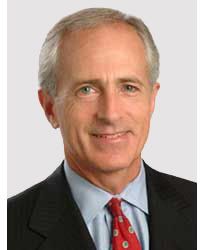
Corker "Underwhelmed" with President Bush |
Local news in Chattanooga reports:
Tennessee Senator Bob Corker raised some eyebrows at a luncheon at the Chattanoogan hotel Tuesday with remarks about President Bush.
Speaking to a crowd of about 500 supporters, led by Hamilton County Mayor Claude Ramsey, Corker spoke about a range of issues, including energy, healthcare, and his experiences during his first year as a Senator.
But his remarks about his experiences with the White House during meetings on the war in Iraq left some in the crowd befuddled.
"I was in the White House a number of times to talk about the issue, and I may rankle some in the room saying this, but I was very underwhelmed with what discussions took place at the White House," Corker said.
A few minutes later during a question and answer session a man in the audience asked him to clarify his statement.
"I was concerned about your statement that you were underwhelmed with what was going on in the White House. Did you mean with him or with his staff?"
In response, Corker said, "Let me say this. George Bush is a very compassionate person. He's a very good person. And a lot of people don't see that in him, and there's many people in this room who might disagree with that.... I just felt a little bit underwhelmed by our discussions, the complexity of them, the depth of them. And yet in spite of that, I do believe that the most recent course of action we've pursued is a good one. I feel like what we've lack in our country is a coherent effort that really links together the Treasury Department, all the various departments of our government in a way that really focuses not just on the hard military side of things, but also the soft effort that it takes to build good will among people. I really think much of that has righted itself, I'm just telling you that at that moment in time I felt very underwhelmed, and I'm just being honest. I've said that to them, and to him, and to others. I kind of in a way wish I hadn't said it today." The last comment was greeted with laughter in the crowd.
Corker is a member of the Foreign Relations Committee. He told the audience that before the end of the year he plans to travel to Pakistan, Afghanistan and India to meet with leaders of those countries.
Friday, November 2, 2007
| [+/-] |
Stage Set for Bush Barbecue |
Finlay has polished mansion for president’s fundrasing visit today
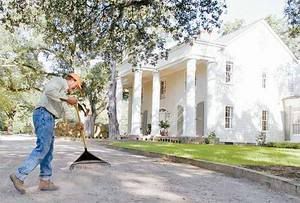 Ronnie Monts rakes the driveway Thursday at Columbia City Councilman Kirkman Finlay’s home in preparation for today’s visit by President Bush.
The State reports:
It has taken a few years to get Columbia’s white house ready — more than 120 years all told — but Kirkman Finlay believes his home is ready for the resident of the most famous White House.
Today, Finlay, his wife, Kathleen, and three children will host President George W. Bush and more than 500 others at a campaign fundraiser for U.S. Sen. Lindsey Graham at the Finlay home.
Planning Southern hospitality on a presidential scale has not been easy, Finlay said.
“It’s all about trying to make it as presentable as you can. To have your home look as good as possible for what I consider a historic event.”
Finlay is a Columbia City Council member and the son of former Columbia Mayor Kirkman Finlay Jr. He is also advising former U.S. Sen. Fred Thompson’s S.C. presidential campaign.
Thursday morning, workers were adjusting the tents set up in the backyard for the lunchtime visit. Elsewhere, landscapers spruced up the lawn and shrubbery and tidied mulch.
Finlay declined to discuss much of the preparation for security reasons, and did not allow a tour of the property. Likewise, neither the White House nor the Graham campaign would confirm the event’s location, though Finlay’s home is listed on invitations sent out last month.
According to the invitation, the minimum donation to attend was $250, while those giving or raising $10,000 could have a photo taken with Graham and Bush.
Bush has headlined fundraisers in Charleston, Myrtle Beach and Greenville, but Friday’s event is his first fundraiser in Columbia since becoming president in 2001.
Supporters “have been really excited about this event,” said Scott Farmer, Graham’s campaign spokesman. “People from all over the state are coming to attend.”
Farmer said Bush’s visit is a “seminal moment” for the re-election campaign.
Planning has been stressful, but the staffs of the White House and Graham’s campaign have smoothed the logistics.
Finlay admitted he has made a few trips to home improvement stores during the month since he was asked to host.
“We’ve done everything from mulching to putting in rye seed,” Finlay said. The benefit, he said, is that he has knocked out a number of long-needed home improvement projects.
“That ‘to do’ list has been whittled down,” he said.
The home off Garners Ferry Road, known as Millwood Plantation, was formerly the three-bedroom homestead of Finlay’s Hampton family ancestors. The columns of Confederate Gen. Wade Hampton’s burned home still stand on the property.
The house has been expanded “three or four times,” Finlay said According to property records, the 5-bedroom home is 7,100 square feet.
Finlay also has stables on the property, but expected Bush’s schedule would be too tight to ride with the Texas rancher.
Much easier was planning lunch, which will be catered by Doc’s Barbecue and Southern Buffet, of which Finlay is a co-owner. Dessert will be petit fours (small cakes).
“A nice meal with a Southern flair,” Finlay said.
Friday, October 26, 2007
| [+/-] |
Bush Plans S.C. Visit |
Trip to Columbia will raise funds for Graham's re-election bid.
The State reports:
President Bush will come to Columbia next week for a high-roller fundraiser for U.S. Sen. Lindsey Graham as the first-term Republican officially launches his 2008 re-election campaign.
Bush will keynote a minimum $250-a-plate barbecue luncheon Nov. 2 at the posh home of Columbia City Councilman Kirkman Finlay III, who owns a cattle and hay farm off Garners Ferry Road near Fort Jackson.
Neither Graham nor the White House would confirm Bush’s visit, but McClatchy Newspapers obtained the invitation going out to hundreds of GOP stalwarts around the state.
Highlighting Bush as the “featured guest,” the invitation offers several levels of access to the president and Graham.
Guests contributing at least $10,000 per couple will get their photo taken with Bush, while those donating at least $5,000 will be photographed with Graham.
McClatchy Newspapers also obtained an e-mail from Shell Suber, political director of Graham’s campaign, to GOP county chairmen, seeking volunteers to help organize the Bush fund-raiser and enjoy “a terrific opportunity to be part of a (sic) historic event.”
Bush has attended fundraisers in Charleston and Greenville, but his appearance in Columbia will be his first fund-raising visit to the state capital since becoming president in 2001.
Graham, who lives in Seneca, has more than $4 million in his campaign coffers and faces no major opposition from either party to date.
“President Bush is very popular in South Carolina, particularly among Republicans,” Graham said. “If he were to come in support of my campaign, it would be very helpful and I would be honored. I look forward to hopefully having him come to South Carolina and stand by my side.”
Graham said he is not nervous about his re-election prospects in the wake of his high-profile support earlier this year for immigration reforms that enraged many GOP activists in South Carolina and beyond.
“I’m going to be judged by what I’ve done for six years, not on one issue,” Graham said. “I think most people in South Carolina appreciate having a senator who will speak his mind and stand up and be counted on the hard issues.”
Rick Beltran, chairman of the Spartanburg County Republican Party, said anger over Graham’s support for giving illegal immigrants legal status has ebbed in his area.
Graham had an approval rating of 55 percent in a recent poll of likely Spartanburg GOP voters, Beltran said, up from 41 percent in June.
“I’m pretty high on Senator Graham,” Beltran said.
But Beltran’s counterpart in nearby Greenville, Samuel Harms, said he wouldn’t attend the fundraiser next week.
“We’re 10 percent of the Republican vote in South Carolina,” Harms said. “I think it’s important that people believe that the chairman isn’t playing favorites with one candidate over another. We do have a contested election.”
Tim Carnes of Greenville and John Cina of Summerville have announced GOP primary challenges against Graham. Gary McLeod, a perennial candidate for the 6th Congressional District, also has expressed interest. Neither Carnes nor Cina has held elective office nor raised significant campaign funds.
Joe Erwin, former chairman of the South Carolina Democratic Party, said Wednesday he wouldn’t run against Graham. No other Democrat has stepped forward.
The Greenville County GOP executive committee passed a “resolution of censure” of Graham in August because of his support for immigration reforms.
Harms said the censure measure has led Graham to support stiffer immigration measures, such as his legislation the Senate recently passed, which provides $3 billion to fortify the U.S.-Mexico border.
“The Greenville County Republican Party probably had a significant influence on Lindsey Graham changing course,” Harms said. “America is a better place because of what we did.”
Wednesday, August 8, 2007
| [+/-] |
Rudy Giuliani's Wife Seen As Liability In Run For President |
Canada.com reports:
She has variously been called a "harpy," a tiara-wearing "princess bride" and "a particularly unpleasant combination of Catherine the Great and Britney Spears."
Republican presidential candidate Rudolph Giuliani and his handlers always knew they would have a delicate task peddling the charms of his mistress-turned-wife given the scandalous and sensationalized origins of their relationship.
But the reception of a gossip-loving media and family-values-focused voters has been even nastier than expected during every step of this summer's carefully scripted "roll-out" of Judith Giuliani as the first lady the former New York City mayor and 9/11 hero would bring to the White House.
For starters, there was the revelation that Mrs. Giuliani had been married not once but twice before (just like Mr. Giuliani himself.)
Then there was the news that in her job selling medical equipment, she used to demonstrate a surgical stapler on dogs who were later put to death.
Now on the stands sits Vanity Fair's less-than-flattering profile based largely on anonymous sources, which describes her as a social status-seeking, materialistic, busybody who has forsaken going by the name Judi in now insisting on being called Judith, demands a separate airplane seat for her "baby Louis" Vuitton suitcase, forced her husband to retrieve a forgotten sack of health bars during a high-security visit to Mexico and has a hit list of her husband's staffers whom she apparently wants fired.
Mr. Giuliani's spokesman Michael McKeon has reportedly denounced the piece as "vile and venomous," but it seems to only have fuelled the media feeding frenzy, with follow-ups from The New York Times to The Times of London seizing on the neophyte political spouse's faux pas. On blogs and in newspaper columns, political commentators have begun to openly wonder whether Mrs. Giuliani is an asset or a liability to one of the front-running contenders for the U.S. presidency.
Gil Troy, a professor of history at McGill University, said Mr. Giuliani's calculated attempts to showcase his wife have made her fair game. Politicians want privacy to be a one-way street in that they want to determine when and how they employ their family members to seduce the public, he said, but that just isn't realistic in today's celebrity-obsessed culture.
"Rudy Giuliani is playing an extremely dangerous game," said Prof. Troy, whose most recent book is Hillary Rodham Clinton: Polarizing First Lady. "The more he goes on Barbara Walters and talks about them as a couple and them as a team, the more scrutiny there will be and the more of an emphasis there will be from people like [Republican rival] Mitt Romney's camp in the most subtle of ways on the fact that he's trying lead a family-values party with a wife who represents a dramatic departure from family values."
The very genesis of the couple's relationship was bound to be problematic. Mr. Giuliani, then mayor of New York, and Judith Nathan, a divorcée, began seeing each other when he was still married to his second wife, actress Donna Hanover. He famously announced the end of his 17-year marriage in a surprise press conference that ultimately provoked a nasty row over who had the right to live in the mayoral Gracie Mansion.
The Giuliani camp has sought to over-write that first impression by playing up his new wife's supportive role during the candidate's bout with prostate cancer, her contribution as a health care advisor due to her training as a nurse and career in medical equipment sales and her struggles as a single mother raising an adopted daughter.
For the most part, however, those attempts have come across as awkward or backfired.
And it certainly hasn't helped that Mr. Giuliani's children harbour deep scorn for the woman they see as having stolen their father from their mother in spectacularly humiliating fashion.
Mr. Giuliani's 21-year-old son Andrew told The New York Times he won't be campaigning for his dad and is, in fact, estranged from him, and cited as his reason "a little problem that exists between me and his wife."
This week, Mr. Giuliani's daughter Caroline, who is reported to have taken her parents' divorce hard, was outed as a supporter of Democratic presidential rival Barack Obama.
In the electoral game, much rides on a candidate's choice of spouse, said Shannon Sampert, a professor of political science at the University of Winnipeg.
"We've always had a sense of what the good first lady or the good prime minister's wife should act like, and if they don't act like that we're very quick to judge them, " she said.
Fairly or unfairly, Prof. Sampert said, the public and the media see political spouses as a reflection of the candidates themselves, and, in the United States particularly, often bristle at women who do not fit the tradition of a smiling, cookie-baking silent partner - more Barbara Bush than Hillary Clinton or Teresa Heinz Kerry.
"If she's perceived as too uppity, the thinking is, 'If you can't control your spouse, if you can't control your family, how are you going to control the country?' " Prof. Sampert said. "If you want to be a good politician, you should think 20 years before you make the decision to run who you marry because that person will be scrutinized as much as you will.
"Be careful who you marry," she said laughing.
Friday, September 30, 2005
| [+/-] |
The GOP's Spreading Plague |
Voters are notoriously slow in voting out politicians accused of corruption, but they may reach the tipping point with the latest revelations.
Joe Conason writes:
To be an honest Republican these days must be to wonder what awful revelation is coming next -- and how the Grand Old Party, which once claimed to represent political reform, became a front for sleaze, corruption and cynical criminality. Across the country, from the Capitol to statehouses, Republican officials are under indictment, under investigation or under suspicion.
This week's headlines featured the indictment of Rep. Tom DeLay and the probe of Senate Majority Leader Bill Frist, but the infection of venality among their fellow partisans is now reaching epidemic proportions. So widespread is the plague that keeping track of all the individual cases, and their increasingly baroque variations, has become a distinct challenge.
Consider Jack Abramoff, once the prince of K Street lobbyists and a dedicated right-wing ideologue who boasted of his powerful connections to DeLay, Karl Rove, Grover Norquist and the entire Republican apparatus in Washington. Already under investigation by the Justice Department for his influence peddling among House members, including DeLay, and his swindling of Indian tribes, Abramoff was indicted last month for bank fraud in a separate South Florida case involving a casino boat company that he partly owned.
The fraud allegedly committed by Abramoff and his business partner Adam Kidan involved a phony wire transfer they used to purchase a controlling interest in SunCruz from the company's founder, Konstantinos "Gus" Boulis, in 2001.
Abramoff and Kidan later fell out with Boulis in a bitter business dispute that turned violent. In February 2001, gunmen ambushed Boulis on a Fort Lauderdale, Fla., highway and shot him repeatedly. On Tuesday, Florida authorities arrested three New York men with mob connections for the Boulis killing. Two of the men -- Anthony Moscatiello and Tony Ferrari -- had received payments totaling more than $240,000 from Kidan and Abramoff. Moscatiello, a longtime associate of the Gambino Mafia family, and Ferrari were supposedly providing food and consulting services to SunCruz -- or so Kidan claimed when questioned by prosecutors. There is no evidence, however, that Moscatiello and Ferrari provided any services to the company.
Connecting the dots isn't difficult here: Kidan and Abramoff want to get rid of Boulis, who won't go away. Kidan and Abramoff hire Moscatiello and Ferrari with SunCruz money. Moscatiello and Ferrari allegedly whack Boulis, without any motive of their own. If the Broward County state's attorney has sufficient evidence to win convictions for a capital crime, some people will probably be talking soon in hope of avoiding the hot shot.
The stunning fall of Abramoff, who has yet to hit bottom, is certainly the most colorful tale of Republican depravity. The corporate money laundering to Texas politicians that led to DeLay's conspiracy indictment, and the suspicious insider stock transaction that spurred investigations of Frist by the Justice Department and the Securities and Exchange Commission, seem mundane by comparison. Outrage will be warranted if their misconduct is proved, but everyone sadly knows that these felonies are now common practice in our political and corporate culture.
Corporate misbehavior has also brought down right-wing publisher Conrad Black, neoconservative strategist and former Bush advisor Richard Perle and the entire corporate board of Hollinger Inc., the Republican-friendly media conglomerate formerly controlled by Lord Black -- and that he and others are plausibly accused of illicitly looting for their own benefit. Furious shareholders forced Black to relinquish control of the company and are suing him, as well as Perle and former Black deputy David Radler, for $500 million. The SEC is also suing Black and Radler, and the Justice Department is investigating the former Hollinger directors.
Last month, U.S. Attorney Patrick Fitzgerald, who also happens to be the special prosecutor in the Valerie Plame case, accepted Radler's guilty plea to mail fraud and wire fraud. Radler is now believed to be cooperating in the prosecution of what former SEC chairman Richard Breeden, a Republican who investigated Hollinger on behalf of shareholders, termed a "corporate kleptocracy."
Kleptocratic morality evidently ruled at least two Republican statehouses in the Midwest as well. Currently under indictment are former Gov. George Ryan of Illinois, whose trial on bribery charges began last week, and Gov. Robert Taft of Ohio, who pleaded no contest last month to charges of accepting illegal gifts from a state contractor.
That contractor is Thomas Noe, a coin dealer who received lucrative investment deals with the state's Workers Compensation Fund and is now at the center of a gigantic scandal known as "Coingate." More than $12 million has disappeared from the fund, and former GOP official Noe stands accused of laundering money to various Republican politicians, including the Bush-Cheney campaign. Like Abramoff, Noe is a Bush "Pioneer," responsible for raising at least $100,000 for the president last year.
Still another Pioneer is currently under criminal investigation in a celebrated corruption case involving Randy "Duke" Cunningham, a prominent Republican representative from San Diego with a senior position on the House defense appropriations subcommittee. On Aug. 18, FBI and IRS agents raided the offices of defense contractor and Bush fundraiser Brent Wilkes.
Wilkes is reportedly a former business associate of Mitchell J. Wade, the head of a defense contracting firm called MZM Inc. who is under investigation in San Diego for alleged bribery of Cunningham. According to newspaper reports, Wade purchased a home owned by Cunningham at a price inflated by at least $700,000, and also permitted the congressman to use his 42-foot yacht free of charge. Federal agents searched Wade's offices in July.
Although prosecutors have brought no criminal charges in the case yet, they have filed civil court documents describing the home sale as a violation of federal bribery laws -- and Cunningham, who has served in Congress for decades, has already announced that he will not seek another term next year.
The Republican National Committee's new treasurer, Robert Kjellander, is under investigation too. (Naturally, he is also a Bush Pioneer.) Not long after he assumed his new post at the party's Washington headquarters, Kjellander received a federal subpoena for records of his dealings with the Illinois Teachers' Retirement System, a state pension fund, and the Carlyle Group. Federal prosecutors are reportedly looking into alleged corruption at the fund, and have asked Kjellander to provide information about a $4.5 million fee he received from Carlyle for his role in arranging investments by the fund with the huge private equity fund. Carlyle, of course, is closely connected to the Bush administration, including the president's father, George H.W. Bush, who has worked for the firm as a rainmaker and advisor.
In fairness, it should be said that all these pols and parasites may be innocent (except for those already convicted), or at least not guilty beyond a reasonable doubt. It is also true that voters have historically been slow to evict politicians from office because of corruption charges.
But public opinion of congressional Republicans is hitting new lows, and Americans are growing furious about the war in Iraq, the government response to Hurricane Katrina and rising energy prices. The natural impulse to throw the rascals out can only be encouraged by the Gilded Age spectacles now unfolding in Washington and in cities across the country as the indictments continue to come down between now and November 2006.
