The Wall Street Journal reports:
At least two bidding groups submitted undisclosed cash offers late Friday for
the 75-year lease of the Pennsylvania Turnpike, in what could represent one
of the largest deals in the coveted U.S. infrastructure sector.
One of the bidding groups is led by Spanish toll-road operator Abertis
Infraestructuras SA and includes undisclosed financial partners, a company
official said Saturday. A person familiar with the situation said another
binding bid was filed by Spain's Cintra Concesiones de Infraestructura de
Transporte SA in partnership with Australia's Macquarie Infrastructure Group.
Investment bank Morgan Stanley advised Pennsylvania's government that a
long-term lease of its Turnpike can cover the $1.7 billion for its annual
highway and transit needs, estimating the value of the 500-mile highway at
$12 billion to $18 billion.
Disclosed terms of the proposed 75-year lease of the Pennsylvania Turnpike are
similar to the privatization of Chicago's Skyway and the Indiana Toll Road.
The city of Chicago raised $1.83 billion in 2005 by leasing its Chicago
Skyway for 99 years. Indiana, in turn, obtained $3.85 billion in 2006 through
the 75-year lease of the Indiana Toll Road. Both deals allow significant toll
hikes over the long run, and both were won by Cintra and Macquarie.
The proposed formula for toll increases at the Pennsylvania Turnpike includes
a 25% hike set for next year. Tolls can then match inflation or rise annually
by at least 2.5%. Pennsylvania's government believes such a tolling formula
benefits drivers, as it won't be required to toll other highways.
Monday, May 12, 2008
| [+/-] |
Pennsylvania Gets Offers For Turnpike |
Monday, December 3, 2007
| [+/-] |
Nevada Learns to Cash In on Sales of Federal Land |
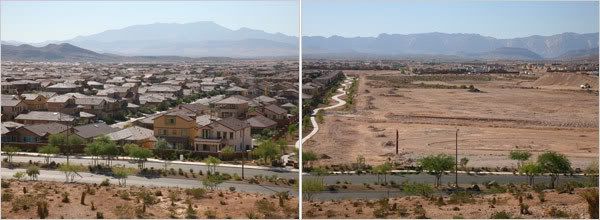 The Mountain’s Edge development sits on land once owned by the federal government in the Las Vegas Valley.
The New York Times reports:
When it opens in 2009, the Clark County Shooting Park will be something to behold, through a scope or otherwise: hundreds of acres devoted to all things gun and bow, complete with a rifle range, a skeet center and an R.V. “host area.”
Las Vegas and other local governments in Nevada quickly caught on that the sales of lands on their outskirts could be used to improve life in the heart of their cities. Local officials find that arrangement fair, but not everyone does.
The coming Craig Ranch Regional Park, due in 2010, should be impressive too, with plans calling for an amphitheater, an aquatics center and sand volleyball courts, all wound around native gardens and wetlands.
Much of the financing for the projects has not come from familiar sources, like local taxes, bond issues or private donations. Instead, they are being paid for through the sales of public lands owned by the federal government.
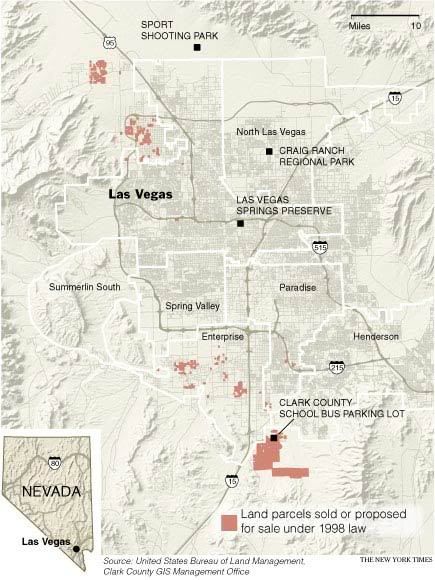
Tens of thousands of acres of federal lands in the Las Vegas area have been sold under an unusual law pushed through Congress nearly a decade ago by the Nevada delegation. The sales have grossed nearly $3 billion and counting.
Because of a stipulation created by the Nevada legislators, the money has not been deposited into the general federal Treasury, but rather put in a special Treasury account to be spent almost exclusively in Nevada on a something-for-everyone collection of projects.
The money has bought environmentally sensitive land and paid for conservation projects, a central purpose of the law and its amendments, as well as improvements in national recreation and refuge areas. But it has also been allocated to such nuts-and-bolts governmental services as education and water projects, and a variety of local perks, including boat ramps, nature trails and community parks complete with tennis courts, dog runs and barbecue pits.
Supporters say the law, which authorized competitive auctions, has been a godsend for a region dealing with rampant population growth, limited room to grow, scarce water and facilities overwhelmed by their own popularity. But critics see it as having created a limitless federal bank account that has encouraged and subsidized unbridled growth at the expense of taxpayers from the 49 other states, all while Nevada continues to draw new residents as a low-tax state disinclined to pay for such projects itself.
Even some ardent fans of the law say the infusion of cash has led to overreaching on the part of some municipalities in Clark County, the mother ship for three growing cities: Las Vegas, North Las Vegas and Henderson.
“We’ve gotten a bit greedy,” said Michael L. Montandon, the mayor of North Las Vegas, which has had $176 million worth of projects approved, including $85.3 million for Craig Ranch. “When your neighboring cities are asking for five times what you are, it tends to make your staff run around looking for projects.”
To gauge the law’s impact since its passage in 1998, The New York Times analyzed data from the United States Bureau of Land Management, the landlord for the federally owned lands. The analysis covered the more than 29,000 acres sold under the law as of Nov. 1, as well as the $2.3 billion in expenditures allocated to projects as of Aug. 31 by the Department of the Interior, which oversees distribution of the money.
The examination found the following:
More than $1 billion in proceeds from the federal land sales have been allocated for parks, trails and nature areas that often amount to public amenities — many of which elected officials say they would not have been able to pay for otherwise. The projects have enhanced property values, and benefited big-name developers, including Focus Property Group, the American Nevada Company, the Del Webb Corporation and the Olympia Development Group, all of which have bought large parcels of arid public lands and turned them into elaborate housing tracts.
Nevada’s schools, which have long sought more money from state lawmakers who resisted raising taxes as enrollment mushroomed, have received $150 million from the sale of the federal lands. The interest on that money has paid for expenses including teachers’ salaries, utility bills and textbooks, which in other states would usually be underwritten by local property taxes.
 Las Vegas and other local governments in Nevada quickly caught on that the sales of lands on their outskirts could be used to improve life in the heart of their cities. Local officials find that arrangement fair, but not everyone does.
The 1998 law uses the same legal framework as a 1920s land act under which the Clark County School District has bought some 685 acres through noncompetitive direct sales for an average of $10 an acre since 2004 to provide land for public schools.
The Southern Nevada Water Authority, the agency that has long provided cheap water to the valley’s two million residents, has received $285 million from the federal land sales, which it has used on a variety of water treatment, testing and transport projects, including facilities at drought-plagued Lake Mead. Plans for revenue from future land sales, water officials say, could include work on a pipeline to import water from 250 miles away.
The acquisition and protection of environmentally sensitive land in private hands was a central element of the law’s purpose, but allocations for those purchases have accounted for only about 15 percent ($346.1 million) of the $2.3 billion in approved spending. Moreover, there has been a net loss of protected land: thus far, some 34,468 acres of public land have been sold or exchanged, while a little more than 20,000 acres of environmentally sensitive land have been bought, though federal officials say other big deals are pending.
Spending on conservation projects, a focus of an amendment to the law in 2002, has also lagged behind other construction-heavy categories. Some $180 million has been allocated for continuing projects like programs to fight litter and dumping, studies of off-road vehicle and water strategies, and wild horse and burro management.
Still, some expenditures designated as conservation have been so broadly defined that they resemble traditional pork. Among them are a mobile fire education trailer ($132,000), an interagency Web site ($269,000), and several plans devoted to safety programs for the region’s abandoned mines ($3 million).
Millions of dollars from the sale of federal lands has been set aside to meet federal requirements — typically the responsibility of local governments — to offset environmental damage from the city’s sprawling growth. Under the act, $53 million has been allocated to help communities in Clark County and the Nevada Department of Transportation to conform with requirements of the Endangered Species Act when development encroaches on native habitats.
Critics argue that the sales help pay for the infrastructure that then supports more expansion.
“Fundamentally, we’re talking about selling public lands which belong to all Americans and giving the proceeds back to local counties for what would ostensibly be conservation projects,” said Myke Bybee, public lands representative for the Sierra Club in Washington. “But those projects,” Mr. Bybee said, are not always “in keeping with conservation.”
That said, in Nevada the law is widely seen by Republicans and Democrats alike as paying off for most everyone at the table, a rarity in a gambling town. Among the winners are developers — who now have access to lands long deemed off-limits — and municipalities, which have added dozens of new recreational amenities, thousands of new residents to tax rolls, and improved the quality of life, all without raising taxes.
“This bill has been across the board incredible for the entire state, for quality of life, for economic development, for managing growth,” said Senator John Ensign, a Republican, who was the bill’s author while serving in the House of Representatives. “And for doing things to make Nevada a better place.”
The law’s original boundary for eligible federal land sales was expanded by Congress in 2002, and some groups, including the Las Vegas Chamber of Commerce, are lobbying to expand it even farther. The allowable area has grown by about 40 percent, or 22,000 acres more than the original 52,000 approved by Congress.
Spreading the Wealth
More and more local officials now want a piece of the land pie. In recent years, Congress has authorized the sale of up to 135,000 acres of public land in White Pine and Lincoln Counties in eastern Nevada. Another later law was enacted in 2000 that requires 80 percent of proceeds from federal land sales be spent in the states where the land is located. And there are similar proposals in other Western states, including land hand-overs to localities in central Idaho and land sales in Washington County, Utah, another fast-growing desert area.
Moreover, local authorities are getting ever bolder in using the proceeds from the federal land sales for expenses not traditionally covered by money from federal taxpayers. More recent bills, authorizing the sales in eastern Nevada, funnel 10 percent of federal proceeds back into law enforcement, fire protection and transportation, traditionally the bailiwick of local governments.
Efforts to redirect at least some of the proceeds from the sales of federal lands into the general federal Treasury have repeatedly been beaten back by the politically connected Nevada delegation, which is now headed by the Senate majority leader, Harry Reid, a Democrat. In recent years, the Bush administration twice failed in efforts to take back some of the payout for the Treasury.
In many ways the law, formally known as the Southern Nevada Public Land Management Act of 1998, has created a new model for managing much of the federally owned land in the West, which encompasses more than 80 percent of the state of Nevada and huge chunks of Utah, Idaho, Wyoming, Arizona, California and Oregon. That model provides a faster way of moving public lands into private hands, and encouraging growth into inhospitable places, in this case, the Mojave Desert.
That local and federal governments work together on such deals is remarkable considering the historic tension between federally owned public lands and the all-American desire for private property. The centuries-old debate has resonated from the high-mindedness of Manifest Destiny’s westward push in the early 1800s to the frenzied scramble of Civil-War-era homesteaders to the defiance of the Sagebrush Rebellion of the 1970s and ’80s, in which ranchers and local officials in the West wanted federal lands transferred to local governments or sold to private owners.
In each case, the central question has been what exactly do America’s national lands represent: Are they expendable, tradeable, and now, salable resources meant to be made private for the sake of progress and individual gain? Or are they public treasures to be protected at all costs, even when they are essentially arid wastelands?
In the Las Vegas area, the answer has increasingly been to sell. The first of a wave of omnibus lands bills passed by a Republican-led Congress, the Nevada law of 1998 was viewed as a pragmatic compromise by environmental groups eager to guarantee the purchase and exchange of fragile habitat.
Subsequent laws affecting other parts of Nevada — which brought environmental groups, land owners and others into negotiations — have coupled land sales with the designation of hundreds of thousands of acres as wilderness. Those wilderness designations, which ban development, were trumpeted by local lawmakers and welcomed even by those who worried about land sales.
“We had a decision to make: Do we pursue this opportunity to protect these special places or do we not?” said Jeremy Garncarz, the associate director of wilderness support at the Wilderness Society. “And we made the decision to pursue the opportunity to protect these places.”
But as the 1998 law has played out, some of its early supporters among environmentalists have also soured on it. The Office of Management and Budget, an arm of the White House, assessed the program in 2004 and said that while it had been “fairly well run,” its revenues were “increasingly being dedicated to low-priority activities.”
Original Intent
“The original concept was to allow private, environmentally sensitive land to be bought more readily,” Jeff Van Ee, a longtime Nevada environmentalist who helped lawmakers draw up the law. “But over the years, what we’ve seen is the money going all over the place, and too much money going to projects that should be funded through more conventional means.”
Sales at auction have accounted for the vast majority of the law’s proceeds, with more than $2.7 billion in sales from 13,000 acres, much of it situated on the edge of cities and primed for development. In a federal-local dance officially known as joint selection, municipalities nominate land for sale once they have determined their infrastructure can support them, said Steve Tryon, assistant field manager for the Las Vegas office of the Bureau of Land Management.
“The cities of Las Vegas and North Las Vegas and Henderson are kind of driving the show,” he said of the selection process, also mentioning that Clark County was very active.
Mr. Tryon said the 1998 law had increased the use of sales provisions in the Federal Land Policy and Management Act of 1976, resulting in more than 14,000 acres sold via direct sale to developers, localities and individuals who owned property adjacent to federal lands. Those sales grossed only a small fraction of the auction sales, bringing in only $114 million.
Nevada lawmakers say it is unfair to view expenditures under the law as a raid on the federal Treasury since the federal government is the largest landowner in Nevada and should be expected to contribute to the state’s economic well-being, just as big private land owners do in other states.
Senator Reid also said that the improvements, including the money spent on parks, trails and natural areas, were on facilities that the general public could use. “All the money is used on public land,” he said. “It doesn’t go onto the Las Vegas Strip.”
Before the 1998 public lands law, the government often converted land to private hands through land exchanges. The deals were regularly criticized by lawmakers and taxpayers, who thought the government gave too much, and wilderness lovers, who thought they got too little.
Land sales, through acts like the 1980 Santini-Burton Act (which sold small tracts of Las Vegas-area land to finance land purchases in the Tahoe basin), were also laborious and the take often meager. A report in September 2001 by the General Accounting Office found that the Bureau of Land Management had sold 79,000 acres between 1991 and 2000 and received just $3 million.
Under the 1998 act, the sales have grossed nearly 1,000 times that figure in the same amount of time — with less than half as much land. One reason is timing: the auctions began just as the Las Vegas real estate market heated up.
The proceeds took the law’s architects by surprise. The Congressional Budget Office estimated in 1998 that the sales would gross some $350 million over seven years. But developers spent more than twice that on a single day in November 2005, when 2,887 acres brought a record $783 million in bids. The majority of auction offerings have been parcels of 10 acres or less. But by 2002, a few large swaths of public lands, more than 100 acres each, were starting to attract bids. At auctions in 2004 and 2005, three bidders bought a combined 10 square miles of land for $1.7 billion for master-planned communities. These developments, often with tens of thousands of units, effectively convert desert into suburbia, complete with parks, artificial lakes, and preternaturally green golf courses.
One of those master builders is John Ritter, chief executive of Focus Property Group, who called the act “a tremendous success,” adding that the fact that sale proceeds would be spent near the communities his company built was an added bonus.
“It’s a well-thought-out way to release land,” said Mr. Ritter, whose company paid $557 million for 1,940 acres at an auction in 2004.
Boat Ramps and Toilets
As quick as money flowed in to the special account, it flowed out. All spending requires authorization by the secretary of the interior from money held in an interest-bearing account, with recommendations from a four-member committee representing four major agencies that receive money from the act, the National Park Service, the United States Forest Service, the Fish and Wildlife Service and the Bureau of Land Management.
Purchases receiving a green light have included a handsome array of land considered environmentally sensitive, which can be recommended by any interested group in the state, including nonprofit organizations and private landholders.
Among the highlights are the planned purchase of Incline Lake near Lake Tahoe, an $83 million project headed by the United States Forest Service, which plans to open it to the public.
But other approved projects read like a Christmas list drafted in Carson City, the state capital: $50.3 million for erosion control and fire prevention programs at Lake Tahoe; $28.8 million in improvements to the picturesque and increasingly popular Red Rock Canyon conservation area; $49.4 million for trails and other amenities at the Springs Preserve, a new environmentally friendly tourist attraction in downtown Las Vegas; and $495,900 for 30 “premier” toilets, complete with “flush technology and solar lighting” at nearby Lake Mead.
This summer, ground was also broken on a tract of low-cost housing in southern Las Vegas, land sold to nonprofit developers at 5 percent of its appraised value.
More than $400 million has also been allocated for building projects on federal lands for the four agencies represented on the executive committee. The law has also been amended six times, and 10 federal agencies, including the Highway Administration and the Army Corps of Engineers, now receive money through it.
Many projects have been focused on Lake Mead, on water pipes, boat ramps and restrooms, as well as pleasantries like picnic tables and campgrounds. But the land sales have also helped federal agencies subsidize basic infrastructure needs, including phone lines, housing, equipment shelters, road construction, fire stations, parking lots, fencing and power supply.
A report last year by the Office of Management and Budget also raised questions about some of the spending, saying too much money went to “purely local projects, which do not reflect the highest priorities of the nation.”
Easing the Burden
Sure enough, the biggest category of approved spending by far has been the urban and suburban projects nominated by local governments, which quickly caught on that the sales of lands on their outskirts could be used to improve life in the heart of their cities. Local officials say that is only fair, arguing that the opening of the lands — and subsequent population growth — increases the stress on local governments to provide services and infrastructure.
The public expenditure, said Erik Pappa, a spokesman for Clark County, in an e-mail message, “relieves some of that burden by providing funding for amenities to improve our quality of life.”
Amendments to the original law have also opened up more categories of spending, including up to $300 million to be set aside for restoration programs in the Lake Tahoe basin, and new counties and groups eligible for money, including fire-safe councils and the Washoe Indian tribe. Some money has also started to be allocated for projects in California, as part of fire prevention programs in the Lake Tahoe region, which includes both states.
In 2006, $476 million was allocated to parks, trails and natural areas throughout the state, a category that has included such cherries as a $1.4 million softball complex in Caliente, a $10 million Las Vegas park with boccie and shuffleboard courts and a $1.5 million planning grant for picnic grounds in Alamo.
P. Lynn Scarlett, the deputy secretary of the interior, defended her agency’s performance, saying the Bureau of Land Management “has very vigorously and carefully selected projects” for the various categories approved by Congress. Ms. Scarlett also said that the disparity between land sold and land bought would most likely equalize as pending purchases of tens of thousands of acres of environmentally sensitive land went through.
For now, with the real estate market here and nationally in a tailspin, the flow of new financing has slowed. Likewise, sales at auctions so far this year have brought in only $20 million.
At the most recent auction, on Nov. 1, the average price per acre topped $500,000, though only one parcel — of 31 offered — sold. In the early days, an acre typically fetched less than $100,000.
Both developers and local politicians have blamed the auction system for inflating land values in the Las Vegas Valley, and some groups have started to push for the boundary to be expanded even farther to lower those costs.
Steve Hill, a major concrete supplier and the chairman of the governmental affairs committee of the Las Vegas Chamber of Commerce, said the lack of available land was making it hard for housing projects to make financial sense, a situation made worse by the mortgage crisis. As such the law was unintentionally encouraging the growth of far-flung suburbs throughout Southern Nevada, Mr. Hill said. Because Las Vegas is encircled by federal lands, these suburbs are forced miles away.
“There are those that feel that land constraint is part social engineering, but the idea that we’re going to squeeze people outside the disposal boundary and push them 50 miles away has social and environmental consequences as well,” he said. “It would be like saying, you can live on the island of Manhattan or you have to live 50 miles away.”
Defenders of the growth of Las Vegas, which is expected to devour its available land by 2017, say the city is in fact very dense, not sprawling. They often refer to the “Manhattanization” of the city, with more and more vertical developments planned, making even more urgent the demand for public parks and other amenities.
“I believe in 100 years they’ll be studying this as a great piece of public policy,” Mr. Montandon, the North Las Vegas mayor, said of the 1998 law. “I think it will go right up beside Robert Moses building New York.”
Meanwhile, plans for similar land sales are moving forward elsewhere in the West. A bill to sell land in fast-growing Washington County in southwestern Utah stalled in Congress last year. But its author, Senator Robert F. Bennett of Utah, said he would introduce another version this year.
Both of Nevada’s senators, Mr. Ensign and Mr. Reid, are circumspect about the spoils or the concept being expanded elsewhere.
“Nevada is doing just fine,” said Mr. Reid, who posed at the ground-breaking for the $64 million shooting range in October 2006. “But I’m not going to be trying to be a missionary for people doing this in other states.”
Public Lands: Treasure or Commodity?
The federal government has sold nearly $3 billion of federal land in the Las Vegas area under a law pushed through Congress nearly a decade ago by Nevada legislators. Some of the projects funded by the proceeds.
Friday, October 12, 2007
| [+/-] |
As Logging Fades, Rich Carve Up Open Land in West |
The NY Times reports:
William P. Foley II pointed to the mountain. Owns it, mostly. A timber company began logging in view of his front yard a few years back. He thought they were cutting too much, so he bought the land.
Mr. Foley belongs to a new wave of investors and landowners across the West who are snapping up open spaces as private playgrounds on the borders of national parks and national forests.
In style and temperament, this new money differs greatly from the Western land barons of old — the timber magnates, copper kings and cattlemen who created the extraction-based economy that dominated the region for a century.
Mr. Foley, 62, standing by his private pond, his horses grazing in the distance, proudly calls himself a conservationist who wants Montana to stay as wild as possible. That does not mean no development and no profit. Mr. Foley, the chairman of a major title insurance company, Fidelity National Financial, based in Florida, also owns a chain of Montana restaurants, a ski resort and a huge cattle ranch on which he is building homes.
But arriving here already rich and in love with the landscape, he said, also means his profit motive is different.
“A lot of it is more for fun than for making money,” said Mr. Foley, who estimates he has invested about $125 million in Montana in the past few years, mostly in real estate.
The rise of a new landed gentry in the West is partly another expression of gilded age economics in America; the super-wealthy elite wades ashore where it will.
With the timber industry in steep decline, recreation is pushing aside logging as the biggest undertaking in the national forests and grasslands, making nearby private tracts more desirable — and valuable, in a sort of ratchet effect — to people who enjoy outdoor activities and ample elbow room and who have the means to take title to what they want.
Some old-line logging companies, including Plum Creek Timber, the country’s largest private landowner, are cashing in, putting tens of thousands of wooded acres on the market from Montana to Oregon. Plum Creek, which owns about 1.2 million acres here in Montana alone, is getting up to $29,000 an acre for land that was worth perhaps $500 an acre for timber cutting.
“Everybody wants to buy a 640-acre section of forest that’s next to the U.S. Forest Service or one of the wilderness areas,” said Plum Creek’s president and chief executive, Rick Holley.
As a result, population is surging in areas surrounding national forests and national parks, with open spaces being carved up into sprawling wooded plots, enough for a house and no nosy neighbors.
Here in Flathead County, on the western edge of Glacier National Park, the number of real estate transactions, mostly for open land, rose by 30 percent from 2003 to 2006, according to state figures. The county’s population is up 44 percent since 1990.
The United States Forest Service projects that over the next 25 years, an area the size of Maine — all of it bordering the national forests and grasslands — will face development pressure and increased housing density.
But the equally important force is the change in ownership. According to a Forest Service study, not yet published, more than 1.1 million new families became owners of an acre or more of private forest from 1993 to 2006 in the lower 48 states, a 12 percent increase. And almost all the net growth, about seven million acres, was in the Rocky Mountain region.
Institutions, pension funds and real estate investment trusts have been particularly aggressive buyers. Over the last 10 years, at least 40 million acres of private forest land have changed hands nationwide, said Bob Izlar, the director of the Center for Forest Business at the University of Georgia. It is a turnover that Mr. Izlar said was unmatched at least since the Great Depression.
Here in the West, questions of clout and class have been raised by the new arrivals.
This year, the conservation group Trout Unlimited, which had been considering ending its involvement in disputes between private landowners and fishermen over public access to fishing streams, backtracked after its members rose up in protest. Some members accused the group of siding with the landowners by not fighting for fishermen’s access rights.
In parts of Colorado where communities have committed tax money to preserve open space, conflicts have erupted on the borders of the public lands over whether the programs — which in many cases buy out an owner’s right to develop property, but not the property itself — are simply enriching landowners who keep the land and the public off, too.
“When you’re there, you’re on four million acres,” said Michael Carricarte, who bought an 800-acre property in Glenwood Springs, Colo., in 2005, and now has the place, bordered on three sides by federal land, up for sale, asking $23.5 million.
“To get to where our property touched public land would take three hours by public road, but from our house it was 10 minutes by four-wheeler or Jeep," he said.
Mr. Carricarte, 39, said he was now in the process of selling a conservation easement to the Aspen Valley Land Trust that would lock 600 acres, all bordering public land, into permanent preservation.
Longtime residents tied to the old timber economy are finding it difficult to keep up. In parts of New Mexico and Colorado, the timber industry has all but collapsed; log harvests in the national forests have fallen to about one-fourth of what they were 20 years ago in the Rocky Mountain region, and less than a tenth what they were in the Pacific Northwest.
Some privately owned timberlands have increased production, but in the West, where more than two-thirds of all forest land is publicly owned (compared with about one-sixth in the eastern United States) private owners, even if they want to allow logging, cannot make up the difference.
Ronald H. Buentemeier, a second-generation forester, said he struggled every day to get enough wood to stoke the family-owned mill he runs in Montana, the F. H. Stoltze Land and Lumber Company.
“There’s not enough private land out there,” said Mr. Buentemeier, a blunt-talking 66-year-old with a flat-top crew cut. “We’ve been pulling rabbits out of the hat to keep going.”
In ways that would have been unthinkable only a few years ago, environmentalists and representatives of the timber industry are reaching across the table, drafting plans that would get loggers back into the national forests in exchange for agreements that would set aside certain areas for protection.
Both groups are feeling under siege: timber executives because of the decline in logging, and environmentalists because of the explosion of growth on the margins of the public lands.
One of the most ambitious proposals is here in Montana. It would allow some logging in the Beaverhead and Deerlodge National Forests in the state’s southwest corner in exchange for the designation of new areas within the forests as permanent wilderness.
Some timber companies say that gaining conservationists as allies may be the only way to get back into the national forests, and so stay in business. But both sides say that success will require a turn of the historical momentum against logging in the West that began in the early ’90s.
A court decision in 1991 involving the northern spotted owl required the Forest Service to manage for more than just timber production. The national forests in the northern Rockies constricted logging, fostering expansion in other forest areas like the South.
“If there’s anything the industry should have learned over the years, it’s that we can’t do this by ourselves,” said Gordy Sanders, the resource manager at Pyramid Mountain Lumber, one of the mill operators involved in the Beaverhead and Deerlodge negotiations.
Many environmentalists say they have come to realize that cutting down trees, if done responsibly, is not the worst thing that can happen to a forest, when the alternative is selling the land to people who want to build houses.
Stoltze Land and Lumber, for example, which owns about 36,000 acres near the border of Glacier National Park, has said that the failure of the logging industry would leave the company no option but to sell land into the booming development market.
That prospect chills the blood of people like Anne Dahl, the director of the Swan Valley Ecosystem Center, a conservation and education group.
“I’m a former tree hugger who was opposed to everything, every timber sale,” Ms. Dahl said, “but now I see that the worst thing you can do is lose it all to development.”
Other new partnerships are emerging. Last year, the Confederated Salish and Kootenai Indian tribes, which have a reservation south of Whitefish, joined with conservationists to buy a square mile of land from Plum Creek that was deemed crucial to the endangered bull trout.
The tribes chipped in $4.8 million, half the purchase price, and the Trust for Public Lands put together the other half. The two parties recently completed a plan to manage the property jointly, said the Salish and Kootenai tribal chairman, James Steele Jr.
Plum Creek, based in Seattle, changed its corporate structure in 1999 to become a real estate investment trust. Some Plum Creek property has been bought by conservation groups, including about 68,000 acres in the Blackfoot Valley northwest of Helena. Negotiations continue for more conservation sales, with money surging into funds organized by groups like the Nature Conservancy and the Trust for Public Lands.
Mr. Holley, the Plum Creek executive, said that his company was committed to both the timber and real estate businesses, but that only a small percentage of its land, perhaps 30,000 acres or so, had the combination of attractions — proximity to public lands but also to other amenities, like shopping and restaurants — to make sale for development feasible.
The Forest Service, meanwhile, is struggling to find its own balance. A spokesman for the agency said that the national forests across the West were increasingly tilting toward recreation and away from logging. But the growth in population on the forests’ edge also means more need than ever to thin the trees, through some logging, if only for wildfire protection.
Tom Tidwell, the regional forester for 25 million acres of national forest that includes Montana, northern Idaho, North Dakota and part of South Dakota, said the Forest Service was eager to keep timber companies in business to help with the thinning.
“We’re more in the need of the industry,” Mr. Tidwell said. “It’s essential that we have someone to do that work so that taxpayers don’t have to pay for it.”
One broiling and unresolved issue is who gets to use the land as it changes hands.
Most private timber tracts in the West, including those owned by Plum Creek, have traditionally been open to recreational use, treated as public entry ways into the vast national forests, grasslands and wilderness areas that in Montana alone add up to nearly 46,000 square miles, about the size of New York State. But in many places, the new owners are throwing up no trespassing signs and fences, blocking what generations of residents across the West have taken for granted — open and beckoning access into the woods to fish, hunt and camp.
“Part of our character is that we have so much big sky and open country,” said Gov. Brian Schweitzer of Montana, a Democrat who has publicly sparred with Plum Creek about its land sales. “We’re going to have to be creative. There’s no textbook written on how to do this.”
Tuesday, August 7, 2007
| [+/-] |
Bridge Collapse Reveals Politics of Spending |
Tragedy forcing nation to address years of neglect of transportation system.
The New York Times reports:
In the past two years, Gov. Tim Pawlenty of Minnesota twice vetoed legislation to raise the state’s gas tax to pay for transportation needs.
Now, with at least five people dead in the collapse of the Interstate 35W bridge here, Mr. Pawlenty, a Republican, appears to have had a change of heart.
“He’s open to that,” Brian McClung, a spokesman for the governor, said Monday of a higher gas tax. “He believes we need to do everything we can to address this situation and the extraordinary costs.”
Even as the cause of the bridge disaster here remains under investigation, the collapse is changing a lot of minds about spending priorities. It has focused national attention on the crumbling condition of America’s roadways and bridges — and on the financial and political neglect they have received in Washington and many state capitals.
Despite historic highs in transportation spending, the political muscle of lawmakers, rather than dire need, has typically driven where much of the money goes. That has often meant construction of new, politically popular roads and transit projects rather than the mundane work of maintaining the worn-out ones.
Further, transportation and engineering experts said, lawmakers have financed a boom in rail construction that, while politically popular, has resulted in expensive transit systems that are not used by a vast majority of American commuters.
Representative James L. Oberstar, Democrat of Minnesota and the chairman of the Committee on Transportation and Infrastructure, sent out a news release last month boasting about Minnesota’s share of a recent transportation and housing appropriations bill.
Of the $12 million secured for the state, $10 million is slated for a new 40-mile commuter rail line to Minneapolis, called the Northstar. The remaining $2 million is divided among a new bike and walking path and a few other projects, including highway work and interchange reconstruction.
The $286 billion federal transportation legislation passed by Congress in 2005 included more than 6,000 earmarks, which amounted to blatant gifts to chosen districts, including the so-called Bridge to Nowhere in rural Alaska (that earmark was later removed after a political uproar).
Senator Charles E. Schumer, Democrat of New York, said in a telephone interview Monday that earmarks for transportation in federal legislation were “almost always new construction and not maintenance.” Earlier, Mr. Schumer said that he would introduce legislation next month to double a proposed federal transportation bill appropriation, with a focus on upkeep to $10 billion.
“The bottom line,” Mr. Schumer said, “is that routine but important things like maintenance always get shortchanged because it’s nice for somebody to cut a ribbon for a new structure.”
Last week, Representative John L. Mica of Florida, the ranking Republican on the Transportation and Infrastructure Committee, met with advisers to the Bush administration to urge a nationwide plan to address transportation needs. Rebuilding the I-35W bridge would be only “a Band-Aid” Mr. Mica said, “to a much more serious problem.”
“We don’t have any kind of strategic plan to deal with infrastructure, and we’re falling behind,” he said.
In statehouses across the country, legislators tried this past session to fill some of the void by passing bond acts or allocating money to improve roads, bridges and other pieces of the transportation system.
In Arkansas, lawmakers set aside $80 million, 15 percent of which will be used to repair county roads, 15 percent for city byways and the rest for its highways. New Mexico approved a $200 million plan for local and tribal road projects, and in Texas, $700 million was allotted for state transportation projects over the next two years.
Voters in California this year authorized nearly $20 billion in transportation bonds to pay for repairs and make other improvements to its taxed system.
“We still barely scratched the surface,” said Adam Mendelsohn, the communications director for Gov. Arnold Schwarzenegger, a Republican. “The governor is very concerned about the lack of attention that the federal government has given to infrastructure. It is probably no more acute than in California because of the tremendous strains from population growth.”
The federal budget for transportation comes largely from excise taxes, particularly on gasoline, set by Congress at 18.4 cents in 1993 and eroded over time by inflation and fuel efficiency. As such, over the last decade, state legislatures in 14 states have voted to raise the state gas tax 19 times. And several states are looking at toll roads and congestion pricing initiatives to help shore up the roads.
The National Conference of State Legislatures, a group with members from all 50 states, is calling for a 3-cents per gallon increase in the federal gas tax.
C. Michael Walton, a professor of civil engineering at the University of Texas, Austin, helped write a series of reports issued by the American Society of Civil Engineers that have repeatedly found the nation’s highway system with insufficient money. “Continually falling short of the actual needs,” Professor Walton said, results largely from “our backlash to increases in taxes.”
Professor Walton said states had been looking to the federal government for leadership. “I am not sure transportation falls to the top of the priorities as it should barring a catastrophic failure,” he said in reference to state government spending.
A study released in May by the Urban Land Institute and Ernst & Young found that 83 percent of the nation’s transportation infrastructure was not capable of meeting the country’s needs over the next 10 years. The American Society of Civil Engineers, in its latest national report card, gave transportation infrastructure a D.
Meanwhile, there are urgent needs. The Interstate highway system turned 50 last year and is showing signs of age and inadequate upkeep. Around St. Louis, for instance, old bridges, rocky roads and tight ramp loops have led to a shutdown of parts of Interstate 64/Highway 40 — one of the most important corridors in the state — until late 2009.
“It’s so easy to let this stuff slip,” said Robert Dunphy, a senior resident fellow at the Urban Land Institute.
The national highway system, originally called the National System of Interstate and Defense Highways, came into being under the Eisenhower administration. (The country’s population was 169 million then, and there were about 54 million registered vehicles on the roads.) It was spurred by fears that Americans would have a mobility crisis if the country were attacked in a nuclear war. By the 1970s much of the system was completed.
But since then, the nation’s highways have eroded with age and use, especially in areas like the Southwest where population booms have far outweighed the ability of roads to carry the new drivers.
Typically financing for capital transportation projects comes from the federal government matched with funds from states, which are then charged with maintaining the roads and bridges. But the federal government and states operate trust funds, filled with revenues from various excise taxes, which have been unable to maintain existing roadways adequately or finance capital expenditures.
But it may often be less the amount allocated for transportation than how it is doled out that leads to eroding highways, some critics say.
“Highway funding is supposed to be on the basis of need,” said Raymond Helmer, a transportation consultant in Houston who has worked on transportation projects for over 50 years. “There is supposed to be cost-benefit analysis, and every state does a study as required by federal government and comes up with needs, but then politicians say, ‘I don’t want that road here, I want it here.’ ”
Some transportation experts also said that though light rail and other public transportation projects made sense in cities, investing in them in sprawling suburban regions might not, even if the systems were supported, in theory, by the public.
“Too many American cities are spending far too much money on expensive rail transit projects, which are used for only 1 to 2 percent of local travel, and far too little on highway projects which are used for 95 to 99 percent of local travel,” Randal O’Toole, a senior fellow with the Cato Institute, said in an e-mail interview.
There has also been more emphasis nationwide on building new roads than on the maintenance and upkeep of old ones. Steve Ellis, the vice president of Taxpayers for Common Sense, a group that monitors federal spending, said that might help move traffic in some places, but it left many others with the equivalent of a leaky roof.
“It would be irresponsible of me to go out to dinner if I couldn’t fix a leak in my roof,” Mr. Ellis said. “But that’s essentially what we do. We don’t take care of what we’ve got, but we talk a lot about building more and new.”
Friday, August 3, 2007
| [+/-] |
Following Bridge Collapse, New Scrutiny for Privatizing U.S. Roads |
Transcript:
AMY GOODMAN: In the wake of Wednesday’s fatal bridge collapse over the Mississippi River in Minneapolis, the condition of the nation’s highway system is coming under increased scrutiny. In 1990 the US government rated the Minneapolis Bridge as structurally deficient and possibly in need of replacement. That rating was contained in the Department of Transportation’s National Bridge Inventory database. More than 70,000 bridges across the country have also been rated structurally deficient. The American Society of Civil Engineers estimates it would take nearly $190 billion to fix these bridges over the next two decades.
In Minnesota, many residents have begun questioning the spending priorities of the state and the nation. Nick Coleman of the Star Tribune wrote a column yesterday entitled "Public Anger Will Follow Our Sorrow." He points out the motto of Governor Tim Pawlenty has been “No New Taxes.” Last spring, Pawlenty vetoed a five-cent gas tax increase, the first in twenty years, that would have produced millions of dollars in revenue to help fix roads. Nick Coleman wrote, "At the federal level, the parsimony is worse, and so is the negligence. A trillion spent in Iraq, while schools crumble, there aren't enough cops on the street and bridges decay while our leaders cross their fingers and ignore the rising chances of disaster."
On the national level, the highway trust fund is about to go broke. When President Bush took office the fund had a $23 billion surplus, but it’s expected to be running a deficit by next year, in part because Bush killed an increase in gas taxes two years ago.
The columnist Jim Hightower recently accused the government of deliberately defunding these vital infrastructure projects in an effort to open the door to privatization. Investment firms including Goldman Sachs, the Carlyle Group, Merrill Lynch and Morgan Stanley are forming large funds to purchase publicly owned infrastructure projects.
And the privatization of the nation's roads has already begun. In Indiana, Governor Mitch Daniels has leased the 157-mile Indiana Toll Road to a foreign consortium from Spain and Australia for $3.85 billion over the next seventy-five years. By one calculation, the Toll Road will generate $11 billion over the life of the lease. Indiana's Governor Mitch Daniels has been nicknamed “Mr. Privatize” by some for his willingness to sell off public assets. Before coming to Indiana, Daniels served as the President Bush's White House budget director. And Indiana is not alone. In Illinois, officials signed a ninety-nine-year, $1.8 billion lease to hand over the Chicago Skyway.
To talk more about the privatization of the nation's highways, we’re joined by two reporters from Mothers Jones magazine: James Ridgeway and Daniel Schulman. Earlier this year they co-wrote an article entitled "The Highwaymen: Why You Could Soon Be Paying Wall Street Investors, Australian Bankers and Spanish Builders for the Privilege of Driving on American Roads.”
We welcome you both to Democracy Now! And I want to begin with Daniel Schulman. Why don’t you start off by giving us the background on the privatization -- or the building of US highways. You talk about President Eisenhower.
DANIEL SCHULMAN: Right. Well, he signed into law the Federal Aid Highway Act in 1956, which really brought the federal interstate highway system that we know now, and it was supposed to be free, and it was supposed to be accessible to everyone, and it was supposed to interconnect the communities in this country. It was really one of the major initiatives of his administration.
AMY GOODMAN: And so, what happened from there?
DANIEL SCHULMAN: Well, over time, there hasn’t been very much commitment at the federal or state level to funding infrastructure projects. As you see in Minnesota, people are very afraid to raise the gas tax. They’re afraid that this is going to impact -- I’m talking about elected officials -- this is going to impact their reelection chances. So, over time, it’s just become a lot easier for them to look to get a big upfront payment. They can use that in the interim to pay down debt or, in the case of Indiana, to put towards other infrastructure projects. And down the road, you know, people are going to have to bear the costs of that, because this asset is not going to be under their control anymore.
AMY GOODMAN: Jim Ridgeway, the piece is called “The Highwaymen: Why You [Could Soon] Be Paying Wall Street Investors, Australian Bankers and Spanish Builders for the Privilege of Driving on American Roads.” Explain who the players are right now. Who’s taking over US highways?
JAMES RIDGEWAY: Well, you know, it’s all in process. I mean, the thing is that the major Wall Street investment companies are trying to link up with various international partners in Australia, in Spain, elsewhere, to essentially buy this sort of decaying -- or infrastructure that is in need of repair. And this is -- you know, it’s appealing, as Dan, I think, mentioned. It’s appealing to the local politicians, because it looks like they’re getting some cash from these guys on Wall Street, and they’re not going to have to raise taxes to fix the roads, and there’s the illusion that sooner or later these roads will get fixed. Now, you know, whether that happens or not is like anybody's guess, because when this actually takes place, when the actual improvement of the roads is done, it's going to be when all these politicians are dead and gone.
AMY GOODMAN: Daniel Schulman, in the piece, you write, “Fifty years to the day after Ike put his pen to the Highway Act, another Republican signed off on another historic highway project. On June 29, 2006, Mitch Daniels, the former Bush administration official turned governor of Indiana, was greeted with a round of applause as he stepped into a conference room packed with reporters and state lawmakers. The last of eight wire transfers had landed in the state's account, making it official: Indiana had received $3.8 billion from a foreign consortium made up of the Spanish construction firm Cintra and the Macquarie Infrastructure Group (mig) of Australia, and in exchange the state would hand over operation of the 157-mile Indiana Toll Road for the next 75 years.” And it goes on from there.
Talk about the political climate. How did people in Indiana, how did Hoosiers feel about this?
DANIEL SCHULMAN: People were absolutely -- I went to Indiana shortly after that, and people were absolutely outraged. If you travel that toll road even now, I think, and talk to people, they still don't understand why this road that really is part of their, you know, cultural -- it's just like the rest of the roads in this country, we really feel a deep affinity for them -- why this is in the hands of a foreign consortium. And some of it is xenophobia. Some of it, they don't want foreigners running their roads. But some of it is also, they've got -- you know, they’ve asked really hard questions about this. “Are we getting a good deal?” And, you know, frankly, a lot of people are saying no.
You cited the figure before that some say that Indiana -- over the life of this contract, the road could have generated $11 billion. So that's a $7 billion net loss for the taxpayers of Indiana. No, people in Indiana are outraged, and elsewhere, too. You’ve seen in New Jersey recently, there was a backlash against the potential plan to privatize the New Jersey Turnpike, which some said could bring in as much as $20 billion. I was driving that road recently, and there was a big sign, a big billboard, you know, against this privatization plan, and the plan has been pulled at this point.
AMY GOODMAN: You write, “In fact, Daniels argued in a paper he wrote for the Reason Foundation last spring, ‘any businessperson will recognize our decision here as the freeing of trapped value from an underperforming asset, to be redeployed into a better use with higher returns,’” Daniel.
DANIEL SCHULMAN: Yeah, well, that's kind of the euphemisms that they’re using right now, but there are other ways to do this. If a state wanted to -- if the state needed to generate more money, they could try to refinance the road, and they could get their $3.8 billion, put it into infrastructure, and still keep control of the road. So, yes, you'll hear Daniels, and you’ll hear the investment bankers say it. I just don’t know if it’s completely true.
AMY GOODMAN: We're going to continue our discussion and talk about what Minneapolis has to do with this with Jim Ridgeway, Washington bureau chief for Mother Jones, and Daniel Schulman, associate editor of Mother Jones. And then we're going to go on to talk about Oklahoma City with Jim Ridgeway, and why talk about that more than a decade later? Stay with us.
[break]
AMY GOODMAN: We're talking to Jim Ridgeway and Daniel Schulman. They have written the piece for Mother Jones magazine called “The Highwaymen: Why You Could Soon Be Paying Wall Street Investors, Australian Bankers and Spanish Builders for the Privilege of Driving on American Roads.”
I want to take this back to Minneapolis and the horror that they’ve experienced now after the Interstate 35W bridge collapsed on Wednesday evening. Nick Coleman, in this very moving piece, "Public Anger Will Follow Our Sorrow," says, “Minneapolis suffered a perfect storm of nightmares Wednesday evening, as anyone who couldn't sleep [last night can] tell you. Including the parents who clench their jaws and tighten their hands on the wheel every time they drive a carload of strapped-in kids across a steep chasm or a rushing river. Don't panic, you tell yourself. The people in charge of this know what they are doing. They make sure that the bridges stay standing. And if there were a problem, they would tell us. Wouldn't they?
“What if they didn't?”
He goes on to write, “The death bridge was ‘structurally deficient,’ we now learn, and had a rating of just 50 percent, the threshold for replacement. But no one appears to have erred on the side of public safety. The errors were all the other way.
“Would you drive your kids or let your spouse drive over a bridge that had a sign saying, ‘CAUTION: Fifty-Percent Bridge Ahead’?”
Jim Ridgeway, can you put what happened in Minneapolis, as they’re still trying to dredge the bodies out, into context of this larger story, the larger story of highway and infrastructure privatization?
JAMES RIDGEWAY: Well, yeah. It's absolutely horrible. I mean, what's going on here is this horrible disaster is going to be used as yet one more reason to privatize all this stuff. They'll say, “Well, you know, we didn't have the money. These Wall Street guys will give us some money, and we'll fix this decaying infrastructure.”
But, look, what's going on in Minneapolis is exactly the same thing that happened with Katrina. What happened in Katrina is that after this storm, Bush goes down there and does his meet-and-greet, and then, under a plan devised by Rove, they start blaming it on the states.
So, what happens here in Minneapolis yesterday? You know, we find out that this bridge was basically marked as deficient years ago, beginning seventeen years ago. This is a bridge that’s under the control -- a highway system that’s under control of the federal government, the Department of Transportation. This is a navigable river, interstate river, which is dominated by the Army Corps of Engineers. It is policed and regulated by the US Coast Guard. And what happens? The President's press secretary gets up, and he says, “Well, we told the state what to do, and it's their problem.” That's exactly what they did in New Orleans. That’s exactly the problem here.
These federal officials get away with murder, and it remains to be seen whether the members of Congress -- and I'm talking about the Democratic members of Congress -- have the guts, you know, to call the Secretary of Transportation and the other appropriate officials before committees in Congress and in a public session ask them what in the world they were doing.
AMY GOODMAN: How much difference, Daniel Schulman, how much effect do you think this bridge collapse in Minneapolis is going to have on this trend right now? Talk about the major forces that could be held to account around the country.
DANIEL SCHULMAN: It's very hard to say what type of impact this is going to have on this trend, but it's definitely picking up pace. And what I think this horrible accident did is it really highlights the fact that the nation's transportation infrastructure is crumbling, and something needs to be done. And as Jim says, hopefully this forces members of Congress to take a better look at this, because right now -- you mentioned the federal highway trust fund earlier. It's going to run out of money in 2009, and not very much is being done about that. And if it does run out of money, then you're going to see this privatization trend pick up, because we're going to no longer be able to afford to keep up these interstate highways, and they will have to go into the hands of multinationals and investment banks.
AMY GOODMAN: Finally, Jim, before we go on to your story on Oklahoma City, what does the infrastructure of this country have to do with war, have to do with the war in Iraq?
JAMES RIDGEWAY: Well, it has everything to do with the war in Iraq. I mean, first of all, I mean, we're spending all the money in Iraq we ought to be spending on infrastructure. This infrastructure has been going down the slope since 1970s. There’s nothing new about any of this. We've been told since the 1970s -- it’s been on and on and on -- and no one's done anything about it or have done very little about it.
The second thing is, that Eisenhower knew, that the infrastructure of the United States is absolutely crucial if you’re going to defend yourself in a war. And we’re supposedly in this war on terrorism. You know, I mean, the terrorists could attack any number of these, you know, susceptible targets, which are scattered around the infrastructure, on railways, bridges, tunnels, etc. So it's in our own, you know, very best interest to make sure that this infrastructure of ours, which is a public endeavor, after all -- it’s not an endeavor of Wall Street, it’s something that the citizenry owns -- that this is, you know, kept up to snuff.
AMY GOODMAN: Well, I want to thank Daniel Schulman for joining us, editor for Mother Jones, D.C. bureau, co-wrote the article with Jim Ridgeway of “The Highwaymen: Why You Could Soon Be Paying Wall Street Investors, Australian Bankers and Spanish Builders for the Privilege of Driving on American Roads.”
Wednesday, August 1, 2007
| [+/-] |
Transcript of 'Democracy Now!' For August 1, 2007 |
Stockton, California City Council Reverses Water Privatization - It Passed Over Widespread Local Opposition
Part 2
Transcript of Democracy Now!, August 1, 2007:
AMY GOODMAN: We end today’s show with a major victory for the opponents of water privatization. I’m talking about Stockton, California, a place that’s long been at the center of California’s water wars.
In late 2003, despite concerted efforts by a wide coalition of groups, the Stockton City Council voted in favor of a $600 million twenty-year water privatization agreement. The deal gave a multinational consortium, made up of the Colorado-based OMI and the London-based Thames Water, full control over Stockton’s water, sewage and storm water systems.
Well, two weeks ago, the City of Stockton reversed its earlier position and voted unanimously to undo the privatization deal and resume control of its water utilities. Before we go to the current victory, let’s go back in time to the Stockton City Council vote in favor of privatization in February of 2003. I want to play a clip from the PBS documentary Thirst that brought national attention to the struggle in Stockton.
DON EVANS: To safeguard the water of Stockton, you have the absolute commitment of our company and you have the commitment of Thames Water to deliver this contract effectively. That’s also, as the president, my personal commitment to you.
STOCKTON RESIDENT: It is clear that the decision to privatize has been made covertly without a public vote.
STOCKTON RESIDENT: I don't think the people at home realize how many hundreds of people were here and that it's all filled up back here and downstairs, and that it was hard to hear, so I appreciate [inaudible].
DEZARAYE BAGALAYOS: City Council Members, by signing this contract without the vote of the people, you will be betraying the people you supposedly represent. Water is life. This company, OMI-Thames, wants to profit from our water. Water for life, not for profit.
STOCKTON RESIDENT: I'm ashamed that we’ve followed this path and have gone down the road at making something happen that was not consensus building, not citizen-involved. It was basically handed down as a dictate. This is not the principle of an All-America City.
MAYOR PODESTO: OK, Council Member Giovanetti.
COUNCIL MEMBER GIOVANETTI: Thank you. I'm prepared to approve this contract tonight, ahead of the so-called vote of the people.
COUNCIL MEMBER: There comes a time when the people become so involved in an issue that it is important that they be heard by way of the ballot.
COUNCIL MEMBER NOMURA: As a Christian, I’ve always felt that prayer is very powerful. And when this process began, I’ve always prayed for guidance in what I should do. It says that in the Constitution, that you will elect representatives to vote and to make decisions that are best for you.
COUNCIL MEMBER MARTIN: We've not been elected to babysit and maintain the city until a vote can be taken by the citizens on major issues.
COUNCIL MEMBER: I do not feel they are too dumb to understand.
COUNCIL MEMBER MARTIN: Nobody said that.
COUNCIL MEMBER: And you know, the people who founded this republic obviously didn't think the people were too dumb to run it.
COUNCIL MEMBER MARTIN: Neither Lorrie and I or anyone on this council believes that the people are too dumb to resolve or to understand the issue. That's not -- that's not what we've said.
MAYOR PODESTO: Alright, quiet down. Officers, close the door, please. Tonight I want to thank the council for their indulgence and their endurance and their hard work to come up with whatever their answers are tonight. Do I believe that this should go to a vote of the people? Absolutely not. And that’s for no more reason than I can think any government by initiative is good. There's been a motion and a second. I'm calling for the question. Please cast your votes. Carries 4-3. Thank you all for your hard work.
AMY GOODMAN: With that, in 2003, the Stockton City Council voted for the privatization of their water supply. This, an excerpt of the award-winning PBS documentary Thirst, on water privatization in Bolivia, India and the United States. Alan Snitow is its co-director, also a board member of Food and Water Watch, and recently co-wrote the book that delves deeper into the implications of water privatization in the United States. It's called Thirst: Fighting the Corporate Theft of Our Water. Alan Snitow joins us from San Francisco. Welcome, Alan, to Democracy Now!
ALAN SNITOW: Thanks, Amy. Thanks for having me.
AMY GOODMAN: Talk about what happened since 2003 in Stockton, California.
ALAN SNITOW: Well, what's happened in Stockton is really quite an extraordinary victory and transformation. It proves that privatization is really fundamentally flawed as a model for something like an essential service like water.
What we’ve seen in the past four years, since the private consortium took over, have been spills -- sewage spills, with a failure to inform people at the height of the summer when the river was being -- when people were using it for recreation and swimming. There was a pass of who was going to tell people that the water actually had fecal matter in it. You're talking about a series of problems, in which you brought in a lot of temp workers, non-union contractors. There were spills into irrigation ditches. There were fines. There was lack of transparency. People couldn't find out what was going on. The rates went up.
There's a series of problems, one after the other, so that in the end you got not only unanimous city council reversal of its decision four years earlier, but even the mayor who had been pushing this in the past, the former mayor, said he agreed with the council decision. The city newspaper, the Stockton Record, which had been a supporter of privatization, said they supported the council decision. There was no one willing to go to bat for this consortium, OMI-Thames, and the only reason that people are not really getting down on them in public is that they signed a no disparagement agreement.
This is the way things work when you make a contract with a private company for something that's really an essential service that people have a right to have. You know, this is something that is too key. It is really -- you know, they say that police and fire and schools have to be something that's in the public sector, that's run for the people. Well, you know, there's something else that also has to go in there, and water -- and some of us would also say, I suppose, healthcare.
AMY GOODMAN: But how did Stockton get out of it? It was a twenty-year deal. And how did this consortium approach Stockton?
ALAN SNITOW: You know, when people say that there's a contract -- “Oh, it's a safe thing to do a privatization, because you have a contract that's hard and fast” -- contracts are changed. That's what lawyers are for. And when you have certain kinds of noncompliance, when the company is not making money, it's always possible to say, “Hey, look, guys, you guys are not doing a good job here, and you're not even making that much money. Let's make a deal to cut you out and get rid of you and return it to public control.” So that's what's happened in this particular case.
And the reason why the company would let it go was that they were not even making money. They realized they were not fulfilling their obligations. But they're going to take an enormous hit, because Stockton was the largest privatization in the western half of the United States. After Atlanta's failure by Suez in the 2002, when they were kicked out of Atlanta, you now got another major failure. This is a real blow to the idea that a private company, a contractor, can come in and take over your water supply and do a better job than public employees.
AMY GOODMAN: In your book and also in your documentary -- in your book, Alan, Nestle -- you talk about Wisconsin, you talk about Michigan. You're speaking to us from San Francisco, where the mayor has banned the flow of money to buy bottled water. Talk about these local initiatives and where you see them going right now. I think, for most people, this is way below the radar screen. They think of bottled water, one thing, as healthy, and people don't realize that water supplies are being taken over.
ALAN SNITOW: Well, you know, people have a visceral response to the loss of control of their water. But water is a local issue. So when you hear about Stockton, it's pretty unusual that you'd hear about Stockton in New York or Michigan or Florida. And the same is true that a small local battle in Massachusetts or in Wisconsin rarely is going to get national press. And the result is that water is a watershed issue. It's both essential, but it's also something that you're not going to hear about outside of the local area.
So what we've found is that all over the country, in towns and cities, you're getting these local movements, visceral upsurges of community reaction to the loss of control of their water services or their water supplies. And supplies -- I know that the folks from Corporate Accountability and Michael Blanding were all talking about the bottled water -- they're also having the same kind of reaction of loss of control of their utility. And this has brought now a kind of emerging movement to try to make it not only that bottled water is something that we're not focusing on, that we're not going to be drinking, but also that we're going to actually provide the money that is necessary to make public water universal, affordable and clean.
And to do that, because you have hundred-year-old pipes in the ground, there needs to be federal investment. And the Bush administration has cut back investment in water by billions of dollars every year. And there's now a fight that's going on in Washington to create a federal trust fund for water, the way we have for highways or building airports, so that you actually can have a clean water trust fund that makes it possible for local areas, for states and cities, to be able to upgrade their water systems so that they won't have to have this kind of situation in which the bottled water companies are implying that their water is pure, when actually they're getting the same source of water, they're using tap water themselves.
AMY GOODMAN: Back on the issue of Stockton, I mean, didn’t -- we're talking about the state weighing in here, too, a judge saying that the Stockton City Council actually violated the Environmental Protection Act -- the state won -- by not doing an environmental assessment. And you had the former mayor, Podesto, or the former head of the city council, who voted for the privatization, turning around. How does that all take place?
ALAN SNITOW: Well, when they passed the privatization, they were in a real rush to do it, because the Citizens Coalition, this amazing and tenacious citizens group in Stockton, had gotten 18,000 signatures from people in the city to put a referendum on the ballot to require a public vote for the privatization. The city council voted to approve the privatization just thirteen days before that vote was to take place. And in order to do that, they had to put in a line saying, “We are exempting this decision from the California Environmental Quality Act.” That was patently illegal. And the result was that two judges have ruled against the privatization and said to the city that they have to reverse it.
The city had a choice that they could have appealed it; they decided not to. They had a choice to take it to the referendum vote and revote on the issue; they decided not to. So what was really going on here was that the privatization hadn't worked on the ground, to some extent. It hadn't worked for the river, it hasn't worked for the water. And so, they decided unanimously to reverse it.
And one of the things that happens is happening here and around the country, this question about preempting the vote in the referendum. One of the things that we found in the movie and in our book Thirst was that you have a constant drumbeat by these companies to undermine democratic input in order to be able to take control of water supplies, because people want it to be a public service.
AMY GOODMAN: Alan Snitow, we only have a few minutes, so I want to just -- bullet points on these struggles that you've documented around the country. For example, Nestle comes to Wisconsin Dells in Wisconsin; what happened?
ALAN SNITOW: There, a series of groups got together and battled against the company and drove Nestle out of the state of Wisconsin, an amazing victory there. But Nestle then moved into the state of Michigan, where the Michigan Citizens for Water Conservation has been fighting against their taking water out of aquifers and streams in Michigan. And they just had a Supreme Court decision in the state of Michigan, which was denying citizens’ groups the right to intervene on certain environmental issues. Again, Nestle trying to intervene against the possibility of people taking a direct role in the future of their water.
AMY GOODMAN: And Nestle, which owns among other water brands, Poland Spring, Arrowhead, Deer Park.
ALAN SNITOW: Ice Mountain. Yeah, Deer Park.
AMY GOODMAN: What about Lee, Massachusetts and Holyoke?
ALAN SNITOW: In Massachusetts, there was a real battle, because there's a state law that allows cities, if they apply for it, to be able to do single-bidder kinds of contracts on essential services. And in Lee, again, a citizens’ movement, sort of spontaneous from below, fought against Veolia North America, a major French-based company, taking over their water. And they fought it successfully.
In Holyoke, they did not succeed. It was very much a parallel case to Stockton, in which Aquarion took over the water system in the city of Holyoke, Massachusetts, again going around the process.
AMY GOODMAN: Lexington, Kentucky?
ALAN SNITOW: Lexington, Kentucky, there, the citizens’ group lost a vote to take back water that was owned by the American Water Company, a part of a big multinational consortium, one of the hundred largest companies in the world, after a multi-year fight. But now it's coming back to haunt the city. And the fight is once again on the agenda over the future of the water in Lexington, Kentucky.
AMY GOODMAN: And Atlanta, Georgia?
ALAN SNITOW: Atlanta was one of the biggest scandals. The mayor who brought in the privatization was indicted. There were charges that he went to Paris on an all-expenses-paid trip with his mistress, paid for by the water company, and then signed off on massive increases in money going to the water company in Atlanta. They were thrown out by the current mayor, Shirley Franklin, because there was brown water, because there was constant eruptions.
AMY GOODMAN: Alan, we're going to have to leave it there.
ALAN SNITOW: All right. Thanks so much.
AMY GOODMAN: I want to thank you very much for being with us, Alan Snitow, co-director of the PBS documentary Thirst, author of Thirst, as well, Fighting the Corporate Theft of our Water.
| [+/-] |
Transcript of 'Democracy Now!' For August 1, 2007 |
Salvadorans Face Terror Charges For Opposing Water Privatization
Transcript from Democracy Now!:
AMY GOODMAN: We turn to El Salvador, where protests against water privatization early last month ended with the arrest of fourteen protesters, thirteen of whom were subsequently charged with committing acts of terrorism.
On July 2, hundreds of people had gathered in the Suchitoto municipality to protest President Antonio Saca’s plan to decentralize water distribution. They saw the plan as an attempt to privatize municipal water resources as stipulated in a 1998 World Bank loan. The protesters were met with heavily armed riot police, who fired rubber bullets and tear gas on the crowd and detained fourteen people. Among those arrested was a journalist covering the protest and members of CRIPDES, the Association of Rural Communities for the Development of El Salvador. They were on their way to attend the rally in Suchitoto.
Last week, the prisoners were released on bail as a result of national and international pressure. But the charges of terrorism remain, and if found guilty, they could face up to sixty years of prison time. El Salvador's antiterrorism law came into effect last year and is modeled on the USA PATRIOT Act. Human rights groups have condemned the government’s response and application of this draconian law. Human Rights Watch said yesterday the law criminalizes a wide variety of acts most of which “do not fall within any reasonable definition of terrorism.”
Today, Krista Hanson joins us, also from Boston, to tell us more. She's the program director at CISPES, the Committee in Solidarity with the People of El Salvador. Welcome to Democracy Now!, Krista. Explain what's happening in El Salvador.
KRISTA HANSON: Well, I think that what's really important to know about that event on July 2 in Suchitoto is that it comes from -- I mean, the resistance that was happening there comes from a long history in El Salvador of -- first, of this implementation of privatization. People in El Salvador know what privatization of public resources looks like. The telecommunications, electricity, other industries have been privatized, and the rates go up so much that people have no access anymore to those. And so, you can't have that with water, right?
So over the last couple of years people have been out in the streets. And community by community, really, going out, and a common protest tactic is to shut down a street and demand access to water, to demand that it not be decentralized or privatized, or that there even be water. People pay water bills right now, and water comes out one hour a day in their taps, or one day a week or two days as a week, so people have been doing this for the last couple of years.
What was different on July 2 is that we're getting a lot closer to the government pushing forward this general water law that would privatize the currently public water system. So people were out there defending their right to water, defending, trying to stop the announcement of this first step in decentralization.
AMY GOODMAN: And explain the response of the state, of the police, and who the people are who have been arrested.
KRISTA HANSON: So on July 2, the people that went out were the community that lives there in Suchitoto, this fairly rural community, as well as people who are involved nationally in this rural development organization, CRIPDES, the local water union, FMLN representatives. They were all out there trying to stop the announcement of the privatization or what -- the government knows they can't call it “privatization,” so President Saca was there to announce “decentralization,” which, of course, is the first step.
So people were protesting. They were protesting in the street, you know, with signs saying, you know, “Water is a human right.” And the police went in in full, full force, as you were saying, full riot gear, rubber bullets, shooting rubber bullets at close range, shooting tear gas at kids, at old people. And then, actually, four of the people who were arrested were actually in a car a few miles away, driving to the protest. And there's video of this that was shown in court, and it's on our webpage, the CISPES webpage, if people want to see it. And you can really see the police dragging people out of their car who were on their way to the protest. And those are the people that they arrested and are currently charging with terrorism.
AMY GOODMAN: With terrorism.
KRISTA HANSON: They are being charged with terrorism for attempting to go to a peaceful protest against the privatization of water. It's really terrifying, because, as you said, it is exported from the United States. I mean, when this law was passed -- it's not a coincidence, just stepping back a little bit, that CAFTA passed -- CAFTA was implemented, excuse me, in March of 2006. It was September of 2006, last fall, when the rightwing government passed this law called the Antiterrorism Law that would define broadly, broadly define things like occupying a public road as terrorism and allow people to be imprisoned for up to sixty years, which is what these people from Suchitoto are facing. Not coincidentally, the US was behind the passing -- the US government was behind the passage of CAFTA, pushed really hard to get it implemented, because even after it passed, there was resistance. And then in September the US ambassador in El Salvador congratulated the Salvadoran government for passing that law and said, you know, “This is proof that we're partners in the war on terrorism.” So that's the law.
And this is really one of the first times that this law is being used, and it’s being used, not coincidentally, not against any terrorists, but against peaceful protesters. And so, people see this as really precedent-setting, this case that's going to come before the courts in September, of seeing whether or not the government really will move forward in imprisoning people and whether or not they actually -- you know, they're declared guilty of -- you know, supposedly of terrorism. Everyone is really clear that this is about scaring people out of protesting and criminalizing protest to the extent that people are afraid to go out and defend their right to something that's so clearly a human right.
AMY GOODMAN: CAFTA stands for Central American Free Trade Agreement. We only have thirty seconds, but, Krista, what does this have to do with the World Bank? How is the World Bank identified with this so-called “decentralization” program?
KRISTA HANSON: The World Bank gave the loan in 1998 that first pushed decentralization and brought in the element of private corporations having a say in this. And maybe just to conclude, also I think that because the World Bank is a part of this, because the US government is pushing this, that's why as solidarity we're so concerned about accompanying people out there. And the US government is going to continue to be involved through their major elections in 2009 in El Salvador. Whether it's the Democrats or the Republicans in power here, they need to maintain their ally, this rightwing government in El Salvador that's going to push privatization, push the neoliberal model, through repressive policing, through calling protest terrorism and criminal acts.
AMY GOODMAN: We're going to have to leave it there. Krista, I want to thank you very much for being with us.
KRISTA HANSON: Thank you.
AMY GOODMAN: Krista Hanson, program director of CISPES, the Committee in Solidarity with the People of El Salvador, and Gigi Kellett with the Corporate Accountability International, both speaking to us from Boston. Corporate Accountability International is the incarnation of Infact. Link to the video of the Salvador protest.
| [+/-] |
As Water Around The World Goes Private . . . . |
. . . . New Scrutiny Falls on the Economic and Environmental Costs of a Billion Dollar Industry
Democracy Now! reports:
AMY GOODMAN: The soft drink giant Pepsi has been forced to make an embarrassing admission: its bestselling Aquafina bottled water is nothing more than tap water. Last week, Pepsi agreed to change the labels of Aquafina to indicate the water comes from a public water source. Pepsi agreed to change its label under pressure from the advocacy group Corporate Accountability International, which has been leading an increasingly successful campaign against bottled water.
In San Francisco, Mayor Gavin Newsom recently banned city departments from using city money to buy any kind of bottled water. In New York, local residents are being urged to drink tap water. The US Conference of Mayors has passed a resolution that highlighted the importance of municipal water and called for more scrutiny of the impact of bottled water on city waste.
The environmental impact of the country's obsession with bottled water has been staggering. Each day an estimated sixty million plastic water bottles are thrown away. Most are not recycled. The Pacific Institute has estimated twenty million barrels of oil are used each year to make the plastic for water bottles.
Economically, it makes sense to stop buying bottled water, as well. The Arizona Daily Star recently examined the cost difference between bottled water and water from the city's municipal supply. A half-liter of Pepsi's Aquafina at a Tucson convenience store costs $1.39. The bottle contains purified water from the Tucson water supply. From the tap, you can pour over 6.4 gallons for a penny. That makes the bottled stuff about 7,000 times more expensive, even though Aquafina is using the same source of water.
Gigi Kellett of Corporate Accountability International joins us in Boston, the group spearheading the Think Outside the Bottle campaign. We're also joined by freelance writer Michael Blanding. Last year he wrote an article for alternet.org called “The Bottled Water Lie.” We welcome you both to Democracy Now!
I want to begin with Gigi Kellett. Talk about Pepsi's admission.
GIGI KELLETT: Well, after a couple of years of our Think Outside the Bottle campaign, we have been asking of the bottled water corporations to come clean about where they get their water, what is the source of the water that they're bottling, because most people don't know that Pepsi's Aquafina, Coke's Dasani, comes from our public water systems. And so, after thousands of phone calls, thousands of public comments submitted to the corporation, and us taking these demands directly to the corporation’s annual shareholder meeting this year, Pepsi last week made the announcement that it would reveal that it gets its water from our public water systems.
AMY GOODMAN: Now, where exactly does Pepsi get it? Which public water supply?
GIGI KELLETT: Well, that is the issue that we're really looking at next, is what cities are they bottling the water in. You know, here in Massachusetts, it's coming from Ayre, Massachusetts. So we want to make sure that on those bottles it says: “Public water source: Ayre, Massachusetts.” That way, people know exactly what they're getting when they're buying that Aquafina bottled water.
AMY GOODMAN: Ayre being the name of a town in Massachusetts.
GIGI KELLETT: Ayre is the name of a town, right. Exactly.
AMY GOODMAN: And what happens to the town? They have their public water supply, and they have the plant for Pepsi?
GIGI KELLETT: That's right. We want to make sure that -- you know, Pepsi has certainly taken a lead on this for the bottled water industry, and we want to make sure that Coke and Nestle also follow suit. One of the things that we're finding as we're talking to people about this issue on the street is that they don't know where the water is coming from. And the bottled water corporations have spent tens of millions of dollars on ads that make people think that bottled water is somehow better, cleaner, safer than our public water systems. And in reality, we know that that's not true. And so, we want to make sure that we're increasing our people's confidence in their public water systems once again and knowing that we need to be investing in our public systems.
AMY GOODMAN: Gigi, can you go further who owns what? You mention Nestle. What does Nestle own?
GIGI KELLETT: Nestle owns several dozen brands of bottled water. The bottled water brand they source from our public water systems is called Nestle Pure Life. They also own Poland Spring, Ozarka, Arrowhead. The list goes on. And regionally, it's distributed across the country. And then we also have Coca-Cola, which bottles Dasani water, and, or course, Pepsi with Aquafina.
AMY GOODMAN: And when it comes to being tap water, what is the difference between plain tap water and distilled water from these public sources.
GIGI KELLETT: Well, there's very little difference. You know, our public water systems go through a very rigorous testing and monitoring system and is tested by the Environmental Protection Agency. So we want to make sure that people know that our public water systems are much better regulated than these bottled water brands, which don't have to go through the same rigorous type of process.
AMY GOODMAN: We're talking to Gigi Kellett, associate campaigns director of Corporate Accountability International. Michael Blanding is a freelance writer, has written the piece "The Bottled Water Lie." Michael, what is the lie?
MICHAEL BLANDING: Well, there are actually several lies, I think, that the bottled water companies perpetrate, but I think the main one is exactly what Gigi said, that this image bolstered by, you know, millions and millions of dollars of advertising that bottled water is somehow better for you, it tastes better, it's more pure. And in many cases, that's simply not true. People are paying, you know, enormous premiums for bottled water and don't even realize the fact that in many cases not only does tap water taste the same, but that it's actually more tightly regulated and actually healthier for you. There have been, you know, several cases of bottled water that's actually been contaminated and found to contain hazardous chemicals. And tap water, there’s actually, you know, a rigorous testing and monitoring of the water supply that actually in many cases makes it healthier.
AMY GOODMAN: When we come back from break, I want to talk about some of those cases of contamination, but also talk about the community struggles that are working to take back their water supply. Our guests are Michael Blanding, wrote "The Bottled Water Lie," and Gigi Kellett of Corporate Accountability International. Stay with us.
[break]
AMY GOODMAN: We're talking to Gigi Kellett of Corporate Accountability International and Michael Blanding, wrote “The Bottled Water Lie” for alternet.org. They're both in the Boston studio. We're talking about the bottled water lie.
Now, Michael, you begin your piece by talking about Antonia Mahoney. Talk about who she is.
MICHAEL BLANDING: She was someone who was just walking down the street in downtown Boston when the folks at Corporate Accountability -- Gigi and the folks in her group -- were holding something called the Tap Water Challenge, which was a taste test between tap water and various bottled water brands, Aquafina and Dasani. And I stood there during the afternoon and watched, you know, many people come up who were bottled water drinkers and could swear that they could tell the difference and that they could recognize their brand.
And Antonia Mahoney was one of those who -- she actually had given off drinking bottle -- drinking tap water a few years ago and was drinking only Poland Spring and knew, you know, that she would be able to tell Poland Spring of all the other types of water that she was drinking there. And it turned out that what she thought was Poland Spring was actually the tap water from Boston, the good old tap water, which -- we actually have very good tap water that comes from western Mass here. So she was very surprised and shocked and decided right there that she was going to leave off her contract of paying $30 a month for Poland Spring water that she got delivered to her house. So it was very -- and there were other experiences like that during the day that I witnessed.
AMY GOODMAN: Michael, you write about the problems of a suspected carcinogen chemical, bromate. You talk about the contamination of Dasani water, owned by Coca-Cola, in 2004. Explain what the problems are, the contamination issues.
MICHAEL BLANDING: So, ironically, one of the processes that actually takes the tap water and purifies it -- it’s called ozonation -- can actually in some cases have a byproduct, which is bromate, which is, as you say, a suspected carcinogen. And the largest case of contamination was in the UK in 2004, right when Dasani launched in the United Kingdom. They had something like a half-million bottles of Dasani water actually found to be contaminated, and people were getting sick. And, you know, it's just indicative of the lack of controls and the lack of monitoring that you find with bottled water.
And it's not an isolated case. There have been many others that have occurred. Most recently up in Upstate New York with an independent bottled water company, there were multiple cases of bromate contamination, as well.
AMY GOODMAN: Can you talk about the issue of filtering? First of all, I don't know if people realize when something says “public water source” that it means tap water. But then, what it means for that tap water to be filtered to -- you talk about additional techniques like reverse-osmosis.
MICHAEL BLANDING: Right, yeah. So there are various techniques that the companies use, and, you know, they tout them as these proprietary techniques that, you know, they go through seven different phases of filtering, and all the rest of it. And, you know, when you look at it, though -- you know, reverse-osmosis is the main one, which is basically just pushing water through a membrane to remove contaminants, and it's actually very similar to the type of process that can be found in home water filters, just, you know, the kind that you attach to your tap for a couple of hundred bucks. So, you know, the -- it's not as sophisticated as they might, you know, pretend that it is.
AMY GOODMAN: And internationally, the movements, from Bolivia to Peru, La Paz, all over.
MICHAEL BLANDING: Yeah. What's interesting is that, you know, here in the United States there are, you know, several communities that have actually, you know, had plants take a lot of water from their groundwater up in Michigan, you know, where they can actually see the water level of one of their streams declining because of, you know, the massive amount that Nestle was taking from their water.
And it's even a more critical issue in other countries where water scarcity is a real problem, so places like India, where Coca-Cola and Pepsi have actually, you know, really depleted communities and farmers have been unable to grow their crops, it's kind of been a double whammy. They've taken the water, and then the water that they -- the waste water they've dumped back has been polluted, in many cases. And so, that's one issue, is just the depletion of water from the plants themselves.
And then the other issue, which I know Gigi could talk about, is just the perception that comes across that somehow tap water is -- you know, municipal water is somehow, you know, not as good as water that's been privatized. And so, you have -- it sort of starts this steady creep of where privatization of water sources becomes OK. And there have been many communities, like in Bolivia, where water supplies have been privatized and have been sold back to -- water that was previously free has, you know, skyrocketed in price. And people have taken to the streets and protested and actually got the private companies to leave.
AMY GOODMAN: Gigi Kellett, let's talk about the tainting of the image of the municipal water supply in this country, the effect of the bottled water advertising industry campaigns.
GIGI KELLETT: Well, this is something that’s of real concern to our organization and our members and activists across the country, because we are seeing this -- you know, who are we turning to to provide our drinking water? And there are -- these bottled water corporations are spending tens of millions of dollars every year on ads that effectively undermine people's confidence in their water. There was actually a poll done by the University of Arkansas earlier this year that found young people tend to choose bottled water over tap water, because they feel it's somehow cleaner or better than their public water systems. And as we've already mentioned here, we know that in reality that's not true. So there is a real concern about the impact that these bottled water corporations are having on the way we think about water.
And our Think Outside the Bottle campaign is aiming to change that, and we're having real success with cities like San Francisco and Ann Arbor, Michigan and New York City, taking a lead on putting their public water systems back in the forefront and not contracting with bottled water corporations, for example, like in Salt Lake City and in San Francisco. And we're seeing restaurants turn to the tap in lieu of bottled water. So there’s a lot that people are starting to look at in terms of this industry and what changes we can make to promote our own public water systems here in this country and make sure that they have the funding they need to thrive, and that also we're looking internationally to make sure that countries that may be cash-strapped also have the resources they need to have good, strong public water systems and not turn to privatization.
AMY GOODMAN: Gigi, tell us about what happened in Salt Lake City and in San Francisco, with the mayor announcing that city money cannot be used to buy bottled water.
GIGI KELLETT: That's right. You know, the mayor of San Francisco, Gavin Newsom, after we had been working with his staff there, working with the San Francisco Department of the Environment and the San Francisco Public Utilities Commission, they looked at how much money they were spending on bottled water every year. It was close to a half-million dollars. And they said, “We're the forefront. We're cities. We're the forefront of ensuring that people have access to good, safe, clean water. And we're also now at the forefront of dealing with the waste that results from the bottled water industry. So we need to take a stand as a city.” And in June, Mayor Newsom issued an executive order saying that the city would no longer be buying bottled water. And he joined with the mayor of Salt Lake City, Rocky Anderson, and also the mayor of Minneapolis, R.T. Rybak, to put forward a resolution at the US Conference of Mayors calling on a study to really look at what are the impacts of bottled water on our municipal waste. So it’s a real great leadership that we're seeing of these cities.
AMY GOODMAN: And, Gigi, what about the effect that the water in the plastic bottle has? Is there any kind of leeching out? People think that they're getting healthier water in all sorts of ways, but what about the impact of that plastic?
GIGI KELLETT: Well, there are a number of concerns about the impact of the plastic, yes, of course, in the leeching. These bottles that are made are single-serve bottles, so they're not intended to be reused, because of the potential for leeching of the plastic into -- you know, when you're drinking the water. And then, of course, there are the environmental impacts of the bottles that are ending up in our landfills and on the side of the road as litter. They're not being recycled. Only about 23% of these plastic bottles are being recycled. So it's a huge impact for our environment and, of course, for people's health. So we want people to be looking at turning back to the tap and thinking outside the bottle.
AMY GOODMAN: You talked about international, and we're going to go international now to El Salvador.
