At IPSnews.net, Mohammed Omer reports:
A stream of dark and putrid sludge snakes through Gaza's streets. It is a noxious mix of human and animal waste. The stench is overwhelming. The occasional passer-by vomits.
Over recent days this has been a more common sight than the sale of food on the streets of Gaza, choked by a relentless Israeli siege.
Hundreds of thousands of Gazans, almost all of its able male adults among a population of 1.5 million, crossed over into Egypt last week to buy essential provisions - and a new lease of life. That has staved off starvation. But streets continue as sewers.
The rain has not helped. The sludge has spread, and the stench with it. Starved of timely income and essential supplies, municipal services have all but ceased.
"The smell," says Ayoub al-Saifi, 56, grimacing as he holds a handkerchief over his nose and mouth. "The stench of the sewage ... my wife has asthma, and she can't breathe."
Saifi lives next to what has become a newly formed pool of waste. This used to be the street leading to home. "It's getting worse day by day," says neighbour Said Ammar, an engineer, and father of four.
The sewage treatment plant in al-Zaytoun neighbourhood in Gaza City requires 20,000 litres of fuel a day. Last week Israel ceased delivery of all fuel and supplies to Gaza. The consequences have been catastrophic.
Without fuel to pump it away, the waste backs up, flooding the streets and clogging the plumbing. The local ministry of health has declared this an environmental catastrophe.
Doctors have warned that a medical catastrophe could follow by way of spread of cholera and other diseases. That is at a time when not even life-saving medical services are on offer any more.
"We have to choose between cutting the electricity on babies in the maternity ward, cutting it to heart patients, or shutting down our operating rooms," says Dr. Mawia Hasaneen, director of emergency at al-Shifa Hospital, the largest in Gaza.
The World Health Organisation released a statement Jan. 22 warning of serious health difficulties arising in Gaza Strip, isolated by the Israeli siege, the Egyptian border and the Mediterranean Sea.
"Frequent electricity cuts and the limited power available to run hospital generators are of particular concern, as they disrupt the functioning of intensive care units, operating theatres, and emergency rooms," the WHO said. "In the central pharmacy, power shortages have interrupted refrigeration of perishable medical supplies, including vaccine."
Christine McNab, acting director in the communications department in Geneva adds that "our current concerns are about the supply of electricity to health facilities, the ability to move medical supplies into the region, and the ability of people to seek care outside of Gaza."
McNab notes that even if the full blockade is lifted, additional measures would need to be taken by the international community against any further disruptions.
Israel has blocked off fuel and supplies to Gaza because it says it faces rocket attacks from the Palestinian area, which elected Hamas, the Palestinian party that does not recognise Israel.
Official Israeli sources say that about 150 homemade rockets have been fired from Gaza into Israel since Israel commenced this latest raid. Two Israelis have been slightly wounded and several others treated for shock.
Israel has retaliated with firing from tanks and attacks by F-16 aircraft firing Hellfire missiles into Gaza's neighbourhoods. At least 76 Palestinians have been killed, and another 293 injured since Jan. 1, officials here say.
Through the suffering, many Palestinians still do not blame Hamas.
"Hamas has never been the problem. The occupation has always been the big problem," says Ammar. He instead blames Palestinian Authority President Mahmoud Abbas, who administers the West Bank Palestinian area, and who has been in talks with Israel.
"Abbas doesn't deserve one percent of the respect that (former Palestinian leader Ysser) Arafat earned. Israel will never find someone as good as Arafat. He gave them a historical chance at two states. Yet despite this, they (Israel) laid siege to him."
Rajaa Shalil, 38, and mother of four in Rafah at the Egyptian border, says "my respect for Hamas has increased more than ever. I love them for their empathy for the weak."
But not all of Gaza's residents feel this way. "Both Israel and Hamas are the reason for this," says resident Abu Mohammed. "Before, we were all in better conditions, but since Hamas took over Gaza they have been unable to handle it."
Monday, January 28, 2008
| [+/-] |
Feces Change the Face of Gaza |
Thursday, September 20, 2007
| [+/-] |
Life These Days In Gaza |
Throughout 40 years of occupation, collective punishments that violate the fourth Geneva Convention have been commonplace
The BBC's Middle East editor, Jeremy Bowen:
The other week, I sat in Gaza City with Raji Sourani, the director of the Palestinian Centre for Human Rights (PCHR).
 The Gaza Strip's economy has been hit hard by the Israeli embargo
It was a hot Gaza day, the summer was winding down to the holy month of Ramadan, and outside his office not much was moving on the street.
Why should it? The economy of the Gaza Strip is in a state of collapse. The jobs that are left - and they are few - are disappearing.
Since the militant group Hamas used force to drive out its rivals, Fatah, in June, the crossing used for the passage of goods between Gaza, Israel and the outside world has been closed.
Around 1.4 million people live in the Gaza Strip. Some 1.1 million of them receive UN food rations.
For many Palestinians, it is ironic that President Abbas will talk to representatives of the Israeli government, but not to anyone from Hamas
Israel, like most of its Western allies, regards Hamas as an unreconstructed terrorist organisation bent on the destruction of the Jewish state and believes that embargo and isolation are good ways of dispatching it to the dustbin of history.
Fatah, the other main Palestinian faction, also wants pressure on Hamas kept up.
Publicly, Fatah protests about what the embargo does to Gaza's people, privately it gives tacit approval.
For many Palestinians, it is ironic that their President, Mahmoud Abbas, will talk to representatives of the Israeli government, but not to anyone who comes from the Islamist group which won a democratic election in January 2006.
Collective punishment
Raji Sourani and I discussed all of that. Then he spoke about some orange groves his family owned.
Even though Gaza is one of the most crowded places in the world, there is a surprising amount of open agricultural land.
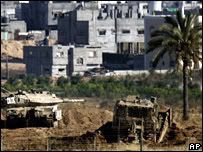 Israel wants to halt to the continued rocket attacks launched from Gaza
Mr Sourani spoke of how on hot days like the one that was sweltering all around us, they would picnic in the shade of the trees.
They could not do it anymore, he said, because Israeli bulldozers had crossed into Gaza and flattened the orange groves.
A wide strip of land along the border has been cleared, Israel says for security reasons, so its soldiers can spot Palestinian militants who want to kill Israelis.
Many Palestinians say that reasons of security can also be a cover for the collective punishment of property owners.
'Worse things happen'
I was expecting Mr Sourani to talk about the pain of losing something that was full of family memories.
He said it did hurt. But he also described the way that his elderly mother, to all and intents and purposes, had told her family to pull themselves together.
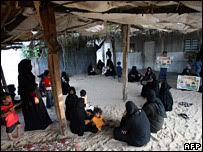 Israel has apologised for killing the three young cousins last month
Listen, she said, they were only trees. They have gone, but they can grow again.
The important thing, she told them, is that none of you are dead.
Now, what is the point of writing about all this?
As Mr Sourani's mother said, many worse things happen in Gaza. Violent death is part of everyone's life.
Later the same day, I went to the home of a family that was mourning three children, two boys aged 10 and 12, and a 12-year-old girl.
The young cousins were mistakenly killed by Israeli soldiers last month because they were playing close to rocket launchers outside Beit Hanoun.
I suppose I am mentioning Mr Sourani's mother because she displays not just a commendable sense of proportion, but also a capacity to endure. You won't get far without it in Gaza.
Israeli frustration
They need it too on the other side of the border wire in the southern Israeli town of Sderot, which is regularly rocketed from Gaza.
A couple of days after I met Mr Sourani, a rocket landed close to the town's nursery school.
 Sderot residents have protested against perceived Israeli inaction
Very fortunately, nobody was hurt in that attack. But it filled many Israelis who saw television pictures of terrified infants with rage and frustration.
Newspaper columnists asked what Israel would be doing if the children in the Sderot nursery school had been killed (their answer: re-invading Gaza) and angrily rejected the idea that Israel's policy should be dictated by the kill-rate of Palestinian rockets.
That started calls to find a way to punish Gazans for allowing rockets to be fired at Israel, which deepened after more than 60 Israeli soldiers were hurt in another attack.
This week, the Israeli government produced its answer.
It decided to classify Gaza a "hostile entity", and, pending a legal review, to reserve the right to impose collective punishments by cutting supplies of fuel and electricity, and by restricting the movement of people.
'Big prison'
Gaza's new status institutionalises methods that Israel is already using to ratchet up the pressure.
UN Secretary General Ban Ki-moon asked Israel to reconsider.
He said Gaza's people "should not be punished for the unacceptable actions of militants and extremists".
The Palestinians to whom I have spoken ask what is new.
For years, they have routinely described the Gaza Strip as a big prison and it is hard to argue with the description.
Throughout 40 years of occupation, collective punishments that violate the fourth Geneva Convention have been commonplace.
Echoing terminal
In Gaza today, supplies of everything are in short supply because of existing Israeli restrictions, and the movement of Palestinians into and out of the territory has already almost ceased.
Israel has built an enormous border terminal with sophisticated layers of security that culminate with a full body scan.
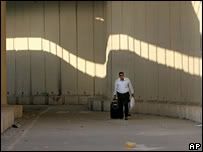 Israel has heavily restricted movement into and out of Gaza
You enter a circular chamber, the doors of which hiss shut behind you.
A loudspeaker voice, owned by a person who presumably is watching what is happening on a TV monitor, tells you to stand with your legs apart and to raise your hands above your head.
Sensors spin and swoop round, looking for dangerous substances that you may have swallowed or inserted into your body.
It does not hurt - nothing touches you and if you pass scrutiny, you walk out into the echoing terminal, glacial with air conditioning, past security people who preside over a building that is almost empty because so few people can cross.
Perhaps the terminal is designed for a better time, of neighbourly relations between two states.
US friends only
And as life for Gaza's civilians becomes worse, Western politicians and diplomats have hopes that for the first time since the collapse of the Camp David summit in 2000, there could be a chance to restart peace talks.
For them, everything has become easier since Hamas took over in Gaza.
 Ms Rice has yet to address the problem that her strategy ignores both Hamas and the Syrian government - two entities who have the capacity to wreck anything the conference produces
 They can now deal solely with Fatah, which has set up a technocratic "government" without any Hamas participation.
The West - and the Israeli prime minister and the Palestinian Authority president - is focusing on a US plan for an international conference in November, which Secretary of State Condoleezza Rice is working towards this week as she tours the Middle East.
She has yet to address the problem that her strategy ignores both Hamas and the Syrian government - two entities who have the capacity to wreck anything the conference produces that they do not like. Only friends of the US are being invited.
An invitation arrived at Mr Sourani's office to meet the new Middle East peace envoy Tony Blair.
It would have meant going through the empty border terminal and to travel up to Jerusalem, but Mr Sourani was not granted a permit by the Israeli authorities.
He was frustrated, but he also cannot get a permit to visit his wife and children, who are in Egypt.
Guess which hurts most. As his mother said, keep everything in proportion.
