The Washington Post reports:
Bush administration officials unveiled a bold new assertion of executive authority yesterday in the dispute over the firing of nine U.S. attorneys, saying that the Justice Department will never be allowed to pursue contempt charges initiated by Congress against White House officials once the president has invoked executive privilege.
The position presents serious legal and political obstacles for congressional Democrats, who have begun laying the groundwork for contempt proceedings against current and former White House officials in order to pry loose information about the dismissals.
Under federal law, a statutory contempt citation by the House or Senate must be submitted to the U.S. attorney for the District of Columbia, "whose duty it shall be to bring the matter before the grand jury for its action."
But administration officials argued yesterday that Congress has no power to force a U.S. attorney to pursue contempt charges in cases, such as the prosecutor firings, in which the president has declared that testimony or documents are protected from release by executive privilege. Officials pointed to a Justice Department legal opinion during the Reagan administration, which made the same argument in a case that was never resolved by the courts.
"A U.S. attorney would not be permitted to bring contempt charges or convene a grand jury in an executive privilege case," said a senior official, who said his remarks reflect a consensus within the administration. "And a U.S. attorney wouldn't be permitted to argue against the reasoned legal opinion that the Justice Department provided. No one should expect that to happen."
The official, who spoke on the condition of anonymity because he was not authorized to discuss the issue publicly, added: "It has long been understood that, in circumstances like these, the constitutional prerogatives of the president would make it a futile and purely political act for Congress to refer contempt citations to U.S. attorneys."
Mark J. Rozell, a professor of public policy at George Mason University who has written a book on executive-privilege issues, called the administration's stance "astonishing."
"That's a breathtakingly broad view of the president's role in this system of separation of powers," Rozell said. "What this statement is saying is the president's claim of executive privilege trumps all."
The administration's statement is a dramatic attempt to seize the upper hand in an escalating constitutional battle with Congress, which has been trying for months, without success, to compel White House officials to testify and to turn over documents about their roles in the prosecutor firings last year. The Justice Department and White House in recent weeks have been discussing when and how to disclose the stance, and the official said he decided yesterday that it was time to highlight it.
Yesterday, a House Judiciary subcommittee voted to lay the groundwork for contempt proceedings against White House chief of staff Joshua B. Bolten, following a similar decision last week against former White House counsel Harriet E. Miers.
The administration has not directly informed Congress of its view. A spokeswoman for Rep. John Conyers Jr. (D-Mich.), the Judiciary Committee's chairman, declined to comment . But other leading Democrats attacked the argument.
Senate Majority Leader Harry M. Reid (D-Nev.) called it "an outrageous abuse of executive privilege" and said: "The White House must stop stonewalling and start being accountable to Congress and the American people. No one, including the president, is above the law."
Sen. Charles E. Schumer (N.Y.) said the administration is "hastening a constitutional crisis," and Rep. Henry A. Waxman (D-Calif.) said the position "makes a mockery of the ideal that no one is above the law."
Waxman added: "I suppose the next step would be just disbanding the Justice Department."
Under long-established procedures and laws, the House and Senate can each pursue two kinds of criminal contempt proceedings, and the Senate also has a civil contempt option. The first, called statutory contempt, has been the avenue most frequently pursued in modern times, and is the one that requires a referral to the U.S. attorney in the District.
Both chambers also have an "inherent contempt" power, allowing either body to hold its own trials and even jail those found in defiance of Congress. Although widely used during the 19th century, the power has not been invoked since 1934 and Democratic lawmakers have not displayed an appetite for reviving the practice.
In defending its argument, administration officials point to a 1984 opinion by the Justice Department's Office of Legal Counsel, headed at the time by Theodore B. Olson, a prominent conservative lawyer who was solicitor general from 2001 to 2004. The opinion centered on a contempt citation issued by the House for Anne Gorsuch Burford, then administrator of the Environmental Protection Agency.
It concluded: "The President, through a United States Attorney, need not, indeed may not, prosecute criminally a subordinate for asserting on his behalf a claim of executive privilege. Nor could the Legislative Branch or the courts require or implement the prosecution of such an individual."
In the Burford case, which involved spending on the Superfund program, the White House filed a federal lawsuit to block Congress's contempt action. The conflict subsided when Burford turned over documents to Congress.
The Bush administration has not previously signaled it would forbid a U.S. attorney from pursuing a contempt case in relation to the prosecutor firings. But officials at Justice and elsewhere say it has long held that Congress cannot force such action.
David B. Rifkin, who worked in the Justice Department and White House counsel's office under presidents Ronald Reagan and George H.W. Bush, praised the position and said it is consistent with the idea of a "unitary executive." In practical terms, he said, "U.S. attorneys are emanations of a president's will." And in constitutional terms, he said, "the president has decided, by virtue of invoking executive privilege, that is the correct policy for the entire executive branch."
But Stanley Brand, who was the Democratic House counsel during the Burford case, said the administration's legal view "turns the constitutional enforcement process on its head. They are saying they will always place a claim of presidential privilege without any judicial determination above a congressional demand for evidence -- without any basis in law." Brand said the position is essentially telling Congress: "Because we control the enforcement process, we are going to thumb our nose at you."
Rozell, the George Mason professor and authority on executive privilege, said the administration's stance "is almost Nixonian in its scope and breadth of interpreting its power. Congress has no recourse at all, in the president's view. . . . It's allowing the executive to define the scope and limits of its own powers."
Friday, July 20, 2007
| [+/-] |
Broader Privilege Claimed In U.S. Attorney Firings |
Saturday, July 14, 2007
| [+/-] |
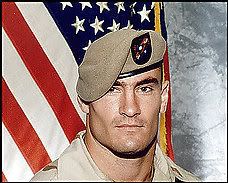
White House Denies Request For Documents In Pat Tillman's Death |
The Washington Post reports:
The White House has refused to give Congress documents about the death of former NFL player Pat Tillman, with White House counsel Fred F. Fielding saying that certain papers relating to discussion of the friendly-fire shooting "implicate Executive Branch confidentiality interests."
Reps. Henry A. Waxman (D-Calif.) and Thomas M. Davis III (R-Va.), the leading members of the House Committee on Oversight and Government Reform, objected to the refusal yesterday in letters to the White House and the Defense Department.
White House and Pentagon officials have turned over about 10,000 pages of material, but Waxman and Davis said those papers do not include critical documents that would show communications between senior administration officials and top military officers shortly after Tillman was killed in Afghanistan in 2004.
Tillman's celebrity, as one who gave up a professional football contract to join the Army after the Sept. 11, 2001, attacks, made his death major news. The military at first concocted a heroic story about how Tillman, a specialist posthumously promoted to corporal, had been killed in a fierce firefight with the enemy, despite obvious evidence that he had been shot by his own men at close range. More than a month later, a military investigation reported publicly that the death was not linked to enemy fire.
"The main focus of the committee's investigation is to examine what the White House and the leadership of the Department of Defense knew about Corporal Tillman's death and when they knew it," Waxman and Davis said in a letter to Fielding. "Unfortunately, the document production from the White House sheds virtually no light on these matters."
After an oversight hearing in April -- in which Tillman's family members testified -- the committee sought the documents to learn about the alleged coverup and the high-level discussions about how to spin the case. Waxman and Davis plan to hold another hearing on Aug. 1.
Monday, July 9, 2007
| [+/-] |
All, Or Nothing At All |
Reuters reports:
The White House on Monday dared the Democratic-led Congress to fight it in court by refusing to provide information and testimony demanded in an investigation into the firing of federal prosecutors.
White House counsel Fred Fielding, in a letter to two congressional chairmen, called their demands "unreasonable because it represents a substantial incursion into presidential prerogatives."
Congressional leaders disagreed and made it clear they were prepared for a court battle unless they reach a compromise with the White House on access to documents and witnesses.
"I hope the White House stops this stonewalling and accepts my offer to negotiate a workable solution," said Senate Judiciary Committee Chairman Patrick Leahy, a Vermont Democrat.
Democrats have sought compromise because a fight over whether Congress or the White House is right could take years to weave its way through the court system and still be undecided when President George W. Bush's second term ends in January 2009.
Bush is relying on a legal doctrine known as executive privilege, which has been invoked with mixed success to shield presidents and their aides from having to answer questions or turn over information to Congress.
White House spokesman Tony Snow brushed off the threat of a possible congressional contempt citation, saying, "It's up to them."
"What we do believe is that we are on perfectly solid legal ground," Snow said.
Congress wants the documents and testimony to determine if the firing of nine of the nation's 93 U.S. attorneys last year was the result of partisan politics and White House efforts to reward supporters.
Bush and U.S. Attorney General Alberto Gonzales insist the dismissals of the federal prosecutors were justified but mishandled. Gonzales, with Bush's support, has withstood bipartisan calls to resign.
OFFER TO TALK
The White House has offered to allow current and former aides to talk to lawmakers behind closed doors -- but only if it is not sworn testimony and there is no transcript. Leahy and others say the offer is unacceptable.
Sen. Arlen Specter of Pennsylvania, ranking Republican on the Judiciary Committee, said, "I think, candidly, there's a lot of posturing going on on both sides."
"I hope we can work it out so that we don't test the good faith of the executive branch ... or the good faith of the legislative branch," Specter said.
In his letter, Fielding rejected requests for materials to support Bush's claim of executive privilege last month in refusing to turn over documents. He also wrote Bush, as expected, was asserting presidential privilege to block subpoenaed testimony by two former aides, Sara Taylor and Harriet Miers.
Taylor, who served as White House political director, has been summoned to testify before the Senate Judiciary Committee on Wednesday, while Miers, who served as White House counsel, had been ordered to testify before a House panel on Thursday.
"While we remain willing to negotiate with the White House, they adhere to their unacceptable all-or-nothing position, and now will not even seek to properly justify their privilege claims," said House of Representatives Judiciary Committee Chairman John Conyers, a Michigan Democrat.
"Contrary to what the White House may believe, it is the Congress and the courts that will decide whether an invocation of executive privilege is valid, not the White House unilaterally," Conyers said.
There was no immediate indication how much longer Democrats would seek to reach an agreement with the White House before initiating court action.
| [+/-] |
Bush Invokes Executive Privilege, Refuses To Allow Miers & Taylor To Testify |
The International Herald Tribune reports:
President George W. Bush, invoking executive privilege for the second time in his clash with lawmakers over the firing of federal prosecutors, said Monday that he would refuse to comply with congressional subpoenas for testimony from two top former aides.
In a letter to the chairmen of the House and Senate Judiciary Committees, Bush's counsel, Fred Fielding, declared that the legislative and executive branches of government were at an impasse. Fielding wrote that Bush was directing the two aides - Sara Taylor, former White House political director, and Harriet Miers, former White House counsel - not to testify.
"The assertion of executive privilege here is intended to protect a fundamental interest of the presidency: the necessity that a president receive candid advice from his advisers and that those advisers be able to communicate freely and openly with the president," Fielding wrote.
He added that in the case of the firing of federal prosecutors, "the institutional interest of the executive branch is very strong."
The move was not unexpected.
Bush said last month that he had no intention of letting Miers or Taylor testify.
Bush offered at that time to allow the two women, as well as other top aides - including Karl Rove, his chief political strategist - to be interviewed by lawmakers if the interviews were not under oath and were not transcribed. Though Democratic leaders in Congress rejected that offer as insufficient, Bush renewed it Monday.
The latest refusal to comply with the subpoenas raises tensions in an already tense legislative-executive clash and heightens the likelihood that the two sides will wind up in court. Congressional Democrats are trying to determine who sought the firings of nine federal prosecutors, and why. They want to know whether White House officials, including Rove, interfered with hiring and firing decisions at the Justice Department for political reasons, or perhaps to thwart certain investigations.
Bush said in June that he would not comply with subpoenas for documents in the case. At that time, the committee chairmen - Representative John Conyers and Senator Patrick Leahy - wrote to Fielding to complain that Bush was not acting in good faith.
In his letter, Fielding complained about the tone and language the Democrats used, telling them he wanted to convey "a note of concern over your letter's apparent direction in dealing with a situation of this gravity."
Leahy was dismissive of Fielding's letter, saying in a statement: "This is more stonewalling from a White House that believes it can unilaterally control the other co-equal branches of government. What is the White House trying to hide by refusing to turn over evidence it was willing to provide months ago, as long as that information was shared in secret with no opportunity for Congress to pursue the matter further?"
