McClatchey reports:
The Bush administration's top two officials in Iraq answered questions from Congress for more than six hours on Monday, but their testimony may have been as important for what they didn't say as for what they did.
A chart displayed by Army Gen. David Petraeus that purported to show the decline in sectarian violence in Baghdad between December and August made no effort to show that the ethnic character of many of the neighborhoods had changed in that same period from majority Sunni Muslim or mixed to majority Shiite Muslim.
Neither Petraeus nor U.S. Ambassador Ryan Crocker talked about the fact that since the troop surge began the pace by which Iraqis were abandoning their homes in search of safety had increased. They didn't mention that 86 percent of Iraqis who've fled their homes said they'd been targeted because of their sect, according to the International Organization for Migration.
While Petraeus stressed that civilian casualties were down over the last five weeks, he drew no connection between that statement and a chart he displayed that showed that the number of attacks rose during at least one of those weeks.
Petraeus also didn't highlight the fact that his charts showed that "ethno-sectarian" deaths in August, down from July, were still higher than in June, and he didn't explain why the greatest drop in such deaths, which peaked in December, occurred between January and February, before the surge began.
And while both officials said that the Iraqi security forces were improving, neither talked about how those forces had been infiltrated by militias, though Petraeus acknowledged that during 2006 some Iraqi security forces had participated in the ethnic violence.
Both officials said they believed that Iraq was on the path to potential success. Petraeus said that "the military objectives of the surge are, in large measure, being met." Crocker was similarly optimistic: "In my judgment, the cumulative trajectory of political, economic and diplomatic developments in Iraq is upwards, although the slope of that line is not steep."
They both pleaded for more time, even as Petraeus said that the U.S. should begin pulling troops out, with the goal of being back to the pre-surge level of 130,000 troops by next July. Further reductions would be considered next spring, as conditions allow, he said.
Both men celebrated their plan's success in encouraging residents in once-restive Anbar province to work with U.S. troops against al Qaida in Iraq.
Petraeus conceded that that success didn't extend to Ninevah province, where progress "has been much more up and down." But he didn't say that many believe that al Qaida numbers increased there only after the surge began. Ninevah is where some of the largest bombings of the year occurred, including the attack on the Yazidis, which killed more than 300.
He also offered a tepid endorsement of the Iraqi security forces, at times saying that they were increasingly capable of defending Iraq, while conceding that they needed to show more progress.
"Iraqi security forces have also continued to grow and shoulder more of the load, albeit slowly and amid continuing concerns about the sectarian tendencies of some elements in their ranks," Petraeus said. "In general, however, Iraqi elements have been standing and fighting and sustaining tough losses, and they have taken the lead in operations in many areas."
He said 445,000 people were on the security forces' payroll, but didn't discuss that many officials believe that thousands of those don't actually exist, but are phantoms whose salaries actually go into ministry officials' pockets.
Both Iraqis and U.S. officials concede that militias have infiltrated the security forces and that political leaders continue to interfere with their operations to serve their sects' interests.
Petraeus presented a series of maps to show how sectarian violence had dropped in Baghdad from December 2006 to August 2007. But all of the maps showed the same color-coding for Sunni, Shiite and mixed neighborhoods, even though the ethnicity of many neighborhoods have shifted dramatically over the previous year. U.S. military officials say that Baghdad was once 65 percent Sunni and is now 75 percent Shiite.
Questions from the 107 members of Congress who sat in on the hearing rarely produced more detail.
Still, the two men, considered by many to be among the most capable U.S. public servants to have served in Iraq, didn't attempt to hide their reservations. Both said they couldn't guarantee success.
Crocker, a fluent Arabic speaker and a lifelong student of the area, questioned the U.S. criteria for measuring success and said that the Iraqi government might never meet most of the 18 benchmarks laid out by Congress in a May law. Petraeus, who wrote the Army's counterinsurgency manual, acknowledged that violence remained at unacceptable levels.
Independent observers said the numbers that Crocker and Petraeus provided showed the violence has dropped to about where it was in May 2006, a few months after a February 2006 bombing of a revered Shiite shrine in the mostly Sunni city of Samarra, which the military uses to mark the rise in sectarian violence.
"At best, what you've got is the status quo from May or June of 2006," said Kirk Johnson, who served for 13 months as the chief statistician for Crocker and who said he supports the current strategy in Iraq.
Rand Beers, a former White House counterterrorism aide who resigned to protest the invasion of Iraq, noted there was another troop surge, in Baghdad, in summer 2006.
"We've had two surges, and in a way, things are back to the level before the first surge," Beers said in a conference call with reporters.
Retired Army Lt. Gen. Robert Gard said that it was understandable that Petraeus emphasized the positive.
"He's a human being and he's a military human being that wants to accomplish the mission," Gard said.
Monday, September 10, 2007
| [+/-] |
What Crocker and Petraeus Didn't Say |
Friday, July 27, 2007
| [+/-] |
Iraq's PM Maliki's Relations With Petraeus, "Poor" |
From the Marine Corps Times:
A key aide says Prime Minister Nouri al-Maliki’s relations with U.S. commander Gen. David Petraeus are so poor the Iraqi leader may ask Washington the withdraw the well-regarded U.S. military leader from duty here.
The Iraqi foreign minister calls the relationship “difficult.”
Petraeus says his ties with al-Maliki are “very good” but acknowledges expressing “the full range of emotions” on “a couple of occasions.”
U.S. Ambassador Ryan Crocker, who meets together with al-Maliki and Petraeus at least weekly, concedes “sometimes there are sporty exchanges.”
Al-Maliki has spoken sharply — not of Petraeus or Crocker personally — but about their tactic of welcoming Sunni militants into the fight against al-Qaida forces in Anbar and Diyalah provinces.
But the reality of how the three men get along likely lies somewhere between the worst and best reports about their relationship — perhaps one of the most important in the world and unquestionably central to the future of Iraq, the larger Middle East and scores, if not hundreds, of political, diplomatic and military careers in the United States.
A tangle of issues confront the three men, and none of them present clear or easy solutions:
— Al-Maliki, a Shiite who spent years in exile under Saddam Hussein, hotly objects to U.S. tactic of recruiting men with ties to the Sunni insurgency into the ongoing fight against al-Qaida. He has complained loudly but with little effect except a U.S. pledge to let al-Maliki’s security apparatus vet the recruits before they join the force. He also has spoken bitterly, aides say, about delivery delays of promised U.S. weapons and equipment for his forces.
— Petraeus is confronted with an Iraqi military and police force, nominally under al-Maliki’s control, that has in many cases acted on sectarian — namely Shiite — not national Iraqi interests. He has faced a significant challenge in persuading al-Maliki to shed his ties to radical Shiite cleric Muqtada al-Sadr, who runs the Mahdi Army militia.
— Crocker’s problems with the Iraqi leader are the appearance of foot-dragging or ineffectiveness on the political front — the need to shepherd critical benchmark legislation through parliament. U.S. opponents of the war will undoubtedly demand from Crocker, when he reports to congress in September, an explanation of why U.S. troops are fighting and dying to give al-Maliki political breathing space that the Iraqi leader will not or cannot capitalize on.
First word of strained relations began leaking out with consistency earlier this month.
Sami al-Askari, an key aide to al-Maliki and a member of the prime minister’s Dawa Party, said the policy of including one-time Sunni insurgents in the security forces shows Petraeus has a “real bias and it bothers the Shiites. It is possible that we may demand his removal.”
Foreign Minister Hoshyar Zebari said in an interview with Newsweek, that the Petraeus-al-Maliki relationship was “difficult.”
“The prime minister cannot just pick up the phone and have Iraqi army units do what he says. Maliki needs more leverage.”
A lawmaker from the al-Sadr bloc, who refused use of his name fearing the party would expel him over his continued close ties to al-Maliki, said the prime minister has complained to U.S. President George W. Bush about the policy of arming Sunnis.
“He told Bush that if Petraeus continues doing that he would arm Shiite Militias. Bush told al-Maliki to calm down,” according to the lawmaker who said he was told of the exchange by al-Maliki.
The lawmaker said al-Maliki once told Petraeus: “I can’t deal with you any more. I will ask for someone else to replace you.”
In an angry outburst earlier this month, al-Maliki said American forces should leave and turn over security to Iraqi troops. He quickly backpedaled, but the damage was done.
“There is no leader in the world that is under more pressure than Nouri al-Maliki, without question. Sometimes he reflects that frustration. I don’t blame him. I probably would too,” Crocker said.
The ambassador, one of the State Department’s most seasoned Middle East diplomats, appeared to be genuinely fond of al-Maliki and profoundly understanding of the Iraqi leader’s troubles.
“We are dealing with existential issues. There are no second tier problems ... so there is a lot of pressure. And we all feel very deeply about we’re trying to get done. So yeah, sometimes there are sporty exchanges,” he said.
“And believe me I’ve had my share of them. That in no way means, in my view, strained relations. I have great admiration for Prime Minister Maliki, and I know General Petraeus does as well. And I like to think it is reciprocal. Wrestling with the things we’re all wrestling with here, it would almost be strange if you didn’t get a little passionate from time to time.”
Petraeus, a wily, rising star at the Pentagon who is known for holding his cards close to his chest, called his relations with al-Maliki “very good...and that’s the truth,” but acknowledged, “we have not pulled punches with each other.”
Here’s why, he said:
“We have made an enormous investment here — 3,600-plus soldiers, sailors, airmen and Marines have given their lives. And where we see something that could unhinge the progress that our soldiers and their soldiers are fighting to make ... or jeopardize some of the very hard-fought gains that we have made, I’m going to speak up. And I have on occasion. And on a couple of occasions have demonstrated the full range of emotions.”
All sides spoke with the critical September reports by Crocker and Petraeus to Congress clearly at the front of their minds — the need to make it clear to an increasingly hostile U.S. legislative branch that progress is being made and it would be wrong to start pulling out troops and cutting support now.
It will be a tough sell, but not for lack of getting their views before the public in advance of walking into Congressional committee rooms about seven weeks from now.
Monday, April 23, 2007
| [+/-] |
Profile: Ryan Crocker, U.S. Ambassador To Iraq |
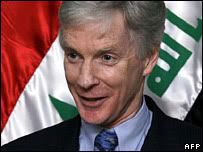
A career diplomat and fluent Arabic-speaker, Mr Crocker has also served as ambassador to Lebanon, Kuwait, Syria and, most recently, Pakistan.
He knows Iraq well, having served in Baghdad in the 1970s, headed the US state department's Iraq-Kuwait Task Force during the first Gulf War, and worked for the Coalition Provisional Authority shortly after the US-led invasion in 2003.
Mr Crocker succeeded Zalmay Khalilzad - appointed the new US permanent representative to the UN - amid a sustained period of unprecedented sectarian violence.
"The road is going to be a tough one," he said.
"I don't begin my tour here with any illusions. It's going to be very, very difficult, but I certainly believe that success is possible or else I wouldn't be standing here."
'Bloodied'
Mr Crocker was born in 1949 in Spokane, in eastern Washington State.
As his father worked for the US Air Force, Mr Crocker spent a large part of his childhood abroad and attended schools in Morocco, Turkey, Canada and the US.
He returned to Washington State, however, for his higher education, to study at Whitman College in Walla Walla.
I've been impressed by the extent to which Iraqis have stood up to the challenges of building a new state; the courage, the resolve, the dedication they have demonstrated
Ryan Crocker
After graduating in 1971 with a BA in English, Mr Crocker joined the Foreign Service. He was first posted overseas a year later, when he worked at the US consulate in Khorramshahr in Iran.
Mr Crocker undertook his first assignment in Iraq in 1979, the same year in which Saddam Hussein became president.
It was also when he first met his wife, Christine, a former secretary in the Foreign Service.
The couple were posted together to Beirut in 1981 at the height of the Lebanese civil war.
They witnessed the Israeli invasion of Lebanon in 1982 and, in 1983, were in the US embassy when a suicide truck bomb exploded outside, killing 63 people. According to the Washington Post, the blast left Mr Crocker "bloodied, but not seriously injured".
His first senior diplomatic posting came seven years later, when he returned to Beirut as US ambassador. He served later as ambassador to Kuwait and Syria.
The ambassador has spent time talking to Baghdad residents
Mr Crocker returned to Washington in August 2001, when was appointed deputy assistant secretary of state for Near Eastern affairs.
In this role, he made a number of visits to the north of Iraq before the US-led invasion in 2003 to help co-ordinate efforts with Kurdish leaders who also opposed the central government.
After the overthrow of Saddam Hussein, Mr Crocker spent three months as the first director of governance for the Coalition Provisional Authority.
He was responsible for setting up the 25-member Iraqi Governing Council (IGC), which helped the CPA administer Iraq until an interim government was appointed a year later.
In 2004, Mr Crocker became the US ambassador to Pakistan.
While based in Islamabad, he resisted calls in the US to increase pressure on Pakistan's President, Pervez Musharraf, to act decisively against Islamist militants operating near the country's border with Afghanistan.
Instead, Mr Crocker insisted President Musharraf was a solid US ally in its "war on terror".
'Buying time'
In a news conference marking Mr Crocker's first month in Baghdad, the new ambassador said he had been struck by the impact violence had had on Iraq, but nevertheless was impressed by what had been achieved.
"When I left in 2003, there was no constitution, there was no Council of Representatives, there was no sovereign government," he said.
"All of these things are now in place. And I've been impressed by the extent to which Iraqis have stood up to the challenges of building a new state; the courage, the resolve, the dedication they have demonstrated."
He said the next few months were critical in the effort to reconcile Iraq's warring communities and urged the government to make use of a US-led security plan in the capital.
"I think the Baghdad Security Plan led by Iraq, supported by the coalition, can buy time," he explained.
"But what it does is buy time for what ultimately has to be a set of political understandings among Iraqis."
