Digital Cosunilbo reports:
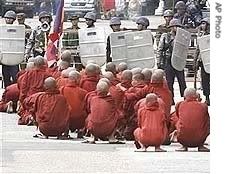
The Burmese military government's grip on the political situation is growing steadily tighter. The streets of Rangoon were reported quiet Sunday, while the government announced scores more arrests in its crackdown on pro-democracy demonstrations. The government's stranglehold on communications with the outside world is also continuing.
The Burmese military government said Sunday that 78 more people were taken for questioning in connection with mass protests over the last two weeks.
The number of police was meanwhile reported to have decreased, and barricades were taken down, near Rangoon's Shwedagon and the Sule Pagoda - two religious sites where protests had been staged and police fired on demonstrators.
The Internet played a key role in getting information and images to the outside world during the early days of the protests and the crackdown, but the government soon clamped down on Internet access.
An Internet café owner in Rangoon who declined to allow his name to be used told VOA the Internet is only available during the middle of the night, when there is a curfew in effect and it is illegal to be on line.
He says the city has been without Internet for nine or 10 days, though sometimes there is a very slow connection from 10 at night until four in the morning. He says he expects the Internet blackout to be lifted Monday, but nothing is certain.
The government meanwhile says more than 12 hundred people detained for their part in the protests in Rangoon have been released, about half of them Buddhist monks, after they pledged not to demonstrate again.
The military says 135 monks remain in custody, but diplomats and dissident groups say the number of detainees is probably closer to six thousand.
Outside the country, protests and an ongoing diplomatic debate at the United Nations over the Burmese government's actions are continuing.
On Saturday, thousands of demonstrators gathered in London, with smaller protests in cities around the world including Sydney, Stockholm, Paris, Washington D.C., and Bangkok.
A second day of protests here in Bangkok drew about 300 people to the Burmese embassy Sunday. Thailand is home to hundreds of thousands of Burmese exiles and migrant workers.
Britain, France and the U.S. have circulated a draft resolution at the U.N. Security Council calling on Burma's government to free political prisoners and open talks with dissident leaders.
The document would not be legally binding, but the Burmese government may take notice if the statement were approved by China, which is one of Burma's main trading partners and arms suppliers.
Up to now, China, along with Russia, has been opposed to any action against Burma by the U.N. Security Council.
Sunday, October 7, 2007
| [+/-] |
Crackdown Continues in Burma, Diplomatic Debate Rages Abroad |
Friday, September 28, 2007
| [+/-] |
Journalists Struggle as Burma Internet Access Cut |
PM broadcast [MP3; text transcript]:
MARK COLVIN: It's a truism about the internet that, like the human body, it reacts to damage by creating pathways around it.
But in the case of Burma, where the country's main internet pipeline has actually been cut today, that may take a while.
Hours after the Internet stoppage became obvious, a Burmese official is now claiming that "the Internet is not working because the underwater cable is damaged".
But it's not just the cable. By a strange coincidence, an official at a Thai telecom that provides satellite services to Burma says it appears that internet services inside the country are down as well.
Since the Burmese military government won't let journalists in to see what's happening for themselves, those, like our Correspondent Karen Percy in Bangkok, who are trying to gain information from afar, are finding it even harder.
Karen joins me now.
But, Karen, I gather that some information, even with the internet down, is starting to leak out?
KAREN PERCY: Yes, we're starting to get some stories come across the wires. New video has also appeared. CNN has just showed some video. It is from yesterday, but apparently we are … there has been some way that the various people who've been feeding out information have been able to get around these restrictions.
We're in fact hearing that shots have been fired in Rangoon. We cannot confirm this at this stage. There are reports of hundreds or thousands, depending on who you believe, of crowds in the city, but we do know that also, going on what has happened in the past couple of days, that the security forces will be on the lookout for anybody breaching the various bans that the Junta has put on on gatherings and the like.
We are also hearing, via some internet websites, that troops are on their way to the city, troops … divisions from central Burma are on their way to Rangoon.
Now, there is an extraordinary … some speculation going on. In fact, a couple of these divisions may well be preparing to retaliate against the troops who are already in Rangoon.
I do stress this is unconfirmed, it is speculation, but I will also say that a lot of the rumours and speculation that we have heard over this past week or so have turned out to be true, but I will still caution, I guess, what is going on there. We're also hearing of military aircraft activity.
So there's certainly a sense that the Junta, there's activity, military activity, and the protesters are active again today. So confrontation of some sort is inevitable.
MARK COLVIN: Military aircraft activity, is that coming, for instance, from the … from surveillance by, from outside? Is it coming from the Thai Air Force or anything like that?
KAREN PERCY: I'm not sure where the … it's popping up on one of the various websites that are monitored by activists on the outside. Where they're getting their information, I don't know. I guess that they're hearing from people on the inside that there is military activity. As to where it's coming from, I don't know. But if aircraft are up and about, then that would signal something major is going on.
MARK COLVIN: And what about what we've been able to glean about yesterday? We already have heard the Australian ambassador saying the death toll is probably well above what the military government is saying. What else can we find out about yesterday?
KAREN PERCY: Well, new pictures have appeared. CNN has just played some new pictures, apparently shot from a rooftop of some sort, looking down onto where the protesters were yesterday, and seeing I think it would be the Japanese photographer video journalist, you see him in the distance, a soldier very close to him, I think it's him being shot pretty much at point-blank range. There is another person who goes down in front of him, just a few seconds before.
The crowd is quite large, so certainly the information we're getting in terms of the fact that there is still a resolve by people seems to be there, but that also the military is certainly not just firing into the air. They seem to be firing with an intent to, if not kill, then maim.
There are some other …
MARK COLVIN: But, by the way, with the Japanese photographer, I think the Burmese military claimed that it was just a ricochet, but you say the video makes it pretty clear that it's nothing of the sort.
KAREN PERCY: Well, this particular video, if it matches up with the video that the Japanese have also got, then I think yes, it certainly shows he's very close. But even the still that I have seen on a Japanese website shows a soldier … shows the journalist lying on the floor and a soldier maybe two metres away from him, standing, looking at him. Nobody else is around.
So it would appear to me that yes there was a deliberate, and that's certainly been what the various reports on websites has been saying as well.
But again, you know, we need to be very careful here. It's hard to make judgement calls because there is so little information.
But we area also getting information from the Asian Human Rights Commission that is saying that it has heard of eight people being killed in a suburb of Rangoon yesterday, that there were …
So, and also we were talking earlier about reports of activity at a school at Rangoon, we think this morning, where a student might've been killed.
MARK COLVIN: Karen Percy, thank you very much. Karen Percy in Bangkok.
Monday, May 14, 2007
| [+/-] |
Pentagon Blocks MySpace & YouTube |
The Defense Department has decided to make it impossible to reach 13 Web sites from its network, citing an overabundance of “recreational traffic.”
The ban also includes Metacafe, IFilm, StupidVideos, FileCabi, BlackPlanet, Hi5, Pandora, MTV, 1.fm, live365 and Photobucket.
The NY Times reports:
In the policy released today, General B.B. Bell, commander in South Korea, said use of those sites “impacts our official DoD network and bandwidth ability, while posing a significant operational security challenge.” The memo is available in pdf format.
A spokeswoman for the United States Strategic Command was more specific in framing the issue as a technical limitation. “We’ve got to have the networks open to do our mission. They have to be reliable, timely and secure,” Julie Ziegenhorn said in an interview with Stars & Stripes, an independent newspaper published for the American military.
Private internet connections still have access, but most troops in Iraq and Afghanistan are limited to Pentagon service, Stars and Stripes notes.
Today’s Web site ban and last month’s revision of military blogging policy were partly justified by operational security concerns. Both also prompted questions about whether leaders were trying to reduce the voices of individual soldiers by making it more difficult to publish their own material.
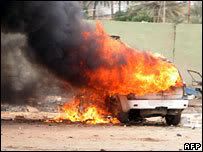
The ban also arrived as the American military started to increase its profile on YouTube, posting official footage that aimed “to show another side of operations in Iraq beyond news reports of ‘the car bomb of the day,’” the BBC said.
A writer for Wired Magazine told The Associated Press that individual soldiers were also helping to present a more positive picture of the situation in Iraq. “They are muzzling their best voices,” Noah Shachtman said.
Sunday, May 13, 2007
| [+/-] |
DoD Blocking YouTube, Others |
To save bandwidth, officials say several sites to be off-limits at work.
Stars and Stripes report:
Starting Monday, the Defense Department will block access to MySpace, YouTube and a host of other sites on official department computers worldwide, in an effort to boost its network efficiency.
Troops and families living on U.S. bases will still be able to view the sites through private Internet networks, but the move leaves servicemembers in Iraq and Afghanistan who use the popular picture- and video-sharing sites with little or no access to them.
Defense officials said the move is solely a reaction to the heavy drain the streaming video and audio can put on the defense computer network.
“We’re not passing any judgment on these sites, we’re just saying you shouldn’t be accessing them at work,” said Julie Ziegenhorn, spokeswoman for U.S. Strategic Command. “This is a bandwidth and network management issue. We’ve got to have the networks open to do our mission. They have to be reliable, timely and secure.”
In a message to troops from U.S. Forces Korea commander Gen. B.B. Bell on Friday, he acknowledged many of the sites being blocked are used by troops to keep in touch with family and friends.
“This recreational traffic impacts our official DOD network and bandwidth availability, while posting a significant operational security challenge,” he wrote.
Ironically, the Defense Department this year had just begun expanding its own use of YouTube to reach a younger, broader audience and show clips of U.S. troops in action.
Multi-National Force — Iraq, U.S. Army Civil Affairs Command in Afghanistan, and the U.S. Army Corps of Engineers in the Gulf Region have all launched new channels on the Web site to highlight recent successes overseas.
Ziegenhorn said that wasn’t taken into consideration when the Joint Task Force Global Network Operations began reviewing and flagging sites that posed problems to the network.
“This is all about what is a drain on the system,” she said.
A review of the banned sites has been under way since February, she said. And the task force is still considering other problematic addresses to add to the list.
“This will be an ever-evolving discussion, because we need to constantly make sure those networks are available and secure,” she said.
The official policy blocking the sites will be released Monday, the same day they go into effect. But Ziegenhorn said most network administrators are already aware of the change.
The individual services have already blocked some sites for the same bandwidth issues. In addition, Defense Department policy prohibits troops or civilian workers from using government computers from accessing inappropriate sites because of inappropriate content, such as pornography.
Friday, May 11, 2007
| [+/-] |
U.S. Military Takes Iraq War To YouTube |
The US military has taken the war in Iraq into cyberspace, with the launch of its own channel on the video-sharing website YouTube.
The BBC reports:
Its 25 brief clips include footage of US soldiers firing at unseen snipers in Baghdad, handing out footballs to Iraqi children and rescuing an Iraqi family injured by an explosive device.
In two months, the Multi-National Force-Iraq channel has climbed to 16th in YouTube's most subscribed-to listing and has, the military says, just passed the 1 million video views mark.
With titles like Battle on Haifa Street and Iraqi Boy Scouts Prepare for Jamboree, the clips are intended to show a "boots on the ground" perspective of Iraq, a statement on the site says.
The channel is also a perhaps belated attempt to move into the territory of Islamist extremist groups which have used the internet to post footage of hostages or attacks on US forces.
But, sceptics ask, will it give audiences a truer picture - or is it just an attempt by the US military to shift the focus in Iraq to the positive developments it accuses the mainstream media of neglecting?
Cyberspace battle
Lt Col Christopher Garver, a spokesman for US forces in Iraq, told the BBC News website the project's initial motivation was simply to get the "great footage" being shot by the military's combat cameramen in Iraq out to a wider audience.
However, it also serves to show another side of operations in Iraq beyond news reports of "the car bomb of the day", he says - and to counter the messages of anti-American sites.
Lt Col Garver acknowledges the US military has been slow to try to combat the influence of extremist groups on the internet.
"The cyberspace battle space was not one that we were particularly operating well in," he says. "This was one of the first public steps into that cyberspace."
The footage is not picked specifically to show the military in a good light, he says, and is only edited for reasons of time or content too graphic to be shown on YouTube.
And while all the clips currently posted have been shot by the military's combat cameramen, soldiers and marines have been invited to submit their own clips.
Spin or reality?
As on any YouTube channel, viewers are free to comment positively or negatively on the clips posted on MNF-Iraq.
Remarks are usually only taken down if they are profane, Lt Col Garver says, and not because they are critical of the military.
"About 80-90% of the comments left generally approve of what we have done in terms of trying to get information out into the public domain.
"Generally we see a lot of debate... and in an open society debate is a good thing, so we tend to try to let it go."
A look at the comments posted beneath the clip Troops Give Gifts to Iraqi Children reveals a wide range of opinion.
One viewer posts a one-word reaction: "Propaganda."
Another says: "No matter how you spin it, it is a 'Winning the hearts and minds' campaign. We did the same thing when I was there. Yes it's to pass along a gift, but also to buy them off so they don't toss grenades or other explosives at us or into our compound."
A third viewer responds: "When I was there I spent like an hour a day blowing up soccer balls for those kids, not buildings. Unfortunately our media is too busy selling the idea that we are 'bombing buildings', so all you know us as are baby killers. Unbelievable."
Chasing the enemy
There is no shortage of comment on the US-led war in Iraq already posted on the internet.
However, there has been debate about how much freedom active-duty soldiers should have to blog on their experiences, with some officers concerned it could impact on security and morale.
The defence department has now blocked access to sites including YouTube on its networks, meaning servicemen overseas will not be able to watch them unless they use private computers.
The military has said the move is intended to improve the efficiency of its networks by reducing traffic on its bandwidth.
But what is the reaction in the blogosphere to the military establishment's own move into the internet "battle space"?
Blogger, writer and former US soldier Bill Roggio says it is really just an extension of the US military's attempt to reach the public through mainstream media.
"It's really a smart move. One thing that al-Qaeda does very well is put its own videos of attacks on Americans or Iraqis up on their own websites. They dominate that terrain and they get the hits."
By getting a good YouTube and Google rating, the US military will improve the chances of theirs being the first site people go to when they search on topics relating to Iraq, he says.
"They are very slow, very behind the times in things like blogs," he argues. "But they are starting to move forward and recognising the medium - they have to, the enemy is doing it and they have to counter that."
 The military wants to shift the focus from the many car bombs in Iraq
Mr Roggio - who has been embedded with the military in Iraq three times since the 2003 US-led invasion - says he is willing to give the US military the benefit of the doubt over its choice of videos.
"Some of these are very military friendly but not all of them are," he says.
He points to one clip where the footage is murky, one of the soldiers looks scared and the viewer is left wondering what is going on.
"It certainly wasn't a recruiting commercial. I think it was a pretty frank look at what combat looks like in our generation.
"I don't think they are going to put something up that shows them in a bad light, but I do think they are trying to give you a little snapshot of 'one day in the life of...'."
Lt Col Garver would agree. "All I'm looking to provide is another view of things that are happening here in this very complicated, very complex place that is Iraq."
Saturday, May 5, 2007
| [+/-] |
Military Bloggers Wary of New Policy |
The Washington Post reports:
President George W. Bush -- appearing via remote broadcast on two large television screens -- on Saturday thanked a roomful of military bloggers in Arlington, Va., for their service to the country.
"America's military bloggers are also an important voice for the cause of freedom," Bush said in the taped message to the group, which was gathered in Northern Virginia for the 2007 MilBlog Conference. "You understand that defeating the terrorists requires us to defeat their ideology of hatred and of death with a more powerful vision, a vision of human liberty."
This compliment came just days after some bloggers lamented that a new U.S. Army regulation might hinder military blogging from combat zones. On April 19, the Army issued Regulation 530-1, an updated policy on operational security that requires soldiers to consult with a commanding officer before posting information in a public forum. Army OPSEC Program Manager Maj. Ray Ceralde told washingtonpost.com Wednesday that the policy would have no effect on blogging.
But Bloggers at the convention remained skeptical.
"It has the potential for great mischief," said blogger John Donovan of a blog called Argghhh!. Donovan said he worried that commanders might interpret the new policy to mean that they have to read every blog post before it goes online. This could swamp commanders to a point where they will no longer allow blogging, he said.
Bloggers only would be required to register their blogs once, according to Ceralde, not to vet every post with commanders. This, though, is a point of contention, according to Donovan and milblogger Matthew Currier Burden of Blackfive.net.
Burden said he talked to several soldiers blogging from Iraq who said they were unsure of how to deal with the updated policy. Describing the policy as badly written, Burden said he and other milbloggers on the home front would try and clear up any confusion.
Ward Carroll, editor of military.com, one of the sponsors of the conference, said the president's willingness to appear via videotape at the conference, along with Rear Admiral Mark I. Fox's appearance via Web cam from Iraq, shows a positive change in how the civilian government and the military are reacting to the milblogging community.
"There have been initiatives, direct outreach to milbloggers," Carroll said. "Again this is evidence of a community that is growing of import and of impact."
Roxie Merritt, director of new media operations at the Office of the Secretary of Defense for Public Affairs, stood up during one of the four panel discussions and offered every blogger her contact information so they could participate in the blogger roundtables her office hosts. These conference calls connect bloggers with high-ranking U.S. military officials.
Blogger Bill Roggio of "The Fourth Rail" said the milblogging community has gotten a lot bigger since their first conference, held in April 2006. "It shows that there is a medium here that has a real influence," Roggio said.
However, Roggio too feared the new Army policy might have done some damage.
"It has a chilling effect," Roggio said.
Wednesday, October 18, 2006
| [+/-] |
FBI Director Wants ISPs To Track Users |
USA Today reports:
FBI Director Robert Mueller on Tuesday called on Internet service providers to record their customers' online activities, a move that anticipates a fierce debate over privacy and law enforcement in Washington next year.
"Terrorists coordinate their plans cloaked in the anonymity of the Internet, as do violent sexual predators prowling chat rooms," Mueller said in a speech at the International Association of Chiefs of Police conference in Boston.
"All too often, we find that before we can catch these offenders, Internet service providers have unwittingly deleted the very records that would help us identify these offenders and protect future victims," Mueller said. "We must find a balance between the legitimate need for privacy and law enforcement's clear need for access."
The speech to the law enforcement group, which approved a resolution on the topic earlier in the day, echoes other calls from Bush administration officials to force private firms to record information about customers. Attorney General Alberto Gonzales, for instance, told Congress last month that "this is a national problem that requires federal legislation."
Justice Department officials admit privately that data retention legislation is controversial enough that there wasn't time to ease it through the U.S. Congress before politicians left to campaign for re-election. Instead, the idea is expected to surface in early 2007, and one Democratic politician has already promised legislation.
Law enforcement groups claim that by the time they contact Internet service providers, customers' records may be deleted in the routine course of business. Industry representatives, however, say that if police respond to tips promptly instead of dawdling, it would be difficult to imagine any investigation that would be imperiled.
It's not clear exactly what a data retention law would require. One proposal would go beyond Internet providers and require registrars, the companies that sell domain names, to maintain records too. And during private meetings with industry officials, FBI and Justice Department representatives have cited the desirability of also forcing search engines to keep logs — a proposal that could gain additional law enforcement support after AOL showed how useful such records could be in investigations.
A representative of the International Association of Chiefs of Police said he was not able to provide a copy of the resolution.
Preservation vs. retention
At the moment, Internet service providers typically discard any log file that's no longer required for business reasons such as network monitoring, fraud prevention or billing disputes. Companies do, however, alter that general rule when contacted by police performing an investigation—a practice called data preservation.
A 1996 federal law called the Electronic Communication Transactional Records Act regulates data preservation. It requires Internet providers to retain any "record" in their possession for 90 days "upon the request of a governmental entity."
Because Internet addresses remain a relatively scarce commodity, ISPs tend to allocate them to customers from a pool based on if a computer is in use at the time. (Two standard techniques used are the Dynamic Host Configuration Protocol and Point-to-Point Protocol over Ethernet.)
In addition, Internet providers are required by another federal law to report child pornography sightings to the National Center for Missing and Exploited Children, which is in turn charged with forwarding that report to the appropriate police agency.
When adopting its data retention rules, the European Parliament approved U.K.-backed requirements saying that communications providers in its 25 member countries-several of which had enacted their own data retention laws already—must retain customer data for a minimum of six months and a maximum of two years.
The Europe-wide requirement applies to a wide variety of "traffic" and "location" data, including: the identities of the customers' correspondents; the date, time and duration of phone calls, VoIP (voice over Internet Protocol) calls or e-mail messages; and the location of the device used for the communications. But the "content" of the communications is not supposed to be retained. The rules are expected to take effect in 2008.
